




No CrossRef data available.
Article contents
Depression in patients with advanced illness: An examination of Ontario complex continuing care using the Minimum Data Set 2.0
Published online by Cambridge University Press: 07 December 2005
Abstract
Objective: In this study, we examined the prevalence of depression, its recognition, and its treatment in continuing care patients with advanced illness (AI).
Methods: All data were obtained from the Ontario (Canada) provincially-mandated MDS 2.0 form for chronic care. Of 3,801 patients, 524 met our empiric definition of AI, which was predicated on a previously validated algorithm. The MDS-embedded Depression Rating Scale (DRS) was used to measure psychological well-being and a score of 3 or greater indicated potential depression.
Results: Twenty-nine percent of patients with AI scored greater than 3, making them nearly twice as likely to be potentially depressed as other patients (OR 1.8, 95% CI 1.5–2.2). Despite this patients with AI were less likely to have received antidepressants (28.9% vs. 38.2%), even among those with a diagnosis (45.3% vs. 58.4%). Using logistic regression, correlates of potential depression were identified and surprisingly patients with cancer were substantially less likely to be depressed (AOR 0.37, 95% CI 0.2–0.6). Further investigation revealed that cancer patients were more likely to be treated for depression and to be recognized as being within the terminal phase of illness.
Significance of results: These findings suggest that a high proportion of terminally ill patients had unmet needs for psychological support. As well, they suggest that cancer patients received better targeted end-of-life care, which resulted in an overall decrease in psychological distress when compared to other patients with similarly advanced illness.
Information
- Type
- Research Article
- Information
- Copyright
- © 2005 Cambridge University Press
INTRODUCTION
The importance of depression in dying patients is recognized in the literature and appropriate diagnosis and treatment have been highlighted as priorities for the improvement of end-of-life care (Cassel & Foley, 1999; Stiefel et al., 2001). While studies of its prevalence have resulted in wide ranging estimates, there is consensus that the impact of depression at the end of life is substantial (Billings, 1995; Beck et al., 1998; Wilson et al., 2000). One major review concluded that the prevalence of major depression is 15% and of all other depressive disorders is nearly 30% (Hotopf et al., 2002). Moreover, there is consistent evidence that depression has the greatest impact on quality of life of any symptom at any stage of illness, in particular the terminal phase (Hotopf et al., 2002). Depression has been associated with worsened physical impairment (Parmalee et al., 1992; Ostbye et al., 2000; Wilson et al., 2000; Bruce, 2002), cognitive decline (Austin et al., 1992; Brand et al., 1992; Parmalee et al., 1992; Gallasi et al., 2001), pain (Stiefel et al., 2001; Geerlings et al., 2002), and increased mortality not associated with suicide (Parmalee et al., 1992; Ganzini et al., 1997; Sutor et al., 1998). In addition, other research suggests that depression is the strongest predictor of requests for hastened death but that these requests subside with appropriate treatment (Chochinov et al., 1995; Hooper et al., 1997; Kugaya et al., 1999; Breitbart et al., 2000; Suarez-Almazor et al., 2002).
Despite the common occurrence of depression and the seriousness of the condition among patients with life threatening illness, there is often a poor response by clinicians with respect to detection and treatment. Studies of both community-dwelling and institutionalized older adults have shown that depressed individuals often go without adequate antidepressant therapy (Newman & Hassan, 1999; Hirdes et al., 2000). A British survey of hospice-palliative care programmes found that only 7% of patients had received antidepressants and that there was a 5-day average delay to treatment initiation once symptoms had been noted (Lloyd-Williams et al., 1999). The low occurrence of treatment in this population cannot be explained away by lack of evidence. Antidepressants, in particular SSRIs, and psychostimulants have both been shown to alleviate depressive symptoms in terminally ill patients (Breitbart & Jacobsen, 1996; Martin & Jackson, 1999; Dein, 2000; Lander, Wilson & Chochinov, 2000). Although less studied and less prescribed, psychotherapies have also been shown to be beneficial in this population (Dein, 2000; Lander et al., 2000; Anderson, 2001).
There are a number of limitations in the current literature that warrant attention. First, labelling a patient as “end-stage” or making a limited prognosis is very difficult and often dependent on factors such as diagnosis. Moreover, efforts to establish criteria by which to estimate risk of death generally have had no greater predictive ability than clinical judgement (Knaus et al., 1995; Kinzbrunner, 2002). Second, the majority of studies have tended to focus on patients with malignant disease, so little is known about depression in other life-limiting illnesses. Finally, because the majority of studies have used interview or self-report measures to detect depression, only cognitively intact patients could be included. This has led to a paucity of information regarding the psychological experience of patients with cognitive impairment in the end stages of illness. As well, since cognitive decline is common as most end-stage illnesses progress, patients who are closest to death are excluded from the majority of studies. This study was designed to address these gaps in the literature. Secondary data analysis was used to determine the prevalence of potential depression, its recognition and treatment, and associated characteristics in a hospital population with empirically defined advanced illness.
METHODS
All data were gathered using the Minimum Data Set 2.0 (MDS 2.0) form for complex continuing care hospitals. The data used in this study were compiled by a network of hospitals participating in a collaborative network known as the MDS Resource Group, which included all complex continuing care beds during the fiscal year 2000–2001 in the metropolitan Toronto area. For this study, the last full assessment for each patient during the given time period was used.
The study sample was identified as having advanced illness (AI) based on an empirically derived algorithm . The Changes in Health, End-stage disease, and Signs and Symptoms (CHESS) scale uses MDS 2.0 data to identify patients at risk for serious decline in health or mortality (Hirdes et al., 2003). Scoring is based on the presence of: vomiting, dehydration, weight loss, leaving 25% of food uneaten, and shortness of breath; end-stage disease; decline in cognition; and decline in ADL function. Each increment on the scale is associated with a distinct survival curve, with higher scores corresponding to greater reduction in survival. Based on a proportional hazards model, the CHESS score was found to be a very strong predictor of mortality independent of age, cognitive status, gender, and disability. Patients with the highest possible score were found to have a risk of death 10.5 times greater than those with the lowest score. For this study, all patients scoring 4 or more (range of 0 to 5) were included in the study sample.
Depression was measured using the embedded MDS-Depression Rating Scale (DRS), which is composed of mood and behavioural items. The psychometric properties of the scale have been described elsewhere (Burrows et al., 2000). Participants were considered to be potentially depressed if they scored 3 or more. A cut-off of 3 has been shown to provide the greatest sensitivity (91%) with minimal loss to specificity (69%) when compared to standard diagnostic tools (Burrows et al., 2000). The DRS has been validated for use in patients with cognitive impairments and it does not rely on the presence of somatic symptoms, which are central DSM-IV criteria but may not be appropriate among a seriously ill population.
A diagnosis of depression, taken from the MDS 2.0 list of diagnostic options, was used to measure recognition of depression. Both pharmacologic and non-pharmacologic treatment types were considered. Responses to items regarding use of antidepressants and therapy by a licensed mental health professional were dichotomized, such that receipt on at least 1 of the 7 days prior to assessment was coded “yes”.
Socio-demographic and social support variables included age in years, marital status, and absence of contact with family or friends. Time since admission was also included but dichotomized so that patients assessed within 2 weeks of admission were considered “new” patients. Health and functioning included a number of diagnostic groups, each of which has either been directly associated with depression, a major cause of death, or significantly limits cognitive and/or physical functioning. The diagnostic groups were: diabetes, cardiovascular conditions, arthritis, neurological diseases (Alzheimer's, other dementias, Parkinson's, and stroke), emphysema/COPD, and cancer. Pain was included and measured via the embedded MDS—Pain Scale, which is based on both intensity and frequency of pain (Fries et al., 2001). Physical disability was included as the ability to perform the ADLs and was measured by the ADL Hierarchy Scale (Morris et al., 1999). Finally, cognitive functioning included both cognitive performance and delirium. Cognition was measured using the embedded Cognitive Performance Scale (CPS), which has been validated against the Mini Mental State Examination and the Test for Severe Impairment (Morris et al., 1994). A possible delirium was considered present if specific behavioral items were designated as being of recent onset (within the 7 days prior to assessment).
Univariate analyses were used to characterize the sample and to determine the prevalence of depression as measured by the DRS. As well, univariate techniques were used to determine the proportion of depressed patients with a diagnosis and the proportion that received treatment. Multivariate logistic regression was carried out to determine which variables increased the odds of depression. All variables that were significant at the bivariate level were considered for inclusion in the final model. Stepwise selection methods were not used in order to avoid order of entry/deletion effects, and tests for collinearity and normality were performed. All analyses were performed using SAS Version 8 software (SAS Institute, Inc., Cory, NC).
RESULTS
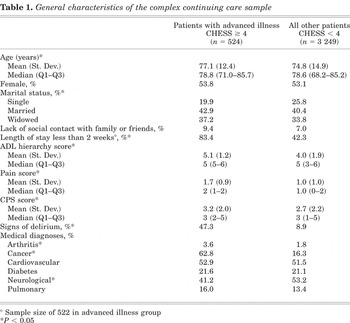
Of 3,801 patients, 552 scored 4 or greater on the CHESS scale (Table 1). Excluding comatose patients, a total of 524 were designated as having AI. Patients with AI showed moderate levels of cognitive impairment and high levels of physical impairment. The most common diagnoses were cancer, cardiovascular, and neurological conditions.
General characteristics of the complex continuing care sample

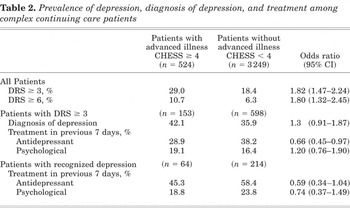
Table 2 shows the prevalence of depression, diagnosed depression, and treatment for depression by AI status. Patients identified as having an AI showed higher levels of depression compared to those patients not in a life-threatening stage of illness. Twenty-nine percent of patients with AI were depressed and nearly 11% were severely depressed (DRS ≥ 6).
Prevalence of depression, diagnosis of depression, and treatment among complex continuing care patients

Of depressed patients, only 42.1% had received a formal diagnosis. In the week prior to assessment less than 30% received antidepressants and less than 20% had been seen by a mental health professional. In patients with a diagnosis, the proportion who received antidepressants increased to 45% but the proportion seen by a mental health professional remained below 20%. Patients without AI were found to have a much lower prevalence of depression (18%) than those with AI, but the proportion of those with a formal diagnosis was comparable. Patients with AI also showed a higher prevalence of severe depression. The difference in prevalence remained when cognitive impairment was controlled for (not shown). A higher percentage of depressed patients without AI received antidepressants, but the difference did not persist when recognition was considered (Table 2).
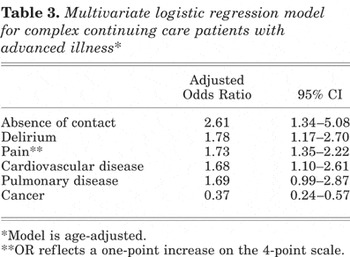
On average, depressed patients with AI were older (t value = −2.87; p = 0.004), reported less contact with family and friends (OR 2.16; 95% CI 1.2–3.9), and had been in hospital longer (t value = −3.26; p = 0.001) than non-depressed patients. Depressed patients also experienced greater pain (t value = −3.49; p < 0.001) and more delirium (OR 2.78; 95% CI 1.3–2.8). Of the diagnostic groups, cardiovascular (OR 2.1; 95% CI 1.4–3.1), neurological (OR 2.25; 95% CI 1.5–3.3), and pulmonary (OR 1.97; 95% CI 1.2–3.2) diseases were more common in depressed patients. Conversely, a diagnosis of cancer was less common among depressed patients (OR 0.34; 95% CI 0.2–0.5). An age adjusted multivariable model is presented in Table 3.
Multivariate logistic regression model for complex continuing care patients with advanced illness*

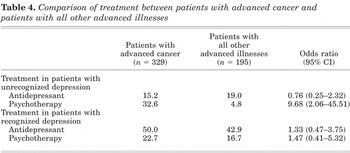
Comparison of treatment between patients with advanced cancer and patients with all other advanced illnesses

Focusing on Patients with Cancer
The strong negative association of cancer and depression prompted further investigation into how cancer patients differed from others in the same stage of illness. Comparison on baseline characteristics revealed that cancer patients were on average younger (t value = 5.78; p < 0.001) and had shorter lengths of stay (t value = 5.23; p < 0.001) than non-cancer patients. In addition, they were found to have higher cognitive functioning (t value 6.61; p < 0.001) but more pain (t value = −3.42; p < 0.001). A larger proportion of cancer patients were designated as being within the last 6 months of life (OR = 22.5; 95% CI 13.9–36.2) and were indicated as being in a hospice programme (OR = 14.5; 95% CI 9.0–23.2) than were non-cancer patients. As well, more cancer patients were seen by a mental health professional (OR = 2.7; 95% CI 1.6–4.4) and were seen by their doctor more often (t value = −2.4; p = 0.02; not shown in table) than non-cancer patients. When diagnosis of depression was considered, no statistically significant differences were found between patient groups with respect to psychotherapeutics, with one exception. Cancer patients without a diagnosis of depression were far more likely to have been seen by a mental health professional than their non-cancer counterparts (OR = 9.7; 95% CI 2.1–45.5).
DISCUSSION
Use of the CHESS scale allowed for identification of patients who clearly differed from the general population of continuing care patients. Patients with a score of 4 or more displayed clinical features consistent with end-of-life populations described in previous research (Bortz, 1990).
Nearly 30% of patients with AI were found to score 3 or more on the DRS, making them 1.8 times as likely as other complex continuing care patients to be depressed. The prevalence found in this study is consistent with other estimates of depressive disorders among terminally ill populations (Chochinov, 2000; Wilson et al., 2000; Hotopf et al., 2002). The consistency of these findings lends confidence to the use of the DRS in this population and the ability of the scale to detect depression without reliance on somatic symptoms. It suggests that the CHESS scale cut-off was adequately able to identify a group of patients who are clinically similar to those identified in primary research as approaching death.
Patients with AI were found to have nearly twice the prevalence of high-risk depression (DRS ≥ 6) as all other patients. These findings suggest that not only is depression more common as disease states progress towards death, but it also more severe. Therefore, patients with AI may also be at a greater risk for extreme changes in mood that could lead to suicidal ideation and requests for hastened death.
The finding that less than half of potentially depressed patients have a diagnosis of depression present suggests that there may be a problem of weak surveillance of psychiatric conditions in these facilities. These low levels of recognition may in part account for the alarmingly poor response to depression in this population. However, even in patients with a diagnosis of depression, fewer than half received antidepressants. Even more disconcerting is the almost complete lack of psychological services provided to depressed patients. Still, the small proportion of patients without AI who received psychological therapies suggests that this problem extends beyond the sickest of patients. This may, at least partly, be explained by the current Ontario funding scheme, which does not provide incentives for psychological services, particularly when nursing and other physical management services are in need.
Not surprising, both social isolation and pain were associated with an increased likelihood of depression. Both have been well studied in the literature, but the exact mechanism by which these associations operate is still not understood. The presence of at least one delirium trigger was found to nearly double the odds of depression. While no previous evidence could be found that described the association between delirium and depression, there is evidence to suggest that a change in cognitive function is associated with depression (Parmalee et al., 1992; Gallasi et al., 2001). All of the delirium triggers used in this study were described by a recent onset of disturbed behaviour, each of which would also be present in patients experiencing cognitive decline. The presence of delirium triggers and cognitive decline was far greater in patients with AI than those without. It is possible that decline, and not cognitive impairment itself, may explain the higher prevalence of depression found in patients with AI. Physical impairments as measured by the ADL Hierarchy Scale did not reach significance in this model, but this is not surprising considering the lack of variability found in scale scores. However, the presence of cardiovascular or pulmonary conditions were both associated with an increase in the odds of depression. These conditions have debilitating effects and have been shown elsewhere to have strong associations with depression (Hodges et al., 1998; Yohannes et al., 2000). While no clear explanations have been outlined for these associations, hypotheses having to do with increased disability, psychosocial consequences, and physical changes have been put forward (Clary et al., 2002; Harrington, 2002; Jiang et al., 2002; Krishnan et al., 2002).
Contrary to reports that the occurrence of depression is similar among patients with and without cancer (Krishnan et al., 2002), this study found that complex continuing care patients with cancer had a much lower prevalence of depression than others. In the multivariate analysis, patients with cancer were one-third as likely to be depressed as patients without cancer who were in similarly advanced disease states. Further investigation revealed that patients with and without cancer differed on a number of clinical and treatment factors. Patients with cancer were younger and in hospital for much shorter periods of time. Levels of physical impairment did not differ between groups, but those with cancer were significantly less cognitively impaired and showed less decline. Patients with cancer were over 20 times more likely to be designated as being within the last 6 months of life and 15 times more likely to receive hospice care than patients with other diagnoses. As well, over a course of 7 days, cancer patients were seen by physicians more often than non-cancer patients. Cancer patients were also more likely to receive antidepressants and to be seen by mental health professionals. Since those who received psychiatric services are still the minority, this difference in provision is not enough to explain why cancer patients presented with less depression. The greater use of hospice services, physician and mental health professional visits, and formal designation of end-stage status have likely led to care planning and provision more suited to meeting the specific needs of patients with AI. These patients likely received better management of physical symptoms and more social contact and support, ameliorating two of the major known risk factors for depression. This signifies the need for more comprehensive end-of-life services for all patients, regardless of their diagnosis.
References
REFERENCES
Anderson, D.N.
(2001).
Treating depression in old age: The reasons to be positive.
Age and Ageing,
30,
13–17.Google Scholar
Austin, M.P.,
Ross, M.,
Murray, C.,
et al.
(1992).
Cognitive function in major depression.
Journal of Affective Disorders,
25,
21–30.Google Scholar
Beck, D.A.,
Koenig, & H.G.,
Beck J.S.
(1998).
Depression.
Clinics in Geriatric Medicine,
14(4),
765–786.Google Scholar
Bortz, W.M.
(1990).
The trajectory of dying. Functional status in the last year of
life.
Journal of the American Geriatrics Society,
38,
1300–1306.Google Scholar
Brand, A.N.,
Jolles, J., &
Gispen-de Wied, C.
(1992).
Recall and recognition memory deficits in depression.
Journal of Affective Disorders,
25,
77–86.Google Scholar
Breitbart, W. &
Jacobsen, P.B.
(1996).
Psychiatric symptom management in terminal care.
Clinics in Geriatric Medicine,
12(2),
329–347.Google Scholar
Breitbart, W.,
Rosenfeld, B.,
Pessin, H.,
et al.
(2000).
Depression, hopelessness, and desire for hastened death in
terminally ill patients with cancer.
JAMA,
284(22),
2907–2911.Google Scholar
Bruce, M.L.
(2002).
Psychosocial risk factors for depression in late life.
Biological Psychiatry,
52(3),
175–184.Google Scholar
Burrows, A.B.,
Morris, J.N.,
Simon, S.E.,
et al.
(2000).
Development of a Minimum Data Set-based depression rating scale for
use in nursing homes.
Age and Ageing,
29,
165–172.Google Scholar
Cassel, C.K. &
Foley, K.M.
(1999).
Principles for care of patients at the end of life: An emerging
consensus among the specialties of medicine.
New York:
Millbank Memorial Fund.
Chochinov, H.M.
(2000).
Psychiatry and terminal illness.
Canadian Journal of Psychiatry,
45(2),
143–150.Google Scholar
Chochinov, H.M.,
Wilson, K.G.,
Enns, M.,
et al.
(1995).
Desire for death in the terminally ill.
American Journal of Psychiatry,
152(8),
1185–1191.Google Scholar
Clary, G.L.,
Palmer, S.M., &
Doraiswamy, M.
(2002).
Mood disorders and chronic obstructive pulmonary disease: Current
research and future needs.
Current Psychiatry Reports,
4,
213–221.Google Scholar
Dein, S.
(2000).
The management of psychological distress in terminal illness.
Primary Care Psychiatry,
6(3),
123–126.Google Scholar
Fries, B.E.,
Simon, S.E.,
Morris, J.N.,
et al.
(2001).
Pain in U.S. nursing homes: Validating a pain scale for the Minimum
Data Set.
The Gerontologist,
41(2),
173–179.Google Scholar
Gallasi, R.,
Morreale, A., &
Pagni, P.
(2001).
The relationship between depression and cognition.
Archives of Gerontology and Geriatrics,
S7,
163–171.Google Scholar
Ganzini, L.,
Smith, D.M.,
Fenn, D.S.,
et al.
(1997).
Depression and mortality in medically ill older adults.
JAGS,
45(3),
307–312.Google Scholar
Geerlings, S.W.,
Twisk, J.W.R.,
Beekman, A.T.F.,
et al.
(2002).
Longitudinal relationship between pain and depression in older
adults: Sex, age, and physical disability.
Social Psychiatry and Psychiatric Epidemiology,
37,
23–30.Google Scholar
Harrington, C.
(2002).
Depression in the medically ill.
Medicine and Health/Rhode Island,
85(9),
273–277.Google Scholar
Hodges, E.P.,
Mast, B.,
Lichtenberg, P.A.,
et al.
(1998).
Disease and depression in older medical patients.
Psychological Reports,
83,
1081–1082.Google Scholar
Hirdes, J.P.,
Fritjers, D.H., &
Teare, G.F.
(2003).
The MDS-CHESS scale: A new measure to predict mortality in
institutionalized older people.
Journal of the American Geriatrics Society,
51(1),
1–5.Google Scholar
Hirdes, J.P.,
Ikegami, N.,
Jónsson, P.V.,
et al.
(2000).
Cross-national comparisons of antidepressant use among
institutionalized older persons based on the Minimum Data Set
(MDS).
Canadian Journal on Ageing,
19(S2),
18–37.Google Scholar
Hooper, S.C.,
Vaughan, K.J.,
Tennant, C.C.,
et al.
(1997).
Preferences for voluntary euthanasia during major depression and
following improvement in an elderly population.
Australian Journal on Ageing,
16(1),
3–7.Google Scholar
Hotopf, M.,
Addington-Hall, J.,
Chidgey, J.,
et al.
(2002).
Depression in advanced disease: A systematic review. Part 1.
Prevalence and case findings.
Palliative Medicine,
16,
81–97.Google Scholar
Jiang, W.,
Krishnan, R.R.K., &
O'Connor, C.M.
(2002).
Depression and heart disease: Evidence of a link and its therapeutic
implications.
CNS Drugs,
16(2),
111–127.Google Scholar
Kinzbrunner, B.M.
(2002).
Predicting prognosis: How to decide when end-of-life care is
needed. In
20 Common Problems in End-of-Life,
Kinzbrunner, B.M.,
Weinreb, N.J. &
Policzer, J.S. (eds.),
New York:
McGraw Hill.
Knaus, W.A.,
Harrell Jr., F.E.,
Lynn, J.,
et al.
(1995).
The SUPPORT prognostic model: Objective estimates of survival for
seriously ill hospitalized adults.
Annals of Internal Medicine,
122(3),
191–203.Google Scholar
Krishnan, K.R.R.,
Delong, M.,
Kraemer, H.,
et al.
(2002).
Comorbidity of depression with other medical diseases in the
elderly.
Biological Psychiatry,
52,
559–588.Google Scholar
Kugaya, A.,
Akechi, T.,
Nakano, T.,
et al.
(1999).
Successful antidepressant treatment for five terminally ill cancer
patients with major depression, suicidal ideation and a desire for
hastened death.
Supportive Care in Cancer,
7,
432–436.Google Scholar
Lander, M.,
Wilson, K., &
Chochinov, H.M.
(2000).
Depression and the dying older patient.
Clinics in Geriatric Medicine,
16(2),
335–356.Google Scholar
Lloyd-Williams, M.,
Friedman, T., &
Rudd, N.
(1999).
A survey of antidepressant prescribing in the terminally ill.
Palliative Medicine,
13,
243–248.Google Scholar
Martin, A.C. &
Jackson, K.C.
(1999).
Depression in palliative care patients.
Journal of Pharmaceutical Care in Pain & Symptom Control,
7(4),
71–89.Google Scholar
Morris, J.N.,
Fries, B.E.,
Mehr, D.R.,
et al.
(1994).
MDS Cognitive Performance Scale.
Journal of Gerontology: Medical Sciences,
49(4),
M174–M182.Google Scholar
Morris, J.N.,
Fries, B.E., &
Morris, S.A.
(1999).
Scaling ADLs within the MDS.
Journal of Gerontology,
7,
34–40.Google Scholar
Newman, S.C. &
Hassan, A.I.
(1999).
Antidepressant use in the elderly population in Canada: Results from
a national survey.
Journal of Gerontology: Medical Sciences,
54A(10),
M527–M530.Google Scholar
Ostbye, T.,
Steenhuis, R.,
Walton, R.,
et al.
(2000).
Correlates of dysphoria in Canadian seniors: The Canadian Study of
Health and Ageing.
Canadian Journal of Public Health,
91(4),
313–317.Google Scholar
Parmalee, P.A.,
Katz, I.R., &
Lawton, M.P.
(1992).
Incidence of depression in long-term care settings.
Journal of Gerontology: Medical Sciences,
47(6),
M189–M196.Google Scholar
Stiefel, F.,
Die Trill, M.,
Berney, A.,
et al.
(2001).
Depression in palliative care: A pragmatic report for the Expert
Working Group of the European Association for Palliative Care.
Supportive Care in Cancer,
9,
477–488.Google Scholar
Suarez-Almazor, M.E.,
Newman, C.,
Hanson, J.,
et al.
(2002).
Attitudes of terminally ill cancer patients about euthanasia and
assisted suicide: Predominance of psychosocial determinants and beliefs
over symptom distress and subsequent survival.
Journal of Clinical Oncology,
20(8),
2134–2141.Google Scholar
Sutor, B.,
Rummans, T.A.,
Jowsey, S.G.,
et al.
(1998).
Major depression in medically ill patients.
Mayo Clinic Proceedings,
73,
329–337.Google Scholar
Wilson, K.G.,
Chochinov, H.M.,
de Faye, B.J.,
et al.
(2000).
Diagnosis and management of depression in palliative care.
In
Handbook of psychiatry in palliative medicine,
Chochinov, H.M. &
Breitbart, W. (eds.).
New York:
Oxford University Press.
Yohannes, A.M.,
Baldwin, R.C., &
Connolly, M.J.
(2000).
Mood disorders in elderly patients with chronic obstructive
pulmonary disease.
Reviews in Clinical Gerontology,
10,
193–202.Google Scholar
General characteristics of the complex continuing care sample
Prevalence of depression, diagnosis of depression, and treatment among complex continuing care patients
Multivariate logistic regression model for complex continuing care patients with advanced illness*
Comparison of treatment between patients with advanced cancer and patients with all other advanced illnesses
 You have
Access
- 19
- Cited by