


A generalization of the classical Manin–Mumford conjecture is the following theorem, which was proven by Raynaud [Reference RaynaudRay83a, Reference RaynaudRay83b] for abelian varieties, by Laurent [Reference LaurentLau84] for algebraic tori, and by Hindry [Reference HindryHin88] in general. We recall that a semiabelian variety  $G$ over a field
 $k$ is a connected smooth algebraic
 $k$-group that is the extension of an abelian variety by a torus.
Theorem 1. Let  $G$ be a semiabelian variety over
 $\overline{\mathbb{Q}}$ with torsion points
 $\text{Tor}(G)\subseteq G(\overline{\mathbb{Q}})$. For any algebraic subvariety
 $X$ of
 $G$, there are finitely many connected algebraic subgroups
 $G_{i}$ of
 $G$ and finitely many torsion points
 $x_{i}\in \text{Tor}(G)$ such that
 $\bigcup _{i=1}^{n}(G_{i}+x_{i})$ is the Zariski closure of
 $X\cap \text{Tor}(G)$.
More recently, another type of intersection in semiabelian varieties has been widely studied. These intersections are with algebraic subgroups instead of torsion points. Of course, investigating the intersection of  $X$ with a single such subgroup is a dreary task. However, very interesting phenomena appear when intersecting
 $X\subseteq G$ with the countable union
 $G^{[s]}$ of all algebraic subgroups having codimension
 ${\geqslant}s$ for some fixed integer
 $s$.
Since the pioneering work of Bombieri, Masser, and Zannier [Reference Bombieri, Masser and ZannierBMZ99] in this direction, two choices of  $s$ are of paramount importance. If
 $s=\dim (X)+1$, an algebraic subgroup
 $H\subset G$ of codimension
 ${\geqslant}s$ usually does not meet
 $X$ at all. The intersection
 $X\cap G^{[s]}$ may nevertheless be dense in the Zariski topology, even in generic cases. If
 $X$ is not contained in a proper algebraic subgroup of
 $G$, conjectures of Pink [Reference PinkPin05] and Zilber [Reference ZilberZil02] imply that this never happens. Such statements about ‘unlikely intersections’ are still unsettled problems, on which the reader finds a comprehensive overview in [Reference ZannierZan12]. This article treats the other important and related case where
 $s=\dim (X)$. In this case, a generic subgroup
 $H\subset G$ of codimension
 ${\geqslant}s$ intersects
 $X$ already in finitely many points, and
 $X\cap G^{[\dim (X)]}$ can be dense with respect to the Zariski topology of
 $X$. The gist of the bounded height conjecture (BHC) stated below is that the Weil height of the
 $\overline{\mathbb{Q}}$-points in
 $X\cap G^{[\dim (X)]}$ should be nevertheless bounded from above.
In order to state this conjecture, we have to introduce some additional notions to tackle also non-generic cases. A closed irreducible subvariety  $Y\subseteq G$ is called
 $s$-anomalous if there exists a connected algebraic subgroup
 $H\subseteq G$ satisfying
 $$\begin{eqnarray}\max \{0,s-\operatorname{codim}_{G}(H)\}<\dim (Y)\end{eqnarray}$$
and a point  $y\in Y(\overline{\mathbb{Q}})$ such that
 $Y\subseteq H+y$ (i.e.,
 $Y$ is contained in a translate of
 $H$). In this situation, we say that
 $Y$ is associated with
 $H$. By
 $X^{(s)}$ we mean the union of all positive dimensional closed irreducible
 $s$-anomalous subvarieties contained in
 $X$. It is a corollary of Kirby’s work [Reference KirbyKir09] that
 $X^{(s)}$ (respectively
 $X\setminus X^{(s)}$) is a Zariski closed (respectively Zariski open) subset of
 $X$ (cf. [Reference Chambert-Loir and Chambert-LoirCha12, Proposition 2.6]). In addition, a proof allowing to determine
 $X^{(s)}$ effectively was given by Bombieri, Masser, and Zannier [Reference Bombieri, Masser and ZannierBMZ07] for tori and carried over to abelian varieties by Rémond [Reference RémondRém09].
Now let  $G$ be a semiabelian variety over
 $\overline{\mathbb{Q}}$ and
 $X$ a closed irreducible subvariety of
 $G$. To be able to work with heights, we choose a compactification
 $\overline{G}$ of
 $G$ (i.e., an open immersion
 $G{\hookrightarrow}\overline{G}$ such that
 $\overline{G}$ is proper). Let
 $L$ be a line bundle on
 $\overline{G}$ of
 $G$. Finally, let
 $h_{L}:\overline{G}(\overline{\mathbb{Q}})\rightarrow \mathbb{R}$ be a Weil height associated with
 $L$. We can now state the following.
Bounded height conjecture (BHC). The height  $h_{L}$ is bounded from above on the set
 $(X\setminus X^{(\dim (X))})(\overline{\mathbb{Q}})\cap G^{[\dim (X)]}(\overline{\mathbb{Q}})$.
This conjecture was first proposed by Bombieri, Masser, and Zannier [Reference Bombieri, Masser and ZannierBMZ07] in the case where  $G$ is an algebraic torus. Even before this, they had provided a proof if
 $G$ is an algebraic torus and
 $X$ is a curve [Reference Bombieri, Masser and ZannierBMZ99]. The extension of their conjecture from tori to semiabelian varieties is merely formal and can be found in Habegger’s article [Reference HabeggerHab09a], where a proof of the BHC for abelian varieties is given. It is also envisaged in [Reference Chambert-Loir and Chambert-LoirCha12, Théorème 1.4]. This extension is in fact natural as semiabelian varieties have proven to be the right object for many standard conjectures in diophantine geometry (e.g., Manin–Mumford, Mordell–Lang, Bogomolov). In addition, they appear naturally as Jacobians of semistable curves (cf. [Reference Bosch, Lütkebohmert and RaynaudBLR90, Example 9.2.8]) like abelian varieties do for smooth curves so that they still retain a connection with the original study of rational points on curves. We also mention intermediate results in the direction of the BHC given by Bombieri, Masser, and Zannier [Reference Bombieri, Masser and ZannierBMZ08], Maurin [Reference MaurinMau08, Reference MaurinMau11], Viada [Reference ViadaVia03], and Zannier [Reference ZannierZan00]. Finally, let us indicate that the conjecture becomes quite generally false if
 $\dim (X)$ is replaced with any
 $s<\dim (X)$.
In parallel to his work on the BHC for abelian varieties, Habegger [Reference HabeggerHab09b] obtained a complete proof of the conjecture for tori. Regarding the general case of the BHC, no further progress was made since his two breakthrough articles [Reference HabeggerHab09a, Reference HabeggerHab09b]. In fact, several additional problems precluded further generalizations up to now. These problems originate from the ‘mixed’ nature of semiabelian varieties (i.e., the additional structures induced by the non-triviality of the extension constituting the semiabelian variety). The aim of this article is to solve these problems. Its main result, Theorem 2 below, yields the BHC in general. In line with [Reference HabeggerHab09a], we actually prove a stronger version of the BHC here. To announce it, we introduce certain ‘height cones’; for each subset  $\unicode[STIX]{x1D6F4}\subset G(\overline{\mathbb{Q}})$ and each real number
 $\unicode[STIX]{x1D700}>0$, we define such a height cone by setting
 $$\begin{eqnarray}C(\unicode[STIX]{x1D6F4},h_{L},\unicode[STIX]{x1D700})=\{x\in G(\overline{\mathbb{Q}})\mid \exists a\in \unicode[STIX]{x1D6F4},b\in G(\overline{\mathbb{Q}}):x=a+b~\text{and}~h_{L}(b)\leqslant \unicode[STIX]{x1D700}\max \{1,h_{L}(a)\}\}.\end{eqnarray}$$
Theorem 2. Let  $G$ be a semiabelian variety and
 $\overline{G}$ a compactification endowed with an ample line bundle
 $L$. Furthermore, let
 $X$ be a closed subvariety of
 $G$. In addition, assume that
 $G$,
 $\overline{G}$,
 $L$, and
 $X$ are defined over
 $\overline{\mathbb{Q}}$. Let
 $h_{L}$ be a Weil height associated with
 $L$. For each integer
 $s$, there exists some
 $\unicode[STIX]{x1D700}>0$ such that
 $h_{L}$ is bounded from above on
 $(X\setminus X^{(s)})(\overline{\mathbb{Q}})\cap C(G^{[s]}(\overline{\mathbb{Q}}),h_{L},\unicode[STIX]{x1D700})$.
The above Theorem 2 is proven in the course of § 7. We sketch the proof to compare our approach with the one of Habegger from [Reference HabeggerHab09a, Reference HabeggerHab09b]. However, not all new obstructions are yet present in this case (see § 8 and the more involved Example 32 in particular). Ignoring some preliminary reductions (§ 7.1), the proof consists of three major steps, which we outline successively in the following.
In the first step (§ 7.2), we pass from algebraic subgroups  $H$ to a family of
 $\mathbb{Q}$-line bundles parameterized by bounded subsets
 ${\mathcal{K}}$ in a (subcone of a) finite-dimensional
 $\mathbb{Q}$-vector space
 $V_{\mathbb{Q}}$. This means that with each point
 $\unicode[STIX]{x1D719}\in V_{\mathbb{Q}}$ is associated an element of
 $\text{Pic}_{\mathbb{Q}}(\overline{G}_{\unicode[STIX]{x1D719}})=\text{Pic}(\overline{G}_{\unicode[STIX]{x1D719}})\otimes _{\mathbb{Z}}\mathbb{Q}$ for some compactification
 $\overline{G}_{\unicode[STIX]{x1D719}}$ of
 $G$, which usually depends itself on
 $\unicode[STIX]{x1D719}$. Subsequently, we use the boundedness of
 ${\mathcal{K}}$ to approximate its members by finitely many
 $\mathbb{Q}$-line bundles on various compactifications of
 $G$ (Lemma 25). In order to reduce book-keeping to a minimum while still presenting the main new ideas, we let
 $E$ be an elliptic curve and assume for now that
 $G$ is the extension of
 $E^{2}$ by a 2-dimensional torus
 $\mathbb{G}_{m}^{2}$. Even more, we consider only 2-dimensional subgroups
 $H\subset G^{[2]}$ that are extensions of
 $E$ by a 1-dimensional torus
 $\mathbb{G}_{m}$.
To start with, we replace the subgroups  $H\subset G^{[2]}$ under consideration by their associated quotients
 $\unicode[STIX]{x1D70B}_{H}:G\rightarrow G^{\prime }=G/H$. A point
 $x\in G(\overline{\mathbb{Q}})$ lies on a subgroup
 $H$ if and only if it is contained in the kernel of
 $\unicode[STIX]{x1D70B}_{H}$. One can choose compactifications
 $\overline{G}$,
 $\overline{G}^{\prime }$ of
 $G$,
 $G^{\prime }$, an algebraic map
 $\overline{\unicode[STIX]{x1D70B}}_{H}:\overline{G}\rightarrow \overline{G}^{\prime }$ extending
 $\unicode[STIX]{x1D70B}_{H}$, and an ample line bundle
 $L^{\prime }$ on
 $\overline{G}^{\prime }$ such that
 $x\in \ker (\unicode[STIX]{x1D70B}_{H})$ implies
 $$\begin{eqnarray}\widehat{h}_{\overline{\unicode[STIX]{x1D70B}}_{H}^{\ast }L^{\prime }}(x)=0,\end{eqnarray}$$
where  $\widehat{h}_{\overline{\unicode[STIX]{x1D70B}}_{H}^{\ast }L^{\prime }}:G(\mathbb{Q})\rightarrow \mathbb{R}$ is the Néron–Tate height associated with the line bundle
 $\overline{\unicode[STIX]{x1D70B}}_{H}^{\ast }L^{\prime }$ (see § 3 for this notion).
Let us first consider exclusively the case where  $G$ is the trivial extension
 $\mathbb{G}_{m}^{2}\times E^{2}$. All quotients of
 $G$ are then likewise trivial extensions; this allows us to restrict to surjective homomorphisms
 $\unicode[STIX]{x1D711}:G\rightarrow G^{\prime }=\mathbb{G}_{m}\times E$. Any such homomorphism extends to an algebraic map
 $\overline{\unicode[STIX]{x1D711}}:G_{\overline{\unicode[STIX]{x1D6E4}(\unicode[STIX]{x1D711}_{\text{tor}})}}\rightarrow \overline{G}^{\prime }=\mathbb{P}^{1}\times E$ for some ‘graph’ compactification
 $G_{\overline{\unicode[STIX]{x1D6E4}(\unicode[STIX]{x1D711}_{\text{tor}})}}$ of
 $G$ (see Construction 7). Fixing once and for all an ample line bundle
 $L^{\prime }$ on
 $\overline{G}$, each
 $\unicode[STIX]{x1D711}\in V=\operatorname{Hom}(G,G^{\prime })$ yields a line bundle
 $\overline{\unicode[STIX]{x1D711}}^{\ast }L^{\prime }\in \text{Pic}(G_{\overline{\unicode[STIX]{x1D6E4}(\unicode[STIX]{x1D711}_{\text{tor}})}})$. Homogeneity allows us to associate also a
 $\mathbb{Q}$-line bundle
 $\overline{\unicode[STIX]{x1D719}}^{\ast }L^{\prime }$ with each quasi-homomorphism
 $$\begin{eqnarray}\displaystyle \unicode[STIX]{x1D719}\in V_{\mathbb{Q}}=\operatorname{Hom}_{\mathbb{Q}}(G,G^{\prime })=\operatorname{Hom}(G,G^{\prime })\otimes _{\mathbb{Z}}\mathbb{Q}; & & \displaystyle \nonumber\end{eqnarray}$$
to be precise, we have  $\overline{\unicode[STIX]{x1D719}}^{\ast }L^{\prime }\in \text{Pic}_{\mathbb{Q}}(G_{\overline{\unicode[STIX]{x1D6E4}(n\cdot \unicode[STIX]{x1D719}_{\text{tor}})}})=\text{Pic}(G_{\overline{\unicode[STIX]{x1D6E4}(n\cdot \unicode[STIX]{x1D719}_{\text{tor}})}})\otimes _{\mathbb{Z}}\mathbb{Q}$ with
 $n$ being a denominator of
 $\unicode[STIX]{x1D711}$ (i.e.,
 $n$ is an integer such that
 $n\cdot \unicode[STIX]{x1D719}\in \operatorname{Hom}(G,G^{\prime })$). In this way, we obtain a
 $\mathbb{Q}$-line bundle for each point of
 $V$. Let
 $V^{\circ }\subset V$ be the subset of ‘surjective’ quasi-homomorphisms (i.e., those elements
 $\unicode[STIX]{x1D719}\in \operatorname{Hom}_{\mathbb{Q}}(G,G^{\prime })$ for which there exists an integer
 $n\geqslant 1$ such that
 $n\cdot \unicode[STIX]{x1D719}$ is a surjective homomorphism
 $G\rightarrow G^{\prime }$).
For our purposes, some manipulation of homomorphisms (cf. Lemma 24) allows us to further restrict to a bounded subset  ${\mathcal{K}}\subset V^{\circ }$ such that the distance between
 ${\mathcal{K}}$ and
 $V\setminus V^{\circ }$ (with respect to any linear norm on
 $V$) is strictly positive. This allows us to eventually arrange for the following assertion, which corresponds to our Lemmas 25 and 26: for each
 $\unicode[STIX]{x1D6FF}>0$, there exist finitely many ‘surjective’ quasi-homomorphisms
 $\unicode[STIX]{x1D719}_{1},\ldots ,\unicode[STIX]{x1D719}_{K}\in V^{\circ }$ and a constant
 $c(\unicode[STIX]{x1D6FF})>0$ such that, for every
 $x\in H\subset G^{[2]}(\overline{\mathbb{Q}})$ with
 $H$ as above, we have
 $$\begin{eqnarray}\widehat{h}_{(\overline{\unicode[STIX]{x1D719}}_{k})^{\ast }L^{\prime }}(x)\leqslant \unicode[STIX]{x1D6FF}\widehat{h}_{L}(x)+c(\unicode[STIX]{x1D6FF})\end{eqnarray}$$
for some  $k\in \{1,\ldots ,K\}$. Comparing this inequality with (3), we notice that passing to a finite family of
 $\mathbb{Q}$-line bundles worsens the bound but that the dependence on
 $\widehat{h}_{L}(x)$ can be curbed by choosing
 $\unicode[STIX]{x1D6FF}$ sufficiently small. So far, this is just Habegger’s argument as in [Reference HabeggerHab09a, Reference HabeggerHab09b], although the focus in his work is more on
 $\operatorname{Hom}_{\mathbb{Q}}(G,G^{\prime })$ than on the associated
 $\mathbb{Q}$-line bundles on compactifications of
 $G$.
Every split semiabelian variety can be essentially treated in this way, relying solely on quasi-homomorphisms. For general extensions  $G\in \text{Ext}^{1}(E^{2},\mathbb{G}_{m}^{2})$, however, a shift to
 $\mathbb{Q}$-line bundles instead of quasi-homomorphism becomes essential. Indeed, the quotients of such a semiabelian variety
 $G$ regularly fall into infinitely many different isogeny classes; compare the footnote on p. 1436 for the simpler case
 $\text{Ext}^{1}(E,\mathbb{G}_{m}^{2})$. This means that a basic premise of Habegger’s approach is not satisfied for general extensions. In fact, repeating the above procedure does not lead to finitely many line bundles. Consequently, it does not yield an inequality like (4) with a uniform constant
 $c(\unicode[STIX]{x1D6FF})$. To circumvent this problem, we define suitable
 $\mathbb{Q}$-line bundles directly on
 $G$. These should generalize pullbacks of line bundles along quasi-homomorphisms.
There are some indications on how to write down such line bundles. First, it is a well-known fact that a homomorphism  $\unicode[STIX]{x1D711}$ between semiabelian varieties is describable in terms of the induced homomorphism
 $\unicode[STIX]{x1D711}_{\text{tor}}$ between their maximal subtori and the induced homomorphism
 $\unicode[STIX]{x1D711}_{\text{ab}}$ between their underlying abelian varieties (see Lemma 1). In the situation above, it is hence natural to consider a family of
 $\mathbb{Q}$-line bundles parameterized by the
 $\mathbb{Q}$-vector space
 $$\begin{eqnarray}\displaystyle V_{\mathbb{Q}}=\operatorname{Hom}_{\mathbb{Q}}(\mathbb{G}_{m}^{2},\mathbb{G}_{m})\times \operatorname{Hom}_{\mathbb{Q}}(E^{2},E), & & \displaystyle \nonumber\end{eqnarray}$$
though not every pair  $(\unicode[STIX]{x1D719}_{\text{tor}},\unicode[STIX]{x1D719}_{\text{ab}})\in V$ comes from an actual quasi-homomorphism between semiabelian varieties. Second, a result of Knop and Lange [Reference Knop and LangeKL85, Theorem 2.1] states that linearized line bundles on compactifications of
 $G$ retain a ‘product-like’ shape even if
 $G$ is a non-trivial extension and there is no section
 $G\rightarrow \mathbb{G}_{m}^{2}$ of the inclusion
 $\mathbb{G}_{m}^{2}{\hookrightarrow}G$.
The already mentioned results of § 2 (especially Construction 6) allow us to define for each  $(\unicode[STIX]{x1D711}_{\text{tor}},\unicode[STIX]{x1D711}_{\text{ab}})$ in
 $$\begin{eqnarray}\displaystyle V=\operatorname{Hom}(\mathbb{G}_{m}^{2},\mathbb{G}_{m})\times \operatorname{Hom}(E^{2},E) & & \displaystyle \nonumber\end{eqnarray}$$
a compactification  $G_{\overline{\unicode[STIX]{x1D6E4}(\unicode[STIX]{x1D711}_{\text{tor}})}}$ of
 $G$, which only depends on (the graph of)
 $\unicode[STIX]{x1D711}_{\text{tor}}:\mathbb{G}_{m}^{2}\rightarrow \mathbb{G}_{m}$, and a
 $\mathbb{Q}$-line bundle
 $L_{(\unicode[STIX]{x1D711}_{\text{tor}},\unicode[STIX]{x1D711}_{\text{ab}})}$ on
 $G_{\overline{\unicode[STIX]{x1D6E4}(\unicode[STIX]{x1D711}_{\text{tor}})}}$. For each homomorphism
 $\unicode[STIX]{x1D711}:G\rightarrow G^{\prime }$ with restriction
 $\unicode[STIX]{x1D711}_{\text{tor}}:\mathbb{G}_{m}^{2}\rightarrow \mathbb{G}_{m}$ to maximal subtori, there furthermore exists an extension
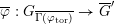 $\overline{\unicode[STIX]{x1D711}}:G_{\overline{\unicode[STIX]{x1D6E4}(\unicode[STIX]{x1D711}_{\text{tor}})}}\rightarrow \overline{G}^{\prime }$ such that
 $\overline{\unicode[STIX]{x1D711}}^{\ast }L^{\prime }=L_{(\unicode[STIX]{x1D711}_{\text{tor}},\unicode[STIX]{x1D711}_{\text{ab}})}$ for some ample line bundle
 $L^{\prime }$ on
 $\overline{G}^{\prime }$. The line bundles
 $L_{(\unicode[STIX]{x1D711}_{\text{tor}},\unicode[STIX]{x1D711}_{\text{ab}})}$ play a prominent role in our proof, generalizing the pullbacks
 $\overline{\unicode[STIX]{x1D711}}^{\ast }L^{\prime }$ from the split case
 $G=\mathbb{G}_{m}^{2}\times E^{2}$. Surprisingly, there is neither need for a homomorphism
 $\unicode[STIX]{x1D711}:G\rightarrow G^{\prime }$ nor for a semiabelian variety
 $G^{\prime }$ to define them. Naturally, some checking is necessary to guarantee that they simulate pullbacks along homomorphisms sufficiently well (see, e.g., Lemmas 10, 11, and 12).
For the next two steps of the proof, we can revert to the general case of Theorem 2. In the second step of the proof (§ 7.3), we establish two concurring height bounds similar to [Reference HabeggerHab09a, Reference HabeggerHab09b]. However, the non-homogeneity of the canonical height on semiabelian varieties, which decomposes into a linear and a quadratic part, is yet another problem. A sensible choice of line bundles is needed to counterbalance this in the height estimates (cf. the proof of Lemma 26). The first of the two said height bounds is similar to (4). The second opposing height bound is a consequence of Siu’s numerical bigness criterion [Reference SiuSiu93, Corollary 1.2]. To apply Siu’s criterion, we need to estimate two types of intersection numbers related to the line bundles  $L_{(\unicode[STIX]{x1D711}_{\text{tor}},\unicode[STIX]{x1D711}_{\text{ab}})}$ and the Zariski closure of
 $X$ in
 $G_{\overline{\unicode[STIX]{x1D6E4}(\unicode[STIX]{x1D711}_{\text{tor}})}}$ (Lemma 28). Subject to sufficiently strong estimates on these intersection numbers (as stated in Lemmas 29 and 30), we already finish the proof of Theorem 2 at this point by combining the two opposite height bounds.
In the third and last step of our proof (§ 7.4), we estimate these intersection numbers. Homogeneity, or the lack hereof, is once again an issue. Serious difficulties seem to arise when trying to obtain lower bounds on intersection numbers by counting torsion points as in [Reference HabeggerHab09a, Reference HabeggerHab09b]. Although some technical tools such as [Reference HabeggerHab09a, Proposition 3] were already written up more generally than strictly necessary in order to foster future generalizations, it is not clear whether this can be done at all. Therefore, we provide an alternative to this argument (Lemma 29) based on hermitian differential geometry (see also §§ 4 and 6 for details). In fact, this alternative is strikingly simple in the special case of abelian varieties treated in [Reference HabeggerHab09a]. We obtain the sought-after lower bounds on intersection numbers by integrating appropriately chosen  $(1,1)$-forms. These
 $(1,1)$-forms are defined in § 5 as real interpolations of Chern forms associated with specific hermitian metrics on the line bundles
 $L_{(\unicode[STIX]{x1D711}_{\text{tor}},\unicode[STIX]{x1D711}_{\text{ab}})}$. On the level of
 $(1,1)$-forms, balancing the different homogeneities of the ‘toric’ and ‘abelian’ contributions is an easy task (see, e.g., our definition (66)).
Whereas the definition of the used  $(1,1)$-forms and the verification of their basic properties is almost trivial for abelian varieties (§ 5.2), tori and hence general semiabelian varieties demand considerably more work (§ 5.1). The reason for this is that any invariant hermitian metric on the line bundles under consideration is merely continuous and leads to a singular Chern current supported on the maximal compact subgroup
 $K_{G}\subseteq G(\mathbb{C})$ (see, e.g., [Reference Chambert-LoirCha00, Lemme 6.3]). A singular Chern current being detrimental for the application of Ax’s theorem [Reference AxAx72] in § 6, we have to work with a less natural non-invariant hermitian metric instead. For the Chern forms associated to such a metric, establishing some natural properties is a non-trivial task; the reader may compare the proof of Lemma 17 with the evident relation (39).
It should be mentioned that Chern forms were also used by Maurin [Reference MaurinMau11], Rémond [Reference RémondRém09], and Vojta [Reference VojtaVoj96] to control intersection numbers appearing in diophantine geometry. In particular, both [Reference MaurinMau11], in the case of tori, and [Reference VojtaVoj96], in the case of semiabelian varieties, endow line bundles with non-invariant hermitian metrics. Apart from this, it seems that the overlap of their work with our §§ 5 and 6 is rather narrow. It is nevertheless noteworthy that Ax’s theorem plays an essential role here as it does in the work of Habegger [Reference HabeggerHab09a, Reference HabeggerHab09b] and Rémond [Reference RémondRém09]. In contrast to Lemma 29, our proof of the supplementary upper bounds on intersection numbers in Lemma 30 uses algebraic intersection theory [Reference FultonFul98] to avoid problems stemming from the non-compactness of  $G$.
Finally, it should be mentioned that a previous announcement [Reference KühneKüh16] stated a non-optimal version of the first step in the proof of Theorem 2. This included a non-effective compactness argument [Reference KühneKüh16, Lemma 2], which is replaced here by the simpler Lemma 25. The improvement is due to the systematic avoidance of quasi-homomorphisms. Related to this is our § 8. Not being logically necessary for the main proof, it illustrates why a direct use of quasi-homomorphisms as in [Reference HabeggerHab09a, Reference HabeggerHab09b] proves difficult. Quintessentially, the surjective quasi-homomorphisms from a fixed semiabelian variety  $G$ to other semiabelian varieties are more or less parameterized by the
 $\mathbb{Q}$-points of certain algebraic varieties (Theorem 3). However, these varieties are generally rather complicated. This is in stark contrast to the special cases of both tori and abelian varieties, where they are just affine linear spaces. Since the set of quotients, or dually the set of algebraic subgroups, of a fixed semiabelian variety
 $G$ is interesting in various situations beyond the results of this article (e.g., in the Manin–Mumford conjecture or more generally in the Zilber–Pink conjectures), adding these findings here seemed beneficial to further investigations. To my knowledge, neither a statement like Theorem 3 nor an explicit non-rational counterexample as in Example 32 is mentioned anywhere, or even hinted at, in the literature so far.
It may well be that the general framework of our method (i.e., the use of bounded families of  $\mathbb{Q}$-line bundles in combination with real interpolations of Chern forms) gives also some leeway in problems where no group structure is present.
Notation and conventions
Algebraic geometry (general). Denote by  $k$ an arbitrary field. By a
 $k$-variety, we mean a reduced scheme of finite type over
 $k$. By a subvariety of a
 $k$-variety we mean a closed reduced subscheme. Note that a subvariety is determined by its underlying topological space and we frequently identify both. The tangent bundle of a
 $k$-variety
 $X$ is written
 $TX$ and its fiber over a point
 $x\in X(k)$ is denoted by
 $T_{x}X$. Furthermore,
 $X^{\text{sm}}$ denotes the smooth locus of
 $X$.
Meromorphic functions. For every  $k$-variety
 $X$, we write
 ${\mathcal{K}}_{X}$ for the sheaf of its meromorphic functions (cf. [Reference LiuLiu02, Definition 7.1.13]). With each meromorphic function
 $f\in \unicode[STIX]{x1D6E4}(X,{\mathcal{K}}_{X})$, we associate the complement
 $D(f)$ of its zero set (i.e., those points
 $x\in X$ such that
 $f_{x}\notin \mathfrak{m}_{x}{\mathcal{O}}_{X,x}$).
Products and projections. For any product  $Y_{1}\times _{k}\cdots \times _{k}Y_{m}$ of algebraic varieties, we write
 $\operatorname{pr}_{i}$ (
 $i=1,\ldots ,m$) for the projection
 $Y_{1}\times _{k}\cdots \times _{k}Y_{m}\rightarrow Y_{i}$ without further specification of the varieties
 $Y_{i}$. This leads to multiple different usages of the same notation
 $\operatorname{pr}_{i}$, sometimes close to each other. However, this should cause confusion nowhere if context is taken into account.
Algebraic groups. An algebraic  $k$-group is a group scheme of finite type over
 $\text{Spec}(k)$. We refer to [SGA3, Exposé
 $\text{VI}_{A}$] for the basic properties of algebraic
 $k$-groups. An algebraic
 $k$-subgroup of an algebraic
 $k$-group
 $G$ is a
 $k$-subscheme
 $H$ such that the group law of
 $G$ induces a group law on
 $H$. Note that
 $H$ is necessarily Zariski closed in
 $G$ [SGA3, Corollaire
 $\text{VI}_{A}.0.5.2$] and of finite type over
 $\text{Spec}(k)$. Left-multiplication by an element
 $g\in G(k)$ is written
 $l_{g}:G\rightarrow G$. More generally, we use the same notation
 $l_{g}$ for the left-multiplication with respect to an action
 $G\times X\rightarrow X$.
A split  $k$-torus is an algebraic
 $k$-group that is isomorphic to some direct product of copies of multiplicative groups
 $\mathbb{G}_{m}$. A
 $k$-torus is an algebraic group
 $G$ such that its base change
 $G_{k^{\text{sep}}}$ to the separable closure
 $k^{\text{sep}}$ of
 $k$ is a split torus. A linear
 $k$-algebraic group is an algebraic
 $k$-group whose underlying scheme is both affine and connected.
For fixed algebraic  $k$-groups
 $G_{1}$ and
 $G_{3}$, the isomorphism classes of Yoneda extensions

form an abelian group  $\operatorname{Ext}_{k}^{1}(G_{1},G_{3})$ with respect to Baer summation (cf. [Reference OortOor66, § I.3]).
We write  $[n]_{G}$ for the multiplication-by-
 $n$ map on any commutative algebraic group
 $G$. The notation
 $\cdot _{G}:G\times G\rightarrow G$ is used for the group law of
 $G$ and
 $e_{G}:k\rightarrow G$ denotes the identity of
 $G$. We omit the reference to
 $G$ in these notations when this group can be inferred from context. We write
 $A^{\vee }$ for the dual abelian variety associated with an abelian variety
 $A$. Pulling back line bundles along a homomorphism
 $\unicode[STIX]{x1D711}:A\rightarrow B$ induces a homomorphism
 $\unicode[STIX]{x1D711}^{\vee }:B^{\vee }\rightarrow A^{\vee }$ of the associated dual abelian varieties.
Line bundles and linearizations. Line bundles are denoted by capital italic letters  $L,M,\ldots \,$ whereas the corresponding calligraphic letters
 ${\mathcal{L}},{\mathcal{M}},\ldots \,$ are reserved for the invertible sheaves formed by their sections. The line bundle dual to
 $L$ is written
 $L^{\vee }$. In the situation where we have an algebraic group
 $G$ acting on a scheme
 $X$, we use Mumford’s definition of
 $G$-linearization [Reference Mumford, Fogarty and KirwanMFK94, Definition 1.6] for general
 ${\mathcal{O}}_{X}$-modules. For an invertible sheaf
 ${\mathcal{L}}$ on
 $X$, a
 $G$-linearization corresponds to an action
 $\unicode[STIX]{x1D71A}:G\times L\rightarrow L$ such that the projection
 $L\rightarrow X$ is
 $G$-equivariant. We refer to [Reference Mumford, Fogarty and KirwanMFK94, § 1.3] for details. Given a
 $G$-linearized line bundle
 $(L,\unicode[STIX]{x1D71A})$ we write
 $(L,\unicode[STIX]{x1D71A})^{\otimes n}$ for the line bundle
 $L^{\otimes n}$ with the
 $T$-linearization induced by
 $\unicode[STIX]{x1D71A}$. If
 $\unicode[STIX]{x1D711}:H\rightarrow G$ is a homomorphism from another algebraic group
 $H$,
 $Y$ a scheme with
 $H$-action and
 $f:Y\rightarrow X$ a
 $\unicode[STIX]{x1D711}$-equivariant algebraic map, we write
 $f^{\ast }(L,\unicode[STIX]{x1D71A})$ for the line bundle
 $f^{\ast }L$ with the induced
 $H$-linearization. For a
 $G$-equivariant closed immersion
 $\unicode[STIX]{x1D704}:Y{\hookrightarrow}X$, we also write
 $(L,\unicode[STIX]{x1D71A})|_{Y}$ instead of
 $\unicode[STIX]{x1D704}^{\ast }(L,\unicode[STIX]{x1D71A})$.
Chern classes. With a line bundle  $L$ on a projective variety, we associate a first Chern class
 $c_{1}(L)$ in the sense of [Reference FultonFul98]; we refer the reader to there for an exposition on the basic properties of Chern classes and the basic intersection theory we are using. We denote by
 $[X]$ the
 $k$-cycle class associated with an irreducible algebraic variety
 $X$ of dimension
 $k$ (in some ambient projective variety).
Complex points and analytifications. Throughout this article, we choose once and for all an embedding  $\overline{\mathbb{Q}}{\hookrightarrow}\mathbb{C}$. For every
 $\overline{\mathbb{Q}}$-variety
 $X$, we consider its complex points
 $X(\mathbb{C})$ as a complex (analytic) space (see [GPR94] for this notion), the analytification of
 $X$. By our above convention on varieties,
 $X(\mathbb{C})$ is in fact reduced.
Complex spaces, differential forms, and currents. Let  $S$ be a reduced complex (analytic) space. Recall that this means that
 $S$ is locally biholomorphic to a closed analytic subvariety
 $V$ in a complex domain
 $U\subset \mathbb{C}^{n}$. A function
 $f$ on
 $S$ is smooth (respectively holomorphic, meromorphic) if, for each such sufficiently small local chart, it is the restriction of a smooth (respectively holomorphic, meromorphic) function on
 $U$. In the same way, we use local charts to define plurisubharmonic functions on
 $S$ as restrictions.
Similarly, a smooth differential form  $\unicode[STIX]{x1D714}$ on
 $S$ is a differential form on the smooth locus
 $S^{\text{sm}}$ of
 $S$ with the following additional property:
 $S$ can be covered by local charts
 $V\subset U\subset \mathbb{C}^{n}$ as above such that for each such chart the differential form
 $\unicode[STIX]{x1D714}|_{V^{\text{sm}}}$ is the restriction of a smooth differential form on
 $U$. There are also well-defined linear operators
 $d$ and
 $d^{c}=i/2\unicode[STIX]{x1D70B}(\overline{\unicode[STIX]{x2202}}-\unicode[STIX]{x2202})$ on the smooth differential forms on
 $S$. For each local chart
 $V\subset U\subset \mathbb{C}^{n}$, these are simply the restrictions of the operators of the same name on
 $\mathbb{C}^{n}$. A differential form
 $\unicode[STIX]{x1D714}$ on
 $S$ is called closed (respectively exact) if
 $d\unicode[STIX]{x1D714}=0$ (respectively there exists a differential form
 $\unicode[STIX]{x1D714}^{\prime }$ on
 $S$ such that
 $d\unicode[STIX]{x1D714}^{\prime }=\unicode[STIX]{x1D714}$). Recall that, by a classical result of Lelong [Reference LelongLel57], we can locally integrate smooth differential forms of maximal degree on complex spaces.
A line bundle  $L$ over
 $S$ is a complex analytic space over
 $S$ such that
 $S$ can be covered by open subsets
 $U$ with
 $L|_{U}=U\times \mathbb{C}$. A smooth hermitian metric on
 $L$ is a smooth (in the above sense) function
 $\Vert \cdot \Vert :L\rightarrow \mathbb{R}$ whose restriction to each fiber over
 $S$ is a hermitian metric. With such a metric, we can define a Chern form
 $c_{1}(L,\Vert \cdot \Vert )$ in the usual way; if
 $\mathbf{s}:U\rightarrow L$ is a non-zero holomorphic section over some open subset
 $U\subset S$, we set
 $c_{1}(L,\Vert \cdot \Vert )|_{U}=dd^{c}(-\log \Vert \mathbf{s}\Vert )$. This construction yields a smooth differential form
 $c_{1}(L,\Vert \cdot \Vert )$ on
 $S$.
1 Preliminaries on semiabelian varieties
1.1 Basics
Recall that a semiabelian variety  $G$ over
 $k$ is a connected smooth algebraic
 $k$-group that is the extension

of an abelian variety  $A$ by a torus
 $T$. Any homomorphism from a smooth linear algebraic group to an abelian variety is the zero homomorphism (see, e.g., [Reference ConradCon02, Lemma 2.3]). Therefore, any smooth linear algebraic subgroup of
 $G$ must be contained in
 $T$. It follows that
 $T$ is the maximal smooth linear algebraic subgroup of
 $G$. We hence call
 $T$the toric part of
 $G$ and
 $G\rightarrow G/T=A$ (or just
 $A$) the abelian quotient of
 $G$. For a semiabelian variety
 $G$ over
 $k$, we write
 $\unicode[STIX]{x1D702}_{G}$ for the Yoneda extension class in
 $\operatorname{Ext}_{k}^{1}(A,T)$ described by (
). Each homomorphism  $\unicode[STIX]{x1D711}:A\rightarrow B$ (respectively
 $\unicode[STIX]{x1D711}:T\rightarrow S$) of abelian varieties (respectively tori) induces a pullback
 $\unicode[STIX]{x1D711}^{\ast }:\operatorname{Ext}_{k}^{1}(B,T)\rightarrow \operatorname{Ext}_{k}^{1}(A,T)$ (respectively a pushforward
 $\unicode[STIX]{x1D711}_{\ast }:\operatorname{Ext}_{k}^{1}(A,T)\rightarrow \operatorname{Ext}_{k}^{1}(A,S)$).
The Weil–Barsotti formula (see [Reference OortOor66, § III.18] or the appendix to [Reference Moret-Bailly and SzpiroMor81]) gives a canonical identification  $\operatorname{Ext}_{k}^{1}(A,\mathbb{G}_{m})=A^{\vee }(k)$. If
 $T$ is split (i.e.,
 $T=\mathbb{G}_{m}^{t}$) we make frequent use of the identify
 $\operatorname{Ext}_{k}^{1}(A,\mathbb{G}_{m}^{t})=\operatorname{Ext}_{k}^{1}(A,\mathbb{G}_{m})^{t}=(A^{\vee })^{t}(k)$. The pullback
 $$\begin{eqnarray}\unicode[STIX]{x1D711}^{\ast \!}:\operatorname{Ext}_{k}^{1}(B,\mathbb{G}_{m}^{t})\longrightarrow \operatorname{Ext}_{k}^{1}(A,\mathbb{G}_{m}^{t})\end{eqnarray}$$
along a homomorphism  $\unicode[STIX]{x1D711}:A\rightarrow B$ corresponds to the
 $t$-fold product
 $\unicode[STIX]{x1D711}^{\vee }\times \cdots \times \unicode[STIX]{x1D711}^{\vee }$ of the dual morphism
 $\unicode[STIX]{x1D711}^{\vee }:B^{\vee }\rightarrow A^{\vee }$. Pushforwards also allow a simple description. Indeed, let
 $\unicode[STIX]{x1D711}:\mathbb{G}_{m}^{t}\rightarrow \mathbb{G}_{m}^{t^{\prime }}$ be the homomorphism described by
 $\unicode[STIX]{x1D711}^{\ast }(Y_{v})=\prod _{u=1}^{t}X_{u}^{a_{uv}}$ in standard coordinates
 $X_{1},\ldots ,X_{t}$ (respectively
 $Y_{1},\ldots ,Y_{t_{2}}$) on
 $\mathbb{G}_{m}^{t}$ (respectively
 $\mathbb{G}_{m}^{t^{\prime }}$). Then, the pushforward
 $$\begin{eqnarray}\unicode[STIX]{x1D711}_{\ast }:\operatorname{Ext}_{k}^{1}(A,\mathbb{G}_{m}^{t})\longrightarrow \operatorname{Ext}_{k}^{1}(A,\mathbb{G}_{m}^{t^{\prime }})\end{eqnarray}$$
corresponds to the homomorphism  $(A^{\vee })^{t}\rightarrow (A^{\vee })^{t^{\prime }}$ sending
 $(\unicode[STIX]{x1D702}_{1},\ldots ,\unicode[STIX]{x1D702}_{t})$ to
 $(\sum _{u=1}^{t}a_{uv}\unicode[STIX]{x1D702}_{u})_{1\leqslant v\leqslant t^{\prime }}$.
As for abelian varieties, one calls two semiabelian varieties  $G,G^{\prime }$ isogeneous if there exists an isogeny
 $G\rightarrow G^{\prime }$ (i.e., a surjective homomorphism
 $G\rightarrow G^{\prime }$ with finite kernel). Evidently, the multiplication-by-
 $n$ homomorphism
 $[n]$ of a semiabelian variety is an isogeny. As for abelian varieties, this yields an equivalence relation on semiabelian varieties.
Finally, we note that quotients as well as smooth algebraic subgroups of a semiabelian variety are themselves semiabelian varieties (cf. [Reference BrionBri17, Corollary 5.4.6]). In particular, the algebraic subgroups appearing in Theorem 2 are all semiabelian varieties because a well-known result of Cartier [SGA3, Corollaire  $\text{VI}_{B}.1.6.1$] states that all algebraic
 $k$-groups are smooth if
 $k$ has characteristic 0.
1.2 Homomorphisms and quasi-homomorphisms
We recall the fundamental result on homomorphisms between semiabelian varieties.
Lemma 1. Let  $G$ (respectively
 $G^{\prime }$) be a semiabelian variety over
 $k$ such that
 $A$ (respectively
 $A^{\prime }$) is the abelian quotient and
 $T$ (respectively
 $T^{\prime }$) is the toric part of
 $G$ (respectively
 $G^{\prime }$). For any homomorphism
 $\unicode[STIX]{x1D711}:G\rightarrow G^{\prime }$ there exist unique homomorphisms
 $\unicode[STIX]{x1D711}_{\text{tor}}:T\rightarrow T^{\prime }$ and
 $\unicode[STIX]{x1D711}_{\text{ab}}:A\rightarrow A^{\prime }$ such that

is a homomorphism of exact sequences. Furthermore, the induced map
 $$\begin{eqnarray}\operatorname{Hom}(G,G^{\prime })\longrightarrow \operatorname{Hom}(T,T^{\prime })\times \operatorname{Hom}(A,A^{\prime }),\quad \unicode[STIX]{x1D711}\longmapsto (\unicode[STIX]{x1D711}_{\text{tor}},\unicode[STIX]{x1D711}_{\text{ab}}),\end{eqnarray}$$
is an injective homomorphism with image
 $$\begin{eqnarray}\{(\unicode[STIX]{x1D711}_{\text{tor}},\unicode[STIX]{x1D711}_{\text{ab}})\in \operatorname{Hom}(T,T^{\prime })\times \operatorname{Hom}(A,A^{\prime })\mid (\unicode[STIX]{x1D711}_{\text{tor}})_{\ast }\unicode[STIX]{x1D702}_{G}=(\unicode[STIX]{x1D711}_{a})^{\ast }\unicode[STIX]{x1D702}_{G^{\prime }}~\text{in}~\operatorname{Ext}_{k}^{1}(A,T^{\prime })\}.\end{eqnarray}$$
This lemma is well-known in the literature (see e.g. [Reference BertrandBer82] or [Reference VillarealVil08]). In fact, the existence of a pair  $(\unicode[STIX]{x1D711}_{\text{ab}},\unicode[STIX]{x1D711}_{\text{tor}})$ follows directly from the fact that any map from a smooth linear algebraic group to an abelian variety is zero [Reference ConradCon02, Lemma 2.3] and its uniqueness is obvious. The remaining assertions can be shown by standard homological algebra in the category of commutative algebraic
 $k$-groups, which is abelian by a result of Grothendieck [SGA3, Théorème
 $\text{VI}_{A}.5.4.2$]. By the snake lemma, the homomorphism
 $\unicode[STIX]{x1D711}$ is surjective (respectively an isogeny) if and only if both
 $\unicode[STIX]{x1D711}_{\text{tor}}$ and
 $\unicode[STIX]{x1D711}_{\text{ab}}$ are surjective (respectively isogenies). All of this is contained in [Reference SerreSer88, ch. VII], described in a pre-schematic language.
In the situation of Lemma 1 we call  $\unicode[STIX]{x1D711}_{\text{tor}}$ (respectively
 $\unicode[STIX]{x1D711}_{\text{ab}}$) the toric (respectively abelian) component of
 $\unicode[STIX]{x1D711}$. In addition, we say that
 $\unicode[STIX]{x1D711}$ is represented by the pair
 $(\unicode[STIX]{x1D711}_{\text{tor}},\unicode[STIX]{x1D711}_{\text{ab}})$ and, conversely, that
 $(\unicode[STIX]{x1D711}_{\text{tor}},\unicode[STIX]{x1D711}_{\text{ab}})$ represents
 $\unicode[STIX]{x1D711}$. We state an immediate consequence of Lemma 1 for later reference as a separate lemma.
Lemma 2. Assume that  $k$ is algebraically closed. Let
 $G$ be a semiabelian variety over
 $k$ with abelian quotient
 $A$ and toric part
 $\mathbb{G}_{m}^{t}$. For every homomorphism
 $\unicode[STIX]{x1D711}_{\text{tor}}:\mathbb{G}_{m}^{t}\rightarrow \mathbb{G}_{m}^{t^{\prime }}$ and every isogeny
 $\unicode[STIX]{x1D711}_{\text{ab}}:A\rightarrow B$ there exists a semiabelian variety
 $G^{\prime }$ over
 $k$ and a homomorphism
 $\unicode[STIX]{x1D711}:G\rightarrow G^{\prime }$ represented by
 $(\unicode[STIX]{x1D711}_{\text{tor}},\unicode[STIX]{x1D711}_{\text{ab}})$.
Proof. Write  $(\unicode[STIX]{x1D711}_{\text{tor}})_{\ast }\unicode[STIX]{x1D702}_{G}=(\unicode[STIX]{x1D702}_{1}^{\prime \prime },\ldots ,\unicode[STIX]{x1D702}_{t^{\prime }}^{\prime \prime })\in (A^{\vee })^{t^{\prime }}(k)$. Since
 $\unicode[STIX]{x1D711}_{\text{ab}}^{\vee }:B^{\vee }\rightarrow A^{\vee }$ is an isogeny (cf. [Reference MumfordMum70a, Remark (3) on p. 81]), there exist
 $\unicode[STIX]{x1D702}_{i}^{\prime }\in B^{\vee }(k)$ such that
 $\unicode[STIX]{x1D702}_{i}^{\prime \prime }=\unicode[STIX]{x1D711}_{\text{ab}}^{\vee }(\unicode[STIX]{x1D702}_{i}^{\prime })$. Let
 $G^{\prime }$ be the semiabelian variety described by
 $\unicode[STIX]{x1D702}_{G^{\prime }}=(\unicode[STIX]{x1D702}_{1}^{\prime },\ldots ,\unicode[STIX]{x1D702}_{t^{\prime }}^{\prime })\in (B^{\vee })^{t^{\prime }}(k)=\operatorname{Ext}_{k}^{1}(B,\mathbb{G}_{m}^{t^{\prime }})$. As
 $(\unicode[STIX]{x1D711}_{\text{tor}})_{\ast }\unicode[STIX]{x1D702}_{G}=(\unicode[STIX]{x1D711}_{\text{ab}})^{\ast }\unicode[STIX]{x1D702}_{G^{\prime }}$, there exists a homomorphism
 $\unicode[STIX]{x1D711}:G\rightarrow G^{\prime }$ representing
 $(\unicode[STIX]{x1D711}_{\text{tor}},\unicode[STIX]{x1D711}_{\text{ab}})$ by Lemma 1.◻
We need to work also with quasi-homomorphisms of semiabelian varieties. First of all, note that for any semiabelian varieties  $G$ and
 $G^{\prime }$ the
 $\mathbb{Z}$-module
 $\operatorname{Hom}(G,G^{\prime })$ of homomorphisms is torsion-free. Indeed, this is true for both tori and abelian varieties so that we may infer the general case from Lemma 1. By quasi-homomorphisms we mean the elements of
 $\operatorname{Hom}_{\mathbb{Q}}(G,G^{\prime })=\operatorname{Hom}(G,G^{\prime })\otimes _{\mathbb{Z}}\mathbb{Q}$. In analogy to actual homomorphisms, each quasi-homomorphism is denoted in the form
 $\unicode[STIX]{x1D719}:G\rightarrow _{\mathbb{Q}}G^{\prime }$. By tensoring (10) with
 $\mathbb{Q}$, we can also associate with each quasi-homomorphism
 $\unicode[STIX]{x1D719}:G\rightarrow _{\mathbb{Q}}G^{\prime }$ uniquely a toric component
 $\unicode[STIX]{x1D719}_{\text{tor}}:T\rightarrow _{\mathbb{Q}}T^{\prime }$ and an abelian component
 $\unicode[STIX]{x1D719}_{\text{ab}}:A\rightarrow _{\mathbb{Q}}A^{\prime }$. With each quasi-homomorphism
 $\unicode[STIX]{x1D719}:G\rightarrow _{\mathbb{Q}}G^{\prime }$ we can associate a ‘kernel up to torsion’
 $\ker (\unicode[STIX]{x1D719})+\operatorname{Tors}(G)$ in the following way: let
 $n$ be a denominator of
 $\unicode[STIX]{x1D719}$ (i.e.,
 $n\cdot \unicode[STIX]{x1D719}\in \operatorname{Hom}(G,G^{\prime })$) and set
 $\ker (\unicode[STIX]{x1D719})+\operatorname{Tors}(G)=\ker (n\cdot \unicode[STIX]{x1D719})+\operatorname{Tors}(G)$. Additionally, we say that
 $\unicode[STIX]{x1D719}$ is surjective if
 $n\cdot \unicode[STIX]{x1D719}$ is. These definitions are clearly independent of the chosen denominator
 $n$. Albeit a quasi-homomorphism
 $\unicode[STIX]{x1D719}_{\text{ab}}\in \operatorname{Hom}_{\mathbb{Q}}(A^{\prime },A)$ does not induce a pullback as in (7), it gives rise to a homomorphism
 $$\begin{eqnarray}\displaystyle (\unicode[STIX]{x1D719}_{\text{ab}})^{\ast ,\mathbb{Q}}:\operatorname{Ext}_{k}^{1}(A,\mathbb{G}_{m}^{t})_{\mathbb{Q}}=(A^{\vee }(k)\otimes _{\mathbb{Z}}\mathbb{Q})^{t}\longrightarrow ((A^{\prime })^{\vee }(k)\otimes _{\mathbb{Z}}\mathbb{Q})^{t}=\operatorname{Ext}_{k}^{1}(A^{\prime },\mathbb{G}_{m}^{t})_{\mathbb{Q}}. & & \displaystyle \nonumber\end{eqnarray}$$
Similarly, a quasi-homomorphism  $\unicode[STIX]{x1D719}_{t}\in \operatorname{Hom}_{\mathbb{Q}}(\mathbb{G}_{m}^{t},\mathbb{G}_{m}^{t^{\prime }})$ induces a homomorphism
 $$\begin{eqnarray}\displaystyle (\unicode[STIX]{x1D719}_{\text{tor}})_{\ast ,\mathbb{Q}}:\operatorname{Ext}_{k}^{1}(A,\mathbb{G}_{m}^{t})_{\mathbb{Q}}=(A^{\vee }(k)\otimes _{\mathbb{Z}}\mathbb{Q})^{t}\longrightarrow (A^{\vee }(k)\otimes _{\mathbb{Z}}\mathbb{Q})^{t^{\prime }}=\operatorname{Ext}_{k}^{1}(A,\mathbb{G}_{m}^{t^{\prime }})_{\mathbb{Q}} & & \displaystyle \nonumber\end{eqnarray}$$
in place of (8).
2 Compactifications
To compactify semiabelian varieties we use a well-known construction proposed by Serre (cf. [Reference SerreSer01, § 3.2] and Serre’s appendix in [Reference WaldschmidtWal79]). Let  $G$ be a semiabelian variety over
 $k$ with split toric part
 $T=\mathbb{G}_{m}^{t}$ and abelian quotient
 $A$.Footnote 1 Furthermore, let
 $\overline{T}$ be a
 $T$-equivariant compactification of
 $T$. This means that we are given a dense open immersion
 $T{\hookrightarrow}\overline{T}$ with
 $\overline{T}$ a proper
 $k$-variety and that there is an extension
 $\cdot _{\overline{T}}:T\times \overline{T}\rightarrow \overline{T}$ of the group law
 $\cdot _{T}:T\times T\rightarrow T$. We endow
 $G\times _{k}\overline{T}$ with the
 $T$-action given by
 $$\begin{eqnarray}t\cdot (g,\overline{t})=(t\cdot _{G}g,t^{-1}\cdot _{\overline{T}}\overline{t}),\quad t\in T(S),\overline{t}\in \overline{T}(S),g\in G(S),\end{eqnarray}$$
on  $S$-points. It is well-known that the (categorical) quotient
 $G_{\overline{T}}=G\times _{k}\overline{T}/T$ in the category of
 $k$-schemes exists and is a proper
 $k$-variety (see, e.g., [Reference Faltings and WüstholzFW84, Reference Knop and LangeKL84]). In fact, there exists a (finite) Zariski covering
 $\{U_{i}\}$ of
 $A$ together with compatible
 $T$-equivariant trivializations
 $\unicode[STIX]{x1D719}_{i}:U_{i}\times _{A}G\rightarrow U_{i}\times _{k}T$ over each
 $U_{i}$. The isomorphisms
 $$\begin{eqnarray}\displaystyle \unicode[STIX]{x1D719}_{j}\circ \unicode[STIX]{x1D719}_{i}^{-1}|_{(U_{i}\cap U_{j})\times _{k}T}:(U_{i}\cap U_{j})\times _{k}T\longrightarrow (U_{i}\cap U_{j})\times _{k}T & & \displaystyle \nonumber\end{eqnarray}$$
determine sections  $t_{ij}\in \unicode[STIX]{x1D6E4}(U_{i}\cap U_{j},T)$. The variety
 $G$ can be described as a gluing of these trivial
 $T$-torsors by means of the Čech cocycle
 $\{t_{ij}\}\in \check{\text{H}}^{1}(\{U_{i}\},T)$. (In fact,
 $\{t_{ij}\}$ is also the cocycle describing
 $\unicode[STIX]{x1D702}_{G}\in (A^{\vee })^{t}(k)=\operatorname{Ext}_{k}^{1}(A,T)$ in the Barsotti–Weil formula.) Via the extension
 $\cdot _{\overline{T}}$ of the group law
 $\cdot _{T}$, the same Čech cocycle
 $\{t_{ij}\}$ determines also a gluing of the
 $k$-varieties
 $U_{i}\times _{k}\overline{T}$, yielding a proper
 $k$-variety
 $X$ and a projection
 $\overline{\unicode[STIX]{x1D70B}}:G_{\overline{T}}\rightarrow A$. There is a canonical map
 $p:G\times _{k}\overline{T}\rightarrow G_{\overline{T}}$ over
 $A$ such that its base change
 $$\begin{eqnarray}\displaystyle p\times _{G_{\overline{T}}}(U_{i}\times _{k}\overline{T}):(U_{i}\times _{A}G)\times _{k}\overline{T}\longrightarrow U_{i}\times _{k}\overline{T} & & \displaystyle \nonumber\end{eqnarray}$$
coincides with the action
 $$\begin{eqnarray}\displaystyle U_{i}{\times _{k}\cdot }_{\overline{T}}:U_{i}\times _{k}(T\times _{k}\overline{T})\longrightarrow U_{i}\times _{k}\overline{T} & & \displaystyle \nonumber\end{eqnarray}$$
under the identification  $U_{i}\times _{A}G=U_{i}\times _{k}T$ described by
 $\unicode[STIX]{x1D719}_{i}$. Neither
 $G_{\overline{T}}$ nor
 $p$ depends on the Zariski covering
 $\{U_{i}\}$ as the above is compatible with any further refinement. In addition, the
 $G$-action given by the group law
 $+_{G}:G\times G\rightarrow G$ extends uniquely to an action
 $G\times G_{\overline{T}}\rightarrow G_{\overline{T}}$.
If  $(M,\unicode[STIX]{x1D71A}:T\times _{k}M\rightarrow M)$ is a
 $T$-linearized line bundle on
 $\overline{T}$, we endow
 $G\times _{k}M$ with a
 $T$-action in a way similar to (12) and form the quotient
 $G(M,\unicode[STIX]{x1D71A})=G\times _{k}M/T$. Repeating the above procedure, it is easy to infer that
 $G(M,\unicode[STIX]{x1D71A})$ is a line bundle over
 $G_{\overline{T}}$. One checks also a compatibility
 $G(M\otimes M^{\prime },\unicode[STIX]{x1D71A}\otimes \unicode[STIX]{x1D71A}^{\prime })\approx G(M,\unicode[STIX]{x1D71A})\otimes G(M^{\prime },\unicode[STIX]{x1D71A}^{\prime })$ with tensor products.
Lemma 3. Let  $(M,\unicode[STIX]{x1D71A})$ be an ample
 $T$-linearized line bundle on
 $\overline{T}$ and
 $N$ an ample line bundle on
 $A$. Then, the line bundle
 $G(M,\unicode[STIX]{x1D71A})\otimes \overline{\unicode[STIX]{x1D70B}}^{\ast }N$ (respectively
 $G(M,\unicode[STIX]{x1D71A})$) is ample (respectively nef).
Proof. By [Reference LazarsfeldLaz04, Example 1.2.22], the line bundle  $M^{\otimes 3k}$ is normally generated for sufficiently large integers
 $k$. This allows us to apply [Reference Knop and LangeKL84, Theorem 3.5], which yields that
 $$\begin{eqnarray}\displaystyle G(M,\unicode[STIX]{x1D71A})^{\otimes 3k}\otimes \overline{\unicode[STIX]{x1D70B}}^{\ast }N^{\otimes 3k}=(G(M,\unicode[STIX]{x1D71A})\otimes \overline{\unicode[STIX]{x1D70B}}^{\ast }N)^{\otimes 3k} & & \displaystyle \nonumber\end{eqnarray}$$
is normally generatedFootnote 2 and hence very ample (cf. [Reference MumfordMum70b, p. 38] for this final implication).Footnote 3
For nefness, let  $C$ be a proper curve in
 $G_{\overline{T}}$. We already know that
 $$\begin{eqnarray}\displaystyle G(M,\unicode[STIX]{x1D71A})^{\otimes k}\otimes (\overline{\unicode[STIX]{x1D70B}}^{\ast }N)=G(M^{\otimes k},\unicode[STIX]{x1D71A}^{\otimes k})\otimes (\overline{\unicode[STIX]{x1D70B}}^{\ast }N) & & \displaystyle \nonumber\end{eqnarray}$$
is ample for any integer  $k\geqslant 1$. Hence, the degree of the 0-cycle class
 $$\begin{eqnarray}\displaystyle kc_{1}(G(M,\unicode[STIX]{x1D71A}))\cap [C]+c_{1}(\overline{\unicode[STIX]{x1D70B}}^{\ast }N)\cap [C] & & \displaystyle \nonumber\end{eqnarray}$$
is positive for any  $k$ (see e.g. [Reference FultonFul98, Lemma 12.1]). Dividing by
 $k$ and taking the limit
 $k\rightarrow \infty$, we obtain
 $$\begin{eqnarray}\displaystyle \deg (c_{1}(G(M,\unicode[STIX]{x1D71A}))\cap [C])\geqslant 0, & & \displaystyle \nonumber\end{eqnarray}$$
which means that  $G(M,\unicode[STIX]{x1D71A})$ is nef.◻
We are interested in the behavior of the above constructions with regard to homomorphisms. For this, let  $\unicode[STIX]{x1D711}:G\rightarrow G^{\prime }$ be a homomorphism of semiabelian varieties with toric component
 $\unicode[STIX]{x1D711}_{\text{tor}}:T\rightarrow T^{\prime }$ as in (9). In addition, let
 $\overline{T}$ (respectively
 $\overline{T}^{\prime }$) be a
 $T$-equivariant (respectively
 $T^{\prime }$-equivariant) compactification of
 $T$ (respectively
 $T^{\prime }$) so that
 $\unicode[STIX]{x1D711}_{\text{tor}}$ extends to a
 $\unicode[STIX]{x1D711}_{\text{tor}}$-equivariant map
 $\overline{\unicode[STIX]{x1D711}}_{\text{tor}}:\overline{T}\rightarrow \overline{T}^{\prime }$. Endowing
 $G\times _{k}\overline{T}$ (respectively
 $G^{\prime }\times _{k}\overline{T}^{\prime }$) with a
 $T$-action (respectively
 $T^{\prime }$-action) as in (12), the
 $\unicode[STIX]{x1D711}_{\text{tor}}$-equivariant map
 $\unicode[STIX]{x1D711}\times _{k}\overline{\unicode[STIX]{x1D711}}_{\text{tor}}:G\times _{k}\overline{T}\rightarrow G^{\prime }\times _{k}\overline{T}^{\prime }$ induces a map
 $\overline{\unicode[STIX]{x1D711}}:G_{\overline{T}}\rightarrow G_{\overline{T}^{\prime }}^{\prime }$. Now let
 $(M,\unicode[STIX]{x1D71A})$ be a
 $T^{\prime }$-linearized line bundle on
 $\overline{T}^{\prime }$. We have
 $\overline{\unicode[STIX]{x1D711}}^{\ast }G^{\prime }(M,\unicode[STIX]{x1D71A})\approx G(\overline{\unicode[STIX]{x1D711}}_{\text{tor}}^{\ast }(M,\unicode[STIX]{x1D71A}))$; for the line bundle
 $G\times _{k}\overline{\unicode[STIX]{x1D711}}_{\text{tor}}^{\ast }M$ is the pullback of
 $G^{\prime }\times _{k}M$ along
 $\unicode[STIX]{x1D711}\times _{k}\overline{\unicode[STIX]{x1D711}}_{\text{tor}}$ and the induced map
 $G\times _{k}\overline{\unicode[STIX]{x1D711}}_{\text{tor}}^{\ast }M\rightarrow G^{\prime }\times _{k}M$ is
 $\unicode[STIX]{x1D711}_{\text{tor}}$-equivariant.
In these considerations, the case where  $\unicode[STIX]{x1D711}$ is the multiplication-by-
 $n$ homomorphism
 $[n]_{G}$ for a semiabelian variety
 $G$ with toric part
 $T$ is of particular importance. To avoid pathologies, some further technical requirements on both the
 $T$-equivariant compactification
 $\overline{T}$and the
 $T$-linearizable line bundle
 $M$should be met. First, an extension of
 $[n]_{T}$ to a map
 $[n]_{\overline{T}}:\overline{T}\rightarrow \overline{T}$ should exist for each integer
 $n$. (Such an extension is unique by separatedness.) Under this condition, there is an extension
 $\overline{\unicode[STIX]{x1D711}}=[n]_{\overline{G}}:G_{\overline{T}}\rightarrow G_{\overline{T}}$ of
 $[n]_{G}$ by the last paragraph. Second, there should be a
 $T$-equivariant isomorphism
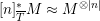 $[n]_{\overline{T}}^{\ast }M\approx M^{\otimes |n|}$. If this is satisfied, the last assertion of the preceding paragraph specializes to
 $[n]_{\overline{G}}^{\ast }G(M,\unicode[STIX]{x1D71A})\approx G([n]_{\overline{T}}^{\ast }(M,\unicode[STIX]{x1D71A}))\approx G((M,\unicode[STIX]{x1D71A})^{\otimes |n|})\approx G(M,\unicode[STIX]{x1D71A})^{\otimes |n|}$.
Before introducing the two types of compactifications to be employed in our proof of Theorem 2, we recall a further notion. Let  $T$ be a torus with
 $T$-equivariant compactification
 $\overline{T}$. Pulling meromorphic functions back fabricates a
 $T$-linearization of
 ${\mathcal{K}}_{\overline{T}}$. Denote by
 $\operatorname{pr}_{2}:T\times \overline{T}\rightarrow \overline{T}$ the projection and by
 $\unicode[STIX]{x1D70E}:T\times \overline{T}\rightarrow \overline{T}$ the
 $T$-action on
 $\overline{T}$. A Cartier divisor
 $D$ on
 $\overline{T}$ is called
 $T$-invariant if the pullbacks
 $\operatorname{pr}_{2}^{\ast }D$ and
 $\unicode[STIX]{x1D70E}^{\ast }D$ are equal. In this case,
 $D$ gives rise to a
 $T$-invariant invertible subsheaf
 ${\mathcal{O}}(D)$ of
 ${\mathcal{K}}_{\overline{T}}$. Hence, there is an induced
 $T$-linearization on
 ${\mathcal{O}}(D)$. We always mean this linearization when associating a
 $T$-linearized line bundle
 $(L(D),\unicode[STIX]{x1D71A}_{D})$ with a
 $T$-invariant Cartier divisor
 $D$. Note that this
 $T$-linearization on
 ${\mathcal{O}}(D)$ is uniquely characterized by the fact that its rational section
 $1\in {\mathcal{K}}_{\overline{T}}(\overline{T})$ is
 $T$-invariant.
Any  $T$-invariant Cartier divisor
 $D$ on
 $\overline{T}$ yields naturally a Cartier divisor on
 $G_{\overline{T}}$. Indeed, assume that
 $D$ is represented by
 $(V_{j},f_{j})$ with Zariski opens
 $V_{j}\subset \overline{T}$. For each Zariski open
 $U_{i}\subset A$ this gives a Cartier divisor on
 $U_{i}\times _{A}G_{\overline{T}}=U_{i}\times _{k}\overline{T}$ that is represented by
 $(U_{i}\times _{k}V_{j},f_{j}\circ \operatorname{pr}_{2})$. By
 $T$-invariance, these Cartier divisors glue together to a Cartier divisor
 $G(D)$ on
 $G_{\overline{T}}$. Furthermore, it is easy to see that
 $L(G(D))$ is isomorphic to
 $G(L(D),\unicode[STIX]{x1D71A}_{D})$.
Construction 4  $(D_{t},(M_{t},\unicode[STIX]{x1D71A}_{t}))$.

The torus  $\mathbb{G}_{m}=\text{Spec}(k[X,X^{-1}])$ has a
 $\mathbb{G}_{m}$-equivariant compactification
 $\unicode[STIX]{x1D704}_{1}:\mathbb{G}_{m}{\hookrightarrow}\mathbb{P}^{1}=\text{Proj}(k[Z_{1},Z_{2}])$ with
 $\unicode[STIX]{x1D704}_{1}^{\ast }(Z_{2}/Z_{1})=X$. There is an extension
 $[n]_{\mathbb{P}^{1}}:\mathbb{P}^{1}\rightarrow \mathbb{P}^{1}$ of
 $[n]_{\mathbb{G}_{m}}:\mathbb{G}_{m}\rightarrow \mathbb{G}_{m}$. Let
 $E_{0}$ (respectively
 $E_{\infty }$) be the
 $\mathbb{G}_{m}$-invariant Cartier divisor on
 $\mathbb{P}^{1}$ represented by
 $$\begin{eqnarray}\displaystyle (D(Z_{1}),Z_{2}/Z_{1})\quad \text{and}\quad (D(Z_{2}),1)\quad (\text{respectively}~(D(Z_{1}),1)~\text{and}~(D(Z_{2}),Z_{1}/Z_{2})). & & \displaystyle \nonumber\end{eqnarray}$$
For the torus  $T=\mathbb{G}_{m}^{t}$, the map
 $\unicode[STIX]{x1D704}_{t}=\unicode[STIX]{x1D704}_{1}\times \cdots \times \unicode[STIX]{x1D704}_{1}:\mathbb{G}_{m}^{t}{\hookrightarrow}\overline{T}=(\mathbb{P}^{1})^{t}$ gives a
 $T$-equivariant compactification. Denoting by
 $\operatorname{pr}_{i}:\overline{T}=(\mathbb{P}^{1})^{t}\rightarrow \mathbb{P}^{1}$ the projection to the
 $i\text{th}$ component, we set
 $D_{t}=\sum _{1\leqslant i\leqslant t}\operatorname{pr}_{i}^{\ast }(E_{0}+E_{\infty })$ and
 ${\mathcal{M}}_{t}={\mathcal{O}}(D_{t})$. By the above, there is a natural
 $T$-linearization
 $\unicode[STIX]{x1D71A}_{t}=\unicode[STIX]{x1D71A}_{D_{t}}$ on the associated line bundle
 $M_{t}$ that acts trivially on its global section
 $1\in {\mathcal{M}}_{t}(\overline{T})$. Furthermore, from the evident identity
 $[n]_{\overline{T}}^{\ast }D_{t}=|n|\cdot D_{t}$ of Cartier divisors we obtain an identity
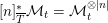 $[n]_{\overline{T}}^{\ast }{\mathcal{M}}_{t}={\mathcal{M}}_{t}^{\otimes |n|}$ of
 ${\mathcal{O}}_{X}$-submodules of
 ${\mathcal{K}}_{\overline{T}}$ so that
 $[n]_{\overline{T}}^{\ast }(M_{t},\unicode[STIX]{x1D71A}_{t})=(M_{t},\unicode[STIX]{x1D71A}_{t})^{\otimes |n|}$.
Construction 5 $(\overline{G},M_{\overline{G}},G(D_{t}))$.

Given a semiabelian variety  $G$ having split toric part
 $T=\mathbb{G}_{m}^{t}$ and abelian quotient
 $\unicode[STIX]{x1D70B}:G\rightarrow A$, we use the
 $T$-equivariant compactification
 $\unicode[STIX]{x1D704}_{t}:\mathbb{G}_{m}^{t}{\hookrightarrow}(\mathbb{P}^{1})^{t}=\overline{T}$ constructed above to obtain a smooth compactification
 $\overline{G}=G_{\overline{T}}$ with abelian quotient
 $\overline{\unicode[STIX]{x1D70B}}:\overline{G}\rightarrow A$. The
 $T$-invariant line bundle
 $(M_{t},\unicode[STIX]{x1D71A}_{t})$ yields further a line bundle
 $M_{\overline{G}}=G(M_{t},\unicode[STIX]{x1D71A}_{t})$ on
 $\overline{G}$, which satisfies
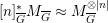 $[n]_{\overline{G}}^{\ast }M_{\overline{G}}\approx M_{\overline{G}}^{\otimes |n|}$. In addition, the line bundle
 $M_{\overline{G}}$ is associated with the Cartier divisor
 $G(D_{t})$.
We remark that this compactification also appears in [Reference Chambert-LoirCha99, Reference Chambert-LoirCha00, Reference VojtaVoj96, Reference VojtaVoj99] and Serre’s appendix to [Reference WaldschmidtWal79].
Construction 6 $(G_{\overline{\unicode[STIX]{x1D6E4}(\unicode[STIX]{x1D711}_{\text{tor}})}},M_{\overline{\unicode[STIX]{x1D6E4}(\unicode[STIX]{x1D711}_{\text{tor}})}},\unicode[STIX]{x1D70B}_{\overline{\unicode[STIX]{x1D6E4}(\unicode[STIX]{x1D711}_{\text{tor}})}})$.

Assume given a semiabelian variety  $G$ with split toric part
 $\mathbb{G}_{m}^{t}$ and abelian quotient
 $\unicode[STIX]{x1D70B}:G\rightarrow A$ as well as a homomorphism
 $\unicode[STIX]{x1D711}_{\text{tor}}\in \operatorname{Hom}(\mathbb{G}_{m}^{t},\mathbb{G}_{m}^{t^{\prime }})$. Let
 $\unicode[STIX]{x1D6E4}(\unicode[STIX]{x1D711}_{\text{tor}})\subset \mathbb{G}_{m}^{t}\times \mathbb{G}_{m}^{t^{\prime }}$ be the graph of
 $\unicode[STIX]{x1D711}_{\text{tor}}$ and
 $\overline{\unicode[STIX]{x1D6E4}(\unicode[STIX]{x1D711}_{\text{tor}})}$ its Zariski closure in the
 $(\mathbb{G}_{m}^{t}\times \mathbb{G}_{m}^{t^{\prime }})$-equivariant compactification
 $(\mathbb{P}^{1})^{t}\times (\mathbb{P}^{1})^{t^{\prime }}$.Footnote 4 The projection to
 $\mathbb{G}_{m}^{t}$ induces an identification
 $\unicode[STIX]{x1D6E4}(\unicode[STIX]{x1D711}_{\text{tor}})=\mathbb{G}_{m}^{t}$. In this way,
 $\overline{\unicode[STIX]{x1D6E4}(\unicode[STIX]{x1D711}_{\text{tor}})}$ can be considered as a
 $\mathbb{G}_{m}^{t}$-equivariant compactification of
 $\mathbb{G}_{m}^{t}$. As
 $[n]_{\unicode[STIX]{x1D6E4}(\unicode[STIX]{x1D711}_{\text{tor}})}$ is just the restriction of
 $[n]_{\mathbb{G}_{m}^{t}\times \mathbb{G}_{m}^{t^{\prime }}}$, it clearly extends to
 $\overline{\unicode[STIX]{x1D6E4}(\unicode[STIX]{x1D711}_{\text{tor}})}$ because
 $[n]_{\mathbb{G}_{m}^{t}\times \mathbb{G}_{m}^{t^{\prime }}}$ extends to
 $(\mathbb{P}^{1})^{t}\times (\mathbb{P}^{1})^{t^{\prime }}$. Therefore, there is an extension of
 $[n]_{G}$ to the ‘graph compactification’
 $G_{\overline{\unicode[STIX]{x1D6E4}(\unicode[STIX]{x1D711}_{\text{tor}})}}$. To fix notations, we record the following self-explanatory commutative diagram.

Construction 4 gives a  $\mathbb{G}_{m}^{t^{\prime }}$-linearized line bundle
 $(M_{t^{\prime }},\unicode[STIX]{x1D71A}_{t^{\prime }})$ on
 $(\mathbb{P}^{1})^{t^{\prime }}$. Its
 $(\mathbb{G}_{m}^{t}\times \mathbb{G}_{m}^{t^{\prime }})$-linearized pullback
 $\operatorname{pr}_{2}^{\ast }(M_{t^{\prime }},\unicode[STIX]{x1D71A}_{t^{\prime }})$ yields a line bundle
 $M_{\overline{\unicode[STIX]{x1D6E4}(\unicode[STIX]{x1D711}_{\text{tor}})}}=G_{\overline{\unicode[STIX]{x1D6E4}(\unicode[STIX]{x1D711}_{\text{tor}})}}(\operatorname{pr}_{2}^{\ast }(M_{t^{\prime }},\unicode[STIX]{x1D71A}_{t^{\prime }})|_{\overline{\unicode[STIX]{x1D6E4}(\unicode[STIX]{x1D711}_{\text{tor}})}})$ on
 $G_{\overline{\unicode[STIX]{x1D6E4}(\unicode[STIX]{x1D711}_{\text{tor}})}}$. Setting
 $\unicode[STIX]{x1D711}_{\text{tor}}=\operatorname{id}_{\mathbb{G}_{m}^{t}}$, this construction specializes to Construction 5 above (i.e.,
 $\overline{G}\approx G_{\overline{\unicode[STIX]{x1D6E4}(\operatorname{id}_{\mathbb{ G}_{m}^{t}})}}$ with compatible
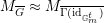 $M_{\overline{G}}\approx M_{\overline{\unicode[STIX]{x1D6E4}(\operatorname{id}_{\mathbb{ G}_{m}^{t}})}}$).
For any non-zero integer  $n$, we can relate
 $(G_{\unicode[STIX]{x1D6E4}(\unicode[STIX]{x1D711}_{\text{tor}})},M_{\unicode[STIX]{x1D6E4}(\unicode[STIX]{x1D711}_{\text{tor}})})$ with
 $(G_{\unicode[STIX]{x1D6E4}(n\cdot \unicode[STIX]{x1D711}_{\text{tor}})},M_{\unicode[STIX]{x1D6E4}(n\cdot \unicode[STIX]{x1D711}_{\text{tor}})})$. For this, we define
 $G^{\prime }$ and
 $G^{\prime \prime }$ to be the semiabelian varieties such that
 $\unicode[STIX]{x1D702}_{G^{\prime }}=(\unicode[STIX]{x1D702}_{G},(\unicode[STIX]{x1D711}_{\text{tor}})_{\ast }\unicode[STIX]{x1D702}_{G})$ and
 $\unicode[STIX]{x1D702}_{G^{\prime \prime }}=(\unicode[STIX]{x1D702}_{G},(n\cdot \unicode[STIX]{x1D711}_{\text{tor}})_{\ast }\unicode[STIX]{x1D702}_{G})$ in
 $\operatorname{Ext}^{1}(A,\mathbb{G}_{m}^{t}\times \mathbb{G}_{m}^{t^{\prime }})$. The equivariant closed immersions
 $\overline{\unicode[STIX]{x1D6E4}(\unicode[STIX]{x1D711}_{\text{tor}})}$,
 $\overline{\unicode[STIX]{x1D6E4}(n\cdot \unicode[STIX]{x1D711}_{\text{tor}})}\subset (\mathbb{P}^{1})^{t}\times (\mathbb{P}^{1})^{t^{\prime }}$ yield closed immersions
 $G_{\overline{\unicode[STIX]{x1D6E4}(\unicode[STIX]{x1D711}_{\text{tor}})}}\subset \overline{G}^{\prime }$ and
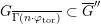 $G_{\overline{\unicode[STIX]{x1D6E4}(n\cdot \unicode[STIX]{x1D711}_{\text{tor}})}}\subset \overline{G}^{\prime \prime }$. In addition, the finite morphism
 $[1]_{(\mathbb{P}^{1})^{t}}\times [n]_{(\mathbb{P}^{1})^{t^{\prime }}}$ yields a finite map
 $\unicode[STIX]{x1D717}_{n}:\overline{G}^{\prime }\rightarrow \overline{G}^{\prime \prime }$. As
 $[1]_{(\mathbb{P}^{1})^{t}}\times [n]_{(\mathbb{P}^{1})^{t^{\prime }}}$ restricts to a
 $\mathbb{G}_{m}^{t}$-equivariant birational map
 $\overline{\unicode[STIX]{x1D6E4}(\unicode[STIX]{x1D711}_{\text{tor}})}\rightarrow \overline{\unicode[STIX]{x1D6E4}(n\cdot \unicode[STIX]{x1D711}_{\text{tor}})}$,
 $\unicode[STIX]{x1D717}_{n}$ restricts to a birational map
 $\unicode[STIX]{x1D717}_{\unicode[STIX]{x1D711}_{\text{tor}},n}:G_{\overline{\unicode[STIX]{x1D6E4}(\unicode[STIX]{x1D711}_{\text{tor}})}}\rightarrow G_{\overline{\unicode[STIX]{x1D6E4}(n\cdot \unicode[STIX]{x1D711}_{\text{tor}})}}$. Furthermore,
 $$\begin{eqnarray}\displaystyle \unicode[STIX]{x1D717}_{\unicode[STIX]{x1D711}_{\text{tor}},n}^{\ast }M_{\overline{\unicode[STIX]{x1D6E4}(n\cdot \unicode[STIX]{x1D711}_{\text{tor}})}}\approx \unicode[STIX]{x1D717}_{n}^{\ast }\overline{G}^{\prime \prime }(\operatorname{pr}_{2}^{\ast }(M_{t^{\prime }},\unicode[STIX]{x1D71A}_{t^{\prime }}))|_{\overline{\unicode[STIX]{x1D6E4}(n\cdot \unicode[STIX]{x1D711}_{\text{tor}})}}\approx \overline{G}^{\prime }(\operatorname{pr}_{2}^{\ast }(M_{t},\unicode[STIX]{x1D71A}_{t})^{\otimes |n|})|_{\overline{\unicode[STIX]{x1D6E4}(\unicode[STIX]{x1D711}_{\text{tor}})}}\approx M_{\overline{\unicode[STIX]{x1D6E4}(\unicode[STIX]{x1D711}_{\text{tor}})}}^{\otimes |n|}. & & \displaystyle \nonumber\end{eqnarray}$$
In addition, there are the evident relations  $\unicode[STIX]{x1D70B}_{\overline{\unicode[STIX]{x1D6E4}(\unicode[STIX]{x1D711}_{\text{tor}})}}=\unicode[STIX]{x1D70B}_{\overline{\unicode[STIX]{x1D6E4}(n\cdot \unicode[STIX]{x1D711}_{\text{tor}})}}\circ \unicode[STIX]{x1D717}_{\unicode[STIX]{x1D711}_{\text{tor}},n}$,
 $q_{\overline{\unicode[STIX]{x1D6E4}(\unicode[STIX]{x1D711}_{\text{tor}})}}=q_{\overline{\unicode[STIX]{x1D6E4}(n\cdot \unicode[STIX]{x1D711}_{\text{tor}})}}\circ \unicode[STIX]{x1D717}_{\unicode[STIX]{x1D711}_{\text{tor}},n}$ and
 $\unicode[STIX]{x1D704}_{\overline{\unicode[STIX]{x1D6E4}(n\cdot \unicode[STIX]{x1D711}_{\text{tor}})}}=\unicode[STIX]{x1D717}_{\unicode[STIX]{x1D711}_{\text{tor}},n}\circ \unicode[STIX]{x1D704}_{\overline{\unicode[STIX]{x1D6E4}(\unicode[STIX]{x1D711}_{\text{tor}})}}$.
Construction 7 $(\overline{\unicode[STIX]{x1D711}}:G_{\overline{\unicode[STIX]{x1D711}_{\text{tor}}}}\rightarrow \overline{G}^{\prime })$.

We describe a subcase of Construction 6 for later reference, enlarging also the commutative diagram (13). In this case, we start with a homomorphism  $\unicode[STIX]{x1D711}:G\rightarrow G^{\prime }$ of semiabelian varieties with split toric parts
 $T=\mathbb{G}_{m}^{t}$ and
 $T^{\prime }=\mathbb{G}_{m}^{t^{\prime }}$. We obtain a compactification
 $G_{\overline{\unicode[STIX]{x1D6E4}(\unicode[STIX]{x1D711}_{\text{tor}})}}$ from Construction 6. Furthermore, the homomorphism
 $\unicode[STIX]{x1D711}$ induces now an even larger commutative diagram

such that there is a decomposition  $\unicode[STIX]{x1D711}=\overline{\unicode[STIX]{x1D711}}\circ \unicode[STIX]{x1D704}_{\unicode[STIX]{x1D711}}$; the map
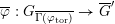 $\overline{\unicode[STIX]{x1D711}}:G_{\overline{\unicode[STIX]{x1D6E4}(\unicode[STIX]{x1D711}_{\text{tor}})}}\rightarrow \overline{G}^{\prime }$ here arises naturally as follows: the toric part
 $\unicode[STIX]{x1D711}_{\text{tor}}:\mathbb{G}_{m}^{t}\rightarrow \mathbb{G}_{m}^{t^{\prime }}$ of
 $\unicode[STIX]{x1D711}$ extends to a
 $\unicode[STIX]{x1D711}_{\text{tor}}$-equivariant map
 $\overline{\unicode[STIX]{x1D711}}_{\text{tor}}:\overline{\unicode[STIX]{x1D6E4}(\unicode[STIX]{x1D711}_{\text{tor}})}\rightarrow (\mathbb{P}^{1})^{t^{\prime }}$, which is just a restriction of
 $\text{pr}_{2}:(\mathbb{P}^{1})^{t}\times (\mathbb{P}^{1})^{t^{\prime }}\rightarrow (\mathbb{P}^{1})^{t^{\prime }}$. As described above, this induces a corresponding extension
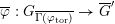 $\overline{\unicode[STIX]{x1D711}}:G_{\overline{\unicode[STIX]{x1D6E4}(\unicode[STIX]{x1D711}_{\text{tor}})}}\rightarrow \overline{G}^{\prime }$ of
 $\unicode[STIX]{x1D711}:G\rightarrow G^{\prime }$.
In addition, each line bundle  $M_{\overline{\unicode[STIX]{x1D6E4}(\unicode[STIX]{x1D711}_{\text{tor}})}}$ is a pullback
 $\overline{\unicode[STIX]{x1D711}}^{\ast }M_{\overline{G}^{\prime }}$ for some homomorphism
 $\unicode[STIX]{x1D711}:G\rightarrow G^{\prime }$ of semiabelian varieties. In fact, we can take
 $\unicode[STIX]{x1D702}_{G^{\prime }}=(\unicode[STIX]{x1D711}_{\text{tor}})_{\ast }\unicode[STIX]{x1D702}_{G}\in \operatorname{Ext}^{1}(A,\mathbb{G}_{m}^{t^{\prime }})$ and the homomorphism
 $\unicode[STIX]{x1D711}:G\rightarrow G^{\prime }$ represented by
 $(\unicode[STIX]{x1D711}_{\text{tor}},\operatorname{id}_{A})$.
3 Heights
We consistently work with (logarithmic) Weil heights and refer to [Reference Hindry and SilvermanHS00, Theorem B.3.6] for the main features of Weil’s height machinery. In short, it provides for each line bundle  $L$ on a projective
 $\overline{\mathbb{Q}}$-variety
 $X$ a class of height functions
 $h_{L}:X(\overline{\mathbb{Q}})\rightarrow \mathbb{R}$ such that any two height functions attached to
 $(X,L)$ differ by a globally bounded function on
 $X(\overline{\mathbb{Q}})$.
Let  $G$ be a semiabelian variety over
 $\overline{\mathbb{Q}}$ with toric part
 $T$ and abelian quotient
 $\unicode[STIX]{x1D70B}:G\rightarrow A$. Assume also given a
 $T$-equivariant compactification
 $\overline{T}$of the torus
 $T$and a
 $T$-linearized line bundle
 $(M,\unicode[STIX]{x1D71A})$on
 $\overline{T}$such that
 $[n]_{T}$extends to
 $[n]_{\overline{T}}:\overline{T}\rightarrow \overline{T}$and that there is an isomorphism
 $[n]_{\overline{T}}^{\ast }(M,\unicode[STIX]{x1D71A})\approx (M,\unicode[STIX]{x1D71A})^{\otimes n}$. For our purposes, these conditions on
 $\overline{T}$ and
 $(M,\unicode[STIX]{x1D71A})$ are always satisfied. Additionally, we choose a symmetric line bundle
 $N$ on
 $A$. We furnish
 $G_{\overline{T}}$ with the line bundle
 $L=G(M,\unicode[STIX]{x1D71A})\otimes \overline{\unicode[STIX]{x1D70B}}^{\ast }N$, which is ample if both
 $M$ and
 $N$ are ample (Lemma 3). Weil’s height machinery supplies us with some height function
 $h_{L}:G_{\overline{T}}(\overline{\mathbb{Q}})\rightarrow \mathbb{R}$. The function
 $h_{L}$ is neither unique nor does it enjoy homogeneity properties like the Néron–Tate height of a symmetric line bundle on an abelian variety. However, the following lemma remedies this partially. We call a
 $T$-linearized line bundle
 $T$-effective if it has a
 $T$-invariant non-zero global section.
Lemma 8. For any  $(M,\unicode[STIX]{x1D71A})$ (respectively
 $N$) as above, there exists a function
 $\widehat{h}_{G(M,\unicode[STIX]{x1D71A})}:G_{\overline{T}}(\overline{\mathbb{Q}})\rightarrow \mathbb{R}$ (respectively
 $\widehat{h}_{\overline{\unicode[STIX]{x1D70B}}^{\ast }N}:G_{\overline{T}}(\overline{\mathbb{Q}})\rightarrow \mathbb{R}$) such that:
(a)
$|h_{G(M,\unicode[STIX]{x1D71A})}-\widehat{h}_{G(M,\unicode[STIX]{x1D71A})}|$ (respectively $|h_{\overline{\unicode[STIX]{x1D70B}}^{\ast }N}-\widehat{h}_{\overline{\unicode[STIX]{x1D70B}}^{\ast }N}|$) is globally bounded on $G(\overline{\mathbb{Q}})$;(b)
$\widehat{h}_{G(M,\unicode[STIX]{x1D71A})}([n]x)=|n|\widehat{h}_{G(M,\unicode[STIX]{x1D71A})}(x)$ (respectively $\widehat{h}_{\overline{\unicode[STIX]{x1D70B}}^{\ast }N}([n]x)=n^{2}\widehat{h}_{\overline{\unicode[STIX]{x1D70B}}^{\ast }N}(x)$) for any $x\in G(\overline{\mathbb{Q}})$ and any integer $n$;(c) given a second
$T$-linearized line bundle $(M^{\prime },\unicode[STIX]{x1D71A}^{\prime })$ (respectively a symmetric line bundle $N^{\prime }$ on $A$) as above, we have the additivity relations $$\begin{eqnarray}\displaystyle \widehat{h}_{G(M\otimes M^{\prime },\unicode[STIX]{x1D71A}\otimes \unicode[STIX]{x1D71A}^{\prime })}=\widehat{h}_{G(M,\unicode[STIX]{x1D71A})}+\widehat{h}_{G(M^{\prime },\unicode[STIX]{x1D71A}^{\prime })}\quad \text{and}\quad \widehat{h}_{\overline{\unicode[STIX]{x1D70B}}^{\ast }(N\otimes N^{\prime })}=\widehat{h}_{\overline{\unicode[STIX]{x1D70B}}^{\ast }N}+\widehat{h}_{\overline{\unicode[STIX]{x1D70B}}^{\ast }N^{\prime }}; & & \displaystyle \nonumber\end{eqnarray}$$(d) if
$(M,\unicode[STIX]{x1D71A})$ (respectively $N$) is $T$-effective (respectively ample), then $\widehat{h}_{G(M,\unicode[STIX]{x1D71A})}|_{G(\overline{\mathbb{Q}})}$ (respectively $\widehat{h}_{\overline{\unicode[STIX]{x1D70B}}^{\ast }N}$) is non-negative.







Furthermore,  $\widehat{h}_{G(M,\unicode[STIX]{x1D71A})}$ (respectively
 $\widehat{h}_{\overline{\unicode[STIX]{x1D70B}}^{\ast }N}$) is uniquely characterized by (a) and (b).
It is natural to work with the unique  $\widehat{h}_{L}=\widehat{h}_{G(M,\unicode[STIX]{x1D71A})}+\widehat{h}_{\overline{\unicode[STIX]{x1D70B}}^{\ast }N}$ instead of a non-canonical Weil height
 $h_{L}$. By (a) of the above theorem, their difference is globally bounded on
 $G(\overline{\mathbb{Q}})$. As for abelian varieties, the zero set of
 $\widehat{h}_{L}$ coincides with the torsion points of
 $G$ if both
 $M$ and
 $N$ are ample and
 $(M,\unicode[STIX]{x1D71A})$ is
 $T$-effective.
The assumption of  $T$-effectivity in (d) cannot be relaxed to mere effectivity. In fact, assume that
 $T=\mathbb{G}_{m}^{t}$ and let
 $Q_{i}$,
 $1\leqslant i\leqslant t$, be the line bundles on
 $A$ such that
 $$\begin{eqnarray}\displaystyle \unicode[STIX]{x1D702}_{G}=(Q_{1},\ldots ,Q_{t})\in A^{\vee }(k)^{t}=\operatorname{Ext}_{k}^{1}(A,T). & & \displaystyle \nonumber\end{eqnarray}$$
For  $\unicode[STIX]{x1D71A}$ running through all possible
 $T$-linearizations of the trivial line bundle
 $\mathbb{A}_{\overline{T}}^{1}$, the line bundle
 $G(\mathbb{A}_{\overline{T}}^{1},\unicode[STIX]{x1D71A})$ runs through
 $\overline{\unicode[STIX]{x1D70B}}^{\ast }(Q_{1}^{k_{i}}\otimes \cdots \otimes Q_{t}^{k_{t}})$ for arbitrary integers
 $k_{i}$, as a comparison of Čech cocycles shows. Except for this caveat, we do not need this and leave the verification to the interested reader.
Proof. (a, b) The first two assertions of the lemma as well as uniqueness can be inferred directly from [Reference Hindry and SilvermanHS00, Theorem B.4.1] applied to  $G(M,\unicode[STIX]{x1D71A})$ (respectively
 $N$). Indeed,
 $[n]_{\overline{G}}^{\ast }G(M,\unicode[STIX]{x1D71A})\approx G(M,\unicode[STIX]{x1D71A})^{\otimes n}$ by our assumption (compare § 2) and
 $[n]_{\overline{G}}^{\ast }\overline{\unicode[STIX]{x1D70B}}^{\ast }N\approx \overline{\unicode[STIX]{x1D70B}}^{\ast }[n]_{A}^{\ast }N\approx \overline{\unicode[STIX]{x1D70B}}^{\ast }N^{\otimes n^{2}}$ since
 $N$ is symmetric. (The result in [Reference Hindry and SilvermanHS00] is stated for divisor classes on smooth varieties but it is also true for line bundles on general varieties with exactly the same proof. The reader may compare also [Reference Bombieri and GublerBG06, Lemma 9.2.4].)
(c) As  $G(M\otimes M^{\prime },\unicode[STIX]{x1D71A}\otimes \unicode[STIX]{x1D71A}^{\prime })\approx G(M,\unicode[STIX]{x1D71A})\otimes G(M^{\prime },\unicode[STIX]{x1D71A}^{\prime })$, the global boundedness of
 $$\begin{eqnarray}\displaystyle |h_{G(M\otimes M^{\prime },\unicode[STIX]{x1D71A}\otimes \unicode[STIX]{x1D71A}^{\prime })}-h_{G(M,\unicode[STIX]{x1D71A})}-h_{G(M^{\prime },\unicode[STIX]{x1D71A}^{\prime })}| & & \displaystyle \nonumber\end{eqnarray}$$
is a standard property of the Weil height. As (a) and (b) already characterize  $\widehat{h}_{G(M\otimes M^{\prime },\unicode[STIX]{x1D71A}\otimes \unicode[STIX]{x1D71A}^{\prime })}$ uniquely, we infer the first equality in (c). The second one follows similarly.
(d) Similarly, one observes that  $\widehat{h}_{G(M,\unicode[STIX]{x1D71A})}$ (respectively
 $\widehat{h}_{\overline{\unicode[STIX]{x1D70B}}^{\ast }N}$) is non-negative if
 $h_{G(M,\unicode[STIX]{x1D71A})}$ (respectively
 $h_{\overline{\unicode[STIX]{x1D70B}}^{\ast }N}$) is bounded from below on
 $G(\overline{\mathbb{Q}})$ (respectively
 $G_{\overline{T}}(\overline{\mathbb{Q}})$). For the height
 $h_{\overline{\unicode[STIX]{x1D70B}}^{\ast }N}$, this is true because the ampleness of
 $N$ implies that
 $N$ and hence
 $\overline{\unicode[STIX]{x1D70B}}^{\ast }N$ has empty base locus. By assumption, we have a
 $T$-invariant non-zero global section
 $s:\overline{T}\rightarrow M$. This gives rise to local sections
 $$\begin{eqnarray}\displaystyle s_{i}^{\prime }=U_{i}\times _{k}s:U_{i}\times _{A}G_{\overline{T}}=U_{i}\times _{k}\overline{T}\rightarrow U_{i}\times _{k}M=U_{i}\times _{A}G(M,\unicode[STIX]{x1D71A}). & & \displaystyle \nonumber\end{eqnarray}$$
Due to the  $T$-invariance of
 $s$, the sections
 $s_{i}^{\prime }$ glue together to a non-zero global section
 $s^{\prime }$ of
 $G(M,\unicode[STIX]{x1D71A})$. Furthermore,
 $T$-invariance guarantees that
 $s_{x}$ generates
 $M_{x}$ for every
 $x\in T(\overline{\mathbb{Q}})$. We infer that
 $s_{x}^{\prime }$ generates
 $G(M,\unicode[STIX]{x1D71A})$ for every
 $x\in G(\overline{\mathbb{Q}})$. Therefore the base locus of
 $G(M,\unicode[STIX]{x1D71A})$ is contained in
 $G_{\overline{T}}\setminus G$ and
 $h_{G(M,\unicode[STIX]{x1D71A})}|_{G(\overline{\mathbb{Q}})}$ is bounded from below.◻
In addition, we have a good functorial behavior of the heights  $\widehat{h}_{G(M,\unicode[STIX]{x1D71A})}$ and
 $\widehat{h}_{\overline{\unicode[STIX]{x1D70B}}^{\ast }N}$. To state precisely what this means, let
 $G$ (respectively
 $G^{\prime }$) be a semiabelian variety over
 $\overline{\mathbb{Q}}$ with toric part
 $T$ (respectively
 $T^{\prime }$) and abelian quotient
 $A$ (respectively
 $A^{\prime }$). Take furthermore equivariant compactifications
 $\overline{T}$ and
 $\overline{T}^{\prime }$ so that
 $\unicode[STIX]{x1D711}_{\text{tor}}:T\rightarrow T^{\prime }$ extends to a
 $\unicode[STIX]{x1D711}_{\text{tor}}$-equivariant map
 $\overline{\unicode[STIX]{x1D711}}_{\text{tor}}:\overline{T}\rightarrow \overline{T}^{\prime }$. In this situation, we consider a
 $T^{\prime }$-linearized line bundle
 $(M,\unicode[STIX]{x1D71A})$ on
 $\overline{T}^{\prime }$ such that there is a
 $T^{\prime }$-equivariant isomorphism
 $[n]_{\overline{T}^{\prime }}^{\ast }(M,\unicode[STIX]{x1D71A})\approx (M,\unicode[STIX]{x1D71A})^{\otimes n}$. We also take a symmetric ample line bundle
 $N$ on
 $A^{\prime }$.
Lemma 9. In the situation described in the above paragraph, let  $\unicode[STIX]{x1D711}:G\rightarrow G^{\prime }$ be a homomorphism with toric (respectively abelian) component
 $\unicode[STIX]{x1D711}_{\text{tor}}$ (respectively
 $\unicode[STIX]{x1D711}_{\text{ab}}$). For every
 $x\in G(\overline{\mathbb{Q}})$, we have then
 $$\begin{eqnarray}\displaystyle \widehat{h}_{G^{\prime }(M,\unicode[STIX]{x1D71A})}(\unicode[STIX]{x1D711}(x))=\widehat{h}_{G(\unicode[STIX]{x1D711}_{\text{tor}}^{\ast }(M,\unicode[STIX]{x1D71A}))}(x)\quad \text{and}\quad \widehat{h}_{(\overline{\unicode[STIX]{x1D70B}}^{\prime })^{\ast }N}(\unicode[STIX]{x1D711}(x))=\widehat{h}_{\overline{\unicode[STIX]{x1D70B}}^{\ast }(\unicode[STIX]{x1D711}_{\text{ab}}^{\ast }N)}(x). & & \displaystyle \nonumber\end{eqnarray}$$
Proof. This follows directly from the functorial behavior of the Weil height under pullback and the uniqueness assertion of Lemma 8. ◻
We note a further addendum to Lemma 8, which is specifically related to the line bundles  $M_{\overline{G}}$ and
 $M_{\overline{\unicode[STIX]{x1D6E4}(\unicode[STIX]{x1D711}_{\text{tor}})}}$.
Lemma 10. Let  $G$ a semiabelian variety with split toric part
 $\mathbb{G}_{m}^{t}$ and abelian quotient
 $\unicode[STIX]{x1D70B}:G\rightarrow A$. For any
 $\unicode[STIX]{x1D711}_{\text{tor}}\in \operatorname{Hom}(\mathbb{G}_{m}^{t},\mathbb{G}_{m}^{t^{\prime }})$, the restriction of
 $\widehat{h}_{M_{\overline{\unicode[STIX]{x1D6E4}(\unicode[STIX]{x1D711}_{\text{tor}})}}}:G_{\overline{\unicode[STIX]{x1D6E4}(\unicode[STIX]{x1D711}_{\text{tor}})}}(\overline{\mathbb{Q}})\rightarrow \mathbb{R}$ to
 $G(\overline{\mathbb{Q}})$ is non-negative. In particular, the restriction of
 $\widehat{h}_{M_{\overline{G}}}$ to
 $G(\overline{\mathbb{Q}})$ is non-negative.
Proof. In Construction 7, it is shown that each  $M_{\overline{\unicode[STIX]{x1D6E4}(\unicode[STIX]{x1D711}_{\text{tor}})}}$ is isomorphic to the pullback of a line bundle of the form
 $M_{\overline{G}^{\prime }}$. Using Lemma 9, it hence suffices to prove the non-negativity of
 $\widehat{h}_{M_{\overline{G}}}$. This is already in the literature (cf. [Reference Chambert-LoirCha00, Lemme 3.9]), but we give the argument here for completeness because it is a direct consequence of Construction 4. The Cartier divisor
 $D_{t}$ on
 $\mathbb{G}_{m}^{t}$ is effective and
 $\mathbb{G}_{m}^{t}$-invariant so that the constant function
 $1\in {\mathcal{K}}_{(\mathbb{P}^{1})^{t}}((\mathbb{P}^{1})^{t})$ gives rise to a
 $\mathbb{G}_{m}^{t}$-invariant global section of its associated line bundle
 $(M_{t},\unicode[STIX]{x1D71A}_{t})$. In other words,
 $(M_{t},\unicode[STIX]{x1D71A}_{t})$ is
 $\mathbb{G}_{m}^{t}$-effective and we can use Lemma 8(d).◻
Fix again a semiabelian variety  $G$ over
 $\overline{\mathbb{Q}}$ with toric part
 $\mathbb{G}_{m}^{t}$ and abelian quotient
 $\unicode[STIX]{x1D70B}:G\rightarrow A$. Furthermore, let
 $\overline{G}$ be a compactification of
 $G$ and
 $\overline{\unicode[STIX]{x1D70B}}:\overline{G}\rightarrow A$ its abelian quotient as in Construction 5. We want to estimate the difference between
 $\widehat{h}_{M_{\overline{\unicode[STIX]{x1D6E4}(\unicode[STIX]{x1D711}_{\text{tor}})}}}$ and
 $\widehat{h}_{M_{\overline{\unicode[STIX]{x1D6E4}(\unicode[STIX]{x1D711}_{\text{tor}}^{\prime })}}}$ for two ‘close’ homomorphisms
 $\unicode[STIX]{x1D711}_{\text{tor}},\unicode[STIX]{x1D711}_{\text{tor}}^{\prime }\in \operatorname{Hom}(\mathbb{G}_{m}^{t},\mathbb{G}_{m}^{t^{\prime }})$. Simultaneously, we examine the corresponding ‘abelian’ analog. For this purpose, let
 $A^{\prime }$ be a second abelian variety and
 $N$ (respectively
 $N^{\prime }$) an ample symmetric line bundle on
 $A$ (respectively
 $A^{\prime }$). We choose some linear norms
 $|\cdot |$ on
 $\operatorname{Hom}(\mathbb{G}_{m}^{t},\mathbb{G}_{m}^{t^{\prime }})$ and
 $\operatorname{Hom}(A,A^{\prime })$ for quantification.Footnote 5
Lemma 11. In the above situation, there exist constants  $c_{1}$ and
 $c_{2}$ depending only on
 $G$,
 $N$,
 $t^{\prime }$,
 $A^{\prime }$,
 $N^{\prime }$ and the linear norms
 $|\cdot |$ on
 $\operatorname{Hom}(\mathbb{G}_{m}^{t},\mathbb{G}_{m}^{t^{\prime }})$ and
 $\operatorname{Hom}(A,A^{\prime })$ such that the following assertions are true: for any pair
 $(\unicode[STIX]{x1D711}_{\text{tor}},\unicode[STIX]{x1D711}_{\text{tor}}^{\prime })\in \operatorname{Hom}(\mathbb{G}_{m}^{t},\mathbb{G}_{m}^{t^{\prime }})^{2}$ and any
 $x\in G(\overline{\mathbb{Q}})$, we have
 $$\begin{eqnarray}|\widehat{h}_{M_{\overline{\unicode[STIX]{x1D6E4}(\unicode[STIX]{x1D711}_{\text{tor}})}}}(x)-\widehat{h}_{M_{\overline{\unicode[STIX]{x1D6E4}(\unicode[STIX]{x1D711}_{\text{tor}}^{\prime })}}}(x)|\leqslant c_{1}|\unicode[STIX]{x1D711}_{\text{tor}}-\unicode[STIX]{x1D711}_{\text{tor}}^{\prime }|\cdot \widehat{h}_{M_{\overline{G}}}(x).\end{eqnarray}$$
Similarly, we have
 $$\begin{eqnarray}|\widehat{h}_{\overline{\unicode[STIX]{x1D70B}}^{\ast }\unicode[STIX]{x1D711}_{\text{ab}}^{\ast }N^{\prime }}(x)-\widehat{h}_{\overline{\unicode[STIX]{x1D70B}}^{\ast }(\unicode[STIX]{x1D711}_{\text{ab}}^{\prime })^{\ast }N^{\prime }}(x)|\leqslant c_{2}|\unicode[STIX]{x1D711}_{\text{ab}}-\unicode[STIX]{x1D711}_{\text{ab}}^{\prime }|^{2}\cdot \widehat{h}_{\overline{\unicode[STIX]{x1D70B}}^{\ast }N}(x)\end{eqnarray}$$
for any pair  $(\unicode[STIX]{x1D711}_{\text{ab}},\unicode[STIX]{x1D711}_{\text{ab}}^{\prime })\in \operatorname{Hom}(A,A^{\prime })^{2}$.
Proof. We prove first the inequality (15). The proof takes place on the ‘graph compactification’  $G_{\overline{\unicode[STIX]{x1D6E4}}}$ of
 $G$ where
 $\overline{\unicode[STIX]{x1D6E4}}=\overline{\unicode[STIX]{x1D6E4}(\unicode[STIX]{x1D711}_{\text{tor}}\times \unicode[STIX]{x1D711}_{\text{tor}}^{\prime })}\subset (\mathbb{P}^{1})^{t}\times (\mathbb{P}^{1})^{t^{\prime }}\times (\mathbb{P}^{1})^{t^{\prime }}$. We denote the projections corresponding to these three factors by
 $\text{pr}_{i}$ (
 $i=1,2,3$). The projections
 $(\operatorname{pr}_{1}\times \operatorname{pr}_{2})|_{\overline{\unicode[STIX]{x1D6E4}}}:\overline{\unicode[STIX]{x1D6E4}}\rightarrow \overline{\unicode[STIX]{x1D6E4}(\unicode[STIX]{x1D711}_{\text{tor}})}$ and
 $(\operatorname{pr}_{1}\times \operatorname{pr}_{3})|_{\overline{\unicode[STIX]{x1D6E4}}}:\overline{\unicode[STIX]{x1D6E4}}\rightarrow \overline{\unicode[STIX]{x1D6E4}(\unicode[STIX]{x1D711}_{\text{tor}}^{\prime })}$ are
 $\mathbb{G}_{m}^{t}$-equivariant and hence induce maps
 $G_{\overline{\unicode[STIX]{x1D6E4}}}\rightarrow G_{\overline{\unicode[STIX]{x1D6E4}(\unicode[STIX]{x1D711}_{\text{tor}})}}$ and
 $G_{\overline{\unicode[STIX]{x1D6E4}}}\rightarrow G_{\overline{\unicode[STIX]{x1D6E4}(\unicode[STIX]{x1D711}_{\text{tor}}^{\prime })}}$, which both restrict to the identity on
 $G$. By Lemma 9, we obtain
 $$\begin{eqnarray}\widehat{h}_{M_{\overline{\unicode[STIX]{x1D6E4}(\unicode[STIX]{x1D711}_{\text{tor}})}}}(x)=\widehat{h}_{G(\operatorname{pr}_{2}^{\ast }(M_{t^{\prime }},\unicode[STIX]{x1D71A}_{t^{\prime }})|_{\overline{\unicode[STIX]{x1D6E4}}})}(x)\quad \text{and}\quad \widehat{h}_{M_{\overline{\unicode[STIX]{x1D6E4}(\unicode[STIX]{x1D711}_{\text{tor}}^{\prime })}}}(x)=\widehat{h}_{G(\operatorname{pr}_{3}^{\ast }(M_{t^{\prime }},\unicode[STIX]{x1D71A}_{t^{\prime }})|_{\overline{\unicode[STIX]{x1D6E4}}})}(x)\end{eqnarray}$$
for any  $x\in G(\overline{\mathbb{Q}})$. Similarly, we have
 $$\begin{eqnarray}\widehat{h}_{M_{\overline{G}}}(x)=\widehat{h}_{G(\operatorname{pr}_{1}^{\ast }(M_{t},\unicode[STIX]{x1D71A}_{t})|_{\overline{\unicode[STIX]{x1D6E4}}})}(x)\end{eqnarray}$$
for every  $x\in G(\overline{\mathbb{Q}})$.
Using standard coordinates  $X_{u}$,
 $1\leqslant u\leqslant t$, (respectively
 $Y_{v}$,
 $1\leqslant v\leqslant t^{\prime }$) on
 $\mathbb{G}_{m}^{t}$ (respectively
 $\mathbb{G}_{m}^{t^{\prime }}$), we write
 $$\begin{eqnarray}\displaystyle \unicode[STIX]{x1D711}_{\text{tor}}^{\ast }(Y_{v})=X_{1}^{a_{1v}}X_{2}^{a_{2v}}\cdots X_{t}^{a_{tv}}\quad (\text{respectively}~(\unicode[STIX]{x1D711}_{\text{tor}}^{\prime })^{\ast }(Y_{v})=X_{1}^{a_{1v}^{\prime }}X_{2}^{a_{2v}^{\prime }}\cdots X_{t}^{a_{tv}^{\prime }}),\,1\leqslant v\leqslant t^{\prime }, & & \displaystyle \nonumber\end{eqnarray}$$
with integers  $a_{uv}$ (respectively
 $a_{uv}^{\prime }$). Our strategy is to compare the restriction of the line bundles
 $\text{pr}_{1}^{\ast }(M_{t},\unicode[STIX]{x1D71A}_{t})^{\otimes l}$,
 $l$ sufficiently large, and
 $\text{pr}_{2}^{\ast }(M_{t^{\prime }},\unicode[STIX]{x1D71A}_{t^{\prime }})\otimes \text{pr}_{3}^{\ast }(M_{t^{\prime }},\unicode[STIX]{x1D71A}_{t^{\prime }})^{\otimes -1}$ on
 $\overline{\unicode[STIX]{x1D6E4}}$. In fact, we claim that both
 $$\begin{eqnarray}(\text{pr}_{1}^{\ast }M_{t}^{\otimes l}\otimes \text{pr}_{2}^{\ast }M_{t^{\prime }}\otimes \text{pr}_{3}^{\ast }M_{t^{\prime }}^{\otimes -1})|_{\overline{\unicode[STIX]{x1D6E4}}}\quad \text{and}\quad (\text{pr}_{1}^{\ast }M_{t}^{\otimes l}\otimes \text{pr}_{2}^{\ast }M_{t^{\prime }}^{\otimes -1}\otimes \text{pr}_{3}^{\ast }M_{t^{\prime }})|_{\overline{\unicode[STIX]{x1D6E4}}}\end{eqnarray}$$
are  $\mathbb{G}_{m}^{t}$-effective with respect to the induced linearizations. In this case, Lemma 8(c, d) implies that
 $$\begin{eqnarray}|\widehat{h}_{G(\operatorname{pr}_{2}^{\ast }(M_{t^{\prime }},\unicode[STIX]{x1D71A}_{t^{\prime }})|_{\overline{\unicode[STIX]{x1D6E4}}})}(x)-\widehat{h}_{G(\operatorname{pr}_{3}^{\ast }(M_{t^{\prime }},\unicode[STIX]{x1D71A}_{t^{\prime }})|_{\overline{\unicode[STIX]{x1D6E4}}})}(x)|\leqslant l\cdot \widehat{h}_{G(\operatorname{pr}_{1}^{\ast }(M_{t},\unicode[STIX]{x1D71A}_{t})|_{\overline{\unicode[STIX]{x1D6E4}}})}(x)\end{eqnarray}$$
for each  $x\in G(\overline{\mathbb{Q}})\subset G_{\overline{\unicode[STIX]{x1D6E4}}}(\overline{\mathbb{Q}})$. Using the equalities (17) and (18), the inequality (15) can be derived from (20) if we have adequate control on
 $l$. For this, we note that
 $\operatorname{pr}_{1}^{\ast }(L_{t},\unicode[STIX]{x1D71A}_{t})|_{\overline{\unicode[STIX]{x1D6E4}}}$ (respectively
 $\operatorname{pr}_{2}^{\ast }(L_{t^{\prime }},\unicode[STIX]{x1D71A}_{t^{\prime }})|_{\overline{\unicode[STIX]{x1D6E4}}}$,
 $\operatorname{pr}_{3}^{\ast }(L_{t^{\prime }},\unicode[STIX]{x1D71A}_{t^{\prime }})|_{\overline{\unicode[STIX]{x1D6E4}}}$) can be defined by means of the
 $\mathbb{G}_{m}^{t}$-invariant Cartier divisor
 $\operatorname{pr}_{1}^{\ast }D_{t}|_{\overline{\unicode[STIX]{x1D6E4}}}$ (respectively
 $\operatorname{pr}_{2}^{\ast }D_{t^{\prime }}|_{\overline{\unicode[STIX]{x1D6E4}}}$,
 $\operatorname{pr}_{3}^{\ast }D_{t^{\prime }}|_{\overline{\unicode[STIX]{x1D6E4}}}$). We next describe these divisors explicitly and start with giving a covering of
 $\overline{\unicode[STIX]{x1D6E4}}$. With each
 $(t+2t^{\prime })$-tuple
 $\text{}\underline{m}$ of numbers
 $m_{r}\in \{-1,1\}$,
 $1\leqslant r\leqslant t+2t^{\prime }$, we associate a Zariski open
 $$\begin{eqnarray}\displaystyle U_{\text{}\underline{m}}=\overline{\unicode[STIX]{x1D6E4}}\cap \mathop{\bigcap }_{1\leqslant u\leqslant t}D(\operatorname{pr}_{1}^{\ast }X_{u}^{m_{u}})\cap \mathop{\bigcap }_{1\leqslant v\leqslant t^{\prime }}D(\operatorname{pr}_{2}^{\ast }Y_{v}^{m_{v+t}})\cap \mathop{\bigcap }_{1\leqslant v\leqslant t^{\prime }}D(\operatorname{pr}_{3}^{\ast }Y_{v}^{m_{v+t+t^{\prime }}}). & & \displaystyle \nonumber\end{eqnarray}$$
Evidently,  $\operatorname{pr}_{1}^{\ast }D_{t}|_{\overline{\unicode[STIX]{x1D6E4}}}$ is represented by
 $(U_{\text{}\underline{m}},f_{\text{}\underline{m}})$ with
 $$\begin{eqnarray}\displaystyle f_{\text{}\underline{m}}=\operatorname{pr}_{1}^{\ast }(X_{1}^{-m_{1}}X_{2}^{-m_{2}}\cdots X_{t}^{-m_{t}}) & & \displaystyle \nonumber\end{eqnarray}$$
and  $\operatorname{pr}_{2}^{\ast }D_{t^{\prime }}|_{\overline{\unicode[STIX]{x1D6E4}}}$ (respectively
 $\operatorname{pr}_{3}^{\ast }D_{t^{\prime }}|_{\overline{\unicode[STIX]{x1D6E4}}}$) is represented by
 $(U_{\text{}\underline{m}},g_{\text{}\underline{m}})$ (respectively
 $(U_{\text{}\underline{m}},g_{\text{}\underline{m}}^{\prime })$) with
 $$\begin{eqnarray}\displaystyle g_{\text{}\underline{m}}=\mathop{\prod }_{1\leqslant v\leqslant t^{\prime }}\operatorname{pr}_{2}^{\ast }(Y_{v}^{-m_{v+t}})\quad \biggl(\text{respectively}~g_{\text{}\underline{m}}^{\prime }=\mathop{\prod }_{1\leqslant v\leqslant t^{\prime }}\operatorname{pr}_{3}^{\ast }(Y_{v}^{-m_{v+t+t^{\prime }}})\biggr). & & \displaystyle \nonumber\end{eqnarray}$$
The meromorphic function  $1\in {\mathcal{K}}_{\overline{\unicode[STIX]{x1D6E4}}}(\overline{\unicode[STIX]{x1D6E4}})$ gives a
 $\mathbb{G}_{m}^{t}$-invariant rational section of
 ${\mathcal{O}}(\operatorname{pr}_{1}^{\ast }D_{t}|_{\overline{\unicode[STIX]{x1D6E4}}})$,
 ${\mathcal{O}}(\operatorname{pr}_{2}^{\ast }D_{t^{\prime }}|_{\overline{\unicode[STIX]{x1D6E4}}})$ and
 ${\mathcal{O}}(\operatorname{pr}_{3}^{\ast }D_{t^{\prime }}|_{\overline{\unicode[STIX]{x1D6E4}}})$ by our choice of linearizations. It thus also gives a
 $\mathbb{G}_{m}^{t}$-invariant rational section of
 ${\mathcal{O}}(l\cdot \operatorname{pr}_{1}^{\ast }D_{t}|_{\overline{\unicode[STIX]{x1D6E4}}}+\operatorname{pr}_{2}^{\ast }D_{t^{\prime }}|_{\overline{\unicode[STIX]{x1D6E4}}}-\operatorname{pr}_{3}^{\ast }D_{t^{\prime }}|_{\overline{\unicode[STIX]{x1D6E4}}})$ and
 ${\mathcal{O}}(l\cdot \operatorname{pr}_{1}^{\ast }D_{t}|_{\overline{\unicode[STIX]{x1D6E4}}}-\operatorname{pr}_{2}^{\ast }D_{t^{\prime }}|_{\overline{\unicode[STIX]{x1D6E4}}}+\operatorname{pr}_{3}^{\ast }D_{t^{\prime }}|_{\overline{\unicode[STIX]{x1D6E4}}})$, to which the line bundles in (19) are associated. For
 $\mathbb{G}_{m}^{t}$-effectivity, we may hence prove that it is actually a global section. In other words, we have to prove that both
 $f_{\text{}\underline{m}}^{l}\cdot g_{\text{}\underline{m}}\cdot (g_{\text{}\underline{m}}^{\prime })^{-1}$ and
 $f_{\text{}\underline{m}}^{l}\cdot (g_{\text{}\underline{m}})^{-1}\cdot g_{\text{}\underline{m}}^{\prime }$ are regular on
 $U_{\text{}\underline{m}}$. Let us remark first that for
 $l_{v}=\max _{1\leqslant u\leqslant t}\{|a_{uv}-a_{uv}^{\prime }|\}$ the meromorphic function
 $$\begin{eqnarray}\displaystyle f_{\text{}\underline{m}}^{l_{v}}\cdot \operatorname{pr}_{2}^{\ast }(Y_{v})\operatorname{pr}_{3}^{\ast }(Y_{v})^{-1}=\mathop{\prod }_{1\leqslant u\leqslant t}\operatorname{pr}_{1}^{\ast }(X_{u}^{s_{u}}),\quad s_{u}=-m_{u}l_{v}+(a_{uv}-a_{uv}^{\prime }), & & \displaystyle \nonumber\end{eqnarray}$$
is regular on  $U_{\text{}\underline{m}}$; for
 $\operatorname{pr}_{1}^{\ast }(X_{u}^{-m_{u}})$ is regular on
 $U_{\text{}\underline{m}}\subset D(\operatorname{pr}_{1}^{\ast }(X_{u}^{m_{u}}))$. Similarly, the meromorphic function
 $f_{\text{}\underline{m}}^{l_{v}}\cdot \operatorname{pr}_{2}^{\ast }(Y_{v})^{-1}\operatorname{pr}_{3}^{\ast }(Y_{v})$ is regular on
 $U_{\text{}\underline{m}}$. We write
 $g_{\text{}\underline{m}}\cdot (g_{\text{}\underline{m}}^{\prime })^{-1}=\prod _{v=1}^{t^{\prime }}h_{\text{}\underline{m}}$ with
 $$\begin{eqnarray}\displaystyle h_{\text{}\underline{m}}=\operatorname{pr}_{2}^{\ast }(Y_{v}^{-m_{v+t}})\operatorname{pr}_{3}^{\ast }(Y_{v}^{m_{v+t+t^{\prime }}}) & & \displaystyle \nonumber\end{eqnarray}$$
and claim that  $f_{\text{}\underline{m}}^{l_{v}}\cdot h_{\text{}\underline{m}}$ is regular on
 $U_{\text{}\underline{m}}$. If
 $m_{v+t}=m_{v+t+t^{\prime }}=1$ or
 $m_{v+t}=m_{v+t+t^{\prime }}=-1$, this follows directly from our previous remark. In case
 $m_{v+t}=-1$ and
 $m_{v+t+t^{\prime }}=1$, the function
 $$\begin{eqnarray}\displaystyle f_{\text{}\underline{m}}^{l_{v}}\cdot h_{\text{}\underline{m}}=\operatorname{pr}_{2}^{\ast }(Y_{v})^{2}\cdot (f_{\text{}\underline{m}}^{l_{v}}\cdot \operatorname{pr}_{2}^{\ast }(Y_{v})^{-1}\operatorname{pr}_{3}^{\ast }(Y_{v})) & & \displaystyle \nonumber\end{eqnarray}$$
is regular by our remark and the fact that  $\operatorname{pr}_{2}^{\ast }(Y_{v})$ is regular on
 $U_{\text{}\underline{m}}\subset D(\operatorname{pr}_{2}^{\ast }(Y_{v})^{-1})$. The case
 $m_{v+t}=1$ and
 $m_{v+t+t^{\prime }}=-1$ can be handled in the same way, establishing our claim. In conclusion, the condition
 $$\begin{eqnarray}l\geqslant \mathop{\sum }_{1\leqslant v\leqslant t^{\prime }}l_{v}=\mathop{\sum }_{1\leqslant v\leqslant t^{\prime }}\Bigl(\max _{1\leqslant u\leqslant t}\{|a_{uv}-a_{uv}^{\prime }|\}\Bigr)\end{eqnarray}$$
suffices to ensure the regularity of  $f_{\text{}\underline{m}}^{l}\cdot g_{\text{}\underline{m}}\cdot (g_{\text{}\underline{m}}^{\prime })^{-1}$. The same argument shows that each meromorphic function
 $f_{\text{}\underline{m}}^{l}\cdot (g_{\text{}\underline{m}})^{-1}\cdot g_{\text{}\underline{m}}^{\prime }$ is regular on
 $U_{\text{}\underline{m}}$. Combining (20) and (21), we obtain (15).
The inequality (16) boils down to
 $$\begin{eqnarray}\displaystyle |\widehat{h}_{N^{\prime }}(\unicode[STIX]{x1D711}_{\text{ab}}(y))-\widehat{h}_{N^{\prime }}(\unicode[STIX]{x1D711}_{\text{ab}}^{\prime }(y))|\leqslant c_{2}|\unicode[STIX]{x1D711}_{\text{ab}}-\unicode[STIX]{x1D711}_{\text{ab}}^{\prime }|^{2}\cdot \widehat{h}_{N}(y),y=\unicode[STIX]{x1D70B}(x), & & \displaystyle \nonumber\end{eqnarray}$$
where  $\widehat{h}_{N}$ and
 $\widehat{h}_{N^{\prime }}$ are now just the Néron–Tate heights on the abelian varieties
 $A$ and
 $A^{\prime }$. This follows straightforwardly from the fact that the map
 $$\begin{eqnarray}\displaystyle \operatorname{Hom}(A,A^{\prime })\longrightarrow \operatorname{Pic}(A),\quad \unicode[STIX]{x1D711}_{\text{ab}}\longmapsto \unicode[STIX]{x1D711}_{\text{ab}}^{\ast }N^{\prime }, & & \displaystyle \nonumber\end{eqnarray}$$
is quadratic, which is a direct consequence of the theorem of the cube [Reference MumfordMum70a, Corollary II.6.2]. The reader may refer to [Reference HabeggerHab09a, p. 417] for details. ◻
Finally, we state a lemma on the behavior of the heights  $\widehat{h}_{\overline{\unicode[STIX]{x1D6E4}(\unicode[STIX]{x1D711}_{\text{tor}})}}$ with respect to the group law. Again, there is an ‘abelian’ analog and we mention this also for later reference.
Lemma 12. For any  $\unicode[STIX]{x1D711}_{\text{tor}}\in \operatorname{Hom}(\mathbb{G}_{m}^{t},\mathbb{G}_{m}^{t^{\prime }})$ and any points
 $x,y\in G(\overline{\mathbb{Q}})$, we have
 $$\begin{eqnarray}\displaystyle \widehat{h}_{M_{\overline{\unicode[STIX]{x1D6E4}(\unicode[STIX]{x1D711}_{\text{tor}})}}}(xy)\leqslant \widehat{h}_{M_{\overline{\unicode[STIX]{x1D6E4}(\unicode[STIX]{x1D711}_{\text{tor}})}}}(x)+\widehat{h}_{M_{\overline{\unicode[STIX]{x1D6E4}(\unicode[STIX]{x1D711}_{\text{tor}})}}}(y). & & \displaystyle \nonumber\end{eqnarray}$$
Similarly, we have
 $$\begin{eqnarray}\displaystyle \widehat{h}_{\overline{\unicode[STIX]{x1D70B}}^{\ast }N}(xy)\leqslant 2\widehat{h}_{\overline{\unicode[STIX]{x1D70B}}^{\ast }N}(x)+2\widehat{h}_{\overline{\unicode[STIX]{x1D70B}}^{\ast }N}(y). & & \displaystyle \nonumber\end{eqnarray}$$
Note that this statement includes the fact that
 $$\begin{eqnarray}\widehat{h}_{M_{\overline{G}}}(xy)\leqslant \widehat{h}_{M_{\overline{G}}}(x)+\widehat{h}_{M_{\overline{G}}}(y)\end{eqnarray}$$
for all  $x,y\in G(\overline{\mathbb{Q}})$ (set
 $\unicode[STIX]{x1D711}_{\text{tor}}=\operatorname{id}_{\mathbb{G}_{m}^{t}}$). Most of our proof is actually about establishing this inequality, which has already been provided in the literature (see, e.g., [Reference RémondRém03, Corollaire 3.1]). Nevertheless, we give a proof here both for completeness and because it is very close to the proof of Lemma 11 above.
Proof. For the first assertion, it suffices to prove (22). In fact, each  $M_{\overline{\unicode[STIX]{x1D6E4}(\unicode[STIX]{x1D711}_{\text{tor}})}}$ is isomorphic to some pullback
 $\overline{\unicode[STIX]{x1D711}}^{\ast }M_{\overline{G}^{\prime }}$ along a homomorphism
 $\unicode[STIX]{x1D711}:G\rightarrow G^{\prime }$ to another semiabelian variety
 $G^{\prime }$ (see Construction 7). In order to prove (22), we use the same strategy as for Lemma 11. This means we consider the Zariski closure
 $\overline{\unicode[STIX]{x1D6E4}}\subset ((\mathbb{P}^{1})^{t}\times (\mathbb{P}^{1})^{t})\times (\mathbb{P}^{1})^{t}$ of the graph of the group law
 $\cdot _{T}:\mathbb{G}_{m}^{t}\times \mathbb{G}_{m}^{t}\rightarrow \mathbb{G}_{m}^{t}$. Again, we denote the projection to the
 $i\text{th}$ component by
 $\operatorname{pr}_{i}$ (
 $i=1,2,3$). For this, we use standard coordinates
 $X_{u}$,
 $1\leqslant u\leqslant t$, on
 $\mathbb{G}_{m}^{t}$ (and on its extension to
 $(\mathbb{P}^{1})^{t}$). Note that
 $(\operatorname{pr}_{3}^{\ast }X_{u})=(\operatorname{pr}_{1}^{\ast }X_{u})(\operatorname{pr}_{2}^{\ast }X_{u})$ on
 $\overline{\unicode[STIX]{x1D6E4}}$.
With each  $(3t)$-tuple
 $\text{}\underline{m}\in \{-1,1\}^{3t}$ of numbers
 $m_{r}\in \{-1,1\}$,
 $1\leqslant r\leqslant 3t$, we associate a Zariski open. To wit, we define
 $$\begin{eqnarray}\displaystyle U_{\text{}\underline{m}}=\overline{\unicode[STIX]{x1D6E4}}\cap \mathop{\bigcap }_{1\leqslant u\leqslant t}D(\operatorname{pr}_{1}^{\ast }X_{u}^{m_{u}})\cap \mathop{\bigcap }_{1\leqslant u\leqslant t}D(\operatorname{pr}_{2}^{\ast }X_{u}^{m_{u+t}})\cap \mathop{\bigcap }_{1\leqslant u\leqslant t}D(\operatorname{pr}_{3}^{\ast }X_{u}^{m_{u+2t}}). & & \displaystyle \nonumber\end{eqnarray}$$
It is easy to see that each  $\operatorname{pr}_{i}^{\ast }D_{t}|_{\overline{\unicode[STIX]{x1D6E4}}}$ (
 $i=1,2,3$) is represented by
 $(U_{\text{}\underline{m}},f_{\text{}\underline{m}}^{(i)})$, where
 $$\begin{eqnarray}\displaystyle f_{\text{}\underline{m}}^{(i)}=\operatorname{pr}_{i}^{\ast }(X_{1}^{-m_{1+(i-1)t}}X_{2}^{-m_{2+(i-1)t}}\cdots X_{t}^{-m_{t+(i-1)t}}). & & \displaystyle \nonumber\end{eqnarray}$$
Consequently, the restriction of  $\operatorname{pr}_{1}^{\ast }D_{t}+\operatorname{pr}_{2}^{\ast }D_{t}-\operatorname{pr}_{3}^{\ast }D_{t}$ to
 $\overline{\unicode[STIX]{x1D6E4}}$ is represented by
 $$\begin{eqnarray}\displaystyle (U_{\text{}\underline{m}},f_{\text{}\underline{m}}^{(1)}\cdot f_{\text{}\underline{m}}^{(2)}\cdot (f_{\text{}\underline{m}}^{(3)})^{-1}). & & \displaystyle \nonumber\end{eqnarray}$$
The meromorphic function  $f_{\text{}\underline{m}}^{(1)}\cdot f_{\text{}\underline{m}}^{(2)}\cdot (f_{\text{}\underline{m}}^{(3)})^{-1}$ equals
 $$\begin{eqnarray}\displaystyle \operatorname{pr}_{1}^{\ast }(X_{1})^{-m_{1}+m_{2t+1}}\cdots \operatorname{pr}_{1}^{\ast }(X_{t})^{-m_{t}+m_{3t}}\operatorname{pr}_{2}^{\ast }(X_{1})^{-m_{t+1}+m_{2t+1}}\cdots \operatorname{pr}_{2}^{\ast }(X_{t})^{-m_{2t}+m_{3t}}. & & \displaystyle \nonumber\end{eqnarray}$$
By definition, each  $\operatorname{pr}_{i}^{\ast }(X_{u})^{-m_{u+(i-1)t}}$,
 $i\in \{1,2,3\}$,
 $1\leqslant u\leqslant t$, is regular on
 $U_{\text{}\underline{m}}$. Since
 $$\begin{eqnarray}\displaystyle -m_{u}+m_{2t+u}\in \{0,-2m_{u}\}\quad \text{and}\quad -m_{t+u}+m_{2t+u}\in \{0,-2m_{t+u}\}, & & \displaystyle \nonumber\end{eqnarray}$$
we infer the regularity of  $f_{\text{}\underline{m}}^{(1)}\cdot f_{\text{}\underline{m}}^{(2)}\cdot (f_{\text{}\underline{m}}^{(3)})^{-1}$ on
 $U_{\text{}\underline{m}}$. As in the proof of Lemma 11, we see that this implies that
 $1\in {\mathcal{K}}_{\overline{\unicode[STIX]{x1D6E4}}}(\overline{\unicode[STIX]{x1D6E4}})$ is a
 $T$-invariant global section of
 ${\mathcal{O}}(\operatorname{pr}_{1}^{\ast }D_{t}+\operatorname{pr}_{2}^{\ast }D_{t}-\operatorname{pr}_{3}^{\ast }D_{t})$. Thus, the first assertion follows from Lemma 8(d). For the second assertion, it suffices to note the equivalence of the assertion with
 $$\begin{eqnarray}\displaystyle \widehat{h}_{\overline{\unicode[STIX]{x1D70B}}^{\ast }N}(\unicode[STIX]{x1D70B}(x)+\unicode[STIX]{x1D70B}(y))\leqslant 2\widehat{h}_{\overline{\unicode[STIX]{x1D70B}}^{\ast }N}(\unicode[STIX]{x1D70B}(x))+2\widehat{h}_{\overline{\unicode[STIX]{x1D70B}}^{\ast }N}(\unicode[STIX]{x1D70B}(y)). & & \displaystyle \nonumber\end{eqnarray}$$
Indeed, this inequality follows directly from the parallelogram law for the Néron–Tate height [Reference Hindry and SilvermanHS00, Theorem B.5.1(c)] and its non-negativity for symmetric line bundles. ◻
4 Hermitian differential geometry
In the next two sections, we make extensive use of hermitian differential geometry at the level of rather explicit computations on semiabelian varieties. To avoid permanent interruptions in these, we recall here the necessary abstract framework separately. The reader is referred to [Reference VoisinVoi07, § 3.1] as well as [Reference Griffiths and HarrisGH94, § 0.2] and [Reference HuybrechtsHuy05, § 1.2] for details.
Let  $Y$ be a complex manifold (e.g.,
 $X^{\text{sm}}(\mathbb{C})$ for a complex algebraic variety
 $X$). To
 $Y$ is associated its real tangent bundle
 $T_{\mathbb{R}}Y$, its holomorphic tangent bundle
 $T_{\mathbb{C}}^{1,0}Y$ (e.g.,
 $T_{x}X(\mathbb{C})$ for a smooth complex algebraic variety
 $X$) and its anti-holomorphic tangent bundle
 $T_{\mathbb{C}}^{0,1}Y$. As real vector bundles, all three can be canonically identified (cf. [Reference Griffiths and HarrisGH94, p. 17]) and we do so from now on. In this way, we obtain an almost complex structure
 $I:T_{\mathbb{R}}Y\rightarrow T_{\mathbb{R}}Y$ (i.e., a linear map
 $I:T_{\mathbb{R}}Y\rightarrow T_{\mathbb{R}}Y$ such that
 $I^{2}=-\text{id}_{T_{\mathbb{R}}Y}$) from the multiplication-by-
 $i$ (respectively multiplication-by-
 $(-i)$) homomorphism on the complex vector bundle
 $T_{\mathbb{C}}^{1,0}Y$ (respectively
 $T_{\mathbb{C}}^{0,1}Y$). A
 $(1,1)$-form of real type on
 $Y$ is an alternating
 $\mathbb{R}$-bilinear pairing
 $$\begin{eqnarray}\displaystyle \unicode[STIX]{x1D714}:T_{\mathbb{R}}Y\times _{Y}T_{\mathbb{R}}Y\longrightarrow \mathbb{R}\times Y & & \displaystyle \nonumber\end{eqnarray}$$
such that  $\unicode[STIX]{x1D714}(I(\cdot ),I(\cdot ))=\unicode[STIX]{x1D714}(\cdot ,\cdot )$. Under the identification
 $T_{\mathbb{C}}^{1,0}Y=T_{\mathbb{R}}Y$, this corresponds to an alternating
 $\mathbb{R}$-bilinear pairing
 $$\begin{eqnarray}\displaystyle \unicode[STIX]{x1D714}:T_{\mathbb{C}}^{1,0}Y\times _{Y}T_{\mathbb{C}}^{0,1}Y\longrightarrow \mathbb{R}\times Y & & \displaystyle \nonumber\end{eqnarray}$$
such that  $\unicode[STIX]{x1D714}(i(\cdot ),i(\cdot ))=-\unicode[STIX]{x1D714}(\cdot ,\cdot )$.Footnote 6 The Chern forms of hermitian line bundles are the basic examples of such
 $(1,1)$-forms. More generally, for any smooth function
 $\unicode[STIX]{x1D706}:Y\rightarrow \mathbb{R}$ the
 $(1,1)$-form
 $dd^{c}\unicode[STIX]{x1D706}$ (
 $d^{c}=i/2\unicode[STIX]{x1D70B}(\overline{\unicode[STIX]{x2202}}-\unicode[STIX]{x2202})$) is always of real type. To such a
 $(1,1)$-form
 $\unicode[STIX]{x1D714}$ is associated a symmetric
 $\mathbb{R}$-bilinear pairing
 $$\begin{eqnarray}\displaystyle g_{\unicode[STIX]{x1D714}}:T_{\mathbb{R}}Y\times _{Y}T_{\mathbb{R}}Y\longrightarrow \mathbb{R}\times Y,\quad (v,w)\longmapsto \unicode[STIX]{x1D714}(v,Iw). & & \displaystyle \nonumber\end{eqnarray}$$
In fact, this establishes a one-to-one correspondence between  $(1,1)$-forms of real type and symmetric
 $\mathbb{R}$-bilinear forms on
 $T_{\mathbb{R}}Y$. Using our identification of
 $T_{\mathbb{R}}Y$ with
 $T_{\mathbb{C}}^{1,0}Y$ and
 $T_{\mathbb{C}}^{0,1}Y$, the
 $(1,1)$-form
 $\unicode[STIX]{x1D714}$ is positive (respectively semipositive) in the ordinary sense (e.g. [Reference HuybrechtsHuy05, Definition 4.3.14]) if and only if
 $g_{\unicode[STIX]{x1D714}}$ is positive definitive (respectively positive semidefinite). We note that for a smooth function
 $\unicode[STIX]{x1D706}:Y\rightarrow \mathbb{R}$, the
 $(1,1)$-form
 $dd^{c}\unicode[STIX]{x1D706}$ is semipositive if and only if
 $\unicode[STIX]{x1D706}$ is plurisubharmonic (cf. [Reference GunningGun90a, Theorem K.8]).
For later reference, we remark that for any smooth function  $f:Y\rightarrow \mathbb{R}$ the
 $(1,1)$-form
 $\unicode[STIX]{x1D714}=i(\unicode[STIX]{x2202}f\wedge \overline{\unicode[STIX]{x2202}}f)$ is of real type and
 $$\begin{eqnarray}g_{\unicode[STIX]{x1D714}}={\textstyle \frac{1}{2}}(\unicode[STIX]{x2202}f\otimes \overline{\unicode[STIX]{x2202}}f+\overline{\unicode[STIX]{x2202}}f\otimes \unicode[STIX]{x2202}f);\end{eqnarray}$$
for this is a local assertion that reduces by linearity to the fact that the  $(1,1)$-form
 $$\begin{eqnarray}\displaystyle \unicode[STIX]{x1D714}=i\cdot (\unicode[STIX]{x1D6FC}\,dz_{i}\wedge d\overline{z}_{j}+\overline{\unicode[STIX]{x1D6FC}}\,dz_{j}\wedge d\overline{z}_{i}),\quad \unicode[STIX]{x1D6FC}\in \mathbb{C}, & & \displaystyle \nonumber\end{eqnarray}$$
on  $\mathbb{C}^{n}$ is of real type and the fact that
 $$\begin{eqnarray}\displaystyle i\,dz_{i}\wedge d\overline{z}_{j}(v,Iw)={\textstyle \frac{1}{2}}(dz_{i}(v)\,d\overline{z}_{j}(w)+d\overline{z}_{j}(v)\,dz_{i}(w)),\quad v,w\in T_{\mathbb{R},x}\mathbb{C}^{n},x\in \mathbb{C}^{n}. & & \displaystyle \nonumber\end{eqnarray}$$
To a  $(1,1)$-form
 $\unicode[STIX]{x1D714}$ of real type is also associated a hermitian form (with respect to
 $I$)
 $$\begin{eqnarray}H_{\unicode[STIX]{x1D714}}:T_{\mathbb{R}}Y\times _{Y}T_{\mathbb{R}}Y\longrightarrow \mathbb{C}\times Y,\quad (v,w)\longmapsto g_{\unicode[STIX]{x1D714}}(v,w)-i\cdot \unicode[STIX]{x1D714}(v,w),\end{eqnarray}$$
and this can be also seen to be a one-to-one correspondence. Indeed,  $\unicode[STIX]{x1D714}=-\text{Im}(H_{\unicode[STIX]{x1D714}})$.
Let  $Z$ be a complex submanifold of a complex manifold
 $Y$ and
 $\unicode[STIX]{x1D714}$ a
 $(1,1)$-form of real type on
 $Y$. Restricting and taking exterior products, we obtain an alternating
 $\mathbb{R}$-multilinear map
 $$\begin{eqnarray}\displaystyle (\unicode[STIX]{x1D714}|_{Z})^{\wedge \dim (Z)}:(T_{\mathbb{R},x}Z)^{2\dim (Z)}\longrightarrow \mathbb{R} & & \displaystyle \nonumber\end{eqnarray}$$
for each  $x\in Z$. If the restriction of the
 $\mathbb{R}$-bilinear form
 $g_{\unicode[STIX]{x1D714},x}$ to
 $T_{\mathbb{R},x}Z$ is moreover positive definite, we have a non-zero Riemannian volume form [Reference HelgasonHel01, pp. 361–362]
 $$\begin{eqnarray}\displaystyle \text{vol}(g_{\unicode[STIX]{x1D714},x}):(T_{\mathbb{R},x}Z)^{2\dim (Z)}\longrightarrow \mathbb{R}. & & \displaystyle \nonumber\end{eqnarray}$$
By [Reference VoisinVoi07, Lemma 3.8],  $\text{vol}(g_{\unicode[STIX]{x1D714},x})$ agrees with
 $\dim (Z)!^{-1}(\unicode[STIX]{x1D714}|_{Z})^{\wedge \dim (Z)}$. If
 $\unicode[STIX]{x1D714}$ is continuous, this implies immediately that there is a euclidean neighborhood
 $U$ of
 $x$ in
 $Z$ such that
 $\int _{U}(\unicode[STIX]{x1D714}|_{Z})^{\wedge \dim (Z)}>0$.
To use this argument effectively, we need a criterion to check whether the restriction of  $g_{\unicode[STIX]{x1D714},x}$ to
 $T_{\mathbb{R},x}Z$ is positive definite. For an arbitrary
 $\mathbb{R}$-bilinear form
 $g$ on a real vector space
 $V$, we define its kernel by
 $$\begin{eqnarray}\displaystyle \text{ker}(g)=\{v\in V\mid \forall w\in V:g(v,w)=0\}. & & \displaystyle \nonumber\end{eqnarray}$$
In our applications,  $\unicode[STIX]{x1D714}$ is always semipositive so that
 $g_{\unicode[STIX]{x1D714}}$ is positive semidefinite. For a positive semidefinite bilinear form
 $g$, we have
 $$\begin{eqnarray}\ker (g)=\{v\in V\mid g(v,v)=0\}\end{eqnarray}$$
and hence that  $\ker (g|_{W})=\ker (g)\cap W$ for any
 $\mathbb{R}$-linear subspace
 $W\subset V$. Consequently, the restriction of
 $g_{\unicode[STIX]{x1D714},x}$ to
 $T_{\mathbb{R},x}Z$ is positive definite if and only if
 $\ker (g_{\unicode[STIX]{x1D714},x})\cap T_{\mathbb{R},x}Z=\{0\}$. Finally, let us note that for any positive semidefinite
 $\mathbb{R}$-bilinear forms
 $g_{1},g_{2}$ on
 $V$ their sum
 $g_{1}+g_{2}$ is also a positive semidefinite
 $\mathbb{R}$-bilinear form and (25) implies that
 $$\begin{eqnarray}\ker (g_{1}+g_{2})=\ker (g_{1})\cap \ker (g_{2}).\end{eqnarray}$$
Finally, let us remark that  $\ker (\unicode[STIX]{x1D714}_{x})=\ker (g_{\unicode[STIX]{x1D714},x})$ for each
 $(1,1)$-form of real type on
 $Y$ and every point
 $x\in Y$, under the condition that we consider
 $\unicode[STIX]{x1D714}$ as a bilinear form on
 $T_{\mathbb{R}}Y$. We use this fact to simplify our notion in § 6.
5 Weil functions, hermitian metrics, and Chern forms
We provide here the necessary tools for § 7.4, in which bounds on certain intersection numbers are established. Our approach is to endow all line bundles under consideration with smooth hermitian metrics so that intersection numbers become integrals of the associated Chern forms. Throughout this section, we hence take  $k=\mathbb{C}$ as our base field. A major issue is to interpolate between the Chern forms of different line bundles. For this purpose, we introduce certain explicit smooth
 $(1,1)$-forms of real type, namely the ‘toric’
 $(1,1)$-forms
 $\unicode[STIX]{x1D714}(\unicode[STIX]{x1D719}_{\text{tor}})$ in § 5.1 and the ‘abelian’
 $(1,1)$-forms
 $\unicode[STIX]{x1D714}(N;\unicode[STIX]{x1D719}_{\text{ab}})$ in § 5.2.
5.1 ‘Toric’ $(1,1)$-forms

Our first aim is to endow the line bundles  $M_{\overline{G}}$ from Construction 5 with a hermitian metric and to compute the associated Chern forms. Functoriality allows us to endow additionally the line bundles
 $M_{\overline{\unicode[STIX]{x1D6E4}(\unicode[STIX]{x1D711}_{\text{tor}})}}$ from Construction 6 with a hermitian metric. A closer look at the associated Chern forms leads us to introduce the ‘toric’
 $(1,1)$-forms
 $\unicode[STIX]{x1D714}(\unicode[STIX]{x1D719}_{\text{tor}})$.
Our main instrument are Weil functions, on which the reader may find details in [Reference LangLan83, ch. 10] and [Reference LangLan88, ch. I]. Let  $X$ be a complex algebraic variety and
 $D$ a Cartier divisor on
 $X$. In this situation, a function
 $\unicode[STIX]{x1D706}:(X\setminus \operatorname{supp}(D))(\mathbb{C})\rightarrow \mathbb{R}$ is called a Weil function for
 $D(\mathbb{C})$ if every point
 $x\in X(\mathbb{C})$ has an open neighborhood
 $U$ (in the euclidean topology) such that
 $$\begin{eqnarray}\unicode[STIX]{x1D706}=-\log |f|+\unicode[STIX]{x1D6FC}\quad \text{on}~U\setminus \operatorname{supp}(D)(\mathbb{C})\end{eqnarray}$$
with  $f$ a meromorphic function on
 $U$ such that
 $\operatorname{div}(f)=D|_{U}$ (as formal sums of irreducible analytic varieties on
 $U$) and
 $\unicode[STIX]{x1D6FC}$ a continuous function on
 $U$. Furthermore,
 $\unicode[STIX]{x1D706}$ is called a smooth Weil function if
 $\unicode[STIX]{x1D6FC}$ can be even assumed smooth on
 $U$. Every (smooth) Weil function
 $$\begin{eqnarray}\displaystyle \unicode[STIX]{x1D706}:(X\setminus \operatorname{supp}(D))(\mathbb{C})\rightarrow \mathbb{R} & & \displaystyle \nonumber\end{eqnarray}$$
associated with  $D$ yields a (smooth) hermitian metric
 $g$ on the associated line bundle
 $L(D)$. In fact, its sections
 ${\mathcal{O}}(D)$ form a
 ${\mathcal{O}}_{X}$-submodule of
 ${\mathcal{K}}_{X}$ and we can just set
 $g_{x}(f)=e^{-\unicode[STIX]{x1D706}(x)}|f(x)|$ for any meromorphic function
 $f$ on
 $U$ and any
 $x\in X(\mathbb{C})$ in its domain of definition. To a smooth Weil function
 $\unicode[STIX]{x1D706}$ for
 $D$ is associated a smooth closed
 $(1,1)$-form of real type, namely the Chern form
 $c_{1}(L(D),g)$ of the associated smooth metric on
 $L(D)$. On an open euclidean neighborhood
 $U$ such that (27) is true, we have
 $c_{1}(L,g)=dd^{c}\unicode[STIX]{x1D6FC}$. Additionally,
 $dd^{c}\unicode[STIX]{x1D6FC}=dd^{c}\unicode[STIX]{x1D706}$ outside
 $\operatorname{supp}(D)(\mathbb{C})$.
We now record a standard result on Weil functions. Let  $D$ be a Cartier divisor on a complex projective variety
 $X$ and
 $\unicode[STIX]{x1D706}$ be a Weil function for
 $D$. Assume that
 $D$ is the difference
 $D_{1}-D_{2}$ of two effective Cartier divisors
 $D_{1},D_{2}$ with disjoint supports. From [Reference LangLan83, Propositions 10.2.1 and 10.3.2], we infer that
 $\sup \{\unicode[STIX]{x1D706},0\}$ (respectively
 $-\inf \{\unicode[STIX]{x1D706},0\}$) is a Weil function for
 $D_{1}$ (respectively
 $D_{2}$). The next lemma provides a smooth variant of this observation in the same situation.
Lemma 13. In the situation described above, assume additionally that  $\unicode[STIX]{x1D706}$ is a smooth Weil function. Then,
 $\log (1+e^{2\unicode[STIX]{x1D706}})/2$ (respectively
 $\log (1+e^{-2\unicode[STIX]{x1D706}})/2$) is a smooth Weil function for
 $D_{1}$ (respectively
 $D_{2}$).
Proof. By assumption, we know that for each  $x\in X(\mathbb{C})$ there exists an open euclidean neighborhood
 $U$, a meromorphic function
 $f$ representing
 $D$ on
 $U$ and a smooth function
 $\unicode[STIX]{x1D6FC}$ satisfying (27). Since
 $D_{1}$ and
 $D_{2}$ have disjoint supports, we may shrink
 $U$ to guarantee that it is relatively compact and that its topological closure
 $\overline{U}$ does not intersect
 $\operatorname{supp}(D_{1})(\mathbb{C})$ or
 $\operatorname{supp}(D_{2})(\mathbb{C})$. Suppose
 $\overline{U}\cap D_{1}=\emptyset$ (respectively
 $\overline{U}\cap D_{2}=\emptyset$). Then,
 $|f|\geqslant \unicode[STIX]{x1D700}>0$ (respectively
 $|f|\leqslant \unicode[STIX]{x1D700}^{-1}$) for some sufficiently small
 $\unicode[STIX]{x1D700}>0$. Furthermore, 1 (respectively
 $f$) is a local equation for
 $D_{1}$. Note that
 $\unicode[STIX]{x1D6FD}=\log (1+|f|^{-2}e^{2\unicode[STIX]{x1D6FC}})/2$ (respectively
 $\unicode[STIX]{x1D6FD}=\log (|f|^{2}+e^{2\unicode[STIX]{x1D6FC}})/2$) is a smooth function on
 $U$.Footnote 7 In addition,
 $$\begin{eqnarray}\displaystyle {\textstyle \frac{1}{2}}\log (1+e^{2\unicode[STIX]{x1D706}})=-\log |1|+\unicode[STIX]{x1D6FD}\quad (\text{respectively}~{\textstyle \frac{1}{2}}\log (1+e^{2\unicode[STIX]{x1D706}})=-\log |f|+\unicode[STIX]{x1D6FD}). & & \displaystyle \nonumber\end{eqnarray}$$
This demonstrates that  $\frac{1}{2}\log (1+e^{2\unicode[STIX]{x1D706}})$ is a smooth Weil function for
 $D_{1}$. Similarly,
 $\frac{1}{2}\log (1+e^{-2\unicode[STIX]{x1D706}})$ can be shown to be a smooth Weil function for
 $D_{2}$.◻
Let us next recollect a fundamental result of Vojta [Reference VojtaVoj96]. Let  $G$ be a semiabelian variety with split toric part
 $T=\mathbb{G}_{m}^{t}$ and abelian quotient
 $A$. Recall from Construction 5 its compactification
 $\overline{G}$ as well as the Cartier divisor
 $G(D_{t})$ on
 $\overline{G}$. With
 $\operatorname{pr}_{u}:(\mathbb{P}^{1})^{t}\rightarrow \mathbb{P}^{1}$ being the projection to the
 $u\text{th}$ component as in Construction 4, we set
 $D_{u,0}=G(\operatorname{pr}_{u}^{\ast }E_{0})$ and
 $D_{u,\infty }=G(\operatorname{pr}_{u}^{\ast }E_{\infty })$ so that
 $G(D_{t})=\sum _{u=1}^{t}(D_{u,0}+D_{u,\infty })$.
Lemma 14. For each divisor  $D_{u,0}-D_{u,\infty }$,
 $1\leqslant u\leqslant t$, there exists a unique smooth Weil function
 $$\begin{eqnarray}\displaystyle \unicode[STIX]{x1D706}_{u}:\overline{G}(\mathbb{C})\setminus \operatorname{supp}(D_{u,0}-D_{u,\infty })(\mathbb{C})\longrightarrow \mathbb{R} & & \displaystyle \nonumber\end{eqnarray}$$
that satisfies
 $$\begin{eqnarray}\displaystyle \unicode[STIX]{x1D706}_{u}(x+y)=\unicode[STIX]{x1D706}_{u}(x)+\unicode[STIX]{x1D706}_{u}(y) & & \displaystyle \nonumber\end{eqnarray}$$
for all  $x,y\in G(\mathbb{C})$. In addition,
 $e^{\unicode[STIX]{x1D706}_{u}}$ is locally the absolute value of a meromorphic function.
Outside  $\operatorname{supp}(D_{u,0}-D_{u,\infty })(\mathbb{C})$, we have locally
 $\unicode[STIX]{x1D706}_{u}=\log |f|$ for some holomorphic function
 $f$. This implies
 $dd^{c}\unicode[STIX]{x1D706}_{u}=0$ on
 $G(\mathbb{C})$.
Proof. This is stated in [Reference VojtaVoj96, Proposition 2.6] except for the assertion about  $e^{\unicode[STIX]{x1D706}_{u}}$. Inspecting (2.6.3) in the proof of the said proposition, one sees that it suffices to prove the same assertion for the Néron function
 $\unicode[STIX]{x1D706}_{(s)}$ (cf. [Reference LangLan83, Theorem 11.1.1]) attached to the divisor
 $(s)$ on
 $A$. As
 $s$ is a rational section of an algebraically trivial line bundle by construction, the divisor
 $(s)$ is algebraically equivalent to the zero divisor. The explicit formula for
 $\unicode[STIX]{x1D706}_{(s)}$ in terms of a normalized theta function [Reference LangLan83, Theorem 13.1.1] directly yields the assertion in this case; the hermitian form
 $H$ in the formula is zero because
 $(s){\sim}_{\text{alg}}0$ (cf. [Reference Birkenhake and LangeBL04, Proposition 2.2.2]).◻
Using the Weil functions  $\unicode[STIX]{x1D706}_{u}$ we can define a subgroup
 $$\begin{eqnarray}\{x\in G(\mathbb{C})\mid \unicode[STIX]{x1D706}_{1}(x)=\unicode[STIX]{x1D706}_{2}(x)=\cdots =\unicode[STIX]{x1D706}_{t}(x)=0\}\subset G(\mathbb{C}).\end{eqnarray}$$
This coincides with the maximal compact subgroup  $K_{G}$ of
 $G(\mathbb{C})$. Indeed, any homomorphism
 $K_{G}\rightarrow \mathbb{R}$ vanishes by compactness so that
 $\unicode[STIX]{x1D706}_{u}|_{K_{G}}=0$. By uniqueness, the restriction of
 $\unicode[STIX]{x1D706}_{u}$ to the maximal torus
 $T(\mathbb{C})$ equals
 $-\log |X_{u}|$ (in standard coordinates
 $X_{1},\ldots ,X_{t}$). Hence, the subgroup in (28) is topologically a fiber bundle with compact fiber
 $(S^{1})^{t}$,
 $S^{1}=\{z\in \mathbb{C}\mid |z|=1\}$, over the compact base
 $A(\mathbb{C})$. Therefore, it is compact itself and hence contained in
 $K_{G}$. As
 $G(\mathbb{C})$ is Hausdorff, its maximal compact subgroup
 $K_{G}$ is a closed subgroup. Using [Reference HelgasonHel01, Theorem II.2.3] and counting dimensions, we see that
 $K_{G}$ is a real Lie subgroup of (real) dimension
 $2\dim (A)+t$.
Recall that  $M_{\overline{G}}$ is the line bundle associated to the
 $T$-invariant Weil divisor
 $G(D_{t})$. By Lemmas 13 and 14, the function
 $$\begin{eqnarray}\unicode[STIX]{x1D706}=\frac{1}{2}\mathop{\sum }_{u=1}^{t}(\log (1+e^{2\unicode[STIX]{x1D706}_{u}})+\log (1+e^{-2\unicode[STIX]{x1D706}_{u}}))\end{eqnarray}$$
is a smooth Weil function for  $G(D_{t})$. For the associated smooth hermitian line bundle, which is denoted
 $\overline{M}_{\overline{G}}$ in the following, we have
 $$\begin{eqnarray}\displaystyle c_{1}(\overline{M}_{\overline{G}})=\frac{1}{2}\mathop{\sum }_{u=1}^{t}(dd^{c}\log (1+e^{2\unicode[STIX]{x1D706}_{u}})+dd^{c}\log (1+e^{-2\unicode[STIX]{x1D706}_{u}}))\quad \text{on}~G(\mathbb{C}). & & \displaystyle \nonumber\end{eqnarray}$$
The Weil functions of Lemma 14 also satisfy some functoriality. To be precise, let  $\unicode[STIX]{x1D711}:G\rightarrow G^{\prime }$ be a homomorphism of semiabelian varieties with toric component
 $\unicode[STIX]{x1D711}_{\text{tor}}:T=\mathbb{G}_{m}^{t}\rightarrow T^{\prime }=\mathbb{G}_{m}^{t^{\prime }}$. Let
 $X_{i}$ (respectively
 $Y_{j}$) be the standard algebraic coordinates on
 $\mathbb{G}_{m}^{t}$ (respectively
 $\mathbb{G}_{m}^{t^{\prime }}$) and write
 $$\begin{eqnarray}\displaystyle \unicode[STIX]{x1D711}_{\text{tor}}^{\ast }(Y_{v})=X_{1}^{a_{1v}}\cdots X_{t}^{a_{tv}} & & \displaystyle \nonumber\end{eqnarray}$$
with integers  $a_{uv}$. Lemma 14 supplies Weil functions
 $\unicode[STIX]{x1D706}_{v}^{\prime }$,
 $1\leqslant u\leqslant t^{\prime }$, on
 $G^{\prime }$ and there is an identity
 $$\begin{eqnarray}\unicode[STIX]{x1D711}^{\ast }\unicode[STIX]{x1D706}_{v}^{\prime }=\unicode[STIX]{x1D706}_{v}^{\prime }\circ \unicode[STIX]{x1D711}=a_{1v}\unicode[STIX]{x1D706}_{1}+a_{2v}\unicode[STIX]{x1D706}_{2}+\cdots +a_{tv}\unicode[STIX]{x1D706}_{t}\quad \text{on}~G(\mathbb{C}).\end{eqnarray}$$
Indeed, the equality is valid on  $T$ since the restriction of
 $\unicode[STIX]{x1D706}_{u}$ (respectively
 $\unicode[STIX]{x1D706}_{v}^{\prime }$) to the maximal torus
 $T(\mathbb{C})\approx (\mathbb{C}^{\times })^{t}$ (respectively
 $T^{\prime }(\mathbb{C})\approx (\mathbb{C}^{\times })^{t^{\prime }}$) is
 $(-\log |X_{u}|)$ (respectively
 $(-\log |Y_{v}|)$) as we noted above. It is also true on
 $K_{G}$ because
 $\unicode[STIX]{x1D711}(K_{G})\subset K_{G^{\prime }}$. As
 $K_{G}$ and
 $T(\mathbb{C})$ generate
 $G(\mathbb{C})$ as a group, (30) is true for all of
 $G(\mathbb{C})$. Note that
 $\unicode[STIX]{x1D711}^{\ast }\unicode[STIX]{x1D706}_{v}^{\prime }$ is independent of the abelian component of
 $\unicode[STIX]{x1D711}$. Abusing notation, we therefore write
 $\unicode[STIX]{x1D711}_{\text{tor}}^{\ast }\unicode[STIX]{x1D706}_{v}^{\prime }$ instead of
 $\unicode[STIX]{x1D711}^{\ast }\unicode[STIX]{x1D706}_{v}^{\prime }$. Even more, we can use (30) to formally define
 $\unicode[STIX]{x1D719}_{\text{tor}}^{\ast }\unicode[STIX]{x1D706}_{v}^{\prime }:G(\mathbb{C})\rightarrow \mathbb{R}$,
 $v=1,\ldots ,t^{\prime }$, for an arbitrary
 $\unicode[STIX]{x1D719}_{\text{tor}}\in \operatorname{Hom}_{\mathbb{R}}(\mathbb{G}_{m}^{t},\mathbb{G}_{m}^{t^{\prime }})$.
We now apply the results of the previous paragraph to endow the line bundles  $M_{\overline{\unicode[STIX]{x1D6E4}(\unicode[STIX]{x1D711}_{\text{tor}})}}$,
 $\unicode[STIX]{x1D711}_{\text{tor}}\in \operatorname{Hom}(\mathbb{G}_{m}^{t},\mathbb{G}_{m}^{t^{\prime }})$, with hermitian metrics. For this, we use the homomorphism
 $\unicode[STIX]{x1D711}:G\rightarrow G^{\prime }$ from Construction 7 with
 $\overline{\unicode[STIX]{x1D711}}^{\ast }M_{\overline{G}^{\prime }}\approx M_{\overline{\unicode[STIX]{x1D6E4}(\unicode[STIX]{x1D711}_{\text{tor}})}}$. We may endow
 $M_{\overline{\unicode[STIX]{x1D6E4}(\unicode[STIX]{x1D711}_{\text{tor}})}}$ with a hermitian metric such that
 $\overline{\unicode[STIX]{x1D711}}^{\ast }\overline{M}_{\overline{G}^{\prime }}\approx \overline{M}_{\overline{\unicode[STIX]{x1D6E4}(\unicode[STIX]{x1D711}_{\text{tor}})}}$. Since the isomorphism between
 $\overline{\unicode[STIX]{x1D711}}^{\ast }M_{\overline{G}^{\prime }}$ and
 $M_{\overline{\unicode[STIX]{x1D6E4}(\unicode[STIX]{x1D711}_{\text{tor}})}}$ is unique up to multiplication with a non-zero constant, this singles out a hermitian metric on
 $\overline{M}_{\overline{\unicode[STIX]{x1D6E4}(\unicode[STIX]{x1D711}_{\text{tor}})}}$ up to a non-zero constant scaling factor. Regardless of this indeterminate scaling factor, we have an identity of Chern forms
 $c_{1}(\overline{M}_{\overline{\unicode[STIX]{x1D6E4}(\unicode[STIX]{x1D711}_{\text{tor}})}})=\overline{\unicode[STIX]{x1D711}}^{\ast }c_{1}(\overline{M}_{\overline{G}^{\prime }})$. Thus,
 $$\begin{eqnarray}c_{1}(\overline{M}_{\overline{\unicode[STIX]{x1D6E4}(\unicode[STIX]{x1D711}_{\text{tor}})}})=\frac{1}{2}\mathop{\sum }_{v=1}^{t^{\prime }}(dd^{c}\log (1+e^{2\unicode[STIX]{x1D711}_{\text{tor}}^{\ast }\unicode[STIX]{x1D706}_{v}^{\prime }})+dd^{c}\log (1+e^{-2\unicode[STIX]{x1D711}_{\text{tor}}^{\ast }\unicode[STIX]{x1D706}_{v}^{\prime }}))\quad \text{on}~G(\mathbb{C}).\end{eqnarray}$$
Since the indeterminacy in the metric is negligible for our purposes, we suppress it in writing  $\overline{M}_{\overline{\unicode[STIX]{x1D6E4}(\unicode[STIX]{x1D711}_{\text{tor}})}}$ for any hermitian line bundle as constructed above. Again, the right-hand side of (31) depends only on
 $\unicode[STIX]{x1D711}_{\text{tor}}$ and is moreover well-defined for any
 $\unicode[STIX]{x1D719}_{\text{tor}}\in \operatorname{Hom}_{\mathbb{R}}(\mathbb{G}_{m}^{t},\mathbb{G}_{m}^{t^{\prime }})$. In other words, we can associate with each
 $\unicode[STIX]{x1D719}_{\text{tor}}\in \operatorname{Hom}_{\mathbb{R}}(\mathbb{G}_{m}^{t},\mathbb{G}_{m}^{t^{\prime }})$ a
 $(1,1)$-form
 $$\begin{eqnarray}\displaystyle \unicode[STIX]{x1D714}(\unicode[STIX]{x1D719}_{\text{tor}})=\frac{1}{2}\mathop{\sum }_{v=1}^{t^{\prime }}(dd^{c}\log (1+e^{2\unicode[STIX]{x1D719}_{\text{tor}}^{\ast }\unicode[STIX]{x1D706}_{v}^{\prime }})+dd^{c}\log (1+e^{-2\unicode[STIX]{x1D719}_{\text{tor}}^{\ast }\unicode[STIX]{x1D706}_{v}^{\prime }})) & & \displaystyle \nonumber\end{eqnarray}$$
on  $G(\mathbb{C})$. (Note that we do not claim that
 $\unicode[STIX]{x1D714}(\unicode[STIX]{x1D719}_{\text{tor}})$ extends to any compactification of
 $G(\mathbb{C})$. In the proof of Lemma 17 we give such an extension in the case where
 $\unicode[STIX]{x1D719}_{\text{tor}}\in \operatorname{Hom}(\mathbb{G}_{m}^{t},\mathbb{G}_{m}^{t^{\prime }})$, but we neither can prove the existence of an extension in general nor do we need it.) In the remainder of this section, we establish basic properties of this
 $(1,1)$-form.
Lemma 15. Each  $dd^{c}\log (1+e^{\pm 2\unicode[STIX]{x1D719}_{\text{tor}}^{\ast }\unicode[STIX]{x1D706}_{v}^{\prime }})$,
 $1\leqslant v\leqslant t^{\prime }$, is a semipositive
 $(1,1)$-form of real type on
 $G(\mathbb{C})$. Consequently,
 $\unicode[STIX]{x1D714}(\unicode[STIX]{x1D719}_{\text{tor}})$ is a semipositive
 $(1,1)$-form of real type.
Proof. It suffices to prove that  $\log (1+e^{\pm 2\unicode[STIX]{x1D719}_{\text{tor}}^{\ast }\unicode[STIX]{x1D706}_{v}^{\prime }})$ is a plurisubharmonic function. This follows directly from
 $dd^{c}\unicode[STIX]{x1D706}_{u}=0$ (i.e., both
 $\unicode[STIX]{x1D706}_{u}$ and
 $-\unicode[STIX]{x1D706}_{u}$ are plurisubharmonic on
 $G(\mathbb{C})$) and the fact that
 $\log (1+e^{x})$ is a convex monotonously increasing function (cf. [Reference GunningGun90a, Theorem K.5(d)]).◻
Furthermore, the map  $\unicode[STIX]{x1D719}_{\text{tor}}\mapsto \unicode[STIX]{x1D714}(\unicode[STIX]{x1D719}_{\text{tor}})$ is continuous with respect to the euclidean topology on
 $\operatorname{Hom}_{\mathbb{R}}(\mathbb{G}_{m}^{t},\mathbb{G}_{m}^{t^{\prime }})\approx \mathbb{R}^{t\times t^{\prime }}$ and the usual topology on smooth
 $(1,1)$-forms (cf. [Reference DemaillyDem12, § I.2] and [Reference RudinRud91, § 1.46]). By Lemma 14, there exists locally on
 $G(\mathbb{C})$ a non-zero holomorphic function
 $\unicode[STIX]{x1D705}_{u}$ such that
 $e^{\unicode[STIX]{x1D706}_{u}^{\prime }}=|\unicode[STIX]{x1D705}_{u}|$. From
 $\unicode[STIX]{x1D706}_{u}^{\prime }=\log (|\unicode[STIX]{x1D705}_{u}|^{2})/2$, we deduce
 $$\begin{eqnarray}\displaystyle \unicode[STIX]{x2202}\unicode[STIX]{x1D706}_{u}^{\prime }=\frac{\overline{\unicode[STIX]{x1D705}_{u}}\unicode[STIX]{x2202}\unicode[STIX]{x1D705}_{u}}{2|\unicode[STIX]{x1D705}_{u}|^{2}}=\frac{\unicode[STIX]{x2202}\unicode[STIX]{x1D705}_{u}}{2\unicode[STIX]{x1D705}_{u}}\quad \text{and}\quad \overline{\unicode[STIX]{x2202}}\unicode[STIX]{x1D706}_{u}^{\prime }=\frac{\unicode[STIX]{x1D705}_{u}\overline{\unicode[STIX]{x2202}}\overline{\unicode[STIX]{x1D705}_{u}}}{2|\unicode[STIX]{x1D705}_{u}|^{2}}=\overline{\biggl(\frac{\unicode[STIX]{x2202}\unicode[STIX]{x1D705}_{u}}{2\unicode[STIX]{x1D705}_{u}}\biggr)}. & & \displaystyle \nonumber\end{eqnarray}$$
Using Lemma 16 below, we hence obtain
 $$\begin{eqnarray}dd^{c}\log (1+e^{2\unicode[STIX]{x1D719}_{\text{tor}}^{\ast }\unicode[STIX]{x1D706}_{v}^{\prime }})+dd^{c}\log (1+e^{-2\unicode[STIX]{x1D719}_{\text{tor}}^{\ast }\unicode[STIX]{x1D706}_{v}^{\prime }})=\frac{2i(\unicode[STIX]{x2202}\unicode[STIX]{x1D719}_{\text{tor}}^{\ast }\unicode[STIX]{x1D706}_{v}^{\prime }\wedge \overline{\unicode[STIX]{x2202}}\unicode[STIX]{x1D719}_{\text{tor}}^{\ast }\unicode[STIX]{x1D706}_{v}^{\prime })}{\unicode[STIX]{x1D70B}(1+e^{2\unicode[STIX]{x1D719}_{\text{tor}}^{\ast }\unicode[STIX]{x1D706}_{v}^{\prime }})(1+e^{-2\unicode[STIX]{x1D719}_{\text{tor}}^{\ast }\unicode[STIX]{x1D706}_{v}^{\prime }})}.\end{eqnarray}$$
Lemma 16. Let  $\unicode[STIX]{x1D705}_{1},\ldots ,\unicode[STIX]{x1D705}_{m}$ be zero-free holomorphic functions on an open subset
 $U\subset \mathbb{C}^{n}$. Then,
 $$\begin{eqnarray}\displaystyle dd^{c}\log (1+|\unicode[STIX]{x1D705}_{1}|^{a_{1}}\cdots |\unicode[STIX]{x1D705}_{m}|^{a_{m}})=\frac{i}{4\unicode[STIX]{x1D70B}}\frac{|\unicode[STIX]{x1D705}_{1}|^{a_{1}}\cdots |\unicode[STIX]{x1D705}_{m}|^{a_{m}}}{(1+|\unicode[STIX]{x1D705}_{1}|^{a_{1}}\cdots |\unicode[STIX]{x1D705}_{m}|^{a_{m}})^{2}}\biggl(\mathop{\sum }_{u=1}^{m}\frac{a_{u}\unicode[STIX]{x2202}\unicode[STIX]{x1D705}_{u}}{\unicode[STIX]{x1D705}_{u}}\wedge \overline{\mathop{\sum }_{u=1}^{m}\frac{a_{u}\unicode[STIX]{x2202}\unicode[STIX]{x1D705}_{u}}{\unicode[STIX]{x1D705}_{u}}}\biggr) & & \displaystyle \nonumber\end{eqnarray}$$
for any real numbers  $a_{1},\ldots ,a_{m}$.
Proof. Without loss of generality, we assume that all  $a_{1},\ldots ,a_{m}$ are non-zero. To simplify our notation, we set
 $f(z)=|\unicode[STIX]{x1D705}_{1}|^{a_{1}}\cdots |\unicode[STIX]{x1D705}_{m}|^{a_{m}}$. First, we note that
 $\unicode[STIX]{x2202}|\unicode[STIX]{x1D705}|^{q}=\unicode[STIX]{x2202}(\unicode[STIX]{x1D705}\overline{\unicode[STIX]{x1D705}})^{q/2}=(q/2)|\unicode[STIX]{x1D705}|^{q-2}\overline{\unicode[STIX]{x1D705}}\unicode[STIX]{x2202}\unicode[STIX]{x1D705}=(q/2)|\unicode[STIX]{x1D705}|^{q}(\unicode[STIX]{x2202}\unicode[STIX]{x1D705}/\unicode[STIX]{x1D705})$ (respectively
 $\overline{\unicode[STIX]{x2202}}|\unicode[STIX]{x1D705}|^{q}=(q/2)|\unicode[STIX]{x1D705}|^{q}\overline{(\unicode[STIX]{x2202}\unicode[STIX]{x1D705}/\unicode[STIX]{x1D705})}$) implies that
 $$\begin{eqnarray}\displaystyle \unicode[STIX]{x2202}f(z)=f(z)\cdot \mathop{\sum }_{u=1}^{m}\biggl(\frac{a_{u}\unicode[STIX]{x2202}\unicode[STIX]{x1D705}_{u}}{2\unicode[STIX]{x1D705}_{u}}\biggr)\quad \biggl(\text{respectively}~\overline{\unicode[STIX]{x2202}}f(z)=f(z)\cdot \mathop{\sum }_{u=1}^{m}\overline{\biggl(\frac{a_{u}\unicode[STIX]{x2202}\unicode[STIX]{x1D705}_{u}}{2\unicode[STIX]{x1D705}_{u}}\biggr)}\biggr). & & \displaystyle \nonumber\end{eqnarray}$$
Since both  $\unicode[STIX]{x1D705}_{u}$ and
 $\unicode[STIX]{x1D705}_{u}^{-1}$ are holomorphic, we have
 $$\begin{eqnarray}\displaystyle \unicode[STIX]{x2202}\overline{\unicode[STIX]{x1D705}_{u}^{-1}\unicode[STIX]{x2202}\unicode[STIX]{x1D705}_{u}}=\overline{\overline{\unicode[STIX]{x2202}}(\unicode[STIX]{x1D705}_{u}^{-1}\unicode[STIX]{x2202}\unicode[STIX]{x1D705}_{u})}=\overline{\overline{\unicode[STIX]{x2202}}(\unicode[STIX]{x1D705}_{u}^{-1})\wedge \unicode[STIX]{x2202}\unicode[STIX]{x1D705}_{u}+\unicode[STIX]{x1D705}_{u}^{-1}\overline{\unicode[STIX]{x2202}}\unicode[STIX]{x2202}(\unicode[STIX]{x1D705}_{u})}=0 & & \displaystyle \nonumber\end{eqnarray}$$
and hence
 $$\begin{eqnarray}\displaystyle \unicode[STIX]{x2202}\overline{\unicode[STIX]{x2202}}f(z) & = & \displaystyle \unicode[STIX]{x2202}f(z)\wedge \biggl(\mathop{\sum }_{u=1}^{m}\overline{\biggl(\frac{a_{u}\unicode[STIX]{x2202}\unicode[STIX]{x1D705}_{u}}{2\unicode[STIX]{x1D705}_{u}}\biggr)}\biggr)+f(z)\cdot \unicode[STIX]{x2202}\biggl(\mathop{\sum }_{u=1}^{m}\overline{\biggl(\frac{a_{u}\unicode[STIX]{x2202}\unicode[STIX]{x1D705}_{u}}{2\unicode[STIX]{x1D705}_{u}}\biggr)}\biggr)\nonumber\\ \displaystyle & = & \displaystyle f(z)\biggl(\mathop{\sum }_{u=1}^{m}\frac{a_{u}\unicode[STIX]{x2202}\unicode[STIX]{x1D705}_{u}}{2\unicode[STIX]{x1D705}_{u}}\biggr)\wedge \biggl(\mathop{\sum }_{u=1}^{m}\overline{\biggl(\frac{a_{u}\unicode[STIX]{x2202}\unicode[STIX]{x1D705}_{u}}{2\unicode[STIX]{x1D705}_{u}}\biggr)}\biggr).\nonumber\end{eqnarray}$$
We compute
 $$\begin{eqnarray}\displaystyle \unicode[STIX]{x2202}\overline{\unicode[STIX]{x2202}}\log (1+f(z)) & = & \displaystyle \unicode[STIX]{x2202}\biggl(\frac{1}{1+f(z)}\overline{\unicode[STIX]{x2202}}f(z)\biggr)\nonumber\\ \displaystyle & = & \displaystyle \frac{-1}{(1+f(z))^{2}}\unicode[STIX]{x2202}f(z)\wedge \overline{\unicode[STIX]{x2202}}f(z)+\frac{1}{1+f(z)}\unicode[STIX]{x2202}\overline{\unicode[STIX]{x2202}}f(z)\nonumber\\ \displaystyle & = & \displaystyle \biggl(\frac{-f(z)^{2}}{(1+f(z))^{2}}+\frac{f(z)}{1+f(z)}\biggr)\biggl(\mathop{\sum }_{u=1}^{m}\frac{a_{u}\unicode[STIX]{x2202}\unicode[STIX]{x1D705}_{u}}{2\unicode[STIX]{x1D705}_{u}}\wedge \mathop{\sum }_{u=1}^{m}\overline{\biggl(\frac{a_{u}\unicode[STIX]{x2202}\unicode[STIX]{x1D705}_{u}}{2\unicode[STIX]{x1D705}_{u}}\biggr)}\biggr)\nonumber\\ \displaystyle & = & \displaystyle \frac{f(z)}{4(1+f(z))^{2}}\biggl(\mathop{\sum }_{u=1}^{m}\frac{a_{u}\unicode[STIX]{x2202}\unicode[STIX]{x1D705}_{u}}{\unicode[STIX]{x1D705}_{u}}\wedge \mathop{\sum }_{u=1}^{m}\overline{\biggl(\frac{a_{u}\unicode[STIX]{x2202}\unicode[STIX]{x1D705}_{u}}{\unicode[STIX]{x1D705}_{u}}\biggr)}\biggr).\nonumber\end{eqnarray}$$
The assertion follows directly as  $dd^{c}=(i/2\unicode[STIX]{x1D70B})(\unicode[STIX]{x2202}+\overline{\unicode[STIX]{x2202}})(\overline{\unicode[STIX]{x2202}}-\unicode[STIX]{x2202})=(i/\unicode[STIX]{x1D70B})\unicode[STIX]{x2202}\overline{\unicode[STIX]{x2202}}$.◻
The next lemma establishes an essential homogeneity property for  $\unicode[STIX]{x1D714}(\unicode[STIX]{x1D719}_{\text{tor}})$.
Lemma 17. Let  $G$ be a semiabelian variety with abelian quotient
 $\unicode[STIX]{x1D70B}:G\rightarrow A$ and toric part
 $\mathbb{G}_{m}^{t}$. In addition, let
 $t^{\prime }$ be a non-negative integer and
 $\unicode[STIX]{x1D71B}$ a smooth closed
 $(1,1)$-form on
 $A(\mathbb{C})$. For every
 $\unicode[STIX]{x1D719}_{\text{tor}}\in \operatorname{Hom}_{\mathbb{Q}}(\mathbb{G}_{m}^{t},\mathbb{G}_{m}^{t^{\prime }})$, every algebraic subvariety
 $X\subset G$, and every non-negative integer
 $s_{1}$,
 $s_{2}$ satisfying
 $s_{1}+s_{2}=\dim (X)$, the integral
 $$\begin{eqnarray}\displaystyle \int _{X(\mathbb{C})}\unicode[STIX]{x1D714}(\unicode[STIX]{x1D719}_{\text{tor}})^{\wedge s_{1}}\wedge (\unicode[STIX]{x1D70B}^{\ast }\unicode[STIX]{x1D71B})^{\wedge s_{2}} & & \displaystyle \nonumber\end{eqnarray}$$
is finite and
 $$\begin{eqnarray}\int _{X(\mathbb{C})}\unicode[STIX]{x1D714}(n\cdot \unicode[STIX]{x1D719}_{\text{tor}})^{\wedge s_{1}}\wedge (\unicode[STIX]{x1D70B}^{\ast }\unicode[STIX]{x1D71B})^{\wedge s_{2}}=n^{s_{1}}\cdot \int _{X(\mathbb{C})}\unicode[STIX]{x1D714}(\unicode[STIX]{x1D719}_{\text{tor}})^{\wedge s_{1}}\wedge (\unicode[STIX]{x1D70B}^{\ast }\unicode[STIX]{x1D71B})^{\wedge s_{2}}\end{eqnarray}$$
for each non-negative integer  $n$.
Proof. Let us first prove the lemma assuming that  $\unicode[STIX]{x1D719}_{\text{tor}}=\unicode[STIX]{x1D711}_{\text{tor}}\in \operatorname{Hom}(\mathbb{G}_{m}^{t},\mathbb{G}_{m}^{t^{\prime }})$. In this situation,
 $\unicode[STIX]{x1D714}(\unicode[STIX]{x1D711}_{\text{tor}})$ extends to a smooth closed
 $(1,1)$-form on the (complex) analytic space
 $G_{\overline{\unicode[STIX]{x1D6E4}(\unicode[STIX]{x1D711}_{\text{tor}})}}(\mathbb{C})$. Indeed,
 $\unicode[STIX]{x1D714}(\unicode[STIX]{x1D711}_{\text{tor}})$ is precisely defined to agree with the restriction of the smooth differential form
 $\widetilde{\unicode[STIX]{x1D714}}(\unicode[STIX]{x1D711}_{\text{tor}})=c_{1}(\overline{M}_{\overline{\unicode[STIX]{x1D6E4}(\unicode[STIX]{x1D711}_{\text{tor}})}})$ on
 $G_{\overline{\unicode[STIX]{x1D6E4}(\unicode[STIX]{x1D711}_{\text{tor}})}}(\mathbb{C})\supset G(\mathbb{C})$. Writing
 $\overline{X}$ for the Zariski closure of
 $X$ in
 $G_{\overline{\unicode[STIX]{x1D6E4}(\unicode[STIX]{x1D711}_{\text{tor}})}}$, we have hence
 $$\begin{eqnarray}\displaystyle \int _{X(\mathbb{C})}\unicode[STIX]{x1D714}(\unicode[STIX]{x1D719}_{\text{tor}})^{\wedge s_{1}}\wedge (\overline{\unicode[STIX]{x1D70B}}^{\ast }\unicode[STIX]{x1D71B})^{\wedge s_{2}}=\int _{\overline{X}(\mathbb{C})}\widetilde{\unicode[STIX]{x1D714}}(\unicode[STIX]{x1D711}_{\text{tor}})^{\wedge s_{1}}\wedge (\overline{\unicode[STIX]{x1D70B}}^{\ast }\unicode[STIX]{x1D71B})^{\wedge s_{2}} & & \displaystyle \nonumber\end{eqnarray}$$
because  $(\overline{X}\setminus X)(\mathbb{C})$ is of positive codimension in
 $X(\mathbb{C})$. As we are integrating a smooth differential form over a compact analytic space, the integral on the right-hand side is evidently finite.
To show the second part of the assertion, still assuming that  $\unicode[STIX]{x1D719}_{\text{tor}}=\unicode[STIX]{x1D711}_{\text{tor}}\in \operatorname{Hom}(\mathbb{G}_{m}^{t},\mathbb{G}_{m}^{t^{\prime }})$, we start by noting that also
 $c_{1}(\overline{M}_{\overline{\unicode[STIX]{x1D6E4}(n\cdot \unicode[STIX]{x1D711}_{\text{tor}})}})$ is an extension of
 $\unicode[STIX]{x1D714}(n\cdot \unicode[STIX]{x1D711}_{\text{tor}})$ on
 $G_{\overline{\unicode[STIX]{x1D6E4}(n\cdot \unicode[STIX]{x1D711}_{\text{tor}})}}(\mathbb{C})\supset G(\mathbb{C})$. In addition, Construction 6 supplies us with a map
 $\unicode[STIX]{x1D717}_{\unicode[STIX]{x1D711}_{\text{tor}},n}:G_{\overline{\unicode[STIX]{x1D6E4}(\unicode[STIX]{x1D711}_{\text{tor}})}}\rightarrow G_{\overline{\unicode[STIX]{x1D6E4}(n\cdot \unicode[STIX]{x1D711}_{\text{tor}})}}$, which is the identity on
 $G$. Therefore, the smooth closed
 $(1,1)$-form
 $\widetilde{\unicode[STIX]{x1D714}}(n\cdot \unicode[STIX]{x1D711}_{\text{tor}})=\unicode[STIX]{x1D717}_{\unicode[STIX]{x1D711}_{\text{tor}},n}^{\ast }c_{1}(\overline{M}_{\overline{\unicode[STIX]{x1D6E4}(n\cdot \unicode[STIX]{x1D711}_{\text{tor}})}})$ extends
 $\unicode[STIX]{x1D714}(n\cdot \unicode[STIX]{x1D711}_{\text{tor}})$ to
 $G_{\overline{\unicode[STIX]{x1D6E4}(\unicode[STIX]{x1D711}_{\text{tor}})}}(\mathbb{C})\supset G(\mathbb{C})$. (Note that both extensions
 $\widetilde{\unicode[STIX]{x1D714}}(\unicode[STIX]{x1D711}_{\text{tor}})$ and
 $\widetilde{\unicode[STIX]{x1D714}}(n\cdot \unicode[STIX]{x1D711}_{\text{tor}})$ are actually unique.)
Denote by  $\overline{\unicode[STIX]{x1D70B}}:G_{\overline{\unicode[STIX]{x1D6E4}(\unicode[STIX]{x1D711}_{\text{tor}})}}\rightarrow A$ the abelian quotient. Since the boundary
 $(\overline{X}\setminus X)(\mathbb{C})$ has measure zero, (33) would follow from the equality
 $$\begin{eqnarray}\int _{\overline{X}(\mathbb{C})}\widetilde{\unicode[STIX]{x1D714}}(m\cdot \unicode[STIX]{x1D711}_{\text{tor}})^{\wedge s_{1}}\wedge (\overline{\unicode[STIX]{x1D70B}}^{\ast }\unicode[STIX]{x1D71B})^{\wedge s_{2}}=m^{s_{1}}\cdot \int _{\overline{X}(\mathbb{C})}\widetilde{\unicode[STIX]{x1D714}}(\unicode[STIX]{x1D711}_{\text{tor}})^{\wedge s_{1}}\wedge (\overline{\unicode[STIX]{x1D70B}}^{\ast }\unicode[STIX]{x1D71B})^{\wedge s_{2}}.\end{eqnarray}$$
For this, we claim that any function
 $$\begin{eqnarray}\displaystyle \unicode[STIX]{x1D70C}_{v}^{\pm }:G(\mathbb{C})\rightarrow \mathbb{R}^{{>}0},\quad x\mapsto (1+e^{\pm 2m\unicode[STIX]{x1D711}_{\text{tor}}^{\ast }\unicode[STIX]{x1D706}_{v}^{\prime }})/(1+e^{\pm 2\unicode[STIX]{x1D711}_{\text{tor}}^{\ast }\unicode[STIX]{x1D706}_{v}^{\prime }})^{m},\quad 1\leqslant v\leqslant t^{\prime }, & & \displaystyle \nonumber\end{eqnarray}$$
extends smoothly to  $G_{\overline{\unicode[STIX]{x1D6E4}(\unicode[STIX]{x1D711}_{\text{tor}})}}(\mathbb{C})$. It suffices to prove that each
 $x\in (G_{\overline{\unicode[STIX]{x1D6E4}(\unicode[STIX]{x1D711}_{\text{tor}})}}\setminus G)(\mathbb{C})$ has a (euclidean) neighborhood on which
 $\unicode[STIX]{x1D70C}_{v}^{\pm }$ extends smoothly. For this, we let
 $\unicode[STIX]{x1D711}:G\rightarrow G^{\prime }$ be again the homomorphism from Construction 7 so that
 $M_{\overline{\unicode[STIX]{x1D6E4}(\unicode[STIX]{x1D711}_{\text{tor}})}}\approx \overline{\unicode[STIX]{x1D711}}^{\ast }M_{\overline{G}^{\prime }}$. As before, Lemma 14 affords a Weil function
 $\unicode[STIX]{x1D706}_{v}^{\prime }$,
 $1\leqslant v\leqslant t^{\prime }$, for each divisor
 $D_{v,0}^{\prime }-D_{v,\infty }^{\prime }$ on
 $\overline{G}^{\prime }$. Its pullback
 $\overline{\unicode[STIX]{x1D711}}^{\ast }\unicode[STIX]{x1D706}_{v}^{\prime }$ along
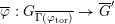 $\overline{\unicode[STIX]{x1D711}}:G_{\overline{\unicode[STIX]{x1D6E4}(\unicode[STIX]{x1D711}_{\text{tor}})}}\rightarrow \overline{G}^{\prime }$ restricts to the function
 $\unicode[STIX]{x1D711}_{\text{tor}}^{\ast }\unicode[STIX]{x1D706}_{v}^{\prime }:G(\mathbb{C})\rightarrow \mathbb{R}$ formally defined by (30). There exists a euclidean neighborhood
 $U$ of
 $\overline{\unicode[STIX]{x1D711}}(x)$ and a meromorphic function
 $f$ on
 $U$ with
 $\operatorname{div}(f)=(D_{v,0}^{\prime }-D_{v,\infty }^{\prime })|_{U}$ such that
 $\unicode[STIX]{x1D706}_{v}^{\prime }+\log |f|$ extends to a smooth function
 $\unicode[STIX]{x1D6FC}$ on
 $U$. On
 $G(\mathbb{C})\cap \overline{\unicode[STIX]{x1D711}}^{-1}(U)\subset G_{\overline{\unicode[STIX]{x1D6E4}(\unicode[STIX]{x1D711}_{\text{tor}})}}(\mathbb{C})$, we have
 $$\begin{eqnarray}\displaystyle \unicode[STIX]{x1D711}_{\text{tor}}^{\ast }\unicode[STIX]{x1D706}_{v}^{\prime }=\unicode[STIX]{x1D706}_{v}^{\prime }\circ \overline{\unicode[STIX]{x1D711}}=-\log |f\circ \overline{\unicode[STIX]{x1D711}}|+(\unicode[STIX]{x1D6FC}\circ \overline{\unicode[STIX]{x1D711}}) & & \displaystyle \nonumber\end{eqnarray}$$
and thus
 $$\begin{eqnarray}\unicode[STIX]{x1D70C}_{v}^{\pm }=\frac{1+|f\circ \overline{\unicode[STIX]{x1D711}}|^{\mp 2m}e^{\pm 2m(\unicode[STIX]{x1D6FC}\circ \overline{\unicode[STIX]{x1D711}})}}{(1+|f\circ \overline{\unicode[STIX]{x1D711}}|^{\mp 2}e^{\pm 2(\unicode[STIX]{x1D6FC}\circ \overline{\unicode[STIX]{x1D711}})})^{m}}=\frac{|f\circ \overline{\unicode[STIX]{x1D711}}|^{\pm 2m}+e^{\pm 2m(\unicode[STIX]{x1D6FC}\circ \overline{\unicode[STIX]{x1D711}})}}{(|f\circ \overline{\unicode[STIX]{x1D711}}|^{\pm 2}+e^{\pm 2(\unicode[STIX]{x1D6FC}\circ \overline{\unicode[STIX]{x1D711}})})^{m}}.\end{eqnarray}$$
Since  $\operatorname{supp}(D_{v,0}^{\prime })\cap \operatorname{supp}(D_{v,\infty }^{\prime })=\emptyset$, we have
 $x\notin \operatorname{supp}(D_{v,0}^{\prime })$ or
 $x\notin \operatorname{supp}(D_{v,\infty }^{\prime })$. Shrinking
 $U$ if necessary, we may hence assume that
 $f$ or
 $f^{-1}$ is holomorphic on
 $U$. In either case, (35) yields a smooth extension of
 $\unicode[STIX]{x1D70C}_{v}^{\pm }$ on
 $\overline{\unicode[STIX]{x1D711}}^{-1}(U)$. By uniqueness, these extensions glue together to a smooth function
 $\widetilde{\unicode[STIX]{x1D70C}}_{v}^{\pm }:G_{\overline{\unicode[STIX]{x1D6E4}(\unicode[STIX]{x1D711}_{\text{tor}})}}(\mathbb{C})\rightarrow \mathbb{R}^{{>}0}$. (In fact,
 $\widetilde{\unicode[STIX]{x1D70C}}_{v}^{\pm }(x)=1$ for all
 $x\in \operatorname{supp}(D_{v,0}^{\prime })(\mathbb{C})\cup \operatorname{supp}(D_{v,\infty }^{\prime })(\mathbb{C})$ because
 $(1+e^{mx})/(1+e^{x})^{m}\rightarrow 1$ if
 $x\rightarrow \pm \infty$.) In addition,
 $$\begin{eqnarray}\widetilde{\unicode[STIX]{x1D714}}(m\cdot \unicode[STIX]{x1D711}_{\text{tor}})-m\widetilde{\unicode[STIX]{x1D714}}(\unicode[STIX]{x1D711}_{\text{tor}})=\frac{1}{2}\mathop{\sum }_{v=1}^{t^{\prime }}(dd^{c}\log (\widetilde{\unicode[STIX]{x1D70C}}_{v}^{+})+dd^{c}\log (\widetilde{\unicode[STIX]{x1D70C}}_{v}^{-}));\end{eqnarray}$$
indeed, this equality is obvious on  $G(\mathbb{C})$ and any
 $(1,1)$-form on
 $G(\mathbb{C})$ has at most one smooth extension to the compactification
 $G_{\overline{\unicode[STIX]{x1D6E4}(\unicode[STIX]{x1D711}_{\text{tor}})}}(\mathbb{C})$. We deduce from (36) that
 $\widetilde{\unicode[STIX]{x1D714}}(m\cdot \unicode[STIX]{x1D711}_{\text{tor}})-m\widetilde{\unicode[STIX]{x1D714}}(\unicode[STIX]{x1D711}_{\text{tor}})$ is exact and hence Stokes’ theorem [Reference Griffiths and HarrisGH94, p. 33] in combination with a partition of unity implies (34).
Now, let us consider a general  $\unicode[STIX]{x1D719}_{\text{tor}}\in \operatorname{Hom}_{\mathbb{Q}}(\mathbb{G}_{m}^{t},\mathbb{G}_{m}^{t^{\prime }})$ and a positive integer
 $n$ that is a denominator for
 $\unicode[STIX]{x1D719}_{\text{tor}}$ (i.e.,
 $n\cdot \unicode[STIX]{x1D719}_{\text{tor}}\in \operatorname{Hom}(\mathbb{G}_{m}^{t},\mathbb{G}_{m}^{t^{\prime }})$). Setting
 $Y=[n]^{-1}(X)$, the restriction
 $[n]|_{Y}:Y\rightarrow X$ is finite étale of degree
 $n^{2\dim (A)+t}$. By functoriality (30), we have
 $[n]^{\ast }\unicode[STIX]{x1D714}(\unicode[STIX]{x1D719}_{\text{tor}})=\unicode[STIX]{x1D714}(n\cdot \unicode[STIX]{x1D719}_{\text{tor}})$ and
 $[n]^{\ast }\unicode[STIX]{x1D714}(m\cdot \unicode[STIX]{x1D719}_{\text{tor}})=\unicode[STIX]{x1D714}(m\cdot n\cdot \unicode[STIX]{x1D719}_{\text{tor}})$. We infer that
 $$\begin{eqnarray}\displaystyle n^{2\dim (A)+t}\int _{X(\mathbb{C})}\unicode[STIX]{x1D714}(m\cdot \unicode[STIX]{x1D719}_{\text{tor}})^{\wedge s_{1}}\wedge (\overline{\unicode[STIX]{x1D70B}}^{\ast }\unicode[STIX]{x1D71B})^{\wedge s_{2}}=\int _{Y(\mathbb{C})}\unicode[STIX]{x1D714}(m\cdot n\cdot \unicode[STIX]{x1D719}_{\text{tor}})^{\wedge s_{1}}\wedge (\overline{\unicode[STIX]{x1D70B}}^{\ast }[n]^{\ast }\unicode[STIX]{x1D71B})^{\wedge s_{2}} & & \displaystyle \nonumber\end{eqnarray}$$
and
 $$\begin{eqnarray}\displaystyle n^{2\dim (A)+t}\int _{X(\mathbb{C})}\unicode[STIX]{x1D714}(\unicode[STIX]{x1D719}_{\text{tor}})^{\wedge s_{1}}\wedge (\overline{\unicode[STIX]{x1D70B}}^{\ast }\unicode[STIX]{x1D71B})^{\wedge s_{2}}=\int _{Y(\mathbb{C})}\unicode[STIX]{x1D714}(n\cdot \unicode[STIX]{x1D719}_{\text{tor}})^{\wedge s_{1}}\wedge (\overline{\unicode[STIX]{x1D70B}}^{\ast }[n]^{\ast }\unicode[STIX]{x1D71B})^{\wedge s_{2}}. & & \displaystyle \nonumber\end{eqnarray}$$
Since  $n\cdot \unicode[STIX]{x1D719}_{\text{tor}}\in \operatorname{Hom}(\mathbb{G}_{m}^{t},\mathbb{G}_{m}^{t^{\prime }})$, this reduces the assertion of the lemma to the already proven special case.◻
5.2 ‘Abelian’ $(1,1)$-forms

This subsection is the ‘abelian’ equivalent of the last one and we introduce here  $(1,1)$-forms
 $\unicode[STIX]{x1D714}(N;\unicode[STIX]{x1D719}_{\text{ab}})$ analogous to the
 $(1,1)$-forms
 $\unicode[STIX]{x1D714}(\unicode[STIX]{x1D719}_{\text{tor}})$. In fact, we construct a
 $(1,1)$-form
 $\unicode[STIX]{x1D714}(N;\unicode[STIX]{x1D719}_{\text{ab}})$ on
 $A(\mathbb{C})$ for each
 $\unicode[STIX]{x1D719}_{\text{ab}}\in \operatorname{Hom}_{\mathbb{R}}(A,A^{\prime })$,
 $A$ and
 $A^{\prime }$ abelian varieties, and each ample line bundle
 $N$ on
 $A^{\prime }$. Having pullbacks from abelian quotients at our disposal, it suffices here to work on abelian varieties and the definition is technically less demanding.
Let  $\unicode[STIX]{x1D711}_{\text{ab}}:A\rightarrow A^{\prime }$ be a homomorphism of abelian varieties. We choose lattices
 $\unicode[STIX]{x1D6EC}\subseteq \mathbb{C}^{g}$,
 $g=\dim (A)$, and
 $\unicode[STIX]{x1D6EC}^{\prime }\subseteq \mathbb{C}^{g^{\prime }}$,
 $g^{\prime }=\dim (A^{\prime })$, such that
 $$\begin{eqnarray}\displaystyle \mathbb{C}^{g}{\twoheadrightarrow}\mathbb{C}^{g}/\unicode[STIX]{x1D6EC}=A(\mathbb{C})\quad \text{and}\quad \mathbb{C}^{g^{\prime }}{\twoheadrightarrow}\mathbb{C}^{g^{\prime }}/\unicode[STIX]{x1D6EC}^{\prime }=A^{\prime }(\mathbb{C}) & & \displaystyle \nonumber\end{eqnarray}$$
are universal coverings. In the following, each holomorphic tangent space  $T_{x}A(\mathbb{C})$,
 $x\in A(\mathbb{C})$, (respectively
 $T_{x}A^{\prime }(\mathbb{C})$,
 $x^{\prime }\in A^{\prime }(\mathbb{C})$,) is identified with
 $\mathbb{C}^{g}$ (respectively
 $\mathbb{C}^{g^{\prime }}$) by virtue of this quotient map. We write
 $\widetilde{\unicode[STIX]{x1D711}}_{\text{ab}}:\mathbb{C}^{g}\rightarrow \mathbb{C}^{g^{\prime }}$ for the lifting of
 $\unicode[STIX]{x1D711}_{\text{ab}}$ along the universal coverings.
Let  $N$ be an ample line bundle on
 $A^{\prime }$. The Appell–Humbert theorem (see e.g. [Reference Birkenhake and LangeBL04, § 2.2]) allows us to describe
 $N$ in terms of a pair
 $(H,\unicode[STIX]{x1D712})$ consisting of a hermitian form
 $H:\mathbb{C}^{g^{\prime }}\times \mathbb{C}^{g^{\prime }}\rightarrow \mathbb{C}$ such that
 $\text{Im}\,H(\unicode[STIX]{x1D6EC}^{\prime },\unicode[STIX]{x1D6EC}^{\prime })\subseteq \mathbb{Z}$ and a semicharacter
 $\unicode[STIX]{x1D712}:\unicode[STIX]{x1D6EC}^{\prime }\rightarrow S^{1}$ for
 $H$. It is well-known (cf. [Reference Birkenhake and LangeBL04, Exercise 2.6.2] and [Reference VoisinVoi07, Theorem 7.10]) that
 $N$ can be endowed with a metric
 $g$ such that the Chern form
 $c_{1}(\overline{N})$ of the hermitian line bundle
 $\overline{N}=(N,g)$ is given by
 $$\begin{eqnarray}\displaystyle c_{1}(\overline{N})_{x}:T_{\mathbb{R},x}A^{\prime }(\mathbb{C})\times T_{\mathbb{R},x}A^{\prime }(\mathbb{C})=\mathbb{C}^{g^{\prime }}\times \mathbb{C}^{g^{\prime }}\longrightarrow \mathbb{C},\quad (v,w)\longmapsto -\text{Im}(H)(v,w),\,x\in A^{\prime }(\mathbb{C}). & & \displaystyle \nonumber\\ \displaystyle & & \displaystyle\end{eqnarray}$$
Ampleness of  $N$ is equivalent to
 $H$ being positive definite [Reference Birkenhake and LangeBL04, Proposition 4.5.2], which is equivalent to
 $c_{1}(\overline{N})$ being a positive
 $(1,1)$-form. The pullback of
 $c_{1}(\overline{N})$ along
 $\unicode[STIX]{x1D711}_{\text{ab}}$ is given by
 $$\begin{eqnarray}\displaystyle \unicode[STIX]{x1D711}_{\text{ab}}^{\ast }c_{1}(\overline{N})_{x}:T_{\mathbb{R},x}A(\mathbb{C})\times T_{\mathbb{R},x}A(\mathbb{C})=\mathbb{C}^{g}\times \mathbb{C}^{g}\longrightarrow \mathbb{C},\quad (v,w)\longmapsto -\text{Im}(H)(\widetilde{\unicode[STIX]{x1D711}}_{\text{ab}}(v),\widetilde{\unicode[STIX]{x1D711}}_{\text{ab}}(w)), & & \displaystyle \nonumber\\ \displaystyle & & \displaystyle\end{eqnarray}$$
for each  $x\in A(\mathbb{C})$. Lifting homomorphisms
 $A\rightarrow A^{\prime }$ to homomorphisms
 $\mathbb{C}^{g}\rightarrow \mathbb{C}^{g^{\prime }}$ of the universal coverings induces an injection
 $\operatorname{Hom}_{\mathbb{R}}(A,A^{\prime }){\hookrightarrow}\operatorname{Hom}_{\mathbb{R}}(\mathbb{C}^{g},\mathbb{C}^{g^{\prime }})$,
 $\unicode[STIX]{x1D719}_{\text{ab}}\mapsto \widetilde{\unicode[STIX]{x1D719}}_{\text{ab}}$. As in (31), the right-hand side of (38) is well-defined for any
 $\widetilde{\unicode[STIX]{x1D719}}_{\text{ab}}\in \operatorname{Hom}_{\mathbb{R}}(\mathbb{C}^{g},\mathbb{C}^{g^{\prime }})$. For an element
 $\unicode[STIX]{x1D719}_{\text{ab}}\in \operatorname{Hom}_{\mathbb{R}}(A,A^{\prime })$, we hence define the
 $(1,1)$-form
 $\unicode[STIX]{x1D714}(N;\unicode[STIX]{x1D719}_{\text{ab}})$ on
 $A$ by demanding
 $$\begin{eqnarray}\displaystyle \unicode[STIX]{x1D714}(N;\unicode[STIX]{x1D719}_{\text{ab}})_{x}:T_{\mathbb{R},x}A(\mathbb{C})\times T_{\mathbb{R},x}A(\mathbb{C})=\mathbb{C}^{g}\times \mathbb{C}^{g}\longrightarrow \mathbb{C},\quad (v,w)\longmapsto -\text{Im}(H)(\widetilde{\unicode[STIX]{x1D719}}_{\text{ab}}(v),\widetilde{\unicode[STIX]{x1D719}}_{\text{ab}}(w)), & & \displaystyle \nonumber\end{eqnarray}$$
for each  $x\in A(\mathbb{C})$. Since
 $c_{1}(\overline{N})$ is positive and of real type,
 $\unicode[STIX]{x1D714}(N;\unicode[STIX]{x1D719}_{\text{ab}})$ is semipositive and of real type as well. In addition,
 $\unicode[STIX]{x1D714}(N;\unicode[STIX]{x1D719}_{\text{ab}})$ only depends on
 $\unicode[STIX]{x1D719}_{\text{ab}}$ and the hermitian form
 $H$ associated with
 $N$ (i.e., the Néron–Severi class of
 $N$) but we have no use for this fact in the following. Yet again, the assignment
 $\unicode[STIX]{x1D719}_{\text{ab}}\mapsto \unicode[STIX]{x1D714}(N;\unicode[STIX]{x1D719}_{\text{ab}})$ is continuous with respect to the usual topologies. Finally, there is the obvious homogeneity relation
 $$\begin{eqnarray}\unicode[STIX]{x1D714}(N;n\cdot \unicode[STIX]{x1D719}_{\text{ab}})=n^{2}\cdot \unicode[STIX]{x1D714}(N;\unicode[STIX]{x1D719}_{\text{ab}}).\end{eqnarray}$$
6 Distributions, analytic subgroups, and Ax’s theorem
In general, the  $(1,1)$-forms
 $\unicode[STIX]{x1D714}(\unicode[STIX]{x1D719}_{\text{tor}})$ and
 $\unicode[STIX]{x1D714}(N;\unicode[STIX]{x1D719}_{\text{ab}})$ introduced in § 5 have no realization as Chern forms of hermitian line bundles. As we show in this section, they nevertheless convey geometric information and are closely connected to the group structure of the semiabelian variety.
Once again, we consider a semiabelian variety  $G$ with abelian quotient
 $\unicode[STIX]{x1D70B}:G\rightarrow A$ and toric part
 $T=\mathbb{G}_{m}^{t}$. Let
 $t^{\prime }$ be a non-negative integer,
 $A^{\prime }$ an abelian variety and
 $N$ an ample line bundle on
 $A^{\prime }$. For each
 $\unicode[STIX]{x1D719}_{\text{tor}}\in \operatorname{Hom}_{\mathbb{R}}(\mathbb{G}_{m}^{t},\mathbb{G}_{m}^{t^{\prime }})$ (respectively
 $\unicode[STIX]{x1D719}_{\text{ab}}\in \operatorname{Hom}_{\mathbb{R}}(A,A^{\prime })$), we have a semipositive
 $(1,1)$-form
 $\unicode[STIX]{x1D714}(\unicode[STIX]{x1D719}_{\text{tor}})$ (respectively
 $\unicode[STIX]{x1D70B}^{\ast }\unicode[STIX]{x1D714}(N;\unicode[STIX]{x1D719}_{\text{ab}})$) of real type on
 $G(\mathbb{C})$. Set
 $$\begin{eqnarray}\displaystyle \unicode[STIX]{x1D714}=c\cdot \unicode[STIX]{x1D714}(\unicode[STIX]{x1D719}_{\text{tor}})+\unicode[STIX]{x1D70B}^{\ast }\unicode[STIX]{x1D714}(N;\unicode[STIX]{x1D719}_{\text{ab}}) & & \displaystyle \nonumber\end{eqnarray}$$
for some arbitrary positive constant  $c>0$. (The flexibility provided by
 $c$ is needed later in the proof of Lemma 29 in order to remedy the fact that there is no ample line bundle on a general semiabelian variety that is homogeneous with respect to the multiplication-by-
 $n$ map
 $[n]$.) Since
 $g_{\unicode[STIX]{x1D714}(\unicode[STIX]{x1D719}_{\text{tor}})}$ and
 $g_{\unicode[STIX]{x1D70B}^{\ast }\unicode[STIX]{x1D714}(N;\unicode[STIX]{x1D719}_{\text{ab}})}$ are positive semidefinite, we infer from (26) that
 $$\begin{eqnarray}\ker (\unicode[STIX]{x1D714}_{x})=\ker (\unicode[STIX]{x1D714}(\unicode[STIX]{x1D719}_{\text{tor}})_{x})\cap \ker (\unicode[STIX]{x1D70B}^{\ast }\unicode[STIX]{x1D714}(N;\unicode[STIX]{x1D719}_{\text{ab}})_{x})\subseteq T_{\mathbb{R},x}G(\mathbb{C})\end{eqnarray}$$
for each  $x\in G(\mathbb{C})$. In addition,
 $\unicode[STIX]{x1D714}(I(\cdot ),I(\cdot ))=\unicode[STIX]{x1D714}(\cdot ,\cdot )$ implies that
 $\ker (\unicode[STIX]{x1D714}(\unicode[STIX]{x1D719}_{\text{tor}})_{x})$ is invariant under
 $I$. In fact, both
 $\ker (\unicode[STIX]{x1D714}(\unicode[STIX]{x1D719}_{\text{tor}})_{x})$ and
 $\ker (\unicode[STIX]{x1D714}(N;\unicode[STIX]{x1D719}_{\text{ab}})_{x})$ are
 $I$-invariant for the same reason. Under our standing identification of
 $T_{\mathbb{R}}G(\mathbb{C})$ and
 $T_{\mathbb{C}}^{1,0}G(\mathbb{C})$, this means that
 $\ker (\unicode[STIX]{x1D714}_{x})$ is a
 $\mathbb{C}$-linear subspace of
 $T_{\mathbb{C},x}^{1,0}G(\mathbb{C})$. Our next observation is that this yields a left-invariant holomorphic distribution (i.e., a holomorphic vector subbundle)
 $\ker (\unicode[STIX]{x1D714})\subset T_{\mathbb{C}}^{1,0}G(\mathbb{C})$, which is a straightforward consequence of the lemma below.
Lemma 18. For every  $x,y\in G(\mathbb{C})$, we have
 $(dl_{y})_{x}\ker (\unicode[STIX]{x1D714}_{x})=\ker (\unicode[STIX]{x1D714}_{y+x})$.
Proof. Because of (40), it suffices to prove that
 $$\begin{eqnarray}\displaystyle (dl_{y})_{x}\ker (\unicode[STIX]{x1D714}(\unicode[STIX]{x1D719}_{\text{tor}})_{x})=\ker (\unicode[STIX]{x1D714}(\unicode[STIX]{x1D719}_{\text{tor}})_{y+x})\quad \text{and}\quad (dl_{y})_{x}\ker (\unicode[STIX]{x1D70B}^{\ast }\unicode[STIX]{x1D714}(N;\unicode[STIX]{x1D719}_{\text{ab}})_{x})=\ker (\unicode[STIX]{x1D70B}^{\ast }\unicode[STIX]{x1D714}(N;\unicode[STIX]{x1D719}_{\text{ab}})_{y+x}) & & \displaystyle \nonumber\\ \displaystyle & & \displaystyle\end{eqnarray}$$
for all  $x,y\in G(\mathbb{C})$. The latter equality is a direct consequence of the fact that the Chern form
 $c_{1}(\overline{N})$ on
 $A^{\prime }(\mathbb{C})$ is translation-invariant, which can be read off from (37). Using (23), we see that (32) implies
 $$\begin{eqnarray}\displaystyle g_{\unicode[STIX]{x1D714}(\unicode[STIX]{x1D719}_{\text{tor}})}=\mathop{\sum }_{v=1}^{t^{\prime }}\frac{\unicode[STIX]{x2202}\unicode[STIX]{x1D719}_{\text{tor}}^{\ast }\unicode[STIX]{x1D706}_{v}^{\prime }\otimes \overline{\unicode[STIX]{x2202}}\unicode[STIX]{x1D719}_{\text{tor}}^{\ast }\unicode[STIX]{x1D706}_{v}^{\prime }+\overline{\unicode[STIX]{x2202}}\unicode[STIX]{x1D719}_{\text{tor}}^{\ast }\unicode[STIX]{x1D706}_{v}^{\prime }\otimes \unicode[STIX]{x2202}\unicode[STIX]{x1D719}_{\text{tor}}^{\ast }\unicode[STIX]{x1D706}_{v}^{\prime }}{2\unicode[STIX]{x1D70B}(1+e^{2\unicode[STIX]{x1D719}_{\text{tor}}^{\ast }\unicode[STIX]{x1D706}_{v}^{\prime }})(1+e^{-2\unicode[STIX]{x1D719}_{\text{tor}}^{\ast }\unicode[STIX]{x1D706}_{v}^{\prime }})}. & & \displaystyle \nonumber\end{eqnarray}$$
By Lemma 15, each  $\unicode[STIX]{x2202}\unicode[STIX]{x1D719}_{\text{tor}}^{\ast }\unicode[STIX]{x1D706}_{v}^{\prime }\otimes \overline{\unicode[STIX]{x2202}}\unicode[STIX]{x1D719}_{\text{tor}}^{\ast }\unicode[STIX]{x1D706}_{v}^{\prime }+\overline{\unicode[STIX]{x2202}}\unicode[STIX]{x1D719}_{\text{tor}}^{\ast }\unicode[STIX]{x1D706}_{v}^{\prime }\otimes \unicode[STIX]{x2202}\unicode[STIX]{x1D719}_{\text{tor}}^{\ast }\unicode[STIX]{x1D706}_{v}^{\prime }$ is a positive semidefinite bilinear form on
 $T_{x}G(\mathbb{C})$ and it follows by (26) that
 $$\begin{eqnarray}\displaystyle \ker (\unicode[STIX]{x1D714}(\unicode[STIX]{x1D719}_{\text{tor}}))=\mathop{\bigcap }_{v=1}^{t^{\prime }}\ker (\unicode[STIX]{x2202}\unicode[STIX]{x1D719}_{\text{tor}}^{\ast }\unicode[STIX]{x1D706}_{v}^{\prime }\otimes \overline{\unicode[STIX]{x2202}}\unicode[STIX]{x1D719}_{\text{tor}}^{\ast }\unicode[STIX]{x1D706}_{v}^{\prime }+\overline{\unicode[STIX]{x2202}}\unicode[STIX]{x1D719}_{\text{tor}}^{\ast }\unicode[STIX]{x1D706}_{v}^{\prime }\otimes \unicode[STIX]{x2202}\unicode[STIX]{x1D719}_{\text{tor}}^{\ast }\unicode[STIX]{x1D706}_{v}^{\prime }). & & \displaystyle \nonumber\end{eqnarray}$$
In addition, (25) implies that
 $$\begin{eqnarray}\displaystyle \ker ((\unicode[STIX]{x2202}\unicode[STIX]{x1D719}_{\text{tor}}^{\ast }\unicode[STIX]{x1D706}_{v}^{\prime }\otimes \overline{\unicode[STIX]{x2202}}\unicode[STIX]{x1D719}_{\text{tor}}^{\ast }\unicode[STIX]{x1D706}_{v}^{\prime }+\overline{\unicode[STIX]{x2202}}\unicode[STIX]{x1D719}_{\text{tor}}^{\ast }\unicode[STIX]{x1D706}_{v}^{\prime }\otimes \unicode[STIX]{x2202}\unicode[STIX]{x1D719}_{\text{tor}}^{\ast }\unicode[STIX]{x1D706}_{v}^{\prime })_{x})=\{w\in T_{\mathbb{R},x}G(\mathbb{C})\mid \unicode[STIX]{x2202}\unicode[STIX]{x1D719}_{\text{tor}}^{\ast }\unicode[STIX]{x1D706}_{v}^{\prime }(w)\cdot \overline{\unicode[STIX]{x2202}}\unicode[STIX]{x1D719}_{\text{tor}}^{\ast }\unicode[STIX]{x1D706}_{v}^{\prime }(w)=0\}. & & \displaystyle \nonumber\end{eqnarray}$$
Since each  $\unicode[STIX]{x1D719}_{\text{tor}}^{\ast }\unicode[STIX]{x1D706}_{v}^{\prime }$ is real-valued, we have
 $\overline{\unicode[STIX]{x2202}\unicode[STIX]{x1D719}_{\text{tor}}^{\ast }\unicode[STIX]{x1D706}_{v}^{\prime }(v)}=\overline{\unicode[STIX]{x2202}}\unicode[STIX]{x1D719}_{\text{tor}}^{\ast }\unicode[STIX]{x1D706}_{v}^{\prime }(v)$ and thus
 $$\begin{eqnarray}\displaystyle \ker ((\unicode[STIX]{x2202}\unicode[STIX]{x1D719}_{\text{tor}}^{\ast }\unicode[STIX]{x1D706}_{v}^{\prime }\otimes \overline{\unicode[STIX]{x2202}}\unicode[STIX]{x1D719}_{\text{tor}}^{\ast }\unicode[STIX]{x1D706}_{v}^{\prime }+\overline{\unicode[STIX]{x2202}}\unicode[STIX]{x1D719}_{\text{tor}}^{\ast }\unicode[STIX]{x1D706}_{v}^{\prime }\otimes \unicode[STIX]{x2202}\unicode[STIX]{x1D719}_{\text{tor}}^{\ast }\unicode[STIX]{x1D706}_{v}^{\prime })_{x}) & = & \displaystyle \{w\in T_{\mathbb{R},x}G_{0}(\mathbb{C})\mid \unicode[STIX]{x2202}\unicode[STIX]{x1D719}_{\text{tor}}^{\ast }\unicode[STIX]{x1D706}_{v}^{\prime }(w)=0\}\nonumber\\ \displaystyle & = & \displaystyle \ker (\unicode[STIX]{x2202}\unicode[STIX]{x1D719}_{\text{tor}}^{\ast }\unicode[STIX]{x1D706}_{v}^{\prime }).\nonumber\end{eqnarray}$$
Note that  $(\unicode[STIX]{x2202}\unicode[STIX]{x1D719}_{\text{tor}}^{\ast }\unicode[STIX]{x1D706}_{v}^{\prime })_{x}$ is a
 $\mathbb{R}$-linear map
 $T_{\mathbb{R},x}G(\mathbb{C})\rightarrow \mathbb{C}$. As each
 $\unicode[STIX]{x1D706}_{v}^{\prime }$ is a homomorphism, we have
 $(\unicode[STIX]{x1D719}_{\text{tor}}^{\ast }\unicode[STIX]{x1D706}_{v}^{\prime }\circ l_{y})(\cdot )=\unicode[STIX]{x1D719}_{\text{tor}}^{\ast }\unicode[STIX]{x1D706}_{v}^{\prime }(\cdot )+\unicode[STIX]{x1D719}_{\text{tor}}^{\ast }\unicode[STIX]{x1D706}_{v}^{\prime }(y)$ and therefore
 $\unicode[STIX]{x2202}(\unicode[STIX]{x1D719}_{\text{tor}}^{\ast }\unicode[STIX]{x1D706}_{v}^{\prime }\circ l_{y})=\unicode[STIX]{x2202}\unicode[STIX]{x1D719}_{\text{tor}}^{\ast }\unicode[STIX]{x1D706}_{v}^{\prime }$. We infer
 $$\begin{eqnarray}\displaystyle (dl_{y})\ker (\unicode[STIX]{x2202}\unicode[STIX]{x1D719}_{\text{tor}}^{\ast }\unicode[STIX]{x1D706}_{v}^{\prime })_{x}=\ker (\unicode[STIX]{x2202}(\unicode[STIX]{x1D719}_{\text{tor}}^{\ast }\unicode[STIX]{x1D706}_{v}^{\prime }\circ l_{y}))_{y+x}=\ker (\unicode[STIX]{x2202}\unicode[STIX]{x1D719}_{\text{tor}}^{\ast }\unicode[STIX]{x1D706}_{v}^{\prime })_{y+x}, & & \displaystyle \nonumber\end{eqnarray}$$
and thus establish the first equation of (41). ◻
Having proven translation-invariance, we can easily determine the rank of  $\ker (\unicode[STIX]{x1D714})$ by determining the dimension of
 $\ker (\unicode[STIX]{x1D714}_{e})$. We do this next under some surjectivity assumption on
 $\unicode[STIX]{x1D719}_{\text{tor}}$ and
 $\unicode[STIX]{x1D719}_{\text{ab}}$. To describe this assumption, we recall that the complex exponential map gives a universal covering
 $\mathbb{C}\rightarrow \mathbb{G}_{m}(\mathbb{C})$. Taking products, we obtain universal coverings
 $\mathbb{C}^{t}\rightarrow \mathbb{G}_{m}^{t}(\mathbb{C})$ and
 $\mathbb{C}^{t^{\prime }}\rightarrow \mathbb{G}_{m}^{t^{\prime }}(\mathbb{C})$. Each homomorphism
 $\unicode[STIX]{x1D711}_{\text{tor}}\in \operatorname{Hom}(\mathbb{G}_{m}^{t},\mathbb{G}_{m}^{t^{\prime }})$ lifts to a linear map
 $\widetilde{\unicode[STIX]{x1D711}}_{\text{tor}}:\mathbb{C}^{t}\rightarrow \mathbb{C}^{t^{\prime }}$ (cf. [Reference WarnerWar83, Theorems 3.25 and 3.27]). Tensoring with
 $\mathbb{R}$, we obtain an injection
 $\operatorname{Hom}_{\mathbb{R}}(\mathbb{G}_{m}^{t},\mathbb{G}_{m}^{t^{\prime }}){\hookrightarrow}\operatorname{Hom}_{\mathbb{R}}(\mathbb{C}^{t},\mathbb{C}^{t^{\prime }})$,
 $\unicode[STIX]{x1D719}_{\text{tor}}\mapsto \widetilde{\unicode[STIX]{x1D719}}_{\text{tor}}$, and set
 $$\begin{eqnarray}\displaystyle \operatorname{Hom}_{\mathbb{R}}^{\circ }(\mathbb{G}_{m}^{t},\mathbb{G}_{m}^{t^{\prime }})=\{\unicode[STIX]{x1D719}_{\text{tor}}\in \operatorname{Hom}_{\mathbb{R}}(\mathbb{G}_{m}^{t},\mathbb{G}_{m}^{t^{\prime }})\mid \widetilde{\unicode[STIX]{x1D719}}_{\text{tor}}~\text{is surjective}\}. & & \displaystyle \nonumber\end{eqnarray}$$
In § 5.2, we have associated with each  $\unicode[STIX]{x1D719}_{\text{ab}}\in \operatorname{Hom}(A,A^{\prime })$ a linear map
 $\widetilde{\unicode[STIX]{x1D719}}_{\text{ab}}:\mathbb{C}^{g}\rightarrow \mathbb{C}^{g^{\prime }}$ and we define similarly
 $$\begin{eqnarray}\displaystyle \operatorname{Hom}_{\mathbb{R}}^{\circ }(A,A^{\prime })=\{\unicode[STIX]{x1D719}_{\text{ab}}\in \operatorname{Hom}_{\mathbb{R}}(A,A^{\prime })\mid \widetilde{\unicode[STIX]{x1D719}}_{\text{ab}}~\text{is surjective}\}. & & \displaystyle \nonumber\end{eqnarray}$$
Lemma 19. If  $\unicode[STIX]{x1D719}_{\text{tor}}\in \operatorname{Hom}_{\mathbb{R}}^{\circ }(\mathbb{G}_{m}^{t},\mathbb{G}_{m}^{t^{\prime }})$ and
 $\unicode[STIX]{x1D719}_{\text{ab}}\in \operatorname{Hom}_{\mathbb{R}}^{\circ }(A,A^{\prime })$, then
 $\ker (\unicode[STIX]{x1D714})$ has rank
 $$\begin{eqnarray}\displaystyle (t-t^{\prime })+(\dim (A)-\dim (A^{\prime })) & & \displaystyle \nonumber\end{eqnarray}$$
(as a complex vector bundle).
Proof. First, we claim that there is the following commutative exact diagram.

Except for the surjectivity of  $\ker (\unicode[STIX]{x1D714}_{e})\rightarrow \ker (\unicode[STIX]{x1D714}(N;\unicode[STIX]{x1D719}_{\text{ab}})_{e})$, this is a direct consequence of semipositivity and (25). For surjectivity, it suffices to prove that there exists an
 $I$-invariant subspace
 $V\subset \ker (\unicode[STIX]{x1D714}(\unicode[STIX]{x1D719}_{\text{tor}})_{e})$ such that
 $$\begin{eqnarray}T_{\mathbb{R},e}T(\mathbb{C})\oplus V=T_{\mathbb{R},e}G(\mathbb{C}).\end{eqnarray}$$
Given such a decomposition, we can find for any  $v\in \ker (\unicode[STIX]{x1D714}(N;\unicode[STIX]{x1D719}_{\text{ab}})_{e})$ a
 $(d\unicode[STIX]{x1D70B})_{e}$-preimage
 $w\in V$. Furthermore, we have
 $$\begin{eqnarray}\displaystyle g_{\unicode[STIX]{x1D714},e}(w,w)=c\cdot g_{\unicode[STIX]{x1D714}(\unicode[STIX]{x1D719}_{\text{tor}}),e}(w,w)+g_{\unicode[STIX]{x1D70B}^{\ast }\unicode[STIX]{x1D714}(N;\unicode[STIX]{x1D719}_{\text{ab}}),e}(w,w)=g_{\unicode[STIX]{x1D714}(N;\unicode[STIX]{x1D719}_{\text{ab}}),e}(v,v)=0 & & \displaystyle \nonumber\end{eqnarray}$$
since  $w\in \ker (\unicode[STIX]{x1D714}(\unicode[STIX]{x1D719}_{\text{tor}})_{e})$ and
 $(d\unicode[STIX]{x1D70B})_{e}(w)=v\in \ker (\unicode[STIX]{x1D714}(N;\unicode[STIX]{x1D719}_{\text{ab}})_{e})$. Recall that the maximal compact subgroup
 $K_{G}\subset G(\mathbb{C})$ is a real Lie subgroup such that
 $\dim _{\mathbb{R}}(T_{\mathbb{R},e}K_{G})=2\dim (A)+t$.
We now claim that  $V=T_{\mathbb{R},e}K_{G}\cap I(T_{\mathbb{R},e}K_{G})\subset T_{\mathbb{R},e}G(\mathbb{C})$ is a suitable choice for (43). Since each Weil function
 $\unicode[STIX]{x1D706}_{u}$ (
 $1\leqslant u\leqslant t$) is constant zero on
 $K_{G}$, both the
 $(1,0)$-forms
 $\unicode[STIX]{x2202}\unicode[STIX]{x1D706}_{u}$ (
 $1\leqslant u\leqslant t$) and the
 $(0,1)$-forms
 $\overline{\unicode[STIX]{x2202}}\unicode[STIX]{x1D706}_{u}$ (
 $1\leqslant u\leqslant t$) have to vanish on
 $V$. This immediately implies that
 $V\subset \ker (\unicode[STIX]{x1D714}(\unicode[STIX]{x1D719}_{\text{tor}})_{e})$. We already know that
 $\unicode[STIX]{x1D706}_{u}|_{T(\mathbb{C})}=-\log |z_{u}|$ in standard coordinates
 $z_{1},\ldots ,z_{t}$ on
 $T(\mathbb{C})=\mathbb{G}_{m}^{t}(\mathbb{C})$. We compute that
 $$\begin{eqnarray}\unicode[STIX]{x2202}\unicode[STIX]{x1D706}_{u}|_{T_{\mathbb{R}}T(\mathbb{C})}=-dz_{u}/2z_{u}\quad \text{and}\quad \overline{\unicode[STIX]{x2202}}\unicode[STIX]{x1D706}_{u}|_{T_{\mathbb{R}}T(\mathbb{C})}=-d\overline{z}_{u}/2\overline{z}_{u}\quad (1\leqslant u\leqslant t),\end{eqnarray}$$
which shows that the restrictions of  $\unicode[STIX]{x2202}\unicode[STIX]{x1D706}_{1},\ldots ,\unicode[STIX]{x2202}\unicode[STIX]{x1D706}_{t},\overline{\unicode[STIX]{x2202}}\unicode[STIX]{x1D706}_{1}^{\prime },\ldots ,\overline{\unicode[STIX]{x2202}}\unicode[STIX]{x1D706}_{t}^{\prime }$ to
 $T_{\mathbb{R},e}T(\mathbb{C})$ form a
 $\mathbb{C}$-basis of
 $\operatorname{Hom}_{\mathbb{R}}(T_{\mathbb{R},e}T(\mathbb{C}),\mathbb{C})$. Since each of these forms vanishes on
 $V$ (see (28)), we have
 $$\begin{eqnarray}\displaystyle T_{\mathbb{R},e}T(\mathbb{C})\cap V=\{0\}. & & \displaystyle \nonumber\end{eqnarray}$$
As  $\dim _{\mathbb{R}}(V)=\dim _{\mathbb{R}}(T_{\mathbb{R},e}K_{G}\cap I(T_{\mathbb{R},e}K_{G}))\geqslant 2\dim (A)$, we obtain the direct sum decomposition (43).
Using (42), it remains to compute the dimensions of the  $I$-invariant
 $\mathbb{R}$-linear subspaces
 $\ker (\unicode[STIX]{x1D714}(\unicode[STIX]{x1D719}_{\text{tor}})|_{T_{\mathbb{R},e}T(\mathbb{C})})$ and
 $\ker (\unicode[STIX]{x1D714}(M;\unicode[STIX]{x1D719}_{\text{ab}})_{e})$. For the former one, let us represent a map
 $\widetilde{\unicode[STIX]{x1D719}}_{\text{tor}}\in \operatorname{Hom}_{\mathbb{R}}(\mathbb{C}^{t},\mathbb{C}^{t^{\prime }})$ as a matrix
 $(a_{uv})_{1\leqslant u\leqslant t,1\leqslant v\leqslant t^{\prime }}\in \mathbb{R}^{t\times t^{\prime }}$. As in the proof of Lemma 18 above, we have
 $$\begin{eqnarray}\displaystyle \ker (\unicode[STIX]{x1D714}(\unicode[STIX]{x1D719}_{\text{tor}})|_{T_{\mathbb{R},e}T(\mathbb{C})}) & = & \displaystyle \mathop{\bigcap }_{v=1}^{t^{\prime }}\ker ((a_{1v}\unicode[STIX]{x2202}\unicode[STIX]{x1D706}_{1}+\cdots +a_{tv}\unicode[STIX]{x2202}\unicode[STIX]{x1D706}_{t})|_{T_{\mathbb{R},e}T(\mathbb{C})})\nonumber\\ \displaystyle & = & \displaystyle \mathop{\bigcap }_{v=1}^{t^{\prime }}\ker (a_{1v}\,dz_{1}+\cdots +a_{tv}\,dz_{t}:T_{\mathbb{R},e}T(\mathbb{C})\rightarrow \mathbb{C}).\nonumber\end{eqnarray}$$
Setting  $dz_{i}=dx_{i}+i\,dy_{i}$ with
 $dx_{i},dy_{i}:T_{\mathbb{R},e}T(\mathbb{C})\rightarrow \mathbb{R}$, we can rewrite this as
 $$\begin{eqnarray}\displaystyle \ker (\unicode[STIX]{x1D714}(\unicode[STIX]{x1D719}_{\text{tor}})|_{T_{\mathbb{R},e}T(\mathbb{C})})=\mathop{\bigcap }_{v=1}^{t^{\prime }}\ker (a_{1v}\,dx_{1}+\cdots +a_{tv}\,dx_{t})\cap \mathop{\bigcap }_{i=1}^{t^{\prime }}\ker (a_{1v}\,dy_{1}+\cdots +a_{tv}\,dy_{t}). & & \displaystyle \nonumber\end{eqnarray}$$
The condition  $\unicode[STIX]{x1D719}_{\text{tor}}\in \operatorname{Hom}_{\mathbb{R}}^{\circ }(\mathbb{G}_{m}^{t},\mathbb{G}_{m}^{t^{\prime }})$ is equivalent to the matrix
 $(a_{uv})$ having maximal rank
 $t^{\prime }$. This implies that the
 $2t^{\prime }$ real-valued functionals
 $$\begin{eqnarray}\displaystyle a_{1v}\,dx_{1}+\cdots +a_{tv}\,dx_{t},a_{1v}\,dy_{1}+\cdots +a_{tv}\,dy_{t}\quad (1\leqslant v\leqslant t^{\prime }) & & \displaystyle \nonumber\end{eqnarray}$$
on  $T_{\mathbb{R},e}T(\mathbb{C})$ are
 $\mathbb{R}$-linearly independent. From this, we infer
 $$\begin{eqnarray}\displaystyle \dim _{\mathbb{R}}\ker (\unicode[STIX]{x1D714}(\unicode[STIX]{x1D719}_{\text{tor}})|_{T_{\mathbb{R},e}T(\mathbb{C})})=2(t-t^{\prime }). & & \displaystyle \nonumber\end{eqnarray}$$
For  $\ker (\unicode[STIX]{x1D714}(N;\unicode[STIX]{x1D719}_{\text{ab}})_{e})$, it follows directly from (38) that
 $$\begin{eqnarray}\displaystyle g_{\unicode[STIX]{x1D714}(N;\unicode[STIX]{x1D719}_{\text{ab}}),e}:T_{\mathbb{R},x}A(\mathbb{C})\times T_{\mathbb{R},x}A(\mathbb{C})=\mathbb{C}^{g}\times \mathbb{C}^{g}\longrightarrow \mathbb{C},\quad (v,w)\longmapsto \text{Re}(H)(\widetilde{\unicode[STIX]{x1D719}}_{\text{ab}}(v),\widetilde{\unicode[STIX]{x1D719}}_{\text{ab}}(w)) & & \displaystyle \nonumber\end{eqnarray}$$
(compare with (24)). Since  $H$ is positive definite, so is its real part
 $\text{Re}(H)$. Using (25), we deduce that
 $$\begin{eqnarray}\displaystyle \ker (\unicode[STIX]{x1D714}(N;\unicode[STIX]{x1D719}_{\text{ab}})_{e})=\widetilde{\unicode[STIX]{x1D719}}_{\text{ab}}^{-1}(\ker (\text{Re}(H)))=\widetilde{\unicode[STIX]{x1D719}}_{\text{ab}}^{-1}(\{0\})=\ker (\widetilde{\unicode[STIX]{x1D719}}_{\text{ab}}). & & \displaystyle \nonumber\end{eqnarray}$$
Finally,  $\unicode[STIX]{x1D719}_{\text{ab}}\in \operatorname{Hom}_{\mathbb{R}}^{\circ }(A,A^{\prime })$ implies that
 $\dim _{\mathbb{R}}\ker (\unicode[STIX]{x1D714}(N;\unicode[STIX]{x1D719}_{\text{ab}})_{e})=2(\dim (A)-\dim (A^{\prime }))$.◻
In summary, we have proven that  $\ker (\unicode[STIX]{x1D714})\subset T_{\mathbb{C}}^{1,0}G(\mathbb{C})$ is a left-invariant holomorphic distribution on
 $G(\mathbb{C})$. By the holomorphic Frobenius theorem [Reference VoisinVoi07, Theorem 2.26], the distribution
 $\ker (\unicode[STIX]{x1D714})$ is (holomorphically) integrable since the Lie bracket on
 $T_{\mathbb{C}}^{1,0}G(\mathbb{C})$ vanishes. In fact, the integral manifold of
 $\ker (\unicode[STIX]{x1D714})$ through a given point
 $x\in G(\mathbb{C})$ coincides with the analytic subgroup
 $x\cdot \exp _{G(\mathbb{C})}(\ker (\unicode[STIX]{x1D714})_{e})$ with
 $\exp _{G(\mathbb{C})}:T_{\mathbb{C}}^{1,0}G(\mathbb{C})\rightarrow G(\mathbb{C})$ being the Lie group exponential (cf. [Reference HelgasonHel01, Theorem II.1.7]).
As indicated in § 4, we are interested in determining when a submanifold  $Y\subset G(\mathbb{C})$ and a point
 $x\in Y(\mathbb{C})$ are such that
 $g_{\unicode[STIX]{x1D714}}|_{T_{\mathbb{R},x}Y}$ is positive definite. For this purpose, we introduce an elementary lemma about integrable (holomorphic) distributions.
Lemma 20. Let  $M$ be a complex manifold of dimension
 $n$,
 ${\mathcal{D}}\subset T_{\mathbb{C}}^{1,0}M$ an integrable holomorphic distribution of rank
 $m$ on
 $M$,
 $Z\subset M$ a
 $k$-dimensional analytic subvariety and
 $x$ a point on
 $Z$. Assume that there exists an open neighborhood
 $U\subset M$ of
 $x$ such that
 $\dim _{\mathbb{C}}({\mathcal{D}}\cap T_{\mathbb{C},y}^{1,0}Z)\geqslant l$ for any
 $y\in Z^{\text{sm}}\cap U$. Then, the integral submanifold
 $L\subset U$ of
 ${\mathcal{D}}$ through
 $x$ satisfies
 $\dim _{x}(L\cap Z)\geqslant l$.
Proof. By shrinking  $U$ if necessary, we can assume that there exists a holomorphic flat chart
 $f:U\rightarrow \mathbb{C}^{n-m}$ for
 ${\mathcal{D}}|_{U}$. Recall that this means that
 $f$ is a submersion and that each non-empty fiber of
 $f$ is an integral submanifold for
 ${\mathcal{D}}|_{U}$. By our assumption, the differential
 $$\begin{eqnarray}\displaystyle d(f|_{Z}):T_{\mathbb{C},y}^{1,0}Z\rightarrow \mathbb{C}^{n-m} & & \displaystyle \nonumber\end{eqnarray}$$
has rank  ${\leqslant}k-l$ for every
 $y\in Z^{\text{sm}}\cap U$. By [Reference GunningGun90b, Lemma L.6], the local dimension of any fiber
 $f|_{Z}^{-1}(f(y))=f^{-1}(f(y))\cap Z$,
 $y\in Z^{\text{sm}}\cap U$, is
 ${\geqslant}l$ everywhere. If
 $x$ is a smooth point of
 $Z$, this already implies
 $\dim _{x}(f^{-1}(f(x))\cap Z)\geqslant l$. For
 $x$ in the singular locus, we use also the upper semi-continuity of the fiber dimension [Reference GunningGun90b, Lemma L.2] to conclude the proof.◻
Finally, we are ready to use Ax’s theorem to show non-degeneracy in all cases of interest.
Lemma 21. Let  $X\subset G$ be an algebraic subvariety such that
 $X^{(s)}\neq X$ for some non-negative integer
 $s$. Then
 $(\unicode[STIX]{x1D714}|_{X})^{\wedge \dim (X)}\neq 0$ for every
 $(\unicode[STIX]{x1D719}_{\text{tor}},\unicode[STIX]{x1D719}_{\text{ab}})\in \operatorname{Hom}_{\mathbb{R}}^{\circ }(\mathbb{G}_{m}^{t},\mathbb{G}_{m}^{t^{\prime }})\times \operatorname{Hom}_{\mathbb{R}}^{\circ }(A,A^{\prime })$ with
 $t^{\prime }+\dim (A^{\prime })\geqslant s$.
Proof. Assume  $(\unicode[STIX]{x1D714}|_{X})^{\wedge \dim (X)}=0$, which means that
 $\dim _{\mathbb{C}}(\ker (\unicode[STIX]{x1D714}_{x})\cap T_{x}X)\geqslant 1$ for any
 $x\in X(\mathbb{C})$. For each
 $x\in X(\mathbb{C})$, let
 $L_{x}=x\cdot \exp _{G(\mathbb{C})}(\ker (\unicode[STIX]{x1D714}|_{e}))$ be the integral manifold of
 $\ker (\unicode[STIX]{x1D714})$ through
 $x$. By Lemma 19, the holomorphic distribution
 $\ker (\unicode[STIX]{x1D714})$ has rank
 ${\leqslant}\dim (G)-s$ and this is also the dimension of
 $L_{x}$. From Lemma 20, we know that
 $\dim _{x}(L_{x}\cap X(\mathbb{C}))\geqslant 1$. This is an intersection of an algebraic subvariety with an analytic subgroup in
 $G(\mathbb{C})$. Applying Ax’s theorem [Reference AxAx72, Corollary 1], we obtain for each
 $x\in X(\mathbb{C})$ an algebraic subgroup
 $H\subset G$ such that
 $X\subset xH$ and
 $$\begin{eqnarray}\displaystyle \dim (H)\leqslant \dim (X)+\dim (L_{x})-\dim _{x}(L_{x}\cap X(\mathbb{C}))<\dim (X)+\dim (G)-s. & & \displaystyle \nonumber\end{eqnarray}$$
A comparison with (1) shows that this implies that  $X$ is itself an
 $s$-anomalous variety, associated with
 $H$, and hence
 $X=X^{(s)}$.◻
7 Proof of Theorem 2
In this section, all algebraic groups are over  $\text{Spec}(\overline{\mathbb{Q}})$ without further mention. As usual,
 $T$ denotes the toric part of
 $G$ and
 $A$ the underlying abelian variety. Since our base field is
 $\overline{\mathbb{Q}}$, the torus
 $T$ is split and we keep fixed a splitting throughout this section (i.e., assume
 $T=\mathbb{G}_{m}^{t}$).
7.1 Reductions
We start with an elementary observation related to the ‘height cones’ introduced in (2). Let  $h,h^{\prime }:G(\overline{\mathbb{Q}})\rightarrow \mathbb{R}$ be functions satisfying
 $$\begin{eqnarray}c_{3}h^{\prime }(x)-c_{4}\leqslant h(x)\leqslant c_{5}h^{\prime }(x)+c_{6}\quad \text{and}\quad h^{\prime }(x_{1}+x_{2})\leqslant c_{7}(h^{\prime }(x_{1})+h^{\prime }(x_{2}))+c_{8}\end{eqnarray}$$
for all  $x,x_{1},x_{2}\in G(\overline{\mathbb{Q}})$ with constants
 $c_{i}>0$ (
 $i\in \{3,\ldots ,8\}$). For any subset
 $\unicode[STIX]{x1D6F4}\subseteq G(\overline{\mathbb{Q}})$ and any
 $\unicode[STIX]{x1D700}>0$, there is an inclusion
 $$\begin{eqnarray}\displaystyle C(\unicode[STIX]{x1D6F4},h^{\prime },\unicode[STIX]{x1D700}^{\prime })\subseteq C(\unicode[STIX]{x1D6F4},h,\unicode[STIX]{x1D700})\cup \{x\in G(\overline{\mathbb{Q}})\mid h^{\prime }(x)<c_{9}\} & & \displaystyle \nonumber\end{eqnarray}$$
with  $\unicode[STIX]{x1D700}^{\prime }=\unicode[STIX]{x1D700}c_{3}c_{5}^{-1}/2$ and some constant
 $c_{9}=c_{9}(c_{3},\ldots ,c_{8},\unicode[STIX]{x1D700},\unicode[STIX]{x1D700}^{\prime })$. We leave this straightforward computation to the reader.
Let  $\overline{G}$ be the compactification of
 $G$ and
 $M_{\overline{G}}$ the line bundle as in Construction 5. Furthermore, let
 $N$ be an ample symmetric line bundle on
 $A$. By Lemma 3,
 $L=M_{\overline{G}}\otimes \overline{\unicode[STIX]{x1D70B}}^{\ast }N$ is an ample line bundle on
 $\overline{G}$. For Theorem 2, it is sufficient to prove the boundedness of
 $h_{L}$ on
 $(X\setminus X^{(s)})(\overline{\mathbb{Q}})\cap C(G^{[s]}(\overline{\mathbb{Q}}),h_{L},\unicode[STIX]{x1D700})$. In fact, let
 $L^{\prime }$ be an arbitrary ample line bundle on an arbitrary compactification
 $\overline{G}^{\prime }$ of
 $G$ and
 $h_{L^{\prime }}$ an associated Weil height. Applying [Reference VojtaVoj99, Proposition 2.3] to the identity map
 $\operatorname{id}_{G}$, which gives a birational map
 $\overline{G}{\dashrightarrow}\overline{G}^{\prime }$, and the line bundles
 $L$ and
 $L^{\prime }$ we obtain the first two inequalities in (45). The third inequality follows from applying the same proposition to the group law
 $+_{G}$, understood as a rational map
 $\overline{G}^{\prime }\times \overline{G}^{\prime }{\dashrightarrow}\overline{G}^{\prime }$. We may thus use our above observation to ensure the asserted reduction. Considering also Lemma 8(a), we see that it even suffices to prove that
 $\widehat{h}_{L}=\widehat{h}_{M_{\overline{G}}}+\widehat{h}_{N}:G(\overline{\mathbb{Q}})\rightarrow \mathbb{R}^{{\geqslant}0}$ is bounded from above on
 $(X\setminus X^{(s)})(\overline{\mathbb{Q}})\cap C(G^{[s]}(\overline{\mathbb{Q}}),\widehat{h}_{L},\unicode[STIX]{x1D700})$.
Our last reduction step is to note that Theorem 2 is easily inferred from the following proposition, which is shown in the remaining parts of § 7.
Proposition 22. Let  $X\subseteq G$ be an irreducible Zariski closed subset of positive dimension such that
 $X^{(s)}\neq X$. Then, there exists a non-empty Zariski open subset
 $U\subseteq X$ and some
 $\unicode[STIX]{x1D700}>0$ such that
 $\widehat{h}_{L}$ is bounded on
 $U\cap C(G^{[s]}(\overline{\mathbb{Q}}),\widehat{h}_{L},\unicode[STIX]{x1D700})$.
Proof of Theorem 2 (using Proposition 22).
We perform an induction on  $\dim (X)$. Theorem 2 is clearly trivial if
 $X$ has dimension zero, which starts our induction. Assume now that
 $X$ is positive dimensional and that the assertion of the theorem, with
 $h_{L}$ replaced by
 $\widehat{h}_{L}$, is already known for any
 $X^{\prime }$ with
 $\dim (X^{\prime })<\dim (X)$. Without loss of generality, we can additionally assume that
 $X$ is irreducible and that
 $X^{(s)}\neq X$. Applying Proposition 22 to
 $X$, we obtain a non-empty Zariski open subset
 $U\subseteq X$ and a real number
 $\unicode[STIX]{x1D700}>0$ such that
 $\widehat{h}_{L}$ is bounded on
 $U(\overline{\mathbb{Q}})\cap C(G^{[s]}(\overline{\mathbb{Q}}),\widehat{h}_{L},\unicode[STIX]{x1D700})$. Now,
 $X^{\prime }=X\setminus U$ has dimension strictly less than
 $\dim (X)$ so that we may apply our inductive hypothesis to
 $X^{\prime }$. We obtain that
 $\widehat{h}_{L}$ is bounded on
 $(X^{\prime }\setminus (X^{\prime })^{(s)})(\overline{\mathbb{Q}})\cap C(G^{[s]}(\overline{\mathbb{Q}}),\widehat{h}_{L},\unicode[STIX]{x1D700}^{\prime })$ for some
 $\unicode[STIX]{x1D700}^{\prime }>0$. In conclusion, we know that
 $\widehat{h}_{L}$ is bounded on
 $$\begin{eqnarray}\displaystyle (X\setminus (X^{\prime })^{(s)})(\overline{\mathbb{Q}})\cap C(G^{[s]}(\overline{\mathbb{Q}}),\widehat{h}_{L},\min \{\unicode[STIX]{x1D700},\unicode[STIX]{x1D700}^{\prime }\}). & & \displaystyle \nonumber\end{eqnarray}$$
As  $(X^{\prime })^{(s)}\subseteq X^{(s)}$ by (1), this yields the assertion of Theorem 2 for
 $X$.◻
7.2 Approximating homomorphisms
The following lemma is useful for reducing the proof of the main theorem to a manageable situation.
Lemma 23. There exist finitely many abelian varieties  $A_{1}^{\prime },\ldots ,A_{j_{0}}^{\prime }$ (depending on
 $s$) such that each
 $x\in G^{[s]}(\overline{\mathbb{Q}})$ is contained in the kernel of some surjective homomorphism
 $\unicode[STIX]{x1D711}:G\rightarrow G^{\prime }$,
 $\dim (G^{\prime })\geqslant s$, that is represented (as in Lemma 1) by the following diagram.

As  $\unicode[STIX]{x1D711}_{\text{tor}}$ is surjective, we clearly have
 $t^{\prime }\leqslant t$.
Proof. Evidently, if  $x\in H(\overline{\mathbb{Q}})$ with
 $\operatorname{codim}_{G}(H)\geqslant s$ then
 $x$ is in the kernel of the quotient
 $\unicode[STIX]{x1D70B}:G\rightarrow G/H$. The toric part of
 $G/H$ can be identified with
 $\mathbb{G}_{m}^{t^{\prime }}$. The abelian component
 $\unicode[STIX]{x1D70B}_{\text{ab}}:A\rightarrow B$ of
 $\unicode[STIX]{x1D70B}$ is surjective. By Poincaré’s complete reducibility theorem [Reference MumfordMum70a, Theorem 1 on p. 173], there exist only finitely many quotients
 $A\rightarrow A_{j}^{\prime }$,
 $1\leqslant j\leqslant j_{0}$, up to isogeny. In particular, there exists an isogeny
 $\unicode[STIX]{x1D713}:B\rightarrow A_{j}^{\prime }$ for some
 $j^{\prime }\in \{1,\ldots ,j_{0}\}$. By Lemma 2, there exists a semiabelian variety
 $G^{\prime }$ and a unique homomorphism
 $\unicode[STIX]{x1D713}^{\prime }:G/H\rightarrow G^{\prime }$ with toric part
 $\text{id}_{\mathbb{G}_{m}^{t^{\prime }}}$ and abelian part
 $\unicode[STIX]{x1D713}$. We can take
 $\unicode[STIX]{x1D711}=\unicode[STIX]{x1D713}^{\prime }\circ \unicode[STIX]{x1D70B}$.◻
If  $G$ is an abelian variety, Poincaré’s complete reducibility theorem yields immediately the existence of finitely many quotients
 $\unicode[STIX]{x1D711}_{i}:G\rightarrow G_{i}$,
 $\dim (G_{i})\geqslant s$, such that each
 $x\in G^{[s]}(\overline{\mathbb{Q}})$ is contained in the kernel of some
 $\unicode[STIX]{x1D711}_{i}$. In addition, if
 $G$ is a torus a similar statement is true for more trivial reasons. Nevertheless, the analogous statement is false for general semiabelian varieties as simple examples show.Footnote 8 Our lemma is optimal in the general case.
By Lemma 1, we may associate with each  $\unicode[STIX]{x1D711}\in \operatorname{Hom}(G,G^{\prime })$ as in Lemma 23 a pair
 $$\begin{eqnarray}\displaystyle (\unicode[STIX]{x1D711}_{\text{tor}},\unicode[STIX]{x1D711}_{\text{ab}})\in \operatorname{Hom}(\mathbb{G}_{m}^{t},\mathbb{G}_{m}^{t^{\prime }})\times \operatorname{Hom}(A,A_{j}^{\prime }),\quad t^{\prime }\in \{0,\ldots ,t\},\,j\in \{1,\ldots ,j_{0}\}. & & \displaystyle \nonumber\end{eqnarray}$$
This allows us to concentrate on a finite number of fixed finite rank  $\mathbb{Z}$-modules
 $$\begin{eqnarray}V^{(t^{\prime },j)}=\operatorname{Hom}(\mathbb{G}_{m}^{t},\mathbb{G}_{m}^{t^{\prime }})\times \operatorname{Hom}(A,A_{j}^{\prime }),\quad t^{\prime }\in \{0,\ldots ,t\},\,j\in \{1,\ldots ,j_{0}\},\end{eqnarray}$$
instead of infinitely many different  $\operatorname{Hom}(G,G^{\prime })$. We study now one of these modules separately and drop the superscripts, writing
 $V$ instead of
 $V^{(t^{\prime },j)}$. As
 $V$ is a free
 $\mathbb{Z}$-module, it embeds into
 $V_{\mathbb{Q}}=V\otimes _{\mathbb{Z}}\mathbb{Q}$ and
 $V_{\mathbb{R}}=V\otimes _{\mathbb{Z}}\mathbb{R}$. Furthermore, a quasi-homomorphism
 $\unicode[STIX]{x1D719}\in \operatorname{Hom}_{\mathbb{Q}}(G,G^{\prime })$ determines a pair
 $(\unicode[STIX]{x1D719}_{\text{tor}},\unicode[STIX]{x1D719}_{\text{ab}})\in V_{\mathbb{Q}}$. However, the relation between elements
 $(\unicode[STIX]{x1D719}_{\text{tor}},\unicode[STIX]{x1D719}_{\text{ab}})\in V_{\mathbb{Q}}$ and actual quasi-homomorphisms
 $\unicode[STIX]{x1D719}:G\rightarrow _{\mathbb{Q}}G^{\prime }$ of semiabelian varieties is quite intricate. The reader is referred to § 8 for details. As witnessed by the results of § 6, we have a special interest in pairs that are contained in
 $$\begin{eqnarray}\displaystyle V_{\mathbb{R}}^{\circ }=\operatorname{Hom}_{\mathbb{R}}^{\circ }(\mathbb{G}_{m}^{t},\mathbb{G}_{m}^{t^{\prime }})\times \operatorname{Hom}_{\mathbb{R}}^{\circ }(A,A_{j}^{\prime })\subset V_{\mathbb{R}}. & & \displaystyle \nonumber\end{eqnarray}$$
For this reason, we also define  $V_{\mathbb{Q}}^{\circ }=V_{\mathbb{Q}}\cap V_{\mathbb{R}}^{\circ }$. It is easy to see that a quasi-homomorphism
 $\unicode[STIX]{x1D719}_{\text{tor}}\in \operatorname{Hom}_{\mathbb{Q}}(\mathbb{G}_{m}^{t},\mathbb{G}_{m}^{t^{\prime }})$ (respectively
 $\unicode[STIX]{x1D719}_{\text{ab}}\in \operatorname{Hom}_{\mathbb{Q}}(A,A_{j}^{\prime })$) is contained in
 $\operatorname{Hom}_{\mathbb{R}}^{\circ }(\mathbb{G}_{m}^{t},\mathbb{G}_{m}^{t^{\prime }})$ (respectively
 $\operatorname{Hom}_{\mathbb{R}}^{\circ }(A,A_{j}^{\prime })$) if and only if it is surjective in the sense of § 1.2.
With these preparations, we can state our first approximation result. The proof is a simple reduction to the abelian and toric cases treated in [Reference HabeggerHab09a, Reference HabeggerHab09b].
Lemma 24. There exists a compact subset  ${\mathcal{K}}={\mathcal{K}}_{\text{tor}}\times {\mathcal{K}}_{\text{ab}}\subset V_{\mathbb{R}}^{\circ }$ such that the following assertion is true: let
 $x\in G(\overline{\mathbb{Q}})$ be contained in the kernel of a surjective homomorphism
 $\unicode[STIX]{x1D711}:G\rightarrow G^{\prime }$ of semiabelian varieties that is represented by some
 $(\unicode[STIX]{x1D711}_{\text{tor}},\unicode[STIX]{x1D711}_{\text{ab}})\in V$. Then, there exists a semiabelian variety
 $G^{\prime \prime }$ and a surjective quasi-homomorphism
 $\unicode[STIX]{x1D719}:G\rightarrow _{\mathbb{Q}}G^{\prime \prime }$ such that
 $x\in \ker (\unicode[STIX]{x1D719})+\operatorname{Tors}(G)$ and
 $\unicode[STIX]{x1D719}$ is represented by some
 $(\unicode[STIX]{x1D719}_{\text{tor}},\unicode[STIX]{x1D719}_{\text{ab}})\in V_{\mathbb{Q}}\cap {\mathcal{K}}$.
The reader may be reminded that  $\dim (G^{\prime })=\dim (G^{\prime \prime })$ as well as the fact that
 $\mathbb{G}_{m}^{t^{\prime }}$ (respectively
 $A_{j}^{\prime }$) is the toric part (respectively the abelian quotient) of both
 $G^{\prime }$ and
 $G^{\prime \prime }$ is automatic.
Proof. Using again Lemma 1, we obtain the following commutative diagram.

By [Reference HabeggerHab09a, Lemma 2], there exists some compact subset  ${\mathcal{K}}_{\text{ab}}\subset \operatorname{Hom}_{\mathbb{R}}^{\circ }(A,A_{j}^{\prime })$ such that for every surjective
 $\unicode[STIX]{x1D713}\in \operatorname{Hom}_{\mathbb{Q}}(A,A_{j}^{\prime })$ there exists a surjective
 $\unicode[STIX]{x1D713}^{\prime }\in \operatorname{Hom}_{\mathbb{Q}}(A_{j}^{\prime },A_{j}^{\prime })$ with
 $\unicode[STIX]{x1D713}^{\prime }\circ \unicode[STIX]{x1D713}\in {\mathcal{K}}_{\text{ab}}$. As
 $\unicode[STIX]{x1D711}$ is surjective, the same is true for its abelian component
 $\unicode[STIX]{x1D711}_{\text{ab}}$. Hence, we may apply the lemma with
 $\unicode[STIX]{x1D713}=\unicode[STIX]{x1D711}_{\text{ab}}$ and obtain a quasi-homomorphism
 $\unicode[STIX]{x1D713}_{\text{ab}}^{\prime }:A_{j}^{\prime }\rightarrow _{\mathbb{Q}}A_{j}^{\prime }$ such that
 $\unicode[STIX]{x1D713}_{\text{ab}}^{\prime }\circ \unicode[STIX]{x1D711}_{\text{ab}}\in {\mathcal{K}}_{\text{ab}}$. Similarly, we can extract from the proof of [Reference HabeggerHab09b, Lemma 4.2] that there exists a compact set
 ${\mathcal{K}}_{\text{tor}}\subset \operatorname{Hom}_{\mathbb{R}}^{\circ }(\mathbb{G}_{m}^{t},\mathbb{G}_{m}^{t^{\prime }})$ such that there always exists a surjective quasi-homomorphism
 $\unicode[STIX]{x1D713}_{\text{tor}}^{\prime }:\mathbb{G}_{m}^{t^{\prime }}\rightarrow _{\mathbb{Q}}\mathbb{G}_{m}^{t^{\prime }}$ with
 $\unicode[STIX]{x1D713}_{\text{tor}}^{\prime }\circ \unicode[STIX]{x1D711}_{\text{tor}}\in {\mathcal{K}}_{\text{tor}}$. We claim that
 ${\mathcal{K}}={\mathcal{K}}_{\text{tor}}\times {\mathcal{K}}_{\text{ab}}\subset V_{\mathbb{R}}^{\circ }$ satisfies the assertion of the lemma.
Let  $n$ be a positive integer such that
 $n\cdot \unicode[STIX]{x1D713}_{\text{ab}}^{\prime }\in \operatorname{Hom}(A_{j}^{\prime },A_{j}^{\prime })$ and
 $n\cdot \unicode[STIX]{x1D713}_{\text{tor}}^{\prime }\in \operatorname{Hom}(\mathbb{G}_{m}^{t^{\prime }},\mathbb{G}_{m}^{t^{\prime }})$. By Lemma 2, there exists a semiabelian variety
 $G^{\prime \prime }$ and a homomorphism
 $\unicode[STIX]{x1D711}^{\prime }:G^{\prime }\rightarrow G^{\prime \prime }$ such that

is a commutative diagram with exact rows. The homomorphism  $\unicode[STIX]{x1D711}^{\prime }\circ \unicode[STIX]{x1D711}:G\rightarrow G^{\prime \prime }$ is represented by
 $$\begin{eqnarray}\displaystyle n\cdot (\unicode[STIX]{x1D713}_{\text{tor}}^{\prime }\circ \unicode[STIX]{x1D711}_{\text{tor}},\unicode[STIX]{x1D713}_{\text{ab}}^{\prime }\circ \unicode[STIX]{x1D711}_{\text{ab}})\in V\cap n\cdot {\mathcal{K}}. & & \displaystyle \nonumber\end{eqnarray}$$
Multiplying with  $n^{-1}$, we get a quasi-homomorphism
 $\unicode[STIX]{x1D719}:G\rightarrow _{\mathbb{Q}}G^{\prime \prime }$ that is represented by
 $$\begin{eqnarray}\displaystyle (\unicode[STIX]{x1D713}_{\text{tor}}^{\prime }\circ \unicode[STIX]{x1D711}_{\text{tor}},\unicode[STIX]{x1D713}_{\text{ab}}^{\prime }\circ \unicode[STIX]{x1D711}_{\text{ab}})\in V_{\mathbb{Q}}\cap {\mathcal{K}}. & & \displaystyle \nonumber\end{eqnarray}$$
This is evidently the quasi-homomorphism we are searching for. ◻
For the next lemma, we endow  $\operatorname{Hom}_{\mathbb{R}}(\mathbb{G}_{m}^{t},\mathbb{G}_{m}^{t^{\prime }})$ and
 $\operatorname{Hom}_{\mathbb{R}}(A,A_{j}^{\prime })$ with linear norms. As all norms on a finite-dimensional
 $\mathbb{R}$-vector space are equivalent, the precise choice is irrelevant for our purposes. Therefore, we just fix an arbitrary norm
 $|\cdot |$ on
 $\operatorname{Hom}_{\mathbb{R}}(\mathbb{G}_{m}^{t},\mathbb{G}_{m}^{t^{\prime }})$ and
 $\operatorname{Hom}_{\mathbb{R}}(A,A_{j}^{\prime })$ for the following. We slightly abuse notation in denoting both norms by
 $|\cdot |$. For each real
 $r>0$, we denote by
 $B_{r}(\unicode[STIX]{x1D719}_{\text{tor}})$ (respectively
 $B_{r^{1/2}}(\unicode[STIX]{x1D719}_{\text{ab}})$) the open ball with radius
 $r$ (respectively
 $r^{1/2}$) around
 $\unicode[STIX]{x1D719}_{\text{tor}}\in \operatorname{Hom}_{\mathbb{R}}(\mathbb{G}_{m}^{t},\mathbb{G}_{m}^{t^{\prime }})$ (respectively
 $\unicode[STIX]{x1D719}_{\text{ab}}\in \operatorname{Hom}_{\mathbb{R}}(A,A_{j}^{\prime })$). In addition, we set
 $$\begin{eqnarray}\displaystyle B_{r}(\unicode[STIX]{x1D719}_{\text{tor}},\unicode[STIX]{x1D719}_{\text{ab}})=B_{r}(\unicode[STIX]{x1D719}_{\text{tor}})\times B_{r^{1/2}}(\unicode[STIX]{x1D719}_{\text{ab}}),\quad (\unicode[STIX]{x1D719}_{\text{tor}},\unicode[STIX]{x1D719}_{\text{ab}})\in V_{\mathbb{R}}. & & \displaystyle \nonumber\end{eqnarray}$$
Lemma 25. Let  $\unicode[STIX]{x1D6FF}>0$ be arbitrary. Then, there exists an integer
 $n_{\unicode[STIX]{x1D6FF}}\geqslant 1$ and a finite set
 $$\begin{eqnarray}\displaystyle \{(\unicode[STIX]{x1D719}_{1,\text{tor}},\unicode[STIX]{x1D719}_{1,\text{ab}}),\ldots ,(\unicode[STIX]{x1D719}_{k_{\unicode[STIX]{x1D6FF}},\text{tor}},\unicode[STIX]{x1D719}_{k_{\unicode[STIX]{x1D6FF}},\text{ab}})\}\subset n_{\unicode[STIX]{x1D6FF}}^{-1}V & & \displaystyle \nonumber\end{eqnarray}$$
such that for each  $(\unicode[STIX]{x1D719}_{\text{tor}},\unicode[STIX]{x1D719}_{\text{ab}})\in {\mathcal{K}}$ we have
 $(\unicode[STIX]{x1D719}_{\text{tor}},\unicode[STIX]{x1D719}_{\text{ab}})\in B_{\unicode[STIX]{x1D6FF}}(\unicode[STIX]{x1D719}_{k,\text{tor}},\unicode[STIX]{x1D719}_{k,\text{ab}})$ for some
 $1\leqslant k\leqslant k_{\unicode[STIX]{x1D6FF}}$.
Proof. For sufficiently large  $n_{\unicode[STIX]{x1D6FF}}$, the open sets
 $$\begin{eqnarray}\displaystyle B_{\unicode[STIX]{x1D6FF}}(\unicode[STIX]{x1D719}_{\text{tor}},\unicode[STIX]{x1D719}_{\text{ab}})=B_{\unicode[STIX]{x1D6FF}}(\unicode[STIX]{x1D719}_{\text{tor}})\times B_{\unicode[STIX]{x1D6FF}^{1/2}}(\unicode[STIX]{x1D719}_{\text{ab}}),(\unicode[STIX]{x1D719}_{\text{tor}},\unicode[STIX]{x1D719}_{\text{ab}})\in n_{\unicode[STIX]{x1D6FF}}^{-1}V, & & \displaystyle \nonumber\end{eqnarray}$$
cover all of  $V_{\mathbb{R}}$. By compactness, finitely many of these open sets suffice to cover all of
 ${\mathcal{K}}$.◻
In both [Reference HabeggerHab09a] and [Reference HabeggerHab09b], a step analogous to Lemma 25 is performed quite explicitly with a quantitatively much better result, using diophantine approximation. The above weaker estimate is however sufficient for our proof.
7.3 Height bounds
In this section, we derive two competing height bounds. The first one (Lemma 26) is valid for any  $x\in C(G^{[s]},\widehat{h}_{L},\unicode[STIX]{x1D700})$, whereas the second one (61) is valid for almost all
 $x\in (X\setminus X^{(s)})(\overline{\mathbb{Q}})$. In combination, they imply the desired Proposition 22.
Throughout this section, we keep fixed some sufficiently small  $\unicode[STIX]{x1D6FF}$; the precise conditions on
 $\unicode[STIX]{x1D6FF}$ can be found in (48) and (62). For the constants to be introduced in the following, we have to distinguish between those depending only on
 $G$and
 $X$and those that depend additionally on
 $\unicode[STIX]{x1D6FF}$. For this purpose, the former are written plainly
 $c_{i}$whereas the latter are written
 $c_{i}(\unicode[STIX]{x1D6FF})$. None of these constants depend on the point
 $x\in G(\overline{\mathbb{Q}})$under consideration.
We now consider a point  $x\in (X\setminus X^{(s)})(\overline{\mathbb{Q}})\cap C(G^{[s]}(\overline{\mathbb{Q}}),\widehat{h}_{L},\unicode[STIX]{x1D700})$. Write
 $x=y+z$ with
 $y\in G^{[s]}(\overline{\mathbb{Q}})$ and
 $\widehat{h}_{L}(z)\leqslant \unicode[STIX]{x1D700}\max \{1,\widehat{h}_{L}(y)\}$. Assuming
 $\unicode[STIX]{x1D700}<1/4$, we obtain
 $$\begin{eqnarray}\displaystyle \widehat{h}_{L}(y)=\widehat{h}_{L}(x-z)\leqslant 2\widehat{h}_{L}(x)+2\widehat{h}_{L}(z)\leqslant 2\widehat{h}_{L}(x)+\frac{\widehat{h}_{L}(y)}{2}+\frac{1}{2} & & \displaystyle \nonumber\end{eqnarray}$$
by using Lemma 8(b) and Lemma 12 for the first inequality. Hence, we have that
 $$\begin{eqnarray}\widehat{h}_{L}(y)\leqslant 4\widehat{h}_{L}(x)+1\quad \text{and}\quad \widehat{h}_{L}(z)\leqslant \unicode[STIX]{x1D700}(4\widehat{h}_{L}(x)+2).\end{eqnarray}$$
Denote by  $A_{1},\ldots ,A_{j_{0}}^{\prime }$ the abelian varieties afforded by Lemma 23. We endow each
 $A_{j}^{\prime }$ with an ample symmetric line bundle
 $N_{j}$,
 $1\leqslant j\leqslant j_{0}$. There exists a semiabelian variety
 $G^{\prime }$ with abelian quotient
 $A_{j}^{\prime }$ (
 $j\in \{1,\ldots ,j_{0}\}$) and toric part
 $\mathbb{G}_{m}^{t^{\prime }}$ (
 $t^{\prime }\in \{0,\ldots ,t\}$) such that there is a surjective homomorphism
 $\unicode[STIX]{x1D711}:G\rightarrow G^{\prime }$ satisfying
 $y\in \ker (\unicode[STIX]{x1D711})$. We emphasize that it is essential that there are only finitely many choices for
 $j^{\prime }$ and
 $t^{\prime }$ as
 $x$ varies; otherwise, we would not be able to choose all constants below independent of the point
 $x$.
Consider the  $\mathbb{Z}$-module
 $V=V^{(t^{\prime },j)}$ defined in (46) and choose linear norms on
 $\operatorname{Hom}_{\mathbb{R}}(\mathbb{G}_{m}^{t},\mathbb{G}_{m}^{t^{\prime }})$ and
 $\operatorname{Hom}_{\mathbb{R}}(A,A_{j}^{\prime })$, which we simply denote both by
 $|\cdot |$. Lemma 24 yields a compact set
 $$\begin{eqnarray}\displaystyle {\mathcal{K}}={\mathcal{K}}_{\text{tor}}\times {\mathcal{K}}_{\text{ab}}\subset V_{\mathbb{R}}^{\circ }=\operatorname{Hom}_{\mathbb{R}}^{\circ }(\mathbb{G}_{m}^{t},\mathbb{G}_{m}^{t^{\prime }})\times \operatorname{Hom}_{\mathbb{R}}^{\circ }(A,A_{j}^{\prime })\subset V_{\mathbb{R}} & & \displaystyle \nonumber\end{eqnarray}$$
and a quasi-homomorphism  $\unicode[STIX]{x1D719}_{0}:G\rightarrow _{\mathbb{Q}}G_{0}$ represented by some
 $(\unicode[STIX]{x1D719}_{0,\text{tor}},\unicode[STIX]{x1D719}_{0,\text{ab}})\in {\mathcal{K}}$ such that
 $y\in \ker (\unicode[STIX]{x1D719}_{0})+\operatorname{Tors}(G)$. We compactify
 $G_{0}$ by
 $\overline{G}_{0}$ as in Construction 5 and endow
 $\overline{G}_{0}$ with the ample line bundle (cf. Lemma 3)
 $$\begin{eqnarray}\displaystyle L_{0}=M_{\overline{G}_{0}}\otimes (\overline{\unicode[STIX]{x1D70B}}_{0})^{\ast }N_{j}, & & \displaystyle \nonumber\end{eqnarray}$$
where  $\overline{\unicode[STIX]{x1D70B}}_{0}:\overline{G}_{0}\rightarrow A_{j}^{\prime }$ denotes the usual projection.
Since  ${\mathcal{K}}_{\text{tor}}$ (respectively
 ${\mathcal{K}}_{\text{ab}}$) is compact and contained in the open subset
 $\operatorname{Hom}_{\mathbb{R}}^{\circ }(\mathbb{G}_{m}^{t},\mathbb{G}_{m}^{t^{\prime }})$ (respectively
 $\operatorname{Hom}_{\mathbb{R}}^{\circ }(A,A_{j}^{\prime })$), the distance between
 ${\mathcal{K}}_{\text{tor}}$ (respectively
 ${\mathcal{K}}_{\text{ab}}$) and the complement
 $$\begin{eqnarray}\displaystyle {\mathcal{C}}_{\text{tor}}=\operatorname{Hom}_{\mathbb{R}}(\mathbb{G}_{m}^{t},\mathbb{G}_{m}^{t^{\prime }})\setminus \operatorname{Hom}_{\mathbb{R}}^{\circ }(\mathbb{G}_{m}^{t},\mathbb{G}_{m}^{t^{\prime }})\quad (\text{respectively}~{\mathcal{C}}_{\text{ab}}=\operatorname{Hom}_{\mathbb{R}}(A,A_{j}^{\prime })\setminus \operatorname{Hom}_{\mathbb{R}}^{\circ }(A,A_{j}^{\prime })) & & \displaystyle \nonumber\end{eqnarray}$$
is strictly positive. We assume that
 $$\begin{eqnarray}\unicode[STIX]{x1D6FF}<\min \{\text{dist}({\mathcal{K}}_{\text{tor}},{\mathcal{C}}_{\text{tor}}),\text{dist}({\mathcal{K}}_{\text{ab}},{\mathcal{C}}_{\text{ab}})^{2}\}.\end{eqnarray}$$
By the triangle inequality, this implies that the distance between  ${\mathcal{K}}_{\unicode[STIX]{x1D6FF}}={\mathcal{K}}+B_{\unicode[STIX]{x1D6FF}}(0,0)$ and
 $V_{\mathbb{R}}\setminus V_{\mathbb{R}}^{\circ }$ is strictly positive. Consequently,
 ${\mathcal{K}}_{\unicode[STIX]{x1D6FF}}$ is a relatively compact subset of
 $V_{\mathbb{R}}^{\circ }$. We choose pairs
 $$\begin{eqnarray}(\unicode[STIX]{x1D719}_{k,\text{tor}},\unicode[STIX]{x1D719}_{k,\text{ab}})\in n_{\unicode[STIX]{x1D6FF}}^{-1}V,\quad 1\leqslant k\leqslant k_{\unicode[STIX]{x1D6FF}},\end{eqnarray}$$
such that the conclusion of Lemma 25 is true. Discarding pairs if necessary, we may assume that  $(\unicode[STIX]{x1D719}_{k,\text{tor}},\unicode[STIX]{x1D719}_{k,\text{ab}})\in {\mathcal{K}}_{\unicode[STIX]{x1D6FF}}$ and hence that
 $(\unicode[STIX]{x1D719}_{k,\text{tor}},\unicode[STIX]{x1D719}_{k,\text{ab}})\in V_{\mathbb{Q}}^{\circ }$. Our choice of the pairs (49) allows us to pick a pair
 $(\unicode[STIX]{x1D719}_{k,\text{tor}},\unicode[STIX]{x1D719}_{k,\text{ab}})$,
 $k\in \{1,\ldots ,k_{\unicode[STIX]{x1D6FF}}\}$, with
 $(\unicode[STIX]{x1D719}_{0,\text{tor}},\unicode[STIX]{x1D719}_{0,\text{ab}})\in B_{\unicode[STIX]{x1D6FF}}(\unicode[STIX]{x1D719}_{k,\text{tor}},\unicode[STIX]{x1D719}_{k,\text{ab}})$. Renumbering if necessary, we can even impose that
 $$\begin{eqnarray}\displaystyle (\unicode[STIX]{x1D719}_{0,\text{tor}},\unicode[STIX]{x1D719}_{0,\text{ab}})\in B_{\unicode[STIX]{x1D6FF}}(\unicode[STIX]{x1D719}_{1,\text{tor}},\unicode[STIX]{x1D719}_{1,\text{ab}}) & & \displaystyle \nonumber\end{eqnarray}$$
in order to simplify our notation. Again, let us emphasize that it is important that we only have to choose among finitely many pairs (49) so that all constants in the following can be taken independent of  $k$ and hence of the point
 $x$.
Set  $\overline{\unicode[STIX]{x1D6E4}}_{1}=\overline{\unicode[STIX]{x1D6E4}(n_{\unicode[STIX]{x1D6FF}}\cdot \unicode[STIX]{x1D719}_{1,\text{tor}})}\subset (\mathbb{P}^{1})^{t}\times (\mathbb{P}^{1})^{t^{\prime }}$. From Construction 6, we obtain a compactification
 $G_{\overline{\unicode[STIX]{x1D6E4}}_{1}}$ endowed with a line bundle
 $M_{\overline{\unicode[STIX]{x1D6E4}}_{1}}$. Denoting by
 $\unicode[STIX]{x1D70B}_{\overline{\unicode[STIX]{x1D6E4}}_{1}}:G_{\overline{\unicode[STIX]{x1D6E4}}_{1}}\rightarrow A$ the projection to the abelian quotient, the line bundle
 $$\begin{eqnarray}\displaystyle L_{1}=M_{\overline{\unicode[STIX]{x1D6E4}}_{1}}^{\otimes n_{\unicode[STIX]{x1D6FF}}}\otimes (\unicode[STIX]{x1D70B}_{\overline{\unicode[STIX]{x1D6E4}}_{1}})^{\ast }(n_{\unicode[STIX]{x1D6FF}}\cdot \unicode[STIX]{x1D719}_{1,\text{ab}})^{\ast }N_{j} & & \displaystyle \nonumber\end{eqnarray}$$
is nef by Lemma 3.
Let  $n$ be a denominator of
 $\unicode[STIX]{x1D719}_{0}$ (i.e.,
 $n$ is an integer such that
 $\unicode[STIX]{x1D713}_{0}=n\cdot \unicode[STIX]{x1D719}_{0}\in \operatorname{Hom}(G,G_{0})$). We also write
 $(\unicode[STIX]{x1D713}_{1,\text{tor}},\unicode[STIX]{x1D713}_{1,\text{ab}})$ for
 $n_{\unicode[STIX]{x1D6FF}}\cdot (\unicode[STIX]{x1D719}_{1,\text{tor}},\unicode[STIX]{x1D719}_{1,\text{ab}})\in V$. As
 ${\mathcal{K}}_{\unicode[STIX]{x1D6FF}}\subset V_{\mathbb{R}}^{\circ }$ is relatively compact, there exists a constant
 $c_{10}>1$ such that
 $$\begin{eqnarray}\displaystyle c_{10}^{-1}\leqslant \min \{|\unicode[STIX]{x1D719}_{\text{tor}}|,|\unicode[STIX]{x1D719}_{\text{ab}}|\}\leqslant \max \{|\unicode[STIX]{x1D719}_{\text{tor}}|,|\unicode[STIX]{x1D719}_{\text{ab}}|\}\leqslant c_{10} & & \displaystyle \nonumber\end{eqnarray}$$
for any  $(\unicode[STIX]{x1D719}_{\text{tor}},\unicode[STIX]{x1D719}_{\text{ab}})\in {\mathcal{K}}_{\unicode[STIX]{x1D6FF}}$. Since
 $n_{\unicode[STIX]{x1D6FF}}^{-1}(\unicode[STIX]{x1D713}_{1,\text{tor}},\unicode[STIX]{x1D713}_{1,\text{ab}})=(\unicode[STIX]{x1D719}_{1,\text{tor}},\unicode[STIX]{x1D719}_{1,\text{ab}})\in {\mathcal{K}}_{\unicode[STIX]{x1D6FF}}$, we infer
 $$\begin{eqnarray}c_{10}^{-1}n_{\unicode[STIX]{x1D6FF}}\leqslant \min \{|\unicode[STIX]{x1D713}_{1,\text{tor}}|,|\unicode[STIX]{x1D713}_{1,\text{ab}}|\}\leqslant \max \{|\unicode[STIX]{x1D713}_{1,\text{tor}}|,|\unicode[STIX]{x1D713}_{1,\text{ab}}|\}\leqslant c_{10}n_{\unicode[STIX]{x1D6FF}}.\end{eqnarray}$$
We can now demonstrate the first of the two announced height bounds.
Lemma 26. There is some constant  $c_{11}>0$ such that
 $$\begin{eqnarray}\widehat{h}_{L_{1}}(x)\leqslant c_{11}n_{\unicode[STIX]{x1D6FF}}^{2}(\unicode[STIX]{x1D6FF}+\unicode[STIX]{x1D700})(\widehat{h}_{L}(x)+1).\end{eqnarray}$$
Proof. From Lemma 12, we know the estimate
 $$\begin{eqnarray}\widehat{h}_{L_{1}}(x)\leqslant 2\widehat{h}_{L_{1}}(y)+2\widehat{h}_{L_{1}}(z).\end{eqnarray}$$
We may hence bound  $\widehat{h}_{L_{1}}(y)$ and
 $\widehat{h}_{L_{1}}(z)$ separately. Recall that
 $$\begin{eqnarray}\displaystyle \widehat{h}_{L}(y)=\widehat{h}_{M_{\overline{G}}}(y)+\widehat{h}_{\overline{\unicode[STIX]{x1D70B}}^{\ast }N}(y) & & \displaystyle \nonumber\end{eqnarray}$$
and note that
 $$\begin{eqnarray}\displaystyle \widehat{h}_{L_{1}}(y)=n_{\unicode[STIX]{x1D6FF}}\widehat{h}_{M_{1}}(y)+\widehat{h}_{\overline{\unicode[STIX]{x1D70B}}_{1}^{\ast }\unicode[STIX]{x1D713}_{1,\text{ab}}^{\ast }N_{j}}(y) & & \displaystyle \nonumber\end{eqnarray}$$
by Lemma 8(b, c). Let  $c_{1}$ and
 $c_{2}$ be the constants of Lemma 11 if applied to
 $G=G$,
 $N_{0}=N$,
 $t=t^{\prime }$,
 $A_{1}=A_{j}^{\prime }$,
 $N_{1}=N_{j}$ and our fixed linear norms
 $|\cdot |$ on
 $\operatorname{Hom}_{\mathbb{R}}(\mathbb{G}_{m}^{t},\mathbb{G}_{m}^{t^{\prime }})$ and
 $\operatorname{Hom}_{\mathbb{R}}(A,A_{j}^{\prime })$. Comparing Constructions 6 and 7, we infer
 $\unicode[STIX]{x1D713}_{0}^{\ast }M_{\overline{G}_{0}}\approx M_{\overline{\unicode[STIX]{x1D6E4}(\unicode[STIX]{x1D713}_{0,\text{tor}})}}$. From Construction 6, we also know the homogeneities
 $$\begin{eqnarray}\displaystyle M_{1}^{\otimes n}=M_{\overline{\unicode[STIX]{x1D6E4}(\unicode[STIX]{x1D713}_{1,\text{tor}})}}^{\otimes n}\approx \unicode[STIX]{x1D717}_{\unicode[STIX]{x1D713}_{1,\text{tor}},n}^{\ast }M_{\overline{\unicode[STIX]{x1D6E4}(n\cdot \unicode[STIX]{x1D713}_{1,\text{tor}})}}\quad \text{and}\quad \unicode[STIX]{x1D713}_{0}^{\ast }M_{\overline{G}_{0}}^{\otimes n_{\unicode[STIX]{x1D6FF}}}\approx M_{\overline{\unicode[STIX]{x1D6E4}(\unicode[STIX]{x1D713}_{0,\text{tor}})}}^{\otimes n_{\unicode[STIX]{x1D6FF}}}\approx \unicode[STIX]{x1D717}_{\unicode[STIX]{x1D713}_{0,\text{tor}},n_{\unicode[STIX]{x1D6FF}}}^{\ast }M_{\overline{\unicode[STIX]{x1D6E4}(n_{\unicode[STIX]{x1D6FF}}\cdot \unicode[STIX]{x1D713}_{0,\text{tor}})}}, & & \displaystyle \nonumber\end{eqnarray}$$
implying
 $$\begin{eqnarray}\displaystyle n\widehat{h}_{M_{1}}(y)=\widehat{h}_{M_{\overline{\unicode[STIX]{x1D6E4}(n\cdot \unicode[STIX]{x1D713}_{1,\text{tor}})}}}(y)\quad \text{and}\quad n_{\unicode[STIX]{x1D6FF}}\widehat{h}_{\unicode[STIX]{x1D713}_{0}^{\ast }M_{\overline{G}_{0}}}(y)=\widehat{h}_{M_{\overline{\unicode[STIX]{x1D6E4}(n_{\unicode[STIX]{x1D6FF}}\cdot \unicode[STIX]{x1D713}_{0,\text{tor}})}}}(y). & & \displaystyle \nonumber\end{eqnarray}$$
Invoking Lemma 11 for  $n\cdot (\unicode[STIX]{x1D713}_{1,\text{tor}},\unicode[STIX]{x1D713}_{1,\text{ab}})$ and
 $n_{\unicode[STIX]{x1D6FF}}\cdot (\unicode[STIX]{x1D713}_{0,\text{tor}},\unicode[STIX]{x1D713}_{0,\text{ab}})$ yields
 $$\begin{eqnarray}|n\widehat{h}_{M_{1}}(y)-n_{\unicode[STIX]{x1D6FF}}\widehat{h}_{\unicode[STIX]{x1D713}_{0}^{\ast }M_{\overline{G}_{0}}}(y)|<c_{1}|n\cdot \unicode[STIX]{x1D713}_{1,\text{tor}}-n_{\unicode[STIX]{x1D6FF}}\cdot \unicode[STIX]{x1D713}_{0,\text{tor}}|\widehat{h}_{M_{\overline{G}}}(y)\end{eqnarray}$$
and
 $$\begin{eqnarray}|n^{2}\widehat{h}_{\overline{\unicode[STIX]{x1D70B}}^{\ast }\unicode[STIX]{x1D713}_{1,\text{ab}}^{\ast }N_{j}}(y)-n_{\unicode[STIX]{x1D6FF}}^{2}\widehat{h}_{\unicode[STIX]{x1D713}_{0}^{\ast }(\overline{\unicode[STIX]{x1D70B}}_{0})^{\ast }N_{j}}(y)|<c_{2}|n\cdot \unicode[STIX]{x1D713}_{1,\text{ab}}-n_{\unicode[STIX]{x1D6FF}}\cdot \unicode[STIX]{x1D713}_{0,\text{ab}}|^{2}\widehat{h}_{\overline{\unicode[STIX]{x1D70B}}^{\ast }N}(y).\end{eqnarray}$$
As  $y\in \ker (\unicode[STIX]{x1D713}_{0})+\text{Tor}(G)$, we have
 $\unicode[STIX]{x1D713}_{0}(y)\in \text{Tor}(G_{0})$ and consequently
 $$\begin{eqnarray}\widehat{h}_{L_{0}}(\unicode[STIX]{x1D713}_{0}(y))=\widehat{h}_{M_{\overline{G}_{0}}}(\unicode[STIX]{x1D713}_{0}(y))+\widehat{h}_{(\overline{\unicode[STIX]{x1D70B}}_{0})^{\ast }N_{j}}(\unicode[STIX]{x1D713}_{0}(y))=0.\end{eqnarray}$$
With Lemma 10, we obtain
 $$\begin{eqnarray}\displaystyle \widehat{h}_{\unicode[STIX]{x1D713}_{0}^{\ast }M_{\overline{G}_{0}}}(y)=\widehat{h}_{M_{\overline{G}_{0}}}(\unicode[STIX]{x1D713}_{0}(y))=0\quad \text{and}\quad \widehat{h}_{\unicode[STIX]{x1D713}_{0}^{\ast }(\overline{\unicode[STIX]{x1D70B}}_{0})^{\ast }N_{j}}(y)=\widehat{h}_{(\overline{\unicode[STIX]{x1D70B}}_{0})^{\ast }N_{j}}(\unicode[STIX]{x1D713}_{0}(y))=0 & & \displaystyle \nonumber\end{eqnarray}$$
from (55). Since
 $$\begin{eqnarray}n\cdot (\unicode[STIX]{x1D713}_{1,\text{tor}},\unicode[STIX]{x1D713}_{1,\text{ab}})-n_{\unicode[STIX]{x1D6FF}}\cdot (\unicode[STIX]{x1D713}_{0,\text{tor}},\unicode[STIX]{x1D713}_{0,\text{ab}})=nn_{\unicode[STIX]{x1D6FF}}\cdot ((\unicode[STIX]{x1D719}_{1,\text{tor}},\unicode[STIX]{x1D719}_{1,\text{ab}})-(\unicode[STIX]{x1D719}_{0,\text{tor}},\unicode[STIX]{x1D719}_{0,\text{ab}})),\end{eqnarray}$$
we may cancel  $n$ (respectively
 $n^{2}$) in (53) (respectively (54)) and obtain
 $$\begin{eqnarray}\widehat{h}_{L_{1}}(y)<c_{12}\unicode[STIX]{x1D6FF}n_{\unicode[STIX]{x1D6FF}}^{2}\widehat{h}_{L}(y)\leqslant c_{12}\unicode[STIX]{x1D6FF}n_{\unicode[STIX]{x1D6FF}}^{2}(4\widehat{h}_{L}(x)+1)\end{eqnarray}$$
for some constant  $c_{12}>0$. Applying Lemma 11 to
 $(\unicode[STIX]{x1D713}_{1,\text{tor}},\unicode[STIX]{x1D713}_{1,\text{ab}})$ and
 $(0,0)\in V$, we obtain similarly
 $$\begin{eqnarray}\displaystyle \widehat{h}_{L_{1}}(z)<c_{13}(n_{\unicode[STIX]{x1D6FF}}|\unicode[STIX]{x1D713}_{1,\text{tor}}|+|\unicode[STIX]{x1D713}_{1,\text{ab}}|^{2})\widehat{h}_{L}(z) & & \displaystyle \nonumber\end{eqnarray}$$
for some constant  $c_{13}>0$. Using (50), we deduce from this the estimate
 $$\begin{eqnarray}\widehat{h}_{L_{1}}(z)<2c_{13}c_{10}^{2}n_{\unicode[STIX]{x1D6FF}}^{2}\widehat{h}_{L}(z)\leqslant 4\unicode[STIX]{x1D700}c_{13}c_{10}^{2}n_{\unicode[STIX]{x1D6FF}}^{2}(2\widehat{h}_{L}(x)+1).\end{eqnarray}$$
Finally, (51) follows from combining (52), (57), and (58). ◻
Our second height bound is a consequence of Siu’s numerical bigness criterion [Reference SiuSiu93, Corollary 1.2]. Recall from (13) the maps  $\unicode[STIX]{x1D704}=\unicode[STIX]{x1D704}_{\overline{\unicode[STIX]{x1D6E4}}_{1}}:G\rightarrow G_{\overline{\unicode[STIX]{x1D6E4}}_{1}}$ and
 $q=q_{\overline{\unicode[STIX]{x1D6E4}}_{1}}:G_{\overline{\unicode[STIX]{x1D6E4}}_{1}}\rightarrow \overline{G}$. The idea is to compare the line bundles
 $L_{1}$ and
 $q^{\ast }L$ on the Zariski closure
 $\overline{X}$ of
 $\unicode[STIX]{x1D704}(X)\subset G_{\overline{\unicode[STIX]{x1D6E4}}_{1}}$. Set
 $r=\dim (X)\geqslant 1$ and
 $$\begin{eqnarray}\unicode[STIX]{x1D6FC}=\frac{\deg (c_{1}(L_{1})^{r}\cap [\overline{X}])}{\max \{1,2r\deg (c_{1}(L_{1})^{r-1}c_{1}(q^{\ast }L)\cap [\overline{X}])\}}.\end{eqnarray}$$
We note that both  $L_{1}$ and
 $q^{\ast }L$ are nef.
Lemma 27. There exists a non-empty Zariski open subset  $U_{\unicode[STIX]{x1D6FF}}\subseteq X$ and a constant
 $c_{14}(\unicode[STIX]{x1D6FF})$, both depending on
 $\unicode[STIX]{x1D6FF}$, such that
 $$\begin{eqnarray}\unicode[STIX]{x1D6FC}\widehat{h}_{L}(x)-c_{14}(\unicode[STIX]{x1D6FF})\leqslant \widehat{h}_{L_{1}}(x)\end{eqnarray}$$
if  $x\in U_{\unicode[STIX]{x1D6FF}}(\overline{\mathbb{Q}})$.
Proof. If  $\deg (c_{1}(L_{1})^{r}\cap [\overline{X}])=0$, then
 $\unicode[STIX]{x1D6FC}=0$ and there is nothing left to prove because
 $\widehat{h}_{L_{1}}(x)$ is non-negative by Lemma 10. Hence, we may and do assume
 $\deg (c_{1}(L_{1})^{r}\cap [\overline{X}])\neq 0$. As
 $L_{1}$ is nef, this actually means
 $\deg (c_{1}(L_{1})^{r}\cap [\overline{X}])>0$. Set
 $$\begin{eqnarray}\displaystyle u=\deg (c_{1}(L_{1})^{r}\cap [\overline{X}])\quad \text{and}\quad v=\max \{1,2r\deg (c_{1}(L_{1})^{r-1}c_{1}(q^{\ast }L)\cap [\overline{X}])\}. & & \displaystyle \nonumber\end{eqnarray}$$
This is arranged so that
 $$\begin{eqnarray}\displaystyle \deg (c_{1}(L_{1}^{\otimes v})^{r}\cap [\overline{X}])=v^{r}\deg (c_{1}(L_{1})^{r}\cap [\overline{X}]) & {\geqslant} & \displaystyle 2rv^{r-1}u\deg (c_{1}(L_{1})^{r-1}c_{1}(q^{\ast }L)\cap [\overline{X}])\nonumber\\ \displaystyle & = & \displaystyle 2r\deg (c_{1}(L_{1}^{\otimes v})^{r-1}c_{1}(q^{\ast }L^{\otimes u})\cap [\overline{X}]).\nonumber\end{eqnarray}$$
Thus, Siu’s criterion as stated in [Reference LazarsfeldLaz04, Theorem 2.2.15] implies that  $L_{2}=(L_{1}^{\otimes v}\otimes q^{\ast }L^{\otimes (-u)})|_{\overline{X}}$ is big. In particular, some power of
 $L_{2}$ is effective. By [Reference Hindry and SilvermanHS00, Theorem B.3.6], there exists a non-empty Zariski-open set
 $U_{\unicode[STIX]{x1D6FF}}\subseteq X$ and a constant
 $c_{15}(L_{2})>0$ such that
 $$\begin{eqnarray}\displaystyle -c_{15}(L_{2})\leqslant h_{L_{1}^{\otimes v}\otimes q^{\ast }L^{\otimes (-u)}}(x) & & \displaystyle \nonumber\end{eqnarray}$$
for all  $x\in U_{\unicode[STIX]{x1D6FF}}(\overline{\mathbb{Q}})$. For a fixed
 $\unicode[STIX]{x1D6FF}>0$, we wind up here with finitely many choices for
 $\overline{X}\subset G_{\overline{\unicode[STIX]{x1D6E4}}_{1}}$ and the line bundles
 $L_{1}$ and
 $q^{\ast }L$ on
 $G_{\overline{\unicode[STIX]{x1D6E4}}_{1}}$. As
 $L_{2}$ can be determined from this data, we can hence replace
 $c_{15}(L_{2}^{\otimes w})$ by some constant depending only on
 $\unicode[STIX]{x1D6FF}$. Combining this fact with Lemma 8(a), we conclude the existence of some constant
 $c_{16}(\unicode[STIX]{x1D6FF})>0$ such that
 $$\begin{eqnarray}\displaystyle -c_{16}(\unicode[STIX]{x1D6FF})\leqslant \widehat{h}_{L_{1}^{\otimes v}\otimes q^{\ast }L^{\otimes (-u)}}(x) & & \displaystyle \nonumber\end{eqnarray}$$
whenever  $x\in U_{\unicode[STIX]{x1D6FF}}(\overline{\mathbb{Q}})$. Inequality (60) follows immediately by using Lemma 8(c), Lemma 9, and
 $\unicode[STIX]{x1D6FC}=u/v$.◻
It remains to bound the quantity  $\unicode[STIX]{x1D6FC}$ from below.
Lemma 28. There exists a constant  $c_{17}>0$ such that
 $\unicode[STIX]{x1D6FC}\geqslant c_{17}n_{\unicode[STIX]{x1D6FF}}^{2}$.
Proof. We first define auxiliary functions  $\unicode[STIX]{x1D6FD}_{i}$,
 $0\leqslant i\leqslant r$, and
 $\unicode[STIX]{x1D6FE}_{i}$,
 $0\leqslant i\leqslant r-1$, on
 $V_{\mathbb{Q}}$. Once again, we use that Construction 6 gives for each
 $\unicode[STIX]{x1D711}_{\text{tor}}\in \operatorname{Hom}(\mathbb{G}_{m}^{t},\mathbb{G}_{m}^{t^{\prime }})$ a compactification
 $G_{\overline{\unicode[STIX]{x1D6E4}(\unicode[STIX]{x1D711}_{\text{tor}})}}$ of
 $G$ with abelian quotient
 $\unicode[STIX]{x1D70B}_{\overline{\unicode[STIX]{x1D6E4}(\unicode[STIX]{x1D711}_{\text{tor}})}}:G_{\overline{\unicode[STIX]{x1D6E4}(\unicode[STIX]{x1D711}_{\text{tor}})}}\rightarrow A$ and a line bundle
 $M_{\overline{\unicode[STIX]{x1D6E4}(\unicode[STIX]{x1D711}_{\text{tor}})}}$ on
 $G_{\overline{\unicode[STIX]{x1D6E4}(\unicode[STIX]{x1D711}_{\text{tor}})}}$. We use the notations introduced in (13). In addition, we let
 $X_{\overline{\unicode[STIX]{x1D6E4}(\unicode[STIX]{x1D711}_{\text{tor}})}}$ be the Zariski closure of
 $\unicode[STIX]{x1D704}_{\overline{\unicode[STIX]{x1D6E4}(\unicode[STIX]{x1D711}_{\text{tor}})}}(X)$ in
 $G_{\overline{\unicode[STIX]{x1D6E4}(\unicode[STIX]{x1D711}_{\text{tor}})}}$. For any
 $(\unicode[STIX]{x1D711}_{\text{tor}},\unicode[STIX]{x1D711}_{\text{ab}})\in V$, we can now define
 $$\begin{eqnarray}\displaystyle \unicode[STIX]{x1D6FD}_{i}(\unicode[STIX]{x1D711}_{\text{tor}},\unicode[STIX]{x1D711}_{\text{ab}})=(|\unicode[STIX]{x1D711}_{\text{tor}}|+|\unicode[STIX]{x1D711}_{\text{ab}}|)^{i}\deg (c_{1}(M_{\overline{\unicode[STIX]{x1D6E4}(\unicode[STIX]{x1D711}_{\text{tor}})}})^{i}c_{1}((\unicode[STIX]{x1D711}_{\text{ab}}\circ \unicode[STIX]{x1D70B}_{\overline{\unicode[STIX]{x1D6E4}(\unicode[STIX]{x1D711}_{\text{tor}})}})^{\ast }N_{j})^{r-i}\cap [X_{\overline{\unicode[STIX]{x1D6E4}(\unicode[STIX]{x1D711}_{\text{tor}})}}]) & & \displaystyle \nonumber\end{eqnarray}$$
and
 $$\begin{eqnarray}\displaystyle & & \displaystyle \unicode[STIX]{x1D6FE}_{i}(\unicode[STIX]{x1D711}_{\text{tor}},\unicode[STIX]{x1D711}_{\text{ab}})\nonumber\\ \displaystyle & & \displaystyle \quad =(|\unicode[STIX]{x1D711}_{\text{tor}}|+|\unicode[STIX]{x1D711}_{\text{ab}}|)^{i}\deg (c_{1}(M_{\overline{\unicode[STIX]{x1D6E4}(\unicode[STIX]{x1D711}_{\text{tor}})}})^{i}c_{1}((\unicode[STIX]{x1D711}_{\text{ab}}\circ \unicode[STIX]{x1D70B}_{\overline{\unicode[STIX]{x1D6E4}(\unicode[STIX]{x1D711}_{\text{tor}})}})^{\ast }N_{j})^{r-1-i}c_{1}(q_{\overline{\unicode[STIX]{x1D6E4}(\unicode[STIX]{x1D711}_{\text{tor}})}}^{\ast }L)\cap [X_{\overline{\unicode[STIX]{x1D6E4}(\unicode[STIX]{x1D711}_{\text{tor}})}}]).\nonumber\end{eqnarray}$$
This defines a  $\mathbb{Z}$-homogeneous function
 $\unicode[STIX]{x1D6FD}_{i}$ (respectively
 $\unicode[STIX]{x1D6FE}_{i}$) of degree
 $2r$ (respectively
 $2r-2$) on
 $V$. To prove this, we recall that Construction 6 provides a finite birational morphism
 $\unicode[STIX]{x1D717}_{n,\unicode[STIX]{x1D711}_{\text{tor}}}:G_{\overline{\unicode[STIX]{x1D6E4}(\unicode[STIX]{x1D711}_{\text{tor}})}}\rightarrow G_{\overline{\unicode[STIX]{x1D6E4}(n\cdot \unicode[STIX]{x1D711}_{\text{tor}})}}$ such that
 $\unicode[STIX]{x1D717}_{\unicode[STIX]{x1D711}_{\text{tor}},n}^{\ast }M_{\overline{\unicode[STIX]{x1D6E4}(n\cdot \unicode[STIX]{x1D711}_{\text{tor}})}}\approx M_{\overline{\unicode[STIX]{x1D6E4}(\unicode[STIX]{x1D711}_{\text{tor}})}}^{\otimes n}$. The homogeneity relation follows from the projection formula (cf. [Reference FultonFul98, Proposition 2.5(c)]) by using the straightforward relations
 $(\unicode[STIX]{x1D717}_{\unicode[STIX]{x1D711}_{\text{tor}},n})_{\ast }[X_{\overline{\unicode[STIX]{x1D6E4}(\unicode[STIX]{x1D711}_{\text{tor}})}}]=[X_{\overline{\unicode[STIX]{x1D6E4}(n\cdot \unicode[STIX]{x1D711}_{\text{tor}})}}]$,
 $\unicode[STIX]{x1D717}_{\unicode[STIX]{x1D711}_{\text{tor}},n}^{\ast }((n\cdot \unicode[STIX]{x1D711}_{\text{ab}})\circ \unicode[STIX]{x1D70B}_{\overline{\unicode[STIX]{x1D6E4}(n\cdot \unicode[STIX]{x1D711}_{\text{tor}})}})^{\ast }N_{j}=(\unicode[STIX]{x1D711}_{\text{ab}}\circ \unicode[STIX]{x1D70B}_{\overline{\unicode[STIX]{x1D6E4}(\unicode[STIX]{x1D711}_{\text{tor}})}})^{\ast }N_{j}^{\otimes n^{2}}$ and
 $\unicode[STIX]{x1D717}_{\unicode[STIX]{x1D711}_{\text{tor}},n}^{\ast }(q_{\overline{\unicode[STIX]{x1D6E4}(n\cdot \unicode[STIX]{x1D711}_{\text{tor}})}}^{\ast }L)=q_{\overline{\unicode[STIX]{x1D6E4}(\unicode[STIX]{x1D711}_{\text{tor}})}}^{\ast }L$. Therefore, we may and do extend both
 $\unicode[STIX]{x1D6FD}_{i}$ and
 $\unicode[STIX]{x1D6FE}_{i}$ to unique
 $\mathbb{Q}$-homogeneous functions on
 $V_{\mathbb{Q}}$. We denote these extensions also by
 $\unicode[STIX]{x1D6FD}_{i}$ and
 $\unicode[STIX]{x1D6FE}_{i}$. By [Reference KleimanKle66, Theorem III.2.1], the nefness of
 $M_{\overline{\unicode[STIX]{x1D6E4}(\unicode[STIX]{x1D711}_{\text{tor}})}}$,
 $N_{j}$ and
 $L$ implies that all
 $\unicode[STIX]{x1D6FD}_{i}$ and
 $\unicode[STIX]{x1D6FE}_{i}$ are non-negative.
Recall that  $\overline{X}$ is the Zariski closure of
 $\unicode[STIX]{x1D704}(X)$ in
 $G_{\overline{\unicode[STIX]{x1D6E4}}_{1}}$. The reason for introducing the functions
 $\unicode[STIX]{x1D6FD}_{i}$ and
 $\unicode[STIX]{x1D6FE}_{i}$ are the relations
 $$\begin{eqnarray}\displaystyle \deg (c_{1}(L_{1})^{r}\cap [\overline{X}])=\mathop{\sum }_{i=0}^{r}\binom{r}{i}\frac{n_{\unicode[STIX]{x1D6FF}}^{i}}{(|\unicode[STIX]{x1D713}_{1,\text{tor}}|+|\unicode[STIX]{x1D713}_{1,\text{ab}}|)^{i}}\unicode[STIX]{x1D6FD}_{i}(\unicode[STIX]{x1D713}_{1,\text{tor}},\unicode[STIX]{x1D713}_{1,\text{ab}}) & & \displaystyle \nonumber\end{eqnarray}$$
and
 $$\begin{eqnarray}\displaystyle \deg (c_{1}(L_{1})^{r-1}c_{1}(q^{\ast }L)\cap [\overline{X}])=\mathop{\sum }_{i=0}^{r-1}\binom{r-1}{i}\frac{n_{\unicode[STIX]{x1D6FF}}^{i}}{(|\unicode[STIX]{x1D713}_{1,\text{tor}}|+|\unicode[STIX]{x1D713}_{1,\text{ab}}|)^{i}}\unicode[STIX]{x1D6FE}_{i}(\unicode[STIX]{x1D713}_{1,\text{tor}},\unicode[STIX]{x1D713}_{1,\text{ab}}). & & \displaystyle \nonumber\end{eqnarray}$$
Each  $n_{\unicode[STIX]{x1D6FF}}^{i}/(|\unicode[STIX]{x1D713}_{1,\text{tor}}|+|\unicode[STIX]{x1D713}_{1,\text{ab}}|)^{i}$,
 $0\leqslant i\leqslant r$, is bounded both from above and below by virtue of (50). Therefore, the assertion of the lemma follows by homogeneity from the existence of constants
 $c_{18},c_{19}>0$ such that
 $$\begin{eqnarray}\displaystyle \max _{0\leqslant i\leqslant r}\{\unicode[STIX]{x1D6FD}_{i}(\unicode[STIX]{x1D719}_{\text{tor}},\unicode[STIX]{x1D719}_{\text{ab}})\}\geqslant c_{18} & & \displaystyle \nonumber\end{eqnarray}$$
and
 $$\begin{eqnarray}\displaystyle \max _{0\leqslant i\leqslant r-1}\{\unicode[STIX]{x1D6FE}_{i}(\unicode[STIX]{x1D719}_{\text{tor}},\unicode[STIX]{x1D719}_{\text{ab}})\}\leqslant c_{19} & & \displaystyle \nonumber\end{eqnarray}$$
for every  $(\unicode[STIX]{x1D719}_{\text{tor}},\unicode[STIX]{x1D719}_{\text{ab}})\in {\mathcal{K}}_{\unicode[STIX]{x1D6FF}}\cap V_{\mathbb{Q}}$. The former bound is stated as Lemma 29 and the latter as Lemma 30 below.◻
Lemma 28 allows us to make (60) precise: there exists a non-empty Zariski open  $U_{\unicode[STIX]{x1D6FF}}\subset X$ such that
 $$\begin{eqnarray}c_{17}n_{\unicode[STIX]{x1D6FF}}^{2}\widehat{h}_{L}(x)-c_{14}(\unicode[STIX]{x1D6FF})\leqslant \widehat{h}_{L_{1}}(x)\end{eqnarray}$$
whenever  $x\in U_{\unicode[STIX]{x1D6FF}}(\overline{\mathbb{Q}})$. Combining this with (51), we obtain
 $$\begin{eqnarray}\displaystyle c_{17}n_{\unicode[STIX]{x1D6FF}}^{2}\widehat{h}_{L}(x)-c_{14}(\unicode[STIX]{x1D6FF})\leqslant c_{11}n_{\unicode[STIX]{x1D6FF}}^{2}(\unicode[STIX]{x1D6FF}+\unicode[STIX]{x1D700})(\widehat{h}_{L}(x)+1). & & \displaystyle \nonumber\end{eqnarray}$$
Canceling  $n_{\unicode[STIX]{x1D6FF}}^{2}$, this can be rewritten as
 $$\begin{eqnarray}\displaystyle (c_{17}-c_{11}(\unicode[STIX]{x1D6FF}+\unicode[STIX]{x1D700}))\widehat{h}_{L}(x)\leqslant n_{\unicode[STIX]{x1D6FF}}^{-2}c_{14}(\unicode[STIX]{x1D6FF})+c_{11}(\unicode[STIX]{x1D6FF}+\unicode[STIX]{x1D700}). & & \displaystyle \nonumber\end{eqnarray}$$
This inequality gives the desired upper bound on  $\widehat{h}_{L}(x)$ if
 $$\begin{eqnarray}\max \{\unicode[STIX]{x1D6FF},\unicode[STIX]{x1D700}\}<{\textstyle \frac{1}{2}}c_{11}^{-1}c_{17}.\end{eqnarray}$$
Consequently, Proposition 22 is proven up to Lemmas 29 and 30, whose proofs are provided next in § 7.4.
7.4 Bounds on intersection numbers
The reader may profitably compare our derivation of Lemma 29 with the lengthy one of [Reference HabeggerHab09b, Proposition 4] to appreciate the technical advantage provided by using Chern forms. In fact, our argument is particularly simple if  $G$ is an abelian variety because most of § 5 is not needed in this case and only the functions
 $\unicode[STIX]{x1D6FD}_{0}$ and
 $\unicode[STIX]{x1D6FE}_{0}$ are non-zero.
Lemma 29. Assume  $X^{(s)}\neq X$. There exists a constant
 $c_{18}>0$ such that
 $$\begin{eqnarray}\displaystyle \max _{0\leqslant i\leqslant r}\{\unicode[STIX]{x1D6FD}_{i}(\unicode[STIX]{x1D719}_{\text{tor}},\unicode[STIX]{x1D719}_{\text{ab}})\}\geqslant c_{18} & & \displaystyle \nonumber\end{eqnarray}$$
for all  $(\unicode[STIX]{x1D719}_{\text{tor}},\unicode[STIX]{x1D719}_{\text{ab}})\in {\mathcal{K}}_{\unicode[STIX]{x1D6FF}}\cap V_{\mathbb{Q}}$.
Before starting the proof, let us recall a compatibility between algebraic Chern classes and analytic Chern forms on proper complex algebraic varieties. Let  $Z$ be a proper complex algebraic variety and let
 $L_{1},\ldots ,L_{n}$ be line bundles on
 $Z$. If
 $\Vert \cdot \Vert _{i}$ (
 $1\leqslant i\leqslant n$) are smooth Hermitian metrics on
 $L_{i}$, then
 $$\begin{eqnarray}\displaystyle c_{1}(L_{1})c_{1}(L_{2})\cdots c_{1}(L_{n})\cap [Z]=\int _{Z(\mathbb{C})}c_{1}(L_{1},\Vert \cdot \Vert _{1})c_{1}(L_{2},\Vert \cdot \Vert _{2})\cdots c_{1}(L_{n},\Vert \cdot \Vert _{n}). & & \displaystyle \nonumber\end{eqnarray}$$
In case  $Z$ is smooth, this follows from the fact that the topological Chern class of a line bundle is given by its Chern form (see, e.g., [Reference Griffiths and HarrisGH94, Proposition on p. 141]) and the compatibility between algebraic Chern classes and their topological counterparts acting on singular homology [Reference FultonFul98, Proposition 19.1.2]. For general
 $Z$, one can reduce to this case via Hironaka’s desingularization theorem [Reference HironakaHir64] (see also [Reference KollárKol07]).
Proof. Since  ${\mathcal{K}}_{\unicode[STIX]{x1D6FF}}$ is a relatively compact subset of
 $V_{\mathbb{R}}^{\circ }$, it suffices to prove the following claim: for each
 $(\unicode[STIX]{x1D719}_{\text{tor}}^{\prime },\unicode[STIX]{x1D719}_{\text{ab}}^{\prime })\in V_{\mathbb{R}}^{\circ }$, there exists a euclidean neighborhood
 $U\subset V_{\mathbb{R}}^{\circ }$ of
 $(\unicode[STIX]{x1D719}_{\text{tor}}^{\prime },\unicode[STIX]{x1D719}_{\text{ab}}^{\prime })$ and a constant
 $c_{20}(\unicode[STIX]{x1D719}_{\text{tor}}^{\prime },\unicode[STIX]{x1D719}_{\text{ab}}^{\prime })>0$ such that
 $$\begin{eqnarray}\max _{0\leqslant i\leqslant r}\{\unicode[STIX]{x1D6FD}_{i}(\unicode[STIX]{x1D719}_{\text{tor}},\unicode[STIX]{x1D719}_{\text{ab}})\}\geqslant c_{20}(\unicode[STIX]{x1D719}_{\text{tor}}^{\prime },\unicode[STIX]{x1D719}_{\text{ab}}^{\prime })\end{eqnarray}$$
for all  $(\unicode[STIX]{x1D719}_{\text{tor}},\unicode[STIX]{x1D719}_{\text{ab}})\in U\cap V_{\mathbb{Q}}$.
In order to prove this claim, let  $(\unicode[STIX]{x1D719}_{\text{tor}},\unicode[STIX]{x1D719}_{\text{ab}})\in V_{\mathbb{Q}}$ and let
 $n$ denote a denominator for
 $(\unicode[STIX]{x1D719}_{\text{tor}},\unicode[STIX]{x1D719}_{\text{ab}})$. In § 5, the line bundle
 $M_{\overline{\unicode[STIX]{x1D6E4}(n\cdot \unicode[STIX]{x1D719}_{\text{tor}})}}$ is endowed with a hermitian metric such that
 $c_{1}(\overline{M}_{\overline{\unicode[STIX]{x1D6E4}(n\cdot \unicode[STIX]{x1D719}_{\text{tor}})}})$ equals
 $\unicode[STIX]{x1D714}(n\cdot \unicode[STIX]{x1D719}_{\text{tor}})$. Similarly, the line bundle
 $N_{j}$ is endowed with a hermitian metric such that
 $c_{1}(\overline{N}_{j})=\unicode[STIX]{x1D714}(N_{j};n\cdot \unicode[STIX]{x1D719}_{\text{ab}})$. These hermitian line bundles can be used to express
 $\unicode[STIX]{x1D6FD}_{l}(\unicode[STIX]{x1D719}_{\text{tor}},\unicode[STIX]{x1D719}_{\text{ab}})$ analytically; to wit,
 $\unicode[STIX]{x1D6FD}_{l}(\unicode[STIX]{x1D719}_{\text{tor}},\unicode[STIX]{x1D719}_{\text{ab}})=n^{-2r}\unicode[STIX]{x1D6FD}_{l}(n\cdot \unicode[STIX]{x1D719}_{\text{tor}},n\cdot \unicode[STIX]{x1D719}_{\text{ab}})$ and
 $$\begin{eqnarray}\displaystyle \unicode[STIX]{x1D6FD}_{l}(n\cdot \unicode[STIX]{x1D719}_{\text{tor}},n\cdot \unicode[STIX]{x1D719}_{\text{ab}}) & = & \displaystyle (|n\cdot \unicode[STIX]{x1D719}_{\text{tor}}|+|n\cdot \unicode[STIX]{x1D719}_{\text{ab}}|)^{l}\int _{X_{\overline{\unicode[STIX]{x1D6E4}(n\cdot \unicode[STIX]{x1D719}_{\text{tor}})}}(\mathbb{C})}\unicode[STIX]{x1D714}(n\cdot \unicode[STIX]{x1D719}_{\text{tor}})^{\wedge l}\nonumber\\ \displaystyle & & \displaystyle \wedge (\overline{\unicode[STIX]{x1D70B}}_{\unicode[STIX]{x1D6E4}(n\cdot \unicode[STIX]{x1D719}_{\text{tor}})})^{\ast }\unicode[STIX]{x1D714}(N_{j};n\cdot \unicode[STIX]{x1D719}_{\text{ab}})^{\wedge r-l}.\nonumber\end{eqnarray}$$
Since each  $\unicode[STIX]{x1D6FD}_{l}$ is a non-negative function, it suffices to prove that there exists a positive constant
 $c_{21}(\unicode[STIX]{x1D719}_{\text{tor}}^{\prime },\unicode[STIX]{x1D719}_{\text{ab}}^{\prime })$ and a neighborhood
 $U$ of
 $(\unicode[STIX]{x1D719}_{\text{tor}}^{\prime },\unicode[STIX]{x1D719}_{\text{ab}}^{\prime })$ such that
 $$\begin{eqnarray}\displaystyle & & \displaystyle n^{2r}\mathop{\sum }_{l=0}^{r}\binom{r}{l}\unicode[STIX]{x1D6FD}_{l}(\unicode[STIX]{x1D719}_{\text{tor}},\unicode[STIX]{x1D719}_{\text{ab}})\nonumber\\ \displaystyle & & \displaystyle \quad =\int _{X_{\overline{\unicode[STIX]{x1D6E4}(n\cdot \unicode[STIX]{x1D719}_{\text{tor}})}}(\mathbb{C})}((|n\cdot \unicode[STIX]{x1D719}_{\text{tor}}|+|n\cdot \unicode[STIX]{x1D719}_{\text{ab}}|)\unicode[STIX]{x1D714}(n\cdot \unicode[STIX]{x1D719}_{\text{tor}})+(\overline{\unicode[STIX]{x1D70B}}_{\unicode[STIX]{x1D6E4}(n\cdot \unicode[STIX]{x1D719}_{\text{tor}})})^{\ast }\unicode[STIX]{x1D714}(M_{j};n\cdot \unicode[STIX]{x1D719}_{\text{ab}}))^{\wedge r}\end{eqnarray}$$
exceeds  $n^{2r}c_{21}(\unicode[STIX]{x1D719}_{\text{tor}}^{\prime },\unicode[STIX]{x1D719}_{\text{ab}}^{\prime })$ for any
 $(\unicode[STIX]{x1D719}_{\text{tor}},\unicode[STIX]{x1D719}_{\text{ab}})\in U\cap V_{\mathbb{Q}}$ with denominator
 $n$. As the boundary
 $X_{\overline{\unicode[STIX]{x1D6E4}(n\cdot \unicode[STIX]{x1D719}_{\text{tor}})}}(\mathbb{C})\setminus \unicode[STIX]{x1D704}_{\overline{\unicode[STIX]{x1D6E4}(n\cdot \unicode[STIX]{x1D719}_{\text{tor}})}}(X)(\mathbb{C})$ has measure zero, the integral in (64) equals
 $$\begin{eqnarray}\displaystyle \int _{X(\mathbb{C})}((|n\cdot \unicode[STIX]{x1D719}_{\text{tor}}|+|n\cdot \unicode[STIX]{x1D719}_{\text{ab}}|)\unicode[STIX]{x1D714}(n\cdot \unicode[STIX]{x1D719}_{\text{tor}})+(\overline{\unicode[STIX]{x1D70B}}_{\unicode[STIX]{x1D6E4}(n\cdot \unicode[STIX]{x1D719}_{\text{tor}})})^{\ast }\unicode[STIX]{x1D714}(N_{j};n\cdot \unicode[STIX]{x1D719}_{\text{ab}}))^{\wedge r}, & & \displaystyle \nonumber\end{eqnarray}$$
which by Lemma 17 and (39) simplifies to
 $$\begin{eqnarray}\displaystyle n^{2r}\int _{X(\mathbb{C})}((|\unicode[STIX]{x1D719}_{\text{tor}}|+|\unicode[STIX]{x1D719}_{\text{ab}}|)\unicode[STIX]{x1D714}(\unicode[STIX]{x1D719}_{\text{tor}})+(\overline{\unicode[STIX]{x1D70B}}_{\unicode[STIX]{x1D6E4}(\unicode[STIX]{x1D719}_{\text{tor}})})^{\ast }\unicode[STIX]{x1D714}(N_{j};\unicode[STIX]{x1D719}_{\text{ab}}))^{\wedge r}. & & \displaystyle \nonumber\end{eqnarray}$$
It remains to show that the integral
 $$\begin{eqnarray}\int _{X(\mathbb{C})}((|\unicode[STIX]{x1D719}_{\text{tor}}|+|\unicode[STIX]{x1D719}_{\text{ab}}|)\unicode[STIX]{x1D714}(\unicode[STIX]{x1D719}_{\text{tor}})+\unicode[STIX]{x1D70B}^{\ast }\unicode[STIX]{x1D714}(N_{j};\unicode[STIX]{x1D719}_{\text{ab}}))^{\wedge r}\end{eqnarray}$$
is bounded from below by a positive constant  $c_{21}(\unicode[STIX]{x1D719}_{\text{tor}}^{\prime },\unicode[STIX]{x1D719}_{\text{ab}}^{\prime })$ for all
 $(\unicode[STIX]{x1D719}_{\text{tor}},\unicode[STIX]{x1D719}_{\text{ab}})\in V_{\mathbb{Q}}$ in a neighborhood
 $U$ of
 $(\unicode[STIX]{x1D719}_{\text{tor}}^{\prime },\unicode[STIX]{x1D719}_{\text{ab}}^{\prime })$. In the following, we write
 $$\begin{eqnarray}\unicode[STIX]{x1D714}(\unicode[STIX]{x1D719}_{\text{tor}},\unicode[STIX]{x1D719}_{\text{ab}})=(|\unicode[STIX]{x1D719}_{\text{tor}}|+|\unicode[STIX]{x1D719}_{\text{ab}}|)\unicode[STIX]{x1D714}(\unicode[STIX]{x1D719}_{\text{tor}})+\unicode[STIX]{x1D70B}^{\ast }\unicode[STIX]{x1D714}(N_{j};\unicode[STIX]{x1D719}_{\text{ab}})\end{eqnarray}$$
for any  $(\unicode[STIX]{x1D719}_{\text{tor}},\unicode[STIX]{x1D719}_{\text{ab}})\in V_{\mathbb{R}}$. From § 5, we know that each
 $\unicode[STIX]{x1D714}(\unicode[STIX]{x1D719}_{\text{tor}},\unicode[STIX]{x1D719}_{\text{ab}})$ is a semipositive
 $(1,1)$-form of real type. Furthermore, our assumption
 $X\neq X^{(s)}$ implies
 $(\unicode[STIX]{x1D714}(\unicode[STIX]{x1D719}_{\text{tor}}^{\prime },\unicode[STIX]{x1D719}_{\text{ab}}^{\prime })|_{X})^{\wedge \dim (X)}\neq 0$ by Lemma 21 (with
 $c=|\unicode[STIX]{x1D719}_{\text{tor}}^{\prime }|+|\unicode[STIX]{x1D719}_{\text{ab}}^{\prime }|$). We infer from this the existence of a non-empty relatively compact open subset
 $K$ such that
 $(\unicode[STIX]{x1D714}(\unicode[STIX]{x1D719}_{\text{tor}}^{\prime },\unicode[STIX]{x1D719}_{\text{ab}}^{\prime })|_{X,y})^{\wedge \dim (X)}$ is a positive volume form for each
 $y\in K$. By continuity of
 $\unicode[STIX]{x1D714}(\unicode[STIX]{x1D719}_{\text{tor}},\unicode[STIX]{x1D719}_{\text{ab}})$ with respect to
 $(\unicode[STIX]{x1D719}_{\text{tor}},\unicode[STIX]{x1D719}_{\text{ab}})$ and compactness, there exists an open neighborhood
 $U\subset V_{\mathbb{R}}$ such that
 $$\begin{eqnarray}\displaystyle \unicode[STIX]{x1D714}(\unicode[STIX]{x1D719}_{\text{tor}},\unicode[STIX]{x1D719}_{\text{ab}})^{\wedge \dim (X)}-{\textstyle \frac{1}{2}}\unicode[STIX]{x1D714}(\unicode[STIX]{x1D719}_{\text{tor}}^{\prime },\unicode[STIX]{x1D719}_{\text{ab}}^{\prime })^{\wedge \dim (X)} & & \displaystyle \nonumber\end{eqnarray}$$
restricts to a positive volume form on each  $T_{\mathbb{R},y}X^{\text{sm}}(\mathbb{C})$,
 $y\in K$. Using the semipositivity of
 $\unicode[STIX]{x1D714}(\unicode[STIX]{x1D719}_{\text{tor}},\unicode[STIX]{x1D719}_{\text{ab}})$, we obtain that (65) is bounded from below by
 $$\begin{eqnarray}\displaystyle \int _{K}\unicode[STIX]{x1D714}(\unicode[STIX]{x1D719}_{\text{tor}},\unicode[STIX]{x1D719}_{\text{ab}})^{\wedge \dim (X)}\geqslant \frac{1}{2}\int _{K}\unicode[STIX]{x1D714}(\unicode[STIX]{x1D719}_{\text{tor}}^{\prime },\unicode[STIX]{x1D719}_{\text{ab}}^{\prime })^{\wedge \dim (X)}=c_{21}(\unicode[STIX]{x1D719}_{\text{tor}}^{\prime },\unicode[STIX]{x1D719}_{\text{ab}}^{\prime })>0. & & \displaystyle \nonumber\end{eqnarray}$$
This proves our claim. ◻
Lemma 30. There exists a constant  $c_{22}>0$ such that
 $$\begin{eqnarray}\displaystyle \max _{0\leqslant i\leqslant r-1}\{\unicode[STIX]{x1D6FE}_{i}(\unicode[STIX]{x1D719}_{\text{tor}},\unicode[STIX]{x1D719}_{\text{ab}})\}\leqslant c_{22} & & \displaystyle \nonumber\end{eqnarray}$$
for all  $(\unicode[STIX]{x1D719}_{\text{tor}},\unicode[STIX]{x1D719}_{\text{ab}})\in {\mathcal{K}}_{\unicode[STIX]{x1D6FF}}\cap V_{\mathbb{Q}}$.
It is tempting to provide a proof resembling the one of Lemma 29. In fact, we can reduce the statement of the lemma to bounds on certain integrals of volume forms on  $X(\mathbb{C})$ that vary continuously with
 $(\unicode[STIX]{x1D719}_{\text{tor}},\unicode[STIX]{x1D719}_{\text{ab}})$. If
 $X(\mathbb{C})$ were compact (e.g., because
 $G=A$ is an abelian variety), the above lemma could be immediately inferred from this continuity. However, non-compactness of
 $X(\mathbb{C})$ precludes such a direct argument in the general case. We circumvent these problems by using algebraic intersection theory [Reference FultonFul98] instead. This resembles the proof of [Reference HabeggerHab09b, Lemma 3.3] by a multiprojective version of Bézout’s theorem. We use the standard notation from [Reference FultonFul98] freely.
Proof. Consider a fixed  $(\unicode[STIX]{x1D719}_{\text{tor}},\unicode[STIX]{x1D719}_{\text{ab}})\in {\mathcal{K}}_{\unicode[STIX]{x1D6FF}}\cap V_{\mathbb{Q}}$ with denominator
 $n$. By compactness,
 $(|\unicode[STIX]{x1D719}_{\text{tor}}|+|\unicode[STIX]{x1D719}_{\text{ab}}|)$ is bounded on
 ${\mathcal{K}}_{\unicode[STIX]{x1D6FF}}$. It suffices to bound
 $$\begin{eqnarray}\displaystyle \deg (c_{1}(M_{\overline{\unicode[STIX]{x1D6E4}(n\cdot \unicode[STIX]{x1D719}_{\text{tor}})}})^{i}c_{1}(((n\cdot \unicode[STIX]{x1D719}_{\text{ab}})\circ \overline{\unicode[STIX]{x1D70B}}_{\overline{\unicode[STIX]{x1D6E4}(n\cdot \unicode[STIX]{x1D719}_{\text{tor}})}})^{\ast }N_{j})^{r-1-i}c_{1}(q_{\overline{\unicode[STIX]{x1D6E4}(n\cdot \unicode[STIX]{x1D719}_{\text{tor}})}}^{\ast }L)\cap [X_{\overline{\unicode[STIX]{x1D6E4}(n\cdot \unicode[STIX]{x1D719}_{\text{tor}})}}]) & & \displaystyle \nonumber\end{eqnarray}$$
by  $n^{2r-2}c_{22}$ because
 $\unicode[STIX]{x1D6FE}_{i}(\unicode[STIX]{x1D719}_{\text{tor}},\unicode[STIX]{x1D719}_{\text{ab}})$ is homogeneous of degree
 $2r-2$. As in the proof of Lemma 29, it is enough to demonstrate that
 $$\begin{eqnarray}\deg (c_{1}(M_{\overline{\unicode[STIX]{x1D6E4}(n\cdot \unicode[STIX]{x1D719}_{\text{tor}})}}\otimes ((n\cdot \unicode[STIX]{x1D719}_{\text{ab}})\circ \overline{\unicode[STIX]{x1D70B}}_{\overline{\unicode[STIX]{x1D6E4}(n\cdot \unicode[STIX]{x1D719}_{\text{tor}})}})^{\ast }N_{j})^{r-1}c_{1}(q_{\overline{\unicode[STIX]{x1D6E4}(n\cdot \unicode[STIX]{x1D719}_{\text{tor}})}}^{\ast }L)\cap [X_{\overline{\unicode[STIX]{x1D6E4}(n\cdot \unicode[STIX]{x1D719}_{\text{tor}})}}])\end{eqnarray}$$
is bounded by  $n^{2r-2}c_{23}$.
Let  $G^{\prime }$ be the semiabelian variety described by
 $\unicode[STIX]{x1D702}_{G^{\prime }}=(n\cdot \unicode[STIX]{x1D719}_{\text{tor}})_{\ast }\unicode[STIX]{x1D702}_{G}\in \operatorname{Ext}_{\overline{\mathbb{Q}}}^{1}(A,\mathbb{G}_{m}^{t^{\prime }})$. From Construction 5, we recall the compactification
 $\overline{G}$ (respectively
 $\overline{G}^{\prime }$) of
 $G$ (respectively
 $G^{\prime }$) with its abelian quotient
 $\overline{\unicode[STIX]{x1D70B}}:\overline{G}\rightarrow A$ (respectively
 $\overline{\unicode[STIX]{x1D70B}}^{\prime }:\overline{G}^{\prime }\rightarrow A$) and the line bundle
 $M_{\overline{G}}$ (respectively
 $M_{\overline{G}^{\prime }}$) on
 $\overline{G}$ (respectively
 $\overline{G}^{\prime }$). The Zariski closure of
 $X$ in
 $\overline{G}$ is denoted
 $\overline{X}$. Then,
 $L=M_{\overline{G}}\otimes \overline{\unicode[STIX]{x1D70B}}^{\ast }N$ and we also set
 $$\begin{eqnarray}\displaystyle L^{\prime }=M_{\overline{G}^{\prime }}\otimes ((n\cdot \unicode[STIX]{x1D719}_{\text{ab}})\circ \overline{\unicode[STIX]{x1D70B}}^{\prime })^{\ast }N_{j}. & & \displaystyle \nonumber\end{eqnarray}$$
The homomorphism  $(\operatorname{id}_{\mathbb{G}_{m}^{t}},n\cdot \unicode[STIX]{x1D719}_{\text{tor}}):\mathbb{G}_{m}^{t}\rightarrow \mathbb{G}_{m}^{t}\times \mathbb{G}_{m}^{t^{\prime }}$ extends to a
 $(\operatorname{id}_{\mathbb{G}_{m}^{t}},n\cdot \unicode[STIX]{x1D719}_{\text{tor}})$-equivariant map
 $\overline{\unicode[STIX]{x1D6E4}(n\cdot \unicode[STIX]{x1D719}_{\text{tor}})}\rightarrow (\mathbb{P}^{1})^{t}\times (\mathbb{P}^{1})^{t^{\prime }}$, yielding a closed immersion
 $\unicode[STIX]{x1D704}:G_{\overline{\unicode[STIX]{x1D6E4}(n\cdot \unicode[STIX]{x1D719}_{\text{tor}})}}\rightarrow \overline{G}\times \overline{G}^{\prime }$ by means of the constructions in § 2. Furthermore, the line bundle
 $q_{\overline{\unicode[STIX]{x1D6E4}(n\cdot \unicode[STIX]{x1D719}_{\text{tor}})}}^{\ast }L$ (respectively
 $M_{\overline{\unicode[STIX]{x1D6E4}(n\cdot \unicode[STIX]{x1D719}_{\text{tor}})}}$) on
 $G_{\overline{\unicode[STIX]{x1D6E4}(n\cdot \unicode[STIX]{x1D719}_{\text{tor}})}}$ coincides with the pullback
 $\unicode[STIX]{x1D704}^{\ast }\operatorname{pr}_{1}^{\ast }L$ (respectively
 $\unicode[STIX]{x1D704}^{\ast }\operatorname{pr}_{2}^{\ast }M_{\overline{G}^{\prime }}$). Using the projection formula [Reference FultonFul98, Proposition 2.5.c], we infer that (67) equals the degree of
 $$\begin{eqnarray}c_{1}(\operatorname{pr}_{1}^{\ast }L)c_{1}(\operatorname{pr}_{2}^{\ast }L^{\prime })^{r-1}\cap [\unicode[STIX]{x1D704}(X_{\overline{\unicode[STIX]{x1D6E4}(n\cdot \unicode[STIX]{x1D719}_{\text{tor}})}})]\in A_{0}(\overline{G}\times \overline{G}^{\prime }).\end{eqnarray}$$
To estimate this degree, we use suitable projective embeddings  $\overline{G}{\hookrightarrow}\mathbb{P}^{r_{1}}$ and
 $\overline{G}^{\prime }{\hookrightarrow}\mathbb{P}^{r_{2}}$. By Lemma 3, the line bundles
 $L$ and
 $L_{0}^{\prime }=L^{\prime }\otimes (\overline{\unicode[STIX]{x1D70B}}^{\prime })^{\ast }N$ are ample. Consequently, there exists an integer
 $l_{1}$ such that
 $L^{\otimes l_{1}}$ is very ample. Since
 $L$ is independent of
 $(\unicode[STIX]{x1D719}_{\text{tor}},\unicode[STIX]{x1D719}_{\text{ab}})$, we can choose
 $l_{1}$ less than some constant
 $c_{24}$ that only depends on
 $G$ and
 $X$. The line bundle
 $(L_{0}^{\prime })^{\otimes l_{2}}$ is very ample if
 $l_{2}$ is sufficiently large; in contrast to
 $l_{1}$, there is an implicit dependence on
 $(\unicode[STIX]{x1D719}_{\text{tor}},\unicode[STIX]{x1D719}_{\text{ab}})$ here. These very ample line bundles determine projective embeddings
 $\unicode[STIX]{x1D704}_{1}:\overline{G}{\hookrightarrow}\mathbb{P}^{r_{1}}$ and
 $\unicode[STIX]{x1D704}_{2}:\overline{G}^{\prime }{\hookrightarrow}\mathbb{P}^{r_{2}}$ such that
 $\unicode[STIX]{x1D704}_{1}^{\ast }{\mathcal{O}}_{\mathbb{P}^{r_{1}}}(1)\approx L^{\otimes l_{1}}$ and
 $\unicode[STIX]{x1D704}_{2}^{\ast }{\mathcal{O}}_{\mathbb{P}^{r_{2}}}(1)\approx (L_{0}^{\prime })^{\otimes l_{2}}$. Setting
 $\unicode[STIX]{x1D705}=(\unicode[STIX]{x1D704}_{1}\times \unicode[STIX]{x1D704}_{2})\circ \unicode[STIX]{x1D704}$, we continue by estimating the degree of
 $$\begin{eqnarray}c_{1}(\operatorname{pr}_{1}^{\ast }{\mathcal{O}}_{\mathbb{P}^{r_{1}}}(1))c_{1}(\operatorname{pr}_{2}^{\ast }{\mathcal{O}}_{\mathbb{P}^{r_{2}}}(1))^{r-1}\cap [\unicode[STIX]{x1D705}(X_{\overline{\unicode[STIX]{x1D6E4}(n\cdot \unicode[STIX]{x1D719}_{\text{tor}})}})]\in A_{0}(\mathbb{P}^{r_{1}}\times \mathbb{P}^{r_{2}}).\end{eqnarray}$$
If it is shown that the degree of (69) is less than  $l_{1}l_{2}^{r-1}n^{2r-2}c_{23}$, the desired degree bound on (68) follows immediately. In fact, the degree of (69) equals the degree of
 $$\begin{eqnarray}\displaystyle l_{1}l_{2}^{r-1}c_{1}(\operatorname{pr}_{1}^{\ast }L)(c_{1}(\operatorname{pr}_{2}^{\ast }L^{\prime })+c_{1}(\operatorname{pr}_{2}^{\ast }(\overline{\unicode[STIX]{x1D70B}}^{\prime })^{\ast }N))^{r-1}\cap [\unicode[STIX]{x1D704}(X_{\overline{\unicode[STIX]{x1D6E4}(n\cdot \unicode[STIX]{x1D719}_{\text{tor}})}})]\in A_{0}(\overline{G}\times \overline{G}^{\prime }) & & \displaystyle \nonumber\end{eqnarray}$$
by the projection formula. By Lemma 3, the line bundles  $\operatorname{pr}_{1}^{\ast }L$,
 $\operatorname{pr}_{2}^{\ast }L^{\prime }$ and
 $\operatorname{pr}_{2}^{\ast }(\overline{\unicode[STIX]{x1D70B}}^{\prime })^{\ast }N$ are nef so that this can be expanded into a sum of
 $r$ zero-cycle classes with non-negative degrees (see [Reference KleimanKle66, Theorem III.2.1]). Since one of the summands is a
 $(l_{1}l_{2}^{r-1})$-multiple of (68), the reduction is clear. (Note that both
 $l_{1}$ and
 $l_{2}$ cancel out in this way, and hence the dependence of
 $l_{2}$ on
 $(\unicode[STIX]{x1D711}_{\text{tor}},\unicode[STIX]{x1D711}_{\text{ab}})$ is not an issue. Of course, we have to make sure that
 $c_{23}$ depends only on
 $G$ and
 $X$, as it should be by our convention.)
The variety  $\unicode[STIX]{x1D705}(X_{\overline{\unicode[STIX]{x1D6E4}(n\cdot \unicode[STIX]{x1D719}_{\text{tor}})}})$ is an irreducible component of
 $$\begin{eqnarray}\displaystyle \unicode[STIX]{x1D705}(G_{\overline{\unicode[STIX]{x1D6E4}(n\cdot \unicode[STIX]{x1D719}_{\text{tor}})}})\cap (\unicode[STIX]{x1D704}_{1}(\overline{X})\times \mathbb{P}^{r_{2}})\subset \mathbb{P}^{r_{1}}\times \mathbb{P}^{r_{2}}. & & \displaystyle \nonumber\end{eqnarray}$$
In fact, both are subvarieties of  $\unicode[STIX]{x1D704}_{1}(\overline{G})\times \unicode[STIX]{x1D704}_{2}(\overline{G}^{\prime })$ whose restrictions to the open dense subset
 $\unicode[STIX]{x1D704}_{1}(G)\times \unicode[STIX]{x1D704}_{2}(G^{\prime })$ coincide with
 $\unicode[STIX]{x1D705}(X)$. Choose hypersurfaces
 $S_{1},S_{2},\ldots ,S_{k}\subset \mathbb{P}^{r_{1}}$ such that
 $$\begin{eqnarray}\displaystyle \unicode[STIX]{x1D704}_{1}(\overline{X})=S_{1}\cap S_{2}\cap \cdots \cap S_{k} & & \displaystyle \nonumber\end{eqnarray}$$
as varieties (i.e., set-theoretically). As  $X$ is irreducible, we can select a subset
 $\{S_{k_{1}},\ldots ,S_{k_{\dim (G)-r}}\}$ of these hypersurfaces such that
 $\unicode[STIX]{x1D705}(X_{\overline{\unicode[STIX]{x1D6E4}(n\cdot \unicode[STIX]{x1D719}_{\text{tor}})}})$ is an irreducible component of
 $$\begin{eqnarray}\displaystyle \unicode[STIX]{x1D705}(G_{\overline{\unicode[STIX]{x1D6E4}(n\cdot \unicode[STIX]{x1D719}_{\text{tor}})}})\cap (S_{k_{1}}\times \mathbb{P}^{r_{2}})\cap \cdots \cap (S_{k_{\dim (G)-r}}\times \mathbb{P}^{r_{2}}). & & \displaystyle \nonumber\end{eqnarray}$$
For reasons of dimension (cf. [Reference FultonFul98, Lemma 7.1(a)] and [Reference FultonFul98, Example 8.2.1]), we have
 $$\begin{eqnarray}\unicode[STIX]{x1D704}(\unicode[STIX]{x1D705}(X_{\overline{\unicode[STIX]{x1D6E4}(n\cdot \unicode[STIX]{x1D719}_{\text{tor}})}}),\unicode[STIX]{x1D705}(G_{\overline{\unicode[STIX]{x1D6E4}(n\cdot \unicode[STIX]{x1D719}_{\text{tor}})}})\cdot (S_{k_{1}}\times \mathbb{P}^{r_{2}})\cdots (S_{k_{\dim (G)-r}}\times \mathbb{P}^{r_{2}});\mathbb{P}^{r_{1}}\times \mathbb{P}^{r_{2}})\geqslant 1.\end{eqnarray}$$
It is well-known that the tangent vector bundle  $T(\mathbb{P}^{r_{1}}\times \mathbb{P}^{r_{2}})=\operatorname{pr}_{1}^{\ast }(T\mathbb{P}^{r_{1}})\oplus \operatorname{pr}_{2}^{\ast }(T\mathbb{P}^{r_{2}})$ is globally generated because each
 $T\mathbb{P}^{r_{i}}$,
 $i\in \{1,2\}$, is ample and thus globally generated (compare [Reference FultonFul98, Example 12.2.1(d)]). By [Reference FultonFul98, Corollary 12.2(a)], every distinguished subvariety contributes a non-negative cycle to the intersection product in (70). The degree of the 0-cycle class (69) is hence majorized by the degree of the 0-cycle class
 $$\begin{eqnarray}c_{1}(\operatorname{pr}_{1}^{\ast }{\mathcal{O}}_{\mathbb{P}^{r_{1}}}(1))c_{1}(\operatorname{pr}_{2}^{\ast }{\mathcal{O}}_{\mathbb{P}^{r_{2}}}(1))^{r-1}\cap \unicode[STIX]{x1D705}(G_{\overline{\unicode[STIX]{x1D6E4}(n\cdot \unicode[STIX]{x1D719}_{\text{tor}})}})\cdot (S_{k_{1}}\times \mathbb{P}^{r_{2}})\cdots (S_{k_{\dim (G)-r}}\times \mathbb{P}^{r_{2}})\end{eqnarray}$$
on  $\mathbb{P}^{r_{1}}\times \mathbb{P}^{r_{2}}$. The Chow ring
 $A_{\ast }(\mathbb{P}^{r_{1}}\times \mathbb{P}^{r_{2}})$ is of the form
 $$\begin{eqnarray}\displaystyle \mathbb{Z}[H_{1}]/([H_{1}]^{r_{1}+1})\otimes \mathbb{Z}[H_{2}]/([H_{2}]^{r_{2}+1}) & & \displaystyle \nonumber\end{eqnarray}$$
for any two hyperplanes  $H_{1}\subset \mathbb{P}^{r_{1}}$ and
 $H_{2}\subset \mathbb{P}^{r_{2}}$ (see [Reference FultonFul98, Example 8.3.7]). Thus, we may write
 $[S_{i}\times \mathbb{P}^{r_{2}}]=d_{i}[H_{1}\times \mathbb{P}^{r_{2}}]$ and
 $$\begin{eqnarray}\displaystyle [\unicode[STIX]{x1D705}(G_{\overline{\unicode[STIX]{x1D6E4}(n\cdot \unicode[STIX]{x1D719}_{\text{tor}})}})]=\mathop{\sum }_{i_{1}+i_{2}=r_{1}+r_{2}-\dim (G)}e_{i_{1},i_{2}}[H_{1}^{i_{1}}\times H_{2}^{i_{2}}]. & & \displaystyle \nonumber\end{eqnarray}$$
Furthermore, the definition of the first Chern class immediately implies that
 $$\begin{eqnarray}\displaystyle c_{1}(\operatorname{pr}_{i}^{\ast }{\mathcal{O}}_{\mathbb{P}^{r_{i}}}(1))\cap [H_{1}^{i_{1}}\times H_{2}^{i_{2}}]=\left\{\begin{array}{@{}ll@{}}[H_{1}^{i_{1}+1}\times H_{2}^{i_{2}}]\quad & \text{if}~i=1,\\ \text{}[H_{1}^{i_{1}}\times H_{2}^{i_{2}+1}]\quad & \text{if}~i=2.\end{array}\right. & & \displaystyle \nonumber\end{eqnarray}$$
With these notations, the degree of (71) is
 $$\begin{eqnarray}\displaystyle d_{k_{1}}\cdots d_{k_{\dim (G)-r}}e_{r_{1}+r-\dim (G)-1,r_{2}-r+1}\leqslant \max _{\substack{ K\subset \{1,\ldots ,k\} \\ |K|=\dim (G)-r}}\bigg\{\mathop{\prod }_{k\in K}d_{k}\bigg\}\cdot e_{r_{1}+r-\dim (G)-1,r_{2}-r+1}. & & \displaystyle \nonumber\end{eqnarray}$$
Additionally, we have
 $$\begin{eqnarray}\displaystyle e_{r_{1}+r-\dim (G)-1,r_{2}-r+1}=\deg (c_{1}(\operatorname{pr}_{1}^{\ast }{\mathcal{O}}_{\mathbb{P}^{r_{1}}}(1))^{\dim (G)+1-r}c_{1}(\operatorname{pr}_{2}^{\ast }{\mathcal{O}}_{\mathbb{P}^{r_{2}}}(1))^{r-1}\cap [\unicode[STIX]{x1D705}(G_{\overline{\unicode[STIX]{x1D6E4}(n\cdot \unicode[STIX]{x1D719}_{\text{tor}})}})]), & & \displaystyle \nonumber\end{eqnarray}$$
which is less than
 $$\begin{eqnarray}c_{24}^{\dim (G)+1-r}l_{2}^{r-1}\deg (c_{1}(\operatorname{pr}_{1}^{\ast }L)^{\dim (G)+1-r}c_{1}(\operatorname{pr}_{2}^{\ast }L_{0}^{\prime })^{r-1}\cap [\unicode[STIX]{x1D704}(G_{\overline{\unicode[STIX]{x1D6E4}(n\cdot \unicode[STIX]{x1D719}_{\text{tor}})}})])\end{eqnarray}$$
by the projection formula. To ease our exposition notationally, we write  $\unicode[STIX]{x1D6FC}_{1}=c_{1}(\operatorname{pr}_{1}^{\ast }M_{\overline{G}})$,
 $\unicode[STIX]{x1D6FC}_{2}=c_{1}(\operatorname{pr}_{2}^{\ast }M_{\overline{G}^{\prime }})$,
 $\unicode[STIX]{x1D6FD}_{1}=c_{1}(\operatorname{pr}_{1}^{\ast }\overline{\unicode[STIX]{x1D70B}}^{\ast }N)$,
 $\unicode[STIX]{x1D6FD}_{2}=c_{1}(\operatorname{pr}_{2}^{\ast }((n\cdot \unicode[STIX]{x1D719}_{\text{ab}})\circ \overline{\unicode[STIX]{x1D70B}}^{\prime })^{\ast }N_{j})$,
 $\unicode[STIX]{x1D6FD}_{3}=c_{1}(\operatorname{pr}_{2}^{\ast }(\overline{\unicode[STIX]{x1D70B}}^{\prime })^{\ast }N)$ and
 $r^{\prime }=\dim (G)+1-r$ in the following computations. Then,
 $$\begin{eqnarray}\displaystyle c_{1}(\operatorname{pr}_{1}^{\ast }L)^{r^{\prime }}c_{1}(\operatorname{pr}_{2}^{\ast }L_{0}^{\prime })^{r-1} & = & \displaystyle (\unicode[STIX]{x1D6FC}_{1}+\unicode[STIX]{x1D6FD}_{1})^{r^{\prime }}(\unicode[STIX]{x1D6FC}_{2}+\unicode[STIX]{x1D6FD}_{2}+\unicode[STIX]{x1D6FD}_{3})^{r-1}\nonumber\\ \displaystyle & = & \displaystyle \biggl(\mathop{\sum }_{s_{1}=0}^{r^{\prime }}\binom{r^{\prime }}{s_{1}}\unicode[STIX]{x1D6FC}_{1}^{s_{1}}\unicode[STIX]{x1D6FD}_{1}^{r^{\prime }-s_{1}}\biggr)\biggl(\mathop{\sum }_{s_{2}=0}^{r-1}\binom{r-1}{s_{2}}\unicode[STIX]{x1D6FC}_{2}^{s_{2}}(\unicode[STIX]{x1D6FD}_{2}+\unicode[STIX]{x1D6FD}_{3})^{r-1-s_{2}}\biggr).\nonumber\end{eqnarray}$$
For each positive integer  $n$, the isogeny
 $[n]_{G}:G\rightarrow G$ of degree
 $n^{t+2\dim (A)}$ extends to a proper map
 $[n]_{G_{\overline{\unicode[STIX]{x1D6E4}(n\cdot \unicode[STIX]{x1D719}_{\text{tor}})}}}:G_{\overline{\unicode[STIX]{x1D6E4}(n\cdot \unicode[STIX]{x1D719}_{\text{tor}})}}\rightarrow G_{\overline{\unicode[STIX]{x1D6E4}(n\cdot \unicode[STIX]{x1D719}_{\text{tor}})}}$ such that
 $$\begin{eqnarray}\displaystyle ([n]_{G_{\overline{\unicode[STIX]{x1D6E4}(n\cdot \unicode[STIX]{x1D719}_{\text{tor}})}}})_{\ast }[G_{\overline{\unicode[STIX]{x1D6E4}(n\cdot \unicode[STIX]{x1D719}_{\text{tor}})}}]=n^{t+2\dim (A)}[G_{\overline{\unicode[STIX]{x1D6E4}(n\cdot \unicode[STIX]{x1D719}_{\text{tor}})}}]. & & \displaystyle \nonumber\end{eqnarray}$$
Furthermore, pulling back the line bundles
 $$\begin{eqnarray}\displaystyle \operatorname{pr}_{1}^{\ast }M_{\overline{G}}\quad \text{and}\quad \operatorname{pr}_{2}^{\ast }M_{\overline{G}^{\prime }}\quad (\text{respectively}~\operatorname{pr}_{1}^{\ast }\overline{\unicode[STIX]{x1D70B}}^{\ast }N,\,\operatorname{pr}_{2}^{\ast }((n\cdot \unicode[STIX]{x1D719}_{\text{ab}})\circ \overline{\unicode[STIX]{x1D70B}}^{\prime })^{\ast }N_{j},\text{and}~\operatorname{pr}_{2}^{\ast }(\overline{\unicode[STIX]{x1D70B}}^{\prime })^{\ast }N) & & \displaystyle \nonumber\end{eqnarray}$$
along  $[n]_{G_{\overline{\unicode[STIX]{x1D6E4}(n\cdot \unicode[STIX]{x1D719}_{\text{tor}})}}}$ amounts to rising them to the
 $n\text{th}$ (respectively
 $n^{2}\text{th}$) power. Therefore, the projection formula (applied to
 $[n]_{G_{\overline{\unicode[STIX]{x1D6E4}(n\cdot \unicode[STIX]{x1D719}_{\text{tor}})}}}$) yields that
 $$\begin{eqnarray}n^{2\dim (G)-s_{1}-s_{2}}\deg (\unicode[STIX]{x1D704}^{\ast }(\unicode[STIX]{x1D6FC}_{1}^{s_{1}}\unicode[STIX]{x1D6FC}_{2}^{s_{2}}\unicode[STIX]{x1D6FD}_{1}^{r^{\prime }-s_{1}}(\unicode[STIX]{x1D6FD}_{2}+\unicode[STIX]{x1D6FD}_{3})^{r-1-s_{2}})\cap [G_{\overline{\unicode[STIX]{x1D6E4}(n\cdot \unicode[STIX]{x1D719}_{\text{tor}})}}])\end{eqnarray}$$
is the same as
 $$\begin{eqnarray}\displaystyle & & \displaystyle \deg (\unicode[STIX]{x1D704}^{\ast }(\unicode[STIX]{x1D6FC}_{1}^{s_{1}}\unicode[STIX]{x1D6FC}_{2}^{s_{2}}\unicode[STIX]{x1D6FD}_{1}^{r^{\prime }-s_{1}}(\unicode[STIX]{x1D6FD}_{2}+\unicode[STIX]{x1D6FD}_{3})^{r-1-s_{2}})\cap ([n]_{G_{\overline{\unicode[STIX]{x1D6E4}(n\cdot \unicode[STIX]{x1D719}_{\text{tor}})}}})_{\ast }[G_{\overline{\unicode[STIX]{x1D6E4}(n\cdot \unicode[STIX]{x1D719}_{\text{tor}})}}])\nonumber\\ \displaystyle & & \displaystyle \quad =n^{t+2\dim (A)}\deg (\unicode[STIX]{x1D704}^{\ast }(\unicode[STIX]{x1D6FC}_{1}^{s_{1}}\unicode[STIX]{x1D6FC}_{2}^{s_{2}}\unicode[STIX]{x1D6FD}_{1}^{r^{\prime }-s_{1}}(\unicode[STIX]{x1D6FD}_{2}+\unicode[STIX]{x1D6FD}_{3})^{r-1-s_{2}})\cap [G_{\overline{\unicode[STIX]{x1D6E4}(n\cdot \unicode[STIX]{x1D719}_{\text{tor}})}}]).\nonumber\end{eqnarray}$$
It follows that (73) is zero whenever  $s_{1}+s_{2}\neq t$. Hence, the quantity (72) can be rewritten as
 $$\begin{eqnarray}\displaystyle c_{24}^{\dim (G)+1-r}l_{2}^{r-1}\mathop{\sum }_{s=\max \{0,t-r+1\}}^{\min \{r^{\prime },t\}}\binom{r^{\prime }}{s}\binom{r-1}{t-s}\deg (\unicode[STIX]{x1D6FC}_{1}^{s}\unicode[STIX]{x1D6FC}_{2}^{t-s}\unicode[STIX]{x1D6FD}_{1}^{r^{\prime }-s}(\unicode[STIX]{x1D6FD}_{2}+\unicode[STIX]{x1D6FD}_{3})^{\dim (A)-(r^{\prime }-s)}\cap [G_{\overline{\unicode[STIX]{x1D6E4}(n\cdot \unicode[STIX]{x1D719}_{\text{tor}})}}]). & & \displaystyle \nonumber\end{eqnarray}$$
(Note that  $(r^{\prime }-s)+(r-1-t+s)=\dim (G)-t=\dim (A)$.) Taking into account our previous reductions, it is sufficient to show that each
 $$\begin{eqnarray}\deg (\unicode[STIX]{x1D6FC}_{1}^{s}\unicode[STIX]{x1D6FC}_{2}^{t-s}\unicode[STIX]{x1D6FD}_{1}^{r^{\prime }-s}(\unicode[STIX]{x1D6FD}_{2}+\unicode[STIX]{x1D6FD}_{3})^{\dim (A)-(r^{\prime }-s)}\cap [G_{\overline{\unicode[STIX]{x1D6E4}(n\cdot \unicode[STIX]{x1D719}_{\text{tor}})}}])\end{eqnarray}$$
is bounded from above by  $c_{25}n^{2r-2}$ for some constant
 $c_{25}$.
As  $\unicode[STIX]{x1D70B}_{\overline{\unicode[STIX]{x1D6E4}(\unicode[STIX]{x1D719}_{\text{tor}})}}:G_{\overline{\unicode[STIX]{x1D6E4}(n\cdot \unicode[STIX]{x1D719}_{\text{tor}})}}\rightarrow A$ exhibits
 $G_{\overline{\unicode[STIX]{x1D6E4}(n\cdot \unicode[STIX]{x1D719}_{\text{tor}})}}$ as a
 $\overline{\unicode[STIX]{x1D6E4}(n\cdot \unicode[STIX]{x1D719}_{\text{tor}})}$-bundle over
 $A$, it is flat of relative dimension
 $t$. We can therefore pull back cycle classes on
 $A$ to cycle classes on
 $G_{\overline{\unicode[STIX]{x1D6E4}(n\cdot \unicode[STIX]{x1D719}_{\text{tor}})}}$. In particular, we have
 $\unicode[STIX]{x1D70B}_{\overline{\unicode[STIX]{x1D6E4}(n\cdot \unicode[STIX]{x1D719}_{\text{tor}})}}^{\ast }([A])=[G_{\overline{\unicode[STIX]{x1D6E4}(n\cdot \unicode[STIX]{x1D719}_{\text{tor}})}}]$ and
 $\unicode[STIX]{x1D70B}_{\overline{\unicode[STIX]{x1D6E4}(n\cdot \unicode[STIX]{x1D719}_{\text{tor}})}}^{\ast }([p])=[\unicode[STIX]{x1D70B}_{\overline{\unicode[STIX]{x1D6E4}(n\cdot \unicode[STIX]{x1D719}_{\text{tor}})}}^{-1}(p)]$ for any point
 $p\in A$. Setting
 $$\begin{eqnarray}\displaystyle \unicode[STIX]{x1D70E}_{s}=c_{1}(N)^{r^{\prime }-s}(c_{1}((n\cdot \unicode[STIX]{x1D719}_{\text{ab}})^{\ast }N_{j})+c_{1}(N))^{\dim (A)-(r^{\prime }-s)}\cap [A]\in A_{0}(A), & & \displaystyle \nonumber\end{eqnarray}$$
we know from [Reference FultonFul98, Proposition 2.5(d)] that there exist points  $p_{1},\ldots ,p_{\deg (\unicode[STIX]{x1D70E}_{s})+m},q_{1},\ldots ,q_{m}\in A$ such that
 $$\begin{eqnarray}\displaystyle \unicode[STIX]{x1D6FD}_{1}^{r^{\prime }-s}(\unicode[STIX]{x1D6FD}_{2}+\unicode[STIX]{x1D6FD}_{3})^{\dim (A)-(r^{\prime }-s)}\cap [G_{\overline{\unicode[STIX]{x1D6E4}(n\cdot \unicode[STIX]{x1D719}_{\text{tor}})}}]=\mathop{\sum }_{l=1}^{\deg (\unicode[STIX]{x1D70E}_{s})+m}[\unicode[STIX]{x1D70B}_{\overline{\unicode[STIX]{x1D6E4}(n\cdot \unicode[STIX]{x1D719}_{\text{tor}})}}^{-1}(p_{l})]-\mathop{\sum }_{l=1}^{m}[\unicode[STIX]{x1D70B}_{\overline{\unicode[STIX]{x1D6E4}(n\cdot \unicode[STIX]{x1D719}_{\text{tor}})}}^{-1}(q_{l})]. & & \displaystyle \nonumber\end{eqnarray}$$
By construction, there exists a non-canonical isomorphism between each fiber  $\unicode[STIX]{x1D70B}_{\overline{\unicode[STIX]{x1D6E4}(n\cdot \unicode[STIX]{x1D719}_{\text{tor}})}}^{-1}(x)$,
 $x\in A$, and
 $\overline{\unicode[STIX]{x1D6E4}(n\cdot \unicode[STIX]{x1D719}_{\text{tor}})}\subset (\mathbb{P}^{1})^{t}\times (\mathbb{P}^{1})^{t^{\prime }}$ such that the restrictions of
 $\operatorname{pr}_{1}^{\ast }M_{\overline{G}}$ and
 $\operatorname{pr}_{2}^{\ast }M_{\overline{G}^{\prime }}$ to
 $\unicode[STIX]{x1D704}(\unicode[STIX]{x1D70B}_{\overline{\unicode[STIX]{x1D6E4}(n\cdot \unicode[STIX]{x1D719}_{\text{tor}})}}^{-1}(x))$ correspond to the line bundles
 $\operatorname{pr}_{1}^{\ast }M_{t}|_{\overline{\unicode[STIX]{x1D6E4}(n\cdot \unicode[STIX]{x1D719}_{\text{tor}})}}$ and
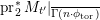 $\operatorname{pr}_{2}^{\ast }M_{t^{\prime }}|_{\overline{\unicode[STIX]{x1D6E4}(n\cdot \unicode[STIX]{x1D719}_{\text{tor}})}}$. Once again, we apply the projection formula to obtain
 $$\begin{eqnarray}\deg (\unicode[STIX]{x1D6FC}_{1}^{s}\unicode[STIX]{x1D6FC}_{2}^{t-s}\cap [\unicode[STIX]{x1D70B}_{\overline{\unicode[STIX]{x1D6E4}(n\cdot \unicode[STIX]{x1D719}_{\text{tor}})}}^{-1}(p_{l})])=\deg (c_{1}(\operatorname{pr}_{1}^{\ast }M_{t})^{s}c_{1}(\operatorname{pr}_{2}^{\ast }M_{t^{\prime }})^{t-s}\cap [\overline{\unicode[STIX]{x1D6E4}(n\cdot \unicode[STIX]{x1D719}_{\text{tor}})}]).\end{eqnarray}$$
In particular, (74) is bounded by
 $$\begin{eqnarray}\displaystyle \deg (\unicode[STIX]{x1D70E}_{s})\deg (\unicode[STIX]{x1D6FC}_{1}^{s}\unicode[STIX]{x1D6FC}_{2}^{t-s}\cap [\unicode[STIX]{x1D70B}_{\overline{\unicode[STIX]{x1D6E4}(n\cdot \unicode[STIX]{x1D719}_{\text{tor}})}}^{-1}(e_{A})]). & & \displaystyle \nonumber\end{eqnarray}$$
We first show that  $\unicode[STIX]{x1D6FC}_{1}^{s}\unicode[STIX]{x1D6FC}_{2}^{t-s}\cap [\unicode[STIX]{x1D70B}_{\overline{\unicode[STIX]{x1D6E4}(n\cdot \unicode[STIX]{x1D719}_{\text{tor}})}}^{-1}(e_{A})]$ has degree less than
 $c_{26}n^{t-s}$ for some constant
 $c_{26}$. Using standard coordinates
 $X_{1},\ldots ,X_{t}$ (respectively
 $Y_{1},\ldots ,Y_{t^{\prime }}$) on
 $\mathbb{G}_{m}^{t}$ (respectively
 $\mathbb{G}_{m}^{t^{\prime }}$), let us write
 $$\begin{eqnarray}\displaystyle (n\cdot \unicode[STIX]{x1D719}_{\text{tor}})^{\ast }(Y_{v})=X_{1}^{a_{1v}}\cdots X_{t}^{a_{tv}} & & \displaystyle \nonumber\end{eqnarray}$$
with integers  $a_{uv}$ (
 $1\leqslant u\leqslant t,1\leqslant v\leqslant t^{\prime }$). By dimension, we have again
 $$\begin{eqnarray}\displaystyle \unicode[STIX]{x1D704}(\overline{\unicode[STIX]{x1D6E4}(n\cdot \unicode[STIX]{x1D719}_{\text{tor}})},(Y_{1}=X_{1}^{a_{11}}\cdots X_{t}^{a_{1t}})\cdots (Y_{t^{\prime }}=X_{1}^{a_{1t^{\prime }}}\cdots X_{t}^{a_{tt^{\prime }}});(\mathbb{P}^{1})^{t}\times (\mathbb{P}^{1})^{t^{\prime }})\geqslant 1. & & \displaystyle \nonumber\end{eqnarray}$$
We determine next the intersection product
 $$\begin{eqnarray}(Y_{1}=X_{1}^{a_{11}}\cdots X_{t}^{a_{1t}})\cdots (Y_{t^{\prime }}=X_{1}^{a_{1t^{\prime }}}\cdots X_{t}^{a_{tt^{\prime }}})\in A_{t}((\mathbb{P}^{1})^{t}\times (\mathbb{P}^{1})^{t^{\prime }}).\end{eqnarray}$$
From [Reference FultonFul98, Example 8.3.7], we deduce an identification
 $$\begin{eqnarray}\displaystyle A_{\ast }((\mathbb{P}^{1})^{t}\times (\mathbb{P}^{1})^{t^{\prime }})=\mathbb{Z}[\unicode[STIX]{x1D700}_{1},\ldots ,\unicode[STIX]{x1D700}_{t},\unicode[STIX]{x1D700}_{1}^{\prime },\ldots ,\unicode[STIX]{x1D700}_{t^{\prime }}^{\prime }]/((\unicode[STIX]{x1D700}_{1})^{2},\ldots ,(\unicode[STIX]{x1D700}_{t})^{2},(\unicode[STIX]{x1D700}_{1}^{\prime })^{2},\ldots ,(\unicode[STIX]{x1D700}_{t^{\prime }}^{\prime })^{2}) & & \displaystyle \nonumber\end{eqnarray}$$
such that  $\unicode[STIX]{x1D700}_{i}$ (respectively
 $\unicode[STIX]{x1D700}_{i}^{\prime }$) corresponds to the flat pullback of the cycle class associated with an arbitrary point in the
 $i\text{th}$ factor of
 $(\mathbb{P}^{1})^{t}$ (respectively
 $(\mathbb{P}^{1})^{t^{\prime }}$). Considering appropriate intersections, it is easy to verify
 $$\begin{eqnarray}\displaystyle [Y_{v}=X_{1}^{a_{1v}}\cdots X_{t}^{a_{tv}}]=|a_{1v}|\unicode[STIX]{x1D700}_{1}+|a_{2v}|\unicode[STIX]{x1D700}_{2}+\cdots +|a_{tv}|\unicode[STIX]{x1D700}_{t}+\unicode[STIX]{x1D700}_{v}^{\prime }. & & \displaystyle \nonumber\end{eqnarray}$$
Thus, (76) is simply the product
 $$\begin{eqnarray}\displaystyle \mathop{\prod }_{1\leqslant v\leqslant t^{\prime }}(|a_{1v}|\unicode[STIX]{x1D700}_{1}+|a_{2v}|\unicode[STIX]{x1D700}_{2}+\cdots +|a_{tv}|\unicode[STIX]{x1D700}_{t}+\unicode[STIX]{x1D700}_{v}^{\prime }). & & \displaystyle \nonumber\end{eqnarray}$$
Inspecting the definition of  $M_{t}$ (respectively
 $M_{t^{\prime }}$) in Construction 4, we note that intersecting a cycle class on
 $(\mathbb{P}^{1})^{t}\times (\mathbb{P}^{1})^{t^{\prime }}$ with
 $c_{1}(\operatorname{pr}_{1}^{\ast }M_{t})$ (respectively
 $c_{1}(\operatorname{pr}_{2}^{\ast }M_{t^{\prime }})$) amounts to multiplication with
 $2(\unicode[STIX]{x1D700}_{1}+\cdots +\unicode[STIX]{x1D700}_{t})$ (respectively
 $2(\unicode[STIX]{x1D700}_{1}^{\prime }+\cdots +\unicode[STIX]{x1D700}_{t^{\prime }}^{\prime })$) in the Chow ring. We infer that the degree of (75) is majorized by the degree of
 $$\begin{eqnarray}\displaystyle 2^{t}(\unicode[STIX]{x1D700}_{1}+\cdots +\unicode[STIX]{x1D700}_{t})^{s}(\unicode[STIX]{x1D700}_{1}^{\prime }+\cdots +\unicode[STIX]{x1D700}_{t^{\prime }}^{\prime })^{t-s}\mathop{\prod }_{1\leqslant v\leqslant t^{\prime }}(|a_{1v}|\unicode[STIX]{x1D700}_{1}+\cdots +|a_{tv}|\unicode[STIX]{x1D700}_{t}+\unicode[STIX]{x1D700}_{v}^{\prime }). & & \displaystyle \nonumber\end{eqnarray}$$
Exploiting cancellations, this can be simplified to
 $$\begin{eqnarray}\displaystyle 2^{t}s!(t-s)!\cdot \mathop{\sum }_{\substack{ 1\leqslant u_{1},\ldots ,u_{t-s}\leqslant t\text{ distinct} \\ 1\leqslant v_{1}<\cdots <v_{t-s}\leqslant t^{\prime }}}|a_{u_{1}v_{1}}a_{u_{2}v_{2}}\cdots a_{u_{t-s}v_{t-s}}|(\unicode[STIX]{x1D700}_{1}\cdots \unicode[STIX]{x1D700}_{t}\unicode[STIX]{x1D700}_{1}^{\prime }\cdots \unicode[STIX]{x1D700}_{t^{\prime }}^{\prime }). & & \displaystyle \nonumber\end{eqnarray}$$
Since  $(\unicode[STIX]{x1D719}_{\text{tor}},\unicode[STIX]{x1D719}_{\text{ab}})\in {\mathcal{K}}_{\unicode[STIX]{x1D6FF}}$, (75) can be consequently bounded from above by
 $c_{26}n^{t-s}$ as claimed.
We finally demonstrate that  $\deg (\unicode[STIX]{x1D70E}_{s})$ is bounded from above by
 $c_{27}n^{2(\dim (A)-(r^{\prime }-s))}$ for some constant
 $c_{27}$. For this, it suffices to note that
 $\operatorname{Hom}(A,A_{j}^{\prime })$ is a finitely generated
 $\mathbb{Z}$-module and that
 $$\begin{eqnarray}\displaystyle \operatorname{Hom}(A,A_{j}^{\prime })\longrightarrow \operatorname{Pic}(A),\unicode[STIX]{x1D711}_{\text{ab}}\longmapsto \unicode[STIX]{x1D711}_{\text{ab}}^{\ast }N_{j}, & & \displaystyle \nonumber\end{eqnarray}$$
is quadratic by the theorem of the cube [Reference MumfordMum70a, Corollary II.6.2] because  $N_{j}$ is symmetric (see [Reference HabeggerHab09a, p. 417] for details). Combining this with the previous estimate, we immediately obtain the bound
 $$\begin{eqnarray}\displaystyle c_{26}c_{27}n^{t-s+2(\dim (A)-(r^{\prime }-s))}\leqslant c_{26}c_{27}n^{2(t-s+\dim (A)-r^{\prime }+s)}=c_{26}c_{27}n^{2r-2} & & \displaystyle \nonumber\end{eqnarray}$$
on (74). Taking our previous reductions into account, this completes the proof of the lemma. ◻
8 Quotients of semiabelian varieties
In this section, we elucidate the set of quotients belonging to a fixed semiabelian variety. Let  $G$ be a semiabelian variety over
 $\overline{\mathbb{Q}}$ with split toric part
 $\mathbb{G}_{m}^{t}$ and abelian quotient
 $\unicode[STIX]{x1D70B}:G\rightarrow A$. For a fixed torus
 $\mathbb{G}_{m}^{t^{\prime }}$ and a fixed abelian variety
 $A^{\prime }$, we ask which elements
 $(\unicode[STIX]{x1D719}_{\text{tor}},\unicode[STIX]{x1D719}_{\text{ab}})$ of
 $$\begin{eqnarray}\displaystyle V_{\mathbb{Q}}=\operatorname{Hom}_{\mathbb{Q}}(\mathbb{G}_{m}^{t},\mathbb{G}_{m}^{t^{\prime }})\times \operatorname{Hom}_{\mathbb{Q}}(A,A^{\prime }) & & \displaystyle \nonumber\end{eqnarray}$$
are such that there exists a quasi-homomorphism  $\unicode[STIX]{x1D719}:G\rightarrow G^{\prime }$ represented by
 $(\unicode[STIX]{x1D719}_{\text{tor}},\unicode[STIX]{x1D719}_{\text{ab}})$ in the sense of § 1.2. Let
 $Z(\mathbb{Q})\subset V_{\mathbb{Q}}$ denote the subset consisting of these elements. For a fixed semiabelian variety
 $G^{\prime }$ with toric part
 $\mathbb{G}_{m}^{t^{\prime }}$ and abelian quotient
 $A^{\prime }$, we know from Lemma 1 that the surjective quasi-homomorphisms
 $\unicode[STIX]{x1D719}:G\rightarrow G^{\prime }$ are parameterized by a linear subspace of
 $V_{\mathbb{Q}}$. The set
 $Z(\mathbb{Q})$ is the union of all these linear subspaces for varying
 $G^{\prime }$. It is, however, not a union of finitely many linear subspaces in general. Nevertheless, we can interpret
 $V_{\mathbb{Q}}$ as the
 $\mathbb{Q}$-points of an additive algebraic group, which we abusively denote also by
 $V_{\mathbb{Q}}$, and ask whether there is an algebraic subvariety
 $Z\subset V_{\mathbb{Q}}$ with
 $Z(\mathbb{Q})$ as its set of
 $\mathbb{Q}$-points. This would also motivate our notation
 $Z(\mathbb{Q})$ retroactively. In the next theorem, a cone
 $Z\subset V_{\mathbb{Q}}$ is a (not necessarily closed) algebraic subvariety of
 $V_{\mathbb{Q}}$ such that
 $[n]_{V_{\mathbb{Q}}}(Z)\subseteq Z$ for any non-zero integer
 $n$.
Theorem 3. There exists a cone  $Z\subset V_{\mathbb{Q}}$ such that its
 $\mathbb{Q}$-points are precisely the pairs
 $(\unicode[STIX]{x1D719}_{\text{tor}},\unicode[STIX]{x1D719}_{\text{ab}})$ representing quasi-homomorphisms.
In the following, pairs  $(\unicode[STIX]{x1D719}_{\text{tor}},\unicode[STIX]{x1D719}_{\text{ab}})\in V_{\mathbb{Q}}$ representing quasi-homomorphisms are called realizable.
Proof. Write  $\unicode[STIX]{x1D702}_{G}=(\unicode[STIX]{x1D702}_{G}^{(1)},\ldots ,\unicode[STIX]{x1D702}_{G}^{(t)})\in A^{\vee }(\overline{\mathbb{Q}})^{t}$. By Lemma 1, a pair
 $(\unicode[STIX]{x1D719}_{\text{tor}},\unicode[STIX]{x1D719}_{\text{ab}})\in V_{\mathbb{Q}}$ is realizable if and only if for one of its multiples
 $n\cdot (\unicode[STIX]{x1D719}_{\text{tor}},\unicode[STIX]{x1D719}_{\text{ab}})\in V$ there exists some
 $$\begin{eqnarray}\displaystyle \unicode[STIX]{x1D707}=(\unicode[STIX]{x1D707}_{1},\ldots ,\unicode[STIX]{x1D707}_{t^{\prime }})\in (A^{\prime })^{\vee }(\overline{\mathbb{Q}})^{t^{\prime }} & & \displaystyle \nonumber\end{eqnarray}$$
such that
 $$\begin{eqnarray}(n\cdot \unicode[STIX]{x1D719}_{\text{tor}})_{\ast }(\unicode[STIX]{x1D702}_{G}^{(1)},\ldots ,\unicode[STIX]{x1D702}_{G}^{(t)})=(n\cdot \unicode[STIX]{x1D719}_{\text{tor}})_{\ast }\unicode[STIX]{x1D702}_{G}=(n\cdot \unicode[STIX]{x1D719}_{\text{ab}})^{\ast }\unicode[STIX]{x1D707}=((n\cdot \unicode[STIX]{x1D719}_{\text{ab}})^{\vee }\unicode[STIX]{x1D707}_{1},\ldots ,(n\cdot \unicode[STIX]{x1D719}_{\text{ab}})^{\vee }\unicode[STIX]{x1D707}_{t^{\prime }})\quad\end{eqnarray}$$
in  $A^{\vee }(\overline{\mathbb{Q}})^{t^{\prime }}$. Write
 $$\begin{eqnarray}\displaystyle \left(\begin{array}{@{}ccc@{}}a_{11} & \cdots \, & a_{1t^{\prime }}\\ \vdots & & \vdots \\ a_{t1} & \cdots \, & a_{tt^{\prime }}\end{array}\right),\quad a_{uv}\in n^{-1}\mathbb{Z}, & & \displaystyle \nonumber\end{eqnarray}$$
for the matrix representing  $\unicode[STIX]{x1D719}_{\text{tor}}\in \operatorname{Hom}_{\mathbb{Q}}(\mathbb{G}_{m}^{t},\mathbb{G}_{m}^{t^{\prime }})$ and let
 $\unicode[STIX]{x1D719}_{v,\text{tor}}:\mathbb{G}_{m}^{t}\rightarrow _{\mathbb{Q}}\mathbb{G}_{m}$,
 $1\leqslant v\leqslant t^{\prime }$, be the quasi-homomorphism described by the column vector
 $(a_{1v},\ldots ,a_{tv})^{t}$. Then, (77) is equivalent to the equations
 $$\begin{eqnarray}\displaystyle (n\cdot \unicode[STIX]{x1D719}_{v,\text{tor}})_{\ast }\unicode[STIX]{x1D702}_{G}=na_{1v}\cdot \unicode[STIX]{x1D702}_{G}^{(1)}+\cdots +na_{tv}\cdot \unicode[STIX]{x1D702}_{G}^{(t)}=(n\cdot \unicode[STIX]{x1D719}_{\text{ab}})^{\vee }\unicode[STIX]{x1D707}_{v},\quad 1\leqslant v\leqslant t^{\prime }, & & \displaystyle \nonumber\end{eqnarray}$$
having solutions  $\unicode[STIX]{x1D707}_{v}\in A^{\vee }(\overline{\mathbb{Q}})$. Hence, the pair
 $(\unicode[STIX]{x1D719}_{\text{tor}},\unicode[STIX]{x1D719}_{\text{ab}})$ is realizable if and only if each pair
 $(\unicode[STIX]{x1D719}_{v,\text{tor}},\unicode[STIX]{x1D719}_{\text{ab}})$,
 $1\leqslant v\leqslant t^{\prime }$, represents a quasi-homomorphism
 $G\rightarrow G_{v}^{\prime }$. Assume that there are cones
 $$\begin{eqnarray}\displaystyle Z_{v}\subset \operatorname{Hom}(\mathbb{G}_{m}^{t},\mathbb{G}_{m})\times \operatorname{Hom}(A,A^{\prime })=V_{v,\mathbb{Q}},\quad 1\leqslant v\leqslant t^{\prime }, & & \displaystyle \nonumber\end{eqnarray}$$
with  $Z_{v}(\mathbb{Q})$ consisting of the pairs in
 $V_{v,\mathbb{Q}}$ representing quasi-homomorphisms. Denoting by
 $p_{v}:V_{\mathbb{Q}}\rightarrow V_{v,\mathbb{Q}}$ the standard projection, the cone
 $Z=\bigcap _{v=1}^{t^{\prime }}p_{v}^{-1}(Z_{v})\subset V_{\mathbb{Q}}$ is as wanted. In conclusion, it suffices to show the assertion for
 $t^{\prime }=1$.
Choose pairwise non-isogeneous simple abelian varieties  $B_{1},\ldots ,B_{k}$ such that there exist isogenies
 $$\begin{eqnarray}\displaystyle \unicode[STIX]{x1D712}:A\longrightarrow B_{1}^{r_{1}}\times \cdots \times B_{k}^{r_{k}}\quad \text{and}\quad \unicode[STIX]{x1D712}^{\prime }:A^{\prime }\longrightarrow B_{1}^{r_{1}^{\prime }}\times \cdots \times B_{k}^{r_{k}^{\prime }} & & \displaystyle \nonumber\end{eqnarray}$$
and set
 $$\begin{eqnarray}\displaystyle W=\operatorname{Hom}(\mathbb{G}_{m}^{t},\mathbb{G}_{m})\times \operatorname{Hom}(B_{1}^{r_{1}}\times \cdots \times B_{k}^{r_{k}},B_{1}^{r_{1}^{\prime }}\times \cdots \times B_{k}^{r_{k}^{\prime }}). & & \displaystyle \nonumber\end{eqnarray}$$
Let further  $\unicode[STIX]{x1D713}$ (respectively
 $\unicode[STIX]{x1D713}^{\prime }$) be isogenies such that
 $\unicode[STIX]{x1D713}\circ \unicode[STIX]{x1D712}=\unicode[STIX]{x1D712}\circ \unicode[STIX]{x1D713}=[m]_{A}$ (respectively
 $\unicode[STIX]{x1D713}^{\prime }\circ \unicode[STIX]{x1D712}^{\prime }=\unicode[STIX]{x1D712}^{\prime }\circ \unicode[STIX]{x1D713}^{\prime }=[m]_{A^{\prime }}$) for some integer
 $m\geqslant 1$. We have
 $\mathbb{Q}$-linear maps
 $$\begin{eqnarray}\displaystyle f:V_{\mathbb{Q}}\longrightarrow W_{\mathbb{Q}},\quad (\unicode[STIX]{x1D719}_{\text{tor}},\unicode[STIX]{x1D719}_{\text{ab}})\longmapsto (\unicode[STIX]{x1D719}_{\text{tor}},\unicode[STIX]{x1D712}^{\prime }\circ \unicode[STIX]{x1D719}_{\text{ab}}\circ \unicode[STIX]{x1D713}) & & \displaystyle \nonumber\end{eqnarray}$$
and
 $$\begin{eqnarray}\displaystyle g:W_{\mathbb{Q}}\longrightarrow V_{\mathbb{Q}},\quad (\unicode[STIX]{x1D719}_{\text{tor}},\unicode[STIX]{x1D719}_{\text{ab}})\longmapsto (\unicode[STIX]{x1D719}_{\text{tor}},\unicode[STIX]{x1D713}^{\prime }\circ \unicode[STIX]{x1D719}_{\text{ab}}\circ \unicode[STIX]{x1D712}) & & \displaystyle \nonumber\end{eqnarray}$$
such that both  $g\circ f:V_{\mathbb{Q}}\rightarrow V_{\mathbb{Q}}$ and
 $f\circ g:W_{\mathbb{Q}}\rightarrow W_{\mathbb{Q}}$ send
 $(\unicode[STIX]{x1D719}_{\text{tor}},\unicode[STIX]{x1D719}_{\text{ab}})$ to
 $(\unicode[STIX]{x1D719}_{\text{tor}},m^{2}\cdot \unicode[STIX]{x1D719}_{\text{ab}})$. Hence,
 $f$ and
 $g$ are bijections between
 $V_{\mathbb{Q}}$ and
 $W_{\mathbb{Q}}$. Using Lemma 2, we additionally deduce that both
 $f$ and
 $g$ preserve realizable pairs. Consequently, we may assume that
 $A=B_{1}^{r_{1}}\times \cdots \times B_{k}^{r_{k}}$ and
 $A^{\prime }=B_{1}^{r_{1}^{\prime }}\times \cdots \times B_{k}^{r_{k}^{\prime }}$ in proving the theorem. In this case, we can also identify
 $$\begin{eqnarray}\displaystyle V_{\mathbb{Q}}=\operatorname{Hom}_{\mathbb{Q}}(\mathbb{G}_{m}^{t},\mathbb{G}_{m})\times \mathop{\prod }_{i=1}^{k}\operatorname{Hom}_{\mathbb{Q}}(B_{i}^{r_{i}},B_{i}^{r_{i}^{\prime }}). & & \displaystyle \nonumber\end{eqnarray}$$
By Lemma 1, an element  $(\unicode[STIX]{x1D719}_{\text{tor}},\unicode[STIX]{x1D719}_{\text{ab}}^{(1)},\ldots ,\unicode[STIX]{x1D719}_{\text{ab}}^{(k)})\in V_{\mathbb{Q}}$,
 $\unicode[STIX]{x1D719}_{\text{ab}}^{(i)}\in \operatorname{Hom}_{\mathbb{Q}}(B_{i}^{r_{i}},B_{i}^{r_{i}^{\prime }})$, is realized by a quasi-homomorphism if and only if for one of its multiples
 $n\cdot (\unicode[STIX]{x1D719}_{\text{tor}},\unicode[STIX]{x1D719}_{\text{ab}}^{(1)},\ldots ,\unicode[STIX]{x1D719}_{\text{ab}}^{(k)})\in V$ there exists some tuple
 $(\unicode[STIX]{x1D702}^{(1)},\ldots ,\unicode[STIX]{x1D702}^{(k)})\in B_{1}^{\vee }(\overline{\mathbb{Q}})^{r_{1}^{\prime }}\times \cdots \times B_{k}^{\vee }(\overline{\mathbb{Q}})^{r_{k}^{\prime }}$ such that
 $$\begin{eqnarray}\displaystyle (n\cdot \unicode[STIX]{x1D719}_{\text{tor}})_{\ast }\unicode[STIX]{x1D702}_{G}=(n\cdot \unicode[STIX]{x1D719}_{\text{ab}}^{(1)},\ldots ,n\cdot \unicode[STIX]{x1D719}_{\text{ab}}^{(k)})^{\ast }(\unicode[STIX]{x1D702}^{(1)},\ldots ,\unicode[STIX]{x1D702}^{(k)})=((n\cdot \unicode[STIX]{x1D719}_{\text{ab}}^{(1)})^{\vee }(\unicode[STIX]{x1D702}^{(1)}),\ldots ,(n\cdot \unicode[STIX]{x1D719}_{\text{ab}}^{(k)})^{\vee }(\unicode[STIX]{x1D702}^{(k)})). & & \displaystyle \nonumber\end{eqnarray}$$
Arguing as above, we deduce that it suffices to prove the theorem under the additional assumption that  $k=1$ (i.e.,
 $A=B^{r}$ and
 $A^{\prime }=B^{r^{\prime }}$ with a simple abelian variety
 $B$).
Let us write  $\unicode[STIX]{x1D702}_{G}=(\text{}\underline{\unicode[STIX]{x1D702}}_{1},\ldots ,\text{}\underline{\unicode[STIX]{x1D702}}_{t})\in (B^{r})^{\vee }(\overline{\mathbb{Q}})^{t}=\operatorname{Ext}_{\overline{\mathbb{Q}}}^{1}(B^{r},\mathbb{G}_{m}^{t})$ and
 $\text{}\underline{\unicode[STIX]{x1D702}}_{j}=(\unicode[STIX]{x1D702}_{1j},\ldots ,\unicode[STIX]{x1D702}_{rj})^{t}\in (B^{\vee })(\overline{\mathbb{Q}})^{r}=(B^{r})^{\vee }(\overline{\mathbb{Q}})$. Again,
 $(\unicode[STIX]{x1D719}_{\text{tor}},\unicode[STIX]{x1D719}_{\text{ab}})\in V_{\mathbb{Q}}$ is realizable if and only if there exists some multiple
 $n\cdot (\unicode[STIX]{x1D719}_{\text{tor}},\unicode[STIX]{x1D719}_{\text{ab}})\in V$ such that
 $$\begin{eqnarray}(n\cdot \unicode[STIX]{x1D719}_{\text{tor}})_{\ast }\unicode[STIX]{x1D702}_{G}=(n\cdot \unicode[STIX]{x1D719}_{\text{ab}})^{\ast }\unicode[STIX]{x1D707}\end{eqnarray}$$
has a solution  $\unicode[STIX]{x1D707}=(\unicode[STIX]{x1D707}_{1},\ldots ,\unicode[STIX]{x1D707}_{r^{\prime }})\in B^{\vee }(\overline{\mathbb{Q}})^{r^{\prime }}=\operatorname{Ext}_{\overline{\mathbb{Q}}}^{1}(A^{\prime },\mathbb{G}_{m})$. This condition can be translated into linear algebra over the
 $\mathbb{Q}$-division algebra
 $D=\operatorname{End}(B^{\vee })_{\mathbb{Q}}$ (cf. [Reference MumfordMum70a, Corollary 2 on p. 174]). For this, we denote by
 $\unicode[STIX]{x1D6E4}$ the left
 $\operatorname{End}(B^{\vee })$-submodule of
 $B^{\vee }(\overline{\mathbb{Q}})$ generated by
 $$\begin{eqnarray}\displaystyle \unicode[STIX]{x1D702}_{ij},\quad 1\leqslant i\leqslant r,\quad 1\leqslant j\leqslant t. & & \displaystyle \nonumber\end{eqnarray}$$
The tensor product  $\unicode[STIX]{x1D6E4}_{\mathbb{Q}}=\unicode[STIX]{x1D6E4}\otimes _{\mathbb{Z}}\mathbb{Q}$ is a left
 $D$-submodule of
 $B^{\vee }(\overline{\mathbb{Q}})\otimes _{\mathbb{Z}}\mathbb{Q}$. For any
 $\unicode[STIX]{x1D6FE}\in B^{\vee }(\overline{\mathbb{Q}})$, we let
 $[\unicode[STIX]{x1D6FE}]$ denote
 $\unicode[STIX]{x1D6FE}\otimes 1\in B^{\vee }(\overline{\mathbb{Q}})\otimes _{\mathbb{Z}}\mathbb{Q}$. As
 $D$ is a division ring,
 $\unicode[STIX]{x1D6E4}_{\mathbb{Q}}$ is a free left
 $D$-module so that we may choose
 $\operatorname{End}(B^{\vee })$-linearly independent elements
 $\unicode[STIX]{x1D6FE}_{1},\ldots ,\unicode[STIX]{x1D6FE}_{l}\in B^{\vee }(\overline{\mathbb{Q}})$ satisfying
 $$\begin{eqnarray}\unicode[STIX]{x1D6E4}=\operatorname{End}(B^{\vee })\cdot \unicode[STIX]{x1D6FE}_{1}\oplus \cdots \oplus \operatorname{End}(B^{\vee })\cdot \unicode[STIX]{x1D6FE}_{l}\oplus \operatorname{Tors}(\unicode[STIX]{x1D6E4});\end{eqnarray}$$
here  $\operatorname{Tors}(\unicode[STIX]{x1D6E4})$ denotes the
 $\mathbb{Z}$-torsion elements of
 $\unicode[STIX]{x1D6E4}$. If (78) has a solution
 $\unicode[STIX]{x1D707}=(\unicode[STIX]{x1D707}_{1},\ldots ,\unicode[STIX]{x1D707}_{r^{\prime }})\in B^{\vee }(\overline{\mathbb{Q}})^{r^{\prime }}$ for some
 $n$, then it also has a solution
 $\unicode[STIX]{x1D707}\in \unicode[STIX]{x1D6E4}^{r^{\prime }}\subset B^{\vee }(\overline{\mathbb{Q}})^{r^{\prime }}$ for a possibly larger
 $n$. In fact, one may take any image under a
 $D$-linear projection from
 $\unicode[STIX]{x1D6E4}_{\mathbb{Q}}+D\cdot [\unicode[STIX]{x1D707}_{1}]+\cdots +D\cdot [\unicode[STIX]{x1D707}_{r^{\prime }}]$ to
 $\unicode[STIX]{x1D6E4}_{\mathbb{Q}}$. Since we can always arrange for
 $n$ to annihilate the finite group
 $\operatorname{Tors}(\unicode[STIX]{x1D6E4})$, we infer that
 $(\unicode[STIX]{x1D719}_{\text{tor}},\unicode[STIX]{x1D719}_{\text{ab}})$ is realizable if and only if, in the notation from § 1.2,
 $$\begin{eqnarray}\displaystyle (\unicode[STIX]{x1D719}_{\text{tor}})_{\ast ,\mathbb{Q}}(\unicode[STIX]{x1D702}_{G})=(\unicode[STIX]{x1D719}_{\text{ab}})^{\ast ,\mathbb{Q}}(\unicode[STIX]{x1D707}) & & \displaystyle \nonumber\end{eqnarray}$$
has a solution  $\unicode[STIX]{x1D707}\in \unicode[STIX]{x1D6E4}_{\mathbb{Q}}^{r^{\prime }}\subset (B^{\vee }(\overline{\mathbb{Q}})\otimes _{\mathbb{Z}}\mathbb{Q})^{r^{\prime }}$. Both quasi-homomorphisms
 $\unicode[STIX]{x1D719}_{\text{tor}}\in \operatorname{Hom}_{\mathbb{Q}}(\mathbb{G}_{m}^{t},\mathbb{G}_{m})$ and
 $\unicode[STIX]{x1D719}_{\text{ab}}^{\vee }\in \operatorname{Hom}_{\mathbb{Q}}((A^{\prime })^{\vee },A^{\vee })$ can be represented by matrices
 $$\begin{eqnarray}(a_{1},a_{2},\ldots ,a_{t})^{t},\quad a_{i}\in \mathbb{Q},\end{eqnarray}$$
and
 $$\begin{eqnarray}\left(\begin{array}{@{}ccc@{}}b_{11} & \cdots \, & b_{1r^{\prime }}\\ \vdots & & \vdots \\ b_{r1} & \cdots \, & b_{rr^{\prime }}\end{array}\right),\quad b_{ij}\in D.\end{eqnarray}$$
Using this notation, we are searching for (80) and (81) such that
 $$\begin{eqnarray}a_{1}\cdot \left(\begin{array}{@{}c@{}}[\unicode[STIX]{x1D702}_{11}]\\ \vdots \\ \text{}[\unicode[STIX]{x1D702}_{r1}]\end{array}\right)+\cdots +a_{t}\cdot \left(\begin{array}{@{}c@{}}[\unicode[STIX]{x1D702}_{1t}]\\ \vdots \\ \text{}[\unicode[STIX]{x1D702}_{rt}]\end{array}\right)=\left(\begin{array}{@{}ccc@{}}b_{11} & \cdots \, & b_{1r^{\prime }}\\ \vdots & & \vdots \\ b_{r1} & \cdots \, & b_{rr^{\prime }}\end{array}\right)\left(\begin{array}{@{}c@{}}[\unicode[STIX]{x1D707}_{1}]\\ \vdots \\ \text{}[\unicode[STIX]{x1D707}_{r^{\prime }}]\end{array}\right)\end{eqnarray}$$
has a solution  $([\unicode[STIX]{x1D707}_{1}],\ldots ,[\unicode[STIX]{x1D707}_{r^{\prime }}])\in \unicode[STIX]{x1D6E4}_{\mathbb{Q}}$. Using the decomposition (79), we expand
 $$\begin{eqnarray}\displaystyle [\unicode[STIX]{x1D702}_{ij}]=c_{ij}^{(1)}[\unicode[STIX]{x1D6FE}_{1}]+\cdots +c_{(ij)}^{(l)}[\unicode[STIX]{x1D6FE}_{l}],\quad c_{ij}^{(\cdot )}\in D. & & \displaystyle \nonumber\end{eqnarray}$$
Then, (82) has a solution  $([\unicode[STIX]{x1D707}_{1}],\ldots ,[\unicode[STIX]{x1D707}_{r^{\prime }}])$ if and only if each of the
 $l$ linear equations
 $$\begin{eqnarray}a_{1}\cdot \left(\begin{array}{@{}c@{}}c_{11}^{(\cdot )}\\ \vdots \\ c_{r1}^{(\cdot )}\end{array}\right)+\cdots +a_{t}\cdot \left(\begin{array}{@{}c@{}}c_{1t}^{(\cdot )}\\ \vdots \\ c_{rt}^{(\cdot )}\end{array}\right)=\left(\begin{array}{@{}ccc@{}}b_{11} & \cdots \, & b_{1r^{\prime }}\\ \vdots & & \vdots \\ b_{r1} & \cdots \, & b_{rr^{\prime }}\end{array}\right)\left(\begin{array}{@{}c@{}}\unicode[STIX]{x1D6FF}_{1}^{(\cdot )}\\ \vdots \\ \unicode[STIX]{x1D6FF}_{r^{\prime }}^{(\cdot )}\end{array}\right)\end{eqnarray}$$
has a solution  $(\unicode[STIX]{x1D6FF}_{1}^{(\cdot )},\ldots ,\unicode[STIX]{x1D6FF}_{r^{\prime }}^{(\cdot )})\in D^{r}$. By Lemma 31 below, the corresponding condition on (83) and (84) is described by a subcone of
 $\mathbb{Q}^{t}\times D^{r\times r^{\prime }}$. The intersection
 $Z^{\vee }$ of these
 $l$ cones is almost what we are searching for. In fact, a pair
 $(\unicode[STIX]{x1D719}_{t},\unicode[STIX]{x1D719}_{a})\in V_{\mathbb{Q}}$ is realizable if and only if
 $(\unicode[STIX]{x1D719}_{t},\unicode[STIX]{x1D719}_{a}^{\vee })\in \mathbb{Q}^{t}\times D^{r\times r^{\prime }}$ is in
 $Z^{\vee }(\mathbb{Q})$. The theorem follows now from the
 $\mathbb{Q}$-linearity (cf. [Reference MumfordMum70a, (ii) on p. 75]) of
 $$\begin{eqnarray}\displaystyle \operatorname{Hom}_{\mathbb{Q}}(A,A^{\prime })\longrightarrow \operatorname{Hom}_{\mathbb{Q}}((A^{\vee })^{\prime },A^{\vee }),f\longmapsto f^{\vee }.\Box & & \displaystyle \nonumber\end{eqnarray}$$
The following lemma is certainly standard (for  $t=1$ and
 $a_{1}=1$ at least) but I have found no trace of it in the literature so that a complete proof is given.
Lemma 31. Let  $D$ be a finite-dimensional
 $\mathbb{Q}$-algebra and
 $\text{}\underline{y}_{1},\ldots ,\text{}\underline{y}_{t}\in D^{r}$ column vectors. Then, the pairs
 $(\text{}\underline{a},M)\in \mathbb{Q}^{t}\times D^{r\times r^{\prime }}$,
 $\text{}\underline{a}=(a_{1},\ldots ,a_{t})$, such that
 $$\begin{eqnarray}a_{1}\text{}\underline{y}_{1}+\cdots +a_{t}\text{}\underline{y}_{t}=M\cdot \text{}\underline{x}\end{eqnarray}$$
has a solution  $\text{}\underline{x}\in D^{r^{\prime }}$, are the
 $\mathbb{Q}$-points of a cone
 $Z\subset \mathbb{Q}^{t}\times D^{r\times r^{\prime }}$.
Here,  $\mathbb{Q}^{t}\times D^{r\times r^{\prime }}$ is given its canonical structure as an affine linear space over
 $\mathbb{Q}$. We also remark that
 $Z$ is generally not a closed subvariety.
Proof. Choosing a  $\mathbb{Q}$-linear isomorphism
 $\unicode[STIX]{x1D711}:D\rightarrow \mathbb{Q}^{n}$, we obtain a map
 $l:D{\hookrightarrow}\mathbb{Q}^{n\times n}$ such that
 $l(d_{1})\unicode[STIX]{x1D711}(d_{2})=\unicode[STIX]{x1D711}(d_{1}d_{2})$. This realizes
 $D$ as a
 $n$-dimensional subspace
 $l(D)$ of
 $\mathbb{Q}^{n\times n}$. With these identifications, (84) can be written as
 $$\begin{eqnarray}\displaystyle a_{1}\text{}\underline{y}_{1}^{\prime }+\cdots +a_{t}\text{}\underline{y}_{t}^{\prime }=M^{\prime }\cdot \text{}\underline{x}^{\prime } & & \displaystyle \nonumber\end{eqnarray}$$
with  $M^{\prime }\in \mathbb{Q}^{nr\times nr^{\prime }}$,
 $\text{}\underline{x}^{\prime }\in \mathbb{Q}^{nr^{\prime }}$, and
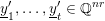 $\text{}\underline{y}_{1}^{\prime },\ldots ,\text{}\underline{y}_{t}^{\prime }\in \mathbb{Q}^{nr}$. We then search for
 $M^{\prime }\in \mathbb{Q}^{nr\times nr^{\prime }}$ such that a solution
 $\text{}\underline{x}^{\prime }$ exists under the additional restraint that
 $M^{\prime }$ comes from a matrix
 $M\in D^{r\times r^{\prime }}$ by applying
 $l$ to each entry. Since this restraint can be evidently expressed as
 $M^{\prime }$ being contained in a
 $\mathbb{Q}$-subcone of
 $\mathbb{Q}^{nr\times nr^{\prime }}$, we can restrict to the case
 $D=\mathbb{Q}$.
To deal with this special case, we make the following elementary observation: write  $M=(\text{}\underline{m}_{1}\ldots \text{}\underline{m}_{r^{\prime }})$ with column vectors
 $\text{}\underline{m}_{i}\in \mathbb{Q}^{r}$. For any
 $\text{}\underline{y}\neq 0$, we have
 $\text{}\underline{y}\in \operatorname{im}(M)$ if and only if there exists a subset
 $I\subset \{1,\ldots ,r^{\prime }\}$ such that
 $\bigwedge _{i\in I}\text{}\underline{m}_{i}\neq 0\in \bigwedge ^{|I|}\mathbb{Q}^{r}$ and
 $\bigwedge _{i\in I}\text{}\underline{m}_{i}\wedge \text{}\underline{y}=0\in \bigwedge ^{|I|+1}\mathbb{Q}^{r}$. From this, we straightforwardly obtain equations for the sought-after
 $\mathbb{Q}$-cone
 $Z\subset \mathbb{Q}^{t}\times \mathbb{Q}^{r\times r^{\prime }}$.◻
The proof of Theorem 3 gives evidently a procedure to determine  $Z$ via linear algebra so that one may hope that its rational points
 $Z(\mathbb{Q})$ are equally easy to describe. However,
 $Z(\mathbb{Q})$ can be rather complicated if
 $G$ is neither an abelian variety nor a torus. For example,
 $Z$ is not even rational in general, although it is in these two special cases. With respect to the proof of Theorem 2, this means in particular that (Dirichlet) approximation arguments as in [Reference HabeggerHab09a, § 4] and [Reference HabeggerHab09b, § 4] break down if one insists on the use of surjective quasi-homomorphisms
 $G\rightarrow G^{\prime }$. This makes it necessary to work with explicit line bundles on
 $G$ as we do in this article.
Example 32. Let  $E$ be an elliptic curve without complex multiplication (i.e.,
 $\operatorname{End}(E)=\mathbb{Z}$). Furthermore, let
 $\unicode[STIX]{x1D6FE}_{1},\unicode[STIX]{x1D6FE}_{2},\unicode[STIX]{x1D6FE}_{3}\in E^{\vee }(\overline{\mathbb{Q}})$ be such that
 $\unicode[STIX]{x1D6E4}=\sum _{i=1}^{3}\mathbb{Z}\cdot \unicode[STIX]{x1D6FE}_{i}$ is a free
 $\mathbb{Z}$-module of rank 3. For an arbitrary tuple
 $(n_{1},n_{2},n_{3})\in \mathbb{Z}^{3}$, we define
 $$\begin{eqnarray}\displaystyle \text{}\underline{\unicode[STIX]{x1D702}}_{1}=\left(\begin{array}{@{}c@{}}n_{1}\cdot \unicode[STIX]{x1D6FE}_{1}\\ \unicode[STIX]{x1D6FE}_{3}\\ \unicode[STIX]{x1D6FE}_{2}\end{array}\right),\quad \text{}\underline{\unicode[STIX]{x1D702}}_{2}=\left(\begin{array}{@{}c@{}}n_{2}\cdot \unicode[STIX]{x1D6FE}_{2}\\ \unicode[STIX]{x1D6FE}_{1}\\ \unicode[STIX]{x1D6FE}_{3}\end{array}\right),\quad \text{}\underline{\unicode[STIX]{x1D702}}_{3}=\left(\begin{array}{@{}c@{}}n_{3}\cdot \unicode[STIX]{x1D6FE}_{3}\\ \unicode[STIX]{x1D6FE}_{2}\\ \unicode[STIX]{x1D6FE}_{1}\end{array}\right), & & \displaystyle \nonumber\end{eqnarray}$$
considering these column vectors as elements of  $(E^{3})^{\vee }(\overline{\mathbb{Q}})$. Let
 $G$ be the semiabelian variety determined by
 $$\begin{eqnarray}\displaystyle (\text{}\underline{\unicode[STIX]{x1D702}}_{1},\text{}\underline{\unicode[STIX]{x1D702}}_{2},\text{}\underline{\unicode[STIX]{x1D702}}_{3})\in ((E^{3})^{\vee })^{3}=\operatorname{Ext}^{1}(E^{3},\mathbb{G}_{m})^{3}=\operatorname{Ext}^{1}(E^{3},\mathbb{G}_{m}^{3}). & & \displaystyle \nonumber\end{eqnarray}$$
From Theorem 3, we know that the realizable pairs in
 $$\begin{eqnarray}\displaystyle V_{\mathbb{Q}}=\operatorname{Hom}(\mathbb{G}_{m}^{3},\mathbb{G}_{m})_{\mathbb{Q}}\times \operatorname{Hom}(E^{3},E^{2})_{\mathbb{Q}} & & \displaystyle \nonumber\end{eqnarray}$$
are the  $\mathbb{Q}$-rational points of an algebraic subvariety
 $Z\subset V_{\mathbb{Q}}$. Consider the projection
 $$\begin{eqnarray}\displaystyle \unicode[STIX]{x1D70B}:V_{\mathbb{Q}}\rightarrow \operatorname{Hom}(\mathbb{G}_{m}^{3},\mathbb{G}_{m})_{\mathbb{Q}}. & & \displaystyle \nonumber\end{eqnarray}$$
An inspection of the three linear equations given by (83) tells us that the image  $\unicode[STIX]{x1D70B}(Z)$ is described by
 $$\begin{eqnarray}\displaystyle \det \left(\begin{array}{@{}ccc@{}}n_{1}a_{1} & n_{2}a_{2} & n_{3}a_{3}\\ a_{2} & a_{3} & a_{1}\\ a_{3} & a_{1} & a_{2}\end{array}\right)=(n_{1}+n_{2}+n_{3})a_{1}a_{2}a_{3}-n_{1}a_{1}^{3}-n_{2}a_{2}^{3}-n_{3}a_{3}^{3}. & & \displaystyle \nonumber\end{eqnarray}$$
It is easy to check (cf. [Reference MordellMor69, ch. 10] or [Reference DolgachevDol12, § 3.1]) that
 $$\begin{eqnarray}\displaystyle n_{1}X^{3}+n_{2}Y^{3}+n_{3}Z^{3}-(n_{1}+n_{2}+n_{3})XYZ=0 & & \displaystyle \nonumber\end{eqnarray}$$
is the projective equation of an elliptic curve  $E_{n_{1},n_{2},n_{3}}^{\prime }$ for generic tuples
 $(n_{1},n_{2},n_{3})\in \mathbb{Z}^{3}$. In these cases,
 $\unicode[STIX]{x1D70B}(Z)$ is birationally equivalent to
 $\mathbb{P}^{1}\times E_{n_{1},n_{2},n_{3}}^{\prime }$. The existence of a global non-zero one-form (i.e., the pullback of the invariant differential form on
 $E_{n_{1},n_{2},n_{3}}^{\prime }$) precludes unirationality of
 $\mathbb{P}^{1}\times E_{n_{1},n_{2},n_{3}}^{\prime }$ (cf. [Reference Kollár, Smith and CortiKSC04, Theorem 1.52]). Therefore,
 $Z$ itself cannot be a rational variety. In addition, the set
 $Z(\mathbb{Q})$ surjects onto the Mordell–Weil group of the
 $\mathbb{Q}$-elliptic curve
 $E_{n_{1},n_{2},n_{3}}^{\prime }$. Given that no known algorithm produces the Mordell–Weil rank, this should demonstrate that the ‘mixed structure’ of a semiabelian variety can lead to an intricate set of quotients and subgroups.
Acknowledgements
The author deeply thanks Philipp Habegger for suggesting this problem quite some years ago and for providing a constant motivation to continue working on it. The present article also profited from discussions with and advice of Daniel Bertrand, Pietro Corvaja, Marc Hindry, Rafael von Känel, Friedrich Knop, Harry Schmidt, and Gisbert Wüstholz. He also thanks the organizers of the workshop ‘Diophantische Approximationen’ (ID: 1615) at the MFO for allowing him to present the results of this article there for the first time in a preliminary fashion. In addition, the author acknowledges the supportive hospitality of both the Max Planck Institute for Mathematics and the Fields Institute, where this article has been written. Finally, he thanks the referee for their suggestions, which helped to improve the expository quality of this article.


























