Smith–Lemli–Opitz syndrome (SLOS) is a multiple congenital malformation syndrome that was first described by Smith, Lemli and Opitz in 1964 (Ref. Reference Smith, Lemli and Opitz1). Many hundreds of SLOS cases have been reported since that time, leading to the recognition of SLOS as a relatively common malformation syndrome. The clinical characteristics of SLOS encompass a wide spectrum. It can be inferred, from the great disparity between incidence estimates for the genetic defect and SLOS patients identified, that more severely affected infants often die in utero or in the perinatal period as a result of multiple congenital malformations Less severely affected patients experience milder physical anomalies and characteristic learning and behavioural issues. Although SLOS was suggested to be an autosomal recessive inherited disorder shortly after it was identified (Refs Reference Opitz2, Reference Dallaire3), a major clue to the underlying genetic defect was not provided until 1993, when >1000 times the normal concentration of 7-dehydrocholesterol (7-DHC; cholesta-5,7-dien-3β-ol) was measured in the plasma of a SLOS patient (Ref. Reference Irons4). The biochemical profile of this patient and four others was consistent with deficient activity of 7-dehydrocholesterol reductase (DHCR7, which has 7,8-reductase activity), an enzyme that normally converts 7-DHC to cholesterol in the final step of the cholesterol biosynthetic pathway (Refs Reference Kandutsch and Russell5, Reference Tint6). In a short period of time, the enzyme deficiency was proved in SLOS (Ref. Reference Shefer7); the human DHCR7 gene (GenBank accession number AF034544) was cloned and localised to chromosome 11q12–13 (Ref. Reference Moebius8), and causative mutations in DHCR7 were independently reported by three groups of investigators (Refs Reference Fitzky9, Reference Wassif10, Reference Waterham11). Gene-knockout mouse models for SLOS have since been generated that recapitulate aspects of the human disorder [null mutations Dhcr7 Δ3−5 (Ref. Reference Wassif12) or Dhcr7 delEX8 (Ref. Reference Fitzky13) or hypomorphic mutation Dhcr7 Δ3−5/T93M (Ref. Reference Correa-Cerro14)]. In addition, rodents treated with DHCR7 inhibitors provide another model for studying SLOS (Refs Reference Xu15, Reference Fliesler16).
There is still much to learn regarding the pathophysiological processes that occur in SLOS. The effect of cholesterol deficiency in SLOS patients is being actively studied, in particular the effect on brain structure, function and development, in utero and from birth to adulthood. Although circulating concentrations of cholesterol can be normal in some patients (probably due to residual endogenous cholesterol synthesis fortified with exogenous cholesterol from the diet), the inability of cholesterol to cross the blood–brain barrier suggests that brain cholesterol is deficient in most SLOS patients. Adequate cholesterol is not transferred across the placenta to normalise circulating cholesterol in DHCR7-deficient fetuses, and severely affected SLOS newborns can have plasma cholesterol concentrations as low as 1 mg/dl (2% of the normal newborn concentration) (Ref. Reference Cunniff17), with cholesterol deficiency found in all tissues, especially brain tissue. Fetal cholesterol is also thought to be low during embryogenesis, with malformations occurring in tissues and structures whose embryonic patterning depends on signalling by the hedgehog family of secreted proteins, after these proteins are activated by cholesterol (Ref. Reference Cooper18). Insufficient cholesterol during embryogenesis with resultant deficient activation of hedgehog signalling, however, is an overly simplistic explanation, because non-cholesterol sterols can also activate sonic hedgehog.
Cholesterol deficiency is a trait shared by other malformation syndromes caused by defects in cholesterol synthesis, including desmosterolosis, lathosterolosis, HEM dysplasia, X-linked dominant chondrodysplasia punctata, CHILD syndrome, SC4MOL deficiency and Antley–Bixler syndrome (reviewed recently in Ref. Reference Porter and Herman19). Although these disorders share some developmental and clinical characteristics, their manifestations are quite varied, suggesting that the unique biochemical intermediates that accumulate in each disorder have an important role in disease pathophysiology. The role of accumulated 7-DHC in SLOS, and potentially bioactive or toxic oxysterols (Refs Reference Xu, Korade and Porter20, Reference Korade21) and sterols (Refs Reference Chignell22, Reference De23) generated from the ready oxidation of 7-DHC, is currently being explored.
A number of informative reviews of SLOS have been published (Refs Reference Ryan24, Reference Ginat25, Reference Porter26, Reference Kelley and Hennekam27, Reference Battaile and Steiner28, Reference Yu and Patel29, Reference Porter30, Reference Phillipi and Steiner31, Reference Steiner, Martin and Hume32). Here, we will focus on recent advances in our understanding of the cellular, biochemical and molecular mechanisms in SLOS and the clinical implications of this knowledge.
Biochemical phenotype of SLOS
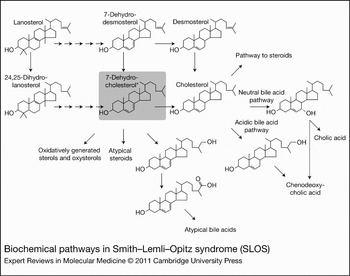
The human DHCR7 enzyme reduces the 7–8 unsaturated bond of 7-DHC in a pathway to form cholesterol (Ref. Reference Kandutsch and Russell5) (Fig. 1), as well as the 7–8 bond in 7,8-dehydrodesmosterol to form desmosterol (a sterol that is relatively abundant in the brain). A major biochemical consequence of defective DHCR7 in SLOS patients is an accumulation of 7-DHC in the plasma and tissues of patients, and probably also 7,8-dehydrodesmosterol in the brain. 7-DHC isomerises to form 8-DHC [cholesta-5,8(9)-dien-3β-ol], which is also found in large excess in SLOS. Accumulation of DHC is used in the diagnosis of SLOS, which is performed primarily by measurement of elevated plasma 7-DHC (2.7–470 µg/ml; 10–2000 times normal) in the proper clinical setting. For prenatal diagnosis, an increased concentration of 7-DHC in amniotic fluid after the 14th week of gestation (Refs Reference Kelley33, Reference Kratz and Kelley34, Reference Tint35) or in chorionic villus samples between the 10th and 12th week of gestation (Refs Reference Nowaczyk36, Reference Linck37) is confirmatory for SLOS. Sampling of chorionic villus carries a risk of spontaneous abortion that limits its usefulness.
Biochemical pathways in Smith–Lemli–Opitz syndrome (SLOS). SLOS patients experience a broad range of biochemical consequences stemming from elevated levels of 7-dehydrocholesterol (7-DHC) and deficiency in cholesterol. Because cholesterol is a precursor in the synthesis of steroid hormones, bile acids and oxysterols, these compounds may be deficient in SLOS patients. Conversely, atypical sterols, oxysterols, steroid hormones and bile acids are formed from 7-DHC and 8-DHC. Atypical bile acids appear to be formed in an ‘acidic pathway’ by 27-hydroxylation; formation of 27-hydroxylated 7-DHC and 8-DHC (Ref. Reference Wassif53), and conversion to 3β-hydroxycholestadienoic acids (Ref. Reference Honda49) have been demonstrated. *7-DHC can isomerise to form 8-DHC.

Steroids in SLOS
Because cholesterol is a precursor to adrenal hormones, insufficient synthesis of adrenal steroid hormones might therefore be expected in SLOS, and indeed adrenal insufficiency has been identified as a treatable manifestation that can occur in SLOS (Ref. Reference Andersson38). In addition, unsaturated analogues of pregnanetriol, dehydroepiandrosterone and androstenediol derived from 7-DHC and 8-DHC have been detected in the urine of SLOS patients (Ref. Reference Shackleton39). A urinary steroid sulfate with a proposed keto-pregnadien-diol structure was also detected in patient urine (Ref. Reference Pitt40), as well as Δ7 unsaturated analogues of the neurosteroids pregnanolone and allopregnanolone (Ref. Reference Marcos41).
In human pregnancies with DHCR7-deficient fetuses, adrenal 7-DHC and 8-DHC are precursors for steroid synthesis in the fetus, and significant amounts of Δ7 and Δ8 unsaturated C18, C19 and C21 dehydrosteroids are excreted in maternal urine once the fetal adrenal gland becomes active at 10–11 weeks of gestation (Refs Reference Shackleton42, Reference Shackleton43, Reference Matabosch44). In a large multicentre trial, measurement of maternal urinary dehydro-oestriol 7-dehydropregnanetriol or 8-dehydropregnanetriol (expressed as ratios to naturally occurring oestriol and pregnanetriol) could be used as a noninvasive prenatal test for SLOS between 14 and 22 weeks of gestation (Ref. Reference Shackleton43).
Bile acids in SLOS
Because bile acids are synthesised from cholesterol, bile acid deficiency may also be present in SLOS. Faecal bile acids were virtually absent in a 6-month-old girl affected with a severe SLOS phenotype (Ref. Reference Tint6); however, after cholesterol supplementation, normal amounts of primary bile acids were excreted in the bile and faeces of this subject (Ref. Reference Irons45). In another study, no difference in bile acid synthesis, as measured by the sterol balance technique that quantifies faecal sterols and bile acids, was found in SLOS and control subjects subjected to a controlled diet low in cholesterol (Ref. Reference Steiner46). Overall, bile acid deficiency might not be a feature of SLOS, except in the most severely affected patients, and further research is needed.
Unusual bile acids derived from DHC have been characterised in SLOS patients. Fast atom bombardment– and gas chromatography–mass spectrometry (GC–MS) analysis of urine from SLOS patients indicated deficiency in bile acids (cholanoic acids) and the presence of abnormal species, postulated to be hydroxylated cholenoic and cholestenoic acid sulfates (Refs Reference Natowicz and Evans47, Reference Batta48). In experiments using rat liver tissue, 7-DHC and 8-DHC were found to be competitive inhibitors of the cholesterol 7α-hydroxylase and sterol 27-hydroxylase enzymes (Ref. Reference Honda49) that initiate the synthesis of bile acid (Fig. 1). As substrates for the sterol 27-hydroxylase, they were partially converted to 3β-hydroxycholestadienoic acids (Ref. Reference Honda49). These results suggest that reduced bile acids in some SLOS patients are a result of competitive inhibition of cholesterol 7α-hydroxylase and sterol 27-hydroxylase enzymes, in addition to the lack of cholesterol.
DHC-derived sterols and oxysterols
7-DHC can undergo lipid peroxidation and maintain an oxidative free radical chain reaction at a very high rate (Ref. Reference Korade21). It is possible that oxidatively derived DHC sterols and oxysterols that are formed in SLOS have a role in disease pathophysiology. For example, UV photosensitivity is a common phenomenon in SLOS (Ref. Reference Charman50), and in keratinocytes UV photosensitivity is probably a result of oxidative stress generated by 7-DHC (Ref. Reference Valencia51) or 7-DHC-derived metabolites, such as cholesta-5,7,9(11)-trien-3β-ol (Refs Reference Chignell22, Reference De23). The AY9944-induced rat SLOS model has been shown to be hypersensitive to intense light-induced retinal damage (Ref. Reference Vaughan52). In this model, generation of cytotoxic oxysterols from 7-DHC oxidation was proposed to be an integral part of retinal cell death exacerbated by intense light, with antioxidant therapy demonstrating possible ameliorative effects (Ref. Reference Vaughan52).
Enzyme-catalysed formation of atypical DHC-derived oxysterols can also occur in SLOS; 27-hydroxylated 7-DHC and 8-DHC have been detected in the serum from SLOS patients (Ref. Reference Wassif53) (Fig. 1). In addition, the levels of oxysterols derived from cholesterol might be altered in SLOS. Bjorkhem and colleagues demonstrated that 24S-hydroxycholesterol, a circulating marker of cholesterol synthesis in the brain, was markedly reduced in the plasma from SLOS patients (Ref. Reference Bjorkhem54). Although 7-DHC is a precursor in the cutaneous synthesis of vitamin D, circulating concentrations of vitamin D metabolites were not significantly different from concentrations in appropriate controls (Ref. Reference Rossi55).
Recent bioanalytical advances
Although GC-MS has long provided a sensitive and broad method for sterol detection, and has become an established method for diagnostic confirmation of SLOS, liquid chromatography–mass spectrometry (LC–MS) methods–to test for SLOS have also been explored (Ref. Reference Zimmerman, Hercules and Naylor56). More recently LC–tandem mass spectrometry (MS/MS) methods have been described for the selective detection of SLOS-associated sterols that offer good sensitivity, faster run times and sample processing and analysis more amenable to automation and high-throughput sample testing (Ref. Reference Pitt40). Sterol-derivatisation strategies in particular have been used to improve MS/MS sensitivity, enabling the detection of DHC and cholesterol from small volumes of amniotic fluid (Ref. Reference Griffiths57), serum and plasma (Refs Reference Honda58, Reference Johnson, ten Brink and Jakobs59). These methods demonstrate the potential for population-based dried blood spot (DBS) screening for SLOS because DHC and cholesterol can be extracted and analysed from DBSs (Ref. Reference Griffiths57) or dried plasma spots (Ref. Reference Johnson, ten Brink and Jakobs59). An emerging surface sampling and ionisation technique, atmospheric pressure thermal desorption chemical ionisation, has been recently used for MS analysis of DHC and cholesterol directly from DBSs obtained from SLOS patients (Ref. Reference Paglia60).
Clinical phenotype of SLOS
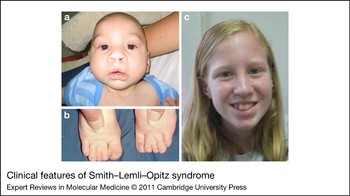
SLOS is characterised by multiple congenital malformations, intellectual disability and behavioural disorders. Typical craniofacial features include microcephaly, bitemporal narrowing, ptosis, a short nasal root, anteverted nares and micrognathia (Fig. 2a). Most patients have 2–3-toe syndactyly (Fig. 2b). Box 1 lists other clinical features of the syndrome. Initially, two phenotypes of SLOS were described, Type I being milder and Type II more severe. However, after discovery of the biochemical defect, both were recognised to fall within the clinical spectrum of the same disorder. Severely affected SLOS infants with major organ malformations often die in the perinatal period. Among survivors, there is great variability in phenotypic expression, with some individuals showing a milder phenotype (Fig. 2c), whereas others have malformations in virtually every organ system. At the mildest end of the spectrum, some children with SLOS have been identified with borderline normal IQ (personal observation, R.D.S.).
Box 1. Clinical features of SLOSa

aFrom Refs Reference Porter and Herman19, Reference Ryan24.
Clinical features of Smith–Lemli–Opitz syndrome. (a) Typical facial features of SLOS: microcephaly, bitemporal narrowing, ptosis, short nasal root, anteverted nares and micrognathia. (b) Toe syndactyly in SLOS. (c) SLOS with mild phenotype. These pictures were obtained and are reproduced with informed consent.

Most SLOS individuals have global intellectual disability (Refs Reference Ryan24, Reference Nwokoro and Mulvihill61, Reference Tierney, Nwokoro and Kelley62). Although moderate-to-severe cognitive disability is typical, approximately 10% of children have mild retardation and a few have normal or borderline normal development (Ref. Reference Mueller63). The spectrum of psychomotor development in SLOS might change as a result of increased recognition of milder phenotypes in the future.
Feeding problems and failure to thrive are common in newborns and infants with SLOS because of weak suckling, swallowing difficulties, vomiting and a lack of interest in food (Refs Reference Ryan24, Reference Kelley and Hennekam27). Weight gain is poor during the initial years, and many patients require tube feeding, often necessitating gastrostomy placement. Hypotonia is nearly universal in infancy; however, muscle tone improves with age (Ref. Reference Kelley and Hennekam27). Gross motor development is more delayed than fine motor skills, but most children eventually learn to walk.
Behavioural features of SLOS include sleep disturbances, irritability, repetitive and ritualistic behaviours, aggressiveness, self-injury, social and communication impairment, attention deficit hyperactivity disorder and autism spectrum disorder (Ref. Reference Tierney64). Sleep disturbances vary with age. Although parents report excessive sleepiness in young infants, insomnia is more common in older children and tends to diminish with age (Ref. Reference Ryan24). SLOS infants are often irritable and have prolonged, inconsolable screaming episodes. Aggressive and self-injurious behaviours have been reported in up to 60% and 90% of children and adults with SLOS, respectively (Refs Reference Ryan24, Reference Tierney64).
Recent behavioural insights in SLOS
Behavioural abnormalities that fall within the spectrum of autistic disorder have frequently been reported in children affected with SLOS. Although the rate of autistic spectrum disorder (ASD) in the general population is 1:91 (Ref. Reference Kogan65), Tierney and colleagues found that 53% of patients with SLOS met the diagnostic criteria for ASD (Refs Reference Tierney64, Reference Bukelis66). Steiner and co-workers reported a higher percentage (71–86%) (Ref. Reference Sikora67). The much higher rate of ASD in individuals with SLOS and the finding that cholesterol levels are below the 5th percentile in about 20% of children with ASD suggest a possible link between cholesterol and autism (Ref. Reference Tierney68). Structural changes found in the central nervous system (CNS) in small numbers of patients with autism suggest that an insult causing autism can occur in utero in the first trimester, as early as 20–24 days after conception (Refs Reference Arndt, Stodgell and Rodier69, Reference Johnson and Myers70). Interestingly, treatment of pregnant rats with valproic acid, which has been demonstrated to inhibit cholesterol synthesis in the rat brain during development (Ref. Reference Bolanos, Medina and Williamson71), can induce experimental autism in offspring (Ref. Reference Kuwagata72). This raises the possibility that valproic-acid-induced autism is mediated by cholesterol suppression and suggests that the maternal and fetal cholesterol environment is a crucial factor in the development of autism. In addition to proposals that dietary cholesterol supplementation during pregnancy prevents embryo malformation and severe fetal hypocholesterolaemia in a rat model of SLOS (Ref. Reference Chevy73), one can further speculate that cholesterol supplementation might also protect from development of ASD in the offspring.
Therapeutic intervention
Life expectancy in SLOS is determined primarily by the severity of internal malformations and the quality of supportive care. Surgical interventions to repair congenital anomalies and gastrostomy placement to support nutritional status are often needed. Dietary cholesterol supplementation, although somewhat controversial, has become a standard potentially therapeutic intervention for individuals with SLOS. Initial protocols suggested cholesterol ‘doses’ ranging from 20 to 300 mg/kg/day, either in natural form (eggs, cream, liver, meats) or as purified food-grade cholesterol sprinkled on food, in oil or in aqueous solution (Ref. Reference Kelley and Hennekam27). The estimated cholesterol supplementation during infancy is 30–40 mg/kg/day (Ref. Reference Steiner46). Cholesterol supplementation, in addition to providing cholesterol to tissues, downregulates HMG-CoA reductase activity and presumably suppresses 7-DHC synthesis (Refs Reference Ginat25, Reference Linck74). Although a few uncontrolled early human studies showed that cholesterol supplementation results in increased plasma cholesterol concentration (Refs Reference Irons45, Reference Nwokoro and Mulvihill61, Reference Elias75), and positive behavioural changes in SLOS patients (Refs Reference Tierney, Nwokoro and Kelley62, Reference Tierney64, Reference Martin76), others have reported that cholesterol supplementation does not improve the developmental progress of children and adolescents with SLOS (Refs Reference Sikora77, Reference Tierney78). Although cholesterol supplementation can increase plasma cholesterol concentrations and potentially ameliorate the extra-CNS phenotype of SLOS, including improvement in photosensitivity (Refs Reference Azurdia, Anstey and Rhodes79, Reference Starck, Lovgren-Sandblom and Bjorkhem80), plasma cholesterol in the circulation does not cross the blood–brain barrier. Therefore, beneficial effects on brain 7-DHC synthesis and brain cholesterol content are unlikely.
Statin medication which is routinely used to treat hypercholesterolaemia by inhibiting HMG-CoA reductase, has also been evaluated in preliminary studies in SLOS, to reduce accumulation of 7-DHC and 8-DHC (Refs Reference Jira81, Reference Starck, Lovgren-Sandblom and Bjorkhem82, Reference Haas83). Simvastatin crosses the blood–brain barrier (Ref. Reference Saheki84) and, by potentially reducing brain 7-DHC and 8-DHC, has the potential to improve neurological and cognitive outcomes. However, statins also reduce the levels of cholesterol – an unwelcome effect in SLOS. Treatments used to date have typically provided statins in addition to cholesterol supplementation (Refs Reference Haas83, Reference Chan85) or statins plus fresh frozen plasma as a source of cholesterol (Ref. Reference Jira81). Long-term treatment of two SLOS patients with simvastatin preceded by exchange transfusion was associated with long-lasting improvement of the ratio of 7-DHC to cholesterol in plasma and cerebrospinal fluid (Ref. Reference Jira81). A retrospective study with simvastatin in 39 SLOS patients showed that cholesterol supplementation in combination with simvastatin decreased the plasma 7-DHC plus 8-DHC to cholesterol ratio (which is considered to be a severity index of the disease), but improvement in growth and behaviour could not be confirmed (Ref. Reference Haas83).
Simvastatin treatment of SLOS fibroblasts with residual DHCR7 enzymatic activity led to decreased 7-DHC concentrations and increased cholesterol synthesis, which were hypothesised to occur by increased expression of the mutant allele with residual function (HMG-CoA inhibition induces a concerted upregulation of the majority of enzymes required for cholesterol synthesis) (Ref. Reference Wassif86). The effect of simvastatin was also studied in hypomorphic Dhcr7 T93M/Δ3−5 mice, where the drug decreased 7-DHC concentrations in both peripheral and brain tissues while increasing the expression of Dhcr7 in tissues (Ref. Reference Correa-Cerro14).
Caution is advised when administering statins in SLOS because statins reduce plasma 24S-hydroxycholesterol concentrations in non-SLOS subjects (Ref. Reference Vega87), suggesting a reduction in brain cholesterol synthesis. Whether statins reduce cholesterol synthesis in SLOS subjects needs to be confirmed with further studies. Marked elevations in transaminases and creatine kinase have been reported in patients that are more severely affected with SLOS (Ref. Reference Starck, Lovgren-Sandblom and Bjorkhem82). Controlled, long-term studies in SLOS patients are therefore needed to evaluate the efficacy and safety of simvastatin in SLOS.
Novel therapeutic approaches
Watson and colleagues recently described restoration of DHCR7 activity in Dhcr7 Δ3−5 mouse (Dhcr7 null) liver by treatment with adenovirus-associated viral vector containing the human DHCR7 gene (Ref. Reference Matabosch88). Preliminary data showed improvement in the DHC to cholesterol ratio. If effective in humans, this approach might offer a possible alternative to exogenous cholesterol therapy; however, a complete cure is not possible because consequences of the genetic defect have already been established during prenatal development. Modulation of maternal to fetal cholesterol transport has the potential for in utero treatment of SLOS. Abca1, a cholesterol transporter in the placenta, contributes to transport of maternal cholesterol to the developing fetus; moreover, in a SLOS mouse model, in utero treatment with TO901317, an LXR-agonist that induces Abca1, increased cholesterol content in Dhcr7 −/− embryos (Ref. Reference Lindegaard89). Antenatal cholesterol supplementation through fetal intravenous and intraperitoneal transfusions of fresh frozen plasma has also been described (Ref. Reference Irons90). The in utero transfusions resulted in increased levels of fetal cholesterol, as measured in blood samples obtained by cordocentesis.
Genotype in SLOS
The DHCR7 gene maps to chromosomal region 11q13. SLOS genomic DNA covers about 14 000 base pairs; seven of the nine exons (exons 3–9) code for the protein. The mRNA contains 2786 nucleotides with 1425 bases of an open reading frame that encodes 475 amino acids. The transcripts are ubiquitously expressed, with the highest mRNA concentrations in adrenal gland, liver, testes and brain (Ref. Reference Moebius8). A recent review describes several potential regulatory elements in the 5′ untranslated region: three SP1 sites, an inverted NF-Y site and a potential partial SRE1/E box (Ref. Reference Correa-Cerro91). Expression of Dhcr7 mRNA is induced in rats on a diet designed to decrease cholesterol absorption and synthesis (chow with cholestyramine and lovastatin) (Ref. Reference Kim, Lee and Paik92). Alternative splicing in the 5′ untranslated region of the rat Dhcr7 creates five isoforms (Ref. Reference Lee, Bae and Paik93). The isoforms are differentially expressed in different tissues and at different ages, suggesting potential regulatory function. In one human liver cell line, however, only one RNA species was identified.
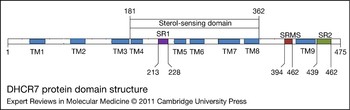
The enzyme synthesised from the coding region is DHCR7 (E.C. 1.3.1.21), which has a predicted sequence of 475 amino acids and a predicted molecular weight of about 55 000 kDa. DHCR7 catalyses the conversion of 7-DHC to cholesterol and 7-dehydrodesmosterol to desmosterol, which requires NADPH (Ref. Reference Nishino and Ishibash94). The human amino acid sequence has 56% identity to the plant enzyme (Arabidopsis thaliana), 87% identity to the rat enzyme (Ref. Reference Bae95) and 89% identity to the mouse enzyme (Ref. Reference Fitzky9). Commercial antibodies against DHCR7 are not currently available, which hampers the study of protein expression. A putative sterol-sensing domain has been predicted in the rat enzyme, at amino acid residues 177–358, corresponding to residues 181–362 in the human protein (Ref. Reference Nishino and Ishibash94). There is a sterol reductase 1 motif (amino acids 213–228), a sterol reductase 2 motif (amino acids 439–462) and a sterol reductase signature motif (amino acids 394–405) (Ref. Reference Correa-Cerro91) (Fig. 3). Although the three-dimensional structure of the DHCR7 protein is unknown, it is predicted to have nine transmembrane domains (Refs Reference Fitzky9, Reference Waterham and Wanders96) (Fig. 3).
DHCR7 protein domain structure. Diagram identifying the putative locations of the nine transmembrane regions, TM1–TM9 (blue), the three sterol reductase motifs, SR1 (purple), SR2 (green) and SRMS (red), and the sterol-sensing domain.

In tissue culture, 7-DHC provides negative feedback to HMG-CoA reductase, which is normally thought to be the rate-limiting enzyme for cholesterol synthesis (Ref. Reference Honda97). Measurement of DHCR7 enzyme activity is difficult owing to the lack of commercially available isotopically labelled 7-DHC. Several labs have measured activity using different strategies such as (1) synthesis of isotopically labelled 7-DHC in the lab and measuring its conversion to cholesterol (Ref. Reference Honda98), (2) measuring the conversion of a plant sterol, ergosterol, to brassicasterol (Ref. Reference Ginat99), and (3) measuring the conversion of D2O to deuterium-labelled 7-DHC and cholesterol (Ref. Reference Wassif86). Very low DHCR7 enzyme activity is measured in patient fibroblasts compared with controls (Ref. Reference Honda98).
Since the first mutations in DHCR7 were reported in individuals with SLOS (Refs Reference Fitzky9, Reference Wassif10, Reference Waterham and Wanders96), over 100 different mutations have been described in the literature, in addition to at least 15 variants that probably do not cause disease (Ref. Reference Yu and Patel29). Most are missense mutations, although one of the most common is a splice site mutation (described below). Affected individuals are generally compound heterozygotes, with a different mutation in each allele. Of the 32 subjects followed in our study, only one is homozygous. Multiple phenotypes, ranging from very mild to very severe, result from a large number of different combinations of mutations. A small number of mutations have been labelled ‘null mutations’, which produce an enzyme with no activity predicted. These are the splice mutation c.964-1G > C (also described as IVS8-1G > C) and the nonsense mutations p.E37X, p.Q98X and p.W151X. Patients with combinations of these null mutations are very severely affected, often not surviving the neonatal period, but those with c.964-1G > C homozygous null mutations have detectable concentrations of cholesterol. This splice mutation might be leaky, providing some properly spliced enzyme with full activity. Several groups of patients have a null mutation combined with another mutation: p.T93M, p.V326L, p.R352W and p.R404C. One would expect that the severity would be due to the second allele, but there is wide variability of clinical severity within each group (Ref. Reference Correa-Cerro91). This suggests that there are factors in addition to the SLOS genotype that significantly influence the clinical severity. Other genes involved in cholesterol synthesis, transport or regulation are also likely to modify outcomes; examples include: (1) differences in the conversion of 7-DHC to abnormal steroids, oxysterols or neuroactive sterols; (2) the supply of cholesterol during development regulated by the activity of the ABCA1 cholesterol transporter (Ref. Reference Irons90); (3) maternal ApoE genotype that affects cholesterol transfer from the mother to the fetus (Ref. Reference Witsch-Baumgartner100); or (4) the size of high-density lipoprotein particles (smaller size in cord blood from affected fetus than in controls) that might influence the transport of maternal cholesterol to the fetus (Ref. Reference Jenkins101). Occasionally, only one mutation has been found in the coding region and around the splice sites of the exons. We hypothesise that the missing mutation could be in the untranslated regulatory region, in a section of an intron with a vital function that has not yet been identified or perhaps as a deletion too big to be identified by sequencing. Two mutations have been found in all but one of the patients in which the DHCR7 gene has been sequenced by our research laboratory.
Estimates of incidence range from 1:80 000 (Ref. Reference Jira102) to 1:13 000 (Refs Reference Battaile103, Reference Nowaczyk104). Undiagnosed fetal loss, difficulty in identifying mild cases and missed diagnosis of very severe cases, where diagnosis might have been brain malformation, make the true determination of incidence difficult. The most common mutations are p.T93M, p.W151X, p.V326L, p.R352W, p.R404C, p.E448K and c.964-1G > C. The frequency of c.964G > C and W151X mutations depends on the geographic region. The c.964-1 G > C mutation is most frequent in North America and Western Europe (Ref. Reference Waye105). The p.W151X mutation is most frequent in Central and Eastern Europe (Refs Reference Witsch-Baumgartner106, Reference Ciara107). This suggests a founder effect for these two mutations. Fifty per cent of the mutations occur in transmembrane regions. A selective advantage for heterozygotes has been proposed in an effort to explain the high incidence of SLOS. Increased 7-DHC concentrations might increase the synthesis of vitamin D, which would lower the risk of rickets (Ref. Reference Kelley and Hennekam27). Perhaps low cholesterol concentrations in tissues provide protection from infection, because cholesterol in the cell membrane is a crucial component required by microorganisms to enter or exit cells. In addition, cholesterol is necessary for cytolytic activity of cholesterol-dependent cytolysins (Ref. Reference Goluszko and Nowicki108).
Diagnostic utility of mutation analysis
In most cases, the biochemical measurement of 7-DHC and cholesterol concentrations in plasma is the simplest and most convenient method for diagnosis. It is important to note that plasma cholesterol concentrations can be in the normal range in SLOS, so normal plasma cholesterol by no means rules out the diagnosis of SLOS. In at least two situations, mutation analysis might be necessary or at least very useful: in patients with borderline concentrations of 7-DHC and in prenatal testing. Some mildly affected children with SLOS can have 7-DHC levels as low as 0.1 mg/dl (Ref. Reference Langius109), and occasionally children who lack DHCR7 mutations can have 7-DHC levels greater than 0.1 mg/dl (those with other disorders such as the bile acid synthesis disorder cerebrotendinous xanthomatosis), although virtually every individual with diagnostically elevated 7-DHC in the correct clinical setting is affected with SLOS. In families with a known genotype, prenatal diagnosis of SLOS by mutation analysis of chorionic villus samples or amniotic fluid cells can be performed (Ref. Reference Waye, Eng and Nowaczyk110), although testing of maternal urine for abnormal steroids synthesised by the fetus has also been shown to be accurate and is less invasive (Refs Reference Shackleton43, Reference Jezela-Stanek111). Preimplantation genetic diagnosis is reported for two cases, with the transfer of mutation-free embryos and successful pregnancies (Ref. Reference Liss112).
Animal models of SLOS
Attempts have been made to develop animal models for SLOS to explain the biochemical and cellular basis for the pathophysiology of the syndrome and to provide a basis to develop and test potential dietary, pharmacological and other treatments. The attempt is challenging because the SLOS subjects have both physical and psychological abnormalities, and because cholesterol is vital to normal development.
Models of SLOS treated with DHCR7 inhibitors
The malformations seen in rats treated with DHCR7 inhibitors overlap those seen in human SLOS subjects. AY9944 [trans-1,4-bis(2-chlorobenzyl-amino-methyl)cyclohexane dihydrochloride] and BM15766 {4-[1-(4-chlorocinnamyl)piperazin-4-yl]ethyl-benzoic acid} are chemically unrelated inhibitors of DHCR7, but they induce similar defects in offspring when fed to pregnant rats at different time points during gestation (Refs Reference Roux, Horvath and Dupuis113, Reference Roux114, Reference Barbu115). When AY9944 is given to rats on gestation day 3, the offspring develop holoprosencephaly; when given on day 10, male offspring develop sexual malformations. If the maternal plasma cholesterol concentrations during pregnancy are below 30 mg/dl, the malformation of rat fetus is holoprosencephaly (Ref. Reference Barbu115). BM15766 has teratogenic potency that is similar to AY9944. Wolf and colleagues studied changes in the serum sterols of rats treated with these inhibitors and compared sterol concentrations in the model and in humans with SLOS (Ref. Reference Wolf116). Both drugs lower plasma cholesterol concentrations and increase plasma 7-DHC concentrations. The aberrant sterols detected in rats are similar to those observed in human SLOS subjects. They include 7-DHC and 8-DHC. Oxidised derivatives of 7-DHC induce growth retardation in cultured rat embryos, suggesting a toxic role for 7-DHC and its derivatives (Ref. Reference Gaoua117). Retinal degeneration in rats treated with AY9944 is comparable with that observed in the human disease (Ref. Reference Fliesler16). However, there appear to be a number of differences between pharmacological animal models and humans with SLOS. Pharmacological inhibition is reversible and is species dependent. For example, Wistar rats are more sensitive to the teratogenic action of AY9944 compared with Sprague–Dawley rats, and mice are more resistant than rats, requiring 10–20 times the rat dose (Ref. Reference Roux118). Three distal inhibitors of cholesterol synthesis, AY9944, BM15766 and triparanol, have different chemical structures and different physical properties (and triparanol has a different target enzyme), but similar teratogenic activity. Deficiency of cholesterol rather than accumulation of aberrant sterols is suggested to be the major cause of teratogenic activity in SLOS animal models (Ref. Reference Gaoua119). Careful consideration of physiological cholesterol differences, and maternal–fetal sterol transfer, between and among the different rat and mice strains might help us better understand the development of malformations in utero in SLOS. In rat models, cholesterol supplementation to mothers prevents embryo malformation, severe hypocholesterolaemia and accumulation of abnormal sterols (Ref. Reference Chevy73). Fetal cholesterol is thought to be low during embryogenesis, with malformations occurring in tissues and structures whose embryonic patterning depends on signalling by secreted hedgehog proteins, after they are activated by cholesterol. Insufficient cholesterol, however, is an overly simplistic explanation. Experiments using chick embryos, chick neural plate explants and cultured fibroblasts suggest that malformations in SLOS are probably not due to sterol depletion and altered hedgehog activation, because 27-carbon cholesterol precursors, including 7-DHC and lathosterol, can substitute for cholesterol in sonic hedgehog activation. The SLOS malformations are thought to be caused by signalling defects in the Patched and Smoothened pathways (Ref. Reference Cooper18). In addition, hedgehog signalling is impaired in embryonic fibroblasts derived from the Sc5d (lathosterolosis) mutant mouse, again suggesting that impairments in signalling through Smoothened and Patched rather than defective hedgehog activation are likely to be responsible for the malformations in SLOS (Ref. Reference Krakowiak120).
Knockout mouse models for SLOS
A genetic model for SLOS was created by disrupting the Dhcr7 gene in mouse embryonic stem cells by targeted homologous recombination (Ref. Reference Wassif12). Heterozygous mice appeared to be phenotypically normal. Homozygous pups died during their first day of life as a result of their failure to feed. Homozygous pups were growth retarded, had craniofacial abnormalities such as a cleft palate, and failed to feed as a result of the inability to suck. The lack of suckling and the decreased movement observed in these homozygous pups are traits similar to those observed in some severely affected SLOS children and might be attributed to neurological abnormalities. The SLOS mouse had low plasma cholesterol concentrations and high plasma 7-DHC levels. In homozygous pups, serum levels of 7-DHC were increased >1500-fold and tissue levels were 250–2000 times that of the controls. In the CNS of mutant mice, desmosterol levels were reduced drastically and 7-DHC levels were similar to cholesterol levels. In another DHCR7-knockout SLOS mouse model, homozygous pups showed low brain and liver cholesterol concentrations and 30- to 40-fold elevated concentrations of 7-DHC; however, the newborn pups did not suckle, had a cleft palate and immature lungs, and died within 18 h of birth (Ref. Reference Fitzky13). Cholesterol deficits were most profound in the brain, where DHC comprised 80% of total sterols (desmosterol was not detected, and 7-dehydrodesmosterol accumulated), owing to the lack of 7,8-reductase activity (Ref. Reference Fitzky13).
The fact that these SLOS models do not survive for more than a day suggests that we need a better model to study alterations in neurophysiological functions in SLOS subjects. A hypomorphic mouse model has been created by introducing a mutation corresponding to the p.T93M mutation found in SLOS patients. Both Dhcr7 T93M/T93M and Dhcr7 T93M/Δ3−5 mice, although they possess high 7-DHC concentrations, are viable and fertile (Ref. Reference Correa-Cerro14). Dhcr7 T93M/T93M mice appear normal, whereas Dhcr7 T93M/Δ3−5 mice demonstrate mild growth retardation, syndactyly and an occasional cleft palate. In these pups, the sterol defect in peripheral tissues improves with age.
Insights provided by SLOS mouse models
Simvastatin treatment reduces 7-DHC concentrations in peripheral tissues and in CNS tissues of Dhcr7 7T93M/Δ3−5 pups. Simvastatin treatment might therefore be effective in improving the brain sterol profile and could effectively treat the behavioural and learning problems in SLOS subjects (Ref. Reference Correa-Cerro14). Cholesterol and 7-DHC concentrations change in perinatal to weanling age SLOS mice; however, changes in the brain and liver were found to be independent (Ref. Reference Marcos121). The use of age-matched animals at early stages might provide an insight into the mechanism that these mice use to normalise cholesterol. The viability of these Dhcr7 −/– mice has enabled images of brain sterol localisation to be recorded in the abnormally developing cerebellum and brainstem using in situ detection methods and cation-enhanced nanostructure-initiator MS (Ref. Reference Patti122).
Future research directions
It is notable that although the biochemical basis for SLOS has been understood for over 15 years, and the genetic basis for over 10 years, there is still no proven therapy. One of the most important goals for continued research in SLOS should be development of better animal models. The current rodent models are suboptimal because of lethality in one case (Ref. Reference Wassif12), reversion to normal in a second (Ref. Reference Correa-Cerro14) and nonspecificity on pharmacological treatment. Human DHCR7 transgenes have been inserted into the liver and CNS in the knockout mouse model (Refs Reference Yu123, Reference Yu124). Selective reconstitution of liver cholesterol biosynthesis promotes lung maturation, but does not prevent neonatal lethality in Dhcr7-null mice (Ref. Reference Yu123). Limited success was obtained in rescuing the neonatal lethality with a human DHCR7 transgene inserted into the brain (Ref. Reference Yu124). However, tissue-specific transgenic conditional DHCR7-knockout and DHCR7-knock-in mice are needed to allow further studies of the pathophysiology and to test interventions in animal models before tests in humans will be possible.
In addition to animal models, the creation of cellular models of human SLOS will surely be useful. For example, creation of SLOS-induced pluripotent stem cells (iPSs) would allow various SLOS cell types to be grown in culture and studied. Cells derived from human brain or neural iPSs are urgently needed to study the pathophysiology of SLOS and to test the effect of interventions on cells that must be targeted if therapy is to have a significant effect. For brain-derived stem cells to become available, courageous families will need to donate brain tissue from their children when they die; the Smith–Lemli–Opitz/RSH Foundation (www.smithlemliopitz.org/) has teamed up with the National Disease Research Interchange (www.ndriresource.org/) to facilitate such donations.
Proteomic and lipidomic approaches are already yielding insights into SLOS. Porter and colleagues recently identified differentially expressed proteins in the DHCR7-knockout mouse brain (Ref. Reference Jiang125). Identification of increased cofilin-1 expression led to the finding of aberrant activation of Rho–Rac signalling in SLOS, which could have functional consequences for dendrite and axonal growth. Associated with this were developmental abnormalities of neuronal process formation, which might contribute to the neurocognitive deficits found in SLOS. The authors speculated that Rho–Rac signalling could represent a potential target for therapeutic intervention. At a minimum, these findings should be followed up with additional investigation of aberrant signalling pathways in SLOS. Few published lipidomic studies in SLOS are available, but lipid expression has been examined in the retina of the pharmacological SLOS rat model (Ref. Reference Ford126). The retinal lipidome is globally altered in the SLOS rat model, with the most profound changes being fewer phosphatidylcholine, phosphatidylethanolamine and phosphatidyl-serine molecular species containing docosahexaenoic acid (22:6) (Refs Reference Ford126, Reference Boesze-Battaglia127). Additional lipidomic studies in SLOS are warranted, perhaps using the SLOS mouse models and available human tissues as well, to see whether these findings can be replicated. Further specific investigation into phospholipid and fatty acid metabolism in SLOS is also likely to be illuminating, because the cholesterol deficit and excess dehydrocholesterol clearly have many secondary effects that contribute to disease pathophysiology.
In vitro studies and use of animal models will undoubtedly move the field forward, but in vivo human studies are also crucial. There have been only limited phenotypic and natural history studies of SLOS to date. More comprehensive studies of natural history and targeted studies following up on earlier observations are ongoing. For example, Irons and colleagues reported in a study of brain MRI and MRS in SLOS that the ratios of choline:NAA (N-acetylaspartate), lipid:NAA and lipid:choline metabolites correlated with clinical disease severity and serum sterols, and in two cases, with the effect of cholesterol supplementation (Ref. Reference Caruso128). 1H-MRS demonstrated abnormally elevated lipids before cholesterol therapy, which improved with dietary cholesterol (Ref. Reference Caruso128). 1H-MRS of the brain might yield biomarkers useful for the assessment of the effects of interventions in SLOS within the brain. This and additional biomarker development will be crucial in facilitating clinical trials because the clinical phenotype can change slowly over many years. Methods are needed for determining brain and whole-body cholesterol mass and accretion, and the effects of interventions on these parameters.
Finally, development and testing of additional potential therapies will be essential if we are to make headway towards ameliorating the effects of SLOS. Approaches such as mechanical delivery of cholesterol to the brain should be considered. The blood–brain barrier represents a major obstacle to treatment of SLOS. Potential areas of investigation to overcome this obstacle are (1) bypassing the blood–brain barrier by direct injection of cholesterol to the brain; (2) developing synthetic sterols that can cross the blood–brain barrier; (3) transplanting neural stem cells into the brain; and (4) delivering cholesterol from the peripheral circulation by disrupting the blood–brain barrier (Ref. Reference Kroll and Neuwelt129). Gene-transfer techniques are perhaps the most promising, considering recent successes in gene therapy for neurological disorders (Ref. Reference Cartier130), although we are still years away from when human clinical trials in SLOS will be possible. However, recent progress in gene-transfer studies in animal models for SLOS is exciting (Ref. Reference Vega87). If maximal benefit of therapeutic approaches is to be realised, prenatal approaches to therapy might be necessary. Steps as simple as cholesterol supplementation early in pregnancy in mothers at risk of carrying a fetus affected with SLOS might be worthy of investigation, given what we know about maternal–fetal transfer of cholesterol (Refs Reference Witsch-Baumgartner100, Reference Woollett131). Additional investigations into the origins of fetal and embryonic cholesterol and prenatal cholesterol transport are ongoing, but almost exclusively in animals: creative thinking is needed to explore this issue in humans. More practical therapies also warrant investigation. The bile acids ursodeoxycholic acid and chenodeoxycholic acid have been used in early trials of cholesterol supplementation in SLOS to ameliorate potential bile acid deficiency and improve cholesterol absorption (Refs Reference Nwokoro and Mulvihill61, Reference Ullrich132) and are still used in certain situations. Recently, tauroursodeoxycholic acid (TUDCA), a taurine-conjugated bile acid with antioxidant, antiapoptotic and neuroprotective properties, has been investigated as a therapy for other disorders. Evidence that TUDCA crosses the blood–brain barrier (Ref. Reference Rodrigues133) makes TUDCA a potential therapy for SLOS. There is also evidence of increased oxidative stress in SLOS (Ref. Reference Korade21), suggesting that investigation of the safety and efficacy of antioxidants in SLOS is warranted, especially given the good safety record of many antioxidants.
Acknowledgements and funding
The Steiner laboratory is supported by a grant from the US Public Health Service (R01 HL073980) and by a cooperative agreement (U54 HD061939) for the Sterol and Isoprenoid Diseases (STAIR) consortium, part of the NIH Rare Diseases Clinical Research Network (RDCRN) supported by NICHD and the NIH Office of Rare Diseases Research (ORDR). This work was also supported by a training grant awarded to A.E.D. from the STAIR consortium. In addition, we gratefully acknowledge J. Roullet and J. Adsit for help in preparing the manuscript, and the anonymous peer reviewers for insightful review of the manuscript and constructive suggestions.