HUNTER-GATHERERS AND HERDERS: KALAHARI AND CAPE KHOISAN DEBATES
The shift from foraging subsistence strategies to a reliance on domesticated species has long been a key concern in social science disciplines, which have traditionally used subsistence-based classification schemes for understanding human diversity (cf. Pluciennik Reference Pluciennik and Barnard2004). In southern Africa, the persistence of foraging strategies into the twentieth century, alongside agro-pastoralist and pastoralist societies, has foregrounded the relationship between hunter-gatherers and food producers as a key area of research and debate.
Southern African hunter-gatherers – particularly the NyaeNyae and Dobe Juǀ'hoansi (ǃKung) – have played a significant role in archaeological and anthropological discourse as a source of analogies for the behavioural and cultural adaptations that may have shaped the evolution of modern humanity (Lee and deVore Reference Lee and deVore1968; Reference Lee and deVore1976). This analogical deployment has, in turn, been subject to critiques that suggest such academic representations substantially distorted the historical circumstances of these hunter-gatherer groups: together with responses from the original authors, these critiques came to be termed the Kalahari Debate (Barnard Reference Barnard1992a). This debate coalesced around Wilmsen's (Reference Wilmsen1989) premise that many of the ethnographic features observed among southern African hunter-gatherers were consequent on their incorporation as a low-status community within the society of their Bantu-speaking farmer neighbours: specific applications of this approach have been criticized on empirical (Lee and Guenther Reference Lee and Guenther1993) and interpretive (Solway and Lee Reference Solway and Lee1990) grounds.
The imperfect nature of our archaeological understandings of precolonial interactions in the Kalahari is a considerable obstacle in attempts to reconstruct long-term trajectories for the region (Sadr Reference Sadr1997: 109–11), and investigations into the time depth and dynamics of the prehistory of pastoralism in the southern African subcontinent are thus intertwined with the Kalahari Debate (Sadr Reference Sadr2003: 202). Historical sources attest to the presence of both hunter-gatherer (known variously as Bushman, San and Sonqua) and pastoralist (Khoekhoen) societies in the south-western Cape (South Africa) at the time of colonial contact, and much debate has focused on unravelling the spread of pastoralism that must have underpinned this situation.
Colonial characterizations of Cape societies have been revisited by historians and social scientists, who have questioned (given the intimately linked genetic and linguistic history of the ‘Cape Khoisan’) whether this stark separation was an accurate reflection of the social dynamics at the Cape, and whether ‘hunter-gatherers’ and ‘pastoralists’ might not instead represent different positions on a single spectrum of stock acquisition and loss (Marks Reference Marks1972; Schrire Reference Schrire1980; Parkington Reference Parkington and Schrire1984; Elphick Reference Elphick1985). In archaeological terms, the debate – still far from resolved – has centred on three broad scenarios based upon the initial occurrence of domesticated species in the archaeological record of the Cape (from broadly the beginning of the Common Era):
1. the inclusion of domesticates in a ‘package’ that moved along with a specific group of people (the ancestors of the historical Khoekhoen);
2. processes of diffusion and local adoption that were responsible for a more gradual uptake of technologies;
3. some combination of these two, incorporating an initial diffusion and later migration (cf. Smith Reference Smith1990; Reference Smith1992; Reference Smith1998; Reference Smith2008; Reference Smith2011; Sadr Reference Sadr1998; Reference Sadr2003; Reference Sadr2008; Smith and Ouzman Reference Smith and Ouzman2004; Sadr and Sampson Reference Sadr and Sampson2006; Arthur Reference Arthur2008; Barnard Reference Barnard2008; Fauvelle-Aymar Reference Fauvelle-Aymar2008; Güldemann Reference Güldemann2008).
Smith (Reference Smith1990; Reference Smith1992; Reference Smith1998; Reference Smith2008; Reference Smith2011) has repeatedly advanced the argument that ‘ideological’ components of southern African hunter-gatherer socio-cultures inhibit their potential to adopt pastoralist strategies: ideology, in this case, describes a broad set of hunter-gatherer orientations or ontological premises informing a series of normative cultural pressures and social structures that emphasize particular ways of relating to non-human animal species (and the products derived from them).
In particular, foragers' redistributive rules governing the sharing of meat, as part of a general ‘egalitarian’ ethos that structures southern African hunter-gatherer social relations (Ingold Reference Ingold, Lee and Daly1999: 400–4), have been seen as important obstacles to be overcome if domesticated stock are to be incorporated within hunter-gatherer strategies. These particular mechanisms and regulations are ultimately tied into much wider social issues, and shifts towards pastoralist subsistence strategies are thus characterized as fundamental social changes involving phenomena such as the emergence of persistent or marked social and wealth hierarchies (by allowing for accumulation of livestock), the incorporation of livestock within significant lifecycle rituals (in initiations, as bride wealth, slaughtered at funerals, and so on), and even transitions between distinct forager and pastoralist ‘modes of thought’ (Ingold Reference Ingold2000; Barnard Reference Barnard, Stewart, Barnard and Omura2002).
THE BLEEK–LLOYD ARCHIVE
Both the Kalahari and the ‘Cape Khoisan’ debates have drawn largely on ethnographic data from Northern Bushman populations from the Kalahari – and indeed upon more general characterizations of ‘hunter-gatherer’ and ‘pastoralist’ attitudes synthesized from large bodies of ethnographic data. These data do not, however, represent the only sources of information on southern African hunter-gatherer interactions with food producers, herders and/or their domesticated flora and fauna: we can also turn to the Bleek–Lloyd Archive for insights into the ways in which Southern Bushman groups viewed these types of interaction.
From the late 1850s until his death in 1875, a German linguist by the name of Wilhelm Bleek – working at the South African Library in Cape Town – embarked on a project to record the ǀXam language, which was spoken by the hunter-gatherer populations of the arid interior ‘Karoo’ regions of the Cape Colony. Working at first in the Breakwater prison (which housed a number of Bushman convicts) and later from his home in Mowbray, Bleek relied upon six main informants – five men (ǀaǃkunta, ǁkabbo, ǂkasin, Diaǃkwain, and ǀhanǂkass'o) and one woman (ǃkweitǝn-ta-ǁkeŋ) – some of whom stayed in the Bleek household for several years.
Lucy Lloyd, Bleek's sister-in-law, initially assisted him with interviews and translations, and increasingly came to play a central role in the project: it was through Lloyd's efforts that the project was continued after Bleek's death, and she was ultimately responsible for collecting around 85 per cent of the archive. Together, Bleek and Lloyd recorded over 11,000 pages of personal histories, traditional narratives and ethnographic data, which were taken down verbatim in ǀXam: English translations were provided alongside, following further discussions with the informants (often mediated through Afrikaans, at least in the earlier stages of the project; Bank Reference Bank2006: 87, 108).
Bleek and Lloyd produced short reports on the material they collected (Bleek Reference Bleek1875; Lloyd Reference Lloyd1880), but the narratives were not published in any substantial manner until the early decades of the twentieth century (Bleek and Lloyd Reference Bleek and Lloyd1911) through the efforts of Bleek's daughter Dorothea (Bleek Reference Bleek1923; see Hollmann Reference Hollmann2004). The unusually detailed nature of Bleek and Lloyd's accounts, coupled with their preservation of the original ǀXam language, has ensured the ongoing significance of their work. Numerous subsequent analyses have drawn upon their data to explore Southern Bushman beliefs and practices, and have delineated the historical contexts that underpinned Bleek and Lloyd's interest in ‘Bushman researches’ (see Lewis-Williams Reference Lewis-Williams1981; Reference Lewis-Williams1992; Reference Lewis-Williams, Deacon and Dowson1996; Reference Lewis-Williams1997; Reference Lewis-Williams2000; Deacon Reference Deacon1986; Reference Deacon1988; Reference Deacon, Deacon and Dowson1996; Barnard Reference Barnard1992b; Deacon and Dowson Reference Deacon and Dowson1996; Schmidt Reference Schmidt, Deacon and Dowson1996; Guenther Reference Guenther1989; Reference Guenther1999; Hollmann Reference Hollmann2004; Bank Reference Bank2006; Hewitt Reference Hewitt2008; Moran Reference Moran2009; de Prada-Samper Reference de Prada-Samper2009; Wessels Reference Wessels2010).
Recently, digital scans were made of the original notebooks (Skotnes Reference Skotnes2007),Footnote 1 allowing unparalleled access to the primary materials of the archive. In particular, these images allow researchers to explore ǀXam terminology recorded by Bleek and Lloyd as they learned the language and refined their understandings of ǀXam society: this element is crucial when considering the impact of the translation processes applied by researchers on contemporary readings of the archive. While the Bleek–Lloyd Archive remains a colonial project, and issues of misrepresentation are ever present (Wessels Reference Wessels2010: 25–46; Reference Wessels2011; cf. Spivak Reference Spivak, Nelson and Grossberg1988), by revisiting the original terminology we may be able to gain some sense of the emic structure of the narratives (McGranaghan Reference McGranaghan2014a; Reference McGranaghan2014b).
Although these digitized scans can be searched in a limited fashion, these ‘re-translations’ demand that close attention be paid to recurrent patterns linking words and ideas across the entirety of the corpus. This paper relies upon a fully searchable transcription of the complete archive, produced in the course of doctoral research into ǀXam ethno-history (McGranaghan Reference McGranaghan2012), which can be scoured to extract all references to particular terms. These terms can then be compared against ǀXam terminology, and attempts can be made to synthesize underlying attitudes and ‘world views’ that structured the particular narratives given.
The paper aims to provide fodder for the ‘Cape Khoisan’ debate by considering the ways in which the ǀXam informants presented their interactions with domesticated fauna. It looks at whether such interactions can be considered as operating in opposition to any hunter-gatherer orientations present in their interactions with non-domesticated faunal species, and in particular whether ǀXam conceptions of domestication and the control of herds necessitated a shift to a ‘pastoralist’ world view (Smith Reference Smith2011: 14–15) that was at odds with the ‘egalitarian’ structures governing their treatment of wild game resources.
THE NINETEENTH-CENTURY KAROO
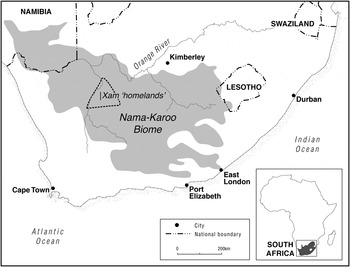
Before presenting these interactions, it is necessary to briefly outline the nineteenth-century Karoo contexts within which the Bleek–Lloyd informants lived (Figure 1), as this had a considerable bearing on their experiences involving livestock. By the late eighteenth century, the frontiers of European settler colonialism spreading from the south-western Cape had engulfed the ǀXam ‘homelands’ (Penn Reference Penn2005). As settler farmers moved away from Cape environments (where winter rainfall regimes facilitated agricultural practices based on European crops), these arid zones became a key factor in structuring the development of new transhumant pastoralist systems, relying on indigenous labour and incorporating considerable mobility. It is within the context of these systems that the Bleek–Lloyd informants generated many of their experiences dealing with livestock.
The location of ǀXam homelands within the Nama-Karoo biome.

Although permanent settlement of these arid regions would not prove possible until the borehole and windmill technologies of the late nineteenth century permitted the tapping of groundwater (Archer Reference Archer2000: 683), pastoralist groups adopted nomadic strategies to take advantage of periodic grazing availability; the resources of the Orange (Gariep) River and the societies beyond it also attracted the attention of a wide range of colonial agents, missionaries, traders and stock farmers (Penn Reference Penn and Smith1995). Of particular importance were a series of ‘mixed descent’ groups – mainly comprising people of European and Khoekhoe/Bushman descent (called at the time Bastaards) but also including runaway slaves, impoverished or fugitive Europeans (Penn Reference Penn1999), and Xhosa groups displaced by internecine conflicts beyond the eastern frontier of the colony (Kallaway Reference Kallaway1982; Anderson Reference Anderson1987).
Colonial strategies exploiting the resources of Karoo regions incorporated the potential for considerable violence, most famously in the institution of the commando (Penn Reference Penn2005: 110). This system of rapidly mobilized armed and mounted bands of farmers and their servants (responding to stock raiding) allowed for the capture of Khoekhoe and Bushman women and children, and thus underpinned the labour relations upon which colonial expansion relied (Newton-King Reference Newton-King1999). Relatively weak governmental oversight ensured that no single group exerted a monopoly on this violence, creating an ‘open’ (Giliomee Reference Giliomee, Elphick and Giliomee1979) or ‘heterodox’ (Mitchell Reference Mitchell2009: 17–30) situation in which multiple groups employed a range of strategies to propagate or resist colonial expansion. Although this type of frontier structured the intense violence to which Bushman populations were subjected (Deacon Reference Deacon, Deacon and Dowson1996: 13–16), it also undermined colonial farming strategies of controlling labour, by facilitating independent hunter-gatherer existence or by allowing individuals to adopt new strategies of raiding (cf. Challis Reference Challis2012).
Until the discovery of the mineral wealth of the interior from the 1860s onwards (Ross Reference Ross2008: 75), there was relatively little official government interest in the interior Karoo. Throughout the first half of the nineteenth century, there was considerable continuity in terms of eighteenth-century strategies (Penn Reference Penn2005: 81–7). As violent frontier relationships continued throughout the nineteenth century, hunter-gatherer groups began to lose the war of attrition: with increasing incorporation into international markets, the Karoo came under the influence of an increasingly hegemonic colonial government presence. From the 1850s onwards, the ostrich feather (van Sittert Reference van Sittert2005: 274) and wool trades (Beck Reference Beck2000: 50) created a potential for profits that rendered the area more attractive to settlers. For colonial government, neither of these goods was as significant as the fact that the northern districts of the Cape Colony represented a route through which the mineral wealth of the interior flowed towards international markets; resources invested to incorporate mining towns into the colonial state were crucial in allowing farming settlement to become dominant.
The establishment of a police force, magistracy, railways, roads and the other paraphernalia of colonial bureaucracy cemented the colonial presence in the ǀXam homelands in a new and enduring fashion (Legassick Reference Legassick and Coombes2006). Government resources effectively imposed a colonial ‘landscape’ over the Karoo, one that no longer included the necessary space for the pursuit of nomadic hunter-gatherer lifestyles, now defined as illegal uses of land (van Sittert Reference van Sittert2005). Hunting and gathering practices, which had survived over a century of contact with colonial populations and a much longer prehistoric contact with pastoralists, finally ceased as primary subsistence modes; the supplementary collection of wild plant foods and small game continues even today in rural South Africa (Youngblood Reference Youngblood and Peter2008; Chevallier and Ashton Reference Chevallier and Ashton2006: 13–14).
DOMESTICATES AND THE ǀXAM
Domesticated flora and fauna were important components structuring European colonial interests in southern Africa – indeed, they represented the impetus both for the initial contact between European and indigenous societies and for the start of European farming at the Cape (Ross Reference Ross2008: 22–3). Equally, the aims of securing and controlling a sufficient labour force to manage herds were central in shaping colonial pastoralist (both European and Bastaard) interactions with the ǀXam. Environmental and ecological considerations – the demands of cattle and sheep for food and especially their high water requirements relative to indigenous bovids – substantially influenced the direction and intensity of colonial settlement (cf. Beinart and Hughes Reference Beinart and Hughes2007).
Here, I consider the influence of ǀXam world views on their relationships with domesticated animals, as revealed in recurrent themes scattered throughout the narratives of the archive. ǀXam had only one word for their narratives, kum (pl. kukumm-i) (Bleek Reference Bleek1956: 106), differentiated in Bleek and Lloyd's translations as stories, histories, talk and news: these kukumm-i incorporate topics and narrative styles ranging from accounts of personal experiences of arrests and imprisonmentFootnote 2 to formal narrations of the creation of the ǀXam world by various non-human agents,Footnote 3 with a series of more or less stereotyped forms of narrative in between. Rather than providing detailed analyses of specific stories, this discussion extrapolates information about ǀXam ways of understanding the world, and applies this to our understandings of their interactions with their colonial situation: as tales of all kinds can reveal important information about ǀXam conceptions, relevant information is taken from throughout the archive.
I focus on whether behaviours inherent in contacts with food producers represented the disaggregation of ǀXam ‘hunter-gatherer’ identity and practice, exploring participation in pastoralism, labouring for immigrant European and mixed-heritage groups, and raiding practices. Nineteenth-century ǀXam relationships with domesticated fauna were numerous – many of the Bleek–Lloyd informants (as well as their friends and relatives) had worked for European and Bastaard farmers, or had been involved in stock theft practices. Domesticates were thus incorporated into the practical exigencies of their everyday experiences, and they were thoroughly integrated into mythological narratives and significant rituals. I discuss three categories of domesticated fauna: dogs, small stock (sheep) and large stock (cattle and horses).
Understanding dogs
Southern African hunter-gatherer relationships with dogs have – in the Cape Khoisan debate – not been considered as significant indicators of their abilities to incorporate domesticated animals generally. This is presumably in part because of the ubiquity of canines in mutualistic relationships with hunter-gatherers and because of the time depth of this domestication event (Clutton-Brock Reference Clutton-Brook and Serpell1996), although details pertaining to the prehistoric arrival and spread of this species are poorly understood for southern Africa, complicated by difficulties in separating domesticated from wild canids (Horsburgh Reference Horsburgh2008; Mitchell Reference Mitchell, Badenhorst, Mitchell and Driver2008). Nevertheless, dogs were frequently discussed by the ǀXam informants, although this was not done uniformly (the sole woman, ǃkweitən-ta-ǁkeŋ, mentioned dogs only once). It is, therefore, necessary at least to briefly consider the content of their discussions, as they may have a bearing on ǀXam characterizations of other domesticated fauna.
Commonly, these animals were discussed as extensions of hunter personae and closely associated with their owners (ǃkwin-ta-ǃkwi, ‘dog's man’Footnote 4) in male informants' hunting narratives. The closeness of identity in this relationship between the ‘dog's man’ and his animal was expressed by the incorporation of dogs within the ‘respect’ connections established between the successful hunter and his quarry (Hollmann Reference Hollmann2004: 66–75): if a ‘dog's man’ broke the forelegs of prey killed by his dog, corresponding bones would break in his dog's leg when it was next running down game.Footnote 5 Dogs that consumed inappropriately would cause the men to miss their aimFootnote 6 or injure themselves,Footnote 7 in much the same ways as taboo transgressions on the part of a hunter's wife or children might let game animals escape.Footnote 8
The extension of identities between humans and dogs could be put to good use by competent individuals, in the skilful deployment of particular abilities to achieve the socially meritorious ends that the ǀXam termed ‘understanding’ behaviour, which was linked with the correct fulfilment of adult social obligations and roles (McGranaghan Reference McGranaghan2012: 168–81). If a baboon captured a dog, the hunters would misrepresent it, calling it a ‘girl's dog’,Footnote 9 which would cause the baboon to treat the dog with respect and fear rather than injuring it.Footnote 10 This desire to injure dogs was situated in the context of baboons' antipathetic attitudes towards Bushman hunters; by obscuring their own relationship with the dog, the hunters presumably were intimating to the baboon that it had engaged inappropriately in interactions with animals that were not associated with hunting.
Dogs themselves could also act ‘understandingly’, by utilizing their superlative olfactory senses to help defend against intrusions of antisocial beings – paradigmatically lionsFootnote 11 but also antagonistic ǃgi:tən Footnote 12 – into the domestic sphere, providing early warnings that allowed people time to prepare the correct responses. Odour was an integral component of ǀXam notions of personhood (Low Reference Low2007a; Reference Low, Low and Hsu2007b), and particular skills in interpreting smells over long distances were common among non-human forces that might attempt to injure people or to escape and deprive them of food. By cultivating relationships with dogs, people could attempt to access equivalent non-human skills, but to marshal them to human ends.
ǀXam relationships with dogs were firmly integrated into their ontological understandings of the world. Most importantly, they were linked with skilful and successful subsistence performances, a component that rendered their position rather different to that occupied by game species or wild carnivores (McGranaghan Reference McGranaghan2014b). For the ǀXam, successful performance had a fundamentally moral dimension, being linked not only with the requisite physical or mental skills but also with the moral dispositions to ensure that acquired resources were distributed correctly among friends and relatives (i.e. the redistributive regulations typically associated with ‘egalitarian’ hunter-gatherers).
ǀXam relationships with dogs were highly reminiscent of their relationships with their friends and families, and were similarly structured along moral lines: dogs were expected to behave according to particular strictures for the good of the community. The ‘dog's men’ – who were intimately linked to their animals' identities – were supposed to direct and control their canine hunting companions. In this respect, dogs appear as markedly similar to children, who were instructed to behave in particular ways (and were partly responsible for their own behaviour), but who were also connected with particular adults expected to regulate their behaviour where the child was unwilling or unable to do so.
Stock raiding
Sheep overwhelmingly dominate ǀXam references to livestock. This is, perhaps, only to be expected for individuals used to encountering Northern Cape farming practices, which from the mid-nineteenth century came increasingly to focus on merino wool production for export. Although hunter-gatherer interactions with livestock and livestock-owning communities in Karoo regions probably had a considerable precolonial dimension (Sealy and Yates Reference Sealy and Yates1994; Beaumont et al. Reference Beaumont, Smith, Vogel and Smith1995; Webley Reference Webley1997; Sampson Reference Sampson, Hall, Avery, Avery, Wilson and Humphreys1984; Reference Sampson1986; Reference Sampson, Pwiti and Soper1996; Reference Sampson2010), experiences recorded in the ǀXam informants' personal histories are primarily associated with domesticates belonging to incoming European or Bastaard colonial populations. While this is not surprising given the dramatic consequences of colonial expansion into the region, it does raise the necessary caveat that these relationships are not necessarily appropriate analogues for precolonial interaction with these species (or their owners). Colonial populations characterized raiding as a quintessential ‘Bushman’ form of interaction with livestock, and Bleek and Lloyd's informants were well acquainted with these practices. ǀaǃkunta, ǁkabbo and ǀhanǂkass'o were all convicted for stock theft or for consuming stolen sheep and goats; their arrests emerged from personal involvement in the widespread raiding of the First Korana War (Ross Reference Ross1975; Strauss Reference Strauss1979).
Familiarity with raiding was reflected in its thorough incorporation into ǀXam schemes of understanding – into the ‘understanding’ behaviour idioms discussed above; ǁkabbo attributed the desire to steal livestock (‘from hunger’) to ǀkaggǝn'sFootnote 13 influence disordering one's ‘thinking strings’,Footnote 14 the idiom used by the ǀXam to denote rational, adult ‘proper’ behaviour (McGranaghan Reference McGranaghan2012: 173–4). This link with ‘thinking strings’ placed stock theft within the realm of foolish versus understanding action: the derangement of these strings by ǀkaggǝn (who often acted foolishly, and was frequently in antagonistic relationships with human agents) implies an unfavourable assessment of such action, a perhaps unsurprising judgement from a man who was ultimately arrested for stock theft.
The bokmakierie (a bushshrike, Telophorus zeylonus) was said to come to inform Bushmen (not involved in the theft) of other Bushmen stealing cattle, telling them of ‘bad things which it knows’.Footnote 15 This belief too represents an example of ‘understanding’ behaviour, with sufficiently skilled people correctly interpreting these ethological occurrences to avoid danger and acquire useful information from afar about the status of resources. Diaǃkwain's reference to the ‘bad things’ it told casts a negative light on the type of ‘understanding’ derived from interpretations of its behaviour: potential consequences of engaging in stock raiding (or sharing its spoils) thus undermined attributes and abilities normally considered praiseworthy or demonstrative of unusual skill in resource procurement. Even the premier socially responsible practice, food sharing, might have disastrous consequences if it involved stolen livestock; Kwirri-tu was killed by a farmer after he travelled to share in an ox that had been stolen and killed.Footnote 16
Boers catch the children of the Bushmen … in order that they may herd the sheepFootnote 17
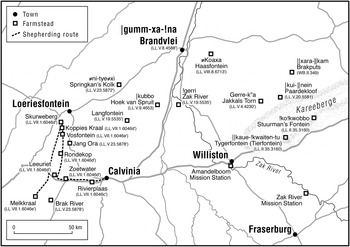
Despite their familiarity with raiding, the dominant representations of ǀXam interactions with sheep are in the context of herding. Male informants recounted personal experiences with pastoralist activities as a dimension of their interactions with colonial farmers: Diaǃkwain and Jan Plat described a herding route ranging widely across the south-west Hantam in the course of their shepherding activities (Figure 2) as part of Diaǃkwain's close association with the van Wyks.Footnote 18 Informants' notes on sheep demonstrate highly pragmatic orientations founded on herding experiences, derived from the transhumant strategies within which they were enmeshed.Footnote 19
Diaǃkwain and Jan Plat's shepherding route.

Incidental remarks noting that particular events took place while herding sheep are scattered throughout the archive: ǁkabbo encountered a ǁkhã:-ka-mumu (‘lion ghost’) when driving sheep home after sunset,Footnote 20 and his son was out herding sheep when he ‘saw the wind’.Footnote 21 In these references, shepherding appears as an activity that was markedly similar to hunting: both were activities that led people out into the veld, where they might encounter and interact with a range of non-human persons, and both were concerned with movements and feeding habits of bovids. Different techniques of physical interaction with wild and domesticated species were linguistically distinguished, with swai specifically describing ‘driving’ animals (such as cattle) that could be approached closely and ǁgamma-se used for ‘driving’ game.Footnote 22
This contiguity of herding and hunting or gathering strategies can also be seen in the integration of herding into broader ǀXam practice. ‘Nicknaming’ (gen; Bleek Reference Bleek1956: 46)Footnote 23 practices were widespread among the ǀXam, with people receiving names based on particular events in their lives. For men this typically meant incidents occurring while hunting: ǃkhwai-ǃkwa was named for a gemsbok that stabbed his legFootnote 24 and Diaǃkwain's father received his nickname after dislocating his thumb when stumbling in the clay, running in front of springbok.Footnote 25 Man-se received the nickname ‘Stone-knee’ after falling down and injuring himself chasing after sheep he was herding.Footnote 26 Even when practising pastoralist activities, he was embedded in a network of ǀXam speakers who continued naming practices generally widespread and connected with hunting experiences: these ǀXam individuals evidently considered herding as an activity contiguous with hunting, at least in terms of this nicknaming aspect of ǀXam culture.
Just as with hunted game, ǀXam comments on livestock incorporated close observation of the behaviour and appearance of the relevant species, which informed the ways in which people interacted with them. Sheep breeds were distinguished through their possession of particular physical and behavioural traits. The informants contrasted the Africaander or Kaap sheep (ǃgei; Bleek Reference Bleek1956: 381) with the European-introduced Farland and Mof breeds (ǃk“o:a; Bleek Reference Bleek1956: 508), on the basis that the former returned to their kraals without being led, while the latter would not return from the veld unless herded back.Footnote 27 ‘Africaander’ here presumably represented one of the extant Namaqua or Ronderib Afrikaner breeds (or a related extinct variety), mutton stock with fat deposits distributed around the tail and with hairy rather than woolly coats, likely the result of selection for kaross production (Campbell Reference Campbell1995; Smith Reference Smith, Blench and MacDonald2000: 223).
Introduced breeds were separated into three categories on the basis of their wool, a phenotypically and economically salient feature with the rise of wool production as the major impetus for sheep farming. They were differentiated into Farland schaapFootnote 28 with thick hair, Mof sheep with hair that was ‘so much and so big’ (merinos), and a cross between the two.Footnote 29 ǀXam interactions with sheep did not incorporate these animals in isolation, but were situated in relationships with colonial stock-owning communities. Occurrences of European vocabulary (such as hamel, Afr. wether (a castrated ram))Footnote 30 for techniques of stock management indicate that much of their more specialized knowledge of domesticates drew heavily upon European or Bastaard sources (though it is difficult to be certain that Afrikaans vocabulary did not overlay prior familiarity). These interactions were predominantly framed in a coercive idiom, as farmers attempted to control and direct ǀXam labour through the abduction of ǀXam childrenFootnote 31 and the subjection of ‘their’ herders to disciplinary violence, illustrated in a narrative concerning the fate of a man named Ruyter, who died after being beaten by a farmer for perceived deficiencies in his herding work.Footnote 32
Women's initiation and sheep
Despite the herding experiences of male informants, it was ǃkweitǝn-ta-ǁkeŋ who spoke most frequently about sheep (in relative terms). Most significantly, she recounted that, after emerging from the ritual seclusion imposed at the onset of menarche, the New Maiden together with her xoakən-gu Footnote 33 consumed a sheep:Footnote 34 young men were specifically excluded from this consumption. The use of sheep to re-socialize the New Maiden after her seclusion appears to parallel their appearance in Early RaceFootnote 35 stories, where they were occasionally employed in connection with the establishment of proper ‘human’ order: the contents of goats' stomachs restored the ‘human’ identity of the Early Race caracal (McGranaghan Reference McGranaghan2014a),Footnote 36 and after the monstrous all-devouring ǁkhwai-hem was killed (McGranaghan Reference McGranaghan2014b), it was the restoration of the sheep and their kraal that made the place ‘handsome’ once more.Footnote 37
The New Maiden was a significant figure in ǀXam society: mentioned frequently in the Bleek–Lloyd Archive, she was implicated in ‘understanding’ behaviours associated with hunting and with rain making. The presence of sheep in rites connected with this figure seems to represent an intersection of Bushman and Khoekhoen beliefs around the locus of domesticated species; ǃkweitən-ta-ǁkeŋ's description is strikingly similar to those of menarcheal rites observed among a range of Khoekhoe groups, including the Nama (Hoernlé Reference Hoernlé1918) and the Korana (Maingard Reference Maingard1932: 141–2; Engelbrecht Reference Engelbrecht1936), and extant among Griqua populations in the Northern Cape today (Waldman Reference Waldman2003: 662). Their widespread occurrence suggests that such practices draw upon a common ‘Khoisan’ core (Barnard Reference Barnard1992b: 252), and that, despite differences between Bushmen and Khoekhoe populations, their shared history and overlapping territories may have rendered certain cultural practices mutually ‘meaningful’ (see Morris Reference Morris2002 for a discussion of ‘Khoisan’ cultural meaning, pertaining to specific emplaced rock art sites, that likely extended beyond putative ‘ethnic’ affiliations).
While these meanings and practices may have been held in common, they need not have been identical. The deployment of sheep in ritualized New Maiden behaviours likely derived from the wider associations both of sheep and of the New Maiden role in ǀXam society. The connection probably stemmed from sheep fat deposits, with indigenous southern African sheep breeds having distinctive large concentrations of fat in their tails. ǃkhwa: (the personification of the rain) was attracted to ‘fatness’: foodstuffs belonging to him, such as tortoises and porcupine tails, usually displayed this quality.Footnote 38 The special relationship between ǃkhwa: and the New Maiden (his ‘attraction’ to her) was the foundation of the role (Hewitt Reference Hewitt2008: 208–10), and the incorporation of fat-tailed sheep within ritualized treatments of the New Maiden thus situates these domesticates in their logical niche, in terms of ǀXam criteria for resource evaluation.
Large stock
Cattle and horses usually appear only in the Bleek–Lloyd Archive in narratives of personal experience, associated with the colonial situation.Footnote 39 References to larger livestock outlined concerns regarding their behaviour in the context of labour associated with their care, and related to the timings for cattle eating, drinking and sleeping in the context of tending herds,Footnote 40 interactions with domestic livestock at Bleek's house in Mowbray,Footnote 41 practical concerns about livestock diet,Footnote 42 and evaluations of the relative abilities and value of domesticated species (mules versus horses).Footnote 43
The existence of specialized terminology referring to domestic stock suggests that focusing on narrative appearances alone may misrepresent their wider significance. Recalling the diverse ǀXam springbok terminology that related to the central role this species played in ǀXam subsistence (Roche Reference Roche2005), a number of colour terms related exclusively to horses: ǂaǂattən (Bleek Reference Bleek1956: 642) for schimmel horses (grey or roan horses; Pettman Reference Pettman1913: 29) and ǃai:tən (Bleek Reference Bleek1956: 70) for horses with a white blaze. Despite not appearing as characters in Early Race narratives, livestock formed key referents in them. Oxen, for example, were linked with the superlative size of the eland,Footnote 44 which ǀkaggǝn ‘worked’ until it grew to become ‘like an ox’.Footnote 45 In another instance, their contemporary behaviour was used to evoke the actions of game during Early Race times,Footnote 46 providing a powerful ‘experiential’ manifestation of this period.
Unlike Bushman populations that inhabited the south-eastern portions of the subcontinent (Challis Reference Challis, Mitchell and Smith2009: 104–7; Reference Challis2012), Karoo groups do not appear to have adopted horses as part of their economic strategies: Collins (Reference Collins1808) recounted that the practice of stealing horses was ‘unknown among the Bosjesmen of Karee Berg and the neighbourhood of Zak River’ at the beginning of the nineteenth century. In part, this was related to environmental difficulties in sustaining horse populations there, and even experienced horse-keeping groups found the lack of water and dearth of pasture a major challenge (Jackson Reference Jackson1879: xxiii). However, some Bushman individuals by the mid-nineteenth century were well enough acquainted with horse riding to judge distances in these terms,Footnote 47 suggesting that familiarity with these animals on an individual level had developed by this time, either through horse ownership or through the increasing percolation of ‘horse knowledge’ into the region as it became incorporated within the colonial purview.
One of the few direct confirmations of ǀXam ownership of livestock (rather than interactions with animals belonging to other people) is present in Diaǃkwain's reference to cattle he once owned, given to his wife by his father-in-law. Although his ability to control and look after them was limited, his account demonstrates vividly the benefits of being able to access even small numbers of stock.Footnote 48 After the death of his wife, he relied heavily on the assistance of his female relatives, as he needed milk to feed his young child – he called upon his niece to wean his child.Footnote 49 Diaǃkwain observed that, had he maintained his control of the cattle, he would have been able to feed his child without familial assistance, which (given the constructions of responsibility and obligation implicated in mobilizing this assistance) points to the potential significance of domesticates in altering the terms of interpersonal relationships. The importance of secondary dairy products to pastoralist populations in providing subsistence without depleting herds is well known (Sadler et al. Reference Sadler, Kerven, Calo, Manske and Catley2010); where colonial writers emphasized Bushman interactions with domesticates as ‘improvident’ (raiding and immediately consuming the products of this raiding), Diaǃkwain's discussion of dairy products as a fallback against the sometimes precarious nature of Karoo subsistence suggests that he recognized secondary products as salient components of his interactions with cattle.
Domesticating spirits
Other domesticated species were similarly integrated as part of ‘understanding’ behaviours, as they too were recognized as components of subsistence strategies: Diaǃkwain even explicitly equated sheep with the all-important springbok. Diaǃkwain's mother exhorted the ‘great doctress and sorceress’ Tano-ǃkaukən to let the springbok travel to her place because she lacked flocks of sheep (gu-xu),Footnote 50 presenting her demand for springbok as a requirement for an equivalent subsistence staple.Footnote 51
Tano-ǃkaukənFootnote 52 ‘possessed’ a short-horned springbok, which Diaǃkwain's father killed. This possession likely referred to her spiritual control over animals (Lewis-Williams and Dowson Reference Lewis-Williams and Dowson1999: 100) – she was a ʘpwai:tən-ta-ǃgi:xa (‘game's sorcerer’; Bleek Reference Bleek1956: 382, 685) who could influence the movements of antelope. These ritual specialists were subject to the same ‘egalitarian’ redistributive strictures as applied to hunters: the ‘sorcerer’ who refused to release the resources he or she controlled was chastised as ‘stingy’, just as the hunter was who gave only ‘lean’ meat.Footnote 53
Tano-ǃkaukən's springbok was said to be one that was ‘not used to stand outside’, one that stood ‘fastened up’, and one that she ‘unloosed from the riem’ (Afr. thong, strap or leash) – all idioms that appear to recall the behaviours and treatment of domesticated rather than wild species. She even described the animal as a ‘kapater’ (Afr. a castrated animal), clearly referencing practices of dealing with livestock. It was her relationship with this springbok that enabled Tano-ǃkaukən to induce wild springbok to act as ‘flocks’ for Diaǃkwain's mother, making them travel to her place where they could be shot – just as one might herd livestock across the veld.
When hunting these nomadic ‘flocks’ of springbok, people would attempt to channel their movement using feather brushes treated with fragrant plant ‘medicines’ and red pigments, which would make the antelope act ‘foolishly’.Footnote 54 When hunting single springbok, other types of plant medicine (de Prada-Samper Reference de Prada-Samper2007) might be rubbed on the bodies of the hunters to make the game ‘foolishly afraid’.Footnote 55 Particular ritual specialists (skilled in the use of these plant medicines) attempted to influence the behaviour of wild game – to make them approach the hunters closely, or to run slowly rather than to leap away – and, in so doing, to make them act as controllable, domesticated resources.
These extraordinary connotations of influence over domesticated species can only have been strengthened by references to domesticates in rain-making practices. Both horses and cattle were connected with these practices, one of the most important domains of ǀXam ritual action: bara-ka-ǃhauǃhau (‘horse's thongs’ (i.e. reins); Bleek Reference Bleek1956: 156, 396) were evocative of ǃgi:tən abilities in influencing rain, as they ‘rode’ and ‘bound’ the rain for their own ends.Footnote 56 More commonly, the rain was likened to cattle, with distinctive characteristics based on gender: the rain-bull had to be bound with a thong and coerced out,Footnote 57 and brought an angry rain;Footnote 58 by contrast, the rain-cow was ‘gentle’ and could be ‘ridden’.Footnote 59
In the realm of these ritual specialists, then, domesticated fauna appear as creatures that were contiguous both with wild species and with more nebulous entities – in fact, the roles of these specialists depended upon their abilities to make ‘wild’ animals (or the rain) behave like domesticated species. These abilities were not, however, reserved only for ritual specialists: more accurately, ǀXam hunting and ‘ritual’ activity should not be considered as separate domains. Particularly able hunters might be able to induce ‘tame’ behaviours in the animals they targeted: individuals who possessed the requisite ethological knowledge were able to drive game animals back towards their huts, saving themselves the labour of carrying meat for long distances,Footnote 60 and those with mimicry skills might give a ‘peculiar kind of liquid call’ to induce springbok to approach and ‘lie down for’ the hunter.Footnote 61 Domestic fauna do not appear in the Bleek–Lloyd Archive as a discrete category of animals, requiring radically different modes of interaction – many ǀXam practices were founded on attempts to govern, control or otherwise ‘herd’ game species.
HUNTER-GATHERERS AND RESOURCE CONTROL
Domesticated animals appear in the ǀXam narratives in several ways. Firstly, and most unsurprisingly, they were animals that were thoroughly integrated into the ǀXam world – all the informants were familiar with their appearances and behaviours, and all had had substantial opportunities to interact with them. These domesticated animals were discussed in terms that would not be out of place with regard to non-domesticates, and, like these wild species, they commonly featured in stereotyped forms of narrative, including ‘mythological’ tales.
Domesticated animals were important components of key ritualized cultural domains. Sheep, for example, appear to have been involved in the initiatory practices associated with the onset of menarche, while cattle and horses were implicated in the rain-making activities of ritual specialists. They were ‘comprehensible’ creatures, which could readily be understood in terms of ǀXam relationships with particular kinds of wild resources. Many ǀXam practices were concerned with attempts to control or otherwise influence the movement of non-human animals – some specialized ritual roles were founded upon superlative skills in this regard. Livestock, being easily manoeuvred and unafraid of close human contact, displayed precisely those characteristics that the ritual specialists were supposed to induce in the animals they controlled: the game species hunted by the ǀXam were not portrayed by them as truly ‘wild’, but rather as species ‘domesticated’ by the ǃgi:tən.
The pastoralism presented in the Bleek–Lloyd Archive was very much a part of its colonial context, in which livestock became an increasingly commoditized resource – valued either for meat or (in the case of sheep) for lucrative wool exports. Although South Africa had a long precolonial history of pastoralist strategies, the expansion of colonial sheep farming in the Karoo created and faced issues similar to those outlined for other areas of settler colonization, such as Australia (with no precolonial domesticate livestock), albeit in a somewhat ameliorated form (Paterson Reference Paterson, Veth, Smith and Hiscock2005: 277). In both areas, dependence on herds as a motivation for settlement produced a fluid sheep-farming frontier that fluctuated as farmers attempted to assess the carrying capacity of the environment under shifting conditions, which included the establishment of crops where possible and changes in the composition of grassland, with grazing pressure, droughts and seasonal variability (Paterson Reference Paterson, Veth, Smith and Hiscock2005: 278–9).
In both areas, too, indigenous communities played a vital role in establishing sheep farms, providing the labour-intensive shepherding practices necessary in an unfenced landscape and contributing their detailed knowledge of the environment and geography. In southern Africa (Beinart Reference Beinart2003: 29–47), the employment of new breeds of livestock in settler pastoralism (breeds less suited to Karoo environments) meant that farmers needed to develop strategies to ensure the survival of their flocks. Skills possessed by indigenous hunter-gatherers (and pastoralists) – tracking, knowledge of flora and their properties, and an understanding of local geography and climate – rendered their participation essential for successful farmer exploitation. Trigger (Reference Trigger2008: 633) notes that demands for Aboriginal labour in cattle ranching in Australia have generated a strong sense of familiarity with the species (cattle, horses and dogs) connected with this practice, as well as considerable degrees of ‘bush’ knowledge pertinent to keeping and controlling cattle.
These developments may have built on indigenous practices of controlling the movement of ‘wild’ species; Reynolds (Reference Reynolds2006: 162) proposes that the employment of Aboriginal populations in livestock industries generated substantial overlaps with extant hunting practices, involving the driving of prey with stick and bush constructions. Although these practices were somewhat different to the ǀXam ‘driving’ of springbok (Roche Reference Roche2005), both examples confirm that hunting strategies often portray animals as agents whose movements are to be directed and controlled. Pastoralist labour – even when geared to international markets – thus emerges as a practice that is not qualitatively opposed to hunting and gathering, but rather is part of a continuum of interactions with non-human species: the fact that ǀXam representations of the veld involved both hunting and livestock-herding practices implies that the two occupied a contiguous ideological space as well as the same physical space.
Egalitarian hunter-gatherer groups with a sharing ethos do not treat resources in an undifferentiated fashion, and different resources are subject to sharing demands that vary in their stringency: for example, differences in the ways in which plant and animal foods are shared (the latter with a smaller set of kin) are widely recognized, and are deployed in attempts to examine ideologies of inequality in gender relations within putatively egalitarian groups (Brightman Reference Brightman1996). Among the ǀXam, redistributive strictures did not apply in a generalized fashion: instead, they applied to specific resources that were deployed within specific social relationships, as part of normative pressures to behave in an orderly, proper fashion. Honey, for example, was to be shared by married couples (McGranaghan Reference McGranaghan2014c: 9), while porcupines were divided along descent and residence lines.Footnote 62 While it is likely (given the importance of redistribution within these egalitarian systems) that domesticated livestock would have been subject to sharing pressures, there are a number of possible ways in which these demands might have been articulated.
Classifications of livestock as ‘large bovids’ or ‘hunted prey’ resources – which, for southern African hunter-gatherer groups, would typically be subject to obligatory sharing rules – may seem logical, and this certainly was a feature of the ǀXam conceptual world (which remarked on similarities between ‘flocks’ of springbok and sheep). However, even if we restrict ourselves to depictions of wild, hunted game, the ǀXam informants did not represent resources in an undifferentiated fashion: the nomadic springbok herds, for example, were said to come from and go to the ‘springbok's place’, while ostriches were creatures that ‘belonged’ to particular territories (ǃxoe; Bleek Reference Bleek1956: 500) that the ǀXam associated with specific named individuals (Deacon Reference Deacon1986; Hewitt Reference Hewitt2008: 16–17). These ‘emplaced’ resources had to be dealt with in particular ways – to be ‘taken care of’ in such a way that would allow for their ongoing exploitation.Footnote 63
Resource management strategies are common among hunter-gatherers, and notions that certain kinds of resource can be ‘owned’ are widespread. For the Mardu of the Western Desert (Australia), the application of fire management confers a form of limited ownership on the person instigating the burn, who obtains a right of first access that may be defended with violence (Bird et al. Reference Bird, Bird and Parker2005: 457–8); among the Southern Paiute, at Corn Creek in the Las Vegas Valley (Nevada), springs were associated with specific named ‘owners’ (von Till Warren Reference von Till Warren, Roberts, von Till Warren and Eskenazi2007: 92–3). The ǀXam narratives confirm an equivalent ownership of managed resources including ostriches and honey (McGranaghan Reference McGranaghan2014c) in Nama-Karoo hunter-gatherer strategies, where ‘owners’ of water sources were obliged to manage their territories correctly.Footnote 64
Bearing this in mind, ǀXam applications of ‘care’ that allowed for the regeneration of ostrich eggs and honey could be said to broadly parallel the ‘care’ that, when applied to cattle, would allow for the ongoing extraction of milk, as in Diaǃkwain's account above. In the role of the ‘game sorcerer’ and the ‘dog's man’, the ǀXam had further idioms for recognizing and valuing abilities to instigate particular relationships with non-human species, which could then be mobilized in the successful fulfilment of subsistence obligations to friends and relatives.
The ǀXam appear to have perceived few or no contradictions in terms of their relationships with livestock and wild fauna: abilities to control and manipulate animals could readily be incorporated as part of the obligations of water-hole ‘owners’, who were already enjoined to ‘take care’ of the resources they managed. For the ǀXam, incorporation of or interactions with domestic stock were not incompatible with the maintenance of ‘foraging ideologies’ and their general characterizations of interactions with non-human species: these ideologies did not exclude close relationships with domesticated species, and they included both a concern with managing resources and a ready idiom for understanding the manipulation of animal behaviour in the context of herding activities.
ACKNOWLEDGEMENTS
The transcription of the Bleek–Lloyd Archive on which this research is based was produced in the course of doctoral research funded by the Institute of Archaeology, University of Oxford. This funding is gratefully acknowledged. Rachel King and Sam Challis provided valuable feedback on an earlier draft of this paper, as did two anonymous reviewers.