Introduction
Robinia pseudoacacia L. comes from a disjoined range in North America, one centred in the Appalachian Mountains and the other in the Ozark Plateau (Huntley, Reference Huntley1990). It is usually associated with oak forests, where it occupies the niches of young stands (Jackson et al., Reference Jackson, Turner and Pearson2014). The species has been widely planted in the USA, Southern Canada, Europe and Asia. Robinia pseudoacacia is established as a naturalized/invasive plant in a wide part of the world, having been documented in seven out of 15 recognized geographical regions (Rejmánek & Richardson, Reference Rejmánek and Richardson2013). In Europe, it is threatening especially dry and semi-dry grasslands and listed in the top 100 most aggressive invaders (DAISIE 2008). Globally it is listed among the 40 most invasive woody angiosperms (Richardson & Rejmánek, Reference Richardson and Rejmánek2011), but still voluntarily planted; a vast (often grey) literature refers to its management and use (well revised in Barrett et al., Reference Barrett, Mebrahtu and Hanover1990; Huntley Reference Huntley1990; DeGomez & Wagner Reference DeGomez and Wagner2001). It is a nitrogen-fixing species, then its use for soil improvement; but its blooming is also very appreciated for ornamental purposes in private and public gardens. Robinia pseudoacacia has been brought to Europe at the beginning of 1600 (Vítková et al., Reference Vítková, Müllerová, Sádlo, Pergl and Pyšek2017) and this may justify why the public does generally not perceive it as an alien (Fischer et al., Reference Fischer, Bednar-Friedl, Langers, Dobrovodská, Geamana, Skogen and Dumortier2011). Therefore, literature has so far concentrated on its economic value. Vitková et al. (2017) recently filled part of the gap by addressing historical, ecological and socio-economic issues on this species in Central Europe, bringing evidence of its impact in different habitats and for different plant and animal communities. Interestingly, no one ever addressed to its pollinators. Not in its home range, where the literature getting closer relates to the overall pollinator community of the Southern Appalachian forests. Jackson et al. (Reference Jackson, Turner and Pearson2014) identified Halictidae and Megachilidae as the more abundant bee families in younger forest stands, but provided no direct association of bee species with the plant. In Europe, the situation is similar, but a huge exception is due to the economic interest linked to the honey production. Therefore, even if no study directly accounted for flower visits, extended literature exists related to the unifloral honey that is obtained by the activity of Apis mellifera (the honeybee). Acacia honey (as it is called in Europe) is very appreciated on the market and its bouquet is strictly linked not only to the nectar, but also to other chemicals present in different flower parts (Aronne et al., Reference Aronne, Giovanetti, Sacchi and De Micco2014). In Europe, we can therefore list the honeybee as a pollinator, actually proven to get into contact with the flower reproductive parts (Giovanetti & Aronne, Reference Giovanetti and Aronne2013). Nevertheless, there are two evolutionary aspects that may sound controversial and are worthy to be deeper investigated.
The first is that A. mellifera originated in Africa or Asia (Whitfield et al., Reference Whitfield, Behura, Berlocher, Clark, Johnston, Sheppard, Smith, Suarez, Weaver and Tsutsui2006; Han et al., Reference Han, Wallberg and Webster2012). Hence, even if it is now paying frequent visits to R. pseudoacacia, coevolutionary paths usually called for to explain angiosperm relationships with pollinators cannot have played a role in this case. Nowadays, the honeybee is probably the most abundant bee species on earth: partly because of a natural spread throughout Africa, the Middle East and Europe, partly because man-managed beekeeping for honey production and pollination purposes, that brought it as far as America and Australia. The honeybee relationship with this plant is then widespread as the plant itself, and even at the base of local/national economic incomes deriving from the honey production (Farkas & Zajácz, Reference Farkas and Zajácz2007). Establishment of novel interactions between non-native species and mutualists has been recognized as one kind of response by a native biotic community to alien species, tending to meld the alien plant with the existing food web (Cox, Reference Cox2004). Exploitation for food gives rise to novel interactions and may result a mutual benefit for interacting species, enhancing the integration of the alien plant. Bee's visits to R. pseudoacacia flowers are expected, since the honeybee is a generalist species, i.e. visiting a variety of angiosperm flowers. It may adapt its foraging strategies even to visit unsuitable anemophilous flowers (Giovanetti & Aronne, Reference Giovanetti and Aronne2011), therefore also to visit flowers of an alien species. Actually, honeybees expressed clear preferences when it was to choose for pollen sources, while apparently they were visiting any available source for nectar (Aronne et al., Reference Aronne, Giovanetti and De Micco2012). Literature on honeybee preferences in relation to flower morphology and nectar content also highlighted that honeybees would visit floral morphologies offering the greatest floral reward (Seeley et al., Reference Seeley, Camazine and Sneyd1991; Gonzalez et al., Reference Gonzalez, Rowe, Weeks, Whittle, Gilbert and Barnard1995; Dedej & Delaplane, Reference Dedej and Delaplane2005), exploiting all available resources (Manetas & Petrapoulou, Reference Manetas and Petropuolou2000), being able to choose among individual flowers (Benard et al., Reference Benard, Stach and Giurfa2006; Giovanetti & Aronne, Reference Giovanetti and Aronne2013).
However, here is where the second aspect comes into play. The honeybee is not the best-adapted visitor for papilionate flowers, the same type of flower showed by R. pseudoacacia. In fact, it did not perform well in an experiment evaluating the necessary strengths that bees needed to force the tripping mechanisms of the papilionate flower of Fabaceae (Córdoba & Cocucci, Reference Córdoba and Cocucci2011). Giovanetti & Aronne (Reference Giovanetti and Aronne2013) reported, on the one hand, that honeybees were successful pollinators of R. pseudoacacia, getting in touch with its reproductive parts while engaged in nectar collection. On the other hand, that work also highlighted that (a) finding a suitable position on the flower to further access the nectar was a behavioural unit requesting a significant amount of time; (b) positioning may fail and illegitimate visits were frequent; and finally (c) there was a difference among individual flowers. Discrimination among flowers and selective procedures are essential for bee foraging strategies, and have implications for plant ecology and evolution (Goulson, Reference Goulson1999). Visual cues may contribute to the ability to select slightly different flowers of the same species (Benard et al., Reference Benard, Stach and Giurfa2006; Giovanetti & Aronne, Reference Giovanetti and Aronne2013). Totland & Matthews (Reference Totland and Matthews1998) examined honeybee preferences among Crocus vernus flowers: they found that honeybee foragers showed no bias when visiting flowers differing in size or colour. Floral display may be associated with nectar content, and then, through learning, expected to drive bee choices. This was the case highlighted by Duffield et al. (Reference Duffield, Gibson, Gilhooly, Hesse, Inkley, Gilbert and Barnard1993) for honeybees visiting inflorescences of Lavandula stoechas. Ability to discriminate reward content, from bare presence to quantity, is a topic highly investigated but still offering uncertain interpretation of results (Giurfa & Núñez, Reference Giurfa and Núñez1992; Goulson et al., Reference Goulson, Chapman and Hughes2001). Data related to bee choices as for nectar and floral display have been often obtained under controlled manipulated experiments (Wells & Wells, Reference Wells and Wells1983; Fülöp & Menzel, Reference Fülöp and Menzel2000; Sanderson et al., Reference Sanderson, Orozco, Hill and Wells2006; Grüter et al., Reference Grüter, Moore, Firmin, Helanterä and Ratnieks2011). Less data about natural conditions are available, and this may be a reason for results turned to opposite directions.
Given that R. pseudoacacia flowers are a rich resource, widely available, but difficult to manipulate, how did this generalist ubiquitous bee find a way to cope with this problem? This paper concerns the foraging tactic of the honeybee on R. pseudoacacia, inferring that (a) nectar resource is widely available across flowers and day time; (b) honeybees do select individual flowers to maximize the intake of resource; (c) flower selection occurs at short distance as driven by nectar content. Novelty of this work is addressing the above-mentioned questions by investigating both bee ability in discriminating flowers and nectar content directly in the field, in natural conditions. I will address nectar offer and distribution as experienced by bees while foraging throughout the day. Prevalence of today knowledge on honeybee flower choices in relation to flower morphology and nectar content came from studies conducted in artificial conditions, where nectar content and flower colour and shape were manipulated (Fülöp & Menzel, Reference Fülöp and Menzel2000; Sanderson et al., Reference Sanderson, Orozco, Hill and Wells2006). Manipulation implies that the offer, to foraging bees, is limited to a given number of choices/situations, often connected with a training phase. This work will instead investigate bee choices among real flowers of the same plant species, associating choices with flower-type morphological characteristics and nectar content. Data on honeybee discrimination of inflorescences and of flower type abundance are rare (Duffield et al., Reference Duffield, Gibson, Gilhooly, Hesse, Inkley, Gilbert and Barnard1993). They may convey important information on honeybee ability to discriminate and memorize morphological keys useful for improving foraging effort, the pollination service paid to the plant and, in case of invasive species, even bringing about new insights on their success.
Material and methods
Field site and preliminary observations
Field observations focused on the activity of A. mellifera while foraging on flowers of R. pseudoacacia in a hill area of the Euganean Hills Regional Park (Vicenza, Italy). Data were collected from 25 April 2012 to 9 May 2012, from 08:00 to 18:00 (Summer Time), during peak of flowering. The vegetation on the hills is quite variable, due to the variability in soil composition, including chestnut and holm oak woods but also hosting dry grasslands. At the site where observations were carried out, R. pseudoacacia is dominating a disturbed mixed forest with scattered individuals of Quercus robur. Close to it, there were domestic hives of A. mellifera ligustica. To my knowledge, no feral colonies were present in the area, but beekeeping is intensely performed and hives are moved on the hills during the blooming period of R. pseudoacacia for economic purposes related to honey production. As mentioned, no information exists on R. pseudoacacia pollinator assemblage, in its home range as in Italy, but honeybee is certainly a constant and valuable pollinator.
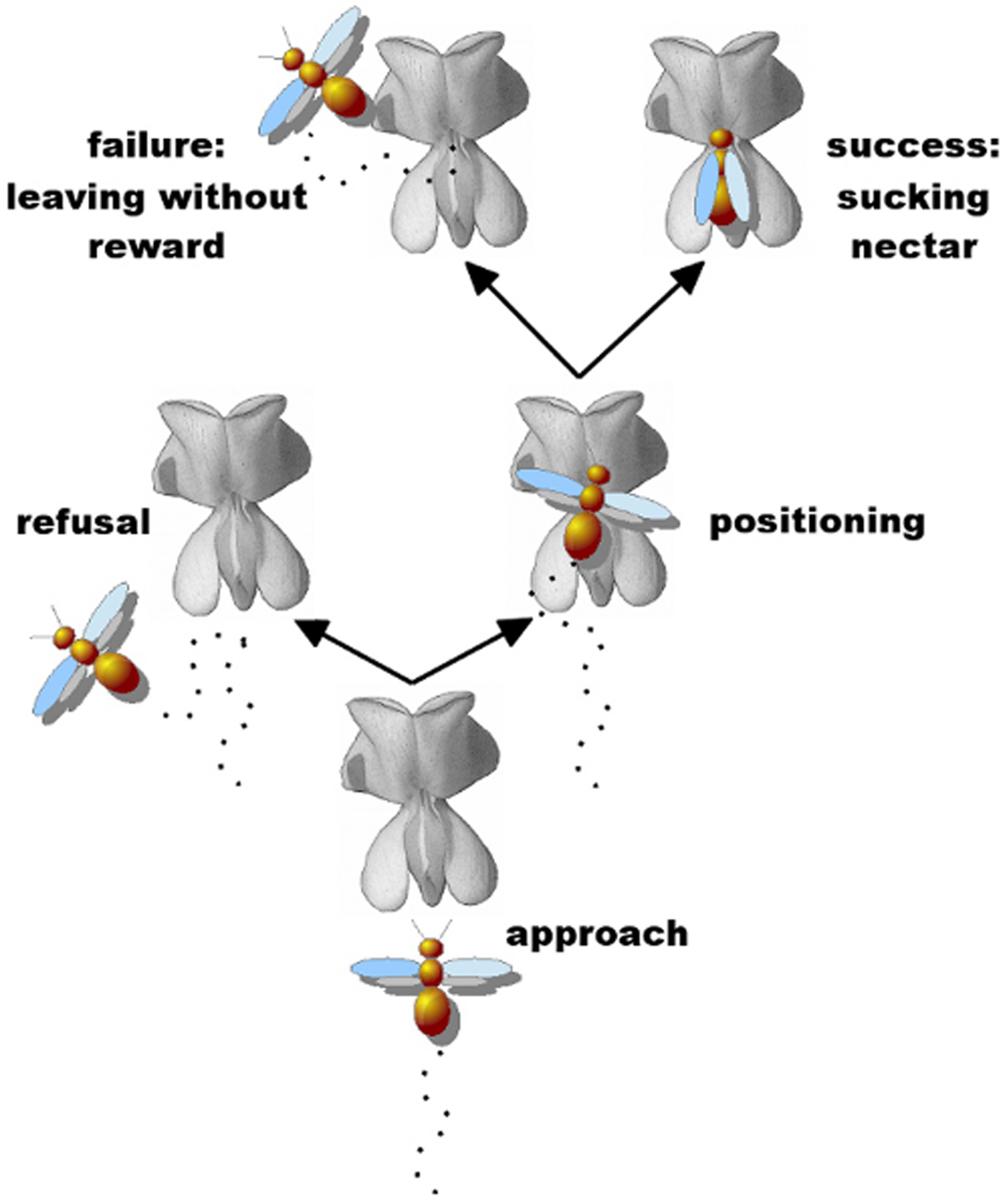
Preliminary observations were carried out in order to outline foraging behaviour of honeybees. Honeybees usually head towards a single flower, orientating towards the flower the long axis of their body. Head and antennae are directed to the front part of the flower. Using this behavioural unit as starting point, subsequent actions were listed as summarized in fig. 1. Any heading towards a single flower at about 1 cm distance was recorded, calling this behavioural-unit approach. Approaches may have two outcomes: first is that bees may quickly turn away from approached flower, having or not physically touched it. This behavioural unit was called a refusal of previously selected flower. Alternatively, a bee may try to find a balanced position on the carina and alae. This behavioural unit was called positioning: honeybees landed, if previously on flight, or directly started, if already standing on the inflorescence, to look for a suitable posture to reach nectaries (for details, see Giovanetti & Aronne Reference Giovanetti and Aronne2013). If the honeybee was successful at positioning, the following behavioural unit was sucking nectar, clearly detectable by bobbing of the abdomen. In some cases, however, the honeybee could not reach nectaries due to manipulation failure and left the flower without any reward.
Ethogram of honey bee foraging activities on flowers of Robinia pseudoacacia. Bees selected a single flower by pointing towards it at about 1 cm distance; the following behaviour could be a refusal, moving towards another flower or positioning on the carina and alae; the outcome of a successful positioning was the collection of nectar, while if positioning failed, the bee left the flower without the resource.

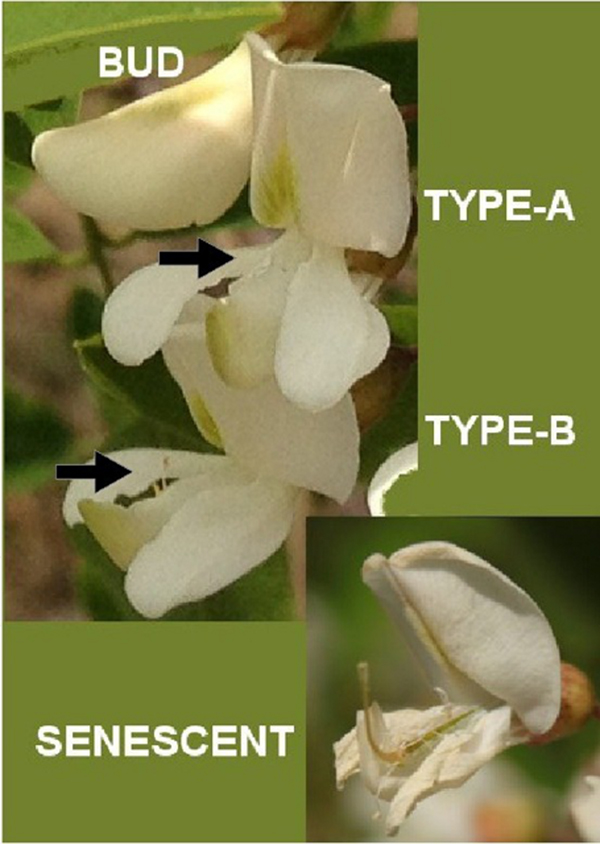
Robinia pseudoacacia shows typical flag blossom described by Faegri & van der Pijl (Reference Faegri and van der Pijl1971): single flowers with the sexual organs in the lower part, pollen coming from down behind. Flag blossom is adapted for visits by bees, able to force the petals apart. Petals are expected to resume their original position after visitor left (Faegri & van der Pijl, Reference Faegri and van der Pijl1971). Flowers are disposed in acropetal succession (Ward & Groom, Reference Ward, Groom and Groom1905), with an inflorescence bearing flowers in different stages at any given time. As for honeybee behaviour, preliminary observations were carried on to allow identifying flowers on the base of their appearance: buds, flowers in anthesis with all their petals (flag, alae, carina) well distended and senescent flowers with loose floral parts (fig. 2). Since honeybees were never observed on buds and paid few visits to senescent flowers, while main foraging activity was, as expected, on flowers in anthesis, data collection focused on them. Stamens and pistils may be a visual (and possibly olfactory; Dobson et al., Reference Dobson, Groth and Bergstrom1996) cue distinguished by bees. Two groups were then discerned: type-a flowers, with closed carina, and type-b flowers, with carina partially opened and visible stamens and/or pistil (fig. 2, see black arrows).
Robinia pseudoacacia flowers, observed in the field from bud to senescence. During anthesis, we distinguished between type-a and type-b, depending on the position (inside or outside the carina) of pistil and/or stamens (see black arrows).

Data collection focused on flower appearance and nectar content, on the one hand, and bee behaviours related to the type of flowers, on the other. Behavioural observations were carried on natural or manipulated inflorescences (MIs).
Flower morphology
Three sets of observations were designed to verify if and how type-a flowers changed their appearance into type-b. A first observation aimed at verifying if changes in appearance could be ascribed to flower age. Knowing flowers are flowering in acropetal sequence, after some days from the start of flowering, it was expected to miss early stages (buds) and found variable amount of ageing flowers (type-a, type-b, senescent). Fourteen inflorescences were bagged on four different plants, using handmade bags of mesh net. Flowers (n = 260) were all at bud stage when first bagged. These inflorescences were kept as bagged for 6 days (so the first buds should be turned into senescent flowers, based on average flower longevity: 6–7 days; Barbi, Reference Barbi2008), after which flowers were counted in different states as follows: 1. buds, 2. type-a flowers, 3. type-b flowers and 4. senescent flowers. A second observation aimed at verifying changes in the appearance possibly related to pollinator's activity. In the evening, 11 inflorescences were bagged on four different plants, cutting off any type-b or senescent flower and leaving on them only buds and type-a flowers (n = 196; 48.5% buds, 51.5% type-a). The following morning, bagging was removed and the visitations were allowed to continue until nightfall. In the evening, flowers were counted as reported above. A third observation was devoted to detect any change in the appearance of type-a and type-b flowers, following a single honeybee visit. Two hundred and twenty-one bee visits were recorded: flowers were ascribed to type-a (n = 121) or type-b (n = 100) before bee visit, and again immediately after the visit.
Nectar standing crop
Nectar standing crop volume was estimated directly in the field, using 1–5 µl disposable calibrated pipets (Drummond Science Company, Broomall, PA, USA) after gently removing the flag to allow an easy access to nectaries. Nectar was measured on 3, 4, 5 and 7 May 2012 at same location where behavioural observations took place, randomly sampling flowers on two close plants. Samples were collected on 20 flowers of each type and replicated two times a day: between 08:00 and 09:00, before the main peak of bee activity, and between 16:00 and 17:00, when activity had started to decline. No more than four flowers (two type-a and two type-b) were selected on the same inflorescence.
Honeybees foraging behaviour on natural inflorescences
Without interfering, randomly flying honeybees were observed while freely foraging among R. pseudoacacia inflorescences, recording which flower type (n = 853) they approached and which behaviour (refusal or positioning) followed approach. An individual was recorded while visiting a maximum of five flowers, then subject was changed. Successful and failed visits were recorded on a sub-sample of the two types of flowers.
Honeybees foraging behaviour on manipulated inflorescences (MIs)
To control for a given flower-type abundance and its attraction to bees, observations on MIs were planned. First, some parameters were estimated describing natural inflorescences, in order to mimic a natural arrangement when offering MIs to freely foraging honeybees. Average number of flowers on a natural inflorescence was 14.2 ± 3.6 (range 7–22; n = 40). Inflorescences were not isolated, but at least two were flowering at close distance on the same branch. Average distance between a natural inflorescence and its nearest neighbour was 3.82 ± 1.77 cm (n = 51). Due to short average distance between neighbouring inflorescences and to their volume, closed inflorescences looked as a single group with abundant flowers. Number of inflorescences in a group varied from 2 to 8, and average distance among groups on same branch was 17.50 ± 4.04 cm (n = 8 groups on two branches). This information was used to build MIs: natural fresh inflorescences were cut from tree, cleared from flowers of a given type and reassembled by fastened them together, till reaching an amount of 40 flowers to simulate between two and three close inflorescences. MIs were then positioned on a branch (free from other inflorescences) at about 20 cm of distance one from the other. MIs were of three types: made of solely type-a flowers, solely type-b flowers or a mix of them (ratio of the two types of flowers was 1:1). Relative positions of three types of MIs on the branch was constantly changed. An observer stands in front of them during time units of 30 min, recording as above: type of flower approached, subsequent refusal or positioning. After a honeybee visit to solely type-a flowers, flowers were checked and removed if ascribable to type-b group. If more than five flowers had to be removed, new type-a flowers were added. Even if honeybees were still attracted to MIs after 4 h, honeybee visits to same MI were recorded for no longer than 90 min uninterruptedly, not to incur in changes of flower appearance possibly due to wilting. Individual bees were followed as far as moving among MIs, but not further if leaving the manipulated patch. Seventy bees were scored during 390 min. Records of these individuals were also used to investigate temporal foraging sequence of approached flowers.
Data analysis
Results of the three sets of observations devoted to investigate changes in flower appearance were qualitatively described and quantified by reporting percentages recorded for flower types (buds, type-a flowers, type-b flowers and senescent flowers). Results on nectar differences were investigated applying the parametric t-test when comparing samples from two types of flowers, or from morning and afternoon collection on same type of flower. Since frequency distribution of data (type-b) were skewed, t-test values reported are that of equal variances not assumed. When investigating possible associations among categories, Fisher's exact test was applied. For honeybee approaches, data were tested against the prediction of an equal chance of approaching the two flower types using a χ2 test. Similarly, the same test was applied when investigating landings on three type of inflorescences of manipulated patch. For investigations on positioning or refusal and their association with flower type, Fisher's exact test was applied. For t-test analyses, software SPSS was employed (version 13.0; SPSS Inc.); for Fisher's exact test (computing two-sided P value using the method of summing small P values) and for χ2 tests, QuickCalcs was employed (online; GraphPad Software Inc.).
Results
Flower morphology
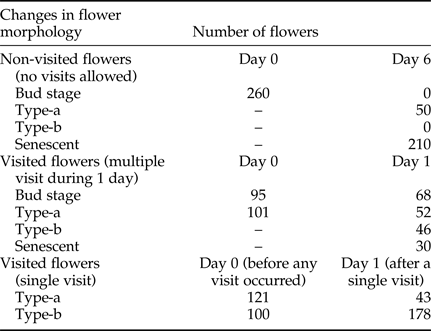
The first observation set was devoted to describe the changes occurred to non-visited flowers from bud stage to senescence. After 6 days, all the buds had distended their petals, i.e. no flower was recorded at bud stage any longer. None of 260 flowers could be described as type-b flower: 19.2% of flowers were still presenting a closed carina and fresh petals (type-a), while remaining 80.8% were senescent.
The second observation set was devoted to understand if pollinator's visits may affect flower morphology. On bagged inflorescences, there were 95 buds and 101 type-a flowers in the morning. In the evening, there were still 68 buds: then other 27 distended their petals during the day. Out of 128 type-a flowers available to pollinators, 59.4% of them changed their morphology being ascribable to the type-b (35.9%) or senescent (23.4%) by evening time.
The third observation set focused on the results of a single pollinator's visit. After a bee visit, 82.4% of 85 successfully visited type-a flowers showed visible stamens and pistil: then they changed category, becoming type-b flowers. All the 100 type-b flowers were still ascribed to this group after bee visit. Among type-a flowers on which visits failed (n = 36), instead, 22.2% changed their morphology into type-b.
All these data are summarized in table 1.
Changes in flower morphology according to the possible visits of honeybee foragers. Data on unvisited flowers, flowers visited during 1 day, flowers visited only once.

Nectar standing crop
Not all flowers contained nectar: among type-a flowers, 1% did not contain nectar; among type-b flowers, 43% were nectarless. Nectar presence or absence in type-b flowers was not associated with time of the day (morning or afternoon; Fisher's exact test, two-tailed P = 0.7308).
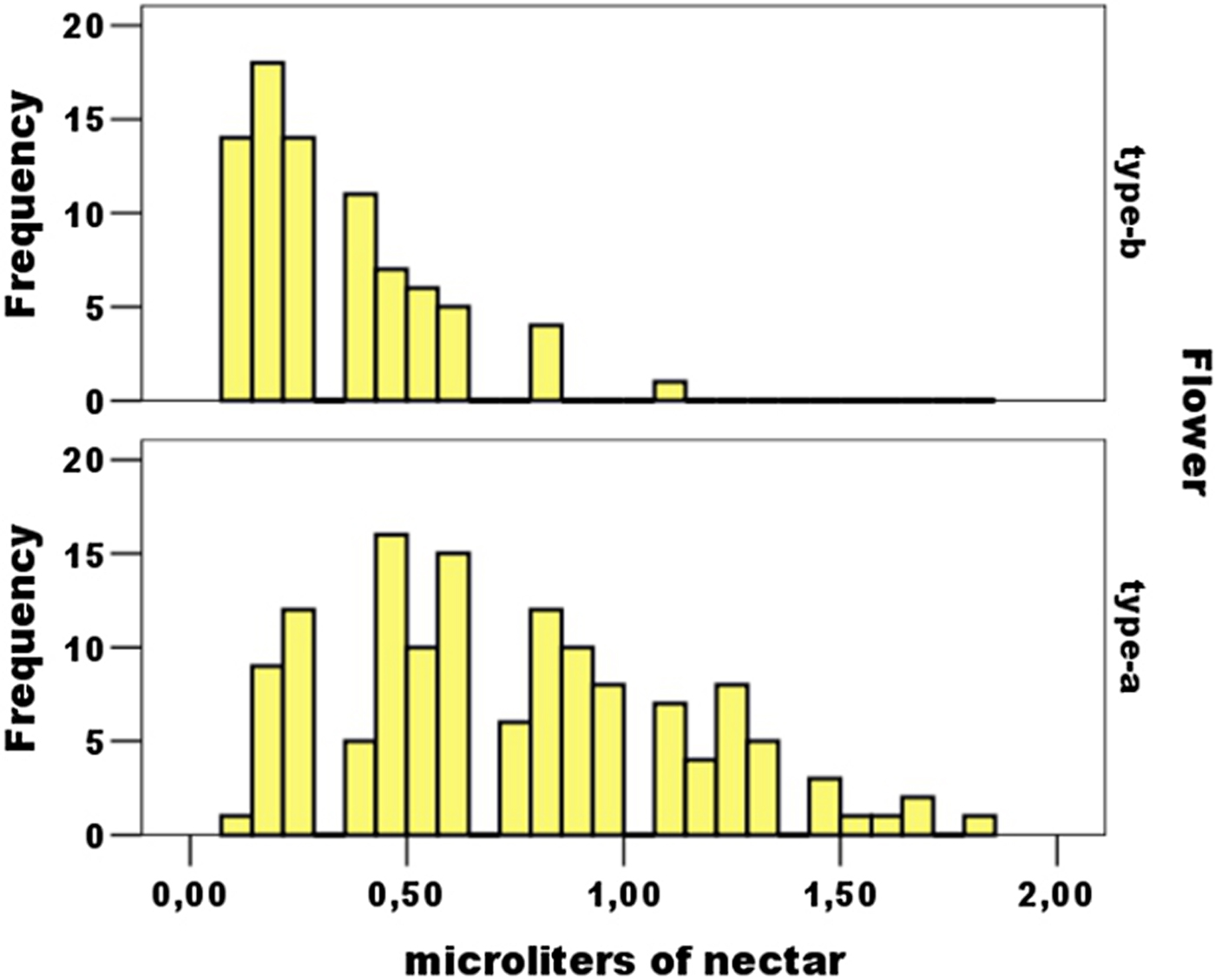
Frequency of nectar (emptied flowers excluded) of both flower types showed a positive skewed distribution (fig. 3). Average content of nectar of type-a flowers was higher than that of type-b flowers (fig. 4), the difference being statistically significant (t-test, t = 10.198, df = 212.785, P < 0.0001). This difference was maintained during the day, morning and afternoon, respectively (t-test on morning data, t = 9.041, df = 123.472, P < 0.0001; afternoon data t = 5.508, df = 87.377, P < 0.0001; fig. 4). There was no significant difference in type-b flowers during the day (t-test, t = 0.635, df = 78, P = 0.528), while average content of nectar in type-a flowers changed during the day, being significantly higher in the morning (t-test, t = 4.334, df = 133.994, P < 0.0001).
Frequency (as number of flowers) distributions of nectar in type-a (lower graph) and type-b (upper graph) flowers. Microlitres of nectar have been collected on flowers at the field site, on two close plants where also the behavioural observations were carried on.

Nectar distribution in the two flower types, depending on time of collection (morning, between 8:00 and 9:00, or afternoon, between 18:00 and 17:00). Points represent outliers.

Honeybees foraging behaviour on natural inflorescences
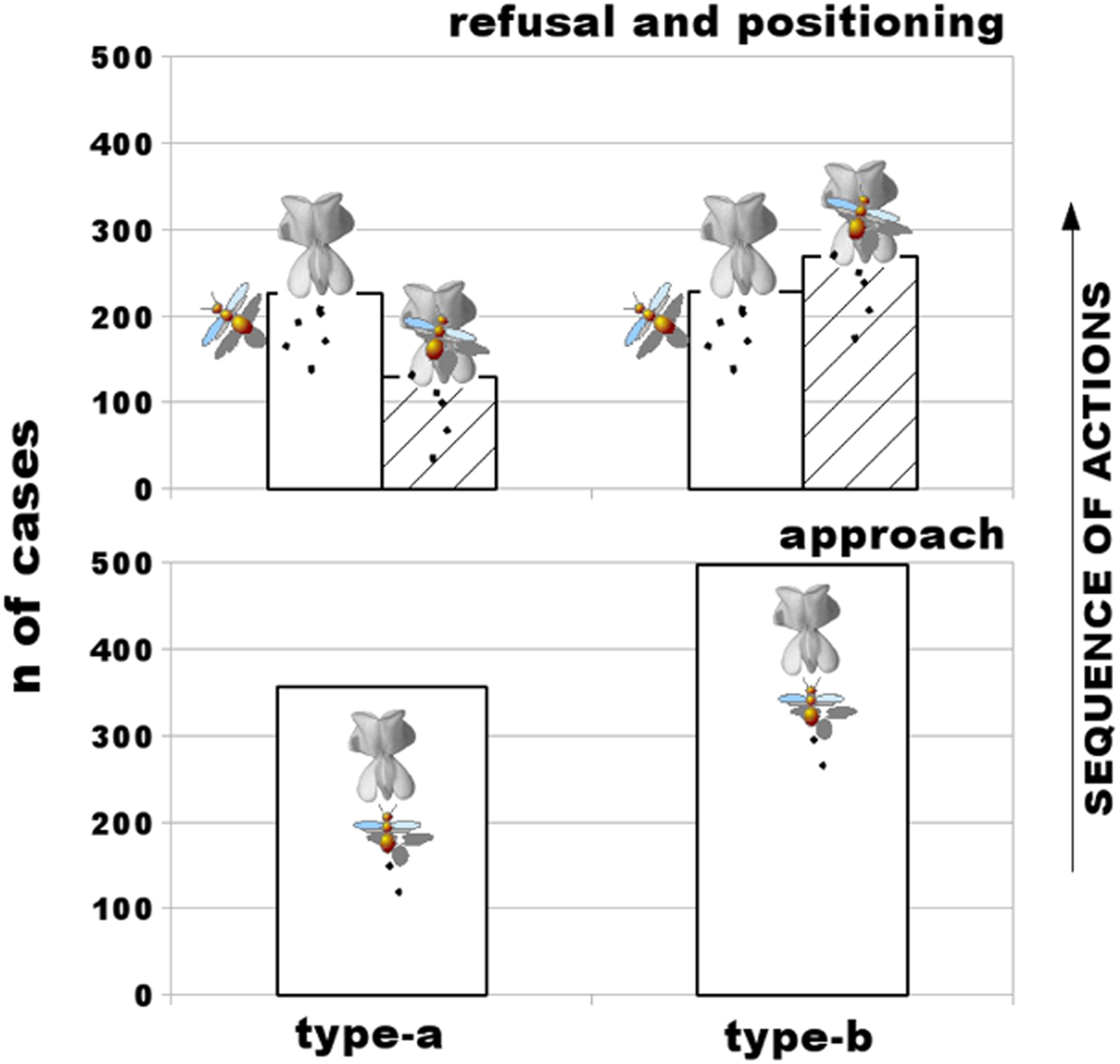
Honeybee foragers approached more frequently type-b (58.3%) than type-a flowers (41.7%; fig. 5). If tested against the prediction of an equal chance of approaching each flower type, result is a statistically significant difference (χ2 = 23.307, df = 1, P < 0.0001), i.e. there is no randomness in the performance of the behavioural-unit approach to a given flower type. There is a statistically significant association also between which action followed the behavioural-unit approach and the type of flower formerly approached. After approaching a type-a, honeybees more frequently adopted the behavioural-unit refusal, while after approaching a type-b they more frequently chose behavioural-unit positioning (Fisher's exact test, two-tailed P < 0.0001, fig. 5). Positioning and refusal were equally distributed during morning and afternoon on type-a flowers (Fisher's exact test, two-tailed P = 0.2270), while there was a reduction of refusals on type-b flowers in the afternoon (Fisher's exact test, two-tailed P = 0.0462). Visits were always successful when performed on type-b flowers, while 30% of positioning on type-a flowers were unsuccessful. Association between flower types and outcome of the positioning (successful or unsuccessful positioning) was statistically significant (Fisher's exact test, two-tailed P < 0.0001).
Number of approaches, positioning and refusals of flowers of the two types, recorded from freely foraging bees on natural inflorescences.

Honeybees foraging behaviour on MIs
A similar number of landings happened on the three types of inflorescences: MIs with only flower type-a, only flower type-b or mixture of flowers of the two types (χ2 = 0.521, df = 2, P = 0.770). Similarly, shifts among inflorescences happened randomly without emerging preferences. Twenty-seven bees (38.6%) approached a single flower, then departed abandoning area with MIs; other individuals stayed on the same inflorescence or moved to an adjacent one. There was a significant statistical association between first action performed (positioning or refusal) and the following decision to stay or leave the inflorescence on which the honeybee landed (Fisher's exact test, two-tailed P = 0.0042): more honeybees abandoned the inflorescence after refusing the first flower. There was no association, instead, between type of first flower approached (type-a or type-b) and following decision to stay or leave (Fisher's exact test, two-tailed P = 0.1569).
As for observations on natural inflorescences, type-b flowers were more frequently approached (χ2 = 4.985, df = 1, P = 0.025) and there was a statistically significant association between flower types and behavioural units of refusal/positioning (Fisher's exact test, two-tailed P < 0.0001): type-b flowers were more frequently associated with a positioning. When examining temporal foraging sequence, of 43 bees followed while approaching more than one flower, 46% consistently approached a single flower type, while the remaining 54% switched between two flower types. Among the ones that kept a constant behaviour, 30% approached only type-a flowers and 70% only type-b, the difference not being statistically significant (χ2 = 3.200, df = 1, P = 0.074).
Discussion
Robinia pseudoacacia has been previously studied for its use (timber, reforestation) and its ecological influence on various invaded ecosystems, while no interest has been shown for its pollination. Related to its blooming, in Europe it was investigated for its relevance on the production of a highly appreciated unifloral honey: at least one known pollinator, even if out of its homerange. Therefore, nectar has been estimated in relation to its potential productivity for honey. For example, Farkas and Zajácz (Reference Farkas and Zajácz2007) reported that on average 1.5 mg nectar and 0.9 mg sugar may be collected from a single flower, making it an excellent plant for honey production in Hungary. Cierjacks et al. (Reference Cierjacks, Kowarik, Joshi, Hempel, Ristow, Lippe and Weber2013) reported about 38 mg of nectar and total sugar concentration of 35% during the life span of a flower in the British Isles. Somme et al. (Reference Somme, Moquet, Quinet, Vanderplanck, Michez, Lognay and Jacquemart2016) reported a sugar concentration of 66% in an urban ecosystem, and the list may continue: numerous estimations using different methodologies at different locations in different years. Hence, a huge variability of results: as expected by the fact that nectar production is known to be highly dependent on many variables, especially those related to local temperature and humidity (Pacini & Nepi, Reference Pacini, Nepi, Nicolson, Nepi and Pacini2007). Even knowing that nectar production is nonetheless abundant and that the honeybee is paying constant visit to this plant species notwithstanding its weakness in tripping the flower mechanism, what is more intriguing is which foraging tactic is in place.
The first prediction is confirmed: in R. pseudoacacia, nectar is widely available across flowers and day time, but it is not equally available in all flowers at any stage. A main interesting result of this work is that nectar distribution is strictly associated with individual flower morphology and that the latter is related to flower phase. Type-a flowers, with stamens and/or pistil not visible, always showed a significant higher content of nectar when compared with type-b flowers, as overall day average as well as when analyses took into account morning and afternoon data separately. Robinia pseudoacacia has papilionate flowers, and many visits of a pollinator, able to trip the ‘brush mechanism’, are needed to release available pollen (Galloni et al., Reference Galloni, Podda, Vivarelli and Cristofolini2007). Stamens and pistil are expected to return to their former position enclosed into the carina, after an insect visit (Faegri & van der Pijl, Reference Faegri and van der Pijl1971; Lavin & Delgado, Reference Lavin and Delgado1990; Aronne et al., Reference Aronne, Giovanetti and De Micco2012), yet this has never been proven by a dataset. In fact, after one or more pollinator visits, flower mechanism may not always be able to resume its original position, allowing sight of extruding stamens and/or pistil. Actual data confirmed this hypothesis: the first set of observations, carried on preventing pollinator visits, highlighted that, at the sixth day, bud stage was over as expected, but only type-a and senescent flowers were recorded. Due to acropetal flowering, if type-b were the result of flower ageing and possibly loss of turgidity by petals, not involving insect visits, all flower stages should be there: presence of type-a flowers confirmed flowering was not so advanced to miss type-b. Other two sets of observation confirmed instead the role of pollinators in type-b morphology: about 34% of type-a flowers turned into type-b when visits were allowed during a single day, and in majority of cases, this happened after a single visit (about 82% type-a turned to type-b). Moreover, the lowest amount of nectar in type-b flowers sustains the hypothesis this kind of flower being the result of a pollinator visit: its lower content could either be due to a partial depletion of resource by visiting bee, to flower re-synthesis after full depletion or following evaporation. Finally, data on visit success to type-a flowers indicated that the carina enclosed back reproductive parts in 18% of successful visits, and in 78% of unsuccessful visits. Then it can be stated that stamens and/or pistil extrusion was a consequence of a previous visit. Bees visually detecting extruding stamens and/or pistil could then associate two information: (type-b) flowers have been visited, at least once (therefore, the mechanism was already tripped), and may contain less reward.
The second prediction expected the honeybees to actively select individual flowers to maximize the intake of resource. This was true, but somehow contrary to the intuitive expectation that bees would select the flower with the highest reward quantity. Honeybees in fact actively discriminated among flowers, but approached more frequently type-b than the most profitable type-a flowers, on natural as well as on MIs and even repeating the same choice on a sequence of visited flowers. When choosing type-a flowers, they incurred in a 30% of chance to fail the visit, something that never happened when visiting type-b. The type-b flowers that did contain nectar often contained half as much as their type-a counterparts. However, reduced rate of floral reward offered by type-b flowers is likely to be still sufficient to warrant honeybee visitation, while approaching the flower to a short distance may allow excluding those with no resource, possibly further basing the choice on chemical cues. Optimization of resource intake should in this case not be referred to the relative quantity, but to the capacity of getting it. Handling difficulty was evinced by a significant longer time required for positioning when visiting R. pseudoacacia type-a flowers. Time required to find a suitable position, trip the mechanism and reach nectaries was found to be a major component of the entire visit of A. mellifera to R. pseudoacacia and could even preclude collection of resources (Giovanetti & Aronne, Reference Giovanetti and Aronne2013). Faegri & van der Pijl (Reference Faegri and van der Pijl1971) proposed that evolution would vary sizes of flag blossoms to adapt to different-sized bees: notwithstanding, not perfectly adapted bees may find alternative strategies to visit such flowers. Honeybees are known to take into account a combination of factors before choosing and maintaining a foraging source (Gil, Reference Gil2010): then, on R. pseudoacacia they need to look for a compromise, preferring easier-to-manipulate flowers even if containing less resource, optimising their collection by reducing handling time. Moreover, bees may count on a visual cue to drive their choice: visible anthers (pollen) or stigmas that may even release volatile compounds to be used as an olfactory cue.
Finally, the third prediction was that flower selection occurs at short distance as driven by nectar content. If so, bees should not discriminate at inflorescence level. Results actually sustained this prediction: bees were found not to be able to discriminate among inflorescences, manipulated so to have a specific and more abundant flower type/nectar offer. Three types of inflorescences were equally visited and the first flower approached did not induce honeybees in staying longer on that inflorescence. Interestingly, among the three types of inflorescences, type-b flowers were more frequently approached, indicating the selection is performed when at short distance from the flower.
To my knowledge, this is the first study integrating field measurement of R. pseudoacacia nectar standing crop with associated honeybee activity of flower handling and selection. Results of this work actually indicate that previous estimation of honey production based on solely nectar quantity may need a deep revision. From an evolutionary point of view, even if honeybees show a low capacity of tripping the mechanism of papilionate flowers (Córdoba & Cocucci, Reference Córdoba and Cocucci2011) that significantly shortens duration of a single visit (Giovanetti & Aronne, Reference Giovanetti and Aronne2013), they can adopt an alternative strategy to perform a flower selection, actively choosing those flowers easier to manipulate. Difficulties in flower manipulation may turn out as a limit also in gathering all available resource, even if collecting all nectar would be the behaviour usually adopted (Manetas & Petrapoulou, Reference Manetas and Petropuolou2000). Due to incomplete resource exploitation, or possibly re-synthesis by flowers, visited flowers have nectar. From an evolutionary point of view, in this system, it makes sense to repeat visits to already visited flowers, mainly containing a reward and being easier to manipulate. Similarly, we would not expect a selective pressure in recognising inflorescences considering that they exhibit a mixture of type-a and type-b flowers, in continue and daily dynamic fluctuation of abundance. Only the ability in recognising individual flowers will pay back: results of records of honeybee behaviour are in accordance to this hypothesis. Behavioural plasticity is the main key to successfully adapt to flowers, independently from physical limits.
Acknowledgements
The author thanks Dr Johnson and Mrs Pullmann for English revision and editing. She is especially thankful to three anonymous referees for their helpful suggestions. The author is also indebted to the colleague Nadia Bovone for help during fieldwork, and to G. Aronne for advices during project planning.