


Non-technical Summary
A new species of extinct ibis was recently discovered in the renowned Fossil Lake deposits of Wyoming. The species is just over 50 million years in age and was named Rhynchaeites mcfaddeni after Dr. Gary McFadden, who donated the only known specimen to the Field Museum in Chicago (USA). Rhynchaeites mcfaddeni differed from modern ibises in its tiny size (about the same weight of a pigeon) and short legs. The new species had a sharp bill tip with less well-developed sensory capabilities, which suggests it may have pried open mollusks that it located visually rather than probing below the surface to detect prey by vibrations like many modern ibises.
Introduction
Threskiornithidae (ibises and spoonbills) are a cosmopolitan group of birds that are best known for their specialized beaks. Extant ibises use their slender curved bills to probe in water or substrate for insects, mollusks, crustaceans, and small vertebrates. They range in size from the São Tomé ibis Bostrychia bocagei Chapin, Reference Chapin1923 (~860 g; Tobias et al., Reference Tobias, Sheard, Pigot, Devenish and Yang2022) to the giant ibis Pseudibis gigantea Oustalet, Reference Oustalet1877 (3.5 kg; Dunning, Reference Dunning2008). Extant ibises show varying degrees of sexual dimorphism, with males generally reaching slightly larger body sizes and females having more gracile bills in some species. Molecular data suggest that the spoonbills, formerly classified in the family Plataleidae, are nested within a clade including several Old World ibises (Chesser et al., Reference Chesser, Yeung, Yao, Tian and Li2010), and thus that the eponymous bill shape of spoonbills is derived from an ancestrally downturned ibis-like bill. Although threskiornithids are commonly associated with wetland habitats, several ibis species occupy drier environments such as savanna, farmland, and even steep rocky slopes (Matheu and Del Hoyo, Reference Matheu, Del Hoyo, Del Hoyo, Elliot and Sargatal1992). The fossil record of Threskiornithidae is unevenly distributed in time, and all pre-Pleistocene records are restricted to the Northern Hemisphere, although this almost certainly reflects uneven sampling effort. The oldest putative record of the family is Dakotornis cooperi Erickson, Reference Erickson1975, which is known only from a single humerus from the late Paleocene of North Dakota (USA) (Erickson, Reference Erickson1975). This humerus bears no unambiguous synapomorphies linking it to Threskiornithidae and differs in the strongly proximally projecting tuberculum dorsale. More complete material is needed before the affinities of this fossil can be resolved. A few scrappy Eocene fossils have been assigned to ibises, but most have been found to be undiagnostic or to belong to other groups of birds or, in one case, a fish (Olson, Reference Olson1981; Agnolin et al., Reference Agnolin, Bogan and Rozadilla2019; Mayr, Reference Mayr2022).
Rhynchaeites provides the earliest convincing record of stem Threskiornithidae. This taxon is known from co-eval deposits of the British London Clay Formation (54.6–55 Ma), the Danish Fur Formation (~54.0–54.5 Ma), and the German Messel Formation (~48 Ma) (Wittich, Reference Wittich1898; Peters, Reference Peters1983; Mayr, Reference Mayr2002, Reference Mayr2022; Mayr and Bertelli, Reference Mayr and Bertelli2011; Mayr and Kitchener, Reference Mayr and Kitchener2023; see also Hoch, Reference Hoch1980, who erroneously described a specimen of R. messelensis Wittich, Reference Wittich1898 from Messel as a new species of the Charadriiformes). Rhynchaeites messelensis is represented by about a dozen well-preserved skeletons from the Messel Formation that reveal fine details of the anatomy (Peters, Reference Peters1983; Mayr, Reference Mayr2002). The bill of Rhynchaeites messelensis closely resembles that of extant ibises, but the tip lacks dense pitting for neurovascular foramina, suggesting this species was less specialized for tactile feeding than extant ibises and spoonbills (Mayr, Reference Mayr2002). The postcranial skeleton likewise differs from ibises and spoonbills in many features, particularly regarding the shorter legs of the fossil (Mayr, Reference Mayr2002). The sternum of Rhynchaeites messelensis bears only a single pair of caudal incisures, whereas in almost all extant ibises there are two pairs (we observed a single pair of incisures in the only sternum of Pseudibis gigantea available for this study and observed variation in Pseudibis papillosa Temminck and Laugier de Chartrouse,Reference Temminck and Laugier de Chartrouse1824 with some specimens exhibiting a single pair of incisures, some exhibiting two pairs, and one showing left/right asymmetry with a single incisure on one side and two on the other).
Rhynchaeites litoralis Mayr and Kitchener, Reference Mayr and Kitchener2023 represents a similar species, which is known from multiple three-dimensionally preserved partial skeletons from the London Clay Formation of the United Kingdom (Mayr and Kitchener, Reference Mayr and Kitchener2023). A second unnamed species of Rhynchaeites is also present in the London Clay Formation (Mayr and Kitchener, Reference Mayr and Kitchener2023), and an articulated leg from the Fur Formation in Denmark has been referred to Rhynchaeites (Mayr and Bertelli, Reference Mayr and Bertelli2011). Other Paleogene records of Threskiornithidae include Actiornis anglicus Lydekker, Reference Lydekker1891, known only from a humerus from the late Eocene of England (Harrison and Walker, Reference Harrison and Walker1976), a postcranial skeleton of an unnamed ibis from the early Oligocene of Céreste in France (Roux, Reference Roux2002), and a partial carpometacarpus from the early Oligocene Boom Formation of Belgium (Mayr and Smith, Reference Mayr and Smith2013).
Vadaravis brownae Smith, Grande, and Clarke, Reference Smith, Grande and Clarke2013 represents an early Eocene semi-aquatic bird of uncertain affinities, which may possibly share a close relationship to Threskiornithidae (Smith et al., Reference Smith, Grande and Clarke2013). This relatively large species is known from a partial skeleton from the Green River Formation. Vadaravis was recovered as the sister taxon to a clade including Threskiornithidae, Ciconiidae, and Phoenicopteridae in an analysis using the morphological matrix of Livezey and Zusi (Reference Livezey and Zusi2006, Reference Livezey and Zusi2007). However, when the relationships of extant taxa were constrained to match recent molecular phylogenies, Vadaravis was instead recovered as sister taxon to the threskiornithids Ajaja and Plegadis (Smith et al., Reference Smith, Grande and Clarke2013). Unfortunately, the holotype and only known specimen of Vadaravis brownae lacks the skull, so it remains uncertain whether this species possessed an ibis-like bill. Further material is needed to unambiguously constrain the affinities of Vadaravis.
The earliest well-supported record of crown group Threskiornithidae is Gerandibis pagana Milne-Edwards, Reference Milne-Edwards1868 (formerly Plegadis paganus) from the early Miocene of France (De Pietri, Reference De Pietri2013). This species is known from abundant material that supports a close relationship with the extant genera Eudocimus and Plegadis. The oldest putative record of any of the extant ibis genera is Geronticus perplexus Wagler, Reference Wagler1832 from the Miocene of Sansan (Cheneval, Reference Cheneval2000), although this identification is based only on the distal end of a humerus and thus cannot be firmly linked to the bald ibis genus Geronticus (De Pietri, Reference De Pietri2013). Geronticus thackerayi Pavia, Reference Pavia2019 provides a more certain record from near the Plio–Pleistocene boundary of Kenya (Pavia, Reference Pavia2019). The oldest records of Plegadis and Eudocimus come from the Pliocene of North America (Olson, Reference Olson, Farner, King and Parkes1985a), the oldest records of Threskiornis from the Pliocene of South Africa (Olson, Reference Olson1985b), and the oldest records of Theristicus from the late Pleistocene of Peru (Campbell, Reference Campbell1979). Notable, two taxa of flightless island ibises went extinct in the Quaternary: Apteribis in Hawaii (Olson and Wetmore, Reference Olson and Wetmore1976; Olson and James, Reference Olson and James1991) and the club-winged Xenicibis in Jamaica (Olson and Steadman, Reference Olson and Steadman1977).
Here we describe a new species of Rhynchaeites from the Fossil Butte Member of the Green River Formation of Wyoming, USA (Figs. 1, 2). This specimen was briefly mentioned by Mayr (Reference Mayr2022, p. 144) but has not previously been figured or described. It was collected from Quarry H (sensu Grande, Reference Grande2013), which samples the sandwich beds of the Fossil Butte Member of the Green River Formation. The Fossil Butte Member has been dated to 51.97 ± 0.09 Ma in age based on 40Ar/39Ar dates from an overlying tuff deposit (Smith et al., Reference Smith, Chamberlain, Singer and Carroll2010). The partial skeleton was damaged before acquisition of the specimen by the Field Museum (Chicago, USA), leaving some bones preserved only as impressions or exposed cross-sections. Nonetheless, the specimen clearly documents the presence of ibis-billed stem threskiornithids in the Fossil Lake avifauna. In addition, it represents the first New World record of Rhynchaeites and the earliest well-supported threskiornithid from North America. The discovery of a species of Rhynchaeites in the Green River Formation adds to the great similarities of the early to middle Eocene avifaunas of Europe and North America (Mayr, Reference Mayr2022). With an age of ~52 million years, the new species falls temporally between the ranges of R. litoralis from the London Clay of Walton-on-the-Naze at ~55 million years and R. messelensis from Messel at ~48 million years old.
(1) Part and (2) counterpart slabs of the Rhynchaeites mcfaddeni n. sp. holotype (FMNH PA 833).

(1) Part and (2) counterpart slabs of the Rhynchaeites mcfaddeni n. sp. holotype (FMNH PA 833). White indicates intact bone, light gray indicates damaged bone, and dark gray indicates impressions of bone. l-cmc = left carpometacarpus; l-pII-2 = left phalanx II-2; l-tmt = left tarsometatarsus; not = notarium; r-cmc = right carpometacarpus; r-tmt = right tarsometatarsus; tra = trachea.

Materials and methods
Anatomical nomenclature
In the following descriptions, we use the anatomical terminology of Baumel and Witmer (Reference Baumel, Witmer, Baumel, King, Breazile, Evans and Vanden Berge1993).
Repositories and institutional abbreviations
FMNH, Field Museum of Natural History, Chicago, USA; SMF, Senckenberg Research Institute and Natural History Museum Frankfurt, Frankfurt am Main, Germany; USNM, Smithsonian National Museum of Natural History, Washington, DC, USA.
Systematic paleontology
Aves Linnaeus, Reference Linnaeus1758
Pelecaniformes Sharpe, Reference Sharpe1891
Threskiornithidae Richmond, Reference Richmond1917
Rhynchaeites Wittich, Reference Wittich1898
Type species
Rhynchaeites messelensis Wittich, Reference Wittich1898.
Rhynchaeites mcfaddeni new species
Comparative lateral view of the skull with close-up of beak tip in (1) Rhynchaeites mcfaddeni n. sp. (FMNH PA 833), (2) limpkin Aramus guarauna Linnaeus, 1766 (FMNH 378539), (3) ibisbill Ibidorhyncha struthersii (USNM 292766), (4) Eurasian whimbrel (Numenius phaeopus Linnaeus, Reference Linnaeus1758 FMNH 106289), (5) glossy ibis Plegadis falcinellus (FMNH 339209), (6) northern bald ibis Geronticus eremita (SMF 13344). ma = mandible; na = rostral margin of nasolabial groove; tip = tip of premaxilla.

Holotype
FMNH PA 833, partial largely articulated skeleton split between part and counterpart slabs, preserving the skull, presacral vertebral series, left and right wing, and left and right tarsometatarsus and pedal phalanges.
Diagnosis
Differs from Rhynchaeites messelensis in: (1) premaxilla tapers to a sharp (versus rounded) tip, (2) caudal portion of mandible is less strongly dorsoventrally curved in lateral view, and (3) tarsometatarsus exceeds carpometacarpus in length. Differs from Rhynchaeites litoralis in having a proportionally more elongate cervical vertebrae, more bowed ulna, and less mediolaterally expanded proximal end of tarsometatarsus.
Occurrence
Locality H (Grande, Reference Grande2013) of the sandwich beds in the Fossil Butte Member of the Green River Formation of southwestern Wyoming, USA. This quarry exposes the early Eocene Fossil Butte Member of the Green River Formation.
Description
The most striking feature of the new taxon is the short and sharp-tipped beak. Compared with all specimens of Rhynchaeites messelensis and all extant ibises, the beak is proportionally shorter and less down-curved. Fortuitously, the tip of the bill is one of the areas of the holotype skeleton where the bone surface remains mostly intact. As in Rhynchaeites messelensis (the condition in R. litoralis is unknown),the bill tip differs from that of extant ibises in possessing only a sparse number of neovascular pits (Mayr, Reference Mayr2002) versus the extensive distribution of smaller, more closely packed pits observed in modern ibises (du Toit et al., Reference du Toit, Chinsamy and Cunningham2022, Reference du Toit, Chinsamy and Cunningham2024). In extant ibises, a slit-like nasolabial groove extends from the nares to the tip of the beak. In the new species as well as in Rhynchaeites messelensis, this groove is present but ends well short of the tip. The mandible shows more dorsoventral curvature than the upper beak, owing to the caudal end being strongly curved to articulate with the quadrate. However, this curvature is less pronounced than in Rhynchaeites messelensis. Neurovascular pits appear to be largely absent along the intact portions of the mandible tip, whereas these are extensive in extant ibises (du Toit et al., Reference du Toit, Chinsamy and Cunningham2022, Reference du Toit, Chinsamy and Cunningham2024).
The cervical column is preserved in articulation. Eleven presacral vertebrae can be counted, and at least three more appear to be covered by the wing bones. The postzygapophyses of the mid-cervical vertebrae appear caudolaterally expanded as in R. litoralis, in contrast to those of R. messelensis, which show weakly developed caudolateral expansions (Mayr and Kitchener, Reference Mayr and Kitchener2023). Similarly, the cervical vertebrae exhibit proportionally rostrocaudally longer lengths (i.e., greater aspect ratios; ~1:4) than those of R. messelensis (~1:3) and R. litoralis (~1:2.2). The spinous processes of the cervical vertebrae are well developed. The notarium is damaged, but we infer that four coalesced vertebrae formed this element, all of which share elongate neural spines. In most extant ibises, the notarium incorporates three fused thoracic vertebrae, but we observed four elements in some individuals of Plegadis falcinellus Linnaeus, 1767, Bostrychia hagedash Latham, Reference Latham1790, and Pseudibis papillosa. In the fossil, the two cranial-most elements bear strong ventral flanges, which vary in development in extant ibises.
On the main slab (Figs. 1.1, 2.1), the cranial face of both the left and right humerus is exposed, but most of the bone surface is lost, except for the crista deltopectoralis of both humeri and the middle of the shaft of the left humerus. The crista deltopectoralis has a rounded margin and is strongly dorsally projected. It is shorter in proximo-distal extent than in extant ibises. As in extant ibises, a sigmoid flat scar extends from the proximal margin of the crista deltopectoralis distally to the point where the crest merges with the shaft, widening significantly distally. The margins of the crista deltopectoralis form a strong raised rim on the cranial face. The tuberculum ventrale is strongly projected, but the loss of bone surface renders it impossible to determine the shape of the tuberculum dorsale. A small intact portion of the distal end indicates the processus flexorius was well developed. The radius and ulna are markedly longer than the humerus, but unfortunately informative surface features cannot be observed due to loss of bone. In overall appearance, the carpometacarpus resembles that of most modern ibises in having a deep sulcus tendineus, a fairly straight metacarpal III (more bowed in Lophotibis), and a narrow spatium intermetacarpale. Photographs taken before the specimen was damaged demonstrate that a small, raised eminence is present that appears homologous to the larger processus intermetacarpalis that is present in many birds. Extant ibises lack this eminence and instead show a low, oblong ridge. Phalanx II-1 is intact on the right side and resembles that of most modern ibises in having a relatively slender rectangular shape (wider and hatchet-shaped in Lophotibis cristata Boddaert, Reference Boddaert1783) and a depression on the dorsal surface separated by a diagonal ridge. A modestly projected processus internus indicis (sensu Stegmann, Reference Stegmann1963) is present. Phalanx II-2 is slender and has a rounded, expanded tip. Phalanges II-1 and II-2 have become separated from the rest of the wing on the left side (Fig. 2), with the former being preserved with some damage on a separate small slab (not shown). Phalanx III-1 bears a strong tubercle on the caudal margin as in extant ibises.
The tarsometatarsus is proportionally short compared with most modern ibises (Table 1). It measures 65% of humerus length in Rhynchaeites mcfaddeni n. sp. versus 55–63% in Rhynchaeites messelensis. In the latter species, these proportions show more variance due to the nature of preservation in the Messel Formation, in which bird bones are often diagenetically deformed. There is no sign of ossified tendons, which are preserved in multiple specimens of Rhynchaeites messelensis and Rhynchaeites sp. from the Fur Formation. However, it is possible that such delicate structures may have been lost when the slab was damaged. The trochlea metatarsi II is intact on the right side and is retracted farther proximally than in modern ibises, as noted for Rhynchaeites messelensis and Rhynchaeites specimens from the London Clay. In extant ibises, the trochlea metatarsi II extends farther distally. The pedal phalanges are one of the few parts of the skeleton for which the bone surface is almost completely intact. The hallux is shorter proportional to the tarsometatarsus than in Rhynchaeites messelensis. The third toe is longest by far and is subequal in length to the tarsometatarsus. The fourth toe is slightly longer than the second toe.
Measurements (mm) and proportions of the humerus and tarsometatarsus in extant ibises. Species are ordered by the relative length of the tarsometatarsus, from shortest to longest. Primary habitat data taken from Matheu and del Hoyo (Reference Matheu, Del Hoyo, Del Hoyo, Elliot and Sargatal1992)

Etymology
The species is named after Gary J. McFadden, M.D., who generously donated the type specimen to the Field Museum.
Measurements
Skull length 91.6 mm; right humerus: length ~58 mm, proximal width ~21 mm; right radius length 60 mm; right ulna length ~64 mm; left carpometacarpus length 36.5 mm; manual phalanx II-1 length 16.9 mm; manual phalanx II-2 length 12.0 mm; manual phalanx III-1 length 5 mm; notarium length 27.3 mm; right tarsometatarsus: length 37.8 mm, proximal width ~7.5 mm.
Remarks
Rhynchaeites mcfaddeni n. sp. was a diminutive taxon compared with most modern ibises. The lengths of the major limb bones fall below those of even the smallest extant ibis, the insular dwarf species Bostrychia bocagei. We calculated an estimated body mass of 279 g judging from the humerus length regression of Field et al. (Reference Field, Lynner, Brown and Darroch2013), which is less than half that of Bostrychia bocagei (~860 g).
Discussion
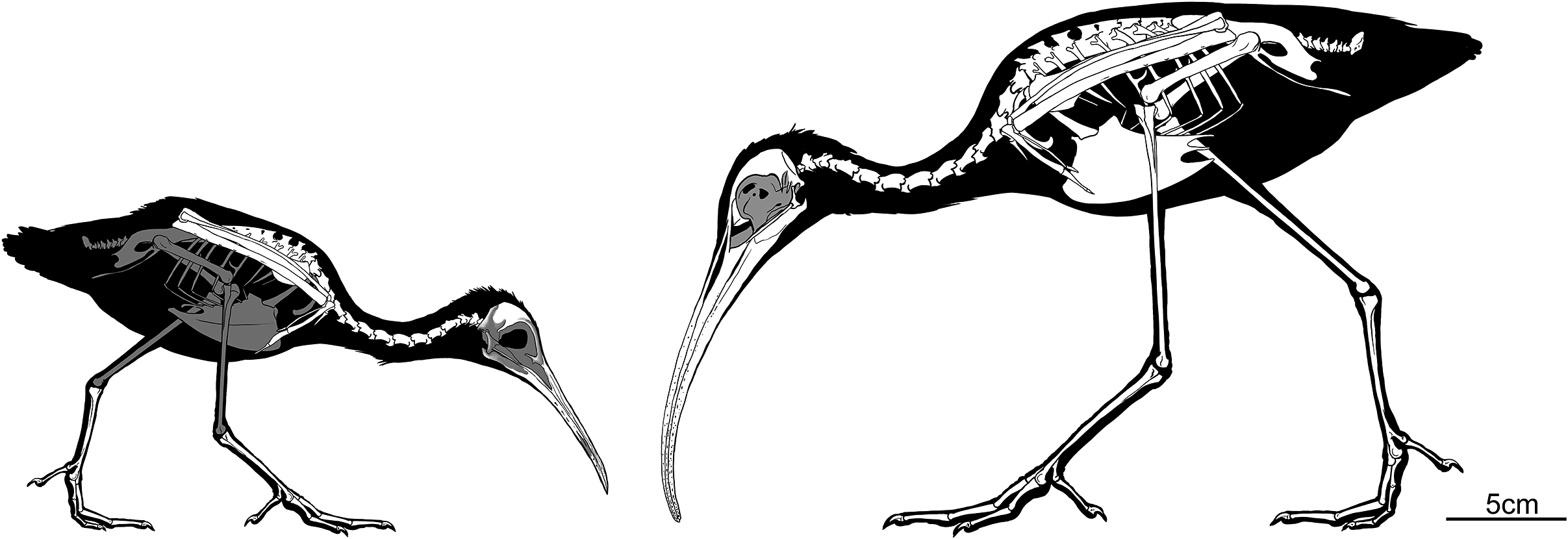
The most interesting feature of Rhynchaeites mcfaddeni n. sp. is the sharply pointed beak tip, which is unlike the rounded tip in extant ibises and R. messelensis (the shape of the beak tip is unknown in R. litoralis). As already noted by Mayr (Reference Mayr2002), the beak of Rhynchaeites lacks the dense pitting that houses Herbst corpuscles in extant ibises. In addition, the nasolabial grooves extend to the tip of the bill in extant ibises but end well caudal to the tip in Rhynchaeites (Fig. 3). A study by du Toit et al (Reference du Toit, Chinsamy and Cunningham2022) demonstrated that the nasolabial grooves do not contain nerves or blood vessels. Thus the functional significance of their elongation in extant ibises remains uncertain. Although the femur and tibiotarsus are not preserved in the new fossil, the tarsometatarsus is the major hind limb element that is most strongly elongated in extant wading ibises and thus provides a proxy for foraging habitat. The tarsometatarsus:humerus proportions fall near the lower end of the range observed in extant Threskiornithidae (Table 1) and result in a relatively compact appearance compared with wading species (Fig. 4). Extant ibises with similar leg proportions tend to forage more in open country environments, such as grasslands and meadows, as opposed to longer-legged species, which prefer wetlands, marshes, lakes, and coastal regions.
Skeletal reconstructions of (left) Rhynchaeites mcfaddeni n. sp. nov. and (right) the extant scarlet ibis Eudocimus ruber Linnaeus, Reference Linnaeus1758. Bones that are not preserved in the holotype of Rhynchaeites mcfaddeni are shown in gray and are based on those of Rhynchaeites messelensis. Art by Jaime Headden.

Like Rhynchaeites messelensis, Rhynchaeites mcfaddeni was unlikely to have been a tactile foraging specialist. Mayr and Kitchener (Reference Mayr and Kitchener2023) likened the beak of the Rhynchaeites messelensis to that of the Ibisbill Ibidorhyncha struthersii Vigors, Reference Vigors1832, a shorebird that is close in size to Rhynchaeites and resembles the extinct taxon in having short legs and, as the name implies, an ibis-like bill that likewise lacks dense pitting for tactile receptors (Fig. 3). Ibidorhyncha feeds by pecking prey from the water surface as well as by probing among rocks and raking its bill through pebbles to dislodge aquatic invertebrates and fishes (Knystautas, Reference Knystautas1996). The sharper bill of Rhynchaeites mcfaddeni clearly housed fewer tactile receptors compared with extant ibises, suggesting it may have had a different ecology, perhaps using its beak tip to prise prey such as bivalves or snails out of their shells. Viviparid snails are abundant in the Fossil Butte Member, and high-spired pleurocerid snails are also common (Grande, Reference Grande2013). Indeed, extant ibises with proportionally fewer tactile receptor pits exhibit surface plucking behaviors more often than subsurface probers with proportionally greater amounts of tactile receptor pits in the bill (e.g., Plegadis ridgwayi Allen, Reference Allen1876 exhibiting over five times the number of pits observed in Geronticus eremita Linnaeus, Reference Linnaeus1758) (Martin and Portugal, Reference Martin and Portugal2011).
Both increased distal tapering and reduced proportional bill length among birds have received particular attention in studies of both arboreal and wading species. In meliphagids, linear bills (as opposed to distally curving bills) are more associated with insect foraging (e.g., plucking) rather than probing behaviors (Friedman et al., Reference Friedman, Miller, Ball, Kasuga, Remeš and Economo2019), and bills with emphasized distal tapering were associated with ground foraging (Friedman et al., Reference Friedman, Miller, Ball, Kasuga, Remeš and Economo2019). In waders, proportional bill length, rather than morphology, is a greater predictor of either surface probing (i.e., plucking) or subsurface probing, with shorter bills correlated with surface plucking of invertebrates (Lifjeld, Reference Lifjeld1984). Similarly, proportionally shorter bills in waders are associated with greater use of visual foraging rather than tactile foraging (Barbosa and Moreno, Reference Barbosa and Moreno1999). Neontological evidence thus suggests that Rhynchaeites mcfaddeni was a visual forager (as opposed to a subsurface tactile forager) and fed primarily on terrestrial or shoreline invertebrates.
Rhynchaeites messelensis is one of the more common birds in the prolific Messel deposits, with about a dozen specimens currently known, whereas Rhynchaeites mcfaddeni appears to have been rare at Fossil Lake, with only a single specimen uncovered to date. As both formations were deposited in lake environments surrounded by subtropical forests, this disparity in abundance may reflect differences in ecology. We speculate that Rhynchaeites mcfaddeni may have foraged more often in shallow moving streams, whereas Rhynchaeites messelensis may have been more active in foraging directly in the substrate along the lake margins, where individuals were more likely to drift into the lake waters after perishing.
The Rhynchaeites mcfaddeni holotype is preserved in an unusual way, whereby the skull, presacral vertebral column, wings, and feet are individually articulated and appear to remain in nearly undisturbed position relative to how the complete carcass originally lay. The only disturbance to these elements appears to be the separation of the left phalanges II-1 and II-2, which drifted a modest distance from the carpometacarpus, and the slight displacement of the notarium from the rest of the presacral vertebral column. Mayr (Reference Mayr2009) reported a similarly unusual specimen of the early Oligocene trogon Primotrogon wintersteini Mayr, Reference Mayr1999 from the Céreste locality in Southern France, which preserves the wings, neck and pectoral girdle, and feet in life position but lacks pelvis, femur, and tibiotarsus (the skull of that specimen was lost in the cutting of the block). On the basis of studies of Bickart (Reference Bickart1984), Mayr (Reference Mayr2009) considered this unusual preservation to be because some of the bones of the bird carcass stuck to the ground, whereas others were disturbed and lost. The same conclusion was reached by Orr et al. (Reference Orr, Adler, Beardmore, Furrer, McNamara, Peñalver-Mollá and Redelstorff2016), who proposed the “stick ‘n’ peel” model for this kind of fossilization. Under this model, some portion of the carcass becomes adhered to the sediment by fluids released during the decay process. These portions thereafter remain firmly in place while other sections may become dislodged by currents, scavengers, or bloating of the carcass through the formation of putrefaction gases. In the example of Rhynchaeites mcfaddeni, the severance and partial scattering of the trachea may thus represent the work of scavengers picking at exposed sections of the neck after the sediment-facing side became firmly adhered.
Acknowledgments
We thank G. McFadden for his generous donation of the type specimen to the Field Museum, C. Van Beek (FMN) for her skillful preparation of the specimen, B. Marks (FMNH) and C. Milensky (USNM) for access to bird skeletal collections, J. Headden for the skeletal reconstructions, and S. Clark for creating the skillfully reconstructed line drawings.
Competing interests
Daniel Ksepka is an associate editor at the Journal of Paleontology; he had no role in the editing and publication of this manuscript.