The Divisions of the American Political Science Association (APSA) provide their members with significant professional and intellectual benefits.Footnote 1 Established in 1983, these organized sections advance APSA’s goals by grouping scholars of similar academic interests and planning the Annual Meeting program (APSA 2004). In addition, these smaller field- and subfield-specific networks often provide access to relevant journals and newsletters, recognition for academic work, and even financial support in the form of specialized grants and fellowships. However, cost concerns force many graduate students to forego participation, leading them to delay joining until later in their career. The absence of graduate students, moreover, deflates Division membership. As a result, many Divisions undercount the size of their research community and miss opportunities to cultivate emerging scholars in the field.
In 2017, the inaugural APSA Committee on the Status of Graduate Students in the Profession launched an initiative to reduce the costs of Division membership for students. This article examines whether this initiative succeeded in lowering membership costs for students and, in turn, increased student membership in Divisions. We found that it did, on both counts. After providing some background on the initiative, the article discusses our methodological approach and findings. The success of the “intervention” suggests that the discipline should consider additional strategies to reduce the costs of professional participation for graduate students.
BACKGROUND
The charge of the APSA Committee on the Status of Graduate Students in the Profession is to “bring attention to issues and concerns affecting PhD students in the discipline and provide input to the APSA Council and staff on policies and programs to effectively engage and support them” (APSA 2020). In 2017, APSA formed the inaugural committee. To compose the committee, the association requested nominations from faculty and then appointed successful candidates to two-year terms. Committee members represent a diverse range of disciplinary interests, academic institutions, and stages of doctoral progress.
Topping the list of objectives was the reduction of financial barriers to organizational participation.Footnote 2 The high cost of APSA membership and Annual Meeting attendance discourages cash-strapped graduate students from reaping the full benefits of participating in the association. Although some universities, departments, and grant makers provide limited funding to students to help cover the costs of membership and Annual Meeting attendance, most students still come up short. Moreover, many students—particularly those in positions of institutional, racial, or gendered disadvantage within APSA—are unable to access financial support (APSA 2011). The financial barriers to APSA participation therefore reinforce preexisting inequities within the profession.
This concern is compounded by the fact that the majority of APSA networking occurs through Division panels, business meetings, and receptions—but the financial hurdle to membership is significant. In many cases, membership is required for access to Division listservs, APSA Connect platforms, and newsletters, which advertise opportunities for section affiliates. However, graduate students initially may be reluctant to join Divisions, given the upfront costs. Typically, graduate students become members of APSA (or renew their membership) when they register for an Annual Meeting. The opportunity to join Divisions arises only after students agree to pay the membership fee (i.e., $52 in 2020) and the Annual Meeting registration fee (i.e., $125 minimum for the in-person conference in 2019). After accounting for travel and accommodations, these expenses can amount to hundreds—if not thousands—of dollars. Looking to cut costs, graduate students often pass on the opportunity to join a Division, on its face an optional due. Few even consider joining multiple Divisions, as many professional members do (Brintnall Reference Brintnall1991).
Looking to cut costs, graduate students often pass on the opportunity to join a Division, on its face an optional due.
Moreover, many graduate students miss out on important professional and intellectual benefits of the organization: networking at the Annual Meeting. Conferences provide the means to receive feedback on working papers, network with colleagues, and learn about scholarship across subdisciplines in broad research fields. Early-career professionals, in particular, benefit from opportunities to network with scholars in their field for mentoring and future collaboration. In addition, some Divisions have a graduate student representative on their executive board. Although Division membership is not required to access these opportunities, it facilitates them. Junior nonmembers may not hear about or attend field-specific panels, business meetings, and networking events as soon or as often as Division members.
The absence of graduate student participation also negatively affects Divisions. Division members attend and present on panels at the Annual Meeting—but low panel attendance reduces a Division’s panel allocation in the following year, thereby gradually decreasing its presence over time (Losco Reference Losco1998). Division leaders, moreover, miss an opportunity to introduce the field to new students and cultivate future leaders. In addition, graduate students are good candidates for junior leadership roles and can contribute to a Division’s business operations. Moreover, Division involvement in the early stages of a career can develop the professional skills needed to assume more senior roles in the future (Gupta and Waismel-Manor Reference Gupta and Waismel-Manor2006). As cross-institutional intellectual communities, Divisions offer students opportunities for professionalization and training that extend those available in their home department.Footnote 3
The inaugural committee therefore launched a simple but high-impact initiative to reduce or eliminate Division fees—the gatekeepers of Division membership and a measure of participation. In the summer of 2017, committee members emailed the leaders of every Division that charged student dues (N=40) to consider a proposal that entailed reducing or eliminating student fees at their next business meeting in San Francisco.Footnote 4 Although many Divisions were aware of the financial burden of membership on graduate students, few had implemented policy changes to address it. At the onset of this project, we found that only four of the current Divisions did not have any dues requirements for graduate students. Most Divisions agreed to consider the proposal and accepted our offer to send a committee representative to the meeting to discuss the initiative in person. Conversations among Division leadership, members, and status committee representatives occurred via email and in person during the subsequent months leading up to the Annual Meeting.Footnote 5 Some Divisions immediately embraced the initiative; others opted for a longer-term approach (e.g., a gradual or temporary reduction in fees and a multistep reform of Division bylaws); and others abstained. By 2019, 26 Divisions had eliminated or reduced their dues for graduate students.Footnote 6
DATA AND METHODS
We examined the effect of our initiative (i.e., the “intervention”) by testing whether Divisions that reduced fees between 2017 and 2019 observed a larger increase in graduate student membership compared to Divisions that did not reduce fees.Footnote 7 To examine this question, we leveraged data on dues and enrollment for each of APSA’s 44 Divisions from 2017 to 2019 provided by the APSA Department of Research and Development (Fairbanks et al. Reference Fairbanks, Neuner, Perera and Slaughter2021). For the purposes of this study, we eliminated information on two new Divisions that were created only in 2018 (i.e., international collaboration and Middle East and North Africa politics)Footnote 8; however, neither charges students for membership. Six Divisions had tiered pricing structures whereby members can pay reduced fees in exchange for opting out of receiving physical copies of the Division journal. For these Divisions, for comparability, we excluded the data pertaining to these tiered membership levels—that is, the observation included in the dataset is the membership level that includes the physical journal. Data from Divisions that already had eliminated graduate student fees prior to 2017 (N=4) remained in the sample and were not coded as being treated because we were interested in estimating the effect of changes in membership fees during the 2017–2019 period.Footnote 9
To evaluate the impact of our efforts, we first examined whether Division fees for graduate students declined during the period of our intervention before turning to the question of whether membership increased in Divisions that reduced or eliminated fees. For this, we leveraged the difference-in-differences (DID) approach. In its simplest form, this approach compares outcomes for two groups (i.e., treated and control) across two periods (Ashenfelter and Card Reference Ashenfelter and Card1985). Because the same observations in each group are observed within each period, we can subtract the average change in the control group from the average change in the treatment group to obtain an estimate of the treatment effect.Footnote 10
We examined how student membership changed for both Divisions that reduced or eliminated fees and for those that did not between (1) 2017 and 2018, (2) 2018 and 2019, and (3) the entire 2017–2019 period. Thus, our key dependent variable was student membership in Divisions and our treatment variables were constructed for each period: Divisions that did not reduce fees during that period were coded as control observations, whereas Divisions that did reduce fees were coded as treated observations. To formally estimate DID models, we regressed membership on indicators for period and treatment status, as well as the interaction of period and treatment status. The coefficient on the interaction term then could be interpreted as the relative change in membership in Divisions that reduced fees compared to those that did not, attributable to the treatment. This discussion focuses on the graphical illustrations of these trends; the more formal estimations of the DID models are in the online appendix.
RESULTS
The results of our study are discussed in detail in the following subsections.
Change in Graduate Student Division Fees, 2017–2019
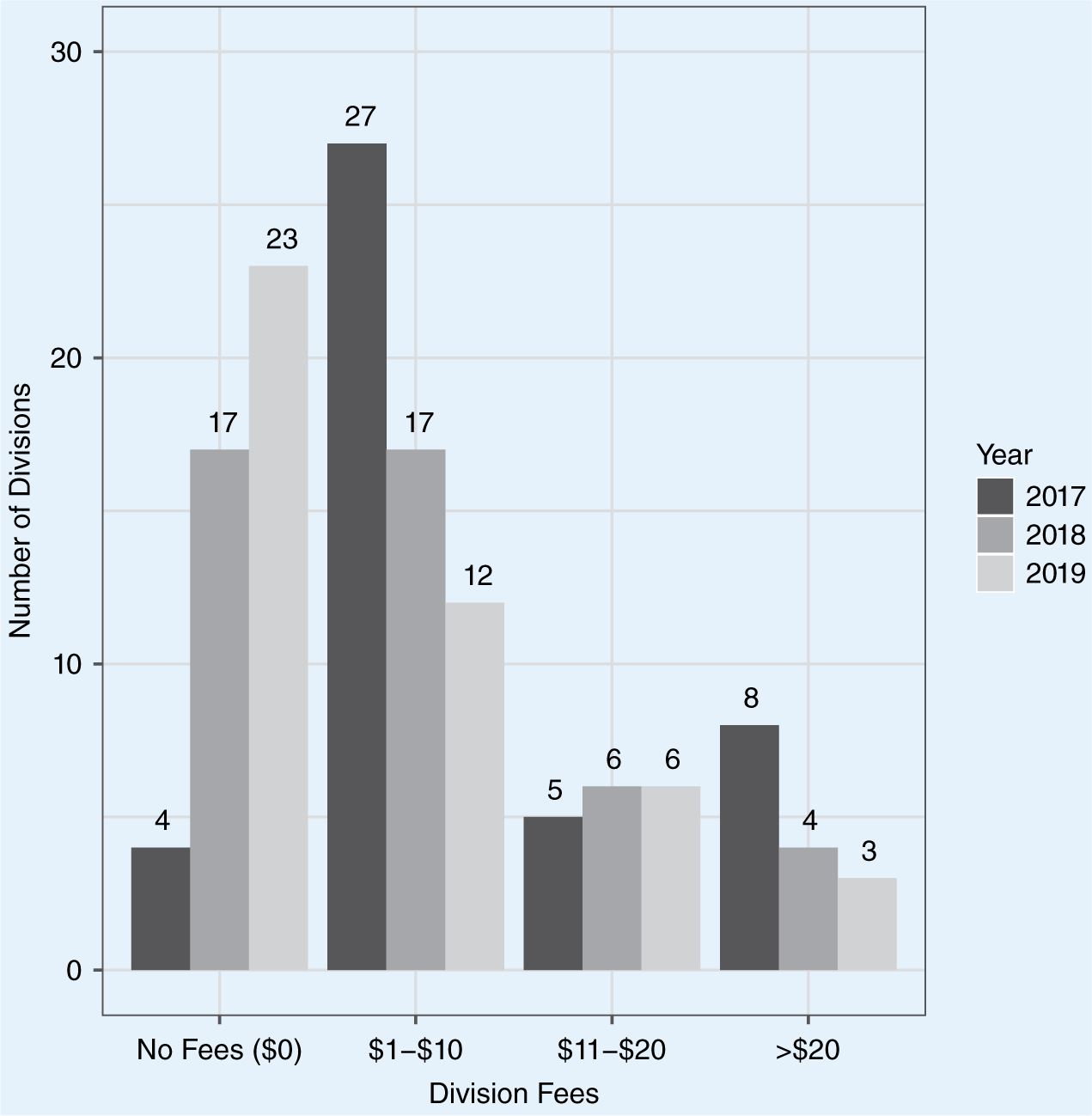
Before we examine whether the intervention affected membership numbers, we present information on changes in graduate student membership fees. Figure 1 depicts the distribution of these membership fees across 44 APSA Divisions from 2017 to 2019. In 2017, at the time of the intervention, the majority of Divisions (N=40) charged student fees in 2017 for an average of $11.57.Footnote 11 Dues ranged from $0 to $33, according to Division bylaws and expenses (e.g., reception costs, prize money, and newsletter-printing charges). As noted, several Divisions also varied fees according to member benefits. For example, the American political thought and urban and local politics sections charge members who receive their publications only online less than those who also receive print copies (data in these reduced categories are excluded).
Distribution of Graduate Student Membership Fees across APSA Divisions, 2017–2019

As our intervention progressed (2018–2019), the average student dues decreased from $11.57 in 2017 to $7.22 in 2018 and to $5.84 in 2019. Note that whereas the differences in mean fees between 2017 and both 2018 and 2019 are statistically significant (at p<0.05), the difference in mean dues between 2018 and 2019 is not statistically significant. More substantively, our most recent data show that more than half of the Divisions (N=23) no longer charge student dues (compared to only four Divisions in 2017). Overall, figure 1 illustrates the decrease in student fees during this period, showing that more than two thirds of Divisions (N=26) reduced or eliminated them as a result of the initiative.
Effect of Intervention on Graduate Student Membership in Divisions
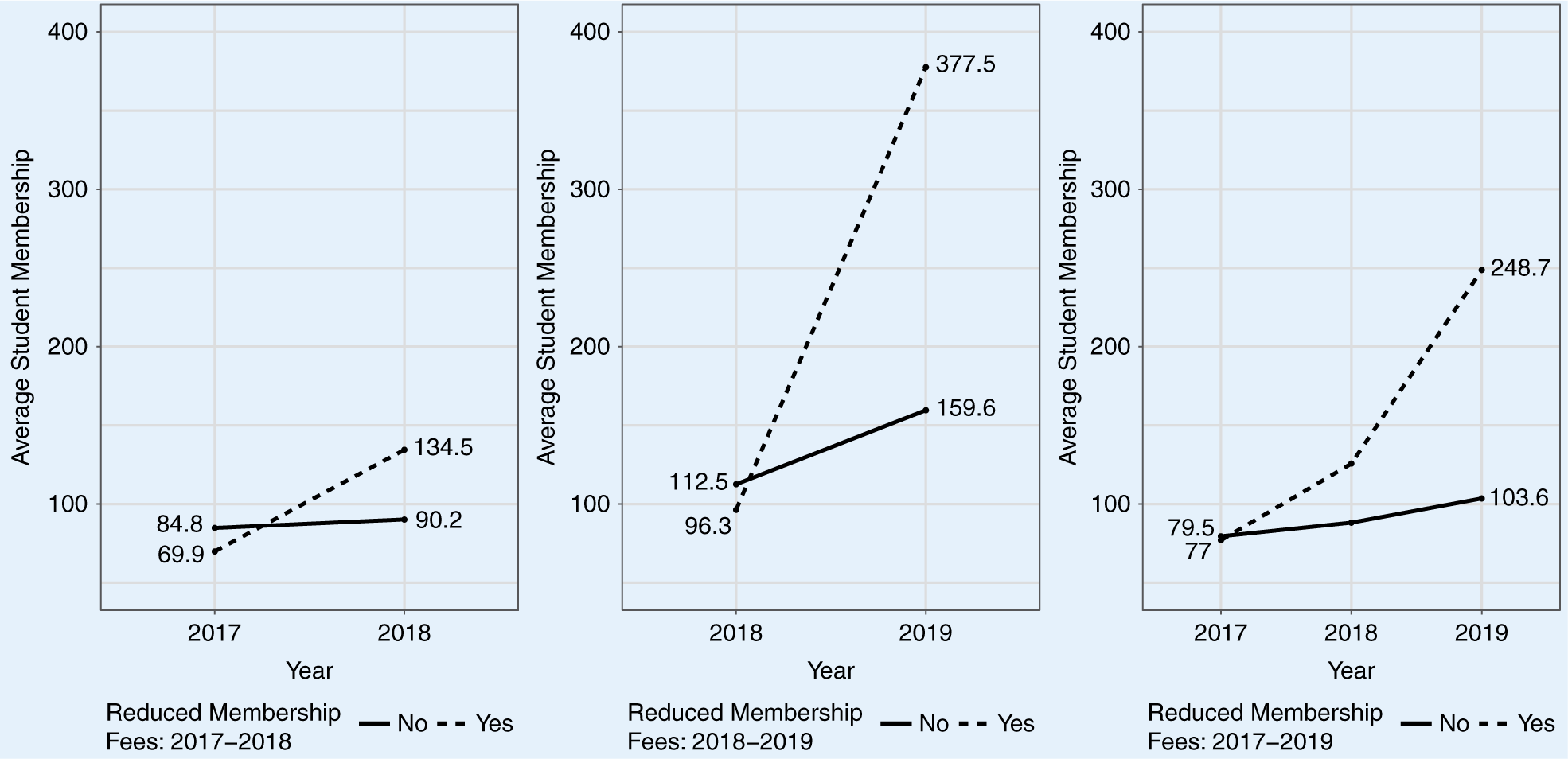
Having established that Division fees for graduate students declined following our intervention, we next examined whether student membership disproportionally increased in those Divisions that reduced fees between 2017 and 2019 when compared to those Divisions that did not. Figure 2 plots the relationship between treatment status (i.e., reduced fees versus did not reduce fees) and student Division membership. The left panel shows this relationship for the 2017–2018 period, the middle panel for the 2018–2019 period, and the right panel for the combined 2017–2019 period.
Changes in Graduate Student Division Membership, by Treatment Status
Notes: Left panel: changes for the period 2017–2018; middle panel: changes for the period 2018–2019; right panel: changes for the period 2017–2019.

Although the magnitudes of the effects differ, the three panels in figure 2 illustrate that Divisions that reduced fees showed a significantly larger increase in student membership compared to those that did not reduce fees. This is evidenced most starkly in the middle panel, which shows that during the period 2018 to 2019, average student membership increased from approximately 96 to 378 in Divisions that reduced fees compared to a much smaller increase from 113 to 160 in Divisions that did not. Based on the formal tests presented in online appendix tables A1–A3, the effect attributable to the intervention was an average increase of approximately 59 graduate student members in the 2017–2018 analysis (p<0.05), 234 student members in the 2018–2019 analysis (p<0.01), and 128 student members in the 2017–2019 analysis (p<0.01). Thus, our analyses demonstrate that reducing fees significantly boosted graduate student membership in Divisions.
Divisions that reduced fees showed a significantly larger increase in student membership compared to Divisions that did not reduce fees.
DISCUSSION AND CONCLUSIONS
Our intervention yielded a modest but impactful decrease in costs for graduate student Division membership, and an overall increase of graduate student membership in Divisions. As revealed in our findings, reducing student dues increased graduate student membership in Divisions in this two-year period. By suggesting that graduate student affiliation costs be reduced or outright eliminated, the committee’s initiative reduced a barrier to Division participation. The analysis demonstrates that Divisions that reduced student fees had an uptick in graduate student membership, as compared to those that did not reduce their fees. The results therefore support the goals of the committee and suggest that graduate students benefited from the initiative. As such, APSA should continue to investigate alternative ways to reduce the high costs of membership within the association, which was (and remains) a primary concern.
However, in light of the financial impact of reducing fees for students and increasing Division participation, questions and opportunities remain. More in-depth analysis, by either the current committee or APSA staff, will reveal the substantive impact of our efforts. We expect that one by-product of our initiative will be increased student leadership in participating Divisions and, potentially, the discipline over time. A follow-up study in five- or 10-years’ time would allow us to examine the longitudinal effects of the intervention.
Increasing graduate student membership in Divisions requires a multipronged approach that goes beyond merely reducing costs. The sign-up process, for instance, merits extra scrutiny. Inviting students to Divisions after they have agreed to pay significant general-membership and Annual Meeting registration fees likely disincentivizes many from joining. The Division sign-up page, furthermore, provides little information about the benefits of Division membership. Both APSA and faculty mentors should communicate these benefits to prospective student members, which also can boost their participation as a complement to the reduced fees.
The initiative nonetheless is an important first step toward developing and expanding the benefits of APSA membership. Both Divisions and graduate students gained from participation. More than two thirds of Divisions participated in our initiative, which tripled their average graduate student membership. As a result, Divisions could gain higher panel attendance, a larger research community, and a new crop of burgeoning leaders in the field. Many students, meanwhile, gained access to one of the most important professional developmental and intellectual benefits of APSA. These valuable networks and opportunities can expand their general training (increasingly in demand by community colleges and smaller departments; see Deardorff Reference Deardorff2015, 316), as well as develop the field-specific skills and communities that their home departments may not be able to provide in full. Reducing the costs of Division participation for graduate students is therefore a win-win.
Many students, meanwhile, gained access to one of the most important professional developmental and intellectual benefits of APSA.
ACKNOWLEDGMENTS
We are grateful to current and previous APSA staff, especially Julia Schwarz, Tanya Schwarz, and Amanda Meyers, for their assistance in acquiring data and acknowledge Nakissa P. Jahanbani’s contribution to this initiative.
DATA AVAILABILITY STATEMENT
Replication materials are available on Harvard Dataverse at https://doi.org/10.7910/DVN/X0NO0K.
SUPPLEMENTARY MATERIALS
To view supplementary material for this article, please visit http://dx.doi.org/10.1017/S1049096521000408.