



1) INTRODUCTIONFootnote *
Our manuscripts of Cicero contain dozens of Greek words that are presented in some passages in Greek letters, and in others are transliterated into Latin. In a recent paperFootnote 1 I collected the evidence for this phenomenon in connection with common nouns and adjectives (for example ὑποθήκη vs hypotheca, ἱστορικός vs historicus), surveyed scholarship to date and posited an interpretative framework which is assumed in this study also. Key components of this framework are the use of mixed alphabets in surviving ancient documents (especially inscriptions) and an awareness of the frequency with which modern editors change the alphabets in the manuscripts when dealing with Greek words—hence the importance of using the apparatus critici, not just the printed text, of our editions.Footnote 2 The earlier paper was also strict in its exclusion of words in continuous passages, and even short phrases, of Greek, since that context excludes the option of transliteration for the author. The major contention of that earlier study was that a coherent pattern of use in the manuscripts can only really be a reflection of Cicero's own considered choice of alphabets: consistently inexplicable choice may indicate that Cicero himself was indifferent to which alphabet he used for single Greek words, or that our copyists paid no attention to this aspect of their exemplars, or both.
Proper nouns and adjectives were excluded from the earlier study not only for reasons of space but also because the manuscripts seem to demonstrate a different, if even more coherent, pattern for these words. For common nouns and adjectives, I showed that generally the most important factor in determining which alphabet was used in our manuscripts was the publication status of the work itself, with the published works being more likely to use transliteration,Footnote 3 but the rule has many exceptions, and other factors were at play as well. When we come to Greek proper nouns and adjectives, we will find an even stronger connection between published works and transliteration: with one exception, the Greek forms of the words appearing in both alphabets across the corpus are restricted to Cicero's correspondence. But while the earlier study claimed that the preference for Greek characters in the letters could be explained largely by their recipients’ known familiarity with the language, this paper will argue that, in addition, proper nouns and adjectives are often written as Greek when their visual appearance has a special contextual significance, and this significance is usually literary.
First we present a complete list of proper nouns and adjectives which appear in both alphabets in Cicero's works, following the earlier paper by excluding the words that appear in continuous passages of Greek or in indivisible Greek phrases,Footnote 4 and separating the names of authors from other Greek proper nouns and adjectives. With the exception of Ἀκαδημικός (Att. 13.12.3, 13.16.1), these Greek forms occur just once each and, except for Λευκοθέα (Tusc. 1.28), are found only in the correspondence. For these words, then, Latin transliteration is overwhelmingly preferred, despite an assumed familiarity with the Greek alphabet even in the published works.Footnote 5 Thus their appearance as Greek in his texts would have been quite striking and, as already suggested, we will usually find specifically visual motives for this use of the Greek alphabet.
proper names and adjectives written in Greek as well as in Latin scripts in the manuscripts of Cicero.
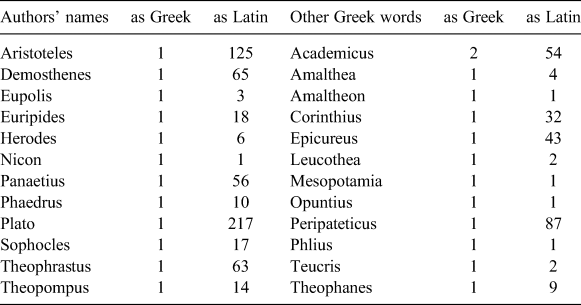
2) AUTHORS’ NAMES
The authors in the Table are indeed a mixed bag, ancient and contemporary, glorious and obscure: as we see, Cicero elsewhere mentions some of them scores of times, while the appearances of others can be counted on one hand, or even on one finger.Footnote 6 Most of them appear in the Greek alphabet only in the immediate context of their written work.
Here we can be reminded of Adams's nice observation about Cicero's alphabet-switching elsewhere:
At Att. 6.1.17 Cicero refers to a statue of Hercules by the sculptor Polycles, using the Greek form of the sculptor's name in the genitive: in illa autem (statua) quae est ad Πολυκλέους Herculem … There is an allusion here to the practice whereby Greek sculptors signed their work in Greek … The statue referred to by Cicero almost certainly had an inscription in Greek, and by his code-switch Cicero is able to bring the object more vividly before Atticus.Footnote 7
Just so.Footnote 8 But when he continues:
Similarly Cicero often gives the titles of Greek literary works in Greek … thereby showing a taste for accuracy
Adams falls back on the least helpful part of his extensive analysis of Cicero's use of Greek to Atticus: a conviction that Cicero's motivation in using the language to his closest friend over many decades was often to show off and to demonstrate that he was well educated.Footnote 9
An alternative explanation—that Cicero's aim is to present the physical reality of a book vividly before the mind of his reader (especially a reader as deeply involved with books as Atticus)Footnote 10—is more consistent with Adams's own observation about the statue and is strongly supported by evidence he does not mention. Let us begin our survey of Greek authors whose names Cicero presents just once as written in Greek:
mecum habeo et Ἀριστοτέλους et Θεοπόμπου πρὸς Ἀλέξανδρον (Att. 12.40.2)
I have Aristotle's and Theopompus’ Letters to Alexander beside me
a Sex. Fadio, Niconis discipulo, librum abstuli Νίκωνος περὶ Πολυφαγίας (Fam. 7.20.3)
From Sextus Fadius, Nicon's pupil, I took Nicon's On Gluttony
epitomen Bruti Caelianorum uelim mihi mittas et a Philoxeno Παναιτίου περὶ Προνοίας (Att. 13.8)
I should be grateful if you would send me Brutus’ abridgement of Caelius’ history and get me Panaetius’ On Providence from Philoxenus
‘Συνδείπνους’ Σοφοκλέους, quamquam a te <f>actam fabellam uideo esse festiue, nullo modo probaui (QFr. 2.16.3)
No way do I approve [your translation of?] Sophocles’ Dinner Party, although I know that you produced it in jest
libros mihi de quibus ad te antea scripsi uelim mittas et maxime Φαίδρου περὶ Θεῶν et †ΠΛΛΙΔΟΣ† (Att. 13.39.2)
Please send me the books about which I wrote to you the other day, especially Phaedrus’ On the Gods and …
Θεοφράστου περὶ Φιλοτιμίας adfer mihi de libris Quinti fratris (Att. 2.3.4)
Please bring me Theophrastus’ On Ambition from Quintus’ library
These names are joined directly to the titles of their books,Footnote 11 and the possession or acquisition of the physical book is the point at issue with all but one; the exception is Sophocles, who is still presented as an author, of course, and the lack of emphasis on the actual roll does not mean that this may not be subtly suggested. But the explicit emphasis on the books of these authors invites further investigation of the links between the use of Greek here and the physical appearance of ancient literary works.
3) CICERO'S LETTERS AND THE MORPHOLOGY OF THE BOOK
In Cicero's time there were two ways in which the contents of books—that is to say, of papyrus rolls—could be distinguished without unrolling them.Footnote 12 The simpler solution was to write information on the outside of the scroll (that is, on the verso of the first page of the text).Footnote 13 Naturally this system came first—we see it illustrated in our earliest picture of an inscribed book rollFootnote 14—and it was still in use in the third century a.d.Footnote 15 However, by Cicero's time a system better suited to the identification of rolls when stored in large numbers had been developed: the books were provided with labels, known as σίλλυβα or σίττυβα,Footnote 16 which were accessible provided just the ends of the rolls, grouped together either vertically or horizontally, were visible. Indeed, our great bookman himself provides the earliest clear reference to the practice: in a series of letters written in mid 56 (Att. 4.4a, 4.5, 4.8), he asks for, and then acknowledges, the help of Atticus’ slaves in attaching these labels, or indices as he also calls them (Att. 4.4a.1), to the books in his library.
Whether written on the verso of the first page of text or on a separate label, the examples Caroli collects let us see the typical way of identifying books, on which anyone looking for a particular volume would be focussed. The usual format is to provide the name of the author in the genitive,Footnote 17 followed by the title of the work. Thus it is in P 8 Caroli, possibly the earliest surviving σίλλυβον, P.Oxy. 3318 (= TM 59981):
indicating the ninth book—of 22!—of Hermarchus’ work Against Empedocles.Footnote 18 So too P 15 Caroli (P.Oxy. 1091 = TM 59341):
This is the typical order, but it is not invariable: hence we also find amongst these labels the name of the work preceding the author in the genitive just as we do with examples from Cicero. For as the latter has, uniquely amongst the instances studied here, the order Συνδείπνους Σοφοκλέους (QFr. 2.16.3), thus we find Caroli's P 14:Footnote 19
It is not a coincidence that both texts reverse the normal order here but a reflection of the rule—explained already by ancient scholars—that in referring to dramatic works one generally puts the title before the author's name.Footnote 20
Despite the usual use of the genitive, one label (P 16 Caroli) has simply the name of the author in the nominative with ὅλος to indicate the complete works (P.Antinoop. 21 = TM 62551):Footnote 21
When we turn back to Cicero's references, we see that he is talking about the inscriptions on actual books in exactly the way in which they appear before his eyes—literal or mental—and that he wishes to convey this same immediacy to his correspondents.Footnote 22
There remain a few other examples where simply the name of the Greek author appears, without the title of a work. Although these instances lack the immediate reference to physical copies of the authors’ books, nuances may still be detected. Fam. 13.15.2 quotes in Greek a verse from Euripides (fr. 905 TrGF) and prefixes it with the poet's name in Greek letters:
confero me ad uera praecepta Εὐριπίδου:
‘μισῶ σοφιστήν, ὅστις οὐχ αὑτῷ σοφός.’
I fall back on that wise saying of Euripides:
‘I despise the clever man who is not clever in his own interest.’
Very similar is the Greek quotation from Plato (Ep. 7.329d)Footnote 23 in Att. 9.13.4, with the philosopher's name similarly marked:
ego autem non tam γοητείαν huius timeo quam πειθανάγκην. ‘αἱ γὰρ τῶν τυράννων δεήσεις’ inquit Πλάτων ‘οἶσθ’ ὅτι μεμιγμέναι ἀνάγκαις.’
I personally however do not fear his beguilements so much as his force majeure. ‘For the requests of despots’ says Plato, ‘have, you know, an element of compulsion.’
The first of these letters is a hyperbolically literary epistle of commendation to Julius Caesar. Although short, it contains six-and-a-half complete Homeric hexameters in addition to the quoted Euripidean trimeter. The representation of Euripides’ name in the letter just as it would appear on one of his books can only bring out further the cultivated, if not quite serious, tone at which Cicero seems to be aiming.Footnote 24
Caesar also features in the second letter, written some years earlier (23 March 49) at the outbreak of the Civil War, but as one of the subjects rather than as the recipient. Cicero's misgivings about Caesar are clear, and a few days later they met and the latter tried unsuccessfully to win him over.Footnote 25 This letter in fact picks up a more subtle allusion to Plato's seventh letter made a little earlier,Footnote 26 and which, as SB says (on Att. 9.13.4), ‘Cicero had evidently been reading’—as well he might in the circumstances, as he turned over in his mind the conflict, described in that famous letter, between principled philosophy and politics as actually practised. The letter was before him as he quoted from it, with Plato's name on the book.Footnote 27
It is noteworthy that both of these examples use Greek letters for the authors’ names in the midst of quoting them in the original language, and it is certainly tempting to think that this has influenced the alphabetic choice. We have seen previously that, even when giving titles in Greek, our manuscripts of Cicero sometimes show the Latin form of authors’ names, but this does not occur in contexts of quoting from these works or even of using other Greek words in the vicinity.Footnote 28 We might suggest, then, that the habit (conscious or otherwise) of ‘clustering’ Greek expressions in the lettersFootnote 29 has been one of the influences on the use of that alphabet here.
We can compare this with further examples of authors’ names written in Greek characters. Demosthenes is mentioned frequently by Cicero, but he writes the name in Greek only when making the pointFootnote 30 that the ‘thunderbolts’ of Demosthenes show that truly ‘Attic’ oratory can be weighty and grand. The argument is made in a way which explicitly recalls to Atticus his experience of reading Demosthenes (Att. 15.1a.2):
quamquam uereor ne cognomine tuo lapsus ὑπεραττικὸς sis in iudicando. sed si recordabere Δημοσθένους fulmina, tum intelleges posse et Ἀττικώτατα <et> grauissime dici.
I fear though that you may be led astray by your surname and judge too Attically. But you have only to call to mind Demosthenes’ thunderbolts to realize that a speaker can be both impeccably Attic and profoundly impressive.
The author's name in the genitive, as we have seen, is visually suggestive of a book, but in the immediate context we see that Cicero has just switched into Greek,Footnote 31 and this would seem to make the use of that alphabet for Demosthenes’ name more natural.
We see something similar with our next author, whose identity is in dispute. There are problems with associating the Herodes of Att. 2.2.2 with the Athenian archon of 60/59 b.c.Footnote 32 and even with the Herodes who was to tutor Cicero's son years later:Footnote 33 it seems likely that this man is a different individual from either. This question does not matter for our purposes. What is clear is that this Herodes was a writer, and that this is the only time Cicero used Greek characters to spell a name which occurs several times elsewhere in the correspondence. Moreover, the use of Greek is explicitly in a context of authorship. Cicero moves from admiration for the work of Dicaearchus to contempt for Herodes’ literary efforts:
Κορινθίων et Ἀθηναίων puto me Romae habere. mihi crede (sed ego te hoc doceo?), mirabilis uir est. Ἡρώδης, si homo esset, eum potius legeret quam unam litteram scriberet; qui me epistula petiuit, ad te, ut uideo, comminus accessit. coniurasse mallem quam restitisse coniurationi si illum mihi audiendum putassem.
I think I have the Corinth and the Athens in Rome. Believe me (but am I telling you?), he's a wonderful man. If Herodes had any sense he would be reading him instead of writing a single character himself. He has attacked me with a letter and met you, I see, hand to hand. I'd rather have joined the conspiracy than opposed it if I had thought I should have to listen to him.
‘The Greek lettering, if genuine, seems capricious’, opines SB ad loc., while conceding the possible influence of Greek book titles in the context. But, while acknowledging this influence, I would also argue that both the titles and the author's name written as Greek are reflections of the physical appearance of books in Cicero's time and of his desire to suggest that appearance to his correspondents. Perhaps there is even a whimsical little joke going on: the failed author, who should not even write a single Greek letter, has his name, and nothing else, spelled out in a few characters from that alphabet.
4) TITLES AND OTHER LITERARY REMINISCENCES
The Table above shows that most proper nouns appearing in both alphabets in Cicero's works are the names of authors. Nearly half of the remaining nouns and adjectives are presented in a strongly literary context, suggesting that here too the visual appearance of a text is being recalled. Here is some more of the passage quoted above, where Cicero is talking about Dicaearchus’ books on Greek constitutions, and again we see his emphasis on the material realities of reading (Att. 2.2.2):
Πελληναίων in manibus tenebam et hercule magnum aceruum Dicaearchi mihi ante pedes exstruxeram. o magnum hominem, et unde multo plura didiceris quam de Procilio! Κορινθίων et Ἀθηναίων puto me Romae habere.
I have the Pellene in my hand and a goodly heap of Dicaearchus piled up in front of me. What a great man! There's a deal more to be learned from him than from Procilius. I think I have the Corinth and the Athens in Rome.
Cicero abbreviates the titles for a recipient who was familiar with them,Footnote 34 but he keeps the lettering as it would have appeared on the books: Πελληναίων πολιτεία and so on.Footnote 35 The Latinized forms of these names for inhabitants of Pellene and Athens do not occur in the works of Cicero, who prefers the older hybrid Atheniensis for the latter, but the Table shows that Corinthius is common. Only here, again in the context of a physical book, do our manuscripts show the word in isolation as Greek.
More allusively, but apparently with the same intention, Ἀκαδημική is only written thus when Cicero refers to his own Academica,Footnote 36 and Περιπατητικός appears only in his reflections on the Peripatetic arguments of De finibus, a work to which he twice gives the unambiguously Greek title περὶ Τελῶν, just as he calls his De re publica Πολιτικά.Footnote 37 This (apparently facetious) use of Greek titles for Latin works was not restricted to Cicero's own writings, but was applied to others as well.Footnote 38 Naturally, we can think of this as a way of acknowledging Greek inspiration of the contents,Footnote 39 but we may also have acknowledgement of the physical identifiers of books in a Roman's library. There were few books of philosophy in Latin before Cicero's: to think of a book of this genre was almost by definition to think of a book with a Greek title.
In Epirus, Atticus constructed an Amaltheum (or Amalthium), named for Amalthea, the nurse of the infant Zeus. Cicero mentions it several times, and indeed admired it so much that he built his own in imitation at his villa in Arpinum.Footnote 40 He always Latinizes both nouns except in one passage (Att. 1.16.18):
uelim ad me scribas cuius modi sit Ἀμαλθεῖον tuum, quo ornatu, qua τοποθεσίᾳ, et, quae poëmata quasque historias de Ἀμαλθείᾳ habes, ad me mittas.
I should be grateful for a description of your Shrine of Amalthea, its furnishings and layout; and would you send me any poems or narratives you have about her?
Again, the use of the Greek alphabet coincides with direct reference to a written document, as if Cicero is already imagining Atticus’ text in front of him. He may have expected a letter in Greek, and the stories and poems would certainly have been in that language.Footnote 41
Our final example of Cicero's Greek script suggesting to a letter's recipient the visual experience of reading a text concerns a well-known author, but not so much the writings of that author as those about him. Cicero is apologizing for a mistake by pleading that he was going by what he had often read (Att. 6.1.18):
et tu belle ἠπόρησας et nos publicam prope opinionem secuti sumus, ut multa apud Graecos. quis enim non dixit Εὔπολιν τὸν τῆς ἀρχαίας ab Alcibiade nauigante in Siciliam deiectum esse in mare? redarguit Eratosthenes.
You were right to be puzzled, while on my side I followed the more-or-less received opinion. There are many such things in Greek authors, for example everybody spoke of Eupolis (him of the Old Comedy) as having been thrown into the sea by Alcibiades on the voyage to Sicily. Eratosthenes disproved the story.
Why the Greek here? Cicero gives the poet's name in its Roman form everywhere else, including elsewhere in the letters.Footnote 42 But, as we see, he has just switched into Greek, and furthermore he is after a special effect here, which is the visual memory of someone reading—repeatedly—Greek on a page. This is the experience that Cicero recalls and wants to convey to his friend, whose psychological reaction to the language he can confidently predict.Footnote 43
5) GREEK LANGUAGE, GREEK SCRIPT AND GREEKS
For Cicero, Greek was not just the fossilized means of transmitting masterpieces of long-dead poets, orators and philosophers but a continuing subject for study in its own right and a still-changing focus of identity for a culture which had never stood still. In this penultimate section we collect further examples of Greek proper nouns which appear in both alphabets in the surviving manuscripts of his works, and which cannot be explained by the visual presentation of the books with which Cicero and his readers were familiar. Sometimes it seems more appropriate to apply the considerations raised in the earlier study of common nouns. For instance, the Hellenistic word Μεσοποταμία first appears as Latin in our manuscripts at Nat. D. 2.130, but they show it as Greek in Att. 9.11.4, written some years earlier: we can see this as a gradual ‘naturalization’ of the word or, perhaps more plausibly, as a generic difference between public and private writings.
Arguably new and subtler factors are in play with Cicero's three references to Leucothea, the sea goddess into whom the mortal Ino was changed. Two look very similar:
Ino dea ducetur et Leucothea a Graecis, a nobis Matuta dicetur, cum sit Cadmi filia …? (Nat. D. 3.48)
Shall Ino be regarded as a goddess and hailed as Leucothea by the Greeks, and as Matuta by us, although she is the daughter of Cadmus …?
Ino Cadmi filia nonne Λευκοθέα nominata a Graecis, Matuta habetur a nostris? (Tusc. 1.28)
Is not Ino, the daughter of Cadmus, called Λευκοθέα by the Greeks, and regarded as Matuta by us?
The manuscriptsFootnote 44 appear to insist that in one case the Greek name is transliterated and in the other it appears in the original alphabet. In both passages the point at issue is the divine status of Ino/Leucothea, but in the first the focus is on her human parentageFootnote 45 and in the second on her human nature and on the fact that she, like so many other mortals, became a goddess. That is the context, but in this second passage her becoming a goddess is not explicit—we lack the dea ducetur—and we are perhaps left to deduce it from the literal meaning of her name presented in Greek.Footnote 46 This is the only word studied in this paper which appears in Greek letters in a published work.
Greek as Greek is required for technical reasons in Att. 6.2.3, where Cicero requests a change to the original text of Rep. 2.8. There he had referred to the inhabitants of Phlius as Phliuntios, and now he asks Atticus to change the form to Phliasios. Footnote 47 He explains that he was misled by analogy with the towns of Opus and Sipontum: Φλιοῦς, Ὀποῦς, Σιποῦς, quod Ὀπούντιοι, Σιπούντιοι. Elsewhere Phlius is written in Latinized form, and an inhabitant of Opus is referred to as an Opuntius, but here a linguistic point is at issue, and Cicero needs to discuss the Greek language in the original.Footnote 48
Theophanes of Mytilene, an influential companion of Pompey, has his name spelt out in Greek letters at Att. 2.5.1. SB ad loc. again implies that this departure from Cicero's usual practice is just ‘capricious’, but there may be a new subtlety here. Although Theophanes was a historian already when Cicero wrote this letter in April 59,Footnote 49 no reference is made to his literary activity (and so he is not grouped with the other authors in the Table above). Rather, the Greek characters suggest that in Cicero's mind he remained very much a foreigner with an influence on Pompey bordering on the sinister.Footnote 50 An active politician in his home city before meeting Pompey, he continued to look after its interests once he became prominent in Rome.Footnote 51 The same suggestion of a suspicious alien may lie behind the unique appearance of the adjective Ἐπικούρειος in Fam. 3.9.2,Footnote 52 written to that ‘proud, corrupt and superstitious’ patrician Appius Claudius Pulcher.Footnote 53
Unlike Theophanes and Epicurus, Teucris or Τεῦκρις is completely unknown. Cicero refers to this person—the form is feminine, but that has not excluded speculation that this is a slighting reference to a man—on just two occasions (Att. 1.12.1 and 1.14.7), both times in connection with the arrangement of a loan, and it is usually thought that this is a code name.Footnote 54 Given the lack of evidence, speculation about the change of alphabet seems pointless, but it should be remembered that Cicero elsewhere resorts to Greek for security reasons in the correspondence.Footnote 55
6) CONCLUSIONS: CICERO'S WRITINGS AND TEXTUALITY
In this paper and in its predecessor it has been an axiom that clear patterns in the choice of alphabet for Greek words exhibited by our manuscripts of Cicero are most easily explained as reflections of the author's original decisions. By focussing just on proper nouns and adjectives, the current study has strongly confirmed the tendency, demonstrated in earlier work, for these manuscripts to use Greek characters for Greek words more often in the correspondence than in the published works. But more complex and interesting patterns have also been claimed in these analyses. Already in the earlier work it was suggested that alphabet-switching could be seen as a rhetorical technique which could bring out nuances in the texts, and also as a tool of precision for technical discussion. Cumulatively, the more plausible these suggestions were found to be, the stronger the argument that the alphabet switches were Cicero's own.
The current paper has taken these suggestions further, especially by its emphasis on the visual appearance of the Greek alphabet in contexts where a letter's recipient is meant to imagine the identifying script on the outside of a book. Even where the allusion to an author or work is not so explicit, I have argued that the use of Greek letters (sometimes in a ‘cluster’ with other Greek words) will have vividly brought to the reader's mind the physical context of such literature and reminded him of his own experience of it. Finally, it was suggested that some particular uses of the Greek alphabet bring out the ‘un-Roman’ qualities of ideas or people elsewhere designated, when a negative presentation is not intended, by a Latin transliteration.
The arguments presented in these studies let us see how very permeable was the border between Latin and Greek in the mind of Cicero and his contemporaries, and also remind us of the importance of visual presentation and reception of texts in Rome at the end of the Republic. As such, the arguments can be seen as contributing to our understanding of the ‘textuality’ of Cicero's writings, those specific qualities they possess by virtue of being written products, which has been the focus of interesting recent research.Footnote 56 The impacts suggested by the change of alphabets are largely visual in nature and further strengthen our understanding of this element of his work.
The change of alphabets in Cicero's writings inevitably needs to be considered also in the light of how they were composed. Cicero would have been in the best position to exercise choice of alphabets if he had written, rather than dictated, the text of his compositions. In fact, writing in his own hand does seem to have been his usual practice, at least in his letters to Atticus, which are our chief source for his use of Greek.Footnote 57 Atticus returned the compliment by writing in his own hand, which Cicero read directly.Footnote 58 Often when reference is made to the dictation of a letter, an excuse is offered to the addressee,Footnote 59 and there is thus some evidence that the usual practice was for Cicero to write his own letters, at least those to intimate acquaintances.Footnote 60 He even did this with his published work: an overlooked piece of evidence is Fam. 16.22.1, where he makes reference to the difficulty scribes might be having with a text written in his own hand (mea manu),Footnote 61 and a study of Roman writing habits has pointed out that both Quintilian (Inst. 1.7.20) and the Elder Pliny (HN 13.83) claimed to have seen autograph works by Cicero. The study concludes after recounting further evidence, much of it directly connected with Cicero, that
elite Romans from the highest social orders … were quite accustomed to writing documents in their own hands. Such handwritten documents … could be of significant length.Footnote 62
Nevertheless, we do know that sometimes dictation was employed, and we can conclude by asking a question relevant to both this paper and its predecessor:Footnote 63 what difference would dictation have made to the Greek in Cicero's letters, especially to the Greek words which are also preserved written in Latin characters? For some certainly dictated correspondence does contain Greek.Footnote 64 Naturally, the language as such would not have presented problems to well-educated scribes such as Tiro.Footnote 65 Writing it in the Greek alphabet would have been necessary when there was anything more than a single word, but the handling of isolated Greek words presented a dilemma for scribes. What did they do? Unfortunately, the data are very meagre: we have explicit testimony for the dictation of only a few particular letters, and only three of these contain words which are subject to alphabet-switching in our manuscripts of Cicero.Footnote 66 Att. 4.16 shows πολιτεία and συμπάθεια in their original form but also a transliterated dialogus.Footnote 67 At the date of composition (c.1 July 54), there is reason for thinking that scribes would have heard the first two words as Greek, not because the Latinized forms politia and sympathia would have sounded different in dictationFootnote 68 but because they may not have been used as Latin words before this time.Footnote 69 But no such doubt attaches to dialogus: not only had it been previously Latinized (Att. 2.9.1, from April 59), but the genitive plural dialogorum found in Att. 4.16 and also in Fam. 9.8.1 (another dictated letter, as we know from Att. 13.25.3) is unambiguously Latin, and no one hearing it could think of writing it in Greek script. Conversely, the genitive Σοφοκλέους in QFr. 2.16.3, discussed above, would give no pause for thought for a scribe, as the equivalent Latin form for the tragedian is Sophoclis or even Sophocli.Footnote 70 Even in dictated letters, then, we see that alphabetic choices as preserved in our manuscripts of Cicero point to their authenticity.



