Introduction
Breast cancer is the most common non-skin cancer among Canadian women representing 26% of all new female cancers diagnosed in 2013.1 Many of these patients with limited stage disease can be managed with breast conservation therapy using surgery and adjuvant radiation therapy. External beam radiation therapy (EBRT) following breast preservation surgery significantly reduces the risk of breast and axillary recurrence and results in long-term survival equivalent to that after mastectomy.Reference Clarke, Collins and Darby2, Reference Fisher, Anderson and Bryant3 Radiation therapy also has an important role in the management of post mastectomy patients who are at high risk of locoregional recurrence.
However, the use of EBRT will often result in the unavoidable irradiation of the ipsilateral lung and heart. As a result, patients are at increased risk of pulmonary complicationsReference Kwa, Lebesque and Theuws4 and a statistically significant prevalence of late injury cardiac abnormalities including congestive heart failure, ischemia and coronary artery diseases has been identified in left-sided breast cancer patients.Reference Borger, Hooning and Boersma5–Reference Correa, Das and Litt7 In addition, the use of potentially cardiotoxic chemotherapy is a further complication for this group of patients.Reference Shapiro, Hardenbergh and Gelman8
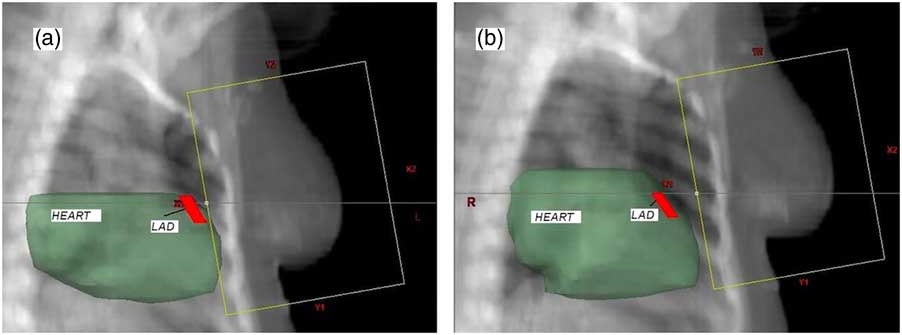
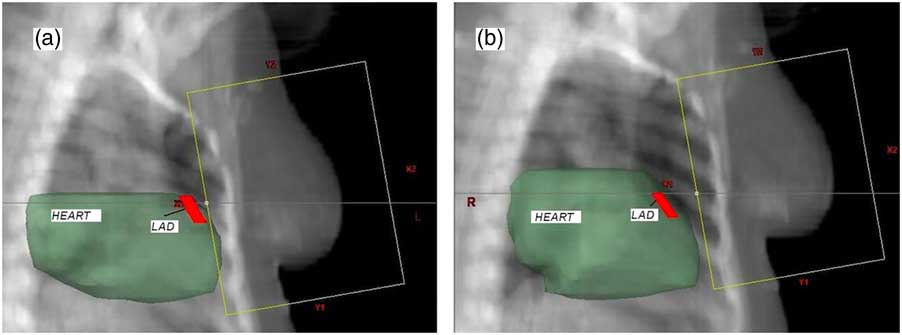
Techniques that avoid irradiating the heart without compromising target coverage are therefore very relevant to patients receiving EBRT for left-sided breast cancer. Deep Inspiration Breath Hold (DIBH) is a method used to maximise the separation of the heart and the target volume so that a high dose of radiation can be delivered to the chest wall and breast tissue, while minimising cardiac dose (Figure 1). To achieve this, the patient is required to be at or close to maximum inspiration before EBRT can be delivered. A number of dose planning-based studies have supported the efficacy of DIBH in reducing dose to the heart, the left anterior descending (LAD) coronary artery and the ipsilateral lung.Reference Pedersen, Korreman, Nyström and Specht9–Reference Sixel, Aznar and Ung11
Beams eye view of whole breast treatment volume with patient performing free breathing (a) and DIBH (b) The heart and LAD are moved away from the irradiated volume as a result of DIBH. Abbreviations: DIBH, Deep Inspiration Breath Hold; LAD, left anterior descending coronary artery.
While the majority of studies focus on the dosimetric benefits of DIBH, there are few reports that address this technique from the patient’s perspective. The objective of this study is to investigate the experiences of the patients who perform DIBH and to provide recommendations on how the process can be further improved to meet the needs of the patient.
Materials and methods
CT-simulation (CTSIM)
At the Vancouver Cancer Center (VCC), all patients with left-sided breast cancer are eligible to receive DIBH during EBRT. The radiation therapist (RT) provides patients with a standard thirty-minute education session to review technical aspects of the technique and to explain the basic rationale of DIBH. The patient also receives coaching on the correct breathing method to be used during CTSIM and treatment delivery.
At CTSIM, the patient is positioned supine on a breast board with arms abducted above the head. A light weight infrared reflecting marker block is positioned on the patient’s sternum and the Varian® Real-time Position Management (RPM) system (Varian Medical Systems Inc, Palo Alto, CA, USA) is used to record the patient’s respiratory cycle. As the patient breaths, a video camera registers the anteroposterior motion of the marker block and the patient’s respiratory cycle is visualised on a computer screen. Patients are required to perform a deep inspiration and hold an inspiratory plateau position for a period of 25–30 seconds. An amplitude ≥1 cm is required between the normal breathing cycle and the deep inspiration plateau. The patient completes a series of practice runs (×3) to ensure they are fully compliant with breathing instructions and to establish a consistent and stable DIBH level. Once the RT is satisfied that the patient understands the instructions and is able to meet the technical specifications of the DIBH technique, the CT scanning can proceed.
Treatment delivery
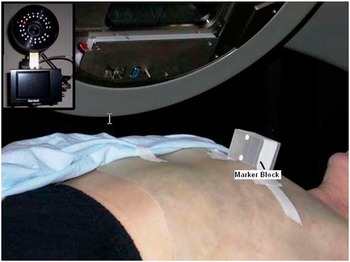
On day one of treatment, the RT completes a patient education section during which the DIBH instructions are reviewed with the patient. The patient is positioned as planned with the infrared marker block taped to the sternum (Figure 2). After completing all required in room quality assurance checks and ensuring that the patient understands the DIBH instructions, the RT is ready to deliver treatment.
Patient in treatment position for post-mastectomy radiation therapy with the infrared reflective marker block taped to sternum. The infrared tracking camera (insert) is mounted on wall opposite linac gantry.

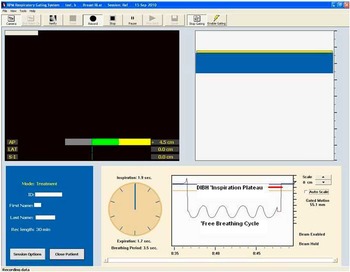
At the treatment console, the RT assesses the patient’s ‘free-breathing’ cycle on the RPM computer and uses an intercom system to instruct the patient on when to initiate DIBH. Treatment is delivered when the patient has reached the correct inspiration plateau (Figure 3) and treatment can be interrupted if the patient has problems maintaining the planned inspiration level. On the first 3 consecutive days of treatment, electronic portal images of all treatment fields are assessed on-line, and so the patient is also required to perform DIBH as these images are acquired.
An example of the respiratory trace displayed on the Varian Real-Time Position Management (RPM) system. The Radiation Therapist (RT) uses this to ensure the patient reaches and maintains the correct deep inspiration level during treatment delivery.

Questionnaire
The research investigators, all of whom had recent experience using the breast DIBH technique, developed the questionnaire. After receiving local research ethics board approval, the questionnaire was pilot tested on a group of five patients. All test questionnaires were returned completed without incident, and the final questionnaire was considered suitable for gathering the required data.
Patients were informed about the study during the day one education session at the treatment unit. An introductory paragraph provided a summary of the research aim, the voluntary/confidential nature of the study and a contact number for the principal investigator (PI) if further clarification was required. Potential participants were asked to complete the questionnaire after they had received at least 1 week of treatment.
The questionnaire consisted of closed-format questions, plus a single open-format question that allowed patients to provide general comments and/or suggestions on how the DIBH process could be improved. A 4-point Likert scale was used to avoid neutral responses and therefore encourage patients to express their opinions. Patients rated their level of; understanding of DIBH instructions provided @ CTSIM/Treatment, preparation for DIBH treatment, treatment position comfort and understanding of the basic rationale of DIBH.
In addition, patients provided information on how difficult it was to hold their breath, how confident they felt about correctly following DIBH instructions and to what degree they worried about potential radiation dose to their heart.
Completed questionnaires were returned to the treatment unit in sealed envelopes and these were collected by the PI. All questionnaires were marked with a study number that could be referenced to the patient’s specific details during the data analysis stage. Relevant patient information including; age, diagnosis, RT technique, dose fractionation and chemotherapy use were extracted using the cancer agency’s electronic information system.
Data analysis
The responses to the closed-format questions were analysed using descriptive statistics. The contents of the open-format question were analysed and categorised according to emergent themes. To complete this content analysis, all comments were reviewed by the PI and grouped according to emergent themes. These initial themes were then reviewed by a study co-investigator and the final categories were produced once consensus was reached.
Results
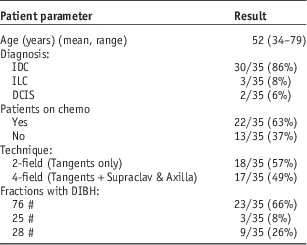
Data collection spanned a 6 months period, during which time 35 patients (Table 1) completed the questionnaire from a total of 56 patients who received DIBH treatments (62·5% response rate).
Summary of patient characteristics
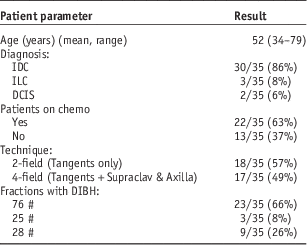
Note: Age, diagnostic and treatment details of study cohort.
Abbreviations: IDC, invasive ductal carcinoma; ILC, infiltrating lobular carcinoma; DCIS, ductal carcinoma in situ.
Challenges and anxiety associated with DIBH instructions
The majority of patients, 25/35 (71%) did not find it difficult to hold their breath during treatment delivery, while 7/35 (20%) described this as a little difficult to perform. Only 1/35 (3%) patient described the need to hold her breath as very difficult and 2/35 (6%) found it difficult.
On the first day of treatment, patients tended to be a little anxious 17/35 (49%) as opposed to not anxious at all 12/35 (34%), when attempting to follow the DIBH instructions from the RT. An equal number of patients, 3/35(8%) were either anxious or very anxious.
Patients were asked to indicate how often they worried about the potential of radiation dose delivered to their heart. The results were; Never 10/35 (29%), Only a few times 15/35 (43%), More than a few times 4/35 (11%) and Always 6/35 (17%).
Comprehension, preparation, comfort and confidence level
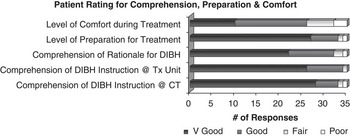
The RTs provided patients with verbal instructions on how to hold their breath at the initial CTSIM appointment and at the first treatment day. The majority of patients appear to comprehend these instructions with only one patient reporting a poor understanding at CTSIM (Figure 4). Patients were also asked to rate how well they comprehended the rationale of the DIBH technique. Again, most patients have a very good understanding of why they are asked to hold their breath.
Patients rated how well they understood the DIBH instructions provided at CTSIM and treatment. Patients were also asked to rate their comprehension of the rationale for DIBH and their level of comfort and preparation associated with DIBH treatment. Abbreviations: DIBH, Deep Inspiration Breath Hold; CTSIM, computed tomography simulation.

The instructions provided at CTSIM are designed to prepare the patient for treatment. When asked how well the patient felt they were prepared, the results closely mirror the ratings for comprehension of DIBH instructions provided at CTSIM, with the same patients who indicated their comprehension as poor or fair also stating that their preparation was poor or fair.
Most patients tended to find the treatment position for DIBH good as opposed to very good, while 3/35 (9%) went as far as to describe the comfort level as poor. As regards how confident patients feel about holding their breath to the correct level during treatment delivery, the results were: Very Confident 23/35 (66%), Confident 9/35 (26%), Somewhat Confident 3/35 (8%) and Not Confident 0/35 (0%).
Comments from DIBH patients
A total of 18 patients provided suggestions on how the DIBH process could potentially be improved. These suggestions were summarised into two main themes:
(1) Consistency of instructions and RTs:
Several patients emphasised the importance of standardised and succinct commands when providing DIBH instructions. The use of brief commands was preferred for example ‘Breath In/Hold/Release’ and the potential anxiety resulting from an inconsistent approach was well illustrated by one patient who stated ‘Different Radiation Therapists would ask me to hold my breath differently, i.e. “Take a deep breath>More>now Hold” whereas others would just say “ Take a deep breath” and when I was at capacity the machine would start. The second technique made me feel less confident that my lungs were full enough. I preferred been told to stop’. The use of variable instruction language can be explained by the fact that different RTs were involved in treatment delivery. However, a consistent team of RTs is important with one patient indicating ‘team consistency is reassuring…, I feel comfortable and confident working with the same group’.
(2) Rehearsal of DIBH:
Rehearsal of the DIBH technique immediately before the first treatment was important to patients. Patients who were coached through a practice session at the treatment unit felt relaxed and confident when performing DIBH during actual treatment. A number of patients also recommended additional self-practice outside the clinical setting. A patient, who unfortunately did not appear to have an opportunity to practice, emphasised the importance of rehearsal—‘It might be helpful to do a “Practice Run” at the first actual treatment. I found myself wondering if it was okay that my back lifted up a bit when I took a breath. I tried to remember the instructions I had received a few days earlier when I had the CT scan’.
Discussion
Several authors who report on a technique similar to the one used at VCC suggest patients have good levels of comprehension, compliance and tolerance to DIBH treatment for breast cancer.Reference Pedersen, Korreman, Nyström and Specht9, Reference Vikstrom, Hjelstuen, Mjaaland and Dybvik10, Reference Cooper, Runkel, Wells, Salter and Olivotto12 Indeed, even the more technically demanding technique that incorporates an ‘Active Breathing Device’ is considered reasonably comfortable and acceptable for patients.Reference Remouchamps, Letts and Vicini13 The general sense is that motivation to perform DIBH is very strong because the majority of patients view the technique as an opportunity to improve the quality of their own treatment.Reference Swanson, Grills and Ye14 In these previously published papers, any reference to the patients’ experience is based on the perspective of the staff using the technique and therefore all information is by nature anecdotal. However, the results reported here are based on the personal experience of the patients who use DIBH during EBRT delivery and the relatively strong response rate to the questionnaire would suggest the results are reasonably representative of the patient population treated at VCC.
This study was initiated approximately 6 months after the introduction of DIBH at VCC and it is reassuring that the majority of patients did not find the technique overly challenging and were confident in their ability to hold their breath at the correct level. However, high confidence levels do not necessarily translate into low anxiety levels, with 2/3 of patients expressing various degrees of anxiety during the initial stages of treatment.
The use of DIBH is justified in terms of reduced dose to the heart and so it is not surprising that the patient will have a heightened awareness of potential cardiac toxicity. While almost 1/3 of patients never worried about dose to the heart, an equal number reported that they worried relatively often about the possibility of receiving dose. It is possible this apprehension stems from the fact that the heart is specifically mentioned during the initial education sessions and/or the patient is conscious that a sub-optimum breath hold may result in unintentional irradiation of the heart. The radiation oncology team (and specifically the RTs who interact directly with the patient during treatment) should be aware that certain patients have higher anxiety levels than others, with persistent concerns about heart dose. The patient’s anxieties can possibly be reduced by providing continuous feedback on their ability to perform DIBH and highlighting the benefits of DIBH in their particular case.
Patients have a solid grasp of the basic rationale of DIBH and understanding of the instructions provided during CTSIM and treatment delivery was regarded as good to very good by all but two of the patients. The positive levels of preparation for treatment mirrored this high level of self-reported comprehension. Although this feedback somewhat validates the quality of information and instruction provided to the patient, it is important to address the small minority of patients who appeared unsatisfied with the way in which they were prepared for treatment. It is not possible to state exactly why one or two patients felt their level of understanding and subsequent preparedness for treatment was only fair or even poor. A number of reasons are possible including, poor patient English language skills (even though professional translators are used at VCC when required), variations in verbal communication styles between RTs and lack of patient focused written material at VCC that specifically addresses DIBH aspects of radiation therapy treatment. Other radiation therapy departments who have developed patient brochures on DIBH15 explaining the key concepts, provides a good example of DIBH literature available to the patient.
Research has indicated that a consistent team of RTs on the treatment unit is important to patientsReference Nijman, Sixma, Van Triest, Keus and Hendricks16 and results from the present study emphasised the importance of receiving DIBH instructions from the same treatment group. Due to operational constraints it can be difficult to guarantee that individual patients receive treatment from the same two or three RTs throughout the entire course of radiation therapy. However, the establishment of a consistent, dedicated team of RTs to treat DIBH patients is to be strongly encouraged. This team would develop high levels of experience and expertise with DIBH, but perhaps more importantly, they would be able to develop the consistent and focused script of instructions that some patients have suggested is currently absent.
The benefits of rehearsing the DIBH technique on day one of treatment with the RTs was acknowledged by several patients. Unfortunately it appears that this opportunity to complete a practice run on the treatment unit was not consistently applied to all patients. The use of a rehearsed DIBH should therefore be a matter of standard practice for all patients and the use of breath hold exercises at home should be encouraged.
Summary of recommendations to improve patient experience with DIBH:
(1) Develop dedicated and stable team of RTs on DIBH unit.
(2) Use consistent and succinct language when providing DIBH instructions.
(3) Implement a ‘day 1’ rehearsal of DIBH technique as standard practice.
(4) Supplement education sessions with written material specific to DIBH use with breast radiation therapy.
(5) Provide patients with feedback on their ability to perform DIBH throughout course of treatment.
(6) Encourage patient to practice DIBH exercises at home.
Conclusion
DIBH in tandem with EBRT to treat left-sided breast cancer is well tolerated, with the majority of patients indicating a solid level of comprehension and preparation that allows them to confidently perform DIBH as planned. Establishment of a dedicated stable team of RTs on the treatment unit, in conjunction with the use of precise and consistent instructions, is an important consideration to increase confidence and reduce anxiety. The patient’s experience can be further improved by providing regular feedback on their performance and ensuring that the opportunity to rehearse the technique before treatment delivery is part of routine standard practice.
Acknowledgements
The authors would like to acknowledge the radiation therapists at VCC who treated the patients using DIBH and who provided patients with a copy of the questionnaire used to collect data for the study.
Ethics
To complete this study, ethics approval was requested and obtained from the University of British Columbia-BCCA research ethics board.
Financial support
None.
Conflicts of Interest
None.