In his illuminating article, Christophersen rethinks concepts in and approaches to the archaeological study of urban living, focusing especially on medieval urban towns in Scandinavia. He recruits various concepts – interaction, event, leakage and creativity – from a materially imbued social-practice theory to explore the urban landscapes as a complex of dynamic social spaces. Christophersen draws from scholars (Hodder Reference Hodder2012; Reckwitz Reference Reckwitz2002; Schatzki Reference Schatzki1996; Shove, Pantzar and Watson Reference Shove, Pantzar and Watson2012) who emphasize that practice is routinized behaviour through which actions and events are performed, that practices are tied to a place and timescape, that social actors live with and interact with materials, and that materials may be the media of interaction with others. Following Hodder (Reference Hodder2012), he emphasizes that the nature and quality of social and material relationships lead to the formation and stabilization of practices. In turn, this practice constitutes the town or city.
Christophersen offers this approach as an antidote to earlier 1980s–mid-1990s processual approaches, with their emphasis on urbanization and urbanism and on function and structure. His approach also refracts the more recent postprocessual approaches that emphasize gender and agency.
Christophersen's approach – a materially saturated form of social-practice theory – is a welcome extension in anthropological approaches to urbanity for several reasons for it offers avenues, elusive in other approaches, by which change in social practice, social behaviors and the cultural repertoire can occur. Following his approach, importantly, we can also be puzzled when we detect no evidence for such change, even while social spaces are available and occupied.
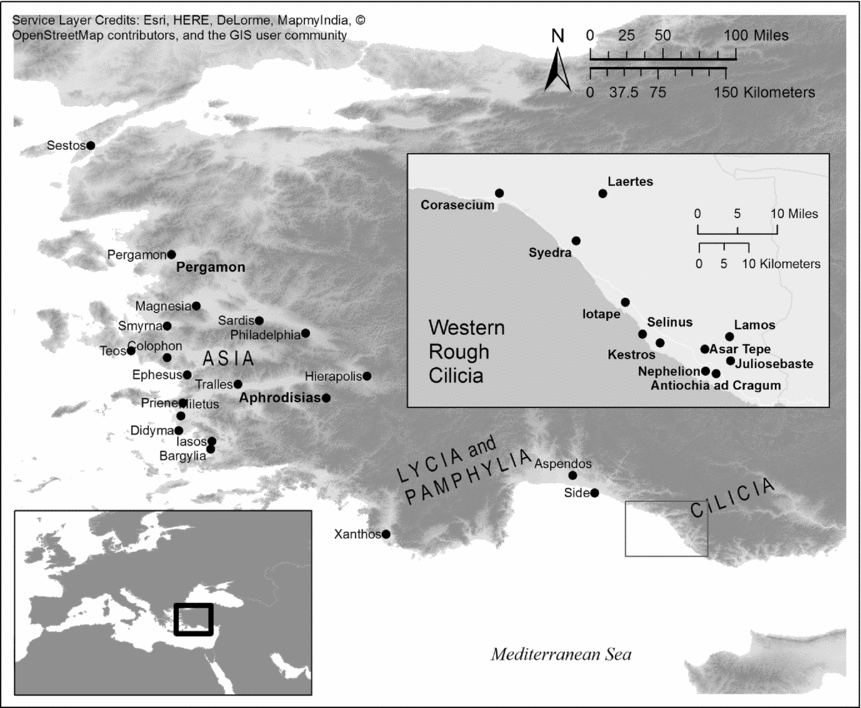
Because I remain interested in trying to understand both sources of variation – why we see urban contexts with certain characteristics – and temporal changes in urbanity – why cities trace sometimes very different organizational histories – I find it useful to consider the scalar dimensions of the space/timescape in order to understand how practice is constrained and directed, with differential potential for rupture and disintegration. After reviewing these scalar qualities, I illustrate their utility by comparing and contrasting the urban situations of southwest Anatolia/Asia Minor and southern Anatolia/Rough Cilicia (southern Turkey) (figure 1).
Map of Anatolia and Roman Asia Minor. Created by the author with assistance from Corbin Bogle using three data sources. The base map comes from data compiled by the European Environment Agency and is derived from the GTOPO30 dataset (http://edcdaac.usgs.gov/gtopo30/gtopo30.html) created by the US Geological Survey, EROS Data Center, Sioux Falls, South Dakota. GTOPO30 is a global digital elevation model (DEM) with a horizontal grid spacing of 30 arc seconds (approximately 1 kilometre). The inset reference map comes from the ESRI ArcMap online gallery. City locations come from a variety of historical sources.

Scalar qualities of the space/timescape
A social/material space may be sized in several important ways. Spaces populated with only a few actors have the potential for few interpersonal relations. If a population consists of five people, then (5–1)? (i.e. the triangular number and computed as the sum of 4 + 3 + 2 + 1) or 10 possible relations exist. In contrast, a population composed of 100 people may host (100–1)? or ∑nk = 1(k − 1), i.e. 4,950 interpersonal relations. Even this simple difference in number of actors must affect how social relations unfold in each of these two different fields. The flow of goods and services within a small social/material space may proceed one way (e.g. via the institution of general reciprocity) while the same flow may expand to include various market institutions in the case of a social/material space with 100 or more actors.
Another scalar dimension of the social/material space is that of density, both spatial and temporal. Christophersen notes the potential for innovation once craftsmen become confined to productive enclaves in Scandinavian medieval towns; that is, a higher-density social/material space. Seasonality in access to ports must also play a role. A congested timespace, with access to a port limited by sea ice, sets constraints for different levels of competence than does an uncongested timespace.
In addition to simple size measures, two other measures consider the number of co-residing kin groups and the number of languages being spoken within the community. If all members of a group belong to the same family, then group order is family order and family order is group order. On the other hand, other institutions appear with the occurrence of multiple co-residing kin groups, especially critical when resources are owned by kin groups. This may be a critical role assumed by the craft guilds referred to by Christophersen.
The number of different languages used in social transactions within a group of people may also influence the nature of those interactions. In any social space, communication occurs via a suite of media – language, material, space use etc. Where multiple languages are in use, communication via materials may play a larger role, compared with a monolingual situation. Trigger (Reference Grundberg1990) argues for the power and reach of material symbols, such as monumental architecture, in the case of polyglot populations, perhaps seen for the port at Trondheım examined by Christophersen.
Finally, the degree to which a social/material space is tethered to place is also important. In this latter case, the built environment has the potential to become an active participant in the social/material space. In contrast, when the social/material space is untethered, as documented by Night Pipe (Reference Christophersen, Mundal and Øye2012) for large aggregations of multilingual Lakota in the historic period, then the built environment matters little; the effective field of practice resides with the individual, for whom we see magnificent attires for males and their horses as they jockey for social position in a dynamic field.
I illustrate further the importance of each of these dimensions of the space/timescape of urban and proto-urban social/material spaces through an examination of urban histories of Hellenistic Anatolia and provincial Rome during antiquity.
Urban centres in Anatolia and Roman Asia
Urban centres in Anatolia and Roman Asia have long histories, with some city states autonomously appearing in the Neolithic and others established by a succession of states to either control or develop population, territory or resources (Gates Reference Anglert, Larsson, Andersson, Hansen and Øye2011). While city states with structures of many kinds appeared, here I focus on those with Greek civic structures – council, assembly and judiciary – which allowed Greek cities (found throughout the Mediterranean and beyond) to behave themselves as agents. The assembly and council made decisions and charged magistrates with carrying out those decisions (Hansen Reference Bergquist2000).
Importantly, over the Hellenistic (323–31 B.C.) and early Roman imperial (31 B.C.–A.D. 270) periods, Greek civic institutions had a material expression in increasingly monumental public buildings: an agora with nearby prytaneion (house of the chief magistrate, where visiting dignitaries were also housed), bouleuterion (where the council met) and stoas that provided offices for magistrates, temples and sanctuaries (some now dedicated to cults originating from Alexander's east), gymnasia, a theatre, a stadium and sometimes another auditorium or library; a commercial agora with rooms for shops; and city walls (Billows Reference Amin and Thrift2003).
I am especially interested in the urban world that developed in Anatolia after the 323 B.C. death of Alexander the Great, who ‘founded’ Greek cities throughout Anatolia, Syria, Palestine and Mesopotamia (Cohen Reference Andrén and Ersgård1995). These were extant cities that now included a Greek population, a new Greek name, and, importantly, Greek civic institutions (Billows Reference Amin and Thrift2003, 198). Simultaneously, some non-Greek cities in Anatolia, e.g. Alabanda (Antiocheia) (Ma Reference Ma2003, 25–26), came to adopt Greek political language and civic apparatus at this time (ibid., 138). Thus throughout Anatolia, multiple languages – native, Greek, ‘foreign’ (by merchants) and later Latin – were spoken in city agoras, with Greek the language of civic discourse and Greek and Latin beginning to replace local native languages (Gleason Reference Bäck, Brendalsmo, Eliassen and Gansum2006; Mitchell Reference Christophersen1993, 172–75).
Following the death of Alexander the Great, we see several interrelated trends in peri-urban Anatolia (Walbank Reference Hansen1993). For one, the security environment of cities changed substantially, with autonomous city states transitioning to cities embedded in larger security structures. Early in the post-Alexander era, vying successor states and local dynasts waged large wars with each other in an attempt to control territory, resources and trade; smaller wars were waged by individual city states over territory (Ma Reference Brendalsmo, Brendalsmo, Eliassen and Gansum2000). Simultaneously, the civil wars of the Roman Republic spilled into this area, with cities variously called upon to garrison Roman troops. As the Antigonid (based in Macedonia), Ptolemaic (based in Egypt) and Seleucid (based in the Levant and further east) successor states waxed and waned, power vacuums developed, into which pirates and brigands expanded, taxing cities in other ways, for example by kidnapping citizens and demanding ransom. When pirates (but see de Souza Reference Andrén, Riksmuseet, Museet and Museum1999) operating from these areas interrupted the grain trade to the heartland of the Roman Republic, the Roman Senate took action. The pirates were eventually defeated and areas harbouring antisocial elements were brought under the control of client kings, responsible for maintaining order and collecting tribute (Sherwin-White Reference Giddens1977). The Pax Romana that the new Roman emperor Augustus Caesar imposed meant that cities no longer had to maintain fortification walls and inter-city competition shifted to other arenas. Cities launched extensive building programmes in order, I argue, to impress agents of Rome, seeking relief from taxation, or the siting of an imperial temple (resourced by the emperor), or to be named first city in the province (Wandsnider Reference Haugland2015). In the later imperial period, cities sent champions to agonistic competitions in sports and poetry (Mitchell Reference Christophersen1993).
Second, what constitutes an effective agent of the city shows change. Where only native-born adult males were recognized as citizens in the early Hellenistic period, women and freed slaves, while not citizens, began to play larger roles in the late Hellenistic city, as documented by Pomeroy (Reference Christophersen and Supphellen1997) for Ptolemaic Egypt. As well, we see an increase in the proportion of foreigners – non-Greek, transient and resident, later including Romans – in Greek cities (Chamoux Reference Andersson, Andersson, Carelli and Ersgård2003, 197–200; Mitchell Reference Christophersen2000).
Third, an oligarchic political system, populated by ‘the notables’ (Veyne Reference Hadley, Harkel, Hadley and Harkel1976), emerges. Inscriptions from the cities of western Asia document several patterns for the early 3rd century B.C. to the end of the Hellenistic period (Dmitriev Reference Anglert and Larsson2005). Offices were increasingly held ‘for life’ and ‘by descent’. What had been designated sacral offices (often held by wealthy citizens) in the early Hellenistic period gradually became incorporated as part of city functions in the later portion. The terms of offices increased over time from one to six months (for treasurers) to life. Women and children, supported by their wealthy families, began to hold religious offices. Office-holders announced their intent to absorb all finances of the office; this is confined to religious offices early on and later found at both higher and lower levels of secular city government. Individuals increasingly held multiple offices simultaneously. Focusing especially on inscriptions about civic benefactions, Marest-Caffey (Reference Carelli2008) identifies benefactors as sons and daughters from a family with a tradition of civic benefactions. Decrees at this late Hellenistic time become much more detailed, profiling the education and careers of the benefactors.
All of these changes represent incremental adjustments in the behaviours of everyday (and elite) people, some of them encouraged by outside forces, such as the Roman practice of cultivating the landed elite, in an effort to stabilize their administrative base (Gleason Reference Bäck, Brendalsmo, Eliassen and Gansum2006, 234; Ratté Reference Ratté, Berns, Hesberg, Vandeput and Waelkens2002, 19). Another force may also have operated: extending Zuiderheok's (Reference Zuiderhoek2009, 53–60) neo-Ricardian (and almost Pikettian (Piketty Reference Christophersen2014)) analysis offered for the later imperial period to this earlier stretch of time, simple population growth means that land becomes scarcer relative to labour. Rents thus should increase with more surplus accruing to those owning the land, with a subsequent concentration of wealth. Thus it may be not so much that women and foreigners take on better-acknowledged roles in city life, but rather that elite (or at least wealthy) women and foreigners assume these roles.
The social and material practices of city inhabitants over time, of course, are the grist of these broad trends and this is Christophersen's important point. City inhabitants build fortification walls, don their armor and shed their blood to defend their city. They attend the assembly and vote on proposals about whether to support Rome or not. They name their children with ‘native’, Greek or Latin names. They donate a subscription to help build the temple or not. They come to bathe with their peer citizens each afternoon. Through their routine but charged actions, they sustain and remake the city.
The central point of my contribution complements that of Christophersen: the field within which social practice unfolds is a social and material space with scalar constraints that are analytically useful. I illustrate this by contrasting the social/material spaces with different scalar properties, as for urban south-west Anatolia/Roman Asia Minor compared with urban southern Anatolia/Roman Rough Cilicia. In the latter area, population centres were smaller, with a more modest and dispersed resource base and a population with a strong indigenous presence, and late in incorporating Graeco-Roman civic structures.
Isaurian tribes, organized in lineages and speaking Luwian, a language derived from Hittite, composed the indigenous element of Rough Cilicia. Rauh and colleagues (Reference Damsholt and Simonsen2009) argue for Isaurians holding territory whence were harvested cedar trees, a critical strategic resource used in building the naval ships of interest to Cleopatra and others. In addition to these resources, Rough Cilicia has pockets of productive agricultural land, but nothing like the vast stretches seen in valleys further east or west.
During the Hellenistic period, Rough Cilicia served as a place of refuge for organized communities of pirates until their defeat by the Roman statesman and military leader Gnaeus Pompeius Magnus in 67–66 B.C. It was administered by the client kings Archelaus I and II of Cappadocia and Antiochus IV of Commagene for Rome, eventually becoming a Roman province during the reign of the Roman emperor Vespasian (A.D. 69–79) (Rauh et al. Reference Damsholt and Simonsen2009).
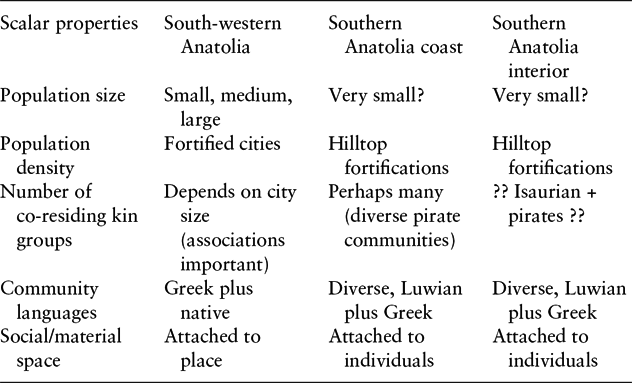
Table 1 summarizes the scalar differences seen in urban centres of south-western and southern Anatolia for the Hellenistic period. In both areas, security is a concern and fortifications likely forced city-dwellers, at least periodically, into cheek-by-jowl circumstances, with consequences for the density of social/material fields. Small, medium, and a few very large cities – Pergamon, Smyrna and Ephesus – begin to develop in south-western Anatolia, supported by rich agricultural landscapes; settlements in southern Anatolia appear to remain smallish with a limited agricultural base. The warp and weft of urban life in the Greek cities of south-western Anatolia was provided by city institutions, the temple and ritual cycle, family, and also cultic and social associations, especially in larger cities with multiple co-residing kin groups (Fisher Reference Anglert, Mogren, Roslund, Sundnér and Wienberg1988; Kloppenborg Reference Blom1996; Millar Reference Casana and Herrmann1993). Our knowledge of this fabric in the case of southern Anatolia is impoverished: we can see that population centres are fortified, that there is limited consumption of contemporary ceramics and that inhabitants are burying individuals with items circulating in the Mediterranean, but evidence for Greek civic institutions in the form of public architecture is lacking (Rauh et al. Reference Damsholt and Simonsen2009; Rauh, Dillon and Rothaus Reference Deggim, Bill and Clausen2013). Textual sources variously refer to Cilician pirates based along this coast and moving between small, highly fortified bases where slaves crafted weapons and sails, and built fast ships (Rauh et al. Reference Eliassen, Brendalsmo, Eliassen and Gansum2000).
Scalar properties of the social/material spaces in urban late Hellenistic south-western and southern Anatolia.
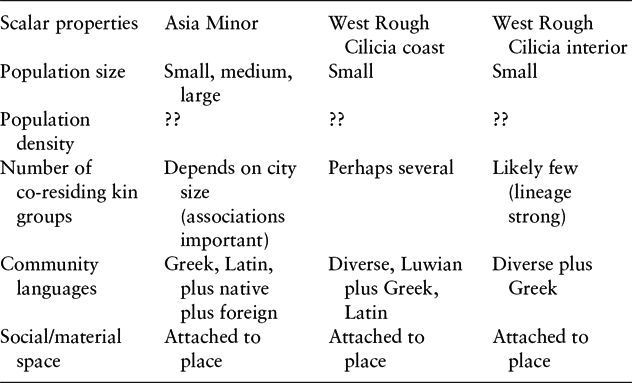
Into the imperial Roman period (table 2), south-western Anatolian cities (now in the organized Roman province of Asia Minor) and southern Anatolian cities (by A.D. 70 in Roman Rough Cilicia), appear on the face of it to have similar civic infrastructures, with the social and material spaces attaching to place in each area. Family, civic and religious structures again were the foundation of society and in medium and larger cities, with multiple co-residing kin groups, associations and collegia appear important (Van Nijf Reference Gundersen and Sæther1997). In Rough Cilicia, the Isaurian lineage structure intersected with civic and religious structures in interesting ways. In Asia Minor, city centres are composed of pyreatia, a bouleuterion, temples, gymnasia, stadia and bathing complexes, along with theatres and amphitheatres. All of these, save theatres and amphitheatres, are found in Rough Cilicia. To explain this disparity, I suggested (Wandsnider Reference Hansen2013) a scalar difference in wealth, with communities of more opulent farmers and landholders of western Asia being able to finance expansive structures like theatres. Townsend (Reference Griffith, Hadley and Harkel2013), however, challenges this and, going beyond scale to structure and institution, argues that indigenous tribal elites who inhabited the seats of power in Rough Cilicia refused to sanction such public fora, where ‘the people’ could exercise their will, as seen in theatres and amphitheatres throughout the Mediterranean (Gleason Reference Bäck, Brendalsmo, Eliassen and Gansum2006; Potter Reference Christophersen, Brandt and Karlsson1996; Veyne Reference Veyne1976). Similarly, Townsend argues that the afternoon bath shared by elites and commoners reinforced difference (Yegül Reference Helle, Helle, Eliassen, Myhre and Stugu1995), hence bathing complexes abound in Rough Cilicia.
Scalar properties of the social/material spaces in urban provincial Asia Minor and Rough Cilicia.
Thus cities in Asia Minor and Rough Cilicia supported many of the same social/material spaces but scalar (and structural) differences in those spaces mean that spatial and temporal density of behaviours – bathing, trading in the market, participating in city functions or religious ceremonies, attending spectacles – all were quite different. In turn, how practice unfolded within these similar, yet different, spaces impacted the formation and re-formation of the city.
On complementarity in approaching urban living
My point here is that the bundles of practices that allow a collection of individuals and families to become a city may unfold very differently in the social/material fields of Asia Minor versus Rough Cilician contexts simply owing to scalar effects. In sum, I argue that Christophersen's social-practice approach works best in concert with approaches that also attend to structure and function along with scalar issues. Indeed, both of these elements frame Christophersen's approach and all together – practice, structure and scale – propel field-based and analytic approaches that enable the researcher to study population centres as they form and re-form cities.
It is important to note that Christophersen's approach, as articulated here, requires an investigation of the synchronized social and material. Yet our archaeological record rarely affords that degree of contemporaneity (e.g. Holdaway and Wandsnider Reference Bill and Bill2008). At best, we can document snatches of social practice, as in a consideration of the mortuary remains associated with individuals in tombs (speaking here from the experiences of the record that emerges from survey in Rough Cilicia). Second, Christophersen's approach would have us attend to the everyday things of lived lives. Again, these everday things become salient especially in the context of the larger artefacts of structure, such as monumental architecture, associated with rhythms of life unfolding monthly, annually, and supra-annually.
Acknowledgements
I thank my colleagues Matthew Dillon, Michael Hoff, Nicholas Rauh and Rhys Townsend for sharing their experiences. Survey in Rough Cilicia was supported by National Science Foundation Award 0079951 to Rauh and Wandsnider.