The emergence of democracies over the last two centuries, now almost on a worldwide scale, has been the most remarkable long-term political development. It has to be seen in close interaction with general socioeconomic developments, in particular the varieties of capitalism and their conflictual relationships. In this article, I first briefly sketch some of these developments, discuss some of the explanations in the broad literature on empirical democratic theory and come to a more complex assessment. In the second part, some of the countervailing forces and continuing conflicts are examined. These refer to specific ethnic, religious or similar group identities which put the respective ‘demos’ of equal citizenship and the drawing of existing boundaries into question. In a similar way, increasing social inequalities and the discrimination of specific minorities endanger basic democratic principles such as equality of opportunity and social solidarity. In a concluding section, some of the current developments and crises, possible alternatives and future prospects are discussed.
The Driving Forces of Democracy
The Historical Background
The emergence of contemporary democracies has to be seen in its historical and regional-cultural context. This includes the processes of state formation and nation-building, which often have pre-democratic or external origins. Sovereign states are the most important geopolitical units today, and they are the most influential actors in international politics. Their identities and legitimacy have both objective (in terms of concrete boundaries and specific institutions) and subjective (acceptance by citizens) dimensions. Discrepancies between these two dimensions may appear during processes of democratization because the participatory aspirations of citizens and their respective identities will not necessarily coincide with the existing political boundaries or the institutional framework. This may lead to a more or less peaceful redrawing of boundaries and attempts at internal democratic reforms. But it can also result in attempts at secession, wars with neighbouring countries or internal civil strife, together with more abrupt and sometimes revolutionary and violent regime changes. These processes and possible conflicts cannot be resolved by democratic standards and procedures themselves because the rule of law presupposes an existing political unit, and procedures such as majority decisions may exclude and possibly suppress important segments of the population. Therefore, if democracy, in a broad and simple sense, means ‘rule of the people’, it first has to be decided who the people are and which boundaries should be respected. In this sense, state formation and nation-building must be considered as prerequisites of any meaningful democratization. As such they are, however, only rarely addressed by works of democratic theory. Rather, they constitute, in Dahl’s (Reference Dahl1989) terms, a ‘shadow theory’ of democracy. Or, as Juan Linz (Reference Linz2007) has put it: ‘no state, no democracy’.
In modern times, large nation-states were first formed in Europe, in particular after the ‘Westphalian Peace’ treaty in 1648 and the agreements of the Vienna Congress in 1815. Both coercive military interventions and commercial-capitalist interests were instrumental in that process (see also Tilly Reference Tilly1990). In the twentieth century, the redrawing of boundaries after the two world wars and the dissolution of the Soviet Union and former Yugoslavia changed the political landscape and gave it its present shape. In other parts of the world, the colonialism and imperialism of the major European powers determined most present-day boundaries. This applies to Latin America and the Caribbean, most parts of Africa and large parts of Asia. Exceptions include Ethiopia, Iran, Afghanistan, Thailand and, most significantly, Japan and China. In the Middle East, the dissolution of the Ottoman Empire after the First World War and League of Nations mandates for Great Britain and France shaped most of the present political landscape.
Most modern states have relatively firm and undisputed boundaries (which in some regions are beginning to be transcended by ‘supra-national’ arrangements and institutions). Nevertheless, some critical places have not resolved their territorial problems. These include Israel/Palestine, Cyprus, Lebanon, the Kurdish areas in the Middle East, war-torn states such as Afghanistan and Cambodia and, in particular, the ‘collapsed states’ in Africa: Somalia, Liberia, Sierra Leone, the Congo, and so on (see, for example, Zartman Reference Zartman1995). In others, severe internal conflicts between contending ethnic and other identities still predominate (see Horowitz Reference Horowitz2000; a more general assessment of democracy’s outer and inner edges can also be found in Shapiro and Hacker-Cordón Reference Shapiro and Hacker-Cordón1999).
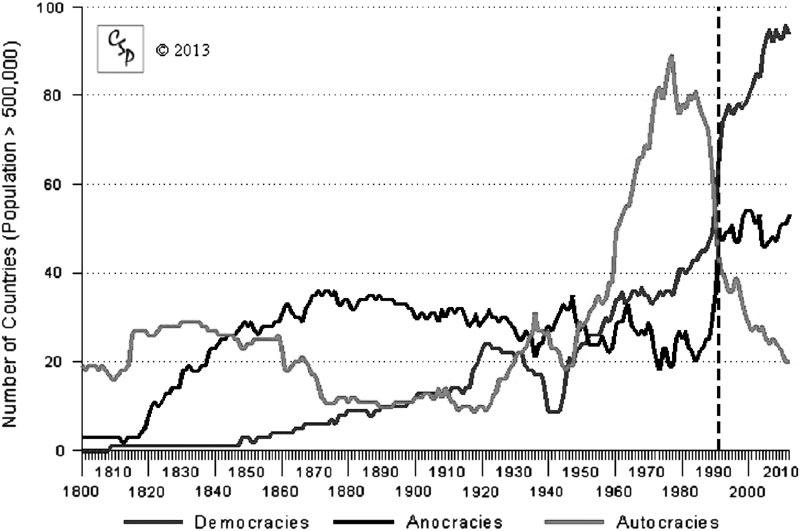
Over and above these basic historical preconditions of present-day democracies, a great number of other factors contributed to their emergence over time. If we take only formally established democratic regimes, as covered in the Polity IV time series data set, the worldwide growth of the number of countries with democratic governments can be depicted as shown in Figure 1.
Global Trends in Governance, 1800–2012Source: Polity IV data set, Center for Systemic Peace, Vienna, VA www.systemicpeace.org/inscrdata.html.

As this figure shows, democracies have emerged in increasing numbers, at first in some rudimentary forms, since the beginning of the nineteenth century, mostly in Anglo-Saxon and Western European countries. This culminated in a more rapid expansion shortly after the First World War, still mostly in Europe but now including some parts of the former Tsarist, Habsburg and Ottoman Empires. This trend was then considerably reversed, leading to fascist or other types of authoritarian regimes until the end of the Second World War (see also Berg-Schlosser and Mitchell Reference Berg-Schlosser and Mitchell2000, Reference Berg-Schlosser and Mitchell2002; Linz and Stepan Reference Linz and Stepan1978). The breakdown of the colonial empires after the Second World War then led to the emergence of many more independent states, first in Asia and then in the Middle East and Africa. These included a number of new democracies. In addition to the latter, some civil-authoritarian or military regimes in Southern Europe and Latin America have also democratized or re-democratized since the middle of the 1970s. The strongest upsurge occurred after the democratic changes in Eastern Europe in 1989–90 with the dissolution of the Soviet Union and its worldwide repercussions. Most recently, the Arab Spring is another phenomenon in this respect, the outcomes of which in many countries still have to be seen (Khatib and Lust Reference Khatib and Lust2014).
To speak of these developments as three distinct waves with their respective ‘reverse waves’, as does, for example, Huntington (Reference Huntington1991), is an oversimplification. The causes and interrelationships of this pattern are far from being undisputed (see also Doorenspleet Reference Doorenspleet2005; Markoff Reference Markoff1996). In addition to some longer waves based on long-term economic and cultural trends, some critical short periods or ‘conjunctures’ have to be seen as well. These have occurred, for example, at the end of the two world wars and the end of the Cold War, leading to more, if still fragile, democracies, but also in a negative sense during the Great Depression in the 1930s or the breakdown of democratic regimes in Latin America in the 1960s and 1970s. During such critical moments certain actors (personalities, but also social movements, and so on) play a much stronger role. Characteristically, strong international interaction effects (‘demonstration’ and neighbourhood effects) can also be observed (Berg-Schlosser Reference Berg-Schlosser2008).
The autocracies, as shown in Figure 1, show the opposite tendency. With many of the de-colonized new states turning autocratic and a wave of military coups in Latin America, their numbers reached a peak in the 1970s, often supported by the two superpowers during the Cold War irrespective of their internal policies. The end of the Cold War then contributed to their drastic decline. A number of them became ‘anocracies’, to use the term employed here, which refers to ‘milder’ autocracies or ‘hybrid’ regimes with some democratic façades such as regular elections but without pluralist competition and a minimal rule of law. Some of these turned out to be relatively stable regimes with a strong element of personal rule and clientelism (Kailitz and Köllner Reference Kailitz and Köllner2013; Levitsky and Way Reference Levitsky and Way2010), others may still become more fully democratic (Lindberg Reference Lindberg2009). Depending on the coding of this data set, there has been some controversy about this categorization (for example, Munck Reference Munck2009), but by and large this picture reflects the major developments.
Explanatory Factors
The analysis of conditions conducive to the emergence of democratic political systems has always been one of the central concerns of political science. From Aristotle through Locke, Rousseau and de Tocqueville, up to the multitude of contemporary studies, this analysis has been attempted again and again. Under closer scrutiny, however, the results obtained are still controversial. Among this mass of work, some major emphases in the more recent literature are evident. The broadest is closely linked to what has become known as ‘modernization’ theory. Based on studies by Lerner (Reference Lerner1958), Lipset (Reference Lipset1960) and Almond and Coleman (Reference Almond and Coleman1960) among others, this approach takes general trends of socioeconomic development, urbanization, literacy, and so on and considers them as basic conditions for modern ‘political development’, which includes democratization. This approach employs a number of indicators, such as the levels of GNP per capita and literacy, as independent variables on which the resulting level of democratization (also measured with certain indices) is seen to depend. In a more extreme version, a high level of socioeconomic development is seen as a prerequisite for democracy (this was expressed in the title of Lipset’s original article (Reference Lipset1959); his later, more ‘probabilistic’ view can be found in Lipset Reference Lipset1994).
There have always been a number of counter-factual examples guarding against an all-too-simple interpretation of this thesis. These include the breakdown of democratic regimes in highly modern countries, as happened in Weimar Germany, and the continued existence of workable democracies in poorer countries such as in India and some other states in the developing world. In particular, some of the policy recommendations based on such perspectives advocating ‘development dictatorships’ in the early stages of modernization (for example, Löwenthal Reference Löwenthal1963) have turned out to be false. The most comprehensive study of this kind clearly shows that ‘Democracies can survive even in the poorest nations if they manage to generate development, if they reduce inequality, if the international climate is propitious and if they have parliamentary institutions’ (Przeworski et al. Reference Przeworski, Alvarez, Cheibub and Limongi1996: 49, emphasis added). Rather than being a prerequisite, economic development can be a condition favouring the emergence of democracy and an associated factor that increases its sustainability. This has been further confirmed by the findings and arguments put forward by Daron Acemoglu and James Robinson (Reference Acemoglu and Robinson2006, Reference Acemoglu and Robinson2012) who emphasize the importance of inclusive (rather than merely extractive) economic institutions and broad political inclusion and empowerment.
In contrast to broad ‘macro-quantitative’ statistical analyses based on the respective means and correlations of major indicators, more specific ‘structuralist’ approaches have been developed. These consider the emerging class structures and their dynamic interactions, rather than the overall level of economic development, to be decisive. In a neo-Marxist sense, Moore’s (Reference Moore1966) study distinguished three paths to modernity: one based on a successful bourgeois revolution and strong middle classes (as in the US, the UK or France) leading to the contemporary democracies; another based on an alliance of the old landed oligarchy and the more recent capitalist class ending in fascism (as in Germany or Japan); and a third one emanating from a successful peasants’ and workers’ revolution establishing communist regimes (as in the Soviet Union and China).
In a more refined and extended version, which includes smaller European states and Latin American countries, Rueschemeyer et al. (Reference Rueschemeyer, Huber and Stephens1992) and Collier (Reference Collier1999) followed up this line of argument and pointed out the sometimes ambivalent role of the middle classes and the significance of workers’ organizations such as unions and socialist parties in the process of democratization.
In many cases, the vertical (‘class’) dimension of social structures has to be supplemented by a horizontal one juxtaposing ethnic, religious and similar social cleavages that often have particular regional strongholds. These may interact with the vertical dimension, forming cross-cutting or reinforcing patterns. They can also be ordered in hierarchical (‘ranked’) or parallel ways (see, for example, Horowitz Reference Horowitz2000). In addition, ethnic or religious groups are usually also internally stratified, which complicates their potential for conflict even further (Waldmann Reference Waldmann1989).
The most comprehensive integration of dominant vertical and horizontal cleavages and their consequences for state formation, nation-building and democratization in a concrete region and period has been attempted by Stein Rokkan (Rokkan et al. Reference Rokkan, Flora, Kuhnle and Urwin1999) in his ‘Typological-Topological Model of (Western and Central) Europe’. There, he identifies the major social cleavages in Europe since about the sixteenth century concerning the relationship between Church and State (in particular after the Protestant Reformation in Northern Europe), relations between the respective political centre and the regional periphery/peripheries in each country, conflicts of interest between the rural (often formerly feudal) and the urban (including the emergent bourgeoisie) classes, and, finally, modern conflicts between capital and labour in increasingly industrialized states. On this pattern, in his view, can be based many important political developments. These include trajectories of the respective countries towards authoritarianism, fascism or democracy in the twentieth century and the major characteristics of their party systems up to the present time (see Lipset and Rokkan Reference Lipset and Rokkan1967 and the more recent assessments in Karvonen and Kuhnle Reference Karvonen and Kuhnle2000). Attempts to develop and apply similar models to other parts of the world have, however, remained very limited (see, for example, Shiratori Reference Shiratori1997; Temelli Reference Temelli1999).
These ‘objective’ social–structural dimensions of the social bases of democratic development were also contrasted by more ‘subjectively’ oriented political–cultural studies. Pioneering among these was Almond and Verba’s ‘Civic Culture’ (Reference Almond, Coleman and Verba1963). They showed that the democracies in the US and Great Britain were also deeply rooted in the attitudes and values of the population at large, in contrast to the situation in (post-Second World War) Germany, Italy and Mexico. More recent studies indicate that, in the meantime, democracy has become more anchored in the minds of (West) Germans and (northern) Italians as well, but with strong remaining regional sub-milieus (see, for example, Baker et al. Reference Baker, Dalton and Hildebrandt1981; Berg-Schlosser and Rytlewski Reference Berg-Schlosser and Rytlewski1993; Putnam et al. Reference Putnam, Leonardi and Nanetti1993).
Similar studies in the behaviouralist tradition have also been extended to other parts of the world, including the ‘Latino-’, the ‘Afro-’ and the ‘New Democracies’ barometers (see, for example, Plasser et al. Reference Plasser, Ulram and Waldrauch1998; Rose et al. Reference Rose, Mishler and Haerpfer1998; and the waves of the World Values Survey, Inglehart Reference Inglehart1997; Inglehart and Welzel Reference Inglehart and Welzel2005). The scope of political attitudes and (potential) political actions has also been considerably widened, including the ‘conventional’ and ‘unconventional’, legal and illegal, and peaceful and violent forms in the panels of the Political Action study (Barnes and Kaase Reference Barnes and Kaase1979; Jennings et al. 1991). This ‘subjective dimension’ of politics is an important factor for the long-term consolidation of democracy. It interacts with the objective social-structural and institutional aspects, but only rarely can it be considered as an independent variable in early processes of democratization (Elkins and Simeon Reference Elkins and Simeon1979).
The impact of these objective and subjective social bases of politics depends on their interactions and forms of aggregation at the intermediate (meso-) level. There, certain cleavages and their cultural expressions often harden into particular ‘sub-milieus’ which can reproduce themselves over long periods. The party system may also reflect such structural or cultural strongholds (Rohe Reference Rohe1992). If the party system is mainly based on strong horizontal affinities and identities among contending (such as ethnic or religious) groups, then no ‘floating vote’ from one election to another can be expected. Elections then become just another form of a population census. This may lead, depending on the respective number of such groups and their relative sizes, to permanent majorities of one or a few groups. This seriously endangers the long-run stability of any democratic system, if no ‘consociational’ agreement can be found (see also Lijphart Reference Lijphart1977, Reference Lijphart2012). In addition, various forms of (economic and other) interest organizations and (often more temporary) social movements shape this sphere. Taken together, they constitute the most important collective actors (see also Della Porta Reference Della Porta2013; Olson 1968).
During the last few decades, the importance of this intermediate realm between the micro (individual) and macro (state) levels for ongoing processes of democratization has also been emphasized by proponents of civil society (see, for example, Hall Reference Hall1995; Keane Reference Keane1988). These include all kinds of non-governmental organizations (NGOs) that act in the public sphere. The major modes of transmission of interests can be pluralist, emanating from the more or less open competition of a multitude of social groups; corporatist or neocorporatist, involving the major economic interest groups of employers and unions in conjunction with the state authorities (Schmitter and Lehmbruch Reference Schmitter and Lehmbruch1979), or clientelist, based on personal vertical relationships of ‘unequal exchanges’ (for example, material benefits in exchange for political support) (Eisenstadt and Roniger Reference Eisenstadt and Roniger1984; Kitschelt and Wilkinson Reference Kitschelt and Wilkinson2007).
Complex Approaches
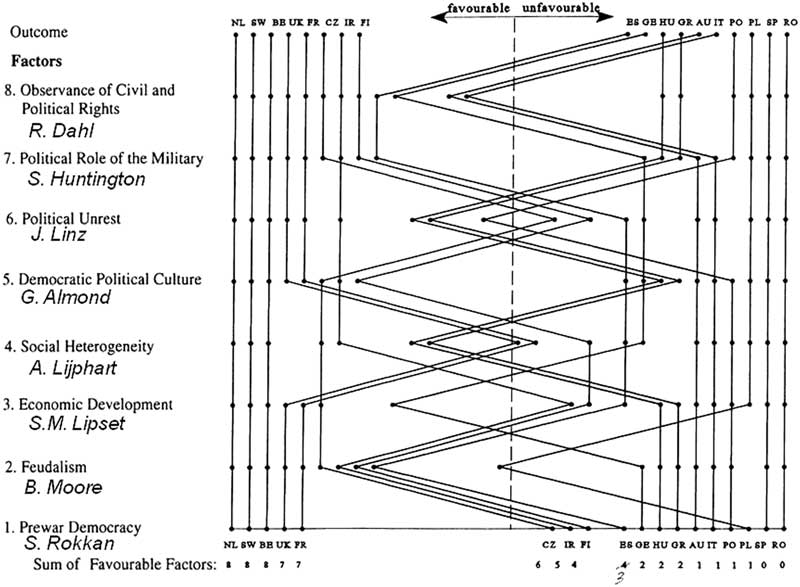
In a large-scale international comparative research project which analysed the conditions of survival or breakdown of democracy in the period between the two world wars in Europe the general historical, socioeconomic, political-cultural, etc. background conditions could be summarized in an ‘Analytic Map’ (see Figure 2).
Analytic Map of Interwar Europe Source: Berg-Schlosser and Mitchell (Reference Berg-Schlosser and Mitchell2002: 282).

At the bottom of this map all cases are listed at the beginning of this period (roughly 1919/1920). All countries were initially democracies, at least in some formal sense holding regular elections. Some of these had existed before the war, others were newly created states after the dissolution of the Habsburg, Ottoman and Tsarist empires (such as Czechoslovakia, Hungary, Estonia, Finland) and others had only become democracies after the war (such as Weimar Germany and Austria). At the top of the map the situation towards the end of the period (late 1930s) is shown: the surviving democracies on the left, the breakdown cases on the right. On the left-hand side, eight major historical, structural and cultural factors are listed which contributed to this outcome either in a favourable or an unfavourable sense. These factors were derived from a comprehensive empirical analysis, the details of which cannot be presented here, but which all correspond to some major works and authors in empirical democratic theory. As can be seen, these background and structural conditions determine the clear-cut survivor (the Netherlands, Sweden, Belgium, UK, France) and breakdown (Italy, Portugal, Poland, Spain, Romania) cases. The mixed cases in the middle (Czechoslovakia, Ireland, Finland as survivors and Estonia, Germania, Austria as breakdowns) cannot be explained by these conditions alone. There, in addition, the impact of the crisis and the interventions by specific actors played a major role.
These can be analysed (with the advantage of hindsight) by historians looking at specific events, but also, in a more general sense, through psychological or sociocultural approaches (Elms Reference Elms1976; Furnham and Heaven Reference Furnham and Heaven1999). In a different vein, rational-choice and game-theoretical models and arguments have been employed in this context. This was, for example, the case with the strategies and decisions that crucial actors made in the various modes of transition from authoritarian to democratic forms of government. Rational pacts of this kind thus have been concluded by softliners and moderates in the authoritarian and democratic camps respectively in a number of cases (Colomer Reference Colomer2000). Games such as ‘Battle of the Sexes’ and ‘Stag Hunt’ can also be modelled for such transitions (Geddes Reference Geddes2003). In a more general sense, an ‘actor-centred institutionalism’ (Scharpf Reference Scharpf1997) can help explain such developments.
Complex theories of democracy must look not only at the general historical and social conditions – the ‘input’ side of the political system and the central institutions and actors. They must also take account of the respective ‘outputs’ and the more general performance over time. In this respect, a number of studies have compared the results of democratic regimes with different types of authoritarian ones (Berg-Schlosser and Kersting Reference Berg-Schlosser and Kersting1996; Przeworski et al. Reference Przeworski, Alvarez, Cheibub and Limongi2000). This applies not only to the common economic indicators (GDP per capita growth, and so on), but also to the more differentiated social and quality of life criteria (see, for example, UNDP 2002) and normative aspects as reported by organizations such as Amnesty International, Human Rights Watch or Freedom House. Such criteria are also increasingly taken into account by the major international development agencies, which have become concerned about good governance (Kaufmann et al. Reference Kaufmann, Aart and Zoido-Lobatón1999; World Bank 1992). The extent of public waste, corruption and private enrichment from public sources is now also regularly monitored by organizations such as Transparency International. In this regard, a critical public, independent media and a well-functioning judiciary, which are characteristic of the more democratic states, contribute to the performance of democracies in the longer run (Rothstein Reference Rothstein2011). As Amartya Sen, winner of the 1998 Nobel Prize for Economics, has stated: ‘A country does not have to be deemed fit for democracy, rather it has to become fit through democracy’ (Sen Reference Sen1999a: 4, emphasis in the original).
All this takes place, of course, in an international environment that may or may not be favourable to such developments. As has been mentioned, during the Cold War, for example, the superpowers and their camps often gave external (including military and financial) support to their ‘friends’ without taking into account the internal conditions of those regimes. Then, after 1989–90, a number of authoritarian regimes collapsed when this external support (or threat of intervention) was withdrawn. Events in one country may also have significant ‘demonstration’ (chain reaction and domino) effects as media and other contacts transmit news to neighbouring states in a similar situation as well as to countries further afield (Whitehead Reference Whitehead1996). The international political climate may be less (as in the 1919–39 interwar period in Europe) or more (as in present times) favourable for democratic regimes. Furthermore, external support can help to stabilize and consolidate new democracies, as the European Union has been doing in Eastern Europe (for broader assessments see also Berg-Schlosser 2007; Haerpfer et al. 2009).
The further promotion of democracy has been assisted by foundations and NGOs such as the National Endowment for Democracy in the United States, the German foundations linked to major political parties (such as the Konrad Adenauer Foundation, the Friedrich Ebert Foundation, and so on), or the International Institute for Democracy and Electoral Assistance (IDEA) located in Stockholm (Carothers 2004). Altogether, according to the latest data collected by Freedom House (2014), out of the 195 independent states considered, there are now 88 countries (45 per cent) which are classified to be ‘free’, another 59 (30 per cent) are ‘partly free’, and only the remaining 48 states (25 per cent) are clearly authoritarian (‘not free’). This categorization, albeit based on a different database and coding system, roughly corresponds to the one used by the ‘Polity’ authors. It is equally open to debate, and some of the borderlines – especially for the middle category – cannot be drawn so clearly, but it is a clear indication of the successful long-term emergence of democracy over the last two centuries.
Countervailing Aspects
In spite of the latest wave of democratization, some of the countervailing forces and continuing conflicts must not be overlooked. Democratization offers new rights and freedoms to people who have lived for long periods under different forms of authoritarian rule. At the same time, however, it may give rise to the expression of conflicts which have been forcefully suppressed by the previous regimes or which have been created by such regimes favouring certain groups and regions and fanning sentiments of envy and revenge. This applies, specifically, to multi-ethnic or multi-religious countries where certain groups or regions have been dominated by others. Formal democratic majoritarian procedures alone cannot regulate such conflicts. The definition of the ‘demos’ cannot be left to a single group or even a large majority. It must include specific resident minorities or socially weak groups (for example, the Roma) as well.
Group Identities
Such conflicts occur, in particular, in the transition processes of recent democracies in socially highly diverse societies. Social diversity has two dimensions: horizontal and vertical. The horizontal dimension concerns ethno-linguistic, religious, regional or similar groupings based on strong group identities. The vertical dimension differentiates people according to their levels of income, education or similar indicators of social status and influence. Both dimensions interact and may lead to situations of severe and protracted social conflicts and even violence when these dimensions are mutually reinforcing rather than cross-cutting. This can create long-lasting patterns of social and political exclusion and lack of life chances for some groups on the one hand and a position of dominance and privileges for relatively closed elites on the other.
Particular numerical constellations also play a role. Conflicts are usually most pronounced in a bi-communal situation where one social group is perceived to permanently dominate another (for example, cases such as Northern Ireland, pre-division Cyprus, Sri Lanka, Zimbabwe). By contrast, in countries with a very high level of horizontal (ethnic) fragmentation where no single group or coalition of groups can permanently dominate the others, social conflicts on this basis remain low (for example, in Tanzania). In between, there are countries with a few major groups but not a single dominant one, where conflicts can be also pronounced but may lead to shifting coalitions (as in Kenya and Ethiopia, for example).
Furthermore, patterns of residence are important. If horizontally differentiated groups are regionally concentrated rather than being dispersed over the country or living in close neighbourhoods in big cities, it can also lead to intense conflicts and even territorial secession as in the cases of Eritrea or South Sudan. Internal and international migration increasingly also affects such patterns and can lead to new conflict constellations, especially when, again, horizontal and vertical aspects of social diversity coincide (as in the poorer suburbs of cities such as Paris, London or Birmingham). Finally, such relationships are subject to dynamic demographic, economic and attitudinal changes over time, influencing each other’s perceptions and may lead to multiple identities beyond one’s own primordial group (for such and similar arguments see also Anderson Reference Anderson1983; Horowitz Reference Horowitz2000).
Social Inequalities
The vertical dimension is equally important. Here, the relationship with capitalism and overall socioeconomic development comes into play again. In the nineteenth century, early capitalist developments had created great social misery in Europe (Polanyi Reference Polanyi1944; Schumpeter 1943). In a related way, the ‘peripheral-capitalist’ development of much of the ‘global south’ has led to a strong dependence on exports of minerals and agricultural products not available in the north and forms of increasing ‘underdevelopment’ (Frank Reference Frank1968). In some cases, such dependency has even led to a ‘resource curse’ where oil production or the extraction of rare minerals such as coltan or alluvial ‘blood diamonds’ benefit only a few authoritarian rulers or warlords at the expense of the largest parts of the population and often create severe environmental damage (Collier Reference Collier2003; Leonard and Straus Reference Leonard and Straus2003).
In the past, in Europe and elsewhere with increasing industrialization and urbanization, the poorer parts of society have become increasingly organized in secular social-democratic, socialist or communist parties and strong labour unions, but also in church-related organizations such as Christian democratic parties and unions. For these groups democratization and the right to vote and to participate in other ways meant an additional important resource to influence and improve their way of living through legislation (regulating, for example, work hours and work conditions) and social security and redistributive measures of public finances. Their strength could mainly be expressed through their sheer numbers and their effective organization (in elections, strikes and so on).
Nevertheless, there can be and have been concerns about the equality of opportunity with regard to conventional and also unconventional forms of political participation. These concerns have shifted, but not diminished in the course of time, with increasing activities in the services sectors and trends towards relocating labour-intensive industries and other forms of globalization. The membership and influence of unions in Europe and elsewhere has generally declined, and in many of the new forms of political activity and protest as organized by NGOs and over the internet the better-educated (new) middle-class groups tend to dominate (Della Porta Reference Della Porta1995). Gated communities, private schools and universities only affordable by the rich, the lack of basic public health and old age care show worrying trends in this respect. New ‘categorical’ differences are created in this way. As Dalton and Anderson (Reference Dalton and Anderson2010: 72) put it: ‘Indeed, our analysis suggests that this tension between participation and equality exists across various vastly different contexts and is particularly apparent in more affluent and democratic societies. Thus, the expanding repertoire of political action in these nations may raise new issues of generating the equality of voice that is essential to democracy.’
‘Labelled’ Groups
This is even truer for the smaller and often specifically characterized and ‘labelled’ groups who experience extreme forms of poverty. It is significantly more difficult for them to be organized and to be heard in effective forms of ‘collective action’. This is true of the considerable number of (de-unionized) unemployed or (mostly younger) persons who have never entered the official labour market, but it also concerns parts of the ‘working poor’ who find themselves in low-paid temporary employments which are much more affected by the vicissitudes of business cycles and financial crises. In fact, the overall long-term income distribution has become worse in much of the industrialized world (Piketty Reference Piketty2014). A new ‘precariat’ has been created (Standing Reference Standing2009). In this respect, some forms of self-organization, self-help and voluntary outside support exist (Council of Europe 2010), but their political influence in this situation generally remains very low, which often results in forms of political apathy out of despair or cynicism, leading to a more or less permanent ‘exit’ from the political arena in Hirschman’s (Reference Hirschman1970) sense. Yet, there are successful examples of how democratic feedback and redistribution mechanisms can alleviate such discrepancies in the longer run. This is also emphasized in the ‘New Strategy and Council of Europe Action Plan for Social Cohesion’ (Council of Europe 2010).
The ‘empowerment’ of low-income workers and of people experiencing extreme poverty thus has come to the forefront both of social scientists and political action groups (Dierckx Reference Dierckx2010). Empowerment is understood here as a ‘process by which people, organizations, and communities gain mastery over their affairs . . . in the context of changing their social and political environment to improve equity and quality of life’ (Dierckx Reference Dierckx2010: 58). Empowerment in this sense refers to individual, group-related and political aspects. Whereas the former can be enhanced by specific social services and policies (for which the political will has to be mobilized), the latter depend, in part, on the mobilization of the affected groups themselves.
Group action requires some form of solidarity and organization together with possibly some outside support. However, the more extreme certain forms of poverty are – concerning, for example, single mothers, homeless persons, alcohol or drug addicts or combinations of such situations – the more isolated, secluded and often discriminated these groups become. The effective organization of such people, therefore, is severely hampered and their potential of raising attention to their situation remains very limited. Nevertheless, a number of forms of self-organization at local, national and even European levels, such as the European Federation of National Organizations Working with the Homeless (FEANTSA), the Youth Empowerment Partnership Programme (YEPP) or the European Older People’s Platform (AGE), to mention but a few, do exist. By themselves, however, such organizations often remain weak, have highly fluctuating memberships and require outside assistance by civil society groups or governmental institutions.
Here, civil society organizations of concerned people not belonging to the more seriously affected groups themselves can and do play an important role. ‘Advocacy’ interest representation on behalf of economically, socially and therefore also politically weak groups has gained increasing importance in recent decades. Such advocacy can help to provide direct material assistance, mostly on the local level, such as free meals and other supplies, clothing and similar items. It may also include free legal assistance and similar support where needed. Over and above such services, these advocacy groups can also raise the awareness of the general public about specific groups and issues, even influencing more general reforms and legislation in these respects (Baumgartner and Leech Reference Baumgartner and Leech1998; Berry and Wilcox Reference Berry and Wilcox2007).
One particular issue, however, has to be mentioned here which affects the legal position of specifically targeted groups such as migrants, refugees or asylum-seekers in a fundamental way – the question of citizenship. Basic public social services are usually confined to those who are legally part of the respective welfare systems and who are entitled to specific benefits and services. Persons without citizenship or, at least, residence permits remain in a much more precarious situation. They are often grouped in special homes or camps, not being entitled to work, and often facing extradition. Their legal position is defined by the Geneva Convention for refugees or special asylum laws, as in Germany. Even though their human dignity cannot be put in any doubt, as for everyone else, the kind of formal assistance such persons can receive remains extremely limited. This often forces them into clandestine informal and illegal activities. In Europe, such problems have become all the more pressing with recent crises in particular countries and regions, as in former Yugoslavia in the 1990s or currently the Middle East and parts of sub-Saharan Africa. Attempts to find some kind of joint solution on a European level or, at least, some more tolerant forms of accommodating such persons have not come to much so far. On the contrary, such problems have even triggered strong populist and xenophobic reactions in a number of places and countries (Mudde Reference Mudde2007).
Prospects and Conclusions
Conditions for Survival
In the longer run, the feedback mechanisms of democratic systems through regular elections and centripetal forces assuring ‘tolerable’ levels of social diversity and inequality through adequate institutional arrangements and redistributive measures will have to prevail over the centrifugal ones driving states and societies apart. Charles Tilly (Reference Tilly2007) in a wide-ranging historical analysis of the success and failure of democratic regimes has identified three major criteria to be fulfilled to hold democracies together:
-
1. Reduction of autonomous power centres in control of coercive means within a state’s territory (for example, (semi-)feudal landlords, warlords, drug barons, mafias and so on).
-
2. Insulation of public politics from major categorical inequalities (such as ethnicity, religion, gender, class and so on).
-
3. Integration between interpersonal networks of trust and public politics.
The first mainly applies to early stages of state and nation-building, but still can be observed in countries such as Afghanistan or fragile democracies such as Colombia. Completely ‘failed’ states such as presently Somalia or the Democratic Republic of Congo are examples of the opposite outcome. The second criterion is mostly relevant for societies where strong horizontal cleavages prevail and where strong tendencies of nepotism and clientelism based on such cleavages can be observed. Lijphart’s ‘consociational’ model in this respect has to be checked by procedures of ‘direct’ democracy cutting across such arrangements as in Switzerland, a strong and independent judiciary, and critical public media. Otherwise, such countries can be immersed in a long-lasting swamp of nepotism and corruption as in Nigeria and a number of other African and Asian countries in spite of being formally ‘democratic’. The third criterion must be fulfilled in contemporary ‘consolidated’ democracies showing a high level of ‘social capital’. This is a state of affairs, however, which cannot be taken for granted and may be endangered by new developments, as examples from the US and Western Europe demonstrate (Pharr and Putnam Reference Pharr and Putnam2000; Putnam Reference Putnam2000). Thus, conditions of ethnic and similar fragmentation and broader social diversity pose specific problems in terms of appropriate institutional arrangements and their historical dynamics over time.
There is, however, not necessarily a contradiction between such a situation and the prospects of further and sustainable democratization. On the contrary: there are institutional means and historical paths to cope with such problems (Di Palma Reference Di Palma1990; Sartori Reference Sartori1994). Federal and consociational arrangements are one way to integrate highly diverse social groups in a common state framework. To find an appropriate ‘fit’ is, however – as manifested in such diverse countries as Belgium, Canada or Nigeria, for example – a protracted and difficult process by itself. There is no ‘one size fits all’ solution. To remain democratic, it is important that such conflicts and processes are conducted peacefully (as in Belgium or Canada, in contrast to Northern Ireland or the Basque region, for example), not violating the normative dimension of democracy by all concerned (state apparatus and contending groups).
The International Dimension
In our world of ever-increasing globalization, social diversity and inequalities on a worldwide scale pose continuing problems. Discrepancies between what used to be called the ‘Third World’ and the OECD countries are still very great. More than 1.2 billion people live in extreme poverty (less than US$1.25 per day). There has been some catching up, and some regional non-Western powers have emerged which have become known as the BRICS (Brazil, Russia, India, China, and South Africa) states. The life situation in a number of smaller countries in Africa and Asia has improved as well, in particular among the better ‘governed’ ones (UNDP 2013). But, as the recent and still ongoing global financial crisis has shown, capitalism can show its ugly face again when ‘markets’ operate without any significant restrictions and regulations on the global level and sheer speculation and greed dominate. Polanyi’s earlier concerns, which had been mitigated by countervailing democratic forces, may now come true again on another level. International bodies such as the International Monetary Fund (IMF) or the World Trade Organization (WTO), following a ‘neoliberal’ ideology of the ‘Washington consensus’ since the 1980s, have contributed to this state of affairs rather than regulating at least the worst excesses. The strong interests of Wall Street, the City of London and other global financial centres still prevail. An ‘end of history’ in a peaceful, democratic and prosperous world with a regulated and well-working market economy, as anticipated by Francis Fukuyama (Reference Fukuyama1992), is not in sight.
In spite of the common value-building framework of the United Nations, we are far from a consensus on universal basic democratic values, let alone a world democracy and universally applied legal norms (for such a vision see, for example, Held Reference Held1995). There are some advances in this respect, such as the International Criminal Court (ICC), but many countries, including the US, have not signed or ratified this agreement. In limited ways, some international ‘regimes’ – such as the ‘United Nations Convention on the Law of the Sea’, concluded in 1982 – have been more successful. On the whole, however, narrowly perceived ‘national interests’, broad cultural diversity and various forms of religious fundamentalism still threaten international efforts for peace-building and democratization.
Nevertheless, in my view, there is no viable and ‘exportable’ alternative to further democratic developments and ‘taming’ capitalism’s ugly aspects. As possible alternatives, the Chinese (single party, mixed economy), Russian (authoritarian rule, dependence on primary products) and Iranian (theocracy or ‘mullahcracy’, weak economy) ‘models’ are each very specific and cannot easily be copied or followed elsewhere. There are a number of relatively stable authoritarian states dominated by certain dynasties (as on the Arabian Peninsula) or some families and clans (as in Central Asia) based on extractive resources, mainly oil, but their future, as the Arab Spring has demonstrated, is uncertain as well. The problem of an undisputed succession of rulers following established rules in such states still exists, and aspirations of larger parts of the population to participate in decisions affecting their lives and to share more of the benefits of the ‘rent’ revenues will grow, as in other parts of the world (see also Brooker Reference Brooker2009). The future of ‘hybrid’ or ‘competitive authoritarian’ regimes trying to hide authoritarian and very unequal structures under a democratic façade seems even more problematic (Kailitz and Köllner Reference Kailitz and Köllner2013; Levitsky and Way Reference Levitsky and Way2010). Ukraine is the latest case in point.
There is no reason for complacency in the established democracies either. Some of their ‘qualities’ leave a lot to be desired (Diamond and Morlino 2005), disaffection may grow further, and some of their institutional features which have become dysfunctional in the course of time such as the electoral college with its distorting effects in the US or some of the blockades of federalism in Germany have, in fact, become almost unchangeable (Dahl Reference Dahl2002; Scharpf et al. Reference Scharpf, Reissert and Schnabel1976). Some authors fear that the relationship between formal democratic procedures and large multinational corporations will be dominated by the latter, leading to ‘post democracy’ (Crouch Reference Crouch2004) or an ungovernable situation with regard to international finance capitalism in the future (Streeck Reference Streeck2013).
Continuing Dynamics
The relationship between capitalism and democracy thus remains a dynamic but unstable one (Hall and Soskice 2001). Each has its respective strengths, but also a number of weaknesses which may not necessarily balance out each other. Small-scale capitalism for family farmers, craftsmen, traders and middle-class entrepreneurs where competitive markets actually exist has certainly demonstrated its strength. But even industrial capitalism, in spite of its ugly beginnings, has become a positive long-term developmental force when it has been properly regulated by public institutions and checked by countervailing forces. It has promoted innovation and has created previously unthinkable levels of productivity and wealth for large parts of the populations in the industrialized world. Even a long-time very vocal critic such as Claus Offe (Reference Offe2011: 192) has conceded: ‘It seems safe to state that the notion of a modern society “after” and “without” capitalism and its key features – a notion that has inspired much of the history of the political left – has largely been rendered obsolete today.’ As has been mentioned above, however, this does not apply to purely extractive ‘rentier’ capitalism and its strong relationship with autocratic regimes, and the still-unregulated international financial capitalism.
Similarly, in spite of some of the weaknesses and worrying tendencies mentioned, democracies have shown some fundamental strengths. When working properly, being based on strong long-term popular support, they create a ‘reservoir’ of legitimacy (‘diffuse support’ in Easton’s (Reference Easton1965) terms) that helps them weather political and economic crises. They provide, through regular elections, an accepted succession mechanism when discontent with those in power has risen and a legitimate opposition can take over. This does not exist in autocratic regimes. Similarly, effective self-cleansing procedures can operate through pluralist open media, an attentive public and civil society, and an independent judiciary when faced with scandals and problems of corruption. Working at several levels (local, regional, national, possibly even supra-national), by respecting the principle of subsidiarity they offer a decentralized way of coping with everyday problems in the most appropriate and effective manner. Last, but not least, they can re-equilibrate existing social inequalities by effective redistribution mechanisms such as a progressive income or property tax, but also long-term efforts of providing equality of opportunity through public education, health insurance and other measures of social security.
Current trends are characterized by an ever-increasing ‘globalization’ and ‘mediatization’ (Kriesi et al. Reference Kriesi, Bochsler, Matthes, Lavenex, Bühlmann and Esser2013). With regard to the former, the world of nation-states is being transcended by international institutions in both a territorial and a functional sense. Territorially, regional forms of transnational and supranational cooperation have emerged in many parts of the world in very diverse forms, such as the Association of Southeast Asian Nations (ASEAN), the Southern African Development Community (SADC), the Economic Community of West African States (ECOWAS), the Mercado Comun del Sur (Mercosur) in South America, and so on. Most advanced in this respect, and in some ways a model for others, is the European Union (EU) with its various predecessors such as the European Coal and Steel Community (ECSC) or the European Economic Community (EEC). These are still mostly organized in an intergovernmental way, leaving most of the decision-making and sovereignty to the member states, but, as in the EU, may have some federal, supranational characteristics as well. This is still an ongoing process in all these regions, but the democratic element in all these organizations in the sense of a more direct citizens’ involvement has been very restricted and limited, at best (McCormick Reference McCormick2007; Moravcsik Reference Moravcsik2006).
This is also true for the large international organizations on a functional basis. These, like the United Nations and its sub-organizations, including the World Bank, the United Nations Development Programme (UNDP), the Food and Agriculture Organization (FAO), the United Nations Educational, Scientific and Cultural Organization (UNESCO), and so forth, but also important institutions such as the International Monetary Fund, the World Trade Organization, and so on, are all organized on an intergovernmental basis, leaving little or no room for democratic participation. With an increasing dependence on such organizations, and the daily lives of everyone becoming ever more affected by them, the realm for actual and meaningful citizen involvement is becoming more restricted, too. Democracy may lose much of its substance.
But in this respect, in addition to further organizational changes as in the EU, there is a possible countervailing force. Driven by enormous technological innovations, the possibilities of communicating worldwide through the internet, email, the new social media and so forth have taken on completely new dimensions. People can inform themselves, exchange views and, if they wish, mobilize joint forces for specific purposes in a very short time in previously unthinkable forms. This opens up new avenues of democratic mobilization and grassroots involvement on local, regional and international levels. The forceful actions on Tahir, Taksim and Maidan squares are important cases in point.
Yet these new media and their possibilities have downsides. The rights of privacy and data protection, which are integral parts of democratic values, have increasingly been put into question. Citizens, rather than democratic and international organizations, are becoming transparent. Cell phones and GPS systems can be traced constantly, internet connections are easily tapped, and ‘Big Brother’ is watching almost everywhere. The scandals surrounding the US National Security Agency (NSA) have revealed that even leaders of ‘friendly’ democratic states are not secure from mutual spying.
We thus continue to live in an ever-changing and insecure world. ‘Democratic peace’ has been achieved, at least to some extent, among the advanced democracies (Russett Reference Russett1993). Some ‘constructive’ elements of international relations also point in this direction (Wendt Reference Wendt1999). An ‘eternal’ peace in Kant’s sense, however, is not in sight. Populations the world over have increasingly begun to share some basic democratic values (Welzel Reference Welzel2013) and, indeed, the most basic value of them all, the dignity of every human being, and some core aspects of human nature are not put into doubt in any religion or culture, at least in theory, if not in practice (see also Beetham Reference Beetham2009; Sen Reference Sen1999b).
So, hope is an important element of democracy as well, and aspirations of many peoples around the world for a better future – if not after the next elections, then possibly at some later stage – have not ceased to motivate them to participate actively in shaping their living conditions. In spite of all current problems and crises, taking a long-term perspective over the last two centuries, I remain basically optimistic. Furthermore, as political scientists we are part of this world: not only analysing but possibly also influencing it. So, in the words of Charles Tilly (Reference Tilly2007: 205), ‘Hopeful democrats need not sit on their hands.’