Introduction
Population ageing represents one of the most significant societal transformations of this century. By 2050, the number of persons aged 60 and over globally is expected to more than double, while those aged 80 and above are expected to triple (United Nations Department of Economic and Social Affairs, Population Division, 2017b). Globally, the median proportion of individuals living alone aged 60 or over was 12 per cent in 2017 (United Nations Department of Economic and Social Affairs, Population Division, 2017a). Generally, older women are more likely to live alone than older men, particularly in regions such as North America, Europe and Oceania (de Vaus and Qu, Reference de Vaus and Qu2015a; United Nations Department of Economic and Social Affairs, Population Division, 2017a). In Australia, 31 per cent of older women live alone, compared with 18 per cent of older men (Australian Bureau of Statistics, 2017). The likelihood of a person living alone increases with age, with more than one in four people aged 65 and over living on their own (Australian Bureau of Statistics, 2015). Some individuals choose to live alone, emphasising values of independence, freedom and self-reliance, however, others find themselves living alone as a product of circumstance, following the breakdown of relationships, or death or relocation of a spouse (de Vaus and Qu, Reference de Vaus and Qu2015b). While living alone can be a positive experience, it has been associated with numerous social- and health-related disadvantages, including poor self-rated health, multimorbidity, psychological distress, impaired mobility, financial insecurity and lack of social support (Weissman and Russell, Reference Weissman and Russell2016; Dreyer et al., Reference Dreyer, Steventon, Fisher and Deeny2018; Henning-Smith and Gonzales, Reference Henning-Smith and Gonzales2020).
Regardless of living status, many older people around the world wish to age in place (Australian Institute of Health and Welfare, 2013; National Association of Area Agencies on Aging, National Council on Aging and UnitedHealthcare, 2015); that is, to continue living safely and independently in their community, and avoid moving to higher-level care. Staying in one's home can become more difficult as a person ages, with increasing likelihood of impairment to physical, cognitive, psychological and/or social functioning (Kharicha et al., Reference Kharicha, Iliffe, Harari, Swift, Gillmann and Stuck2007; Cheng et al., Reference Cheng, Fung and Chan2008; Cohen-Mansfield and Perach, Reference Cohen-Mansfield and Perach2015). These deficits in functioning may intersect with social and environmental factors to further affect the older person living alone – particularly their mental and emotional health (Lucas, Reference Lucas2007).
While individuals may be able to remain in the community utilising informal care, there is a diminishing pool of potential informal care-givers. Recent changes to family structure alongside decreases in the fertility rate, increases in divorce and those choosing to live without a partner have led to smaller families and therefore fewer individuals to care for older family members (Redfoot et al., Reference Redfoot, Feinberg and Houser2013). Therefore, formal services are often employed to support individuals to remain in their home. Research has shown that appropriate and accessible home- and community-based services allow individuals to achieve this goal of delayed high-level service use, while providing economic benefits compared to residential care (Gaugler and Zarit, Reference Gaugler and Zarit2001; Chappell et al., Reference Chappell, Dlitt, Hollander, Miller and McWilliam2004). However, the growing number of individuals living alone is likely to increase the need for formal home and community-based care.
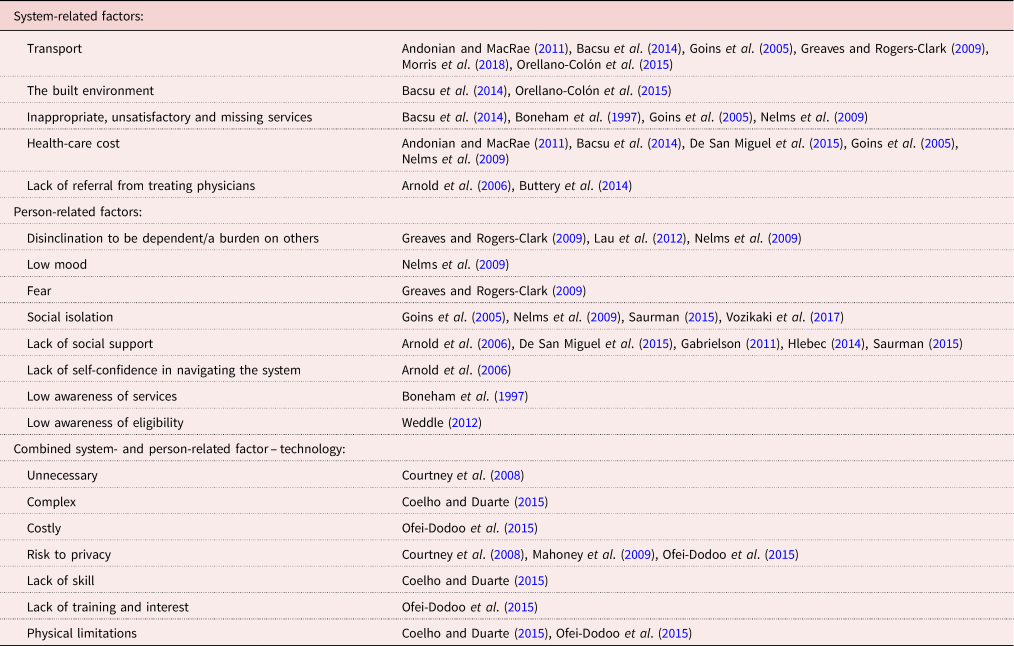
Considering this increased need for home and community services, it is important to understand the barriers and enablers to access experienced by potentially vulnerable groups in the community. Research has identified different contributing factors, outlined in Table 1.
Factors affecting service access by older people identified in the literature

While these barriers have been discussed in isolation, they have not commonly been brought together, and not with specific attention to gender. As discussed above, ageing is experienced differently by women and men, therefore their experience of barriers and enablers to service usage are likely to differ. While a substantial body of research is emerging regarding the experience of growing older, these reports frequently lack distinction between older women and men, and women's experience of growing older remains under-researched (Feldman and Radermacher, Reference Feldman and Radermacher2016). Furthermore, barriers and enablers are rarely examined specifically for those living alone. To reduce inequity for this at-risk group, it is important to identify the barriers and enablers to accessing and using health and social care in the community for this group. The aim of this study was to identify the barriers and enablers for women living alone to access services to age in a place of their choosing.
Methods
This study was conducted and reported in accordance with the Consolidated Criteria for Reporting Qualitative Research (Tong et al., Reference Tong, Craig and Sainsbury2007). This study is part of a larger multi-component mixed-methods project which aimed to optimise the wellbeing of older women, focusing on the social, economic and health disadvantage of women who live alone, co-creating new services and strategies to optimise service access equity. A crucial aspect of the co-creation process is to understand the barriers and enablers perceived by the end users, in this case older women living alone, which was afforded by the current study.
Research design
We employed a qualitative descriptive approach for this study, which was appropriate given its exploratory nature (Sandelowski, Reference Sandelowski2000). This approach enabled us to develop a deeper understanding of the lived experience of older women living alone, in particular regarding service access, needs and barriers.
Inclusion criteria
Individuals were eligible to participate if they were aged 55 or over, female and living alone in the community. A broader age range than ‘conventional old age’ (65 years and older) was used to capture issues relating to the difference between biological and functional age (Levine and Crimmins, Reference Levine and Crimmins2018), and associated service eligibility and entitlements. Only those with severe cognitive impairment were excluded from taking part.
Recruitment
We used quota sampling, informed by preliminary analysis of home nursing and population data (Australian Bureau of Statistics, 2017; Joe et al., Reference Joe, Dickins, Enticott, Ogrin and Lowthian2020; Reference Dickins, Joe, Enticott, Ogrin and LowthianDickins et al. in press), to ensure that women with a wide range of perspectives were included. Given the increasing health needs of this cohort, home nursing data were used to capture those who were in a more-vulnerable health state and in need of accessing higher-level supportive services. Sampling was based on socio-demographic factors including age, socio-economic disadvantage, location, education level, country of origin and receipt of home nursing care. In addition, the Index of Relative Socio-economic Disadvantage (IRSD) was used as a proxy for socio-economic status. The IRSD uses a range of social and economic information about people and households within a postal area in order to rank areas on a continuum from the most to the least disadvantaged (Australian Bureau of Statistics, 2013).
We recruited participants through two avenues: a home nursing service and the general community. To recruit individuals from the home nursing organisation, a list of current clients meeting the inclusion criteria was provided by the organisation's data analyst. For the general community, information was provided to a range of stakeholder organisations and individuals known to the research team for dissemination; with team members also attending community groups and placing advertisements in community newsletters.
Eligible participants were contacted by a member of the research team who explained the project and what participation entailed. If they wished to proceed, they were provided with the Participant Information and Consent Form via their preferred contact method (mail or email), and a time for interview was scheduled. Informed consent was obtained from all individuals. In addition, participants were assured that their acceptance or refusal to take part in the study would not impact on any relationship with the home nursing organisation (if applicable).
Data collection
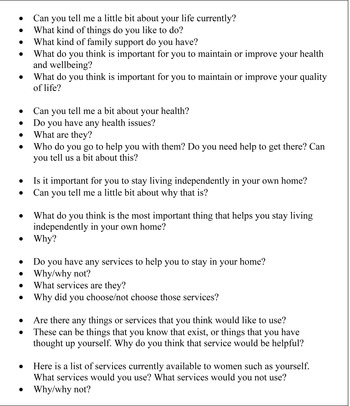
We conducted semi-structured interviews (for the interview schedule, see Figure 1) in the participants’ own homes or at a community place at a mutually convenient time. This was to facilitate access to participation, particularly for housebound individuals. The interviews were conducted by members of the research team (MD, ER, GJ), previously unknown to the participants. MD (BA(Hons), PhD), a female Research Fellow with substantial experience conducting research with vulnerable populations, ER (BAppSci (Ex&SpSc) (Hons)), a female Research Officer with significant experience conducting research with vulnerable populations, and GJ (BA/Sc (Hons) (Psych)), a female Research Officer with limited experience, conducted all interviews. Unless an interpreter was required, or the interview was conducted in a public place at the request of the participant, there were no other people present at the time of interview.
Interview schedule.

Participants only knew about the professional role of the interviewer in the context of the research study and the company that they worked for. Interviews were audio recorded and transcribed verbatim by an external transcription service. Each transcript was checked for accuracy against the interview recording. For interviews with participants where a translator was utilised, both English and native language were transcribed to ensure accuracy. Transcripts were not returned to participants. Data collection took place between May and August 2017.
Ethics
Approval to conduct this study was granted by the Bolton Clarke Human Research Ethics Committee.
Data analysis
We used thematic analysis to analyse the data, with an inductive approach used to allow for themes and findings to be derived from the data, grounding the findings in the perspectives and experiences of participants. We employed the six phases of thematic analysis described by Braun and Clarke (Reference Braun and Clarke2006) of familiarisation, generation of initial codes, searching, review and naming of themes, followed by report production, treating them in a reciprocal manner, allowing movement back and forth between the phases as required. ER conducted the primary coding, with MD conducting the double coding. We used NVivo 11 (QSR International, Melbourne) as a tool to assist qualitative analysis. Regular discussions were held within the research team and the project reference group to provide further insight into the themes arising from the analysis.
Rigour
We engaged in peer debriefing and reflexive conversations throughout the data collection and analysis stages. Given our background as researchers embedded in the home nursing service, the use of reflexivity was important to ensure that our beliefs and assumptions regarding participant's views and the health system were not imposed on to the data, allowing findings to emerge inductively from the analysis. Data saturation was reached before recruitment was completed, however, further participants were sought to ensure that diverse perspectives were considered as per the quota sampling method.
Results
Sample description
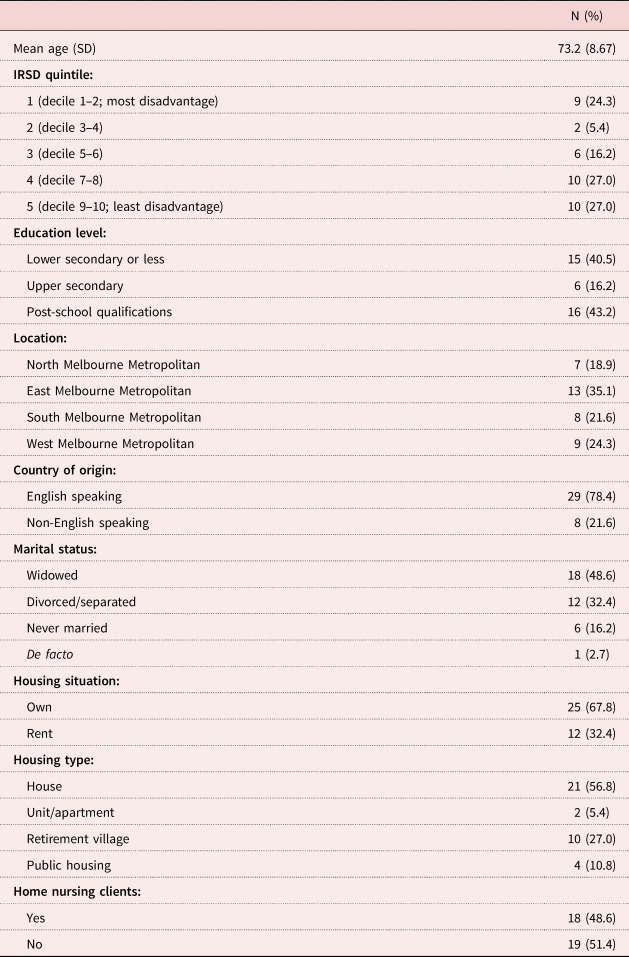
Thirty-seven individuals agreed to participate. Interview duration ranged from 21 to 119 minutes (mean = 52 minutes). The mean age of participants was 73.2 years (standard deviation = 8.67 years). For further demographic characteristics of participants, see Table 2.
Demographic characteristics of participants

Notes: SD: standard deviation. IRSD: Index of Relative Socio-economic Disadvantage.
Six main themes were derived from the inductive exploration: financial; mobility and ability; transport; mental and emotional wellbeing; social connections and participation; and knowledge. While both barriers and enablers to service use were elicited within the interviews, women found it easier to speak about the barriers rather than the enablers; this is reflected in the themes below.
Financial
Several factors impacted on participant's financial situations. Overarching financial issues placed strain on women in multiple domains, including general living expenses such as food and utilities: ‘When you're on your own everything's doubled, you know what I'm saying?’ (participant 19). This cost was further exacerbated by home-ownership status, with those renting finding it difficult to make ends meet; ‘There's never anything left … it is very, very hard’ (participant 25).
The gendered nature of past employment patterns was linked with long-term financial security. For many older women, limited or no workforce participation due to parenting or caring responsibilities, compounded by lifetime lower wages and/or casual employment, resulted in a lack of personal financial resources, particularly retirement savings:
When I first started work and all that [mandatory retirement savings] was not even known about and things like that. (Participant 26)
Given the dearth of retirement savings for this group, the majority were reliant on a fixed income, such as a government-provided pension. For some, this was viewed as supporting their ‘survival’:
[The government social security department has] been amazing and I wouldn't still be standing if it hadn't been for the help that I got from them. They've just been so supportive. (Participant 32)
Many participants, however, expressed that the pension had not increased commensurately with the cost of living, causing financial hardship and forcing them to live from week to week:
I just wish that finances were a little bit better than they are. It's a bit of a struggle because the pensions don't go up. The foods go up. The fees go up but the pension don't go up and I'm only on the pension. So it's – ugh. (Participant 12)
Financial constraints forced difficult choices about spending. Spending was a calculated task, with many women describing a careful, budgeted, frugal life. This was particularly salient for women with health issues, who were often forced to prioritise the cost of their health-care services over preventative and non-urgent care, or other necessities. For many this impacted on their ability to do things they enjoyed and to socialise, affecting their mental health and sense of wellbeing:
A lot of friends go out for dinner and I have to say no because … I can only just cover everything … It does limit [what I can do], especially with my friends because they've all got money and can go around to patchwork shops and they're always going out for lunch in nice places … [it's] very depressing. (Participant 06)
Mobility and ability
Mobility and ability affected many facets of the women's lives, particularly where they felt their ability to perform tasks had changed. One area of particular frustration was domestic life – traditionally part of the ‘woman's role’. The inability to prepare food was difficult for some women to adjust to. While some women employed services when unable to do these tasks (e.g. meal deliveries), others found other strategies that allowed them to maintain their independence:
When [my neighbours] were both working full-time, and before I fell over, I was doing a lot of cooking for them … But since my fall I can't do that anymore. My hands are pretty bad as well now. So yes, I use a lot of frozen vegetables because I can't chop stuff up as easily now. (Participant 31)
It was often the simple domestic tasks that women found challenging. These small tasks were often overlooked by the services available to them, which was a source of frustration for women:
I don't get up on anything anymore. So changing lightbulbs it sounds a funny thing but if they're high up that can be a problem. (Participant 34)
Limited mobility hampered women's ability to access services outside the home, compounded by many services being poorly designed for those with mobility issues:
I don't have a good solution for getting out of the house … I mean getting to the doctor has been really difficult … to get to an actual doctor from the front – from wherever you're parked, you'd have to walk a really long distance. I mean maybe I should have a wheelchair or a scooter or something but that has all sorts of logistics. (Participant 30)
Some women expressed the distress and depression that they experienced at their newly diminished capacity to carry out everyday tasks, which were often linked with issues of pain:
I couldn't get inside without screaming because the pain down here was sort of like white fire … it was like a misty grey straitjacket because I think part of it there was a depressive element to it that I hadn't experienced before. (Participant 30)
Women were acutely aware that their domestic capabilities and mobility were central to remaining independent, and that any decline in these may prompt significant life changes, such as moving into a retirement village or residential aged care:
If you're not mobile, if you're ill or something and you can't do your housework, or can't do your gardening, or can't get to places. I'm starting to think about that actually, yeah. Go to a nursing – or retirement village. (Participant 14)
Transport
Transport was viewed as a major contributor to service access and retention of independence by women. Transport acted as an essential link to friends, family and the wider community, including services. There was a significant link between an individual's mobility and physical ability and their capability to transport themselves as needed. At the forefront of transport for these women was the ability to drive, which was seen as an integral part of not only independence and service access, but identity and wellbeing. The thought of losing that ability was a frightening and daunting prospect for those still driving:
[Driving is] my salvation. Because sometimes I'm going for the blood test, going here and there, and when I come home and I sit and I thought how I could do those things without driving? (Participant 04)
Health was the most common reason women were no longer driving, with significant health events triggering the loss of a licence. Some women modified their driving voluntarily, driving less often or only in the local area as they felt unable to drive in the same way they used to:
I don't drive as far as I used to. So there have been changes. I wasn't terribly well last year and I stopped driving some distances. But I still get around locally, so I guess that's better than not getting around at all. (Participant 16)
Others had never learned to drive, instead relying on family or husbands for transportation:
It was my choice. I just never bothered. When I got married to my husband he used to drive me everywhere. He was a good husband. (Participant 13)
Highlighting the link between mobility and ability and transport, effective alternatives to driving were important. Public transport was seen by some as a viable alternative, but deterioration in physical capability coupled with inconsistent disability access and safety concerns limited their ability to use public transport:
I'm a bit scared about trains now, because my walking ability has deteriorated. (Participant 29)
For those who did access services, such as taxis, to overcome their inability to travel, the lack of ability to be flexible and spontaneous was lamented. This was particularly true for ‘necessary’ travel such as that undertaken for medical appointments:
The thing I miss most is I gave up driving, and that is a big, big one. That's the thing I feel most. Just trying to make doctor's appointments … Even getting taxis or anything, you still get a taxi there but then you've got to organise to get back home. You don't know how long the appointments are going to be. All that sort of thing is the hardest thing for me. (Participant 23)
Many spoke of how friends and families drove them to engagements, but this was always prefaced by concerns about reliance, and not wanting to worry them because they were busy:
It's a huge thing. Because I know they're all busy and they've got their lives. When you see them, they always say just ask if you need anything and you go yeah, yeah. But then it's really hard if it comes to that to actually go can you help me? That's really my issue … we don't want to be a burden to people. But on the other hand, sometimes you just need help and you just have to suck it up and say please. (Participant 32)
Mental and emotional health
Mental and emotional health for women permeated through their life. Poor mental health was often linked with major life changes such as loss of a loved one, separation, serious medical events or chronic illnesses, compounded by the fact they were living alone. For many, it was a case of ‘taking it one day at a time’ and recognising the impact that mental and emotional ill-health can have on quality of life, and the ability to look after one's self and access the services required to maintain independence. Issues such as isolation, loneliness and depression were common in the narratives of women:
I'm also at a stage of life as many ladies you talk to will be where old friends are passing away and that makes it more difficult too … It is a difficult part, yes and with each passing you feel that little bit lonelier. (Participant 16)
Adapting to changing health for many women involved reconciling new limitations. Some spoke of the negative effect of these limitations, and coming to terms with these changing abilities:
If you don't help yourself – because I have been in a black hole and I don't want to go back there. It's too painful … you've got to do everything in moderation. You can't do what you used to do. You've got to be happy with what you can do. But what you can't do, don't worry about it. Just be grateful every day that you can get up and look after yourself. (Participant 03)
These newfound limitations, however, would often lead to women being housebound. While some had services to tend to their physical needs coming into their home, these women spoke of the apathy that this could bring:
On the days [the nurses] don't come I'm not washing my face or combing my hair mostly. I'm not getting dressed. I only get dressed if I go out. I think that's a real problem. I think actually getting dressed I think I would be less depressed … I went through this phase about nine months after I stopped work where I really couldn't see any point in doing anything at all. There was no point in learning a language. What's the point of doing it? What's the point of doing anything really? Why would you bother doing anything at all? … I wouldn't have had enough energy to actively commit suicide but I could have seen very easily how you could just turn your face to the wall and not bother, just die. (Participant 30)
Social connections and participation
Women outlined that social connections and participation were imperative to their overall health and wellbeing. Service access was not just seen as important for accessing health services, but also for accessing services which facilitated social connection and participation. These interactions provided meaning and purpose within their life, ensuring their quality of life and mental health were maintained:
I think social contact is extremely important if you're going to survive. Because otherwise you just sit around. Life is meaningless. (Participant 08)
Women felt their socialisation was compromised by modern life, seen as becoming increasingly individual and separate. Many women felt that they could not call on their family as they led ‘busy lives’. While women understood this, it would sometimes leave them feeling down:
My daughter is very busy and so is her husband. They've got very busy lives, so I don't see them very often … I do miss it. But their excuse is they're busy, so I have to accept that … I do miss it terribly, but there's nothing I can do. (Participant 25)
The care-giver role was ingrained in many women, therefore becoming a ‘burden’ was something they wanted to avoid. While some women had supportive families, many preferred alternative arrangements, such as friends, neighbours and formal services. This did not mean, however, that they totally eschewed family support:
Well mainly I don't want to be – you would have heard this a million times – I don't want to be a burden. My eldest daughter is a nurse and she calls me the independent b***h. Mum why didn't you ring? I could have taken you. (Participant 27)
For those without family support (or who were unwilling to utilise it), friends would often become a dependable source of support:
If I've got appointments to go to specialists and that, my girlfriend takes me and she sits in there and listens to what they've got to say, because I can't remember it right. (Participant 11)
Neighbours also provided assistance; with multiple women creating supportive communities around themselves to ‘keep an eye on each other’, with a covert system of surveillance to ensure that if something should happen to them, it would be noticed:
We get up in the morning and we check the blinds are open. If they're not open at a certain time we check on them, ring them up … that's something that everyone worries about on their own. I could have a heart attack through the night or anything and nobody would know about … but somebody will check the next morning sort of thing [if] my blinds are still closed. (Participant 23)
Other women used formal services to achieve the same end; they ordered meals or organised care not solely because they needed it, but because it meant someone would check in on them:
That's the reason I order those meals. I thought that every day somebody come and check on me. (Participant 04)
Knowledge
Frequently, women spoke about a lack of knowledge being a major barrier to accessing services. For many, they knew that services must be available, but did not know where to look:
Yeah, you don't know what's out there. I don't think so. I don't know what's available. I think maybe if we knew what was available it would help. (Participant 22)
There was also a feeling that the aged-care system was ‘too much bloody system and not enough action’ (Participant 29) and was needlessly complex and confusing:
Navigating. It's very complicated. I just know talking to a few people they don't know where to go to access services. (Participant 14)
Further exacerbating the difficulties with the aged-care system was its reliance on technology. While many women were technologically proficient, others had no technological literacy and no desire to learn. This was further exacerbated by the financial instability that women experienced, which made many technological resources out of their financial reach. This was viewed by some as a failing of those who designed the system:
First of all, there's a prerequisite. You have to have a computer and know how to use it … it's just a generational thing. (Participant 21)
While concerns about privacy and security were voiced by some, those women who used technology saw it as a useful means to find information:
I'm pretty good on the computer and stuff. Google is my friend. Sometimes it's really useful and sometimes not so. It is a good one to find out about [services]. (Participant 32)
Another avenue that women drew on was established connections with family, friends and community groups. Some heard of services through word of mouth, others had family members or friends acting as knowledge brokers, assisting them to find services and navigate the system:
So we manage. We exchange information about a good gardener together or someone who's happy to come in and do a bit of weeding, that type of thing. (Participant 16)
This was not a one-way exchange; women wanted to help others to access services:
I want [the information] to be passed on because it's very important for what I've learned to help others because they need to help themselves as well. (Participant 03)
Many did note that the impetus was still on them to find the required information. This was reasonable for those who had the time, inclination, ability and capability to do so, however, those experiencing ill-health found this demanding:
I find that you can't just sit back. You've got to get yourself out there and do for yourself, because things are not going to knock on your door and say ‘here I am’. (Participant 26)
Discussion
This study detailed the barriers and enablers to service access for older women living alone. Six major themes were identified, relating to finances, mobility and ability, transport, mental and emotional health, social connections and participation, and knowledge. Older individuals are increasingly likely to live with multiple comorbidities and require support from a range of health and social care services to remain living independently in the community. To our knowledge, this is the first study to elucidate the barriers that older women living alone face to remain living independently in the community.
The financial situation these women described was often bleak. Rising costs of living, coupled with a lack of fiscal resources, forced women into difficult choices about spending money. This was particularly true for those with poor health, who prioritised spending on health-related costs. This was not always the case; some women experienced a financially comfortable existence as they aged. This finding is supported by previous research, which has shown that women not only have higher health-care expenses than men (primarily due to higher numbers of chronic health conditions, experienced over longer periods), but that they have very limited capacity to support themselves in retirement due to lower pay and opportunity to contribute to retirement savings throughout the lifecourse (Salganicoff et al., Reference Salganicoff, Cubanski, Ranji and Neuman2009). While much previous research has focused on the health-care and related costs (Goins et al., Reference Goins, Williams, Carter, Spencer and Solovieva2005; Nelms et al., Reference Nelms, Johnson, Teshuva, Foreman and Stanley2009; Andonian and MacRae, Reference Andonian and MacRae2011; Bacsu et al., Reference Bacsu, Jeffery, Novik, Abonyi, Oosman, Johnson and Martz2014; De San Miguel et al., Reference De San Miguel, Lewin, Burton, Toye, Boldy and Howat2015), this research highlights that alleviating pressure in other fiscal areas will ease a burden that many women bear alone when living by themselves in older age.
Women identified issues with both driving and other types of transport, including public transport and subsidised travel such as taxis. While concerns and ramifications of a diminishing ability to drive are common in the literature (Goins et al., Reference Goins, Williams, Carter, Spencer and Solovieva2005; Greaves and Rogers-Clark, Reference Greaves and Rogers-Clark2009), less acknowledged is that some of this cohort have never driven; this was the responsibility of their spouse. Thus, the loss of their spouse or partner places them in a difficult situation – intensified by feeling unsafe and/or unable to use public transport (Andonian and MacRae, Reference Andonian and MacRae2011; Bacsu et al., Reference Bacsu, Jeffery, Novik, Abonyi, Oosman, Johnson and Martz2014; Morris et al., Reference Morris, Barnes and Fildes2018). Furthermore, due to the financial issues outlined above, it is also possible that women were residing in an area with limited public transport infrastructure.
Women's mobility and ability were at the forefront of their minds when discussing difficulties they faced both within and outside the home. This is consistent with previous research indicating that individuals living alone report more concerns regarding mobility than those living with others (Tsai et al., Reference Tsai, Rantakokko, Portegijs, Viljanen, Saajanaho, Eronen and Rantanen2013). Shortcomings of the built environment and limited transport options restricted their movement in the community – including when accessing services. Within the home, both mobility and ability affected women's capacity to engage in activities of daily living and maintain their household. Many of the smaller tasks that women were unable to do were not those that were supported by the services available to them. These limitations impacted women's overall quality of life – a finding supported by the literature (Banister and Bowling, Reference Banister and Bowling2004).
Knowledge, or lack thereof, permeated women's narratives. The complexity of the health and aged-care system, alongside its dependence on technology, left women both confused and unsure about what they were entitled to and how to access it. While some women embraced technology, others had no interest in it, supporting previous research indicating that older women (particularly those aged 75 years and over) are low users of technology (Cresci et al., Reference Cresci, Yarandi and Morrell2010; Hodge et al., Reference Hodge, Carson, Carson, Newman and Garrett2017). This, alongside a lack of skill and interest in technology (Coelho and Duarte, Reference Coelho, Duarte, Abascal, Barbosa, Fetter, Gross, Palanque and Winckler2015; Ofei-Dodoo et al., Reference Ofei-Dodoo, Medvene, Nilsen, Smith and DiLollo2015), and the costs related to acquiring and maintaining technology, fosters low awareness of available services which are often located and accessed through technological means (Boneham et al., Reference Boneham, Williams, Copeland, McKibbin, Wilson, Scott and Saunders1997; Weddle, Reference Weddle2012). Therefore, it is important that services have multiple avenues of access available that are widely promoted and accessible.
What has become apparent is that each of these themes is a complex, interwoven web, particularly when placed in the context of these women's roles in both work and family across the lifecourse. In addition, other diverse factors such as age, ethnicity, education and health status also inform the services required by older women living alone to maintain independence.
Underpinning the interconnected themes was a clear preference for autonomy; to choose and control how they want to live and the services they wanted to access, whilst being treated with dignity and respect. These preferences have been identified previously as important to older people (Dow et al., Reference Dow, Sparrow, Moore, Gaffy and Yates2013). Further, this was linked with women's keen awareness and reluctance to becoming a ‘burden’ on those around them. This attitude is evident in the underlying reluctance of many women to engage formal services, despite a clear need to do so. Many of the women were experiencing a role transition, moving from the traditional ‘women's role’ of domesticity and caring for others, to being cared for themselves. This disinclination to be a burden on others is found elsewhere in the literature (Greaves and Rogers-Clark, Reference Greaves and Rogers-Clark2009; Nelms et al., Reference Nelms, Johnson, Teshuva, Foreman and Stanley2009; Lau et al., Reference Lau, Machizawa and Doi2012), and services that work to assuage this feeling in women will better meet the needs of older women, thereby ensuring that they are able to age in a place of their choosing. This in turn will likely increase their independence and wellbeing, leading to a reduction in health-care system use.
Therefore, services provided to older women living alone need to address or acknowledge where possible each of these barriers and characteristics to ensure optimal service access. Moreover, to align successfully with consumer-directed care principles that place the consumer at the centre of their health and aged care (Delaney, Reference Delaney2018), these perceived barriers and enablers should be utilised in the design or re-design of service offerings. A service ecosystem that accounts for the interrelated nature of physical, social and mental health, and understands the unique financial constraints that older women face as they age, will facilitate access for services required for women to age in a place of their choosing. Further, addressing the underlying reluctance to access services when required will further improve the health and wellbeing of older women as they age.
This is the first study to outline the barriers and enablers to service access for this group and provides useful information for policy makers and service providers to ensure that services provided to this group meet the needs of community members. Whilst efforts were made to include the perspectives of a diverse group of individuals, individuals from culturally and linguistically diverse backgrounds, those from mid-level socio-economic areas and younger old were underrepresented compared with our sampling quotas and may benefit from further investigation.
Conclusion
Older women living alone are a growing cohort. Ensuring that they are able to age in a place of their choosing is imperative to ensure that they achieve optimal wellbeing, without placing undue stress on the health-care system. Service barriers and enablers of financial, transport, mobility, mental and emotional health, social connections and participation, and knowledge affect how women age in place in the community. These issues do not stand alone but are a complex constellation of interrelated issues which intersect with the characteristics of the woman, to affect her service usage and ability to age in place successfully. Services and policy makers must address barriers to access to ensure that women who need support can access appropriate services in the community.
Acknowledgements
The authors would like to acknowledge the generosity of the participants for sharing their time and experiences for this research.
Financial support
This work was supported by the Lord Mayor's Charitable Foundation – Eldon & Anne Foote Trust (Innovation Grant 2016).
Conflict of interest
The authors declare no conflicts of interest.
Ethical standards
Approval to conduct this study was granted by the Bolton Clarke Human Research Ethics Committee (approval number 170003).