Introduction
Based on many studies, it has been concluded that the current levels and intensities of harvesting of most plant species subjected to non-timber forest products (NTFPs) extraction do not threaten their natural populations. Furthermore, it has been found that plant species subjected to NTFPs extraction may, in fact, represent an attractive option for keeping gatherers out of poverty (Stanley et al., Reference Stanley, Voeks and Short2012).
However, some studies have also reached the conclusion that extraction and trade of some plant species subjected to NTFPs extraction may cause overharvesting, which leads to population declines and biodiversity losses (Vasquez & Gentry, Reference Vasquez and Gentry1989; Gaoue & Ticktin, Reference Gaoue and Ticktin2010). Also, most ecological analyses of plant population sustainability report physical extraction rates over a short study period, usually 2 years or less (Stanley et al., Reference Stanley, Voeks and Short2012). Hence, long-term ecological monitoring is essential to evaluate the effects of episodic recruitment, periodic disturbances and harvesting intensity on plant species (Ticktin, Reference Ticktin2004; Stanley et al., Reference Stanley, Voeks and Short2012).
Lychnophora ericoides Mart. is a shrub popularly known in Brazil as arnica, false arnica, Brazilian arnica, arnica da Serra, candeia and pau candeia (Almeida et al., Reference Almeida, Proença, Sano and Ribeiro1998; Semir et al., Reference Semir, Rezende, Monge and Lopes2011). As a plant species sold over the course of the past 30 years at fairs and pharmacies, the species is a culturally important plant in Brazil (Semir et al., Reference Semir, Rezende, Monge and Lopes2011). The lack of polymorphism, low migration and disjunct geographical distribution with small populations of Lychnophora ericoides (Collevatti et al., Reference Collevatti, Rabelo and Vieira2009) are among the factors that strengthen the possibility of population declines. Also, the intensive harvesting of leaves and branches of Lychnophora ericoides may cause high individual mortality (Silva, Reference Silva2005).
Demographic studies are fundamental to understanding the effects of harvesting on the population dynamics of plant species (Ticktin et al., Reference Ticktin, Nantel, Ramirez and Johns2002; Zuidema & Boot, Reference Zuidema and Boot2002; Gaoue & Ticktin, Reference Gaoue and Ticktin2010). Matrix population models (MPMs) have been widely used as a tool to assess the population dynamics of plants, including the effects of NTFPs harvesting on population dynamics (Bernal, Reference Bernal1998; Zuidema & Boot, Reference Zuidema and Boot2002; Holm et al., Reference Holm, Miller and Cropper2008; Portela et al., Reference Portela, Bruna and Santos2010; Baldauf et al., Reference Baldauf, Corréa, Ferreira and Santos2015). Schmidt et al. (Reference Schmidt, Mandle, Ticktin and Gaoue2011) reviewed studies that used MPMs to evaluate species subjected to NTFPs extraction and observed that whole-plant harvest of herbs and bark harvest from trees was not sustainable, largely because of decreases in survival of individuals, whereas palm leaf or fruit harvest and rattan stem harvest were potentially sustainable.
Schmidt et al. (Reference Schmidt, Mandle, Ticktin and Gaoue2011) also emphasised the need to collect data on environmental or management covariates that could potentially have an important effect on population dynamics (e.g. rainfall, fire or grazing). Gauoe & Ticktin (Reference Gaoue and Ticktin2010) found that ecological differences between regions had a more significant effect on population growth rates of African mahogany (Khaya senegalensis (Desv.) A.Juss.) than harvest practices. Baldauf et al. (Reference Baldauf, Corréa, Ferreira and Santos2015) observed high mortality in many diameter classes of the NTFP species Himatanthus drasticus (Mart.) Plumel correlated with the extremely low precipitation levels in a Brazilian semiarid region, and Ticktin et al. (Reference Ticktin, Ganesan, Paramesha and Setti2012) observed that invasive species, besides grazing, are the main drivers of declines of amla (Phyllanthus emblica L. and Phyllanthus indofischeri Bennet).
We predict that disturbances occurring frequently in Cerrado remnants, such as wildfires, rainfall variability and harvesting, would have negative effects on the population growth rates of Lychnophora ericoides, and that these are the main factors strengthening the possibility of population declines. The alternative hypothesis is null effects on the population growth rates of Lychnophora ericoides.
In matrix population modeling, if a population experiences a constant environment with unlimited resources, then it settles to a long-term stable rate of asymptotic growth (or decline) and a theoretically stable demographic distribution. However, populations typically experience a changeable environment in which extrinsic disruptions to population structure of biotic, abiotic and anthropogenic origin lead to a realised initial demographic distribution that is different from the population's stable demographic distribution (Stott et al., Reference Stott, Townley and Hodgson2011). An alternative approach for evaluating population dynamics comprises the indices of transient dynamics, which describe how much populations vary as a consequence of stochastic events before reaching asymptotic growth rates and stable-stage distributions (Stott et al., Reference Stott, Townley and Hodgson2011, Reference Stott, Townley and Hodgson2012).
Accordingly, this article reports the results of a demographic study of a remnant population of Lychnophora ericoides in the Central Brazilian Cerrado (Brazilian Savanna). The study was carried out with the aim of using MPMs to analyze the demographic trends of this species from 2010 to 2014, in the expectation that the results of measurement of population asymptotic growth rates and transient dynamics, a life table response experiment (LTRE) and calculation of probability of local extinction could form a basis for the biological conservation of this species. Furthermore, we have collected temporal data on environmental drivers, such as rainfall patterns and the fire regime, as well as personal observations related to management activities (harvesting) that could potentially have important effects on the population dynamics of Lychnophora ericoides.
Materials and Methods
Study area and species description
The Federal District is located in the Central-West Region of Brazil (47°25′–48°12′ longitude and 15°30′–16°03′ latitude). Elevation varies from 1000 to 1152 m above sea level.
The present study was carried out in an area of campo rupestre at Sucupira Farm, which is located in the south-western city of Brasília, Federal District. Sucupira Farm occupies an area of 1736 ha. Campo rupestre is a herbaceous-shrubby vegetation type of the Cerrado, that occurs at altitudes higher than 700 m and usually on litholic soils, where species of the genus Lychnophora are frequent, along with other members of the Asteraceae (Ribeiro & Walter, Reference Ribeiro, Walter, Sano, Almeida and Ribeiro2008).
The climate in this region is classified as Aw, in accordance with the Köppen climate classification system, which means wet tropical with two well-marked climatic seasons (dry winters and wet summers). The annual rainfall is from 1300 to 1800 mm, and the mean annual temperature ranges from 23 to 25°C (Silva et al., Reference Silva, Assad, Evangelista, Sano, Almeida and Ribeiro2008).
The Brazilian Institute of the Environment and Renewable Natural Resources (Instituto Brasileiro do Meio Ambiente e dos Recursos Naturais Renováveis) listed Lychnophora ericoides as a threatened species (portaria no. 37-N, 3 April 1992). Currently, this species is not included in national or international lists of threatened species. However, the disjunct geographical distribution with small populations (Collevatti et al., Reference Collevatti, Rabelo and Vieira2009) and the traditional and extensive trade of this species as an NTFP (Semir et al., Reference Semir, Rezende, Monge and Lopes2011) are factors that indicate that it should not have been excluded from such lists.
Lychnophora ericoides occurs in the Cerrado rocky environments (campos rupestres), which are habitats characterised by shallow soils, low nutrients, high levels of aluminium, and seasonal water deficiency, in which plants are subjected to high solar exposure, strong winds and a wide daily thermal amplitude (Benites, Reference Benites2001; Benites et al., Reference Benites, Schaefer, Simas and Santos2007). The flowering of Lychnophora ericoides occurs between July and early October and from January to mid-March, with a peak in February, and may be very asynchronous between individuals. Lychnophora ericoides is mainly pollinated by butterflies, bees (Apidae) and wasps (Scoliidae) (Avelino, Reference Avelino2005). The presence of 3–5 flowers on each floral bud confers adaptation against predation, because up to 70% of the floral buds are free of infestation (Avelino, Reference Avelino2005).
Similar to other Cerrado woody species, Lychnophora ericoides has thick bark, densely packed persistent leaf bases and a sprouting capacity after fires, all of which afford resilience and resistance to Cerrado wildfires, typically occurring at 3- to 5-year intervals (Gottsberger & Silberbauer-Gottsberger, Reference Gottsberger and Silberbauer-Gottsberger2006). However, high fire frequency (annual fires) of anthropogenic origin, as observed in the study area, results in both mortality of woody species individuals and a high proportion of plants suffering top kill (aerial mortality) (Medeiros & Miranda, Reference Medeiros and Miranda2005).
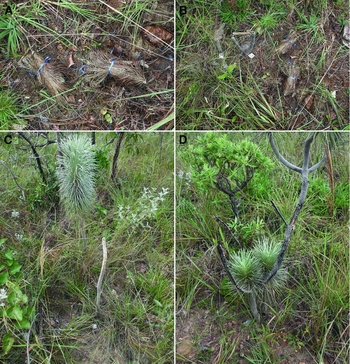
This area in Sucupira Farm harbours one of the few populations of Lychnophora ericoides in the Federal District, and it has been harvested periodically. Harvesters prune aerial parts (Fig. 1) without authorisation from Sucupira Farm, the responsible management entity. An important way to test the direct effects of NTFPs harvest is to take the potential for spatiotemporal variation into account in the study design (Schmidt et al., Reference Schmidt, Mandle, Ticktin and Gaoue2011). However, the illegal nature of harvesting activities in the area has prevented the establishment of controlled areas, and it was possible to include only temporal variation in the study design. Harvesting of stems, leaves and branches was annual throughout the study period. Although this activity occurred in different months from 2010 to 2014, it intensified in the period from 2013 to 2014 (personal observation). Despite the number of harvested individuals in the sampled plots not being recorded because harvesters prune the aerial parts furtively as an illegal activity, a number of individuals disappeared in this period. These individuals vanished in the study area, and even the numbered metal identification tags disappeared. Field observations indicated that individuals were generally harvested after data collection (February to March), during and after the population's reproductive phase. There are no grazing activities or invasive species in this study area.
Branches of Lychnophora ericoides tied for marketing (A and B), harvested branches (C) and individuals with evidence of damage caused by fire (D). (Photographs by Felipe Oliveira Resende.)

Fire regime and rainfall
To determine the frequency of fire scars, we counted scars from 2000 to 2014 using LandSat with 30 m of spatial resolution (TM 5, 7 ETM and 8 OLI) satellite images obtained from the United States Geological Service (2015) with false-color composition R4G5B3 (Landsat TM 5 and ETM 7) and R5G6B4 (Landsat 8 OLI) (Giroldo & Scariot, Reference Giroldo and Scariot2015). We selected satellite images from June to October in each year relative to the dry season. The processing of the images was done with Esri ArcGIS, version 10.1
The annual rainfall values from 2010 to 2013 were obtained from the Inmet database from a weather station (Brasília) located 30 km from the study site (Instituto Nacional de Meterologia, continuously updated).
Annual samplings
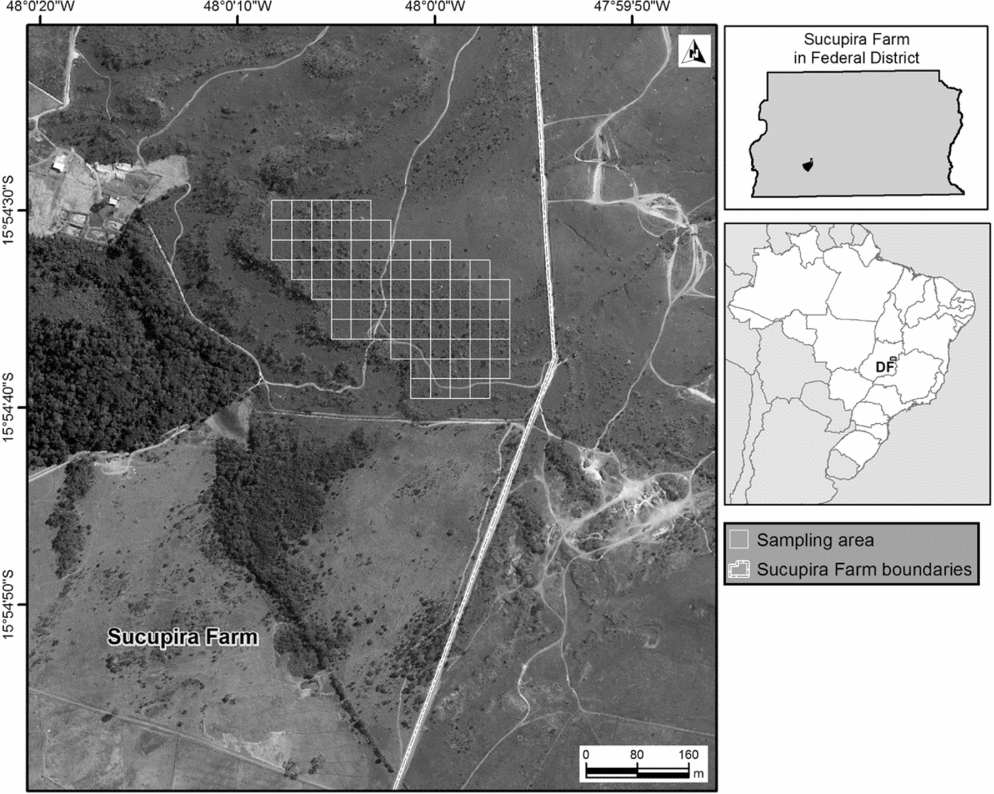
All Lychnophora ericoides individuals existing in the study area were evaluated in a grid of 69 contiguous plots each measuring 20 × 20 m (Fig. 2). Individuals were identified with aluminium tags between January 2010 and February 2014. Height and stem diameter (mm) at ground level were measured using a metric tape and a digital caliper, respectively. The study included four demographic intervals: 2010–2011, 2011–2012, 2012–2013 and 2013–2014. Survival of the plants was monitored between January and February of each annual interval.
Sampling grid in campo rupestre for individuals of Lychnophora ericoides at Sucupira Farm, Brasília, Federal District, Brazil.

Population projection matrices
Four annual transition matrices (A1, A2, A3 and A4) were constructed, based on life stages (Lefkovitch, Reference Lefkovitch1965). The Lychnophora ericoides population was classified into three life stages: seedling or sapling, juvenile and adult. Classification was based on size and reproductive status: seedlings or saplings (plants up to 20 mm in diameter), juveniles (> 20 to 28 mm in diameter) and adults (> 28 mm in diameter; reproductive individuals). The size of individuals with flowers or fruits (reproductive individuals) was observed throughout the study period.
To construct these matrices, we used the following parameters from the survey for each time interval t and t + 1: stasis, growth and retrogression. Fecundity (F) was calculated as the number of recruited plants between the time interval t and t + 1 divided by the number of adult individuals. The construction of the Lefkovitch matrix and its analysis are described by Caswell (Reference Caswell2001).
Matrix population models and population dynamics
The population growth rate (dominant eigenvalue, λ) with 95% confidence interval was calculated by the bootstrap method, resampling the data 10,000 times (Caswell, Reference Caswell2001).
The stochastic population growth rate (exp [log (λs)]) was performed with 10,000 simulations (T) and a confidence interval of 95% (Morris & Doak, Reference Morris and Doak2002) to evaluate the effects of environmental variability on population dynamics. Each matrix was estimated with a probability of 0.30%, and the 2013–2014 matrix with a probability of 0.10% because of the extremely high mortality of individuals in this period. Elasticity analyses were performed to characterise the relative contribution of each matrix element (aij) to the population growth rates (Caswell, Reference Caswell2001; Kroon et al., Reference Kroon, Groenendael and Eherlen2000).
The cumulative distribution function was also calculated for the predicted extinction time of the Lychnophora ericoides population through simulations of probability in a stochastic environment for the time intervals noted above (Morris & Doak, Reference Morris and Doak2002). Each matrix had equal probability of occurrence (30%), again excluding the 2013–2014 matrix with a probability of 10%, for a maximum time of 50 years, with 10 simulations of the cumulative distribution function. The cut-off limit (threshold) of quasi-extinction was 50 individuals.
Transient dynamics
We used the indices that measure transient (short-term) dynamics to complement the demographic parameters based on long-term population growth rates (Stott et al., Reference Stott, Townley and Hodgson2011, Reference Stott, Townley and Hodgson2012): damping ratio (a measure of the speed at which the population converges to stability), reactivity (maximum population growth in a single time step, relative to stable growth rate), first-time step attenuation (minimum population growth in a single time step, relative to stable growth rate), maximum amplification (the largest possible future population density achievable, relative to a population with stable growth rate and the same initial density), maximum attenuation (the smallest possible future population density achievable, relative to a population with stable growth rate and the same initial density), fixed long-term amplification (amplified inertia) and fixed long-term attenuation (attenuated inertia).
These indices are standardised to remove the effects of asymptotic dynamics and to assume a total initial population density of 1, as recommended by Stott et al. (Reference Stott, Townley and Hodgson2011). Case-specific indices of transient dynamics and transient bounds are both valuable measures of transient dynamics, but it is important that both are comparable across models. Standardising the initial stage distribution so that overall population density is equal to 1 achieves this (Stott et al., Reference Stott, Townley and Hodgson2011).
Life table response experiment analysis
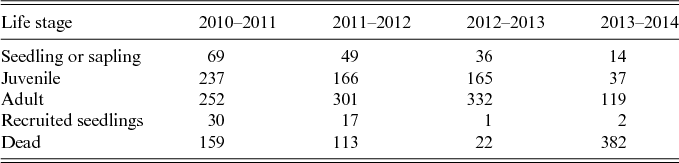
The mortality of individuals was high for annual intervals 2010–2011 (159 individuals) and 2011–2012 (113 individuals). However, the annual interval 2013–2014 presented an extreme mortality of 382 individuals (219 adults and 138 juveniles). The matrix for the annual interval 2013–2014 was considered separately from the other years in the LTRE analysis. The contribution of each matrix element (cij) to the observed differences in λ between the high mortality interval (A4) and other (A1, A2 or A3) years was performed with a fixed-design LTRE: cij = Sij (aij – āij), in which Sij was the sensitivity of the mean matrix between periods and āij was an element of the mean matrix (Am), calculated as Am = (A4 + A)/2. A was one of the other matrices (A1, A2 or A3) (Sampaio & Scariot, Reference Sampaio and Scariot2010). When Sij is positive, a negative value of cij indicates that the value of that vital rate in the bad year is lower than that in the good year, contributing to the observed decrease in λ.
We conducted the MPM analysis using the popbio package (Stubben & Milligan, Reference Stubben and Milligan2007) and the popdemo package for the transient dynamics analysis (Stott et al., Reference Stott, Townley and Hodgson2012), both in the R statistical environment (R Development Core Team, 2015).
Results
Matrix population models and population dynamics
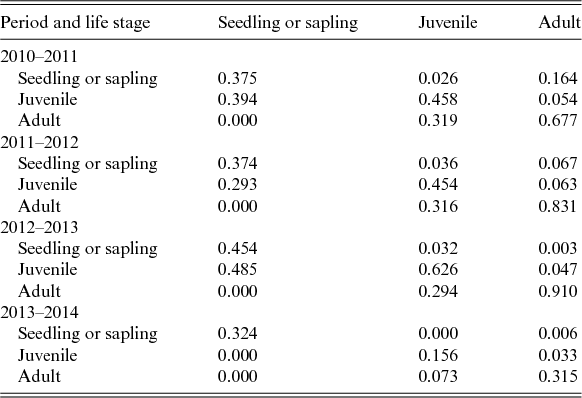
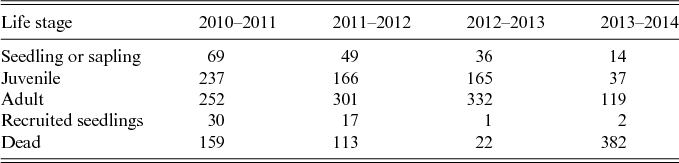
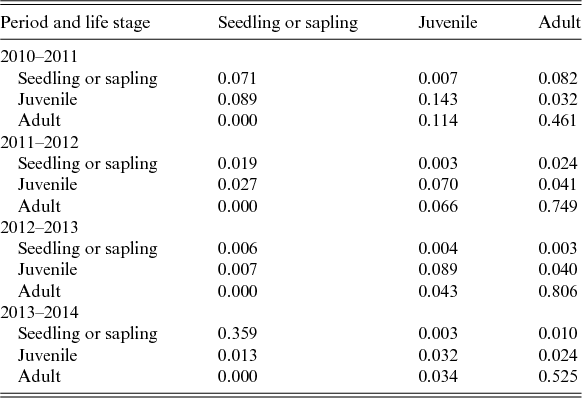
The four annual transition matrices (A1, A2, A3 and A4) based on life stages are shown in Table 1. A total of 717 individuals of Lychnophora ericoides were found in 2010, comprising 152 seedlings or saplings, 382 juveniles and 183 adults. The number of dead individuals was quite striking in the evaluation period (2010–2014), mainly in 2010–2011, 2011–2012 and 2013–2014. In 2014, more than 50% of seedling or sapling, juvenile, and adult individuals showed mortality in the aerial part without resprouting. The number of recruited seedlings showed a sharp decline over time (Table 2).
Transition matrices of the Lychnophora ericoides population at Sucupira Farm, Brasília, Federal District, Brazil, during the study periods 2010–2011, 2011–2012, 2012–2013 and 2013–2014

Population structure, seedling recruitment and number of dead individuals of Lychnophora ericoides at Sucupira Farm, Brasília, Federal District, Brazil, from 2010 to 2014
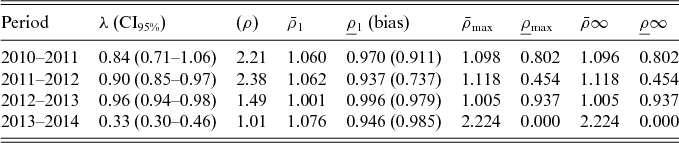
The population growth rates (λ) with 95% confidence intervals indicated a declining population in all periods from 2010 to 2014. The damping ratios also showed a declining trend over time (Table 3).
Population growth rates (λ), damping ratios (ρ) and transient dynamics: reactivity ( ρ 1), first-time step attenuation ( ρ 1), maximum amplification ( ρ max), maximum attenuation ( ρ max) and upper ( ρ ∞) and lower ( ρ ∞) inertia in a population of Lychnophora ericoides in Brasília, Federal District, Brazil*
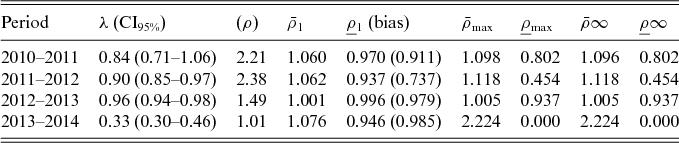
*The first-time step attenuation was calculated using the natural vector of population density and using the biased vector (just seedlings or saplings). The other parameters were calculated using the biased vector of density, and the initial condition imposed was just seedlings or adults (see Stott et al., Reference Stott, Townley and Hodgson2012, for details).
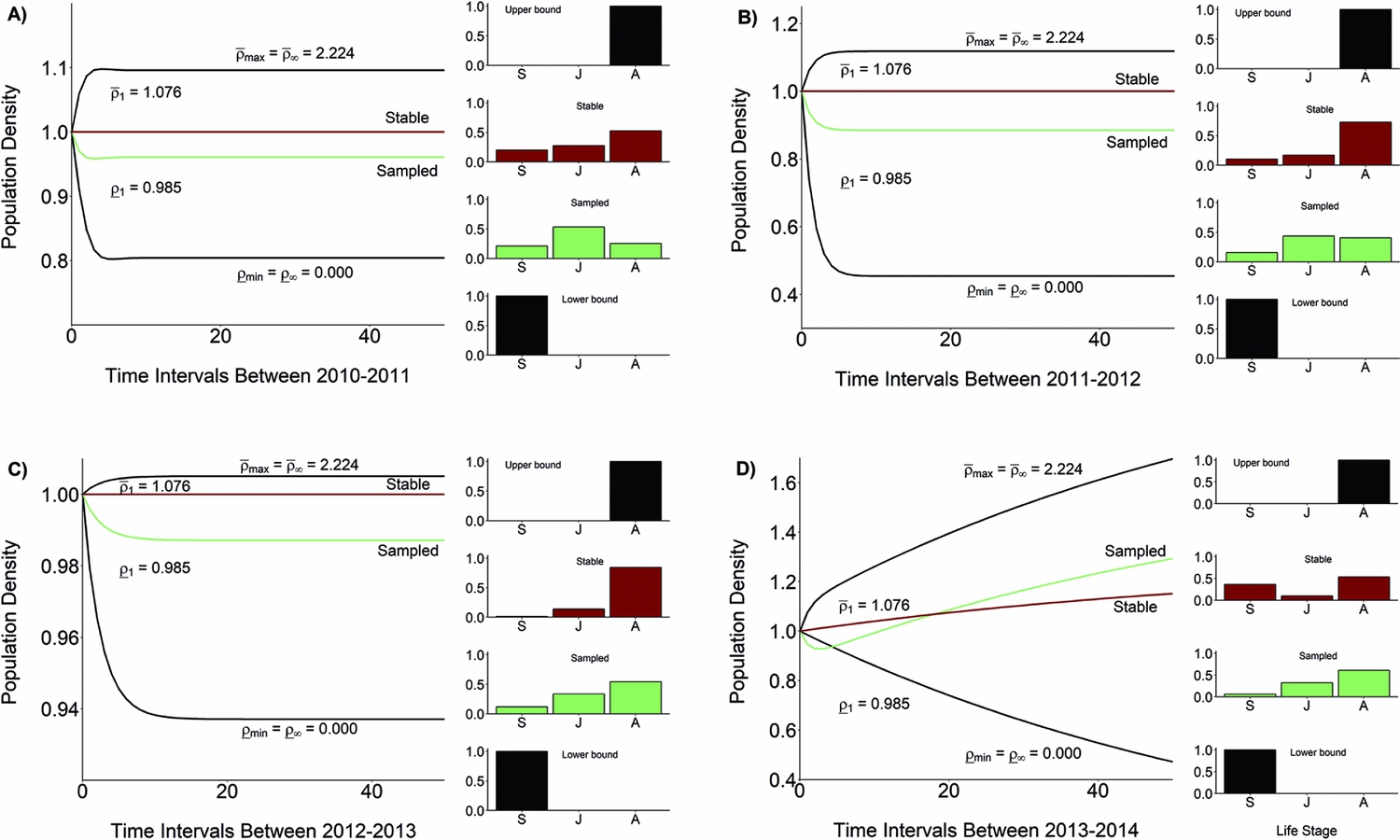
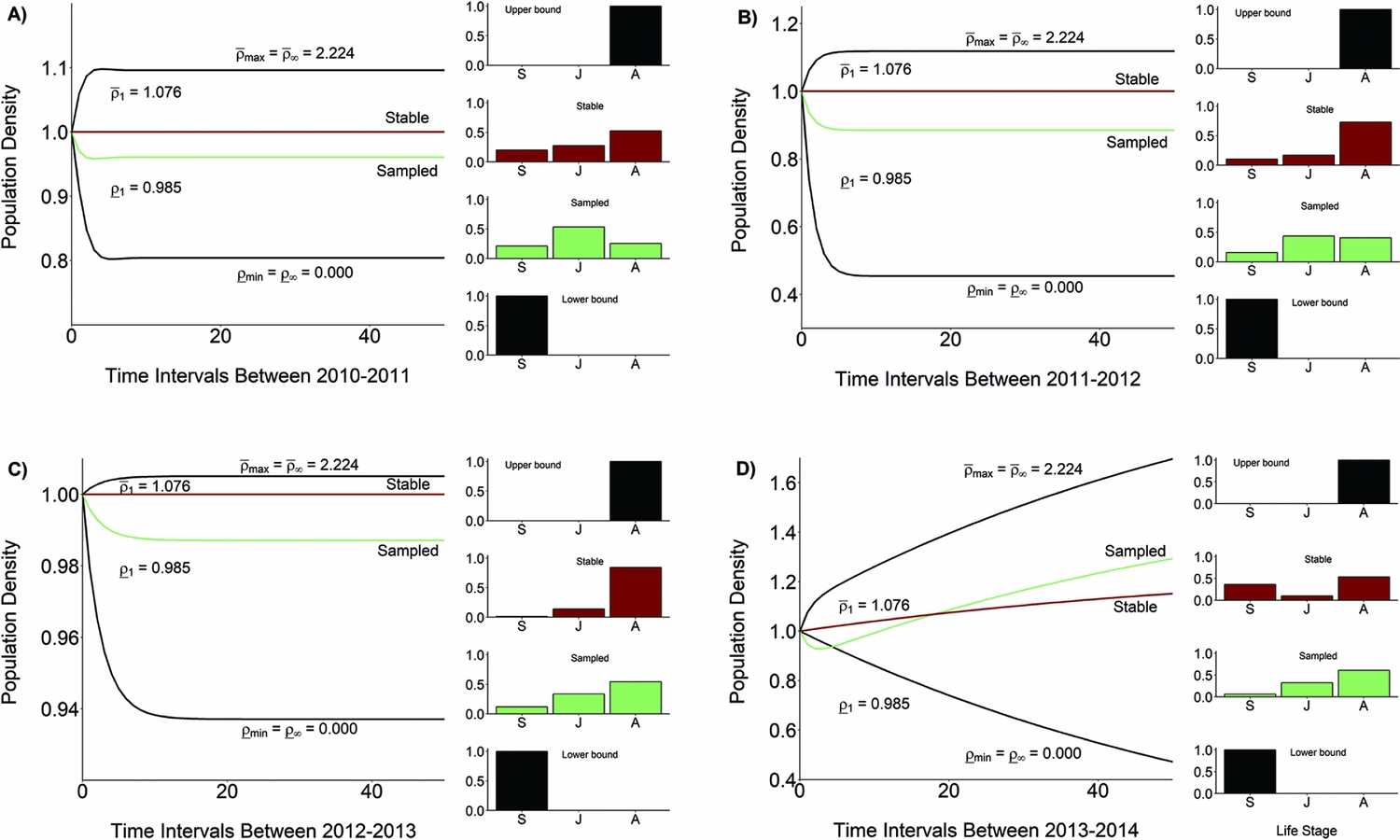
Using the sampled density in each life stage, it was not possible to compute the reactivity or amplification for any interval of time (2010–2011, 2011–2012, 2012–2013 and 2013–2014). Using sampled density, the first-time attenuation for all intervals ranged from 0.937 to 0.996 (Table 3 and Fig. 3), suggesting that the population would decrease by 93.7% within the span of one time period. When the populations were dominated by adults (S = 0, J = 0 and A = 1), we found that reactivity (Table 3) and population could increase by 7.6% to less than 0.1%. However, using the same condition (i.e. only adults), we found that the maximum amplification in density would be from 9.8% to 222.4% in the transient period. On the other hand, when the population had as its initial condition just seedlings, the maximum attenuation (S = 1, J = 0 and A = 0) was a reduction in density from 6.3% to total population extinction (Table 3 and Fig. 3). However, the first-time attenuation using over-represented seedlings or saplings (S = 1, J = 0 and A = 0) suggested that the population could be reduced to 73.7% in just one period (Fig. 3).
Standardised transient dynamics in a population of Lychnophora ericoides in Brasília, Federal District, Brazil, and demographic distribution scaled to an initial population density sum 1. Black bars in the demographic distribution represent the biased distribution [lower boundary in which seedling (S) = 1, juvenile (J) = 1 and adult (A) = 1; upper boundary in which S = 0, J = 0 and A = 1]. The green bars show the sampled distribution at each time interval, and red bars indicate stable distribution. Time intervals: A, 2010–2011; B, 2011–2012; C, 2012–2013; D, 2013–2014. For all intervals, the first-time attenuation ( ρ 1) was calculated using the over-representation of seedlings; however, in the interval 2013–2014, ρ 1 should be calculated using the over-representation of juveniles (S = 0, J = 1 and A = 0), with the result equal to 0.696.
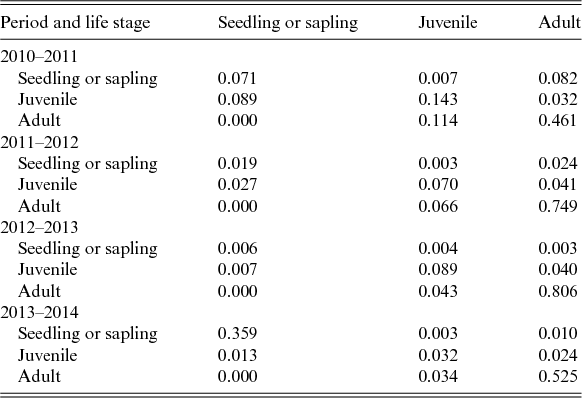
Considering the four matrices, the stochastic population growth rate was < 1 with value λ = 0.358 and CI95% = (0.354–0.362), indicating a sharp decline in the population of Lychnophora ericoides in the study area. Elasticity analyses indicated that stasis of adult individuals (46–80%) contributed most to population growth rate (Table 4).
Elasticity analysis for Lychnophora ericoides at Sucupira Farm, Brasília, Federal District, Brazil, during the study periods 2010–2011, 2011–2012, 2012–2013 and 2013–2014*
*Each value represents the contribution to the dominant eigenvalue (λ).
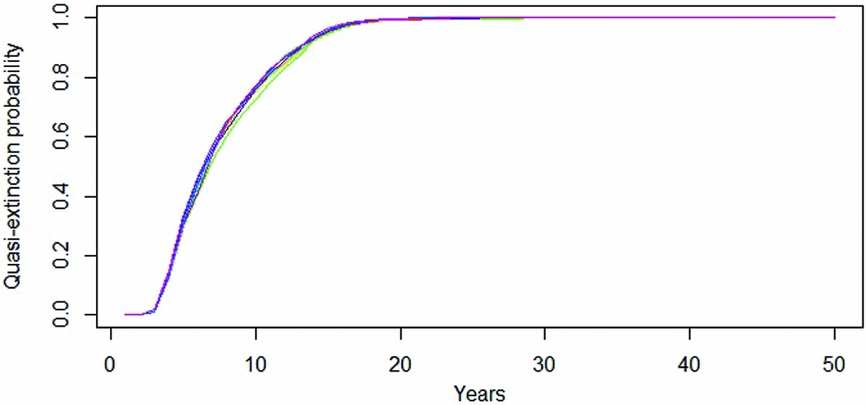
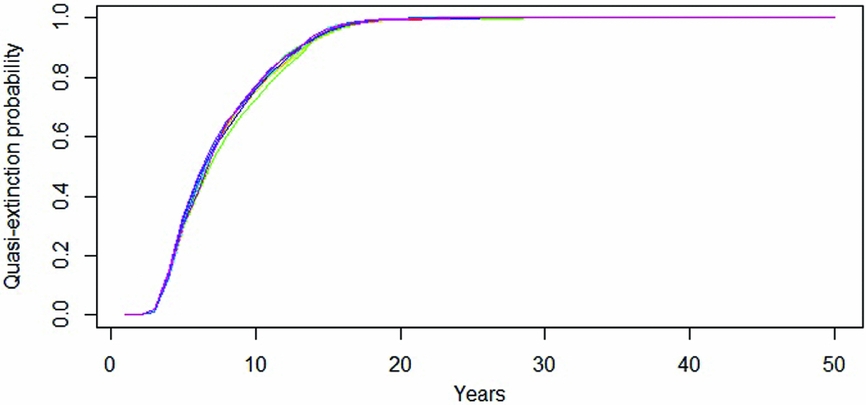
An extinction probability of 100% for the population was predicted for approximately 15 years (Fig. 4), assuming continuous anthropic disturbances in the area.
Probability of local extinction for a population of Lychnophora ericoides in Brasília, Federal District, Brazil, based on transition matrices (2010–2011, 2011–2012, 2012–2013 and 2013–2014).
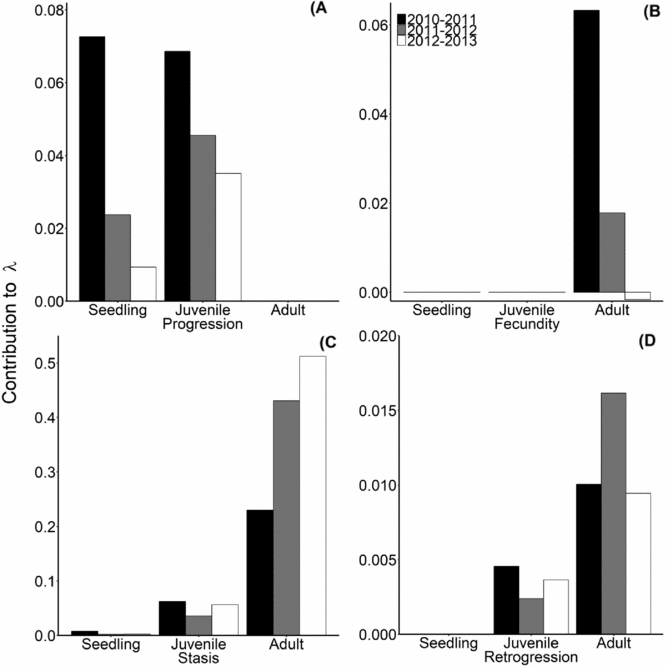
According to the LTRE results, the low value of λ in the high-mortality year was caused by lower stasis of seedlings or saplings, besides the fecundity of adults and retrogression of juvenile and adults (Fig. 5).
Results of a life table response experiment, showing contributions of growth (A), fecundity (B), stasis (C) and retrogression (D) to the difference in annual population growth rate between the high-mortality year (2013–2014) and other years (2010–2011, 2011–2012 and 2012–2013) for Lychnophora ericoides at Sucupira Farm, Brasília, Federal District, Brazil. Note that the scale of the y-axes differs between panels.

Fire regime and rainfall
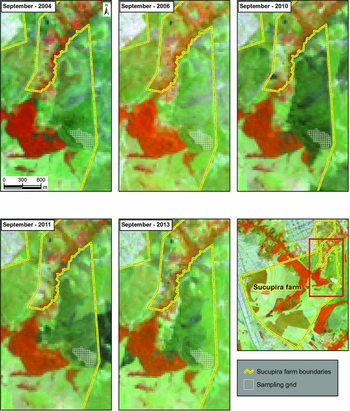
The satellite images showed that the sampling area has had a high frequency of fire (2004, 2006, 2010, 2011 and 2013) (Fig. 6). Fire occurrences were mainly in September, at the end of the dry season. This evidence indicates that the entire population of Lychnophora ericoides at Sucupira Farm has been under fire threat for more than 10 years. During the study period (2010–2014), this area burned in 2010, 2011 and 2013. Although the area burned in 2013, some plots were not affected.
Locations of fire occurrences, obtained from LandSat images (TM 5, 7 ETM and 8 OLI) with false-color composition R4G5B3 (Landsat TM 5 and ETM 7) and R5G6B4 (Landsat 8 OLI), at Sucupira Farm, Brasília, Federal District, Brazil. Fire scars are represented by the dark areas.

The total precipitation values in the study area were 1267 mm (2010), 1416 mm (2011), 1332 mm (2012) and 1600 mm (2013).
Discussion
The pattern of high fire frequency in the late dry season (August to September) observed in the study area may be favorable for some herbaceous and shrub species of the Cerrado vegetation and open physiognomies (Miranda et al., Reference Miranda, Bustamante, Miranda, Oliveira and Marquis2002) because it causes high mortality of woody species (Medeiros & Miranda, Reference Medeiros and Miranda2005). The number of dead or vanished individuals was very high in 2010–2011 (159) and 2011–2012 (113). Subsequently, this number dropped in 2012–2013 (22). However, an intense increase in dead or vanished individuals (382) was observed in 2013–2014. All the high-mortality years were years with fire. Furthermore, because there was no fire in 2012, a higher biomass could have accumulated in the area, causing a stronger fire in 2013 that could have led to higher mortality of Lychnophora ericoides.
Severe variability in precipitation patterns has been a cause of high mortality of woody species in the Brazilian semi-arid north-eastern region (Baldauf et al., Reference Baldauf, Corréa, Ferreira and Santos2015). However, our study area in Central Brazil does not exhibit this type of severe variation in precipitation patterns; Baldauf et al., (Reference Baldauf, Corréa, Ferreira and Santos2015) observed variations of 50% in precipitation patterns throughout 3 years. Furthermore, the total precipitation showed some increase in the 2013 period, the year of severe mortality for Lychnophora ericoides.
In tropical adult trees without damage or individual death caused by harvesting or other disturbances, such as disease and fire, stasis is high and comprises a large amount of the observed elasticity (Kroon et al., Reference Kroon, Groenendael and Eherlen2000). Most of the proportional changes in population growth rate are caused by changes in growth and survival rates (Franco & Silvertown, Reference Franco and Silvertown2004; Bruna et al., Reference Bruna, Fiske and Trager2009). Results of the elasticity analysis indicated this type of pattern for Lychnophora ericoides, with stasis of the adult stage contributing significantly to population decline. Furthermore, the results of the LTRE analysis indicated low stasis of seedlings or saplings, as well as fecundity of adults and retrogression of juvenile and adults, as the main factors for the low value of λ during the period of extreme mortality of individuals (2013–2014). Despite the observed harvesting activities of Lychnophora ericoides, we did not have enough data or control plots to associate the population decline with this kind of human disturbance.
The results of transient dynamics complemented the dataset that indicates a local extinction trend for this Lychnophora ericoides population. Combining asymptotic and transient dynamics creates a clear perspective of possible population changes (Raventós et al., Reference Raventós, Gonzalez, Mujica and Bonet2015, Tremblay et al., Reference Tremblay, Raventós and Ackerman2015). The declining trends of the damping ratios from 2010 to 2014 are the expected results of mortality that reached high levels in 2013–2014, in turn indicating the low resilience of this population (Stott et al., Reference Stott, Townley and Hodgson2011). The other transient indices also showed that the population is much less likely to have increases in density compared with reduction for all intervals from 2010 to 2014.
The prediction that disturbances occurring frequently in Cerrado remnants would have negative effects on the population growth rates of Lychnophora ericoides was verified, because high-mortality years were years with fire. Education of the local population should be undertaken to rescue this vulnerable population of Lychnophora ericoides. Also, a number of actions could be taken for sustainable management for Lychnophora ericoides, including, for example, the establishment of an agreement between the parties involved in resource usage (Dietz et al., Reference Dietz, Ostrom and Stern2003). This agreement should consider the ecological needs for population maintenance and define the boundaries of resources and user groups, as well as establish an arbitration and mediation mechanism to resolve conflicts.
Acknowledgements
The authors acknowledge the Instituto Chico Mendes de Conservação da Biodiversidade for the scientific initiation grant to Hannah Menezes. The authors would like to thank Washington L. Oliveira, Isabella L. P. Lima, Pamela Moser and Hannah Menezes for field assistance. The first author also thanks the Fundação de Amparo à Pesquisa do Distrito Federal.