




No CrossRef data available.
Article contents
The sensitivity of dual-task performance to cognitive status in aging
Published online by Cambridge University Press: 01 March 2004
Abstract
The present study examined dual-task performance in elders with cognitive impairments and normal controls. The participants (N = 60; M age = 84.6) were recruited from residential facilities and the community. They were assigned to one of three groups: (1) cognitive impairment; (2) residential facility control; (3) community control. Two different dual-task conditions were comprised of simple tests that are presumably processed via separate perceptual modalities: 1 visual–manual and 1 auditory–verbal. The first condition consisted of a visual cancellation test and an auditory digit span. The second condition was comprised of an alternate form of the visual cancellation test and letter fluency. MANOVA examined the effect of cognitive status (3-level independent variable) on 3 indices of dual-task performance (letter fluency, digit span, visual cancellation). Analyses controlled for age, education and performance on each test when performed alone. The results revealed that the cognitive impairment group incurred significantly greater dual-task costs compared to both control groups. Furthermore, as was evident from discriminant function analyses, the dual-task measures were very accurate and better than the traditional neuropsychological measures at discriminating elders with cognitive impairments from normal controls. (JINS, 2004, 10, 230–238.)
Keywords
Information
- Type
- Research Article
- Information
- Journal of the International Neuropsychological Society , Volume 10 , Issue 2 , March 2004 , pp. 230 - 238
- Copyright
- © 2004 The International Neuropsychological Society
INTRODUCTION
Executive function is a term that refers to a variety of loosely related “higher-order” cognitive processes such as planning, initiation, judgment, cognitive flexibility, and self-perception (Lezak, 1995; Spreen & Strauss, 1998). The assessment of executive processes is challenging both in terms of test selection and our understanding of the neuroanatomical substrate underlying these functions (Stuss, 1992; Stuss & Alexander, 2000; Stuss & Levine, 2002). Dual-task methodology has been used to assess coordination of resource allocation to competing tasks which is considered as one facet of the executive functions (Salthouse & Miles, 2002; Baddeley, 2001).
Age differences in dual-task performance have been studied extensively (for review, see Hartley, 1992; McDowd & Shaw, 2000). A number of studies have found that aging is associated with increased costs in dual-task performance (e.g., Crossley & Hiscock, 1992; Li et al., 2001; Glass et al., 2000; Salthouse et al., 1984; Whiting & Smith, 1997) while others failed to demonstrate this relationship (e.g., Nyberg et al., 1997; Somberg & Salthouse, 1982; Tun & Wingfield, 1994; Wickens et al., 1987). Hartley (1992) suggested several reasons why age-related costs might be noted in dual-task paradigms even though these costs are not attributable to divided attention. These include compromised performance by the elderly on the individual tasks used in the paradigm, variable complexity levels of the individual tasks, and use of two tasks that target the same perceptual modality (for review of methodological issues relevant to the interpretation of dual-task costs, see Guttentag, 1989; Hartley, 1992). Hartley and Little (1999) demonstrated that age differences in dual-task costs were reduced significantly when using two relatively simple tasks that are processed via different perceptual modalities. Hartley (2001) suggested that age differences in dual-task costs may be confined to concomitant generation and execution of two similar motor programs.
A series of studies examined dual-task performance in normal aging and in Alzheimer's disease (Baddeley et al., 1986, 1991, 2001). The tasks utilized in those studies conformed to an established dual-task model (Baddeley & Hitch, 1974), in which each single task is processed via an independent modality (phonological loop and the visuo–spatial sketchpad). Resource allocation to each task/modality is presumed to occur via a third mechanism, the central executive. In these studies Alzheimer's disease but not normal aging produced disproportionate dual-task costs (Baddeley et al., 2001, 1991, 1986). Further, the dual-task costs varied as a function of the difficulty level of the single tasks.
In light of the significant decline in dual-task performance found in AD patients relative to normal aging in the above studies, it was of considerable interest to examine whether elders who were determined to suffer from cognitive impairments but did not meet formal diagnostic criteria for AD (American Psychiatric Association, 1994; McKhann et al., 1984) incurred greater dual-task costs compared to normal elder controls. Furthermore, we were interested to examine whether dual-task performance indices were better predictors of cognitive status in aging than the traditional neuropsychological tests used in the current study. Such findings would suggest that inclusion of dual-task measures in the assessment of elderly individuals is important as they may provide information that is not available from other commonly used tests. Effort was made to take into account the methodological issues reviewed above regarding the assessment of dual-task performance. The two dual-task conditions in this study were comprised of relatively simple tasks that are presumably processed via separate perceptual modalities: one visual–manual and one auditory–verbal. The first condition consisted of a visual cancellation task and an auditory digit span task. The second condition was comprised of an alternate form of the visual cancellation task and a letter fluency task. Additionally, the design of the study controlled for performance differences on each of the single measures. Due to the prevalence and reported association of depression with cognitive impairments in aging (King & Caine, 1996; Lamberty & Bieliauskas, 1993), the severity of depression was evaluated as well as its potential effect on dual-task performance.
METHODS
Research Participants
The 60 elderly participants (38 women and 22 men) were recruited from three residential facilities and from a small retirement community setting designated solely for the elderly. Mean ± standard deviation age and education, in years, for the entire sample were 84.6 ± 5.3 and 14.2 ± 2.5, respectively. The participants were White, which was not surprising given the demographics of the Binghamton catchment area. The three residential facilities utilized in the present study are designed to provide comprehensive and diverse medical and social services that range in duration and intensity.
The residential facilities' dwellers represented a range in the level of care and assistance they received for daily living. They were all long-term residents who had lived for at least 1 year in the same place. None of the residential facilities' participants were obtained from designated, and locked, dementia units. Of the 40 residential facilities participants, 29 resided in private rooms and 11 had one to three roommates.
The participants residing in the small retirement community were individuals who functioned independently and received no formal assistance in any domain of their daily life. They resided in a small and relatively isolated neighborhood that consisted of independent but identical apartment units designated for elderly individuals. Of the 20 participants recruited from this community setting 13 were married and 7 lived alone.
Exclusion/inclusion criteria
Compliance with the exclusion/inclusion criteria of the study was ascertained by reviewing the medical records of potential participants and by administering the interview and screening tests during the first experimental session. Individuals already diagnosed with dementia of any etiology were excluded from the study. History or current diagnoses of psychosis, alcohol, drug abuse, cerebrovascular events, Huntington disease, Parkinson disease, traumatic brain injury, lead or heavy metal poisoning, seizure disorder, and meningitis served as exclusion criteria. The participants' vision, audition and motor abilities (see Dependent Measures for details) were evaluated using brief screening tests and determined adequate to complete the dual-tasks administered in this study. Ten individuals who originally consented to participate in the study did not complete the testing protocol. Of those 10 individuals, 3 did not meet the exclusion criteria of the study, 2 had poor vision and 2 were determined to be severely impaired based on their DRS test scores. Three additional individuals who completed the first session refused to participate in the second session. Other than their refusal they did not present with any idiosyncrasy or deviation in test scores that differentiated them from those who opted to consent and complete the testing protocol.
A total DRS cut-off score of 123 (Mattis, 1988) was used to determine cognitive status. Elders who scored below the cut-off were assigned a cognitive impairment status while those who scored above the cut-off served as normal controls. The term cognitive impairment was used to describe those individuals with relatively mild level of cognitive dysfunction who did not meet formal diagnostic criteria for dementia. The participants were assigned to one of three groups. The first group (cognitive impairment) comprised 20 residential facilities dwellers whose DRS scores were below the cut-off score. The second group (residential facility control) comprised 20 residential facilities dwellers whose DRS scores were above the cut-off score. The third group (community control) consisted of 20 community residents who scored above the DRS cut-off score. This last group served as a control condition for both cognitive status and the residential facility living environment.
Dependent Measures
Screening tests
- The Wepman's Auditory Discrimination Test: This measure was administered to assess auditory acuity. This test requires subjects to determine whether pairs of single syllable words (read by the tester) are different (gear–bear) or the same (ball–ball).
- Visual acuity: The participants were required to read a sentence written at a font size of 26, Times New Roman (letter's width and length ranged from 1/8–1/4 of an inch), which was much smaller than the 36-font size stimuli (stimulus width and length ranged from ¼–½ of an inch) used in the visual cancellation task.
- Motor: The participants were required to write the alphabet within a 2-min time interval. Inability to perform this task constituted an exclusion criterion.
- Dementia Rating Scale (DRS; Mattis, 1988): The DRS is a widely used scale that examines five areas (Attention, Initiation and Perseveration, Construction, Conceptualization, Memory) that are sensitive to the cognitive changes associated with dementia of the Alzheimer's type. The maximal total score in the DRS is 144 and the suggested cut-off score is 123. Test–retest reliability for the DRS is high (r = .97). The DRS total score correlations with measures of functional competence ranged from .56 to .76.
- The Geriatric Depression scale (GDS; Yesavage et al., 1983): The GDS is a self-report measure of depression that was designed specifically for the elderly population. It is a 30-item (true or false) measure that is free of somatic items. GDS score of 0–10 is normal; 11–20 indicates mild depression; 21–30 indicates moderate to severe depression. The GDS has excellent internal consistency with an alpha of .94 and split-half reliability of .94. The GDS also has excellent stability with a 1-week test–retest correlation of .85. It has been cross-validated in older samples against structured clinical interviews using the Revised third edition of the Diagnostic and Statistical Manual of Mental Disorders (DSM–III–R) and Research Diagnostic Criteria (RDC; Spitzer et al., 1978).
Experimental dual-task measures
Two different dual-task conditions were designed. The first condition consisted of a visual cancellation test and an auditory digit span and the second was comprised of an alternate form of the visual cancellation test and letter fluency.
- Visual cancellation task: The visual cancellation task required the individual to scan rows of visual stimuli from left to right and cross out the randomly interspersed designated target stimulus. The symbols (target and non-target) were not letters or numbers. They were thought to be non-verbal to the extent that they did not correspond to or were intuitively related to real words. Three alternate forms were available for this visual cancellation task (single and two dual-task conditions). The target stimulus was identical in all three forms but the locations of the target and non-target stimuli were changed randomly. Each alternate form consisted of four pages with a total of 116 and 15 non-target and target stimuli in each page, respectively. This timed test (two minutes) was designed to minimize verbal demand and maximize visual processing.
- Efficiency ratio: The number of identified target stimuli/total number of target stimuli scanned within the 2-min time interval was calculated for the alone and two dual-task conditions. The efficiency ratios of the two dual-task conditions were averaged to create one dual-task efficiency ratio index.
- Verbal tasks: The Controlled Oral Word Association (COWA; see Lezak, 1995) test served as one verbal task. One letter trial was administered as a concomitant task with the visual cancellation test. The second letter trial was administered alone to establish performance criterion for each participant. The letters B and F were chosen because they have been reported in the literature to have equal associative frequencies (Lezak, 1995). Norms for verbal fluency (Lezak, 1995; Spreen & Strauss, 1998) are available for 1-min time intervals only. Consequently, the number of words generated during the dual-task condition was recorded at both the 1 and 2-min marks. The letter fluency trial that was administered alone was continued for 2 min as well.
- The Digit Span Forward Test (Wechsler, 1997): This measure served as the other independent concomitant verbal task. This test was first administered alone to establish the optimal performance of each participant (i.e., the correct recall of two consecutive and equally long strings of digits). In the dual-task condition, strings of digits equal in length to the individual's optimal performance were administered as a concomitant task with the visual cancellation task. The percentage of strings recalled inaccurately in the dual-task served as the dependent measure.
Procedure
Participant selection
In the residential facilities, designated care providers reviewed the medical records of individuals who appeared to be appropriate candidates for the study. Following this initial chart review, each of the potential candidates was approached individually and asked to consent to participate in the present investigation. Once an individual consented to participate her/his first session was scheduled. Additionally, the individual's chart was reviewed again to assure compliance with the study's exclusion and inclusion criteria.
Letters explaining the nature of the study were sent to residents in the small retirement community and consent was obtained from those individuals who agreed to participate in the study. All the community participants were tested in their private residence.
Test order
The interview, GDS, DRS, visual, motor, and auditory screens were all administered in the first experimental session. The dual-task measures and standard letter fluency and digit span were administered during the second experimental session which was scheduled within a week following the completion of the first session. The order in which the single and dual-tasks were administered was counter balanced across task conditions. For letter fluency, the letters B and F were randomly used in the dual-task and alone conditions depending on the test order administered. Tape recorders were used during the administration of the dual-tasks to assure that the participants' verbal responses (i.e., letter fluency and digit span) were recorded accurately.
Time of testing
To minimize the effect of fatigue and the “sun down” phenomenon, testing was scheduled during the morning or early afternoon. No sessions were scheduled later than 2:00 PM. Within these parameters, sessions were scheduled based on the participants' preference.
Statistical Analysis
Descriptive statistics (M, SD) for demographic information, GDS total score and DRS total and scale scores were provided for each group. ANOVAs (chi-square for gender distribution) were performed to examine whether group differences on these variables were significant and to determine which of the demographic variables should be used as covariates in subsequent analyses. Descriptive statistics (M, SD) for the visual cancellation, digit span and letter fluency tasks were provided, per group, for the alone and dual-task conditions.
One-way multivariate analysis of variance (MANOVA) was performed to examine whether cognitive status had an effect on dual-task performance. The three groups (cognitive impairment, residential facility control, and community control) served as the three-level independent variable. Dependent measures were letter fluency, digit span and visual cancellation in the dual-task conditions. For letter fluency, the number of words produced in the first one minute of the dual-task condition served as the performance index. While the number of words produced during the entire 2-min interval was recorded as well, we chose to use the number of words produced only during the first minute to be consistent with the standard administration time of letter fluency. For digit span, the percent of digit strings recalled inaccurately (strings recalled incorrectly/total number of strings administered) was used as the performance index. For the visual cancellation test, the efficiency ratios of the two dual-task conditions were averaged to provide one performance index.
Analyses controlled for age, education and performance on letter fluency, digit span (forward condition) and the visual cancellation test when administered alone.
Consistent with suggested statistical procedures that should follow a significant MANOVA (Durate Silva & Stam, 1996) discriminant function analysis was performed to examine how accurately dual-task performance predicted group membership in a two-level cognitive status criterion: (1) cognitive impairment (n = 20); (2) normal control (n = 40). Participants from the community and residential facility control groups were collapsed into one normal control condition. Three different discriminant functions were executed. In the first, the three dual-task measures served as predictors. The second discriminant function analysis used the standard letter fluency, digit span (forward condition), and the efficiency ratio of visual cancellation when performed alone as predictors. This was done to examine whether the dual-tasks measures provided incremental prediction of group membership beyond that available from the single measures. Finally, although the MANOVA controlled for group differences in age and education, it was of interest to remove the effect of these two demographic variables in the context of the discriminant function. To accomplish this goal, the three dual-task measures were orthogonalized with respect to age and education. Then, the orthogonalized dual-task measures were used to predict group membership in the two-level cognitive status criterion.
RESULTS
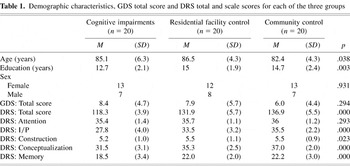
Demographic information, mean GDS total score and mean DRS total and scale scores, per group, are presented in Table 1. As expected, Table 1 shows that group differences in DRS total and scale scores were statistically significant. The participants in the cognitive impairment group obtained a mean DRS total score of 118.3 placing them, on average, in the 86.4th percentile of the DRS demented normative sample which suggested that the level of cognitive impairment in this group was relatively mild. The participants in the residential facility and community control groups scored well within the normal range and above the DRS cut-off score. Post-hoc comparisons revealed significant differences between the cognitive impairment group and both the residential facility and community control groups on the Initiation/Perseveration [t(38) = −5.569, p < .000; t(38) = −7.474, p < .000], Conceptualization [t(38) = −4.671, p < .000; t(38) = −7.007, p < .000] and Memory [t(38) = −3.874, p < .001; t(38) = −4.151, p < .000] scales. On the Construction scale group differences were significant only between the Cognitive Impairment and Community control groups [t(38) = −2.793, p < .05]. Group differences on the Attention scale were not significant. Differences between the two control groups were not significant on any of the DRS scales.
Demographic characteristics, GDS total score and DRS total and scale scores for each of the three groups

As shown in Table 1 group differences in age were statistically significant. Post-hoc comparisons revealed significant differences only between the residential facility and community control groups [t(38) = 2.586, p < .05]. Group differences in education were also statistically significant. Post-hoc comparisons revealed that the cognitive impairment group had lower education compared to both the community control [t(38) = −3.302, p < .005] and residential facility control [t(38) = −2.872, p < .05] groups. The difference in education between the two control groups was not statistically significant. Group differences in depression were not statistically significant. Furthermore, the mean GDS score of each group was below the depression cut-off score. Consistent with the approximate 2:1 female-to-male ratio found in each group, differences in gender distribution were not significant.
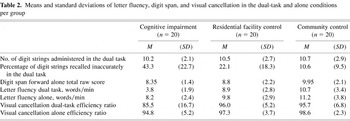
Descriptive statistics (M, SD) for letter fluency, digit span, and the cancellation test in the alone and dual-task conditions are presented, per group, in Table 2. Inspection of Table 2 suggests that group differences on letter fluency and digit span in the alone conditions were rather small. However, group differences on these two verbal tasks appeared to have increased substantially in the dual-task conditions. With respect to digit span, the mean number of total digit strings administered during the dual-task condition was comparable among the three groups. All three groups performed almost at optimal level on the visual cancellation task in the alone condition. While the two control groups maintained close to optimal performance in the dual-task conditions, a slight decrease on this task was observed in the Cognitive Impairment group.
Means and standard deviations of letter fluency, digit span, and visual cancellation in the dual-task and alone conditions per group

One-way MANOVA was run with group as the three-level independent variable and letter fluency, digit span and visual cancellation in the dual-task conditions serving as the dependent measures. Age, education, letter fluency, digit span, and visual cancellation when performed as single tasks served as statistical covariates. The histograms of both digit span and letter fluency in the dual-task conditions were indicative of distributions that approached normality. The distribution of the visual cancellation efficiency ratio was negatively skewed due to the ceiling effect observed on this task in all groups. The assumption of equality of the covariance matrices has not been satisfied based on the significant Box's test results. The results of the evaluation of linearity and multicollinearity were satisfactory. Using the Wilks' criterion, the results revealed that group status had a significant effect on the combined three dependent measures [Wilks's Λ = .487, F(6,100) = 7.21, p < .0001, η2 = .302].
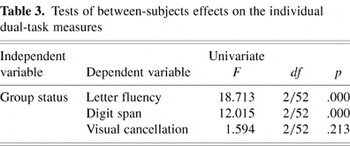
Summary of the results examining the effect of group status on each of the three dual-task measures is presented in Table 3. As shown in Table 3 performance on letter fluency and digit span in the dual-task conditions was significantly affected by group status. However, group differences on visual cancellation were not significant which is likely due to the ceiling effect observed on this measure.
Tests of between-subjects effects on the individual dual-task measures

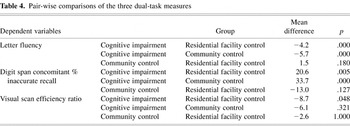
Summary of group comparisons on each of the three dual-task dependent measures is presented in Table 4. Table 4 reveals that the cognitive impairment group performed significantly more poorly on letter fluency and digit span compared to both control groups. Group differences on visual cancellation were not significant after controlling for multiple comparisons. In addition, differences between the two control groups were not significant on any of the dual-task measures.
Pair-wise comparisons of the three dual-task measures

Discriminant function analysis was performed to examine how accurately the participants were classified into a two-level cognitive status criterion using the dual-task measures as predictors. Because the Community and Residential Facility control groups did not differ on any of the dual-task measures they were collapsed into one control group (n = 40). The cognitive impairment group (n = 20) was the second level of the criterion. Three different discriminant function analyses were carried out.
The first analysis used letter fluency, digit span and visual cancellation in the dual-task conditions as predictors. The histograms of both digit span and letter fluency were indicative of distributions that approached normality in the cognitive impairment and control groups. The distribution of the visual cancellation test was negatively skewed due to the ceiling effect observed on this task. Also, there was no indication of non-linearity that might threaten the discriminant analysis. Pearson correlations between the predictors in the control group were: letter fluency and digit span (r = −.339, p < .05); letter fluency and visual cancellation (r = .109, p = ns); digit span and visual cancellation (r = −.124, p = ns). Pearson correlations between the predictors in the cognitive impairment group were letter fluency and digit span (r = −.210, p = ns); letter fluency and visual cancellation (r = .220, p = ns); digit span and visual cancellation (r = .129, p = ns). The discriminant function showed that the three dual-task measures were significant predictors of group membership in the two-level cognitive status criterion [Λ(3) = .404, p < .0001]. Overall, classification accuracy was at 91.7%. Specifically, 18 of the 20 participants in the cognitive impairment group and 37 of the 40 control participants were correctly classified into their original groups.
The second discriminant function used the letter fluency, digit span and visual cancellation tests when administered alone to predict group membership in the two-level cognitive status criterion,. This second discriminant function was statistically significant [Λ(3) = .743, p < . 001]. However, only 73.3% of the participants were correctly classified. Eight individuals in the cognitive impairment group and 8 controls were misclassified.
In the third discriminant function the three dual-task measures were orthogonalized with respect to age and education and then used as predictors of the two-level cognitive status criterion. This third discriminant function was statistically significant [Λ(3) = .580, p < .0001], yielding a classification accuracy of 81.7%. In the cognitive impairment group, 18 of the 20 participants were classified correctly. Of the 40 control participants 31 were correctly classified.
DISCUSSION
The present study compared dual-task performance between elderly individuals with cognitive impairments and normal controls. Effort was made to ensure that methodological issues relevant to the assessment of dual-task performance (Guttentag, 1989; Hartley, 1992) were addressed in the experimental design. The two dual-task conditions were comprised of relatively simple tasks that are presumably processed via separate stimulus response channels: visual–manual and auditory–verbal.
The results revealed that dual-task costs were significantly larger in elders with cognitive impairments relative to normal controls. The effect of cognitive status on dual-task performance, as evident from the multivariate analysis, was not attenuated when performance differences on each of the single tasks were controlled for statistically. These findings extend our knowledge with respect to the association between cognitive status and dual-task performance in aging. While previous research revealed that dual-task costs were larger in AD patients compared to normal controls (Baddeley et al., 1986, 1991, 2001) we have demonstrated using a conceptually similar paradigm that greater dual-task costs were observed in elders with cognitive impairments who were not diagnosed with dementia compared to normal controls. These findings suggest that the ability to execute concomitantly two competing tasks may be sensitive to subtle changes in cognitive status in aging.
It was of further interest to examine how accurately the dual-task measures discriminated between elderly individuals with cognitive impairments and normal controls and whether they were more sensitive than traditional neuropsychological measures to cognitive status in aging. Because the community and residential facility control groups were not statistically different in terms of their dual-task performance they were collapsed into one control group. Using the dual-task measures as predictors the discriminant function analysis yielded an overall classification accuracy of 91.7% in assigning the participants into the two-level cognitive status criterion. The sensitivity and specificity indices were comparable. Furthermore, a second discriminant function that used letter fluency, digit span and visual cancellation when administered alone as predictors, although statistically significant, provided a lower classification accuracy (73.3%). These findings suggest that dual-task performance was more sensitive to cognitive status in aging than the traditional neuropsychological measures that served as the single tasks in this study. In the third discriminant function the dual-task measures were orthogonalized with respect to age and education in order to remove the effect of these two demographic variables on the classification accuracy. While the discrimination of the orthogonalized dual-task measures was somewhat reduced (81.7%), it was still higher than either a base rate prediction or the discrimination accuracy of the single measures.
Although the discriminant analysis was appropriate insofar as to demonstrate the relation between dual-task measures and cognitive status which was determined based on DRS scores, the high classification accuracy it yielded should be interpreted with some caution. The DRS is influenced by measures of executive functions. Hence, using the dual tasks, which capture one facet of executive functions to predict cognitive status that was determined based on scores of another neuropsychological test that also assesses facets of these higher order cognitive abilities, presents an element of circularity that must be acknowledged. The sensitivity of dual tasks to cognitive status in aging should be further assessed using a more general test of cognitive/intellectual function that does not rely on executive functions.
Dual-task costs were notable on letter fluency and digit span but statistically insignificant on the visual cancellation task. This variable effect may be attributed to several reasons. The ceiling effect that was observed on visual cancellation when administered alone and the near optimal performance in the dual-task conditions suggest that this task might have been too easy. In contrast, letter fluency and digit span are both sensitive to cognitive decline in aging. While performance on these two tasks when administered alone was quite comparable among the three groups, it appears that introducing the interference (concomitant visual cancellation task) has forced those elders with cognitive impairments to perform above their “resource threshold.” Consequently, their dual-task costs on letter fluency and digit span were increased substantially compared to the normal controls whose threshold was not exceeded even with the interfering task. One additional possibility is that the participants in the cognitive impairment group have allocated more attentional resources to the easier visual cancellation task compared to letter fluency and digit span in order to maximize their dual-task performance. This, however, was contrary to the task instructions and reports by the participants indicating that they have assigned equal importance to each test in the dual-tasks.
Limitations of this study are concerned with the demographic characteristics of the participants. The effect of education and ethnicity on neuropsychological test performance has been studied extensively (e.g., Heaton et al., 1996). While the demographics of the present sample were representative of the area in which the study was conducted, generalization of these findings to other samples that vary in terms of education and ethnicity cannot be assumed. Also, caution in generalization is in place given the relatively small sample size of the present study. Finally, while the sensitivity of dual-task measures to cognitive status in aging was superior to a few selected single measures, it should be emphasized that the range of neuropsychological tests used in this study was constrained. Hence, further studies should examine whether dual-task performance indices provide better or at least additional information with respect to cognitive status in aging that is not available from traditional and commonly used measures.
In conclusion, dual-task costs were greater in elders with cognitive impairments relative to normal controls even after performance differences on the single tasks were controlled for statistically. In the present study dual-tasks were more sensitive to cognitive status in aging compared to the single neuropsychological tests. We propose that dual-task measures may provide additional and important information regarding cognitive status in aging that is not available from routinely used standardized neuropsychological measures.
ACKNOWLEDGMENTS
We thank Dr. Igor Grant (Editor-in-Chief), Dr. Bruce Crosson (Associate Editor) and 4 anonymous reviewers for constructive comments on previous drafts of this paper. This study was supported by a grant that was awarded to the first author from the Center for Developmental Psychobiology at Binghamton University.
References
REFERENCES
American Psychiatric Association.
(1994).
Diagnostic and statistical manual of mental disorders
(4th ed.).
Washington, DC:
Author.
Baddeley, A.D.,
Baddeley, H.A.,
Buck, R.S., &
Wilcock, G.K.
(2001).
Attentional control in Alzheimer's disease.
Brain,
124,
1492–1508.CrossRefGoogle Scholar
Baddeley, A.D.,
Logie, R.,
Bressi, S.,
Della Salla, S., &
Spinnler, H.
(1986).
Dementia and working memory.
Quarterly Journal Experimental Psychology,
38A,
603–618.CrossRefGoogle Scholar
Baddeley, A.D.,
Logie, R.,
Bressi, S.,
Della Salla, S., &
Spinnler, H.
(1991).
The decline of working memory in Alzheimer's disease.
Brain,
114,
2521–2542.CrossRefGoogle Scholar
Baddeley, A.D. &
Hitch, G.
(1974).
Working memory. In
G.H. Bower (Ed.),
The psychology of learning and motivation
(Vol. 8, pp.
47–89).
New York:
Academic Press.
Crossley, M. &
Hiscock, M.
(1992).
Age-related differences in concurrent task performance of normal
adults: Evidence for a decline in processing resources.
Psychology and Aging,
7,
499–506.CrossRefGoogle Scholar
Durate Silva, P. &
Stam, A.
(1996).
Discriminant analysis. In
L.G. Grimm &
P.R. Yarold (Eds.),
Reading and understanding multivariate statistics (pp.
277–318).
Washington, DC:
American Psychological Association.
Glass, J.M.,
Shumacher, E.H.,
Lauber, E.J.,
Zurbriggen, E.L.,
Gmeinkl, L.,
Kieras, D.E., &
Meyer, D.E.
(2000).
Aging and the psychological refractory period: Task coordination
strategies in young and old adults.
Psychology and Aging,
15,
571–595.CrossRefGoogle Scholar
Guttentag, R.
(1989).
Age differences in dual-task performance: Procedures, assumptions
and results.
Developmental Review,
9,
146–170.CrossRefGoogle Scholar
Hartley, A.A.
(1992).
Attention. In
F.I.M. Craik &
T.A. Salthouse (Eds.),
Handbook of aging and cognition (pp.
1–49).
Hillsdale, NJ:
Erlbaum.
Hartley, A.A.
(2001).
Age differences in dual-task interference are localized to
response-generation processes.
Psychology and Aging,
16,
47–54.CrossRefGoogle Scholar
Hartley, A.A. &
Little, D.M.
(1999).
Age related differences and similarities in dual-task interference.
Journal of Experimental Psychology: General,
128,
41–449.CrossRefGoogle Scholar
Heaton, R.K.,
Ryan, L.,
Grant, I., &
Matthews, C.G.
(1996).
Demographic influence on neuropsychological test performance. In
I. Grant &
K.M. Adams (Eds.),
Neuropsychological assessment of neuropsychiatric disorders (pp.
141–163).
New York:
Oxford University Press.
King, D.A. &
Caine, E.D.
(1996).
Cognitive impairments and major depression: Beyond the
pseudodementia syndrome. In
I. Grant &
K.M. Adams (Eds.),
Neuropsychological assessment of neuropsychiatric disorders (pp.
200–217).
New York:
Oxford University Press.
Lamberty, G.J. &
Bieliauskas, L.A.
(1993).
Distinguishing between depression and dementia in the elderly: A
review of neuropsychological findings.
Archives of Clinical Neuropsychology,
8,
149–170.CrossRefGoogle Scholar
Lezak, M.D.
(1995).
Neuropsychological assessment
(3rd ed.).
New York:
Oxford University Press.
Li, K.Z.H.,
Lindenberger, U.,
Freund, A.M., &
Baltes, P.B.
(2001).
Walking while memorizing: Age-related differences in compensatory
behavior.
Psychological Science,
12,
230–237.CrossRefGoogle Scholar
Mattis, S.
(1988).
Dementia Rating Scale.
Odessa, FL:
Psychological Assessment Resources.
McDowd, J.M. &
Shaw, R.J.
(2000).
Attention. In
F.I.M. Craik &
T.A. Salthouse (Eds.),
Handbook of aging and cognition
(2nd ed., pp.
221–292).
Hillsdale, NJ:
Erlbaum.
McKhann, G.,
Drachamn, D.,
Folstein, M.,
Kazman, R.,
Price, D., &
Stadlan, E.M.
(1984).
Clinical diagnosis of Alzheimer Disease: Report of the NINCDS-ADRDA
work group under the auspices of the Department of Health and Human
Services Task Force on Alzheimer Disease.
Neurology,
34,
939–944.CrossRefGoogle Scholar
Nyberg, L.,
Nilsson, L.G.,
Olofsson, U., &
Backman, L.
(1997).
Effects of division of attention during encoding and retrieval on
age differences in episodic memory.
Experimental Aging Research,
23,
137–143.CrossRefGoogle Scholar
Salthouse, T.A. &
Miles, J.D.
(2002).
Aging and time sharing aspects of executive control.
Memory and Cognition,
30,
572–582.CrossRefGoogle Scholar
Salthouse, T.A.,
Rogan, J.D., &
Perill, K.A.
(1984).
Division and attention: Age differences on a visually presented
memory task.
Memory and Cognition,
12,
613–620.CrossRefGoogle Scholar
Somberg, B.L. &
Salthouse, T.A.
(1982).
Divided attention abilities in young and old adults.
Journal of Experimental Psychology: Human Perception and
Performance,
8,
651–663.CrossRefGoogle Scholar
Spitzer, R.L.,
Edicott, J., &
Robins, E.
(1978).
Research diagnostic criteria: Rational and reliability.
Archives of General Psychiatry,
35,
773–782.CrossRefGoogle Scholar
Spreen, O. &
Strauss, E.
(1998).
A compendium of neuropsychological tests.
New York:
Oxford University Press.
Stuss, D.T.
(1992).
Biological and psychological development of executive functions.
Brain and Cognition,
20,
8–23.CrossRefGoogle Scholar
Stuss, D.T. &
Alexander, M.P.
(2000).
Executive functions and the frontal lobes: A conceptual view.
Psychological Research,
63,
289–298.CrossRefGoogle Scholar
Stuss, D.T. &
Levine, B.
(2002).
Adult clinical neuropsychology: Lessons from studies of the frontal
lobes.
Annual Review of Psychology,
53,
401–433.CrossRefGoogle Scholar
Tun, P.A. &
Wingfield, A.
(1994).
Speech recall under heavy load conditions: Age, predictability and
limits on dual-task interference.
Aging and Cognition,
1,
029–044.CrossRefGoogle Scholar
Wechsler, D.
(1997).
Wechsler Adult Intelligence Test, Third Edition.
San Antonio, TX:
The Psychological Corporation.
Whiting, W.L. &
Smith, A.D.
(1997).
Differential age-related processing limitations in recall and
recognition tasks.
Psychology and Aging,
12,
216–224CrossRefGoogle Scholar
Wickens, C.D.,
Braune, R., &
Stokes, A.
(1987).
Age differences in the speed and capacity of information
processing: 1. A dual-task approach.
Psychology and Aging,
2,
70–78.Google Scholar
Yesavage, J.A.,
Brink, T.L.,
Rose, T.L., &
Leirer, V.O.
(1983).
Development and validation of a geriatric depression screening
scale: A preliminary report.
Journal of Psychiatric Research,
17,
37–49.Google Scholar
Demographic characteristics, GDS total score and DRS total and scale scores for each of the three groups
Means and standard deviations of letter fluency, digit span, and visual cancellation in the dual-task and alone conditions per group
Tests of between-subjects effects on the individual dual-task measures
Pair-wise comparisons of the three dual-task measures
 You have
Access
- 21
- Cited by