The present study on Chinese children's writing in English as a foreign language (EFL) had three purposes. The first was to examine the overlap in writing quality across essays in Chinese and in English in order to test whether there might be some evidence for “transfer” or overall higher order planning (e.g., Hayes, Reference Hayes, Levy and Ransdell1996; Hayes & Flower, Reference Hayes, Flower, Gregg and Steinberg1980) across languages in children's essay writing. The second was to test for lower order longitudinal cognitive correlates of writing composition in English and to compare these in relation to cognitive correlates of native Chinese writing composition following previous work in this area (Yan, McBride-Chang, Wagner, Zhang, Wong & Shu, Reference Yan, McBride-Chang, Wagner, Zhang, Wong and Shu2012). The third was to compare errors made by EFL Chinese children in writing a composition as compared to errors made by native English-speaking American children of approximately the same age and grade level writing on the same topic, in order to determine which errors seem fairly consistent across groups and which appear to be most strongly associated with EFL status in those from a Chinese background. Our focus was, thus, on both higher order aspects of writing and lower level constraints on writing in the EFL writing process in Chinese children. Of primary interest in relation to higher order aspects of writing was the extent to which writing composition in a first language (L1) and a second language (L2) would be associated, presumably indicating similar ways of conceptualizing ideas in writing. Lower level constraints included both reading-related cognitive and linguistic skills, as well as a separate analysis of mechanical errors made by these children.
Research on writing composition in children has thus far focused primarily on the process and characteristics of writing in both a first (e.g., Bereiter & Scardamalia, Reference Bereiter and Scardamalia1987; Berninger, Reference Berninger1999; Berninger & Swanson, Reference Berninger, Swanson, Butterfield and Carlson1994; Berninger, Vaughan, Abbott, Begay, Byrd, Curtin, Hawkins & Graham, Reference Berninger, Vaughan, Abbott, Begay, Byrd, Curtin, Hawkins and Graham2002; Hayes, Reference Hayes, Levy and Ransdell1996; Hayes & Flower, Reference Hayes, Flower, Gregg and Steinberg1980) and a second language (e.g., Edelsky, Reference Edelsky1982; Hudelson, Reference Hudelson1989; Juel, Griffith & Gough, Reference Juel, Griffith and Gough1986; Lanauze & Snow, Reference Lanauze and Snow1989; Montague, Reference Montague1995; Reynolds, Reference Reynolds2005). Most of the research on writing composition in a nonnative language in children has focused on those for whom Spanish is the first language (e.g., Lanauze & Snow, Reference Lanauze and Snow1989). This research tends to highlight the similarities or transfer of writing skills across Spanish and English (Lanauze & Snow, Reference Lanauze and Snow1989). Spanish and English share some clear commonalities, including use of the Roman alphabet, S–V–O sentence structure, and different forms of verbs of various tenses. A study on EFL writing composition among Chinese children is a nice contrast to the English–Spanish pairing because of some notable differences across scripts, including writing system and relationship between sounds and symbols (i.e., alphabetic vs. ideographic.
To what extent might higher order writing processes be transferrable across Chinese to English in children? Relatively few studies have tested this issue in children. However, research on children's reading comprehension often yields at least moderate associations between reading comprehension in L1 and L2 (e.g., Li, McBride-Chang, Wong & Shu, in press; Van Gelderen, Schoonen, Stoel, de Glopper & Hulstijn, Reference Van Gelderen, Schoonen, Stoel, De Glopper and Hulstijn2007). Such research suggests that there may be some common meta-cognitive skills that are common to the process of reading to learn or reading to remember in both in L1 and L2. Some of these same common thinking skills might also apply to writing composition across orthographies. For example, it is possible that the planning aspect of writing as described by John R. Hayes and Linda S. Flower (Hayes, Reference Hayes, Levy and Ransdell1996; Hayes & Flower, Reference Hayes, Flower, Gregg and Steinberg1980) might involve similar processes across languages. In the present study, we tested the correlation between overall L1 and L2 writing composition in order to attempt to begin to capture the idea of overlap or transfer in writing composition across languages.
Because the children in our study learned Chinese as a first language, we scored their writing in English according to the same criteria as those used for their Chinese writing to maximize our ability to compare across languages. We used the five criteria developed by Yan et al. (Reference Yan, McBride-Chang, Wagner, Zhang, Wong and Shu2012) in order to ultimately create a single score for assessing essay quality. These researchers scored essay writing according to depth, or the extent to which students elaborated on their ideas within the writing, as well as sentence and paragraph organization. These two organization variables had to do with logic and connectedness at each of these levels. In addition, the essay writing scoring included a category called “key elements”, which highlighted organization at the overall essay level (including presence or absence of a topic sentence to begin the essay and a conclusion at the end). Finally, writing was scored on overall intelligibility, defined as how easy and smooth the composition was to read overall. Each of these elements was scored on a four-point scale. Generally, these criteria were similar to those used by previous researchers in scoring English compositions (e.g., Cameron, Lee, Webster, Munro, Hunt & Linton, Reference Cameron, Lee, Webster, Munro, Hunt and Linton1995; Wagner, Puranik, Foorman, Foster, Gehron, Tschinkel & Patricia Reference Wagner, Puranik, Foorman, Foster, Gehron, Tschinkel and Patricia2011). However, because the focus on mechanical errors tended to be minimally important to the overall structure of the English compositions as reported by Wagner et al. (Reference Wagner, Puranik, Foorman, Foster, Gehron, Tschinkel and Patricia2011) and because mechanical errors such as period or comma placement are more ambiguous in Chinese than they are in English (Yan et al., Reference Yan, McBride-Chang, Wagner, Zhang, Wong and Shu2012), this mechanical error aspect of the writing was not included in the present study for the purposes of evaluation of overall quality across languages in the same writers. Rather, we scored these mechanical errors separately as a means to understanding differences in writing in a first and foreign language in English as described later. We tested the factor structure of the English compositions as scored according to these five criteria with the goal of creating a total writing composition composite, to be examined in relation to a total score in Chinese writing composition, as well as in relation to longitudinal (ages 5–9) cognitive and linguistic correlates of English writing composition.
Previously, Yan et al. (Reference Yan, McBride-Chang, Wagner, Zhang, Wong and Shu2012) had tested variables focused on speeded naming and general speed of processing, character reading and spelling, phonological awareness, and vocabulary knowledge in Chinese only in order to test the extent to which any of these would be uniquely predictive of writing composition in Chinese. In the present study, we reanalyzed these data from Yan et al. (Reference Yan, McBride-Chang, Wagner, Zhang, Wong and Shu2012) for both Chinese and English. Our approach was similar to that of Yan et al. (Reference Yan, McBride-Chang, Wagner, Zhang, Wong and Shu2012) with two additions to these analyses. First, given the concept of higher order transfer of literacy skills (e.g., Van Gelderen et al., Reference Van Gelderen, Schoonen, Stoel, De Glopper and Hulstijn2007), defined here as use of knowledge of Chinese in order to support English language learning, for writing composition, we statistically controlled for writing in the other language as we carried out the analyses. This was done in an effort to control for any general higher order thinking or writing quality variability that might be consistent in writing exercises across languages. Second, we additionally included English cognitive and linguistic variables obtained across years in all regression equations. These were receptive vocabulary knowledge and English word recognition across all ages and English handwriting fluency at age 9 only.
According to Hayers and Flower (Reference Hayes, Flower, Gregg and Steinberg1980), writing composition comprises two components: translation and revising. Translation includes text generation, which is the translation of ideas into language representations, and transcription refers to the transformation of language representations into orthographic symbols (Berninger et al., Reference Berninger, Vaughan, Abbott, Begay, Byrd, Curtin, Hawkins and Graham2002; Hayers & Flower, Reference Hayes, Flower, Gregg and Steinberg1980). Cognitive and linguistic variables included in the present studies were related to either the transcription or text generation aspect of writing. Below is the rationale for inclusion of each variable.
Speed and fluency are an important component of writing skill, particularly in a timed writing composition exercise such as the one used in the present study. One kind of fluency measure that is often linked to composition fluency overall is that of handwriting itself (Berninger & Graham, Reference Berninger and Graham1998; Berninger, Vaughan, Abbott, Abbott, Rogan, Brooks, Reed & Graham Reference Berninger, Vaughan, Abbott, Abbott, Rogan, Brooks, Reed and Graham1997; Jones & Christensen, Reference Jones and Christensen1999). The more automatic handwriting is, the more cognitive resources it can free up for high order writing processes and therefore the better the writing quality that can be achieved (Berninger, Reference Berninger1999). In contrast, if handwriting is not automatized, writing quality would be reduced (Graham, Berninger, Abbott, Abbott & Whitaker, Reference Graham, Berninger, Abbott, Abbott and Whitaker1997). General speed of processing has also been linked to early literacy skills in both a first and a second language (McBride-Chang & Kail, Reference McBride-Chang and Kail2002). Moreover, rapid automatized naming skill has been linked to writing in Chinese fairly strongly (Chan, Ho, Tsang, Lee & Chung, Reference Chan, Ho, Tsang, Lee and Chung2006; Ding, Richman, Yang & Guo, Reference Ding, Richman, Yang and Guo2010), so it was included as a third speeded indicator in the present study. Ultimately, of these automaticity-like variables, both handwriting fluency and general speed of processing were unique correlates of writing composition in the study by Yan et al. (Reference Yan, McBride-Chang, Wagner, Zhang, Wong and Shu2012).
In addition, dictation and word recognition skills were included in the present study. Spelling tends to be a particularly strong correlate of writing composition in studies of children in a first language (e.g., Graham et al., Reference Graham, Berninger, Abbott, Abbott and Whitaker1997; McCutchen, Reference McCutchen, Carlson and Calfee1995; Yan et al., Reference Yan, McBride-Chang, Wagner, Zhang, Wong and Shu2012). Children's developing writing is often limited by the words they know how to spell with confidence. Unfortunately, in the present study, we did not measure children's general spelling skills in English. However, we did consistently include measures of word recognition in both Chinese and English at every year tested. This allowed us to explore the extent to which basic print recognition might explain the higher level literacy skill of writing composition across languages. We reasoned that children's foreign language English writing should be limited by the words in English that they know, as is the case for first language composition writing; including English word reading helped us to test this empirically.
Phonological awareness measured only in Chinese was also included in the present study. Phonological skills have been discussed as one component of writing, particularly via phonological memory (e.g., Levy & Marek, Reference Levy, Marek, Torrance and Jeffery1999). Phonological awareness has been shown to be strongly related to English but not necessarily to Chinese literacy skills in Hong Kong Chinese children learning English as a foreign language even in late primary school students (Chung & Ho, Reference Chung and Ho2010; Tong & McBride-Chang, Reference Tong and McBride-Chang2010). Therefore, one question in the present study was whether phonological awareness as measured in Chinese might be associated similarly or differently with writing composition in Chinese as compared to English.
In addition to the aforementioned variables related to transcription, vocabulary knowledge, the meaning aspects of language representation, is important for text generation. Therefore, vocabulary skills in both Chinese and English across years were included in the present study as well. Lexical diversity tends to be highlighted as an essential aspect of composition quality (Beard, Reference Beard1986; Wagner et al., Reference Wagner, Puranik, Foorman, Foster, Gehron, Tschinkel and Patricia2011). Particularly for foreign language learners, it seems reasonable to assume that without knowledge of a variety of words, students will be limited in their capacity to write text. Along with vocabulary knowledge, we also included morphological awareness in the form of lexical compounding, measured in Chinese only. Several recent studies (Pasquarella, Chen, Lam & Luo, Reference Pasquarella, Chen, Lam and Luo2011; Wang, Cheng & Chen, Reference Wang, Cheng and Chen2006; Zhang, Anderson, Li, Dong, Wu & Zhang, Reference Zhang, Anderson, Li, Dong, Wu and Zhang2010) have demonstrated some transfer of morphological awareness in the form of lexical compounding from Chinese to English, with one (Zhang et al., Reference Zhang, Anderson, Li, Dong, Wu and Zhang2010) demonstrating that teaching of Chinese compounding can facilitate English skills in Chinese children learning English as a foreign language. Thus, in the present study, morphological awareness, which is bidirectionally associated with vocabulary development (McBride-Chang, Tardif, Cho, Shu, Fletcher, Stokes, Wong & Leung, Reference McBride-Chang, Tardif, Cho, Shu, Fletcher, Stokes, Wong and Leung2008), was included in all analyses. We wanted to test the extent to which morphological awareness, in addition to vocabulary knowledge, might also be a unique correlate of writing composition skill.
One final variable included in the present study was mothers’ education level. Parental education is often uniquely associated with children's literacy skills across cultures (Chiu & McBride-Chang, Reference Chiu and McBride-Chang2006). Moreover, in the context of Hong Kong, the site of the present study, mothers’ education level is particularly important because of the status associated with learning English (e.g., Cheung & Ng, Reference Cheung, Ng, McBride-Chang and Chen2003). In general, wealthier and better educated parents tend to be able to afford extra resources to put into English lessons for their children, whether such resources consist of their own time and energy spent in going over English homework, which better educated parents often know relatively well (e.g., Chow, McBride-Chang & Cheung, Reference Chow, McBride-Chang and Cheung2010, hiring a tutor after school to boost their children's learning, or having a helper, or maid, working at home who uses English to communicate with the family (Cheung & Ng, Reference Cheung, Ng, McBride-Chang and Chen2003).
While longitudinal predictors of English writing composition, including both higher order “general” writing composition skill in the form of a total score of writing composition in Chinese, and lower order linguistic and cognitive skills over time were one focus of the present study, our other focus was a comparison of errors in Chinese children's writings in English. To do this, we compared the Chinese children's mechanical errors that naturally occurred within each essay with those of native English speakers of the same grade level. This comparison of mechanical errors in English writing between native Chinese speaking children and native English speakers from America was motivated in part because such errors are an important component of developing writing in English (e.g., Wagner et al., Reference Wagner, Puranik, Foorman, Foster, Gehron, Tschinkel and Patricia2011). Adults writing in English as a second language make particular errors in accuracy and grammar (for a review, see Silva, Reference Silva1993). However, the types of writing errors children make are likely to depend at least partly on their first language. There have been several research studies documenting the effects of Chinese as a first language on English reading as a second language, particularly at the word level (Gottardo, Yan, Siegel & Wade-Woolley, Reference Gottardo, Yan, Siegel and Wade-Woolley2001; Wang, Perfetti & Liu, Reference Wang, Perfetti and Liu2005). Wang and Geva (Reference Wang and Geva2003) have also focused particularly on Chinese children's spelling of English, demonstrating that Chinese children tend to recall visually presented words better than native English speakers in some instances, perhaps because of the strong orthographic focus that comes from learning Chinese. However, few, if any, studies have focused on Chinese children's writing beyond the word level in relation to mechanical errors.
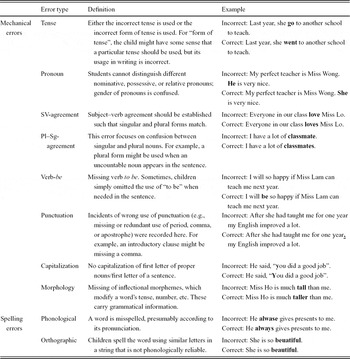
In the present study, we focused on mechanical errors that raters recognized from the perspective of native Chinese speakers. A full list of errors rated is shown in Appendix 1. Many of these errors have been a focus of previous work on native English developing writers (e.g., Wagner et al., Reference Wagner, Puranik, Foorman, Foster, Gehron, Tschinkel and Patricia2011). However, some were specifically identified as potentially specific, or indigenous, to Chinese native speakers. For example, confusing the pronouns of he and she in speech is not a common error made by children speaking English. However, in Chinese, although “he” and “she” have a different written form, in oral language, these are pronounced the same (as is the word for “it” – all are pronounced as ta1 in Mandarin, for example). Therefore, there is often some confusion on the part of Chinese speakers as to when to say he or she in English conversation, since these are the same in Chinese. As another example, because the Chinese language has very few inflections, errors in inflections might be particularly salient in developing writers of English who have Chinese as a first language.
To explore these errors, we had raters rate essays on the same topic by American and Chinese children of the same age. Raters were blind to each child's origin. Ratings were primarily across the three categories of grammar, punctuation, and spelling.
Method
Participants
The Chinese children included across Analyses 1 and 2 were from a longitudinal study that began in 2002. They were recruited from five Maternal and Child Health Centers located in four regions across Hong Kong (Kowloon, Hong Kong Island, New Territories East, and New Territories West). The participants were all native Cantonese speakers and attended schools that used Cantonese as the language of instruction. At the same time, all children had begun to learn English at the age of 3.5 years, the time when Hong Kong kindergartens begin such instruction in English as a foreign language.
All the data for this study were collected yearly during the summers of 2005 to 2009. There were 153 children (62 boys, 91 girls) included in the present study, and they wrote Chinese and English compositions from July to September 2009. Their ages ranged from 103 to 117 months old (M = 109.64, SD = 3.43). In addition, based on the year for data collection, variables were labeled accordingly as tested at ages 5, 6, 7, 8 and 9 respectively.
The cross-country analysis additionally included 90 monolingual English-speaking American children from Florida (see Wagner et al., Reference Wagner, Puranik, Foorman, Foster, Gehron, Tschinkel and Patricia2011) who were from the fourth grade and were, thus, approximately nine years old. The participants were representative of the population of students in schools from which they were drawn. This population included 49% White, 43% Black, and 4% Hispanic students. The remaining children, classified as “other” were primarily Asian. Socioeconomic status in the group was primarily middle and lower class. For Hong Kong pariticipants, although they had begun to learn English at the age at 3.5 via kindergarten instruction, the dominant language they used outside of their classrooms was Cantonese. The American participants were monolingual English-speaking children. As both Hong Kong and American participants were somewhat representative of the populations of students in schools from which they were drawn, the English proficiency level of the American participants was generally higher than that of the Hong Kong participants.
Procedure
In each year, undergraduate psychology majors were recruited as testers. Consent forms were obtained from participants’ parents prior to the study in each year. The date and time for testing were arranged by testers with the participating children and their caregivers during the summer. Children were usually tested at home or, occasionally, in a laboratory on campus. Different tasks were administered in each year because of theoretical interests and practical issues, and the time needed for testing in each year varied from 1.5 to 2 hours.
Measures
Chinese composition
Chinese composition was only administered to the Chinese participants at age 9. The topic assigned for the Chinese composition was “My Favorite Toy”. Pilot testing indicated that this topic was a good one for the children, because no child had difficulties in considering what to write on this topic. Participants were asked to write within a 10-minute time limit; they were expected to write continuously. Before the participants started to write, instruction was given by the testers in Cantonese (as shown in Appendix 2).
English composition
English composition writing was also only administered at age 9 to both the Chinese and American children. The topic for the English composition was “A Classroom Pet”. This composition topic was selected to match the American sample from Wagner et al. (Reference Wagner, Puranik, Foorman, Foster, Gehron, Tschinkel and Patricia2011). Pilot testing indicated that this topic was a suitable one for the Hong Kong Chinese children, who tended to select rabbits, dogs, or hamsters most of all for their focus. Participants were asked to write about their preference for a classroom pet within a 10-minute time limit; they were told that we wanted them to write continuously. Before the participants began writing, an introduction to the task was given by the testers in Cantonese. The instructions were similar to the ones given for the Chinese composition, following Wagner et al. (Reference Wagner, Puranik, Foorman, Foster, Gehron, Tschinkel and Patricia2011) (see Appendix 3).
Composition coding criteria
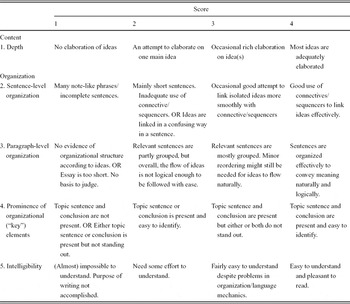
Each composition was coded by two trained raters according to five criteria, namely depth, sentence-level organization, paragraph-level organization, prominence of overall organizational elements, and intelligibility (see Table 1). This five-component scale was adopted from Yan et al. (Reference Yan, McBride-Chang, Wagner, Zhang, Wong and Shu2012). The maximum score for each element was 4; therefore, 20 was the maximum score for each composition, and 5 was a minimum score possible. The components were defined as described below.
Chinese composition rubric for Hong Kong third grade children.

Depth
Depth was used to represent the richness of the compositions. Depth taps the extent to which there is elaboration of the dimensions/aspects discussed.
Organization
Sentence-level, paragraph-level and overall organizational elements were used to evaluate the organization of the compositions. “Sentence level” focused on the completeness of each sentence and the complexity of the sentence structure. “Paragraph level” captured the logical ordering and grouping of ideas within paragraphs. Overall organizational key elements were measured by a consideration of the presence of a topic sentence and conclusion.
Intelligibility
It was defined as the extent to which the compositions were easy to understand despite problems in organization and language mechanics. Inter-rater reliabilities for these elements of English writing composition were .72 for depth, .82 for presentation of ideas, .75 for ordering of sentences, .74 for key elements, and .77 for overall intelligibility. The inter-rater reliabilities for Chinese writing composition, reported by Yan et al. (Reference Yan, McBride-Chang, Wagner, Zhang, Wong and Shu2012), ranged from .72 to .77.
It is important to note that for the English essay only, coding was done twice by different sets of raters. Whereas the first set of raters rated the compositions on the five criteria mentioned above for the Hong Kong sample only, a second set of raters rated all essays written in English, from both the Hong Kong and American students on errors; these raters were blind to whether the essays were from the Hong Kong or American students. Again, these compositions were coded first by a trained Chinese student helper with a psychology major across all ten error types as listed in Table 6 below, and frequencies of all error types were obtained. Then, 20% of the compositions (50 papers) were randomly selected and recoded by another Chinese undergraduate and a native English speaker to derive a final inter-rater reliability.
Chinese character recognition
This task was administered to the children at ages 5–9 years. For age 5, there were two parts to this task, with 61 words (27 one-character words and 34 two-character words) in the first section and 150 two-character words in the second section. From ages 6 to 9 years, only the 150 two-character words were administered, because students had basically reached “ceiling” on the first section. Participants were required to read the words one by one aloud. The children were given one point for reading each word presented individually (comprising between one and three characters) correctly; zero points were awarded for an incorrect reading of any word. This testing stopped when 10 consecutive words were incorrectly read aloud by participants in the first part of the task at age 5, or if 15 consecutive words were incorrectly identified in the second part of the task for ages 5 years and older.
Chinese word dictation
This task was adapted from the Hong Kong Test of Specific Learning Difficulties in Reading and Writing (Ho, Chan, Tsang & Lee, Reference Ho, Chan, Tsang and Lee2000). Participants were asked to write 20, 25, and 48 two-character words in this task when they were 6, 7, and 8 years old, respectively. Changes in item numbers reflected the children's growth in knowledge of character knowledge across years. The tester read each word aloud one by one, and each child was asked to write each word individually as it was presented. Children were asked to write each character of each word in a designated square box; they were asked to put a cross in the box when they encountered a character that they did not know how to write. The task was stopped when participants missed eight consecutive words in a row. The total score for this task was the total number of characters that were correctly written down.
Chinese vocabulary definition
This task tested children's expressive vocabulary knowledge. All words used in this task appeared frequently in textbooks in Hong Kong primary schools (Zhuang, Reference Zhuang2000). The scoring scheme and procedures for this task were adapted from the Hong Kong Wechsler Intelligence Scale for children, published in 1981 by Hong Kong Education Department and the Hong Kong Psychological Society with a rating scheme developed with reference to a Chinese dictionary (Lau, Reference Lau1999). This task was administered to children at ages 5 to 9 years old. There were 46 vocabulary items at age 5, and 52 vocabulary items at ages 6 to 9, and they were arranged in increasing order of conceptual difficulty. Participants were required to provide explanations orally for these vocabulary items. Zero, one, or two points for each item were allotted according to the clarity and depth of the answers given based on the scoring scheme.
Morphological awareness
Some version of this measure was administered to the children across all ages of the children in the present study. To tap morphological construction, participants were asked to produce a plausible (but nonexistent) word or phrase to describe a given scenario using principles of lexical compounding, which are relatively prevalent in Chinese. For instance, one item was “a traffic light (燈) (literally “lamp” in Chinese) with both red (紅) and green (綠) colors, called a “red-green lamp” (紅綠燈). What would we call a traffic light made up of both blue and green colors? The correct answer should be 藍綠燈 “blue-green lamp”. One point was awarded for each question participants answered correctly, whereas zero points were given for a wrong answer. For the children at age 5, this task contained 20 items. There was no ceiling set rule in this task and participants were asked to answer all questions. For the children at 6–8 years, there were 27 items tapping morphological construction, and for age 9, there were 42 items. All items were comprised of either two or three syllables.
Phonological awareness
Children's phonological awareness was measured across the ages of 5–8 years with both syllable deletion and phoneme onset deletion items. All syllable items were comprised of three-syllable words from which a single syllable was deleted. For instance, with the initial syllable /fo2/ “fire” deleted, 火車站 /fo2 tse1 dzam6/ “train station” would become 車站 /tse1 dzam6/ “station”. For the phoneme onset deletion meausre, children were asked to repeat given syllables without the initial sound. For example, 快 /faai3/ “quick” would become 嗌 /aai3/ “shout” without the consonant. Testing stopped when the children got five in a row wrong at age 5 or four in a row wrong at ages 6–8 years.
English word reading
This test consisted of 30, 40, 40, 40 and 60 English words when participants were of the ages of 5, 6, 7, 8 and 9 years old, respectively. At age 5, the ceiling rule was 10 consecutive incorrect answers. For those of ages 6–9 years, once children answered four consecutive items incorrectly in the same level, the testing stopped. Participants were awarded one point for each word they correctly identified for this task.
Peabody Picture Vocabulary Test
Peabody Picture Vocabulary Test (PPVT III; Dunn, Dunn & Dunn, Reference Dunn, Dunn and Dunn1997) was used to assess participants’ receptive vocabulary ability; it was administered to the children across all testing times. For each test item, test administers would say aloud an English word as participants were presented with four numbered pictures. Participants were then asked to choose one of the pictures that could best represent the word. The words were arranged by increasing levels of difficulty and there were six words at each level. Following standard instructions, if the participants answered four items incorrectly within a level, the test stopped. This task was not normed for Hong Kong Chinese children. Therefore, raw scores only, rather than standard scores, were used in analyses that included this task. It was admittedly not a good match that we tapped vocabulary using an expressive measure in Chinese and a receptive measure in English, but it was practically a more realistic choice for the study because the students had different levels of knowledge in the different languages across time.
Rapid number naming
This task was administered to the children when they were 5 to 8 years old. Participants were shown a piece of paper with 25 single digits printed on it, arranged in 5 rows with 5 digits across each row. After the testers determined that the children could recognize each digit by naming it untimed, the participants were asked to name the digits as quickly as possible row by row starting from the first row on the left. A stopwatch was used to record the total time taken to name all the digits on the page. Participants were asked to name the digits twice for this task, and the average time taken across the two trials formed the total score for this task.
Processing speed
Two subsets from the Woodcock-Johnson Test of Cognitive Ability (Woodcock & Johnson, Reference Woodcock and Johnson1989) were administered to assess participants’ speed of processing. There were two tasks, Cross Out and Visual Matching, and the maximum time for each task was 180 seconds. Each task involved identifying two-dimensional stimuli. For the Cross Out task, the stimuli were geometric shapes/patterns that were not easily verbally codable. Children's task was to find all instances of a given target shape and cross it out from within a line of various shapes. For Visual Matching, children were asked to circle a pair of identical numerals within a given line of numbers. Within the line, only one numeral was repeated. Scores for these tasks were derived with reference to the American norms for this task. Although this task was not normed for Hong Kong children, the American norms facilitated combining accuracy and timing information in a way that simply recording number correct would not have allowed us to do. A similar approach has been used in previous research (e.g., McBride-Chang & Kail, Reference McBride-Chang and Kail2002).
Chinese handwriting fluency
This task was a Chinese sentence copying task administered at age 9 only. The participants were first shown an instruction sheet with a Chinese sentence (e.g., 媽媽永遠都是和藹可親的 “Mom is always agreeable”) printed on it. They were then asked to read the sentence aloud in a bid to make sure that they knew what the sentence was that they were going to write. After that, they were told they should write the sentence as quickly as possible and as many times as they could within one minute. The score for this task was the total number of characters that were correctly written down. The test–retest reliability on this task for a separate group of 9-year-old Chinese children was .83.
English handwriting fluency
An English sentence copying task was also administered at age 9. For this one, children were first shown an instruction sheet with an English sentence (e.g., The quick brown fox jumps over the lazy dog) printed on it. They were then asked to read the sentence aloud in order to ensure that they knew what the sentence was that they were going to write. After that, children were asked to write the sentence as quickly as possible as many times as they could within one minute. The score for this task was the total number of English words that were correctly written. This task had a test–retest reliability of .89 for 9-year-old Hong Kong Chinese children.
Statistical analysis
This study was among the first studies to compare Chinese and English writing composition for Chinese–English bilingual children. Therefore, few findings from previous empirical studies could be used. Specifically, we did not know which cognitive factors might be important for Chinese and English writing separately. Therefore, we took a data-driven stepwise approach in order to use as few linguistic or cognitive variables to explain as much variance in dependent variables as possible.
Results
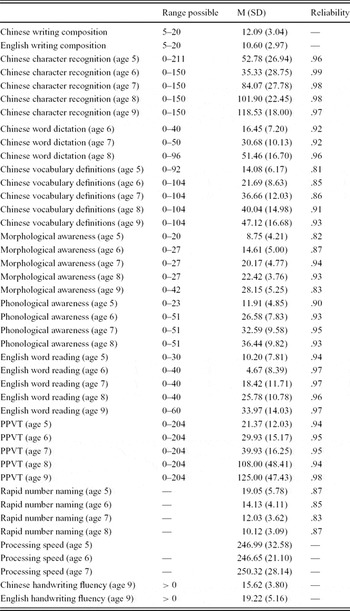
Table 2 shows the means, standard deviations, ranges, and reliabilities for measures included in this study. For all predictor tasks, the internal consistent reliabilities were above .80; test–retest reliabilities for the RAN (Rapid Automatized Naming) tasks were also above .80. In addition, these tasks yielded fairly good variability across participants.
Mean (SD), range and reliability of each measurement.

To ensure that the overall writing composition quality measure would be the same across languages, confirmatory factor analyses were conducted in order to test whether the five components selected initially to fit Chinese composition quality (Yan et al., Reference Yan, McBride-Chang, Wagner, Zhang, Wong and Shu2012) could load on a single factor. For Chinese, the single factor model fit the data well (Yan et al., Reference Yan, McBride-Chang, Wagner, Zhang, Wong and Shu2012), χ 2 (5, N = 153) = 10.21, p = .07, CFI = .988, GFI = .972, AGFI = .917, RMSEA = .08.Footnote 1 Importantly, for English, the model fit was even better, χ 2 (5, N = 153) = 6.77, p = .24, CFI = .996, GFI = .982, AGFI = .946, RMSEA = .05. Given these results, the sum of the five components was used to index the overall skill of writing composition in both Chinese and English in subsequent analyses.
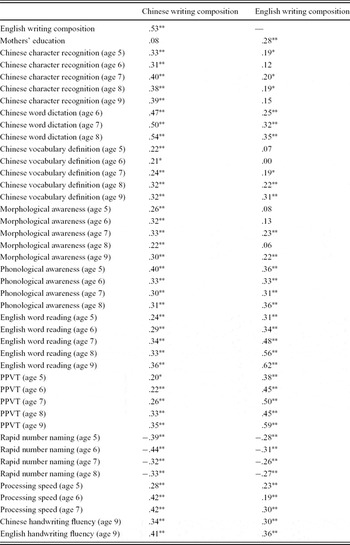
Table 3 shows the associations of overall Chinese and English writing quality with other measures across ages. The question of whether there might be a core higher order skill that is common to both Chinese and English writing compositions can be partly addressed by examining the correlation between these two measures. This association was moderate at .53, suggesting some overlap, perhaps in overall planning or thinking skills that may be “transferable” across languages. Apart from overall writing quality, we also scored the total number of words that students wrote in English and the total number of characters they wrote in Chinese as another indicator of writing quality in each language. We found that the correlation between the number of words in English and number of characters in Chinese was a moderate .55, further supporting the idea of something that might be common to writing compositions in different language. In addition, apart from Chinese word reading, Chinese vocabulary knowledge, and morphological awareness, which were not always significantly associated with English writing composition, most variables were consistently associated with overall writing composition in both languages. Interestingly, mother's education was significantly associated only with English writing quality, but not Chinese writing quality. These differences were further examined in stepwise regression analyses.
Correlations between Chinese/English writing composition and other variables.

* p < .05; ** p < .01
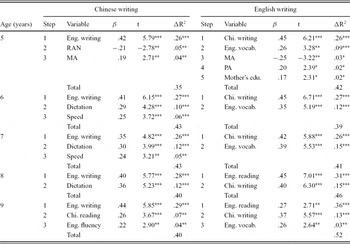
Our overall approach for these regression analyses was that, apart from the higher order general writing skill, which we conceptualized as roughly represented by writing quality in the “other” language, we sought to determine what lower level cognitive or linguistic skills might be uniquely associated with writing quality over time. In order to get at this pattern, we used stepwise regression analyses for each age level separately. Given a relatively strong overlap across the same task (e.g., phonological awareness, vocabulary knowledge) across years and the concern of colinearity issue for regression analysis, it made sense to consider each age separately, rather than including all ages together in a single analysis. At each step, the best remaining variable was included if it could significantly improve the prediction of the dependent variable at the .05 level. Meanwhile, any variables currently in the regression equation were removed if new regressions without them were not significantly worse than the original ones at the .10 level. Five sets of measures were included in each regression as follows: mothers’ education level; writing composition in the other language; Chinese cognitive measures including character recognition, word dictation, vocabulary knowledge, morphological and phonological awareness; English measures including vocabulary skill and word reading; fluency measures including rapid automatized naming, processing speed and handwriting fluency in Chinese and English only at age 9.
Correlates of Chinese writing composition were fairly consistent across time as shown in Table 4. For every year except age 5, a measure of Chinese literacy skill (either dictation or word reading) was a unique predictor of age 9 writing composition. In addition, at every age except age 8, a measure of speed/fluency was also a correlate of composition, apart from writing composition in English. In contrast, for English writing composition, apart from writing composition in Chinese, only English language knowledge as measured as vocabulary (at ages 5, 6, 7, 9) and/or English word reading (ages 8, 9) was a consistent unique predictor. Across all age level analyses, writing composition in the other language was almost always the strongest correlate overall of writing composition in a given language.
Predictors of Chinese/English writing composition using stepwise regression.

*p < .05; ** p < .01; *** p < .001
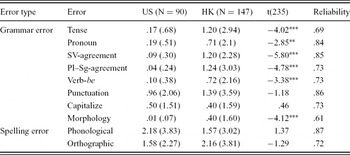
In separate group analyses, we were additionally interested in the relative proportion of production errors in grammar, spelling, and punctuation that children from the US and Hong Kong would make in writing an essay on the same topic. Thus, we analyzed all essays on the same ten errors listed in Appendix 1. Because American children wrote far more words than did Hong Kong children, total number of each error type was divided by total words as the overall index of error for further analyses of group comparisons. Group comparisons were made for each subtype of error at an adjusted significance level (α = 0.05/10 = 0.005).
Results of these analyses are shown in Table 5. Cronbach's alpha coefficients were calculated as an index of raters’ coding consistency (Crocker & Algina, Reference Crocker and Algina1986; Stemler, Reference Stemler2004). Table 5 shows that all subtypes of errors had acceptable inter-rater reliabilities (above .70, except for the morphological errors category), suggesting that coding across raters was relatively consistent. Generally speaking, Hong Kong children made significantly more grammatical errors than did American children. However, the two groups made equal proportions of spelling and punctuation errors. Correlations of each of the ten types of errors listed in Table 5 with overall writing quality in English ranged from .01 to –.23 for the Hong Kong children only, demonstrating that mechanical errors were not strongly related to ratings of overall writing quality for these children. Such findings may underscore a distinction between higher order and lower order processes in writing composition overall.
Means, standard deviations, errors per hundred words, and t-test results for all variables.

*p < .05; ** p < .01; *** p < .001
Discussion
The present study has yielded three findings that are potentially educationally relevant for understanding developing English writers who have Chinese as a first language. First, writing composition in Chinese and English in the same writers tends to be moderately correlated, suggesting that higher order writing skills may require similar thinking and planning skills across languages, as has been found previously in relation to children's reading comprehension in a first and second language (e.g., Li et al., in press; Proctor, Carlo, August & Snow, Reference Proctor, Carlo, August and Snow2005; Van Gelderen et al., Reference Van Gelderen, Schoonen, Stoel, De Glopper and Hulstijn2007; Verhoeven, Reference Verhoeven2000). This may imply some “transfer” in writing composition skill across languages. Second, longitudinal correlates of writing composition in English as a foreign language show a somewhat different pattern from those of writing composition in Chinese as a first language. Such lower order skills may be more language- or context-specific. Finally, whereas Chinese children writing in English as a foreign language tend to show significantly more errors than do American children writing in their native English in all categories of grammar we measured, the groups showed no differences in punctuation or spelling. Each of these points is expanded below.
To begin with, it is important to note that the factor structures of writing quality in the native Chinese and foreign English languages were both satisfactory using the five-component rating system devised previously to fit Chinese (Yan et al., Reference Yan, McBride-Chang, Wagner, Zhang, Wong and Shu2012). Inter-rater reliabilities of ratings of each of these five components by both a native and a nonnative speaker of English were relatively high as well. These results pave the way for continued comparisons of writing compositions across diverse languages and orthographies. This was a necessary first step in examining foreign language developing writing, a relatively understudied phenomenon thus far in children, particularly with a Chinese background.
Given our emphasis on the categories of depth, organization, and intelligibility, which are relatively broad, the fact that the association between overall quality of writing composition was .53 is not all that surprising. For example, students’ writing is tied to both word length (Grobe, Reference Grobe1981; Malecki & Jewell, Reference Malecki and Jewell2003) and general speed or fluency (e.g., Chandler, Reference Chandler2003). At a broader level, such results suggest that some general writing strategies that are taught in one language might be reasonably applicable in another one. An emphasis on writing a “rough draft”, the “translation” aspect of popular writing models (Berninger & Swanson, Reference Berninger, Swanson, Butterfield and Carlson1994; Berninger et al., Reference Berninger, Vaughan, Abbott, Begay, Byrd, Curtin, Hawkins and Graham2002; Hayes, Reference Hayes, Levy and Ransdell1996; Hayes & Flower, Reference Hayes, Flower, Gregg and Steinberg1980) as separate from subsequent editing for mechanical errors seems to be what our overall writing composition measure best represents. This finding is useful in conceptualizing “transfer” in writing composition. One might give alternative explanation by arguing that the reason for the high association between writing compositions in Chinese and English is that these two variables were tested concurrently. However, other Chinese measures tapped concurrently at age 9 such as Chinese word reading, morphological awareness and vocabulary definitions had lower correlations with Chinese writing composition than English writing composition did as shown in Table 2 above, precluding such a possibility and supporting the bilingual transfer proposition. Whereas previous studies have demonstrated such associations in children's reading comprehension (e.g., Li et al., in press; Proctor et al., Reference Proctor, Carlo, August and Snow2005; Van Gelderen et al., Reference Van Gelderen, Schoonen, Stoel, De Glopper and Hulstijn2007; Verhoeven, Reference Verhoeven2000), few, if any other studies have shown such associations in children's writing composition. Such an association serves to highlight a potential core higher order thinking and planning aspect to writing that may hold across languages.
Beyond an apparent core higher order writing composition skill were the longitudinal differences in lower order measures explaining overall writing performance. Analyses by year generally revealed that, whereas for Chinese writing, a fairly consistent predictor each year was a measure of speed or fluency, as found in previous analyses of these data (Yan et al., Reference Yan, McBride-Chang, Wagner, Zhang, Wong and Shu2012), for English writing, the pattern focused more on specific knowledge of English. That is, in Chinese, for every year except age 8, a measure of rapid automatized naming, general speed of processing, or fluency emerged as a unique correlate of age 9 writing composition. For English, in contrast, English vocabulary knowledge emerged as a unique correlate of age 9 writing composition for every age except age 8; English word writing was a unique correlate of this writing composition skill at ages 8 and 9. Thus, for foreign language writing composition for these skills, specific knowledge of English words is crucial for writing in English. Such skills appear to be particularly to L2 writing. It is unlikely that most researchers and teachers would view this result as in any way “news”. Anyone who teaches a foreign language would immediately recognize this as a pillar of their teaching. However, we think this consistent empirical demonstration of these findings is important because it highlights at least two directions for advanced developing writing instruction in a foreign language: Students should have good practice in fluent writing, and they should also have adequate exposure to a wide ranging vocabulary in the language they are learning.
Although the above-highlighted three aspects of writing really focus on the translation aspect of writing (Berninger & Swanson, Reference Berninger, Swanson, Butterfield and Carlson1994; Berninger et al., Reference Berninger, Vaughan, Abbott, Begay, Byrd, Curtin, Hawkins and Graham2002; Hayes, Reference Hayes, Levy and Ransdell1996; Hayes & Flower, Reference Hayes, Flower, Gregg and Steinberg1980), our final findings are particularly important for the editing, or revision, aspect of the writing process. Across ten categories we focused on as particularly relevant for Chinese children learning English as a foreign language, the Chinese children made significantly more errors than did American children in all six aspects of grammar tested. However, the two groups did not differ in relative correct use of capitalization or punctuation; they also made similar proportions of phonological and orthographic spelling errors. Perhaps these results suggest some dichotomy between language and print conventions. Whereas Hong Kong Chinese children likely learn print conventions primarily via print exposure and may be taught relatively clear rules to follow in relation to punctuation and spelling, grammatical cues are more ambiguous in a second language. The oral language English input these children receive is also much more likely to be from a nonnative speaker of English than from a native speaker, and second language learners often have particular difficulties with grammatical constructions (e.g., Silva, Reference Silva1993).
The practical implications of these findings are that, although native English speakers tend to write more than Chinese students learning English as a foreign language, Chinese students perform relatively well on punctuation and spelling task, some of the important mechanics of writing. However, Chinese children have particular difficulties with grammatical aspects of English of all sorts. Future research might consider whether there are any additional categories of writing mechanics that are particularly salient to teachers to consider apart from the ones tested here. Interestingly, in support of writing composition models overall, the mechanical errors tested were not particularly strongly associated with overall writing quality, perhaps providing further evidence for a distinction between higher order general planning or “translation” (Berninger & Swanson, Reference Berninger, Swanson, Butterfield and Carlson1994; Berninger et al., Reference Berninger, Vaughan, Abbott, Begay, Byrd, Curtin, Hawkins and Graham2002; Hayes, Reference Hayes, Levy and Ransdell1996; Hayes & Flower, Reference Hayes, Flower, Gregg and Steinberg1980) and lower order mechanical, or editing, aspects of developing writing in children.
For the children at age 5 only, mothers’ education level was also a unique correlate of subsequent writing quality in English only. These findings perhaps indirectly highlight the importance of human capital resources for supporting foreign language learning. English language learning tends to be associated with better educated parents in Hong Kong (Cheung & Ng, Reference Cheung, Ng, McBride-Chang and Chen2003), because such parents have the knowledge and expertise to support such learning. The fact that mothers’ education levels have some association with subsequent writing production in English, as has been demonstrated previously for reading comprehension in English in Chinese children (Li et al., in press), underscores the relative privileged status of English language learning in Hong Kong.
There were some limitations of the present study. One was that the writing task administered was time-limited. In and of itself, this time limitation was natural and relatively ecologically valid, given that most in-school tasks of essay writing are also timed. However, this time limit may also have been something of a disadvantage to second language learners of English as compared to native speakers of English. Almost by definition, second language learners are less fluent and fluid in using the language (e.g., Silva, Reference Silva1993). Thus, it is possible that they could have written more extensively without this time limit. More writing might have elicited some differences in either writing quality or writing mechanics, or both. Given that word length and writing quality seem to be moderately related (Yan et al., Reference Yan, McBride-Chang, Wagner, Zhang, Wong and Shu2012), this issue of timed vs. untimed writing in developing writers might be one for further study. A second limitation was that we had relatively little information on the American sample. Thus, it is difficult to argue that our samples were comparable on all variables that might have mattered for writing. For example, parents’ education levels or general IQ might conceivably have had an impact on mechanical errors made across groups. Third, because the present study was conducted in the setting of Hong Kong, its findings need to be tested and replicated in other Chinese societies such as mainland China and Taiwan given different instructional methods used there. Hong Kong children learn characters through a look-and-say holistic way (Cheung & Ng, Reference Cheung, Ng, McBride-Chang and Chen2003). However, children in mainland China learn characters in an analytic way with the assistance of Pinyin, a phonological system (Cheung & Ng, Reference Cheung, Ng, McBride-Chang and Chen2003). The case of Taiwan is similar to mainland China except for their adoption of the system of Zhuyin Fuhao, another phonological system. Therefore, phonological awareness might be more closely related to Chinese and English literacy skills for Taiwan and mainland children compared to their Hong Kong counterparts. In addition, simplified characters are used on the mainland while traditional ones are taught in Hong Kong. Since traditional characters are probably easier to read but more difficult to write for children (e.g., Zhang & McBride-Chang, Reference Zhang and McBride-Chang2011), writing fluency might be especially important for Chinese writing composition for Hong Kong children than for their mainland counterparts. Finally, we were limited in the number of skills measured in English across years. English word reading and receptive vocabulary knowledge were relatively easy to incorporate into this study over the years. However, it is possible that other measures, such as invented spelling, phonological awareness, or rapid automatized naming in English might have been additional useful early predictors of writing quality in English. Future research might consider these.
Despite these limitations, however, the present study has been relatively novel in its examination of writing in English as a foreign language, particularly for children with Chinese as a first language. We have established some overlap in writing quality between Chinese and English in Chinese children, potentially suggestive of a core higher order thinking and planning aspect of composition writing. Part of this overlap might be attributable to sheer essay length. However, what is most important about this result is that it may be possible to make use of writing skills in one language to support writing skills in another. Another new finding is the importance of English word knowledge for writing skills in English as a second language. This is in addition to the overlapping skills required for native Chinese writing. Thus, skills in both fluency/speed and English word knowledge are essential for writing in English as a foreign language. Finally, Chinese children tend to make many more errors in grammar as compared to native English speakers. For example, they are more likely to use present tense when past or future tense should be used and use the singular form when the plural form is required. However, Hong Kong children did not differ from their US counterparts in their approaches to punctuation, capitalization, or spelling, suggesting that grammar is a particularly important point of emphasis in mechanical approaches to developing writing in English for Chinese children. Overall, the development of writing composition is a long and complex process, and our findings support the concepts of both translating and revising as separate processes in children's developing writing (Hayes, Reference Hayes, Levy and Ransdell1996; Hayes & Flower, Reference Hayes, Flower, Gregg and Steinberg1980).
Types of mechanical errors and their descriptions

Appendix 2. Instruction of Chinese writing composition
Please use Chinese to write a composition entitled “My Favorite Toy”. When you are writing, I want you to stay focused and keep writing the whole time. Don't stop until I tell you to do so. Also, if you encounter a word that you don't know how to write, you should not ask how to write it. Simply use a homophone or a similar word to replace it for now. If you make a mistake, cross out the word and keep writing. Don't erase your mistake because it will take too long. Do you understand?
After participants’ queries were answered, they were further instructed:
Remember, the topic is “My Favorite Toy”. Think about whether you had or have a favorite toy, or which toy you really want to own. Can you describe it? Why do you like it? If you are clear about the topic, you can start to write.
If they stopped writing before the 10 minutes were up, the tester encouraged them to continue to write by saying:
Are there any other things about this toy you can describe?
Appendix 3. Instruction of English writing composition
Please use English to write a composition entitled “A Classroom Pet”. In this composition, you should write about an animal that you would like to have in your classroom as a classroom pet. When you are writing, I want you to stay focused and keep writing for the whole time. Don't stop until I tell you to do so. Also, if you encounter a word that you don't know how to spell, try to write down the possible letters of the words or use Chinese characters to represent the word you want to write, but please do not use more than 3 Chinese characters in your writing. If you make a mistake, cross out the word and keep writing. Don't erase your mistake because it will take too long. Do you understand?
After answering children's queries, the children were further told the following:
Remember, the topic is “Classroom Pet”, and you should write about choosing an animal that would be a good classroom pet. Imagine if you could have any animal in the world for a classroom pet. What would that animal be? Please give reasons for why you would choose that animal. If you are clear about what to write, you can start to write now.
The children had 10 minutes to write. If they stopped writing before the 10 minutes were up, testers encouraged them to continue to write by saying:
What more could you write about choosing this pet?