





Impact statement
Safe and affordable drinking water remains difficult to secure in many remote and regional communities, where treatment options are often limited by cost, transport and operational complexity. This study addresses that challenge by developing and testing KJ25 EcoPellets, a novel filter medium made from locally available brick-making clays and agricultural residues for the removal of iron and manganese from drinking water. The broader contribution of this research is that it demonstrates how low-cost local materials can be transformed into a potential treatment medium for decentralised systems. In addition to showing strong iron removal and moderate manganese removal under controlled batch conditions, the study identifies mineralogical, surface-chemical and pore-structure features associated with the observed performance. This provides a scientific basis for the further development of low-cost engineered media suited to the practical constraints of underserved communities. Beyond the specific material examined here, the work demonstrates how drinking-water treatment can be linked with circular economy principles. By converting agricultural residues and locally sourced clay into a value-added treatment medium, it points towards more regionally adaptable and potentially resilient water-treatment solutions. Its relevance therefore extends beyond one product or location, offering a pathway for improving water security where conventional media may be difficult to procure or sustain.
Introduction
Access to safe drinking water underpins public health, economic productivity and social well-being. Despite continued progress, substantial inequities persist: in 2022 about 6 billion people used safely managed drinking water, while ~2.2 billion relied on unsafe or basic sources (WHO, 2023). The associated health burden is substantial but largely preventable through improved water, sanitation and hygiene (WASH); UNICEF estimates ~829,000 deaths annually are attributable to unsafe drinking water (United Nations Children’s Fund (UNICEF), 2023). Climate-driven stressors are expected to further challenge supply reliability and treatment robustness, with extreme weather identified among the highest global risks over the coming decade (World Economic Forum, 2024).
In Australia, these challenges are particularly acute in remote and regional areas, where small supplies face persistent infrastructure, monitoring and logistical constraints. Although Australia’s overall Sustainable Development Goal (SDG) performance improved slightly between 2022 and 2024 (38th to 37th), progress on SDG 6 (clean water and sanitation) remains moderate. National reporting often excludes communities with fewer than 10,000 service connections, potentially overlooking ~8% of the population, including many remote and Indigenous settlements (Jenkins, Reference Jenkins2024). More than 400 such communities are reported to lack safe, reliable supplies, contributing to adverse health outcomes and entrenched disadvantage (CSIRO, 2023).
Water quality challenges in small systems arise from multiple stressors. While microbiological contamination is often linked to infrastructure and hygiene gaps, chemical exceedances are also frequent, including iron (Fe) and manganese (Mn) as well as fluoride, nitrate, uranium and arsenic relative to Australian Drinking Water Guidelines (ADWG) values. In regional Queensland, Fe has reached 13.6 mg/L in raw water and 6.33 mg/L post-treatment (ADWG aesthetic guideline 0.3 mg/L). Mn has been reported up to 61 mg/L (raw) and 4.5 mg/L (treated), exceeding the 0.1 mg/L health-based and 0.05 mg/L aesthetic guideline values (Balasooriya et al., Reference Balasooriya, Rajapakse and Gallage2023). These exceedances cause operational problems such as discolouration, staining, deposition and filter or pipe fouling and may also raise health concerns. Treatment options include biological filtration, electro-oxidation/reduction, gas chlorination, ozonation, adsorption and membrane processes (Doble et al., Reference Doble, London, Horner, Thiruvenkatachari, Priestley and O’Brien2023). However, many technologies remain difficult to sustain in decentralised settings because of chemical demand, by-products, frequent cleaning, high capital costs and energy dependence (Kamel et al., Reference Kamel, Al-Juboori, Ladewig, Ibrahim and Alsalhy2023; Shalaby et al., Reference Shalaby, Zayed, Hammad, Menesy and Elbar2024).
Adsorption–filtration remains attractive for low-resource systems because it is relatively simple to operate and energy efficient (Gkika et al., Reference Gkika, Mitropoulos and Kyzas2022). Practical hurdles include media saturation, contact-time requirements, regeneration feasibility and residuals handling; these are typically managed through routine backwashing (often on ~24-h operating cycles) and disposal or lagooning of solids (Turan, Reference Turan2023; Faheem et al., Reference Faheem, Azher Hassan and Wang2025). Nevertheless, widely used media (e.g., sand, pumice, Filtralite and granular activated carbon [GAC]) can entail high material, energy and transport costs for remote deployment (Salzmann et al., Reference Salzmann, Ackerman and Cicek2022). This reinforces the need for low-cost, locally manufacturable and recyclable alternatives that are compatible with small-system constraints.
From a circular economy perspective, novel, sustainable filter media for decentralised water treatment enable industrial symbiosis by converting locally available agricultural by-products into durable granular adsorbents, reducing dependence on imported filter materials and alleviating the logistical and cost constraints of remote supply chains (Diagboya et al., Reference Diagboya, Olu-Owolabi, Mtunzi and Adebowale2020; Wang et al., Reference Wang, Shen, Qiu, Zhang, Ma and Liang2024). Natural clays contain aluminosilicate surfaces and surface functional groups that may support metal uptake through adsorption, surface complexation and, depending on their mineralogical composition, ion-exchange interactions (Wang et al., Reference Wang, Shen, Qiu, Zhang, Ma and Liang2024). Yet practical, granular media tailored for decentralised Australian contexts remain limited.
Batch adsorption testing was adopted as a controlled bench-scale approach to screen and compare the Fe and Mn removal behaviour of the candidate media. This approach enables the influence of key parameters, including pH, adsorbent dose, initial concentration and contact time, to be evaluated while minimising the influence of hydraulic factors associated with continuous-flow systems. The resulting kinetic and equilibrium data therefore provide a material-level assessment of metal uptake and a basis for subsequent filtration evaluation, rather than directly representing full-scale filter performance.
This study develops and evaluates KJ25 EcoPellets, a calcined clay–biomass composite produced from locally available brick-making clay mixes (Harvest Cream [HC] and Common Brick Mix [CBM]) with agricultural residues. Designed to remove Fe and Mn without chemical oxidants, KJ25 aims to provide a sustainable, locally manufacturable alternative to conventional media for small, underserved treatment systems. Specifically, this article
-
I. optimises formulation and characterises physicochemical properties relevant to metal uptake,
-
II. quantifies Fe and Mn removal behaviour using batch experiments and adsorption modelling and
-
III. evaluates production economics to support feasibility for decentralised deployment.
Materials and methods
Development of KJ25 EcoPellets as a new adsorbent
Two brick-making clays, CBM and HC, were sourced from PGH Brick Factory (Oxley, QLD). The clays were dried, ground, sieved to a particle size of <0.6 mm and characterised for their physical, chemical and mineralogical properties. Based on preliminary evaluation, a clay blend consisting of 25 wt% CBM and 75 wt% HC (CH4) was selected for further adsorbent development.
Six agricultural residues, namely sugarcane bagasse (SCB), sugarcane mulch (SCM), barley straw (BS), wood shavings (WS), chickpea stubble (CS) and sorghum stubble (SS), were evaluated as porosity-enhancing additives. Each residue was washed repeatedly with tap water until the wash water reached approximately neutral pH, followed by rinsing with deionised water. The washed residues were dried at 45 °C for 3–5 days, followed by oven-drying 110 °C for 2 h and were subsequently ground and sieved to <0.6 mm. During the initial screening, each agricultural residue was incorporated into the selected CH4 clay blend at 2 wt% and evaluated for Fe and Mn removal.
Based on the screening results, SCM and SS were selected for the final composite formulation. The KJ25 formulation consisted of the CH4 clay blend containing 2 wt% SCM and 2 wt% SS. The homogenised clay–biomass mixture was formed into pellets, dried at 45 C for 3–5 days and subsequently oven-dried at 110 °C for 24 h. The dried pellets were then fired at 750 °C using a heating rate of 10 °C min−1 and a holding time of 6 h. Following firing, the pellets were cooled and sieved to a particle-size range of 0.6–2 mm for subsequent adsorption experiments.
Adsorption kinetics
Kinetic studies were performed to characterise the adsorption kinetics for Fe and Mn removal at the initial concentration of 10 mg/L, adsorbent dose of 0.5 g in 50 mL and natural pH (~4.5), with sampling from 0 to 240 min (Zhou et al., Reference Zhou, Qiu, Hu, Liu, Peng, Yi, Cai and Lei2025). Pseudo-first order (PFO) and pseudo-second order (PSO) models (Diagboya et al., Reference Diagboya, Olu-Owolabi, Mtunzi and Adebowale2020; Kamilya et al., Reference Kamilya, Mondal and Saha2022) were fitted using Eqs. (1) and (2).


where
$ {q}_t $
 and
$ {q}_e $
 (mg/g) are the adsorption capacities at time
$ t $
 and at equilibrium, respectively;
$ {k}_1 $
 (min−1) and
$ {k}_2 $
 (g/mg.min) are the PFO and PSO rate constants, respectively.
To further assess the contribution of intraparticle diffusion to the uptake process, the Weber–Morris intraparticle diffusion model (Eq. (3)) was applied (Verma and Singh Reference Verma and Singh2023).

where
$ {k}_p $
 (mg/g.min0.5) is the intraparticle diffusion rate constant and
$ C $
 (mg/g) is the boundary-layer constant.
Adsorption isotherm modelling
To evaluate the equilibrium adsorption of Fe and Mn, batch tests were performed at 23 °C and natural pH (~4.5) using a fixed adsorbent dose of 0.1 g in 50 mL of solution, while the initial metal concentration (C_0) was varied. Following equilibration, the equilibrium concentration (C_e) was measured, and the equilibrium adsorption capacity (q_e, mg/g) and removal efficiency (%) were calculated using Eqs. (4) and (5) (Kamilya et al., Reference Kamilya, Mondal and Saha2022; Li et al., Reference Li, Liu, Zhou, Chen and Cai2024).


where
$ {C}_0 $
 and
$ {C}_e $
 are the initial and equilibrium metal concentrations (mg/L), respectively. V is the volume (L) of the solution and m is the mass (g) of the used adsorbents.
The Langmuir model assumes monolayer adsorption onto a homogeneous surface. The nonlinear form of the Langmuir equation is given by Eq. (6) (Yusof et al., Reference Yusof, Keat, Ibrahim, Majid and Nizam2010; Ohale et al., Reference Ohale, Onu, Ohale and Oba2020). The dimensionless Langmuir separation factor (
$ {R}_L $
 ) was also calculated using Eq. (7) to assess adsorption favourability. Values of
$ {R}_L>1 $
 indicate unfavourable adsorption,
$ {R}_L=1 $
 indicates linear adsorption,
$ 0<{R}_L<1 $
 indicates favourable adsorption and
$ {R}_L=0 $
 indicates irreversible adsorption.


where
$ {C}_e $
 is the equilibrium concentration (mg/L),
$ {q}_e $
 is the equilibrium adsorption capacity (mg/g),
$ {q}_{\mathrm{max}} $
 is the theoretical maximum monolayer adsorption capacity (mg/g),
$ {K}_L $
 is the Langmuir affinity constant (L/mg) and
$ {C}_0 $
 is the initial metal concentration (mg/L).
The Freundlich model describes adsorption onto heterogeneous surfaces and is expressed by Eq. (8) (Diagboya et al., Reference Diagboya, Olu-Owolabi, Mtunzi and Adebowale2020; Kamilya et al., Reference Kamilya, Mondal and Saha2022)

where
$ {q}_e $
 and
$ {C}_e $
 are defined as above,
$ {K}_F $
 is the Freundlich constant related to adsorption capacity and
$ 1/n $
 is an empirical parameter describing adsorption intensity and surface heterogeneity.
The Langmuir and Freundlich models were fitted directly to the untransformed equilibrium uptake data (
$ {q}_e $
 versus
$ {C}_e $
 ) using the rectangular hyperbola and Allometric1 nonlinear fitting functions in OriginPro, respectively. For the Langmuir model, the fitted coefficients corresponded to
$ {q}_{\mathrm{max}} $
 and
$ {K}_L $
 , while for the Freundlich model, they corresponded to
$ {K}_F $
 and
$ 1/n $
 . Microsoft Excel was used for data organisation and calculation of equilibrium concentration, adsorption capacity and removal efficiency.
Material characterisation of KJ25 EcoPellets: A comparative analysis with conventional filtration media
The study compared conventional filter media (sand, pumice and Filtralite) with the novel calcined clay–biomass composite medium, KJ25 EcoPellets, for Fe and Mn removal. Stock solutions were prepared from anhydrous FeCl₃ and MnCl₂ and diluted to prepare working solutions with metal concentrations of 10–50 mg/L. The media were characterised using scanning electron microscopy (SEM) coupled with energy-dispersive X-ray spectroscopy (EDX), X-ray diffraction (XRD) for mineralogical phase identification, X-ray fluorescence (XRF) for bulk chemical composition and Brunauer–Emmett–Teller (BET) analysis for surface-area and porosity assessment.
Effect of pH, initial concentration, contact time and dose
Batch adsorption tests were conducted to assess Fe and Mn removal by sand, pumice, Filtralite and KJ25 EcoPellets. Unless otherwise stated, experiments were conducted using 50 mL solutions in triplicate, with samples shaken at 150 rpm for 4 h at approximately 23 °C. Fe and Mn were present simultaneously in the test solution at the specified initial concentration of each metal. For each experimental condition, a corresponding metal-solution blank without media was included, together with a deionised-water blank as a procedural control. Following agitation, the supernatants were filtered, and Fe and Mn concentrations were measured by ICP-OES. Removal efficiency was calculated using the initial (
$ {C}_0 $
 ) and equilibrium (
$ {C}_e $
 ) metal concentrations.
pH: Initial pH = 2, 4, 6, 7, 8 and 9 using 0.1 M HCl/NaOH; 0.1 g media;
$ {C}_0= $
 10 mg/L for each of Fe and Mn (Queensland source waters ≈ 4.5–9.8) in the combined solution. Only the initial pH was controlled; the final pH after equilibration was not measured.
Initial concentration:
$ {C}_0 $
 = 10, 20, 30, 40 and 50 mg/L for each of Fe and Mn; 0.1 g media.
Contact time:
$ t $
 = 0–240 min; 0.5 g media;
$ {C}_0= $
 10 mg/L for each of Fe and Mn, with timed aliquots for kinetic modelling (see Section “Adsorption Kinetics”).
Dose:
$ m $
 =0.05, 0.1, 0.2, 0.3, 0.4 and 0.5 g (i.e., 1–10 g/L);
$ {C}_0= $
 10 mg/L for each of Fe and Mn.
Results and discussion
New filter media – KJ25 EcoPellets
CBM and HC, sourced from the PGH Bricks-Oxley, were selected as base materials because of their local availability, low cost (A$16.4/t (CBM) and $17.7/t (HC)) and suitable physicochemical properties. SEM (Supplementary Figure S1) shows irregular granular morphologies with rough, porous textures: CBM exhibits elongated aggregates with visible interparticle voids, whereas HC displays more rounded aggregates with denser but still microporous surfaces. High surface roughness and open-pore networks favour adsorption by increasing surface area and ion diffusion and by enabling mechanical entrapment and capillary-driven uptake (Wang et al., Reference Wang, Cao, Wang, Qu, Xu and Li2023).
XRD identified kaolinite (Al₂Si₂O₅(OH)₄) and quartz (SiO₂) as the dominant crystalline phases in both CBM and HC, with minor contributions from siderite, haematite and illite/mica (Supplementary Figure S2; Supplementary Table S1). HC contained more kaolinite (40.9%) than CBM (32.8%), whereas CBM had a slightly higher quartz (36.6% vs. 33.4%). An amorphous aluminosilicate fraction (~11–14%) provides additional reactive sites and contributes to mesoporosity. XRF confirmed high SiO₂ and Al₂O₃ contents (CBM: 60.06 and 19.50 wt%; HC: 59.07 and 20.63 wt%) consistent with thermal and chemical stability required for water treatment media (Mahinroosta and Moattari, Reference Mahinroosta, Moattari, Verma, Aslam and Khan2023) (Supplementary Table S2).
Complementary physicochemical properties (Table 1) included near-neutral pH (CBM 6.41; HC 6.84), suitable for metal adsorption [Moawed et al., Reference Moawed, Burham and El-Shahat2013]). BET analysis revealed mesoporous structure with surface areas of 19.12 and 18.19 m2/g (CBM and HC) and average pore diameters of 9.78–11.87 nm, facilitating Fe/Mn diffusion and enhancing adsorption kinetics (Bensebaa, Reference Bensebaa and Bensebaa2013; Kim et al., Reference Kim, Ko, Lee and Chon2020). SEM–EDX confirmed Si- and Al-rich compositions consistent with kaolinite/quartz. CBM showed slightly higher Al (23.8 wt%) and Fe (3.4 wt%), while HC had higher Si (51.3 wt%), which may support metal uptake through surface interactions and possible ion-exchange processes.
Surface properties and SEM–EDX elemental composition of base clays

Table 1. Long description
The table is organized into 12 columns. The first column lists the materials: C B M and H C.
Columns 2 through 5 describe surface properties:
- p H: 6.41 for C B M and 6.84 for H C.
- S sub B E T in meters-squared per gram: 19.12 for C B M and 18.19 for H C.
- V sub Total in centimeters-cubed per gram: 0.047 for C B M and 0.054 for H C.
- D sub Avg in nanometers: 9.78 for C B M and 11.87 for H C.
Columns 6 through 12 detail S E M E D X results in weight percent for specific elements:
- O: 43.1 for C B M and 51.3 for H C.
- Mg: 0.6 for C B M and not detected for H C.
- Al: 23.8 for C B M and 21.6 for H C.
- Si: 26.6 for C B M and 22.8 for H C.
- K: 1.6 for C B M and 2.2 for H C.
- Ti: 1.0 for C B M and not detected for H C.
- Fe: 3.4 for C B M and not detected for H C.
Fourier Transform Infrared (FTIR) Spectroscopy (Supplementary Figure S3) further confirmed aluminosilicate structures. Prominent absorption bands in the 400–1,200 cm−1 region were observed for both CBM and HC, corresponding to Si–O stretching (near 1,020–1,100 cm−1), Si–O–Al and Si–O–Fe bending and stretching vibrations and Al–O–H deformation modes all indicative of the presence of kaolinite and quartz (Jozanikohan and Abarghooei, Reference Jozanikohan and Abarghooei2022; Kasraee et al., Reference Kasraee, Dehghani, Mahvi, Nabizadeh, Arjmand, Salari, Hamidi, Mubarak and Tyagi2022; Xia et al., Reference Xia, Hao, Liu, Zhang, Miao, Ma and Gao2023). These findings align with the XRD results which identified kaolinite and quartz as dominant crystalline phases. The sharp peaks around 3,620–3,690 cm−1 are attributed to O–H stretching vibrations from internal hydroxyl groups in kaolinite (or illite), confirming the structural integrity of the clay minerals (Kasprzhitskii et al., Reference Kasprzhitskii, Lazorenko, Khater and Yavna2018; Papakosta et al., Reference Papakosta, Lopez-Costas and Isaksson2020). These hydroxyl groups may provide reactive sites for adsorption, surface complexation and possible ion-exchange interactions. Furthermore, the broad bands observed in the 3,400–3,500 cm−1 range correspond to out-of-plane O–H stretching and internal surface OH groups, suggesting a high density of reactive hydroxyl functionalities that contribute to the hydrophilic nature of the material (Jozanikohan and Abarghooei, Reference Jozanikohan and Abarghooei2022). Notably, HC showed slightly more intense peaks in the O–H and Si–O regions, which may be due to its higher kaolinite content, as also confirmed by XRD and XRF analyses.
Given the favourable mineralogical and chemical characteristics of CBM and HC, a series of CBM–HC blends (CH1–CH5) were prepared: CH1 (100% CBM), CH2 (75/25), CH3 (50/50), CH4 (25/75) and CH5 (100% HC). Blends were assessed by adsorption and density. Spherical 50 mm (based on prior unpublished studies at QUT)) bodies were formed, fired at 450, 600, 750, 900 and 1,050 °C, then crushed to 5–10 mm for testing. CH4 showed the best combination of adsorption capacity and structural stability. Although 450–600 °C yielded higher removals, the bodies lacked strength and partially disintegrated; 750 °C provided the optimal balance of Fe/Mn removal and durability. To enhance porosity, six agricultural residues, SCB, SCM, BS, WS, CS and SS, were each added to CH4 at 2 wt% (based on preliminary internal tests (unpublished), fired at 750 °C and evaluated using Freundlich and Langmuir isotherms (Figure 1; Supplementary Table S3).
Equilibrium isotherm fits for Fe and Mn adsorption onto CH4 composites amended with agricultural residues: (a, c) Freundlich; (b, d) Langmuir. Metals: Fe in (a, b) and Mn in (c, d).

The Langmuir model fit both Fe and Mn removal better than Freundlich, indicating monolayer adsorption on relatively homogeneous sites (Yusof et al., Reference Yusof, Keat, Ibrahim, Majid and Nizam2010). For Fe removal, the SS-amended composite showed a strong Langmuir fit (R^2 = 0.9915), with q_max = 7.203 mg/g and R_L = 0.0821, whereas SCM showed the strongest Langmuir fit for Mn (R^2 = 0.9872, q_max = 3.521 mg/g and R_L = 0.2273). These differences may reflect the combined influence of biomass-induced pore development and changes in surface chemistry during firing. The CH4 + 2%SS composite exhibited a slightly higher specific surface area than CH4 + 2%SCM, whereas the SCM-amended composite exhibited a greater pore volume and average pore diameter, which may influence accessibility of Fe and Mn to available surface sites. Biomass-derived inorganic residues may also modify the surface chemistry of the fired clay matrix. However, because biomass-specific ash composition, residual carbon and mineral transformations were not independently characterised, the preferential Fe and Mn responses cannot be conclusively assigned to a particular mechanism. Accordingly, SS and SCM were selected empirically as the best-performing additives for Fe and Mn, respectively, and subsequently combined in the KJ25 formulation.
For comparability with conventional media, the CH4 + (SCM + SS) composite was sized to 0.6–2 mm and produced at 1, 2, 4 and 6 wt% per components, matching nominal sizes of sand (0.6–1.2 mm), pumice (1–2 mm) and Filtralite (0.8–1.6 mm). Using comparable particle-size ranges reduced particle-size-related differences during the comparative batch experiments.
The resulting spherical pellets (locally referred to as “Clay Pittu” – a name inspired by the preparation method of “Pittu,” a traditional Sri Lankan and South Indian dish made primarily from rice flour and grated coconut), their removal efficiencies and BET surface properties are summarised in Table 2.
Fe and Mn removal efficiencies and BET textural properties of CH4 + SCM/SS composites (Balasooriya et al., Reference Balasooriya, Rajapakse, Gallage and Jayatilake2026)

Table 2. Long description
The table consists of six columns and six data rows. The columns are: Material composition, F e removal efficiency (%), M n removal efficiency (%), S sub B E T (m super 2 per g), V sub Total (c m super 3 per g), and D sub Avg (n m).
* Row 1: C H 4 plus 2% S C M; F e 97.81; M n 39.89; S sub B E T 15.3176; V sub Total 0.056597; D sub Avg 14.7796.
* Row 2: C H 4 plus 2% S S; F e 98.43; M n 38.90; S sub B E T 15.3544; V sub Total 0.051782; D sub Avg 13.4899.
* Row 3: C H 4 plus 1% S C M plus 1% S S; F e 98.59; M n 42.79; S sub B E T 17.1798; V sub Total 0.057571; D sub Avg 13.4043.
* Row 4: C H 4 plus 2% S C M plus 2% S S; F e 98.83; M n 46.21; S sub B E T 19.8045; V sub Total 0.070847; D sub Avg 14.3094.
* Row 5: C H 4 plus 4% S C M plus 4% S S; F e 96.92; M n 43.78; S sub B E T 19.8622; V sub Total 0.070251; D sub Avg 14.1476.
* Row 6: C H 4 plus 6% S C M plus 6% S S; F e 98.00; M n 42.78; S sub B E T 19.9185; V sub Total 0.069198; D sub Avg 13.8963.
In batch tests, CH4 + 2% SCM + 2% SS achieved the highest removals (Fe 98.83%, Mn 46.21%). Although SBET increased with biomass, removals plateaued or declined beyond ~4% total biomass. Correspondingly, total pore volume peaked near 4% and then stabilised or slightly decreased. The average pore diameter remained within the mesoporous range (≈13.4–14.8 nm) but narrowed slightly beyond 4%, despite the increase in surface area. This aligns with previous findings that adsorption is strongly influenced by pore width and pore volume rather than surface area alone (Reddy et al., Reference Reddy, Ponnamma, Sadasivuni, Kumar and Abdullah2021; Petrovic et al., Reference Petrovic, Gorbounov and Soltani2022). These results suggest that biomass loadings above the optimum alter pore architecture, such as by creating narrower or less-accessible pores, wall compaction or ash-induced blockage and may also dilute reactive mineral phases, thereby reducing ion diffusion and active-site accessibility (Kurisingal et al., Reference Kurisingal, Yun and Hong2023). Consequently, excessive biomass addition can hinder adsorption, highlighting that optimising mesoporosity, rather than simply maximising surface area, is critical for improving performance (Omar et al., Reference Omar, Othman, Tai, Kurniawan, Puteh, Jaafar, Rahman, Ismail, Rajamohan, Abdullah and Wong2024).
Balancing porosity enhancement with structural and chemical stability is therefore critical. Thus, the CH₄ + 2% SCM + 2% SS formulation was identified as optimal, providing the best trade-off between surface area, pore accessibility and mechanical integrity. This composition was designated KJ25 EcoPellets.
Performance evaluation of KJ25 EcoPellets for drinking water treatment: A comparison with conventional filtration media
Adsorption performance under operational conditions
The comparative evaluation of KJ25 EcoPellets and conventional media (sand, pumice and Filtralite) across dose, initial concentration, contact time and pH demonstrated higher Fe and Mn removal by KJ25 under the investigated batch conditions (Supplementary Figure S4).
As the dose increased to 10 g/L, Fe removal by KJ25 rose sharply to ~95%–99%, while Mn removal reached ~45%–50%. Pumice also improved with dose, achieving ~65% Fe and ~ 25% Mn removal. In contrast, sand and Filtralite remained consistently poor performers, with <20% removal for both metals.
At increasing initial concentrations (10 → 50 mg/L), KJ25 sustained Fe removal above 80% up to ~20 mg/L before gradually declining at higher concentrations. Pumice showed a steeper decline, with Fe removal falling from ~60% to ~35%–40% and Mn removal from ~40% to ~25%. Sand and Filtralite remained low across the full range.
Time-dependent removal showed the rapid kinetics of KJ25. More than 90% of Fe was removed within ~60 min, with near-complete removal (~99%) achieved at equilibrium. Mn uptake was slower, plateauing at ~45% after 120–240 min. Pumice performed moderately, reaching ~60%–65% Fe and ~ 38%–40% Mn removal after 240 min, whereas sand and Filtralite remained <20%.
pH exerted a strong influence. At neutral to alkaline conditions (≥7), KJ25 achieved nearly 100% Fe and ~ 50% Mn removal. Pumice also improved, reaching ~60%–65% Fe and ~ 45%–50% Mn, while sand and Filtralite remained largely ineffective (<15%). However, some pH-dependent metal loss was also observed in the no-media controls. For Fe, the blank loss increased from <2% at pH 2–4 to approximately 11%–14% at pH 6–9, while Mn blank loss increased from approximately 3% at pH 2 to 11% at pH 9. This indicates that part of the observed removal at elevated pH may have resulted from processes independent of the media. In particular, Fe hydrolysis and precipitation may contribute under neutral-to-alkaline conditions, whereas Mn remains comparatively more soluble, although oxidation and precipitation may become increasingly relevant at higher pH. Final equilibrium pH and aqueous speciation were not measured; therefore, the relative contributions of adsorption, precipitation and other pH-dependent processes cannot be quantitatively distinguished.
Overall, KJ25 showed the highest Fe and Mn removal among the investigated media across the tested batch conditions, with particularly rapid Fe removal and more moderate Mn uptake. Pumice provided intermediate performance, whereas sand and Filtralite generally showed low removal.
Kinetic analysis
To further understand the removal mechanisms of KJ25 EcoPellets compared to other conventional media, a kinetic study was performed using three widely adopted models: PFO, PSO and the Weber–Morris intraparticle diffusion model. The results of this kinetic analysis are presented in Figure 2 and Supplementary Table S4.
Kinetic modelling of Fe and Mn adsorption: (a) and (b) Pseudo first order (PFO) and Pseudo second order PSO); (c) and (d) Weber Morris intraparticle diffusion plots.

Fe adsorption
KJ25 EcoPellets reached adsorption equilibrium within ~120 min, with rapid uptake in the first 30 min followed by a slower approach to the plateau. The PFO model provided the best fit (R 2 = 0.976), with an equilibrium adsorption capacity qₑ(exp) = 6.59 mg/g and a rate constant k1 = 0.0225 min−1, indicating that it adequately described the rapid Fe uptake behaviour. The PSO model also produced a good fit (R 2 = 0.957; qₑ = 7.02 mg/g, k2 = 0.0046 g/mg.min), suggesting that more than one kinetic process may contribute to Fe uptake. In contrast, pumice and Filtralite showed stronger agreement with the PSO model (R 2 = 0.889 and 0.752, respectively), with lower capacities (qₑ = 1.21 and 0.70 mg/g) and smaller rate constants. Sand performed poorly, yielding low R 2 values (PFO = 0.292; PSO = 0.268), a negligible adsorption capacity (qₑ < 0.5 mg/g) and poor predictability, confirming its minimal Fe affinity.
Mn adsorption
The adsorption of Mn was slower, reaching near-equilibrium only after ~240 min. The PSO model provided the best fit (R 2 = 0.723), with qₑ = 1.32 mg/g and k2 = 0.066 g/mg.min, indicating that it adequately described the Mn uptake kinetics. Together with the intraparticle diffusion results, this suggests that internal diffusion and surface interactions contributed to Mn uptake; however, the specific contribution of ion exchange could not be confirmed because CEC and exchangeable-ion measurements were not undertaken. The PFO model produced a weaker fit (R 2 = 0.578; qₑ = 1.22 mg/g, k1 = 0.0727 min−1), reflecting less reliability in predicting Mn uptake. Among the comparative media, pumice again showed the highest Mn adsorption capacity (qₑ = 1.08 mg/g), with kinetic consistency under PSO fitting (R 2 = 0.730). By contrast, Filtralite and sand exhibited poor model fits (R 2 < 0.25) and very low adsorption capacities (qₑ < 0.35 mg/g), underscoring their limited Mn removal potential.
To further assess the contribution of intraparticle diffusion to Fe and Mn uptake, the Weber–Morris intraparticle diffusion model was applied to KJ25 for both Fe and Mn adsorption. For Fe removal, a strong fit was observed in Stage I (R 2 = 0.9205; kp1 = 0.234 mg/g/min0.5), indicating rapid surface diffusion, with further improvement in Stage II (R 2 = 0.990; kp2 = 0.686 mg/g/min0.5), suggesting that pore diffusion plays a key role in sustaining uptake. The weak fit in Stage III (R 2 = 0.335) and high intercept (C3 = 6.489 mg/g) indicate that intraparticle diffusion is not the sole rate-limiting step, indicate that intraparticle diffusion was not the sole rate-controlling process and that other surface or mass-transfer processes may also have contributed.
For Mn removal, the process began with slower surface uptake (Stage I, R 2 = 0.799; kp1 = 0.051 mg/g/min0.5), followed by limited internal diffusion in Stage II (R 2 = 0.717). Notably, Stage III showed a very strong fit (R 2 = 0.939; kp3 = 0.0026 mg/g/min0.5; C3 = 1.312 mg/g), indicating an important contribution from intraparticle diffusion during the later stages of Mn uptake.
Adsorption isotherm analysis
To evaluate adsorption capacity, equilibrium data were fitted to Langmuir and Freundlich isotherm models (Table 3, Supplementary Figure S5). For Fe removal, KJ25 closely followed the Langmuir model (R2 = 0.995), with a maximum adsorption capacity qmax = 10.32 mg/g and a relatively high affinity constant KL = 0.669 L/mg. The corresponding separation factor RL = 0.13 (0 < RL < 1) indicates favourable uptake on largely homogeneous sites. The Freundlich model also described the data well (R 2 = 0.975; Kf = 3.889, 1/n = 0.591), consistent with moderate surface heterogeneity. Overall, the stronger Langmuir fit indicates that the Fe equilibrium data were more consistent with the assumptions of the Langmuir model, although the good Freundlich fit suggests that surface heterogeneity may also influence Fe uptake.
Langmuir and Freundlich isotherm parameters for KJ25 EcoPellets and conventional media

Table 3. Long description
The table is organized into two main sections based on the element being removed: Fe (Iron) and Mn (Manganese). The columns are divided into Materials, Langmuir parameters (R super 2, q sub max, K sub L, R sub L), and Freundlich parameters (R super 2, K sub f, 1/n).
For Fe (Iron):
* K J 25: Langmuir R super 2 is 0.995, q sub max is 10.322, K sub L is 0.669, R sub L is 0.13. Freundlich R super 2 is 0.975, K sub f is 3.889, 1/n is 0.591.
* Sand: Langmuir parameters did not converge. Freundlich R super 2 is 0.444, K sub f is 0.167, 1/n is 0.39.
* Pumice: Langmuir R super 2 is 0.949, q sub max is 2.077, K sub L is 0.308, R sub L is 0.245. Freundlich R super 2 is 0.838, K sub f is 0.547, 1/n is 0.503.
* Filtralite: Langmuir parameters did not converge. Freundlich R super 2 is 0.53, K sub f is 0.156, 1/n is 0.483.
For Mn (Manganese):
* K J 25: Langmuir R super 2 is 0.965, q sub max is 1.895, K sub L is 0.258, R sub L is 0.279. Freundlich R super 2 is 0.938, K sub f is 0.459, 1/n is 0.509.
* Sand: Langmuir parameters did not converge. Freundlich R super 2 is 0.63, K sub f is 0.0423, 1/n is 0.81.
* Pumice: Langmuir R super 2 is 0.953, q sub max is 1.178, K sub L is 0.67, R sub L is 0.13. Freundlich R super 2 is 0.929, K sub f is 0.508, 1/n is 0.346.
* Filtralite: Langmuir parameters did not converge. Freundlich R super 2 is 0.894, K sub f is 0.043, 1/n is 0.903.
For Mn, both the Langmuir (
$ {R}^2=0.965 $
 ;
$ {q}_{\mathrm{max}}=1.90 $
 mg/g;
$ {K}_L=0.258 $
 L/mg;
$ {R}_L=0.28 $
 ) and Freundlich (
$ {R}^2=0.938 $
 ;
$ {K}_F=0.459 $
 ;
$ 1/n=0.509 $
 ) models provided reasonable fits to the equilibrium data. The
$ {R}_L $
 value indicates favourable Mn adsorption under the investigated conditions, although the substantially lower
$ {q}_{\mathrm{max}} $
 compared with Fe demonstrates the more limited Mn uptake capacity of KJ25.
Importantly, the substantially lower
$ {q}_{\mathrm{max}} $
 for Mn than for Fe (1.90 versus 10.32 mg/g) has practical implications for filter design. Under conditions where both metals are present, Mn may become the capacity-limiting constituent sooner than Fe, potentially requiring a greater media quantity, increased bed depth or contact time, or more frequent media replacement or regeneration to sustain Mn removal. These implications should be confirmed under continuous-flow conditions because batch-derived
$ {q}_{\mathrm{max}} $
 values do not directly represent filter breakthrough capacity.
The Langmuir model did not converge for sand or Filtralite, while their Freundlich fits showed low
$ {K}_F $
 values (0.167 for sand and 0.156 for Filtralite), consistent with the comparatively low Fe uptake observed experimentally. Pumice showed moderate Fe adsorption and was described by both the Langmuir (
$ {R}^2=0.949 $
 ;
$ {q}_{\mathrm{max}}=2.08 $
 mg/g) and Freundlich (
$ {R}^2=0.838 $
 ;
$ {K}_F=0.547 $
 ;
$ 1/n=0.503 $
 ) models. For Mn, pumice also showed reasonable agreement with both models (
$ {R}^2=0.953 $
 for Langmuir and
$ {R}^2=0.929 $
 for Freundlich), whereas sand and Filtralite exhibited comparatively low uptake. Overall, KJ25 showed the highest Fe adsorption capacity among the media investigated, while its Mn capacity remained considerably lower.
To place the adsorption capacity of KJ25 in context, its Langmuir capacities were compared with selected low-cost adsorbents reported under broadly comparable batch conditions. Jiang et al. (Reference Jiang, Cao, Su, Lu, Zhao, Shan, Zhang, Wang and Zhang2016) reported Fe capacities of 6.21, 4.46 and 4.05 mg/g and Mn capacities of 3.02, 2.23 and 1.89 mg/g for rice husk ash, inactive Saccharomyces cerevisiae powder and rice husk, respectively, at pH 5–6, an adsorbent dose of 10 g/L and initial metal concentrations of 2–40 mg/L. Alrowais et al. (Reference Alrowais, Bashir, Sikandar, Hayet Khan, Alwushayh, Ghazy, Uddin and Iqbal2023) reported Fe capacities of 4.33–4.86 mg/g and Mn capacities of 3.17–4.15 mg/g for date-palm-derived biochar and a nanometal-oxide composite at near-neutral pH (7 ± 0.2), an adsorbent dose of 4 g/L and initial concentrations of 5–30 mg/L. In comparison, KJ25 exhibited a higher Fe capacity (10.32 mg/g), whereas its Mn capacity (1.90 mg/g) was comparable to that of rice husk but lower than those of the other selected adsorbents. These comparisons further demonstrate the comparatively strong Fe uptake of KJ25 while highlighting its more limited Mn capacity. However, direct comparison of
$ {q}_{\mathrm{max}} $
 values should be made cautiously because differences in pH, adsorbent dose, initial concentration, solution composition and single- versus multi-metal test conditions can influence the estimated adsorption capacities.
Mineralogical contributions to performance
The superior performance of KJ25 across dose, concentration, time and pH (Supplementary Figure S4) can be directly attributed to its distinctive mineralogical composition (Supplementary Figure S6, Table S5). XRD results reveal that KJ25 is composed of crystalline quartz (36.9%), haematite (5.1%), magnetite (0.7%) and illite/mica (10.3%), with a substantial amorphous content (44.8%). The presence of Fe-oxides (haematite, magnetite) enhances Fe adsorption by providing reactive sites for redox-mediated processes and complexation (Fernandes and Baeyens, Reference Fernandes and Baeyens2019; Gareev, Reference Gareev2023; Chen et al., Reference Chen, Huang, Li, Lu, Jiang, Zhou and Wang2025). However, the presence of these Fe-bearing phases also raises the possibility of Fe release from the media under certain water-chemistry conditions. Metal leaching from KJ25 was not directly evaluated in the present study; therefore, dedicated leaching tests are required to determine the stability of Fe-bearing phases and other trace constituents under relevant drinking-water treatment conditions. These combined material characteristics may have contributed to the rapid Fe removal observed, with approximately 99% removal achieved within 60 min.
For Mn, the presence of illite/mica may provide negatively charged surface and interlayer sites that could contribute to Mn2+ retention through surface interactions and possible ion exchange (Yang et al., Reference Yang, Zhou, Hu, Zheng, Zhao, Lv and Liao2024). However, the contribution of ion exchange was not directly quantified because CEC and exchangeable-ion measurements were not undertaken. The amorphous aluminosilicate fraction may also provide additional sites for Mn interaction and, together with the porous structure of KJ25, may contribute to its slower, diffusion-influenced uptake behaviour and moderate overall Mn removal (~45%–50% after 120 min). The substantial amorphous fraction is consistent with thermal transformation of the clay minerals during firing (Daou et al., Reference Daou, Mocuta, Lecomte-Nana, Tessier-Doyen, Peyratout, Guinebretière and Thiaudière2023; Azizi et al., Reference Azizi, Maissara, Chbihi and Naimi2024) and may contribute to the availability of reactive surface sites. However, the specific contributions of the individual mineral phases to Fe and Mn removal could not be independently quantified in the present study.
The observed increase in Fe and Mn removal at neutral-to-alkaline initial pH may also reflect interactions between the media mineralogy and pH-dependent aqueous chemistry. Nevertheless, because final equilibrium pH and aqueous speciation were not measured, the relative contributions of mineral–surface interactions, hydrolysis, precipitation and other pH-dependent processes cannot be conclusively distinguished.
In comparison, sand was predominantly composed of quartz (~94%) and showed low Fe and Mn removal (<15%) under the investigated conditions, consistent with its comparatively low surface area and limited abundance of reactive mineral phases (Wang et al., Reference Wang, Cao, Wang, Qu, Xu and Li2023). Pumice, despite its high amorphous content (~71.6%), exhibited moderate removal of approximately 60%–70% for Fe and 20%–40% for Mn. Its vesicular structure and associated pore network may facilitate mass transfer and physical retention; however, the kinetic model fits alone do not establish the contribution of specific chemical adsorption mechanisms. Filtralite contained crystalline phases including spinel (6.9%), magnetite (0.9%) and olivine (5.1%) but showed comparatively low removal (<20%) under the investigated batch conditions. These differences among the media indicate that removal performance is likely influenced by the combined effects of mineralogical composition, surface chemistry and pore structure.
Surface functional groups (FTIR evidence)
FTIR analysis (Supplementary Figure S7) showed distinct bands associated with Si–O–Si and Al–O–Si vibrations (~695–780 cm−1) and O–H stretching (~3,390 cm−1) in KJ25, which were weaker or less pronounced in the conventional media (Khang et al., Reference Khang, Korovkin and Ananyeva2016; Jozanikohan and Abarghooei, Reference Jozanikohan and Abarghooei2022). The presence of hydroxyl-, silanol- and aluminosilicate-related functional groups indicates the availability of surface functionalities that may participate in interactions with dissolved Fe and Mn species. For Fe, hydroxyl-containing surface groups may contribute to adsorption and surface-complexation interactions. For Mn, aluminosilicate functional groups may contribute to Mn retention through surface interactions and possible ion exchange, together with the slower diffusion-influenced uptake observed in the kinetic analysis. However, the individual contributions of these processes could not be independently quantified in the present study.
The pronounced band near 1,030 cm−1 was attributed to Si–O and Al–O stretching vibrations characteristic of aluminosilicate structures (Kasraee et al., Reference Kasraee, Dehghani, Mahvi, Nabizadeh, Arjmand, Salari, Hamidi, Mubarak and Tyagi2022). A band near 467 cm−1, observed across the investigated media, was associated with Si–O–Si bending vibrations (Xia et al., Reference Xia, Hao, Liu, Zhang, Miao, Ma and Gao2023). Overall, the FTIR spectra indicate differences in the abundance and intensity of surface functional groups among the media, with KJ25 exhibiting a more complex aluminosilicate-associated spectral profile. These observations are consistent with the mineralogical and chemical characterisation of KJ25.
Textural properties and porosity
SEM analysis (Figure 3) revealed clear structural differences between KJ25 and the conventional media. KJ25 exhibited a heterogeneous porous surface with interconnected voids and irregular pore walls, which may facilitate access of dissolved species to external and internal surface sites. Sand displayed a comparatively dense and smooth morphology with limited visible pore development, consistent with its low BET surface area and low Fe and Mn removal. Pumice exhibited a vesicular structure with relatively large open pores, which may facilitate mass transfer and physical retention within the pore network. Filtralite showed irregular interconnected pores but a less developed porous structure than KJ25.
SEM images illustrating pore architecture of (a) KJ25 EcoPellets, (b) sand, (c) pumice and (d) filtralite.

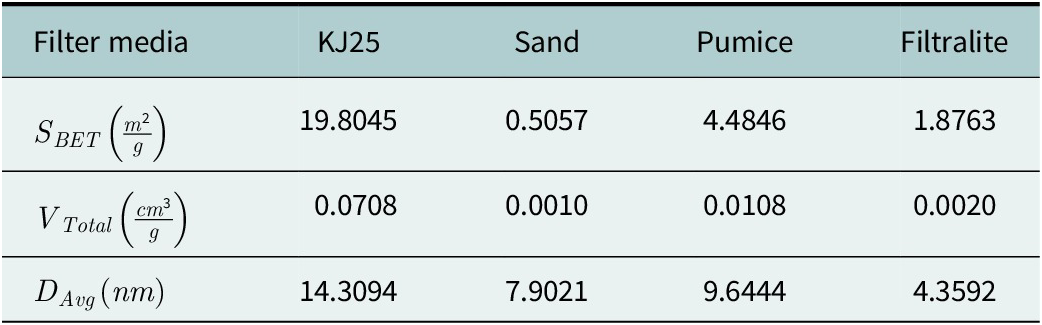
The textural properties of the investigated media are summarised in Table 4. KJ25 exhibited the highest SBET of 19.80 m2/g and a total pore volume of 0.0708 cm3/g, with an average pore diameter of 14.31 nm, placing it within the mesoporous range (2–50 nm) as defined by IUPAC standards (Shi et al., Reference Shi, Santiso, Gubbins, Moreno-Piraján, Giraldo-Gutierrez and Gómez-Granados2021). The comparatively high surface area and developed pore structure of KJ25 may increase the availability of accessible surface sites and facilitate mass transfer within the media (Yang et al., Reference Yang, Zhou, Hu, Zheng, Zhao, Lv and Liao2024). This mesoporosity appears to particularly favour the adsorption of Fe3+ over Mn2+, a trend consistently observed across all tested media. This can be attributed to the smaller hydrated ionic radius of Fe3+ (~0.65 Å) compared to Mn2+ (~0.83 Å), allowing Fe3+ to penetrate narrower pores and reach internal adsorption sites more effectively (Thanh et al., Reference Thanh, Nha, Giang, Nam, Toan, Khan, Manh and Phong2024). Furthermore, Fe3+ exhibits greater electronegativity (1.8) than Mn (1.5), which enhances its electrostatic interactions and surface complexation with hydroxyl and silanol groups present on the pore surfaces (Kim et al., Reference Kim, Ko, Lee and Chon2020).
Surface properties of KJ25 EcoPellets and conventional filter media

Table 4. Long description
The table consists of four columns for the filter media types (K J 25, Sand, Pumice, and Filtralite) and three rows for specific surface properties.
* Row 1: S sub B E T in meters-squared per gram. K J 25 measures 19.8045, Sand measures 0.5057, Pumice measures 4.4846, and Filtralite measures 1.8763.
* Row 2: V sub Total in centimeters-cubed per gram. K J 25 measures 0.0708, Sand measures 0.0010, Pumice measures 0.0108, and Filtralite measures 0.0020.
* Row 3: D sub Avg in nanometers. K J 25 measures 14.3094, Sand measures 7.9021, Pumice measures 9.6444, and Filtralite measures 4.3592.
In contrast, sand exhibited a low specific surface area (0.51 m2/g) and very small total pore volume, consistent with its comparatively low metal-removal performance. Pumice and Filtralite exhibited intermediate textural properties; however, their lower Fe and Mn removal relative to KJ25 indicates that pore structure alone does not determine performance.
Chemical composition and potential surface interactions
The chemical composition of the media (Supplementary Table S6) provides additional context for the comparatively high Fe and Mn removal observed for KJ25. With Al₂O₃ (22.28%), SiO₂ (64.55%) and Fe₂O₃ (5.87%), KJ25 possesses a chemically active aluminosilicate matrix that may support surface adsorption, complexation and ion-exchange interactions. Clay minerals consist of silica tetrahedral sheets (STS) and aluminium octahedral sheets (AOS), which can develop negatively charged surface or interlayer sites depending on their mineralogical structure and composition (Yang et al., Reference Yang, Gao and Yang2021; Yang et al., Reference Yang, Zhou, Hu, Zheng, Zhao, Lv and Liao2024). These sites may interact with dissolved metal ions through surface complexation and possible ion exchange. However, the contribution of ion exchange to Fe and Mn removal was not directly quantified in this study because CEC and exchangeable-ion measurements were not undertaken.
In comparison, sand, predominantly composed of inert SiO₂ (95.43%), lacks reactive sites and structural versatility, explaining its low removal efficiency. While pumice and filtralite exhibit modest amounts of Al and Fe oxides, they still fall short of the more favourable chemical composition and pore architecture present in KJ25.
Mechanistic insights and overall synergy
The Fe and Mn removal behaviour of KJ25 EcoPellets appears to reflect the combined influence of surface interactions, pore structure and mass-transfer processes rather than a single dominant mechanism. For Fe, the PFO model provided the best kinetic fit (
$ {R}^2=0.976 $
 ), indicating that it adequately described the rapid uptake behaviour observed during the early stages of contact. The Weber–Morris analysis further indicated an important contribution from surface and intraparticle diffusion, particularly during Stages I and II. Mineralogical and FTIR analyses showed the presence of Fe-bearing phases, including haematite and magnetite, together with hydroxyl-, silanol- and aluminosilicate-related functional groups that may provide reactive sites for Fe retention through surface interactions and complexation. However, the individual contributions of physisorption, chemisorption, redox reactions and surface complexation could not be independently quantified in the present study.
For Mn, the PSO model provided the better kinetic fit (
$ {R}^2=0.723 $
 ), while the Weber–Morris analysis indicated an important contribution from intraparticle diffusion during the later stages of uptake. The presence of illite/mica and amorphous aluminosilicate phases may provide surface and interlayer sites that contribute to Mn retention through surface interactions and possible ion exchange. However, cation-exchange capacity and exchangeable-ion measurements were not undertaken, and ion exchange therefore cannot be identified as a dominant or confirmed Mn removal mechanism. The slower Mn uptake and lower equilibrium capacity relative to Fe are likely associated with the combined effects of mass transfer, aqueous chemistry and interactions with available surface sites; however, the relative importance of these factors could not be independently resolved.
Among the conventional media, pumice showed moderate Fe and Mn removal, which may be associated with its porous structure and available surface sites. Sand and Filtralite showed comparatively low removal and weaker kinetic and equilibrium-model fits under the investigated conditions. These differences indicate that adsorption performance is likely governed by the combined influence of pore architecture, mineralogical composition, surface chemistry and mass-transfer characteristics rather than by a single material property.
Overall, the comparatively high performance of KJ25 can be associated with the combined presence of a developed mesoporous structure, Fe-bearing mineral phases and an aluminosilicate-rich matrix containing potentially reactive surface sites. These characteristics may collectively support the rapid Fe uptake and more moderate Mn removal observed under the investigated batch conditions. However, the specific contributions of adsorption, surface complexation, ion exchange, diffusion, precipitation and other processes could not be conclusively distinguished, and further mechanistic studies are required to quantify their relative roles.
Circular economy framing and system boundary
KJ25 EcoPellets were developed within a circular economy (CE) framing that prioritises local resource recovery and reduced dependence on imported filter media for decentralised drinking-water treatment (Ellen MacArthur Foundation, 2013; Kirchherr et al., Reference Kirchherr, Reike and Hekkert2017; Satheesh et al., Reference Satheesh, Oh and Tee2021). The core CE strategy aligns with industrial symbiosis: converting low-value by-products (brick-making clay mixtures and locally available agricultural residues) into a granular adsorbent that delivers treatment benefits while diverting materials from disposal pathways (Chertow, Reference Chertow2000; Lombardi and Laybourn, Reference Lombardi and Laybourn2012). Figure 4 defines the conceptual system boundary used here to support life cycle thinking, spanning waste/by-product inputs, local processing and manufacture, deployment for Fe/Mn removal and downstream residuals handling and end-of-life options.
Circular system boundary for KJ25 EcoPellets. Solid arrows denote flows demonstrated in this study; dashed arrows denote potential circular pathways requiring validation.

Within this boundary, the principal sustainability trade-off is the thermal energy demand associated with drying and calcination, which is commonly identified as an life cycle assessment (LCA) hotspot (ISO, 2006a, 2006b). However, KJ25 is produced at a lower calcination temperature (750°C) than many expanded-clay lightweight aggregates, which are typically sintered at substantially higher temperatures, indicating potential for lower thermal intensity relative to high-temperature sintered media (Gellert, Reference Gellert and Hall2010; Ihekweme et al., Reference Ihekweme, Obianyo, Anosike-Francis, Anyakora, Odusanya and Onwualu2021). For remote and regional deployments, local manufacture from low-cost/low-value inputs may also reduce transport exposure and supply-chain vulnerability, which can materially influence life-cycle impacts in small systems (ISO, 2006a, 2006b).
During the use phase, KJ25 functions as a granular adsorbent for Fe and Mn removal without reliance on chemical oxidants, supporting operational simplicity in decentralised settings. Residuals generated during operation (e.g., backwash solids and spent media) are a key end-of-life consideration because spent adsorbents may require regeneration, stabilisation or controlled disposal depending on contaminant loading and leachability (Baskar et al., Reference Baskar, Bolan, Hoang, Sooriyakumar, Kumar, Singh, Jasemizad, Padhye, Singh, Vinu, Sarkar, Kirkham, Rinklebe, Wang, Wang, Balasubramanian and Siddique2022; Fouda-Mbanga et al., Reference Fouda-Mbanga, Onotu and Tywabi-Ngeva2024). At minimum, these residuals can be managed through controlled disposal consistent with established practices for treatment sludges. Potential circular pathways (e.g., reprocessing/regeneration or beneficial reuse) are conceptually feasible but should be validated using appropriate leachate preparation and leaching-risk evaluation under relevant regulatory criteria.
A full LCA was outside the scope of this study; future work should quantify inventory data for thermal energy, water use and transport distances under remote deployment scenarios and evaluate end-of-life options through leaching compliance tests and scenario analysis to identify pathways that maximise circularity while ensuring safety.
Conclusion and recommendations
KJ25 EcoPellets were developed from locally available brick-making clays and agricultural residues and evaluated for simultaneous Fe and Mn removal under controlled batch conditions. KJ25 achieved approximately 95%–99% Fe removal and 45%–50% Mn removal under the investigated conditions and generally outperformed sand, pumice and Filtralite. Langmuir modelling indicated a substantially higher maximum adsorption capacity for Fe (
$ {q}_{\mathrm{max}}=10.32 $
 mg/g) than for Mn (
$ {q}_{\mathrm{max}}=1.90 $
 mg/g), demonstrating promising Fe removal performance but more moderate and potentially capacity-limiting Mn uptake.
The kinetic, equilibrium, mineralogical, chemical and FTIR results indicate that the performance of KJ25 is associated with its porous aluminosilicate matrix, Fe-bearing phases and available surface functional groups. However, the present results do not allow the individual contributions of adsorption, surface complexation, ion exchange, diffusion, precipitation and other processes to be conclusively distinguished.
The present findings demonstrate the potential of KJ25 as a low-cost clay–biomass-derived medium for Fe and Mn removal. However, the results are based primarily on controlled synthetic-water batch experiments and should not be interpreted as direct evidence of full-scale drinking-water treatment performance. Continuous-flow column evaluation of KJ25 has been reported separately; nevertheless, further testing using real source waters with varying water chemistry, natural organic matter, competing ions, pH and temperature is required. Longer-term continuous-flow and pilot-scale studies should evaluate breakthrough behaviour, hydraulic performance, media durability, repeated backwashing, regeneration or media-replacement requirements and sustained Fe and Mn removal, particularly given the lower Mn adsorption capacity.
Future studies should determine the CEC of the precursor clay–biomass formulation and the resulting calcined KJ25 EcoPellets and quantify exchangeable cations released during Fe and Mn uptake to establish the specific contribution of ion exchange. The suitability of KJ25 for drinking-water treatment should also be confirmed through dedicated leaching and safety assessments of the final calcined media under relevant treatment conditions. These assessments should include dissolved organic carbon (DOC), trace metals, nutrients, pesticide residues and other potential organic leachates originating from the clay and biomass feedstocks, together with possible Fe release from Fe-bearing phases within the pellets. Leaching behaviour should be evaluated for both unused and spent media under a range of relevant water chemistries and contact times. Regeneration, spent-media management and end-of-life options should also be investigated. Finally, life cycle and techno-economic assessments are required to quantify the trade-offs associated with thermal processing, local manufacture, transport, operation and end-of-life management before practical decentralised deployment.
Open peer review
To view the open peer review materials for this article, please visit http://doi.org/10.1017/wat.2026.10031.
Supplementary material
The supplementary material for this article can be found at http://doi.org/10.1017/wat.2026.10031.
Acknowledgements
This work was supported by the Queensland University of Technology (QUT) through its Higher Degree Research Program, with financial assistance provided via the first author’s research scholarship. This research was further enabled by the Central Analytical Research Facility (CARF) at QUT). We thank Ashley Mead (Resilient Water Solutions Pty Ltd) and Mickael Georgitsis (Pacific Agency | Saint-Gobain LECA) for supplying Filtralite, Rod Donegan (Ausperl Pty Ltd) for providing pumice and John Zhu (Oxley Brick Factory) for supplying clay mixtures. The authors also gratefully acknowledge the Isaac Regional Council and the South Burnett Regional Council for in-kind support, including the provision of water-quality data and agricultural residues.
Author contribution
Conceptualisation: B. M. J. K. B., J. R. and C. G.; Data curation: B. M. J. K. B., J. R. and C. G.; Formal analysis: B. M. J. K. B.; Investigation: B. M. J. K. B., J. R. and C. G.; Methodology: B. M. J. K. B., J. R. and C. G.; Software: B. M. J. K. B.; Supervision: J. R.; Resources: B. M. J. K. B.; Visualisation: B. M. J. K. B.; Writing – original draft: B. M. J. K. B.; Writing – review and editing: J. R. and C. G.
Data availability statement
The core data validating the Fe and Mn adsorption capacities are provided within the article and its Electronic Supplementary Material files.
Declaration of generative AI and AI-assisted technologies in the manuscript preparation process
During the preparation of this work, the authors used ChatGPT (OpenAI) to rephrase sentences for language clarity. After using this tool, the authors reviewed and edited the content as needed and take full responsibility for the content of the published article.
Funding statement
This research did not receive any specific grant from funding agencies in the public, commercial or not-for-profit sectors.





 Open access


Comments
Dear Professor Fenner,
Re: Submission of manuscript to Cambridge Prisms: Water
I am pleased to submit our manuscript entitled, “From physical to reactive filtration: Mechanistic insights into iron and manganese removal using clay–biomass composite media (KJ25 EcoPellets)”, for consideration in Cambridge Prisms: Water.
Access to safe and affordable drinking water remains a significant challenge in remote and regional communities, including parts of Australia where iron (Fe) and manganese (Mn) frequently exceed guideline limits. While numerous studies report removal performance, the governing mechanisms, particularly for manganese under conditions where it remains predominantly dissolved, are still not well understood.
In this work, we present a controlled mechanistic investigation using a novel calcined clay–biomass composite (KJ25 EcoPellets), developed from locally sourced clays and agricultural residues. Complementing our previously reported continuous-flow column study, this paper isolates the processes governing Fe and Mn removal through systematic batch experiments and comparison with conventional filter media. The results demonstrate that Fe removal is rapid and dominated by physisorption and pore diffusion, whereas Mn removal is slower and governed by surface-mediated and intraparticle diffusion processes. Importantly, the findings show that manganese, rather than iron, governs system performance, and that the composite media enables a transition from conventional physical filtration to reactive filtration behaviour.
We believe this manuscript is well aligned with the scope of Cambridge Prisms: Water, as it advances mechanistic understanding while addressing a practical and globally relevant challenge in decentralised water treatment. The work provides new insight into the design of low-cost, locally manufacturable filtration media, with implications for resilient water supply systems in resource-constrained settings.
This manuscript is original, has not been published previously, and is not under consideration elsewhere. All authors have approved the manuscript and agree with its submission. There are no conflicts of interest to declare.
We appreciate your consideration of our manuscript and would be grateful for the opportunity to contribute to the journal. Suggested reviewers are provided to assist the editorial process.
Please do not hesitate to contact me if further information is required.
Yours sincerely,
Jay Rajapakse
(jay.rajapakse@qut.edu.au)
Senior Lecturer, School of Civil and Environmental Engineering
Queensland University of Technology, Australia