Global warming during the past decade contributed to an increasing number of heat stress (HS) days for dairy cows (Pfleiderer et al., Reference Pfleiderer, Schleussner, Kornhuber and Coumou2019). Most of the HS studies in dairy cows addressed direct HS effects on primary and functional traits during lactation (e.g. Brügemann et al. Reference Brügemann, Gernand, von Borstel and König2011; Gernand et al. Reference Gernand, König and Kipp2019). So far, there was a comparatively low interest in analyzing HS effects during the dry period, because body heat production is associated with milk production (West, Reference West2003). In consequence, dry cow management in Germany neglects HS protection. A few researchers focused on possible carry-over effects of HS from the dry period on time-lagged milk yield (Urdaz et al., Reference Urdaz, Overton, Moore and Santos2006), fertility (Thompson et al., Reference Thompson, Tao, Branen, Ealy and Dahl2013) and immune functions (Dahl et al., Reference Dahl, Tao and Laporta2020) of the same cow in the ongoing lactation.
A new topic addresses the effect of HS of the parental generation during the dry period (i.e. late gestation) on time-lagged performances recorded in the offspring generation. Due to the HS impact during late gestation on unborn individuals, the expression ‘intrauterine HS’ is widely used. Tao and Dahl (Reference Tao and Dahl2013) stated that the dry period is very critical for both the cow and the fetus, because the fetus accumulates 60% of its body weight during the last 8 weeks of gestation (Bauman and Currie, Reference Bauman and Currie1980). Monteiro et al. (Reference Monteiro, Tao, Thompson and Dahl2016) compared different traits in the offspring generation, depending on the HS management of their dams during the last 46 d of gestation. Heat stress during the dry period unfavorably influenced calf body weight from birth up to 1 year of age, the number of services per conception before first lactation, and milk production during first lactation. Tao et al. (Reference Tao, Monteiro, Thompson, Hayen and Dahl2012) associated HS during the last 6 weeks of gestation with shorter gestation lengths and compromised immune functions of the calf. Laporta et al. (Reference Laporta, Ferreira, Ouellet, Dado-Senn, Almeida, De Vries and Dahl2020) identified persisting HS impairments through multiple generations: granddaughters from heat stressed grandmothers produced less milk and had a higher culling than cows from the control group.
Thus, some researchers indicated the importance of HS management during the dry period under hot climate conditions, but they considered only a quite small number of cows in specific research designs or in clinical studies. No data exists for long-lasting effects of HS during pregnancy in relation to commercial practice and climatic conditions of middle Europe. Detailed knowledge of HS influence during pregnancy on later performance, also from an across-generation perspective, could contribute to improvements of the dry cow management. In consequence, the aim of this study was to quantify the effect of HS from different intervals within the last 8 weeks of gestation on productivity, female fertility and longevity in the offspring generation, considering a comprehensive dataset of Holstein cows from Germany over a period of 10 years.
Materials and methods
Data for this study considered primary and functional traits as used for official national genetic evaluations. No additional experiments or trait recordings were conducted. Thus, in concordance with the German animal welfare legislation, no ethical approval was required for this study.
Animals and traits
The dataset considered all Holstein cows participating at the official milk recording scheme from the German federal state of Hesse. Data from herds with fewer than 10 cows were discarded. Production traits included milk yield (MKG), protein percentage (PRO%), fat percentage (FAT%), somatic cell score (SCS) and milk urea nitrogen (MUN) from the first official test-day day (within the period from day 5 to 35 after calving) in first lactation. According to Ali and Shook (Reference Ali and Shook1980), SCS was calculated as: SCS = log 2(SCC/100 000) + 3.
Female fertility traits were the non-return-rate after 56 d (NRR56) in heifers and the interval from calving to first insemination (ICFI) in first parity cows. Longevity traits included the length of productive life (LPL, i.e. the period from the first calving to the culling date), lifetime productivity for milk yield in kg (LTP-MKG) and milk yield per day of life (MKG-DL). For LPL, LTP-MKG and MKG-DL, cows with censored data (i.e. cows without culling date), were excluded. Descriptive statistics for all cow traits are given in detail in Supplementary Table S1. According to the descriptive statistics for production traits with an average milk yield level of 26.23 kg per first official test-day, 9.53 kg per day of life and 19 323 kg lifetime productivity, the present dataset reflects the typical productivity pattern of German Holstein dairy cattle herds.
Meteorological data
Meteorological data included temperature and humidity, and were available from public weather stations. Herds and weather stations were merged according to their closest distance. In this regard, we applied the R-package Geosphere (Hijmans et al., Reference Hijmans, Williams and Vennes2016). The distance between the herds and the weather stations ranged between 7.99 and 36.27 km.
Based on daily averages for temperature (T) (in °C) and relative humidity (RH) (in %), the daily THI was calculated as follows (NRC, 1971):
THI = (1.8 × T + 32) − (0.55–0.0055 × RH) × (1.8 × T − 26)
The major intention of this study was to infer trait-specific time-lagged HS effects. In this regard, different weekly intervals might be relevant for different trait categories. Consequently, eight single week intervals ante partum (a. p.) were considered. The specific weeks were defined as follows:
Week 1 = day 0–7 a. p.
Week 2 = day 8–14 a. p.
Week 3 = day 15–21 a. p.
Week 4 = day 22–28 a. p.
Week 5 = day 29–35 a. p.
Week 6 = day 36–42 a. p.
Week 7 = day 43–49 a. p.
Week 8 = day 50–56 a. p.
Daily THI was averaged within all 8 weeks. Heifer and cow records from the offspring generation were allocated to the following THI classes before birth: class 1: THI ≤39, class 2: THI = 40–49, class 3: THI = 50–59, class 4: THI ≥60. This was done for all 8 weeks separately. The threshold of THI 60 for the upper class was chosen, because Brügemann et al. (Reference Brügemann, Gernand, König von Borstel and König2012) applied the same THI formula (NRC, 1971), and they identified THI 60 as HS-threshold for the direct HS effect on test-day MKG and SCS in German Holstein cows. In this regard, Brügemann et al. (Reference Brügemann, Gernand, König von Borstel and König2012) studied climatic effects on cow traits in different regions and production systems from Germany. In all of their analyses, they identified a decline of cow productivity and detrimental impact of functional traits beyond THI 60.
Heifers and cows in this study were born between November 1998 and October 2011. The focus was on such historical birth years, because we additionally aimed to infer time-lagged effects on longevity traits. During the ‘historical’ period, the considered family farms from the federal state Hesse, Germany, did not apply any heat abatement strategies for dry cows. Accordingly, meteorological data covered historical periods, from November 1998 (i.e. the 8 weeks a. p. for the oldest cows) until October 2011. Supplementary Figure S1 displays the distribution of daily THI for this period.
Statistical analysis
Linear mixed models (for Gaussian distributed traits) and generalized linear mixed models with a logit-link function (for binary traits) were applied to assess the impact of THI during late pregnancy (defined as intrauterine HS) on heifer and cow traits in the offspring generation. For all statistical analyses, the SAS University Edition (SAS Institute Inc., 2017) was used. Assessing the weekly THI impact from 8 single weeks during late gestation on 10 different offspring traits implied in total 80 different runs. Details for statistical model definitions are given in the online Supplementary File.
Results
Impact of THI during late gestation on test-day production traits
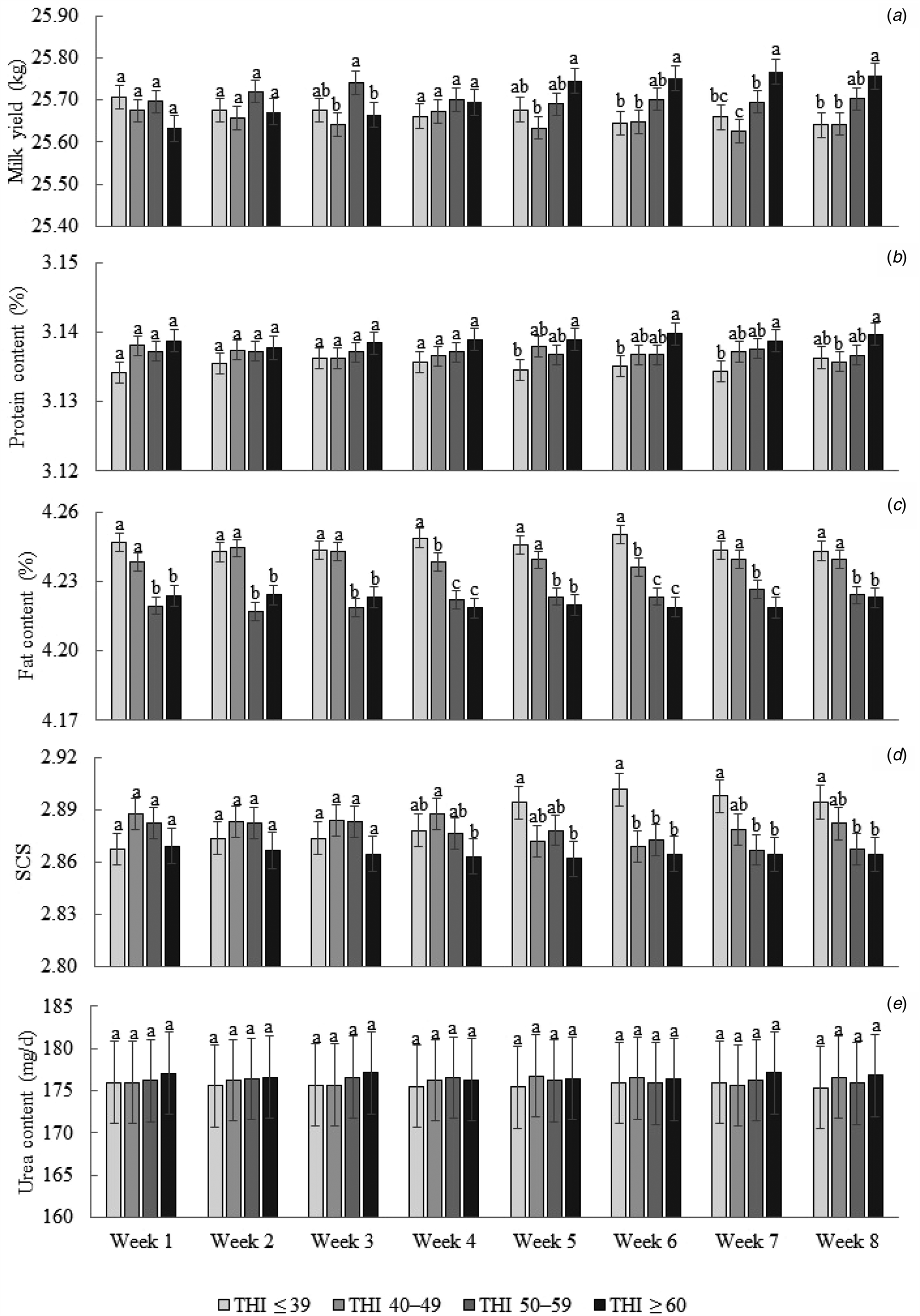
Least squares means for offspring test-day production traits depending on THI from all 8 weeks during late gestation of their dams are depicted in Figure 1. THI ≥60 from weeks 1, 2 and 3 was associated with a decline of MKG. However, with regard to weeks 2 and 3, LSM for MKG in response to THI ≤49 were also quite low. The THI from week 4 had no significant effect on MKG. A THI ≥50 from weeks in greater distance from calving (i.e. weeks 5, 6, 7 and 8) was associated with a slight increase of MKG in the offspring generation. By trend, LSM for PRO% in offspring increased with increasing THI. This was the case for all 8 weeks during late gestation. With regard to FAT%, a strong detrimental impact of HS (THI ≥50) was observed for all 8 weeks. SCS decreased with increasing THI from all 8 weeks, with lowest SCS for THI ≥60. The THI from any of the observed 8 weeks a. p. had no significant effect on MUN.
Least squares means for the production traits (first test-day, first lactation) milk yield in kg (a), protein percentage in % (b), fat percentage in % (c), SCS (d) and MUN in mg/d (f) (± standard errors) in dependency of the average temperature-humidity-index (THI) during single week intervals from the last 8 weeks before birth. Different letters above bars represent significant differences between the 4 THI-classes within weekly periods at P < 0.05 (t-test).

Impact of THI during late gestation on female fertility traits
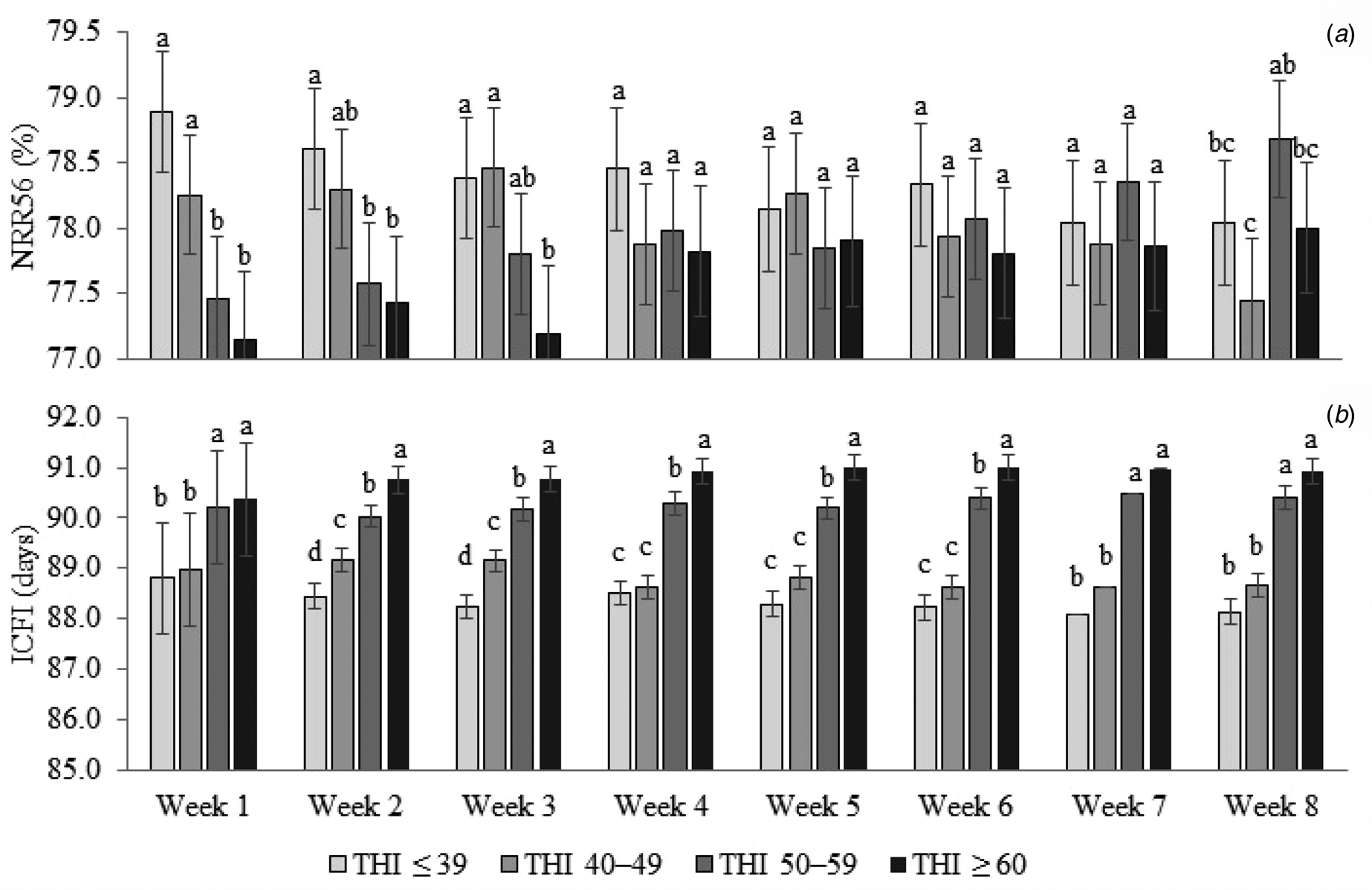
Heifers from dams exposed to high THI during the last 8 weeks of pregnancy had the lowest conception rates (Fig. 2). Such differences for NRR56 were very strong for weeks 1, 2 and 3, with pronounced detrimental impact of THI ≥50. In first parity cows, ICFI after first calving was prolonged due to THI ≥50 during late gestation, with very similar effects for all 8 weeks a. p. (Fig. 2).
Least squares means for the female fertility traits non-return-rate after 56 d in heifers (NRR56) in % (a) and interval from calving to first insemination (ICFI) in first parity cows in days (b) (± standard errors) in dependency of the average temperature-humidity-index (THI) during single week intervals of the last 8 weeks before birth. Different letters above bars represent significant differences between the 4 THI-classes within weekly periods at P < 0.05 (t-test).

Impact of THI during late gestation on longevity traits
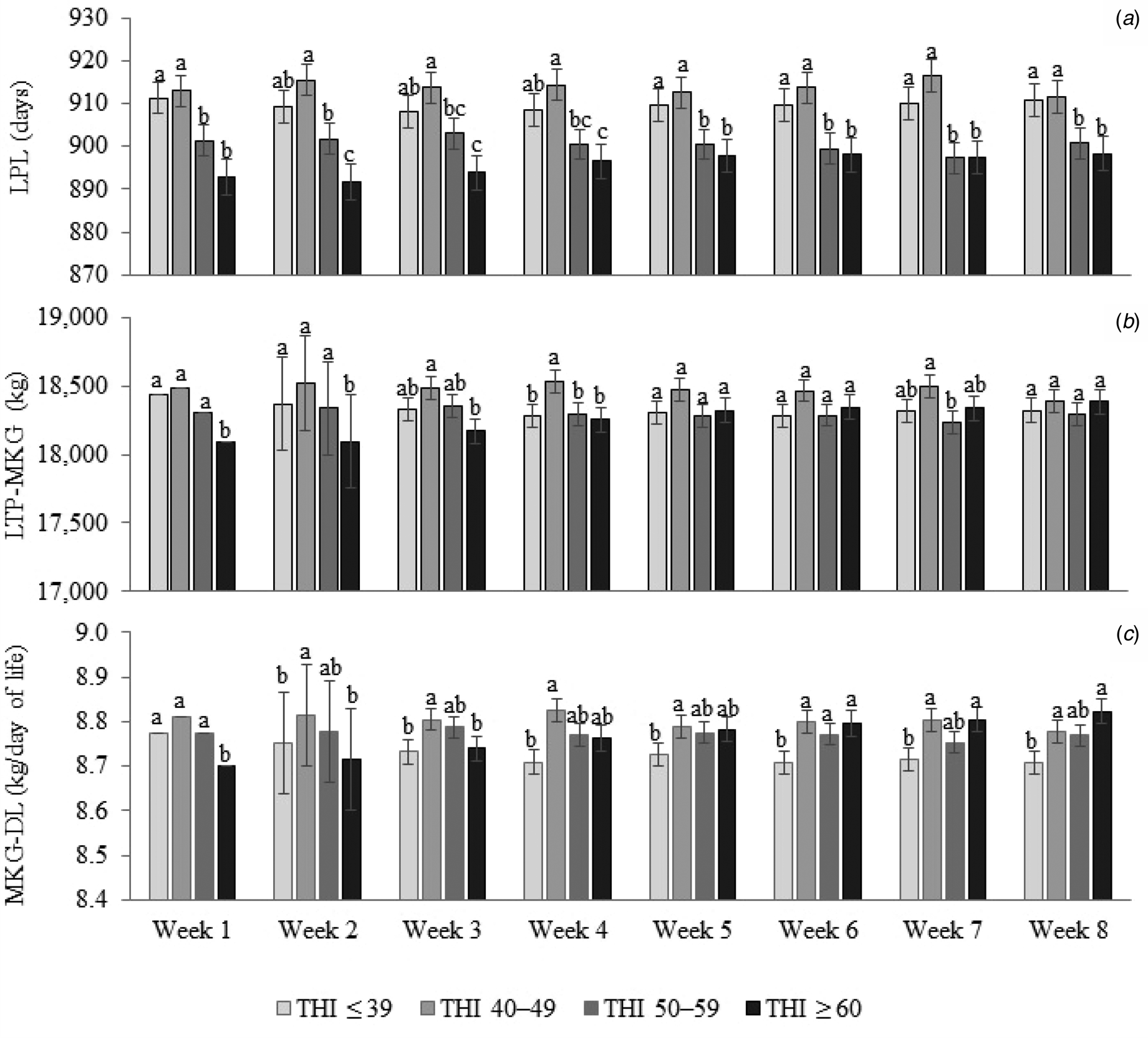
Figure 3 displays LSM for LPL, LPL-MKG and MKG-DL depending on THI from the last 8 weeks of gestation. For all weeks, LSM for LPL were largest for THI 40–49 and lowest for THI ≥60. Similarly, for LTP-MKG and with regard to weeks 1, 2, 3 and 4, LSM were highest for THI 40–49 and lowest for THI ≥60. For MKG-DL, LSM were lowest for THI ≥60 from weeks 1, 2 and 3. For week 4 a. p., LSM for MKG-DL was highest in response to THI 40–49. For the remaining 4 intervals (weeks 5, 6, 7 and 8 a. p.), low THI ≤39 had negative effects on MKG-DL.
Least squares means for the long-term functional traits productive life (LPL) in days (a), lifetime productivity (LTP-MKG) in kg (b) and milk yield per day of life (MKG-DL) in kg/day of life (c) (± standard errors) in dependency of the average temperature-humidity-index (THI) during single week intervals of the last 8 weeks before birth. Different letters above bars represent significant differences between the 4 THI-classes within weekly periods at P < 0.05 (t-test).

Discussion
Physiological explanations for the identified primary and function trait impairments due to fetal HS during late pregnancy address possible carry-over effects. Against this background, Leos et al. (Reference Leos, Anderson, Chen, Pugmire, Anderson and Limesand2010) observed inadequate fetal nutrient and oxygen supply due to a HS related placental insufficiency (Leos et al., Reference Leos, Anderson, Chen, Pugmire, Anderson and Limesand2010), with impact on placental weight (Bell et al., Reference Bell, McBride, Slepetis, Early and Currie1989) and placental hormone production levels (including estrone-sulfate, placental lactogen and pregnancy-specific protein B) (Collier et al., Reference Collier, Doelger, Head, Thatcher and Wilcox1982; Bell et al., Reference Bell, McBride, Slepetis, Early and Currie1989; Thompson et al., Reference Thompson, Tao, Branen, Ealy and Dahl2013). In sheep, Regnault et al. (Reference Regnault, de Vrijer, Galan, Davidsen, Trembler, Battaglia, Wilkening and Anthony2003) detected an impairment of the placental angiogenesis due to HS. Holter et al. (Reference Holter, West and McGilliard1997) identified a feed intake decline of Holstein cows during HS periods. Because the fetus accumulates 60% of its body weight during the last 8 weeks of gestation, the requirement for maternal nutrition during this period is of high priority (Bauman and Currie, Reference Bauman and Currie1980; Yates et al., Reference Yates, Green and Limesand2011). Such nutritional–physiological aspects addressing the fetal energy requirements (Russel and Wright, Reference Russel and Wright1983) is a major explanation for the stronger HS effects at the end of the considered 8-week period. Fetal malnutrition might cause long-term effects in offspring, e.g. due to prenatal programing (Wu et al., Reference Wu, Bazer, Wallace and Spencer2006). Heat stress reduces the barrier functions of the rumen and the intestine (Khafipour et al., Reference Khafipour, Krause and Plaizier2009; Sanz-Fernandez et al., Reference Sanz-Fernandez, Stoakes, Johnson, Abuajamieh, Seibert, Pearce, Gabler, Rhoads and Baumgard2014). In consequence, bacteria and lipopolysaccharide from the gastrointestinal content pass into the blood circulation (Pearce et al., Reference Pearce, Mani, Boddicker, Rhoads, Weber, Ross, Baumgard and Gabler2013). In further causality, endotoxemia might occur, with harmful effects on both the maternal and the fetal organism.
In the present study, intrauterine HS (THI ≥50) especially contributed to a decrease of FAT% in offspring. THI ≥60 in weeks 1, 2 and 3 weeks before birth slightly impaired test-day MKG. One explanation for impaired FAT% and MKG addresses fetal metabolic adaptations due to HS in the a. p. period. Tao et al. (Reference Tao, Monteiro, Hayen and Dahl2014) observed enhanced whole-body insulin response in 55 d old calves when their dams were exposed to HS during the dry period. Chen et al. (Reference Chen, Fahy, Green, Anderson, Rhoads and Limesand2010) reported that a HS induced placental insufficiency causes a down-regulation of β2-adrenergic receptors. In sheep, HS impact on ewes was associated with adrenergic stimulated lipolysis and obesity of their lambs. Long-term effects on lipolysis are unclear, but the strong impact on FAT% as identified in the present study indicate long-term shifts of the lipid metabolism. In the present study, FAT% from the first test-day after calving was analyzed, displaying the clear focus on the early lactation period and the stage of a naturally negative nutrient balance. In consequence, our results indicate long-term HS impact on physiological mechanisms influencing body fat mobilization. In addition to body fat, ruminal short chain fatty acids are an important source for milk fat synthesis. Hence, as a further explanation for the identified HS effects on FAT%, changes in ruminal biohydrogenation pathways characterized by a trans-11 to trans-10 shift inhibited milk fat synthesis (Dewanckele et al., Reference Dewanckele, Jing, Stefańska, Vlaeminck, Jeyanathan, Van Straalen, Koopmans and Fievez2019; Dewanckele et al., Reference Dewanckele, Toral, Vlaeminck and Fievez2020).
Physiological adaptions in response to fat metabolism might explain lower MKG, because in periods of a naturally negative energy balance, body fat is used as energy source. Accordingly, obesity or an increased body fatness due to physiological imbalances were associated with lower productivity in first lactation (Silva et al., Reference Silva, VandeHaar, Whitlock, Radcliff and Tucker2002). Skibiel et al. (Reference Skibiel, Dado-Senn, Fabris, Dahl and Laporta2018) analyzed mammary biopsies of first-lactation heifers. Dams of these heifers experienced HS during the last 46 d of gestation, or were cooled during this period. In the HS group, alveoli size was affected and the proportion of connective tissue was increased, implying a lower storage capacity for milk and lower milk yield. These physiological mechanisms might explain the HS impact from the last 3 weeks of gestation on MKG. However, HS impact on time-lagged MKG differed when evaluating THI from weeks 5, 6, 7 and 8 a. p.
Results from studies investigating associations between direct HS and udder health are controversial. Brügemann et al. (Reference Brügemann, Gernand, König von Borstel and König2012) observed an SCS increase due to HS and due to cold stress in German Holstein cows, depending on the region or production system. Santana et al. (Reference Santana, Bignardi, Pereira, Stefani and El Faro2017) reported decreasing SCS with increasing THI in Brazilian Holstein cows. Olde Riekerink et al. (Reference Olde Riekerink, Barkema and Stryhn2007) explained variations of SCS on climate changes with different responses to specific major pathogens. Similar mechanisms might explain effects from intrauterine HS. Gernand et al. (Reference Gernand, König and Kipp2019) reported direct HS effects on MUN in lactating cows, i.e. a substantial increase of MUN with THI >70 (both measurements from the same day). THI from an earlier period (the week before the test-day) only moderately influenced MUN. Thus, MUN responses were stronger for prompt HS impact, and negligible from an across-generation perspective (the results from the present study).
Here, offspring from dams exposed to HS during late gestation had an impaired conception rate, and a delayed starting of the reproduction cycle after calving. Such across-generation HS influences are in agreement with reports from Akbarinejad et al. (Reference Akbarinejad, Gharagozlou and Vojgani2017), who observed a negative effect of maternal HS on offspring fertility in Iranian Holstein dairy cows. Moreover, offspring of dams exposed to HS during late gestation had lower levels for the anti-Müllerian hormone concentration (Akbarinejad et al., Reference Akbarinejad, Gharagozlou and Vojgani2017). Lower anti-Müllerian hormone concentrations indicate a lower ovarian reserve (Ireland et al., Reference Ireland, Smith, Scheetz, Jimenez-Krassel, Folger, Ireland, Mossa, Lonergan and Evans2011), which is associated with impaired female fertility (Mossa et al., Reference Mossa, Walsh, Butler, Berry, Carter, Lonergan, Smith, Ireland and Evans2012). The unfavorable effect of HS on the ovarian reserve in dairy cows might be due to maternal malnutrition (Mossa et al., Reference Mossa, Walsh, Butler, Berry, Carter, Lonergan, Smith, Ireland and Evans2012), oxidative stress (Devine et al., Reference Devine, Perreault and Luderer2012) or an elevation of catecholamines (Barra et al., Reference Barra, Cruz, Mayerhofer, Paredes and Lara2014).
In the present study, HS had long long-term unfavorable effects on longevity traits, in particular on LPL. As indicated above, intrauterine HS impairs the immune system, with detrimental impact on cow health (Sordillo et al., Reference Sordillo, Contreras and Aitken2009). Shabalina et al. (Reference Shabalina, Yin and König2020) identified strong associations between early diagnoses for health disorders with LPL and stayability rates in adult cows. Generally, LPL is a bio-index combining a broad pattern of functional and health traits (Ahlman et al., Reference Ahlman, Berglund, Rydhmer and Strandberg2011). Unfavorable impact of fetal HS on functional traits was identified in our as well as in some previous studies (e.g. Monteiro et al. Reference Monteiro, Tao, Thompson and Dahl2016).
In conclusion, heat stress during the last 8 weeks of gestation had detrimental effects on test-day production, female fertility and longevity traits recorded in the offspring generation. In this regard, strongest reactions on HS from an across-generation perspective were observed for FAT%. Similarly, high THI in all 8 weeks a. p. unfavorably influenced ICFI and LPL. Heat from weeks 1, 2 and 3 a. p. had detrimental across-generation impact on MKG, NRR56, LTP-MKG and MKG-DL. Hence, we identified trait-specific responses, depending on the weekly interval before calving where HS occurred. In our statistical mixed modeling approach, we considered the general herd effect to account for possible impact of herd specific characteristics, such as feeding strategies or the cow dry management. In ongoing time-lagged HS studies, it might be interesting to infer the effects from specific herd characteristics on offspring performances, which implies a detailed and systematic herd management monitoring. From a practical point of view, results from the present study underline the importance of an improved HS management during the dry period, in order to create optimal conditions for in-utero fetal development, and associated long-term impact on longevity.
Supplementary material
The supplementary material for this article can be found at https://doi.org/10.1017/S0022029921000327.
Acknowledgements
The authors acknowledge the support of the ‘H. Wilhelm Schaumann Stiftung’ for providing a scholarship to Mrs Cordula Kipp. The authors gratefully acknowledge the financial support provided by the German National Science Foundation, DFG, through grant number KO 3520/8-1.