Introduction
Insight into the course and the aetiology of variation in trajectories of psychopathology from childhood into adolescence and adulthood is required to address questions concerning origins and prognosis of psychopathology. In this paper we aim to unravel the causes of variation in trajectories of symptoms of anxiety and depression (SxAnxDep) between ages 3 and 63 years, and specifically to assess the extent to which such variation is caused by genetic factors. A large prospective cohort study would be the optimal design for identifying the importance of genetic aetiological factors, but would require following the same subjects for ⩾50 years. Here we made use of the long-term data collection in nearly 50 000 twins from The Netherlands Twin Register (NTR) over the past 25 years, and analysed data on SxAnxDep reordered according to a cohort-sequential design.
Stability in symptoms and diagnoses of anxiety and depression is evident throughout the lifespan; stability is lowest between childhood and adolescence, and increases from adolescence into adulthood (Hofstra et al. Reference Hofstra, van der Ende and Verhulst2000; Richards, Reference Richards2011; Beesdo-Baum & Knappe, Reference Beesdo-Baum and Knappe2012). During adolescence, there is a rise in the prevalence of anxious and depressive symptoms and diagnoses, especially in women (with the exception of separation anxiety disorder and specific phobia), and there is a marked continuity of symptoms into adulthood (Costello et al. Reference Costello, Mustillo, Erkanli, Keeler and Angold2003; Beesdo-Baum & Knappe, Reference Beesdo-Baum and Knappe2012). When considering stability in longitudinal studies, outcomes depend in part on how anxiety and depression are measured. Greater stability of depression has been observed in continuous measures (e.g. symptom counts) than in binary measures indicating that individuals, who no longer satisfy the criteria for a diagnosis, may still have residual symptoms (Ormel et al. Reference Ormel, Oldehinkel, Brilman and van den Brink1993).
A case has been made that studies of the genetic and environmental contributions to individual differences in health and disease are important to the understanding of illness (Collins, Reference Collins2004). In addition, such studies inform molecular genetics studies (van Dongen et al. Reference van Dongen, Slagboom, Draisma, Martin and Boomsma2012). Knowledge regarding the contributions of genetic and environmental factors to the long-term course of SxAnxDep is still lacking, as most studies using genetically informative subjects have been limited to cross-sectional or short-term follow-up analyses. Moreover, in these short-term follow-up analyses, the age range of the participants at the start of a longitudinal study is often greater than the duration of the follow-up. As a consequence, the age ranges of the participants at the different assessments overlap and age-specific explanations of variation over time might be missed.
The empirical evidence suggests that between ages 3 and 12 years genetic effects are important, and relatively stable, while adolescence is characterized by genetic innovations, i.e. the emergence of novel genetic effects. In an overview of cross-sectional genetic studies of young and adolescent twins, heritability estimates for anxiety, depression and internalizing symptoms range from 0% to 74%, but the majority is over 30% (Rice, Reference Rice2009). The great variability over studies is attributed to rater and age effects; in most studies heritability is higher for parental reports than for self-reports, and heritability is higher at adolescence than in childhood (Rice & Thapar, Reference Rice, Thapar and Kim2009). Longitudinal studies of children in The Netherlands and in the UK showed that stability in SxAnxDep between ages 3 and 12 years is mainly attributable to stable genetic effects (Boomsma et al. Reference Boomsma, van Beijsterveldt, Bartels, Hudziak and Hudziak2008; Trzaskowski et al. Reference Trzaskowski, Zavos, Haworth, Plomin and Eley2012), although genetic innovation was also evident in this age range. The period of transition from childhood to adolescence was investigated in Swedish twins with SxAnxDep, assessed repeatedly between ages 8 and 20 years (Kendler et al. Reference Kendler, Gardner, Annas and Lichtenstein2008a –Reference Kendler, Gardner and Lichtenstein c ). Stability was partly explained by genetic factors. However, the influence of genetic innovation was large, and the contribution of genetic factors expressed during childhood declined in adolescence. Thus, genetic effects on SxAnxDep were developmentally dynamic from middle childhood to young adulthood.
In adulthood, heritability of anxiety disorders and major depression was estimated around 40% (Sullivan et al. Reference Sullivan, Neale and Kendler2000; Middeldorp et al. Reference Middeldorp, Birley, Cath, Gillespie, Willemsen, Statham, de Geus, Andrews, Van Dyck, Beem, Sullivan, Martin and Boomsma2005; Kendler et al. Reference Kendler, Gatz, Gardner and Pedersen2006). For depression in middle age (50–70 years) heritability estimates ranged from 20% to 50% (Franz et al. Reference Franz, Lyons, O'Brien, Panizzon, Kim, Bhat, Grant, Toomey, Eisen, Xian and Kremen2011). In one longitudinal twin study, participants aged 20–70 years rated themselves on SxAnxDep two or three times with an interval of 10 or 20 years. Genetic effects on symptom scores showed a large degree of stability, with some evidence in females for new genetic effects on anxiety and depression in mid-life and later-life, respectively (Gillespie et al. Reference Gillespie, Kirk, Evans, Heath, Hickie and Martin2004).
The role of environmental effects on stability has been found to be smaller than the role of genetic factors. Environmental influences shared by members of the same family, often referred to as the common environment, contributed to stability in SxAnxDep during childhood (Boomsma et al. Reference Boomsma, van Beijsterveldt, Bartels, Hudziak and Hudziak2008; Trzaskowski et al. Reference Trzaskowski, Zavos, Haworth, Plomin and Eley2012), but effects were small and waned from around 15% explained variance in childhood to zero in adolescence and adulthood (Rapee et al. Reference Rapee, Schniering and Hudson2009). Environmental factors that are not shared by family members, referred to as unique environment, mainly seemed to have short-term effects on SxAnxDep. The impact of life events, for example, on the risk for major depression has been shown to last for 1–3 months (Kendler et al. Reference Kendler, Karkowski and Prescott1998). However, two twin studies found enduring unique environmental effects from adolescence into adulthood and beyond (Gillespie et al. Reference Gillespie, Kirk, Evans, Heath, Hickie and Martin2004; Kendler et al. Reference Kendler, Gardner and Lichtenstein2008c ). This was confirmed in a meta-analysis of longitudinally assessed SxAnxDep in eight samples of monozygotic twins, spanning an age range of 10–66 years (Kendler et al. Reference Kendler, Eaves, Loken, Pedersen, Middeldorp, Reynolds, Boomsma, Lichtenstein, Silberg and Gardner2011). Within-pair differences between MZ twins in SxAnxDep increased from childhood into late adulthood. By middle adulthood environmental factors contributed substantially to stable and predictable individual differences in SxAnxDep.
The aim of the present study was to gain insight into the genetic architecture of SxAnxDep across the lifespan by analysing SxAnxDep assessed with a standardized instrument in twins aged 3–63 years. Data collection spanned a period of 25 years, and entry into the study was at different ages, running from birth to old age. The data were reorganized according to a cohort-sequential longitudinal design, covering the entire age range from age 3 to age 63 years with a maximum follow-up time of 25 years.
Method
Subjects
Longitudinal survey data were collected in twins registered with the Netherlands Twin Register (NTR), which includes the Young NTR (YNTR; van Beijsterveldt et al. Reference van Beijsterveldt, Groen-Blokhuis, Hottenga, Franić, Hudziak, Lamb, Huppertz, de Zeeuw, Nivard, Schutte, Swagerman, Glasner, van Fulpen, Brouwer, Stroet, Nowotny, Ehli, Davies, Scheet, Orlebeke, Kan, Smit, Dolan, Middeldorp, de Geus, Bartels and Boomsma2013) and the Adult NTR (ANTR; Willemsen et al. Reference Willemsen, Vink, Abdellaoui, den Braber, van Beek, Draisma, van Dongen, van ’t Ent, Geels, van Lien, Ligthart, Kattenberg, Mbarek, de Moor, Neijts, Pool, Stroo, Kluft, Suchiman, Slagboom, de Geus and Boomsma2013). In the YNTR, twins have been registered at birth by their parents since 1987 (Bartels et al. Reference Bartels, van Beijsterveldt, Derks, Stroet, Polderman, Hudziak and Boomsma2007). Maternal ratings at ages 3, 7, 10, and 12, and self-ratings at ages 12, 14, 16 and 18 years were included in the analysis. When young twins reach age 18, they are enrolled in the ANTR. The ANTR includes adolescent and adult twins, who were recruited through city councils and other means (Willemsen et al. Reference Willemsen, Vink, Abdellaoui, den Braber, van Beek, Draisma, van Dongen, van ’t Ent, Geels, van Lien, Ligthart, Kattenberg, Mbarek, de Moor, Neijts, Pool, Stroo, Kluft, Suchiman, Slagboom, de Geus and Boomsma2013). The twins completed the SxAnxDep subscale in 1991, 1995, 1997, 2000, 2002, and 2009. All twins between the ages of 12 and 63 years were included in the current study. The total dataset comprised 49 524 twins, including 7863 monozygotic (MZ) and 15 815 same-sex and opposite-sex dizygotic (DZ) complete twin pairs. The majority (60%) participated in more than one survey; with 10% taking part ⩾5 times (see online Supplementary Table S1). To analyse the data as a function of age, data were reordered into age bins spanning 2 years. For instance, a 21-year-old twin in the 1991 survey and a 21-year-old twin in the 2003 survey were both included in the 20–21 years age group. Up to age 30, all age bins included more than 1000 observations. Across the entire dataset, no 2-year age bin included fewer than 130 observations.
Phenotypes
SxAnxDep scores were obtained from the ‘anxious-depressed’ subscale from the age-appropriate questionnaires from the Achenbach System of Empirically Based Assessment (ASEBA): the Child Behavior Checklist CBCL/1.5-5 (Achenbach & Rescorla, Reference Achenbach and Rescorla2000) and CBCL/4-18 (Achenbach & Rescorla, Reference Achenbach and Rescorla2001), the Youth Self-Report (YSR; Achenbach, Reference Achenbach1990), and the Adult Self-Report (ASR; Achenbach & Rescorla, Reference Achenbach and Rescorla2003). The instruments were designed to measure comparable constructs over the ages, and are similar in item content. Mothers were asked to rate the extent to which a statement described their child on a 3-point scale (‘not true’, ‘somewhat or sometimes true’, ‘very or often true’). An example item of the mother rating SxAnxDep scale is ‘Unhappy, Sad or Depressed’. In the self-rating scales, used from age 12 onwards, the item is phrased as ‘I am Unhappy, Sad or Depressed’, and the response format was the same. Similar strong parallels exist for the other items for mother-rated and self-rated SxAnxDep. Full sample questionnaires can be found at http://www.aseba.com. At all ages, except age 3 years, the number of items was the same (nine items at age 3, 16 items at all other ages). The instrument has been found to be measurement invariant in adolescence across age and sex (Fonseca-Pedrero et al. Reference Fonseca-Pedrero, Sierra-Baigrie, Lemos-Giráldez, Paino and Muñiz2012).
While the CBCL, YSR and ASR ‘anxious depressed’ scale scores are a good predictor of anxiety disorders and depression diagnosis, a high score is not equivalent to a diagnosis (Bird et al. Reference Bird, Gould, Rubio-Stiptec, Staghezza and Canino1991). Using composite international diagnostic interviews (CIDI), DSM-IV anxiety and depressive diagnoses were assessed in 1331 (345 cases, 986 controls) adults from the present sample in 1997 and 2007. We compared the SxAnxDep scores of these subjects with their CIDI diagnoses using a ROC curve analysis. The area under the curve for all anxiety and mood disorders was fair at 0.76. For major depressive disorder, the area under the curve was 0.75, and for generalized anxiety disorder 0.78. The use of a continuous measure is consistent with the dimensional view of psychopathology, and with diagnoses based on continuous measures (Markon et al. Reference Markon, Chmielewski and Miller2011).
Statistical model
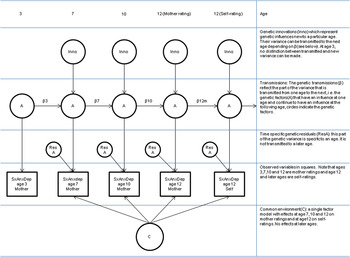
Structural equation modelling was employed to analyse the mean trend across age, sex differences in the mean trend, and the covariance structure of SxAnxDep across age. Estimates of the mean trend for men and women are further analysed using weighted least squares (WLS) (see online Supplementary material). A genetic simplex model was chosen to analyse the longitudinal data (Boomsma & Molenaar, Reference Boomsma and Molenaar1987; Neale et al. Reference Neale, Boker, Xie and Maes2006) and to estimate heritability at each age as well as the phenotypic, genetic, and environmental stability across the lifespan. Fig. 1 provides a graphical description of the model, which is further detailed in the online Supplementary material. In brief, the model allows partitioning the variance in the observed data into variance due to additive genetic factors (A), unique environment (E, not shared between twins) and a common environment (C, shared between twins within a family). The model further allows estimation of the stability of the effects of genetic and environmental factors over age, and to establish the extent to which new effects, called innovations, come into play (Gillespie et al. Reference Gillespie, Kirk, Evans, Heath, Hickie and Martin2004). From the longitudinal model we derived heritability estimates at each age and calculated genetic and environmental correlations between the ages. For model details, and identification, see the online Supplementary material.
Path model representing the genetic simplex model. The simplex model describes an autoregressive process, in which latent genetic values (A) at age t are regressed (β) on previous latent values (t −1). In addition, at each age, novel genetic influences, called innovations (Inno) may come into play. Genotypic values thus consist of a part that is transmitted and a part that is innovation (except at the first age at which data are observed, where such a distinction cannot be made). The residual variance in the phenotype may also be influenced by additive genetic (r A) factors. The unique environmental (E) process is not depicted to avoid clutter but is structurally identical to the genetic process. The common environment shared between twins is modeled as a single factor, loading on observed symptoms of anxiety and depression (SxAnxDep) scores at ages 7, 10, 12 (mother) and age 12 (self-) ratings.

Results
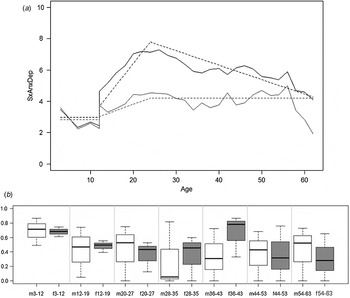
Fig. 2 shows means for men and women and the post-hoc fitted mean trends. The mean in males for SxAnxDep in childhood was 2.79. Between ages 12 and 28 years the mean SxAnxDep scores significantly increased (b = 0.19, t = 5.568, df = 1, p < 0.001). After age 28, the means in males no longer significantly changed (b = −0.06, t = −1.922, df = 1, p = 0.062). In females, the mean SxAnxDep scores in childhood was 2.97. Between the ages of 12 and 28 years the mean SxAnxDep scores significantly increased (b = 0.68, t = 14.35, df = 1, p < 0.001). After age 28 the SxAnxDep scores in females significantly declined (b = −0.18, t = −5.477, df = 1, p < 0.001). The sex difference in SxAnxDep score in childhood was not significant (b = 0.17, df = 1, t = 0.911, p = 0.36), while the increase between ages 12 and 28 years was significantly steeper for females than for males (b = 0.43, t = 6.665, p < 0.001). In this trends analysis means were weighted for sample size (see online Supplementary material for more details).
(a) Mean trends in symptoms of anxiety and depression (SxAnxDep) across the lifespan for females (black) and males (grey). Solid lines are raw means. Dashed lines are fitted trend lines. (b) Univariate heritability estimates across seven broad ages (maternal ratings 3–12, self-report ratings 12–19, 20–27, 28–35, 36–43, 44–53, 54–63 years) separately by sex (m, males; f, females).

Fig. 2 b depicts the heritability estimates by sex and age for seven broad age intervals, with their 99% confidence intervals (CIs). The proportion of variance attributable to genetic factors (i.e. heritability) in males and females differed little, except in the 36–43 years groups.
The observed MZ and DZ twin correlations (presented in online Supplementary Table S2) and the cross-twin cross-age correlations (online Supplementary Fig. S1) suggested a genetic simplex model as longitudinal correlations decreased over time (Boomsma & Molenaar, Reference Boomsma and Molenaar1987) and MZ correlations were higher than DZ correlations. Based on previous analyses in this sample (Boomsma et al. Reference Boomsma, van Beijsterveldt, Bartels, Hudziak and Hudziak2008) we expected the presence of common environmental effects in childhood.
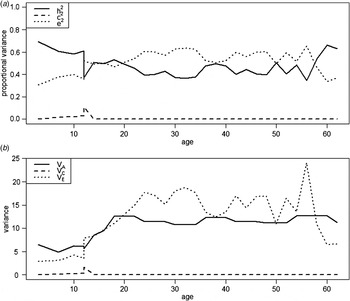
Having fitted the genetic simplex model to the data (model fits online Supplementary Table S3), we obtained heritability estimates for SxAnxDep at each 2-year age bin between ages 3 and 63 years. The estimates are given in Fig. 3 a, which shows that heritability (h2, Fig. 3 a) declined from childhood (around 60–70%) to adulthood (around 40–50%). This decrease in heritability was due to an increase in environmental variance (V E, Fig. 3 b), and not to a decrease in genetic variance (V A, Fig. 3 b), as can be seen in the plot of the absolute variance components estimates in Fig. 3 b. Part of the increase in the unique environmental variance is associated with the switch from mother ratings to self-ratings (see the ‘jump’ in Fig. 3 b at age 12 years). However, Fig. 3 b shows that the unique environmental variance continues to rise after the switch from mother ratings to self-ratings.
(a) Proportions of variance explained by genetic factors (h2, –––), common environment (c2, - - -), and unique environment (e2, ····) at each age as derived from the model. (b) Variance components V A, V C and V E at each age as derived from the model.

At age 12, we looked at the correlations between self-ratings and maternal ratings and found that the agreement was moderate (phenotypic correlation 0.35). The genetic and environmental contributions to this correlation were 56% (genetic), 27% (unique environmental), and 17% (shared environmental).
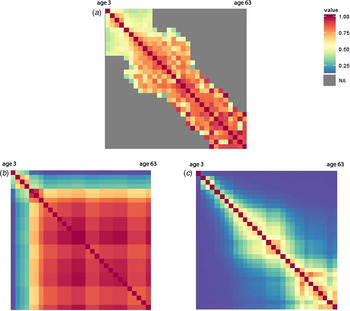
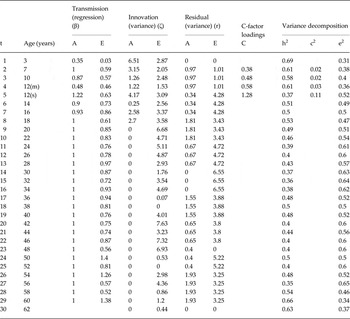
Based on the longitudinal model (Table 1), we derived the phenotypic, genetic, and environmental correlations between SxAnxDep across different ages and visualized these in heat maps (Fig. 4 and online Supplementary Fig. S1). The phenotypic correlations (i.e. observed stability) between two successive ages ranged from 0.29 to 0.63 during childhood (up to age 12), from 0.48 to 0.70 during adolescence (age 12–18), from 0.64 to 0.77 between ages 18 and 32, and from 0.45 and 0.86 from age 32 years onwards. Correlations between successive ages did not differ between males and females (t = −0.57, df = 814, p = 0.57). The genetic correlations between subsequent ages during childhood (mean r = 0.71, range 0.4–0.94) and adulthood (mean r = 0.92, range 0.85–1) were large (Fig. 4). Environmental correlations between subsequent ages were clearly lower than genetic correlations in childhood (mean r = 0.31, range 0.03–0.47), and adulthood (mean r = 0.60, range 0.47–0.73), although an increase was observed with age. The 10-year lag genetic correlations (online Supplementary Fig. S2) were large (mean 0.92, range 0.89–0.97), while 10-year lag environmental correlations were moderate (mean 0.32, range 0.18–0.66, online Supplementary Fig. S2) due to the relatively large proportion of environmental variance attributable to innovation All together, stability was largely attributable to genetic effects, while the increase in stability from childhood to adulthood was due to an increase in environmental correlations with age.
Correlation heat maps to represent (a) the observed correlations between ages 3 and 63 years, (b) the model implied genetic correlations and (c) the model implied unique environmental correlations.

Parameter estimates and variance components from the best longitudinal model

A, Genetic factors; E, unique environment; C, common environment; h2, proportion of variance explained by genetic factors = heritability; c2, proportion of variance explained by common environmental factors; e2, proportion of variance explained by unique environmental factors; m, mother; s, self. See Fig. 1 for an explanation of the terms transmission, innovation and residual variance.
Discussion
The aim of this study was to gain insight into the aetiology of the variation in SxAnxDep across the lifespan. Overall, genetic effects explained around 40% of the phenotypic variance at each age beyond age 7 years, and contributed greatly to the stability in SxAnxDep across age. We observed important differences between childhood and adulthood. Specifically, genetic innovation was observed during childhood and adolescence, but not after age 18. So after age 18, genetic effects are highly stable. This differs markedly from the results obtained for the unique environmental influences, which showed innovations at each age, and less stability. Unique environmental factors contributed primarily to short-time stability, but with increasing age, the contribution to stability of these environmental factors increased. This resulted in increasing stability in SxAnxDep with age corroborating pervious findings by Kendler et al. (Reference Kendler, Eaves, Loken, Pedersen, Middeldorp, Reynolds, Boomsma, Lichtenstein, Silberg and Gardner2011). This comprehensive picture of the aetiology of the course of SxAnxDep is in line with previous studies of SxAnxDep in either childhood/adolescence or in adulthood (Gillespie et al. Reference Gillespie, Kirk, Evans, Heath, Hickie and Martin2004; Boomsma et al. Reference Boomsma, van Beijsterveldt, Bartels, Hudziak and Hudziak2008; Kendler et al. Reference Kendler, Gardner, Annas, Neale, Eaves and Lichtenstein2008b , Reference Kendler, Gardner and Lichtenstein c ; Trzaskowski et al. Reference Trzaskowski, Zavos, Haworth, Plomin and Eley2012).
When analysing data from children (maternal ratings) and adolescents and adults (self-ratings), the question arises if the results are influenced by the different raters. The availability of self- and maternal reports of SxAnxDep at age 12 allowed us to address this question. We found a moderate correlation between mother and child ratings (0.35). Moderate correlations among different raters have been observed before (e.g. Ferdinand et al. Reference Ferdinand, van der Ende and Verhulst2004). In the current dataset, we could establish that the correlation was largely attributable to genetic effects (56%), indicating that different raters to a large extent seem to agree on the genetically influenced SxAnxDep phenotype.
An important result from the current study is the clear explanation of the decline in heritability, which coincides with the switch from maternal to self-ratings. Heritability was highest in childhood (70–50%), and dropped in adulthood (50–35%), and remained stable to the age of 63. These heritability estimates are largely in line with those found in earlier studies (Sullivan et al. Reference Sullivan, Neale and Kendler2000; Johnson et al. Reference Johnson, McGue, Gaist, Vaupel and Christensen2002; Kendler et al. Reference Kendler, Gatz, Gardner and Pedersen2006; Rapee et al. Reference Rapee, Schniering and Hudson2009; Rice, Reference Rice2009; Franz et al. Reference Franz, Lyons, O'Brien, Panizzon, Kim, Bhat, Grant, Toomey, Eisen, Xian and Kremen2011; Sakolsky et al. Reference Sakolsky, McCracken and Nurmi2012). The longitudinal data indicate that a decrease in heritability is not due to a decrease in genetic variance, but that there is an increase in environmental variance (see Fig. 3), which leads to a relatively lower influence of genetic factors. Common environmental effects were only present at ages 7–12 and explained a relatively small proportion of the variance (~2–11%). Mean sex differences in SxAnxDep emerged after age 12, around the same time when the increase in environmental variance is seen, peaked at age 28, and decreased thereafter. Figure 2 b shows that there were no large sex differences in the estimates of genetic and environmental influences.
For clinical practice, it is important to note that environmental effects contribute to change, but also to short-term stability. This suggests that an improvement in SxAnxDep can be accomplished by positive environmental experiences, such as beneficial therapy or positive life events, and that increases of SxAnxDep can be caused by negative experiences, such as adverse life events. Importantly, these effects can endure for several years. An earlier study in part of this sample showed that SxAnxDep increase after negative life events, but that higher scores on SxAnxDep also precede negative life events (Middeldorp et al. Reference Middeldorp, Cath, Beem, Willemsen and Boomsma2008). Thus, individuals already suffering from anxiety or depression are at increased risk of experiencing negative events that can exacerbate their symptoms over an extended period of time. These results further underline the importance of addressing the environment in therapy (e.g. increasing social support or involving significant others). They can also suggest a possible interdependency between the individual and the environment, which may give rise to genotype-environment covariance (Dolan et al. Reference Dolan, de Kort, van Beijsterveldt, Bartels and Boomsma2014), but it was shown that the association between life events and SxAnxDep was not explained by a shared genetic background (Middeldorp et al. Reference Middeldorp, Cath, Beem, Willemsen and Boomsma2008).
The results may have several implications for future research. The stability of genetic effects from childhood into adulthood is important as it indicates that genetic vulnerability is present from early onwards and remains a risk factor throughout life. These results suggest that gene-finding studies may include adults aged between 18 and 63 years, as we have observed little age-related heterogeneity in genetic effects. However, we recognize that high stability in polygenic effects does not rule out age effects at the level of a single causal genetic variant.
Rapee et al. (Reference Rapee, Schniering and Hudson2009) have already pointed out that with respect to childhood anxiety disorders ‘current knowledge of the role and mechanisms of environmental factors is especially poor’ (page 331). The increase in environmental stability over time is an intriguing finding that warrants further investigation. The question is whether new environmental effects on SxAnxDep, decrease with age, or whether the impact of events lasts longer as people age. Our results suggest the latter given that the environmental innovation parameters do not decrease with age, while the transmission parameters increase between ages 3 and 16 years and then remain at a similar level. It is well known that childhood and especially adolescence are characterized by large developmental changes in the brain (Blakemore, Reference Blakemore2008). Possibly, the maturation of the brain is accompanied by a more enduring effect of the environment. Kendler et al. (Reference Kendler, Eaves, Loken, Pedersen, Middeldorp, Reynolds, Boomsma, Lichtenstein, Silberg and Gardner2011) also found that the environmental effects on long-term stability of SxAnxDep reach a plateau after adolescence.
We have shown that even during childhood and adolescence, part of the genetic and unique environmental innovations that appear at each age are transmitted to other ages. This signifies that there is a group of children and adolescents with a risk of enduring symptoms. Given the high disease burden for these children and society it is important to identify risk and protective factors that lead to stability over ages.
Finally, the current results for SxAnxDep are partly different from the results in a similar analysis of the aetiology of stability in attention problems (Kan et al. Reference Kan, Dolan, Nivard, Middeldorp, van Beijsterveldt, Willemsen and Boomsma2013). For attention problems, the genetic variance decreases from childhood to adulthood, while for SxAnxDep the genetic variance increases. Moreover, the increase in stability due to environmental effects that is observed for SxAnxDep after age 18 is not present in attention problems until the age of 30. Although it is of note that, for both phenotypes, genetic factors are most important in explaining stability, these differences indicate that the pattern of genetic and unique environmental factors throughout life do not need to be similar across psychiatric phenotypes. Our results and those for attention problems (Kan et al. Reference Kan, Dolan, Nivard, Middeldorp, van Beijsterveldt, Willemsen and Boomsma2013) suggest similar longitudinal genetic analysis are warranted for other psychiatric phenotypes.
Longitudinal results are essential to increase our understanding of the development and genetic architecture of psychiatric phenotypes. We made use of 25 years of data collection in subjects who entered the study at different ages, and tried to inform both clinical and molecular genetics research in psychiatry, using developmental and etiological informative models.
Supplementary material
For supplementary material accompanying this paper visit http://dx.doi.org/10.1017/S003329171400213X.
Acknowledgements
Funding was provided by The Netherlands Scientific Organization (NWO) (912-100-20): ‘Genetic influences on stability and change in psychopathology from childhood to young adulthood’, and the European Research Council (ERC-230374): ‘Genetics of Mental Illness’. Data collection has been funded by multiple grants from NWO, NIMH and the Neuroscience Campus Amsterdam (NCA). C. M. Middeldorp was supported by NWO (VENI grant 916-76-125).
Declaration of Interest
None.