Introduction
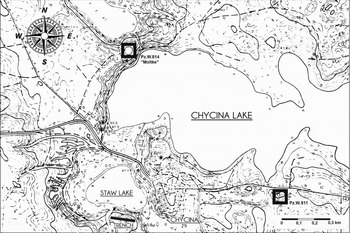
Chycina is a small village in western Poland, which lies between forests, lakes and rivers (Figure 1). Although these lands have been occupied since prehistoric times (Kaczmarek Reference Kaczmarek2002), our interest here is in their recent past, focusing especially on the Second World War and the material remains that it has left in this area.
Map showing the German fortifications around Chycina.

The starting point for this research is the recent increase in interest in twentieth-century archaeology, and in particular the theory that there is no real ‘ontological’ difference between earthworks and material culture from, for example, the Neolithic on the one hand, and Second World War trenches and their associated material culture on the other (Olsen 2003, Reference Olsen2010). This concept is based on the fact that, in either context, it is material culture that archaeologists search for and excavate and, in both cases, the past is interpreted through objects. Indeed, the preference for material culture over historical documents seems almost a conscious decision among some archaeologists studying the twentieth century. This branch of research can be broadly described as conflict archaeology (Schofield Reference Schofield2005). The appeal of the subject lies in the fact that not everything is written down in documents (González-Ruibal Reference González-Ruibal2012). Small, dirty and broken things may tell alternative and hitherto marginalised stories about conflict events such as the Spanish Civil War (González-Ruibal Reference González-Ruibal2007, Reference González-Ruibal2012); they may portray day-to-day life in concentration camps (Kola Reference Kola2000; Gilead et al. Reference Gilead, Haimi and Mazurek2010; Theune Reference Theune and Mehler2013), disclose the burials of victims of armed conflicts (Kola Reference Kaczmarek2005) or reveal why children in the UK were collecting shrapnel during the Second World War (Moshenska Reference Moshenska2008). Another branch of this archaeological research focuses on prisoners of war and includes—very pertinently for this paper—graffiti (Oliver & Neal Reference Oliver and Neal2010a; Burton & Farrell Reference Burton, Farrell, Mytum and Carr2013). Some of these studies indicate the creativity and agency of prisoners of war; others study slave labour and its material remains (Myers & Moshenska Reference Myers and Moshenska2011; Mytum & Carr Reference Mytum and Carr2012, Reference Mytum and Carr2013). In short, it is a cliché worth repeating: archaeology through objects can shed new light on the grand narratives of the twentieth century (Olivier Reference Olivier2003; Schofield Reference Schofield2005), and such stories can be told because of the memories that objects hold (Olsen & Pétursdóttir Reference Olsen and Pétursdóttir2014; Olsen & Witmore Reference Olsen, Witmore, Olsen and Pétursdóttir2014).
Memory as a research topic has been approached by many disciplines during the last three decades. Historians (Le Goff Reference Le Goff1992), cultural anthropologists (Teski & Climo Reference Teski and Climo1995; Berliner Reference Berliner2005) and heritage specialists (Harrison Reference Harrison2012), to name a few, have focused on (cultural) memory. Archaeology has been no exception; attention to material culture as the medium and embodiment of cultural memory is often found in archaeological works (Van Dyke & Alcock Reference Van Dyke and Alcock2003; Borić Reference Borić2010; Olivier Reference Olivier2011). The research trend has even been described as the ‘memory boom’ in the humanities and social sciences (Berliner Reference Berliner2005). While remembering things from the past is a cognitive process, it is deeply anchored in materiality. However, material culture is not only a symbol or an embodiment of broader human activities; it is also possible to speak of an object's memories.
Of course, objects do not consciously remember past events, but rather past events are inscribed in, and through, material culture (Olsen Reference Olsen2010). Bjørnar Olsen and Christopher Witmore (Reference Olsen and Pétursdóttir2014: 187) accurately address this issue:
To speak of the memories that things hold does not imply that a rubber boot heel, a set of melted chessmen, a machine gun nest or the vestiges of a wooden threshold are passive carriers of past meaning; neither do these things act as faithful intermediaries to those kinetic experiences which occurred around them and in which they were involved. Nor should the memories that things hold be conflated with the conscious and wilful faculty of human recollection. Rather what is crucial is the ‘isomorphic’ mnemonics, their capacity for bringing the very particular aspect of their own pastness to us. In addition, this often involves a care for the ineffable, for that which escapes historical consciousness, for that which is regarded as too trivial, self-evident or even too embarrassing to be spoken or written about.
One such ‘self-evident’ and overlooked aspect of twentieth-century armed conflict is the habit of carving on trees. Although graffiti has been considered in the context of conflict studies (Jurga & Kędryna Reference Jurga and Kędryna1994; Conlin Casella Reference Conlin Casella, Beisaw and Gibb2009), carvings on trees and their potential use in archaeological interpretation have been deeply underestimated and overlooked thus far (Mallea-Olaetxe Reference Mallea-Olaetxe, Oliver and Neal2010; Oliver & Neal Reference Oliver, Neal, Oliver and Neal2010b).
Focusing on excavating the material culture from specific military conflicts has its own limitations; there were events that did not leave behind material culture, but which are still archaeologically visible. It is one such example that forms the case study reported in this paper. We want to show how carvings on the bark of trees, in essence the materiality of the trees, can tell stories that would otherwise be unknown; a few common beeches discovered in the vicinity of Chycina (western Poland) are the subject. We surveyed the area several times between 2008 and 2013 (see Frąckowiak Reference Frąckowiak, Mykietów and Tureczek2009) and the preliminary results are presented in this paper. Trees are part of the archaeological record and enable archaeologists to approach the recent past (in this case, the Second World War); we argue that there are memories that only trees hold.
The site
Festungsfront Oder-Warthe-Bogen (Fortified Front Oder-Warthe-Bogen) is one of the biggest regions with military infrastructure preserved from the Second World War (Jurga & Kędryna Reference Jurga and Kędryna2000). It was built by the Third Reich to defend Germany from the east. After the war, the whole region became part of post-war Poland and is part of today's Lubusz voivodeship (województwo lubuskie). The first military fortifications were built there between 1934 and 1936. During that time, the Germans erected approximately 30 shelters that created the so-called Niesłysz-Obra Line. The line ran through natural barriers (lakes, rivers and streams). In 1936, it was decided to broaden the defence line to 80km between two rivers, the Obra and the Warta. The topography is reflected in one of the Polish names for the defence line: the Międzyrzecz (‘between rivers’) fortified line. The line was divided into three smaller sections: northern, central and southern. The largest was the central section, which consisted of a line of shelters connected by tunnels to barracks, storehouses and underground railway stations. In 1938, due to prohibitive production costs, the ongoing erection of the Festungsfront Oder-Warthe-Bogen was abandoned, at which point only 15 per cent of the planned fortifications were complete (Kaufmann & Kaufmann Reference Kaufmann and Kaufmann1997; Kaufmann et al. Reference Kaufmann, Kaufmann and Jurga2002).
After the outbreak of the Second World War, Germany occupied Poland, obviating the Międzyrzecz fortifications, which now lay behind the front line. Many components of the Festungsfront Oder-Warthe-Bogen were dismantled and used on the Siegfried Line (Westwall) and the Atlantic Wall. However, as the war continued, the situation changed and, in 1944, in the face of a growing threat from the Red Army, refortification of the Festungsfront Oder-Warthe-Bogen seemed pertinent once again to Germany. During that time, many kilometres of field fortifications, consisting mainly of trenches and anti-tank outposts, were dug. The work was undertaken by local people and prisoners of war. In January 1945, the Red Army breached the Festungsfront Oder-Warthe-Bogen without difficulty; it was a grievous defeat for the Third Reich, probably caused by insufficient troops and the outdated armament of the shelters (Kaufmann & Kaufmann Reference Kaufmann and Kaufmann1997; Kaufmann et al. Reference Kaufmann, Kaufmann and Jurga2002).
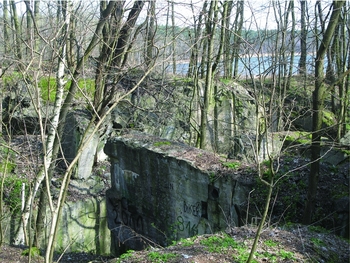
The site that is the focus of this paper has two two-level bunkers that were part of the Festungsfront Oder-Warthe-Bogen (Figure 1). The first, named Pz.W. 811 and located approximately 300m from Chycina, near the route to Gorzyca village, is badly damaged. Pz.W. is an abbreviation of the German ‘Panzerwerk’ (Jurga & Kędryna Reference Jurga and Kędryna2000: 132–33), a term that was used by Nazi Germany for the biggest and best-armoured pill-boxes. The bunker was part of the so-called Niesłysz-Obra Line. The second bunker was erected on a narrow isthmus between Chycina Lake and Cisie Lake, just 500m north of Chycina. This bunker was called Pz.W. 814 and was part of the so-called Werkgruppe ‘Moltke’, which was the northern part of Festungsfront Oder-Warthe-Bogen (Figure 2). Approximately 1km south of this bunker are the beech trees that are the focus of our study.
Ruins of one of the German bunkers (Pz.W. 814) in the vicinity of Chycina (photograph: Maksymilian Frąckowiak).

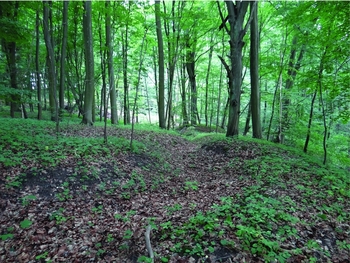
The beeches on which we found marks grow on the southern scarp of Staw Lake. A trench parallel to the scarp runs west–east for about 200m before turning to head south-east towards local fish ponds (Figure 3). Originally, it was 2m deep and 0.4–0.6m wide (Jost Reference Jost2008: 6), however, due to post-depositional processes, its size changed considerably. Today, the depth of the trench has decreased as much as 50 per cent in some sections. The trench was built as an element of the field fortifications complex which formed the northern part of the Festungsfront Oder-Warthe-Bogen. There are still discernible firing positions directed towards the east. Most of the carved beeches date to the later part of Second World War (1944–1945), and they grow along the line of the trench; some of the words and dates carved into the beeches are contemporary with the digging of the trench. Some carvings are hard to decipher or completely destroyed, either by natural processes or because they have been defaced or over-written since the war; many survive only partially. Some, however, are well preserved. For the purpose of this study, the beeches have been numbered I to X, in order from west to east along the course of the trench.
An extant section of the trench situated in the vicinity of Chycina (photograph: Dawid Kobiałka).

The trunk diameter of beeches varies from 1–3m, they stand about 25–35m tall and their typical lifespan is 150–200 years. A 10-year-old beech will be approximately 4m in height.Beeches take around 30 years to fully mature (Boratyńska & Boratyński Reference Boratyńska, Boratyński and Białobok1990). The trunk diameter of the beeches from the site varies from 1–2m and they are about 20–30m tall. This means that they must be older than 50–60 years. However, on one of the trees we found a date, 1915 (catalogue no. 42); this suggests that the trees must be older than 100 years.
Each tree was carefully inspected visually; we used only visual assessment during the research. We looked for beeches with carvings and then documented their position, measurements and carvings. Carvings on each beech tree were carefully photographed and documented (see Figures 4–9). Carvings that were visible and could be deciphered are included in the catalogue (see online supplementary material).
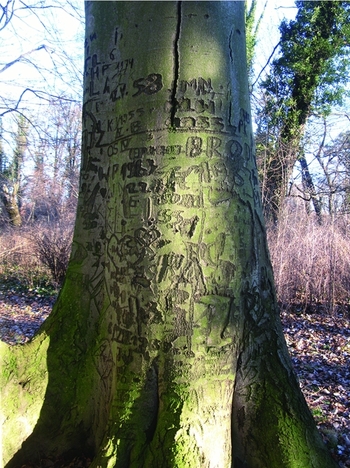
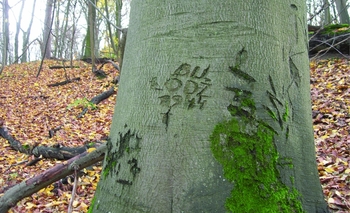
Carved beech tree in the park in Brody (Lubusz voivodeship) (photograph: Maksymilian Frąckowiak).

Carving ‘ŁÓDŹ’ on beech III (photograph: Maksymilian Frąckowiak).

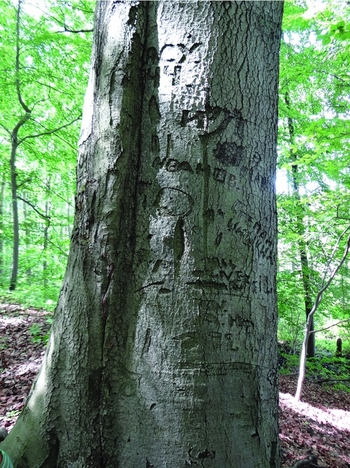
Tree memories: beech I (photograph: Dawid Kobiałka).

Tree memories: beech II (photograph: Dawid Kobiałka).

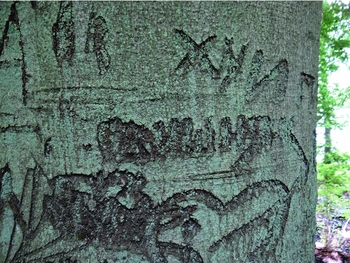
One of the carvings written in Russian or Ukrainian (photograph: Dawid Kobiałka).

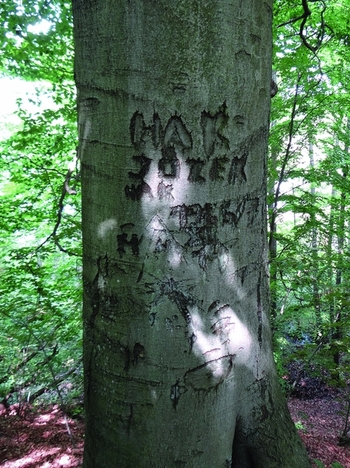
Carving by Józek Hak (photograph: Dawid Kobiałka).

Tree memories
In contrast to other tree species such as oak or pine, beech has a thin, smooth bark that rarely flakes off (Evans Reference Evans2001). These properties make beech the perfect choice for carving (Bystroń Reference Bystroń1980). Beech bark does not usually crack, so a word or date, once carved, can survive decades and still be decipherable. There are 10 beech trees in our study; the oldest date discovered during our research is ‘1915’ (catalogue no. 42).
One of the first people to describe and investigate the practice of notching trees was Jan Stanisław Bystroń (Reference Bystroń1980), a Polish ethnographer and folklorist. He analysed literature and ethnographic literary sources (songs and proverbs), and recognised them as a valuable source in his investigation. According to his research, notching trees dates at least as far back as ancient Greece. This is known from Theocritus’ Idylls, in which the author mentions that ancient Greek people marked their presence on trees (Bystroń Reference Bystroń1980: 132). The practice is also documented in Latin literature and Polish Renaissance poetry (for example Jan Kochanowski's elegies; Bystroń Reference Bystroń1980: 132–34). There are many different kinds of carvings: the medium encompasses beautiful inscriptions found in Pompeii and Herculaneum (Milnor Reference Milnor2014), enigmatic early medieval symbols carved on trees (Dreslerová & Mikuláš Reference Dreslerová and Mikuláš2010), and more recent examples of prison-cell carvings (O’Sullivan Reference O’Sullivan2009) and graffiti (Giles & Giles Reference Giles, Giles, Oliver and Neal2010). This area of research is traditionally the preserve of epigraphers; however, recently, it has also been claimed by archaeologists seeking engagement with materiality. Marking information on trees, then, has long been a widespread cultural practice (Bystroń Reference Bystroń1980) (Figure 4). Even today it is almost impossible to walk in a park and not notice words or dates on trees (e.g. Mallea-Olaetxe Reference Mallea-Olaetxe, Oliver and Neal2010; Oliver & Neal Reference Oliver, Neal, Oliver and Neal2010b). Such carvings have their own historical and archaeological value; sometimes they are sources that help us to approach past events.
The beeches that grow around Chycina are one such example. We were able to document 55 words and symbols carved on these trees. Forty-one of them, due to their specificity, chronology and context, can be considered contemporary with the digging of the trench in August 1944 (compare Figure 3). The assemblage mostly consists of dates, first names, surnames, initials and graphic carvings. Although we discovered 13 dates (catalogue nos. 1–4, 20--21, 23, 25–28 and 37), only two include the day and month of their carving (nos. 20 and 23). These are: ‘24.8.1944’ and ‘26 VIII 1944’. Four Polish surnames (one with the first two letters of a forename) were possible to decipher: ‘Kr. Turek’ (catalogue no. 13), ‘KOSTKA’ (catalogue no. 14), ‘WOLSKI’ (catalogue no. 15) and ‘Kubiak’ (catalogue no. 16). One carving is more enigmatic as it consists of the first letters of a name (possibly ‘Grzegorz’ in Polish—‘Gregory’ in English) and badly damaged letters of a surname: ‘Grz. Kli[. . .]wicz’ (catalogue no. 12). There are also carved initials: ‘M.W’ (catalogue nos. 17 and 29), ‘B U.’ (catalogue no. 25), ‘A.E.’ (catalogue no. 30) and ‘W H’ (catalogue nos. 26, 34, 37, 40 and 41). Close to the ‘B U.’ carving and the date ‘1944’ is another mark: ‘ŁÓDŹ’ (catalogue no. 25) (Figure 5). Łódź is the name of a large Polish city.
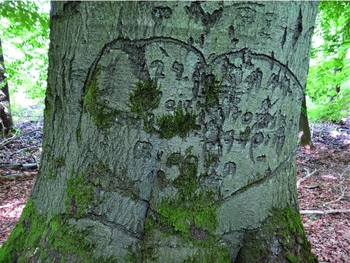
The third carved date is also ‘1944’. Close to it is the word ‘P[. . .]LACY’ (catalogue no. 1) (Figure 6). The word is missing the letter ‘O’; it was probably ‘POLACY’ (‘Poles’). There are words carved in other languages as well. Some are written in the Cyrillic script and are probably Russian, though some might be Ukrainian. Among them are: ‘XYИ’ (catalogue nos. 21 and 22) (this is a vulgar word for ‘penis’ in Russian and Ukrainian); the surname ‘ИBAНOB’ (catalogue no. 5); a fragment of a signature ‘П. A[. . .]’ (catalogue no. 6);letters ‘И’ (catalogue no. 7), ‘ИД’ (catalogue no. 8); and a name, ‘СТЕПАН’, with fragments of a possible surname or city: ШИ[. . .]КНА (catalogue no. 11). There are also words in German on the beeches. In one case, it is most likely a declaration of love; inside a heart carved on the bark is the inscription: ‘Lude[. . .]dorf’, with two dates: ‘24.8.1944’ and ‘1944’ (catalogue no. 23).
The last group of carvings on the beeches are the drawings that were notched in their bark (Figure 7). The image of a heart was carved four times (catalogue nos. 10, 23, 31 and 32); in one case the heart is pierced by an arrow (catalogue no. 24). There is also an image of a human being with the face turned to the left (catalogue no. 9). In addition, there are other interesting carvings that hold memories about past events. There are five rows of vertical lines crossed by a horizontal line drawn on one of the beeches (catalogue no. 36). On the same trees there are many carvings so poorly preserved that it is impossible to decipher them even partially. What kind of events, then, do these trees remember on their bark?
Forced labourers and the beeches
At the turn of 1943 and 1944, the Red Army launched a counterattack on the Eastern Front. It became clear to the Germans that they should start to prepare for the arrival of the Soviets from the east. Bunkers, shelters, trenches and other military facilities were built or strengthened in the area through which the Soviets seemed likely to attack. Part of this defence plan was the Festungsfront Oder-Warthe-Bogen. This is the why the Chycina landscape bears witness to these enterprises. Kilometres of trenches were dug during the spring and autumn of 1944 (Jurga & Kędryna Reference Jurga and Kędryna1995). Most of them were constructed near Chycina because of its strategic location. Since then, they have become an important part of the local landscape, and many trenches are very visible even today (see Figure 3). The construction of the trenches in this area was supervised by an organisation called Todt, the Third Reich's civil and military engineering group; the trenches were dug by local communities and forced labourers. During the Second World War, there were a few working camps near Chycina into which the Germans put prisoners of war, who they used as a free workforce. Such working camps were usually known as Arbeitslager, Zwangsarbeitslager, Sammellager or Auffanglager (Pilichowski Reference Pilichowski1979: 44). Poles were mostly gathered in the work camps in Bledzew, Kęszyca, Stary Dworek, Wysoka and Ziemsko (Pilichowski Reference Pilichowski1979: 108, 228, 471, 577, 592). French prisoners were held in Gorzyca, Kęszyca, Nowa Wieś, Pieski, Sokola Dąbrowa (Pilichowski Reference Pilichowski1979: 185, 228, 337, 384, 462) and Chycina (Klopsch Reference Klopsch1993: 15). Italian prisoners were held in Kęszyca and Wysoka, while Russians were detained in Bledzew and Ziemsko, and Ukrainians in Bledzew, Wysoka and Ziemsko. Forced labourers from other republics of the USSR were held in detention camps in Kęszyca, Osiecko and Zemsko (Pilichowski Reference Pilichowski1979) (Figure 8). All workers were used for labour in agriculture, forestry and, in the case of workers from a camp in Wysoka, in the military industry. Many of the forced labourers were also ordered to undertake agricultural work for local German settlers.
It may be assumed that all of these forced labourers were digging the trenches around Chycina, probably around the dates marked on the trees: ‘24.8.1944’ and ‘26 VIII 1944’ (catalogue nos. 20 and 23). This supposition is based on the fact that the camps were located in Chycina itself, or in the surrounding villages and towns. Instead of transporting people from other countries, the Germans probably used prisoners who were detained in camps located nearby. The memories that the trees hold—that is to say, words carved in Polish, Russian and Ukrainian—support such an interpretation. It appears from our analysis that Poles, Russians and Ukrainians marked their presence in this place by carving on the beeches; the other nationalities, Italians and French, took part in the digging of the trenches but did not mark signs on the trees (or we were not able to decipher marks made by them). It is notable that we found only carvings dating to the last years of the Second World War on the beeches alongside the trench. This is not a coincidence; the trench and the beeches create one landscape and they must be interpreted with reference to each other. In this context, the five rows of vertical lines crossed by a horizontal line, which were drawn on one of the beeches (catalogue no. 36), might be interpreted as a sign of counting something (perhaps days of work) by one of the labourers digging the trench.
Also, the carving ‘B U.’, which was made close to the carving ‘ŁÓDŹ’ (Figure 5), may support our interpretation. Andrzej Chmielewski (Reference Chmielewski, Mykietów and Tureczek2009) has recently published the memories of Paweł Pośpieszny, one of the prisoners of the Międzyrzecz labour camp, which was located 15km from Chycina. According to Pośpieszny, during the war, the Germans detained people in two barracks. Pośpieszny spent four years (1941–1945) in the camp. He revealed that most of the Poles detained in the camp came from Łódź. That makes it quite possible that the trench located close to Chycina was dug at least partially by the prisoners from the camp at Międzyrzecz. The next fact that may account for our interpretation of the tree memories is that Chycina is only 15km from Międzyrzecz. Transporting the prisoners such a short distance would not constitute a problem for the Germans.
It is probably these events that the trees remember on their bark and it seems likely that the trees were used by the prisoners for two reasons: as a space on which human beings mark their presence; and as a medium that through its materiality may affect future generations. When archaeologists and historians research the Second World War they usually analyse material culture (archaeologists) or documents (historians) from the period. Yet such banal, ordinary and common things as carvings on trees, of contemporary date, have remained undiscovered for decades, despite being witnesses to the horrible events of the Second World War. Carvings deserve closer research. Archaeology should encompass the whole landscape and not simply buried objects. The beeches and the carvings on them are aspects of material culture; however, more pertinently, modifications to the carvings on the beeches, made by different people, with various histories to pass on, mean that they can be seen as a kind of organic material culture.
During our research, we conducted surface investigations around the beeches and the trench. We did not find any artefacts that could be dated to the digging of the trench in 1944, or even to the Second World War more generally. The type of material culture discovered around trenches is usually evidence of conflict, such as bullets and shells; however, because the Germans left this area before the arrival of the Red Army, there is little to discover. We are aware that it is a very risky claim to negate the presence of other artefacts of material culture, relying only on surface survey. But we found only one beer can from the beginning of the twenty-first century and a small fragment of a flint tool, probably dating to the Stone Age. An interview with a metal detectorist suggested that no metal artefacts had been discovered in or around the trench. If we had taken a traditional archaeological approach, focusing on excavating material culture, the story of the prisoners may still be unknown. Archaeology sometimes has to tell a story of people through trees and their memories.
Tree memories are palimpsests; the oldest carving we found dates to 1915 (catalogue no. 42). There are many others from the end of the Second World War, and these have been the focus of this paper. However, to stop there would be only half of the story; half of the tree memories. These trees were used after the war as well. Most of the carvings are anonymous, or it is difficult to decipher their authors. Very often it is impossible to say who carved each word or initial. Nonetheless, we found the following carvings on a beech growing near to those carved during the Second World War: ‘HAK JÓZEK’, with a date ‘1966/7’. Below them appears the word ‘HAK’ (Figure 9). This is a Polish name and we discovered that Józek Hak lives in the village of Goruńsko, around 1km from Chycina. In a short interview, Józek Hak said that he did not remember making these carvings, but he knows the place with the beeches because he goes fishing in the nearby lake. He was born in 1948, so in 1966–67 would have been 18 or 19 years old; therefore, it is quite possible that he made the carving but does not remember it.
Conclusion
The archaeology of the recent past offers tools to look archaeologically, so to speak, at the Second World War. Yet, archaeologists have usually focused on material culture from the period that is dug up during excavations. Because that material culture holds memories about past events, archaeologists are able to tell stories about the Second World War that other specialists cannot. In short, the strength of archaeology is based on ‘things’ and the ‘memories’ they hold.
This paper has aimed to broaden that perspective. We state that it is not only material culture that holds memories. The same observation can be made about trees. They also remember past events on their bark through their materiality. To support this thesis, we have highlighted the case of the beeches found around the small village of Chycina in western Poland. These trees hold, in the carvings on their bark, memories about the twentieth century and especially about some events from the Second World War. Our interpretation suggests that most of the carvings were made by prisoners who had to dig the trench at the site. During what were probably short breaks in their work, they wanted to tell their story and be sure that history (and archaeology) would not forget them. The analysis of the beeches is significant, as there are no other sources known to us that reveal who dug this specific trench in the vicinity of Chycina, and when. Here, archaeology can deliver a micro-history of people, landscapes and events.
When the Second World War was over, the beeches were still used as a material medium on which people marked their presence. This is the case of Józek Hak, among others, who made carvings on the beeches after the Second World War. Here too, archaeology can contribute alternative ways to approach the recent past.
Our main conclusion is simple: trees can be an archaeological source for approaching the recent past; carvings on their bark therefore deserve closer archaeological attention. Because there are memories that only trees hold.
Acknowledgements
This paper is partially based on a text previously published by one of the present authors (Frąckowiak Reference Frąckowiak, Mykietów and Tureczek2009).
Supplementary material
To view supplementary material for this article, please visit http://dx.doi.org/10.1017/S0003598X14000520