




No CrossRef data available.
The expression and regulation of negative emotions: Risk factors for young children's peer victimization
Published online by Cambridge University Press: 01 June 2004
Abstract
Using a short-term longitudinal design, internalizing and externalizing emotions were examined as risk factors for being victimized by peers in early childhood. Regulation, aggression, and withdrawal were also tested as mediators. We found that anger, mediated by aggression and regulation, positively predicted being victimized, although the way in which anger related to victimization risk varied for boys and girls and across time. These findings were robust, particularly for girls, attesting to the importance of externalizing variables as risk factors for young children's victimization. Support for internalizing variables as risk factors for being victimized was weak. The implications of the findings for developmental models connecting symptomatology and victimization are discussed.The authors thank all of the students, children, parents, and teachers who participated in this research. Richard A. Fabes and Nancy Eisenberg were funded in part by grants from the National Institute of Mental Health (R01 HH55052 and R01 MH60838) and a Research Scientist Award to Nancy Eisenberg (K05 M801321). Laura D. Hanish was funded by an Arizona State University Faculty Grant-in-Aid. An earlier draft of this paper was presented at the 108th Annual Convention of the American Psychological Association, August 2000, Washington, DC.
Information
- Type
- Research Article
- Information
- Copyright
- © 2004 Cambridge University Press
Being victimized by peers is associated with elevated rates of internalizing and externalizing symptomatology and diagnoses of oppositional defiant disorder, conduct disorder, depression, attention deficit disorder, and anxiety disorders, as well as increased odds of mental health service use (Kumpulainen, Räsänen, & Puura, 2001). The effects of peer victimization on children's functioning can also be seen in related adjustment domains that can exacerbate the severity of psychopathology; for instance, victims typically have few friends and low self-esteem and they often disengage from school. The effects are particularly strong for children who are repeatedly victimized by peers and for those victims who are also aggressive toward their peers (Hanish & Guerra, 2002). These findings are robust but the developmental processes underlying the connections between peer victimization and psychopathology remain unclear.
To address this issue, it is necessary to understand the developmental pathways that connect internalizing and externalizing symptoms with peer victimization. In the present study, we examined the extent to which young children's proneness to internalizing (anxiety and sadness) and externalizing (anger) emotions placed them at risk for peer victimization and we probed the extent to which regulatory abilities and withdrawn and aggressive behaviors mediated these risk pathways. We tested these hypotheses using a short-term longitudinal design, and we drew on a sample of preschoolers and kindergartners. For many children, this age period represents the earliest opportunity for regular, consistent, and extended social interactions with unrelated peers and, therefore, the earliest opportunity for peer victimization to emerge. Furthermore, early childhood marks a critical age for studying affect because a primary developmental task for young children involves learning how to regulate expressions of negative emotion. Thus, understanding the relation between negative emotionality and peer victimization in early childhood is essential for understanding their connections at later developmental periods.
Relations among anxiety, sadness, and anger and peer victimization
Classic formulations of peer victimization have linked victimization and negative emotions, suggesting that victimized youth may experience both internalizing and externalizing types of emotions (Olweus, 1978). In most studies, researchers have focused on describing the concurrent association between victimization and internalizing emotions in middle childhood and early adolescence, demonstrating that victimization is related to both anxiety (including generalized and social anxiety) and depression (Hawker & Boulton, 2000). Less empirical work has specifically addressed the relation between victimization and anger, although some researchers have found that victimization is related to reactive aggression, which is characterized by anger and impulsivity (Schwartz, Dodge, Coie, Hubbard, Cillessen, Lemerise, & Bateman, 1998). Similarly, others have found that angry, aggressive responses to victimization decrease the likelihood that victimization desists, within a bullying episode as well as over time (Kochenderfer & Ladd, 1997; Wilton, Craig, & Pepler, 2000).
To our knowledge, only one study has examined the relations between emotional expressions and victimization among preschoolers and kindergarteners (Hanish, Kochenderfer–Ladd, Fabes, Martin, & Denning, 2004). In this study, Hanish et al. found that negative emotions (externalizing and internalizing emotions were not differentiated) exhibited in the context of peer and teacher interactions were positively correlated with victimization whereas positive emotions were negatively correlated with victimization.
Despite the evidence that victimization is correlated with negative emotions, little is known about the extent to which negative emotions are causally related to heightened risk for peer victimization in young children. Models of developmental psychopathology, however, suggest that such a relation is plausible. Indeed, affective problems have been linked with other developmental problems, including social deficits, suggesting that interdependencies between the two systems set the stage for a reciprocal relationship (Cicchetti, Ackerman, & Izard, 1995; Cicchetti & Toth, 1995). The underlying idea is that proneness to negative emotions, which stems at least partly from temperament and early interactions with caregivers, may predict children's approach to new situations and to relationships with others, including peers (Rothbart & Bates, 1998). Specifically, there appear to be two patterns of negative emotional tone evident from infancy, with one characterized by anger and low frustration-tolerance and the other characterized by fear and withdrawal (Rothbart & Bates, 1998). Although tendencies to express these emotions are based in biology and evident early in life, it is likely that parent–child interaction patterns (e.g., discipline strategies, relationship qualities) can exacerbate or minimize children's tendencies to express these emotions (Belsky, Fish, & Isabella, 1991; Kochanska, 1995). Thus, some children may approach peer interactions with a tendency to express relatively high levels of anger or anxiety that can impact the quality of peer interactions. In particular, when these emotional expressions are extreme or inconsistent with situational demands, they may elicit similarly valenced responses from others, including victimization (e.g., Shields & Cicchetti, 2001; Shields, Ryan, & Cicchetti, 2001). This victimization, in turn, may then increase the likelihood that children approach social situations negatively in the future, and a transactional pattern may develop in which victimization and negative emotions contribute to one another.
In support of the hypothesis that negative emotionality increases the risk for peer victimization, social scientists have found that children's negative emotions predict forms of social maladjustment other than victimization, concurrently as well as over time. Children often report that they try to control their emotional expressions when in the presence of peers (Zeman & Garber, 1996), and those who do so seem to be more socially competent than those who do not (Hubbard & Coie, 1994). In contrast, children who express intense and poorly regulated negative emotions tend to experience negatively toned interactions with peers, characterized by social problems such as aggression, isolation, and rejection (Eisenberg, Cumberland, Spinrad, Fabes, Shepard, Reiser, Murphy, Losoya, & Guthrie, 2001). In fact, there is a growing literature that highlights the importance of the ability to control negative emotional expressions in determining young children's social functioning, with negative emotions predicting aggressive and undercontrolled behaviors in social situations (Calkins, Gill, Johnson, & Smith, 1999; Cole, Zahn–Waxler, Fox, Usher, & Welsh, 1996; Rubin, Coplan, Fox, & Calkins, 1995).
The present study
Because we are working with young children, who have been underrepresented in studies of peer victimization, one question of particular importance involves the extent to which both internalizing and externalizing emotions predict which children peers victimize. Studies of older children and adolescents have shown that peer victimization is more strongly associated with internalizing emotions and behaviors than with externalizing emotions and behaviors. That is, by the time children reach middle to late childhood, victims are more likely to appear anxious, fearful, depressed, and socially inhibited than they are to appear angry, hostile, and aggressive (Olweus, 1978). What is less clear is the extent to which these findings pertain to younger children. Notably, two recent studies of elementary school children found that the relation between social withdrawal and victimization became stronger with age, and the relation between aggression and victimization became weaker with age (Boivin, Hymel, & Hodges, 2001; Hanish & Guerra, 2000). Further evidence of a possible age-related effect can be found in studies that have described victimized preschoolers and kindergarteners as more often aggressive than passive (Alsaker & Valkanover, 2001; Olson, 1992; Patterson, Littman, & Bricker, 1967). In addition, some related studies describing the relations between social withdrawal and social status have made similar claims, suggesting that social withdrawal is unrelated to peer status prior to elementary and middle school (Rubin, Bukowski, & Parker, 1998). The extant literature on the role of social withdrawal in young children's peer relations is not without ambiguity, however. Indeed, some studies have reported that young children who are socially withdrawn are rated as less well liked than their more sociable peers (Hart, Yang, Nelson, Robinson, Olsen, Nelson, Porter, Jin, Olsen, & Wu, 2000; Phillipsen, Bridges, McLemore, & Saponaro, 1999).
Although not directly testing hypotheses about emotionality and the likelihood of peer victimization in early childhood, these studies reflect the need for such an undertaking. Together, these findings underscore the importance of identifying the developmental trajectory that characterizes the relation between internalizing and externalizing symptoms and peer victimization—understanding whether and how the relation between emotionality and victimization changes with age is critical to building models of this phenomenon. Thus, in this study, we were particularly interested in examining the relative importance of internalizing versus externalizing emotions in differentiating young victims from their nonvictimized peers.
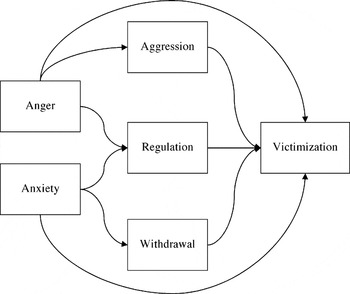
A second goal of this study was to examine the processes through which negative emotions might lead to victimization. Prior research has demonstrated the utility of considering how regulatory abilities mediate risk processes in peer victimization (Schwartz & Proctor, 2000; Shields & Cicchetti, 2001). Thus, we hypothesized that children's emotion regulation abilities and related behavioral expressions, such as aggressive and withdrawn behaviors, are likely to underlie the links between negative emotions and peer victimization (see Figure 1). Each of these hypothesized mediators is conceptually related to negative emotions (with anger particularly associated with aggressive behaviors and anxiety particularly associated with withdrawal) as well as to victimization. Emotion regulation influences the quality and intensity of emotional expressions, making it particularly important for children who experience high levels of negative affect. Children who are able to exert more control (using attentional or behavioral skills) over their emotions tend to express emotions in ways that are relatively adaptive, whereas those who have more difficulty controlling their emotions tend to display emotions that are relatively extreme and dysfunctional (see Eisenberg, Fabes, Guthrie, & Reiser, 2000, for a review). Furthermore, aggression and withdrawal may be seen as outcomes of anger and anxiety, respectively. In particular, aggressive behavior is a defining feature of aggressive victims, who also tend to be angry and hostile; similarly, withdrawal is a defining characteristic of passive victims, who are more likely to be anxious (Olweus, 1978). Understanding the emotional and behavioral contributors to these two subtypes of victims is important because mounting evidence indicates that these two groups are different, with aggressive victims experiencing more disturbed patterns of functioning (Schwartz, Proctor, & Chien, 2001). Thus, in the present study, we tested regulation, aggression, and withdrawal as mediators of the relations of anxiety/sadness and anger to peer victimization.

Hypothesized mediated model with anger and anxiety as the predictor variables, regulation, aggression, and withdrawal as the mediators, and victimization as the outcome variable.
A third goal of this research was to examine sex differences in these relations because sex has been associated with peer victimization as well as with the emotional and behavioral constructs assessed in the present study. For instance, boys are more likely than girls to be victimized by peers and to display externalizing emotions and behaviors and girls tend to be more well regulated than boys. Moreover, boys and girls live in generally segregated social worlds that vary in the types of behaviors boys and girls are exposed to. For example, boys' interactions generally are more forceful and active, and less controlled, than girls' (Fabes, Martin, & Hanish, 2003). Thus, there is reason to believe that the factors that place boys and girls at heightened risk for victimization may also vary. Extant research, however, is ambiguous regarding gender differences in the linkages between victimization and its correlates. Relatively few researchers have examined gender differences in the predictors of peer victimization (Crick, Casas, & Ku, 1999; Kochenderfer & Ladd, 1996), and available findings provide mixed information regarding the role of gender in relation to risk factors for victimization. In the present study, we tested for gender differences in the relations between anger and victimization and anxiety and victimization.
Method
Participants
Participants were drawn from two university-sponsored lab schools offering preschool and kindergarten classes. The schools were open to members of the university as well as to the larger community, and they were located in a major metropolitan area in the southwest. At the beginning of the fall semester, 154 parents, whose children attended one of eight preschool or kindergarten classes, were informed of the nature of the research project and consented to allow the collection of naturalistic observational data and teachers' reports of children's observable behaviors. In addition, a parent was also asked to provide ratings of their children's behaviors. A total of 126 (82%) parents agreed to participate in this aspect of the study and returned questionnaires.
The children ranged in age from 32 to 75 months (M = 52 months, SD = 9 months). The children attended classrooms that served predominantly 3-, 4-, and 5-year-olds. In fact, 95% of the children in the sample were in this age range; only three children were not quite 3 years of age and only five children were 6 years of age or older at the beginning of the study. Approximately half (46%) of the children were girls. Participants were predominately from non-Hispanic White, middle-class, suburban families; 74% of the children were European American, 9% were Asian American, 7% were Native American, 6% were Hispanic, and the remaining 4% were of another or mixed ethnicity. The majority of the children came from two-parent (86%), highly educated families. A total of 39% of mothers had completed college, and 31% of mothers had attended graduate school; 32% of the fathers had completed college, and 44% of fathers had attended graduate school.
Measures and procedures
Measures were collected in the fall and spring semesters of an academic year (hereafter referred to as Time 1 and Time 2, respectively). Multiple methods and reporters were used to assess children's negative emotions. Anger and anxiety were assessed at Time 1 using primary teachers' and parents' ratings (92% were mothers). In addition, observers coded children's naturally occurring expressions of anger and anxiety/sadness at Time 1. Also at Time 1, regulation, aggression, and withdrawal were assessed using secondary teachers' (who were different from primary teachers, but who similarly had extensive contact with, and knowledge of, children) ratings. The secondary teachers also provided ratings of peer victimization at Times 1 and 2.
Assessment of peer victimization
Secondary teachers completed a seven-item measure of peer victimization at Time 1 and again at Time 2. The secondary teachers who completed this measure also completed measures of regulation and aggressive and withdrawn behaviors, but not the measures of emotionality. The peer victimization measure was adapted from Perry, Kusel, and Perry (1988; e.g., “Child gets called names by other kids”; “Child gets hit and pushed by other kids”; Cronbach's α = .90). The items were rated on a Likert-type scale ranging from 1 (never happens) to 5 (happens all of the time).
Assessment of anger and anxiety: Primary teachers' and parents' ratings
Primary teachers and parents reported on children's anger and anxiety at Time 1 using subscales derived from the Children's Behavior Questionnaire (CBQ; Rothbart, Ahadi, Hershey, & Fisher, 2001) and the Child Behavior Scale (CBS; Ladd & Profilet, 1996), both of which are measures that have demonstrated good reliability and validity. Parents and primary classroom teachers completed both measures using Likert-type scales; the CBQ utilized a 7-point scale, and the CBS utilized a 3-point scale. Items on each subscale were averaged together, such that high scores indicated greater levels of negative emotion.
A brief, 10-item version of the Anger/Frustration subscale from the CBQ was administered as a measure of anger (e.g., “This child easily gets irritated when s/he has trouble with some task”; Goldsmith, Lemery, Aksan, & Buss, 2000; Lemery, Gahagan, & Goldsmith, 1999). This shortened version of the Anger/Frustration scale has been found to have good reliability and validity (Goldsmith et al., 2000; Lemery et al., 1999). In the present study, Cronbach's αs were .75 for parents' ratings and .86 for primary teachers' ratings.
Anxiety was measured using the Anxious/Fearful subscale of the CBS. The Anxious/Fearful subscale is a four-item scale that taps general anxiety (e.g., “Is worried. Worries about many things”; αs = .62 for parents' ratings and .51 for primary teachers' ratings). Alpha coefficients of this magnitude are considered acceptable for short scales because they are highly influenced by the number of items in a scale (Nunally, 1976).
Assessment of anger and anxiety/sadness: Classroom observations
Two male and six female undergraduate classroom observers were assigned to observe children's behavior during free-play periods (i.e., all times during the day except teacher-structured formal learning activities, lunch time, and nap time). Observers coded children's expressions of anger and anxiety/sadness at Time 1 using a procedure in which they observed children in a prespecified random order for 10 s and then coded the extent to which the target child expressed anger and anxiety/sadness during the 10-s period using a 4-point scale (1 = no evidence of the emotion and 4 = intense emotional display; Martin & Fabes, 2001). After observers completed the randomized list, they began again at the top of the list. Over the course of the fall semester, a total of 12,151 observations were obtained (mean number of observations per child = 83.23, SD = 41.38), and the ratings for each child were averaged together.
Reliability estimates were obtained by having two observers periodically make independent observations of the same child. Interrater reliabilities were obtained on 1772 observations (about 15% of the total observations). Average kappas, which reflect the degree to which raters coded the displays of emotion as similarly intense, were .86 for anger and .64 for anxiety/sadness, which represent good interrater reliabilities according to the criteria presented by Landis and Koch (1977). Correlations were r = .62 for anger and r = .57 for anxiety/sadness. In addition, percent agreement was high, 96% for anger and 98% for anxiety/sadness.
Assessment of regulation
Secondary teachers completed brief versions of the Attentional Focusing, Attentional Shifting, and Inhibitory Control subscales of the CBQ, which were aggregated to provide a measure of regulation (Goldsmith et al., 2000; Lemery et al., 1999). The Attentional Focusing subscale assessed children's ability to concentrate and focus attention (eight items, e.g., “This child sometimes becomes absorbed in a picture book and looks at it for a long time”; α = .79). The Attentional Shifting subscale measured children's ability to shift attention (five items, e.g., “This child can easily leave off working on a project if asked”; α = .76). The Inhibitory Control subscale measured behavioral regulation (10 items, e.g., “This child can lower his/her voice when asked to do so”; α = .93). These three measures of attentional and behavioral control are all believed to reflect effortful control or regulation (Rothbart, Ahadi, & Hershey, 1994) and were intercorrelated in the present sample, mean r (153) = .58, p < .001. Thus, the Attentional Focusing, Attentional Shifting, and Inhibitory Control subscales were averaged together to create a single measure of effortful regulation.
Assessment of aggressive and withdrawn behaviors
Aggressive and withdrawn behaviors were measured with the CBS (Ladd & Profilet, 1996), which provides indexes of social behaviors that are common among preschoolers. This measure was completed by secondary teachers. The Aggressive with Peers subscale consisted of seven items (e.g., “Fights with other children”; α = .94). The Asocial with Peers subscale consisted of six items (e.g., “Likes to be alone”; α = .92). The items were rated using a 3-point scale (ranging from doesn't apply to certainly applies). Scale scores were computed by averaging corresponding scale items together.
Results
Analyses addressed the questions of whether and how negative emotions serve as risk factors for being victimized by peers. Specifically, we tested the extent to which anger and anxiety expressions differentiated victims from nonvictims, concurrently and one semester later. We also examined whether regulation, aggression, and withdrawal mediated the risk pathways between negative emotions and concurrent or subsequent victimization. Gender differences were also examined.
Preliminary analyses
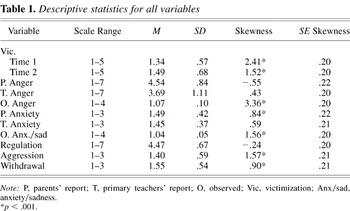
Descriptive statistics for all study variables are presented in Table 1. Normality was assessed by comparing the skewness statistic with zero using the z distribution. Using conservative significance criteria (p < .001) for assessing normality (Tabachnick & Fidell, 1989), Time 1 and Time 2 victimization, parents' ratings of anxiety, observed anger, observed anxiety/sadness, aggressive behavior, and withdrawal were found to be positively skewed. These variables were transformed using a logarithmic transformation, and the transformed variables were used in all subsequent analyses.
Descriptive statistics for all variables

Sex and age differences
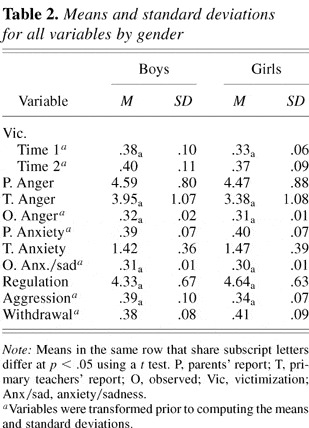
Boys exhibited more problem behaviors and negative emotions than did girls (see Table 2). Specifically, boys were rated as more aggressive and victimized at Time 1 than were girls, ts (138 and 141) = 3.35 and 3.45, ps < .001. In addition, boys evidenced more anger than did girls, t (152) = 3.27, p < .001 and t (143) = 4.42, p < .001, for teachers' ratings and observed anger, respectively. Boys also were observed to express more anxiety and sadness than girls, t (143) = 2.22, p < .05. In contrast, girls were rated as better regulated than were boys, t (151) = −2.99, p < .01.
Means and standard deviations for all variables by gender

Older children had higher victimization scores at Time 1, r (143) = .23, p < .01. Additionally, older children were observed to be higher in anger, r (145) = .22, p < .01, and they were rated as marginally more aggressive relative to younger children, r (140) = .16, p < .06. Thus, age served as a covariate in subsequent analyses.1
Age was also tested as a moderator of all effects. However, patterns of findings were the same for the younger and older children in this sample.
Correlations among variables
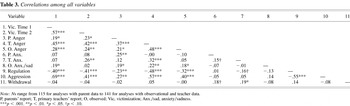
As shown in Table 3, Time 1 and 2 measures of peer victimization were strongly correlated, suggesting continuity in young children's tendency to be victimized by peers across the school year. There were weak to moderate relations among parent-reported, teacher-reported, and observed anger, although, at most, cross-source measures accounted for less than 25% of the variance. Additionally, the correlations among the anxiety measures were weak, and only the relation between parents' and teachers' ratings of anxiety approached significance. Thus, although there was some overlap in assessments of emotionality across source, each measure of anger and anxiety provided unique information. This is common when assessing internalizing and externalizing symptomatology in young children (e.g., Briggs–Gowan, Carter, & Schwab–Stone, 1996).
Correlations among all variables

Anger was consistently correlated with Time 1 and Time 2 victimization, but anxiety was not, with significant correlations obtained only for observed anxiety/sadness at Time 1 and teacher-rated anxiety at Time 2. Additionally, regulation was negatively correlated with victimization and aggression was positively correlated with victimization at both time points. However, there was no correlation with withdrawal.
Identification of victim and nonvictim groups
To be consistent with recent peer victimization research, victims were differentiated from nonvictims using a cut-score criterion of .8 SD above the mean on peer victimization; previous studies have indicated that this procedure validly discriminates victimized and nonvictimized children (Pellegrini, Bartini, & Brooks, 1999; Schwartz, Dodge, Pettit, & Bates, 1997). Using this procedure, 29 children (24 boys and 5 girls) were identified as victims at Time 1 and 34 children (20 boys and 14 girls) were identified as victims at Time 2. In comparison, 114 children (55 boys and 59 girls) were identified as nonvictims at Time 1 and 110 children (57 boys and 53 girls) were identified as nonvictims at Time 2. Boys were equally likely to be identified as victims at Times 1 and 2, t (73) = 0.77, ns, but girls were more likely to be victims at Time 2 than at Time 1, t (61) = −2.21, p < .05.
Concurrent and longitudinal relations between anger and anxiety/sadness and victimization
We conducted a series of hierarchical logistic regressions to examine the extent to which anger and anxiety differentiated victims from nonvictims, concurrently and one semester later. Due to the weak to modest correlations across reporters, parent-rated, teacher-rated, and observed anger and anxiety were entered in separate analyses to predict victimization. To minimize issues related to shared method variance, victimization was measured using secondary teachers' ratings. This procedure also permitted an assessment of the generalizability of the pattern of findings across parents', teachers', and observers' assessments of emotionality. In each analysis, gender and age were entered first, followed by anger and anxiety, which were entered simultaneously. Additionally, for analyses predicting victim status at Time 2, Time 1 victimization was entered prior to the other variables to control for its influence. All predictor variables were centered.
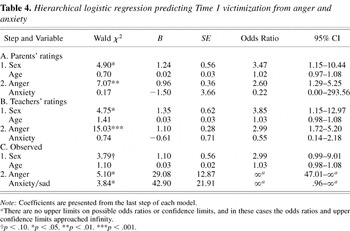
For the prediction of Time 1 victimization from externalizing and internalizing emotions, the models were significant for analyses of parent-rated anger and anxiety, teacher-rated anger and anxiety, and observed anger and anxiety, χ2 (4, N = 120) = 15.46, χ2 (4, N = 140) = 36.66, and χ2 (4, N = 143) = 25.05, all ps < .01, respectively. Parameter estimates for each term are presented in Table 4. Parent-rated, teacher-rated, and observed anger were each associated with increased likelihood of being a victim. There was no relation between parent-rated anxiety or teacher-rated anxiety and victim status; however, observed anxiety/sadness was associated with being a victim, such that children who were observed to display relatively high levels of anxiety and sadness at preschool were likely to be victims.
Hierarchical logistic regression predicting Time 1 victimization from anger and anxiety

To determine if sex moderated any of these relations, we added a third step to each logistic regression model that tested the two-way interactions of Sex × Anger and Sex × Anxiety. No significant interactions were obtained, suggesting that the concurrent relations between anger and victimization status and anxiety and victimization status were similar for boys and girls.
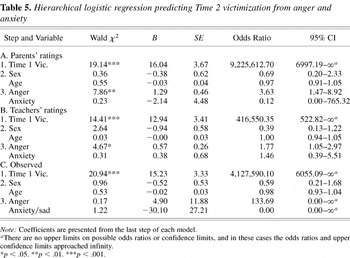
The logistic regression models were also significant in the prediction of Time 2 victimization from externalizing and internalizing emotions, χ2 (5, N = 114) = 42.27, χ2 (5, N = 131) = 41.22, and χ2 (5, N = 134) = 33.07, ps < .001, for analyses of parent-rated, teacher-rated, and observed anger and anxiety variables, respectively. (See Table 5 for parameter estimates.) Parent-rated anger and teacher-rated anger significantly predicted increased odds of being a victim at Time 2.
Hierarchical logistic regression predicting Time 2 victimization from anger and anxiety

Tests of sex as a moderator of these relations were conducted as before by adding the appropriate two-way interaction terms in a fourth step in the logistic regression models. Sex moderated both teacher-rated anger and observed anger in predicting Time 2 victimization, Wald's χ2 (1) = 5.54, p < .05 and Wald's χ2 (1) = 7.17, p < .01, respectively. A breakdown of these findings using Aiken and West's (1991) suggested techniques indicated that teacher-rated and observed anger positively predicted Time 2 victimization for girls (B = 1.13, SE = 0.41, p < .01 and B = 81.30, SE = 29.91, p < .01, respectively), but not for boys (B = −0.3, SE = 0.37, ns and B = −14.07, SE = 14.55, ns, respectively).
Mediational analyses
To examine possible putative mechanisms through which negative emotions predict victimization, we tested regulation, aggressive behavior, and withdrawn behavior as mediators. Mediational analyses were conducted in successive steps; as described by MacKinnon, Lockwood, Hoffman, West, and Sheets (2002), this method of testing mediation has the greatest power to detect effects. Due to the significant variations in gender described previously, all analyses were conducted for the sample as a whole as well as by gender to explore possible variations in patterns of mediation by demographic groups. In analyses testing relations for the sample as a whole, gender and age were entered as covariates; in analyses testing relations by gender, only age was entered as a covariate. Additionally, Time 1 victimization was controlled in analyses predicting Time 2 victim status. Separate analyses were conducted to assess parent-rated, teacher-rated, and observed emotionality.
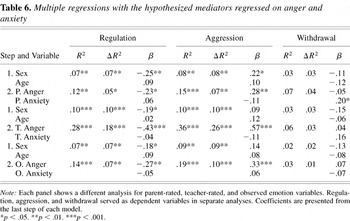
To determine whether the predictor variables were related to the mediators, we conducted multiple regressions in which regulation, aggression, and withdrawal were alternately regressed on anger and anxiety variables. For analyses with the sample as a whole, the anger variables were negatively related to regulation and positively related to aggression. There were no significant relations between anger and withdrawal, however. In addition, parent-rated anxiety was positively related to withdrawal for the sample as a whole, but there were no other significant relations between the anxiety variables and any of the hypothesized mediators (see Table 6). The findings for anger held when the sample was divided by gender, with two exceptions—parent-rated anger was unrelated to regulation and aggression for boys. The significant relation between parent-rated anxiety and withdrawal, however, did not emerge in analyses by gender.
Multiple regressions with the hypothesized mediators regressed on anger and anxiety

Next, we conducted a series of hierarchical logistic regressions predicting victim status at Time 1 or Time 2 in which the predictors (anger and anxiety; parent-rated, teacher-rated, and observed variables were tested in separate analyses) were entered in a single step prior to the mediators (regulation, aggression, and withdrawal, which were all entered simultaneously) to determine the extent to which the mediators were responsible for relations between the predictors and victimization status. We followed these analyses with significance tests as suggested by MacKinnon and colleagues (MacKinnon, Krull, & Lockwood, 2000; MacKinnon et al., 2002). Specifically, we multiplied the unstandardized regression coefficients reflecting the estimate of the effect of the predictor on the mediator (obtained in Step 1) and the estimate of the effect of the mediator on the outcome variable after controlling for the predictor variable (obtained in Step 2). We divided this product by the standard error of these estimates. This produces a z score that provides the significance test of the mediated effect, which was tested against a standard z table.
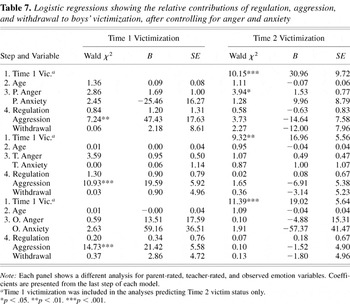
There were gender differences in the findings; thus, results are presented separately for boys and girls. For boys, the logistic regression models testing the relations between regulation, aggression, and withdrawal and victimization, after controlling for anger and anxiety, are shown in Table 7. Each of the models predicting Time 1 victimization were statistically significant, χ2 (6, N = 66) = 56.49, χ2 (6, N = 75) = 46.76, and χ2 (6, N = 77) = 46.88, ps < .001, for analyses with parent-rated, teacher-rated, and observed emotion variables, respectively. The Wald χ2 statistics show that, once the mediators were entered, there were no statistically significant relations between parent-rated, teacher-rated, or observed anger or anxiety and Time 1 victimization. Moreover, aggression, but not regulation or withdrawal, significantly predicted Time 1 victimization status in each analysis. Follow-up significance tests using MacKinnon and colleagues' (2002) procedures demonstrated that, for boys, aggression significantly mediated both teacher-rated anger and observed anger, zs = 2.93 and 2.33, ps < .05, respectively, but regulation and withdrawal did not.
Logistic regressions showing the relative contributions of regulation, aggression, and withdrawal to boys' victimization, after controlling for anger and anxiety

A different pattern of effects was obtained in predicting to boys' Time 2 victimization status. The overall logistic regression models were statistically significant, χ2 (7, N = 62) = 34.40, χ2 (7, N = 69) = 26.64, and χ2 (7, N = 71) = 26.97, ps < .001, for analyses with parent-rated, teacher-rated, and observed emotion variables, respectively. Parent-rated anger made a significant contribution to Time 2 victimization, even after entering regulation, aggression, and withdrawal in the model (see Table 7). However, regulation, aggression, and withdrawal did not predict Time 2 victimization. Follow-up tests revealed no significant patterns of mediation with aggression, regulation, or withdrawal in relation to boys' Time 2 victimization.
For girls, an opposite pattern was obtained such that evidence of mediation was found for Time 2 victimization, but not for Time 1 victimization. The overall logistic regression models predicting girls' Time 1 victimization were statistically significant, χ2 (6, N = 51) = 17.98, p < .01, χ2 (6, N = 62) = 13.33, p < .05, and χ2 (6, N = 63) = 17.00, p < .01, for analyses with parent-rated, teacher-rated, and observed emotionally, respectively. There were no significant relations between girls' anger or anxiety and Time 1 victimization status once regulation, aggression, and withdrawal were in the model, but only aggression was associated with girls' concurrent victimization and this effect reached significance in the analysis with observed emotion variables only (see Table 8). Follow-up analyses indicated that there were no statistically significant mediated effects in relation to girls' Time 1 victimization.
Logistic regressions showing the relative contributions of regulation, aggression, and withdrawal to girls' victimization, after controlling for anger and anxiety

Significant patterns of mediation were obtained in relation to girls' Time 2 victimization. The overall logistic regression models predicting Time 2 victimization status were statistically significant, χ2 (7, N = 62) = 34.40, χ2 (7, N = 69) = 26.64, and χ2 (7, N = 71) = 26.97, ps < .001, for analyses with parent-rated, teacher-rated, and observed emotion variables, respectively. The findings of these analyses are presented in Table 8. Neither parent-rated, teacher-rated, nor observed emotion variables were significantly related to girls' Time 2 victimization with the mediators included in the model. However, regulation predicted Time 2 victimization in analyses with teacher-rated and observed emotion variables. Follow-up analyses demonstrated that regulation significantly mediated teacher-rated anger (z = 2.03, p < .05) and marginally mediated observed anger (z = 1.81, p = .07). No other significant mediated effects were obtained.
Discussion
An important finding in this study was that anger displays differentiated those young children who were victimized by peers from those who were not. Children who were rated by teachers or parents as frequently angry or who were observed to express frequent or intense anger in the classroom were more likely than their peers to be victimized. It is notable that the findings were robust across method, supporting the reliability of this phenomenon. However, the way in which anger related to victimization risk varied for boys and girls and across time.
The relation between boys' anger expressions at school (as rated by teachers or observers) and Time 1 victimization was mediated by aggressive behavior, suggesting that young boys who are victimized by their peers exhibited relatively high rates of contemporaneous angry, aggressive behaviors. Interestingly, we found that anger expressions at home (as rated by parents) were directly associated with concurrent victimization, with no evidence that this relation was mediated by aggression. Importantly, predictions of Time 2 victimization (controlling for Time 1 victimization) indicated that the direct relation between parent-rated anger and boys' victimization persisted over time for boys, suggesting that anger served as a risk factor for subsequent victimization by peers. However, anger expressions at school (as rated by teachers or observers) did not predict later victimization status.
Critical to interpreting these findings is a consideration of how the relations between anger and victimization changed for boys over the course of the school year. That is, during the fall semester, some young boys participated in a pattern of peer interactions that involved relatively high levels of anger, aggressive attacks on peers, and victimization by peers. Such interactions are common among boys, who tend to play in more active, forceful, and domineering ways (Fabes et al., 2003). This may reflect the establishment of dominance hierarchies as boys determine their relative statuses within a newly formed peer group. By spring semester, however, these hierarchies should be better established, and, in the present sample, victimization was increasingly directed toward boys who did not engage in angry, aggressive peer interactions in the classroom. Notably, there was a direct relation between parent-rated anger and boys' likelihood of being victimized in both the fall and spring semesters. This relation likely reflects a more enduring, individual difference propensity to express anger rather than situationally specific responses to ongoing school-based peer interactions.
We also obtained evidence of a relation between anger and victimization for girls, although the mechanisms of the effect were different. It is notable that relatively few (17%) girls were identified as victims in the fall semester; in the spring semester, however, over 40% of the victims were girls. Thus, as the school year progressed, some young girls were increasingly targeted for victimization by their peers, and being victimized was associated with girls' tendency to display anger. Indeed, parent-rated, teacher-rated, and observed anger predicted victimization at Time 2 (even after controlling for Time 1 victimization). Although the relation between parent-rated anger and girls' victimization was direct, regulation mediated the relations for teacher-rated and observed anger. Thus, for girls, the link between anger expressions in the classroom and being victimized by peers was accounted for by poor regulatory skills.
One possible explanation for this finding may be that girls' anger is particularly noticeable by peers. In the present sample, anger expressions in the classroom were more common among the boys than among the girls. Thus, when girls do express anger, it may be more salient, by virtue of being less normative, making angry girls more noticeable than other girls or, perhaps, even than angry boys. Moreover, expressions of anger may be more acceptable for boys than for girls, so that peers may react more negatively to girls' anger expressions and the associated dysregulation.
The relations between externalizing symptoms and victimization are characteristic of aggressive victims, one of two distinct subgroups of victimized youth. We also expected to find evidence of passive victims, who are typified by high levels of anxiety and social withdrawal. However, consistent relations between the anxiety variables and victim status were not found. Only observed anxiety/sadness differentiated victims from nonvictims at Time 1, and no measures of internalizing emotions differentiated victims and nonvictims at Time 2. Additionally, there was no evidence that the relation between anxiety and victimization was mediated. The observed anxiety/sadness measure is unique in that it tapped sadness, whereas parents' and teachers' ratings did not. Thus, the findings may indicate that victims were sadder than nonvictims, but not necessarily more anxious. Furthermore, given that this variable did not predict increased victimization risk over time, it appears that sadness co-occurred with or followed victimization, but did not predict it longitudinally.
The present findings are clearly different from those reported in studies of older children and adolescents, which have demonstrated relatively strong relations for internalizing emotions and relatively weak relations for externalizing emotions. This difference is extremely intriguing, requiring consideration of the possible developmental implications of the findings. Extant research hints that the relation between emotionality and victimization might vary with developmental level. For instance, Alsaker and Valkanover (2001) found that aggressive victims were more common than passive victims in a sample of kindergarteners, whereas passive victims have typically been found to be more common in samples of elementary and middle school-aged children (Schwartz et al., 2001). Relatedly, Boivin and his colleagues (2001) reported that the relation between aggression and victimization decreased from Grade 3 to Grade 6. On the flip side, the relation between peer victimization and internalizing behaviors appears to become stronger with age (Boivin et al., 2001; Hanish & Guerra, 2000). Consistent with this view, Rubin and colleagues (1998) noted that internalizing behaviors are generally unrelated to social status prior to the elementary school years, perhaps due to the fact that young children have difficulty discriminating social withdrawal from other social behaviors (Younger, Schwartzman, & Ledingham, 1985). Thus, there may be a developmental progression in risk patterns for peer victimization, with internalizing attributes becoming more important as risk factors and externalizing attributes becoming less important as children get older. It will be important to assess whether such age differences appear in future samples that encompass age ranges that extend from preschool through middle childhood.
Not only may these findings contribute to models of the developmental trajectory of peer victimization, but they also may contribute to understanding the emergence of psychopathology among victimized youth. Evidence suggests that victimized boys are 3 (for passive victims) to 7 (for aggressive victims) times more likely to be diagnosed with a psychiatric disorder and victimized girls are 4 times more likely to have a psychiatric diagnosis compared to nonvictimized children (Kumpulainen et al., 2001). By demonstrating that externalizing emotions serve as one set of risk factors that predict early victimization, the present findings suggest plausible mechanisms, aggression and regulation, through which psychopathology may emerge. Certainly, cumulative risk models have demonstrated that difficulties in both the emotional and social domains enhance the likelihood of clinically significant symptoms (Davis, MacKinnon, Schultz, & Sandler, 2003). This may operate via “main effect” processes, in which proneness to negative emotions and hostile peer relationships each predict psychopathology, or, more likely, it may operate via a transactional model in which emotionality and peer experiences mutually influence one another over time, ultimately resulting in clinically significant levels of symptoms (Parker, Rubin, Price, & DeRosier, 1995).
One issue for future consideration is if similar findings would be obtained in a sample including more at-risk children; indeed, the present sample consisted of a relatively advantaged group of young children. Given that the presence of multiple risk factors often moderates risk processes, increasing the likelihood of atypical development (Lengua, 2002), research on the impact of negative emotions on the peer-victimization experiences for children with multiple risk factors, such as ethnic minority status, neighborhood disadvantage, or reduced family income, represents an important next step. Nevertheless, the findings of the present study, combined with the findings of many other studies demonstrating risk associated with peer victimization in relatively advantaged samples, suggest that being victimized by peers is a serious problem for many children.
One caveat of this study is that internalizing emotions are often difficult to assess in young children because their ability to reliably report on their internal states is limited. Although we attempted to minimize this potential problem by relying on multiple assessment methods, reliability estimates for the internalizing variables tended to be lower than for the other variables. Further, as has frequently been found by others (e.g., Briggs–Gowan et al., 1996), the intercorrelations among parent-rated, teacher-rated, and observed anxiety were relatively weak. This may reflect the fact that children often express internalizing emotions differently in different contexts (e.g., at home with parents vs. at school with teachers and/or peers). In addition, some raters may be less aware of internalizing emotions than others. Thus, the relatively weak findings regarding the role of anxiety may reflect these measurement issues, and additional research assessing the generalizability of these results is encouraged.
Our finding that anger predicts victimization by peers in early childhood, combined with prior findings indicating that victimization results in both externalizing and internalizing affect (Hanish & Guerra, 2002; Olweus, 1993; Schwartz, McFadyen–Ketchum, Dodge, Pettit, & Bates, 1998), provides some evidence for a transactional process in the occurrence of peer victimization over time. For young children, for whom there is relatively little victimization research, the origins of these emotional and social interrelations likely lie partly in their early socialization experiences; parents and preschool teachers play crucial roles in young children's day to day lives through their management of emotional expressions, their facilitation of peer interactions, and their behavior management practices. The impact of these practices is a critical issue that requires careful examination. When parents and teachers act in ways that promote more positive emotional or social functioning, it may moderate the relations among these variables. Because the joint occurrence of emotional symptoms and social maladjustment reflects multiple developmental difficulties across multiple domains, more research devoted to understanding the relations among these variables, along with ways to minimize their effects, is needed.
References
REFERENCES
Aiken, L. S., &
West, S. G.
(1991).
Multiple regression: Testing and interpreting interactions.
Thousand Oaks, CA:
Sage.
Alsaker, F. D., &
Valkanover, S.
(2001).
Early diagnosis and prevention of victimization in kindergarten.
In
J. Juvonen &
S. Graham (Eds.),
Peer harassment in school: The plight of the vulnerable and
victimized (pp.
175–195).
New York:
Guilford Press.
Belsky, J.,
Fish, M., &
Isabella, R.
(1991).
Continuity and discontinuity in infant negative and positive
emotionality: Family antecedents and attachment consequences.
Developmental Psychology
27,
421–431.Google Scholar
Boivin, M.,
Hymel, S., &
Hodges, E. V. E.
(2001).
Toward a process view of peer rejection and harassment. In
J. Juvonen &
S. Graham (Eds.),
Peer harassment in school: The plight of the vulnerable and
victimized (pp.
265–289).
New York:
Guilford Press.
Briggs–Gowan, M. J.,
Carter, A. S., &
Schwab–Stone, M.
(1996).
Discrepancies among mother, child, and teacher reports: Examining
the contribution of maternal depression and anxiety.
Journal of Abnormal Child Psychology
24,
749–765.Google Scholar
Calkins, S. D.,
Gill, K. L.,
Johnson, M. D., &
Smith, C. L.
(1999).
Emotional reactivity and emotional regulation strategies as
predictors of social behavior with peers during toddlerhood.
Social Development
8,
311–334.Google Scholar
Cicchetti, D.,
Ackerman, B. P., &
Izard, C. E.
(1995).
Emotions and emotion regulation in developmental psychopathology.
Development and Psychopathology
7,
1–10.Google Scholar
Cicchetti, D., &
Toth, S. L.
(1995).
Developmental psychopathology and disorders of affect. In
D. Cicchetti &
D. J. Cohen (Eds.),
Developmental Psychopathology: Vol. 2. Risk, disorder, and
adaptation (pp.
369–420).
New York:
Wiley.
Cole, P. M.,
Zahn–Waxler, C.,
Fox, N. A.,
Usher, B. A., &
Welsh, J. D.
(1996).
Individual differences in emotion regulation and behavior problems
in preschool children.
Journal of Abnormal Psychology
105,
518–529.Google Scholar
Crick, N. R.,
Casas, J. F., &
Ku, H.-C.
(1999).
Relational and physical forms of peer victimization in preschool.
Developmental Psychology
35,
376–385.Google Scholar
Davis, C. H.,
MacKinnon, D. P.,
Schultz, A., &
Sandler, I.
(2003).
Cumulative risk and population attributable fraction in prevention.
Journal of Clinical Child and Adolescent Psychology
32,
228–235.Google Scholar
Eisenberg, N.,
Cumberland, A.,
Spinrad, T. L.,
Fabes, R. A.,
Shepard, S. A.,
Reiser, M.,
Murphy, B. C.,
Losoya, S. H., &
Guthrie, I. K.
(2001).
The relations of regulation and emotionality to children's
externalizing and internalizing problem behavior.
Child Development
72,
1112–1134.Google Scholar
Eisenberg, N.,
Fabes, R. A.,
Guthrie, I. K., &
Reiser, M.
(2000).
Dispositional emotionality and regulation: Their role in predicting
quality of social functioning.
Journal of Personality and Social Psychology
78,
136–157.Google Scholar
Fabes, R. A.,
Martin, C. L., &
Hanish, L. D.
(2003).
Young children's play qualities in same-, other-, and
mixed-sex peer groups.
Child Development
74,
921–932.Google Scholar
Goldsmith, H. H.,
Lemery, K. S.,
Aksan, N., &
Buss, K. A.
(2000).
Temperamental substrates of personality development. In
D. Molfese &
V. Molfese (Eds.),
Temperament and personality development across the lifespan (pp.
1–32).
Hillsdale, NJ:
Erlbaum.
Hanish, L. D., &
Guerra, N. G.
(2000).
Predictors of peer victimization among urban youth.
Social Development
9,
521–543.Google Scholar
Hanish, L. D., &
Guerra, N. G.
(2002).
A longitudinal analysis of patterns of adjustment following peer
victimization.
Development and Psychopathology
14,
69–89.Google Scholar
Hanish, L. D.,
Kochenderfer–Ladd, B.,
Fabes, R. A.,
Martin, C. L., &
Denning, D.
(2004).
Bullying among young children: The influence of peers and
teachers. In
D. Espelage &
S. Swearer (Eds.),
Bullying in American schools: A social ecological perspective on
prevention and intervention (pp.
141–159).
Mahwah, NJ:
Erlbaum.
Hart, C. H.,
Yang, C.,
Nelson, L. J.,
Robinson, C. C.,
Olsen, J. A.,
Nelson, D. A.,
Porter, C. L.,
Jin, S.,
Olsen, S. F., &
Wu, P.
(2000).
Peer acceptance in early childhood and subypes of socially
withdrawn behaviour in China, Russia, and the United States.
International Journal of Behavioral Development
24,
73–81.Google Scholar
Hawker, D. S. J., &
Boulton, M. J.
(2000).
Twenty years' research on peer victimization and psychosocial
maladjustment: A meta-analytic review of cross-sectional studies.
Journal of Child Psychology and Psychiatry
41,
441–455.Google Scholar
Hubbard, J. A., &
Coie, J. D.
(1994).
Emotional correlates of social competence in children's peer
relationships.
Merrill Palmer Quarterly
40,
1–20.Google Scholar
Kochanska, G.
(1995).
Children's temperament, mothers' discipline, and security
of attachment: Multiple pathways to emerging internalization.
Child Development
66,
597–615.Google Scholar
Kochenderfer, B. J., &
Ladd, G. W.
(1996).
Peer victimization: Cause or consequence of school maladjustment?
Child Development
67,
1305–1317.Google Scholar
Kochenderfer, B. J., &
Ladd, G. W.
(1997).
Victimized children's responses to peers' aggression:
Behaviors associated with reduced versus continued victimization.
Development and Psychopathology
9,
59–73.Google Scholar
Kumpulainen, K.,
Räsänen, E., &
Puura, K.
(2001).
Psychiatric disorders and the use of mental health services among
children involved in bullying.
Aggressive Behavior
27,
102–110.Google Scholar
Ladd, G. W., &
Profilet, S. M.
(1996).
The Child Behavior scale: A teacher-report measure of young
children's aggressive, withdrawn and prosocial behaviors.
Developmental Psychology
32,
1008–1024.Google Scholar
Landis, J. R., &
Koch, G. G.
(1977).
The measurement of observer agreement for categorical data.
Biometrics
33,
159–174.Google Scholar
Lemery, K. S.,
Gahagan, A. L., &
Goldsmith, H. H.
(July, 1999).
Exploring the etiology of the relationship between temperament and
behavior problems with temperamentally extreme twins
[Abstract].
Behavior Genetics,
29,
361.Google Scholar
Lengua, L. J.
(2002).
The contribution of emotionality and self-regulation to the
understanding of children's response to multiple risk.
Child Development
2002,
144–161.Google Scholar
MacKinnon, D. P.,
Krull, J. L., &
Lockwood, C. M.
(2000).
Equivalence of the mediation, confounding, and suppression effect.
Prevention Science
1,
173–181.Google Scholar
MacKinnon, D. P.,
Lockwood, C. M.,
Hoffman, J. M.,
West, S. G., &
Sheets, V.
(2002).
A comparison of methods to test mediation and other intervening
variable effects.
Psychological Methods
7,
83–104.Google Scholar
Martin, C. L., &
Fabes, R. A.
(2001).
The stability and consequences of young children's same-sex
peer interactions.
Developmental Psychology
37,
431–446.Google Scholar
Nunally, J. C.
(1976).
Psychometric theory.
New York:
McGraw–Hill.
Olson, S. L.
(1992).
Development of conduct problems and peer rejection in preschool
children: A social systems analysis.
Journal of Abnormal Child Psychology
20,
327–350.Google Scholar
Olweus, D.
(1978).
Aggression in the schools: Bullies and whipping boys.
Washington, DC:
Hemisphere.
Olweus, D.
(1993).
Victimization by peers: Antecedents and long-term outcomes. In
K. H. Rubin &
J. B. Asendorpf (Eds.),
Social withdrawal, inhibition, and shyness in childhood (pp.
315–341).
Hillsdale, NJ:
Erlbaum.
Parker, J. G.,
Rubin, K. H.,
Price, J. M., &
DeRosier, M. E.
(1995).
Peer relationships, child development, and adjustment: A
developmental psychopathology perspective. In
D. Cicchetti &
D. J. Cohen (Eds.),
Developmental psychopathology: Vol. 2. Risk, disorder, and
adaptation.
Oxford:
Wiley.
Patterson, G. R.,
Littman, R. A., &
Bricker, W.
(1967).
Assertive behavior in children: A step toward a theory of
aggression.
Monographs of the Society for Research in Child Development
32(2–3,
Serial No. 113).Google Scholar
Pellegrini, A. D.,
Bartini, M., &
Brooks, F.
(1999).
School bullies, victims, and aggressive victims: Factors relating
to group affiliation and victimization in early adolescence.
Journal of Educational Psychology
91,
216–224.Google Scholar
Perry, D. G.,
Kusel, S. J., &
Perry, L. C.
(1988).
Victims of peer aggression.
Developmental Psychology
24,
807–814.Google Scholar
Phillipsen, L. C.,
Bridges, S. K.,
McLemore, T. G., &
Saponaro, L. A.
(1999).
Perceptions of social behavior and peer acceptance in kindergarten.
Journal of Research in Childhood Education
14,
68–77.Google Scholar
Rothbart, M. K.,
Ahadi, S. A., &
Hershey, K. L.
(1994).
Temperament and social behavior in childhood.
Merrill–Palmer Quarterly
40,
21–39.Google Scholar
Rothbart, M. K.,
Ahadi, S. A.,
Hershey, K. L., &
Fisher, P.
(2001).
Investigations of temperament at three to seven years: The
Children's Behavior Questionnaire.
Child Development
72,
1394–1408.Google Scholar
Rothbart, M. K., &
Bates, J. E.
(1998).
Temperament. In
W. Damon
(Series Ed.) &
N. Eisenberg
(Vol. Ed.),
Handbook of child psychology: Vol. 3. Social, emotional, and
personality development
(5th ed., pp.
105–176).
New York:
Wiley.
Rubin, K. H.,
Bukowski, W., &
Parker, J. G.
(1998).
Peer interactions, relationships, and groups. In
W. Damon
(Series Ed.) &
N. Eisenberg
(Vol. Ed.),
Handbook of child psychology: Vol. 3. Social, emotional, and
personality development
(5th ed., pp.
619–700).
New York:
Wiley.
Rubin, K. H.,
Coplan, R. J.,
Fox, N. A., &
Calkins, S. D.
(1995).
Emotionality, emotion regulation, and preschoolers' social
adaptation.
Development and Psychopathology
7,
49–62.Google Scholar
Schwartz, D.,
Dodge, K. A.,
Coie, J. D.,
Hubbard, J. A.,
Cillessen, A. H. N.,
Lemerise, E. A., &
Bateman, H.
(1998).
Social–cognitive and behavioral correlates of aggression and
victimization in boys' play groups.
Journal of Abnormal Child Psychology
26,
431–440.Google Scholar
Schwartz, D.,
Dodge, K. A.,
Pettit, G. P., &
Bates, J. E.
(1997).
The early socialization of aggressive victims of bullying.
Child Development
68,
665–675.Google Scholar
Schwartz, D.,
McFadyen–Ketchum, S. A.,
Dodge, K. A.,
Pettit, G. S., &
Bates, J. E.
(1998).
Peer group victimization as a predictor of children's behavior
problems at home and in school.
Development and Psychopathology
10,
87–99.Google Scholar
Schwartz, D., &
Proctor, L. J.
(2000).
Community violence exposure and children's social adjustment
in the school peer group: The mediating roles of emotion regulation and
social cognition.
Journal of Consulting and Clinical Psychology
68,
670–683.Google Scholar
Schwartz, D.,
Proctor, L. J., &
Chien, D. H.
(2001).
The aggressive victim of bullying: Emotional and behavioral
dysregulation as a pathway to victimization by peers. In
J. Juvonen &
S. Graham (Eds.),
Peer harassment in school: The plight of the vulnerable and
victimized (pp.
147–174).
New York:
Guilford Press.
Shields, A., &
Cicchetti, D.
(2001).
Parental maltreatment and emotional dysregulation as risk factors
for bullying and victimization in middle childhood.
Journal of Clinical Child Psychology
30,
349–363.Google Scholar
Shields, A.,
Ryan, R. M., &
Cicchetti, D.
(2001).
Narrative representations of caregivers and emotional dysregulation
as predictors of maltreated children's rejection by peers.
Developmental Psychology
37,
321–337.Google Scholar
Tabachnick, B. G., &
Fidell, L. S.
(1989).
Using multivariate statistics
(2nd ed.).
New York:
Harper Collins.
Wilton, M. M. M.,
Craig, W. M., &
Pepler, D. J.
(2000).
Emotional regulation and display in classroom victims of bullying:
Characteristic expressions of affect, coping styles and relevant
contextual factors.
Social Development
9,
227–245.Google Scholar
Younger, A. J.,
Schwartzman, A. E., &
Ledingham, J. E.
(1985).
Age-related changes in children's perceptions of aggression
and withdrawal in their peers.
Developmental Psychology
21,
70–75.Google Scholar
Zeman, J., &
Garber, J.
(1996).
Display rules for anger, sadness, and pain: It depends on who is
watching.
Child Development
67,
957–973.Google Scholar
Hypothesized mediated model with anger and anxiety as the predictor variables, regulation, aggression, and withdrawal as the mediators, and victimization as the outcome variable.
Descriptive statistics for all variables
Means and standard deviations for all variables by gender
Correlations among all variables
Hierarchical logistic regression predicting Time 1 victimization from anger and anxiety
Hierarchical logistic regression predicting Time 2 victimization from anger and anxiety
Multiple regressions with the hypothesized mediators regressed on anger and anxiety
Logistic regressions showing the relative contributions of regulation, aggression, and withdrawal to boys' victimization, after controlling for anger and anxiety
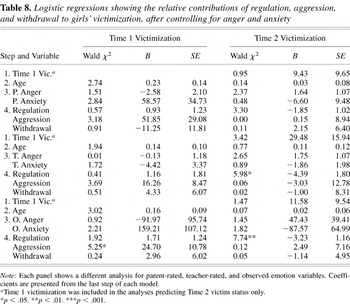
Logistic regressions showing the relative contributions of regulation, aggression, and withdrawal to girls' victimization, after controlling for anger and anxiety
 You have
Access
- 134
- Cited by