Introduction
Leadership is frequently referred to in health care service provision, yet it is a concept that is neither well understood nor defined in that context. In the next decades of the twenty-first century, the global aging of populations will challenge every nation's ability to provide leadership by qualified health professionals to reshape and improve health care delivery systems (Aberdeen and Angus, Reference Aberdeen and Angus2005). With an estimated 24.3 million people worldwide with dementia and 4.6 million new cases presenting every year (Ferri et al., Reference Ferri2005), the challenge for educators is to design and deliver courses that will give students the knowledge and skills they need confidently to fill that leadership role in dementia and aged care.
In previous work we have explored the concept of leadership in international dementia aged care service delivery to identify the knowledge, skills and attitudes required for leadership now and in the future (Aberdeen and Angus, Reference Aberdeen and Angus2005). In that review, management emerged as the dominant feature of leadership. The key attributes identified were the ability to develop a vision and to communicate that vision as clear achievable goals across the boundaries of professions, vested interests, language backgrounds and educational standards. The limit of focus, however, was on the role of leaders to provide cost-effective care and meet organizational goals, rather than a focus on ethical, person-centered care.
The aims of this paper are firstly to explore the ways in which the curriculum can be developed to respond to the nexus between management and dementia care delivery as identified in the review by Aberdeen and Angus (Reference Aberdeen and Angus2005); and secondly, to share a vision of how educators can develop graduates who are ready to become leaders in shaping the industry. Within this context, the Master of Health Science – Aged Services (MHSAS) program at Victoria University, Melbourne, Australia is used as a case study to describe the process by which the concept of leadership is applied as the key driver in curriculum development, teaching practices and learning outcomes. Particular attention is given to the importance of a multidisciplinary gerontological approach to the curriculum to meet the interdisciplinary demands of leadership in dementia practice. Facilitative approaches to teaching and learning are discussed, with the aim to identify and nurture the critical knowledge bases, skills and attitudes required for leadership.
Context
Alongside global aging of populations, the demand for educational leadership in dementia services will rise appreciably over the coming decades. The implication for tertiary educational institutions is that they must be able to prepare professional leaders competent to meet that challenge (Aberdeen and Angus, Reference Aberdeen and Angus2005). Until recently, Australian tertiary institutions have been slow to respond to the need for postgraduate programs in dementia services to meet the growing demand for appropriately qualified managers and administrators within the community and the aged services industry.
The aged care industry has been widely identified as a major growth area within the health care sector (Kendig and Duckett, 2000; Fine and Mitchell, Reference Fine and Mitchell2007). Reviews of the industry in Australia have acknowledged the need to rethink the kind of workforce required to meet government, industry and consumer demands to ensure delivery of high quality multidisciplinary and multi-skilled care services (Duckett, Reference Duckett2005). In the ever-changing bureaucratic and financial environment of the aged and community services sector, staff in leadership roles need to have the ability to blend two professions grounded in health care and management practices (Wyszynski, Reference Wyszynski2000). The basis of this amalgam is that “if the goals of the organization are firmly grounded in the well-being of clients, there will be a fit between the management and professional leadership functions” (Aberdeen and Angus, Reference Aberdeen and Angus2005: 5).
The MHSAS program is a case study example of what can be done to prepare students for this dual role of management and dementia care leadership. MHSAS is the only postgraduate program of its kind in Australia that offers postgraduate multidisciplinary gerontological dementia specialization. Further, it offers students the opportunity to combine specialization in dementia care services with aged services management in a comprehensive coursework program. The focus on management and dementia reflects the increasing demand for flexible, talented and passionate leader-managers in dementia care: “the bottom line is we need to invest in managers if we want them to lead. Only then can they guide front-line staff, those who are charged with the delivery of care” (Donner and Wheeler, Reference Donner and Wheeler2004).
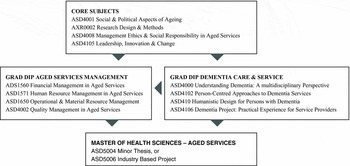
The MHSAS program provides postgraduate educational opportunities within the community and aged residential services sector of the dementia and aged care industry. It comprises a three-step program incorporating a Graduate Certificate in Aged Services, a Graduate Diploma in Dementia Care and Service, and a Graduate Diploma in Aged Services Management. These lead onto a Master of Health Science – Aged Services (by coursework or minor thesis). These three optional pathways to the Master's allow for exit points to accommodate individual professional and personal learning needs of students (Figure 1).
Curriculum map of the MHSAS suite of postgraduate programs.

The dementia stream of the MHSAS program consists of four core units, alongside four specialist stream units followed by either a minor thesis or completion of the management stream to achieve the MHSAS. The core units provide students with the tools to implement dementia best practice (see Figure 1). The specialist stream units include understanding dementia from a multidisciplinary perspective; person-centered approaches to the delivery of services; humanistic approaches to sustainability and design for people with dementia, and the application of the overall course content to a discreet practice orientated project. This unit provides students with the opportunity to integrate theory with practice in a specific workplace and/or community situation. On completion, students are able to demonstrate the ability to plan, develop and critically evaluate an innovative dementia service program and identify the opportunities for improvement and further research. The outcome of this unit often informs the direction of the students' minor thesis topic.
MHSAS students are a “non-traditional” cohort and their learning environment needs to be centered on their requirements (Weaver, Reference Weaver1999; Stanberrry and Azria-Evans, Reference Stanberry and Azria-Evans2001; Karcher and Whittlesey, Reference Karcher and Whittlesey2007; Young and Paterson, Reference Young and Paterson2007). The dementia stream of the MHSAS program provides multidisciplinary flexibility for students to pursue their particular professional interest or area of expertise in dementia. It is of particular interest to students with backgrounds in social work, psychology, nursing, medical, arts, or allied health disciplines. For many students, it is their first opportunity for educational interaction with participants from other disciplines and to contribute their disciplinary knowledge to understanding best practice in dementia services.
The average age of graduates in the MHSAS program is 40 years (Victoria University, Graduate Destination Survey 2005–2007). A large number of the predominantly female student cohort have had many years' experience in the workplace and hold managerial occupations such as director of nursing, clinical coordinator, community case and program management and allied health activities. We know that these mature-aged workers enhance the organizational capacities of institutions to provide services for older clients who prefer care by experienced staff (Brooke, Reference Brooke2001). Yet they often enroll in the postgraduate program with trepidation. Many of these students have not engaged in higher education for years, even decades, and need to overcome entrenched inhibitions, past (often negative) experiences and beliefs about learning. Paradoxically, this is compounded by the common perception that there is little more to learn because they have “seen it all” in practice― they are “experts” in real life situations. These students are often overworked in practice and feel unsure as to whether they are able to balance their work and personal commitments to take on the responsibility for their own learning. They need to be nurtured in an “age friendly” university environment (Karcher and Whittlesey, Reference Karcher and Whittlesey2007) where they are encouraged to direct their learning through theory to reflect creatively and critically on their occupational practices.
In Australia, the tyranny of distance has created problems for students to access educational opportunities (Gattuso and Saw, Reference Gattuso and Saw1998). The program offers flexible delivery of teaching and learning strategies both to on-campus students and by distance education mode for students in regional and more remote areas across Australia. Teaching practices fit with the students' personal and professional growth and responsibilities. Distance education students make up about 30% of the cohort in the MHSAS program. These students are provided with hard copy course materials, electronic WebCT and/or CD ROM modes of delivery. Different forms of electronic communication are used for student-lecturer contact throughout the semester. The curriculum is also offered to the on-campus students at the central city location at times convenient for full-time professionals. The delivery of the lectures is programmed at 17.30–19.30 hours― a time determined by student evaluation surveys to most suit the profile of the full-time professional student.
An interdisciplinary framework for dementia curriculum development
The aged care workforce of the twenty-first century will need to transcend traditional skills boundaries to meet the multidisciplinary needs of an aging population. Australia's first National Health Workforce Strategic Framework (Australian Health Ministers' Conference, 2004) set the direction for the health care workforce by recognizing the need for the alignment of education and training supply with projected increases in workforce requirements and health service needs. Importantly, the framework identified the need for articulated, multiple career pathways and the development of innovative ways to deliver health education.
The multidisciplinary field of gerontology informs the curricular development, content and delivery of the MHSAS program. It is guided by asking: What do future leaders need to know to be effective in leading, managing and delivering innovative programs to provide best practice for a diversity of older people living with dementia in the community and residential sectors of the aged care industry? The scope of this question demands an interdisciplinary approach that is central to the delivery of dementia care and aged care (Glista and Petersons, Reference Glista and Petersons2003). It embraces knowledge from gerontology, biology, sociology, psychology, philosophy, ethics and business management. Such an approach requires an understanding of the physiological, psychological, sociological, environmental and spiritual aspects of older peoples' lives within an organizational context.
Old age does not occur in a vacuum; it is the accumulation of a life time's experience conditioned by gender, social and economic structures, historical location and the subjective experience of aging (Chalmers, Reference Chalmers2004). The heterogeneity of the dementia experience and its relationship with the aging process continues to challenge our thinking about the ways in which curriculum can contribute to improving the psycho-social, environmental and spiritual aspects of care, as well as treating dementia bio-medically. According to Whitehouse (Reference Whitehouse2007), “Alzheimer's is a bellwether condition juxtaposed between the hopes of science and the fears of social and environmental injustices.” The traditional dominance of a mono-disciplinary bio-medical approach to aging and dementia education has hindered the cross-fertilization of ideas across disciplinary boundaries (Estes, Reference Estes and Estes2001). Aberdeen and Angus (Reference Aberdeen and Angus2005) suggested that while their systematic review identified a limited emphasis on the role of leadership within dementia care courses, the need for multidisciplinary education was a strongly emerging recommendation.
Because the MHSAS curriculum targets a multidisciplinary group of students, the structure of the curriculum provides for a ready-made interdisciplinary “classroom” team environment, in effect a simulation of the work teams that students will experience in practice. Students are thus prepared for multiple disciplinary relationships required in the delivery of care services. These relationships include peak bodies and policy-makers; providers and clients; professionals, carers and volunteers ― all central to the delivery of quality dementia care. Graduates are expected to work both autonomously and as part of an interdisciplinary team, capable of engagement in organizational processes to effect and facilitate institutional and social change. Essential to this is effective communication to adapt to the ever-changing needs within the dementia services field that is closely linked to the demands of the social, political and regulatory environment. This mandates that students have expertise in decision-making skills in locating, evaluating and managing the effective use of multidisciplinary information and solving complex problems in socially and culturally diverse community and institutional work environments.
Building a systematic approach to leadership in the dementia and aged services curriculum
The key question in building the curriculum is: how do we go about empowering practitioners to become students (or learners) and then turn them back into a different kind of practitioner― a leader in the field ― who has acquired the capacity to lead and innovate, everyday? I attempt to answer this question by utilizing the concept of leadership as the central tenet that underpins the MHSAS curriculum development and teaching practices. It is the ethos that infiltrates all areas of the MHSAS course curriculum, content, instruction and administration. It is also the core educational outcome of the program to meet twenty-first-century needs within the dementia and aged care industry more generally. This focus on leadership in curriculum development began in 2002 when the concept of “leadership” was used to drive the promotional strategies for the course “Be a Leader in the Aged Care Industry.” This was followed by a series of national conference presentations supported by the systematic review publication by Aberdeen and Angus (Reference Aberdeen and Angus2005) where dominant themes in the attributes and functions of leaders in aged care delivery systems were identified, critically appraised and summarized, and recommendations were tabled for educational curricula outcomes for tertiary students. We argued that changes in education may be required in order for dementia and age-specific leadership courses to evolve (Aberdeen and Angus, Reference Aberdeen and Angus2005).
This research paper guided the curricula outcomes for leadership in the MHSAS program prescribed in, for example, the core unit “Leadership, Innovation and Change” where learning outcomes are directed towards leadership skills and attitudes required by the professional practitioner. This unit examines the theories and styles of leadership required by a professional leader-manager to facilitate best practice in dementia specific care. Particular attention is given to principles of evidence-based health service evaluation to identify and respond appropriately to actual, and potential, issues or practices impacting on the attainment of quality delivery of services. Students are asked, for example, to analyze and evaluate critically the leadership attributes and skills required for innovative interdisciplinary team work that is inclusive of clients with behavioral and psychological symptoms of dementia (BPSD) and their carers. This includes a discussion of leading the team to assess the multi-factoral nature of BPSD including various models of causation, client assessment, care planning and evaluation. The outcome is directed towards achieving person-orientated goals needed to sustain individual identity.
Training quality leaders in modern quality management is one of the most prevalent and accepted methods of surviving in the health care market (Stern, Reference Stern2002). Harnessing the concept of leadership in the MHSAS program, however, goes beyond the view that quality leadership is just “good management” – it demands an ethic of good practice. As an educator, I agree with Joanne Ciulla that the heart of leadership is ethics (Ciulla, Reference Ciulla and Ciulla2004). Ethics is the governance of care and needs to be embedded in leadership. It is perhaps the most important component of the educational process – fundamental to which is an understanding of the intricacy of organizational integrity, good management and practice to uphold the dignity and worth of each relationship of care.
Ethics embedded in leadership opens new kinds of dialogue between educators and students to explore ways of providing good leadership and to be responsive to pressing ethical concerns (Ciulla, Reference Ciulla and Ciulla2004) in the delivery of dementia care services. Students often feel intuitively that they know about ethics, based simply on their own life experience. Harnessing this dynamism as a starting point for theoretical knowledge is a challenge for educators because ethics is part of what van Hooft et al. (Reference van Hooft, Gillam and Byrnes1995) refer to as the “silent conversation” with self. The MHSAS program provides a safe environment where students and educators come together to open up those conversations and to weigh up a range of considerations for and against a course of action. It is also about bringing these conversations on a broad range of issues – political, social, cultural, spiritual and ethical – to the classroom (Beck, Reference Beck and Soltis1981). Ciulla (Reference Ciulla and Ciulla2004) acknowledges the multidisciplinary practice experience of John H. Gardner to encourage our leaders to “keep alive values that are not so easy to embed in law – our caring for others, about honor and integrity, about tolerance and mutual respect.” This approach needs to encompass an entire organization “from top to bottom” to make a commitment to ethical behavior; it needs to begin, however, “at the top” (Gini, Reference Gini and Ciulla2004). Ethics is about good management and good care.
Critical reflective approach to curricular design and implementation
In a climate of economic restraint, health care providers require proof that new methods of providing care are as good as, or better than, standard practices. This has greatly increased reliance on evidence-based practice (Lohfeld and Brazil, Reference Lohfeld and Brazil2000). The principles of evidence-based practice are used to apply a critical reflective approach to teaching to better understand the issues that impact on the delivery of dementia services. Importantly, it also increases and validates the knowledge base of students' specific professional interests. It requires the student to keep abreast of a wide range of interdisciplinary knowledge. It also demands that students are able to reflect on their own experience, subject it to evaluation based on sound evidence and determine the way forward for best practice (van Hooft et al., Reference van Hooft, Gillam and Byrnes1995; Young and Paterson, Reference Young and Paterson2007).
A critical reflective approach to learning assists the student in making difficult decisions. This approach to teaching makes problematic the study of institutional care practices, and encourages students to reflect creatively and critically on the underside of dominant practices. The aim is to open up their learning, by questioning existing methods and relationships and by questioning what is taken for granted. This methodology of teaching can be likened to Foucault's toolbox, where there is a need for flexibility in our instruments of learning – try it, if it doesn't work put it aside and try another instrument: “This investigation can only be carried out step by step on the basis of reflection (which will necessarily be historical in some of its aspects) on given situations” (Foucault, Reference Foucault and Gordon1980). It is a tool of persuasion to promote values and to change attitudes – to challenge and make changes in institutions of caring that are often entrenched in hierarchical and mono-disciplinary traditions.
Our students – the future professional leaders – need to be critical thinkers, to think clearly, not just working with facts but in making value judgments. Students have the opportunity to challenge traditional ways of thinking about practice and to facilitate best practice in the delivery of dementia services. In the assessment task in the core unit “Management Ethics and Social Responsibility,” students are invited to select and describe a situation related to an ethical problem in their own work place, home or community. It is designed to give students an understanding of ethical issues, which arise when managing dementia care facilities and services for older adults. For example, students will critically examine the principle of autonomy which has evolved from protecting the client's right to direct health care decisions affecting them. Specific ethical dilemmas arise with clients with dementia who are not autonomous or whose autonomy is doubtful. Students are encouraged through a case-study approach to examine complex issues such as risk management; informed consent; refusal of treatment and end-of-life decision-making and that may impact on the use and abuse of the autonomy criterion. Students are encouraged to consider other principles and frameworks embedded in the delivery of person-centered care for people with dementia.
A case-study tool for learning
Problem solving in ethical decision-making is more complex than ordinary problem solving and often there will be no clear-cut or generally agreed outcomes. Through a critical reflection, students learn to understand a problem by acknowledging the ground rules, gathering relevant information, active problem solving and proposing a possible solution (van Hooft et al., Reference van Hooft, Gillam and Byrnes1995; Young and Paterson, Reference Young and Paterson2007). As part of the assessment process, an ethical decision-making strategy in the form of a case study is used to assist the student in making a rational or reasonable choice, in contrast to making a guess or acting on “gut feeling.” Case studies are useful in identifying and testing the intuitive principles we all rely upon, and to better appreciate the interrelationship between theory and practice (Young and Paterson, Reference Young and Paterson2007). The student's task is to “identify these values, subject them to critical examination and refinement, and apply them to particular personal or social problems” (Beck, Reference Beck and Soltis1981). In so doing, students learn the pitfalls of the case-study approach where omission of critical, reflective examination of principles can degenerate simply into a description of what people believe (Rachels, Reference Rachels, Kuhse and Singer1998).
This case-study approach gives special consideration of an ethical nature to each step of the decision-making process, and assists the student to identify constraints and the criteria arriving at a reasonable decision, which is sensitive to the relevant features of the situation. This decision-making process has been made thoughtfully and can be explained to others, giving reasons for adopting a particular solution rather than the other possible solutions that were open to them. Students learn that competence in ethical decision-making does not mean always producing the one and only right answer to the problem (van Hooft et al., Reference van Hooft, Gillam and Byrnes1995). It does, however, mean arriving at a reasonable decision, which is sensitive to the relevant features of the situation.
This instrument of learning can provide important lessons for practice and a rationale for certain decisions we make. Often there is not a perfect fit or a perfect model, yet each instrument of learning can offer a way of gaining new insights into practice and how we practice as students and educators. The learning outcomes for students are a critical understanding of ethical terms, philosophical principles and concepts employed by leaders in decision-making, policy planning and administration. On completion of this unit, students are able to demonstrate an awareness of theoretical frameworks underlying arguments and decision-making in ethics; an ability to identify key ethical issues in dementia and aged services, and to distinguish between legal and ethical issues and their interrelation. As prospective leaders, the students gain an understanding of the ethical issues related to an organizational culture alongside an awareness of the imperative of integrity in business management in aged services. Students have the ability to lead in promoting and facilitating policy and guidelines for ethical practice in dementia care services.
Curriculum implementation: methodology of teaching practices
Educators within the MHSAS program form a consensual interdisciplinary view of the interrelatedness of curriculum and teaching and the multidisciplinary experiences of students. It is an authentic educational relationship based on a shared experience of practice. Students bring their own individual attributes that contribute to the learning context in the same way as the educators bring their own sets of personal and professional experience. The educators' philosophy and professional orientation toward the educative process is central to creating a trusting learning environment. In order to facilitate learning, educators need to understand their own personal orientations to the educative process (Stanberry and Azria-Evans, Reference Stanberry and Azria-Evans2001).
Teaching grounded in professional practice is a crucial asset in understanding the experience of students and their relationship of care with clients “in practice.” Curriculum teachers share similar experiences, compare values, examine common problems, interact with critical issues and develop priorities for action (Marsh and Willis, Reference Marsh and Willis2007). Lecturers with the ability to relate experiential knowledge alongside academic interests in the field of gerontology actively pursue a range of problems from different perspectives and use a variety of different methodologies (Marsh and Willis, Reference Marsh and Willis2007) to teach students in the MHSAS program. It provides a strong foundation for teaching and learning (Lohfeld and Brazil, Reference Lohfeld and Brazil2000) and is rewarding work.
So how do we, as educators put into practice this experiential curriculum to guide future leaders? The methodology of teaching practices is never simple and is never one person's alone. The curriculum, although prepared in advance and meeting tertiary institutional regulations, is centered on the interaction between students and lecturers. It is not a one-way transmission of ideas to a group of passive recipients (Young and Paterson, Reference Young and Paterson2007). It begins with guiding students to direct their learning through theory and the ways in which to relate this to their practice. Classes are facilitated more as discussion groups than teacher-orientated lectures (Marsh and Willis, Reference Marsh and Willis2007; Young and Paterson, Reference Young and Paterson2007). It is a lively forum for exchange between theory and practice facilitated through a stimulating and supportive environment where a creative range of teaching and learning methods is introduced.
The MHSAS course content reflects the importance of the practical evidence from within the dementia field of practice to inform education and research – it is a two-way process. This provides opportunities for students with extensive practical experience to use and recognize the value of their existing knowledge and to share it with other students from different disciplinary backgrounds. The objective is for them to have a safe environment where different styles of thinking and different points of view are explored, evaluated, developed or dismissed. Through this process students learn to become leaders in reshaping their profession – one where there is respect for diversity and difference. This can only be achieved through creating a trusting learning environment, which is vital to the educational process and outcome (Stanberry and Azria-Evans, Reference Stanberry and Azria-Evans2001).
Measuring curriculum outcomes
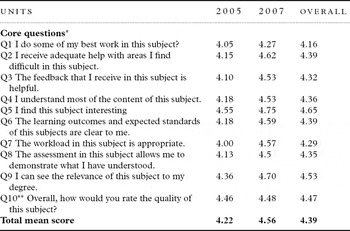
Evaluation instruments are employed for a variety of purposes including teaching, curriculum planning and appraisal. The teaching team meets at the end of each semester to submit a review of units and discusses the program as part of an ongoing quality review of the curriculum. The MHSAS underwent an internal and external University Course Review in 2008. Teachers are encouraged to utilize student evaluation surveys to obtain summative feedback from students about content (e.g. curriculum and related services) and teaching to improve quality and foster staff development (from 2008 it is compulsory for all units). Table 1 provides the mean score of five units in the MHSAS program for 10 core questions in 2005 and 2007. These units demonstrate the focus of discussion in this paper. The improvement in the overall score reflects ongoing curricular quality evaluation processes and the input of highly credentialed teaching staff, external specialists and consultants who support the specialist knowledge of the MHSAS program. Above all, it reflects the strong engagement of the students to learning.
The mean score of the 10 core student evaluation questions for Units ASD4000, ASD4001, ASD4008, ASD4102, ASD4105a

aSee Figure 1 for description.
*Scale: 1 = Strongly Disagree, 2 = Disagree, 3 = Neutral, 4 = Agree, 5 = Strongly Agree.
**Scale: 1 = Very Poor, 2 = Poor, 3 = Satisfactory, 4 = Good, 5 = Very Good.
In 2010 the MHSAS program will undergo a research evaluation of the students' career outcomes five years following graduation. This will provide important insights into the career pathways of students, the outcome of an interdisciplinary approach to curricula development based on leadership and the impact on their practice.
Finally, the diversity of experience of students challenges our skills as educators to investigate new and creative methods of understanding. While the students have different theories, methodologies and research interests, they all have in common an understanding of the complex professional and industry practices that inform dementia care services. They have a belief that they can make a difference – as the future leaders of the industry. According to one student, the MHSAS program:
has made my years of study a more enjoyable experience. I have learned to approach practice from a reflective and critical analysis approach, always seeking to enhance the lives of those I come into contact with. But just as important I have learnt about leadership, about best practices, and using these skills on a daily basis.
Benchmarking the future
In a rapidly changing dementia and aged services environment, we will continue to promote a stronger emphasis on national and international dissemination of postgraduate programs in dementia. The dementia stream of the MHSAS program is particularly adaptable and prepares local and international students equally to perform in local, global and multicultural contexts. We will aim to ensure that the work and scope of the MHSAS program continues to grow by seeking stronger international benchmarks with other educational institutions with similar interests and vision. There is also a need to strengthen and value existing local relationships to utilize each of our strengths and to forge new links with other research and teaching institutions, community agencies and government bodies. This is being achieved through supportive partnerships with community, industry and other tertiary institutions to train employees, encourage mentoring, and promote leadership and a vision of what is possible and desirable in dementia service provision.
The climate change environment of the twenty-first century has put increased pressure on the aged services industry to provide cost effective and sustainable solutions to benefit all – the client, provider, staff and the environment. The MHSAS program has begun to respond to that demand by implementing sustainable practices within units such as “Humanistic Design in Aged Services” that will be at the forefront in environmental design for aged care and dementia specific units.
Finally, academic educators need to reflect critically on our role in overturning our own embedded stereotypical attitudes towards people with dementia and aging more generally (Angus and Reeve, Reference Angus and Reeve2006). This is particularly important for someone who has a diagnosis of dementia as such people are often excluded, stigmatized and discriminated against and experience “dementia-ism” (Brooker, Reference Brooker2007). As educators, we appreciate the scholarly work from a range of disciplines to help us better understand and make better sense of what we are doing (Glista and Petersons, Reference Glista and Petersons2003). However, we need more from these disciplines. We have to review the ways in which universities can build a stronger focus on interdisciplinary approaches to the scholarship of education that values gerontology (Weaver, Reference Weaver1999). Alongside an aging population and increasing emphasis on the prevention of chronic conditions such as dementia, we need visionary educators to bring aging issues such as dementia into the mainstream in undergraduate and postgraduate curricular development across the various disciplines within the tertiary sector. This is the challenge for educational leadership in the future.
Conflict of interest
None.
Acknowledgments
Thanks to Sue Aberdeen for her collegial support and expertise, and to Deborah Tyler and Professor Katie Hughes at Victoria University for their helpful comments on an early draft of this paper.