1. INTRODUCTION
When developing a better understanding of the design process there are several possible approaches to choose from. Many studies are based on novice designers (e.g., students) or designers of relatively modest talents. By contrast, some studies have queried designers who are considered to have outstanding and exceptional ability in order to gain understanding of design at the highest level that it is practiced. The study reported here adopts yet another approach by exploring how the design process is perceived by design educators when they are discussing design with an interviewer.
The approach is motivated by the observation that teaching design requires consciously distilling the essence of the design process for the students, observing students during their design process, and guiding them through the process. At the heart of this work is the assumption that design educators tend to develop a more articulate view of design, and subsequently, the design process than most other designers (Chen & Heylighen, Reference Chen and Heylighen2006). In addition, designers and design educators are encultured into practice and teaching in a specific environment: the design studio. Enculturation takes place within the design studio, where learning situations are partially constructed by the leader's (educator's) notion of design practice. In this setting future designers acquire design-specific capital (Strickfaden & Heylighen, Reference Strickfaden and Heylighen2007), of which one component is their understanding of the design process. Another significant assumption in this work is that design-specific capital and sociocultural capital is considered to be a major part of how an educator teaches design (Strickfaden & Heylighen, Reference Strickfaden and Heylighen2007).
This paper begins by presenting background on how the design process is understood and described within the design community. Following this, the participants, procedures, and data-driven analysis techniques are mapped out. The results of this research provide insights from four perspectives: an overview of the concepts discussed by the participants, the expected aspects about design process, more unusual nuances, and design process as a whole—all in the words of the educators. Finally, this paper concludes with a discussion that illustrates how 19 educators' perceptions of the design process can be loosely grouped into three categories, and how they predominantly talk about designing and design teaching in a “chopped up” pick-and-mix way.
2. BACKGROUND
There is essentially no one approach to understanding and teaching the pluralism of the design process. A number of generic and systematic approaches have been explored and developed, primarily for the purpose of educating designers. Some of these approaches date back to the early idea that designing activities are systematic, whereas others are more current deconstructions of what is considered good design process. These approaches to understanding design process are loosely divided into three aspects including design methods and the generic design process, explicitly taught skills, and implicitly gained knowledge through personal experience and exposure to design. This background on how the design process is understood and described within the design community is presented because it begins to describe some of the existing design-specific capital and it acts as a foundation to build upon. Although these earlier approaches differ from those taken in this study, they are part of a continuum that presents insights into how design process is perceived.
2.1. Design methods and the generic design process
Since the 1960s and continuing today, design academics have explored the design process through observing designers in action resulting in the creation of design methods models. In this way, early research into the design process hoped to improve the efficiency of design practice as prescriptive models for designing. The design methods approach lays out a course of action by dividing the design process into a sequence of procedures that are followed toward the design of an artifact. Early work in this area includes that of Bruce Archer (Reference Archer1963/1964) with a body of work that is a systematic understanding of design problems, J. Christopher Jones (Reference Jones, Jones and Thornley1963), who accounts for the intuitive and logical in design, and Christopher Alexander (Reference Alexander1974/1964), who also presents a prescriptive methodology for designers to follow. These first generations of design methods involve scientific approaches that evolved toward presenting the design process as three stages: analysis, synthesis, and evaluation. Even though the prescriptive design methods approach is deemed somewhat unsuccessful by its originators, there is still a sizable group of contemporary research into methodology that falls into this category (e.g., Hubka, Reference Hubka1982; Pugh, Reference Pugh1991; Pahl & Beitz, Reference Pahl, Beitz, Wallace, Blessing and Bauert2003).
Further work in this area continues predominantly as a quest to understand what is happening while designing; this is redefined and refined as the generic design process. The majority of these contemporary methodologists are known to be part of the science- and technology-oriented disciplines such as engineering design and computer sciences. The generic design process is described as a chain of interlinking parts; however, it is further elaborated on as being iterative and nonlinear. That is, this iterative process is presented as a series of design activities that is loosely followed in order, with particular parts being revisited at regular intervals before reaching the end of artifact development (Cross, Reference Cross2000). The design methods and the generic design process movements provide valuable insights into how overall design process is enacted. Within this process are an essential toolkit of skills, design-specific capital typically taught within design schools, and sociocultural capital implicitly gained through individual experiences.
2.2. Explicitly taught skills
The design-specific capital taught in design studies includes a toolkit of physical and conceptual skills. Physical skills involve well-known attributes of designing such as sketching, rendering, building actual/digital models, and generally manipulating materials. These skills have been taught in design education for some time, and it is commonly understood that teaching by doing and teaching how to explore and communicate through representation is of primary importance in most disciplines of design. Conceptual skills are thought based, and gained through instruction and process-oriented approaches. According to Vincenti (Reference Vincenti1990), explicit information is put down in words, tables, diagrams, and pictures, whereas implicit subjectivity involves skill, judgment, intuition, and associated knowledge. Explicit information includes the tangible aspects of design that are more easily taught in formal situations (lectures, seminars).
One explicitly taught conceptual skill is accomplished through establishing problem-solving activities, which is generally accompanied with a list of specifications in a design brief. In the early 1970s, theorists such as Herbert Simon and Horst Rittel studied complex problem solving related to designing. Complex problems are defined as having a multitude of levels and do not have only one solution, and in this way are set apart from mathematical problems that have a single correct solution. Simon (Reference Simon1973, 1981) describes design problems as “ill-structured and ill-defined” and Rittel describes them as “wicked” (as cited in Churchman, Reference Churchman1967), later elaborated upon by Rittel and Webber (Reference Rittel and Webber1973, Reference Rittel, Webber and Cross1984). Researchers continue to examine the problem-solving activity where concepts such as the notion of designers as problem identifiers (Gedenryd, Reference Gedenryd1998) and design as a question-driven enterprise (Sellgrin, 2004) are considered. Furthermore, investigations into how designers use inspirational sources (e.g., Eckert & Stacey, Reference Eckert and Stacey2000) and analogical/case-based reasoning (e.g., Oxman, Reference Oxman1994; Heylighen & Neuckermans, Reference Heylighen and Neuckermans2002) where designers look to various sources for influence and inspiration are additional research topics related to problem solving.
The notion of design as a problem-solving activity is largely oriented toward exploring the thought processes of the designer, an exploration suitable to psychological studies. However, problem solving lends itself well to the idea of complexity, and sometimes acknowledges more sociocultural factors including interactions within design studio environments as part of the design process. Donald Schön's (Reference Schön1983, Reference Schön1985, Reference Schön1987) work is the most significant to date on this topic, as it focused on the interactions between architecture students and instructors. He is particularly concerned with the relationships and practices that occur between students and instructors and engages with the notion of ill-defined questions and the “messiness of problematic situations” in design (Schön, Reference Schön1985, p. 89). Schön discusses five primary elements including knowing in action, reflection in action, conversation with the situation, reflecting on the situation, and reflective conversation with the situation (Schön, Reference Schön1983). These five elements are what Schön defines as the elements of interacting in a hands-on design situation.
The toolkit of design-specific capital is relative to training that is focused toward teaching physical skills and, perhaps to a lesser extent, conceptual skills. Physical skills are more apparent in teaching design because these are more easily embedded into the practice component of designing, whereas conceptual skills are often part of more theoretical discussions and critiques about designs or designing. Our research acknowledges that a complete toolkit of skills cannot be actively taught in every design program, which means that some skills are explicitly taught, others are implicitly present, and some may not be present at all.
2.3. Implicitly gained experience
Polanyi (Reference Polanyi1962, Reference Polanyi1966) describes implicit or tacit knowledge as an individual person's body of past experiences, the contents of which cannot be easily explicitly articulated. Implicit experience is part of the individual–personal, sociocultural experiences and/or cultural capital (Bourdieu, Reference Bourdieu1984/1979) of all people. People naturally connect their experiences to the things that they are currently involved with, which means that personal experience has a significant impact on designing. Individuals' subjective background experiences are the most ambiguous part of design processes and are linked to specific cognitive outcomes that are described as “making a creative leap” (Jones, Reference Jones1981/1970; Cross, Reference Cross1984), “reaching an aha moment” (Cross, Reference Cross1984), “making an educated guess” (Vincenti, Reference Vincenti1990), “reaching eureka” (Zeisel, Reference Zeisel1984), relying on “nonverbal knowledge derived from experience” (Whiteley, 1993), and involving a “surprise” (Whiteley, 1993). These subjective aspects of the design process in situ are not studied in depth with the exception of studies on the cultural capital of design educators (Strickfaden & Heylighen, Reference Strickfaden and Heylighen2007) and the culture medium (Strickfaden et al., Reference Strickfaden, Heylighen, Rodgers and Neuckermans2006). This is likely because subjective elements in the design process are ambiguous, making them difficult to pin down.
Design researchers are working toward making sense of the complexity of the design process, which naturally infiltrates the perceptions of design educators to greater and lesser degrees. Even though there are a number of significant contributions toward this understanding, Heskett (Reference Heskett2002, pp. 70–71) states “the design process—suggests a unity that is nonexistent in practice.” For example, design process may be interpreted in several different ways; including process as an official procedure of predefined steps (prescriptive management), process as a generic cognitive problem-solving procedure (descriptive), and process as the actual sequence of steps that are carried out while doing a task (descriptive). According to Dorst (Reference Dorst2006, p. 74), models and generic approaches tend to “abstract the dynamics of the design process” by completely ignoring the properties of the designer, the design problem, and the design situation. To clarify this point, these systematic and generic approaches focus predominantly on aspects that are nonspecific; those not related to a certain design domain, situation, or people. However, it is clear that when a designer addresses a given design task the design process gains a certain color or interpretation, which likely differs from task to task, situation to situation, domain to domain, and designer to designer. The approach taken here, which is looking at the perceptions of design educators, moves closer to specific and more concrete aspects of designing. That is, the design educators' perceptions begin to reveal how the design community makes sense of the process while discussing design topics; in so doing, they evolve from these earlier approaches toward understanding process from an alternate perspective.
3. PARTICIPANTS, PROCEDURES, AND ANALYSIS
Nineteen design educators are interviewed using general interview topics as discussion points. Two interviewers with design backgrounds conduct semistructured interviews. Participant interviewing is adopted as a data collection method to record the impressions and perspectives of the educators; they are asked a range of open-ended questions about their experiences with designing and design teaching. The conversations are recorded and transcribed word for word, including the interviewees' questions and participant responses. This data gathering and transcription method yields detailed accounts reflecting intimate understandings of design whereby original speech is captured. The resulting data are on the most part reflective of the participants' rather than the interviewees' interests because of the general nature of the queries; however, it is recognized that the questions and resulting discussions are framed by the researchers' backgrounds. The discussions in the interviews focus on design and designing and not on the notion of the design process per se. The resulting data represent relatively naturally occurring perceptions, suited to exploring what how the participants interpret and articulate design process.
This approach differs from more controlled approaches (e.g., protocol analysis) in that it accepts that the data obtained are partially driven by negotiation between the researcher and the participants. Such an approach is invaluable when engaging in an investigation that explores more abstract research questions such as the notion of design processes. The resulting data illustrate that design processes are interpreted and discussed differently by a range of educators. These data are rich narratives about designing and design teaching that provide an extension of our understanding of the design process and the different ways that it is perceived.
3.1. Design educators
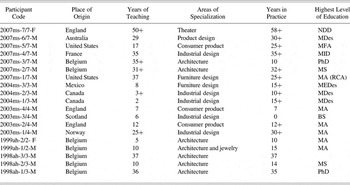
The educators are chosen for this study because they each teach some form of three-dimensional design practice, they reside and work in differing locales, and they are willing to participate in the study. They are between the ages of 33 and 79 years, and have 2 to 50 years of teaching experience. They are considered as novice, intermediate, or seasoned educators when having less than 5, between 6 and 19, and 20+ years of teaching, respectively. Two are defined as novice, with only 2 and 3 years of teaching experience; the majority are rated as intermediate or expert design practitioners because each has more than a 10 years of experience in their fields. Except for two, all participants are male. Table 1 provides an overview of the interviewees and their backgrounds.
An overview of the 19 design educators

At the time of our study, nine participants are teaching at the design school where they were educated, and nine live and teach outside their countries of origin. The participants teach within a range of design programs including architecture, consumer product, furniture, industrial, theater, and jewelry design. The educators define and articulate their areas of specialization as shown in Table 1.
3.2. Semistructured interview procedure
All design educators are interviewed independently in order to better understand how their individual perceptions manifest by using an interview guide. In addition, half of the participants are observed while teaching in situ; however, the analysis and conclusions presented in this paper are predominantly based on the interviews. The interviews involve a number of open-ended questions about their backgrounds, interests, and significant things they feel influence their teaching and designing. For example, the interview guide consists of prompts asking the participants to talk about the following:
• areas of expertise in design and teaching;
• significant industry experience;
• teaching experience at other institutions;
• things, people, places, or general influences on teaching style;
• sources of inspiration used during designing and by or with students;
• strengths and weaknesses of the current design program they teach in; and
• attributes necessary to be a designer today.
Both interviewers have backgrounds in designing, design education, and design research, which means that they approach each interview with significant knowledge on the subject and engage in in-depth discussions with the participants about their ideas around design. However, interview control is practiced by letting the participant lead the conversation; engaging in active listening; not adding any extraneous details, opinions, or additional information; and by using probing (e.g., silent, echo, uh-huh) as a technique to draw out information (Bernard, Reference Bernard1995, pp. 215–219). All interviews result in approximately 2 h of discussion. This varies because of the nature of enquiry and the detail of individual responses. The interviews are taperecorded and notes are made. Then, the verbal materials from the tapes are transcribed word for word. It is important to note that complete interviews are transcribed including the interviewers' questions and all participant responses. This allows for cross-referencing to see how these two correspond and enables to discern to what extent the interviewer has influenced the participant. Only data that come directly from the participants (i.e., statements, words, themes, and concepts) are considered of interest. As described in the following section, overall analyses of transcript contents are strictly data driven.
3.3. Data analysis
The data in this study are looked at as “cultural stories” (Denzin & Lincoln, Reference Denzin and Lincoln2003, p. 345) about the discipline of design. In any large or small group of people, there is always a set of beliefs, values, and ideologies that bind that group together; in this case, these are described as design-specific capital. This capital provides themes and nuances about the culture that the group was encultured into. These details about the culture have the potential to affirm or challenge stereotypical beliefs, values, and ideologies in a culture, which is why the themes in our data are identified as expected and more unusual. To facilitate this type of exploration a thematic approach toward analysis is taken where statements and words are clustered to identify central concepts (Ryan & Bernard, Reference Ryan, Bernard, Denzin and Lincoln2003). This approach is iterative, and involves multiple ways of reducing and displaying the data. It is the information presented by the participant rather than the researchers' judgment that predominantly makes up the data. In stating this, it is important to note that the interviewer guides the topics of discussion, and in this way leads and focuses the participants through particular topics, albeit loosely (as indicated by the interview guide used). In addition, the interview responses are not considered to represent facts around design process; instead, the responses are more like stories or narratives, which is why the results of this work focus on the perceptions of the participants. As a result, the data are not abstracted through analysis because our goal is with “seeing the world from the perspective of our subjects” (Glassner & Loughlin, Reference Glassner and Loughlin1987, p. 37).
The analysis procedure begins with one researcher reading and reviewing all the transcripts aggregately and continues with searching for explicit and implicit indication of the design process. The stages of analysis involve reviewing the interviews separately and looking for the following:
• vocabulary linked to the design process (e.g., imagination, human needs, phases, field research),
• basic forms of describing the design process (i.e., descriptive, domain-specific, word and phrase usage),
• experiences and attitudes linked to ways of knowing designing, and
• references and backgrounds linked to personal ideas or values regarding the design process.
The wording of the interview questions and the interviewers' reactions are cross-referenced with participant responses. The significance of this is to ensure that word and phrase usage and subsequent perceptions are coming directly from the participants, not the interviewers.
Following this, the data are further reduced by clustering phrases and words in bubble charts for each interview, followed by a single matrix for the larger group. Themes and individual nuances are sought by iteratively revisiting the individual interviews and consecutively looking across the whole group. Concepts are isolated based on one of the themes identified in the previous stage of analysis and each transcript is reviewed in detail again, for example, focusing on how the interviewees talk about problem solving (e.g., words, descriptions). Upon completion of this detailed analysis of the transcripts, another matrix is created that allows for further cross-linking where the details of participants' responses are further sorted and organized. This multileveled analysis approach requires continually returning to the data to ensure that the results are strictly data driven.
The procedures used for this study encourage the 19 participants to share their understanding of designing and design teaching with the researchers. Through these interviews the educators reveal beliefs, values, and ideologies about design process reflecting how they have been taught, practice, and teach design along with exposing some of their past experiences, design-specific and individual-personal capital.
4. RESULTS
When the educators discuss design processes, these are not presented in full complexity but as a representation of the basic elements and skills that are deemed most significant to them. In doing so, individuals naturally focus on parts of their complex design knowledge to suit the focus of the questions and discussion. This does not mean that the design process is necessarily simplified or reduced. It is speculated here that the contrary occurs where design educators actually identify and amplify the essence of designing.
Each participant in our study talks about the complexity of design processes in their own unique way. Where other research questions may reveal significant similarities, as far as the view on design process is concerned, the data are marked with many nuances linked to how the individual participants articulate information about designing. This section begins with a summary of concepts discussed by participants and lays out similarities (however few) and differences, expected responses (relative to design-specific capital) and more unusual responses relative to individuals. Following this, the design process in the words of the educators illustrates further the complexity of perceptions around design process.
4.1. Summary of concepts around design process
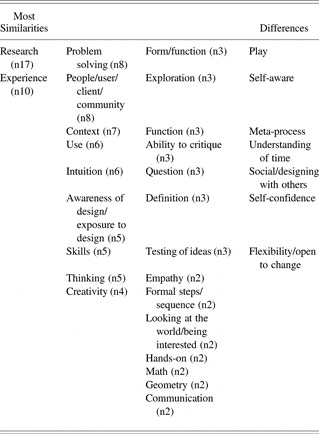
Across the interviews, 34 concepts relating to design process are identified: 2 of these are discussed by the majority, 10 are discussed by 30–50% of the participants, 14 are discussed by two to four individuals, and 8 are discussed by individual participants. Table 2 identifies the concepts along with number of participants.
An overview of the 34 concepts

The participants bring up these concepts while discussing design process, and the range shown begins to illustrate the variety of ways that the design process is interpreted and articulated. For example, participants' perceptions of process include designer (physical and conceptual skills, self-awareness), having resources (research, experience), involving other people (designing with, designing for), being knowledgeable about design, and understanding the context of projects (e.g., political, site). Deconstructing process into these 34 concepts enables us to subdivide these into aspects that are more expected “usual suspects” and those that are “more unusual nuances.”
4.2. The usual suspects
The design process, as defined by the design community and reviewed earlier in this paper, involves a variety of key aspects. Based on our discussions with 19 design educators three expected areas of process are identified: physical skills, conceptual skills, and sociocultural elements. Sketching, building computer-aided design models, and being able to manipulate materials are the specific physical skills mentioned by the educators as being important. Each of the interviewees indicates physical skills as being part of process; however, some mention these fleetingly, whereas others dwell on the necessity for working “hands on.” For the most part, physical skills are not discussed often in our study. Perhaps having a good command of physical skills is so obvious that it is deemed unnecessary to elaborate on to any great extent by the participants.
Conceptual skills involve “thinking” cognitive parts of designing such as problem solving, ability to critique things, and the tangible aspects relative to the stages of designing, for example, defining the project/problem, questioning, and testing ideas. The basic ways of knowing that each participant attaches and assumes to be part of design thinking are also identified as part of the conceptual skill set. For instance, several interviewees discuss mathematics, geometry, and function, implying that they take a more practical or technical stance toward designing. Other interviewees discuss form and function where a seemingly more balanced view of designing is taken. One expert educator from Belgium takes a balanced view of design a step further by stating that,
In essence, the concept has to do with—is actually all the ingredients of a good design, and the ingredients of a good design are firmitas, venustas, et utilitas and the environment.
These examples illustrate that basic thinking is not considered enough in design process; instead, there is a perception that there is a particular kind of “design thinking” that embraces many facets of the design process.
The sociocultural aspect of the design process is considered to be part of the inside ideas around designing (design culture), exposure to design including involvement in design activities, and design-specific capital gained through education. Using intuition and being creative are considered here to be part of the sociocultural aspects of process, based on Margaret Boden's (Reference Boden1995, Reference Boden and Mithen1998) theory that indicates sociocultural environments as a central source toward sparking creativity. As previously indicated, designers and design educators are encultured into particular ways of knowing within different contexts of design. Our study does not focus on one particular design school or geographical location, which means that the ways of knowing are expected to vary significantly among the interviewees. For example, some participants are educated and work within engineering-oriented design schools, whereas others are connected to more arts-based schools. These near sociocultural environments shape participants' understanding of the design process as systematic/analytic or more creative/intuitive. In addition to this, another sociocultural characteristic in designing relates to artifacts being produced for “people,” “users,” “customers,” “clients,” and “community,” and a recognition that artifacts fit within a contextual arena. Physical skills and conceptual skills are clearly the predominant aspects discussed around the design process by participants in this study, whereas sociocultural elements sneak into discussions in a variety of ways. In addition to these usual suspects, participants also discuss aspects that are more unusual.
4.3. More unusual nuances
The more unusual nuances are divided into three areas that overlap with the previous set and include: conceptual, personal, and interpersonal aspects. For example, one conceptual aspect is asserted by an intermediate educator from Belgium: the ability to “act in a very organic way” while designing. Operating in a “go with the flow” attitude or by being “flexible” embraces, on a basic level, the fact that designing is often quite complex. Allowing the process to be “organic” is a recognition that at least some of designing occurs on a less conscious level and that problem solving is not as cut and dry as one might imagine. An expert educator from Norway identifies a second conceptual aspect by asserting,
Design is about living. It's about sort of all the complexities and experiences over a period of time. It's not sort of a snap solution. It's not something that is something you can make decisions on. There's a time element. I think that's an important aspect.
The notion that it is “important” for design students and designers to consider “time” as an “element” implies a system of knowing relative to temporality, which as a consequence can involve past history and present situations. That is, time is thought of by this participant as an intangible aspect that is easily taken for granted while indicating that the act of quality designing takes time: to think, to consider, to reconsider, time to contemplate, to reflect, and so on. He also seems to imply that design solutions are not immediate replies to a design problem, but are a building process where gained insights develop over a longer period of time.
Personal aspects of designing are identified by other interviewees as being able to “look” at the world around oneself, “studying the everyday,” being “interested” in things, being “self-aware,” and being “self-confident.” Four different educators iterate these personal aspects by identifying them as important key attributes for design students to evolve into successful designers. Looking at the world and having an innate sense of curiosity about how things could be are ways of relating to artifact–person contexts that are connected to the ability to reflect and critique things: a form of future gazing. This way that individuals relate to the world, contributes to an enriched people-centric design process that results in artifacts that hold deeper meaning and value. The personal attributes of self-awareness and self-confidence are challenging to pin down in terms of how they directly relate to or may affect the design process. Although these are common sense, they are not necessarily evident for the success or failure of a design or designer.
Several other participants in this study place further emphasis on the interpersonal abilities. For instance, these are treating designing as “play,” a “social” activity involving others, and place value on the need to “communicate” well with others. These aspects also seem relatively apparent and involve common sense; conversely, emphasis on interpersonal skills identifies “a way of being” as a designer and when involved in process. It is interesting that all of the more unusual nuances presented here are stated by expert educators and based on what seem to be very personal reflections on designing and design teaching. Having scrutinized the finer details of the participants' perceptions, we now turn to more complete statements and definitions of the design process.
4.4. Process in the words of the educators
From the participants' spontaneous discussions, seven examples are extracted of how design educators define design process in their own words. These different perspectives begin to illustrate how various aspects of process are interpreted, combined, and intertwined. For example, an intermediate educator (Mexico) explains,
You have to build those building blocks. And when you start to design things, you need to arrange them in certain patterns and groups and this happens in a rational thought process.
This educator points out that, to him, designing requires the acquisition and development of specific elements/principles that are applied to projects. He seems to imply that once the “building blocks” are understood, these are useful for a variety of projects because they can be reconfigured in a variety of different ways. He also indicates that designing requires “rational thought,” which is about intention and not necessarily spontaneity or creativity.
An expert educator (Belgium) echoes a similar notion. He says, “So it was the procedure to order the process. It was set, in steps.” This way of describing the design process as having blocks, patterns, or steps is linked to the design methods and generic design process modes of thinking. Clearly, these educators have the idea that process is related to a systematic way of moving through projects, and that this aids design students toward successfully completing their work.
A second expert educator (Belgium) speaks about the interconnectedness of different projects rather than individual “steps” or “building blocks.” In the design educator's words, “… usually [design process is] a continuation of a process that actually transcends one single project, but … over a longer period.” This continuity or continuousness reveals that, according to this participant, design process is something that is connected to previous work accomplished in the past that acts as a sort of repository. Each of these three educators so far recognize that time and an accumulated knowledge of designing, whether it be in the form of “patterns,” “steps,” or “transcend[ing] single projects,” is significant to the design process.
Another point of view on the issue is articulated by an intermediate educator from the United States, who talks about the necessity for the designer or student to have experience and about the necessary skills for designing:
The design process is centered around the experience—keeping the skills and sketching and researching—and uh, making models and this and that—so it's uh, individual creativity that needs to be part of this process.
Along with physical skills involving manual dexterity such as sketching and model making, this educator recognizes that researching is an important element in designing. It is interesting that this participant clearly states he is elaborating on only “part of this process,” which includes experience and creativity.
Another participant also discusses skills needed for designing while making it clear that he is also discussing just “part of that process.” This novice educator from Canada says, “So I look at sketching as the medium that is part of that process to become a good thinker. It is thinking three-dimensional.” According to this participant, one central ingredient for designers/design students in the design process is to be a good “thinker,” and “sketching” is useful for exploring thoughts and ideas. It is particularly interesting that in this instance the educator indicates sketching as an essential skill but links this to the cognitive aspect of designing. Similar to the previous educator, they both pinpoint several central aspects to designing while recognizing that there is more to designing than is easily discussed.
Two of the expert educators with decades of teaching experience, interestingly, do not present any clear ingredients or aspects attributed to design process and merely articulate the “essence of designing.” For instance, one educator from France who is quoting a book he read recently says,
It puts it in a language that's accessible and directly relatable and it has a beautiful process at the end and I said here's your design process. Uh. Fantastic. Six words and just absolutely beautiful—visualization, sympathy, empathy, symphony.
In this way, he suggests that process is a particular way of working understood to include “visualization.” He also implies that designers place other people at the forefront through “sympathy” and “empathy” with them. Finally, he indicates that designing is a “symphony” that likens design process to an artistic endeavor (playing music). In contrast, the second expert educator (Norway) does little to explain the nature or complexity of designing. He aptly states, “… it's difficult for us as design staff to keep all balls in the air at one time.” With this description he acknowledges that design is challenging to teach and that a teacher must juggle a lot at one time. The metaphor of a designer as a “juggler” is discussed by two of Bryan Lawson's study participants who indicate that a juggler has six balls and if the architect takes an eye off one of them and drops it, they are in trouble (Lawson, Reference Lawson1994, p. 114). It is difficult to say whether our participant is aware of Lawson's study or whether he has come up with the metaphor on his own.
4.5. Summary
The data of this research are explored here by identifying 34 different concepts relating to the design process, three expected areas of the process (physical skills, conceptual skills, sociocultural elements), and three more unusual nuances (conceptual, personal, interpersonal) and by presenting seven definitions of the design process in the words of design educators. What these design educators have in common is that they each articulate the complexity of the design process in various ways while emphasizing what they think is most important. These results, in the words of the educators, reveal further that the different concepts (usual and other) do not appear separately or independently, but interfere with one another. The following discussion further synthesizes and reflects on these results.
5. DISCUSSION
In general, all of the participants pinpoint key aspects that have been and continue to be explored by the design research community. What is clear, and not too surprising, is that the perceptions of these design educators are not straightforward and do not seem to follow any set way of talking about design. This section outlines three categories derived from deeper analysis and nuancing the “chopped up” overview of concepts in our results. The three categories are derived from further readings of each participant's interview independently with a focus on determining how they focus and approach the design process independently of one another. The categories are product focused, process focused, and designer centric.
The product-focused perception is speculated as having a link to individuals' prior experiences collected through working on projects and living in the world. One feature of the product-focused perception of the design process is that “intuition” and “creativity” play significant roles. That is, the design process is indicated as being rather haphazard and organic where it is said to “unfold.” The most senior design educator (England) believes firmly that design is best learned through being allowed to “play.” She describes in detail how she supports play through teaching, and how she plays with materials in her own projects.
In contrast, the process-focused perception is considered as valuing a step-by-step procedure described as being systematic, “logical,” and “analytical.” It is not clear how exactly this formalized way of designing is taught in all cases; however, several of the participants seem to prescribe a way of designing where students follow a sequence that relates closely to the generic design process. One of the intermediate educators from Canada speaks about and is observed constructing his design briefs by guiding the students through a specific series of steps. For example, ideation sketches are created following research and ideas are tested after this, all within prescribed time sequences.
Finally, the designer-centric perception is centred around the idea that the majority of designing occurs within the minds of designers, and that as individual designers have a great deal of personal and individual control. This perception of designing is described as involving the ability to “think” about design “problems,” and that the designer has the aptitude to “problem solve.” For this category a specific knowledge base is connected to these cognitive abilities, including understanding “math” and “geometry.”
On the surface, these three categories seem to suggest that the educators adhere to one category; however, in this study we observe the contrary and note that approaches interfere with one another further illustrating that perceptions of the design process definitely cannot be pigeonholed. There are crossovers and connections made between the categories and the educators are best described as discussing design process in a pick-and-mix way. Individual educators describe designing as a conglomeration or bricolage (Louridas, Reference Louridas1999) to be handled in whatever manner suits the discussion, which may be further translated into teaching projects to groups of students in the same way.
When combining this second layer of scrutiny with our earlier results, we are reminded of the multifaceted ways that design process can be interpreted, articulated, and understood. Yet, for the most part, our participants affirm rather than challenge what seem to be the basic beliefs, values, and ideologies of designing. Clearly, these educators are deeply encultured into a discipline that perpetuates a fairly cohesive set of design-specific capital, and at the same time, the participants place emphasis on different things related to their specific domains and their experiences with design situations. The real value of our interviews with design educators is that they provide insights related to more specific and concrete instances of designing than the generic features that usually result from studies on design process. Where these generic features take a step back (outside view) from the everyday reality of design, the perceptions presented here move closer (inside view) to the designer, to design situations and tasks, and to design education.
6. CONCLUSION
Although artifact development is the result of human decisions, the subject of designing itself is not fixed; it is continually undergoing interpretation, exploration, and evolution in how it is perceived, which is illustrated in the statements and words of 19 design educators interviewed. Although not prompted to do so, the participants in this study often focus their attention on design processes; however, they discuss a broad range of concepts and different things from one another. The majority of their discussions are centered on transformation and designing as a situated activity, which demonstrates a particular way of seeing the world, engaging with artifacts in their surroundings, engaging in designing (doing), conceptualization (thinking), and sociocultural aspects. In this way, the participants demonstrate an intimate knowledge of their discipline linked to how they have been encultured or professionalized. For instance, the educators discuss their perceptions of designing as a problem-solving activity, including describing process as a response to or proposition toward a defined problem that is followed by a myriad of possible actions.
Further, these design educators describe designing as an examination of the social nature and purpose of artifact–person relationships. From more individual points of view, our interviews reveal that these educators continue to enjoy the thrill of new design activities and work well under conditions that relate to the unknown. Richard Buchanan (Reference Buchanan, Buchanan and Margolin1995) describes designing as partly “rational and cognitive,” and partly “irrational, emotive, intuitive, and noncognitive.” Bryan Lawson (Reference Lawson1998) also describes design process as having an aspect that involves “intuitive and imaginative thinking.” It is clear that one key perception of designing is that designers and design educators value the elusive nature of designing where “aha moments” (Cross, Reference Cross2000) and “gaps” (Strickfaden & Rodgers, Reference Strickfaden and Rodgers2004) are a big part of design creativity and working through design projects. Furthermore, the way that the design process is articulated by researchers has the potential to percolate into how educators teach designing.
Designing requires a vast understanding of elements, principles, and approaches. In the words of an expert educator from France, designing is,
An open mindedness of exploring all different types of approaches to simple daily functions. Embracing an open mind. Looking at cultures, and not being locked into one individual culture, is critical. And then certainly a visual, I'd say, right brain-type of thinking and creative, intuitive, impassioned and emotional, often non-verbal side of introspection along with an ability to interpret that type of non-verbal information and relate it to a logical, analytical, systematic approach and being able to navigate from one world of thinking to another and back again.
Combined with this excerpt, our analysis and results (with the various concepts discussed) tell the story of a multitude of ways to approach, interpret, articulate, and understand the design act. That is, design process as perceived by our participants does not take a single cohesive approach, although there are concepts, themes, and categories that provide insights into how the culture of design and design-specific capital are interpreted and articulated.
ACKNOWLEDGMENTS
The authors thank the research participants for their time, support, patience, and honesty. The first author thanks the Design Studies faculty and staff in the School of Communications at Grant MacEwan College, Edmonton, who provided funding for this project through the 2007 Grant MacEwan Faculty Research and Scholarly Activity Fund. This research received funding from the European Research Council under the European Community's Seventh Framework Program (FP7/2007-2013) and European Research Council Grant 201673.
Megan Strickfaden is an Assistant Professor in the Department of Human Ecology at the University of Alberta, where she studied anthropology, people-centered design, and sustainability. Followed her studies at the University of Alberta, she worked for 12 years as a design engineer with various design firms. Megan obtained her PhD in humanities and social sciences from Napier University with a study investigating potential sociocultural influences on the design process and the cultural milieu of design teaching environments. As a postdoctoral researcher she was engaged with the projects Sociocultural Capital of Design Educators at Grant MacEwan College (Canada) and Architectural Design in Dialogue with dis-Ability (AIDA) at Katholieke Universiteit Leuven (KU Leuven). Dr. Strickfaden's current research investigates sociocultural complexities within educational and professional design environments.
Ann Heylighen is an Associate Professor in the Design and Building Methodology Group of KU Leuven. She studied architecture in Leuven and Zürich (ETH) and obtained her MS and PhD in engineering: architecture from KU Leuven. As a postdoctoral researcher, she conducted research at KU Leuven, Harvard, and Berkeley, studying design knowledge embedded in design projects and processes. In 2008 the European Research Council awarded her a Starting Independent Researcher Grant for Project AIDA. This allowed Dr. Heylighen to establish an interdisciplinary team that explores the spatial experience of people with various capacities as sources of design knowledge.