Introduction
Various outbreaks of yellow fever have repeatedly occurred in Nigeria and most have been reported to occur in or close to areas where Ae. aegypti occurs (Nasidi et al., Reference Nasidi, Monath, DeCock, Tomori, Cordellier, Olaleye, Harry, Adeniyi, Sorungbe, Ajose-Coker, van Der Laan and Oyediran1989).
Some factors such as human intervention, ecological variation, vector dispersal patterns and the constant use of insecticides may affect the genetic population structure. The patterns and magnitude of genetic differentiation and gene flow amongst vector populations are crucial since traits associated with insecticide resistance and vector competence are genetically determined (Severson et al., Reference Severson, Anthony, Andreev and ffrench-Constant1997; Bosio et al., Reference Bosio, Harrington, Jones and Scott2005). One of the challenges to mosquito control programmes is the accurate identification of the vectors (Sendeydiego et al., Reference Sendaydiego, Gorospe, Torres, Amparado and Demayo2014). Variations in morphology have been reported to influence disease transmission, resistance, breeding and control measures in Ae. aegypti (Craig et al., Reference Craig, Vandehey and Hickey1961; Tabachnick et al., Reference Tabachnick, Munstermann and Powell1979; Brown et al., Reference Brown, McBride, Johnson, Ritchie, Paupy, Bossin, Lutomiah, Fernandez-Salas, Ponlawat, Cornel, Black, Gorrochotegui-Escalante, Urdaneta-Marquez, Sylla, Slotman, Murray, Walker and Powell2011).
Wings are important in the study of morphological variations. The interceptions and metric proportions of wings provide well-defined landmarks that can assist in the identification of insects (Mondal et al., Reference Mondal, Devi and Jauhari2015). The wing shape of insects is heritable (Demirci et al., Reference Demirci, Lee, Lanzaro and Alten2012). The heritability of the relevant phenotypic traits of wings allows their use for micro-evolutionary studies (Vidal et al., Reference Vidal, Carvalho and Suesdek2012). The shape and vein patterns of insect wings are species specific. This specificity enables wings to be used in insect taxonomy and systematics (Dhivya and Manimegalai, Reference Dhivya and Manimegalai2013).
Genetic and environmental influences have been reported to affect the morphology of insect wings (Gafur and Ajizah, Reference Gafur and Ajizah2008) and variation in morphology can be useful in providing information on the biology of insects (Dujardin et al., Reference Dujardin, Le Pont and Baylac2003). Thus, for useful decisions in control, comprehensive knowledge of the morphological characteristics of the vector is important (Sendeydiego et al., Reference Sendaydiego, Gorospe, Torres, Amparado and Demayo2014). The intersections found on the wing veins provide some well-defined landmarks that can be used for morphometrics (Sendaydiego et al., Reference Sendaydiego, Torres and Demayo2013). Variation in wing morphometric traits can provide useful information for the identification of species complexes as well as within-species variation in different geographical areas (Dujardin et al., Reference Dujardin, Le Pont and Baylac2003).
Gafur and Ajizah (Reference Gafur and Ajizah2008) report that the ratios of interpoint distances on wing venation amongst populations of Ae. aegypti from South Kalimanthan, Indonesia, is an indication of genetic divergence. Sendaydiego et al. (Reference Sendaydiego, Torres and Demayo2013), in their study of the wing geometry of female Ae. aegypti using 18 anatomical landmarks, showed some intra-specific variation in the wing outline and observed that morphological disparity in wing shape suggests a possible morphological divergence amongst populations.
Vidal et al. (Reference Vidal, Carvalho and Suesdek2012) investigated metric differentiation of the wings of Ae. albopictus over a period of time. Results showed wing alterations as an indicator of a micro-evolutionary process in the species. In studies using geometric patterns of wing venation (Henry et al., Reference Henry, Thongsripong, Fonseca-Gonzalez, Jaramillo-Ocampo and Dujardin2010), intra-specific variation was observed in Colombia for Ae. aegypti and in Thailand for Ae. albopictus.
Wing morphometrics is a simple technique that can be a first step towards answering questions that would normally be resolved using expensive molecular tools that require skilled personnel (Francoy et al., Reference Francoy, Grassi, Imperatriz-Fonseca, de Jesús May-Itzá and Quezada-Euán2011).
The aim of this work was to determine if there are variations amongst some populations of Ae. aegypti in rural and urban settings in Lagos State, Nigeria, using simple wing morphometrics. Identification of variation in vector species will assist in the control of these disease vectors.
Materials and methods
Study sites
The study was carried out in three areas, two rural and one urban, in Lagos State. The rural areas were Odogunyan in Ikorodu Local Government Area (LGA), 6.6 °N, 3.49 °E and Ajara in Badagry LGA 6.42 °N, 2.88 °E. Each area represented a zone and each zone had four collection sites. Human activities included agriculture. The urban area was Ebute Metta in Lagos Mainland LGA (6.48 °N, 3.38 °E) and was divided into two zones (Ebute Metta 1 and 2). Each zone had four collection sites. Ebute Metta 2 is swampy than Ebute Metta 1. The distribution of long-lasting insecticide nets started in the urban area in 2010 (Lagos State Ministry of Health, 2012).
Mosquito collection and identification
Black and other coloured plastic ovitraps with a capacity of 250 ml containing 100 ml of tap water were placed at each collection site. Larvae and pupae were collected from these ovitraps using standard methods (O'Malley, Reference O'Malley1995) and also from other containers found in these sites (water reservoirs and tyres that serve as breeding spots) using a dipper, a wide-mouthed pipette, and a plastic bottle. Larvae and pupae were transported to the insectary and reared to adult stage.
The adult mosquitoes were morphologically identified into different groups. This was carried out under the dissecting microscope using morphological characters according to morphological keys (Gillies and Coetzee, Reference Gillies and Coetzee1987). Aedes spp. were further identified using pictorial keys (Rueda, Reference Rueda2004).
Wing measurement of Aedes aegypti
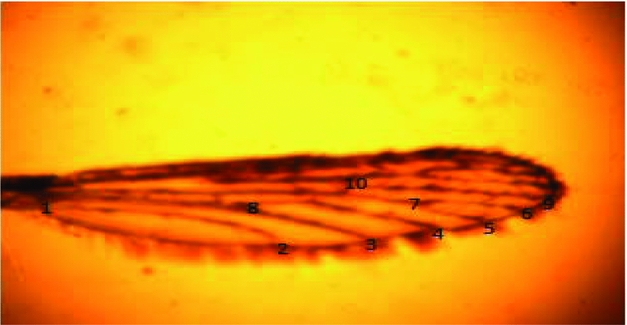
Ten female Ae. aegypti were randomly selected from each collection site from each zone. The number of mosquitoes per area (urban or rural) was 80, and the study used a total of 160 mosquitoes from both urban and rural areas. Each mosquito was placed with head facing north. Mosquito wings on the right were detached from the thorax and placed on a clean slide secured with a mounting solution (DPX mountant) and a cover slip. The wing images were captured using a Nikon digital camera (13.5 mega pixels) under a phase contrast stereomicroscope at X40 magnification. The wing morphometric study was based on 10 landmarks from the anal, cubital, medial and radial wing veins following the Comstock–Needham system of venation (Wikipedia, 2015). The landmarks were digitized using TPSdig software (Rohlf, Reference Rohlf1990). A fixed scale factor (0.239 pixel), fixed radius for landmark points, and fixed measurement unit (mm) were chosen for all wing vein measurements.
Relative distances of vein lengths and vein interpoints
Vein lengths: The lengths were measured of anal, cubital and medial veins from landmark 1 (1–2, 1–3, 1–4, 1–5, 1–6, 1–7) which is the base of the wings. The radial vein (9–10) was also measured. The length of the radial vein (1–9) from the landmark 1 was selected as a standard (Fig. 1). Relative distances of other vein lengths were calculated from the standard and constituted the data for statistical analysis.
Right wing of Aedes aegypti with the 10 landmarks.
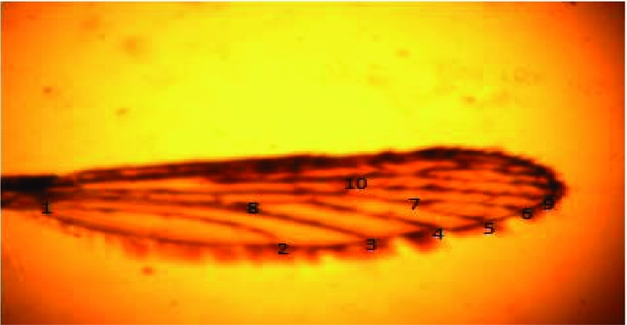
Vein interpoint: Distances of the veins from the intersection of two veins to the vein margin constituted the vein interpoint measurements: distance between the intersection of cubital 1 and 2 and the margin of cubital 2 (3–8) or of cubital 1 (4–8); the intersection of median 1 and 2 and margin of median 2 (5–7) or median 1 (6–7). The intersections between two veins and the margin of another vein also constituted interpoints: distances between the intersection of cubital 1 and 2 veins and anal 1 margin (2–8) and the intersection of median 1 and 2 and cubital 1 margin (4–7). The length of the radial vein (1–9) was also used as a standard and relative distances were also calculated (Fig. 1).
Relationship amongst the populations
Analysis of variance (ANOVA) was performed using SPSS to compare the relative distances of the wing veins and interpoint lengths amongst the populations, and examine wing vein/interpoint lengths with significant differences amongst the populations. Two versions of F-ratio (Brown–Forsythe (f) and Welch (f)) were used to accommodate variance and abnormal distribution. Euclidean distances of wing vein/interpoint lengths with the most significant differences amongst the populations were calculated (using SPSS). To illustrate morphological divergence amongst the populations, a dendrogram was built based on the Euclidean distances (Mooi and Sarstedt, Reference Mooi and Sarstedt2011).
Results
Relative distances of vein lengths
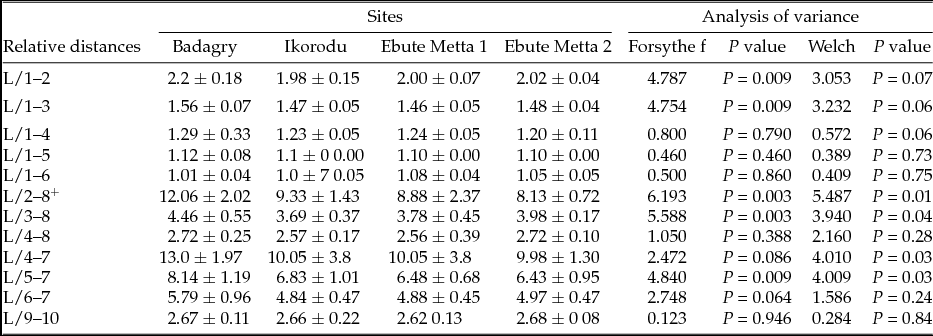
Relative distances of veins 1–2 (anal veins) and 1–3 (cubital) were significant (P<0.01) with Brown–Forsythe (f) ANOVA but insignificant (P>0.05) with Welch (f) ANOVA. The highest values (2.2 ± 0.18) of the anal vein (1–2) and cubital vein (1–3) (1.56 ± 0.07) were recorded in Badagry, a rural area (Table 1).
Analyses of variance of the mean relative distances of the landmarks from the various sites in Lagos State, Nigeria

+ P < 0.01 L: standard length 1−10: lengths of the landmarks.
Relative distances of veins interpoints
The relative distances of three (50%) of the interpoints studied, which were the distances between the intersection of cubital 1 and 2 veins and anal 1 margin (2–8) – cubital and anal veins, intersection of cubital 1 and 2 veins and cubital 2 margin (3–8) – cubital and cubital veins, and intersection of median 1 and 2 and margin of median 2 (5–7) – median and median, were statistically significant (P<0.05) to both Brown–Forsythe (f) and Welch (f) ANOVA. The highest values, 12.06 ± 2.02, 4.46 ± 0.55 and 8.14 ± 1.19 of the interpoints (2–8, 3–8, 5–7), respectively were also recorded in Badagry. Interpoint 2–8 was distinct amongst the landmarks because a high statistical significant difference (df = 3, P=0.003) was recorded when values were compared amongst the sites (Table 1).
Relationship amongst the sites (populations) using the cubital and anal vein interpoints (point 2–8) relative distance
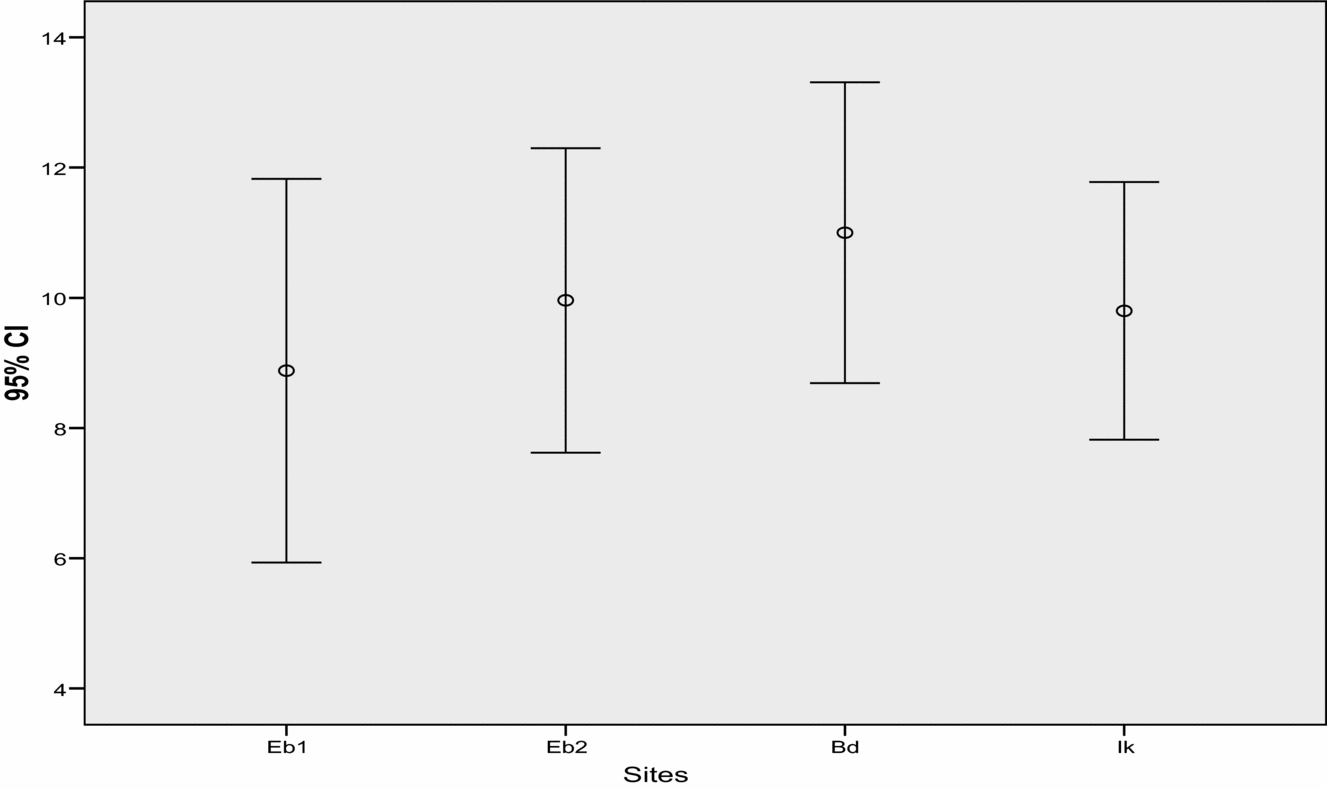
In the comparison of the mean values of the relative distance of cubital and anal vein interpoints from all the sites at 95% confidence interval, a plateau in the histograms constructed was observed between Ikorodu and Ebute Metta 2 with means of 9.54 ± 1.81 and 9.98 ± 2.14 (Fig. 2).
Comparison of relative distances of 2−8 landmarks (cubital and anal veins interpoint) amongst the sites based on mean at 95% confidence interval. Eb1– Ebute Metta 1, Eb2 – Ebute Metta 2, Bd – Badagry, Ik – Ikorodu.

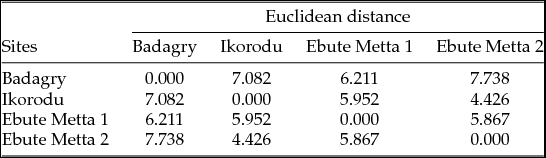
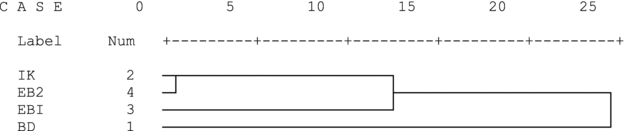
A Euclidean distance was calculated using the relative distances of the cubital and anal vein interpoints (2–8) from all the sites. The highest mean Euclidean distance of 7.738 was observed between Ebute Metta 2 and Badagry, and the lowest of 4.426 was observed between Ikorodu and Ebute Metta 2. The distance between Ebute Metta 1 and Ebute Metta 2 was 5.867, which is higher than the distance between Ebute Metta 2 and Ikorodu (Table 2). A dendrogram (Fig. 3) was constructed to show the relationship amongst the populations. Three groups were identified. Ikorodu and Ebute Metta 2 were in group 1, Ebute Metta 1 was in group 2 and Badagry was the third group.
Mean Euclidean distances of the landmarks from the study sites using relative distance of 2−8 (cubital and anal veins interpoint) landmarks

Dendrogram of the landmarks 2−8 (Cubital and anal veins) amongst the different populations using Average Linkage (Between Groups). BD – Badagry, Ik – Ikorodu, EB1 – Ebute Metta 1, EB2 – Ebute Metta 2.

Discussion
The distance between the anal vein and the midpoint of a medio-cubital vein of the wing was found useful in differentiating amongst Ae. aegypti in the study sites. Differences in interpoints on wings were also observed amongst some populations of Ae. aegypti in Kalimanthan, Indonesia (Gafur and Ajizah, Reference Gafur and Ajizah2008). The workers suggested differences in wing venation and ratio of intercept distances amongst populations of Ae. aegypti can indicate genetic divergence. Chhilar (Reference Chhilar2014) also observed differences in lengths of veins amongst various populations of Anopheles subpictus Grassi in Oriental regions. He suggested variations observed in the morphology might be due to migration and subsequent adaptation to different conditions.
Different Euclidean distances were observed amongst the three populations studied. Jaramillo et al. (Reference Jaramillo, Fonseca-González and Chaverra-Rodríguez2014) suggested wing differentiation could be due to colonization history of Ae. aegypti. The Euclidean distance analysis observed in the two sub-populations in Ebute Metta–Ebute Metta 1 and 2, could imply the evolvement of new strains in Ebute Metta. A study by Vidal et al. (Reference Vidal, Carvalho and Suesdek2012), which investigated metric differentiation in the wings of Ae. albopictus, reported wing alterations as an indicator of a micro-evolutionary process. Sokal and Rohlf (Reference Sokal and Rohlf1995) also reported that changes in the ratio of certain parts of the body probably occurred during the course of evolution.
The least Euclidean distance was observed between one of the sub-populations in Ebute Metta and Ikorodu. The geographical distance between Ebute Metta and Ikorodu is the shortest compared with Ikorodu−Badagry and Ebute Metta−Badagry. Henry et al. (Reference Henry, Thongsripong, Fonseca-Gonzalez, Jaramillo-Ocampo and Dujardin2010) stated that some factors that can affect microevolution and population substitution include migration and drift, and further reported the relationship between wing shape and geographic differentiation amongst various populations of Ae. aegypti in Colombia. Thus, the least Euclidean distance observed amongst Ikorodu and Ebute Metta populations could be as a result of migration. Sendaydiego et al. (Reference Sendaydiego, Torres and Demayo2013) also reported low dispersal behaviour of Ae. aegypti between 100 to 500 m from origin. The dispersal behaviour could have resulted in some strains observed in Ikorodu and Ebute Metta.
Morphological differences were observed between two sub-populations of Ae. aegypti in Ebute Metta. Tabachnick et al. (Reference Tabachnick, Munstermann and Powell1979) and Paupy et al. (Reference Paupy, Chantha, Huber, Lecoz, Reynes, Rodhain and Failloux2004) reported genetic differences amongst populations of Ae. aegypti in close geographical proximity.
Conclusion
Wing length morphology is an inexpensive method that can be used to identify the movement of mosquitoes, and the source and movement of diseases such as arbovirus infections (Dujardin, Reference Dujardin and Tibayrenc2011). More work should be done using molecular methods to confirm the use of wing morphometry.