INTRODUCTION
Clinicians and researchers widely acknowledge the importance of addressing not only physical but also emotional and spiritual suffering at the end of life (Daaleman & Nease, Reference Daaleman and Nease1994; Field & Cassel, Reference Field and Cassel1997; Daaleman et al., Reference Daaleman, Kuckelman Cobb and Frey2001; Puchalski, Reference Puchalski2002, Reference Puchalski2004; Puchalski et al., Reference Puchalski, Dorff and Hendi2004). Yet, identifying appropriate, effective, and brief interventions to address emotional and spiritual concerns has proven elusive. Recommendations from the 2005 National Consensus Project on Quality Palliative Care called for increased efforts to understand patients' existential needs and to conduct and evaluate interventions to address these concerns (End-of-life care. National Institutes of Health Statement on the State of the science, 2005).
It is easy to see the difficulties, both content-related and logistical, of developing standardized approaches to emotional and spiritual care. Suffering is a highly individual experience. Emotional, social, and existential concerns evoked by advanced illness and the approach of death are broad in scope, and vary both within individuals and across populations of patients (Byock, Reference Byock1996, Reference Byock1997, Reference Byock1999; Field & Cassel, Reference Field and Cassel1997; Steinhauser et al., Reference Steinhauser, Clipp and McNeilly2000b, Reference Steinhauser, Voils and Clipp2006; Puchalski, Reference Puchalski2004; Puchalski et al., Reference Puchalski, Dorff and Hendi2004). Illness of attendant stresses, losses, and regrets are unique to the each person and family.
Furthermore, seriously ill patients require interventions that are brief and can be completed by those with compromised energy levels. Although interacting in group settings may be efficient and provide camaraderie, the content of personal experience with advanced illness and impending death is often intimate and particular to the person's own spiritual and religious beliefs. Any standardized clinical approach to spiritual and existential distress and well-being must at once be broadly inclusive and yet enable sufficient specificity to be meaningful and valuable to the individual. For palliative care patient populations, interventions also must be transportable to individuals in the settings in which they may be receiving care, be it home, hospital, long-term care, or residential hospice facilities. Finally, as mortality and death form a common denominator in human experience, interventions must be applicable across a range of gender, ethnic, educational, and socioeconomic backgrounds.
Despite these challenges, the need for innovative standardized approaches to psychosocial and spiritual care remains high. Emotional and spiritual suffering pervades the experience of patients with advanced illness and their families. Clinically and programmatically we must develop comprehensive interventions. The purpose of this project was to test a brief, transportable, and manualized intervention, which we call Outlook, to address emotional and spiritual concerns of patients with advanced, life-limiting illness. The intervention guides participants through discussions of elements of end-of-life preparation and completion, which are associated with emotional and spiritual well-being (Steinhauser et al., Reference Steinhauser, Bosworth and Clipp2002, Reference Steinhauser, Clipp and Bosworth2004, Reference Steinhauser, Voils and Clipp2006).
Life completion and life closure are hailed as central features of hospice and palliative care philosophy, endorsed by major health care institutions, including the Department of Veterans Affairs' efforts to improve end-of-life care (Department of Veterans Affairs, 2003; Hales et al., Reference Hales, Zimmermann and Rodin2008) Despite consensus on their importance, we have few standardized and empirically evaluated interventions of life completion or life closure. In quantitative results of the pilot study, not shown herein, intervention participants showed improvements in anxiety, depression, preparation, and functional status compared to attention control subjects (Steinhauser et al., Reference Steinhauser, Alexander and Byock2008). In this article, we present the development of the intervention content and structure, qualitative results of the project's three intervention sessions, and practical presentation of questions that elicit these domains in a standardized, replicable format. We then discuss the findings' implications for conceptualizing and navigating suffering and well-being at the end of life.
METHODS
Study Design
We conducted a three-armed randomized control trial of an intervention to foster discussions of end-of-life preparation and completion (Steinhauser et al., Reference Steinhauser, Alexander and Byock2008). Conversations from participants in the intervention arm were audiorecorded and transcribed. Qualitative results and illustrative quotes and are presented below.
Procedure
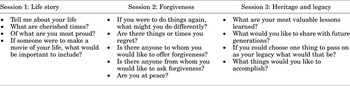
After giving informed consent, participants completed a brief battery of pretest measures to assess pain and symptoms, anxiety and depression, functional status, and quality of life at the end of life (Steinhauser et al., Reference Steinhauser, Alexander and Byock2008). Subjects were then randomly assigned to one of three groups: treatment, relaxation meditation, and control. Subjects assigned to treatment were interviewed three times, spaced a week apart, for a period of 45 minutes each and asked to discuss issues related to life completion and preparation. Session 1 focused on life review, cherished times, and accomplishments. One week later, Session 2 focused on issues of things they would have done differently, regrets, forgiveness asked and given, and whether they were at peace. In the final week, Session 3 focused on lessons learned, heritage, and legacy (see Table 1).
Intervention questions

Subjects
Patients were recruited from two local hospices, the Palliative Care Service, Home Based Care Program, and Extended Care Retirement Center, at the Durham VA Medical Center and inpatient units at Duke University Medical Center. Patients were eligible if their physicians estimated them to have a prognosis of less than 6 months to live. Patients unable to speak or those severely cognitively impaired were excluded from the study. In addition, because sessions occurred in patient's homes, we limited inclusion to subjects living within a 35-mile radius of Durham, North Carolina.
Intervention Development
Outlook Conceptual Model and Content
Outlook content development was based on previous empirical research identifying important domains and attributes of end-of-life experience, the human development and social gerontology literature noting life review as a developmental task, Casell and Byock's work exploring the nature of suffering and opportunity at the end of life, and self-disclosure and health communications research. Synthesizing these literatures, a team of clinician and nonclinician researchers developed and refined Outlook's content and structure. Together, we crafted the interview questions and handouts distributed after each session (see Table 1 and the Appendix). These questions served as the basis for a manualized intervention interview guide, designed to be standard across interviews and transportable to other clinical settings if found efficacious.
In his work exploring the nature of suffering and opportunity at the end of life, Byock builds on the human development and social gerontology literatures, which postulate that growth occurs across the entire life course, from birth to death (Erikson, Reference Erikson1982). Each phase of life includes psychosocial developmental tasks, with late adulthood hosting opportunities for life review and generativity. When life-limiting illness intercedes, these tasks, primarily associated with late adulthood, may come to the fore. According to this model, physical decline is accompanied by the possibility of growth, emotionally, psychologically, and spiritually (Byock, Reference Byock1996, Reference Byock1997, Reference Byock1999). Developmental tasks include achieving a sense of completion in relationships, expressions of regret and forgiveness, acceptance gratitude and appreciation, sense of meaning, telling one's story, life review, and transmission of knowledge or wisdom.
These hypothesized tasks were borne out empirically in subsequent research aimed at identifying attributes and domains integral to the quality of life at the end of life (Steinhauser et al., Reference Steinhauser, Clipp and McNeilly2000b, Reference Steinhauser, Voils and Clipp2006). Patients with advanced illness and their families identified issues of preparation and life completion as two of six domains important to quality of life and related to emotional and spiritual concerns. Preparation included issues such as concern about family in the future, being a burden to loved ones, and issues of regret. Life completion included addressing issues of spirituality and meaningfulness through life review, resolving conflicts, time with family and friends, and saying good-bye.
Building on this theoretical and empirical foundation, we developed a three-session intervention designed to explore these attributes and developmental tasks, with the goal of attending to emotional and spiritual suffering and fostering growth. Session 1, Life Story, included elements of life review, time with family, accomplishments, telling one's story, and the attendant values and ideals embedded in that story. Session 2, Forgiveness, included questions about what they might have done differently, regrets, opportunities of forgiveness, and exploring a sense of peace. Finally, Session 3, Heritage and Legacy, gave participants a chance to transmit knowledge and wisdom from a life lived and consider future goals (see Table 1). The interventionist asked prespecified questions in turn in a plain-spoken, accessible format. Participants were encouraged to respond to questions in whatever manner was comfortable, be it bulleted response or rich narrative. If the content of forthcoming questions was covered in discussion, the interventionist would reiterate the question, acknowledging the previous response, and probe for any additional detail. In this manner, the responses were self-guided within a set structure. The interventionist was specifically trained never to give implicit or explicit messages or an agenda of particular emotional of content disclosure. At the end of each session, participants were given a handout, printed on cardstock, which explored that session content more fully (see the Appendix). In this way, participants could continue to reflect between sessions. We believed that the interventionist was “seeding” ideas and that further reflection would occur for subjects individually.
Outlook intervention structure was based on a review of the life review intervention literature. Fratorolli's (Reference Fratorolli2006) meta-analysis of 146 life review interventions found the greatest effect sizes in interventions that included three sessions or more, were conducted with populations with current physical or mental illnesses, were conducted in person and semistructured, and were administered orally rather than with written materials alone.
Attention Control
Participants in the attention control arm met with the interventionist three times and listened to a nonguided relaxation meditation CD. The relaxation content was recorded and developed by Belleruth Naperstak, an expert in the field of nonguided and guided meditation. The CD also included a soundtrack, developed by composer and sound engineer Bruce Gigax.
Analyses
All intervention discussions were audiorecorded, transcribed, and coded for qualitative content using (Atlas ti) software. In an inductive fashion, we followed a qualitative analytic approach using grounded theory methodology, a series of recursive analyses of the interview transcripts from (Glaser & Strauss, Reference Glaser and Strauss1968; Stern, Reference Stern and Leining1985; Corbin & Strauss, Reference Corbin and Strauss1993). The first level of analysis involved open coding of the transcripts, in which three coders read transcripts and identified common and recurring themes emergent (Stern, Reference Stern and Leining1985). We reviewed and summarized the transcripts by breaking them into thought units.
In the second level of analysis, axial coding, we developed further conceptual domains by describing comparisons between themes within and between transcripts (Glaser & Strauss, Reference Glaser and Strauss1968; Stern, Reference Stern and Leining1985; Corbin & Strauss, Reference Corbin and Strauss1993) We reviewed the preliminary findings of theme exemplars as a check on coding validity throughout the coding process. Once agreement was reached on all coding definitions, we coded each transcript separately. Then, we met and regrouped the conceptual categories based on the recoded transcripts. Finally, we focused on identifying and conceptualizing recurring data patterns and themes constant comparison methods (Glaser & Strauss, Reference Glaser and Strauss1968; Stern, Reference Stern and Leining1985; Corbin & Strauss, Reference Corbin and Strauss1993) Unlike fully open-ended interviews, this semistructured interview format gave a preexisting architecture to the thematic responses. Still, we present common thematic patterns within question type, particularly exploring breadth and depth of themes and gauging accessibility for a range of respondents. The purpose of the presentation of pilot findings is to review typical responses elicited and the range of experiences that may be heard by those hoping to apply Outlook. In a larger test of the intervention, extensive qualitative analyses, including in-depth exploration of gender, ethnic, age, and disease pattern differences, will be possible.
RESULTS
Over a period of 18 months we contacted 209 eligible patients. One hundred twenty-seven refused to participate (74 [58%], general refusal; 19 [15%], caregiver declined; 15 [12%], too much time; 19 [15%], too sick; Steinhauser et al., Reference Steinhauser, Alexander and Byock2008). Eighty-two patients enrolled in the study, and 42 completed all data points. Our enrollment rate of 40% is higher than in usual research among hospice patients and those with this estimated life expectancy (Jordhoy et al., Reference Jordhoy, Kaasa and Fayers1999; Grande & Todd, Reference Grande and Todd2000) At baseline, each arm contained 26 participants and experienced attrition over the course of the study. Because all participants were at the very end of life, attrition was due to severe functional decline (e.g., losing consciousness) or death.
The qualitative analyses presented are based on responses of 18 patients participating in qualitative interviews. Sixty-seven percent were men. Fifty percent were Caucasian, 39% were African American, and 11% were other. Sixty percent of patients had a primary diagnosis of cancer, 20% lung disease, 7% heart disease, and 7% other life-limiting illnesses. Sixty-three percent were from Duke Hospital, 31% from hospice or palliative care, and 6% from the Durham VA Medical Center. In addition, 33% of the sample was married and 67% divorced, widowed, or never married. Forty-four percent lived alone. There was a breadth of educational background with 17% having less than a high school education, 59% graduating high school; 12% having a college degree, and 12% having attended graduate school. Ages ranged from 28 to 80.
Interview 1: Life Story
Eighteen participants, from highly diverse backgrounds (e.g., occupation, education), were able to participate and complete the first interview, which focused on three aspects of the patient's life: a description telling us about their lives, cherished times, and personal accomplishments.
Tell Us about Your Life
Most participants (all but one) responded by describing the circumstances of birth and childhood:
I was born in a very small town in the foothills of the Blue Ridge Mountains. I was in the middle, I had a brother 4 years older and a sister 4 years younger. So, I was right in the middle. My mother and father stayed together and were a great influence in my life. They were very ethical and very much church-going people and taught me a lot of the mountain values.
Typical themes included birth order, number of siblings, location of birth and childhood, economic circumstances, social milieu, familial values, and eventual occupation. Two participants did not initially describe family of origin, but first mentioned when they married and then their family circumstances when they became ill.
Of note, half of respondents' trajectory included some hurdle or challenge that imbued their life narrative with a distinctive shape and tone. The theme would play out through the rest of their discussions. For example, a history of abuse never shared or an early injury became a central inflection point in one's biography; the meaning assigned and response to that event over time was a source of unique personal identity:
My father and mother separated. As a child, this broke me. I just saw my mother walk out of my life. I ran behind her, and she told me to go back, that she would be back to get us. I prayed every day, but she never came back to get us.
In general, both positive and negative experiences were mentioned, with the negative experiences relating to parent and sibling death, personal alcohol and drug use, and difficult marriages and lost loves.
For two thirds of the participants, their life stories were related in a brief, factual manner, usually in chronological order. Such transcripts were characterized by bulleted responses. For the remaining one third, stories were told in a rich narrative style, relayed in prose style; whether highlighting significant career achievements or early childhood memories (both positive and negative), the narrative conveyed a pervasive familial or social milieu:
There were places that my grandmother would take me, like to the department store right before school started. I thought I was the happiest little boy in the world. Smelling them new clothes and looking at them. My grandmother buying me some shoes and buying me clothes, a jacket for school and I was just a happy little boy.
As their life stories progressed, all but two participants interposed the onset of illness, often framed as a disruption in the story. One woman with a previously active and socially connected life described the resulting frustration:
I guess because I'm older and not able to work it is more depressing because I've always been independent and wanted to work and do things on my own. But, now I'm not able to do it. … There are a lot of things that I need, that I just have to forget about because of my age and sickness.
Cherished Times
To invoke personal values and strengths, we asked for recollections of cherished times. Responses always involved social connection, primarily with loved ones, family, or friends. Of the 10 participants with children, 9 discussed times during those childhoods. Many recalled favorite family traditions:
It comes with my family, always it was the best of times. Whether it was at Christmas or a picnic that we decided on during a rainy day where we would have it in the living room. We'd move the table out of the way and we'd have it in the living room. Anytime we had the family together it was special.
The one participant who did not mention his child during cherished memories was a parent of a child with serious developmental disabilities who lived in a nursing home: His cherished memories focused on travel and work:
As manager, which I was for 30 years, I got to go to two or three meetings in [a] distant city. One of the most fascinating cities I went to was Seattle in 1975. They have the Space Needle there.
Accomplishments
In a similar invocation, we asked about life accomplishments. Here we heard significant content variation. For half, the language of accomplishment yielded comments related to work and careers: “It was mostly my degree. I was the first one in my family to get as far as I did. I have an aptitude for academics.” Just over a third of interviewees explained that the importance of their work was derived from the contribution it made to others:
I'm proud of the fact that I've worked all my life from the time I was on the farm up until I got sick. One of the things that I'm most proud of is just being able to help homeless people. That was most fulfilling.
For the other half of respondents, we heard accomplishment themes related to their education (n = 3), children (n = 3), financial stability (n = 3), work with the church (n = 2), and, interestingly, the ability to cope with illness (n = 3).
Interview 2: Forgiveness
Whereas the first interview immersed participants in the strengths and values of previous roles, the second session reflected on things they would have done differently, regrets, asking and seeking forgiveness, and whether they were at peace.
Things Done Differently and Regrets
These two probe questions yielded similar themes: relationships, education, and health:
I'd focus on my marriage. I would try to be, you know, when some things happen someone always wants to play a blame game. I have some regrets about the way I did my marriage. I think I would have put a little more focus on trying to be a better wife. I was always a good mother, but trying to be a better wife.
The most frequently cited topic was not pursuing education (“One thing that has always been troubling me is not finishing college.”). Many voiced a belief that education might have provided a different path:
If I had to do it all over again, I'd get an education, and get a career, and do things the right way. When I was young peer pressure just led me to the streets and this is where I ended up staying.
Additionally, many expressed misgivings relating to health and their self-care, sometimes questioning whether their current illness was related to past behavior:
The time I was drinking alcohol I could leave that alone, I wish I had never gotten drunk in my life, to tell you the truth. I would have tried much better to take care of myself. I did treat this old body kind of bad in the younger days.
Though we may think of questions of regret as tapping themes resulting from individual volition, some respondents recalled circumstances that were disappointing, but over which they felt they had no control, usually involving parents:
I did regret that I had a very unstable time as I was growing up. My mom would tell me these stories about how we were bombed out of several homes during the second world war in Germany. My mom was married four times, and I had a pretty unstable childhood as far as stepfathers go. It was a little rough.
Perhaps most interestingly, regrets were portrayed in an overall arc of important life lessons, with some respondents suggesting that although there were things they might have done differently, they would not substantially alter the events: “Maybe there are some situations that I would change but not take back.”
As another noted, “I think that everything that you do makes you who you are; I wouldn't be who I am.”
Forgiveness Asked
The topic of forgiveness evoked a broad variety of responses. About two thirds said they did not have need to ask forgiveness:
“I disappointed some people, but did not mess anybody up in a major way. Nothing gnaws at me. I have a pretty clear conscience.”
Half of these recalled asking forgiveness, in an ongoing manner; they tried to keep communication open throughout life and therefore did not feel the need for a final reckoning.
Of those who did seek forgiveness, only one respondent offered explicit circumstances beckoning forgiveness:
“My old man. He was blind in one eye, and I used to fuss at him about food on the floor. Chewed him out. I shouldn't have.”
Four of 14 recounted more vague situations: “There are some people I should sit down with.” Transcripts show the forgiveness responses were less verbally dense, yet the interviewer reported times of poignant pauses and internal processing. Such examples were reminders that some participants appeared not to have reflected previously on the issue and did not process those emotions immediately. Rather, the idea of forgiveness was seeded in the session.
Forgiveness Offered
Similar to forgiveness from others, approximately half of the participants in the intervention described forgiveness they gave others during the course of their lives, rather than at a final reckoning at the end of life:
I've done this before; I forgave my daddy for the things that he did and was unaware of what he was doing. I'm grateful that he received forgiveness for that years ago. There's a freedom of forgiveness and a freedom of accepting forgiveness. There's peace in forgiveness and you are sitting in that peace and I know you know it too… . Actually, I contemplated my life as I went through my life and regrets that I have had, I tried to rectify them. I think everything in my life has been resolved. I don't know nothing that is hanging out now that needs to be resolved.
Or, as another explained: “You know, I think I've already done that; I guess that is why I can go home feeling free.”
Reconciliation, we learned, was not always the result of an interpersonal exchange, but rather may be intercessory with God: “As I've gotten older, if there are those who have done me wrong, I asked God to give me the strength to forgive them because a lot of these people I cannot get in contact with anyway.”
Peace
At the end of the second interview, patients spoke about the extent to which they were at peace. Approximately one third said they were either not at peace or not as much as they could be. Themes included fear, sadness, loss, and the inability to fulfill previous roles. The following quotes are illustrative of these themes:
When in the dark by myself, I'm scared to death. I usually leave the light on.
I'm not as at peace as I could be. There are things I don't know about my psyche. You know it's hard [crying], I don't know [crying]. I'm not at peace at all. I hate it when I'm like this. There's not anything I can do about it. I wanted to do so much and it will never happen.
I'm not at peace right with my life, I'm not at peace with it right now. I be so tired. I'm used to going and I can't go. I was at peace until now.
However, other participants expressed a strong sense of the surrounding peace:
100%. If I pass, I'm not worried. During this sickness, hope has changed me. Given me a different look on life. Two, 3 years ago, I might not have said these things.
I'm a peaceful being. Like I said, I might have done some wrong things, but I learned from my mistakes. That's the thing about life, it's a long learning curve.
Interview 3: Heritage and Legacy
Discussions of heritage and legacy focused on life lessons learned, lessons to share with loved ones and other generations, and issues of personal legacy. A total of 11 participants completed the heritage and legacy interview. The themes discussed in this interview often overlapped from one question to the next and often tied back to the content from the life story and forgiveness interviews.
Lessons Learned
In general, the life lessons were provided in bulleted form, without much detail concerning the specific circumstances. Participants most frequently cited basic lessons taught in childhood such as, “help others, be honest, treat people the way you want to be treated, listen to others” and intrapersonal themes like “set goals, be willing to change, be open to new ideas,” and “do what you say you will do.” For two participants, expressed life lessons focused on behaviors for which they had regrets, such as drug and alcohol use as well as vandalism.
Lessons to Share with Loved Ones
We often heard advice designed to steer children or grandchildren from bad choices, ones they themselves made (n = 3) and/or feared their children might make in the future (n = 2). This type of advice ranged from “stay in school, don't do drugs,” to “don't steal.” These lessons were directly related to regrets articulated, or mentioned, in the second interview. Participants seemed to use this interview as an opportunity to address a personal regret and transform it into a way to contribute to others:
The one thing I would tell my daughter is to stay away from the streets. All money is not good money, you've got to have pride over the money you earn, you have no pride over the money you make illegally, you just spend. At least if you earn that money on a job you will be proud of the work and you will have deserved it.
For those with general advice, the content often focused on being good to others: “I would tell my children to be as good as they could be to help a person if you can help them and to strive for your goals.”
Advice to Other Generations
Participants' advice to other generations often pertained to interpersonal relationships. For example: “Love costs nothing. It doesn't cost anything to say I love you, or I care. I don't think people understand that concept.”
In addition, such advice often focused on larger issues of finding God, promoting peace, or expanding one's view:
We all come from the same place and in the end we are going back to the same place. So, why the heck can't we live in peace just between.
Don't be so sure what you are doing is the right way to go. See the world. Get other points of views. Don't be closed in your own thoughts and ideologies and ways of doing things.
Legacy
Not unexpectedly, when asked explicitly to reflect on their own legacy, most participants relayed personal characteristics by which they wanted to be remembered, such as being a good person, someone kind, loving, and giving (n = 7).
As a loving kind person, a person that praises God, a person that's willing to go on no matter how hard it is. I want to be remembered as a person that works hard to do the things that are right.
To be a leader, not a follower.
Sometimes while answering this question, participants, such as this young man with end-stage renal disease, would move seamlessly into issues of legacy:
I didn't realize it, but I inspire people, that is what they tell me. I guess I've come to accept that I can inspire. You know. To see that it could be worse and you don't have to give up.
DISCUSSION
Developing and testing interventions to alleviate emotional, social, and spiritual suffering of patients approaching the end of life has been challenging for researchers and clinicians. We designed the Outlook intervention as a brief, transportable, manualized, and accessible approach to respond to patients' distress and promote well-being. Pilot participants, who varied in age, education, ethnicity, religious affiliation, and gender, successfully completed the three interviews. When analyzing transcripts we noted variations in style of responses, with some participants relaying their perspective in a bulleted informational format and others providing a rich narrative. Anecdotally, the choice of response format did not appear related to the extent to which participants were engaged in the intervention, but merely reflected individual styles of expression. The process of meaning making and reconnecting with one's personal biography appeared to override the format of that exploration. With a larger sample, the effect of this distinction on study outcomes might be evaluated empirically.
The Outlook intervention did not rely on a traditional psychologically therapeutic model that guided participants toward particular emotions. Yet, the speed and depth of personal disclosure were noteworthy. For example, we heard recountings of childhood abuse that had not been previously revealed, we learned of physical disabilities and injuries as well as disclosures of illegal activities, all relayed within the first 45-min session. The Outlook model is semistructured, allowing for self-guidance within that structure, which may provide a sense of empowerment and self-management that promotes quick, yet in-depth revelation.
Conceptually, the Outlook intervention is similar to Frankl's logotherapy, and, therefore, though developed in parallel, it shares goals of Chochinov's dignity therapy (Chochinov et al., Reference Chochinov, Hack and Hassard2005) Additionally, in his work conceptualizing how to address spiritual suffering Rousseau (Reference Rousseau1997) outlines seven key steps: controlling physical symptoms; providing supportive presence; encouraging life review to assist in recognizing purpose, value, and meaning; exploring guilt, remorse, forgiveness, and reconciliation; facilitating religious expression; reframing goals; and encouraging meditative practices focusing on healing rather than cure. Outlook incorporates these steps into a developmental approach, foundational on Byock's (Reference Byock1996, Reference Byock1999) work, that acknowledges dying as a predictably difficult but normal part of the life cycle
Many respondents, when telling their life story (Session 1), portrayed illness as an interruption to the trajectory of their personal narrative. Cassell (Reference Cassell1992) conceptualizes suffering as a result of threats to the integrity or wholeness of personhood. Byock (Reference Byock1999) builds on Cassell's framework to explore both the nature of suffering and personal opportunity in the context of progressive, incurable illness. The onset of illness and subsequent physical debilitation may rupture the integrity of one's personhood by inhibiting participation in social roles related to work or community activities and familial roles of parent, spouse, or caregiver, each of which may be central to an individual's self-identity. Furthermore, during treatment for a serious illness, a person's sense of self and broadly experiential, multidimensional personal narrative may be narrowed to a problem-based biomedical story as the individual is confined to the role of a patient.
The patient role is characterized by problems that are endured and for which the person is a passive recipient of care. A patient's suffering may be exacerbated as the dimension of the future, filled with hopes and dreams that give shape to the present, is truncated (Byock, Reference Byock1996, Reference Byock1999). As a result, a patient's present may come to feel tenuous and anxiety laden. Furthermore, patients often describe existential loneliness; though surrounded by friends and family, the ill person is alone in acknowledging the journey toward death. This loneliness may be compounded by a conspiracy of silence in which both the ill person and close relatives and friends avoid discussing their concerns about the gravity of the illness. Instead of protecting one another, this mutual avoidance of this profound fact within all their lives may further diminish interaction and threaten the ill person's sense of being intact.
Despite the seeming complexity of these realms of clinical practice, Cassell's concept of personhood and definition of suffering and Byock's developmental framework suggest practical therapeutic approaches to alleviating suffering and enhancing quality of life through preserving intactness and facilitating life completion and meaningful life closure. Namely, we sought to allow participants to reconnect, though reflection and narrative, with previous roles, values, experiences, and goals. In doing so, they would expand their current patient role to the more multidimensional whole person that preceded illness onset, and which is the source of emotional and spiritual growth. The interview questions (Table 1) demonstrate a simple and accessible means of assisting patients with past and multidimensional role integration.
From a sociological perspective, roles of work, family, spouse, and so forth provide a sense of authority, certainty, and shape to life course trajectories. Sociologist Anthony Giddens (Reference Giddens1983) suggests that human agents are continuously balancing authority and doubt or threats to authority. When roles are interrupted, doubt and uncertainty increase. Furthermore, Giddens argues that, at such times, we are at risk for an overreliance on expert knowledge—in effect, replacing the authority of our previous roles with an immediate, if incomplete, source of authority and certainty. It is easy to imagine the ways in which principals within a medical narrative assume authoritative roles. Yet, the biomedical narrative is narrow, based in response to problems and predominantly limited to care of one's physical being through diagnosing and treating injuries and diseases, managing symptoms, and improving function. It offers authority in a paucity of personal dimensions. Within the health care system, clinicians often neglect care of other dimensions of personhood that are equally challenged.
The Outlook intervention was designed to acknowledge the interruptions of roles, hopes, and plans and the confining gaze illness can impose and reintroduce each participant to the fullness of his or her unique life narrative. As a first step, participants looked back and engaged in the process of life review. This session invited participants to focus on accomplishments and cherished memories, although discussion of problems was not discouraged. Instead, the central questions asked, “Who have I been?” “What values do I hold dear?” It was intended to orient participants within personal time and space and help them identify and transmit their and their family's key values and special wisdom.
The second session had a more liminal quality, betwixt and between, as participants paused and asked what they might have done differently, if they had regrets, and whether there was forgiveness to be sought from or extended to others. It ended with a reflection on whether and to what extent they were at peace, an attribute found, in previous research, to be as important as being free of pain.
These two sessions gave foundation for the third session, devoted to looking forward, through asking, “What future goals do I have” and “What will my legacy be?” This looking-forward component distinguishes the Outlook intervention from other life review interventions (Fratorolli, 2006) and offers participants an opportunity to reconcile the gravity of their illness with a sense of hopefulness and future orientation. In other populations, increasing future orientation is associated with decreased levels of depressions (Hirsch et al., Reference Hirsch, Duberstein and Conner2006). Additionally, the concept of legacy allows participants to make contributions to others, an attribute identified as important by patients and families at the end of life (Steinhauser et al., Reference Steinhauser, Christakis and Clipp2000a, Reference Steinhauser, Clipp and McNeilly2000b). The contribution often takes the form of wisdom gained from choices either regretted or that participants would have done differently.
The intervention was designed to allow people who are approaching the end of life the opportunity to traverse developmental tasks that hold the opportunity for growth (Byock, Reference Byock1996; Staton et al., Reference Staton, Shuy and Byock2001) The pattern of looking back and then orienting forward emphasized that the life trajectory may have been altered but continues. In their work on understanding the needs of patients at the end of life, Corbin and Strauss (Reference Corbin and Strauss1993) identify illness work and biographical work. Illness work centers on practical issues of care of the disease and physical body. Biographical work reconstructs personal narrative to incorporate illness into one's life, make sense of it, explain it to others, and restore meaning and order (Butler, Reference Butler1963, Reference Butler1974, Reference Butler1980; Lewis & Butler, Reference Lewis and Butler1974)
In other classic anthropological work, Van Gennep (Reference Van Gennep1960) identified a model of role transition, observed in rites of passage across cultures that includes separation, liminality, and return. Although others have noted the concept of illness as such a transition, culturally we have not become adept at leading members through explicitly designed rites that allow them to reflect and maintain passage from separation to return (Taylor, Reference Taylor1970). The Outlook intervention's three sessions focus, first, on acknowledging separation and asking participants to reflect on who they were before illness. Next, in that stage of liminality, they consider what they would have done differently. The third session outlines legacy and what is left to accomplish and offers a plan for integration or return.
This study has several limitations. Most notably, this is a pilot study of 26 intervention participants, with 18 well enough to contribute to intervention discussions. Because of their advanced illness, only 12 participants completed all three interviews. Those who did not complete all three interviews did not differ with respect to gender or ethnicity, but were likely to be older, widowed, and, most importantly, referred from hospice and therefore acknowledged to be dying. The Outlook intervention has potential application during earlier stages of illness. Clinical trials are needed to test the feasibility, acceptability, and effectiveness of this intervention in populations of patients with life-threatening illnesses who are undergoing active disease-modifying treatments.
CONCLUSIONS
Understandably, a majority of palliative care interventions address physical suffering, primarily through pain and symptom management. Yet, clinicians and researchers acknowledge the interconnectedness of spiritual suffering and physical symptoms as well as the salience of spiritual suffering in its own right. Though death is inevitable, suffering is not. The Outlook intervention is an effort to build from sound conceptual frameworks to provide a reproducible and broadly applicable, proactive approach to alleviating emotional, social, and spiritual suffering and enhance quality of life among people approaching life's end. Specifically, it is a model designed to assist with the many role transitions occurring during serious illness by allowing persons not to be limited to a patient role, but rather integrate their whole person resources.
ACKNOWLEDGMENT
This work was supported by a grant from The Fetzer Institute, Kalamazoo, Michigan.
APPENDIX
Reflecting
Serious illness gives people the opportunity to reflect upon what is most important in their lives. It often feels good to review the path of our life, recalling people, places, and times that have been important to us, recalling things we are most proud of.
These cards offer a few ideas to guide you through that process. It is only a suggested starting point—you are the author of this story. Remember, your interpretation of events is valid whether others agree with it or not. This is your story.
The Story of My Life
In our busy lives, we often don't take the time to reflect on the things that are important to us.
In the beginning …
Take a few moments to place yourself and your life within history. When and where were you born? How many siblings did you have? Where were you in that order? What were your parents like? What did they do for a living? Where were they born? How did these things create a unique backdrop for your life story?
People …
Who have been the most important people in your life? Are they family, friends, neighbors, coworkers, role models? Who has influenced you to become the person you are? What have you valued about your relationship with these people? What have you learned from them?
Places …
What places hold special meaning for you? Some of these are places you may have lived—Where were they? With whom did you share that home? Some are places you have visited or always wanted to visit—What was special about them? What memories or dreams do you associate with them?
Events …
What are some of the most important events that have occurred in your life? Some events may be shared by a whole generation, such as living through a war. Others are unique to you. When did these things happen and what made them significant? How did they shape your life?
Recalling Your Story
In recalling memories, some people find it helpful to go through photo albums with family or friends, using pictures to illustrate the stories of their unique heritage. Others may reread a diary or listen to favorite music.
Forgiveness
As each of us thinks about how we have lived our lives, there are things with which we feel totally at peace. Other things feel unresolved. Some may be plans or dreams. Others may involve personal relationships.
As we reflect on our lives, it is common to have at least a few regrets. There are always things we wish we had a chance to do over again, this time, “getting it right.” Sometimes we've said things we wish we could take back. Nobody goes through life perfectly. Imperfection is an inescapable part of being human.
What Is Forgiveness?
Many people confuse forgiveness with excusing. Forgiveness does not excuse someone from doing something wrong. It does not lessen their guilt or what they may have done. Instead, forgiveness accepts the past as it was, embraces the present, and faces the future. Forgiveness is a strategy for you to become free of hurt and anger. Hate, fury, vengeance, and blame weigh us down. The ball and chain of old wounds tethers us to our past and limits our ability to move forward with life.
Forgiving Ourselves
Sometimes the hardest person to forgive is ourself. But, we all are worthy of self-acceptance and of love, right now. Even with our imperfections and faults. All of us have things we wish we hadn't done, even dark secrets that we hide in shame. You might think that other people don't have them, but they do. Yes, you are flawed, you have made mistakes, some serious. Who hasn't? It only proves that you are human. Forgive yourself and show yourself some love.
Think about your life as a long, rich novel. Let's assume that as a reader, you were able to see the difficult circumstances that the main character was dealing with and you knew his or her motives were good. You could see that some things had not worked out the way he or she wanted through life. How would you feel towards the main character? Would you feel some degree of mercy? Can you extend yourself the same mercy you would to this character in the story?
Heritage and Legacy
No matter how young or old you are, you have something to say that no one else can say. Only you can share what you have already learned, loved, and cared about.
Questions to Guide Reflection
What are some of the values your parents or family had that you have tried to live in your life? What are some of the beliefs or values you have chosen as an adult that are unique and different from your family?
What traditions are important to you? How have you celebrated them? What is the special meaning they give to your life?
What are some of the lessons you have learned? If you could talk to younger people, what advice would you give them? What would you say?
What have been your hopes and fears? How have these changed over time?
How have you gathered strength? Has this changed over time?
What did you consider as the meaning of success, when you were younger? What is success now?
Ways of Sharing Heritage
There are many ways to share the wisdom you have learned, the values you have worked for and cherished. Some people use videotapes or letters to provide messages of legacy and love. Some messages are meant for special birthdays, graduations, or weddings. Others may gather special items in a “heritage box” that can be shared between generations.