1. Introduction
Many cognitive neuroscientists suspect that behavioral evidence underdetermines the competing psychological theories about the processes underlying our capacity to read, recognize faces, ascribe beliefs, and so on, and they hold that neuroimages (obtained by means of fMRI, PET, etc.) can overcome this underdetermination (e.g., Wilkinson and Halligan Reference Viswanathan and Freeman2004; Henson Reference Henson2005). To fulfill this promise, cognitive neuroscientists and cognitive scientists have examined various inferential strategies for bringing neuroimages to bear on psychological hypotheses (Sternberg Reference Spunt and Lieberman2001; Shallice Reference Shallice2003; Henson Reference Henson2005, Reference Henson2006; Poldrack Reference Poldrack2006). In this article, I will discuss one of the two inferential strategies described in cognitive neuroscientist Richard Henson's (Reference Henson2005, Reference Henson2006) influential articles: function-to-structure inference (called “forward inference” in Henson Reference Henson2006).Footnote 1
Function-to-structure inferences in cognitive neuroscience are modeled on the inferences based on dissociations in neuropsychology: roughly, in the former case, one infers that two cognitive competences are underwritten by two distinct sets of processes on the basis of divergent patterns of brain activation, while, in the latter case, one makes a similar inference on the basis of divergent patterns of behavioral performances. The former type of inferences relies on cognitive-neuroscientific evidence, the second type on behavioral evidence. The goal of this article is to compare the epistemic standing of these two types of inferences. I will argue that neuroimagery-based function-to-structure inferences have a poorer epistemic standing than their behavior-based counterparts in neuropsychology.
In section 2, I review the inferential use of dissociations in neuropsychology, on which function-to-structure inference is modeled. I then elaborate on Henson's description and justification of function-to-structure inference (sec. 3). In section 4, I compare the epistemic standing of function-to-structure inferences and of the inferences from dissociations in neuropsychology.
2. Inferences from Dissociations in Neuropsychology
The aim of this section is to assess the relative strength of the different kinds of dissociations that are used in neuropsychology to draw conclusions about the psychological mechanisms underlying human cognitive competences.
2.1. Dissociations and Counting Questions
While the nature and goals of neuropsychology have been and remain a matter of controversy (e.g., Kosslyn and Van Kleeck Reference Kosslyn, Kleeck and Schwartz1990; Caramazza Reference Caramazza1992; Patterson and Plaut Reference Patterson and Plaut2009; Coltheart Reference Coltheart2010), it is clear that neuropsychologists share cognitive scientists’ goal of describing the cognitive architecture underlying various cognitive competences, such as reading, speech, or memory. That is, neuropsychologists aim at describing the nature of the processes underlying these competences as well as their organization. What distinguishes their research from cognitive scientists’ is the reliance on a distinctive source of evidence: the patterns of psychological impairments that result from developmental neuronal disorders (e.g., Williams's syndrome) or, more commonly, from accidental brain lesions.Footnote 2 These patterns are usually called “dissociations” because some capacities, but not others, are impaired.
Dissociations are typically brought to bear on a particular kind of question in cognitive science, which I will call “counting questions”: Are competences X and Y underwritten by the same set of processes, or, rather, are they underwritten by two distinct sets of processes—where two sets of processes are distinct if and only if one of them includes a process not included in the other?Footnote 3 I will call hypotheses asserting that two competences are underwritten by a single set of processes “unifying hypotheses” and hypotheses asserting that these are underwritten by two distinct sets “partitioning hypotheses” (mutatis mutandis for unifying and partitioning conclusions).Footnote 4 Neuropsychologists are interested in discriminating between such hypotheses because they result from competing accounts of the cognitive architecture underlying a specific competence (e.g., reading).
Prima facie, dissociations seem to be an important source of evidence for answering this type of question: if competences X and Y are underwritten by two distinct sets of processes (and if a few assumptions hold),Footnote 5 it should be possible for the processes underlying one of the two competences to be intact, while some of the processes underlying the other are impaired. It should thus be possible to find a dissociation between X and Y.
To illustrate, a unifying hypothesis holds that the same cognitive process underwrites short-term memory (the capacity to recall new information immediately after presentation) and long-term memory (the capacity to recall new information after a delay), while a partitioning hypothesis holds that two distinct processes underwrite them.Footnote 6 Dissociations, including those observed in patient HM, played an important role in supporting the partitioning hypothesis (Parkin Reference Parkin and Rapp2001).
2.2. The Hierarchy of Dissociations in Neuropsychology
Neuropsychologists disagree on whether dissociations can be used to answer counting questions (e.g., Shallice Reference Raichle and Mintun1979, Reference Shallice1988; Dunn and Kirsner Reference Dunn and Kirsner1988; Farah Reference Farah1994; Glymour Reference Glymour1994; Plaut Reference Plaut1995; Van Orden, Pennington, and Stone Reference Uncapher, Hutchinson and Wagner2001; Davies Reference Davies2010). Since addressing all these controversies is not possible within this article, I will overlook many of these debates in what follows.
What matters here are neuropsychologists’ efforts to distinguish different types of dissociation and to rank them according to how strongly they support partitioning conclusions (e.g., Dunn and Kirsner Reference Dunn and Kirsner1988; Shallice Reference Shallice1988). It is important to be clear about the grounds for this ranking. Suppose that one infers that competences X and Y are underwritten by two distinct sets of processes from either a dissociation of type A (inference IA) or a dissociation of type B (inference IB). Suppose, second, that Φ and Ψ are possible facts about the processes underlying X and Y such that, if one of them holds, then a dissociation of type A between X and Y would occur even if X and Y are underwritten by the same set of processes. Facts Φ and Ψ are confounds: if they hold, it would be erroneous to infer that X and Y are underwritten by two distinct sets of processes from the dissociation of these competences. Suppose finally that, if Φ holds but not if Ψ holds, a dissociation of type B between X and Y would occur even if X and Y are underwritten by the same set of processes. Now, ceteris paribus (i.e., in the present case, when the possible confounds are not controlled for: when no evidence has been provided that they do not hold), IB is a stronger inference than IA because there is one more possible confound for IA than for IB: ceteris paribus, there is thus one less reason to be wary of the conclusion that X and Y are underwritten by two distinct sets of processes when this conclusion is drawn from a dissociation of type B than from one of type A. This basic principle underlies the hierarchy of dissociations developed in neuropsychology.Footnote 7
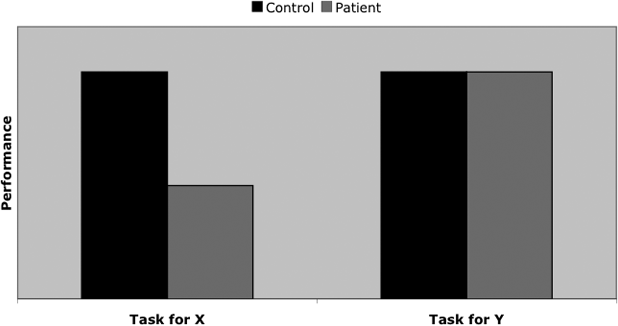
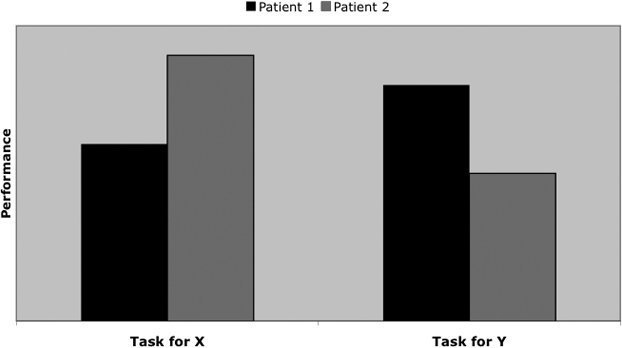
The first kind of dissociation distinguished by neuropsychologists is known as a “single dissociation”: a single dissociation happens when a patient has an impaired competence X but a normal (or a less impaired) competence Y (fig. 1).Footnote 8 Impairment or, on the contrary, normal functioning of a competence is typically measured by patients’ performance on an experimental task that is assumed to tap into this competence.
Single dissociation.

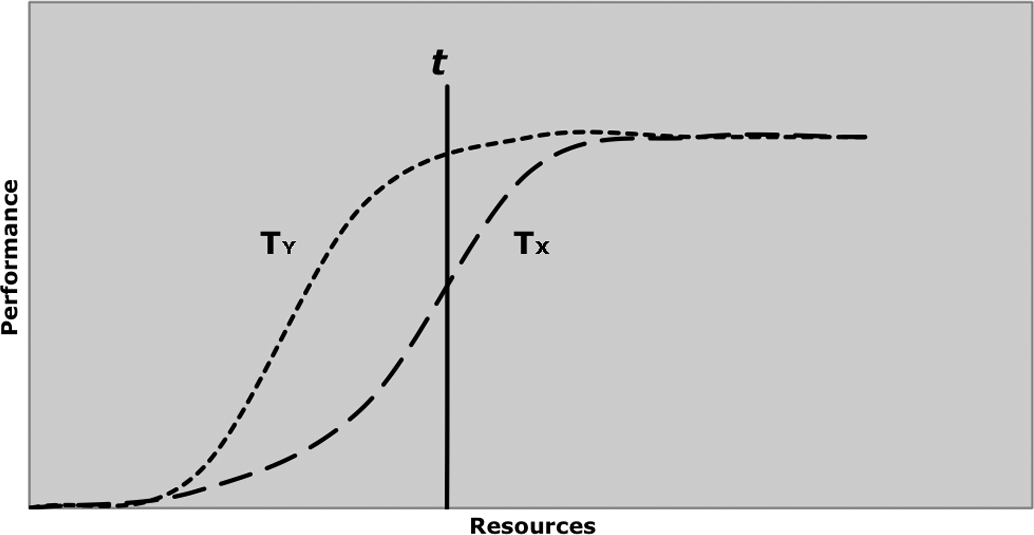
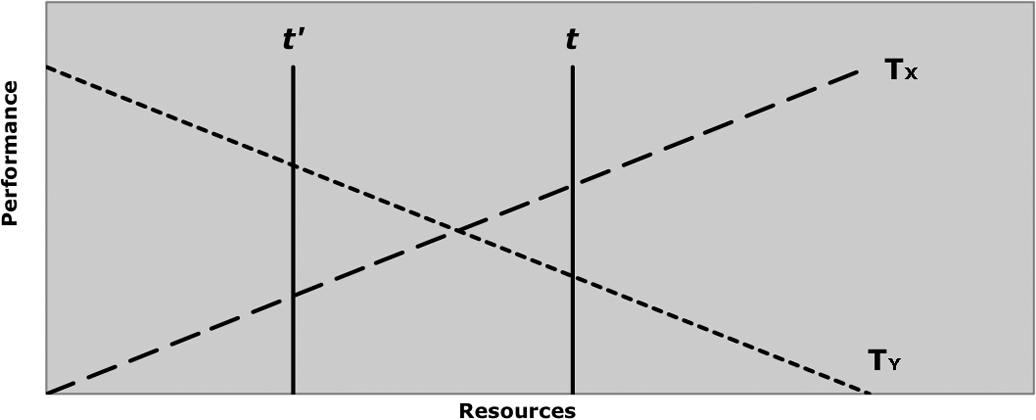
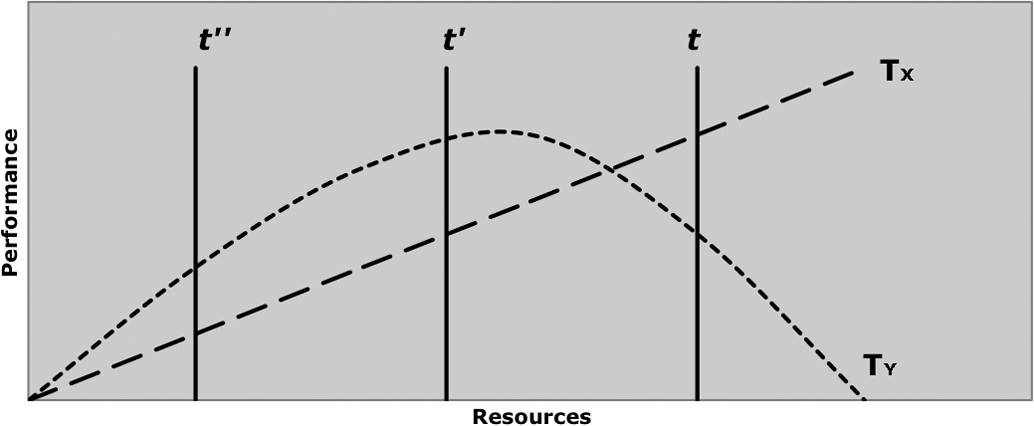
The inference of a partitioning conclusion from a single dissociation can be confounded by the relative difficulty of the tasks tapping into X and Y, respectively, TX and TY (Teuber Reference Sternberg1955; Shallice Reference Raichle and Mintun1979, Reference Shallice1988, chap. 10). For instance, it could be that successfully completing TX requires more cognitive resources (whatever these may be: memory, processing effort, attention, etc.) than TY. The notion of a resource function (Norman and Bobrow Reference Norman and Bobrow1975; Shallice Reference Raichle and Mintun1979, Reference Shallice1988, Reference Shallice2003) is useful to develop this idea. A resource function represents people's performance in a task as a function of the available resources (see fig. 2).Footnote 9 Then, if brain lesions or neurogenetic disorders reduce the resources available to the cognitive agent to level t, a dissociation between X and Y will occur even if X and Y are underwritten by the same set of processes—a situation that has been called a “resource artifact” (Shallice Reference Shallice1988). In these circumstances, it would be erroneous to conclude that X and Y are underwritten by two distinct sets of processes.
Resource function.

Single dissociations provide the weakest type of evidence for partitioning conclusions: the resource functions depicted by figure 2 are a possible confound of the inferences from single dissociations but not of the inferences from other kinds of dissociation. Double dissociations, in which competence X but not Y (or less so) is impaired in a first patient, while Y but not X (or less so) is impaired in a second patient, are supposed to improve on single dissociations in this respect: if X can be unimpaired, while Y is impaired, the impairment of X while Y is unimpaired cannot be merely due to the fact that completing TX successfully requires more resources than completing TY (as in fig. 2); for, if the latter were the case, then, whenever X is impaired, Y would also be impaired.
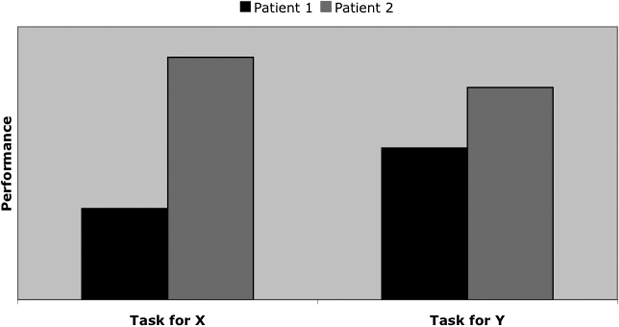
A first kind of double dissociations is known as “uncrossed double dissociation” (fig. 3). As is the case in all double dissociations, patient 1 is more impaired with respect to X than to Y, while patient 2 is more impaired with respect to Y than to X. Thus, there is an interaction between the performance in TX and TY and the type of lesions or neurogenetic disorders that distinguishes patients 1 and 2. What distinguishes the uncrossed double dissociations is that this interaction is not of the crossover kind.
Uncrossed double dissociation.

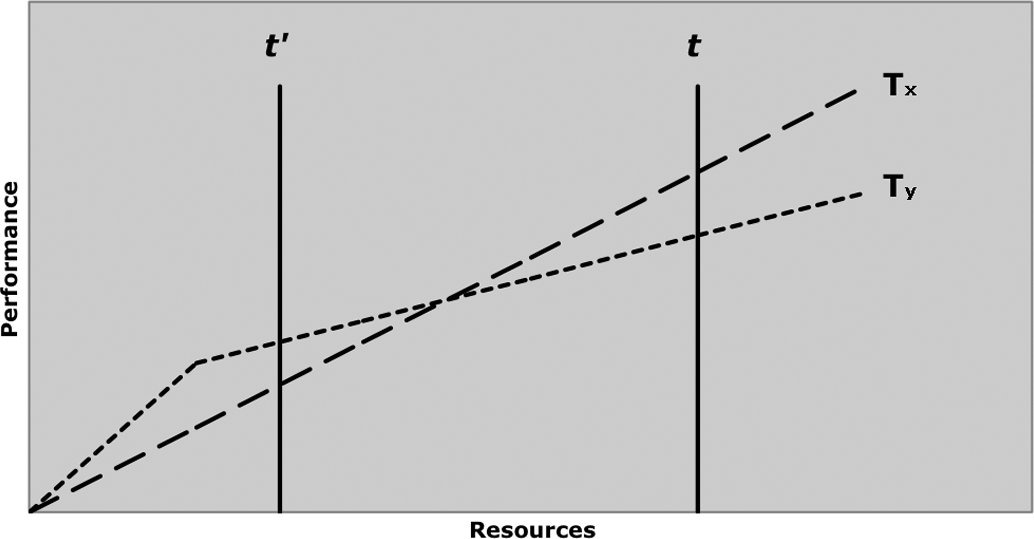
The inference of a partitioning conclusion from an uncrossed double dissociation is confounded when the resource functions of TX and TY cross over one another, as in figure 4—another resource artifact. Suppose that patient 2's lesion or neurogenetic disorder reduces the available cognitive resources to t, while patient 1's lesion or neurogenetic disorder reduces them to t′. In these conditions, the kind of dissociation between X and Y represented by figure 3 will occur even if X and Y are underwritten by the same set of processes. It would then be erroneous to conclude that X and Y are underwritten by two distinct sets of processes.
Resource functions confounding an uncrossed double dissociation.

Uncrossed double dissociations provide a stronger type of evidence for partitioning conclusions than single dissociations but a weaker type of evidence than the second type of double dissociations, which is known as “crossover” or “classical dissociations.” In a classical dissociation, not only is patient 1 more impaired with respect to X than to Y, while patient 2 is more impaired with respect to Y than to X, but patient 2's competence Y is also more impaired than patient 1's, while patient 1's competence X is more impaired than patient 2's (fig. 5). Thus, there is a crossover interaction between the performance in TX and TY and the type of lesions or neurogenetic disorders that distinguishes patients 1 and 2.
Crossover double dissociation.

Inferences from classical dissociations do not suffer from the possible confound that plagues inferences from uncrossed double dissociations: given the resource functions depicted in figure 4, if patient 1 is more impaired with respect to X than to Y, while patient 2 is more impaired with respect to Y than to X, then it has to be the case that patient 1 is more impaired with respect to both Y and X than is patient 2.
However, Dunn and Kirsner (Reference Dunn and Kirsner1988) have identified a possible confound of the inference of a partitioning conclusion from a crossover double dissociation.Footnote 10 Suppose that the resource function of TX is monotonically increasing, while the resource function of TY is monotonically decreasing, as in figure 6. Suppose also that patient 2's lesion or neurogenetic disorder reduces the available cognitive resources to t, while patient 1's lesion or neurogenetic disorder reduces them to t′. In these conditions, a crossover double dissociation between X and Y will occur even if X and Y are underwritten by the same set of processes. It would then be erroneous to conclude that X and Y are underwritten by two distinct sets of processes.
Resource functions confounding a crossover double dissociation.

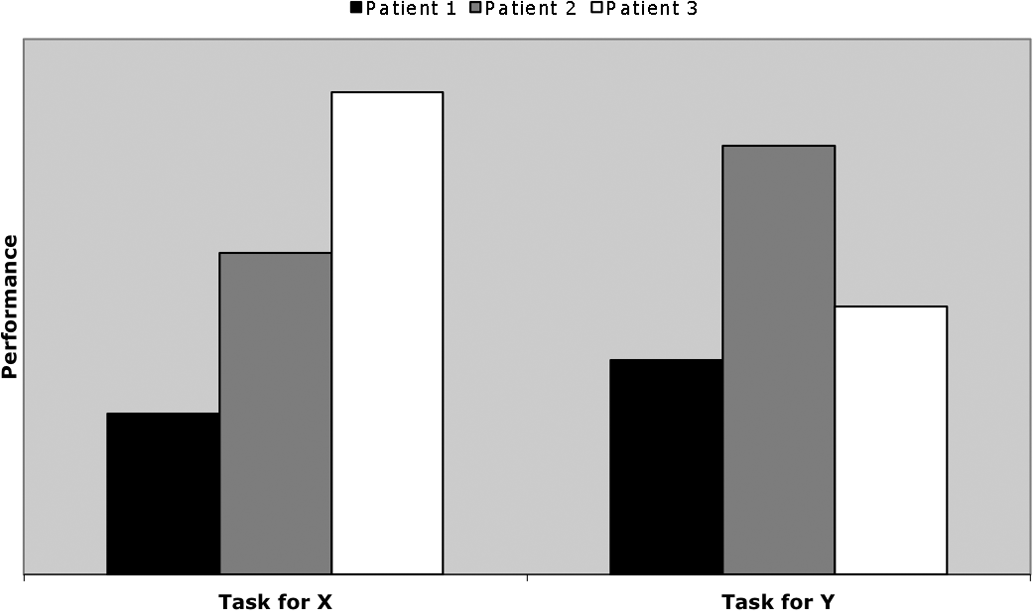
Dunn and Kirsner (Reference Dunn and Kirsner1988) also introduced a pattern of dissociations that eschewed the confound just discussed: reverse association. Reverse association occurs when a crossover dissociation and an association are combined (fig. 7). Let's start with the association of TX and TY. Patient 1's and patient 2's impairments are in the same direction: if patient 1 is more impaired than patient 2 in TX, she is also more impaired in TY. This is incompatible with X and Y being underwritten by a single set of processes and the resource functions of TX and TY being as represented in figure 6. If the performances of patient 2 (or patient 1) and patient 3 in TX and TY are doubly dissociated in a crossover manner, then this is evidence that X and Y are underwritten by two distinct sets of processes.
Reverse association.

In fact, a stronger claim is even justified. Following Dunn and Kirsner (Reference Dunn and Kirsner1988), it is trivial to show that, if the resource functions of TX and TY are strictly monotonic, then a reverse association entails that X and Y are underwritten by two distinct sets of processes.Footnote 11 Variables PX and PY are, respectively, the performance in TX and TY, and R refers to the amount of available resources. If we assume that TX and TY recruit a single process, then


Assuming strict monotonicity,

Thus, 2 entails

that is,

Now,

If g is strictly monotonic, so is g −1, and, as a result, the sign of  is constant. Thus, if the resource functions of TX and TY are strictly monotonic and if a single process underwrites X and Y, then PX is a strictly monotonic function of PY (see 5). As a result, assuming strict monotonicity, a reverse association entails that two distinct sets of processes underlie TX and TY.
2.3. Upshot
For our purposes, two features of the preceding discussion are important. First, inferences from dissociations in neuropsychology can be ranked according to their strength, where the strength of an inference depends on the nature of the confounds that would make it erroneous. Second, resource functions cast light on the nature of these confounds.
3. Function-to-Structure Inferences
3.1. The Basic Insight of Function-to-Structures Inferences
Function-to-structure inferences, as described by Henson (Reference Henson2005, Reference Henson2006), are meant to bring neuroimages to bear on counting questions, such as whether people recognize faces and places by means of the same process, for example, a process for recognizing objects (Haxby et al. Reference Haxby, Gobbini, Furey, Ishai, Schouten and Pietrini2001), or by means of two distinct processes, for example, a process for recognizing places and a process for recognizing faces (e.g., Kanwisher Reference Kanwisher2000)?Footnote 12 The basic insight behind function-to-structure inferences is straightforward: the fact that two tasks, which are meant to tap into two competences, result in the increase (what I will call “activation” or “increase in activity”) or decrease (what I will call “deactivation” or “decrease in activity”) of the BOLD (blood oxygen level dependent) signal (compared to some baseline) in distinct brain areas or networks is evidence that these competences are underwritten by two distinct sets of processes.Footnote 13 As Henson puts it (Reference Henson2005, 198), “if conditions C1 and C2 produce qualitatively different patterns of activity over the brain, then conditions C1 and C2 differ in at least one function, F2.”Footnote 14 I will call a difference in the pattern of activation or deactivation between two tasks a “BOLD dissociation.”Footnote 15
Naturally, this basic insight needs refinement. First, any two stimuli in any given task and a fortiori any two tasks are bound to elicit different patterns of activation or deactivation: because the stimuli or the tasks are different, processing is bound to be different (whether processing the two distinct stimuli or completing the two distinct tasks involves a single process or two distinct processes), which will necessarily result in two different patterns of activation or deactivation—that is, in a BOLD dissociation.Footnote 16 To illustrate, two distinct faces are bound to be processed somewhat differently simply because they are different, and they are thus likely to elicit two different patterns of activation or deactivation. Similarly, even if faces and places were recognized by means of the same process, a face and a landscape would elicit two different patterns of activation or deactivation simply because they are different. So, a mere difference between two patterns of activation or deactivation does not provide evidence that two competences are underwritten by two distinct sets of processes. If function-to-structure inference is to be a useful form of inference, it is thus necessary to identify a particular pattern of differences in activation or deactivation (a particular kind of BOLD dissociation) such that the occurrence of this pattern is evidence for the existence of two distinct sets of processes.
Second, echoing Shallice's (Reference Raichle and Mintun1979, Reference Shallice1988) and Dunn and Kirsner's (Reference Dunn and Kirsner1988) discussion of resource artifacts, Henson shows that, modulo some auxiliary assumptions (which are the counterparts of the possible confounds of the inferences from dissociations in neuropsychology), several kinds of BOLD dissociations are consistent with a single set of processes underlying two competences (see fig. 5 in Henson [Reference Henson2005, 209] and box 2 in Henson [Reference Henson2006, 66]). Thus, in some situations inferences of partitioning conclusions from some kinds of BOLD dissociations would be erroneous. Furthermore, Henson identifies a kind of BOLD dissociation that, he holds, does not suffer from the possible confounds he has identified, exactly as Shallice singles out crossover double dissociations, and Dunn and Kirsner, reverse associations (sec. 2). Henson calls this pattern a “qualitative difference.”
3.2. The Hierarchy of BOLD Dissociations
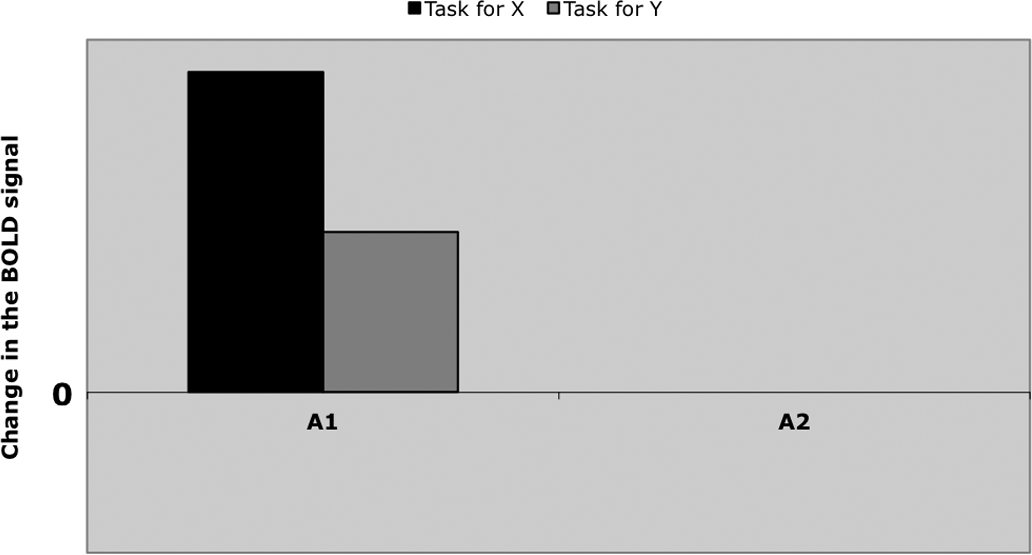
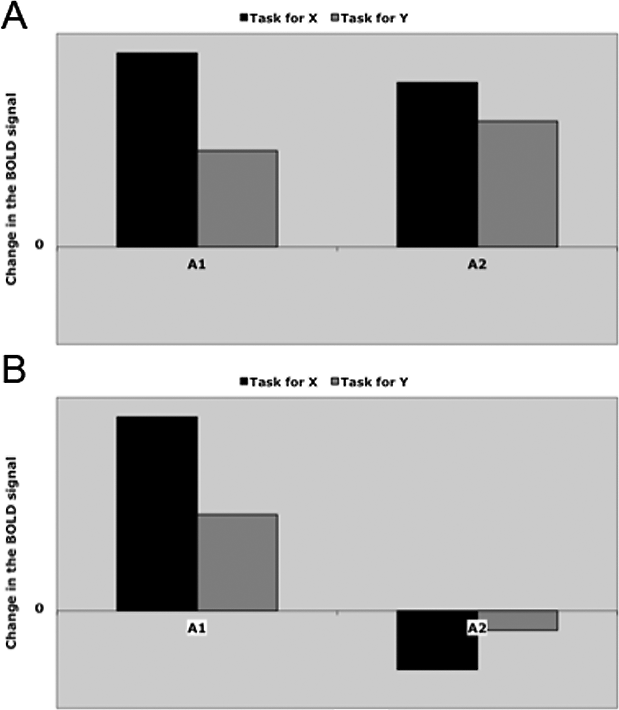
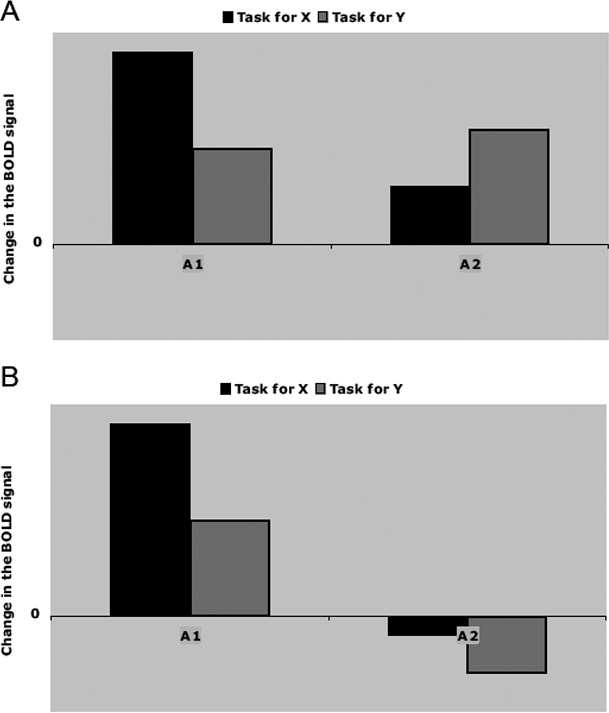
I now elaborate on the types of BOLD dissociations examined by Henson (Reference Henson2005).Footnote 17 In the first type of BOLD dissociation (fig. 8), the interaction between brain area and competence is significant—that is, the difference between the activation (or deactivation) in area A1 caused by the task that taps into competence X, TX, and the activation (or deactivation) in A1 caused by the task that taps into competence Y, TY, is larger than the difference between the level of brain activity in area A2 during TX (compared to a baseline) and the level of activity in A2 during TY (compared to a baseline)—but neither TX nor TY causes an activation (or a deactivation) in A2.Footnote 18
Single BOLD dissociation.

This BOLD dissociation is reminiscent of single dissociations in neuropsychology: both kinds of dissociation involve a single difference—respectively, between the change in activation elicited by the two tasks in a single area (e.g., A1) and between controls’ and patients’ performances in one of the two tasks (e.g., TX). For this reason, I will call this BOLD dissociation a “single BOLD dissociation.”
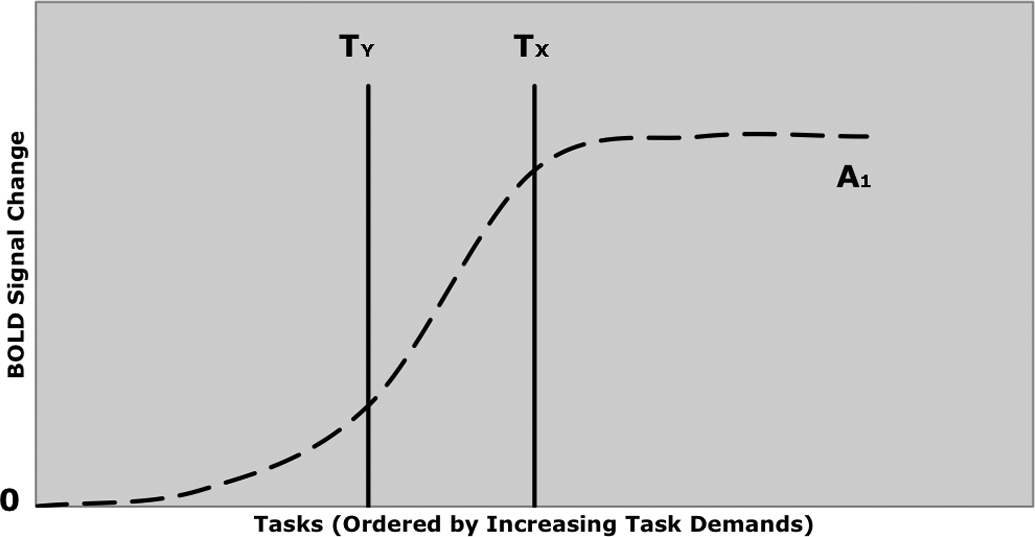
Now, exactly as resource functions are useful to understand the confounds that can render inferences to partitioning conclusions erroneous in neuropsychology, one can introduce another type of function to cast light on the confounds of function-to-structure inferences.Footnote 19 The relevant functions do not map resources onto behavioral performance but, rather, how much information processing is needed to complete some tasks (what I will call “their task demands”) at any particular level of success (e.g., successfully) at a specific speed (e.g., as quickly as possible) at any particular level of confidence (how confident participants are that their answers are correct) onto the activation or deactivation in a brain area or network recruited by these tasks.
For instance, figure 9 depicts a monotonic increase in brain activity in a particular brain area (compared to a baseline) as a function of the task demands imposed by various tasks. Let's call these functions “task demand functions.” On the x-axis, tasks (e.g., TY and TX) are ordered as a function of how much information processing is needed to complete them (thus, TX requires more information processing than TY). The y-axis represents the BOLD signal change, which can be either positive (activation) or negative (deactivation). (In fig. 9, it is assumed that the tasks activate A1.) Tasks TY and TX recruit A1; they may recruit a single process, in which case it is unsurprising that they both recruit A1, but they may also recruit two distinct processes whose neural correlates overlap in A1. The task demand functions of a given area change when different amounts of cognitive resources (attention, etc.) are applied because these result in different levels of success, different amounts of time needed to complete the task, different degrees of confidence, and so on.Footnote 20
Task demand function.

Suppose that the task demand function of A1 looks as depicted in figure 9 and that TX and TY do not recruit A2. Since it is extremely plausible that cognitive processes are realized in particular areas or networks of the brain instead of in the whole brain, an area like A2 is bound to exist. Hence, one could find a single BOLD dissociation, as depicted in figure 8, even if a single process underlies X and Y. In such circumstances, the inference of a partitioning conclusion from a single BOLD dissociation would be erroneous.
Single BOLD dissociations provide the weakest type of evidence for partitioning conclusions: inferences from the other kinds of BOLD dissociations are immune to the confounds that would make inferences from single BOLD dissociations erroneous. Remarkably, the possible confound of the inference from a single BOLD dissociation is similar to the possible confound of the inference from a single dissociation: in both cases, the task tapping into one of the two competences can be more difficult than the task tapping into the other competence.
A second kind of BOLD dissociation does not suffer from the confound that would make inferences from single BOLD dissociations erroneous (fig. 10). In this case, the interaction between area and competence is again significant; in addition, both TX and TY cause an activation (or deactivation) in A2; finally, TX is either causing a greater activation or deactivation than TY in A1 and A2. This second kind of BOLD dissociation is somewhat reminiscent of the double dissociations in neuropsychology. Instead of an interaction between kind of lesion (or developmental disorder) and tasks, this second kind involves an interaction between brain area and tasks (where both areas are activated or deactivated in both tasks). For this reason, I will call this second kind of BOLD dissociation a “double BOLD dissociation.”
Double BOLD dissociation.

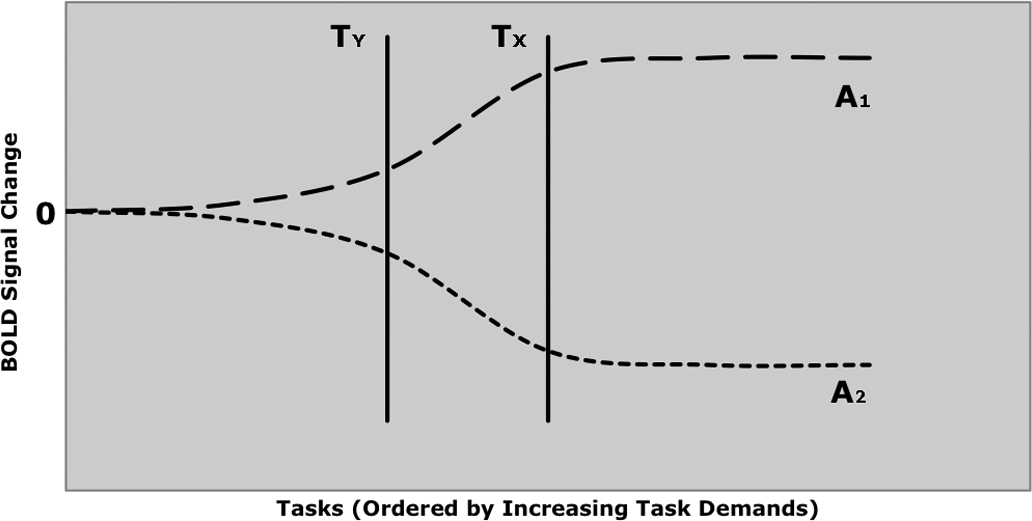
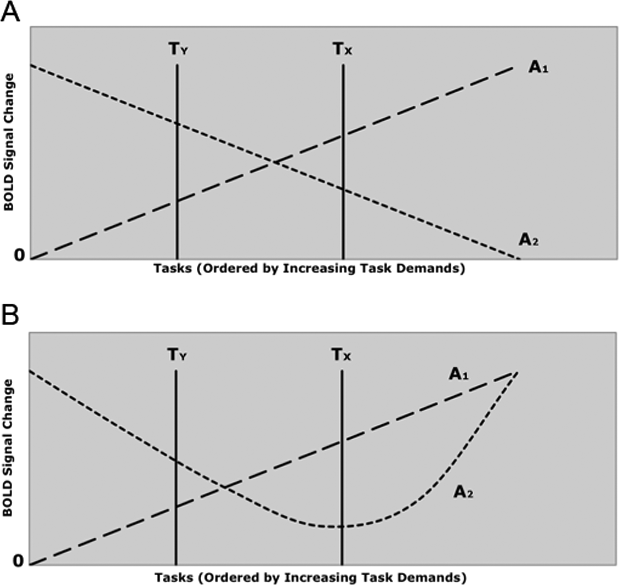
Now, suppose that TX imposes greater task demands than TY. Furthermore, suppose that A1, but not A2, is involved in completing TX and TY and that A2 is connected to A1 in such a way that activation in A1 results in deactivation in A2 (e.g., Shmuel et al. Reference Shallice2002; Amedi, Malach, and Pasqual-Leone Reference Amedi, Malach and Pasqual-Leone2005; Raichle and Mintun Reference Raichle2006). Alternatively, just like A1, A2 may be causally involved in completing TX and TY, but, in contrast to A1, A2 is deactivated when it is recruited by a task: for example, deactivation has often been observed in the hippocampus during encoding and retrieval tasks believed to recruit this brain structure (e.g., Axmacher, Elger, and Fell Reference Axmacher, Elger and Fell2009).Footnote 21 Then, the task demand functions of A1 and A2 may look as represented in figure 11. Both functions are monotonic, but one of them is increasing, while the other one is decreasing. In such circumstances, we would obtain the double BOLD dissociation depicted on the right of figure 11, even if a single process underwrites X and Y.
Task demand functions of A1 and A2.

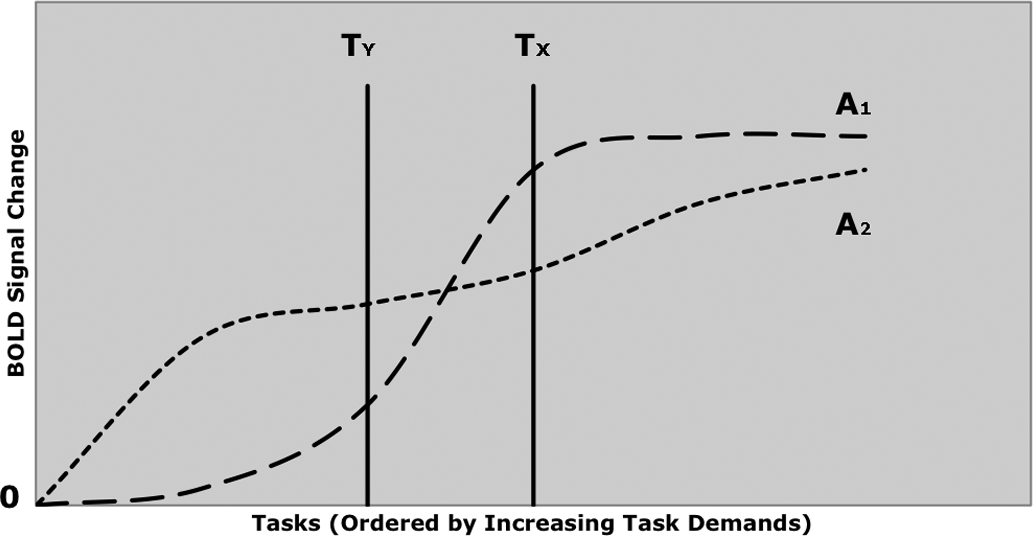
Suppose alternatively that A1 and A2 are both recruited by TX and TY and that the task demand functions for A1 and A2 look as represented in figure 12. In these circumstances, we would find the double BOLD dissociation depicted in figure 10A, even if a single process underwrites X and Y. In all the cases just considered, the inference of a partitioning conclusion from either double BOLD dissociation represented by figure 10 would be erroneous.
Task demand functions of A1 and A2.

The confounds that can render an inference to a partitioning conclusion from the type of double BOLD dissociation in figure 10B erroneous are similar to the confounds of the inference from a crossover double dissociation in neuropsychology discussed in section 2. Particularly, the functions represented by figure 11 are a cognitive-neuroscientific counterpart of the kind of resource functions described by Dunn and Kirsner (Reference Dunn and Kirsner1988) in their critique of the inferences from double dissociations in neuropsychology (fig. 6). In the cognitive-neuroscientific case, greater activation in a first area is correlated with greater deactivation in a second area, while, in the neuropsychological case, higher performance in a first task is correlated with lower performance in a second task.
Finally, Henson (Reference Henson2005) describes a kind of BOLD dissociation that eschews the possible confounds discussed so far: a qualitative difference (fig. 13).Footnote 22 In the case of a qualitative difference, the interaction between area and competence is again significant, and both TX and TY activate or deactivate A2. Furthermore, in contrast to the double BOLD dissociation, in a qualitative difference, if TX causes more activation in A1 than TY, then TY either results in more activation or more deactivation than TX in A2. In the hierarchy of BOLD dissociations, qualitative differences provide the strongest form of evidence.
Qualitative difference.

3.3. Upshot
For our purposes, two features of the hierarchy of BOLD dissociations in cognitive neuroscience are important. First, just like inferences from dissociations in neuropsychology, inferences from BOLD dissociations can be ranked according to their strength, where the strength of an inference depends on the nature of the confounds that would make it erroneous. Second, task demand functions cast light on the nature of these confounds.
4. Dissociations versus BOLD Dissociations
4.1. Comparing Inferences from Dissociations and BOLD Dissociations
Henson's groundbreaking discussion of function-to-structure inference is explicitly inspired by the use of dissociations in neuropsychology to support partitioning hypotheses. Despite the similarities between the two kinds of dissociations, it is an open question whether the inferential use of BOLD dissociations in cognitive neuroscience and the use of dissociations in neuropsychology are on an equal epistemic footing. As sections 2 and 3 show, the strength of an inference of a partitioning conclusion from a dissociation or a BOLD dissociation depends on the existence of possible confounds resulting, respectively, from the resource functions of the tasks under consideration or from the task demand functions of the brain areas under consideration. An epistemological comparison of the kinds of inferences found in neuropsychology and in cognitive neuroscience can thus be done along at least two axes (which I will call the “assessment axes”). First, a kind of inference, I1, is stronger than another kind, I2, to the extent that the possible confounds of I1 are less likely to occur than the possible confounds of I2. Second, I1 is more useful than I2 to the extent that the possible confounds of I1 are more easily controlled for than the possible confounds of I2. These two assessment axes are different, but both are important for assessing the kinds of inference from dissociations found in neuropsychology and in cognitive neuroscience.
Thus, kinds of inferences (e.g., inferences from reverse association and from qualitative differences), not particular inferences, are compared in what follows.Footnote 23 One could object that it would be more fruitful to examine the particular inferences actually drawn by neuroscientists and to assess whether these inferences properly control for potential confounds.Footnote 24 While the latter project is worthwhile, assessing the epistemic standing of kinds of inference by examining their possible confounds is a common practice among methodologists. Shallice (Reference Shallice1988) compares the epistemic standing of various kinds of neuropsychological inferences from dissociations, while Cook and Campbell (Reference Cook and Campbell1979) compare the epistemic standing of experimental designs by looking at the situations that would confound the causal conclusions drawn from experiments using these designs. The comparison done in this section belongs to this methodological tradition. Second, an assessment of the epistemic standing of kinds of inferences has its uses. This assessment may help a scientist embarking on a research project identify the confounds that she would have to control for. Methodologists have assessed kinds of inference precisely for this reason.
One could also question whether the two axes of assessment described above can be used to compare the inferences made in two distinct disciplines.Footnote 25 While it is natural to examine the strength of inferences within a single discipline since the confounds of one kind of inference can be a subset of the confounds of another kind of inference, this situation does not hold for the inferences in two disciplines. However, while this observation suggests that a comparison of the strength of inferences cannot be as precise across two disciplines as it is within a single discipline, it does not make comparisons across two disciplines meaningless. This is particularly the case when the inferences across two disciplines are similar, which is the case for the inferences from dissociations and BOLD dissociations (secs. 2 and 3).
4.2. Inferences from Single Dissociations and Single BOLD Dissociations
Single dissociations and single BOLD dissociations are at the bottom of their respective hierarchies of evidence, and inferences based on these dissociations are the weakest types of inferences to partitioning conclusions. That said, how do the strength and utility of inferences from single dissociations and from single BOLD dissociations compare?
Inferences from single BOLD dissociations are a very weak kind of inference (probably unacceptably so): single BOLD dissociations provide very little evidence that two tasks recruit different cognitive processes. The kind of task demand functions represented by figure 9 are plausibly common: it is plausible that completing successfully two distinct tasks typically requires different amounts of information processing, and the tasks result in different changes in the BOLD signal, even when they recruit a single process. Furthermore, if the neural correlates of most cognitive processes involve some, but not all, brain areas, then one is bound to find areas such as A2—that is, areas that are not recruited by either TX or TY. The inference of a partitioning conclusion from a single dissociation alone is also a weak form of inference since figure 2 describes a common situation in which two distinct tasks are likely to make at least somewhat different demands on the available cognitive resources (memory, etc.).
Turning to the second assessment axis, it may be possible to determine whether the resource functions of two tasks are roughly similar or widely different (but see Norman and Bobrow Reference Norman and Bobrow1975) and thus to establish whether a single dissociation is a resource artifact. One could compare control participants’ performances in the two tasks under increasing cognitive load and determine whether they degrade similarly. On the other hand, it is currently unclear how to determine the shape of task demand functions. Even if this were doable for some areas (perhaps by examining the effect on the BOLD signal of increasingly demanding versions of specific tasks), we cannot say with any degree of confidence how demanding the tasks currently used by cognitive neuroscientists are since we only have a poor understanding of what is involved in solving the tasks used in psychology and cognitive neuroscience. Thus, while inferences of partitioning conclusions from single dissociation and from single BOLD dissociations are both weak, the former may be more useful than the latter.
4.3. Inferences from Double Dissociations and Double BOLD Dissociations
As we have seen in section 2, inferences from uncrossed double dissociations are confounded when the resource functions of the two relevant tasks cross over one another (fig. 4), while inferences from crossover dissociations are confounded when one of the resource functions increases while the other one decreases (fig. 6). Similarly, inferences from double BOLD dissociations are confounded when activation or deactivation increases at a different rate as a function of increasing task demands in different brain areas (fig. 12) or when activation in one area is correlated with deactivation in another one (fig. 11). That said, how does the epistemic standing of inferences from double dissociations and from double BOLD dissociations compare?
The frequency of the type of resource artifacts represented by figure 4 is unknown, and, as a result, it is difficult to assess the strength of the inference of a partitioning conclusion from an uncrossed double dissociation. Neuropsychologists should thus probably be wary of endorsing the conclusions of inferences drawn from uncrossed double dissociations alone. However, as discussed in the previous section, it may be possible to get a sense of the shape of the resource functions of the relevant tasks by using various amounts of cognitive load with control participants.
By contrast, while inferences from crossover double dissociations can be confounded, the confounds they describe are either unlikely or relatively easily controlled for. First, many tasks are likely to be such that the more cognitive resources are available, the better performance will be. Thus, their resource functions are likely to be monotonically increasing, incompatible with the possible confound pointed out by Dunn and Kirsner. Second, this confound can be easily controlled for. It would occur when the measurement scale of TY is such that doing well in TY results in a lower rating (Dunn and Kirsner Reference Dunn and Kirsner1988, 95). For instance, the percentage of correct answers could be measured in TX, and reaction times, in TY. It would also occur when the completion of one task interferes with the completion of the other (perhaps by introducing irrelevant information). Crucially, neuropsychologists would typically be aware that the tasks are so coded or so related.
The situation is different when one turns to inferences from double BOLD dissociations in cognitive neuroscience. The task demand functions represented by figure 12 are probably at least somewhat common even when TX and TY recruit a single process, PR. Suppose that cognitive processes are usefully thought of as programs made of numerous subroutines. When the task demands imposed by TX are greater than the task demands imposed by TY, it is plausible that the additional information processing imposed by TX is not equally distributed over the subroutines of PR. If the neural correlates of these subroutines correspond to different (perhaps overlapping) parts of the neural correlate of PR, then the difference between the activation caused by TX and TY will not be constant across the areas that are part of the neural correlate of PR. This is the situation represented by figure 12.
To illustrate, Uncapher, Hutchinson, and Wagner (Reference Teuber2011) argued that bottom-up and top-down attention involve two different parts of the intraparietal sulcus (IPS) on the grounds that the former activates the left lateral IPS more than the latter, while no difference was found for the medial IPS. This inference is akin to an inference from a double BOLD dissociation (similar to the one depicted by fig. 10A),Footnote 26 and it suffers from the potential confound described by figure 12 for the reason just discussed. Suppose that bottom-up and top-down attention recruit a single process in the IPS (evidence suggests that the underlying networks differ elsewhere in the brain) and that task demands are larger for the former than for the latter, as in figure 12. The additional information processing imposed by bottom-up attention may not be equally distributed over all the components of the underlying process: top-down and bottom-up attention may recruit equally the part of this process whose neural correlate is located in the medial IPS, while bottom-up attention recruits more the part of this process whose neural correlate is located in the left lateral IPS.
Taking into account the relation between the BOLD signal and neuronal activity (known as the hemodynamic function) yields a second reason to expect figure 12 to describe a relatively common situation. Evidence speaks against the common, but implicit, assumption that the hemodynamic function is invariant across the brain (Ekstrom Reference Ekstrom2010). If the hemodynamic function varies across brain areas, then even if the additional information processing imposed by TX is equally distributed on the subroutines of PR or even if the neural correlates of the subroutines of PR do not correspond to parts of the neural correlate of PR, the difference between the BOLD signal change elicited by TX and TY may not be constant across the areas that are part of the neural correlate of PR.
It is more difficult to assess the frequency of the possible confound of the inferences based on the double BOLD dissociation represented by figure 10B. We do not know when the recruitment by a task of a brain area that is part of the neural correlate of a cognitive process results in deactivation, nor do we know how often the activation of a brain area by a task results in the deactivation of a connected brain area. We do know, however, that both situations occur (Shmuel et al. Reference Shallice2002; Amedi et al. Reference Amedi, Malach and Pasqual-Leone2005; Raichle and Mintun Reference Raichle2006).
Turning briefly to the second axis of assessment, in contrast to the possible confounds in neuropsychology, which can be perhaps controlled for, it is difficult to see how, in light of our very imperfect knowledge of the relations between psychological and neuronal processes, we could control for the possible confounds in cognitive neuroscience. Again, neuropsychologists seem better off than cognitive neuroscientists. Particularly, inferences from crossover double dissociations are strong and useful since their confounds are unlikely to occur and can be controlled for.Footnote 27 The same cannot be said of their counterparts in cognitive neuroscience: inferring a partitioning conclusion from the double BOLD dissociation represented in figure 10A is risky, while it is unknown how secure the inferences from the double BOLD dissociation represented in figure 10Bare.
4.4. Reverse Association and Qualitative Differences
A reverse association entails that two competences, X and Y, are underwritten by two distinct sets of processes if the resource functions of the two tasks tapping into X and Y are strictly monotonic (sec. 2). If this condition does not hold, the inference of a partitioning conclusion from a reverse association can be confounded. For instance, suppose that X and Y are underwritten by a single set of processes and that the resource functions of the corresponding tasks are similar to those depicted in figure 14. That is, the resource function of TY is nonmonotonic: performance in TY first improves as a function of the amount of resources available but then worsens. In this case, inferring a partitioning conclusion from a reverse association would be erroneous.
Resource functions.

Nonmonotonic resource functions are not entirely implausible: in at least some circumstances, the greater availability of cognitive resources, such as the amount of time dedicated to think about a problem or the amount of conscious attention, seems to impair performance in a given task (e.g., Dijksterhuis et al. Reference Dijksterhuis, Bos, Nordgren and van Baaren2006). If it is also the case that, in these tasks, too few cognitive resources are detrimental to people's performance, then their resource function would of the inverted-U kind.
That said, in many (if not all) of the well-known cases in which additional cognitive resources result in a poorer performance, the decrease in performance is not directly due to the availability of additional resources. Instead, this availability results in the adoption of a different cognitive process to solve the task at hand—that is, different processes are used when cognitive resources are limited and when they are not—and the process used when more resources are available is less efficient because, for example, it does not have access to the relevant cues or it does not properly integrate these cues. For instance, in study 1 of Dijksterhuis et al. (Reference Dijksterhuis, Bos, Nordgren and van Baaren2006), participants are primed to make a choice after conscious deliberation (they are invited to think about the options for a few minutes) or after unconscious deliberation (they are prevented from thinking about the options for a few minutes). The choice is assumed to result from distinct processes in the conscious and the unconscious conditions.
Two things follow from this. First, tasks whose resource function is of the inverted-U kind are often peculiar: in them, two different processes are recruited depending on the amount of available resources, and the process recruited when the amount of available resources is larger is less reliable than the process recruited when less resources are available. Because of their peculiarities, such tasks seem likely to be the exception rather than the rule. Furthermore, it seems possible to control whether a task recruits different processes when the amount of available resources varies. Many aspects of participants’ performance are likely to differ if two different processes are recruited when the amount of available resources varies. For instance, if the process recruited when resources are limited is automatic, while the other process is not, performance would be impaired by cognitive load in the former case but not in the latter case.
The upshot of this discussion is that monotonic resource functions are plausibly common (Shallice Reference Raichle and Mintun1979): when one is dealing with a behavioral measure, one can assume that more resources correspond to better performances (which can translate into lower ratings if success corresponds to a low rating with the measure used, e.g., frequency of errors). Thus, there is little reason to be skeptical of the inference of a partitioning conclusion from a reverse association on the grounds that it assumes the monotonicity of the resource functions.
What about the inferences based on qualitative differences in cognitive neuroscience? Let's focus first on figure 13A. In figure 15A, the task demand function for A1 is monotonically increasing, while that of A2 is monotonically decreasing. Suppose first that TX and TY recruit a single process, whose neural correlate includes (or is identical to) A1 but not A2. The activation of A2 diminishes with tasks that require more information processing. In this situation, inferring that two distinct processes underlie X and Y on the basis of the qualitative difference represented by figure 13A would be erroneous. Such a situation can plausibly occur since various brain areas (known as the “default network”) are deactivated when participants are asked to complete some task (see Buckner, Andrews-Hanna, and Schacter [Reference Buckner, Andrews-Hanna and Schacter2008] for review). As a result, even if A1 is the neural correlate of the single process recruited by TX and TY, tasks that require more information processing would cause less activation in A2 if A2 belongs to the default network. However, turning to the second axis of assessment, given our increasing knowledge of the default network, this confound can plausibly be controlled for: cognitive neuroscientists could check whether A2 is part of the default network.
Task demand functions of A1 and A2.

Still focusing on figure 15A, one may wonder whether A1 and A2 could be parts of the neural correlates of a single process recruited by TX and TY (instead of A1, but not A2, being the neural correlate of this process, as in the situation just discussed). While this is surely not impossible, this situation does not seem particularly likely.
Does this mean that inferences from the qualitative difference represented by figure 13A are useful (because their possible confounds are plausibly controllable)? Figure 15B shows that this conclusion is premature. The task demand function for A1 is monotonically increasing, while that of A2 is U-shaped: A2 is more activated when the task requires fewer and more resources. In such circumstances, if TX and TY recruit a single process whose neural correlate includes A1 and A2, then inferring two distinct processes from figure 13A would be erroneous.
But can such a situation plausibly occur? While, as we have seen earlier in this section (fig. 14), nonmonotonic resource functions are unlikely to occur in neuropsychology, the situation is different for cognitive neuroscience: a nonmonotonic task demand function is not implausible. Consequently, the inference from a qualitative difference is more precarious than its counterpart in neuropsychology—the inference from a reverse association.
To explain why requires a small detour through the physiology of the BOLD signal. In addition to still not being completely understood (Logothetis Reference Logothetis2008), the connection between activation (or deactivation) and information processing is far from being straightforward. Logothetis and colleagues (Reference Logothetis, Pauls, Augath, Trinath and Oeltermann2001) have shown that to a large extent the intensity of the BOLD signal does not directly reflect the firing rate of the neurons in an area and, thus, presumably the amount of information processing (see also, e.g., Raichle and Mintun Reference Raichle2006; Logothetis Reference Logothetis2008; Ekstrom Reference Ekstrom2010). Instead, according to Logothetis's BOLD-LFP (local field potential) coupling model, the intensity of the BOLD signal mostly reflects the perisynaptic activity, which is assumed to play a regulatory role. The firing rate and BOLD signal are correlated when the perisynaptic activity and firing rate are themselves correlated. According to this model, in some situations the intensity of the BOLD signal may be dissociated from the amount of information processing: the BOLD signal could be strong in a brain area despite little (or no) information processing taking place there because the regulatory activity would both drive the BOLD signal change and prevent any information processing from happening (e.g., Viswanathan and Freeman Reference Van Orden, Pennington and Stone2007; Logothetis Reference Logothetis2008; Ekstrom Reference Ekstrom2010).Footnote 28
The indirect connection between information processing and the BOLD signal can give rise to nonmonotonic task demand functions. For instance, some subroutines of a process PR may need to be inhibited for tasks that require little information processing because they are not needed for these tasks. According to the BOLD-LFP coupling model, this inhibition will result in an increase in the BOLD signal in the neural correlates of these subroutines. More demanding tasks require less inhibition and thus elicit a weaker inhibition-caused BOLD signal: the activation due to inhibition decreases as a function of increasing task demands. If the rate of this decrease is larger than the rate of the activation increase in the BOLD signal due to more demanding tasks, then the task demand function for the neural correlate of the process will have a U shape. If the neural correlates of different subroutines are different (perhaps overlapping) parts of the neural correlate of PR, then the task demand functions of two areas (A1 and A2) that are part of the neural correlate of the single process recruited by two distinct tasks (TX and TY) could be similar to the functions depicted in figure 15B.
For instance, Spunt and Lieberman (Reference Shmuel, Yacoub, Pfeuffer, Van de Moortele, Adriany, Hu and Ugurbil2012) compared brain activation when participants described how an action was performed and why it was performed. Having found that in some areas (e.g., the premotor cortex) the former task elicited more activation than the latter and the inverse in other areas (e.g., the right temporoparietal junction), they concluded that these two tasks recruit two distinct processes. In effect, they report qualitative differences between various brain areas (of the kind depicted by fig. 13A). While Spunt and Lieberman's conclusion is not implausible, the confound just discussed is a possible concern. If participants have to inhibit their motor cortex when they are thinking about how an action is performed and if the task demands of determining how an action is performed are smaller than those of determining why an action is performed, then these two tasks may well produce a qualitative difference, even if determining how and why an action is performed recruits the same process.
One could perhaps object that such a situation is unlikely to occur. This, however, we do not know, and cognitive neuroscientists should thus infer a partitioning conclusion on the basis of a qualitative difference with caution. Furthermore, it is difficult to see how to control for the type of confound just described in light of our current knowledge.
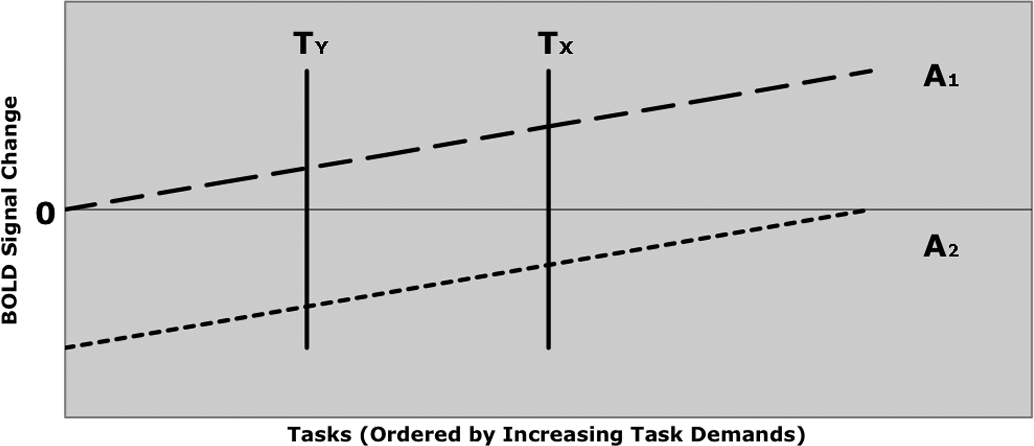
What about the qualitative different depicted in figure 13B? Is it confounded by confounds that are not implausible and hard to control? Suppose that TX and TY recruit a single process whose neural correlate includes A1 and A2. Figure 16 represents the task demand functions of these two areas. For both A1 and A2, the task demand functions are monotonically increasing; for A1, greater task demands correspond to greater activation, while for A2, greater task demands correspond to less deactivation. In this situation, inferring that two distinct processes underlie X and Y on the basis of the qualitative difference represented by figure 13B would be erroneous.
Task demand functions of A1 and A2.

However, this situation is not very plausible since it is hard to see why the part of the neural correlate of a single process would be more deactivated by tasks imposing low task demands than by tasks imposing large task demands. In any case, if it occurs at all, it is unlikely to occur often. As a result, inferences that would be based on the qualitative difference depicted in figure 15B would be on relatively safe grounds. However, this result should provide little comfort to cognitive neuroscientists since the kind of BOLD dissociations depicted in figure 15B is, at the very least, very infrequent.
4.5. Summary
At this point, it would be useful to summarize what has been learned in this section. The upshot can be put simply: in general, cognitive-neuroscientific inferences involving BOLD dissociations are weaker or less useful than their neuropsychological counterparts, being more likely to be confounded, having confounds that are harder to control for, or requiring BOLD dissociations that do not seem to occur frequently in cognitive-neuroscientific research. This is the case of the inferences from single BOLD dissociations, double BOLD dissociations, and Henson's qualitative differences.
But how weak are these cognitive-neuroscientific inferences? And how useful are they? After all, even if they are weaker and less useful than their neuropsychological counterparts, they could still be on a good footing. Absolute judgments are of course difficult to make and should be taken with caution. Still, the discussion so far suggests that by themselves single and double BOLD dissociations provide a weak basis for inferring that two distinct sets of processes underwrite two competences. Qualitative differences provide a stronger basis, although how strong they are is unclear. The first type of qualitative difference (fig. 13A) would lead to error if completing easier tasks requires the inhibition of subroutines, a situation whose frequency is unclear but that can plausibly occur. The second type of qualitative difference (fig. 13B) provides a strong basis for inferring a partitioning conclusion, but, as already noted, this pattern does not turn up often in cognitive-neuroscientific research.
This situation stands in contrast with the inferences from dissociations in neuropsychology. Double dissociations offer a strong and useful evidential basis for inferring partitioning conclusions, while, if resource functions are strictly monotonic, as they are likely to be, reverse associations entail such conclusions.
5. Conclusion
Many cognitive neuroscientists hold out hope that neuroimages, particularly those obtained by means of fMRI, will be more useful than behavioral data for understanding the mind. To do so, however, we need precise characterizations of the inferences bringing neuroimages to bear on psychological hypotheses as well as a detailed examination of the epistemic standing of these inferences. Henson (Reference Henson2005, Reference Henson2006) has done a great service to the cognitive-neuroscientific community by precisely characterizing function-to-structure inferences, which use the cognitive-neuroscientific counterparts of neuropsychological dissociations (BOLD dissociations) to answer counting questions. In this article, I have compared the epistemic standing of the inferences based on dissociations and on BOLD dissociations. This comparison casts doubt on cognitive neuroscientists’ hope: the neuropsychological inferences from dissociations are stronger than their cognitive-neuroscientific counterparts. Thus, a traditional form of behavioral evidence seems to be more useful for psychological purposes than its brain-imagery counterparts.