Introduction
In the UK it is now national policy to implement specialist early intervention services for people with psychosis (Department of Health, 2001). An increasing number of new clinical services are being set up to identify and manage people in the early phase of psychotic disorders. These services often aim to intervene as soon as possible after the onset of the first episode of psychosis. A long duration of untreated psychosis (DUP) has been associated with a poor long-term outcome in psychosis (Marshall et al. Reference Marshall, Lewis, Lockwood, Drake, Jones and Croudace2005), and it is hoped that early intervention will reduce the DUP and thereby improve clinical outcome. It is also possible to intervene during the prodromal or ‘at-risk’ phase of the illness, before the first episode. Intervention at this stage has the potential to dramatically reduce the DUP, as the client has already engaged with services before the onset of illness (Yung et al. Reference Yung, Phillips, Yuen, Francey, McFarlane, Hallgren and McGorry2003, Reference Yung, Phillips, Yuen and McGorry2004; Morrison et al. Reference Morrison, French, Walford, Lewis, Kilcommons, Green, Parker and Bentall2004; Broome et al. Reference Broome, Woolley, Johns, Valmaggia, Tabraham, Gafoor, Bramon and McGuire2005). Furthermore, there is also some evidence that intervention in the high-risk phase can reduce the risk of psychosis developing at all, that is it may have a preventative effect. For example, previous studies found that treatment reduced the rate of transition to psychosis in people with prodromal symptoms from 35% to 15% (McGorry et al. Reference McGorry, Yung, Phillips, Yuen, Francey, Cosgrave, Germano, Bravin, McDonald, Blair, Adlard and Jackson2002; McGlashan et al. Reference McGlashan, Zipursky, Perkins, Addington, Miller, Woods, Hawkins, Hoffman, Preda, Epstein, Addington, Lindborg, Trzaskoma, Tohen and Breier2006).
The extent to which the potential clinical benefits of early intervention impact on the costs of managing people with psychosis is unclear (Mihalopoulos et al. Reference Mihalopoulos, McGorry and Carter1999; Malla et al. Reference Malla, Norman and Joober2005). Considerations of affordability and cost-effectiveness may be crucial, given the scarcity of health-care services, particularly for new developments. The aim of this study was to assess the economic impact of an early intervention service using a modelling approach. We studied Outreach and Support in South London (OASIS), a clinical service for people with an at-risk mental state (ARMS), who have a very high risk of developing psychosis. This was compared with the cost of treatment as usual for people presenting with a first episode of psychosis without having had prior contact with mental health services. We tested the hypothesis that the early intervention service would be cost-effective over the initial 2 years of treatment.
Method
Early intervention service
Data regarding subjects with an ARMS were obtained from referrals to OASIS, a clinical service located in South London, an area of substantial social deprivation and high mental health needs. A detailed description of this service is available elsewhere (Broome et al. Reference Broome, Woolley, Johns, Valmaggia, Tabraham, Gafoor, Bramon and McGuire2005). In brief, OASIS manages individuals that have an ARMS for psychosis (Yung et al. Reference Yung, Phillips, McGorry, McFarlane, Francey, Harrigan, Patton and Jackson1998), which, in the absence of intervention, is associated with a 33–45% risk of developing a psychotic disorder within 24 months (Yung et al. Reference Yung, Phillips, Yuen, Francey, McFarlane, Hallgren and McGorry2003). An individual can meet the criteria for an ARMS if they show one of the following: (1) ‘attenuated’ positive psychotic symptoms; (2) a brief psychotic episode of <1 week's duration that resolves without antipsychotic medication; or (3) a recent decline in functioning coupled with either schizotypal personality disorder or a first-degree relative with psychosis. The presence of the ARMS was determined by a detailed clinical assessment using the Comprehensive Assessment of At Risk Mental States (CAARMS; Phillips et al. Reference Phillips, Yung and McGorry2000). Referrals to OASIS could be made by clients, their relatives, health professionals and other agencies, such as college tutors. New referrals were contacted by telephone for an initial screening focused around the inclusion criteria by a clinical psychologist or a psychiatrist, usually at the surgery of the client's general practitioner (GP).
Clients who meet ARMS criteria were provided with an intervention package that comprised information about their symptoms, practical and social support, and the offer of cognitive behaviour therapy (CBT) and medication (a low-dose antipsychotic or an antidepressant). Those who did not meet ARMS criteria were referred back to the referrer with advice or referred to another mental health service more appropriate for their needs.
Referrals to OASIS
Over 48 months (January 2002–December 2006) OASIS received 451 referrals. Most came from primary care (28%) or from the triage duty nurse of a community mental health team (CMHT) (26%). The local first-episode team referred 16% of the cases and the Accident and Emergency departments referred 4%. Twelve per cent were self-referred and 4% were referred by a friend or relative. Colleges referred 3% of referrals and the remaining 7% of referrals came from other National Health Service (NHS) services, voluntary services and private practice.
Of the 451 referrals received, 84 individuals were screened out either after discussion with the referrer or because they were living outside the boroughs served by the NHS Trust, or because they were outside the age range of the service. An assessment was offered to the remaining 367 suitable referrals, and of these, 68 clients either refused an assessment or recurrently failed to meet with the team. Of the 299 assessments carried out by OASIS, 114 (31% of all suitable referrals, 38% of assessments) met criteria for the ARMS. The mean age of ARMS clients was 24 years (sd=4.71) and 58.8% were male. Most subjects (64.9%) were working or studying.
Three ARMS clients (2.7%) moved out of the area after assessment and 15 (13.1%) refused any intervention after the initial assessment. Eleven (9.6%) agreed to be monitored on a monthly basis and 75 (65.8%) received CBT either as a stand-alone treatment or in combination with antipsychotic medication (n=26, 22.8%) or antidepressants (n=10, 8.8%). Eight clients (7%) chose antipsychotic medication and monitoring, and two (1.8%) clients preferred a combination of antidepressants and monitoring.
Transition to psychosis
Twenty-four (21%) of the 114 clients who met ARMS criteria subsequently developed a first episode of psychosis. Two who made a transition were in the group who denied any interventions after the initial assessment, both were admitted to hospital, one informally and one under the Mental Health Act. One of the patients who moved elsewhere also made a transition but did not need an admission. The mean DUP in all those who made a transition was 10.8 days. The majority of clients who made a transition did not need admission (n=15, 63%), two (8%) were sectioned and seven (29%) were admitted informally within 1 month of transition. At 1-year follow-up only three (13%) had an informal admission.
Care as usual (CAU)
Data on care as usual (CAU) were obtained from the Lambeth Early Onset (LEO) Service, an early intervention team for people with a first episode of psychosis in the same geographical area of South London (Craig et al. Reference Craig, Garety, Power, Rahaman, Colbert, Fornells-Ambrojo and Dunn2004; Power et al. Reference Power, McGuire, Iacoponi, Garety, Morris, Valmaggia, Grafton and Craig2009). None of them had received any form of specialized mental health intervention for the high risk of developing psychosis.
Decision tree structure
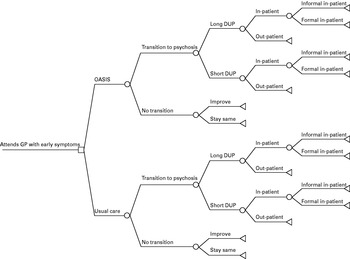
A decision model was developed to estimate the costs of the OASIS service compared to the costs of CAU over 12 and 24 months (Fig. 1). Following initial contact with a GP, the decision model was divided into two: the OASIS subtree and the CAU subtree. Screening costs were not included in the model. As can be seen from Fig. 1, the two parts of the model are identical in structure and show that, in both cases, after contact with the service a patient may either make a transition to psychosis or not make such a transition. Previous data from OASIS indicate that transition takes place on average 12 months after contact with the GP or OASIS (Valmaggia et al., unpublished observations). Once a transition has been made, the period from the onset of psychosis to first contact with mental health services or, in the case of OASIS, another mental health service is defined as the DUP. The tree modelling structure requires continuous variables to be categorized, therefore the DUP was defined as either ‘long’ or ‘short’. Based on the results from the AESOP study (Morgan et al. Reference Morgan, Mallett, Hutchinson, Bagalote, Morgan, Fearon, Dazzan, Boydell, McKenzie, Harrison, Murray, Jones, Craig and Leff2005), in the present study a short DUP was defined as a DUP of ⩽8 weeks. In the model, the DUP may be followed either by ‘out-patient care’ (here broadly defined as treatment by any community mental health service) or admission to hospital. If a patient is admitted, this may be either formally (i.e. compulsory, on a Section of the UK 1983 Mental Health Act) or informally (voluntary). If a patient does not make a transition to psychosis and continues to receive input from OASIS/CAU, they may either remain in a similar clinical state (‘stay same’) or ‘improve’, hence the corresponding branches in the model (Fig. 1).
Decision model.

Model probabilities
With the exception of the square ‘decision node’ at the beginning of the decision tree in Fig. 1, branches emanate from ‘chance nodes’ where there is a probability (P) of taking one route and another probability (1 – P) of taking the alternative route. Based on previous clinical data from OASIS and analogous services elsewhere (e.g. Broome et al. Reference Broome, Woolley, Johns, Valmaggia, Tabraham, Gafoor, Bramon and McGuire2005; Cornblatt et al. Reference Cornblatt, Lencz, Smith, Olsen, Auther, Nakayama, Lesser, Tai, Shah, Foley, Kane and Correll2007; Morrison et al. Reference Morrison, French, Parker, Roberts, Stevens, Bentall and Lewis2007; Phillips et al. Reference Phillips, McGorry, Pan Yuen, Ward, Donovan, Kelly, Francey and Yung2007), the probability of making a transition to psychosis for individuals managed by OASIS was estimated to be 0.20. From transition rates reported in naturalistic follow-up studies of ARMS individuals who were not provided with treatment (Miller et al. Reference Miller, McGlashan, Rosen, Somjee, Markovich, Stein and Woods2002; Yung et al. Reference Yung, Phillips, Yuen, Francey, McFarlane, Hallgren and McGorry2003, Reference Yung, Phillips, Yuen and McGorry2004), we estimated a transition rate to psychosis for the usual care part of the tree of 0.35.
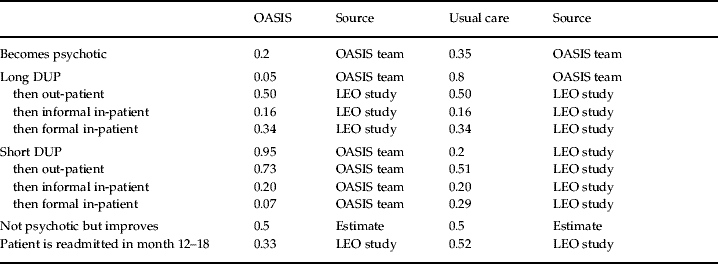
The observed probability of a long DUP (defined here as >8 weeks) was 0.05 in the OASIS group versus the widely reported 0.8 in first-episode services (Marshall et al. Reference Marshall, Lewis, Lockwood, Drake, Jones and Croudace2005). The probabilities of receiving out-patient care, formal in-patient care followed by out-patient care, or informal in-patient care followed by out-patient care for OASIS or CAU patients were obtained from a previous randomized trial of early intervention in first-episode patients from the same geographical area, with data being taken from the standard care part of that study (Craig et al. Reference Craig, Garety, Power, Rahaman, Colbert, Fornells-Ambrojo and Dunn2004). The probabilities of OASIS clients using these services following a short DUP were obtained from a clinical audit of data collected by OASIS. Finally, the OASIS team provided data on the probability that clients who had not made a transition to psychosis would experience an improvement in health. These data were not available for the CAU patients (as they had not been seen prior to the onset of psychosis) and to be conservative they were assumed to be the same as for the OASIS group. Although not specifically shown in the model, to estimate costs over 24 months we also needed to make an assumption about readmission rates to hospital. Again, these were taken from a recent study of local first-episode patients, which revealed a readmission rate of 33% for patients receiving early intervention from LEO services and 51% for those receiving treatment from generic services. The actual probabilities used in the base-case analysis are shown in Table 1, along with their sources.
Tree probabilities used for the OASIS model
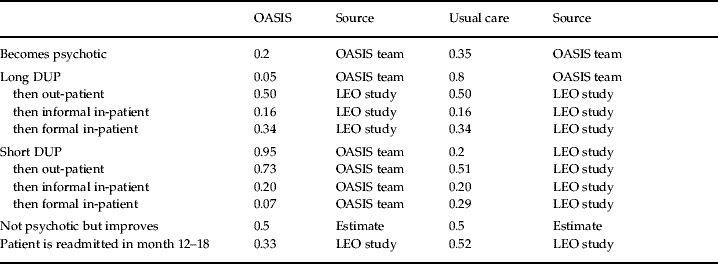
OASIS, Outreach and Support in South London; LEO, Lambeth Early Onset; DUP, duration of psychosis.
Model costs
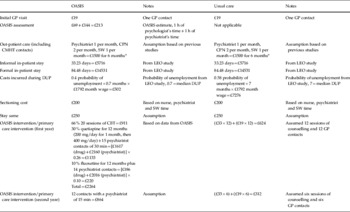
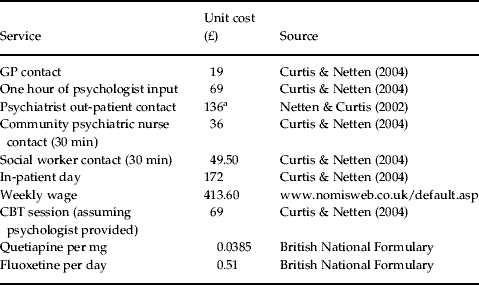
We aimed to take a societal perspective to measuring costs in that both health costs and lost production costs were included. However, costs are also presented with and without lost production. Where possible, service costs (see Table 2) were calculated using OASIS team information, published and unpublished data from a previous study involving LEO services (Craig et al. Reference Craig, Garety, Power, Rahaman, Colbert, Fornells-Ambrojo and Dunn2004), and unit costs from a recognized national source (see Table 3) (Curtis & Netten, Reference Curtis and Netten2004).
Costs required for the OASIS model

OASIS, Outreach and Support in South London; LEO, Lambeth Early Onset; DUP, duration of psychosis; GP, general practitioner; CMHT, Community Mental Health Team; CPN, community psychiatric nurse; SW, social worker; CBT, cognitive behaviour therapy.
a Out-patient costs were rounded down from £1593 to £1500 for both groups.
Unit costs used in analyses
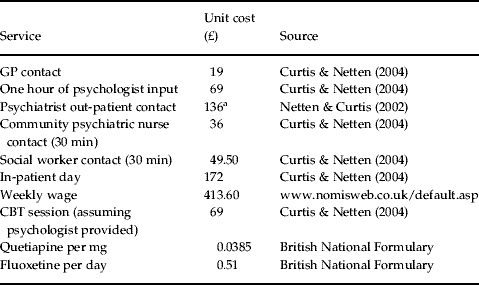
GP, General practitioner; CBT, cognitive behavioural therapy.
a Inflated to £144 using multiplier of 1.05 derived from Curtis & Netten (Reference Curtis and Netten2004).
It was assumed that all patients would initially have one GP attendance. OASIS subjects had an initial 1-h assessment with a psychiatrist and a clinical psychologist, prior to any subsequent care being provided. The types of treatment provided during the first year from presentation to OASIS were estimated on the basis of an audit of clinical practice in the service reported above. Clients are offered both psychological treatment and medication and a different proportion elects to receive each treatment. Thus it was estimated that (i) 66% of OASIS clients would receive up to 20×45-min sessions of CBT, delivered by a clinical psychologist; (ii) 30% would receive up to 12 months of treatment with quetiapine at a daily dose of up to 200 mg in the first month, rising to a maximum of 400 mg per day thereafter, plus up to 15 psychiatrist contacts; and (iii) 10% of subjects would receive up to 12 months of treatment with fluoxetine at a daily dose of 20 mg, plus 14 psychiatrist contacts. In practice, many subjects would not receive the maximum number of psychology sessions, psychiatric consultations or the maximum dose of medication, so these figures probably overestimate the associated costs. Costs over the subsequent 12 months were estimated on the assumption that subjects would then enter a ‘monitoring phase’, where they would receive 15 min of care per month from a clinician (unless they had made a transition to psychosis). Again, this mirrors standard clinical practice in OASIS.
In the absence of any reference data for CAU (as mental health care is not usually provided at this stage), we assumed that, in the absence of a service for people with an ARMS, an individual experiencing prodromal symptoms would have six contacts with a counsellor and six contacts with a GP during the first 12 months. We assumed that this rate of contact with GPs and counsellors would be halved during the second 12 months. As with all other assumptions of the model, this assumption was subject to sensitivity analysis.
Social costs were calculated on the basis of the costs of lost employment when subjects were psychotic but not receiving treatment from mental health services (the period of untreated psychosis). Using data from a previous study of first-episode patients in the same geographical area (Craig et al. Reference Craig, Garety, Power, Rahaman, Colbert, Fornells-Ambrojo and Dunn2004), it was estimated that patients with a short DUP would have a 52% chance of being unemployed, with a median DUP of 3.03 weeks. In the local population at the time of that first-episode study (Craig et al. Reference Craig, Garety, Power, Rahaman, Colbert, Fornells-Ambrojo and Dunn2004), the prevailing unemployment rate was 12% (Office for National Statistics, 2009). Therefore, there was an ‘excess’ rate of 40% for those with a short DUP. With a weekly wage in the UK of £413.60 (Office for National Statistics, 2004), this equates to a lost employment cost of £502 per person (£413.60×3.03 weeks×0.4 probability of being unemployed). For patients with a long DUP (>8 weeks), the median DUP was 30.3 weeks and there was a 70% chance of this group being unemployed; an excess of 58% over the prevailing unemployment rate. Therefore, the lost employment cost for long DUP patients was estimated as £7276 per person (£413.60×30.33 weeks×0.58 probability of being unemployed).
All costs used in the base-case analysis are listed in Table 2. The average costs for patients who became psychotic, out-patient care, formal in-patient care (admission under the Mental Health Act) and informal (voluntary) in-patient care were all taken from a previous study in local first-episode patients (Craig et al. Reference Craig, Garety, Power, Rahaman, Colbert, Fornells-Ambrojo and Dunn2004). Both the formal and informal in-patient categories also included out-patient costs. The out-patient costs were estimated to consist of six psychiatrist contacts, 12 community mental health nurse contacts and six social worker contacts per year; these costs were £1593 but rounded down to £1500 for both groups.
In an analysis of mental health service activity across London, Lambeth was shown to have had 1280 admissions to adult psychiatric wards over a 1-year period (McCrone & Jacobson, Reference McCrone and Jacobson2004). The mean length of stay was 45 days. London as a whole had on average 679 admission per area with a mean length of stay of 48 days. These data, however, were not specific to psychosis but included all admissions to psychiatric hospitals and did not differentiate between informal and formal admissions. In the absence of data that were specific to admissions for psychosis, we used data from a previous first study of local first-episode patients (Craig et al. Reference Craig, Garety, Power, Rahaman, Colbert, Fornells-Ambrojo and Dunn2004) to estimate the length of in-patient stay to be 33.23 days for patients informally admitted and 84.48 days for those compulsorily detained.
As it was assumed that patients who became psychotic did so after an average of 12 months from the initial contact with a GP, according to this model those patients with a long DUP could not therefore have been seen by a CMHT or have been admitted to hospital within the first 12 months. In reality, some subjects will develop psychosis within the first 12 months, but it was necessary to use an average figure in the model. Consequently, in the model we used, costs associated with hospital admission are picked up at 24 months, but not at 12 months.
Analyses
The tree was ‘rolled-back’ to reveal the expected costs of the OASIS and CAU. Decision tree models are helpful in the absence of trial-based data, but they are greatly influenced by the assumptions behind the values of particular parameters. Given the inevitable degree of uncertainty around the various probabilities used in the model, we conducted a series of one-way sensitivity analyses around these parameters. Probability values were varied between 0 and 1. The model was constructed and analyses performed using the Data 4.0 software package (Treeage Software Inc., 2002).
Results
Costs at 12 months
The model revealed that, over the first 12 months, the expected costs of the OASIS intervention were £2596 per person, whereas the expected costs of CAU were £724 per person. These higher costs partly reflected the absence of treatment from a CMHT in the CAU arm and the fact that, in the model used, transition to psychosis (and the associated costs) did not occur until 12 months after referral.
Costs at 24 months
Expected service costs (i.e. excluding lost employment) over 24 months were £4313 for OASIS and £3285 for usual care (a difference of £1028). Total costs (i.e. including lost employment) over 24 months were £4396 for OASIS compared to £5357 for CAU (a difference of £961).
Sensitivity analyses
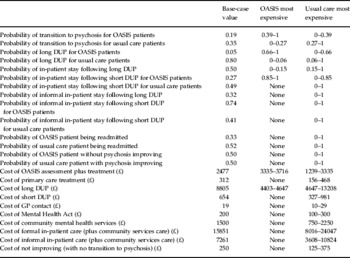
Table 4 shows that large changes from the base-case probabilities would be required to change the results substantially over 24 months. The 24-month cost finding in favour of OASIS was sensitive to the costs associated with a long DUP. If this fell below £3841, which is very unlikely as the base case was £7276, then OASIS would be more expensive. The savings for OASIS would also be removed if the 12-month cost of care from the OASIS team rose above £3439 from a base case of £2477. Out-patient costs had been rounded down to £1500 for both groups, but differences around this figure did not change the results to any substantial degree.
Sensitivity analyses for 24-month model

OASIS, Outreach and Support in South London; DUP, duration of psychosis; GP, general practitioner.
Discussion
Early detection and intervention
An assumption of the study was that all patients who go on to develop psychosis would have experienced a period of ARMS prior to developing psychosis. The Age, Beginning and Course (ABC) study by Häfner et al. (Reference Häfner, Maurer, Ruhrmann, Bechdolf, Klosterkötter, Wagner, Maier, Bottlender, Möller, Gaebel and Wölwer2004) indicated that all patients with schizophrenia went through a similar prodromal phase; however, this may vary in duration and may not always have been detected. There is less information on affective psychoses, but the available data suggest that there is also a prodrome that all patients pass through before developing bipolar disorder (e.g. Correll et al. Reference Correll, Penzner, Lencz, Auther, Smith, Malhotra, Kane and Cornblatt2007). A possible limitation of the study is that OASIS tends to include people experiencing attenuated psychotic symptoms. People presenting with non-psychotic prodromal may therefore not be recognized as having been at risk.
Although the majority of patients who develop psychosis will have gone through an ‘at-risk’ phase, only a subset (about a third) of people with an ARMS later develop a psychotic disorder (Bentall & Morrison, Reference Bentall and Morrison2002; Warner, Reference Warner2005). In view of ethical concerns about intervention in people who may never develop psychosis, clinical management in the ARMS is currently limited to those who want help (McGuire, Reference McGuire2002). As a result, the size of the population of individuals who have ‘at-risk’ symptoms but do not seek clinical help is unknown. This issue may be addressed in epidemiological studies of the prevalence of ‘at-risk’ symptoms in the general population.
Economic impact
It has been suggested that a decrease in costs associated with psychotic disorders could be achieved by intervening in the early stages of the disorder (Andlin-Sobocki & Rössler, Reference Andlin-Sobocki and Rössler2005). Our aim was to design a model to estimate the short-term economic impact of a service for people at very high risk of psychosis. We compared the costs of managing individuals referred to OASIS, a clinical service for this group, with those for existing patterns of care, using local rates of transition to psychosis and the DUP as key parameters. The costs associated with a referral to OASIS or standard care were calculated on the basis of the unemployment during the period of untreated psychosis and service contacts subsequent to the referral. Based on this model, OASIS was cost saving over a 2-year period, mainly through a reduction in the number of subjects with a long DUP and a reduction in the proportion of subjects making a transition to psychosis. Focusing only on service costs indicated that OASIS would be more expensive than CAU. This underlines the importance of the perspective used in estimating the costs of care. A health service perspective may be required by agencies responsible for allocating health resources but it may not capture the full economic impact of the intervention. A further caveat is that the present analysis was limited to the first 24 months of treatment. Psychotic disorders are typically lifelong, and the present study did not examine the long-term benefits of the early intervention.
The savings in total costs over 24 months from the OASIS intervention would disappear if many more OASIS patients were to go on to develop psychosis after 24 months. At present it is unclear whether the reported effect of intervention on the transition rate in the ARMS is permanent or delays the point of transition. Although naturalistic follow-up studies of untreated subjects indicate that very few transitions occur after the first 24 months (Cannon et al. Reference Cannon, Cornblatt and McGorry2007), this issue needs to be addressed using long-term follow-up data. Savings would also disappear if an atypically small proportion of CAU subjects had a long DUP or if substantially fewer cases in this group made a transition to psychosis. However, in the absence of fundamental changes in the organization of generic mental health services or factors influencing the incidence of psychosis, these possibilities are unlikely. It should be noted that the present estimates pertain only to the costs of the first 24 months of care. However, psychotic disorders often affect the individual for most of their adult life. If intervention in the high-risk phase reduces the number of people developing psychosis and also reduces the DUP in those who do become psychotic, the economic impact beyond the first 24 months is likely to be substantially greater.
Limitations
As in all economic models, the analyses were limited by the data available, and it is unclear how the findings would be replicated in a different setting or a different area. However, we deliberately adopted conservative estimates of several parameters in an attempt to reduce the chance of overestimating any savings from OASIS. For example, we assumed that OASIS clients receiving CBT would receive the maximum number of sessions (20); similarly, we assumed that those receiving medication would do so at the maximum dose for the maximum duration of time, and would have the maximum possible number of psychiatric consultations, when in practice most clients will receive less than the maximum. Furthermore, to be conservative we restricted the costs of CAU only to the costs of GP or GP counsellor visits and may therefore have underestimated the costs for the CAU group.
The main limitation of this study is that, although largely based on observational data drawn from two services in South London, and supported by observational data from elsewhere where necessary (and where available), the conclusions are unlikely be as robust as those stemming from a randomized trial. Nevertheless, using data generated by real-world services perhaps offers more realistic indications of the potential economic impacts of early intervention services for psychosis. Another limiting factor is that the cost estimates apply to our local area; however, it is worth pointing out that the tree model structure can easily be tailored to other areas and other settings by changing the model costs and probabilities according to local findings. In addition, sensitivity analyses were conducted to test the robustness of the results. A further limitation was that, although we aimed for a perspective, costs associated with the DUP were limited to lost employment and indirect costs were based on employment rate at the time of the study. Clearly, other costs might occur, for example the costs of social care and criminal justice involvement, in addition to the costs to families and friends in terms of unpaid care or time taken off work (McCrone, Reference McCrone2007) during that period and therefore the savings from intervening earlier may be greater. Finally, costs calculations did not include the costs of screening patients who did not meet criteria for an ARMS for psychosis.
Clinical implications
Clinical intervention in people at very high risk of psychosis has the potential to save costs in the long term by reducing the risk of transition to psychosis.
Acknowledgements
This study was supported by the Guy's and St Thomas' Charitable Foundation, The Wellcome Trust and the UK's Department of Health. We are grateful to Professor Tom Craig and Professor Philippa Garety for allowing us to use the LEO data. Our special thanks go to the staff and patients of OASIS and LEO.
Declaration of Interest
None.