1. Introduction
Dmitrii Ivanovich Mendeleev’s periodic system is often remembered for its predictive accuracy, but talk of its completeness is more rare.Footnote 1 This absence is surprising, because Mendeleev himself viewed completeness (polnost’) as an important quality for his system. In this article, I provide a novel analysis on Mendeleev’s valuing of completeness during the development of the periodic system in 1869–71. I also argue that completeness played an important supportive role in Mendeleev’s use of the periodic system for making predictions.
While completeness has not been thoroughly analyzed in relation to Mendeleev’s system, it makes an occasional appearance in philosophy of chemistry (Chang Reference Chang2012, 22; Llored Reference Llored2017, 64). In section 2, I take Hasok Chang’s definition of completeness, introduced in his account of the Chemical Revolution, and contextualize it to reflect some of the specific concerns arising from systematizing chemical elements in the mid-nineteenth century. In section 3, I introduce five indicators of completeness present in Mendeleev’s articles on the periodic systems that he published between 1869–71. In section 4, I then zoom into one of the indicators of completeness, the schematic row of oxides, and show how it played a crucial part in Mendeleev’s predictions of the properties of little-known and unknown elements. After introducing Mendeleev’s predictions concerning indium and ekaboron/scandium in section 5, I show how it becomes clear that Mendeleev used the periodic system in making predictions—a point that has been recently contested by Woody (Reference Woody, Soler, Zwart, Lynch and Israel-Jost2014, 134).
I conclude by reflecting how investigating values in the context of developing scientific representations can give us useful insights to the relationship between values and further applications of scientific representations. Usually, when Mendeleev’s periodic system is looked at through the lenses of values, most of the attention is given to its predictive accuracy (Lipton Reference Lipton1990; Barnes Reference Barnes2008) or its coherence (Schindler Reference Schindler2014). However, focus on predictive accuracy tilts attention to the context of justifying the system or its reception. Similarly to Elliott and McKaughan (Reference Elliott and McKaughan2009), I advocate investigating values in contexts other than justification. In particular, investigating values in the context of developing scientific representations shows how values may support later applications of those representations.
2. Defining Completeness
In his account of the Chemical Revolution, Chang (Reference Chang2012) argues that the valuing of completeness distinguished Joseph Priestley’s account of combustion from Antoine Lavoisier’s oxygenist account. In this setting, Chang defines completeness as “wanting to account for all the observed phenomena in a given problem area and for all the observed aspects of those phenomena” (22). By bringing in the notion of a problem area, Chang gives a localized idea of completeness, which makes his account different from the more familiar understanding of completeness as a global aim for science (e.g., Hoyningen-Huene Reference Hoyningen-Huene2013, 36–37, 125–34). The notion of a problem area makes Chang’s articulation of completeness more attainable, as it only calls for completeness with respect to a particular problem at hand. While this renders completeness an achievable goal, it is still in some respects quite wide, as it requires accounting for all the observed phenomena and all their aspects. However, Chang’s definition of completeness is also somewhat restrictive, as it only calls for accounting observed phenomena. In what follows, I suggest ways of modifying the definition of completeness to address these worries.
Let us start with it being too demanding. By the 1860s, there was a considerable amount of information concerning elements and their compounds, which meant that teachers of chemistry had to look for effective ways of introducing the multitude of chemical findings to their students. In Bensaude-Vincent’s words, the chemistry teacher “was compelled to teach a long and arduous list of monographs describing each of the known elements. The endless growing population of elements seemed to condemn chemistry to something like a natural history of chemical substances” (Reference Bensaude-Vincent1986, 5). Interestingly, many of the systematizations that were later recognized as precursors to the modern periodic system were formulated as a solution for this pedagogical problem (see Gordin Reference Gordin, Biagoli and Riskin2012).
The plethora of chemical findings suggests that it would be too demanding to require that a system accounted for all the observed phenomena and their observed aspects. Instead of having to account for everything, I suggest that it is enough for completeness to account for those features that chemists themselves deemed to be most important or relevant. For example, the English chemist J. A. R. Newlands (Reference Newlands1863, 71), who competed for the priority of discovering the periodic system, mentioned that chemical features were primary in guiding his first grouping of 1863. This implied that physical features, like metallic appearance, were not as important in the assembly of his systems.
Apart from narrowing Chang’s definition to make completeness more attainable, it also needs to be wider if we wish to apply it to account for the completeness of Mendeleev’s periodic system. As we saw, Chang suggested that completeness involves accounting for observed phenomena. However, the specific concerns arising from systematizing the elements requires also saying something about phenomena that are likely to enter the problem area. This is because by the end of 1860s, it was believed that new elements would be discovered. For example, one of the objections to Newlands’s system was that his arrangement did not make it clear how new elements might be incorporated into its framework (Newlands Reference Newlands1866, 113). The possibility of new chemical elements entering the problem area calls for broadening the definition of completeness: it is not enough just to say something about observed phenomena, but something also needs to be added about phenomena that are likely to enter the problem area.Footnote 2
On these grounds, I suggest the following modifications to Chang’s definition of completeness:
Valuing of completeness involves wanting to account for many observed phenomena in a given problem area, giving special attention to phenomena that are deemed most relevant, and saying something about accommodating phenomena that are likely to enter the problem area.
Now that we are armed with this definition, it becomes easier to explain how Mendeleev emphasized completeness in developing his systematization. Taking the task of systematization of the elements as Mendeleev’s chosen problem area (Reference Mendeleev and Kedrov1869/1958, 14–15, 16), I proceed to discuss the following five indicators of Mendeleev’s valuing of completeness: Mendeleev’s (1) inclusion of all of the substances that were suspected to be chemical elements, (2) demonstration of how unknown elements might be included, (3) evaluations of systematization attempts by other chemists, (4) emphasis on how all the properties of elements should be kept in sight, and (5) bringing many observed aspects of the elements into the arrangement. The difference between the latter two is that 4 consists mostly of Mendeleev’s comments on how several properties should be kept in sight, whereas 5 shows that Mendeleev in fact followed his own guidelines and included several findings to his systems.
3. Polnost’ and the Periodic System
Mendeleev’s aim for completeness is already visible in his first attempt to classify the elements. If we compare this system with those of Newlands, the English chemist William Odling, and the German chemist Julius Lothar Meyer, it is noticeable that Mendeleev included a greater number of elements. Meyer’s earliest tables had 50 elements (Meyer Reference Meyer1864, 137–38). By 1868, the number rose to 53, and by 1870 to 55, and finally, the table of 1872 included 56 elements (Seubert Reference Seubert1895). Newlands’s Law of Octaves had 62 elements in 1865 (Newlands Reference Newlands1865), and William Odling’s had 57 elements in 1864 (Odling Reference Odling1864). Mendeleev included 63 in the earliest version of the system.
With respect to the second indicator (demonstration of how unknown elements might be included) Mendeleev included numerous gaps to the system and made groups on vertical columns uneven, which suggested potential spaces for elements that would be discovered in the future. This forms a contrast especially with the neat presentation of Newlands’s systems, which were criticized for not indicating where to place new elements in case they were discovered (Newlands Reference Newlands1866, 113).
The third indicator of completeness (evaluation of systematization attempts of other chemists) shows that aiming for completeness was a normative requirement for Mendeleev. For example, when Mendeleev surveyed the previous attempts of classifying the elements, he argued that the groupings of Peter Kremers offered only “fragmentary findings that do not lead to a complete systematisation” (Reference Mendeleev and Kedrov1869/1958, 15). Moreover, when Mendeleev was considering different organizing principles for his systematization, he discarded physical properties as organizing principles on the grounds that their study is “not yet in that level of precision and generality that would allow for creating a complete scientific system” (Reference Mendeleev and Kedrov1871/1958, 103, emphasis added).
This brings us to the fourth indicator of completeness (emphasis on how all the properties of elements should be kept in sight). While Mendeleev dismissed physical properties (such as density) and chemical properties (such as acidity and basicity) as organizing principles, he maintained that they needed to be kept in sight during systematization. For example, he argued that in order to make chemical predictions, both individual and shared properties of groups should be considered (Mendeleev Reference Mendeleev and Kedrov1871/1958, 104). Also, while Mendeleev disregarded chemical properties as inadequate organizing principles, he still maintained that “they should not be left out of sight, because many aspects of chemical findings are generalized with their help” (104).
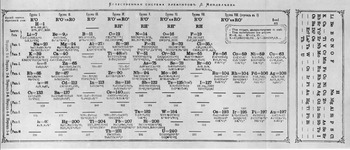
The call for including a larger variety of features does not remain just a recommendation, but Mendeleev in fact brought several observed aspects of chemical elements into the arrangement, giving us our fifth indicator of completeness. After presenting the first table, Mendeleev changed the system so as to include more information. This becomes apparent when contrasting Mendeleev’s earliest systems of 1869 with those he issued in 1871, including the one incorporated into his textbook Principles of Chemistry (see fig. 1). It is especially striking that Mendeleev included various formulas of compounds and the schematic rows of oxides and hydrides (see top rows on fig. 1). Mendeleev introduced these rows first in 1870 and included them in most of the subsequent versions of the system. Of the chemists classifying the elements in 1860–70, Mendeleev was the only one to include such rows in the system.
Table of elements. (Source: Mendeleev Reference Mendeleev and Kedrov1871/1958, 341).

4. The Row of Oxides
So far, I have updated Chang’s definition of completeness and showed how several features of Mendeleev’s papers and periodic systems of 1869–71 revealed an emphasis on completeness. In what follows, I zoom into one of the clearest visual demonstrations of the valuing of completeness—the schematic row of oxides—and show how it supported Mendeleev’s predictions of properties of little-known and unknown elements. Before doing so, I elaborate the role of this schematic row of oxides in Mendeleev’s overall project.
When examining the relationship between atomic weight and other properties of elements, Mendeleev lined the elements of the weight of 7–36 in two rows in order to draw attention to how the change of the atomic weight corresponded to the change the character of the elements:
| Li = 7 | Be = 9,4 | B = 11 | C = 12 | N = 14 | O = 16 | F = 19 |
| Na = 23 | Mg = 24 | Al = 27,3 | Si = 28 | P = 31 | S = 32 | Cl = 35,5 |
These two rows eventually became the first two horizontal rows on the periodic system (Mendeleev Reference Mendeleev and Kedrov1871/1958, 107; see also Reference Mendeleev and Kedrov1869/1958, 18). Mendeleev’s chief observation was that elements in both rows produced higher saline oxides and hydrogen compounds of similar form (Reference Mendeleev and Kedrov1871/1958, 108–9). As only four members of the rows (C, N, O, F and Si, P, S, Cl) combined with hydrogen, and all of them combined with oxygen, oxides became a more important at showing the gradual change in properties. Mendeleev suggested that the elements formed higher saline oxides in the following manner:Footnote 3
R2O, R2O2, R2O3, R2O4, R2O5, R2O6, R2O7
If we relate this row of oxides to the second row above, the elements would form such oxides as follows:
| Na2O | Mg2O2 | Al2O3 | Si2O4 | P2O5 | S2O6 | Cl2O7 |
| or | or | or | ||||
| MgO | SiO2 | SO3 |
The main reason why Mendeleev discussed the row of oxides at length was that it revealed a gradual transitioning from basicity to acidity, as when moving from left to right, the oxides transitioned from greater basicity to greater acidity. To Mendeleev, the gradual transition demonstrated the “complete naturalness” of his comparisons between the elements (Reference Mendeleev and Kedrov1871/1958, 108). By naturalness, Mendeleev implied that he was not trying to make an artificial classification (which would focus on a single property, like being metallic) but that his system took into account several features of the elements. As the oxides and hydrides served the purpose of demonstrating that periodic system was a classification of the latter type, they received considerable space in Mendeleev’s discussion. In what follows, I show how the row of oxides helped in making predictions of little-known and unknown elements. This shows how completeness supported making predictions.
5. Predicting Properties
I follow Woody (Reference Woody, Soler, Zwart, Lynch and Israel-Jost2014, 134) in distinguishing between predicting the existence of elements and predicting the properties of elements. In this section, I show how Mendeleev used the row of oxides in predicting properties of both unknown and little-known elements (indium and ekaboron/scandium).
For Mendeleev, indium allowed him to show the usefulness of the “periodic law” in determining the atomic weight of little-known elements (Reference Mendeleev and Kedrov1871/1958, 131). In order to demonstrate this usefulness, Mendeleev considered the hypothetical element Ya, which he invented for dialectical purposes. He first assumed that Ya would not be very highly oxidizing, or that the oxide was weak (133–34). On the basis of these assumptions, Mendeleev set out to determine its atomic weight and the formula for its oxide.
Mendeleev started in the first group at the far left of the table and then worked his way through the table to find a place for Ya. From the first group, the first option for the atomic weight for Ya was 38, which Mendeleev drew from the assumption that the oxide of Ya was of the composition R2O. He attempted to fit the element to its intuitive place in the first group. This would not do; the only suitable spot in first group was already taken by potassium ( ). He then changed the assumption of the composition of the oxide from R1O to RO, which changed its atomic weight to 76. However, its intuitive home in the second group offered no place for an element of this weight, as zinc (
 ) and strontium (
 ) occupied those spaces.
Mendeleev then changed the oxide from RO to R2O3, thus changing the atomic weight of Ya from 76 to 114. This solution appeared to work the best. Ya’s most intuitive placing in the third group had a space between cadmium ( ) and tin (
 ) for an element with atomic weight close to 114. When considering the oxides of cadmium and tin, their example suggested that the oxide of Ya should be weak (which was one of Mendeleev’s original assumptions for Ya). Moreover, the missing element ought to form analogies with Al2O3 and Tl2O3.
Mendeleev’s great revelation was that there was a rare element very much like Ya: indium. Its atomic weight had been assumed to be 75, but Mendeleev suggested that it should be changed to 113, with its oxide being In2O3. Indium formed analogies in the third group, together with aluminium (Al) and thallium (Tl), and with cadmium (Cd) and tin (Sn) in the seventh row (Reference Mendeleev and Kedrov1871/1958, 133–34).
The discussion of Ya/indium shows how the system was used to adjust empirically determined results. Changing the assumption of the form of indium’s oxide changed its weight. Then, checking whether there was a suitable spot for an element of that kind acted as a further guide for testing whether these assumptions on weight and oxidization were warranted. Three of the indicators of completeness were active behind the scenes in guiding these predictions: first, (1) the inclusion of 63 elements gave a greater number of comparisons for indium; second, (2) suggesting places for elements that were yet to be discovered allowed Mendeleev to identify a vacant space for indium; finally, (5) the inclusion of the row of oxides guided the assumptions of weight and oxidization. This shows that the valuing of completeness during the development of the system supported using the system for making predictions.
Mendeleev’s predictions of properties of ekaboron were different. Instead of fitting the element to its spot like he did with Ya/indium, Mendeleev used the periodic system to visualize analogical relations between elements. These visualizations then grounded his predictions concerning properties of ekaboron. As the predictions are numerous, I only focus on those that concern ekaboron’s oxide.
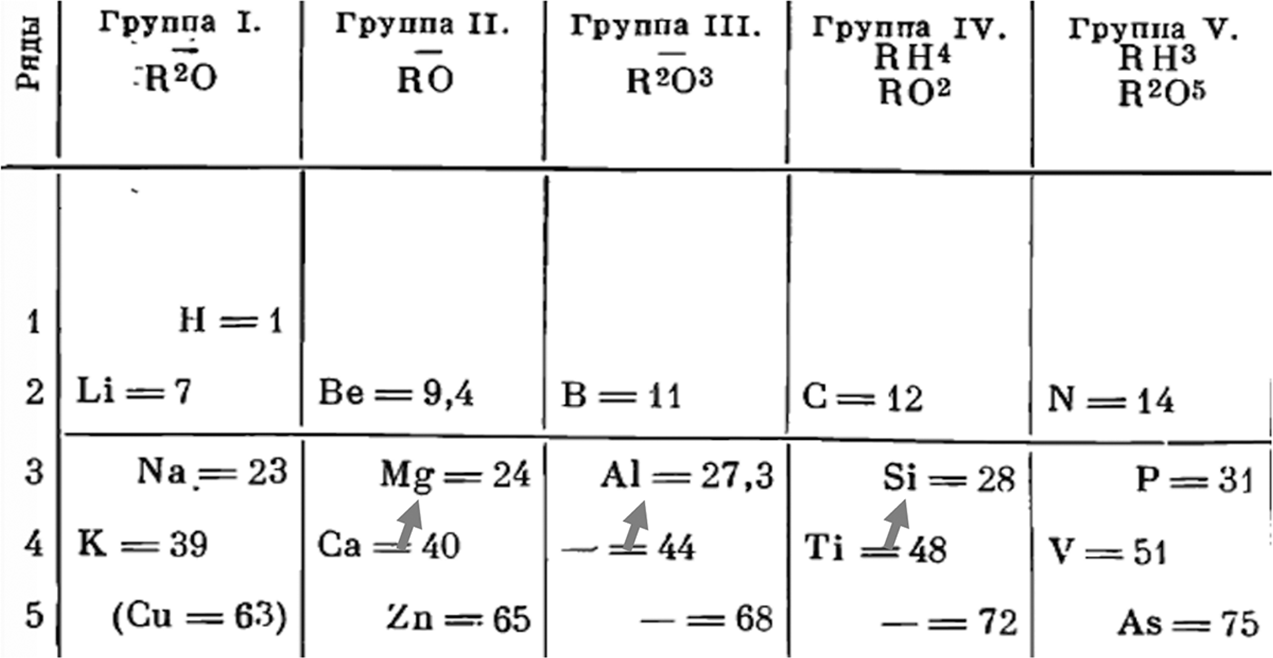
Figure 2 shows that ekaboron’s position is on the fourth row, preceded by calcium ( ) and followed by titanium (
 ). The position led Mendeleev to suggest that its atomic weight must be close to 44. As all the Group III elements provide oxides of the form R2O3, he suggested that ekaboron’s oxide must be Eb2O3 (Mendeleev Reference Mendeleev and Kedrov1871/1958, 151). Mendeleev then generalized that in all its relations, ekaboron’s oxide should show properties that are intermediate between calcium oxide (CaO) and titania (TiO2). As can be seen from the table, this corresponds to ekaboron’s position between calcium and titanium.
Close-up of table of elements. (Source: Mendeleev Reference Mendeleev and Kedrov1871/1958, 116; arrows added).

After this somewhat general prediction, Mendeleev’s descriptions become more specific. He suggested that Eb2O3 must present similar behavior toward its upstairs neighbor alumina as had been observed between ekaboron’s left-side neighbor calcium oxide (CaO) and magnesium oxide (MgO) and between ekaboron’s right-side neighbor titania (TiO2) and silica (SiO2). As aluminium is directly above ekaboron, just as magnesium is directly above calcium and silicon is above titanium, the visual position of the elements in the system coheres with the prediction that Eb2O3 behaves to alumina in the same way as calcium oxide behaves to magnesia (see fig. 2).
Mendeleev then predicted that Eb2O3 should be more basic than alumina. I suggest this is because on the left of ekaboron, CaO is more basic than MgO, and to the right of ekaboron, titania (TiO2) is more basic than silica (SiO2). As the ground-floor neighbors of ekaboron are more basic than the first floor inhabitants, and ekaboron is intermediate between its neighbors, then it must be more basic than alumina. Again, this claim corresponds to the positioning of these elements on the periodic system.
Mendeleev’s next prediction was that magnesia would be more basic than Eb2O3. He suggested this on the grounds that calcium on ekaboron’s left side is less basic than sodium (Na), and titania TiO2 on the right side of ekaboron is less basic than alumina (Al2O3). As ekaboron is the mean between the two in all its relations, then ekaboron’s oxide must be less basic than MgO.
This concludes Mendeleev’s predictions concerning ekaboron’s oxide. As with indium, the valuing of completeness supported predicting ekaboron’s properties. First, the inclusion of (1) all of the substances that were suspected to be elements allowed Mendeleev to demonstrate visual analogies more thoroughly. Second, the inclusion of gaps (2) allowed him to situate the eka-elements to the periodic system. Finally, (5) inclusion of the row of oxides grounded the predictions concerning oxidization. Thus, as with Ya/indium, completeness supported predicting properties of ekaboron, too.Footnote 4
6. Values in the Context of Development
In this article, I have analyzed Mendeleev’s approach to systematizing the chemical elements through the framework of values. In particular, I argued that Mendeleev valued completeness during the development of his system. I pointed out five different indicators across Mendeleev’s papers that speak of his valuing of completeness. As we saw, part and parcel of Mendeleev’s valuing of completeness was his inclusion of the row of oxides in the system. I then demonstrated how the row of oxides guided his predictions of the properties of little-known and unknown elements. With indium, we saw that Mendeleev used the row of oxides to guide his suggestions on its atomic weight. With ekaboron, Mendeleev used the system to visualize analogical relations between elements, which then grounded his predictions on the properties of ekaboron.
Mendeleev’s discussion of ekaboron and indium demonstrates how aiming for completeness in accommodating information on chemical elements supported Mendeleev’s further use of the system for making predictions. It also gives us a response to Woody’s (Reference Woody, Soler, Zwart, Lynch and Israel-Jost2014, 134) recent question of whether it is reasonable to assume that Mendeleev “relied on the table in making these predictions, or that in some meaningful way the table has the capacity to support such predictions.” While the system offered no clear algorithm for making predictions, with the help of a fuller system, Mendeleev could draw analogies from existing elements to areas unknown.
In contrast to existing literature, the focus here has not been on the accuracy of the predictions. The historical and philosophical literature on the periodic system often focuses on the role of prediction in the system’s justification or reception. The projects with a more philosophical emphasis center around whether we are more justified in our belief in the empirical adequacy of those theories that predict rather than accommodate, where the accuracy of Mendeleev’s predictions of properties of unknown elements is often mobilized as an example in favor of the view that successful predictions carry more “conformational weight” than accommodation of known evidence (Lipton Reference Lipton1990; Barnes Reference Barnes2008; Schindler Reference Schindler2014, 62; see Scerri and Worrall [Reference Scerri and Worrall2001] for emphasis on accommodations). The more historically inclined projects examine whether prediction or accommodation in fact influenced the reception of the systems (Brush Reference Brush1996; Kaji, Kragh, and Palló Reference Kaji, Kragh and Palló2015).
Here, I have advocated a different approach. Instead of looking at the context of justification (narrowly construed), or the reception of the systems, I have prioritized the focus on the context of developing the periodic system. In particular, this article establishes that values emphasized during the construction of a system influence its later applications. This suggests that investigating values in the context of development and then seeing how values relate to the later applications can generate helpful information on how some values might support specific uses of systems. In the case of Mendeleev, we saw that completeness supported using the system for making predictions. Whether the relationship between completeness and making predictions emerges in other historical contexts remains to be seen.