Introduction
The trend in which the international community defines a particular political regime, the democratic regime, as the ideal domestic political regime and rewards democratization or imposes sanctions against autocratization has become evident since the end of the Cold War. In this context, election monitoring has become a common means of promoting democratization. The current article presents a theoretical mechanism to explain the substantial impact election monitoring has on political change in various countries through the novel perspective of information about the international standards of electoral integrity. In other words, the article asks whether election monitoring by international observers sent by the United Nations (UN), the United States (US), the Organization for Security and Co-operation in Europe (OSCE), or the European Union (EU) promotes the (mainly developing) country's democratization.
The first impression one has when examining international election monitoring is that it has become fully established and normalized within the short period since the end of the Cold War. While only a handful of countries accepted election monitors during the Cold War, acceptance of election monitors has rapidly spread since, to the extent that, except for established Western democracies, international election monitors are invited for more than 80 percent of present-day elections (Kelley, Reference Kelley2012: 17).
What influence then has the normalization of election monitoring had on democratization in many countries? Conventionally, it has been taken for granted that there is at least no negative effect of election monitoring (i.e., it does not lead to authoritarianism). However, in reality, a number of countries that receive a judgment of ‘unfair elections’ from international election monitors do not work to improve on what is deemed to be an unfair situation. Preceding studies have not fully explained these countries’ behaviors.
In contrast to the above, the current article proposes a theoretical explanation that election monitoring does not lead to an improvement of the situation or, in some cases, leads to further fraud. In doing so, the article introduces two novel viewpoints: first, preceding studies have only focused on the influence the election monitors have on the quality of the particular (nth) election being monitored. The current article, on the other hand, examines how the monitoring of a particular (nth) election influences the following (n + 1th) election.
Second, in examining the influence on the following (n + 1th) election, the article focuses on the dimension of information. Concretely, after election monitoring takes place, a report will be published to pass judgment about the election. The article focuses on the fact that the monitored country can only obtain information about ‘international standards of electoral integrity’ through this post-election report.
As the democratic regime has been internationally defined as the ideal political regime, another concept, international standards of electoral integrity has emerged in order to administer and operate democracy. This can be seen as ‘the right way to conduct elections’ or ‘free and fair elections’ for the international community. The problem here is that international standards of electoral integrity are not objectively clear (Bland et al., Reference Bland, Green and Moore2013; Norris et al., Reference Norris, Frank and Martinez i Coma2013). There are a number of criteria to judge the fairness of elections, and they are not necessarily shared among election monitors. In addition, the criteria have been, albeit gradually, changing over time. This means that it is not necessarily clear whether the country inviting election monitors will be certified as a democratic country.
In this context, inviting election monitors and asking for a judgment means that the host country can obtain solid information about international standards of democracy, since it will allow it to learn how much election fraud can be overlooked by the international community. While the format and procedures of election monitoring varies, in many cases election monitors tend to publish a post-mission draft evaluation when they leave the country and then publish a detailed report that contains evaluations of each criterion. However, as this practice has been repeatedly criticized, it is often the case that an all-or-nothing judgment in the form of ‘whether it was fair or not’ is passed, even though a range of items are evaluated. This is partly because countries and international organizations that send out election monitors, and in some cases the monitored countries, want a clear message.
Conventionally, election monitoring has been regarded as a transmission of information from the developing countries to the international community. In other words, only the aspect through which the developing country signals its democratic credentials to the international community has been examined. However, as mentioned above, the current article proposes that election monitoring is also a route for transmitting information from the international community to the monitored country through the publication of judgments. Furthermore, by conducting a thought experiment as detailed below, the article suggests that election monitoring can lead to either democratization or the intensification of authoritarianism.
The democratic signaling and normalization of election monitoring
This section discusses the normalization of election monitoring as a necessary step to examine the article's research question: how effective is election monitoring? Since the end of the Cold War, Western countries have been more substantially involved with the international promotion of democratization. More concretely, the UN, the US, and the EU have made attempts to support democratization. The donor community, including the World Bank and the European Bank for Reconstruction and Development (EBRD), has started to link development aid to democracy. Democracy has become the requirement for membership of international organizations. Sanctions aimed at reversals of democratization, like coups d'état, etc., can also be mentioned in this context.
What becomes an issue here is the authentication of a country as democratic. While it is evident that coups d’état and large-scale human rights violations constitute deviance from democracy, in other cases it becomes necessary to set criteria to judge whether one country is democratic or not. Here, the question of whether or not free and fair elections are carried out becomes important. Needless to say, a number of scholars argue that elections cannot be the sole criterion to judge the democratic credentials of a country (Zakaria, Reference Zakaria1997). However, there is little objection to the importance that democratizing actors place on whether elections take place and to what extent they are fair in translating the democratic norm into something that can be implemented.
Election monitoring becomes important precisely because the promotion of free and fair elections features as the most important dimension of the promotion of democratization. Despite some variation in the format and procedures of election monitoring, in many cases election monitors tend to publish a draft post-mission evaluation when they leave the country and then to publish a detailed report that contains evaluations of each criterion. However, as this practice has been repeatedly criticized, even though a range of items is evaluated, it is often the case that an all-or-nothing judgment in the form of whether the election was fair or not is passed. This is partly because countries and international organizations that send out election monitors, and in some cases the monitored countries themselves, want a clear message. The number of election-monitoring missions has jumped since the 1990s, and it is clear that this surge coincides with the increased impetus for democratization after the end of the Cold War (Hyde, Reference Hyde2011: 67; Kelley, Reference Kelley2012: 16).
On the other hand, the question of why developing countries accept election monitors remains unanswered. There are many cases among developing countries in which, even if elections under the multi-party system are carried out, they are not exactly fair. These are conceptualized as authoritarian regimes with some terms such as ‘electoral authoritarianism’. In fact, the number of cases in which, while accepting the intervention by election monitors, the host country nevertheless commits fraud in front of them and ends up being criticized is increasing (Kelley, Reference Kelley2012: 18). Furthermore, criticism for election fraud by the election monitors could lead to real harm. A negative report is a strong message and often leads to sanctions (Donno, Reference Donno2013: 27). For example, election monitors uncovered large-scale election fraud in the 2005 general election in Ethiopia, which led to the suspension of development aid. In addition, the study of human rights points out that, even if no concrete sanction follows, ‘naming and shaming’ by the international community changes the country's behavior through its impact on trade and inward investment (Lebovic and Voeten, Reference Lebovic and Voeten2009). There could be negative consequences domestically, too. For instance, an ‘unfair’ verdict by the international election monitors could lead to protest, riots, or even a revolution (Hyde and Marinov, Reference Hyde and Marinov2014). More concretely, in Mexico (in 2000) and Georgia (in 2003), the ‘unfair’ verdict after the election led to a riot, and in Ukraine (in 2004) to a revolution. Why, then, with high international and domestic risks, do authoritarian regimes still want to invite election monitors? (Santa-Cruz, Reference Santa-Cruz2005: Hyde, Reference Hyde2011)
The short answer would be ‘because of pressure from advanced democracies’, but the risks identified above call for a further understanding. This can be best approached from the perspective of ‘democratic signaling’ (Hyde, Reference Hyde2011). To begin with, democracy has been normalized in the international community, and countries that engage in democratization have been rewarded. However, it is not easy to judge if a country is truly democratic or not from the outside. This means that developing countries now have to signal ‘we are democratic’ to the international community, which they achieve by actively inviting international election monitors. Needless to say, the countries that take this type of action first are those that have gone through democratization.
As it becomes commonplace for a democratized country to invite election monitors, the international community would take the view that if election monitors are not invited, there is fraud in the election process. Also, as inviting election monitors becomes widespread, not inviting them would bring serious damage to domestic legitimacy. In fact, by the 1990s, leaders no longer justified why they were inviting election monitors; instead, they had to make some excuse for not inviting election monitors (Hyde, Reference Hyde2011: 84). Therefore, even where election fraud is a fact of life, the countries have to invite election monitors (the normalization of election monitoring). As a result, a contradictory situation in which the invited election monitors pass an unfair verdict becomes commonplace.
The effectiveness of election monitoring
So far, the article has explained the logic behind the situation in which countries have no other choice than to invite election monitors, even though it is known fraud is taking place. On the other hand, the dimension of effectiveness, i.e., whether election monitoring improves the quality of elections of the host country, has not been examined extensively. One reason for this is that it has been taken for granted that election monitoring would promote democratization. In other words, the established view is that election monitoring is a powerful tool in promoting democratization, and that it contains very little that would lead to the strengthening of authoritarianism (Bjornlund, Reference Bjornlund2004; Carothers, Reference Carothers1997; Darnolf, Reference Darnolf2011; Pastor, Reference Pastor1998; Kelley, Reference Kelley2012: 129). The mechanism of election monitoring to convey the degree of fairness of a country's elections to the international community (Donno Reference Donno2013) or domestic citizens (Hyde and Marinov Reference Hyde and Marinov2014) has been pointed out as background to democracy promotion through election monitoring. Consequently, if a verdict is given that an election is unfair, it could lead to international sanctions, condemnation, or domestic protests (Beaulieu Reference Beaulieu2014), and thus states are obliged to avoid unfairness. It is argued, therefore, that election monitoring contributes to fair elections.
Although in a minority, there are some voices that question the effectiveness of election monitoring. They make two main points. First, they point to the emergence of the ‘election-monitoring shadow market’ (Kelley, Reference Kelley2012: Chap.3; Bader et al., Reference Bader, Grävingholt and Kästner2010). This is a kind of mutual-assistance system – a democracy authentication system – in which countries that habitually commit election fraud form a regional organization to supply the election monitors, who pass a ‘fair’ verdict regardless of the quality of the election. These regional organizations include the African Union (AU), the Southern African Development Community (SADC), the Commonwealth of Independent States (CIS), and the Shanghai Cooperation Organization. The existence of this shadow market for monitors does not, however, bring into question the effectiveness of election monitors from the West.
The second point concerns the authoritarian regime's adaptation to election monitoring (Simpser and Donno, Reference Simpser and Donno2012; Sjoberg, Reference Sjoberg2014). It has been pointed out that election monitors’ activity is overwhelmingly focused on the day of the election (Carothers, Reference Carothers1997: 22). Consequently, it is argued, the authoritarian government that is obliged to invite election monitors would do its best to curb election fraud committed on the day of the election by shifting fraudulent activities to the period preceding the election in order to secure democratic authentication. A possible shift in election fraud methods has been identified – from direct methods such as stuffing ballot boxes to indirect ones such as rigging courts and administration bodies and repressing the media (Simpser and Donno, Reference Simpser and Donno2012).
While some studies take for granted that election monitoring promotes democratization and others question such a view, no study has examined the effectiveness of election monitoring by focusing on the question of what impact a ‘fair’ or ‘unfair’ verdict on the election passed by the election monitors would have on the following election. What kind of action would a government that was judged to be ‘unfair’ in its conduct of an election take next time round? This is not a particularly unnatural question, and the article takes a view that there is a serious lacuna in the study of elections.
In this context, it is worth pointing out that although election monitoring has spread and become normalized, election fraud is still common (Donno, Reference Donno2013; Birch, Reference Birch2011).Footnote 1 The fact that even the countries that habitually commit election fraud have to call in election monitors, because election monitoring is established as a norm, can be explained by the logic of democratic signaling, but why election monitoring cannot eliminate election fraud is a different question. There are many countries that, upon receiving an ‘unfair’ verdict, have not improved or even worsened the fraudulent situation: Angola, Azerbaijan, Cambodia, Cameroon, Haiti, Kazakhstan, Kenya, Togo, Uganda, Uzbekistan, and Nigeria (Kelley, Reference Kelley2012: 98). In that sense, notwithstanding its short-term effects, it has been pointed out that election monitoring is not necessarily effective in the long term (Kelley, Reference Kelley2012: Chapter 8).
Needless to say, as the vast quantity of studies in comparative politics suggests, a diverse range of factors influence democratization, and even when democratization is limited to fairness in elections, there are still a number of factors in the background. For instance, election fraud is more likely to be committed if the election is closely fought (Lehoucq, Reference Lehoucq2003), if it is conducted with the single-member district system (Birch, Reference Birch2007), if the election commission is of a poor quality (Elklit, Reference Elklit1999), if there are large-scale socio-economic inequalities (Ziblatt, Reference Ziblatt2009), and if the country is less integrated in the international economy (in terms of investment and trade) (Birch, Reference Birch2011).
What remain interesting, however, is that even in Africa there are many countries that repeatedly invite election monitors and receive ‘unfair’ verdicts. In general, African countries are seen as very susceptible to external influence, and international factors are seen as more powerful than other variables in the cases of African countries. Sometimes, these African countries are ridiculed as ‘donor democracies’, which means that the government is only concerned with satisfying the donors, not its citizens (Economist, 23 November 1996: 23). For example, when donor countries, including the US, Germany, and France, decided to suspend aid to Togo due to the delay in its democratization in early 1993, the Eyadema government immediately agreed to introduce a multi-party system. As seen in this example, since the end of the Cold War, in Africa a number of one-party, authoritarian states adopted multi-party systems (many of them are electoral authoritarian systems). Consequently, it is fair to state that, for African countries that are highly sensitized to donors’ evaluations, international factors have more significance than the variables that have an impact on election fraud, and the results of election monitoring have particular significance.
On the other hand, there are African countries that do not make efforts to improve the situation even after receiving an ‘unfair’ verdict. In particular, in cases such as the presidential elections in Zimbabwe (in 1996 and 2000) and those in Chad (1996), and, even though aid was withdrawn as a consequence of election fraud, the situation was not improved or even worsened. In the case of Togo, the first multi-party election took place in 1993 in response to the suspension of aid, which was severely criticized by the international community. When election monitors were invited for the 1998 election, the results attracted more criticism, and aid was never resumed. Furthermore, the same course of events was repeated in 2003 and 2005. The following sections will explain why this was the case.
Thought experiments with a simplified model
This section prepares the ground for an investigation of the impact of election monitoring on democratization by presenting a very simplified model to examine to what degree a government allows election fraud and by conducting thought experiments with the model.
Concepts
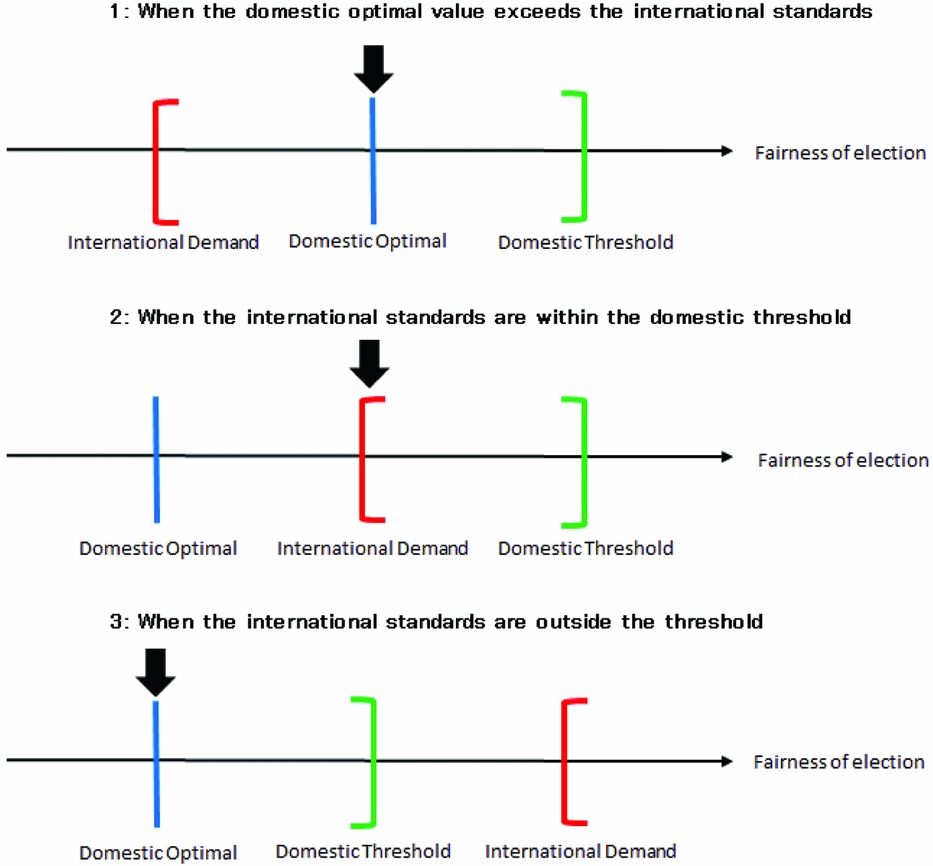
Because the government itself manages the entire election process, it government can determine how fair its elections should be, (Hyde and Marinov, Reference Hyde and Marinov2014). There are diverse ways of committing fraud in elections. An exhaustive list of these is impossible to compile but would include fraud at the systemic level, such as legislation regarding elections; fraud committed before the election, such as interference in electoral activities; fraud on the day of election; and vote rigging. In order to simplify the discussion, these items are integrated under the topic ‘fairness in elections’ in this section. There are three variables that measure the degree of election fraud in this continuous variable of fairness in elections: (a) the domestic optimal value, (b) the domestic threshold, and (c) the international demand (international standards of electoral integrity).
The domestic optimal value
This variable refers to the most effective degree of election fraud for the government in the domestic context. In other words, it refers to a suitable degree of fraud. This is determined by the following factors.
First, winning a fair election is naturally an important source of legitimacy for the government. Even if pressure is exerted and support is won by side payment, it is still beneficial to achieve legitimacy from the election results and, in this case, the fairer the election, the more legitimacy the government can secure.
Second, we need to take into account the following experiential facts: in general, authoritarian regimes do not simply aim to win the election. In other words, there is a tendency among authoritarian regimes to aim at an overwhelming victory, which is hardly possible in a normal election without fraud (Simpser, Reference Simpser2013). The rationale behind aiming at such a victory is said to be that it demonstrates the regime's strength and the size of its resources, which in turn enables the regime to act more extensively and to suppress anti-regime activities.
Third, elections bring about benefits to the government, such as the acquisition of information about citizen support and distribution of patronage to elites, in addition to the securing of legitimacy and parliamentary seats (Gandhi and Lust-Okar, Reference Gandhi and Lust-Okar2009). This means, even in the domestic contest, it does not hold that the more authoritarian the government is or the more fraud the government commits, the better. In other words, an overwhelming victory at any cost is not always the goal, and there is some rationality behind a system with a degree of democracy.
What we can deduce from the tendency that has been observed in authoritarian regimes and from theoretical insights from the study of comparative politics is that the dictator is torn between fair elections and election fraud. This means in the context of the current article that more fraud is not necessarily beneficial to the government but that there is a suitable degree of fraud.
The domestic threshold
This refers to a threshold of permissible fraud beyond which the election can no longer be seen as fair. As an example, we can think of a case in which, because the election is too fair, the current government is defeated. In other words, this is a threshold at which change of government takes place. Of course, the government that has lost the election could choose not to accept the result or to employ violent measures to annul the result. Nevertheless, an electoral defeat tends to work as a factor that encourages regime change. Although many authoritarian regimes tend to aim to achieve an overwhelming victory as discussed above, there are many cases, such as the past government coalition in Malaysia and the People's Action Party in Singapore, in which the government in power aims to achieve not an overwhelming victory but to win a majority, such as more than two-thirds of the seats, and engage with fraud, such as gerrymandering.
International standards of electoral integrity (the international demand)
This refers to the value beyond which the election is deemed to be fair, and the international community authenticates the country as a democracy. In the post-Cold War period, the democratic regime has been given the status of the ideal domestic political regime, and democratization has been promoted in earnest. As has already been discussed, in this context, the election is given significance as a manifestation of democracy.
In addition, the phrase the Western election monitors frequently use is ‘free and fair’ elections. In the realm of application, however, there is a question of what constitutes free and fair elections? In response to that, the concept of ‘international standards of electoral integrity’ has been developed by the international community, and election monitors now comment: ‘the election we have monitored has not reached international standards’.
What then do the ‘international standards of electoral integrity’ entail in concrete terms? It was the Universal Declaration of Human Rights of 1948 that defined the standard for domestic elections from the perspective of international law for the first time. It demands regular and genuine elections. It was followed by the International Covenant of Civil and Political Rights of 1966, which refers to the secret ballot and regular elections as human rights. The foregoing constitute the basis of international norms regarding elections, but as reference materials for election monitors to judge if an election is ‘free and fair’, they are overwhelmingly vague and hardly useful. As a result, more concrete standards became necessary as the norm of election monitoring spread (Elklit and Svensson, Reference Elklit and Svensson1997). In response to this, in the post-Cold War period, the major election monitors, including the OSCE, the EU, the Carter Center, and the Organization for American States (OAS), have attempted to define international election standards by drafting documents and guidelines. Among them, the Copenhagen Document issued by the Office for Democratic Institutions and Human Rights of the OSCE in 1990 and the Declaration of Principles for International Election Observation complied by 22 organizations, including the Electoral Assistance Division of the UN, Carter Center, and the OAS in 2005 are well known.
On uncertainty
So far, three variables of election fraud have been discussed. What has to be pointed out in investigating the effectiveness of election monitoring is that international standards have a high degree of uncertainty in the eyes of the government that is monitored. First, international standards are multiple. As discussed above, a variety of election-monitoring organizations have defined their own international standards. As election monitoring has been normalized, the number of election-monitoring bodies has jumped. At present, in more than 60 percent of election-monitoring cases, multiple election-monitoring bodies were involved. Obviously, there is a large overlap among these bodies’ criteria. For example, universal and equal franchise, the rights of political parties, appropriate access to the media, and elections at an appropriate interval are widely shared criteria. However, when each criterion is examined, there are some differences, and many studies have pointed out that there are no common criteria (Norris, Reference Norris2013: 538; Elklit and Svensson, Reference Elklit and Svensson1997; Bland et al. Reference Bland, Green and Moore2013: 359; Davis-Roberts and Carroll, Reference Davis-Roberts and Carroll2010). As seen in the aforementioned Declaration of Principles for International Election Observation, there have been attempts to harmonize various criteria, but these are still in the development stage.
Second, a large number of criteria are demanded; there are 22 criteria (Davis-Roberts and Carroll, Reference Davis-Roberts and Carroll2010). Even if we can agree that it is difficult to satisfy all criteria, neither the degree of deviance at which the election is deemed to be undemocratic nor any priority among the criteria are clear.
Third, international standards can change. What is often pointed out is that while the behavior on election day has conventionally attracted overwhelming attention, more and more attention is now gradually paid to fraud committed in the pre-election period.
Lastly, it is difficult to ascertain international standards from the results of election monitoring in other (developing) countries. This is because election monitors are invited to signal a regime's democratic intentions because we do not know how elections in different countries are run. In this sense, it is difficult to learn how the degree of fairness of elections in other countries is judged compared to one's own country. For these reasons, international election standards remain unclear to those countries whose elections are monitored, and this leads to the situation in which the government is unclear as to whether its own elections meet the fair standards.
The government's choice
So far, we have carried out the groundwork for the investigation. Now let us carry out a kind of thought experiment by delineating a few scenarios in which the three variables assume different values and by examining what the government chooses as the standard of fairness in elections.
The thought experiment is based on one particular assumption: the government's priority is in the form of ‘the domestic threshold > the international standards > the domestic optimal value’. It is intuitively natural that the government tries to restrict its action within the domestic threshold (i.e., by not conducting a fair election that could lead to regime change). The point here is that the government would try to achieve international standards as long as it does not go beyond the domestic threshold and prioritizes international standards over the domestic optimal value. This implies that the government is susceptible to international pressure due to its reliance on aid from the West (Levitsky and Way, Reference Levitsky and Way2010). On the other side of the coin, this assumption means that countries such as Russia and the Gulf states fall outside the scope of the analysis carried out in this article. This is because these countries do not need to take into account international standards.
When the domestic optimal value exceeds international standards (see Figure 1-1)
This is the case in which not only the domestic threshold but also the domestic optimal value exceeds the international standards of electoral integrity demanded by the international community. In this case, there is no need to take the international context into consideration, and the government only has to work on the election to the domestically optimal level. In the aforementioned context of the spread of election-monitoring norms based on democratic signaling, it was these countries that started to invite election monitors before the establishment of election monitoring as a norm. In other words, due to domestic factors, democratization has started endogenously, and the government invites election monitors.
The government's choice of the degree of fraud

When the international standards are within the domestic threshold (see Figure 1–2)
The next scenario occurs when the international standards are higher than the domestic optimal value but are still within the domestic threshold. In this case, the government would disregard the optimal value and choose the degree of fraud that could meet the internationally demanded standards. This can be understood as democratization. However, this is an exogenous change, and democratization will not exceed the international standards.
International standards revealed by the result of election monitoring
When the international standards are outside the domestic threshold (see Figure 1–3)
Lastly, there is a scenario in which international standards of electoral integrity are outside the domestic threshold. In this case, the government cannot meet international standards. In other words, the country will not be seen as democracy by the international community. In this case, the government would choose the domestic optimal value, as, even if fairness is improved to near the regime change value, it will not be seen as a democracy.
Information disclosure by election monitors and its consequences
The section continues with the thought experiment to show that the result of election monitoring can lead to either democratization or the strengthening of authoritarianism.
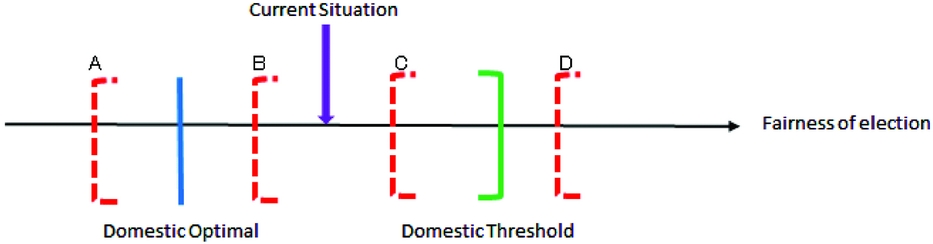
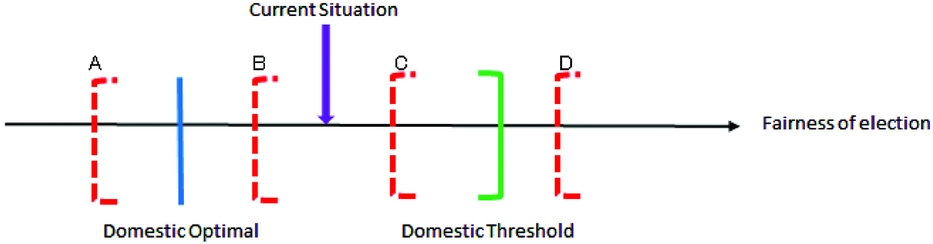
The first factor to be considered is that inviting election monitors has now become a norm as mentioned above. In other words, it is more difficult not to invite election monitors. Consequently, those governments that used to manipulate elections through the domestic optimal value during the Cold War, when they did not have to worry about the international context, are now reducing the degree of fraud upon inviting election monitors (the current situation in Figure 2).
As discussed earlier, there is a high degree of uncertainty about international standards of electoral integrity. In this context, a developing country's government can ascertain what international standards of electoral integrity are by inviting election monitors to monitor an election and by asking them to pass a verdict.
Theoretically speaking, there are four ways in which international standards that are clarified as a result of monitoring relate to ‘the current situation’, ‘the domestic optimal value’, and ‘the domestic threshold’ (coded A to D). In the cases of A and B, the election monitors’ verdict would be ‘fair’, and in the cases of C and D, ‘unfair’.
When monitoring of a particular election in a particular country reveals that international standards stand at position A, the government will prioritize the domestic optimal value at the next election. In other words, the government has learnt from the election-monitoring result that there is still room for election fraud. Since the degree of fraud increases compared to the current situation, this change can be referred to as the autocratization. If international standards stand at position B, the government will choose the international standards at the next election. Again, this is a case of the autocratization. In the case of C, the government will also choose the international standards at the next election, but this can be referred to as ‘democratization’. Lastly, if international standards are at position D exceeding the domestic threshold, the government will choose the domestic optimal value at the next election because it is now clear that it is impossible to satisfy the international community's demand. The change here is the autocratization.
There is of course a case in which the government invites election monitors with the current situation at the domestic optimal value. Applying the aforementioned logic, it can be deduced that there are two possibilities depending on the value of international standards that monitors have clarified: to continue with the domestic optimal value or to democratize in accordance with international standards.
The thought experiments that we have carried out so far have identified a theory that explains why some countries do not improve, or become worse, upon receiving an ‘unfair’ verdict by the election monitors, which is the main research question of the article, i.e., when the result of election monitoring is situated at position D for that country.
The above thought experiments also highlight the possibility for the ‘fair’ verdict by the election monitors to invite autocratization (A and B in Figure 2). Nevertheless, since the retreat of democracy due to this international mechanism is limited to the degree that is permissible within international standards of electoral integrity, it does not generally lead to a change that can be understood as a large-scale retreat.
The thought experiments based on an extremely simplified model have so far produced an important insight. That is, contrary to what has been taken for granted in preceding studies, it is not at all unnatural for the government to strengthen its authoritarianism in response to the result of election monitoring at least on the theoretical level. The current article claims that election monitoring not only reveals international standards of electoral integrity to developing countries but also can encourage either democratization or the strengthening of authoritarianism.
Founding elections and second elections in Africa
Through a case study, this section shows what new interpretation of events can be advanced by the claim made by the article. This section focuses on the problem of democratization in Africa. While there are many variables at work in the process of democratization, the reason why Africa is chosen is because the significance of international factors is relatively higher there and, as such, it is a suitable example to confirm the dynamics the current article suggests. Needless to say, the quality of elections is determined by both domestic and international factors. There is a debate over the role of domestic or international factors in the study of democratization in Africa. The current article only shows a new mechanism through which international factors exercise influence, and it does not argue that only international factors determine the degree of election fraud or that international factors are more important than domestic factors. The article's claim is that an international factor has so far been overlooked.
In the first half of the 1990s, many countries in Africa saw a transition from one-party systems or military dictatorships to the introduction of multi-party elections. The domino-like political change was welcomed as the second independence, but the process of democratization has not been developing smoothly since then. There is a view that democratization in Africa has ended up with the entrenchment of electoral authoritarianism.
In this regard, Lindberg's ‘democratization by elections’ is a useful approach (Lindberg, Reference Lindberg2009). Having analyzed effects of elections in Africa, Lindberg has argued that, even if they are fraudulent, the repetition of elections itself leads to democratization, and that is happening in Africa. In other words, according to him, the situation in Africa is improving, albeit at a glacial pace, and electoral authoritarianism has not become entrenched. This claim has been subjected to a number of criticisms. Some criticism is theoretical in that the mechanism of democratization by elections is not clearly defined; a more serious criticism is that it is not happening in reality. In other words, while the average of democratization data on African countries may well be gradually improving, each country has its own trend, and it appears that the countries are polarized between those with a degree of democratization and those in which electoral authoritarianism has become entrenched. It is pointed out in fact that there is a diverse range of tendencies among African countries; they are now polarized between those that have managed to democratize to a degree and those with naked authoritarianism (Bogaards, Reference Bogaards2013).
What is important here is that in Africa, regardless of the progress or stagnation of democratization, it is very rare for the government to lose an election (Posner and Young, Reference Posner and Young2007). Consequently, even if the quality of elections is now polarized, there is a shared guarantee that the current government does not lose the election.
In regards to the aforementioned situation, the article suggests the existence of an international process for the entrenchment of electoral authoritarianism. In other words, it suggests a process through which a country that has experienced founding elections, with a very high level of uncertainty about international standards of electoral integrity, has acquired information from the monitoring result, which in turn leads to the gradual entrenchment of the regime called electoral authoritarianism. As the level of uncertainty about international standards of electoral integrity is reduced, the developing countries are divided into two groups. One of them focuses on the internationally permissible threshold, in other words, international standards of electoral integrity. The other, having found that they cannot satisfy international standards, gives up efforts to meet international demand and moves to entrench the authoritarian tendency. As far as African countries are concerned, scholars have judged an increase in the number of countries that are internationally deemed to be ‘democratic’, as seen in the former group, to be an indication of ‘an increase in electoral authoritarianism’. This is, in other words, the process through which a electoral authoritarian regime is formed at the international level.
What is important here is that scholars would call a particular state/regime ‘electoral authoritarian’, and the international community would see the same country/regime as a ‘democratic state’. There is thus a discrepancy in evaluation. Let us examine the case of Ghana, which Western election monitors tend to evaluate favorably, especially the data from its 1996 election. Ghana in 1996 scored 2 in Polity 2 score from the Polity IV dataset, the most representative dataset of the degree of democratization, which meant it was seen as an anocracy, which is neither a democracy nor an authoritarian system. Ghana in 1996 was also classified as a competitive authoritarian system, according to the dataset that classifies political regimes (Brownlee, Reference Brownlee2009). In other words, there is an overlap between the ‘grey zone’ according to scholars and ‘democracy’ according to the international community. Scholars ask why there are so many authoritarian regimes in the grey zone, why there are so many electoral authoritarian regimes in Africa. The current article argues that it is because they are at the level that could just about be ‘cleared’ by the international community. In addition, from the perspective of developing countries, there is no better incentive to democratize than being judged to have cleared international standards.
The above discussion is successful only in suggesting an explanation from the international dimension for the generation of electoral authoritarianism and the polarization of the quality of elections, but it is weak in proving that such political change was triggered by the clarification of information by election monitoring. Therefore, we now move on to examine the baffling phenomenon that the degree of election fraud increased from the founding elections to the second elections in Africa of the 1990s.
Many African countries started to get rid of one-party systems or military dictatorships in the 1990s and to introduce multi-party elections. As a result, they held founding elections. More concretely, out of 48 countries in Africa, 44 carried out founding elections, and 38 have had second elections (Lindberg, Reference Lindberg2006: 74). What is often pointed out is that compared to the founding elections, the degree of fraud increased at the second elections (Bratton, Reference Bratton1998; Lindberg, Reference Lindberg2006: 74). What is most intriguing is the fact that in the countries that have received an ‘unfair’ verdict regarding the founding elections, the situation has not improved. There is a consensus about this fact, and attention is paid to its cause, but there has been no appropriate explanation.
This article will present how this phenomenon can be understood based on its theoretical framework, but, before that, let us review some basic information. First, there is the question of how many of the founding elections after the Cold War invited international election monitoring teams from the West. In identifying founding elections, the data set from Lindberg (Reference Lindberg2006) is used, and data about election monitoring is drawn from the data set in Hyde and Marinov (Reference Hyde and Marinov2014). The data set in Hyde and Marinov (Reference Hyde and Marinov2014) has identified 81 presidential and parliamentary elections as founding elections in post-Cold War Africa for which data about election monitoring exists. Election monitoring teams from the West were invited for 62 of the 81 elections. This suggests that it was very common to invite western election monitors at the founding elections phase. Except for a very small number of cases, founding elections that took place in post-Cold War Africa after a regime change invited western election monitors, such as the UN, the NDI/IRI, the EU, and the Commonwealth. A trend was set when election monitors were invited for founding elections in Benin and Zambia in 1991.
Next, let us review the verdicts. The data set in Hyde and Marinov (Reference Hyde and Marinov2014) contains a binary variable on whether the elections were negatively evaluated by the election monitors. According to this, only 14 out of the 62 elections that were monitored by western election monitors received negative evaluations. In other words, most of the elections avoided criticism.
Furthermore, what is particularly relevant to this article is that at the ‘founding election’ phase in Africa, uncertainty about international standards for fair elections was extremely high for two reasons. First, because it was the first time a multi-party election took place, naturally there had been no learning through election monitoring. Second, because the Cold War had just ended, guidelines for election monitoring were under-developed, and no clear international standards for fair elections existed. Consequently, at the founding elections phase, African countries did not know the criteria against which their elections would be assessed by the international community to receive a verdict that their elections were free and fair.
Drawing from the above, I would like to explore why the quality of elections in Africa has not been improved despite the experience of election monitoring. The article's theoretical framework suggests two answers. The first reason is the international mechanism through which electoral authoritarianism is generated as discussed above. In other words, even if researchers objectively determine that there is electoral authoritarianism, the elections under that regime would not receive negative evaluations from the election monitors.
Let us confirm this with indices. As mentioned above, 48 founding elections were not criticized by the election monitors. Then, how many of them would be determined to be electoral authoritarian? Here, using the data set of Cheibub et al. (Reference Cheibub, Gandhi and Vreeland2010) – the most representative data set on political regimes – if the political regime under which the election took place is categorized under ‘undemocratic regime in which multiple parties are legal’, it is considered to be electoral authoritarian. According to this, 38 out of 48 elections are found to be electoral authoritarian. What is important here is this clearly shows discrepancies between the verdicts passed by the actual election monitors and researchers’ judgments. It follows naturally that even if researchers evaluate an election to be electoral authoritarian, if it is confirmed to be democratic through election monitoring in the realm of international politics, there is no incentive for the state to improve the quality of elections any further. Therefore, it is not puzzling at all that electoral authoritarianism does not lead to an improvement in the quality of elections.
The above comments refer to the group that were not criticized by the election monitors. Second, there is a group that clearly comprehended that they could not meet the international standards for fair elections because those standards were made clear as a result of election monitoring. In other words, at the founding elections phase, the high degree of uncertainty about the international standards of fair elections led to a degree of fair elections. However, when it was made clear that the election did not meet the international standards, the standard deteriorated to the degree of fraud which was domestically optimum. This applies to Cameroon and Mali.
Let us now examine the election in Cameroon. In Cameroon, due to both domestic and international pressure, the regime of President Paul Biya decided to move to a multi-party regime in 1990 and the presidential election took place on 11 October 1992. The Biya government, however, committed a number of fraudulent acts such as manipulating electoral laws, monopolizing campaign resources, and interfering with the polls (Bratton and van de Walle, Reference Bratton and van de Walle1997, 120–1). In fact, the NDI, which monitored the election, published a very critical conclusion after the election: ‘the poll had a number of serious problems and was far from free and fair’ (National Democratic Institute for International Affairs, 1993). Furthermore, this in fact led to sanctions (Emmanuel, Reference Emmanuel2010). In the immediate aftermath of the 1992 election, Germany suspended most of its bilateral aid to Cameroon, which resulted in a 40 percent decrease in the amount of aid in 1993 as compared to 1992. Similarly, the United States criticized the Biya government and stopped aid. Despite these sanctions, the quality of the second election in Cameroon in fact further deteriorated as compared to the founding election rather than being improved (Bratton, Reference Bratton1998). One of the reasons is that France, the top donor to Cameroon, consistently supported the Biya government and maintained a bilateral relationship (Emmanuel, Reference Emmanuel2010). But this cannot be the only reason why the quality of elections did not improve in Cameroon. In the first place, was the Biya government able to understand the severe criticism and demand for improvement from the NDI?
Paul Biya won only 39.9 percent of the vote cast at the 1992 presidential election; given that the opposition candidate, John Fru Ndi won 35.9 percent, it was a close call.Footnote 2 This represents a huge decrease from winning 98 percent of the votes cast in the 1984 and 1988 elections in which he was the only candidate. One of the main reasons for this poor showing is because the New Deal policies, the reform he launched when he became President in 1982, were not implemented fast enough and many Cameroonians rejected him (Takougang, Reference Takougang1993: 91). Given this situation, he was not in the position at the second election to carry out fundamental election reform as the election monitors had demanded. In other words, international demands were even more demanding than what fairness could have achieved. Consequently, the incentive to comply with international standards even partially was lost.
As the article has been arguing, making the results of election monitoring public leads to polarization. On the one hand, there are countries that carry out fraud within a scope that does not invite criticism from election monitors; in other words, countries adapt to election monitoring. On the other hand, there are countries that give up trying to meet the democratic standards required by the international community. As such, the theoretical framework of this article proposes a natural interpretation of the phenomenon in which the quality of elections in Africa stops improving or deteriorates from the founding elections to the second elections.
Conclusion
International politics regarding the democratic regime and the promotion of democratization, including election monitoring. is an area in which not much has been theorized, although there are many descriptive studies. Against this background, the current article has proposed a new theory from the perspective of information. For the monitored country, election monitoring is a means to send signals that it is democratic as well as a chance to learn international standards of electoral integrity. Drawing from thought experiments using a simplified model, the article has argued that election monitoring at the theoretical level can lead to either democratization or the strengthening of authoritarianism. In other words, the article has proposed a new interpretation of the situation in which there are many developing countries that do not engage with reform even after receiving a negative evaluation of their elections.
One of the policy implications that can be logically deduced from the article is that one should refrain from drawing an ‘all-or-nothing’ conclusion but restrict evaluation at the level of each criterion. This is what the EU has started to implement recently.
Since the article aims to propose a new theoretical perspective on the effectiveness of election monitoring, the emphasis has been placed on very carefully developing theoretical understanding, including theoretical backgrounds to various concepts. The idea of information regarding international standards of electoral integrity can be applied beyond election monitoring to the promotion of democratization in general. In this sense, this article is a stepping stone for further theoretical development in the field. Due to the limitation of space, not much is said about the case study. It is hoped that more efforts will be made to verify the theoretical model with quantitative investigation as well as country-by-country case studies.
About the author
Taku Yukawa is associate professor at Osaka School of International Public Policy, Osaka University. He received his PhD from Univesity of Tokyo. His research interests include international relations theory, the international relations of Southeast Asia, and agent-based simulation.