1 Background
This study examines the Old English (OE) roots of the to-dative construction, defined as the clausal pattern given in (1) and as illustrated in (2):
(1) [ditransitive verb + NP + to-P(repositional) P(hrase)]
(2) I offer/give/sell/send/show/donate the books to Mary.
The to-dative construction features a to-PP referring to a third participant in a state of affairs that generally involves some kind of transfer and an NP referring to the object of transfer. Note, however, that the same pattern can also be used with a verb that denotes the denial of a transfer, as in (3), or the deprivation of a possession, as in (4) (examples taken from Bresnan & Nikitina Reference Bresnan, Nikitina, Uyechi and Lian2009):
(3) [D]enied leave to a teacher.
(4) The IRS is unionized, and the union apparently has the fear that outsourcing will cost jobs to their members.
In Present-day English (PDE), the to-dative construction alternates with the Double Object Construction (DOC), as illustrated in (5).
(5) I offer/give/sell/bring Mary the books.
The synchronic features of the dative alternation are well studied. There is solid evidence that the speaker's choice for one of the two constructions is motivated by verbal semantics as well as discourse-pragmatic and semantic factors associated with the two objects involved (Thompson Reference Thompson and Landsberg1995; Bresnan Reference Bresnan, Featherston and Sternefeld2007; Bresnan et al. Reference Bresnan, Cueni, Nikitina, Baayen, Bourne, Kraemer and Zwarts2007; Bresnan & Hay Reference Bresnan and Hay2008; Bresnan & Nikitina Reference Bresnan, Nikitina, Uyechi and Lian2009; Kendall, Bresnan & Van Herk Reference Kendall, Bresnan and Van Herk2011; de Marneffe et al. Reference de Marneffe, Grimm, Arnon, Kirby and Bresnan2012; Theijssen Reference Theijssen2012; Theijssen et al. MS). The results of recent studies further suggest that the extra-linguistic factors modality (written vs spoken) and macro-linguistic region may also be involved in the choice of order (Bresnan & Ford Reference Bresnan and Ford2010; Wolk et al. Reference Wolk, Joan Bresnan and Szmrecsanyi2013; Theijssen et al. 2013).
The diachrony of the dative alternation has received much less attention in the literature. The Old English DOC with an accusative object (ACC) and a dative object (DAT) is examined by Visser (Reference Visser1963), Koopman (Reference Koopman1990) and De Cuypere (Reference De Cuypere2010). The results of the latter suggest that the choice of orders appears to be largely influenced by the same factors that motivate the dative alternation in PDE.
The historical emergence of the to-dative construction has traditionally been situated at the transition from OE to Middle English (ME) (McFadden Reference McFadden and Lightfoot2002; Polo Reference Polo and Lightfoot2002; Visser Reference Visser1963: 624). This view is informed by the assumption that prepositions took over the function of morphological case in Middle English; to would thus have taken over the function of the dative case. It is indeed true that the to-dative construction was not used in OE in clauses that had a verb that inherently denoted a transfer of possession (e.g. agifan, gifan, sellan ‘give’ and offrian ‘offer’) and a human recipient. However, there were many other ditransitive verbs with which the to-dative construction was commonly used in OE, such as cweðan (‘to say, speak’), sprecan (‘to speak, say, utter’), cleopian (‘to call, cry out’), sendan (‘to send’), lætan (‘to let’), niman (‘to take’) and bringan (‘to bring’) (Cassidy Reference Cassidy1938; Mitchell Reference Mitchell1985, vol.1: 512).
The aim of this article is to present a detailed description and analysis of the to-dative construction in OE. The study comprises three sub-studies, which look at three different aspects of the construction at hand.
Section 2 starts off with a comparison of the relative frequencies of the to-dative construction vs the DOC in OE and Present-day English (PDE). The results indicate that, although perhaps being less frequent than in PDE, the to-dative construction was not rare in comparison to the DOC in OE. In fact, although the construction was not used with transfer of possession verbs in OE, it seems that the construction was already fully established with certain verb classes, in particular with verbs of caused motion and of communication.
Section 3 looks at the ordering tendencies of the accusative object (ACC, equivalent to the DO in PDE) and the to-dative object (to-DAT, equivalent to the to-PP) in the to-dative construction. A natural hypothesis is that this choice was associated with the same factors that motivate the dative alternation in PDE. A mixed-effects logistic regression analysis of the corpus data corroborates this hypothesis. Five factors were found to be associated with the object orderings: pronominality of the ACC and the to-DAT, definiteness of ACC, number of DAT and the difference in length between the ACC and the to-DAT. Moreover, the relative impact effects and their direction are similar to those found for the dative alternation in PDE.
Section 4 takes a more qualitative approach and outlines various uses of to and the to-DAT in OE. I make the case that the semantic change of to from OE to ME was less saltational than has been suggested in the literature, i.e. from a Goal to a Recipient marker (e.g. McFadden Reference McFadden and Lightfoot2002). The empirical evidence suggests that the use of to as a Recipient marker was embryonically present from early OE onwards.
2 Frequency of the to-dative construction in OE
2.1 Data sample
To estimate the frequency of the to-dative construction in OE, I collected all instances of the OE to-dative construction from the York–Toronto–Helsinki Parsed Corpus of Old English Prose (YCOE) (Taylor et al. Reference Taylor, Warner, Pintzuk and Beths2003), using CorpusSearch2 (Randall Reference Randall2003). I also retrieved all possible DOCs with an accusative object (ACC) and a dative object (DAT) from the same corpus.
Recall that the to-dative construction was defined in (1) as a clause featuring the pattern [Ditransitive Verb+NP+to-PP]. Crucially, the to-dative construction involves a ditransitive verb. I have therefore operationalized the to-dative construction on the basis of the following two criteria.
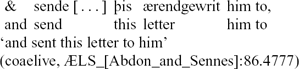
First, the to-dative construction was taken to include a ditransitive verb, i.e. a verb that could also take the DOC, such as asendan (‘to send forth’) in (6). I determined the possibility to take a DOC by examining the DOC data collected for this study, supplemented by information from Bosworth & Toller (Reference Bosworth and Toller1955), Visser (Reference Visser1963, vol. 1: 621) and Mitchell (Reference Mitchell1985, vol.1: 455−64).
(6)


My second criterion was that the to-DAT should refer to an animate being, e.g. to þære abbudissan ‘to the abbess’ in (7), and not a location, as in (8) to Rome. This criterion is informed by the dative alternation in PDE, which also excludes sentences with a locational to-PP, which lack a DOC counterpart in which the IO receives the same locational meaning as the to-PP. In the DOC, the interpretation of the locational DAT is coerced to an animate entity, as in John sends London the books, where London metonymically refers to a human recipient.
(7)
(8)
Fronted ACCs and to-DATs, i.e., ACCs and to-DATs that precede the expressed Subject, were also excluded from the corpus sample. Given that fronting is associated with its own specific pragmatic motivations (Biber et al. Reference Biber, Johansson, Leech, Conrad and Finegan1999: 900), these data would have obscured the motivations behind the optional object ordering.
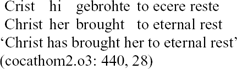
Also excluded were to-DATs functioning as object complements, as in (9) geceas to folgerum ‘chose as disciples’ and to-DATs indicating a Result, as in (10) gebrohte to ecere reste ‘bring to eternal rest’.
(9)
(10)
Finally, sentences with ACCs or to-DATs functioning as Adjuncts were obviously also omitted from the sample.
The data collection of the DOC was more straightforward. I excluded fronted objects (to allow for a comparison with the sample of to-datives), as well as ACCs or DATs functioning as Adjuncts and clauses with object ellipsis.
2.2 Results and discussion
For this part of the study, I collected N = 468 instances of the to-dative construction and N = 2,706 instances of the DOC. Overall, then, there were 15 per cent to-dative constructions in a total of N = 3,174 constructions. Is this proportion lower than one would expect if the sample was drawn from Present-day English?
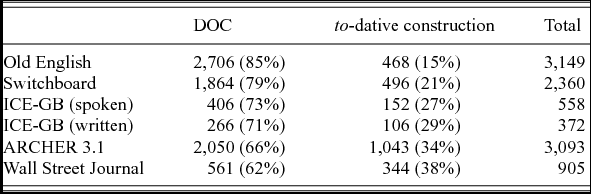
Answering this question requires a reliable estimate of the dative proportions in PDE. Estimates for these proportions are available based on the following corpora: the ICE-GB Corpus (Theijssen Reference Theijssen2012), the Switchboard Corpus, a corpus of US Spoken English (telephone conversations) (Bresnan et al. Reference Bresnan, Cueni, Nikitina, Baayen, Bourne, Kraemer and Zwarts2007), the PennTreebank Wall Street Journal Corpus (Bresnan et al. Reference Bresnan, Cueni, Nikitina, Baayen, Bourne, Kraemer and Zwarts2007) and ARCHER 3.1 (Wolk et al. Reference Wolk, Joan Bresnan and Szmrecsanyi2013). The latter corpus covers the period between 1650 and 1999. The proportion of to-dative constructions in it remains largely stable, ranging from 30 per cent (1900−49) to 39 per cent (1800−49) (Wolk et al. Reference Wolk, Joan Bresnan and Szmrecsanyi2013). The dative proportions observed in these corpora are given in table 1.
Estimated dative proportions for different varieties of English
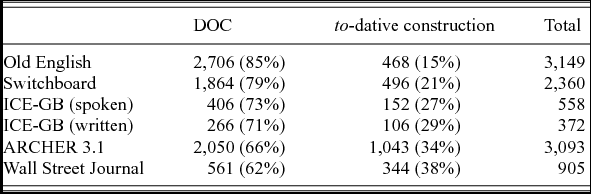
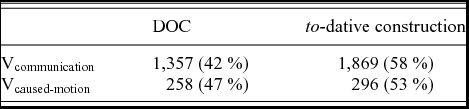
A comparison of our observed proportion of to-dative constructions in OE (468/3,149) with those found for present-day British English based on ICE-GB (258/930; spoken and written data taken together) indicates that this difference is statistically very significant and that the use of the to-dative construction was indeed less frequent in OE than in PDE (χ 2 = 80, df = 1, p-value < 0.0001, 95 per cent Confidence Interval = 10% to 16%). However, the results also contradict the view that the to-dative construction was rare in OE, as suggested, for instance, by Visser (Reference Visser1963: 637). The upper limit of the estimated confidence interval equals 16 per cent. The actual difference between OE and present-day British English is thus possibly not larger than that between the Switchboard and Wall Street Journal corpora, i.e. between spoken and written American English. Moreover, given that in OE the to-dative construction was not used with ‘transfer of possession’ verbs − the most frequently used verb class with the to-dative construction in PDE − the construction was probably just as common in OE as in PDE with those verbs with which the to-dative construction could be used. This conclusion is strongly supported by Cassidy's (Reference Cassidy1938) finding that the to-dative construction was more frequent than the DOC with verbs of caused-motion (e.g. beran, bringan, feccan) and of communication (e.g. tellan, secgan). Table 2 summarizes Cassidy's (Reference Cassidy1938) findings for these two verb classes.
Distribution of DOC and to-dative construction with verbs of communication and verbs of caused-motion (based on Cassidy Reference Cassidy1938: chart I)
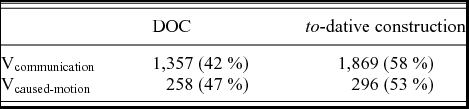
Based on a 2-sample test for equality of proportions (with continuity correction), the proportion of the to-datives was found to be significantly larger than that of the DOC for both verb classes: Vcommunication: χ2 = 161, df = 1, p-value < 0.0001, 95% Confidence Interval for the difference in proportion = 13% to 18%; Vcaused-motion: χ2 = 4.94, df = 1, p-value = 0.02, 95% Confidence Interval for the difference in proportion = 0.08% to 13%. The proportional difference was less outspoken with verbs of caused motion, but was nevertheless still significant.
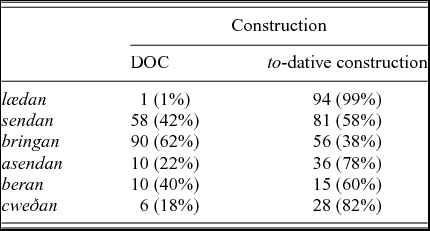
I found similar results based on my data set. Table 3 shows my observations of the to-dative construction vs the DOC for the six most common OE alternating verbs.
Distribution of the DOC vs to-dative construction with the six most common OE alternating verbs
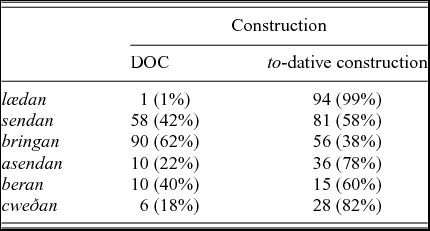
Except for bringan, which was most often found with a DOC, all other alternating verbs were most frequent with the to-dative construction, which again suggests that the construction was commonly used in OE, if the verb allowed for both constructions.
The results further add to Allen's (Reference Allen, Kemenade and Bettelou2006: 214) argumentation against the hypothesis that the to-dative construction replaced the dative case marked IO (cf. McFadden Reference McFadden and Lightfoot2002): ‘given that the to-dative was already found with some verbs in OE when it was not in any sense “necessary” to mark Case, there is no necessity to assume that the to-dative only became available once the morphological dative case was not available’. As the results of this study show, the to-dative was not only available with certain verbs, but already very common. Moreover, Cassidy's (Reference Cassidy1938) results, given in table 4, additionally indicate that the to-dative construction was already being used from early OE onwards. Taken together, the empirical evidence supports Allen's reasoning that the to-dative construction did not replace the dative case marked IO.
Observed frequencies of the to-dative construction with verbs of communication and caused motion throughout OE (based on Cassidy Reference Cassidy1938: chart I)

The number of observations for communication and caused-motion verbs given in table 4 appeared to be strongly correlated (Spearman's ρ = 0.97, p-value < 0.0001). Simply put, the more observations Cassidy found of the to-dative construction with verbs of communication, the more observations he found of the construction with verbs of caused-motion and vice versa. Apart from this correlation, however, no specific trend is discernable. Given that the OE subsample between c.950 and c.1050 accounts for 60 per cent of the full OE corpus (see Kytö Reference Kytö1996), it seems that in periods with more data, there are more observations for both verb classes, which suggests that there was not a specific diachronic trend in OE where the use of the to-dative construction was more frequent with one of both verb classes. These findings do not support the claim that the loss of the dative case leads to an increase in the use of the to-dative construction.
3 Ordering of ACC + to-DAT
3.1 Data collection and annotation
For this part of the study, I retrieved all clauses with an ACC and a to-DAT from the YCOE corpus, using CorpusSearch2, which resulted in a corpus sample of N = 1,285 observations. Note that this clausal pattern is more broadly defined than the to-dative construction discussed in the previous section, which excluded clauses with non-alternating verbs, such as astreccan ‘prostrate’ in (11), as well as inanimate/locational to-DATs, as to Lindesfearena eae ‘to the island of Lindisfarne’ in (12). I included inanimate to-DATs for this part of the study to evaluate their possible effect on the object ordering.
(11)
(12)

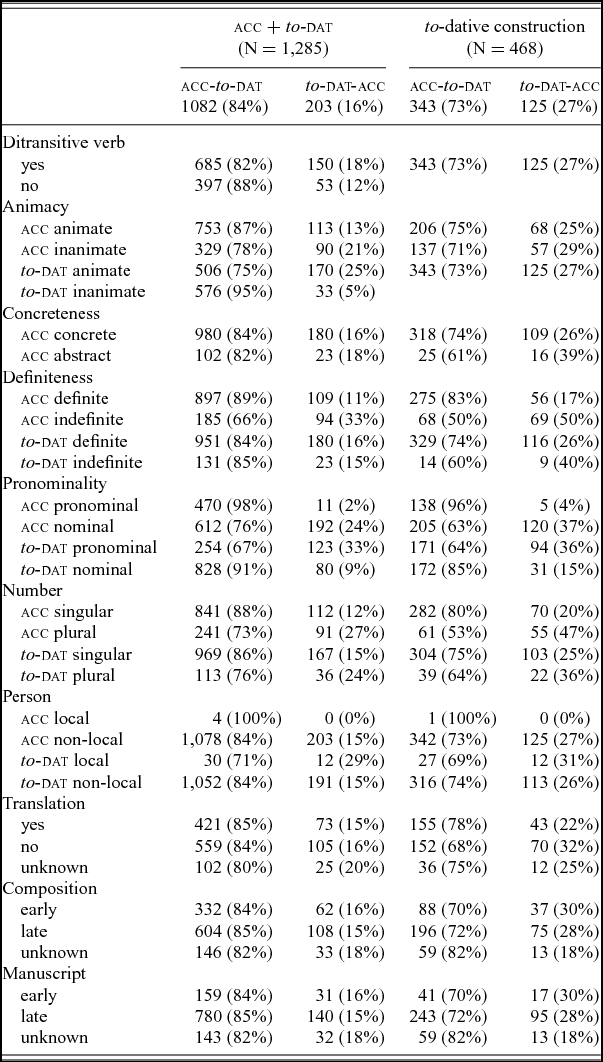
My overall hypothesis was that the alternation of ACC and to-DAT was motivated by the same semantic and discourse-pragmatic factors as those that motivate the dative alternation in PDE, including: discourse status, animacy, definiteness, pronominality, number, person and relative length of the objects involved. There is corpus evidence that the ACC + DAT ordering of the DOC was motivated by the same factors that drive the dative alternation in PDE (see Koopman Reference Koopman1990; De Cuypere Reference De Cuypere2010). I expect that these factors were equally involved in the ordering of the to-dative construction.
I annotated the corpus data in accordance with the variables taken from the corpus studies that Bresnan and her colleagues have performed for the dative alternation in PDE (e.g. Bresnan & Ford Reference Bresnan and Ford2010). Two extra-linguistic variables were additionally included in the analysis: Translation and Date of Composition/Manuscript. Below, I give a brief description of the variables and their annotation.
Response variable (annotated as ACC-to-DAT vs to-DAT-ACC): it should be noted here that with pronominal to-DATs, it was possible for the preposition to follow its head (pro)noun and that both could also be separated by other words (see Alcorn Reference Alcorn2011). The order of such instances (157 observations in total) was based on the order of the objects. Thus, (13) and (14) were annotated as to-DAT-ACC and ACC-to-DAT respectively.
(13)
(14)

Verb: the dative alternation is known to be influenced by verbal semantics (e.g. Bresnan & Ford Reference Bresnan and Ford2010). Bresnan et al. (Reference Bresnan, Cueni, Nikitina, Baayen, Bourne, Kraemer and Zwarts2007) operationalized this variable as the combination of the sentence verb with one of five semantic classes (‘transfer of possession’, ‘abstract transfer of possession’, ‘future transfer of possession’, ‘communication of information’ and ‘prevention of transfer’). In the present data set, however, I have restricted this variable to the sentence verb as such (annotated as its infinitive). The problem with Bresnan et al.'s (Reference Bresnan, Cueni, Nikitina, Baayen, Bourne, Kraemer and Zwarts2007) semantic class classification is that the semantic class defined as ‘transfer’ is too coarse-grained for the present study. The ‘transfer’ class does not distinguish, for instance, between verbs of accompanied motion (e.g. bringan) and verbs that inherently indicate a transfer of possession (e.g. sellan ‘give’). However, this distinction is highly relevant to this study, as sellan is not attested with the to-dative construction, while bringan is. It would thus be misleading to draw conclusions about the transfer class on the basis of verbs of accompanied motion alone. On a statistical note, Verb is modelled as a random intercept, to inspect possible preferences between the verb and the orderings.
Ditransitive (yes vs no): as explained in section 2.1, a ditransitive verb was defined as a verb that could also take a DOC. This possibility was determined by looking at the DOCs collected for this study, supplemented by information by Bosworth & Toller (Reference Bosworth and Toller1955), Visser (Reference Visser1963) and Mitchell (Reference Mitchell1985). No further distinction was made between mono- or intransitive verbs.
Length Difference between ACC andto-DAT: the measurement of this difference follows Bresnan & Ford's (Reference Bresnan and Ford2010) operationalization and is accordingly computed as the difference between natural logarithm of the length of the to-DAT and the natural logarithm of the ACC (with length measured in number of words). The effect of length on constituent ordering and the dative alternation is well documented. We expect to find that longer constituents followed shorter ones.
Animacy of ACC and to-DAT (animate vs inanimate): an object is coded as ‘animate’ when its referent is a living or ‘animated’ entity. This category is taken to include animals, ghosts, spirits and Gods. Plants are excluded from this category, their biological status notwithstanding. Plants are further distinguished from other inanimates under the variable concreteness. Animacy is known to influence the dative alternation, in that animate objects tend to precede inanimate ones. The same effect is expected here.
Concreteness of ACC (concrete vs abstract): an ACC is considered ‘concrete’ when its referent is ‘a prototypical concrete inanimate object or substance perceivable by one of the five senses’ (Bresnan & Ford Reference Bresnan and Ford2010: 10). A plant or a tangible object is thus considered as concrete. Conversely, an ‘abstract’ referent is neither tangible nor perceivable by any other means. This variable is included to draw a supplementary distinction between different types of inanimate accusatives. NPs with meanings such as ‘love’, ‘knowledge’ are thus coded as abstract inanimate ACCs, whereas ‘plants’, ‘money’, ‘flesh’ are classed as concrete inanimate ACCs. In PDE, concrete Themes are known to yield a positive effect on the choice of the DOC order. It is correspondingly expected that a concrete ACC will favour the ACC-to-DAT ordering.
Definiteness of ACC and to-DAT (definite vs indefinite): definiteness is here understood in terms of specificity (see Thompson Reference Thompson and Landsberg1995: 161). Thus, a definite object has a specific (group of) referent(s), whereas an indefinite object has no specific object or refers to a general class of objects. Definite objects are expected to precede indefinite ones.
Pronominality of ACC and to-DAT (pronominal vs. nominal): pronominal objects include phrases headed by a personal, demonstrative, indefinite or reflexive pronoun. Nominal objects are noun phrases with a noun or gerund as a head (Bresnan & Ford Reference Bresnan and Ford2010: 175). The effect of pronominality on constituent ordering in English is widely observed (pronominal objects tend to precede nominal ones) and is therefore also expected to influence the ordering at hand.
Number of ACC and to-DAT (singular vs plural): this feature is derived from formal marking and/or contextual clues. Unclear cases were left out of the data set (seven cases in total). Singular objects tend to precede plural ones in the dative alternation in PDE. The same effect is expected here.
Person of ACC and to-DAT (local vs nonlocal): local refers to the first or second person, nonlocal to the third person. Person is known to have an effect on the dative alternation in PDE in that local objects tend to precede nonlocal ones.
Two extra-linguistic variables were additionally examined:
Translation (yes vs no): the full data set contains 494 (38%) observations from translated texts (from Latin) and 664 (52%) from non-translated texts; 127 (10%) observations could not be classified. The information on this variable was taken from the information provided by the YCOE manual.
Date of Composition (early [before 950] vs late [after 950]): this information was also retrieved from the YCOE. 394 (31%) observations in the full data set come from texts early composed and 712 (55%) from later texts; 181 (14%) remained unclassified. The hypothesis is that the possibility of to-DAT-ACC order will decrease in late OE, which would indicate a change towards the preferred DO-to-PP-order of the to-dative construction in MnE. The manuscript date was additionally examined to see whether there was a different effect from the date of composition.
Finally, based on Alcorn (Reference Alcorn2011: 109), I annotated the dialect of each observation. However, this resulted in far too many categories to be used in a statistically sound way, and so I decided to exclude this variable from further analysis.
3.2 Results
I have analysed two data samples. The first sample is the full data sample with all the observations of the ACC+to-DAT construction (N = 1,285). As mentioned in section 3.1, this sample includes inanimate to-DATs, to evaluate their possible effect on the object ordering. The second sample is the subset (N = 468) with the only observations of the to-dative construction, i.e. ACC+to-DAT construction with a ditransitive verb and an animate to-DAT. I specifically examined the subset with the to-dative construction to be able to draw conclusions about this particular construction.
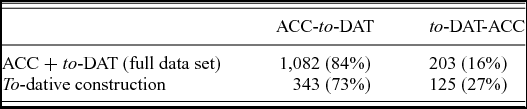
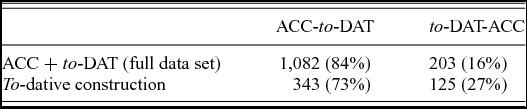
The general ordering results, presented in table 5, indicate that the ACC-to-DAT order is much more frequently attested than the to-DAT-ACC order (5 times more in the full data set, nearly three times more in the to-dative subset). See appendix 1 for a general overview of the bivariate distributions.
Observed frequencies of the ordering of ACC and to-DAT of the full data set and the to-dative construction
This proportional difference is in line with the default ordering in PDE, where the to-PP usually follows the DO. In PDE, it is not ungrammatical to put the to-PP before the NP, as illustrated by (15) (example taken from Biber et al. Reference Biber, Johansson, Leech, Conrad and Finegan1999: 929):
(15) These include principally the discovery of America and the rounding of the Cape, which gave to commerce, to navigation, to industry, an impulse never before known.
This ordering is typically found in formal text genres (Biber et al. Reference Biber, Johansson, Leech, Conrad and Finegan1999: 929) and with long NPs (‘Heavy noun phrase shift’, Huddleston & Pullum et al. Reference Huddleston and Pullum2002: 247). According to Biber et al. (Reference Biber, Johansson, Leech, Conrad and Finegan1999: 928), to may also serve as an additional means to clarify the syntactic role of the to-PP.
I have found no estimates about the frequency of the to-PP-DO order in Present-day English, which prevents me from making a statistically valid comparison between PDE and OE. Biber et al. (Reference Biber, Johansson, Leech, Conrad and Finegan1999: 929) note that ‘examples of this kind are very rare’. I believe this was not the case in OE, in particular not in the to-dative construction, where the to-DAT-ACC order accounts for 27 per cent of the total data sample (see table 5). It seems to me that the ordering of the ACC and the to-DAT was somewhat more lenient in OE than in PDE, even though the same general preference for the DO-to-PP order existed in OE as in PDE. In the remainder of this section, I examine the motivating factors behind the OE optional argument patterning.
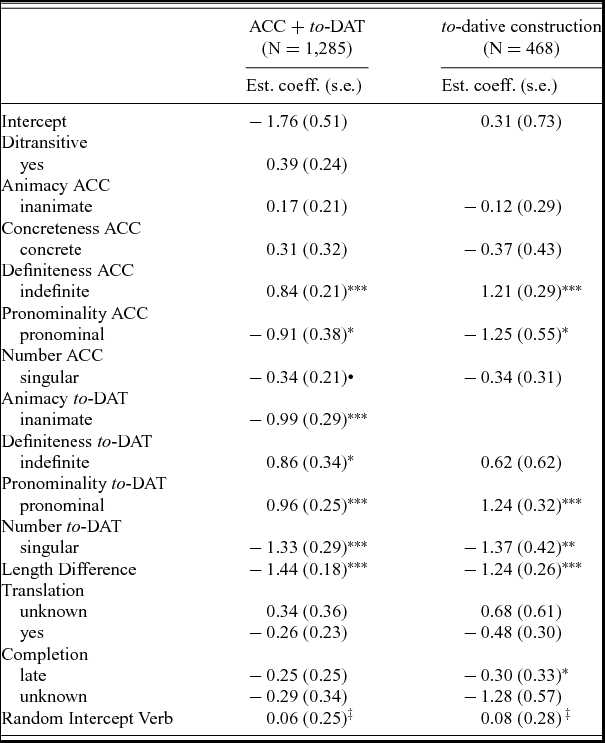
To evaluate the simultaneous effects of the variables, I fitted a mixed-effects logistic regression model to both data samples. The mixed-effects logistic regression models were fitted by means of the Laplace approximation implemented with the lmer function of the lme4 package in R (Bates et al. Reference Bates, Maechler and Bolker2011) in R (2010). The model estimates are given in table 6.
Estimated mixed-effects logistic regression models for the full data set and for the subset with to-dative construction. The to-DAT-ACC order is treated as the success ( = 1)

*** p-value < 0.001, ** p-value < 0.01, * p-value < 0.05, • p-value < 0.1. The significance of the variables was tested by means of a likelihood ratio test of the nested models. ‡Estimated Variance and (Standard deviation) of the Random Intercept.
The quality of both models was very good. I evaluated the prediction accuracy by looking at the mean concordance index C through 100-fold cross-validation. For the sample with the ACC+to-DAT construction (N = 1,285), I divided the data into a training set of 900 and a test set of 385. For the sample with the to-dative construction (N = 468), I divided the data into a training set of 300 and a test set of 168. The concordance indexes suggest that both models make very good predictions: C ACC+to-DAT = 87%, Cto -dative construction = 83 per cent (a concordance index greater than 80 per cent is indicative of a good predictive accuracy; cf. Harrell Reference Harrell2001: 247). Both indexes are also larger than the baseline percentages one would always obtain by predicting the most frequent patterns, i.e. 84 and 73 per cent respectively.
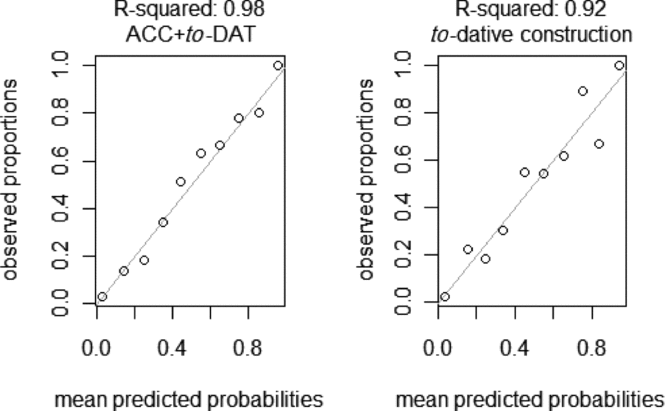
Building on the Hosmer-Lemeshow test to evaluate the goodness of fit for logistic regression models, I grouped the predicted probabilities for each sentence into ten groups using equal cutoff points and compared the correlation between the mean probability for each group and the observed proportions of the response in the same group. The correlation plots in figure 1 further indicate a very good fit of the models to the data (plots were made with the plot.logistic.fit.fnc function in the LanguageR package Baayen (Reference Baayen2011).
Corpus model fit between grouped observations and mean predicted probabilities for the models for the ACC+to-DAT (N = 1285) and the to-dative constructions (N = 468)
The direction of the significant variables was as expected, except for Definiteness of DAT, which was only significant in the full data set, and for Number of DAT, for which singular DATs were negatively associated with the to-DAT-ACC order. However, as expected, an indefinite and nominal ACC, and an animate to-DAT were preferably used with the to-DAT-ACC order. The difference in length between the ACC and the to-DAT yielded a strong effect on the choice of order: the longer the to-DAT is in comparison with the ACC, the less likely it is to take a to-DAT-ACC ordering, which confirms our hypothesis for this variable.
As regards the extra-linguistic variables, the Date of Completion proved significant in the model for the to-dative construction, but only for the category of ‘unknown’, which suggests that there was no change in the ordering preferences during OE. No evidence was found for the effect of the other variables. I also fitted a model in which I included the Date of Manuscript rather than the Date of Composition − the date of composition is earlier than that of the manuscript for many observations and may thus yield a different effect − but this variable was not significant either.
The random intercept associated with the sentence verb was found to be low in both data sets: 0.06 and 0.08 (in comparison, the estimated variance associated with Verb Sense in Bresnan et al. Reference Bresnan, Cueni, Nikitina, Baayen, Bourne, Kraemer and Zwarts2007 was 2.27). A likelihood ratio test of the models with a random factor and the ones without indicated that the sentence verb does not contribute significantly to the choice of order (ACC+to-DAT construction: χ 2 = 1.13, df = 1, p-value ≈ 0.28; to-dative construction: χ 2 = 0.44, p-value ≈ 0.51). No evidence was found, then, that different verbs were biased towards one of the two orders. The same holds true for the variable Ditransitive: ditransitive verbs were not found to be associated with any particular order.
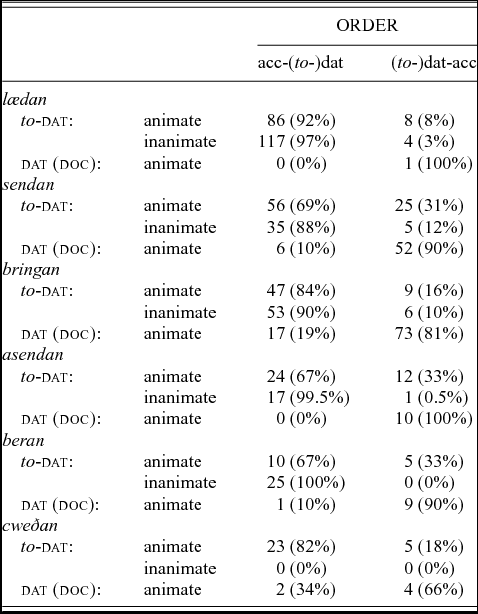
An interesting significant effect that is observed for the full data set is associated with the animacy of the to-DAT: an inanimate to-DAT was less likely to be expressed with the to-DAT-ACC order than an animate to-DAT. The odds ratio for this variable equals 0.37 (95% CI = 0.21 to 0.66), which means that the odds of an inanimate to-DAT being expressed with the to-DAT-ACC order was only about 37 per cent of that of an animate to-DAT. To examine this effect in more detail, I additionally compared the ordering tendencies of the six most common alternating verbs with respect to the to-dative construction and the DOC. Consider the data given in table 7.
The distribution of the six most common alternating verbs with to-DAT (animate and inanimate) and DAT in the DOC by order (no DOC with an inanimate dative object was attested)
Looking at the ordering associated with the to-DATs, we can see that the animate to-DATs are somewhat more lenient in their ordering behaviour than inanimate to-DATs. While inanimate to-DATs nearly always take the ACC-to-DAT order, animate to-DATs more often take the opposite to-DAT-ACC order (which is consistent with the results of the logistic regression model). Interestingly, the DAT-ACC order is also the preferred order of an animate DAT in the DOC. In other words, the ordering behaviour of an animate to-DAT is somehow in between that of an inanimate to-DAT and an animate DAT.
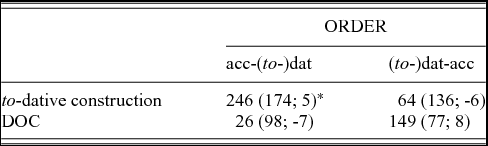
I additionally tested the overall ordering preferences of the to-dative construction vs the DOC, by aggregating the observations (thus dropping the observations for inanimate to-DATs), as outlined in table 8.
Aggregated results for the choice of order by construction class (to-dative construction vs DOC)
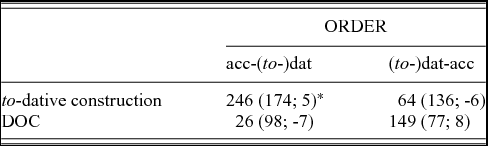
*Expected frequency and Pearson residual. (Residuals larger than |2| are regarded as major influences.)
The data in table 8 suggest that the order of ACC and (to-)DAT was strongly associated with the type of construction in which they were used (χ 2 = 186, df = 1, p-value < 0.0001, φ = 61%): a to-dative construction preferably occurred with ACC-to-DAT order, a DOC preferred the DAT-ACC order. The Pearson residuals (see table 8) further substantiate that the observed frequencies deviate strongly from what we would expect if the ordering of the ACC and to-DAT were independent from the construction in which they occurred. In other words, the OE ordering preferences for the to-dative construction and the DOC were already similar to the standard orderings associated with the dative alternation in PDE.
3.3 ACC+to-DAT ordering: discussion
I found that both orders occurred in OE, but that the ACC-to-DAT order tends to be used more often than the to-DAT-ACC order. As expected, the OE to-dative construction exhibited a relatively freer object ordering than that of PDE, where the to-PP-DO order is limited to particular contexts.
The results of the estimated logistic regression models indicated a very weak association between the ordering and the sentence verb (cf. the low variation of the random factor in both models). Building on the evidence that the dative alternation is associated with verbal semantics, I believe that the reason for this weak association may lie in the fact that there is a stronger association between a verb and the construction with which it is preferably used, than between a verb and a particular object ordering. The ordering is primarily associated with pragmatic motivations and may therefore be independent of verbal semantics.
The results of the logistic regression analysis further show that the ordering is motivated by the same factors that are also found to be involved in the dative alternation in PDE. Based on my corpus sample, I found significant evidence for the influence of five predictors: pronominality of the ACC and the to-DAT, definiteness of ACC, number of DAT and length difference. Moreover, the relative effect sizes associated with these predictors as well as the direction of these effects are similar to those found for the dative alternation in PDE. The effects associated with the dative alternation in PDE have been explained in terms of ‘Harmonic Alignment’, which refers ‘to the tendency for linguistic elements that are more or less prominent on a scale (such as the animacy or nominal-expression type scales) to be disproportionately distributed in respectively more or less prominent syntactic positions (such as preceding in word order or occupying a superordinate syntactic position)’ (Bresnan & Ford Reference Bresnan and Ford2010: 183). Animate, definite, singular, pronominal and shorter ACCs/to-DATs are accordingly expected to occur before inanimate, indefinite, plural, nominal and longer to-DATs/ACCs. The results of this study are consistent with what is expected under the Harmonic Alignment hypothesis, which thus also seems to have been involved in OE.
How do these ordering results bear on the further development of the ditransitive constructions in ME? An important change in ME was the loss of the DO-IO order (cf. the ungrammaticality of give the book John in PDE, which was perfectly possible in OE). According to Allen (Reference Allen, Kemenade and Bettelou2006: 214), the use of the to-dative construction may have led to a lesser need to maintain the ACC-DAT (DO-IO) order, because of their pragmatic similarity (both order have the Recipient in final, i.e. focused, position). The results of this study support this idea.
The fact that the IO-DO order was already the most frequent one in ME to begin with may additionally have contributed to the loss of the DO-IO. Although hard to prove, it seems quite possible to me that both phenomena − the increased use of the to-dative construction (with its preferred ACC-to-DAT/DO-to-PP order) and the winner-takes-it-all behaviour of the DAT-ACC/IO-DO order of the DOC − reinforced each other, a process which ultimately led to the ungrammaticality of the DO-IO order of the DOC.
4 The semantics of to from OE to ME
4.1 Introduction
As discussed in the previous sections, the to-dative construction was well established with certain verb classes in OE, particularly with caused-motion and communication verbs. However, no example has thus far been found of a to-dative construction with a transfer of possession verb and a human recipient. The first examples of this type date back to the thirteenth century. Example (16), featuring the verb ȝiuen (‘give’), is one of the oldest attestations (example taken from the Penn–Helsinki Parsed Corpus of Middle English, second edition; see Kroch & Taylor Reference Kroch and Taylor2000).
(16) ȝeue to ioseph
‘give to Joseph’
(CMJULIA, 119.390)
According to McFadden (Reference McFadden and Lightfoot2002), to was in this process semantically reanalysed from a Goal to a Recipient marker. McFadden's account is in line with the general grammaticalization hypothesis according to which abstract grammatical functions are derived from more concrete meanings. The change from allative to recipient marker is also one of the basic pathways outlined in the grammaticalization literature and several studies argue that the semantics of to followed this grammaticalization path (Cuyckens & Verspoor Reference Cuyckens, Verspoor, Van der Auwera, Durieux and Lejeune1998; Cuyckens Reference Cuyckens and Lewandowska-Tomaszczyk1999; Heine & Kuteva Reference Heine and Kuteva2002; Haspelmath Reference Haspelmath and Tomasello2003; Luraghi Reference Luraghi2003; Newman Reference Newman1996; Tyler & Evans Reference Tyler and Evans2003). I believe that this general grammaticalization path may be correct if one considers the semantic development of to on a broad diachronic scale.
However, McFadden's analysis disregards the empirical evidence that the to-dative construction already existed in OE with many verbs. Because the semantic potential of to was much more varied than that of a Goal marker, the actual semantic change of to in early ME seems to have been much ‘smaller’ than what McFadden maintains.
This section examines the various uses of to in OE, particularly those that closely bordered on that of Recipient. Section 4.2 first presents a comprehensive overview of various contextual uses in which to is found in OE. Section 4.3 then discusses evidence of an ‘embryonic’ Recipient use of to in OE.
The data used in this section were gathered from different sources, including: the Oxford English Dictionary, Albers (Reference Albers1907), Belden (Reference Belden1897), Bosworth & Toller (Reference Bosworth and Toller1955), Mitchell (Reference Mitchell1985), the OE part of the Helsinki Corpus, and my sample observations retrieved for the previous sub-studies.
4.2 To in OE
Distinguishing between the different uses/meanings of a preposition is a lasting topic of discussion (see Van der Gucht et al. Reference Van der Gucht, Willems and De Cuypere2007) and is not one that I will take up here. The outline given below does not pretend to be exhaustive nor to represent the best classification possible, but aims to illustrate the diverse spectrum of uses in which to already occurred in OE
A common use of to involves marking a spatial direction. As in PDE, this particular use is prompted by a verb that signified some kind of motion, as cumen (‘come’) in (17).
(17)

To also occurred in non-spatial contexts, as in (18) to æfenes (‘till the evening’), where to marks a chronological direction, or in (19) gehwyrfþ to (‘converts to’), where to is used in a religious context, to mark an abstract direction of a conversion towards a God or in a belief.
(18)
(19)

As discussed already, to was commonly used with the ACC + to-DAT construction with the to-DAT referring to a location, see (20), to heora gest-huse (‘to their guest house’), or a person, see (21), to þam wælhreowan casere (‘to the cruel emperor’).
(20)
(21)

As seen in section 2, the to-dative construction was often used with verbs of communication, as illustrated in (22) and (23), with the verbs cweðan (‘say’) and witegian (‘prophesy’):
(22)
(23)

It is debatable whether the use of to as an Addressee marker could be regarded as an instance of a Recipient one, given that an Addressee is sometimes also interpreted as the intended recipient of a communicated message (e.g. Rappaport Hovav & Levin Reference Rappaport Hovav and Levin2008: 134). This would imply that the Recipient use of to is already established from early OE onwards. I believe, however, that the distinction between Addressee and Recipient is here warranted by the observation that the to-dative construction was fully established with verbs of communication, but not used with transfer of possession verbs with an animate Recipient. The distinction thus appears to have been functional, in that the OE speaker intuitively knew that the use of to was grammatical as an Addressee marker, but not, or perhaps much less so (see section 4.3), as a Recipient marker. As we shall see, the few instances discussed in section 4.3 suggest, on the one hand, that the use of to as a Recipient marker was grammatical but strongly disfavored. On the other hand, the fact that no transfer of possession verb with a human Recipient is found with a to-dative construction suggests that this combination was ungrammatical. Unfortunately, in the absence of native-speaker intuition one cannot fully determine the grammaticality of to as a Recipient marker in OE.
To could also be used as an index of a place (24) or a specific point in time (25), and even as a price indication (26) to þrim hunde penega (‘for three hundred pence’). Clearly, in these cases no locational change or direction is involved.
(24)
(25)
(26)


To could furthermore indicate a ‘state, quality, condition to be attained’ or ‘the occasion (as a marriage, a feast) to be attended’ (Belden Reference Belden1897: 52), as illustrated in (27), to ecere reste (‘to eternal rest’) and (28), to deaðe (‘to death’):
(27)
(28)

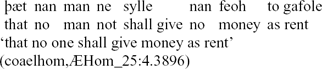
A frequent use of to was that of purpose marker, as in (29), to gafole (‘as rent’):
(29)
To is also found as a comparison marker (30):
(30)
And even as a source marker (31):
(31)

According to Belden (Reference Belden1897: 48), the meaning of to is in all its uses associated with the idea of ‘direction’. This is correct, I believe, although there are some uses where this idea is only faintly present (e.g. when used as a comparison marker; see (30)). Most importantly, however, the examples discussed here clearly illustrate that the sense of ‘direction’ was not confined to spatial contexts and that highly abstract uses of to were abundant in OE. The next section zooms in on the use of to as a possible Recipient marker.
4.3 To-DAT as Recipient in OE?
The semantic role of a participant in the sentence is defined by its semantic relationship with the sentence verb. A Recipient refers to the participant to whom something is transferred and who thus becomes the possessor of the object (the latter criterion distinguishes the Recipient from a locational Goal). In PDE, the Recipient role is typically associated with the IO or the to-PP of a transfer of possession verb.
As regards the use of the to-dative construction with transfer of possession verbs in OE, there are no known attestations of sellan or (a)giefan with a personal to -DAT. However, this does not necessarily imply that the to-DAT could not be used as a Recipient in OE. I believe that there are in fact uses of the to-DAT where the context prompts such an interpretation.
In the OE Charters, which typically document donations to a church or town − mostly of agricultural assets and commodities such as land, livestock and cereals − one finds many examples of sellan with a to-DAT referring to a location, as in (32); more examples can be found in the OE charters 37.8, 41.20, 45.21, 45.29, 45.34, and 45.39.
Visser (Reference Visser1963: 624, fn 1) further notes that similar instances are occasionally found in late OE with the verb agiefan (‘to give’).
(32)
Although to cantuarabyrg (‘to Canterbury’) in (32) denotes a location, it is clear that its actual referent is the community of the church of Canterbury. The gift is thus not so much directed to the church as a physical place, but rather to the social community to which the place name metonymically refers. A Recipient reading of the to-DAT therefore seems appropriate.
The Recipient role of the to-DAT is further prompted by lettan (‘leave’, ‘let’, ‘lease’) and niman (‘take’, ‘receive’, ‘get’), illustrated in (33) to (35):
(33)
(34)
(35)

The state of affairs referred to in (33) and (34) involves a possessional transfer between human individuals, which qualifies both to-DATs as Recipients. The Recipient role of the to-DAT in sentence (35) becomes clear if one takes into account the full context; the sentence is uttered by angels talking to a fallen one, who wish to accept the fallen angel back into their midst.
The examples discussed in section 4.3 provide evidence that the OE to-DAT could be interpreted as a Recipient in contexts that involve some kind of possessional transfer. It is, nevertheless, a matter of fact that the total number of instances of this use remains very small in OE (the clearest examples that I could find are all cited in this article). Assuming that this was not merely due to a lack of recorded evidence and that the evidence was not just lost in the sands of time, one may wonder why this possibility of using the to-DAT as a Recipient was not fully exploited until ME.
There are two possible explanations, I believe, which, admittedly, remain tenuous in the light of the available empirical evidence. A first explanation could be that the use of a transfer of possession verb with a to-dative construction was initiated by some OE speakers but never adopted by many other speakers of the language community, or at least not by the writers of the OE texts that have survived. This account is not very satisfactory, however, as it merely restates the question of why the innovation did not catch on with the rest of the community.
A second, more likely, explanation, is that the use of the to-dative construction with transfer of possession verbs was syntactically blocked by the ACC+DAT DOC. The latter construction is said to be semantically associated with a possessional transfer, while the to-dative construction is associated with a locational change (see Pinker Reference Pinker1989; Langacker Reference Langacker1991; Krifka Reference Krifka, Bird, Carnie, Haugen and Norquest1999; Harley Reference Harley, Pica and Rooryck2003). Based on Bresnan's studies, we know that this semantic difference is not the main factor that drives the dative alternation in PDE, but it is possible that this semantic distinction was stronger in OE, which would explain why a transfer of possession verb only occurred with the DOC. A strong semantic association between the DOC and the ‘transfer of possession’ meaning could have blocked the use of a ‘transfer of possession’ verb with the to-dative construction. Moreover, since the DOC occurred with both object orders, pragmatic differences could be expressed by the DOC alone, which is no longer possible in PDE, where the to-dative construction is obligatory when the order is IO-DO. Unlike in PDE, then, where the to-dative must be used to express certain pragmatic features, there was no need to use it in OE, as both DOC orders could be used with the transfer of possession verbs. Once case morphology was lost, the to-dative construction, which preferred the ACC-to-DAT order, could then have been used to compensate for the loss of the DO-IO order.
5 Conclusion
This study has examined four aspects associated with the OE to-dative construction, which was defined as the clausal pattern [ditransitive Verb + NP + to-PP]. First, based on an investigation of data from the YCOE corpus, I found that the to-dative construction was not rare in comparison to the DOC in OE and that this construction was fully established with verbs of caused motion and communication. The results thus clearly falsify any alleged causal relationship between the emergence of prepositions and the loss of case morphology; the use of the to-dative construction did not lead to the demise of the ACC/DAT distinction, nor did the to-dative construction emerge upon the loss of the ACC/DAT morphology. It remains a matter of fact, however, that no examples were attested of a transfer of possession verb with a human to-DAT Recipient; it therefore remains possible that the use of the to-dative construction with this verb class was associated with case loss. Second, the corpus data furthermore revealed that, overall, the same ordering tendencies already existed in OE as in PDE. Both the ACC-to-DAT and the to-DAT-ACC orders were grammatical, with the former being the most frequent one. However, in contrast to PDE, the to-DAT-ACC appeared to have been more broadly used than in PDE, where its use is heavily restricted. Third, building on the multifactorial approach to the dative alternation in PDE, I used a mixed-effects logistic regression model to evaluate the effect of various factors on the ordering of the to-dative construction in OE (factors that are known to be associated with the dative alternation in PDE). Five factors were found to be associated with this ordering: pronominality of the ACC and of the to-DAT, definiteness of ACC, number of DAT and the difference in length between the ACC and the to-DAT. The relative impact effects of these factors as well as the direction of their effect were additionally found to be similar to those observed for the dative alternation in PDE. Fourth, I made the case that the semantic change of to from OE to ME was more gradual than has traditionally been appreciated in the literature. Given that the to-dative construction was not used with transfer of possession verbs until ME, it stands as a matter of fact that the main semantic change associated with to was the extension of its use to a Recipient marker. However, in contrast to the traditional account, which says that to was reanalysed form a Goal to a Recipient marker, I argued that this alleged change is far too ‘saltational’ in the light of the empirical data, which actually suggests that a Recipient use of to was already embryonically present in OE.
Bivariate descriptive statistics