1. Introduction
A key issue in the design of the tax-benefit system is how to balance the redistribution of resources to those with low income and the promotion of stronger incentives to work. Although the idea that ‘the conflict between equality and economic efficiency is inescapable’ (Okun, Reference Okun1975) has influenced the policy debate since the middle of the 1970s, the enhancement of both the redistributive and the incentive effects of the tax-benefit system can inspire policy reforms. Recent research shows that in-work benefits reduce the inefficiencies associated with traditional income-based transfers because they are conditional on the behavioural response of the recipients (Immervoll et al., Reference Immervoll, Kleven, Kreiner and Saez2007).
Since the 1990s, in the United Kingdom, in-work benefits have been implemented to support low-income people and to raise their incentives to work. They inspired a number of European countries to follow the same route (Immervoll and Pearson, Reference Immervoll and Pearson2009).
Recently, in this journal, Marx et al. (Reference Marx, Vanhille and Verbist2012) considered some policy options related to the fight against in-work poverty in Continental Europe, including the potential impact of a stylised version of the British in-work benefit. Clearly, the success of in-work benefits depends heavily on their design (Brewer et al., Reference Brewer, Saez, Shepard and Mirrlees2010), the institutional constraints (Marx et al., Reference Marx, Vanhille and Verbist2012) and the extent to which they do not induce income effects (a reduced labour supply accompanied by an increase in income due to the benefit) or deadweight losses in the form of windfall beneficiaries (individuals that would have behaved in the same way without the benefit). However, borrowing from the optimal tax theory, it can be argued that in-work benefits might be optimal income transfers and more efficient than guaranteed income support schemes when the individual is facing the choice to enter the labour market or not rather than when the worker is choosing how many hours to work (Saez, Reference Saez2002). Moreover, in-work benefits are also politically attractive because they combine both employment and redistributive objectives at the same time (Owens, Reference Owens2006). As a consequence, the interest for in-work benefits remains at the core of the policy debate and of the academic literature (Kenworthy, Reference Kenworthy2011) and the success of their implementation depends on the integration with the existing tax-benefit system and labour market characteristics. Recently, in-work benefits have been advocated as being potentially suitable to be part of a tax-benefit reform system in Greece, Italy and Spain, due to low female labour market participation and the need to redistribute resources to the most vulnerable individuals (Baldini et al., Reference Baldini, Bosi and Toso2002; Boeri and Perotti, Reference Boeri and Perotti2002; Owens, Reference Owens2006; Figari, Reference Figari2010).
The Southern European countries share a similar welfare system, which does not perform well either in terms of equity or efficiency (Sapir, Reference Sapir2006). Although such countries witnessed a welfare state recalibration at the end of the twentieth century, catching up with the more advanced European countries (Ferrera and Hemerijck, Reference Ferrera, Hemerijck, Zeitlin and Trubek2003), they still characterise a particular system of social protection (Ferrera, Reference Ferrera, Castles, Leibfried, Lewis, Obinger and Pierson2010). To some extent, these countries share common features such as fragmented income maintenance schemes (Matsaganis et al., Reference Matsaganis, Capucha, Ferrera and Moreno2003), low state penetration and diffusion of clientelism (Ferrera, Reference Ferrera1996), high incidence of an underground economy and low administrative capacities (Ferrera, Reference Ferrera, Castles, Leibfried, Lewis, Obinger and Pierson2010), as well as the prominent family role as an informal but effective social safety net (Naldini, Reference Naldini2003). The family has an essential role in providing caring services, and policies aimed at reconciling employment and family responsibilities still lag behind most European countries (Tavora, Reference Tavora2012). Moreover, the tax-benefit systems are influenced by the male breadwinner model, with elements that reduce the incentives for the second potential earner to take a paid job, and are not necessarily well targeted at the poor.
An enhancement of the incentive effects of the tax system is a particularly urgent matter in the Mediterranean countries where, although the labour market performed relatively well before the economic crisis, the employment rate is far below the EU employment target of 75 per cent by 2020 (European Commission, 2010).
In 2008, before the onset of the current economic downturn, the female employment rate was about 51 per cent in Italy, 52 per cent in Greece and 58 per cent in Spain. Among women aged fifteen to twenty-four years those neither in employment nor in education and training were about 26 per cent in Italy, 25 per cent in Greece and 20 per cent in Spain relative to an EU-15 average of 18 per cent: a divergence that enlarged remarkably in the years of the economic crisis. Moreover, the Italian context is characterised by a documented dualism between North and South. In the southern regions employment, in particular among women with little education, is particularly low, due to a large degree to lack of demand as well as lack of services. As in the other Mediterranean countries, in Italy the attainment of the EU target requires increasing labour force participation rather than simply absorbing unemployment. However, although demand constraints, caring responsibilities and other arrangements within the family should be considered as a priority by the policy makers (Saraceno, Reference Saraceno2011), improving the financial incentives channelled through the tax-benefit system is a fundamental starting point for the decisions taken by the individuals.
Using EUROMOD, the EU-wide microsimulation model, this paper aims to analyse the extent to which it is possible to enhance both the redistributive and the incentive effects of the Italian tax-benefit system, which is an interesting case study in its own right. From a comparative perspective, the Italian experience can represent a useful benchmark for other Mediterranean countries and south-eastern European countries that show a number of common features, making a comparison worth pursuing (Ferrera, Reference Ferrera, Castles, Leibfried, Lewis, Obinger and Pierson2010).
This paper is the first contribution to analyse the behavioural and redistributive effects of different designs of in-work benefits in Italy, focusing on women in couples and lone mothers separately. As described in Section 2, I propose two alternative marginal reforms to the tax system: the first reform introduces a family-based in-work benefit while the second reform introduces an individual in-work benefit. Taking into account the behavioural reactions of women (Section 3), the reforms are financed by the simultaneous abolition of the existing tax credit targeted at dependent adult people within the family. Such a tax credit is a rather expensive element of jointness (i.e., couple/family assessment) in the tax system and induces disincentive effects for second earners because it is paid to the tax payer, due to the presence of family members without their own income.
As long as they improve the financial incentive to take a paid job, as shown in Section 4, in-work benefits contribute both to enhancing the redistributive and the incentive effects of the Italian tax-benefit system. Moreover, the effects can be reinforced by the double dividend of female labour market participation: more women working outside the family requires others to provide household chores previously provided by housewives (Ferrera, Reference Ferrera2008). Furthermore, an increase in the labour force participation of second earners in a household is also welfare-improving as increased labour participation is an insurance against household poverty, which is particularly relevant in a period of economic crisis.
2. The Italian tax-benefit system and the design of the two reforms
Like most of the EU tax systems, the Italian one is the result of historical compromises designed under a given set of social and economic circumstances. As a consequence, the Italian tax system does still have elements oriented towards a model of a one breadwinner (predominantly male) couple, which was the case at the time of the major reform of personal income tax in the early 1970s. Despite frequent periodic adjustments to the tax structure, the changes in the tax system have not provided a more competitive fiscal environment and increased work incentives (Owens, Reference Owens2006; Naldini and Saraceno, Reference Naldini and Saraceno2008).Footnote 1
Considering both income tax and social insurance contributions, working-age individuals face quite a high levy compared to other European countries and they receive limited support from the benefit system. The average tax in Italy is about 10 percentage points higher than the OECD average (OECD, 2009), with a one-earner couple with two children facing a tax wedge of 36 per cent (compared with an OECD average of 26 per cent) and a lone parent with two children facing a tax wedge of 25 per cent (compared with an OECD average of 17 per cent). The personal income tax is assessed at the individual level based on a progressive schedule. Non-refundable personal tax credits related to the income source are available to all taxpayers in addition to a number of tax reliefs that depend on the number of dependent persons in the family. They are residual elements of jointly assessed income tax at the family level with direct effects on individual work incentives. The tax credit for dependent adults is up to €546 per year in the case of a spouse and €303 per year for other family members. In aggregate terms, it values €3.3 billion per year, corresponding to 2.7 per cent of the Personal Income Tax revenue. Such a tax credit compromises the equality of tax treatment for the first earner in a couple because it is dependent on the second earner not entering the workforce. It also has disincentive effects on the labour supply of secondary earners in a family because it is received by the tax payer conditional on other family members not working. Moreover, it is a form of support that is not always well targeted because rich individuals can also benefit from it. Actually 19 per cent of people entitled to the tax credit are in the top 40 per cent of the income distribution, receiving basically around 20 per cent of the aggregate amount of resources allocated to the tax credit: even though it decreases with income, low-income individuals do not receive the full amount of the tax credit if this exceeds the tax liability because it is non-refundable. In terms of tax design, the main question behind such a tax credit is why the tax system should encourage dependency relationships (Wilkinson, Reference Wilkinson1982). At the time of the shift to individual taxation in the UK and other countries (Spencer, Reference Spencer1986), the prevailing consideration was that, if a partner or an adult in the family does not work due to caring responsibilities, there should be a tax concession explicitly related to such a responsibility (Hills, Reference Hills1990). Families with children or disabled members have greater needs than families without, where an adult simply prefers to remain at home.
In this paper, I suggest two reforms in which the tax credit for dependent adults of working age is abolished and replaced by two different – and alternative – in-work benefits. The abolition of the existing tax credit for dependent adults does not affect tax concessions targeted at families with disabled persons, children or elderly members (if a family member is dependent and older than sixty-five years, the tax payer would still have the right to receive the existing tax credit). Once the behavioural reactions of individuals included in the analysis are taken into account, the potential reforms are revenue neutral considering not only the abolished tax credit but also the additional taxes (and reduced means-tested Family Allowances) paid by those who supply more work. In their design and construction, the reforms imply a redistribution from one-earner couples to families with low-earning individuals and lone mothers.
Two types of in-work benefits emerged in the last decade in many industrialised countries. First, family-based in-work benefits appeared in the UK and other Anglo-Saxon countries. More recently, individual in-work benefits have become more popular in continental Europe (Belgium, Finland, Hungary, the Netherlands, Sweden) where the potential disincentive effects of the benefits, assessed at the family level, on the second earner encouraged the individualisation of the benefits (Immervoll and Pearson, Reference Immervoll and Pearson2009). In the Italian public debate, the British scheme is often proposed as a way to support labour market participation of women and poor families (Boeri and Del Boca, Reference Boeri and Del Boca2007; Saraceno, Reference Saraceno2007; Del Boca et al., Reference Del Boca, Mencarini and Pasqua2012), but also the individual scheme received attention (Boeri and Perotti, Reference Boeri and Perotti2002).
Given the pioneer role of the British experience in in-work benefits and the recent developments of these policies, I simulate the family-based in-work benefit using the UK Working Tax Credit (WTC) as an exemplar and borrowing its structure.
The main eligibility condition for the Working Tax Credit is that at least one person in the family works sixteen or more hours a week (thirty or more if there are no children). The amount of the tax credit depends on family gross income and it varies according to the composition of the family. Above the given thresholds, the tax credit is tapered out at the rate of 37 per cent (Brewer, Reference Brewer2003).
The individual in-work benefit takes the form of an earning supplement for all individuals working sixteen or more hours a week. Beneficiaries of this policy are individuals characterised by low hourly wages and not simply low earnings due to a small number of hours worked per week. It provides an incentive to work at least part-time. Above a given individual earning threshold (set equal to the fifteenth percentile of the earnings distribution), it is tapered out at the rate of 37 per cent. One of the first individual in-work benefits was implemented in Canada in 1992: evaluations of the programme show an estimated income gain of $1.95 per recipient for each dollar of transfer (Michalopoulos et al., Reference Michalopoulos, Robins and Card2005).
The parameters of the simulated in-work benefits (see Section 4) have been calibrated in order to guarantee revenue neutrality once the existing tax credit for dependent adults has been abolished and labour supply reactions have been taken into account.
Following the argument that individual taxation is closer to the optimal tax scheme, it can be argued that a purely individual-based system should be favoured (Brewer et al., Reference Brewer, Saez, Shepard and Mirrlees2010): the phasing-out region of the family-based in-work benefit might create implicit high taxes on secondary earners. The extent to which the different assessment units of the two types of in-work benefits may have consequences on the incentive and redistributive effects is the main empirical question addressed in this paper.
Two assumptions underlie the implementation of the in-work benefits. First, the administrative burden and procedures involved in such schemes are ignored, even if they are important for the implementation of in-work benefits. Second, a binding minimum wage should be introduced in order to prevent employers decreasing the gross wage below the level existing before the introduction of the in-work benefits. I return to this issue in the Conclusions.
3. Empirical methodology
The first round (static) effects of a policy reform give useful insights into the redistributive and budgetary effects of a policy change. Nevertheless, it is important to analyse the strength of work incentives and the second-round redistributive effects related to the policy changes.
In order to take into account potential labour supply responses of women to the changes in the tax system, I follow the growing economic literature of structural models of labour supply (see Creedy and Duncan, Reference Creedy and Duncan2002 for a review). Given the low participation and the relatively high flexibility of women in the labour market, the analysis focuses on women in couples (i.e., cohabiting with a partner regardless of marriage status) and lone mothers (i.e., with a child but without a partner) separately.
I assume that women can vary their labour supply, while the hours worked by men are kept fixed as observed in the data. This is a standard approach in the literature supported by the almost inelastic male labour supply, particularly in Italy (Aaberge et al., Reference Aaberge, Colombino and Strom1999) where most active men work full time. Nevertheless, the utility maximisation takes place at the family level, taking into consideration the income of all family members. The labour supply model and the estimated preference coefficients are presented in Figari (Reference Figari2011).
3.1 Data
This paper uses the Italian component of EUROMOD, the European-wide tax-benefit model. EUROMOD is a static microsimulation model: it combines detailed information on relevant policy rules with representative data on individual and household circumstances drawn from national household income surveys. EUROMOD simulates the main social insurance contributions, income taxes and the non-contributory benefits. Contributory benefits (mainly old age and disability pensions) are not simulated due to lack of information about contributory history and health conditions and are taken directly from the underlying survey (Sutherland and Figari, Reference Sutherland and Figari2013).
One of the main features of a static microsimulation model is the computation of the disposable income of individuals and their families under different scenarios, taking into account the tax-benefit policies and the way they depend on the level of individual market income and personal/household characteristics (Bourguignon and Spadaro, Reference Bourguignon and Spadaro2006). Considering the gross hourly wage of the woman, and any other source of income of the family and its characteristics, EUROMOD derives the net disposable income of the family corresponding to each possible labour market alternative the woman can opt for, taking into account the whole tax-benefit system.
In order to consider tax evasion behaviour, net self-employment income recorded in the data has been split into two components (assuming that only a part of the total income has been declared to the tax authority), in order to obtain an aggregate amount of the declared income corresponding to that reported in the fiscal data.
The input data comes from the Italian component of the 2004 EU-SILC. The sample used in this analysis is composed of women in couples and lone mothers, restricted to those aged between eighteen and sixty-five years, without any pension or self-employment incomes and not in education. In order to include a couple in the analysis, the male partner must satisfy the same conditions. Such a restriction of the sample is common in the literature on behavioural evaluation of tax reforms and is motivated by the aim to exclude individuals whose labour choices are affected by factors that are not or cannot be controlled for in the labour supply model. Examples of these factors include disability status, educational choices, early retirement, self-employment and professional activities. The final sample includes 4,820 women in couples and 682 lone mothers.
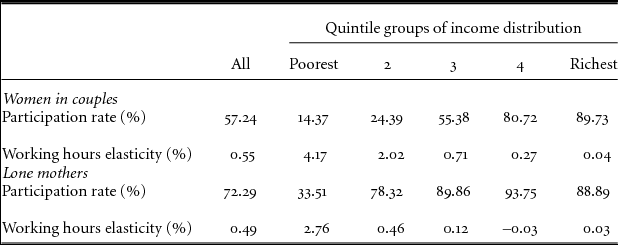
In order to understand how female labour supply could react to changes in financial incentives, I provide details, in Table 1, of participation rates and labour supply elasticities. Elasticities are based on the estimated coefficients of the labour supply model and computed numerically as the percentage variation in working hours due to a 1 per cent increase in the gross hourly wage under the pre-reform tax-benefit system.
Participation rates and labour supply elasticities
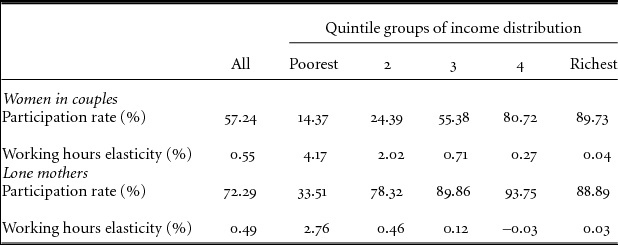
Notes: Labour supply elasticities are computed numerically as the responses to a 1% increase in the gross hourly wage of women. The working hour elasticity corresponds to the behavioural response measured as per cent variation in working hours. Income quintile groups are defined according to the distribution of household equivalised disposable income (using the OECD modified equivalence scale) of the overall population in the pre-reform system (2003).
Source: Author's analysis based on EUROMOD.
The participation rate of women in couples is around 57 per cent, whereas 72 per cent of lone mothers are working. The pattern of participation is clearly increasing with income: 90 per cent of the women in the richest quintile group are in work.
With a simulated increase in the hourly gross wage of 1 per cent, the behavioural response in the working hours is estimated to be, on average, around 0.55 per cent for women in couples and 0.49 per cent for lone mothers. In line with the literature (Bargain et al., Reference Bargain, Orsini and Peichl2014), the average elasticities are quite small, suggesting a modest response in the average behaviour. However, the distribution of such elasticities reveals important variations across quintile groups, being much larger for the women in the poorest quintile group. Such patterns are very often ignored in the literature with the exception of Aaberge et al. (Reference Aaberge, Colombino and Strom1999, Reference Aaberge, Colombino and Strom2004) and Roed and Strom (Reference Roed and Strom2002). The elasticities in the first quintile group are close to 4 per cent for women in couples and 3 per cent for lone mothers pointing out the potentially large responsiveness of women at the bottom of the income distribution, as already found by Aaberge et al. (Reference Aaberge, Colombino and Strom2004) with respect to the Italian case.
With labour supply elasticities large at the bottom of the income distribution, earning subsidies to low-earning people as in-work benefits can be optimal transfers (Brewer et al., Reference Brewer, Saez, Shepard and Mirrlees2010).
4. Empirical results
The empirical results focus on efficiency and equity effects in turn. The efficiency effects are presented by means of behavioural reactions, focusing on the number of hours worked (by hours range) by women. Regarding equity, I present the effects on poverty rates (and poverty gaps) and the distribution of gainers and losers.
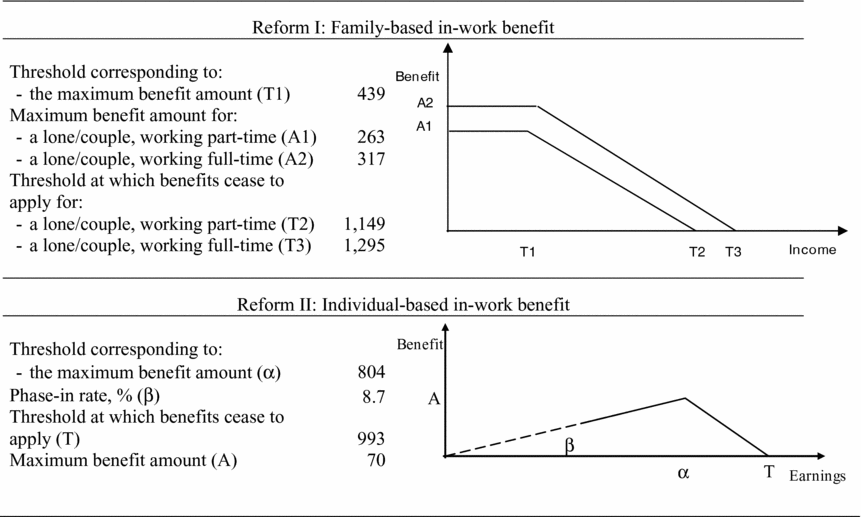
Figure 1 illustrates the parameters of the new in-work benefits. The maximum amount of the simulated transfers ranges from €70 per month for the individual in-work benefit to €317 per month for the family-based in-work benefit (for couples or lone mothers working full-time). Regardless of the limited amount of resources involved in the simulated reforms, the income limits at which the benefits cease to apply are quite high, allowing a relevant share of households to be beneficiaries of the new benefits. As expected, given the higher level of income at which the individual in-work benefit is exhausted, the number of household beneficiaries of the individual in-work benefit (9 per cent of the overall household population, 40 per cent of households included in the analysis) is much higher than those in receipt of the family-based in-work benefit (4 per cent of total households, 17 per cent of those included in the analysis), when behavioural reactions are taken into account.Footnote 2
Parameters of the simulated in-work benefits (€ per month) Notes: Amount of in-work benefit in vertical axes. Family gross income (all main sources of income with the exception of children's incomes and a disregarded amount for pensions, capital and property income) on horizontal axis for the family-based in-work benefit. Individual earnings on horizontal axis for the individual in-work benefit. Phase-out rate equal to 37 per cent of family-based and individual in-work benefit. ‘Reform I’: existing tax credit for dependent persons abolished and replaced by the family-based in-work benefit. ‘Reform II’: existing tax credit for dependent persons abolished and replaced by the individual in-work benefit.Source: Author's analysis based on EUROMOD.

In some cases, more than one recipient of the individual in-work benefit belongs to the same household and this increases the potential redistributive effect of the individual in-work benefit. However, looking at the average value of the in-work benefits received by the entitled households, it emerges that the family-based in-work benefit is more generous than the individual in-work benefit with monthly family-based (individual) in-work benefit around €105 (€35) for women in couples and €78 (€40) for lone mothers.
4.1 Behavioural reactions
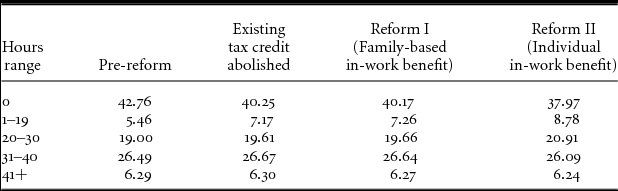
Table 2 illustrates the labour supply effects for women in couples, first abolishing the existing tax credit for dependent adults and then introducing instead the family-based or the individual in-work benefit.
Labour supply (column %): women in couples
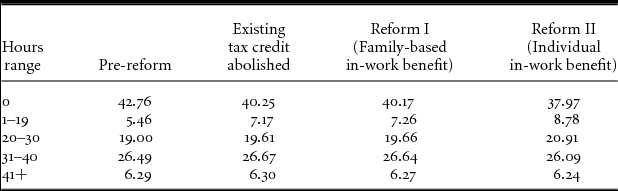
Notes: ‘Reform I’: existing tax credit for dependent persons abolished and replaced by the family-based in-work benefit. ‘Reform II’: existing tax credit for dependent persons abolished and replaced by the individual in-work benefit.
Source: Author's analysis based on EUROMOD.
Confirming the disincentive effect embodied in the current structure of the Italian tax-benefit system, the abolition of the existing tax credit for dependent persons shows a positive incentive effect on labour supply of 2.5 percentage points for women in couples who were previously not working. Most of them offer to work up to nineteen hours per week.
Once the tax credit for dependent adults has been abolished, the further introduction of the family-based in-work benefit does not increase significantly the labour supply of women in couples. On the one hand, the average incentive effects on the labour supply are very similar to those observed after the abolition of the existing tax credit, without any further reactions due to the family-based in-work benefit. On the other hand, the expected disincentive effects of the family-based in-work benefit on the second earner in the family do not seem to be as strong in the Italian case as they are in other contexts, where the disincentive effect is a joint consequence of tax credits and generous social assistance schemes which do not exist in Italy (Bargain and Orsini, Reference Bargain and Orsini2006; Haan and Myck, Reference Haan and Myck2007).
Individual-based in-work benefit has a stronger incentive effect with 4.8 percentage points for women, currently not working, starting a job; an increase of 3.3 percentage points for women working up to nineteen hours; and an increase of 1.9 percentage points for those working between twenty and thirty hours. However, a positive participation effect is combined with a slight reduction in the number of hours worked by those already in employment.
Some women working full-time reduce their labour supply due to the disincentive effect embodied in the benefit: women with earnings above the maximum threshold prefer reducing their labour supply. Otherwise, they are not entitled to receive the transfer.
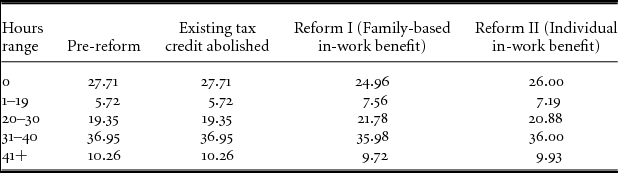
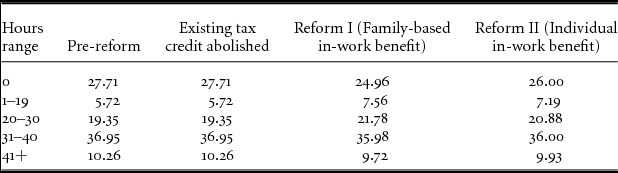
The results for lone mothers are reported in Table 3. They show that the abolition of the existing tax credit itself does not have any impact on the labour supply of lone mothers because they are not entitled to the existing tax credit for a dependent spouse. The labour supply of those currently not working increases significantly more after the provision of the family-based in-work benefit (+2.8 percentage points) than the individual in-work benefit (+1.7 percentage points). This is because lone mothers are generally entitled to both the in-work benefits, and the family-based in-work benefit for them is much more generous. In both scenarios, the overall labour supply slightly decreases for women currently working more than thirty-one hours per week and this is because such women have fewer incentives to work long hours, because by doing so they lose the entitlement to receive the benefits.
Labour supply (column %): lone mothers
Notes: See Table 2.
Source: Author's analysis based on EUROMOD.
In order to evaluate the impact of the reforms, it is also relevant to analyse the changes in the distribution of the number of hours worked pre- and post-reform and to understand where, along the different points in the income distribution, the behavioural reactions take place (see Figari, Reference Figari2011 for more details). The positive effects in the labour supply of women in couples, after the introduction of the new in-work benefits, are focused on those who did not work before the reform. With the new benefits, most of them start working in short part-time arrangements (i.e., above the threshold of sixteen hours per week, which entitles them to receive the new benefits, and up to thirty hours per week). Looking at the distribution of women in couples by income quintile group, it emerges that most of the positive behavioural reactions are faced by those in the first quintile group, where 86 per cent of the women did not work before the reform.
Even if those who decrease the number of hours worked are usually in the phase-out region of the benefit, which discourages work through the income effect, the disincentive effects of the two types of in-work benefits have an impact on women at different points in the income distribution. The family-based in-work benefit shows a disincentive effect among the poorest families who are entitled to the benefit only if the second earner (usually the woman) does not earn above a given threshold. The disincentive effect is also not marked for families at the top of the income distribution because most of the richest families are not entitled to the benefit at all. On the contrary, the individual in-work benefit shows a more pronounced disincentive effect (but not statistically significant) among the richest women, who might reduce the number of hours worked in order to be entitled to the benefit.
Overall, it emerges that most of the reactions are at the extensive margin of the labour supply – where the choice is whether to work or not – rather than at the intensive margin – where the choice is how much to work. This confirms the pattern found in the evaluation of the in-work benefits in the UK and US: a positive impact of these transfers on the participation margin that offsets the potential adverse effect on the number of hours worked (Brewer et al., Reference Brewer, Duncan, Shephard and Suarez2006; Meyer, Reference Meyer2002).
Among lone mothers, the effects on labour supply are clearly differentiated along the income distribution. The poorest lone mothers substantially increase their labour supply after the introduction of the new benefits, with some of them choosing long part-time arrangements after the family in-work benefit due to the additional premium received after thirty hours worked per week. Those belonging to the richest quintile group might find it more attractive to work a smaller number of hours per week when their earnings are topped up by the benefit, rather than working more hours but losing the entitlement to the benefit. In particular, this is true among those who worked more than thirty hours per week before the reform.
Overall, the results of the reforms contrast with the clear disincentive effect for secondary earners in a couple, as assessed in the UK after the introduction of the Working Family Tax Credit (Brewer et al., Reference Brewer, Duncan, Shephard and Suarez2006). On the one hand, the analyses show that there is also scope to enhance women's labour supply with family-targeted instruments due to the very low labour market participation of women and the high labour supply responsiveness of women at the bottom of the income distribution. However, for women in couples, labour supply responses are larger when in receipt of the individual in-work benefit. On the other hand, the results suggest higher incentives to work for lone mothers after the provision of the family-based in-work benefit, given the larger generosity of such a benefit compared to the individual in-work benefit.
4.2 Redistributive effects
Whether the labour supply reactions are responsible for important shifts across the poverty line or changes in the disposable income of those who remain poor even after the implementation of the policy reforms is an empirical question.
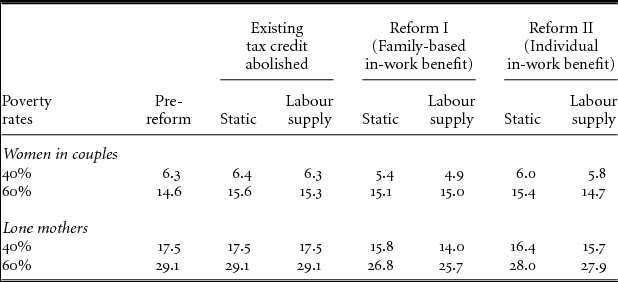
When the existing tax credit for dependent adults is abolished, the proportion of women in couples at risk of poverty (defined as women with equivalised household disposable income below 60 per cent of the median in the pre-reform system) slightly increases, even taking into account the positive behavioural reactions. This is mainly due to the higher taxes to be paid when the existing tax credit is abolished.
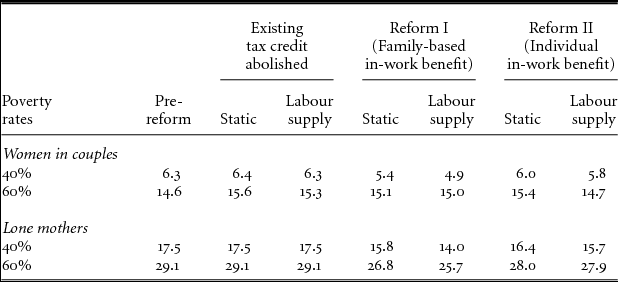
However, the family in-work benefit shows a redistributive effect (see Table 4), reducing the proportion of women living at risk of extreme poverty (i.e., women with equivalised household disposable income below 40 per cent of the median) and revealing the targeting of the family-based in-work benefit to the poorest working family. After taking into account potential behavioural reactions, the risk of poverty reduces even further.
Poverty rates (%) under different policy scenarios
Notes: ‘Reform I’: existing tax credit for dependent persons abolished and replaced by the family-based in-work benefit. ‘Reform II’: existing tax credit for dependent persons abolished and replaced by the individual in-work benefit. The proportions of poor individuals in the different policy scenarios are based on the same poverty line (respectively 40% and 60% of the median equivalised household income using the OECD modified equivalence scale) as in the pre-reform system in order to disregard changes in median income. ‘Static’ refers to the poverty rates without taking into account any behavioural reactions. ‘Labour supply’ refers to the poverty rates when labour supply reactions are taken into account.
Source: Author's analysis based on EUROMOD.
As expected, due to the larger generosity of the benefit, the redistributive effects are generally larger after the provision of the family-based in-work benefit than the individual in-work benefit, although the latter implies a slightly larger reduction in the risk of poverty at 60 per cent of the median when behavioural reactions are taken into account. Such results bring out the inherent tension between tax reforms that have larger effects on labour supply (individual measures) versus reforms that have a larger redistributive effect on poverty (family measures).
For lone mothers, reduction in the risk of poverty is more pronounced in particular with the more generous family-based in-work benefit and taking into account the labour supply reactions which allow them to increase their earning capacity and hence their disposable income.
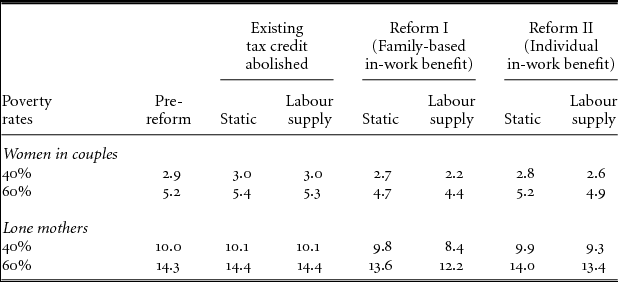
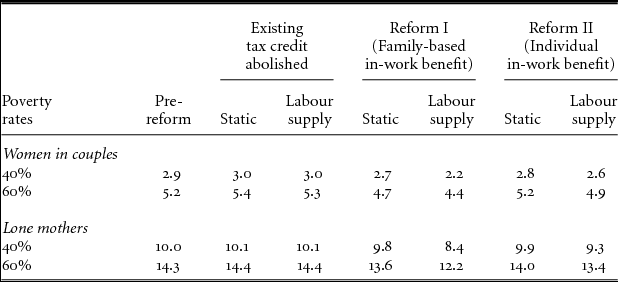
The changes in the poverty rates are only informative in the case of people crossing the poverty line after the reforms. However, the concern about the living standards of those who are poor requires looking at the poverty gap index (i.e., the average, over all individuals, of the gaps between poor individuals’ income and the poverty line, as a percentage of the poverty line). The decrease in the poverty gap index between the static scenario and when labour supply reactions are taken into account is always larger, in relative terms, than that shown for the poverty rates. This reveals that enhanced labour supply among poor individuals allows them to improve their living standard, even if they do not leave the poverty status (see Table 5).
Poverty gap index (%) under different policy scenarios
Notes: ‘Reform I’: existing tax credit for dependent persons abolished and replaced by the family-based in-work benefit. ‘Reform II’: existing tax credit for dependent persons abolished and replaced by the individual in-work benefit. The poverty gap index in the different policy scenarios is based on the same poverty line (respectively 40% and 60% of the median equivalised household income using the OECD modified equivalence scale) as in the pre-reform system in order to disregard changes in median income. ‘Static’ refers to the poverty gap index without taking into account any behavioural reactions. ‘Labour supply’ refers to the poverty gap index when labour supply reactions are taken into account.
Source: Author's analysis based on EUROMOD.
By definition, with revenue-neutral reforms, some families are better off and some are worse off. Considering the behavioural reactions, gainers are always more than losers and they are concentrated at the bottom of the income distribution. Moreover, those who are negatively affected by the reforms do not lose a substantial share of their total income, increasing the political feasibility of such reforms (see Figari Reference Figari2011, for details).
5. Conclusions
In this paper, I have analysed the possibility of enhancing both the redistributive and the incentive effects of the tax-benefit system in Italy, where the tax system shows elements which reduce the incentives to take a paid job and that are not necessarily well targeted to the poor. I have simulated the alternative introduction of two in-work benefits, financed by the simultaneous abolition of the existing tax credit for dependent adults. Such a tax credit compromises the equality of tax treatment for the first earner, embodies disincentive effects on labour supply of the second earner in a couple and is not a well-targeted method of support through the tax system. The introduction of in-work benefits can be seen as an important step in the defamilialisation of the Mediterranean welfare states because they can contribute to reducing the reliance on the family by compensating the cost of services (Lister, Reference Lister, Baldwin and Falkingham1994; Orloff, Reference Orloff1996; Saraceno, Reference Saraceno1997). Moreover, such a reform could improve the bargaining power within the couple where the woman, considering paid and unpaid work, actually works more than the male partner but with a much lower remuneration (Burda et al., Reference Burda, Hamermesh and Weil2013).
At first sight, the effects of the introduction of family-based or individual in-work benefit seem to confirm the traditional trade-off between equity and efficiency. However, the analysis reveals the possibility of designing a more efficient and redistributive tax-benefit system. Replacing the existing tax credit for dependent adults with a new family-based in-work benefit leads to an average increase in the labour supply of women in couples of 3 percentage points. Individual in-work benefit has even stronger incentive effects for women in couples who enhance their labour supply by 5 percentage points. Labour supply of lone mothers increases more with the family-based in-work benefit, given the larger generosity of such a benefit compared to the individual in-work benefit. Most of the labour supply reactions induced by the in-work benefits take place among the poorest individuals with important redistributive effects: the family-based in-work benefit contributes to a more pronounced reduction in extreme poverty among women in couples and it is more beneficial for lone mothers, confirming the higher level of targeting than the individual benefit. However, the individual in-work benefit gives a less generous transfer to a higher number of women in couples, reinforcing the overall incentive effects and hence having broader effects on the disposable income of working families.
Although the magnitude of the results depends on budgetary constraints and the relatively few resources allocated to these reforms, the main findings are in line with previous estimates of the labour supply reaction of lone mothers to in-work benefits (Bargain and Orsini, Reference Bargain and Orsini2006; Brewer et al., Reference Brewer, Duncan, Shephard and Suarez2006; Meyer, Reference Meyer2002). However, the results contrast with the disincentive effect for secondary earners in a couple which has been assessed in the UK with family-based in-work benefits (Brewer et al., Reference Brewer, Duncan, Shephard and Suarez2006). Such a finding (confirmed by De Luca et al., Reference De Luca, Rossetti and Vuri2012) gives an important insight into the effects of these reforms in countries with very low female labour market participation and high labour supply responsiveness of women at the bottom of the income distribution, given the absence or low generosity of social assistance schemes.
Even if the labour supply effects are only a proxy of the final employment effects, they indicate the direction of the likely effects of a policy change, which is essential information that ought to be given some weight when discussing a policy reform.
Kolm and Tonin (Reference Kolm and Tonin2011) show that in-work benefits may boost participation and search effort, and their effect on labour market participation may be higher than that estimated. According to Ferrera (Reference Ferrera2008), one hundred women entering the labour force corresponds to fifteen new jobs in the caring sector with a positive effect on economic growth. Casarico and Profeta (Reference Casarico and Profeta2010) estimated that in Italy an increase of 1 per cent in female labour market participation can led to an increase of GDP of 0.3 per cent.
However, a couple of issues need to be borne in mind in the interpretation of the results.
In the short run, there might be significant institutionally determined rigidities in the labour market that prohibit or limit changes in hours of work (Blundell et al., Reference Blundell, Meghir, Symons and Walker1984). Moreover, a shortfall in demand for work can limit the labour supply reactions and lead to downward pressures on wages, highlighting the importance of introducing a binding minimum wage. This has been the case in the UK, where the National Minimum Wage was introduced in April 1999 at the time of a major reform of the in-work benefit schemes. Nevertheless, relevant to the policy reforms analysed in this paper, Bargain et al. (Reference Bargain, Caliendo, Haan and Orsini2010) show that demand-side constraints might not substantially affect the labour supply effects of individuals voluntarily unemployed (such as part of potential second earner partners in a couple), but they might have a bigger impact on single men and single women.
From a policy perspective, the traits which the Italian tax-benefit system has in common with those of other Mediterranean countries allows me to generalise with five concluding remarks.
First, a challenging political issue emerges from the evidence, which is that the major incentive effects of the reforms come from the abolition of the existing tax concessions rather than from the introduction of new in-work benefits. However, given the absence of guaranteed income support schemes, in-work benefits show their potential as a support targeted to the poorest individuals. As far as poverty reduction is concerned, even if individuals are not able to leave the poverty status, it is also important to consider the social externalities of increased labour market participation (Phelps, Reference Phelps2000) and the long-term effects on human capital (Acs and Toder, Reference Acs and Toder2007) induced by the in-work benefits.
Second, in a country characterised by a high level of tax evasion, low-paid workers might have an incentive to avoid declaring their income in order to get the new benefit. However, in-work benefits, increasing the net pay-off of a regular job (and the cost of earning in the shadow economy), might also reduce the incentive for workers with low-productivity jobs to evade taxes. The final effect is an empirical issue that it is really hard to address given the lack of data on tax evasion behaviour. Blumkin et al. ( Reference Blumkin, Margalioth and Sadka2013) show that when tax evasion is prevalent the implementation of benefits with work requirements is socially desirable.
Third, in-work benefits might be one of the pillars of a redefined welfare system in order to enhance the economic position of the working poor and to increase women's employment. However, they must be complemented by an extension of caring services for both children and elderly people, in order to allow women to take paid work outside the home if they wish to do so (Brilli et al., Reference Brilli, Del Boca and Pronzato2014), and by a universal income support scheme acting as a safety net for those without enough resources (Matsaganis et al., Reference Matsaganis, Capucha, Ferrera and Moreno2003).
Fourth, the potential impact of the tax reforms on those out of the labour market confirms the importance of the reactions at the extensive margin, in particular for low-earning parents as assessed in a recent application of optimal tax theory by Blundell and Shepard (Reference Blundell and Shepard2012).
Finally, in a period of economic downturn the in-work benefits can also help protect the income of the families affected by the crisis (Fernandez et al., Reference Fernandez Salgado, Figari, Sutherland and Tumino2014), in particular when the first earner loses his or her job. The availability to work of those less attached to the labour market has in fact increased as the employment opportunities of the main earner in the household deteriorate and family incomes fall. As a consequence, the role of shock absorber traditionally relegated to the family in Mediterranean countries can be guaranteed if the family relies on more income sources and the unemployment risk is widespread within the family.
Acknowledgements
I am grateful to Tito Boeri, Lucy Brown, Stephen Jenkins, Manos Matsaganis, Brian Nolan, Alari Paulus, Chiara Pronzato, the participants at the EcoMod (2008), IMA (2009), AIEL (2009), AIEL-CHILD (2009) conferences, the Editors and three anonymous referees for helpful comments. This paper uses EUROMOD version D25 and data from the IT-SILC 2004, made available by ISTAT. I am indebted to Holly Sutherland and all members of the EUROMOD consortium. Any errors are the author's responsibility.