A core challenge in developmental psychopathology is understanding the process by which development can lead to pathology; yet, understanding the converse process (the way in which pathology may interfere with future development) has typically received far less attention. This study examines the sequelae of one potentially insidious form of pathology (mild depressive symptoms) experienced at a particularly sensitive period for social development in early adolescence in terms of its long-term effects on adult social functioning.
Although almost all of the long-term outcome research in this area has focused on diagnosable major depression in adolescence (Fergusson, Boden, & Horwood, Reference Fergusson, Boden and Horwood2007; Kasen et al., Reference Kasen, Cohen, Skodol, Johnson, Smailes and Brook2001; Lewinsohn, Rohde, Seeley, Klein, & Gotlib, Reference Lewinsohn, Rohde, Seeley, Klein and Gotlib2000), more minor symptoms of depression may also have significant consequences (Gotlib, Lewinsohn, & Seeley, Reference Gotlib, Lewinsohn and Seeley1995; Pine, Cohen, Cohen, & Brook, Reference Pine, Cohen, Cohen and Brook1999). Although chronically high and increasing levels of depressive symptoms across adolescence are associated with a range of negative adult outcomes (Wickrama & Wickrama, Reference Wickrama and Wickrama2010), the long-term social sequelae of milder depressive symptoms in early adolescence have received scant attention. There is good reason, however, to believe that early adolescence is a period that is particularly sensitive to the negative effects of such symptoms. A developmental psychopathology perspective suggests the likelihood that depressive symptoms in adolescence will impinge upon ontogenic development, altering passage through key developmental tasks in ways that are likely to change long-term developmental outcomes (Cicchetti & Toth, Reference Cicchetti and Toth1998). Social development in particular appears to be affected by depressive symptoms, as adolescence is a critical period for the development of mature, adultlike social relationship skills with parents, peers, and romantic partners. These skills appear potentially altered by the presence of depressive symptoms (Aquilino, Reference Aquilino, Arnett and Tanner2006; Roisman, Masten, Coatsworth, & Tellegen, Reference Roisman, Masten, Coatsworth and Tellegen2004; Wickrama, Conger, Lorenz, & Jung, Reference Wickrama, Conger, Lorenz and Jung2008). In terms of neurological development, the world of adultlike relationships opens up to the early adolescent as brain structures closely tied to adult social functioning (e.g., the prefrontal and parietal cortex) begin to take on their final form (Blakemore & Choudhury, Reference Blakemore and Choudhury2006). The developmental task of learning to establish and maintain increasingly complex and intense peer relationships typically requires and receives extreme levels of attention and energy from the developing adolescent (Collins & Laursen, Reference Collins and Laursen2004). Peer relationships are thus likely to be particularly susceptible to disruption by depressive symptoms that leave the adolescent with less energy and perhaps less interest and confidence in pursuing and developing relationships. The ontogenic development principle suggests that such developmental disruptions may become established and remain on their own developmental track, regardless of whether or not the depressive symptoms themselves display long-term continuity (Cicchetti & Toth, Reference Cicchetti and Toth1998). In essence, the ontogenetic principle suggests that heterotypic continuity may be observed in which early adolescent depressive symptoms display continuity with later markers of social dysfunction (Sroufe & Jacobvitz, Reference Sroufe and Jacobvitz1989).
One path by which the ontogenic principle may play out is that difficulties in initial experiences with key social relationships in early adolescence may provide the adolescent with a template that will partly anchor expectations of relationships going forward. Early relationship experiences are likely to be particularly problematic for depressed adolescents (Connolly, Marton, & Kutcher, Reference Connolly, Geller, Marton and Kutcher1992; Daley & Hammen, Reference Daley and Hammen2002; Stice, Ragan, & Randall, Reference Stice, Ragan and Randall2004). Most research to date has focused on adolescents with diagnosable major depression. This research finds that depressed individuals tend to recall feedback from others more negatively (Gotlib, Lewinsohn, & Seeley, Reference Gotlib, Lewinsohn and Seeley1998) and may thus end up wanting to avoid relationships, which in turn may lead to further social deficits. A similar process has been observed in short-term studies of depressed adolescents (Rohde, Lewinsohn, & Seeley, Reference Rohde, Lewinsohn and Seeley1994), suggesting a role for avoidance of relationships as a mediator of longer term links between depressive symptoms and social difficulties. Given the uniquely challenging social developmental tasks of early adolescence, even teens experiencing mild depressive symptoms are potentially vulnerable to substantial social impairment in both the short and long term. Because adult social difficulties and loneliness have been linked to a wide array of negative outcomes, ranging from mental health difficulties to physical health problems that include an increased risk for early mortality (Coyne, Reference Coyne1976; Hawkley, Berntson, & Cacioppo, Reference Hawkley, Burleson, Berntson and Cacioppo2003; Holt-Lunstad, Smith, & Layton, Reference Holt-Lunstad, Smith and Layton2010; Joiner, Reference Joiner, Gotlib and Hammen2002), potential links to early adolescent depressive symptoms are crucial to explore.
The potential long-term social sequelae of adolescent depressive symptoms are likely to extend to intimate and enduring relationships. Maintaining supportive relationships with parents, for example, is a complex and critical task in adolescence (Allen, Hauser, Bell, & O'Connor, Reference Allen, Hauser, Bell and O'Connor1994), and one that may be disrupted by depressive symptoms. Depressive symptoms often create intense needs for symptom relief and for reassurance that cannot be easily met in close relationships and that can lead to substantial frustration and conflict in these relationships (Hammen, Reference Hammen, Johnson, Hayes, Field, Schneiderman and McCabe2000). Maintaining strong parent–adolescent relationships during the adolescent phase of renegotiation and reconfiguration of these relationships may be particularly important to the establishment of a supportive parent–adult child relationship beyond adolescence and to adult social functioning more broadly. Parent–adult child relationships have been repeatedly found to be crucial to early adult individuation and adjustment (Aquilino, Reference Aquilino, Arnett and Tanner2006; Lerner et al., Reference Lerner, Lerner, von Eye, Ostrom, Nitz, Talwar-Soni, Graber, Brooks-Gunn and Petersen1996; Powers, Hauser, & Kilner, Reference Powers, Hauser and Kilner1989; Wickrama et al., Reference Wickrama, Conger, Lorenz and Jung2008). Depressive symptoms in adolescence thus have the potential to create disruptions to parent–adolescent relationships at a uniquely important and vulnerable period of renegotiation and reconfiguration. Whether such disruptions might ultimately lead to more problematic long-term relationships with parents in young adulthood has not been previously examined.
Romantic relationships present similarly difficult potential challenges for adolescents experiencing depressive symptoms. Depressed individuals tend to find these relationships dissatisfying, even as they intently seek them out (Gotlib et al., Reference Gotlib, Lewinsohn and Seeley1998). Adolescence is a key period for learning to form and maintain positive romantic relationships (Collins, Reference Collins2003), and expectations of relationships from adolescence appear likely to influence relationship qualities going forward (Roisman, Collins, Sroufe, & Egeland, Reference Roisman, Collins, Sroufe and Egeland2007). Because romantic relationships gradually become primary and important sources of social support in adulthood, difficulties learning to establish positive romantic relationships early in adolescence may have substantial long-term consequences (Holt-Lunstad, Birmingham, & Jones, Reference Holt-Lunstad, Birmingham and Jones2008; Zeifman & Hazan, Reference Zeifman, Hazan, Cassidy and Shaver2008).
In sum, even mild to moderate levels of depressive symptoms in early adolescence have the potential to set the adolescent on a social–developmental pathway that will lead to difficulties in several arenas of adult social functioning. This study examined the role of depressive symptoms as predictors of long-term impairments in social functioning in a socioeconomically diverse community sample followed from age 14 through 23. To avoid confounds from the tendency of depressed individuals to recall relationships more negatively, this study assessed not only self-reported loneliness but also direct observations of interactions with a romantic partner and maternal reports of the quality of the mother–young adult relationship. Four specific hypotheses were examined to assess the relation of early adolescent depressive symptoms to early adult maternal relationship quality, romantic relationship quality and loneliness:
1. Early adolescent depressive symptoms will display long-term continuities with lower maternal and romantic relationship quality and with adult loneliness.
2. Links from depressive symptoms to relationship outcomes will remain even after excluding adolescents with the highest levels of early adolescent symptoms (e.g., those above clinical screening cutoffs in any of three assessments across early adolescence).
3. Links will remain even after accounting for baseline markers of peer and maternal relationship quality and for effects of concurrent depressive symptoms in early adulthood.
4. Predictions from adolescent depressive symptoms to early adult outcomes will be mediated via greater tendencies toward social avoidance and reduced quality of maternal relationships in late adolescence.
Methods
Participants
This report is drawn from a larger longitudinal investigation of adolescent social development in familial and peer contexts. Initial participants included 184 seventh and eighth graders (86 male and 98 female) followed over a 10-year period from ages 14 to 24. Adolescents were first assessed annually over a 3-year period in early adolescence (at ages 14.29, SD = 0.75, at Wave 1; 15.22, SD = 0.80, at Wave 2; and 16.35, SD = 0.87, at Wave 3). They were assessed at several points thereafter, up through the final two assessments at ages 22.8 (SD = 0.96) and 23.8 (SD = 0.97).
Adolescents were recruited from the seventh and eighth grades of a public middle school drawing from suburban and urban populations in the Southeastern United States. Students were recruited via an initial mailing to all parents of students in the school along with follow-up contact efforts at school lunches. Families of adolescents who indicated they were interested in the study were contacted by telephone. Of all students eligible for participation, 63% agreed to participate either as target participants or as peers providing collateral information. All participants provided informed assent before each interview session, and parents provided informed consent until participants were over age 18, at which point they provided informed consent. Interviews took place in private offices within a university academic building.
The sample was racially/ethnically and socioeconomically diverse: 107 adolescents (58%) identified themselves as Caucasian, 53 (29%) as African American, 15 (8%) as of mixed race/ethnicity and 9 (5%) as being from other identity groups. Adolescents' parents reported an annual median family income in the $40,000–$59,999 range.
Follow-up and attrition analyses
Follow-up data were obtained for 179 (97.3%) of the original 184 participants at ages 20 to 23 in early adulthood. Ninety-two romantic partners of target participants who were in romantic relationships lasting 3 months or longer between ages 21 and 23 also participated in an observational discussion task. Participants' mothers were surveyed when participants were in early adulthood, and reports from 125 mothers were obtained.
Comparisons of the 179 participants from whom we had follow-up data versus the 5 for whom we did not (1 of whom was deceased and 1 of whom had become intellectually disabled) indicated that those not continuing had lower initial levels of family income but were otherwise statistically indistinguishable from continuing participants. Comparisons of baseline data for participants with and without observational data from romantic partners at follow-up indicated that those without observational data from romantic partners did not differ from those with such data on any baseline measures. Comparisons of baseline data for participants with and without maternal report data in early adulthood indicated that those without maternal report data had lower family incomes in early adolescence than those who had such data but did not differ on any other baseline measures.
To best address any potential biases due to attrition in longitudinal analyses, full imputation maximum likelihood methods were used with analyses, including all variables that were linked to future missing data (i.e., where data were not missing completely at random). Because these procedures have been found to yield the least biased estimates when all available data are used for longitudinal analyses (vs. listwise deletion of missing data), the entire original sample of 184 was utilized for these analyses. This full sample thus provides the best possible estimates of long-term social outcomes and was least likely to be biased by missing data. Alternative longitudinal analyses using just those participants without missing data (i.e., listwise deletion) yielded results that were substantially identical to those reported below. Analyses suggest that, with the exception of romantic partner data (where attrition resulted from individuals who did not have romantic partners but was not related to baseline measures), attrition was quite modest overall and not likely to have distorted any of the findings reported.
Procedure
In the initial introduction and throughout all sessions, confidentiality was assured to all study participants, and adolescents were told that their parents, friends, and romantic partners would not be informed of any of the answers they provided. Participants' data were covered by a Confidentiality Certificate issued by the US Department of Health and Human Services that protected information from subpoena by federal, state, and local courts. Transportation and childcare were provided if necessary. Adolescent/adult participants, their mothers, and their romantic partners were all paid for participation.
Measures
Depressive symptoms (ages 14–16, 23–24)
Adolescents reported the degree of their depressive symptoms using the Child Depression Inventory (CDI; Kovacs & Beck, Reference Kovacs and Beck1977). This 27-item inventory is based on the Beck Depression Inventory (BDI) and has been well validated as a measure of depressive symptomatology linked to poor self-esteem, hopelessness, and negative cognitive attributions (Kazdin, Reference Kazdin1990). Kovacs (Reference Kovacs1992) recommends that a score of 19 on the CDI be used as a screening cutoff, suggesting the need for further inquiry for individuals who may be experiencing clinically diagnosable major depression. Scores were summed and then averaged across assessments at ages 14, 15, and 16 to produce a baseline depressive symptoms score for early adolescence. Internal consistency for this measure was good (Cronbach α = 0.93).
At age 23 and 24, participants completed the BDI, a 21-item measure designed to assess the degree of depressive symptoms in late adolescents and adults (Beck & Steer, Reference Beck and Steer1987). Items were rated on a 0–3 scale and summed to yield a total depression score, with higher scores indicating more severe depressive symptoms. The BDI is a well-validated and widely accepted self-report measure of adult depressive symptomatology (Kazdin, Reference Kazdin1990). Scores were summed and averaged across assessments at ages 23 and 24 to produce an overall depressive symptoms score for early adulthood. Internal consistency for this measure was good (Cronbach α = 0.91).
Both the CDI and BDI use a continuum/severity versus a threshold approach, recognizing that higher levels of depressive symptoms that do not necessarily meet diagnostic thresholds may still be important in predicting future dysfunction (Lewinsohn, Solomon, Seeley, & Zeiss, Reference Lewinsohn, Solomon, Seeley and Zeiss2000).
Adult maternal relationship quality (age 23)
Adult maternal relationship quality was assessed via maternal report from the Network of Relationships Inventory (Furman & Buhrmester, Reference Furman and Buhrmester1985), which obtains ratings on a series of 5-point Likert scales. A total positivity score was obtained by summing six 3-item scales for companionship, intimacy, nurturance, admiration, overall support and satisfaction. Internal consistency for this metascale was good (Cronbach α = 0.89) and reliability and validity have been previously documented (Furman, Reference Furman, Bukowski, Newcomb and Hartup1998).
Adolescent maternal relationship quality (ages 14–16, 18–20)
The Inventory of Parent and Peer Attachment (Armsden & Greenberg, Reference Armsden and Greenberg1987) was used to assess adolescents' perceptions of the quality of their overall relationship with their mothers in early and late adolescence. Total attachment quality is calculated as the sum of fourteen 5-point Likert-scale items capturing communication and trust and seven 5-point items (reverse scored) capturing alienation in the relationship. Scores were summed and then averaged across assessments at ages 14, 15, and 16, and ages 18, 19, and 20 to produce overall scores for early and for late adolescence. Internal consistency was good at both points (Cronbach αs = 0.92 and 0.97, respectively).
Peer relationship quality (age 14–16)
The Inventory of Parent and Peer Attachment (Armsden & Greenberg, Reference Armsden and Greenberg1987) was used to assess adolescents' perceptions of the quality of their overall relationship with their peers in early adolescence. Total attachment was calculated as the sum of fourteen 5-point Likert-scale items capturing communication and trust and seven 5-point items (reverse scored) capturing alienation in the relationship. Scores were summed and then averaged across assessments at ages 14, 15, and 16 to produce an overall score for early adolescence. Internal consistency for this scale was good (Cronbach α = 0.96).
Social avoidance (age 19–21)
Social avoidance was assessed from the four-item general social avoidance scale from the Social Anxiety Scale for Adolescents (La Greca & Lopez, Reference La Greca and Lopez1998). This scale has good psychometric properties and has been related concurrently to broad peer group acceptance and close friendship competence (La Greca & Lopez, Reference La Greca and Lopez1998). Scores were summed and averaged across assessments at ages 19, 20, and 21 to produce an overall score for late adolescence. Internal consistency for this scale was good (Cronbach α = 0.87).
Loneliness (age 23–24)
Loneliness was assessed via the UCLA Loneliness Scale (Russell, Peplau, & Cutrona, Reference Russell, Peplau and Cutrona1980). This 20-item measure assesses loneliness using responses on a 4-point Likert scale. Scores have been related to outcomes ranging from lower life satisfaction to attachment insecurity (Bowlby, Reference Bowlby1969/1982; Goswick & Jones, Reference Goswick and Jones1982; Kobak & Sceery, Reference Kobak and Sceery1988; Moore & Schultz, Reference Moore and Schultz1983). Scores were summed and then averaged across assessments at ages 23 and 24 to produce an overall score for early adulthood. Internal consistency for this scale was good (Cronbach α = 0.97).
Observed romantic relationship quality
Adult-romantic partner dyads participated in an 8-min videotaped task in which partners were presented with a hypothetical “dating court” scenario in which they were asked to separately make judgments about which member of a dating couple was correct in each of a series of hypothetical disagreements over matters ranging from meeting parents to clothing choice to time spent with friends versus partner. After making their decisions separately, target adults and their partners were then brought together in a revealed differences paradigm in which they could compare their answers and then try to come to a consensus (Strodtbeck, Reference Strodtbeck1951).
The Autonomy-Relatedness Coding System was used to code these interactions (Allen, Porter, & McFarland, Reference Allen, Porter and McFarland2001; Allen, Porter, McFarland, McElhaney, & Marsh, Reference Allen, Porter, McFarland, McElhaney and Marsh2007). This system yields a score for partners' behavior toward one another in the interaction. Ratings are molar in nature, yielding overall scores for behavior across the entire the interaction; however, these molar scores are derived from an anchored coding system that considers both the frequency and intensity of each speech relevant to that behavior during the interaction in assigning the overall molar score. The overall score for the quality of the relationship in the interaction sums behaviors of both parties that express warmth and promote collaboration, or are rude and hostile (reverse scored). Interrater reliability, based on double-coding of all interactions, was calculated using intraclass correlation coefficients and was in what is considered the “excellent” range for this coefficient (intraclass r = .82; Cicchetti & Sparrow, Reference Cicchetti and Sparrow1981).
Results
Preliminary analyses
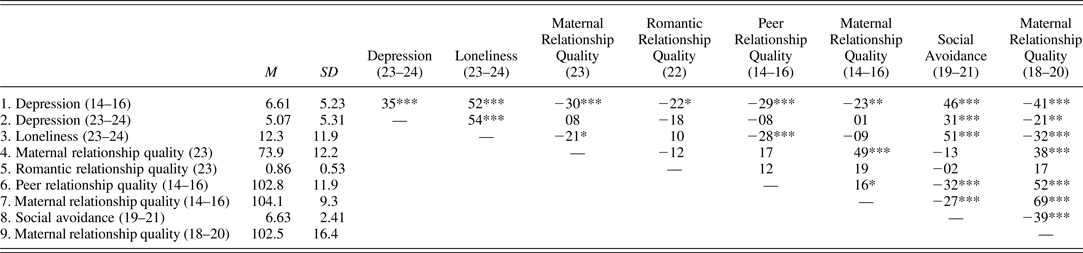
Means and standard deviations for all variables examined in the study are presented in Table 1. Initial analyses examined the role of gender and family income in early adolescence on the primary substantive measures used in the study. Several substantive variables were related to income in the adolescent's family of origin and to adolescent gender; hence, these factors are considered and described as covariates in analyses below. We also examined possible moderating effects of these demographic factors on each of the relationships described in the primary analyses below. Moderation effects were assessed by creating interaction terms based on the product of the centered main effect variables. No moderating effects of adolescent gender or family income were found for any of the observed relationships described below.
Means, standard deviations, and intercorrelations of substantive variables

Note: Correlations are multiplied by 100. The age of assessment is in parentheses.
*p < .05. **p < .01. ***p < .001.
Primary analyses
Predictions of maternal relationship quality
Direct prediction
Simple correlational analysis, as presented in Table 1, indicated a significant (r = –.30, p < .001) relationship between depressive symptoms at ages 14–16 and lower maternal relationship quality, as reported by mothers, in early adulthood. Analyses next examined whether this relationship was primarily driven by adolescents' experiencing high levels of depressive symptoms. To eliminate the possibility that individuals above the recommended screening cutoff for possible depression (a score of 19) were driving findings, we examined a reduced data set in which adolescents who reached this screening cutoff at any of our assessment points at ages 14, 15, or 16 (N = 19) were removed from analyses. In these analyses, the correlation between adolescent depressive symptoms and poorer early adult maternal relationship quality remained, with the correlation actually slightly greater for this subsample (r = –.31, p < .001). All further analyses for this variable were conducted with the reduced data set including only individuals who did not report levels of depressive symptoms above screening cutoffs at any point in early adolescence.
Predictions above baseline functioning and current depressive symptoms
Analyses next examined whether predictions would remain after accounting for both baseline levels of social functioning in adolescence and concurrent levels of depressive symptoms in early adulthood. Although concurrent levels of depressive symptoms and baseline adolescent maternal and peer relationship quality were related to adult maternal relationship quality in simple correlational analyses reported in Table 1, prior levels of symptoms in adolescence continued to predict lower quality maternal relationships, even above concurrent depressive symptoms and adolescent maternal and peer relationship quality (β = –0.34, p < .001). This indicates that the relation of adolescent depressive symptoms to adult maternal relationship quality existed above both baseline social functioning and concurrent adult levels of depressive symptoms.
Mediated pathways
The extent to which predictions from adolescent depressive symptoms to adult maternal relationship quality were mediated by a tendency toward avoidance of social interactions and maternal relationship quality in mid- to late adolescence was examined via a path model that assessed the indirect effect of depressive symptoms on future maternal relationship quality via these two intervening variables in mid- to late adolescence. These analyses were conducted within Mplus, version 6.11 (Muthén & Muthén, Reference Muthén and Muthén2011), using recommended bias-corrected bootstrapping procedures, with 5,000 iterations (MacKinnon, Lockwood, & Williams, Reference MacKinnon, Lockwood and Williams2004; Preacher & Hayes, Reference Preacher and Hayes2008), with variables at each stage predicted by all variables at the prior stage, and covariances among variables within a stage always accounted for in models. This analysis revealed a nonsignificant degree of mediation of baseline depressive symptoms to adult maternal relationship quality via midadolescent maternal relationship quality (βindirect effect = –0.05), just outside the 95% confidence interval (–0.100 to 0.006). The direct effect of adolescent depressive symptoms to adult maternal relationship quality remained in these analyses (β = –0.23, p = .01). A significant effect was also observed from midadolescent maternal relationship quality to early adult depressive symptoms (β = –0.26, p = .01). No mediation via midadolescent social avoidance was found. (See Figure 1 for the full model depicting all significant predictors and pathways.)
(Color online) The mediated relationship between early adolescent depressive symptoms and adult maternal relationship quality.
Prediction to adult romantic relationship behavior
Direct prediction
Simple correlational analysis, as presented in Table 1, indicated a significant (r = –.22 p = .03) relationship between depressive symptoms at ages 14–16 and lower quality interactions in adult romantic relationships at age 23. Analyses next examined whether this link was primarily driven by adolescents experiencing high levels of depressive symptoms. Examining only adolescents who never had scores above 19 on the CDI, as described above, the correlation between adolescent depressive symptoms and later observed quality of romantic partner interactions increased slightly (r = –.37, p < .001). All further analyses for this variable were conducted with the reduced data set including only individuals who did not report levels of depressive symptoms above screening cutoffs at any point in early adolescence.
Predictions above baseline functioning and current depressive symptoms
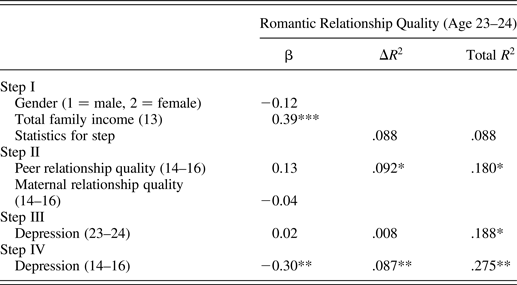
Analyses next examined whether predictions would remain after accounting for both baseline levels of social functioning in adolescence and for concurrent levels of depressive symptoms in early adulthood. Although concurrent levels of depressive symptoms and baseline adolescent functioning with peers were strongly related to adult romantic relationship behavior in simple correlational analyses reported in Table 1, prior levels of depressive symptoms in adolescence continued to predict lower levels of positive romantic relationship behavior, even above concurrent depressive symptoms and adolescent maternal and peer relationship quality, as shown in Table 2.
Predicting observed romantic relationship interaction quality (age 23–24)
Note: The βs are from the final model.
*p < .05. **p < .01. ***p < .001.
Mediated pathways
The extent to which predictions of future romantic relationship quality were mediated by a tendency toward avoidance of social interactions and by maternal and peer relationship quality in mid- to late adolescence was examined via a path model that assessed the indirect effect of depressive symptoms on future loneliness via these two intervening variables in mid- to late adolescence using the approach described above. No evidence of such mediation was found, and even when these two variables were included in models with all of the other variables described above, the direct effect of early adolescent depressive symptoms remained significant (β = –0.27, p = .03). This suggests that the relationship between early adolescent depressive symptoms and future romantic relationship behavior was not mediated via the intervening factors examined.
Prediction of early adult loneliness
Simple correlational analysis, as presented in Table 1, indicated a large effect size (r = .52, p < .001) for the relationship between depressive symptoms at ages 14–16 and early adult loneliness at ages 23–24. Analyses then examined whether this relationship was primarily driven by adolescents' experiencing high levels of depressive symptoms. Examining only adolescents who never had scores above 19 on the CDI, as described above, the correlation between adolescent depressive symptoms and later loneliness remained, with the correlation only modestly reduced (r = .41, p < .001). All further analyses for this variable were conducted with the reduced data set including only individuals who did not report levels of depressive symptoms above screening cutoffs at any point in early adolescence.
Predictions above baseline functioning and current depressive symptoms
Analyses next examined whether predictions would remain after accounting for both baseline levels of social functioning in adolescence and for concurrent levels of depressive symptoms in early adulthood. Although concurrent levels of depressive symptoms and baseline adolescent functioning with peers were strongly related to adult-reported loneliness in simple correlational analyses reported in Table 1, prior levels of depressive symptoms in adolescence continued to predict loneliness above concurrent depressive symptoms and adolescent maternal and peer relationship quality (β = 0.15, p = .05). This indicates that the relation of adolescent depressive symptoms to adult loneliness existed above both baseline social functioning and concurrent adult levels of depressive symptoms.
Mediated pathways
The extent to which predictions of future loneliness were mediated by a tendency toward avoidance of social interactions and by quality of the maternal relationship in mid- to late adolescence was examined via a fully saturated path model that assessed the indirect effect of depressive symptoms on future loneliness via social avoidance and maternal relationship quality in mid- to late adolescence. The effects of baseline depressive symptoms in early adolescence were found to be mediated via a tendency toward social avoidance in midadolescence, with a significant indirect effect (βindirect effect = 0.115, 99% confidence interval = –0.010–0.220) found from early-adolescent depressive symptoms to midadolescent social avoidance to adult loneliness. The direct effect of early-adolescent depressive symptoms on adult loneliness dropped to the trend level (β = 0.13, p =.07). A significant effect was also observed from social avoidance to early adult depressive symptoms (β = 0.25, p = .002). No mediation via quality of the midadolescent maternal relationship was found. Figure 2 presents the full model depicting all significant predictors and pathways.
(Color online) The mediated relationship between early adolescent depressive symptoms and adult loneliness.
Discussion
The results of this study show that even depressive symptoms in early adolescence that do not exceed clinical screening cutoffs in repeated assessments can predict a significant risk for social difficulty into early adulthood. Future social difficulties appeared across a variety of domains, including overall levels of loneliness and difficulties in specific family and romantic relationships. Difficulties were observed from a variety of perspectives from self-report to maternal report to direct observation and were found even after accounting for concurrent depressive symptoms in adulthood and for prior levels of social functioning in early adolescence. Although lay conceptions of adolescence as being associated with “moodiness” might lead to a tendency to minimize the importance of milder depressive symptoms during this period, these findings suggest that such symptoms warrant attention as potential markers of a range of future social difficulties.
Although even longitudinal data cannot establish the presence of causal pathways, these findings are consistent with a role for depressive symptoms in early adolescence as interfering with processes of social development at a critical point in such development to create long-term risks of dysfunction. Consistent with this perspective, predictive effects of depressive symptoms appeared partially mediated by intervening qualities of social functioning in late adolescence. In terms of predictions of adult loneliness, links from adolescent depressive symptoms appeared mediated by a tendency toward avoidance of social interactions in late adolescence. Predictions to qualities of maternal and romantic relationships remained after considering concurrent levels of depressive symptoms and potential intervening variables, although they did not appear to be mediated by the intervening variables examined. Together, these findings are consistent with the perspective that early adolescent depressive symptoms may alter social–developmental trajectories in ways that forecast longer term problems in social functioning.
The types of difficulties predicted by early-adolescent depressive symptoms were not trivial. Loneliness and social isolation in adulthood have been related to a host of deleterious mental and physical outcomes (Hawkley, Masi, Berry, & Cacioppo, Reference Hawkley, Masi, Berry and Cacioppo2006; Holt-Lunstad et al., Reference Holt-Lunstad, Smith and Layton2010; O'Reilly & Emerson Thomas, Reference O'Reilly and Emerson Thomas1989; Powers et al., Reference Powers, Hauser and Kilner1989). In addition, it is noteworthy that in adulthood social difficulties are likely to contribute to future depressive symptoms and may be an important factor underlying the observed chronicity of depressive symptoms (Fergusson et al., Reference Fergusson, Boden and Horwood2007; Joiner, Reference Joiner2000; Pine et al., Reference Pine, Cohen, Cohen and Brook1999). This perspective received some support in the present study, because social avoidance and a lower quality maternal relationship in mid- to late adolescence also predicted depressive symptoms in early adulthood, even after accounting for symptom levels in early adolescence. Although depressive symptoms no doubt have their own endogenous sources of stability, the present results suggest that stability may also be maintained in part via a cumulative continuity process (Caspi, Bem, & Elder, Reference Caspi, Bem and Elder1989) in which early depressive symptoms impair future social relationship qualities that in turn increase the likelihood of future depressive symptoms. In adulthood, major depression is substantially (25%–30%) comorbid with social phobia and avoidant personality disorder (Alpert, Uebelacker, McLean, & Nierenberg, Reference Alpert, Uebelacker, McLean and Nierenberg1997), and the finding that depressive symptoms predict long-term social impairment may help to explain this comorbidity. One caveat should be noted: potential mediators were examined simply as intervening links in a chain. The data did not exist to permit examination of a more formal mediational model in which change was predicted at each stage of the model from identical variables at the preceding stage (i.e., from social avoidance in early adolescence to midadolescence). These findings cannot rule out the presence of alternative causal pathways (e.g., from early relationship difficulties to later depression, or from unmeasured external variables) in these models.
This study found predictions in a sample that excluded adolescents displaying higher levels of depressive symptoms (i.e., above a standard clinical screening cutoff) at any one of the three assessment points from ages 14 to 16. This is consistent with the notion that depressive symptoms in adolescence are best viewed on a continuum, with individuals who consistently appear below clinical diagnostic thresholds vulnerable to long-term impairment in addition to short-term distress (Gotlib et al., Reference Gotlib, Lewinsohn and Seeley1995; Lewinsohn, Solomon, et al., Reference Lewinsohn, Rohde, Seeley, Klein and Gotlib2000). These findings cannot be explained as simply reflecting the ongoing effects of a stable depressive pattern from adolescence to adulthood. Not only does the observed instability of adolescent depressive affect and symptoms across this period mitigate against this explanation (Larson, Moneta, Richards, & Wilson, Reference Larson, Moneta, Richards and Wilson2003; Lewinsohn, Petit, Joiner, & Seeley, Reference Lewinsohn, Petit, Joiner and Seeley2003), but also predictions to each examined social outcome remained, even after accounting for concurrent levels of depressive symptoms in adulthood.
A developmental psychopathology perspective offers perhaps the most satisfying explanation of these findings (Cicchetti & Toth, Reference Cicchetti and Toth1998). From this perspective, depressive symptoms may have deleterious effects on critical ongoing social processes, such as the effort to establish adultlike social relationships with peers and family, which is a key developmental task of adolescence. The current findings are consistent with prior research suggesting that early-adolescent depressive symptoms may alter developmental trajectories in ways that then have effects into early adulthood (Wickrama et al., Reference Wickrama, Conger, Lorenz and Jung2008; Wickrama & Wickrama, Reference Wickrama and Wickrama2010). By interfering with this task at a sensitive point in development, even symptoms that will themselves display only modest stability going forward may profoundly alter the adolescent's developmental trajectory in ways that predict long-term social impairment.
These findings suggest the potential importance of early detection and treatment of even milder depressive symptoms in adolescence. By 2020, depression is predicted to be the second largest cause of disability and related costs worldwide (Murray & Lopez, Reference Murray and Lopez1996), but these cost analyses do not include many of the secondary social effects of early depression identified in this study. The findings of this study suggest that even so-called minor levels of depressive symptoms may be anything but minor. These findings also suggest the potential importance of interpersonal therapies for adolescent depression (Mufson, Weissman, Moreau, & Garfinkel., Reference Mufson, Weissman, Moreau and Garfinkel1999). Addressing the social sequelae of adolescent depressive symptoms within these therapies may be as important as addressing the symptoms themselves in terms of enhancing long-term outcomes.
It is notable that there were no gender differences observed in these data, nor did gender moderate any of the effects observed. Whereas major depressive disorder gradually evinces a clear gender difference in prevalence primarily beginning in mid- to late adolescence (Hankin et al., Reference Hankin, Abramson, Moffitt, Silva, McGee and Angell1998), gender effects on symptom-level reports are typically far more modest. By age 16, females are typically only about 10% above males (e.g., 1 scale point on the CDI) in reported symptom levels (Twenge & Nolen-Hoeksema, Reference Twenge and Nolen-Hoeksema2002). This study found that the pattern of long-term social impairment predicted by adolescent depressive symptoms did not differ significantly for males versus females.
Several limitations to these findings warrant note. As already mentioned, although this study can address causal hypotheses, its design only allows it to potentially disconfirm, not directly support, such hypotheses. In addition, diagnostic interviews were not conducted with this sample. Although, as a community sample, we would expect the incidence of confirmed major depressive disorder to be quite modest, particularly among those who are consistently below clinical screening cutoffs, this cannot be definitively ascertained. Although depressive symptoms were assessed repeatedly on an annual basis, no assessments during the intervening periods were made, leaving open the possibility that substantially higher (or lower) levels of symptoms may have been found during these periods. Future research would be needed to make generalizations to more severely impaired samples. Findings regarding reported loneliness may be somewhat inflated, given the common method variance from use of self-reports to assess both adolescent symptoms and adult loneliness (although by covarying adult reports of depressive symptoms, some of this methods confound is removed from results). Quite similar findings were obtained for other report and observational assessments of adult social functioning where no methods confounds are present. Our understanding of the mediators of long-term predictions from depressive symptoms is still at a quite rudimentary phase. Further research examining microprocesses that occur within early to midadolescence for depressed individuals is needed to flesh out precisely how long-term links to social difficulties are established and maintained.