Introduction
Depressive disorder is a leading cause of morbidity in later life. In late-life depression remission occurs in only a third of those treated with a newer antidepressant (Nelson et al., Reference Nelson, Delucchi and Schneider2008). Since each subsequent drug intervention is associated with progressively poorer response rates (Rush, Reference Rush2007), prevention is definitely better than cure. This paper begins with a short description of the relevant approaches to the prevention of depression, outlines recent studies of primary prevention, explores the role of universal prevention and ends with a discussion of a potential model for depression prevention based on chronic disease management.
Approaches to depression prevention
The U.S. Institute of Medicine (Mrazek and Haggerty, Reference Mrazek and Haggerty1994) has outlined several preventive strategies of relevance to depression. Universal prevention acts to reduce the impact of risk factors at the population level. Examples include governmentally-led blood pressure and cholesterol monitoring programs to reduce the risk of stroke and cardiac disease. Selective intervention targets only that portion of the population with identified risk factors. An example is regular retinal screening of diabetic patients to reduce the risk of eye complications. A third type of primary prevention – indicated prevention – targets people who already manifest some symptoms of the designated disorder but at an early or subsyndromal stage. Examples from mental health include the prevention of dementia in those with mild cognitive impairment (MCI) by means of cognitive training and/or medication or of full-blown depressive disorder in those with depressive symptoms. Secondary prevention, which is not discussed in the current review, is aimed at reducing the chance of a relapse of an existing condition, for example of repeat myocardial infarction by vasoprotective medication or recurrence of depression with antidepressants, lithium or a psychological intervention.
More recently, the Institute of Medicine's report on young people (U.S. Institute of Medicine, 2009) draws a clearer distinction between promotion of health and well-being, treatment (including case identification) and maintenance (the reduction of relapse and recurrence and effective aftercare). The report emphasizes a life cycle approach based on achievable and realistic age-appropriate goals and is relevant to older people. Underpinned by government policy and effective leadership, interventions can be incorporated into community programs aimed at promoting good health and into routine health care.
The question of which of the three primary preventive approaches is most efficient is critical in determining cost-effectiveness. Efficiency comprises the impact of the intervention and the effort required to implement it (Sriwattanakomen et al., Reference Sriwattanakomen2008). Impact is defined in terms of the population attributable fraction (PAF, that portion of the condition, in this case depression, that can be attributed to the adverse effects of risk factors in the population). Calculating the effects of completely blocking the adverse effects of risk factors on depression allows a PAF fraction to be calculated. Effort is calculated by the number needed to treat (NNT, the number of patients who would need to receive a preventive intervention to avoid one new case of late-life depression). High efficiency would be reflected in targeting risk factors with a high PAF fraction, indicating a large decrease in the incidence of depression if the intervention were completely effective, coupled with a low NNT, indicating a low effort to bring about a health gain in the population.
Using data from the Longitudinal Aging Study Amsterdam, Schoevers et al. (Reference Schoevers2006) compared two models of intervention, one which included subthreshold depression (indicated prevention) and the other not. After three years, a quarter of those with subthreshold depression at baseline went on to develop a depressive disorder. The authors concluded that in primary care populations indicated prevention is preferred to selective intervention, even though the former requires more effort since subjects must be screened for depression. The same group (Smit et al., Reference Smit, Ederveen, Cuijpers, Deeg and Beekman2006) advocated combining subsyndromal depression within a more narrowly targeted risk group to improve efficiency, including individuals with functional impairment, a small social network and with chronic diseases. Similar findings were reported by Lyness et al. (Reference Lyness, Yu, Tang, Tu and Conwell2009) who followed up an initial cohort of 617 subjects recruited from primary care over 1–4 years. Subsyndromal depression, functional impairment (rather than medical burden per se) and a past history of depression best predicted incident major depression, with an NNT of 5. The latter is very impressive but this assumes a fully effective intervention, which is unlikely in patients with medical comorbidity.
Primary prevention
The following is an overview of recent research of selective and indicated prevention using randomized controlled trials. It is worth bearing in mind that in some of the studies reviewed, the authors counted both minor and major depression as well as incident anxiety disorders as primary outcomes. The use of several outcomes types, whilst clinically relevant, also provides more events to model in survival analyses, thus increasing the likelihood of finding a statistically significant effect.
Selective preventive intervention
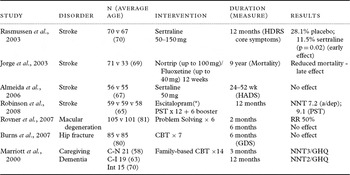
Stroke has been the most commonly studied disorder (Table 1). Two studies showed a positive advantage to active (drug) treatment over placebo. Rasmussen et al. (Reference Rasmussen2003) showed a “sparing” effect of the selective serotonin reuptake inhibitor (SSRI) sertraline of between 15% and 18%. The effect was noticeable within six weeks and tolerability was good. In terms of NNT, this is similar to the data reported by Robinson et al. (Reference Robinson2008) in which new cases of either major or minor depression occurred in 22.4% of placebo-treated patients versus 8.5% in a group treated with the SSRI escitalopram and 11.9% of those treated with Problem-Solving Treatment (PST, a brief psychological therapy), amounting to NNTs of 7.2 and 9.1 respectively for the active groups at 12 months. This study utilized “booster” PST sessions after the clinical intervention period, which may be important to maintain efficacy.
Selective intervention studies

HDRS = Hamilton Rating Scale for Depression; HADS = Hospital and Anxiety Depression Inventory; GDS = Geriatric Depression Scale; PST = Problem-Solving Treatment; CBT = Cognitive Behavior Therapy; C-N = control/no interview dyads; C-I = control/family interview dyads; Int = intervention group; RR = relative risk; NNT = number needed to treat; GHQ = General Health Questionnaire; (*) = 10 mg for <65 yr olds and 5 mg for over 65 yr olds.
An intriguing finding building on an earlier 12-week randomized controlled trial of fluoxetine versus nortriptyline versus placebo in stroke (Jorge et al., Reference Jorge, Robinson, Arndt and Starkstein2003) showed a possible enduring beneficial effect of the initial trial as evidenced by an almost doubled survival rate at nine years in the active group compared to placebo. A suggestion was that antidepressants may permanently alter stroke-mediated depression pathways and there is experimental evidence that neurogenesis may be a property of antidepressants (Duan et al., Reference Duan2008). Not all trials though have shown benefit. Almeida et al. (Reference Almeida, Waterreus and Hankey2006) demonstrated rates of significant depression of 16.7% (sertraline) versus 21.6% (placebo) in a 24-week controlled trial post-stroke. The rather low fixed dose of sertraline (50 mg) is in contrast to the dosages of nortriptyline (up to 100 mg) and fluoxetine (up to 40 mg) in the Jorge et al. study (Table 1). The high rate of discontinuation in both groups because of perceived poor tolerability may have contributed to the negative findings. Relative under-dosing may also be a feature of the study of Robinson et al. (Reference Robinson2008), since those over aged 65 received only 5 mg escitalopram (compared to 10 mg in those younger). In a meta-analysis (Yan et al., Reference Yan, Patel, Guo and Siyan2007), 703 non-depressed patients after stroke were identified from ten studies (all but one randomized). The pooled rate of newly developed cases of post-stroke depression in the intervention and control groups were 12.54% (41/327) and 29.17% (91/312), respectively (pooled rate difference = -0.17, 95% confidence interval: -0.26 to -0.08). Although encouraging, it was not possible to answer whether the type of antidepressant or duration of treatment were critical factors.
Turning to other disorders, Rovner et al. (Reference Rovner, Casten, Hegel, Leiby and Tasman2007) randomly assigned 105 patients with macular degeneration to PST and compared them to 101 who received usual care. PST reduced incident depression (major or minor) by 50% (11.6% PST versus 23.2% usual care) at two months. A reduced chance of dropping a valued activity in the active group was an important ingredient. No effect was seen at six months, emphasizing that short-term gains should be consolidated by booster sessions as discussed by Robsinon and Jorge (Reference Robinson and Jorge2009). Another condition with a high risk of depression is hip fracture. In a dual-pronged approach, Burns et al. (Reference Burns2007) randomized older patients with hip fracture to an intervention trial if depressed or a prevention trial if scoring 6 or less on the GDS post-fracture. A course of up to seven sessions of Cognitive Behavior Therapy (CBT) treatments delivered by an experienced psychologist did not reduce incident depression at any time point (6 weeks, 3 months, 6, months). Possibly CBT was less suited to the advanced age of the sample (80 years) but the average age closely matches that of Rovner et al. who also used a (albeit simpler) psychological intervention. Lenze et al. (Reference Lenze2007) found one in seven hip fracture patients developed incident major depression, mainly in the early weeks after fracture. Half of those with a high baseline apathy score developed depression, this being the only significant factor. Apathy, often expressed as “failure to engage in rehabilitation”, overlaps with depression but is distinct from it and may therefore constitute another risk indicator for depression.
Although not a medical disorder, caring for someone with dementia is associated with very high rates of depression (Ballard et al., Reference Ballard, Eastwood, Gahir and Wilcock1996). Marriott et al. (Reference Marriott, Donaldson, Tarrier and Burns2000) allocated dyads of patient (dementia) and caregivers to a family intervention and one of two control groups, one given an in-depth family interview but no intervention and the other usual care. Beck Depression Inventory (BDI) scores fell significantly in the active intervention group (11.5 to 7.2) immediately post-intervention and remained low at three months, unlike in the other two groups. Although not a prevention trial, the BDI scores in effect fell from sub-syndromal depression levels to non-case levels. Running to 14 sessions, the intervention may be relatively expensive and it would be interesting to know which element of the intervention package worked best – education, coping skills or stress management. Based on the General Health Questionnaire (GHQ), NNTs of 2 and 3 at 3 months and 12 months respectively were achieved.
Indicated prevention
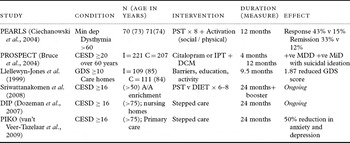
There are few randomized controlled trials of indicated prevention. This section (Table 2) therefore includes some studies which are more treatment oriented than purely preventive but have features of importance to understanding primary prevention because they focus on sub-syndromal depression.
Indicated prevention studies and other relevant studies

A/A = African Americans; CESD = Center for Epidemiological Studies in Depression; DCM = Depression Care Manager; DIP = Depression and Anxiety Indicated Prevention; GDS = Geriatric Depression Scale; IPT = Inter-Personal Therapy; MDD = Major Depressive Disorder; MiD = minor depression; PEARLS = Program to Encourage Active and Rewarding Lives for Seniors; PIKO = Preventive Intervention for Frail Elderly; PROSPECT = Prevention of Suicide in Primary Care Elderly – Collaborative Trial; PST = Problem-Solving treatment; I = intervention; C = control.
The Program to Encourage Active and Rewarding Lives for Seniors (PEARLS) is a community-based treatment program for older adults with minor depression or dysthymia. The program comprises PST, social participation and encouraging an increase in pleasurable activities. A randomized trial (Ciechanowski et al., Reference Ciechanowski2004) showed that recipients of PEARLS were more likely to have a 50% or greater reduction in depressive symptoms, to achieve remission, and have fewer hospitalizations than those in the control group.
A public health approach to suicide prevention among older adults was the starting point for PROSPECT (Prevention of Suicide in Primary Care Elderly – Collaborative Trial) involving 20 primary care practices in the U.S.A. Of 598 subjects enrolled, 396 had major depression and 202 “significant minor depression”. Treatment was based on an algorithm involving citalopram or Inter Personal Therapy if refused. The intervention was effective in reducing depressive symptoms in major depression and in minor depression where there was suicidal ideation. The effect continued at two years follow-up (Alexopoulos et al., Reference Alexopoulos2009). An early reduction in suicidal ideation was also noted by the Neurocognitive Outcomes of Depression in the Elderly (NCODE) study following treatment for depressive symptoms (Cukrowicz et al., Reference Cukrowicz, Duberstein, Vannoy, Lynch, McQuoid and Steffens2009). Central to PEARLS and PROSPECT is a Depression Care Manger (DCM) who supervises all aspects of treatment. In the PROSPECT trial this resulted in 50% better treatment uptake in the DCM group.
Also investigating subthreshold depression, Llewellyn-Jones et al. (Reference Llewellyn-Jones, Baikie, Smithers, Cohen, Snowdon and Tennant1999) allocated 220 nursing home residents (average age 84 years) either to usual care or a shared care intervention package comprising help for primary care to recognize and manage depression, caregiver education and public health promotion. Shared care resulted in an average improvement in the Geriatric Depression Scale of 1.87 points at nine months, a statistically significant change. This effect, although modest, illustrates the feasibility of a large-scale intervention on a group highly vulnerable in major depression.
Although relevant, none of the above studies was primarily aimed at prevention. There are currently three studies which aim to do this with an indicated design. Two are from the Netherlands and use similar methodology. Dozeman et al. (Reference Dozeman, van Schaik, Beekman, Stalman, Bosmans and van Marwijk2007) outlines this for a sample of nursing home residents in Amsterdam, using the Centre of Epidemiologic Studies Depression scale (CES-D 20) as a screening instrument (Table 2) and a stepped-care protocol as the intervention. The steps are: watchful waiting, self-help material with referral to primary care physician, life review delivered by trained personnel, and medication from a primary care physician with collaboration where needed with the specialist mental health services. The main outcome is the number of prevented cases of major depression. Using the same methodology applied to primary care practices, van't Veer-Tazelaar et al. (Reference van't Veer-Tazelaar2009) report completed data on participants randomly assigned to a preventive stepped-care program (n = 86) or to usual care (n = 84). The end-point was to prevent depression or anxiety. In the intervention group, 10 of 86 participants (11.6%) developed a major disorder compared to 20 of 84 of usual care participants (23.8%), with a relative risk of 0.49 (95% confidence interval [CI]: 0.24 to 0.98). To date this is the first completed, well-designed study to show benefit from an indicated prevention study.
Sriwattanakomen et al. (Reference Sriwattanakomen2008) describe an ongoing study with a similar intervention and entry criteria to the Dutch ones. However, to control for non-specific effects, this study has proposed a plausible public health-oriented control intervention, namely dietary education. This may be important as it is clearly possible that positive findings may be largely due to non-specific effects, as is well known in treatment trials of depression (McCusker et al., Reference McCusker, Cole, Keller, Bellavance and Berard1998).
Is a “universal” approach to the prevention of depression feasible?
Late-life depression has a multi-factorial etiology so that universal prevention is often not thought feasible. However, Oyama et al. (Reference Oyama, Fujita, Goto, Shibuya and Sakashita2006) intervened in a defined population aged over 65 years in the area of Yasuzuka, Japan with a ten-year program of education about depression and suicide in primary care. Yasuzuka is a rural area with a high suicide rate and the rate for women fell by 64%. The absence of an effect in men is concerning given they are demographically a high risk group. A meta-analysis of suicide prevention strategies also highlighted physician education as key to reducing suicide along with restricting means to lethal ends, for example fire arms (Mann et al., Reference Mann2005). Generally though, the universal prevention of depression is not thought feasible (Schoevers et al., Reference Schoevers2006).
More generally, are there risk factors in the population as opposed to selected groups which, if modifiable, may lessen the incidence of depression? Among the many candidates some potentially interesting ones include: folic acid and homocysteine, vascular disease, diet and exercise and insomnia. There is a complex relationship between depression, homocsyteine and folate metabolism. In a men's health study Almeida et al. (Reference Almeida, McCaul, Hankey, Norman, Jamrozik and Flicker2008) showed significant reductions in depressive symptoms with incremental reduction in homocysteine levels, more so in those with the TT genotype of the MTHFR C677T genotype. Various formulations of folate, which is linked to homocysteine, have been shown to reduce depressive symptoms (Fava and Mischoulon, Reference Fava and Mischoulon2009). Homocysteine is also a risk factor for vascular disease and if, as the vascular depression hypothesis suggests, cerebrovascular disease can trigger or perpetuate late-life depression, then vasoprotective treatment may prevent it (Baldwin, Reference Baldwin2005). Demonstrating this will be difficult given that much vascular disease begins in mid-life. Inflammation is linked to arterial endothelial dysfunction and in the InCHIANTI study the highest quartiles of the proinflammatory marker IL-1Rra were associated with a 2.32 fold increase in incident depression in older adults at six years (Milaneschi et al., Reference Milaneschi, Corsi, Penninx, Bandinelli, Guralnik and Ferrucci2009). The relationship between depression and vascular disease is two-way. In a study of 324 adults, mean age 60.6 years, measures of carotid artery Intima Media Thickness (IMT) to detect subclinical atheroma showed that baseline depressive symptoms were associated with a significantly greater three-year worsening in carotid IMT, after adjusting for potential confounding factors (Stewart et al., Reference Stewart, Janicki, Muldoon, Sutton-Tyrrell and Kamarck2007).
These data suggest that biological parameters, such as levels of homocysteine and inflammatory markers, might be useful biomarkers when combined with other risk factors for depression both to improve mechanistic understanding of the cascade of pathophysiology leading to late-life depression and to improve the efficiency of preventive interventions via better identification of those most at risk. Biomarkers may also allow clinicians to track changes in risk over time, before, during and after interventions for depression.
Poor sleep is common in later life and strongly linked to depression, again in a bi-directional manner. It is also an example of a clinical symptom which recently has been linked to changes in inflammatory markers in depression (Miller et al., Reference Miller2009). Cho et al. (Reference Cho, Lavretsky, Olmstead, Levin, Oxman and Irwin2008) addressed whether sleep predicts depression or depressive disorder predicts poor sleep in a sample of 145 older adults. Most of those who developed depression had a prior history of it and within this group poor sleep independently predicted depression recurrence. So, in terms of recurrence, poor sleep may be an early warning sign and a predictor of depression and may be amenable to a public health program, as well as linking to biomarker research.
The current emphasis in Western nations on diet and exercise as preventives to mid- and late-life medical disorders poses the question of whether embracing them may lead to a lower burden of depression. There is accumulating evidence that exercise lowers the symptom burden in major depression and can be an effective treatment for subthreshold cases (Sjösten and Kivelä, Reference Sjösten and Kivelä2006) lending itself to indicated prevention. Ethyl-eicosapentaenoic acid (fish oil) attracts much interest and there is some supportive research for its use as an adjunctive treatment for major depression. In a study of the effects of high and low dosage fish oil on the depression scores of older community-dwelling adults, van de Rest et al. (Reference van de Rest2008) found no effect at 26 weeks. However, this was not specifically a preventive trial and given that fish oil is known to benefit arteries (vascular depression), dietary manipulation is a worthwhile target for prevention.
What treatment modalities and models of care might work in prevention?
Undoubtedly antidepressants are the most widely used modality in depression management. However, concerns about unwanted effects of SSRIs and the absence of evidence that they work in mild depression (Fournier et al., Reference Fournier2010) suggest caution in their widespread use in subthreshold depression, as would be the case in an indicated prevention program. To well-known problems such as hyponatremia and a risk of gastric bleeds must be added a risk of falls and long-term bone demineralization (Ensrud et al., Reference Ensrud2003; Rosen, Reference Rosen2009).
Consequently, psychological interventions are favored and the choice is a balance of efficacy and costs. CBT, used in the studies of Marriott et al. (Reference Marriott, Donaldson, Tarrier and Burns2000) and Burns et al. (Reference Burns2007) and Inter-Personal Therapy (IPT) (Bruce et al., Reference Bruce2004) have strong evidence-bases in depression but with the drawback of requiring a high degree of training, certainly for CBT. PST was used in a number of the studies reviewed (Ciechanowski et al., Reference Ciechanowski2004; Dozeman et al., Reference Dozeman, van Schaik, Beekman, Stalman, Bosmans and van Marwijk2007; Robinson et al., Reference Robinson2008; Sriwattanakomen et al., Reference Sriwattanakomen2008; van't Veer-Tazelaar et al., Reference van't Veer-Tazelaar2009). It has the advantage of being an easily learnt technique but may be more difficult to standardize than CBT. Thus, Williams et al. (Reference Williams2000) in a multi-site study found no overall efficacy for PST in sub-threshold depression but noted substantial site variation.
A treatment should be embedded within a clear service model. Thus, in the two Dutch prevention trials (Dozeman et al., Reference Dozeman, van Schaik, Beekman, Stalman, Bosmans and van Marwijk2007; van't Veer-Tazelaar et al., Reference van't Veer-Tazelaar2009) PST formed part of a stepped care model, the steps having been outlined above. In these studies some elements of the intervention were adapted from the Coping with Depression (CWD) initiative, a widely used CBT-oriented, manualized, psychoeducational tool derived from Social Learning Theory. It can be delivered individually, in groups or via the Internet. In a meta-analysis of six preventive trials, CWD resulted in a 38% less chance of developing a depressive disorder than in control settings (Cuijpers et al., Reference Cuijpers, Muñoz, Clarke and Lewinsohn2009).
Compared to a tablet it may be easier to persuade individuals to accept a psychological intervention for a disorder they do not yet have. However, convincing funding bodies of this may be more difficult, particularly as the more recent data (Rovner et al., Reference Rovner, Casten, Hegel, Leiby and Tasman2007; Robinson et al., Reference Robinson2008) suggest that booster sessions may be needed. Recently, the Dutch group responsible for the recent successful indicated depression study (van't Veer-Tazelaar et al., Reference van't Veer-Tazelaar2009) have published cost-effectiveness data of their stepped care model for the prevention of depression and anxiety (van't Veer-Tazelaar et al., Reference van't Veer-Tazelaar2010). They calculated a cost of €563 per recipient and €4367 per disorder-free year gained compared to usual care. This they regarded as good value for money but in a stringent financial climate funders may wish to see cost reductions rather than incremental rises.
Although not directly arising out of prevention research, three other models are relevant. The PATCH (Psychogeriatric Assessment and Treatment in City Housing) program utilizes systematic case-finding in facilities housing older adults combined with a home-based treatment program (Rabins et al., Reference Rabins2000). Montgomery-Åsberg Depression Rating Scale scores, which at baseline were not in the major depression range, were significantly lower (9.1 vs 15.2) at follow-up in the PATCH treated group compared to usual care. Geriatric Evaluation and Management (GEM, also known as Comprehensive Geriatric Evaluation) offers a multidisciplinary specialist approach to geriatric care. Boult et al. (Reference Boult, Boult, Morishita, Dowd, Kane and Urdangarin2001) applied GEM to a large group of adults aged over 70 at high risk of rehospitalization and compared them to control participants. At 18 months the GEM group had fewer bed disability days, less functional decline and less caseness for depression, using the threshold of below 11 on the Geriatric Depression Scale (GDS). Depression and medical comorbidity are very closely linked and it is difficult to disentangle the two. Therefore a model which focuses on the physical but finds ensuing mental health benefits is of interest. However, the costs of GEM are likely to be high.
Collaborative care is a model based in primary care which focuses on a single disorder such as depression with elements of case management by a trained professional (usually a nurse or social worker), a brief psychological intervention (such as PST) and timely access to psychiatric care. The largest study to date is IMPACT (Unützer et al., Reference Unützer2002) in which 1801 depressed primary care patients were allocated to collaborative care or usual care. Because a majority of patients had major depression (70%) IMPACT has not been reviewed in detail here but the model is similar to that used in the PEARLS (Ciechanowski et al., Reference Ciechanowski2004) and PROSPECT (Bruce et al., Reference Bruce2004) trials and, like those, efficacy was demonstrated.
Summary
Prevention is better than cure. Primary prevention of major depression is feasible. Selective intervention with either antidepressants or a psychological intervention has an increasing evidence base in stroke and macular degeneration and may be appropriate for other conditions or states that are less clearly delineated, such as caregiving in dementia. Evidence is also emerging for the efficacy of indicated prevention set within an appropriate service model, with far-reaching implications for preventing depression in whole populations. In England, general practitioners are remunerated to detect depression using simple screening tools in defined conditions such as diabetes and heart disease, for which they must keep chronic disease registries, making this a natural home for a preventive intervention program.
Nevertheless, there are limits to prevention. Not all risk factors can be mitigated and not all interventions are 100% effective. Probably only 30% of depression can be prevented (Schoevers et al., Reference Schoevers2006) but this would be a considerable health gain. Further, targets for intervention can conceivably include targets other than simple symptom reduction, for example mortality linked to depression (including suicide) and medical complications that may be linked to long term depressive disorder (for example, stroke and heart disease). As an example, the five-year follow-up of the PROSPECT trial showed that patients with depression in intervention practices were less likely to have died than those in usual care practices (adjusted hazard ratio: 0.67 [95% CI: 0.44 to 1.00]). Risk for death was reduced in patients with major depression (adjusted hazard ratio: 0.55 [CI: 0.36 to 0.84]) but not patients with clinically significant minor depression (adjusted hazard ratio: 0.97 [CI: 0.49 to 1.92]). The benefit seemed to be almost entirely attributable to a reduction in deaths due to cancer (Gallo et al., Reference Gallo, Bogner, Morales, Post, Lin and Bruce2007).
Lastly, although not covered in this review, the secondary prevention of remitted depression with either medication or a psychological intervention ranks as one of the most effective interventions in psychiatry.
Conflict of interest
None
Acknowledgment
This paper is based on a plenary lecture delivered to the Montreal International Meeting of the International Psychogeriatric Association, 2 September 2009.