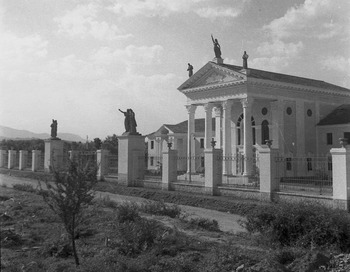
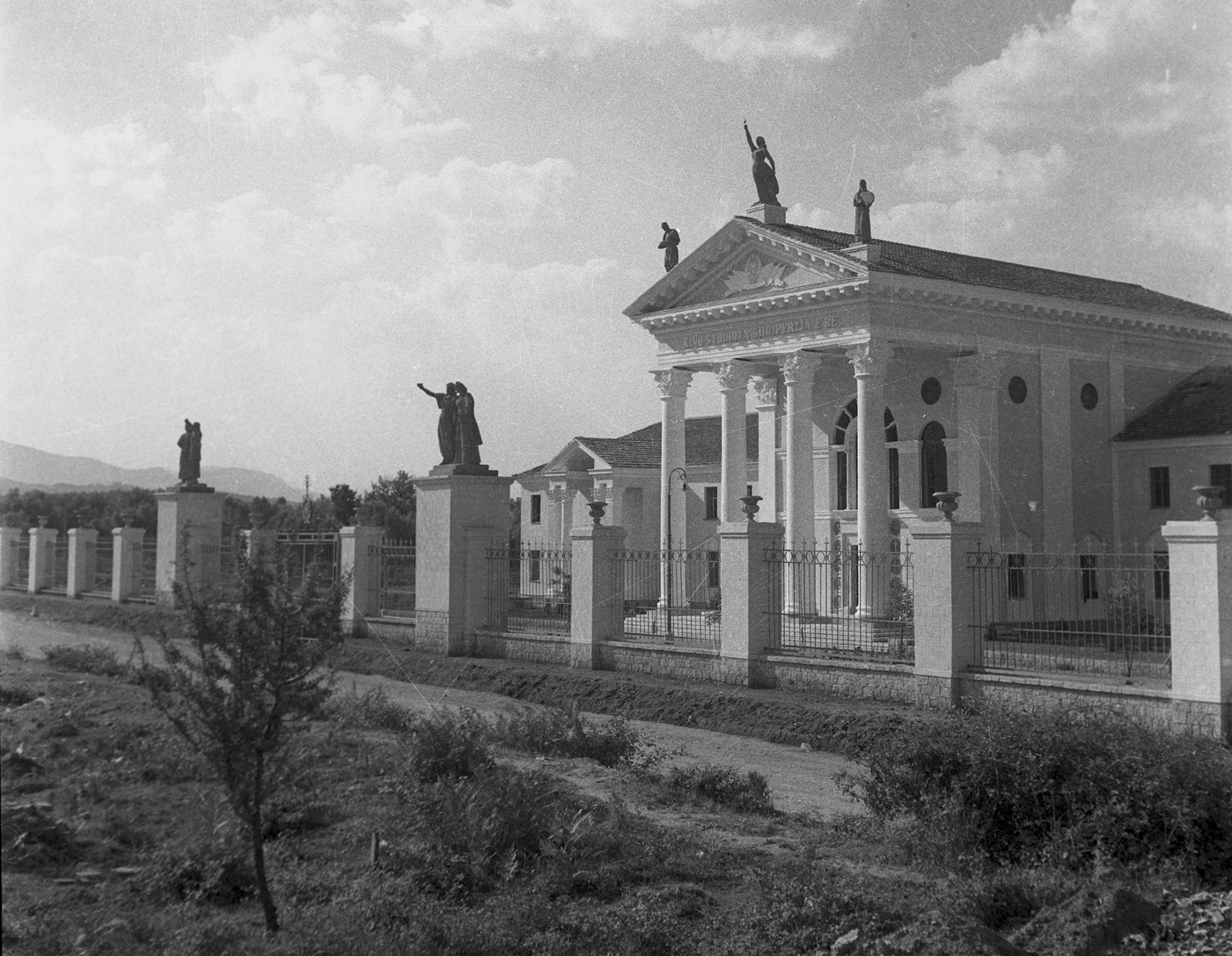
To the northeast of the city center in Tirana, Albania's capital, rises a building that was once an expression of national glory. Years of neglect, however, have taken a toll. Recently, the Ministry of Culture decided to move in, so officials ordered a renovation. The resulting facelift has buried some of the communist-era symbols under a thick layer of white paint. Still, it is hard to miss the hallmarks of late Stalinist architecture: the ornamental gate, the entrance with its Corinthian columns, the emblem of the People's Republic emblazoned on the pediment. Three sculptural figures loom above: a male and a female dressed in traditional garb, flanking a central female character raising a torch to the sky (it was once a star, but renovators reportedly opted for a more western-friendly version). This is the official birthplace of Albanian cinema.
Established in 1952, the country's film studio was based on a Soviet design, which explains the neoclassical façade. Authorities baptized it Shqipëria e Re (New Albania). Residents no longer refer to it by that name, instead simply calling it Kinostudio. On one level, this was the almost-magical seat of a national project: the point of origin for many postwar careers, the source of mass entertainment and the first motion pictures, the first reels that defined many childhoods. That building sought to produce, as the art historian Gëzim Qëndro put it, “a map of reality” under socialism.Footnote 1 On another, it was a manifestly Soviet product of the 1950s, as the architecture attests, offering an opportunity to consider how international engagement produced a national icon.
This article explores Cold War-era filmmaking as a window into collaboration and confrontation across the Sino-Soviet split. Over two decades, a small Balkan country became a site of cross-continental exchange between local planners, Soviet advisers, and, later on, Chinese collaborators. Briefly a Yugoslav satellite after the Second World War, Albania then embraced Stalinism in the 1950s, only to switch allegiances again during the dramatic early 1960s Moscow-Beijing dispute. This shift implicated party functionaries, government administrators, cultural directors, and ambitious youths in worldwide developments, from early struggles over spheres of influence in the Balkans to the advent of socialist disunity across Eurasia. A country on the edge of the capitalist and communist spheres is a good place to explore Cold War antagonism, but Albania also offers extraordinary access to ideological antagonism within the socialist world, including its various economic and cultural manifestations.
In tracing Soviet-Albanian-Chinese exchanges, my objective is to show that nationalizing and globalizing processes have been deeply intertwined. For the novice rulers of Albania—a country that declared independence in 1912, struggled to retain it, then lost it—nationalization was a matter of survival. The regime vowed to build a non-capitalist society but found itself economically dependent on bigger powers like Yugoslavia and the Soviet Union. Nationalization meant more than confiscating private property, devising central plans, and making up enemies. Films, newsreels, and documentaries could be instruments of self-definition too, especially in the context of high levels of illiteracy. It is useful, then, to think of this postwar self-definition as proceeding along three parallel lines: producing a usable past (against an Ottoman and more recent fascist background); mapping a socialist present (with the participation of Soviet actors and directors); and, ultimately, repositioning the country within a changing global map of revolutionary politics (thanks to China's anti-Soviet turn in the 1960s).
As discussions of socialism as a form of transnational exchange proliferate, it becomes necessary to spell out precisely how this exchange interacted with national imperatives over time.Footnote 2 Within Balkan studies, nationalism often emerges as a driving force seemingly drowning alternative ideologies—especially when compared to scholarship on central Europe, where national indifference now seems endemic. Rather than assuming nationalism's fully-formed presence, I show how geopolitics and transnational contact made forms of national assertion possible. Film is only one possible avenue for pursuing this kind of analysis, but it offers some advantages. First of all, a national film industry in Albania was a late development, requiring extensive imports. Soviet directors brought their reels and their plots to the Mediterranean, revealing how the Soviet civilizational blueprint could be used to tell a local story of heroic resistance, Ottoman backwardness, and western betrayal.
By the early 1960s, however, the Soviet-Albanian friendship was in ruins. From instruments of friendship, films became weapons in a battle over the soul of socialism. As Tirana turned to Beijing for support, Albanian films assumed unexpected meaning, especially during China's self-inflicted isolation of the Great Proletarian Cultural Revolution (1966–76). When seen as products of negotiation, then, films make it possible to consider the vision of those who made them, the interests and calculations of those who distributed them, and, ideally, problems of reception and interpretation. Analyzed in the specific context of geopolitical and ideological conflicts, they help bring into focus the role of cultural intermediaries (directors, editors, censors, and administrators of socialist taste), beyond the usual top-level powerbrokers that populate political histories of the Cold War.Footnote 3
Specifically, this article spotlights the Sino-Soviet split not only as a rupture but as an opportunity to connect across a vast distance. Sino-Soviet disagreements played out at the highest party levels, and so Cold War scholars continue to scrutinize documents for clues into the rift, supplying elite-driven analyses.Footnote 4 But a split in the socialist world was always bound to be more than an affair between Central Committees. We lack deep analyses of its far-reaching social consequences, especially from comparative and transnational perspectives. It is the aftermath of the rift that constitutes the pertinent story of how socialism's global fortunes came to be rearticulated. The 1960s provide an opportunity to consider the social history and the cultural dimensions of political disunity within international socialism. How did the schism structure new worldviews and categories of thinking? This, too, was a large-scale offensive to redefine the proper ownership of a revolutionary legacy.
To my mind, a global perspective on this history would have to give a sense of the various scales at which socialism operated—large centers like Moscow and Beijing, with their Central Committees and planning bureaus, but also regional powers and assertive peripheries, internal ideological fault-lines, and zones of contact that the Soviets (or, later, the Chinese) could not control.Footnote 5 The new Cold War scholarship insists that the revolutionary battleground shifted to the Global South by the 1960s, but this overlooks the simple fact that revolutionary battles kept raging in the heart of Europe.Footnote 6 A global perspective on the Cold War can also be an opportunity to capture the surprising reach of small states, specifically how ideological conflict endowed them with outsize significance.Footnote 7 The outcome can be a suggestive view of socialism as containing multiple mental geographies and time regimes, and of socialist connectivity as paradoxical but also productive in unforeseen ways. In this specific instance, the nationalizing process that Soviet directors championed in 1950s Albania combined with the geopolitics of the Sino-Soviet split to create new, unanticipated possibilities for asserting one's place in the world.
Initially, Soviet directors found the story of local resistance against foreigners—fifteenth century to fascism—compelling. They celebrated Albanian militancy, the idea of an improbable state pursuing socialism at all costs. Still, they framed Albania as a socialist country-in the making, which was to say that it lagged behind. A decade later, cultural authorities sought to define a non-Moscow-centered way of being socialist in the world. As Albanian war films circulated around China, Mao Zedong hailed the small Balkan country as being ahead—the defiant protector of Marxism-Leninism and a revolutionary example to emulate. The outcomes of this shifting mental geography were unpredictable; the cultural reorientation from Moscow gradual and uneven. In cinema, for example, it meant allowing a spattering of (carefully screened) western films, rotating Soviet classics, and shipping Albanian war-themed films to China for mass dissemination. There, Cultural Revolution-era audiences encountered Albanian films as a small window into Europe (and hence, “the west”).
To capture these zigzags over time, the article initially sketches Albania's shift from Belgrade to Moscow in 1948, which helps explain the zealous cultural promotion of the Soviet Union that followed it. The administration of films in this period reveals the profound challenge of bringing a national public into being. The analysis then shifts to how two Soviet directors engaged with Albania's Ottoman and fascist past, as well as its socialist present, seeing in their collaborative efforts a kind of mutual discovery in a Soviet key. Sergei Yutkevich and Il΄ia Kopalin both addressed themes of struggle, but they worked in different genres and across a decade, making it possible to give a sense of the scope and evolution of socialist collaboration. The article's final section asks: What happens to socialist interconnectedness after the Moscow-Beijing schism? Championed by Moscow, Albania's emerging national cinema later found a captive audience in China under Mao Zedong, where it came to be celebrated as progressive, militant, and Marxist-Leninist. Earlier Soviet collaborations eventually fell from view, obscured by the writing of nationalized histories of filmmaking. Therefore, this article complements wide-ranging Albanian, Russian, and German archival sources with published and unpublished recollections, as well as contemporary press accounts.
The Distance to Moscow
Albania's Communist Party (renamed Party of Labor in 1948) came into being in 1941, with Yugoslav backing. On the one hand, Yugoslav involvement emboldened local leaders, who were inexperienced and prone to squabbling. On the other, it left Albania liberated from Nazi occupation, but also dependent on Belgrade for political and economic support. This helps explain why the cultural politics of the postwar period reflect a mixture of boundless euphoria and a sense of subordination. Authorities took possession of the tiny existing industries and workshops, and they also expropriated film theaters.Footnote 8 They declared a monopoly on film trade, and set up a national agency to oversee production, imports, and distribution. Yet they could hardly feed the populace, let alone purchase foreign films, and so they relied on neighboring Yugoslavia to serve as a cultural conduit to the outside world.Footnote 9 In short, the nationalization of the film industry, such as it was, preceded the creation of a national audience, just as the nationalization of the economy more broadly preceded the creation of a working class. This encouraged a sense of driving history forward, but also lagging behind.
Stalin initially approved of the Yugoslav tutelage over the smaller Balkan neighbor. But the conflict with Yugoslav leader Josip Broz Tito in 1948 unexpectedly created an opportunity for the Albanian regime to break free. Party leader Enver Hoxha, who relished the opportunity to deal directly with the Kremlin, declared loyalty to Stalin, whom he credited with having “saved” Albania from Yugoslav “colonization.” Explanations for the Soviet-Yugoslav schism center on the idea of a struggle over authority at the highest levels. Stalin had grown impatient and resentful of Tito's schemes for asserting power in the Balkans. He cut Tito loose, heaping scorn on his supporters as traitors to socialism, thus setting the stage for vicious trials of “Titoites” around the eastern bloc.Footnote 10 But it is also possible to see this early moment of disunity in the Communist camp as a struggle over authority other than Stalin's. For Hoxha, the break meant an unprecedented opportunity to assert national authority over socialism. The country's window into the world expanded dramatically. In wartime (officially referred to as Lufta Antifashiste Nacionalçlirimtare, the Anti-Fascist National Liberation War), the party had vowed to bring freedom from fascism. Now, it also declared freedom from Yugoslavia, blaming it for past repression and planning failures. It was a national breakthrough.
This schism allowed the regime to frame the year 1948 as a new beginning.Footnote 11 Because the majority of Albanians were illiterate, non-print forms of communication (radio, rallies, newsreels) were crucial. Films could show illiterate individuals that they were not isolated in the world; that they enjoyed a partnership with the homeland of Lenin. In articulating this vision—in selecting Soviet films to be shown, in explaining them, transforming them into intelligible narratives—an insecure regime could project strength. By some official accounts, the spread of Soviet films increased in the late 1940s. One source put the number of Soviet screenings in 1946 at 3,697. Three years later, it had reached 8,700. The viewing audience had reportedly more than doubled.Footnote 12 Considered in isolation, however, such numbers can be misleading. Official figures reported total screenings, but they did not specify where and when they took place. As with other areas of the central plan, screenings were arranged according to annual targets, as were audience numbers. Yet this was a rural country with a limited road network and electric grid. Even if we allow that a large increase in the number of Soviet film screenings took place after 1948, it hardly means that exposure was uniform.
The Society for Soviet-Albanian Friendship was the main instrument for familiarizing audiences with the Soviet Union. It was also an important vehicle for distributing Soviet films, since it administered mobile film projectors donated by the Vsesoiuznoe obshchestvo kul΄turnykh sviazei s zagranitsei (All-Union Society for Cultural Ties Abroad).Footnote 13 The Society's journal hailed Soviet cinema as the international vanguard, favourably comparing it to “the gangsters” and “decadence” of Hollywood.Footnote 14 It highlighted, in particular, the reception of Soviet reels among villagers, whose worldview could expand through imported technology.Footnote 15 But it is precisely because such rural events were rare that agitators deliberately emphasized them in this fashion. In 1954, the Soviet embassy admitted that almost half of the viewers of Soviet films were in the six largest cities, whereas the far more populous periphery had limited access to screenings.Footnote 16 Uneven exposure to Soviet films, in other words, went parallel with efforts to nationalize a viewing public that was still geographically divided.
The fact that big cities were the most conspicuous sites of “friendship work” made agitators obsess over the countryside.Footnote 17 As we will see, a couple of Soviet directors also addressed this problem—the quest to bring a national audience into being. The challenge was not solely one of resources. Imported films were subject to the authority of several offices, reflecting the interlocking spheres of the party-state. They were initially under the purview of Komiteti i Arteve dhe Kulturës (Arts and Culture Committee). This was a modest organization, forced to rely on Albanian diplomats abroad to sign bilateral agreements with the respective “people's democracies.”Footnote 18 Film administrators, moreover, had to coordinate with the party's Central Committee (specifically, with its agitprop and foreign sectors). Overburdened with problems of grain shipments, loan rates, and spare parts for industrial installations, officials dragged their feet when it came to cultural agreements.Footnote 19
One result of this uneven implementation of cultural exchange was that the number of Soviet films fluctuated from year to year. In 1952, for example, Albania received nine Soviet features (including Taras Shevchenko, The Unforgettable Year 1919, and Country Doctor) and seventy-seven documentaries (among others, Soviet Uzbekistan, Construction Works in Moscow, Ice Dancing, and The Lenin Library). A year earlier, there were twenty-one feature films and eighty-seven documentaries.Footnote 20. One major problem with distribution was that Soviet films arrived in a single copy (or sometimes two). This meant that the theaters in the big cities got to screen them first. Only months later did smaller towns, and eventually perhaps some villages, get a chance. It was common for the reels to take close to a year to circulate from one end of the country to the other. This also explains how reels containing documentaries about Lenin, the film Nasreddin v Bukhare (1943), and the classic Chapaev (1934) became so worn out by repeated screenings that replacement was deemed urgent.Footnote 21
The physical exchange of reels was the beginning of a longer process. There were multiple procedures involved, including translation, dubbing, editing, sound mixing, and formulating explanations to go with the films. In the late 1940s and early 1950s, Soviet films were often shown in the original Russian only.Footnote 22 Adding to the problem of a shortage of translators, the regime saw the older intellectual types who might know foreign languages as politically suspect. As an alternative, authorities approached Albanian students enrolled in Moscow universities, who sometimes collaborated with the Albanian-language service of Radio Moscow.Footnote 23 It was one thing to show Russian-language newsreels depicting contemporary events, but how to make sense of feature films in a foreign language? To address the problem, the Friendship Society sent agitators along with the film reels to explain the proper context and meaning of the film to be screened. We are left speculating about the reception of such showings. Unofficial sources are scarce. What existing records do show, however, is an ongoing preoccupation with workers’ and peasants’ cinematic taste, as well as deliberate attempts to modify it.Footnote 24
At the opening of the Soviet-designed film studio in 1952, for example, Enver Hoxha cautioned filmmakers—almost all of them fresh from courses in Moscow—to go to the people: “Borrow from foreigners what you need and what is best,” he cautioned, “but first of all, find inspiration in the glorious and the heroic labor of our people.”Footnote 25 In a self-conscious move, the studio's first newsreels depicted the construction of the studio itself, lauding “the wonderful architecture of the palace, the beautiful rooms and the complex machines sent by the Soviet Union” (See Figure 1). But this national moment was also clearly marked within an internationalist setting: in addition to agricultural campaigns and military parades, early newsreels depicted a soccer match with East Germany and a visiting Chinese musical ensemble.Footnote 26
Kinostudio: The Soviet-designed film studio, early 1950s. Courtesy of Arkivi i Agjencisë Telegrafike Shqiptare (ATSH).
It is also true that referring to “Shqipëria e Re” as a film studio does not capture the full range of its functions. In addition to producing newsreels in the 1950s, it became part of the chain of state institutions responsible for vetting foreign films. The beginnings of a national film industry, then, were closely linked to parallel processes of filtering western products, promoting and distributing Soviet classics, and screening the other nascent national cinemas comprising the Soviet lands, like the Belorussian-produced Deti partizana (1954), or the first Kazakh feature film Poema o liubvi (1954), alongside titles like the Hungarian Állami áruház (1953). “Shqipëria e Re” served as training ground for the country's future filmmakers, who got their start working as second hand to Soviet directors. Beyond training, the studio depended on Moscow for machine spare parts, stocks of negative and positive film, and necessary chemicals like hydroquinone and sodium carbonate.Footnote 27
Exposure to Soviet cinema was one way of attempting to bridge the geographic distance between Tirana and Moscow. This material reliance on the Soviet Union also produced delays, however, and over time, a sense of lagging behind.Footnote 28 Within the circulatory regime of the Soviet sphere, remote Albania became increasingly connected. And yet, precisely the difficulties in translating and disseminating Soviet culture also served as a constant reminder of deficiency. Later Cold War conflicts between Tirana and Moscow have obfuscated the scope of this early internationalism. Because a national Albanian cinema took many years to develop, it eventually became imperative to strip away the multi-directionality of early postwar contacts, to mark the Soviet interventions as alien and unnatural. This made it seem like the national had always been, and necessarily would have to be, in conflict with the socialist international. Soviet-Albanian cinematographic collaboration, however, brings to light the importance of transnational contacts for narrating a national past and present.
Owning the Past: Constantinople to Cannes
Albania's regime framed the friendship with Moscow as the promise of support against foreign adversaries. The party encouraged a view of Albanians as a fiercely independent lot, surrounded by foes across the border and the Adriatic. There was no better illustration of Soviet engagement with this idea than Sergei Yutkevich's Velikii voin Albanii Skanderbeg (The Great Warrior of Albania Skanderbeg), a biopic of the country's national hero, the 15th century warrior Skanderbeg (Gjergj Kastrioti, in Albanian referred to as Skënderbej).Footnote 29 Cultural authorities were keen on specifically linking the centuries-old stand against the Ottomans with the more recent twentieth century struggles to overcome foreign domination. As a kind of staging of the past, the film also invited Albanians to see their history through “foreign eyes,” to witness their claim to national glory from a Soviet perspective.
Yutkevich's film won the International Prize at the Cannes Film Festival in 1954, but that is not the reason why it remains a cult reference to this day. For Albanian viewers in the 1950s, it was the first feature film that dealt with their country. For some, it was the first feature film they ever saw. Moreover, it was action-packed, conducive to mass entertainment. By the 1980s, when state television issued reruns, Skanderbeg had become something of a weathered artifact from a bygone era. The dubbing seemed hilariously poorly executed; Albanian sounds imperfectly superimposed on the moving lips of Soviet actors. But what seemed disjointed in the context of 1980s Albania—by then, Tirana's regime had long abandoned its alliance with Moscow—had once been a signal of cultural progress.
The film was billed as a co-production between Mosfilm and “Shqipëria e Re.” In reality, the local contribution was relatively modest. Soviet partners carried 80 percent of the costs, whereas the Albanian side provided accommodation, transportation, and food.Footnote 30 Filming, which commenced in 1952 and concluded the following year, took place in Moscow and Crimea, but some scenes had to be shot on location, in Albania.Footnote 31 Yutkevich toured Tirana, Krujë, Berat, Gjirokastër, Korçë, Shkodër, and Durrës.Footnote 32 In addition to allocating funds, the government secured locals to serve as extras and old artifacts to be used as props. The shooting, higher-ups told local administrators, was supposed to become “a mass event.”Footnote 33 In a display of this collaborative ethos, Soviet author Mikhail Papava wrote the screenplay, but the Albanian party's Central Committee also dispatched the historian Aleks Buda to the Soviet Union to serve as a consultant.Footnote 34
When it came to casting, the main question was this: Who would play the legendary hero? The question was politically significant, and here, too, Soviet authorities expressed the wish that an Albanian actor play the part.Footnote 35 During a visit by a high-level delegation to Moscow, however, a number of Soviet candidates came up instead. The Soviet Ministry of Cinematography suggested names, and Albanian government officials, after viewing auditions, agreed that a Georgian actor—Akaki Khorava—was the most apt for the role.Footnote 36 It is not clear why they preferred him. They may have found the Georgian physically impressive. As one reviewer put it later, Khorava was “dramatic.” He had “a giant body.” This was important because it allowed the robust actor to present Skanderbeg “as he actually was: big, smart, a distinguished diplomat, a famed strategist, a sworn enemy of treachery, a fiery lover of everything that is beautiful, noble, and progressive.”Footnote 37
The rest of the cast, which included over sixty Soviet actors, was a kind of microcosm of the “empire of nations.”Footnote 38 The Georgian actress Veriko Anjaparidze played the role of Dafina.Footnote 39 Oleg Zhakov (from The Great Citizen) played the nobleman Tanush Tapia. Three Albanians played key parts, including Skanderbeg's wife and sister. This multi-lingual casting posed logistical challenges. “I did not understand Russian,” recalled Besa Imami, the actress playing Donika, Skanderbeg's wife. Nevertheless, she had found Khorava to be the right man for the job, adding that in his eyes “I saw Skanderbeg in the flesh.” The commitment of the Soviet cast, similarly, had demonstrated “the love of the Soviet people for our people.”Footnote 40 Since actors performed in at least two languages, Yutkevich insisted on strong non-verbal communication, which likely produced some of the exaggerated facial expressions that amused Albanian children watching the reruns in the 1980s.
Vahram Papazian played the sultan. Few individuals exemplified better than him the imperial tangle in early twentieth century southeastern Europe. An ethnic Armenian born in Constantinople in 1888, Papazian excelled in Shakespearean roles in the Soviet Union. In a published interview, he admitted that he was not pleased having to play the part of someone “who did so much damage to Albania, but art forces you to act the role of persons you despise.”Footnote 41 Papazian had thus made a full circle—from the Ottoman capital back to the former Ottoman province, but now in the name of the civilizational mission of Soviet socialism. In his early years of acting, he recalled, he had acted in a play by Sami Frashëri (Şemseddin Sami), a playwright who became a key figure in the Albanian National Awakening (Rilindja Kombëtare). Just as later communist-era textbooks would “cleanse” Frashëri from his Ottoman context, so the film in which a Georgian played Skanderbeg and an ethnic Armenian played the nefarious sultan served to detach and prop Albania as a long-standing national unit. If anything, Papazian's physical reemergence, through a 1950s Soviet lens, is a reminder of how empire and nation were interwoven.
When Skanderbeg premiered in Albania, on the anniversary of the declaration of independence from the Ottoman Empire, it was immediately hailed as an historic event. One reviewer praised it for showing the country's contribution to “the defense of European culture from the barbarism of Turkish jeniçerë [Janissaries].”Footnote 42 But to see Skanderbeg as a product of cultural exchange is to approach it as more than a nationalist ploy. To be sure, the screenplay presented the Venetians as profoundly corrupt, almost comical in their cunning, whereas the Ottomans appeared as wild hordes of barbarians. The film underplayed the warrior's ties to the Christian world, in favor of a more dramatic vision of glorious solitude. Such themes would have been familiar to viewers who might have already encountered Rilindja-era writings about Skanderbeg. But there was something new: the film served as an opportunity to admire the technological modernity of socialism. And that modernity was more immediately visible than, say, promises of future industrial growth.
A big Soviet production, the film circulated in cinemas around the continent, and across the Iron Curtain, from Cannes to Berlin.Footnote 43 Albanian diplomats took pride in this kind of transnational circulation.Footnote 44 Some time later, officials in Tirana screened it during a visit by a Rome-based Sudanese diplomat, who appeared disturbed by how pro-communist fellow Muslims could be, and how Stalin's statue in Tirana seemed taller than the local mosque.Footnote 45 Domestically, Yutkevich's film circulated thanks to the mobile projectors of the Friendship Society. Nevertheless, it would have taken months to get the film to the more remote areas of the country. Even as agitators insisted that socialism was harmonizing time across a vast landmass, the reality was that west Europeans saw Skanderbeg before many Albanians had a chance.
The film's circulation shows how Soviet cultural artifacts could be deployed to serve parallel purposes. The Friendship Society, for example, promoted it as a testament of the bond with Moscow, which was said to be e përjetshme (“eternal”). The Society's journal published reportages linking the film's narrative of struggle to the struggle for building socialism. During one screening, in 1956, an elderly peasant from the Bilisht locality was said to have exclaimed: “I would have died in vain had I not seen this film.”Footnote 46 Culture officials also recognized the film as an opportunity to project a national narrative abroad. First and foremost, it would familiarize Soviet audiences with Albania—an otherwise obscure country. “Do the Soviets know us, and how?” was the title of one article showcasing Skanderbeg as a device to make Soviet citizens aware of Albania's historical captivity to bigger powers.Footnote 47 This was important given the party's line after 1948: the country stood encircled by enemies on all sides, including Italy, Greece, and the “traitors” in Belgrade. For Albania to be known and taken seriously by the Soviets was not presented as some peripheral concern of cultural diplomacy but a matter of survival.
Yutkevich's biopic signaled another enduring approach of Soviet elites towards the country. In the 1950s, Soviet government officials assumed that Albania had much to learn from republics in the Caucasus and Central Asia, and they drew the parallel by pointing to such factors as religion, a pre-industrial economy, and social conservatism. Nikita Khrushchev would boast that a modernized Albania, in turn, might serve as a kind of example for the Arab world. To be sure, these were Soviet projections, reflecting emerging Soviet global anxieties more than Albanian social realities. The country's political elites did not think of themselves as somehow connected to the Arab world, and they certainly did not think of themselves primarily as Muslims. Still, the notion of Albanians as Muslims toiling for socialism kept resurfacing in conversations and correspondence.Footnote 48 Throughout these contacts between Tirana and Moscow, Soviet functionaries had the upper hand. But even as borrowed models became commonplace—history textbooks reviewed by experts in Moscow; the country's first comprehensive university emulating a Soviet template—Soviet officials also insisted that Albanians claim their own past.
Owning the Present
One way of thinking about Soviet-Albanian cinematic contacts in the 1950s, then, is as part of a broader effort to locate the Balkan country within an international map of socialism. To make the country known to outsiders, it was necessary to excavate and accentuate some national differences. Ultimately, however, the point was to spotlight the emerging transnational similarities of socialism, and what better way to do this than by emphasizing themes of occupation and resistance, which transcended national particularities? Like Yutkevich, Soviet director Il΄ia Kopalin explored such themes in the documentaries Novaia Albaniia (Shqipëria e Re, 1948), Albaniia (Shqipëria, 1952), and Albaniia, tsveti! (Lulëzo Shqipëri!, 1959).Footnote 49 Clearly, Kopalin's cine-journalism was of a different genre than Yutkevich's Skanderbeg. Still, it makes sense to view these examples as contextually linked. First of all, both directors anchored the history of Albanian sacrifices and pride on the figure of Skanderbeg.Footnote 50 Secondly, government officials handled these productions in parallel, often referring to them in the same piece of correspondence, as did local press accounts and the Soviet embassy.Footnote 51 A number of aspiring Albanian filmmakers and writers, as we will see, worked with these Soviet projects in parallel.Footnote 52
The differences between the two directors are illuminating, too. Unlike Yutkevich, Kopalin engaged with Albania over a longer period of time, making it possible to observe changes in narrative and focus throughout the 1950s.Footnote 53 His ethnographic approach has echoes of older Soviet debates over the role of cinema under socialism, and specifically the kulturfilms that had once sought to map the vast and diverse territory comprising the Soviet Union. Decades earlier, in fact, Kopalin had worked with Dziga Vertov's “cine-eyes” group, promoting the “technological superiority of the camera over human vision and the primacy of non-fiction over fiction cinema.”Footnote 54 Later works included the Stalin Prize-winning war documentary The Defeat of the German Fascist Troops Near Moscow (1942).Footnote 55 Film scholars might compare the avant-garde years with Kopalin's later output, underscoring a narrowed artistic vision. But it is not the formal qualities that concern me here. Rather, Kopalin's collaborations with Albanian filmmakers reveal how, in a post-1945 world, there was a new socialist territory to be mapped and framed.Footnote 56
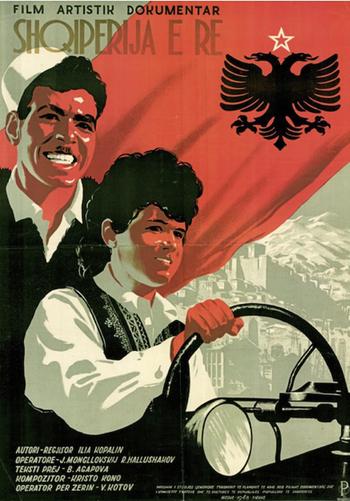
The other important distinction here is that compared to Skanderbeg, Kopalin's genre allowed for greater Albanian involvement. Local filmmakers did not yet have the capacity to produce full-length feature films. Documentaries, however, were smaller investments, and some Albanian authors had experience with shorts.Footnote 57 Novaia Albaniia intentionally highlighted this local agency. The poster depicted two beaming local subjects wearing traditional costumes and radiating the redness of the country's flag (see Figure 2, below). It also featured translations from authors Llazar Siliqi and Fatmir Gjata. Stefanaq Pollo served as narrator of the text by Stalin Prize winner Boris Agapov. All three Albanians studied in Moscow.Footnote 58 The Soviet director collaborated again with Siliqi, who authored the text of Albaniia and the screenplay for Albaniia, tsveti! Footnote 59 Albanian composers supplied the score. Importantly, another Moscow-trained filmmaker, Endri Keko, who emerged as a central figure of the national film industry, worked on several projects with Kopalin.Footnote 60 In short, collaboration grew over time and across many technical aspects of filmmaking. As the Soviet director toured the country to document its geography—from highland peaks to the birthplace of the party leader in the stone city of Gjirokastër—so did his documentaries, by way of mobile projectors.Footnote 61
The New Albania: Albanian-language poster for Il΄ia Kopalin's Novaia Albaniia (1948). Courtesy of Arkivi Qendror Shtetëror i Filmit. With thanks to Iris Elezi.

Compared to Kopalin's earlier works, Albaniia, tsveti! marks a shift in tone. By this point, there had been a decade of construction work on the basis of Soviet material assistance. The focus is not so heavy on the past, but on the championing of a socialist present. The film opens with a sequence celebrating national peculiarities: a man plays the lahuta, the highlander's musical instrument and the mechanism, viewers are told, through which legends have been passed on from ancient times. In a twist, Kopalin and Keko use footage from Yutkevich's Skanderbeg—the genres suddenly intertwined—to underline the idea of past resistance to foreign invaders. We see Akaki Khorava furiously riding his horse in the face of Ottoman armies that are actually Soviet extras. Such scenes from the past are fleeting, however. Albaniia, tsveti! is fast-paced, almost in a rush. Sequences give the impression of movement—birds migrating, bullets flying during anti-Nazi campaigns, partisan troops marching—as well as progress: socialism as motion.
This sense of a forward movement is heightened by the camera's shifts. It travels around the country, counting the decade's achievements: new industrial towns like Memaliaj and Cërrik; East German engineers helping with the construction of a copper processing plant in the remote locality of Kurbnesh; oil refineries staffed with Soviet-trained cadres. The harbor in Durrës, where Soviet ships unload their cargo, emerges as a point of contact with the expansive socialist world. Albania was once isolated, the narrator offers, but it is no longer so. Then, the camera leaves the continent entirely, moving to New York. At the United Nations, the country now has a seat (since 1955) and a say in international affairs. Tirana and Moscow may be thousands of miles apart, but “the silver bird” (a shot of an airplane) brings far-flung people closer together. Once, poverty-stricken Albanians would leave their country in hopes of making a meager living under capitalism, in foreign soil (në dhe të huaj). The pain inflicted by economic migration, viewers learn, produced a distinct genre of mournful songs (këngë kurbeti). The film depicts a snippet of such a song delivered by a group of women peering at the sea.
Borne out of despair, the old mobility of kurbet appears distinct from the mobility of socialism, the sign of a distinct modernity. Youths are shown on an upward move, too. A young peasant man has managed to become an engineer. A peasant girl plans to become a teacher. In the city, where these youths study, they attend evening dances. The camera then travels to the villages where these students are from. The film mixes modern elements with scenes of traditional dances, the narrator reminding viewers that in older times, poor girls would have been sold at an early age to a future husband. How could they marry someone they barely knew? Would they be able to make a living? Under socialism, “women do not need to ask such questions any longer.” Young couples now enjoy employment, and they can afford to go on vacation. They bring to life healthy, happy children. Still, dangers lurk in the shadows. In an unsubtle juxtaposition, the film cuts from images of children sleeping peacefully to shots of airplanes ready to defend the skies from sudden danger. Soldiers stand guard.
Albania's socialist present is one of mobility and an unprecedented sense of openness. But it is not borderless, Kopalin and Keko remind viewers. The camera travels once more, this time to Moscow, where an art exhibit shows works from different socialist countries, including contemporary Albanian socialist realism. Inevitably, the show features a sculpture of the omnipresent Skanderbeg, crafted by Odhise Paskali. Then, triumphantly, it cuts to Khrushchev's visit to Tirana in May 1959. “All of Albania pulsates like one heart,” the narrator declares. The two party leaders are shown giving speeches, Hoxha passionately asserting loyalty to the principles of Marxism-Leninism in front of the powerful guest. Chanting crowds fill the city's streets: the climax of a Sovietized Albania.
The Story Behind the Camera
Nikita Khrushchev's visit in 1959, however, was not exactly the electrifying success documented in Albaniia, tsveti! Signs of trouble had surfaced earlier, shortly after Stalin's death. One reason for the discord was Khrushchev's pursuit of a rapprochement with Yugoslavia. The Soviet leader also urged his Albanian counterparts to mend relations with Belgrade. For the leadership of the Party of Labor, however, a similar rapprochement was out of the question. Hoxha and his inferiors paid lip service to de-Stalinization, but there was no rehabilitation of political prisoners. On the contrary, their ranks kept growing. Additionally, the uprising in Budapest in the fall of 1956, and the Soviet handling of the crisis, further alienated the Albanian side. When Khrushchev finally made it to Tirana in 1959, the public speeches were exalted. But closed-door conversations betrayed tension. Before his visit, the Soviet party boss had warned that he did not wish Yugoslavia to be brought up, infuriating the hosts.Footnote 62
Albanian higher-ups kept asking Khrushchev for more loans, even as earlier loans had gone unpaid. They were adamant to build heavy industries, but Khrushchev thought that the small country might best serve the socialist bloc as an agricultural supplier.Footnote 63 A believer in an international distribution of socialist labor, the Soviet chief did not share the security anxieties of Hoxha and his circle, who obsessed over building a self-sustaining economy, and who were consumed by the idea of being surrounding by enemies. Nevertheless, for all his reservations, Hoxha had no choice but to continue to rely on Moscow. When Khrushchev had delivered his “secret speech” in 1956, there had been grumbling among mid-level apparatchiks, as well as eastern bloc-trained students, who had hoped that some reform might be imminent. Instead, Hoxha presided over a clampdown. Three years later, Khrushchev's visit was an external boost, akin, in the words of the son of a top-level official, to “an emperor coming to town.”Footnote 64
As Sino-Soviet relations took a downturn in the summer of 1960, these earlier frustrations with Khrushchev resurfaced. Trying to discipline the Chinese, Soviet officials also attempted to get the Albanian party to fall in line. At first, Hoxha cunningly avoided coming out against either party. But neither did he back down when pressured by the Kremlin. For their part, Chinese party functionaries were pleased that Albania supported the Chinese criticisms directed at Soviet policies. Mao deemed that de-Stalinization had been a mistake, and the anti-Yugoslav (and anti-revisionist) rhetoric of the Chinese was warmly received in Tirana. This anti-Soviet turn on opposite sides of the socialist world brought the Albanian and Chinese parties closer together. When Moscow retaliated in 1961, withdrawing Soviet advisers and specialists, Beijing agreed to step in and supply grain and, eventually, factories.
High-level sources provide one angle into the Sino-Soviet rift as political history. But appreciating the social implications of this development requires looking beyond Central Committees, as crucial as they were. In a place like Albania, for example, thousands of people owed their careers to Soviet credentials, their knowledge of Russian, and their professional contacts with the “people's democracies.” Many thousands more had attended meeting after meeting, film screening after film screening, where they had heard ad nauseam how the friendship with Moscow was eternal. The friendship now seemed lifeless, raising existential questions about the future. For others still, as we will see, the split seemed like an opportunity for different kinds of alignments: perhaps, eventually, more cultural interactions with the west? In the 1950s, Soviet directors and Albanian propagandists had celebrated a small country's aspiring integration into a socialist world. Now, party directives insisted that Albania would continue to uphold the legacy of Marxism-Leninism—against Moscow.
This required remapping the socialist world, without the Soviets at the center. When the Albanian leadership had embraced Stalinism in the 1940s, official decrees had banned Yugoslav literature. In the early 1960s, however, there was no analogous ban on Soviet books and films. On the contrary, propagandists insisted that it was the post-Stalin revisionism that they rejected, not the Soviet Union as a form of a socialist civilization. Therefore, friendship propaganda with the Soviet Union continued for a few years, unreciprocated. The Friendship Society's journal kept reviewing the latest films from Tajikistan, Lithuania, and Uzbekistan.Footnote 65 Even if they had sought to abolish all Soviet cultural influences at once, it is not clear how government officials would have managed to do it. Many of the country's emerging technical elites had graduated from universities in Moscow and Prague. There was a shortage of professional actors and screenwriters. The Soviet Union had furnished the majority of Albania's imported films. Who else could fill the gap?Footnote 66
When it came to money, factories, and weapons, authorities sought assurances in China. Beijing supplied scholarships for local youths who could no longer receive training in Moscow, in addition to scores of Chinese advisers. Both countries began to exchange cultural delegations more frequently.Footnote 67 But for all the talk of Sino-Albanian brotherhood, Chinese cultural goods could hardly displace Soviet ones.Footnote 68 For one thing, China was distant, its language unfamiliar. This posed logistical problems, from hurdles of transportation to the tricky problem of translation. Officials and diplomats tasked with gathering Chinese films in the 1960s fretted about this cultural distance, carefully framing it in terms of “comprehensibility.” When representatives watched the Chinese film Daji he ta de fuqin (Daji and her Fathers, 1961), for example, they deemed it to have “a healthy educational content.” But another Chinese film on resistance against Japan seemed, as they put it, “difficult to understand.”Footnote 69
Official sources do not allow deeper access into the thinking of intermediaries who made these calls. The precise chain of decision-making cannot always be traced through archival records. Sources do reveal, however, that narrowing opportunities for borrowing after the Sino-Soviet split also raised the political stakes in mapping cross-border exchange. A “healthy educational content” in a Chinese film was politically expedient, but a Chinese film that nobody would want to watch might also turn into a liability. Were there other possibilities? It was possible to expand cultural contacts with North Korea and Vietnam.Footnote 70 Yet these countries could hardly replace the Soviet cultural footprint. As a result, the 1960s reorientation from the Soviet Union, in Albania as in China, happened gradually. Soviet classics continued to circulate for a number of years, with the important distinction that “revisionism” became an increasingly important filter in deciding what aspects of Soviet culture to allow inside national borders.
Another possibility was to purchase films from the capitalist west. The problem here was not simply ideological, though some bureaucrats fretted about western films glorifying “pornography,” “murder,” and a capitalist way of life.Footnote 71 A more immediate concern was the fact that western films, especially the latest productions, cost a lot of money (and required hard currency). Administrators went on state-sponsored pilgrimages to Rome and Paris looking for affordable options. Just as they screened Chinese films for “comprehensibility,” officials surveyed French and Italian postwar cinema for “progressive” themes. During one such outing, they suggested picking up a film about Anne Frank, René Clément's The Battle of the Rails (1946), Babette Goes to War (1959), and a film about the indigenous people of New Guinea. They also recommended purchasing Federico Fellini's Nights of Cabiria (1957), with the justification that the movie illustrated the “state of women in capitalist society.” Francesco Rosi's Salvatore Giuliano (1962) was deemed worthy for showcasing the “Italian mafia and its connections to government circles.” The Italian rural-themed Un ettaro di cielo (1958) and the newer production The Battle of Algiers (1966) also made the list.Footnote 72
A picture that emerges of the 1960s, then, is one of anxiety, particularly in matters of planning and the economy, but also of new possibilities for national assertion within a rearranged socialist world. Just as China helped a small country stand up to the mighty Soviet Union, it also turned into a massive vehicle for projecting Albanian militancy to millions abroad.
Bringing War to China
Considering that the first full-length domestic feature, Tana—the story of a romance set against the heady years of collectivization—only premiered in 1958, Albanian film production in the 1960s seems fast-paced.Footnote 73 These films also showed up in Chinese theaters, given the new geopolitical circumstances, dubbed and promoted as the achievements of a friendly state. They included the now-classic Debatik (1961, translated into Chinese as Tamen ye zai zhandou), Detyrë e posaçme (1963), Toka jonë (1964), Vitet e para (1965), Komisari i dritës (1966), Oshëtimë në bregdet (1966), Ngadhnjim mbi vdekjen (1967), Horizonte të hapura (1968), Njësiti gueril (1969), and Plagë të vjetra (1969). The predominant subject was the National Liberation War, with several titles highlighting acts of anti-fascist resistance. Another theme was the construction of socialism, and here too, screenplays centered on struggles—generational conflicts, the battle against backwardness (defined, for example, as the state-led campaign to eradicate blood feuds), self-sacrifice for the collective good, and mass mobilization.
The Sino-Soviet split, and especially China's own internal struggles in the 1960s, endowed such stories of struggle with symbolic weight. The peak of the Great Proletarian Cultural Revolution (1966–1969) was a high point in Sino-Albanian relations. Mao Zedong launched a vicious campaign aimed at purging the party ranks, attacking the country's elites, replacing “corrupt” officials with more committed ones, and mobilizing China's youths in a revolutionary spirit through Red Guard organizations. At first, these developments disturbed the Albanian party leader, who worried that Mao might lose his grip on power. After reassurances from Beijing, however, the Albanian side heartily supported Mao's campaign in 1967. China's withdrawal from the outside world incidentally helped make the farflung Balkan country politically and culturally relevant. Albanian delegations were allowed privileged access to China, and Mao hailed the Party of Labor as a beacon of Marxism-Leninism. In light of these developments, film screenings turned into an important vehicle by which Chinese individuals came to discover a distant Albanian reality.
Chinese propagandists hailed Albania as revolutionary, and its cinema as exemplary and “progressive.”Footnote 74 But in thinking about the reception of these films, as was the case with the earlier reception of Soviet productions, it is important to keep in mind the effect of limited competition. At the height of the Cultural Revolution, “revisionist” films became taboo in China. An additional parallel development in both countries—an unplanned commonality—was the late development of television, which helped turn some film screenings into popular events.Footnote 75 In this context, 1960s Albanian films projected an ideologically-acceptable worldview. But equally important is the fact that Albanian films were also opportunities for Chinese viewers to access images from Europe. They “provided Chinese people with an important window,” as two authors have put it, “through which to understand the Western world.”Footnote 76
In 1960s Albania, “the western world” stood for capitalism, of course. Officials would have recoiled at the idea that Albanian cinema was somehow emblematic “of the west.” It turned out, however, that Albanian cinematography could also constitute a kind of “ersatz west” under Mao, just like Soviet cinematography in 1950s Albania had served to project a national vision within an internationalist frame. With the seal of official approval, Chinese viewers saw scenes that they might consider to be European modes of living: guitar playing and singing by youthful agitators fighting the Nazis, the dresses of female heroines, and crowded city cafés in the background of the wartime occupation. Socialist states endowed films with political importance. Audiences, in turn, promptly scrutinized them for clues about “the other side.” Chinese viewers thus discovered glimpses of the west in a resistance-themed story like Ngadhnjim mbi vdekjen, which was set during the German occupation and centered on the heroism of two youthful and fearless female characters. On the other side of the globe, Albanian youths looked for glimpses of American life in the Chinese documentary Shijie renmin gongdi (The Enemy of All People), which uncharacteristically attracted a large number of viewers, especially youths.Footnote 77
In the 1950s, Soviet filmmakers had mined the national peculiarities of Albania, within an understanding that socialism was the formula for ultimately giving voice to them. A decade later, those national peculiarities allowed Chinese viewers to look through the scaffolding of socialist realism. As intriguing as such national differences might have seemed, however, we should also consider the power of familiarity. What subjects in the 1960s were easier to understand than war, permanent struggle, and self-sacrifice? These were precisely the themes on offer in Albanian screenplays. Founded by way of Soviet technology and training, the country's film studio projected a specific vision: the notion of defiance. A key difference with earlier Soviet cultural exchanges was that Albania's national character was no longer chiefly articulated through the category of backwardness and aspiration, but through ideas of anti-imperialism and revolutionary zeal.
By the second half of the 1960s, a distinct cinematographic space emerged out of concerns about cultural contamination, party-backed Sino-Albanian cultural exchanges, and the Albanian regime's desire to produce national narratives through film. Whereas Albanian films later found an unexpected life in China, city audiences at home continued to watch older Soviet pictures and a limited range of western titles.Footnote 78 Tirana's moviegoers, for example, were watching Thaw-era films like Two Captains (1957) and Pavel Korchagin (1956), but also older ones like The Story of a Real Man (1948). Some of these had been shown many times before—it was as if Soviet time had stood still in Tirana. Contemporary Chinese films kept circulating too, but they were less popular. A survey of theaters in Tirana found that Soviet films attracted considerably larger audiences than Chinese ones. In fact, almost no Chinese film managed to attract the daily planned target of viewership for the theater in which it was shown. Furthermore, attendance numbers for Soviet films paled in comparison to figures for western ones, with a wildly popular title being The 300 Spartans from 1962.Footnote 79
Why did Chinese films not attract more viewers? One official explained that Chinese directors favored “a manner that our spectator has not gotten used to yet.”Footnote 80 The feeling appears to have been mutual. Among Chinese film-goers a saying reportedly went like this: “Vietnamese movies are about weapons, North Korean movies are funny and tragic, Romanian movies are romantic, and Albanian movies are utterly confusing.”Footnote 81 But it is important to keep in mind that films, whether as sources of confusion or objects of curiosity, were only one facet of a much broader cultural traffic.Footnote 82 To try to make sense of this traffic was to begin to map the cultural borders of non-Soviet socialism, a process bolstered by party-states and national film agencies but not fully commandeered by them.
The Global and the National in Socialism
When was the birthday of Albanian national cinema? The film studio “Shqipëria e Re” was an important marker, but it also stood as an inconvenient reminder of extensive Soviet influence. Perhaps the origins of a national cinema could be dated back to the nationalization of film theaters in 1947 and the modest newsreels that followed. What about earlier newsreels produced by the fascist-era Istituto Luce?Footnote 83 Was a feature film like Tana more national than Yutkevich's Skanderbeg or the collaborations with Kopalin? The Sino-Soviet split rendered such questions ideologically significant. For a regime caught up in some of the defining early battles of a Cold War world, the problem of origin required constant revision. “Our new cinematography is an achievement of our party,” one announcement declared, locating the origins of Albanian cinematography in the second half of the 1940s, thus establishing a chronological lineage not bound by collaboration with the Soviet Union.Footnote 84
Nationalizing this history of cross-border contacts meant flattening, in retrospect, the geography of socialism, thinning the chronology of circulation, and narrowing the confines of postwar internationalism. Of course, the party-state had specific instruments at its disposal for reordering the past, for remixing the cultural precedents. Managers of the so-called komision i vizionimit could order films out of circulation. Since films were a part of the central plan, bureaucrats controlled what domestic screenplays would see the light of day and what western productions might need to be censored.Footnote 85 In a country where fabricated political crimes continued to produce prison sentences, offending directors and actors could be banished, as it later happened with some of the protagonists of Yutkevich's film. In this context, Skanderbeg, which had once helped frame the national heritage, now became a reminder of an inconveniently-tangled past. Similarly, the co-productions with Kopalin fell out of circulation, only to be resurrected half a century later, gaining new life as socialist-era curiosities on YouTube.
When capturing this socialist globalism, a conceptual frame built on a hard distinction between isolation and openness does not work well. Cinematographic exchanges with the Soviet Union in the 1950s could heighten the sense of geographic isolation, for example, just as the self-chosen isolation of Mao's China during the Cultural Revolution created the potential for the largest audience Albanian films ever had. There was no inevitability to some forms of openness, no guarantee that some flows would lead to other kinds of contact, or that they would continue at all. Neither were political breaks neatly aligned with cultural traffic: just as older Soviet films continued to circulate in Albanian theaters after 1961, so Albanian films continued to circulate in China even as the two Communist Parties privately quarreled in the early 1970s on account of Richard Nixon's visit to Beijing. A global telling of the Cold War might discipline the story around political watersheds—1956, 1961, 1972—but it also needs to account for the fact that these obscure the cultural continuity that made the imagination of a socialist future possible.
Interpretations of kombëtarja (the national) in the postwar period, finally, are deficient when they ignore the international staging made possible by anti-fascism at first and, later on, socialism—both in unity and in disunity. These days, Albanian-language newspapers continue to “discover” postwar films, writing about them as if they are the strange relics of a vanished civilization. In fact, precisely because socialist globalism was far-reaching and not easily contained by states, it created emotional attachments that transcended official directives and outlived the Cold War.Footnote 86 Chinese individuals of a certain generation not only remember Albanian films, but, as one protagonist recently put it, they “can sing some of the songs from those films, too.”Footnote 87