On the occasion of the celebration of its 60th anniversary, the Indian Sociological Society (ISS) has published a volume series entitled Readings in Indian Sociology. Each volume is a collection of articles chosen from the Sociological Bulletin (the ISS official journal) between 1952 and 2011. Each volume has a different guest editor whose main responsibility was to select the articles and write an original and comprehensive introduction. Sociologists familiar with Indian sociology may remember that the ISS has already published two series of seven volumes in the recent past, both based on the same source material. However, if only by its scale, this 2014 publication appears as an unprecedented editorial effort with 10 volumes, 137 authors, 156 articles, and 3,748 pages of text.
In his series note, Ishwar Modi, iss President and main coordinator of the series, expresses the hope that “having gone through these volumes the students and researchers of sociology would probably be able to feel and say now: ‘We will be able to look much farther away as we are standing on the shoulder of the Giants’” (vol. I, p. xiii). This paraphrase of Isaac Newton's famous formulaFootnote 1 highlights the primary scientific and institutional vocation of the series: not so much to increase the international visibility of the Indian sociological community as to contribute to the building of a disciplinary memory. Sociologists and historians of science have demonstrated that book collections or journals—such as l'Année Sociologique for the Durkheimian school in late 19th century France —are a powerful means for establishing professionalisation and institutionalisation.
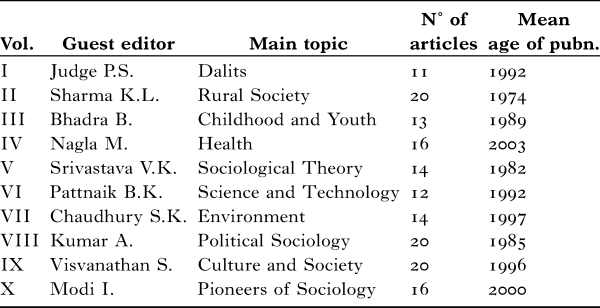
Before discussing three general aspects of this volume series, I would first like to describe the content of these ten volumes. The two tables below provide some basic information.
Table 1 shows significant differences between the volumes: some are rather short (for example, volumes I or VI with approximately 10 articles and a total of 200 pages each) while others are much more substantial (for example, volumes II, VIII or IX with 20 articles and almost 400 pages each). These differences are related to the relative freedom enjoyed by the guest editors. More deeply they reflect the unequal degree of attention (the “foci of attention”) of the Indian sociological community. Some topics remain under-researched domains even today. For example, the editor of volume III on Childhood observes that it “it was quite difficult to find suitable, meaningful articles on childhood and youth” (p. xx). The editor of volume VI on the Environment met with the same problem. In 60 years of publication, only 20 articles of the Sociological Bulletin have been devoted to the topic of the environment. Conversely, the unequal mean ages of publication show that certain topics are associated with well-established research programmes. It is no surprise to observe that volume II devoted to Rural Society has the oldest mean age of publication for the selected articles (1974). Historically the first sociological studies in India, in the 1950s and 1960s, were precisely monographic studies of Indian villages. Therefore the values of table 1 may be interpreted, at least to a certain extent, as indicators of the varying degrees of novelty and collective interest.
Editors, main topics, number of articles, and mean age of publication for the selected articles

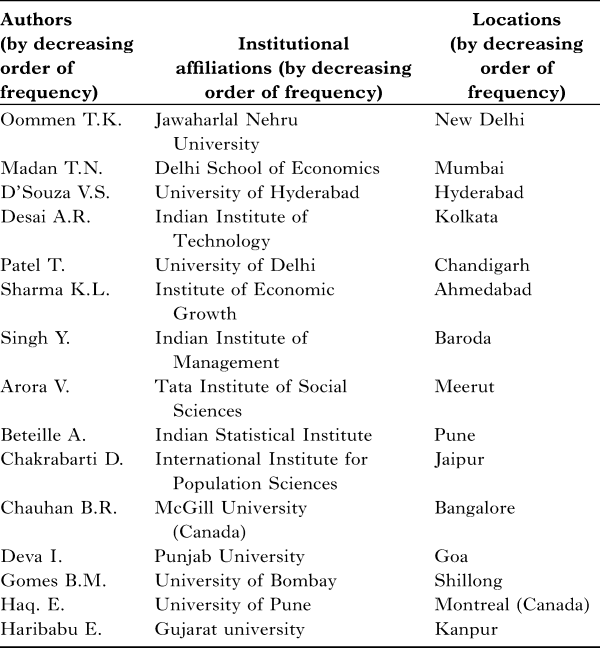
As this 2014 series has an explicit institutional aim, it makes visible one of the possible maps of sociology in India. Table 2 shows, by decreasing order of frequency, the 15 main authors, institutional affiliations and geographical locations. The volume series contains, for example, 5 articles from Tharailath Koshy Oommen, Professor Emeritus at the Centre for the Study of Social Systems (Jawaharlal Nehru University); 4 articles from Triloki Nath Madan, Professor Emeritus of Sociology at the Institute of Economic Growth (University of Delhi); and 3 articles from Victor S. D'Souza, Professor of Sociology at the Punjab University, etc. The selected authors are most frequently affiliated to Jawaharlal Nehru University (20), the Delhi School of Economics (10), and the University of Hyderabad (8), and are located mainly in New Delhi (53), Mumbai (18), Hyderabad (9) or Kolkata (7). As shown in column 3 of table 2, the volume series has a strong national anchoring: most of the articles reproduced were written by sociologists living and working in India. There are however a few exceptions with some authors or collaborators located in Canada (3 articles), the US (3 articles) or Israel (1 article). Those seeking to better know the Indian sociological community could find this volume series a valuable starting point for their intellectual journey.
Main authors, institutional affiliations, and locations represented in the volume series (n = 15)
Each of the 10 volumes provides an opportunity to read rare articles as several issues of the Sociological Bulletin are now out of printFootnote 2. They also provide access to new material such as the introductions written on the occasion of this ISS publication. It is however obvious that these volumes could have benefited from a stronger editorial support from SAGE. This “treasure trove” of Indian thinking in sociology, in the words of I. Modi, contains small but irritating editorial flaws. A careful editing of the original texts produced for this 2014 edition (foreword, preface, introduction) would have eliminated many of the remaining typographical errors and spelling mistakes (see the reference to “the discipline of socialogy”, vol. VI , p. xxii) or factual errors. For example, it is slightly surprising to see the guest editor of volume II announcing in his introduction 24 articles divided into 5 sections when the final volume contains only 20 articles.
With regard to their scientific quality, the texts opening each volume may also be considered as too heterogeneous. Many of these introductions provide an undeniable intellectual added value to the original material, but some of the guest editors have written a state-of-the art paper without really discussing the content of the articles selected (vol. V). Others have chosen to focus on their own contributions to the field (vol. VI), while others have limited themselves to a brief summary of the articles selected (vol. IX), etc. Some minimal guidelines would have been useful in guaranteeing the scientific unity of the volume series. Especially since the guest editors apparently faced significant time constraints in ensuring that the series could be assembled in time for the 39thAll India Sociological Conference in Mysore in December 2013. Finally, the logic underlying the editorial progression of the series remains unclear. Why start with the Sociology of Dalits (vol. I) and finish with the Pioneers of Sociology (vol. X) rather than the other way around? It seems at least as logical to start with the forerunners of sociology in the 1920s and to finish with the research on Dalits that gained momentum 70 years later, in the 1990s. As the volume series is not intended to be read in a linear manner (one volume after the other) there are of course multiple possibilities. However, the reasons (sociological? social? political?) for the editorial progression selected by the main coordinator could be more explicit.
Given the size and wealth of the series, this review is not the appropriate vehicle for a detailed account of the volumes and their content. I will, therefore, limit myself to three general commentaries about 1) some of their main historical and theoretical features, 2) the nature of the empirical areas selected, and 3) the intellectual dialogue between Indian and Western sociological communities.
1) Although theoretically concentrated in volumes V (Sociological Theory) and X (Pioneers of Sociology), all of the volumes make significant contributions to the origins and general theoretical orientations of the Indian sociological community. Volume VIII on Political Sociology, for example, seems at least as important as volume V in understanding the key concepts and theories used to analyse Indian society and its dynamics. Four “giants” are extensively discussed in the volumes: Govind Sadashiv Ghurye (1893–1983), Radhakamal Mukerjee (1889-1968), Dhurjati Prasad Mukerji (1894–1961) and Mysore Narasimhachar Srinivas (1916-1999). Most of the 15 authors listed in table 2 are actually former students of these four sociologists. While the four giants that shaped Indian sociology between the 1920s and the 1980s shared the same general interest in the study of caste, family, religion, values, village, social change, etc., their theoretical orientations were quite different. For Ghurye, appointed in 1924 as Head of the Department of Sociology in Mumbai UniversityFootnote 3, there was no clear distinction between sociology and social anthropology: history, Indology, evolutionism and civilisation were the fundamental features of his approach. Professor of Economics and Sociology and Vice-Chancellor of the University of Lucknow, Radhakamal Mukerjee developed a form of social ecology deliberately freed from economic constraints. Considered as a forerunner of environmental sociology (cf. vol. VII), Mukerjee stressed the necessary equilibrium between naturally given environments and socio-culture organisations, and proposed alternative models to Western patterns of economic growth and industrialisation. Professor at the University of Lucknow (at the invitation of Radhakamal Mukerjee) Dhurjati Prasad Mukerji considered himself as a “Marxologist”. He adopted historical and dialectical modes of sociological analysis and developed an Indianised version of the Marxian sociological approach. A former student of Ghurye’s, Mysore Narasimhachar Srinivas served in various institutions from the University of Delhi to the National Institute of Advanced Studies in Bangalore. As was the case of his mentor, Srinivas refused to separate sociology from social anthropology, and strongly advocated for ethnographic research based on participant observation and a clear distinction between “book view” and “field view”. Influenced by British social anthropology, Srinivas elaborated the notion of “Sanskritisation” to account for social mobility within the framework of caste and Hinduism.
It should be clear by now: as in Europe or in the United States during the same period, there is no unified theoretical framework for early Indian sociology. There is in fact a polyparadigmatic basis that gave birth, between the 1950s and 1980s, to various theoretical attempts at sociological structuralism, structuro-fonctionalism, functionalism, Marxism or neo-Marxism. This absence of theoretical unity may be interpreted as a weakness. For Andre Beteille, a former student of Srinivas’, “one might say at best that there are several and diverse traditions, with little or no agreement on their relative merits, so that one has to pick one's way through a thicket of terms, concepts, techniques and procedures, and in the end rely mainly on improvization” (vol. V, p. 11). In his introduction to volume V, Vinay Kumar Srivastava also emphasises the traditional lack of interest of Indian sociologists for theoretical debate. And in fact Srivastava himself tends to mix the discussion of sociological theory with long developments on the history of sociological ideas or the philosophy of social sciences.
2) This lack of interest for sociological theory leads us to our second general commentary. This volume series is interesting at least as much from the perspective of well-established researched domains (political sociology, rural society, culture and society) as from the perspective of under-researched domains: sociological theory but also the sociology of Dalits, health, the environment, childhood, or science and technology. There is here an intellectual enigma to be resolved: why have these topics been systematically ignored by Indian sociologists—at least until the 1980s or the 1990s? Obviously it seems difficult to interpret this deliberate omission as the consequence of their secondary social importance. As highlighted by Bhula Bhadra, the shift from “son preference” to “get rid of girls” is one of the worst contemporary social crises faced by India: “The indiscriminate killing of girl children beginning with murdering of female foetuses is a feature of our lived experiences of daily life” (vol. III, p. xl). As noted also by Paramjit S. Judge (Vol. II, p. xxxiii), and according to the latest Census of India (2011), Scheduled Castes make up approximately 16% of the total population. They obviously represent a huge population within a huge country and, while it could reasonably be argued that untouchability has been reduced in urban environments, rural India is still in transition in this respect. Concerning health and illness, Madhu Nagla notes that there are only 40 institutions devoted to mental disease in India. At the same time “the National Institute of Mental Health and Neuro Sciences in Bangalore estimated that two crore [20 million] Indians need help for serious mental disorder, while a further five crore [50 million] suffer from mental illness not considered very serious. These figures do not include neurological age-related progressive disorders such as Alzheimer's and Parkinson's” (vol. IV, p. xxxix). Finally, as noted by Susan K. Chaudhury, in modern India “development is only achieved at the cost of continued devastation of environment. Thus modern industrial society is suffering from [high] levels of alienation and anomy” (vol. VII, p. xxxix).
Where does this lack of collective interest for “hot” topics come from? It is possible to distinguish at least four types of reasons. First, political reasons: if the sociology of the environment has been so slow to appear in India it is because ecological concern has emerged in opposition to political development priorities. As the nation’s priority after Independence was to meet the basic needs of its citizens, environmental thinking was perceived of as “anti-development” and “anti-progressist”. In other words, it was seen as a Western luxury incompatible with the Indian national policy. Second, organisational reasons: if the sociology of health and health care has slowly emerged in India it is partly the consequence of the late “professionalisation of health and healthcare specialists, and the increasing concern with preventive medicine, which has involved sociologists teaching health related courses to students training in these fields in the past” (vol. IV, p. xxv). Third, social reasons: if some sociologists have continued to be reluctant to consider Dalits as a central sociological issue (Ghurye, for example, provides a very limited coverage of 40 pages to the Scheduled Castes) it is surely linked to the fact that most of them belong to the upper castes. Hence, according to Oommen, there is a cognitive blackout in the Indian social sciences regarding the Dalits or a strong tendency to suggest that, in the future, Dalits will change “their way of life in favour of the lifestyles of caste Hindus” (vol. II, p. 15). Finally, cultural reasons: for some, if sociologists have failed to perceive the centrality of certain topics, and if social theory is still a deserted and dis-unified landscape, it is because the founding fathers of the discipline have adopted in an unthinking manner a Western framework of inquiry and analysis that is altogether inappropriate to Indian social reality.
3) This last type of reason brings me to my last general point. This volume series clearly shows that Indian sociologists are no different from other scientists: they have been exposed to the same kind of general problems. This country shares with other formerly colonized countries a struggle to establish not only political independence, but also a national scientific traditionFootnote 4. In his article on the emergence of the Indian scientific community, the sociologist of science Venni V. Krishna (vol. VI, chap. 3) notes that, while in the late 19th century a small group of Western settler scientists worked towards the professionalisation of science in India, others were basically the “gate keepers” of colonial science, controlling and regulating research strategies to serve colonial ends. After political liberation in 1947, the political and economic strategies of self-reliance shaped the organisation of science and technology and the goal orientation of scientific communities. And the progressive elaboration of a national scientific tradition has been regularly associated to with the promotion of a form of scientific autonomy. In sociology in particular, the process of “indigenisation” since the 1980s shows that researchers may have “good reasons” for cultivating forms of theoretical and conceptual autonomy rather than adopting in an unthinking manner the priorities of their Western colleagues. However this “indigenisation” should not lead sociology to radical forms of scientific nationalism, conceptual blindness or intellectual communitarianism. Many research technologies or methods developed to analyse social stratification, mobility, relational structure, etc. devised outside India have an obvious transversal scientific value. It would be foolish to exclude them from the sociologist’s “toolbox” in the name of an emancipation from Western sociology. The discontent with existing approaches and the search for radically new alternatives may have paradoxical consequences. Andre Beteille is right in observing that it could lead “able scholars into extreme forms of the very weaknesses they attack most mercilessly in others” (vol. V, p. 13). Hence the absolute necessity to maintain an open dialogue between Western and Indian sociological communities and to give more collective attention to the changing forms of internationalisation of the sciences.