This article examines factors that might affect the production1
Although we limit the scope of this article to tone production, we have considered the learners' tone perception to the extent that it might affect production (see the Methodology and Discussion sections).

In contrast, English is a stress language in which differences in pitch (as well as amplitude and duration) of emphasized (stressed) versus nonemphasized (unstressed) syllables are important to the rhythm of the language but only rarely important lexically.
Given the centrality of tone in the identification of each word as well as its role in grammatical and pragmatic contrasts, tone accuracy is crucial to being able to understand and speak Vietnamese. Tone is typically difficult to learn for speakers of nontonal Indo-European languages.2
A tone-language background can facilitate the acquisition of lexical accents in a target language. For example, in a study by Eliasson (1997), Chinese speakers could distinguish and produce Swedish word accents better than Hindi speakers.
The premise underlying the current study is that variations in L2 learners' tone production are not random but rule-governed. According to interlanguage theory, the observable output might result from a learner's attempt to produce a target language norm while using both the system of the L2 and the structures of the first language (L1) (Selinker, 1972). Thus, an American English speaker brings knowledge from English, among other things, to the task of learning the Vietnamese language system and, in the process, builds an interim interlanguage system. It is expected that the rules of such an interlanguage system are in part a function of factors that affect the learner's learning process and, to that extent, can be used to create teaching proposals that might enhance the learning processes.
Studies on interlanguage phonology have shown that a learner's pronunciation accuracy can be influenced by the learner's L1 (e.g., Archibald, 1992; Hancin-Bhatt, 2000; Kim & Jung, 1998; Smith, 1997), task or style variation (e.g., Beebe, 1987; Dickerson & Dickerson, 1977; Sato, 1985; Tarone, 1979, 1985), and universal processes such as markedness3
We adopt the Prague School's notion of markedness: Unmarked items are more frequent in language inventories, have fewer restrictions on their distribution, and occur with greater frequency in a given language (Jakobson, 1963).
THE PHONETICS AND PHONOLOGY OF TONE
Tone and Other Phonetic Features
The phonetic parameters that characterize tones include pitch, duration, voice quality, and contour. Among these, pitch (both pitch level and pitch contour) is usually considered the primary feature, even though voice quality, such as laryngeal features (breathiness and creakiness), is also important (Pham, 2003). One way to characterize a tone is to measure its pitch at the beginning point, the middle point (when necessary), and the end point. For example, if we convert pitch (measured in hertz) into a five-level pitch range, with 5 being the highest pitch, Mandarin Chinese has a high-level tone of a 5-5 shape, a rising tone of a 3-5 shape, a falling tone of a 5-1 shape, and a falling-rising tone of a 2-1-4 shape (Chao, 1948). Among the types of tones, crosslinguistic evidence suggests that contour tones are more marked than level tones, and complex contour tones are more marked than simple contour tones (Cheng, 1973; Yip, 2002; Zhang, 2000, 2001). The markedness ranking of tones is illustrated in (2).

Additionally, Cheng reported that languages often have more falling tones than rising tones. This might be because falling tones can be produced faster than rising tones (because an upward pitch change takes longer than a downward pitch change); therefore, they make better tonal contrasts and are perceptually more salient (e.g., Ohala, 1978).
Tones have been shown to be affected by certain types of segments in the same syllable and by adjacent elements in the same phrase. Historical evidence shows that higher vowels often give rise to higher tones (Cheung, 1973, cited in Hombert, 1978; Pulleyblank, 1970, 1971) and high vowels in nontonal languages have an intrinsically higher pitch than low vowels (Black, 1949; House & Fairbanks, 1953; Kim, 1968; Lehiste, 1970; Petersen, 1976; Peterson & Barney, 1952). Prevocalic voiceless stops have been shown to cause a higher pitch and voiced stops have been shown to cause a lower pitch in their following vowels in languages as diverse as English and Yoruba (Hombert). Similarly, in diachronic change, it is believed that voiceless stops have led to the development of high tone and voiced stops have led to the development of low tone in their following vowels (e.g., in early Vietnamese; Haudricourt, 1954). Postvocalic consonants, on the other hand, do not seem to influence the pitch of the previous vowels (Hombert).
Tones might also influence neighboring tones. In Vietnamese, acoustic measurements of tones in isolated words and two-word phrases show that the overall pitch height of a tone is influenced by its tonal environment. A preceding high tone causes a high variant of the following tone, and a preceding low tone causes a low variant of the following tone. Tonal interaction is stronger in a progressive direction than in a regressive direction. However, it should be noted that even when tones are affected by the environment, their contour shapes generally remain intact. One exception is that in two-word phrases, the distinction between the level tone and the falling tone is in the overall pitch height rather than the falling contour of the falling tone. Also, in word strings, the falling-rising tone is distinguished from the falling tone not by its rising end but by its lower pitch height and its lowest point. An important point is that the same tone has the same pattern of effect on any tone that follows it. Thus, although tonal overlaps might occur, the native ear can clearly distinguish tones that occur in an identical environment (Han & Kim, 1972).
The position of a tone in a string of syllables might also affect its production. In most African languages and even in nontonal languages, it has been noted that a series of tones in a phrase will downdrift; that is, the tone at the end of the phrase will have a lower pitch than the same tone at the beginning of the phrase (see also Ohala, 1978, and Yip, 2002, for a review). In most Asian languages, tone sandhi (tone change in certain morphosyntactic environments) also occurs. In Vietnamese, however, tone sandhi is found only in lexical reduplications (Nguyen & Ingram, 2006) and thus is more restricted. In sum, tones are sensitive to the height of the nuclear vowels, the voicing of the prevocalic consonants, the tones of surrounding words, and their position in a phrase.
Tone in Vietnamese
Vietnamese (Northern dialect
4This was the dialect of instruction for the participants in this study.
In some analyses, a system of eight tones is adopted in which there are two rising tones and two glottalized falling tones (e.g., Cao, 1998; Hoang, 1986; Pham, 2003). In this study, we adopted a system of six tones because it is transparent to native speakers and is adopted in the teaching of Vietnamese.

,

,

,

, and ngã
6The word for each name bears the tone that it represents.
Tones of the northern Vietnamese dialect

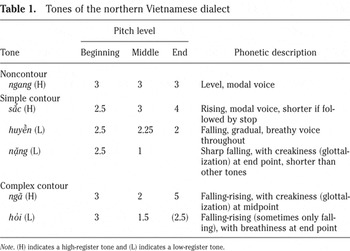
As Table 1 shows, ngang is a noncontoured, high-level tone with modal voice.
7Modal voice is a type of phonation characterized by regular vibrations of the vocal folds. It is the normal state for vowels and sonorants in all languages.

falls gradually and gently with breathy voice throughout the tone.

is a rising simple contour tone with modal voice and is shortened when followed by a final (voiceless) stop. Its beginning point is slightly lower than ngang (and sometimes lower than ngã and

).

, also a simple contour tone, falls more sharply than

and ends with creakiness, which makes it shorter than the other tones.

is a complex contour tone that falls sharply to a level much lower than the lowest point of

. Some speakers do not have a rising final for this tone and, instead, produce it as a deep falling tone with heavy breathiness toward the end. Ngã, the other complex contour tone, falls and then rises, with some creakiness at the midpoint.
The six tones occur with different frequencies in Vietnamese. According to a statistical count by Vo (1997), among words not ending in stops, the order of frequency for the tones, from most to least common, is ngang,

,

,

,

, and ngã. Among words ending in stops,

is more common than

. Based on these data and based on evidence from reduplication and borrowings, Pham (2003) concluded that the markedness ranking of the tones in Vietnamese is as follows (“<” means “less marked than,” and markedness increases from left to right):

This markedness ranking is consistent with crosslinguistic evidence mentioned previously.
Vietnamese Syllables and Phonotactic Constraints on Tones
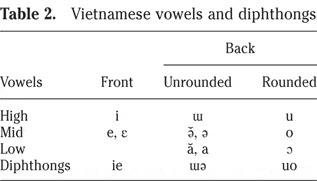
The syllable structure of Vietnamese is quite simple (e.g., Nguyen, 1994): The onset contains an optional consonant; the rhyme consists of an optional prevocalic glide, an obligatory nucleus, and an optional final consonant or glide; and the tone is spread throughout the entire syllable. The initial consonant can be a voiced or voiceless stop or affricate /b, d, t, th, c, k/, a voiced or voiceless fricative

, a nasal

, a liquid /l/, or zero. The prevocalic glide can be either /j/ or /w/, and it occurs with an initial consonant. The nucleus can be any of the 11 vowel monophthongs and 3 diphthongs (vowel combinations that function as phonemic units). The vowels are distinguished phonemically by height, roundness, and length (Table 2). The short vowels are inherently half the length of the other vowels. The three diphthongs are combinations of a high vowel and a mid vowel with the same place of articulation. The final consonant of a syllable can only be a voiceless stop, a nasal, a glide, or zero. The constraints on the final consonant can be formulated as in (4).

Vietnamese vowels and diphthongs

Although tones occur freely with vowels and diphthongs, only

and

can co-occur with voiceless final stops. In this environment, the rising

tone changes to having a sharp rise from the onset to the end point, with a duration of less than 25% of the duration of its variant in other environments. The glottalized falling

tone, which is inherently shorter than the other tones in all environments, remains the same. This phonotactic constraint is presented in (5).

PATTERNS OF TONE PRODUCTION BY AMERICAN LEARNERS
We expect tone production by American learners of Vietnamese to pattern similarly to that of learners of other lexical tonal languages. Given the scarcity of existing research on the acquisition of Vietnamese tones, we will draw largely on the richer literature on the acquisition of a major tone language, Mandarin Chinese, to illuminate our understanding. Studies on Mandarin tone acquisition show that learners' interlanguage is, predictably, strongly influenced by their L1, English (Broselow, Hurtig, & Ringen, 1987; Chen, 2001; Chiang, 1979; White, 1981). First, a major difference is that pitch is lexical (i.e., phonological) in Mandarin (as well as in Vietnamese) but not in English. Second, whereas phonetically there is no major difference between English and Mandarin with respect to phonetic pitch contours (rising vs. falling), the phonetic pitch range of Mandarin is much wider than that found in stressed versus unstressed syllables of English. Because of these phonetic facts in the two languages, American learners of Chinese do not aim high or low enough for the correct tones (White). Third, emphasis in Mandarin is realized through volume (amplitude), not pitch, whereas in English, emphasis correlates with higher pitch as well as with greater amplitude and longer syllable duration. American learners who carry this pitch parameter of English emphasis onto Mandarin will make an error in tone (White). Finally, English intonation also negatively influences the production of Mandarin tones, especially in final positions (Chiang; White; also Broselow et al. on tone perception). Problems with tones have also been attributed to the learner's lack of knowledge about the characteristics of the tones (e.g., Lin, 1985). Regarding types of errors, an acoustic study by Miracle (1989) showed that L2 learners of Mandarin made errors in both tone contour and tone register in equal numbers and that the rising tone showed a slight tendency to be the most problematic.
Similar findings were reported by Nguyen (1999) on errors by English-speaking learners of Vietnamese. Nguyen's observational study showed that with respect to tones, learners often failed to produce their full phonetic correlates (pitch level, duration, glottalization, intensity) and often reduced the correlates to only pitch levels; consequently, their tones were more vulnerable to distortion when produced in sequences. This leads to an interesting question about whether the potential reference to the pitch register of a native speaker who has just spoken in the discourse context might help the learner to stay on the right plateau for tones during a conversational turn. Related to emphasis, Nguyen observed that learners' tones often seemed to be neutralized in nonemphasized positions and were reduced to either rising or falling in emphasized positions. Contrary to White (1981), Nguyen found that in emphasized syllables, learners produced tones either raised up higher with a shorter duration or lowered with a longer duration, whereas native Vietnamese speakers normally used volume and duration but rarely used register and contour shift for emphasis.
These previous studies show that the errors of English-speaking learners of a tone language such as Mandarin Chinese or Vietnamese might be the result of the nonlexical role of pitch in their L1, the narrower pitch range in L1 compared to L2, the transfer of L1 emphasis patterns and features, L1 intonation (which correlates with word position in a clause), and the learners' incomplete knowledge and production capability of L2 tone correlates. There is also evidence in the literature that the rising tone might be more problematic for English-speaking learners.
HYPOTHESES
Based on the nature of tones, general phonology acquisition mechanisms, and tone acquisition, we hypothesized that the following factors would influence the accuracy of tone production:
- Task type: Performance will be less accurate on a conversation task and more accurate on a picture description task (cf. Sato, 1985; Tarone, 1979).
- The position of a tone in a clause (where the clause is either complete or incomplete): Tones in initial clausal position will be produced with higher accuracy than tones in middle and final clausal positions (cf. Chiang, 1979; Han & Kim, 1972).
- Distance to native speaker's model: Amid discourse, the relative distance of the learner's speech from a native Vietnamese speaker's speech affects tone production accuracy (cf. Nguyen, 1999). Words spoken by a learner right after a native Vietnamese speaker's speech will have more accurate tones than will words produced at a greater distance from the native speaker's speech. Closeness is defined as the first five words8from the last words by the native speaker in the conversation.
A length of five words was chosen based on the psycholinguistic claim (Frasier & Fodor, 1978) that the parsing of syntax operates on units of about six words.
- Tone types: Marked tones will have lower accuracy than less marked tones (cf. Benson, 1986; Jakobson, 1963; Pham, 2003). Additionally, the falling tone will be easier and the rising tone will be more difficult (cf. Miracle, 1989; Ohala, 1978).
- Emphasis: In emphasized (stressed) syllables, the rising tone will be produced accurately and the falling tone will be produced inaccurately (cf. White, 1981). In nonemphasized (unstressed) syllables, tones will be neutralized (cf. Nguyen), resulting in higher accuracy for the high-level tone ngang but not for the other tones.
- Tonal environment: (a) The nature of the preceding tone will affect tone accuracy, but (b) the nature of the following tone will not affect tone production accuracy (Han & Kim).
- Voicing of the initial elements: Voiceless initial consonants will induce higher accuracy for high tones, and voiced initial consonants will induce higher accuracy for low tones (cf. Haudricourt, 1954; Hombert, 1978).
- Voicing of the final element: Postvocalic elements will not have an effect on tone accuracy (cf. Hombert).
- Vowel height: High nuclear vowels will induce higher accuracy for high tones, and low nuclear vowels will induce higher accuracy for low tones (cf. Black, 1949; House & Fairbanks, 1953; Pulleyblank, 1970, 1971).
THE STUDY
Methodology
Participants.
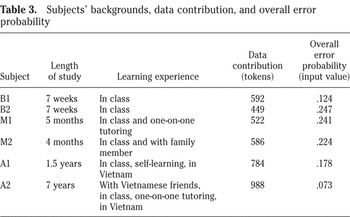
Six American English-speaking female students in an intensive 8-week Vietnamese program participated in this study; two were beginners (B1 and B2), two were classified as intermediate (M1 and M2), and the remaining two were considered advanced learners (A1 and A2). They had studied Vietnamese for various lengths of time (see Table 3). Participants B1 and B2 were both in the beginning class and had the shortest length of exposure to Vietnamese. Participants M1 and M2 had about the same length of study in similar learning contexts: both inside and outside of the classroom. Participant A1 had spent more time studying Vietnamese and had a more diverse experience with the language: She had lived in Vietnam in addition to having formal instruction. Participant A2 was the most experienced of all the participants: She had a considerably longer duration of study and had the most varied experience with Vietnamese, including being in Vietnam, formal learning, and the continuing practice of Vietnamese with native speakers.
Subjects' backgrounds, data contribution, and overall error probability

Materials.
To collect a sample of the participants' speech across styles, conversational topics and pictures were used. Additionally, a tone recognition test was administered to check if the participants' production errors might be related to their perception of the tones. Finally, a repetition test for the six tones was used to check the participants' ability to physically produce the tones.
In the conversation task, the Vietnamese researcher talked with the participants about topics of current interest to them for about 5–10 min. The researcher started with the same topics with all the participants and then let the conversations flow naturally. In the picture description task, the researcher presented the participants with a series of 13 simple drawings and pictures that involved daily scenes or simple stories taken from language textbooks. No attempt was made to elicit any specific tonal environments in either task. For the recognition test, the researcher provided oral input of the same syllable (la) carrying different tones. This recognition test was administered three times with varying orders of tone presentation, and participants were asked to mark the words they heard in the order they were presented. Participants were able to recognize all of the tones with accuracy, except for some errors or requests for multiple repetitions with the falling-rising tone,

. For the repetition test, the Vietnamese researcher again pronounced the syllable la with each of the six possible tones and asked the participants to repeat each one after her. All of the participants were judged by the researcher to have repeated the isolated tones accurately.
Data Elicitation and Recording.
The data were collected in the last week of the program. The participants' speech was recorded on a digital audiotape using a Sony digital audio recorder in a quiet room away from traffic. The data collection started with the conversation task, followed by the picture description task, then the recognition test, and, finally, the repetition test. It was explained to the participants that the study was on their pronunciation, but no information was given about a focus on tones. The duration of the entire session with each participant was 30–45 min.9
Immediately after the data collection, the researcher asked each participant to clarify a list of words that the researcher had been noting as the participant was speaking. These were lower frequency words whose tones were mispronounced rather consistently. For example, if a word such as tò, báo “newspaper” (falling tone, rising tone) was pronounced repeatedly as tó, bào (reversed tones, meaningless expression), the researcher would ask the participant how she normally pronounced “newspaper” in Vietnamese and what the tones would be. If the participant showed that she had the wrong tones in her lexical knowledge at that point, the word was discarded from the list of items. On the other hand, if a participant occasionally mispronounced a high-frequency word, such as

“of,” the researcher would not question her about this word and would code it as an item. The purpose of this checking was to learn about the participant's knowledge of the tones in order to reject tone errors due to a lack of lexical knowledge and to code only mistakes due to performance failure.
Data Coding.
The native Vietnamese researcher listened to the tapes, transcribed them, and coded the words with respect to the dependent and the independent variables described in the next subsection.10
The transcript recorded the target words that participants were trying to say based on the context. Tone errors were noted separately from the transcript. Unintelligible words were discarded.
The data were coded for dependent and independent variables. The dependent variable was tone production accuracy, coded as correct or incorrect. The coding of independent variables was as follows: The focus word's position in the clause was coded as initial, middle, or final; its distance to native-speaker speech was coded as close or far; the target tone was coded as ngang (high level),

(falling),

(rising),

(glottalized falling),

(falling-rising), or ngã (glottalized falling-rising); the presence of emphasis on the tone was coded as yes or no; the nuclear vowel that carries the tone was coded as high, mid, low, or diphthong; the initial element was coded as voiced, voiceless, or zero; the final element was coded as voiced, voiceless, glide, or zero; the immediately preceding tone was coded as ngang,

,

,

,

, ngã, or pause;
11A pause was coded when there was a silence of about 1 s or longer or when there was a brief silence of about one third of a second with fillers such as “um” or “uh.”

,

,

,

, ngã, or pause. Task type was coded as picture or conversation.
Analytical Procedure.
We used Goldvarb (Robinson, Lawrence, & Tagliamonte, 2001), a multivariate analysis application whose previous versions have been used effectively in the analysis of linguistic variation (Bayley & Preston, 1996). Goldvarb analyzes variable rules by investigating the relationship between a dependent variable and one or more independent variables (for more details, see Rand & Sankoff, 1990). In this study, we applied the analysis to individual learners' data to examine the relationship between accuracy, on the one hand, and linguistic and discourse factors, on the other hand. The key advantage of Goldvarb is that it can calculate the effects of several factors simultaneously in relation to one another. The significance level was set at p ≤ .05.
We performed the statistical analysis with attention paid to the linguistic nature of Vietnamese tones. First, tones in Vietnamese are distributed with uneven frequency; therefore, we cannot expect each tone to occur in all environments in equal number. Second, as explained earlier, certain tones have constraints on their combinations with final consonants. If we test the effects of all factors for all the tones combined, there might be no variation in certain environments and the multiple regression analysis will not run. For these reasons, two separate Goldvarb condition files (models) were fitted to each learner's data. First, the general model used all observations in each learner's data in order to test the effects of factors that were present under no constraint among all the tones—namely, task type, position, distance to native-speaker speech, target tone, and emphasis.12
Even though the effects of emphasis are tone-specific, emphasis is a general factor and was included in the general model so that the effects of the other factors could be calculated with consideration of emphasis' effects. The effects of emphasis will be interpreted in the context of specific tones.
Results
The overall probability that the learners would produce tones inaccurately was fairly low, with .124 and .247 for the two beginners, .241 and .224 for the two intermediate learners, and .178 and .073 for the advanced learners (Table 3). These figures suggest that tone accuracy does not correlate in a linear manner with length of study. Although A2, the participant with the longest length of study, did have the lowest probability for making tone errors, one beginner (B1) outperformed both of the intermediate learners and one advanced learner.
Task Type, Clausal Position, Distance to Native-Speaker Speech, Target Tone Type, and Emphasis.
Overall, factors predicted by the first five hypotheses—task, clausal position, target tone type, and emphasis—proved to have an effect on tone production by some participants. Among the significant factors, tone type proved to have the strongest effect for most learners, followed by emphasis, clausal position, and task type.13
Factor strengths were calculated based on the range of values for each factor. The higher the range, the stronger the effect.
As predicted by hypothesis 1, accuracy was lower on the conversation task than on the picture description task, but only for one beginner and one intermediate learner. For these two participants, B1 and M1, errors were favored in the conversation task and disfavored in the picture description task. Hypothesis 1 was thus only partially supported.

The scalar positions in the rankings do not have equal distance; the distance among these positions is calculated based on the error probability.
Similarly, hypothesis 2 was also partially supported by the data. The clausal position of tones significantly affected their accuracy for only three participants: B2, A1, and A2. Among these participants, the hypothesis held for B2 and A1, for whom errors were strongly disfavored when the tone was in initial position and either favored or mildly disfavored in final or middle position. The pattern for A2 was the opposite: Errors were favored when the word occurred clause-initially and disfavored when it was final.

Hypothesis 4 predicted that more marked tones (ngã,

,

) would be produced with lower accuracy than less marked tones (

,

, ngang) and that the rising tone (

) would be more difficult than the falling tone (

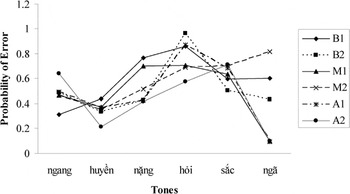
). Overall tone production was found to be affected by the target tone type significantly only for the beginning and advanced learners but not for the intermediate learners. Furthermore, the specific effects of the target tone type on tone pronunciation were more complex than predicted (Figure 1). The overall error probability ranking for each tone for the four learners is presented in (8).

If error probability can be positively associated with difficulty, then the pattern seems to be that the three more difficult tones for these learners were the falling-rising tone

, the rising tone

, and the high-level tone ngang, and the three easier tones were the glottalized falling tone

, the falling tone

, and the glottalized falling-rising tone ngã. Thus, although the marked tone

was indeed more difficult for some learners, the other marked tones, ngã and

, were not more difficult for some learners, as predicted by hypothesis 4. However, for all four learners, the rising tone

proved to be more difficult than the falling tone

, thus supporting part of this hypothesis. It is important to note that there were some inconsistencies among the participants. For example, whereas ngang tended to be problematic for most learners, it was pronounced with the highest accuracy by participant B1.

The effects of tone type on tone production.
Hypothesis 4 considered the effects of the target tone type in both emphasized and nonemphasized environments. Hypothesis 5 predicted that emphasis might affect different tones in different ways, so two additional general models were fitted to each learner's data: one for the emphasized environment and one for the nonemphasized environment. The results revealed somewhat more uniform patterns among the learners.
In an emphasized environment, tone type was a significant factor to predict accuracy for the intermediate and advanced learners but not for the beginning learners, as illustrated in (9) and in Figure 2. Hypothesis 5 predicted that when a word is emphasized, the rising tone

would be pronounced accurately and the falling tone

would be pronounced incorrectly. This was only partially supported by the data. For three learners, errors with

were not favored in this environment, whereas errors with

were highly favored. The exception was participant A2: Errors with

were actually strongly disfavored, thus contradicting the hypothesis. Furthermore, for most participants, even though

was likely to be pronounced accurately when emphasized, production accuracy was even better for other tones—namely,

, ngã,

, and

. Similarly, whereas

was highly problematic for three participants, the high-level tone ngang also had a high error probability for two participants.


The effects of tone type in an emphasized environment.

The effects of tone type in a nonemphasized environment.
Turning now to the nonemphasized environment, tone pronunciation by all six learners was significantly affected by the target tone type, as illustrated in (10) and in Figure 3. The prediction of hypothesis 5, that the high-level tone ngang would be pronounced most accurately in a nonemphasized environment, was supported by data from only two participants, B1 and M2; it was contradicted by data from A2 and not supported by data from the other participants. Thus, it might not be the case that tones are neutralized in a nonemphasized environment. Furthermore, even though it is true that two contoured tones, the falling-rising tone

and the rising tone

, were most likely to be pronounced incorrectly (falling for

and level or half-rising for

, thus providing possible evidence that neutralization took place in the absence of emphasis, there was also evidence against tone neutralization. The falling tone

and the glottalized falling-rising tone ngã, both contoured tones, were most likely to be pronounced correctly; that is, they were not neutralized. The data also show that differences existed among participants. First, as an exception to the usual pattern, ngã was actually most difficult for M2, an intermediate learner. Second, the glottalized falling tone

tended to be pronounced incorrectly by B1 and M1 but correctly by the other participants.

Intertonal Context, Consonant Voicing, and Nuclear Vowel Height.
The second statistical model predicted the probability of each tone's accuracy based on tone-specific factors: the preceding tone, the following tone, the initial and final elements in the syllable, and the height of the nuclear vowel. Because the results of the general model showed that task type, clausal position, and emphasis were significant factors in predicting accuracy, these were also included in the tone-specific model. The model was fitted multiple times, each time with the data pool of one tone produced by one learner.15
Due to the unequal distribution of tones in different environments, certain factors had to be excluded from multivariate analysis when knock-outs occurred. The number of the remaining tokens (after knock-outs) for each participant in each test is noted.
For the high-level tone ngang, there was only one tone-specific factor that was proven to be significant and only for the two advanced participants: the following tone. For A1 and A2, ngang was most likely to be pronounced accurately when it was followed by another ngang, and it was most likely to be pronounced inaccurately (as falling or half-falling) when it was followed by a rising tone

, as shown in (11).

For the falling tone

, the data from four participants showed that there were significant effects by three tone-specific factors, even though these effects were not the same for these learners. First, vowel height affected the accuracy of tone production for two participants, M2 and A1, as shown in (12). For these participants, errors with

were favored the most when the vowel that carries the tone was high, and they were moderately favored when the vowel was mid. This tone tended to be pronounced accurately when the vowel was a diphthong or a low vowel.

The second tone-specific factor that significantly affected the accuracy of

was the postvocalic element in the word, and it was significant for two participants, B2 and A1. Errors with

were favored most when the final element was a voiced (nasal) consonant and next when it was a glide, as illustrated in (13). Tone errors were disfavored when

occurred in an open syllable (i.e., zero final element).

The third and final significant tone-specific factor for

was the initial element in the word, but it was significant for only one participant, M1. As shown in (14), data from this learner did not contain any instances of a falling tone occurring with a zero initial element. Errors were favored when the initial consonant was voiceless and disfavored when it was voiced.

For the rising tone

, data from five participants (all except M1) showed that tone accuracy was significantly affected by three tone-specific factors. First, the preceding tone significantly affected the accuracy of

for three participants. As shown in (15), when

was preceded by the falling-rising tone

, errors were most favored (the rising contour of

in this context was often compromised and became falling, half-falling, level, or half-rising); errors were least favored when

was preceded by a pause. The effects of the other preceding tones for the participants were mixed. For A1, when the rising tone was preceded by another high tone (ngã, ngang,

), errors were favored (

became level, half-rising, half-falling, or falling), and errors were disfavored when it was preceded by a low tone other than

(

,

). For M2, this pattern was followed except that a preceding low tone,

, favored errors (resulting in a level or half-rising contour for

) and a preceding high tone, ngang, did not favor errors. For B2, the pattern was the reverse of A1's: Preceding low tones

and

favored errors (

also became level or half-rising), whereas preceding high tones ngang and

disfavored errors.

The second significant tone-specific factor for

was the final element, and it was significant for two participants, B2 and A2. As presented in (16), for these participants, errors with

were disfavored when it was followed by a voiceless consonant and favored when it was followed by a (nasal) voiced consonant or a glide or when the syllable was open (

became level, half-rising, or falling in this context).

Finally, the last significant tone-specific factor for

was the initial element but only for one participant, B1, as illustrated in (17). For this participant, the data subset did not contain any instances of an initial glide. When the rising tone was preceded by a consonant, errors were favored with approximately equal effects by a voiced or voiceless consonant, and errors were not favored when the onset was empty.

For the glottalized falling tone

, the data from four participants were significantly affected by five different tone-specific factors. Among these factors, the final element affected three participants. The effects of the other factors were less uniform.
As displayed in (18), errors with

were not favored when the final element was a voiceless stop, and they were favored when the word ended with a (voiced) nasal or glide or when the syllable was empty. Data from the two beginning learners, B1 and B2, suggested that errors were favored more with a final nasal than with an open syllable (zero final element). This was also supported by data from A2,
16Participant A2's data had too many knock-outs (reducing the number of tokens in this pool from 137 to 14); thus, it was not possible to run multivariate analysis on the data.

was pronounced correctly 100% of the time when the final element was a voiceless stop, 94% of the time when it was a (voiced) nasal, and 77% of the time when it was zero (there were too few instances of a final glide to make a comparison).

The initial element was a significant factor for

for only one participant, B2, as illustrated in (19). This participant's data showed that voicing of the initial consonant had an effect on the accuracy of

: Errors were favored when the initial element was a voiced consonant and were not favored when it was a voiceless consonant.

The next factor, nuclear vowel height, was also significant for

for only one participant, M1. As shown in (20), errors with

were favored when the vowel was high or low and not favored when it was a diphthong or a mid vowel.

M1's data also showed another significant factor for

: the preceding tone. As illustrated in (21), errors were favored when

followed a pause (

became nonglottalized falling or level) or another low tone (

or

;

became nonglottalized falling, half-rising, or level) and were not favored when

followed a high tone (ngang or

).

The following tone, on the other hand, was a significant factor for another participant, B2. As shown in (22), when the following tone was a high-level tone (

or

), errors with

were favored (it became nonglottalized falling). Errors were not favored when

was followed by a rising tone or a pause.

For the falling-rising tone

and the glottalized falling-rising tone ngã, no significant test was achieved due to their limited distribution in the lexicon of Vietnamese.
Taken together, the results from the second multivariate analysis model showed that some hypotheses were partially supported and some were contradicted. First, hypothesis 6a predicted that the preceding tone would affect the target tone accuracy, but this was only the case with the rising tone (for three participants) and the glottalized falling tone (for one participant); thus, hypothesis 6a was partially supported. Whereas hypothesis 6b predicted that the following tone would have no effects, the data showed that for the high-level tone and the glottalized falling tone, the following tone affected accuracy (for two participants and one participant, respectively), thus contradicting the hypothesis. Hypothesis 7 predicted that a voiceless initial consonant would increase the accuracy of high tones and, vice versa, that a voiced initial consonant would increase the accuracy of low tones. The results were mixed and not very strong: The hypothesis was supported by data of the falling tone (for one participant), not supported by data of the rising tone (for one participant), and contradicted by data of the glottalized falling tone (also for one participant). Hypothesis 8 predicted that the postvocalic element should have no effect on tone accuracy; however, the data showed that it affected tone accuracy in data of three tones: the falling tone (for two participants), the rising tone (for two participants), and the glottalized falling tone (for three participants). Hypothesis 8 was thus contradicted. Finally, hypothesis 9 predicted that vowel height would correlate with tone pitch; that is, a high vowel would increase the accuracy of a high tone and, vice versa, a low vowel would increase the accuracy of a low tone. This was supported by data on the falling tone for two participants but was not supported by another low tone, the glottalized falling tone. Hypothesis 9 was thus only partially supported. These results revealed very interesting processes that were not predicted by the hypotheses; these will be considered in the Discussion.
DISCUSSION
Effects of Task Type, Clausal Position, and Distance to a Native Speaker's Speech in Discourse
As found in other studies (e.g., Sato, 1985), different tasks proved to have varied effects on tone production. However, it is puzzling why task type affected tone accuracy for one beginner (B1) and one intermediate participant (M1) but not the other learners. A qualitative look at the data revealed that B2, the other beginning learner, spoke very slowly, enunciating almost every single word throughout the interview, and this careful style could have helped her overcome the task effect. The other intermediate and advanced participants, M2, A1, and A2, seemed equally fluent in both tasks, which could suggest that tone production, once routinized, might become less sensitive to the effects of task type.
As for the effect of the tone's position in the clause, it seems that for some learners [such as B2 and A1, as in (7)], tone accuracy benefits from the tone being at the beginning of a clause and is compromised when it occurs in the middle or at the end of the clause. However, for some other learners (such as A2), the pattern might be reversed and tone accuracy benefits the most from the tone being at the end of the clause. Further research is needed to explain these different patterns.
It is surprising that a learner's tone accuracy was not affected by how close the word was in discourse to a native speaker's speech. Although this might suggest that immediate input by a model in a nonrepetition task might not have any effects on tone production, it is also possible that the native speaker's speech affects fewer than five words at the beginning of the learner's next turn in discourse, as hypothesis 3 postulated. This issue should also be explored further in a future study.
Tone Type and Emphasis Effects
Regarding the effects of tone types, results showed that markedness alone cannot account for the data. Overall, errors of one marked tone (the falling-rising tone

) and two unmarked tones (the high-level tone

) were favored, whereas errors with one unmarked tone (the falling tone

) and two marked tones (the glottalized falling-rising tone ngã and the glottalized falling tone

) were not favored [see (8)]. Particularly, ngã, being the most marked, was also one of the tones most likely to be pronounced accurately. The reason might be that glottalization occurred at the point where the contour movement shifts from falling to rising, thus helping the learner anchor the falling-rising contour. Therefore, even though this tone is highly marked, given the architecture of the tone, it was in fact easier for most participants in both emphasized and nonemphasized conditions.
17An exception was M2, whose errors of ngã were highly favored in the nonemphasized environment but not in the emphasized environment. Qualitative examination of her data revealed that she often produced a nonemphasized ngã with a half-falling or level pitch contour, exhibiting a strong preference for a falling or level pitch contour in this environment, a preference also seen with other participants (see discussion on

).
Furthermore, emphasis played an important role in a tone's accuracy in discourse. For most participants, the falling-rising tone

had a low error probability when the syllable was emphasized but a high error probability when it was not emphasized [see (9) and (10)]. First, this tone benefited from emphasis perhaps because the participants could pay more attention to its complex contour in the emphasized environment. Its pitch falls much lower than the other tones, which might have been difficult for the participants to produce when they did not pay close attention. In fact, a qualitative examination of the data showed that many of the errors with this tone occurred because

was produced as a falling tone; that is, the learners' pitch did not fall low enough, an observation also made by Nguyen (1999). Second, the tone's voice quality—breathiness—is not a feature that carries lexical meaning in English. In a nonemphasized environment, learners might not realize this feature of the tone, and, together with the neutralization of the pitch contour, this can result in an incorrect form (see Nguyen). Another reason why

had a lower accuracy likelihood in a nonemphasized environment was perhaps because of the inconsistency between textbook instructions on this tone and its actual realization in speech sequences (T. B. Nguyen & H. B. Tran, personal communication, July 2002).

is often presented in textbooks as having a final rising intonation contour, but empirical data (Nguyen & Edmonson, 1997; Pham, 2003) have shown that in native speakers' ordinary speech, this tone might not rise but continue to fall much lower than the falling tone. In effect, textbooks teach students how to pronounce

only in an emphasized condition, not in a nonemphasized condition. The learners' higher error rate for

in nonemphasized conditions could thus be a result of training effects. Indeed, the participants had some difficulty perceiving this tone in the recognition test (some asked to have the input repeated several times) and expressed that they found this tone difficult to pronounce.
The rising tone

also benefited from emphasis for most participants, except in one case (A2) where it was the falling tone

that benefited. This seemingly contradictory pattern can be explained if we consider English emphasis patterns. Emphasis in English (to mark prominence or contrast) can be achieved by either raising or lowering the pitch level (Celce-Murcia, Brinton, & Goodwin, 1997). Evidence for the correlation between tone accuracy and pitch associated with emphasis can be found in the fact that for most learners whose tone accuracy was significantly affected by emphasis [see (9)], if the rising tone benefited from emphasis, the falling tone was compromised by emphasis, and vice versa. That pitch changes in the presence of emphasis also explains the fact that errors with the high-level tone ngang were favored (for four participants) when the word was emphasized. Thus, this finding extends White's (1981) report on American learners of Mandarin Chinese and supports Nguyen's (1999) observation on English-speaking learners of Vietnamese: Although it is true that learners' L1 emphasis patterns might affect their production of tones, the direction of this effect mighty also depend on the individual learners' linguistic habits.
The falling tone

and, to some extent, the high-level tone ngang benefited from a nonemphasized condition, except for one learner (A2), whose errors of ngang were favored in this environment [see (10)]. The general trend with most learners might indicate the learners' preference for a falling pitch contour and, to a lesser degree, a level contour in a lax environment. Qualitative examination of the data from A2 in fact supports this general tendency and also suggests a difference in strength of these two preferences. A2 often produced a high-level tone in a nonemphasized environment as a half-falling tone, thus exhibiting a strong preference for a falling pitch contour in this condition—so strong that it affected the accuracy of the high-level tone.
In sum, participants' production accuracy for the tones seems to reflect the influence of their L1's emphasis pattern, their attention to speech, and their knowledge about the specific characteristics of the target tone. This demonstrates that, in line with what Broselow and Finer (1991) asserted, universal markedness can be overridden by the structures of L1 and L2.
Intertonal Effects
It is interesting that the rising tone

and the glottalized falling tone

were the only tones affected by a preceding tone [for some participants; see (15) and (21)]. For the rising tone, error probability was low when the tone was preceded by a pause, which suggests that participants were more likely to pronounce

correctly when it was not preceded by any tone. The situation was the opposite for

: It was most likely to be mispronounced when preceded by a pause. Taken together, this might mean that for some participants, it was easier to resume speech with a rising pitch contour than with a quick, deep falling contour ending with glottalization. As an example of this tendency, some participants were recorded saying Cháo cô (rising tone for the first word) instead of the correct Chào cô (falling tone for the first word) “hello, teacher” to greet the researcher in the interviews.
At the other end of the continuum, for the rising tone

, a preceding falling-rising tone

tended to favor errors of

the most [see (15)]. Because participants produced

with either a falling-rising or a deep falling contour, there can be two explanations for why it might have led to lower accuracy probability for the following rising tone. First, when

is produced with a falling-rising contour, the combination

results in a falling-rising-rising contour. There is evidence that a rising-rising pitch sequence was not preferred by the participants. For two of them (A1 and M2), errors with

were favored when it was preceded by another rising tone and not favored when it was preceded by the falling tone

, which suggests that the sequence falling-rising was preferred more than the sequence rising-rising for these participants. Second, when

is produced with a deep falling contour, there is a large pitch jump between its end point and the beginning of

, which proved to pose a problem for the participants. This seems to support a natural tendency to reduce the pitch interval between tones, which has been observed elsewhere (e.g., Hyman, 1973).
Consistent with the first explanation, errors with the rising tone

by some learners were also favored when it was preceded by a glottalized falling-rising tone ngã. The reason might be because the

combination results in a falling-rising-rising contour, which is not as preferred as the falling-rising sequence. Whereas quantitative data for A1 seem to contradict this observation, a qualitative examination of her data showed that the preference for a falling-rising pitch sequence also existed. A1 often pronounced the rising tone as a high-level tone or a half-rising tone in this context, thus still resulting in the sequence falling-high level/low rising and approximating the falling-rising sequence preferred by the other participants.
Regarding the avoidance of pitch jumps, for two participants, B2 and M2, errors of the rising tone

were favored with the presence of a preceding glottalized falling tone

. The reason for this might be that these participants had trouble transitioning from a deep falling pitch accompanied by glottalization to a rising pitch. Indeed, qualitative data of their speech showed that most of the errors with

in the

sequence were due to an inadequate rise in pitch for

. An exception to this pattern was A1, who, as an advanced learner, seemed to have overcome this problem in the

sequence. It is also worth noting that for B2, the presence of a preceding rising tone

or a high-level tone ngang did not favor errors of

, showing that she, as a beginner, could produce the sequence rising-rising and high-level-rising accurately most of the time. This might have been due to her careful enunciation, which was noted earlier to have helped her overcome task effects.
The high-level tone ngang and the glottalized falling tone

, on the other hand, were affected by a following tone [for some participants; see (11) and (22)]. Specifically, the accuracy of ngang was affected more negatively by a rising tone

than by the other tones or a pause. The reason might be that ngang is the only level (noncontoured) tone in the language and it is a high tone, like

. It seems that when there was a high-level-rising sequence, the high-level tone was changed by participants into a nontarget tone in anticipation of the rising tone. Close examination of the data showed that these participants often gave the high-level tone a falling contour in this context. For example, the high-level tone in the first word of

“not sure” was pronounced with a nontarget, slightly falling contour by one participant. This again suggests a preference for a falling-rising sequence and that the high-level tone—a noncontoured tone—was more prone to being affected than other tones. In the case of the glottalized falling tone

, errors were favored except when

was followed by a rising tone or a pause. The fact that a pause might lower

error probability the most might suggest that a short falling contour was favored at the end of speech immediately before silence. The lower error probability for

followed by

was found to be coincidental after a close look at the words spoken by B2: 50% of the

combinations were the pronoun

“she,” and B2's accurate pronunciation of this common pronoun alone could have skewed the data.
To summarize, the negative effect of a following rising tone on the high-level tone indicates that intertonal effects can take a regressive as well as a progressive direction, thus contradicting previous findings for native speakers (e.g., Han & Kim, 1972; Ohala, 1978). Furthermore, the data showed that participants preferred a falling-rising pattern that favors the rising tone; that is, the rising tone's accuracy was enhanced by a preceding falling tone, and the shape of a preceding high-level tone was sacrificed for the accuracy of the rising tone.
Voicing Effects
The data from some learners showed that the accuracy of two low tones—the falling tone

and the glottalized falling tone

—were significantly affected by the voicing of the initial consonant [for some participants; see (14) and (19)]. As predicted, for

, an initial voiceless consonant tended to favor errors and a voiced initial consonant did not (for one participant). However, for

, the pattern was reversed: A voiced initial consonant favored error, whereas a voiceless initial consonant did not. This pattern with

, however, turned out to be lexically affected: In the data from the only participant who significantly showed this pattern (B2), 25% of the words with

were either

“older sister” or

“study”—both of which are common vocabulary items with a voiceless initial consonant—and both were pronounced correctly nearly all of the time. Thus, only

showed a true effect of initial consonant voicing on tone accuracy. According to Hombert (1978) and others, this is because the fundamental frequency of the tone is affected by the residual articulatory mechanism inherent in the production of voiced and voiceless consonants. This is possible evidence that universal mechanisms were at work in the participant's production of tones. It is curious, however, to note that initial consonant voicing did not show any effect on the accuracy of the rising tone

; rather,

accuracy was affected by syllable structure.
The effect of final elements was observed with the falling tone

, the rising tone

, and the glottalized falling tone

for some participants [see (13), (16), and (18)]. Because the falling tone can be followed by only a voiced (nasal) consonant, not a voiceless one, the voicing effect for this tone is out of the question. For

and

, a voiced final consonant favored error, whereas a voiceless one did not. This is puzzling because final consonants have not been found to affect tone production, and the effect was the opposite of the effect of initial consonants on tones. However, these results might be an effect of the phonotactic constraints of Vietnamese rather than final consonant voicing. As mentioned previously, only

or

can occur with a voiceless final consonant. Thus, in this environment, Vietnamese has only two options for tone—rising or falling—and having to choose among fewer options might have helped lower the probability for error for the participants.
18Some participants also produced a third (nontarget) option in this environment—a high-level tone—but even then, the number of options is still not as many as in other environments (when all tones are allowed).
Syllable Structure Effects
Syllable structure seemed to have important effects on the production of certain tones in the data, even though this effect has not been suggested by previous research. For the falling tone, whose coda can be either filled with a nasal or glide or unfilled (e.g., bàn, bày, or bà), a filled coda led to higher error likelihood (based on data from two participants). This might be because the falling tone is a long and lax tone and an open syllable creates a more facilitating environment for its production. For the rising tone and the glottalized falling tone, an open or semiopen syllable increased the error probability compared to a closed syllable (e.g., má or máy were more likely to be pronounced incorrectly than mán or mát). Although it is possible to speculate that this is because the rising tone is tense and is more easily realized with a closed syllable, this pattern held for only one participant for each tone (A2 for

and M2 for

) and not for the other participants, whose tone accuracy was also significantly affected by the final element [see (16) and (18)]. Thus, these patterns should be tested with further data. The rising tone also seemed to benefit from an empty onset (based on B1's data). However, close examination of her data showed that among the words with

, 32% were

(second part of third person pronouns), and these were pronounced correctly 100% of the time. B1's correct pronunciation of this lexical item alone could have skewed the data and given the false impression that an empty onset might affect the accuracy of the rising tone.
Nuclear Vowel Height Effects
The data showed that only the two falling tones, the falling tone

and the glottalized falling tone

, were affected by the height of the nuclear vowels [see (12) and (20)]. As predicted by the theory, high vowels increased error probability for

(based on data from two participants). For

, high and low vowels seemed to favor errors, whereas diphthongs and mid vowels did not, but this pattern held for only one participant. Close examination of the data did not reveal any lexical effects on this pattern, and we are led to conclude that with glottalization as part of the tone, vowel height might not correlate with pitch. The reason why a diphthong reduced error probability might have to do with the fact that

is inherently a short tone and it might have a greater chance of being pronounced correctly when it is stretched longer over a vowel combination.
CONCLUSIONS
In this study, we have investigated the effects of task and discourse factors as well as intersyllable and intrasyllable factors on the production of tones by American learners of Vietnamese. The significance of this study is its detailed analysis of an important and complex aspect of SLA that has not been thoroughly researched: tone acquisition. It is also unique in its focus on the acquisition of Vietnamese, a target language that has not been studied as much as, for example, English.
As the first exploration of the effects of multiple factors in tone production by American learners of Vietnamese, this study opens up further directions for future research. First, there was a high degree of variation among the participants, which, on the one hand, might suggest the diversity of learners' individual interlanguage systems and, on the other, calls for more data involving more participants so that the patterns reported here can be confirmed or modified. Particularly, where attention to individual interlanguage systems is emphasized, more data from each participant are required. Second, our understanding of learners' tone acquisition could be enhanced by examining the structures in individual learners' grammars as well as the phonetic characteristics of their errors. Finally, knowledge about the acquisition of tonal languages could be extended by investigating how tone acquisition is related to the acquisition of other areas of the language.