1. Introduction
This study investigates the use and interpretation of specific and generic subject noun phrases in the Italian of 20 adult German–Italian simultaneous bilinguals (2L1ers) and 15 second language learners (L2ers) with Italian as a second language and German as their first language.
Italian and German both have articles, but these languages differ in terms of the contexts where articles must be used. Both languages require articles with specific reference (nominals corresponding to the cats in The cats sleep a lot). However, only Italian requires articles with generic reference (nominals corresponding to cats in Cats sleep a lot). In contrast, German allows bare nouns in this case, similar to English. In brief, the two languages display overlap in terms of article use, but this overlap is only partial.
Another property of the phenomenon investigated here is that it is at the crossroads between syntax, semantics and pragmatics or discourse, because the interpretation of the article depends on the context in which the noun phrase is used. This is relevant because studies on cross-linguistic influence (CLI) – in bilingual acquisition, incomplete acquisition and attrition in adult bilinguals – suggest that the linguistic competence of bilinguals is not affected globally. Rather, when compared to narrow-syntax, interfaces (i.e., areas where syntax meets other linguistic modules) turn out to be comparatively more vulnerable (see Sorace, Reference Sorace2011, for an overview).
Studies within the field of bilingual first language acquisition (e.g., Hulk & Müller, Reference Hulk and Müller2000) have argued that partial overlap of properties and a location at the interface between syntax and pragmatics or discourse are prerequisites for the occurrence of CLI. And, in fact, bilingual English–Italian and German–Italian children, even at school ages, have been shown to have problems using and interpreting articles appropriately (Kupisch & Pierantozzi, Reference Kupisch, Pierantozzi, Franich, Iserman and Keil2010; Serratrice, Sorace, Filiaci & Baldo, 2009, age range: 6–10 years). Importantly, however, monolingual children in some languages show the same problems, yet to a different degree or for a shorter period of time than bilinguals (Kupisch & Pierantozzi, Reference Kupisch, Pierantozzi, Franich, Iserman and Keil2010). One might therefore speculate whether bilingual children acquire the investigated phenomenon incompletely, or differently (compared to monolinguals) because of CLI from the language that is being acquired simultaneously. This may be so especially for a minority language, because once bilingual children enter school, they normally tend to hear and use the minority language even less than before – bilingual schooling being the exception.
Montrul and Ionin (Reference Montrul and Ionin2010) have provided evidence that adult Spanish heritage speakers face problems using articles with generic subject noun phrases. The authors argued in favour of incomplete acquisition. However, their study did not investigate Spanish–English bilinguals in a Spanish-speaking environment. It therefore remains an open question whether such problems with article use are typical of English–Spanish bilinguals, or whether they are typical only for those with Spanish as a (weaker) minority language.
The present study addresses the following related research questions:
• Do acquisition outcomes depend on whether Italian is acquired as a bilingual speaker's weaker or stronger language?
• Is age of onset a factor with respect to the acquisition of article use in specific and generic noun phrases?
The study investigates specific and generic subject noun phrases, comparing two groups of bilinguals who differ in terms of their stronger language, and L2 learners of Italian with German as their L1. Moreover, quantitative and qualitative models on the directionality of CLI with respect to the phenomenon are discussed.
In the following, the concepts of weaker and stronger language, language dominance as well as contemporary ideas on interfaces as vulnerable domains are introduced. Sections 2 and 3 introduce the investigated phenomenon and formulate predictions on CLI. Section 4 summarizes previous research. Section 5 presents two experimental studies, Section 6 discusses the results and Section 7 draws conclusions.
1.1 The weaker and the stronger language in simultaneous bilingualism
Throughout, the terms stronger and weaker language characterize the learner's relative proficiency in the two languages. Over the past years, it has been frequently argued that the grammar of adult bilinguals differs from that of monolingual speakers. A closer look reveals that much of this research has been dedicated to bilingual speakers’ weaker language, which in many studies coincides with the heritage language (e.g., Montrul, Reference Montrul2008; Polinsky, Reference Polinsky, Wayles Browne, Dornisch, Kondrashowva and Ze1997). The latter is loosely defined as a language spoken at home without being the language of a larger society (or nation) (Rothman, Reference Rothman2009). Nevertheless, the view that the heritage language is always the weaker language may not be correct for all speakers. Similarly, it is debatable whether the notions of stronger and dominant language are interchangeable. Some authors reserve the term “dominant” for “the predominant of the ambient languages in a given setting” (Meisel, Reference Meisel2007, p. 499), pointing out that it need not correspond to the more proficient language of a speaker.
For the bilingual participants investigated in this study, the dominant and strong language happen to coincide, as do the minority (i.e., heritage) and weaker language. Perhaps unsurprisingly, Italian developed into the more proficient language of the bilingual German–Italian speakers who grew up in Italy, and into the less proficient language of those who grew up in Germany. Therefore, the terms stronger and dominant language are here used interchangeably.
It is often taken for granted, and rarely investigated systematically, that convergence to some monolingual norm is guaranteed provided some language constitutes the stronger language, while the same may but need not be the case for the weaker language. This study shows that, for the phenomenon investigated, this assumption is indeed correct.
1.2 Age of onset vs. frequency of exposure
There is a consensus that the simultaneous acquisition of two languages can be seen as an instance of bilingual first language acquisition (2L1 acquisition). Normally, three reasons are offered in support of this view: (i) bilinguals separate their languages from early on, (ii) they pass through the same developmental stages as monolinguals (sometimes more slowly or faster), and (iii) they commit the same types of error as monolinguals (see Meisel, Reference Meisel2011, for an overview).
Within the generative framework, it is an uncontroversial assumption that the process of first language acquisition (monolingual and bilingual) is guided by UG, the acquisition outcome being successful provided that both languages are heard and used sufficiently.Footnote 1 In contrast, many researchers hold that the same does not apply for second language acquisition in adulthood (L2 acquisition), irrespective of frequency (i.e., how much the L2 is heard and used). According to Bley-Vroman's (Reference Bley-Vroman1990) Fundamental Difference Hypothesis – which is consistent with Lenneberg's (Reference Lenneberg1967) Critical Period Hypothesis – the innate linguistic system that operates in childhood is no longer available to adult L2ers, who must therefore rely on domain-general cognitive mechanisms.
Lenneberg associated the critical period with the age around puberty. Recent work by Meisel (Reference Meisel2011) argues for at least two clusters of sensitive phases in language acquisition. One cluster is around age 4;0, the other around age 7;0. Here, the conditions that are optimal for language acquisition slowly start to fade out. According to Meisel, inflectional morphology is subject to this change relatively early (around age 4), but the two clusters of sensitive phases are not necessarily grammatically homogeneous. Hence, sensitive periods for particular syntactic phenomena may be associated with any of the two phases. The assumption that some critical phases come to end only around the age of school entry, together with the finding that some phenomena (e.g., how to express generic reference) are not fully acquired by that same age, supports the hypothesis that, in relevant domains, differences between L1 and L2 learners may be neutralized. In other words, with respect to some phenomena, “L1 learners may be L2 learners”. It might be a matter of frequency of language exposure and use (rather than age of first exposure) as to how successfully these phenomena will be acquired. The acquisition of generics could be a case in point.Footnote 2
2. Article use in Italian and German
Article use is a particularly fruitful phenomenon in investigating CLI. Following the original proposals by Hulk and Müller (Reference Hulk and Müller2000) and Platzack (Reference Platzack2001), phenomena that are dependent on pragmatic and contextual variables are especially vulnerable in acquisition. As will become clearer below, contextual information is crucial for the appropriate use and interpretation of articles.Footnote 3
German (Ge.) and Italian (It.) have definite and indefinite articles, as well as contexts in which nouns can or must occur without an article.Footnote 4 In both languages, bare noun phrases (NPs) can occur in lexically governed positions, as in (1). However, as shown in (2), German but not Italian also allows bare NPs in subject positions. (In the following, relevant nominals are printed in bold; ungrammatical and semantically inappropriate sentences are starred.)
(1)


(2)
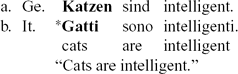
Chierchia (Reference Chierchia1998) ascribes these syntactic differences between “Germanic” and “Romance” to semantic properties: Germanic nouns have the semantic status of arguments and can be mapped as such onto syntax.Footnote 6 Romance nouns are predicates and must be turned into arguments before they can be mapped onto syntax. This occurs through the projection of a D-position, which can be filled by an overt or phonetically empty determiner. The latter has the status of a null morpheme and is only allowed in lexically governed positions. This explains why Italian subjects, unlike objects, can never be bare.
2.1 Similarities between German and Italian
German and Italian count nouns in the singular must be preceded by an article. In the absence of a context enforcing a particular reading, definite determiner phrases (DPs) are ambiguous and can be interpreted either specifically or generically:
(3)

In the context of specific reference, definite determiners are obligatory, regardless of whether the noun is singular, plural count, or mass―again, in both German and Italian, as shown in (4)–(6):
(4)

(5)

(6)

Whether a nominal has a specific or a generic reading is not determined by the article alone, but also by the type of verb, its tense and aspect, or adverbs in the same clause (e.g., by progressive aspect in the Italian examples and the adverb gerade “at the moment” in the corresponding German examples). With plural and mass nouns, the definite article is sufficient for disambiguation in German but not in Italian (see examples (7)–(10) below).
2.2 Article use with specific and generic plural and mass subjects
German and Italian differ when the noun is plural or mass. In German, bare NPs have a generic interpretation and DPs have a specific interpretation (see (7a) and (8a) for plural nouns and (9a) and (10a) for mass nouns). Italian does not allow bare NPs (see (7b) for plural nouns and (9b) for mass nouns), while DPs are ambiguous between the specific and the generic reading (see (8b) and (10b)).
(7)
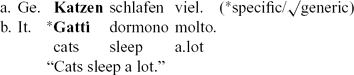
(8)

(9)

(10)

A further difference between German and Italian with regard to plural and mass nouns – relevant to the study presented below – is the existence of a partitive article in Italian. The partitive article normally yields an existential (nonspecific) interpretation and is semantically inappropriate with generic readings.Footnote 7 In (11), it is inappropriate because the property of containing fat is true of butter in general.
(11)

2.3 Variation in article use with generic plural and mass subjects
So far, a somewhat idealized picture of article use in Italian and German has been provided. Things become less neat once exceptions and dialectal variation are considered. Contrary to the generalizations stated above, Italian allows bare subject NPs if they are made to be “syntactically heavy”, e.g., through coordination or modification. These normally have an existential interpretation, as in (12).
(12)

There is some controversy surrounding the question of whether bare subject NPs can co-occur with kind-selecting predicates (Chierchia, Reference Chierchia1998, p. 385). Despite their heaviness, bare NPs as in (13a) “sound bad”, but can become acceptable with more liberal kind-selecting predicates and “more heaviness” (cf. (13b)).
(13)

The number of occurrences of such bare subject NPs is probably very low in everyday Italian speech. However, their existence provides learners with conflicting evidence as to whether Italian generally tolerates bare NPs, or not.
German, too, shows variation in the use of articles with generic reference (e.g., Dayal, Reference Dayal2004; Krifka, Pelletier, Carlson, ter Meulen, Chierchia & Link, Reference Krifka, Pelletier, Carlson, ter Meulen, Chierchia, Link, Carlson and Pelletier1995; Oosterhof, Reference Oosterhof and Karlsson2004; ter Meulen, Reference ter Meulen, Carlson and Pelletier1995). According to these authors, with reference to kinds, mass nouns and (to a lesser extent) plural count nouns, German can employ a definite article:
(14)

On the basis of examples like (14), it is sometimes claimed that the use of the article in German is “optional” with generic nominals (e.g., Oosterhof, Reference Oosterhof and Karlsson2004). Optionality in such contexts is said to be subject to dialectal variation. Yet, so far no study has specified the dialects to which this applies. Intuitively speaking, speakers of North-Western German varieties show a strong preference for generic nominals to be bare. At the same time, however, Standard German speakers appear to be more tolerant towards article use in generic DPs than speakers of English, perhaps owing to their exposure to other varieties of German, especially in larger urban areas. Most participants in this study have been exposed to North-Western German varieties. Since they have lived in larger urban areas, we cannot exclude the above-mentioned tolerance.
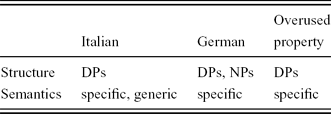
To summarize, German allows two different types of plural nominals in the subject position, realized syntactically as NPs and DPs. Italian only allows DPs in subject positions, with very few exceptions. In Standard German, each type of nominal is associated with one semantic interpretation: NPs with generic reference, DPs with specific reference. However, DPs are acceptable with generic reference in some varieties of German. Hence, there is variation in both languages, though to a lesser extent in Italian than in German. Table 1 summarizes the relevant properties.
Article use with plural and mass nouns in subject position.

3. Predicting cross-linguistic influence
Different scenarios predict the directionality of CLI with specific and generic plural and mass DPs. Some of these have been devised in previous studies.
Models of CLI can be distinguished into quantitative (To what extent does CLI occur?) and qualitative ones (What are the characteristics of CLI and why does it occur?). These two types of models do not compete, as the size of some effect does not generally depend on particular ways of describing or explaining the effect.
It is proposed here that (when predicting CLI in adult advanced learners) models which refer to semantic properties are more appropriate than models referring to syntactic properties. After all, unlike children and L2ers at the initial state, advanced learners will already have acquired the syntax of the language, while they continue to face problems when syntactic knowledge needs to be adjusted in the light of additional semantic and pragmatic information. Although it remains true that qualitative and quantitative models do not directly compete – in the sense of excluding one another – it is here assumed that these types of models can be ranked. In particular, the assumption is that the qualitative models can be overruled by language dominance. If so, then CLI only occurs in the weaker language.Footnote 8
3.1 Economy Hypothesis
According to Chierchia's (1998) Nominal Mapping Parameter (NMP), Germanic and Romance represent two parametric settings, differing in terms of the manner in which semantic properties are mapped onto syntax. In Romance, nouns emerge from the lexicon as predicates and in syntax the D-position must be projected to turn them into arguments. This means that Romance nominals in argument positions are structurally represented as DPs, and that nouns are generally preceded by articles or other determiners.
In Germanic, nouns come out of the lexicon as arguments or predicates. Predicate-denoting nouns in Germanic normally have a count denotation, and, as in Romance, need to project D. Argument-denoting nouns, by contrast, have a kind denotation and are directly mapped onto syntax, i.e., as NPs, which means that nouns may remain bare. However, even predicate-denoting nouns can sometimes be bare: Germanic employs a type-shifter which can turn bare predicates into arguments in order to denote kinds. Unlike in Romance, this type-shifter can be applied at the NP-level and generate the generic reading without projecting D. Chierchia (Reference Chierchia1998, p. 393) refers to the principle responsible for this operation as avoid structure: a determiner is avoided in the generic interpretation if the same interpretation can be obtained with a bare NP.
Avoid Structure predicts that learners will opt for the more economical structure whenever possible (see Pérez-Leroux, Munn, Schmitt & DeIrish, 2004; Serratrice et al., Reference Serratrice, Sorace, Filiaci and Baldo2009). This means for German–Italian bilinguals and L2ers that CLI is likely to occur from German to Italian, because German allows for structurally less complex nominals than Italian. The result of such influence would be the overuse and overacceptance of bare NPs with kind reference in Italian. Following Serratrice et al. (ibid., p. 244) this account is referred to as the economy hypothesis. Note that the Economy Hypothesis should also be effective in monolingual child language acquisition (see Gavarró, Pérez-Leroux & Roeper, Reference Gavarró, Pérez-Leroux, Roeper and Escobar2006).
3.2 Structural Overlap Hypothesis
Building on Döpke (Reference Döpke1998) and Müller (Reference Müller1998), Hulk and Müller (Reference Hulk and Müller2000) proposed that partial structural overlap at the surface level is a precondition for CLI: If one language has two options, e.g., structures X and Y, and the other language has only one option, e.g., only structure X, the option common to both languages, i.e., structure X, will be overused in the language that has both. By this rationale, Serratrice et al. (Reference Serratrice, Sorace, Filiaci and Baldo2009) outlined the following with regard to the distribution of definite articles in plural subjects in Italian–English bilinguals: CLI should go from Italian (only definite articles with plural NPs) to English (both definite plural DPs and bare plural NPs), where definite plural NPs should become acceptable with a generic reading.Footnote 9
German is similar to English in having definite plural DPs and bare plural NPs. Therefore, if this account applies to the present case, Italian should not be influenced, as it is the language with only one option. Importantly, the Structural Overlap Hypothesis does not make reference to the interpretation of definite nominals.
3.3 Semantic Overlap Hypothesis
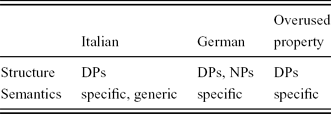
The Economy Hypothesis and the Structural Overlap Hypothesis make reference to the two structural representations, NP and DPs, while focussing on surface structure. Yet knowledge of the structures is insufficient for a proper interpretation of nominals in Italian, as the structures still have to be linked to the appropriate semantics on the basis of a given context. The overlap scenario looks different when applied to semantics than when applied to structure (see Table 2). From the perspective of DP-semantics, Italian would be the language with two interpretative options (specific and generic) and German the language with only one interpretative option (specific). Under the assumption that the option that is common to both languages (i.e., specific) is extended to the language that has two options, one expects that Italian is influenced by German, the effect being that DPs might be interpreted as having specific reference in Italian, even if a generic interpretation is also possible or required.
Predictions for cross-linguistic influence: Structural vs. semantic overlap.
3.4 Dominance Hypothesis
At the same time, language dominance may be crucial for the occurrence of CLI. If this were the case, Italian should only be affected in the group of German-dominant bilinguals and L2ers, but not in Italian-dominant bilinguals.
To sum up, there are four possible scenarios predicting the direction of CLI with subject nominals in German–Italian bilinguals and L2ers:
• The Economy Hypothesis predicts that German influences Italian, resulting in the overuse and overacceptance of NPs in Italian, specifically in generic contexts, where German requires them.
• The Structural Overlap Hypothesis predicts that there is no influence from German to Italian.
• The Semantic Overlap Hypothesis predicts influence from German to Italian: Bilinguals should be more inclined to interpret definite plural and mass DPs in Italian as specific because this is the interpretation that Italian and German share.
• The Dominance Hypothesis predicts that Italian is only affected in German-dominant simultaneous bilinguals and L2 Italian learners.
4. Previous research on the acquisition of generics
An increasing number of studies has been dedicated to article use and interpretation in generic contexts in monolingual, bilingual and L2 acquisition. Although the focus of the present study is adult simultaneous bilinguals and L2ers, the results from monolingual L1 acquisition studies retain their relevance, as they provide information about the age at which children may be expected to use and interpret articles correctly. Moreover, they can help uncover potential task effects.
4.1 Monolingual studies
Gelman and Raman (2003, pp. 314–315) investigated how English-learning children interpret generic utterances and which cues they pay attention to. One of their tasks displayed pictures of atypical or unusual characters, e.g., two tiny elephants or two cats without tails. After introducing these characters (Here are two elephants), a simple yes/no question was posed. Crucially, this question was presented in a way that used either the generic form (elephants) or the nongeneric form (the elephants), e.g., Now I am going to ask you a question about elephants. Are elephantsbig? or Now I am going to ask you a question about the elephants. Are the elephantsbig? Two-year-old English-learning children were shown to be able to make use of linguistic form to distinguish specific from generic readings. Clear overall discrimination patterns were observed in children and adults, with individual response patterns showing that a specific bias was more common than a generic bias.
Pérez-Leroux et al. (Reference Pérez-Leroux, Munn, Schmitt, DeIrish, Brugos, Micciulla and Smith2004) came to different results in a study of monolingual Spanish- and English-speaking children. To investigate the status of definite plural DPs in generic contexts they designed eight stories containing two atypical members of a kind. As in the task by Gelman and Raman (Reference Gelman and Raman2003), participants were presented with yes/no questions about the atypical characters (e.g., spotted zebras, cats who love to be in the water, vegetarian tigers). The answer to the question served to identify the semantic status of the noun phrase. Affirmative answers to questions about canonical properties of the kind (Do the zebrashave stripes?) and, conversely, negative answers to questions about the atypical (i.e., noncanonical) property (e.g., Do the zebrashave spots?) were taken to indicate acceptance of a generic interpretation of a noun phrase.
Results showed a strong preference among the Spanish-speaking children (ages 3;5–5;0 and 6;5–7;0) to interpret DPs (e.g., los tigres) as generic in contexts where either specific or generic interpretations were possible. Unexpectedly, the English-speaking children (ages 4;4–6;0 and 6;5–7;3) also gave a large proportion of generic answers (60–70%) although only specific interpretations were appropriate (Pérez-Leroux et al., Reference Pérez-Leroux, Munn, Schmitt, DeIrish, Brugos, Micciulla and Smith2004, p.5.). For instance, when shown pictures with spotted zebras and asked Do the zebras have stripes? they answered “yes”. As the authors note (ibid., p.11), the preference for generic interpretations may have resulted from introducing the characters by name. For example, the children saw a picture with spotted zebras while listening to the following story and question.
(15) Zippy the zebra and Suzy the zebra are spotted. The giraffe wonders why they look different. Now let me ask you some questions. Do the zebras have spots? . . .
Clearly, once a character has been introduced by name, referring to them with a definite DP is at least pragmatically marked, if not inappropriate.
To summarize, L1 acquisition studies have produced conflicting results with respect to children's interpretation of NPs and DPs in Romance and Germanic languages in specific and generic contexts. Gelman and Raman have shown sensitivity to the presence/absence of articles as a cue for specific/generic readings for children as young as 2–3 years, while Pérez-Leroux et al. have shown that older children (4;5–7;3) still had problems. The tendency for the children in the former study was to overaccept specific readings; the children in the latter study tended to overaccept generic readings. Comparing the two studies, which differed in terms of context length, one might suspect that there is a stronger reliance on the picture (creating a specific bias) with shorter contexts.
4.2 Bilingual studies
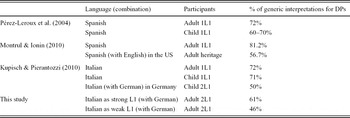
Kupisch and Pierantozzi (Reference Kupisch, Pierantozzi, Franich, Iserman and Keil2010) tested 6–10-year-old German–Italian bilingual children, monolingual children and adult controls in both German and Italian. They adapted Pérez-Leroux et al.'s (2004) design to investigate the interpretation of definite plural DPs. The children grew up in monolingual Italian and bi-national families in Germany and were generally more proficient in German.
Unlike in Pérez-Leroux et al. (Reference Pérez-Leroux, Munn, Schmitt, DeIrish, Brugos, Micciulla and Smith2004), where there was a separate story for each picture shown, pictures in this study were accompanied by a coherent story of two children, who set out on adventures on a Caribbean island where they met atypical characters. An example of a context and test question in Italian is given in (16a) and (16b). The associated picture displayed witches flying on vacuum cleaners.
(16)

Since definite DPs can only have a specific reading in Standard German, overacceptance of generic readings was unexpected here. In contrast, a preference for the specific reading in Italian (where both specific and generic readings are possible) was expected because of CLI from German, the stronger language of most children.
Similar to Pérez-Leroux's Spanish subjects, the monolingual child and adult participants showed a generic bias in Italian. Moreover, the bilingual children gave more generic interpretations in Italian than in German, constituting evidence which can be interpreted in favour of language separation. Interestingly, in both Italian and German, the bilingual children often explicitly commented on the perceived ambiguity of definite subject DPs, such as (16), which implies that both readings were available to them.
In German, child and adult participants overaccepted generic readings with definite plural subject DPs, adults doing so less often (20% of cases) than monolingual and bilingual children (both 37% of cases). This indicates that using the presence/absence of an article as a clue for a specific/generic reference seems to be acquired late by Germanic-learning children, likely after school enrolment. However, with increasing age, the children attributed comparatively fewer generic readings to definite DPs, and this change in the rate of attribution tended to occur at earlier ages in monolingual children. In general, this study raises the question whether the discrimination patterns witnessed by the bilinguals’ different interpretation preferences in each language will change at later ages, with increasing exposure to German.
Unlike all previous child studies, Serratrice et al. (Reference Serratrice, Sorace, Filiaci and Baldo2009) used an acceptability judgment task (AJT) to investigate article use with specific and generic subject nominals. Their study tested whether simultaneous English–Italian bilinguals (aged 6;2–10;10) accept ungrammatical Italian sentences with a bare NP, such as (17), when influenced by English:
(17)

The test sentences were preceded by an initial adjunct that was either compatible with the specific reading (It. qui/En. here) or with the generic reading (It. in genere/En. in general). Results indicated that, in Italian, bilingual children (especially in the UK) were significantly more likely than monolingual children to accept ungrammatical bare nouns in a generic context. All English–Italian bilinguals performed worse in the generic condition than in the specific condition. Also, their accuracy scores differed significantly vis-à-vis bilingual Italian–Spanish and monolingual Italian controls. These results can be interpreted as evidence in support of CLI from English, raising the question whether bilinguals can recover from CLI at later ages.
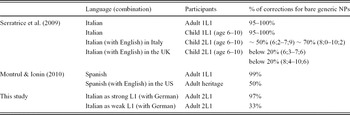
Montrul and Ionin (Reference Montrul and Ionin2010) investigated generic nominals in adult Spanish heritage speakers living in the US. The authors used a truth value judgment task (TVJT) with atypical characters and contextualized questions, similar to the studies summarized above, as well as an AJT. Participants were shown to be influenced by English when interpreting and using definite articles in generic contexts in Spanish. In the TVJT, Spanish DPs were interpreted as generic in 57% of all cases. In the AJT, participants failed to correct ungrammatical bare generic NPs 50% of the time. In contrast, they were not influenced by Spanish when interpreting and using English nominals. This study makes no prediction as to whether deviances from the monolingual norm might also occur in bilinguals with the same language combination but for whom Spanish is not the minority language.
Generics have also been studied in the L2 acquisition of Romance and Germanic languages (Ionin & Montrul, Reference Ionin and Montrul2010; Slabakova, Reference Slabakova2006; Snape, García Mayo & Gürel, Reference Snape, García Mayo, Gürel, Bowles, Ionin, Montrul and Tremblay2009). All studies show evidence of transfer from the L1, but – importantly for the present study – also evidence of recovery from transfer at very advanced levels.
The research summarized above raises two questions which are addressed in this study.
• Does bilingualism lead to incomplete acquisition of generic subject DPs in a Romance language when it is in contact with a Germanic language?
• Could methodological problems have obscured previous results (e.g., did the use of contexts in the form of stories create a generic bias)?
5. The study on article use in specific and generic plural DPs
5.1 Participants
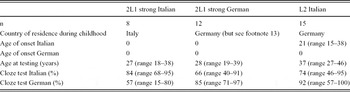
This study involves three different groups of adult participants who were recruited in Germany and Italy: two groups of early simultaneous bilinguals (2L1ers) and L2 learners of Italian (L2ers) with German as their L1.Footnote 10 All bilinguals grew up in bi-national families according to the one person–one language strategy and regularly used both languages at least until school age.Footnote 11 The two groups of 2L1ers differed with respect to their dominant language. Language dominance was assessed through a timed cloze test with 45 blanks which required filling in free morphemes and content words.Footnote 12 All 2L1ers scored better in the language of their childhood environment, which will therefore be considered “dominant”. The bilingual participants’ speech was also rated for foreign accent by native speakers of the respective languages. These ratings re-confirmed the conclusions arrived at by the cloze test.
Early bilinguals (2L1s) with Italian as dominant language
The bilinguals with Italian as their dominant language (n = 8) were between 18 and 38 years old (mean age: 27). All but one participant were recruited in Italy and had never spent more than six consecutive months in Germany. Five participants went to a German–Italian bilingual school. All participants in this group used more Italian than German in their daily lives, and self-reportedly felt more at ease when using Italian. All claimed to have good or very good knowledge of English. One participant in this group was recruited in Germany. He grew up in Italy but moved to Germany at the age of 17, where he continued to live for 21 years. Although he reported to use more German than Italian on a daily basis, and to feel equally confident using either language, he was more proficient in Italian according to the cloze test (48% and 75% accuracy in German and Italian, respectively). Moreover, 19 in 20 raters considered his German to sound foreign, compared to five in 20 raters judging his Italian to sound foreign.
Early bilinguals (2L1ers) with German as dominant language
The 2L1ers with German as dominant language (n = 12) were between 19 and 39 years old (mean age: 28). Participants in this group were recruited in Germany, although one was a resident of Italy at the time of testing. All but one had grown up in Germany.Footnote 13 Participants had spent between two consecutive months and six consecutive years in Italy (mean: 2 years). All but the Italian resident used more German than Italian on a daily basis. As for language preference, six participants reportedly felt more at ease when using German, three did not provide a statement, two felt more at ease when using Italian, one felt equally comfortable using both languages. The latter three turned out to be more proficient in German (as measured by the cloze test and foreign accent rating). The participant recruited in Italy showed only minimal differences between his two native languages. None of the participants went to a bilingual school, but two were students of Italian language and literature at the University of Hamburg. All participants reported to have good or very good knowledge of English and good or very good knowledge of Spanish or French. Two of them considered their level of English higher than their level of Italian, while ten considered themselves to be more proficient in Italian than in any foreign language they knew.
Second language learners (L2ers) of Italian
Preconditions for the L2ers’ participation were that they were advanced speakers (based on self-assessment) and had not received any Italian input before the age of 11. Participants in this group (n = 15) were between 27 and 46 years old (mean age: 37) and were first exposed to Italian between the ages of 15 and 38 years (mean age: 21). They had learnt Italian for between six and 30 years (mean: 16) and had spent either no time or up to 14 consecutive years in Italy (mean: 4 years). Five participants had been recruited in Italy and 10 in Germany; among the latter some had lived in Italy for several years. All L2ers were very fluent in Italian and had taken Italian language classes at some point. Nevertheless, naturalistic exposure was the prevalent input source for most of them. According to the cloze test, all L2ers were more proficient in their L1 German despite their high proficiency in Italian.
Information presented in this section is summarized in Table 3. Two points are particularly important for the remainder of the study. First, the language of the participants’ childhood environment determined their dominant language during adulthood. Second, the range obtained from the cloze test results indicates considerable variation in proficiency among the 2L1ers with weak Italian and the L2ers.
Overview of participants.

5.2 Acceptability judgment task (AJT)
Test items
All participants completed an AJT with 42 items targeting article use in specific and generic subject contexts.Footnote 14
A total of eight sentences were constructed with a context calling for a specific interpretation (specific condition); 34 test sentences were constructed with a context calling for a generic interpretation (generic condition).
Of the 34 test items in the generic condition, 17 contained grammatical subject DPs with a definite article, as in (18). These 17 items (nine with mass nouns, eight with count nouns) tested whether participants would accept subject DPs with definite articles, although the equivalent German sentences do not require an article.
(18)

Of the remaining 17 items, eight were ungrammatical containing a bare subject NP, as in (19), and nine were inappropriate containing an indefinite-marked subject DP, as in (20). Again, subject nominals were constructed with mass nouns (n = 9) and plural nouns (n = 8). The eight bare NPs tested whether participants would correct ungrammatical bare NPs in cases where German requires them. The nine indefinite-marked DPs were included to control whether participants paid attention to an article that is semantically inappropriate in the given context. (Because the context is generic, the equivalent German sentences require bare NPs).
(19)

(20)

The remaining eight stimuli contained sentences testing whether participants faced problems using or not using a definite article when the preceding context was biased towards specific reference (see (21)–(22)).Footnote 15 Associative uses of the definite article were constructed, because using the same DP in the context and test sentences might otherwise have influenced participants’ judgments.
(21)

(22)

Items were constructed in pairs; each grammatical/acceptable sentence had an ungrammatical/inappropriate counterpart similar in length, context sentence and vocabulary.
Procedure
Stimulus sentences appeared in random order and were presented both auditorily and in writing (yellow type on a black computer screen). Most test sentences were preceded by a context sentence in a different colour.Footnote 16 Participants were instructed to read and listen to each example, and to repeat the yellow sentence when they thought it sounded good, else correct it when they thought it sounded bad. Response time was limited and corresponded to three times the duration of the test sentence read by a native speaker. If participants failed to respond within this limit, their response was not recorded or recorded incompletely.
Results
For the data analysis, the number of responses to acceptable and unacceptable/ungrammatical items were counted separately. Participants’ corrections were examined and classified as relevant or irrelevant. Answers which failed to correct missing or semantically inappropriate articles in subject nominals were taken to indicate lack of sensitivity towards the phenomenon investigated. For example, sometimes participants corrected the gender of a given indefinite article instead of correcting it to a definite article. Items for which participants failed to provide an answer within the time limit were removed from the analysis.Footnote 17
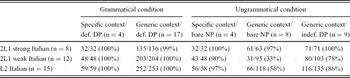
Results of the AJT (mean accuracy in %) are shown in Table 4, indicating correct repetition in the case of grammatical contexts and expected correction in the case of inappropriate or ungrammatical items.
Responses in the AJT (accuracy in %).

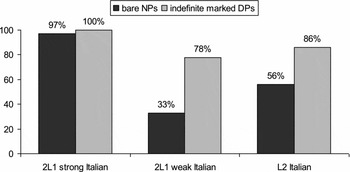
In only one case was a correct sentence repeated incorrectly. Therefore, grammatical contexts do not reveal differences between the three groups of learners (and will not be discussed further). Comparisons between the three ungrammatical contexts are illustrated in Figures 1 and 2. A multilevel logistic regression analysis was carried out to determine whether there were significant contrasts between the three conditions and between the three groups.
Appropriate corrections of bare NPs in specific and generic contexts.

Appropriate corrections of bare NPs and indefinite DPs in generic contexts.

A comparison between specific and nonspecific ungrammatical contexts (see Figure 1) did not yield a reliable test result for the 2L1ers with Italian as their stronger language.Footnote 18 The same comparison was highly significant for the 2L1ers with Italian as the weaker language (B = 5.24, SE = 1.28, z = 4.09, p < .0001) and for the L2ers (B = 4.49, SE = 1.08, z = 4.16, p < .0001). Across-group comparison of corrections in specific contexts did not yield a reliable test result with respect to the contrast between the two groups of 2L1ers and between the L2ers and the 2L1ers with Italian as their stronger language due to ceiling performance of the latter group. The difference between the 2L1s with Italian as their weaker language and the L2ers was not significant (B = –1.26, SE = 1.41, z = –0.89, p > .05). As for corrections in generic contexts, contrasts were highly significant between the two groups of 2L1s (B = –6.74, SE = 1.66, z = –0.06, p < .0001) and moreover between the 2L1s with Italian as their stronger language and the L2ers (B = 4.75, SE = 1.62, z = 2.94, p < .005), but not between the 2L1s with Italian as their weaker language and the L2ers (B = –2.0, SE = 1.07, z = –1.87, p > .05).
Comparison between the corrections of bare NPs and of indefinite-marked DPs in generic contexts, illustrated in Figure 2, did not yield a reliable result for the 2L1ers with Italian as their stronger language, again due to ceiling performance. In contrast, comparison was highly significant for the 2L1ers with Italian as their weaker language (B = 2.92, SE = 0.44, z = 6.71, p < .0001) and for the L2ers (B = 2.93, SE = 0.49, z = 5.97, p < .0001). Comparison across groups in the indefinite condition did not yield reliable test results between the 2L1ers with Italian as the stronger language and each of the other two groups. Comparison was not significant between the 2L1ers with Italian as their weaker language and the L2ers (B = –1.46, SE = 1.01, z = –1.45, p < .5).
There was considerable individual variation, especially within the groups of L2ers and 2L1ers with Italian as the weaker language. While all bilingual participants who grew up in Italy corrected at least 75% of bare nouns in the test condition, only two out of 12 heritage speakers did so (17%), compared to seven out of 15 L2ers (47%).
Summarizing, there were no differences across groups with respect to grammatical contexts. Here, all participants showed target-like performance. Bilinguals with Italian as the stronger language (i.e., those who grew up in Italy) also performed in a target-like manner in all remaining conditions. In contrast, bilinguals with Italian as the weaker language and L2ers faced problems correcting bare and indefinite-marked nouns. These two groups showed qualitatively similar tendencies, correcting significantly more bare NPs in specific contexts than in generic contexts, and significantly more indefinite DPs than bare NPs in the generic condition. Overall, the L2ers corrected more ungrammatical bare NPs and semantically inappropriate DPs than the bilinguals with Italian as the weaker language, but this contrast was not statistically significant.
5.3 Truth value judgment task (TVJT)
Test items
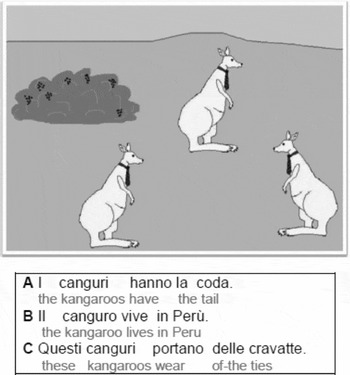
The truth value judgment task was modelled on similar tasks used by Gelman and Raman (Reference Gelman and Raman2003) and Pérez-Leroux et al. (Reference Pérez-Leroux, Munn, Schmitt, DeIrish, Brugos, Micciulla and Smith2004) with the methodological changes outlined below. Twelve coloured pictures were designed. Every picture showed three objects or characters of one kind, each with two anomalies (e.g., blue sunflowers in the desert; kangaroos with ties but without tails, flying monkeys eating ice-cream). Each picture was accompanied by three statements, resulting in a total of 36 statements (see Figure 3).
Test item in TVJT.

The 36 statements divide into three conditions. Statements in all conditions were balanced for truth value: half the statements were true with respect to the picture but false with respect to facts, and vice versa for the other half. All sentences were grammatical.
The major condition displayed statements (n = 12) with definite DPs, such as those in (23) below. Recall that these can have a specific or a generic reading in Italian. The assigned truth value served to identify the semantic status of the DP.
(23)

The response “true” (T) to a statement about canonical properties of the kind (e.g., kangaroos having tails, as in (23a)) indicates a generic interpretation of the subject DP; the response “false” (F) indicates a specific interpretation. Conversely, the response “true” to a statement about atypical (i.e., noncanonical) properties of the kind (e.g., blue sunflowers, as in (23b)) indicates a specific reading; the response “false” indicates acceptance of a generic interpretation.
Importantly, the major condition indicates a “preference” for one of two possible readings of definite DPs in Italian. It was expected that different preferences arise depending on whether there is CLI from Standard German, where such DPs can only have specific readings.
The second condition contained demonstrative controls (n = 12), which always yielded specific readings. Again, sentences displayed made statements either about a canonical property of the kind, as in (24a) – and were false with respect to the picture – or about a noncanonical property, as in (24b) – and then were true with respect to the picture.
(24)

The third condition consisted of singular controls (n = 12). These were subdivided depending on whether their truth value could in principle be gathered from the picture, see (25a) below, or whether their truth value required world knowledge that could not be gained from the picture, see (25b).
(25)

Such items controlled whether the participants paid attention to the meaning of the sentences. For example, if a participant answered “false” with respect to (25a), she may not have looked at the picture carefully enough. If a participant did not know the answer to the question in (25b), he may have lacked the required world knowledge or may not have paid attention. A further purpose of the controls was to increase participants’ awareness that test statements could in principle be interpreted with respect to the picture or with respect to the world.
Singular controls always appeared between the other two statements, while the order of statements containing plural articles and demonstratives varied between the other two positions. Out of three statements, at least one (and maximally two) could be interpreted as true. (In each picture, demonstrative and singular controls had different truth values.)
Five methodological decisions were made which distinguish the design from previous studies. First, prior to testing, participants were explicitly instructed that sentences could either be related to the picture or to the world. The reason for this instruction was that during the pilot some participants gave one and the same type of interpretation throughout the test (only specific or only generic). The disadvantage is that participants might have intuitively guessed what the test was about. Second, as mentioned above, participants were instructed to listen to all three statements before giving a truth value judgment. This way, they heard and read sentences containing subject DPs of different types (e.g., with a demonstrative and a definite article) one after the other. This measure was used to make the different surface structure of sentences as evident as possible. Third, there was no context in the form of a preceding story or introductory sentence in order to avoid a bias towards either the generic or the specific reading through context. Fourth, there were no semantic clues that could have triggered specific or generic interpretations, such as “here” or “in general”. Fifth, each character had two anomalies, so the test question and the demonstrative question referred to different properties.
Procedure
Stimuli were presented in PowerPoint, and participants were instructed that they would see a series of pictures, each with three statements they could hear and read, and which they had to judge as being true or false. They were explicitly instructed that statements either could or could not be related to pictures, and that they had to listen to and read all three statements before making a judgment. They were also told that at least one but maximally two statements were true. There were two semi-randomized test versions.
Results
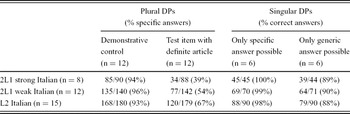
Responses were counted as specific interpretations if they were congruous with the pictures, and as generic interpretations if they were not. In case participants changed their mind, their final judgment was counted. Table 5 summarizes the results.
Responses in the TVJT. a

a Object DPs in the test sentences contained either a singular definite DP or a plural indefinite DP (compare (i) and (ii)):

the birds have the beak
This variation between indefinite and definite object DPs was included to test whether definite object DPs would consistently bias speakers’ judgments towards the specific reading and definite object DPs towards the generic reading. This was not the case, although all groups were more inclined to give a generic response when the object DP was definite.
Statements with singular DPs for which the proper judgments could be found in the pictures yielded mostly specific interpretations (98–100%). Statements with singular DPs that could not be judged on the basis of the pictures (but required world knowledge) yielded mostly generic responses (around 90%). The number of incorrect judgments was slightly higher for the latter, probably because some participants lacked the required world knowledge (e.g., “The horse was domesticated more than 500 years ago”).
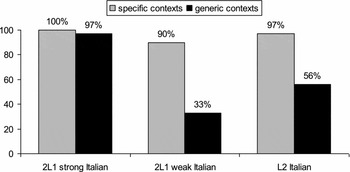
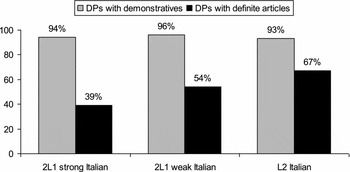
Control sentences containing plural demonstratives yielded predominantly specific answers (93–96%).Footnote 19 In the test condition, where specific and generic interpretations were possible, 2L1ers with Italian as the stronger language showed a preference for generic readings (61% of all cases). 2L1s with Italian as their weaker language accepted both readings without showing a clear preference for any of the two (46% generic interpretations), while L2ers showed a specific bias (33% generic interpretations) (see Figure 4).
Specific answers with demonstrative plurals and definite articles in TVJT.

A multiple logistic regression analysis did not yield significant differences between the individual groups in the demonstrative condition, neither between the two bilingual groups (B = –0.59, SE = 0.73, z = –0.81, p > .5) nor between the 2L1s with strong Italian and the L2ers (B = 0.18, SE = 0.63, z = 0.28, p > .5), nor between the 2L1 with weak Italian and the L2ers (B = 0–.77, SE = 0.61, z = –1.26, p > .5). In the condition with definite articles, the comparison was not significant between the two bilingual groups (–1.24, SE = 0.87, z = –1.43, p > .5) and between bilinguals with Italian as the weaker language and the L2ers (B = 0.78, SE = 0.73, z = 1.06, p > .05). Only between 2L1ers with Italian as the stronger language and L2ers did the comparison yield a significant difference (B = –2.01, SE = 0.83, z = –0.42, p < .05).
Noticeable individual variation could be observed. The number of subjects who interpreted 75% or more of statements with plural subject DPs as generic was four out of eight Italian-dominant subjects, four out of 12 bilinguals with Italian as the weaker language, compared to only one out of 15 L2ers.
Comparing the results of the two test modes, the AJT shows more quantitative similarities between bilinguals with strong Italian and L2ers (i.e. more than between the two groups of 2L1ers), while the TVJT shows more quantitative similarities between the two groups of 2L1ers (i.e. more than between the bilinguals with strong Italian and the L2ers). One could ask whether these findings point to a disadvantage for bilingual speakers in AJTs as compared to tasks requiring more intuitive judgments. What speaks against this conjecture is that participants heard and read sentences in both the AJT and the TVJT, and had to provide spoken answers in both cases. However, a difference between the two tests was that, in the TVJT, participants could determine the speed themselves and then tended to respond rather quickly. In contrast, the response time in the AJT was pre-programmed and appeared to be too long for many participants. The relatively long response time in the AJT may have induced access to explicit knowledge, which would have been especially advantageous for L2ers, most of whom had some formal instruction in Italian.
5.4 Summary
The AJT has shown that bilingual German–Italian speakers who grew up in Italy perform at ceiling (accuracy 97–100%) in judging the grammaticality and acceptability of bare, indefinite and definite nominals in Italian, regardless of how these properties are realized in German. L2ers and bilinguals with Italian as their weaker language accept grammatical DPs regardless of how these are realized in German. However, the latter face significantly more problems in correcting ungrammatical and inappropriate Italian DPs whose German equivalents have a different structure, compared with correcting DPs whose German equivalents look the same. In the TVJT definite plural articles were more likely to be interpreted as generic provided Italian was the stronger language.
6. Discussion
Returning to the questions raised in the beginning, and based on the results presented in the previous section, implications for models of CLI, methodology and terminology are now discussed.
6.1 Differences between the weaker and the stronger language
German–Italian bilinguals who grew up in Italy have been shown to perform at ceiling (accuracy 97–100%) in judging the grammaticality and acceptability of bare, indefinite and definite nominals in Italian. In contrast, German–Italian bilinguals who grew up in Germany faced considerable problems correcting bare subject NPs if these were embedded in a generic context. They were slightly better at correcting indefinite subject DPs and they faced no problems correcting bare NPs in specific contexts. That is, deviances between the stronger and the weaker language were restricted to contexts in which Italian differs from German.
Results of the AJT are compatible with previous studies testing the acceptability of bare subject NPs in generic contexts. Montrul and Ionin (Reference Montrul and Ionin2010) found that Spanish heritage speakers corrected ungrammatical bare plural NPs with generic reference in Spanish only 50% of the time. The result is also in line with Serratrice et al.'s (2009) study. Although these authors found that all Italian–English bilingual children scored significantly lower than monolingual controls, bilinguals in Italy outperformed their bilingual counterparts in the UK and showed significant progress with increasing age (ibid., p. 252). This suggests that they may become native-like at a later point in their development, which in turn is consistent with the outcomes of this study. Table 6 compares the results of all three studies.
Correction of bare subject NPs in AJTs testing Romance languages.

The TVJT also yielded differences between Italian as the stronger and as the weaker language. With definite DPs – the condition in which Standard German does not allow generic interpretations – participants with Italian as the stronger language were more inclined to give a generic interpretation than participants with Italian as the weaker language. Although this difference was not statistically significant between the two groups, there was a clear tendency for bilingual subjects with a Romance language as their weaker language to provide more specific responses than monolingual speakers or bilinguals for whom the Romance language is stronger, thus weakly confirming results of previous studies (see Table 7).
Interpretation of definite subject DPs in TVJTs testing Romance languages.

Taken together, the results of this study suggest that frequency of hearing and using Italian may play a significant role in the development of grammar, here with respect to article use in subject DPs. In fact, among 2L1ers who grew up in Germany, only the participant who had spent two years prior to testing in Italy showed ceiling performance in the AJT (accuracy above 95%). These results are consistent with previous hypotheses, e.g., by Gathercole (Reference Gathercole, Oller and Eilers2002) and Serratrice et al. (Reference Serratrice, Sorace, Filiaci and Baldo2009), which stress the role of frequency of exposure and language use in bilingual development.
This study shows further that in the language which constitutes the majority language of a given environment bilinguals will develop the same grammar as monolinguals, suggesting that data from bilinguals’ stronger language may be as adequate as control data for the weaker language as monolingual data.
6.2 Age of onset
This study shows that, in the TVJT (measuring preferred readings of definite DPs) and in the AJT (measuring the ability to correct indefinite DPs and bare NPs in generic contexts), there were no statistically significant differences between 2L1ers with Italian as their weaker language and L2ers. This in turn implies that the age at which participants had first been exposed to the language cannot have determined their acquisition outcomes.
Instead, the time the two groups had spent in Italy and the length of sustained exposure may have been crucial. L2ers who succeeded in correcting 75% or more bare subject NPs had on average lived seven consecutive years in Italy, compared with the 2L1 weak Italian group having on average lived in Italy for only two years. Moreover, the L2ers were older than the 2L1ers and had been learning Italian for 16 years on average, suggesting that some L2ers may have heard and used Italian even more frequently than the 2L1ers.
These results support the conclusion that, for the phenomenon investigated, the impact of age of onset can be overruled by frequent and sustained exposure, regardless of whether exposure took place in childhood or adulthood.
Incomplete grammars?
Recent studies in the domain of heritage language development have proposed that incomplete acquisition is a possible result of insufficient language input and use in the heritage or weaker language (e.g., Montrul, Reference Montrul2008).
This study provides three reasons why the weaker 2L1 and L2 grammars should not be considered “incomplete”. First, participants did not reject definite nominals in generic contexts but merely failed to correct bare NPs. Second, they did not consistently interpret definite nominals as specific (but merely did so predominantly). Third, they often corrected indefinite articles in generic contexts to definite ones, indicating that they did not fail to acquire the generic feature of the definite article.
In this respect, these Italian grammars correspond more closely with what Sorace (Reference Sorace1993), in the context of near-native L2ers, has referred to as deviant (rather than incomplete) grammars. Incomplete and divergent grammars are two distinct states of grammatical competence in ultimate attainment. The incomplete grammar lacks a particular L2 property, which leads to random judgments. The divergent grammar incorporates an alternative representation of an L2 property, which leads to judgments that are consistently different from those of native speakers. Given the rather systematic behaviour of the Italian 2L1ers with German as their stronger language and of the L2ers, the concept of divergent grammars appears to be a more appropriate descriptive term than that of incomplete grammars.
6.3 Models of cross-linguistic influence
It has been shown above that the stronger language of an adult bilingual speaker exhibits the properties of the monolingual target, while this does not hold for the weaker language. Therefore, any standard model of CLI which intends to fully capture such data should take language dominance into account. In this study, the dominant language corresponded with the environment language during childhood and adolescence, indicating that the quantity of input during childhood may be a factor that determines acquisition outcomes.
The results also support the Semantic Overlap Hypothesis, which predicts that an interpretation present in both contact languages (here: the specific interpretation of DPs) is overused in the language where two different interpretations are available, at the cost of the option available in only one of the two languages (here: the generic interpretation of DPs). Since speakers with German as the dominant language showed a strong inclination to interpret DPs as specific in Italian (compared to Italian-dominant speakers of Italian), the predictions of the Semantic Overlap Hypothesis may count as confirmed by this data.
In contrast, the Structural Overlap Hypothesis predicts that Italian is not subject to influence. However, German-dominant participants (2L1ers and L2ers) overaccepted bare Italian NPs in contexts where DPs are required, thus contradicting this model.
At first glance, however, the results also seem to be consistent with the Economy Hypothesis, according to which learners opt for the syntactically less complex option. Nevertheless, it can be argued that this is not a plausible model for predicting CLI, at least not in adult bilinguals. The first problem the model faces is the existence of German varieties allowing both bare nouns and definite articles with generic nouns (see Section 2 above). If Avoid Structure were a universal or exceptionless linguistic principle, then speakers of a language should never entertain the possibility of projecting DPs whenever projecting an NP is an option in that language. Second, although participants in this study overaccepted bare NPs in generic contexts, they also accepted DPs in the same type of context (instead of correcting them to structurally less complex bare NPs, as Avoid Structure predicts). Third, they corrected semantically inappropriate indefinite DPs to definite DPs, even though these DPs translate into bare NPs in German.Footnote 20 Taken together, these observations make it rather difficult to interpret the data as evidence for a general dislike of structurally more complex DPs.
To conclude, it appears reasonable to assume that German-dominant speakers showed a preference for the specific interpretation of DPs in Italian because this is the only possible interpretation in Standard German and Italian. In contrast, it appears improbable that German-dominant speakers accept more Italian bare NPs in generic contexts in order to avoid syntactically more complex structures. An alternative explanation could be that bilinguals try to create or accept syntactic constructions that more transparently reflect the underlying semantic and syntactic relations, as proposed by Andersen (Reference Andersen, Lambert and Freed1982, p. 99): bilinguals might have overaccepted bare NPs when the definite article was ambiguous in an attempt to create a one-to-one mapping between syntax and semantics, as they find it in German. If this were indeed the case, fewer problems would be expected in a corresponding German test, something to be explored in future research.
6.4 Methodological issues in the truth value judgment task
This study attempted to avoid methodological problems potentially arising in previous studies using truth value judgment tasks. As mentioned above, one puzzling fact is that Gelman and Raman's (2003) English-speaking children were more successful than those studied by Pérez-Leroux et al. (Reference Pérez-Leroux, Munn, Schmitt, DeIrish, Brugos, Micciulla and Smith2004) in using the presence of the definite article as an indicator of specific reference, even though they were younger. It was speculated that the generic bias in the latter study might have been triggered by particular properties of the introductory sentences. In Serratrice et al.'s (2009) study, failure to interpret adverbs (“here or “in general”) as clues for, respectively, specificity or genericity, may account for some of the problems their participants faced.
This study tried to avoid contextual influences, and refrained from the use of introductory sentences or adverbs that might bias the sentences’ interpretation to either a specific or a generic one. However, this move may have created a new problem: The absence of context in this study may have increased the subject's focus on the picture, thereby inducing a specific bias. An indication that this may have been the case is that some bare NPs were interpreted as specific in the German version of the test. Moreover, when looking at a series of pictures with anomalous characters, a participant may think that she has to interpret statements about genericity within the world presented in the pictures. In other words, the participants’ judging of pictures from the point of view of imaginary rather than real world knowledge may have obscured the results. Although this may be a possible flaw in the experimental setting, it does not invalidate the measured difference in preferred answers between Italian-dominant bilinguals and German-dominant bilinguals. Nevertheless, future studies should address this issue.
7. Conclusions
This study focussed on the use and interpretation of generic nominals in learners of Italian. Three groups were tested: (i) simultaneous German–Italian bilinguals who grew up in Germany and had Italian as their weaker language, (ii) simultaneous German–Italian bilinguals who grew up in Italy and had Italian as their stronger language (and German as their weaker language), and (iii) advanced L2ers of Italian with German as their L1. Both groups of German-dominant speakers (i.e., 2L1ers with weak Italian and L2ers) differed from bilinguals with Italian as the stronger language in judging and interpreting nominals in generic contexts: they faced significantly more problems in rejecting bare NPs in generic contexts, and overaccepted sentences like Italian *Donne guidano meglio (literally: “Women drive better”). Additionally, they were more likely to interpret definite-marked DPs (ambiguous in terms of specific and generic readings) as specific, as in sentences such as Italian I canguri hanno la coda (literally: “The kangaroos have the tail”). Since German and Italian differ in these two conditions, the results can be taken as evidence in favour of CLI from German. In fact, none of the three groups experienced difficulties in test conditions for which German and Italian have overlapping structures and interpretations, as is the case for DPs with specific reference.
While showing CLI, 2L1ers with Italian as their weaker language and L2ers never corrected DPs into bare NPs, and they were not generally insensitive to semantic violations in generic contexts. This speaks against the view that they failed to acquire the generic feature of definite articles. Instead, they consistently and rather uniformly tolerated bare NPs in contexts where Standard German requires them (see also Barton (Reference Barton2011) for similar results with German–French bilinguals), suggesting that their grammars may count as “deviant” from the grammars of speakers who grew up in Italy, rather than “incomplete”.
Since Italian-dominant bilinguals provide the same judgments as one would expect from monolingual speakers, one may conclude that bilingualism does not automatically lead to deviant grammars. Rather, deviance may be a result of reduced input and language use during childhood.
The fact that some L2ers perform native-like and on a par with bilinguals whose stronger language is Italian indicates that L1-influence can be overcome at very advanced stages of development. Quantitative and qualitative similarities between Italian as an L2 and as the weaker language in bilinguals imply that frequent exposure and consistent input are more crucial than age of onset, at least for the phenomenon investigated.