Introduction
Helping smokers to quit will reduce the death and disease caused by tobacco (Jha & Chaloupka, Reference Jha and Chaloupka1999), however, despite decades of clinical investigation, reliably assisting smokers to successfully quit remains a challenge. Numerous studies have reported that craving intensity is positively associated with relapse (e.g., Ferguson & Shiffman, Reference Ferguson, Shiffman and Millier2013; Ferguson, Shiffman, & Gwaltney, Reference Ferguson, Shiffman and Gwaltney2006; Killen & Fortmann, Reference Killen and Fortmann1997). While craving and relapse are often associated with nicotine deprivation as a result of smoking abstinence, observational studies have found that during a quit attempt, smokers can experience periods of intense craving – and lapses – following exposure to smoking-relevant situations and stimuli (Abrams, Monti, Carey, Pinto, & Jacobus, Reference Abrams, Monti, Carey, Pinto and Jacobus1988; Niaura, Abrams, Monti, & Pedraza, Reference Niaura, Abrams, Monti and Pedraza1989; Wray, Gass, & Tiffany, Reference Wray, Gass and Tiffany2013). Such effects – commonly attributed to learned associations between stimuli and smoking – have also been observed experimentally under laboratory conditions (Carter & Tiffany, Reference Carter and Tiffany1999). The key finding from the cue-reactivity literature is that exposing smokers to smoking-related environmental stimuli reliably provokes cigarette cravings (termed cue-induced cravings; Carter & Tiffany, Reference Carter and Tiffany1999; Niaura et al, Reference Niaura, Rohsenow, Binkoff, Monti, Pedraza and Abrams1988; Sayette & Tiffany, Reference Sayette and Tiffany2013). Together, the findings from both laboratory and clinical settings provide compelling evidence that environmental cues can provoke craving and relapse. Developing effective methods for resisting cue-induced craving is, therefore, an important therapeutic objective (Ferguson & Shiffman, Reference Ferguson and Shiffman2009).
At present there are few treatments that have demonstrated efficacy at aiding recovery from cue-induced cravings. While pharmacological treatments such as nicotine patches and bupropion have been shown to be both efficacious and to reduce background craving and withdrawal severity (Fiore et al., Reference Fiore, Jaen, Baker, Bailey, Benowitz and Curry2008), they do not appear to either prevent cue-induced cravings (that is, to prevent the spike in craving associated with cue-exposure), or to aid recovery from them (that is, to reduce the duration of the craving event itself; see Ferguson & Shiffman, Reference Ferguson and Shiffman2009 for a review). In contrast to steady-state nicotine patches, acute administration of nicotine via gum and lozenge has been shown to reduce the duration of cue-induced cravings (Durcan et al., Reference Durcan, De’Ath, Targett, Marsh, Chan and Ong2003; Niaura et al., Reference Niaura, Sayette, Shiffman, Glover, Nides and Shelanski2005). Varenicline also, has been shown by some studies to alter cue provoked responses (Brandon et al., Reference Brandon, Drobes, Unrod, Heckman, Oliver and Roetzheim2011; Franklin et al., Reference Franklin, Wang, Suh, Hazan, Cruz and Li2011). However, acute nicotine replacement and/or the prescription of varenicline are not acceptable options for all quitters, as many smokers prefer to attempt to quit without medication (see Shiffman, Brockwell, Pillitteri, & Gitchell, Reference Shiffman, Brockwell, Pillitteri and Gitchell2008).
While a majority of quitters attempt to do so unassisted, when aids are used, 1-in-4 of these include some form of behavioural intervention (e.g., counselling, web-based support programs etc.) and are, thus, among some of the most commonly used smoking cessation strategies utilized (Shiffman et al., Reference Shiffman, Brockwell, Pillitteri and Gitchell2008). These interventions – which typically focus on providing advice for either avoiding or overcoming high-risk smoking situations (Civljak, Sheikh, Stead, & Car, Reference Civljak, Sheikh, Stead and Car2010; Lancaster & Stead, Reference Lancaster and Stead2005) – have consistently been shown to improve the odds of quitting (Fiore et al., Reference Fiore, Jaen, Baker, Bailey, Benowitz and Curry2008). However, despite being a mainstay in assisted quit attempts, the components of which can be clearly identified and defined (Michie, Hyder, Walia, & West, Reference Michie, Hyder, Walia and West2011), very little is known about how behavioural interventions actually work (Shiffman, Reference Shiffman1993). Further, there are a variety of programs available, with diverse, unevaluated content. One plausible mechanism is that they may help smokers to either avoid or cope with cue-induced cravings, thereby increasing the likelihood of maintaining abstinence. This has not been comprehensively evaluated. Data from a small number of observational studies (Curry & Marlatt, Reference Curry, Marlatt, Shiffman and Wills1985; Merchant, Pulvers, Brooks, & Edwards, Reference Merchant, Pulvers, Brooks and Edwards2013; O’Connell, Hosein, & Schwartz, Reference O’Connell, Hosein and Schwartz2006; O’Connell & Martin, Reference O’Connell and Martin1987; Shiffman, Reference Shiffman1982, Reference Shiffman1984) have suggested relapse can be avoided when participants use coping strategies during temptation episodes, but as participants were not randomized it is not possible to determine whether the effect was due to the coping strategies themselves, or whether the intervention itself was effective. This pilot study was conducted to evaluate the effect of selected coping techniques on alleviating cue-induced cravings in a laboratory cue-reactivity setting.
Method
Participants
Participants were recruited to take part in a multi-site randomized cue reactivity study. Adult smokers (≥10 cigarettes per day [CPD] for ≥3 years) who were not currently interested in quitting smoking, but were interested in learning ways to cope with smoking temptations, were recruited across three University of Tasmania campuses and surrounding districts. Participants were recruited between March and August 2013 using flyers and targeted advertising on Facebook© (see Frandsen, Walters, & Ferguson, Reference Frandsen, Walters and Ferguson2014). Interested smokers were told that the study was designed to investigate the use of coping strategies to help smokers deal with cigarette cravings. A total of 37 (Control Group: 17 [45.9%], Intervention Group: 20 [54.1%]) participants were recruited and completed the study. [An additional participant was recruited and enrolled but failed to complete the second experimental session and hence has been removed from the analyses.] The average participant was 32 years of age, female, smoked 14.4 CPD, and 67.6% smoked their first cigarette of the day within 30 minutes of waking. There were no significant differences between groups for ethnicity, education, marital status, number of years smoking, prior quit attempts, or partner's smoking behaviour. Participants gave informed written consent to partake in the study, which was approved by the Human Research Ethics Committee (Tasmania) Network.
Procedure
Interested individuals who met the initial screening criteria were invited to take part in the study, comprising two sessions. Participants were asked to abstain from smoking for three hours prior to each of the two study sessions (verified by self-report). Following the completion of a baseline survey gathering basic background information, participants undertook a cue-reactivity task.
The cue-reactivity task followed a standardized procedure (Ferguson & Shiffman, Reference Ferguson and Shiffman2009; Niaura et al., Reference Niaura, Sayette, Shiffman, Glover, Nides and Shelanski2005; Shiffman et al., Reference Shiffman, Shadel, Niaura, Khayrallah, Jorenby and Ryan2003), by pre-recorded computer-delivered instructions, and lasted approximately 25 minutes. After 5 minutes of acclimatisation, participants were instructed to complete a craving assessment (pre-exposure) [to obtain an ‘uncued’ baseline measure of abstinence-based craving (Sayette & Tiffany, Reference Sayette and Tiffany2013)]; craving was assessed using the Questionnaire of Smoking Urges – Brief (10 items, range 10–70; Cox, Tiffany, & Christen, Reference Cox, Tiffany and Christen2001). Next, participants were asked to open a grey box containing a packet of cigarettes, an ashtray and a lighter. They were instructed to handle the items: to remove and smell a cigarette and flick the lighter. After 3 minutes of this acute cue exposure, a second craving assessment took place (post-exposure). Participants were then asked to remain in the laboratory for an additional 10 minutes. The smoking cues were visible during this period and participants were instructed not to touch the stimuli but to imagine handling these items as they previously had been. Following this prolonged visual cue exposure, participants completed a final craving assessment (prolonged exposure). [Since the purpose of this pilot study was to determine the potential treatment effect of coping strategies on cue induced-cravings, and not to measure the level of cue-reactivity invoked, the inclusion of a control or ‘neutral’ stimuli was deemed unnecessary.]
Following the cue-reactivity task, participants were randomized to either the control or intervention group using a pre-determined sequence. Participants in the intervention group received detailed instructions and training in a range of cognitive and behavioural coping strategies believed to help to alleviate, or to resist, cue-induced cravings. This training was provided in-person by one of two trained research assistants, following a standardized training procedure. Each participant engaged only with one researcher. The coping strategies discussed were drawn from the smoking literature (Fiore et al., Reference Fiore, Jaen, Baker, Bailey, Benowitz and Curry2008) and included thinking about short-term positive consequences of not smoking (e.g., health benefits) or the long-term negative consequences associated with smoking. The use of distraction (e.g., counting backwards from 100 to 1) and a deep breathing exercise for relaxation were also discussed. Participants were provided with instructions on using the strategies they had been taught and were encouraged to practice these before their second and final study session.
During the second study session (scheduled for ~7 days after the initial session; mean = 7.3, SD = 1.9) participants in both groups repeated the cue-reactivity task. Participants in the Intervention Group were encouraged to utilize the coping strategies they had been taught in the previous session during exposure to the cues. At the completion of the second study session participants in the Control Group were provided with the same coping training as had been given to the Intervention Group participants at the end of the first session.
Analytic Plan
To determine the effect of intervention on craving, we first assessed the effect of the intervention on reducing the spike in craving associated with initial exposure to smoking cues. To do this, we calculated the difference between the pre-exposure (baseline) and post-exposure measures. Next, we assessed the effect of the intervention on prolonged craving. To do this, we calculated the difference between craving pre-exposure and that reported at the end of the prolonged-exposure.
While overall results are also presented, analyses focus on the subset of participants who were shown to be responsive to the cue reactivity procedure. Participants were split into groups based on their response to the cue-reactivity procedures during the first study session. Similar to previous studies (e.g., Shiffman et al., Reference Shiffman, Shadel, Niaura, Khayrallah, Jorenby and Ryan2003; Weinberger, McKee, & George, Reference Weinberger, McKee and George2012), participants whose craving increased following exposure (based on the difference between pre-exposure and post-exposure craving scores) were classified as responders (n = 19 [Intervention n = 9; Control n = 10]; mean increase = 6.2, range: 1 to 17); all other participants were considered to be non-responders (n = 18 [Intervention n = 11; Control n = 7]; mean change = −9.4, range: −25 to 0).
Results
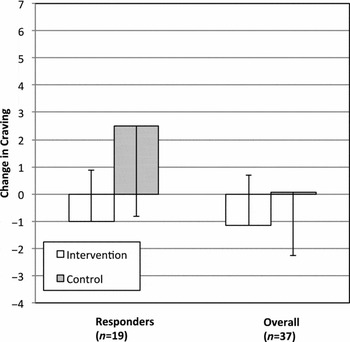
Figure 1 shows the difference between the pre-exposure and post-exposure craving measures by group assignment. Among responders, participants in the Intervention Group reported a slight decrease in craving following the acute exposure manipulation, compared to an increase in craving (as would be expected) among participants in the Control Group; however this difference was not significant (p = .38; d = −.42, 95% Confidence Intervals [CI]: −1.33, 0.49).
Change in craving from pre-exposure to immediately post-exposure, stratified by treatment group and responder status.

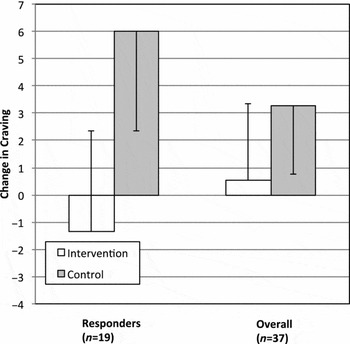
Next, we assessed the effect of the intervention on prolonged craving. Among responders, Intervention Group participants reported a decrease in craving following prolonged exposure to the smoking cues compared to an increase in craving among Control Group participants (Figure 2); again, however, this difference was not significant (p = .087; d = −.65, 95% CI: −1.57, 0.27).
Change in craving from pre-exposure to the end of the study session (prolonged exposure), stratified by treatment group and responder status.

All participants in the Intervention Group reported practicing at least one of the coping strategies between Session 1 and Session 2 and 85% (n = 17) reported using at least one of the coping strategies during the second cue-reactivity session (Session 2). The most popular strategies practiced and used by participants were distraction and relaxation (n = 12; 60% each). Thinking about the positive consequences of not smoking or the negative consequences of smoking were the least popular, with only two participants reporting using either strategy.
Discussion
This pilot study evaluated the effect of using a suite of selected coping techniques to alleviate cue-induced cravings in a laboratory setting. There were no significant differences between the groups but the pattern of results suggests that a larger trial is warranted to examine the effect of coping techniques on both the initial spike in craving observed following acute cue exposure, and on recovery from such spikes. Participants in the Intervention Group actually reported slight decreases in craving following initial cue-exposure, as opposed to the more typical increase in craving seen among Control Group participants. Consistent with previous cue-reactivity studies (e.g., Conklin, Robin, Perkins, Salkeld, & McClernon, Reference Conklin, Robin, Perkins, Salkeld and McClernon2008; Shiffman et al., Reference Shiffman, Shadel, Niaura, Khayrallah, Jorenby and Ryan2003), we observed substantial variation in craving response to the cue-exposure manipulation. Indeed, just under half of our participants could be classified as non-responders to the cue manipulation; a rate consistent with earlier studies that have reported such analyses (Shiffman et al., Reference Shiffman, Shadel, Niaura, Khayrallah, Jorenby and Ryan2003 – 44%; Weinberger et al., Reference Weinberger, McKee and George2012 – 29%). This variation may be the result of subject-level differences in susceptibility to smoking cues, or, perhaps more likely, to the artificial way in which cues are presented in laboratory conditions. In either case, as would be expected, the observed effect of the intervention appeared more pronounced among participants who responded to the cue-exposure manipulation.
Moving on, pragmatically, our results also demonstrate that it is feasible to train participants to utilize common coping strategies, and that these strategies can be utilized in the context of a laboratory cue-reactivity study. In this study, distraction and relaxation techniques were the strategies most commonly used by smokers when confronted by smoking cues. This may reflect that such techniques were more feasible to learn and/or implement in the given timeframe, or it may reflect smokers’ perceptions as to the relative effectiveness of these techniques. Determining the relative effectiveness of individual coping strategies would require randomizing strategies across participants; a consideration for future studies. Future larger trials should also develop and use a formal training manual to both ensure consistency of participant training and to aid future teams to replicate their intervention (Michie et al., Reference Michie, Hyder, Walia and West2011).
The primary limitation of the study was the sample size: although the relatively modest cue-reactive effect size observed in this study is comparable to recent similar studies (e.g., Shiffman et al., Reference Shiffman, Dunbar, Kirchner, Li, Tindle and Anderson2013), our pilot study was under-powered to detect differences in treatment effects. Additionally, while larger effect sizes are typical of cue-reactivity studies (Carter & Tiffany, Reference Carter and Tiffany1999), many of these studies use more intense cues such as having smokers actually light and/or sham smoke a cigarette (i.e., thus combining tactile, olfactory, and visual stimuli) (e.g., Niaura, Abrams, Pedraza, Monti, & Rohsenow, Reference Niaura, Abrams, Pedraza, Monti and Rohsenow1992, Reference Niaura, Abrams, Shadel, Rohsenow, Monti and Sirota1999). Due to the pilot nature of the study and site regulations, the use of such cues was not possible in this case. Additional larger studies, potentially utilizing more complex stimuli, will be necessary to confirm the patterns observed here.
Another important limitation was that we recruited smokers who were not currently interested in quitting; a fact that may have influenced smokers’ responses to smoking related cues (although previous studies have successfully elicited craving in smokers uninterested in quitting – e.g., Wilson, Sayette, & Fiez, Reference Wilson, Sayette and Fiez2012), or, more likely, the effectiveness of the strategies themselves (e.g., our smokers may not have been motivated to use the strategies, knowing that the ‘cost’ of the failure to cope – increased craving – could be easily managed after the manipulation by smoking a cigarette). If this is the case, however, the effectiveness of the intervention may actually be stronger in smokers who are currently attempting to quit and hence our results would underestimate the true effect of the intervention. Further studies with smokers actually undertaking a quit attempt, and those combining laboratory monitoring with real-world observations to determine effectiveness in actual relapse crisis situations, are worth considering. A final limitation of our study is the possibility that participants deduced their group allocation (i.e., assumed they were in the control group after not receiving coping training in the first study session), thus potentially influencing their responses in the second study session. Future studies may consider providing control group participants with alternative ‘non therapeutic’ activities to practice before the second session. Researchers would have to ensure, however, that these control activities were in fact ‘non-therapeutic’. Additionally, one could consider including measures of craving that do not rely on self-report (Sayette et al., Reference Sayette, Shiffman, Tiffany, Niaura, Martin and Shadel2000) to guard against socially desirable responding.
In conclusion, the present pilot study suggests that cognitive and behavioural coping strategies may provide a promising strategy for reducing cue-induced cravings. The pattern of findings observed here warrant a larger study, and, if successfully replicated, would support the continued use and promotion of such strategies among smokers attempting to quit (Borland et al., Reference Borland, Li, Driezen, Wilson, Hammond and Thompson2012; Fiore et al., Reference Fiore, Jaen, Baker, Bailey, Benowitz and Curry2008). Future studies should also examine whether the types of cognitive and behavioural coping techniques commonly taught to smokers are effective in real-world quit attempts. Such studies would provide useful information for the future development of behavioural smoking cessation interventions.
Acknowledgements
The authors would like to thank Isabelle Morris, Dr Natalie Schüz and Dr Julia Walters for their assistance with data collection and study design.
Financial Support
This work was funded by the University of Tasmania (UTAS) School of Psychology and through an internal UTAS grant awarded to SF. Dr Ferguson is also supported through a fellowship from the Cancer Council Tasmania.
Conflict of Interest
The authors have no conflicts of interest to declare.
Ethical Standards
The authors assert that all procedures contributing to this work comply with the ethical standards of the relevant national and institutional committees on human experimentation and with the Helsinki Declaration of 1975, as revised in 2008.