Introduction
Among elderly people, changing residence can be a strategy for gaining access to the assistance they need when health problems reduce their ability to live independently. In addition, a residential relocation may meet an older person's desire for contact with relatives when social relationships become more difficult to maintain. The topic of residential relocations at older ages has been the focus of a body of research (Bloem, Van Tilburg and Thomése Reference Bloem, Van Tilburg and Thomése2008; De Jong et al. Reference De Jong, Wilmoth, Angel and Cornwell1995; Glaser and Grundy Reference Glaser and Grundy1998; Litwak and Longino Reference Litwak and Longino1987; Longino et al. Reference Longino, Jackson, Zimmerman and Bradsher1991; Rogers et al. Reference Rogers, Frey, Speare, Rees and Warnes1992; Wilmoth Reference Wilmoth2010), and these studies have provided clear evidence that at older ages, health problems in particular can lead to an adjustment of residential needs and preferences (Golant Reference Golant2011; Longino et al. Reference Longino, Jackson, Zimmerman and Bradsher1991; Wilmoth Reference Wilmoth2010). For some individuals, this adjustment may be made by moving to a facility where formal care services are provided, whereas for others a residential relocation elsewhere may be sufficient. Furthermore, it has often been argued that older people may move in order to live geographically closer to family members (Clark and Wolf Reference Clark, Wolf and Rogers1992; De Jong et al. Reference De Jong, Wilmoth, Angel and Cornwell1995; Rogerson, Burr and Lin Reference Rogerson, Burr and Lin1997; Silverstein and Angelelli Reference Silverstein and Angelelli1998).
When health problems reduce a person's ability to live independently, and when social relationships become more difficult to maintain, the presence and the support of adult children become more salient (Bengtson Reference Bengtson2001; Van Tilburg Reference Van Tilburg, Knipscheer, De Jong Gierveld, Van Tilburg and Dykstra1995). Since contact (Bordone Reference Bordone2009; Greenwell and Bengtson Reference Greenwell and Bengtson1997; Hank Reference Hank2007), the exchange of support (Knijn and Liefbroer Reference Knijn, Liefbroer, Dykstra, Kalmijn, Knijn, Komter, Liefbroer and Mulder2006; Mulder and Van der Meer Reference Mulder and Van der Meer2009), and feelings of safety, togetherness and belonging (Breheny and Stephens Reference Breheny and Stephens2009; Dunér and Nordström Reference Dunér and Nordström2007; Hjälm Reference Hjälm2012; Kohli, Künemund and Ludiche Reference Kohli, Künemund, Ludiche and Borsch-Supan2005; Künemund and Rein Reference Künemund and Rein1999) are associated with geographic proximity, older people might change residence less frequently if they have children living close by (De Jong et al. Reference De Jong, Wilmoth, Angel and Cornwell1995). This may also hold for moves to a care institution (Boaz and Muller Reference Boaz and Muller1994). Because the conditions for and consequences of living in a residential care facility differ from those associated with independent living, the main aim of this article is to gain insight into the extent to which the proximity of children affects the propensity of older people to relocate to a care institution or elsewhere. Because the prevalence of multiple forms of disability increases substantially after age 75 (Klijs, Mackenbach and Kunst Reference Klijs, Mackenbach and Kunst2010), which can in turn lead to a greater need for assistance and a desire for family contact, we confined our analyses to those aged 75 and above.
We used population register data for the Netherlands to investigate the propensity of nearly one million people aged 75 years and older to change residence in 2008, and to distinguish between relocations to care institutions and moves elsewhere, i.e. not to an institution. These data were enriched with other data from the Social Statistical Database (Centraal Bureau voor de Statistiek (CBS) 2013), which contains information about income and home-ownership.
Using multinomial regression models, we estimated the effects of geographic distance to the closest child and of other important factors on the propensity to relocate to a care institution or elsewhere. Because the absence of a partner indicates the absence of an important potential care provider, and may also affect the desire for family contact, an interaction between intergenerational proximity and partnership status was considered.
Theoretical framework
Need for assistance, desire for family contact and residential relocations at older ages
In general, people do not change residence unless they have a substantive reason for doing, so mobility rates of older people are rather low compared with those of younger people (Rogers et al. Reference Rogers, Frey, Speare, Rees and Warnes1992), and residential changes are predominantly health-related (Bentham Reference Bentham1988; Bloem, Van Tilburg and Thomése Reference Bloem, Van Tilburg and Thomése2008; Geerlings et al. Reference Geerlings, Pot, Twisk and Deeg2005; Litwak and Longino Reference Litwak and Longino1987; Wilmoth Reference Wilmoth2010). The lifecourse model of migration of Litwak and Longino (Reference Litwak and Longino1987) suggests that after the age of retirement, three types of migration motivations can be distinguished. The first type of move, mainly undertaken by married couples in good health, occurs shortly after retirement, and is primarily motivated by lifestyle considerations. The other two migration types are generally related to health problems, and are therefore referred to as assistance moves. The second type of move occurs when people develop chronic disabilities that make everyday household tasks difficult to perform, and when an adjustment of the current dwelling is not possible or would not satisfy assistance needs. The third and final type of move occurs when people experience more severe forms of chronic disability, and the resources needed to provide support and care at home are lacking or are inadequate. In this situation, a move to a care institution may be undertaken in order to meet the person's assistance needs.
Empirical studies have confirmed this model by showing that a residential relocation at an older age is often induced by a decline in health (Bloem, Van Tilburg and Thomése Reference Bloem, Van Tilburg and Thomése2008; De Jong et al. Reference De Jong, Wilmoth, Angel and Cornwell1995; Wilmoth Reference Wilmoth2010), that less healthy older people are more likely to move than healthier people (Bentham Reference Bentham1988; Verheij et al. Reference Verheij, Van de Mheen, De Bakker, Groenewegen and Mackenbach1998) and that poor health is an important predictor of institutionalisation (Boaz and Muller Reference Boaz and Muller1994; Geerlings et al. Reference Geerlings, Pot, Twisk and Deeg2005; Grundy Reference Grundy2011; Puts et al. Reference Puts, Lips, Ribbe and Deeg2005).
Beyond these health considerations, the desire for contact with children, grandchildren and other family members may also motivate older people to change residence (De Jong et al. Reference De Jong, Wilmoth, Angel and Cornwell1995; Silverstein and Angelelli Reference Silverstein and Angelelli1998), especially when other social relationships become more difficult to maintain due to illness or the death of siblings and friends, or when people choose to maintain fewer network ties (Carstensen Reference Carstensen1992). De Jong et al. (Reference De Jong, Wilmoth, Angel and Cornwell1995) showed that living with or close to children or other relatives is a frequently stated reason for older people to change residence. Others have also shown that even at more advanced ages parents continue to provide support to their children by, for example, taking care of grandchildren (Hank and Buber Reference Hank and Buber2009; Hayslip and Kaminski Reference Hayslip and Kaminski2005).
Benefits of children living close by in relation to residential relocations at older age
With the exception of a partner, an adult child is more likely than any other potential care-giver to provide personal and practical support to older persons (Komter and Vollebergh Reference Komter and Vollebergh2002; Spitze and Logan Reference Spitze and Logan1990), as his or her natural bond is generally accompanied by feelings of responsibility and affection (Bengtson and Roberts Reference Bengtson and Roberts1991; Umberson Reference Umberson1992).
Because it facilitates face-to-face contact, geographic proximity is associated with more mutual involvement (Lawton, Silverstein and Bengtson Reference Lawton, Silverstein and Bengtson1994) and more contact (Bordone Reference Bordone2009; Greenwell and Bengtson Reference Greenwell and Bengtson1997; Hank Reference Hank2007). Children who live a short distance from their parents provide them with considerably more support than children who live farther away (Knijn and Liefbroer Reference Knijn, Liefbroer, Dykstra, Kalmijn, Knijn, Komter, Liefbroer and Mulder2006; Mulder and Van der Meer Reference Mulder and Van der Meer2009). Beyond actual contact and the exchange of support, the feeling of having ‘someone to turn to’ reinforces feelings of safety (Dunér and Nordström Reference Dunér and Nordström2007; Hjälm Reference Hjälm2012). Living in the same household or living a very short distance from each other also enhances feelings of togetherness (Kohli, Künemund and Ludiche Reference Kohli, Künemund, Ludiche and Borsch-Supan2005) and makes the reciprocation of support more likely. These exchanges may in turn strengthen feelings of being needed, self-esteem and competence (Breheny and Stephens Reference Breheny and Stephens2009; Künemund and Rein Reference Künemund and Rein1999).
Empirical studies have provided insights into the relationship between intergenerational proximity and residential relocations at older ages. Some older parents move in the direction of their children (Pettersson and Malmberg Reference Pettersson and Malmberg2009; Rogerson, Burr and Lin Reference Rogerson, Burr and Lin1997; Silverstein Reference Silverstein1995; Smits Reference Smits2010; Zhang, Engelman and Agree Reference Zhang, Engelman and Agree2013), whereas having children living close by reduces the likelihood of changing residence (De Jong et al. Reference De Jong, Wilmoth, Angel and Cornwell1995; Pettersson and Malmberg Reference Pettersson and Malmberg2009). A greater intergenerational distance is associated with residential relocations that are motivated by the desire to live close to family (De Jong et al. Reference De Jong, Wilmoth, Angel and Cornwell1995). These insights lead us to hypothesise:
• Hypothesis 1: Having children living close by will be associated with a lower propensity to change residence.
In Western societies, governments increasingly aim to provide support and care to older people in their own homes as long as possible (Davies and James Reference Davies and James2011). When health problems require a redefinition of residential needs, older people may consider making modifications to their current dwelling, relying on informal support or making use of professional care at home. Proximate network members may play a role in this adjustment process. In the Netherlands, for example, the availability and capability of network members to provide regular and informal care is evaluated in the process of assessing the extent to which a person is eligible to receive subsidised professional care, either at home or in a residential care institution (CIZ 2012). However, the extent to which care can be provided at home is primarily determined by the severity of health problems. When these problems are severe, a move to a care institution will be likely regardless of whether children live close by. We therefore hypothesise:
• Hypothesis 2: Intergenerational proximity will have a stronger effect on the propensity to relocate elsewhere (i.e. not to an institution) than on the propensity to relocate to a care institution.
The impact of intergenerational proximity may differ by parental partnership status. A partner is generally the first to respond to the need for intimacy, attachment and support, and is considered to be the primary provider of support (De Jong Gierveld et al. Reference De Jong Gierveld, Broese van Groenou, Hoogendoorn and Smit2009). The loss of a partner is therefore a major risk factor for loneliness late in life (De Jong Gierveld and Van Tilburg Reference De Jong Gierveld and Van Tilburg1987; Victor et al. Reference Victor, Scambler, Shah, Cook, Harris and Rink2002) and for dependence on others for care and help (Geerlings et al. Reference Geerlings, Pot, Twisk and Deeg2005). The absence of a partner may therefore lead to difficulties in the performance of everyday household tasks, and may also increase the desire for contact with relatives. Partnership status is known to be a strong predictor of residential relocations at older age; people who have recently lost their partner are most likely to change residence (Chevan Reference Chevan1995), as the absence of a partner increases the likelihood of moving to a care institution (Bloem, Van Tilburg and Thomése Reference Bloem, Van Tilburg and Thomése2008; Freedman Reference Freedman1996; Grundy and Jitlal Reference Grundy and Jitlal2007; Nihtila and Martikainen Reference Nihtila and Martikainen2008). Children who live close by may therefore be more beneficial for older people without a partner than for those with a partner. Still, the quality of parent–child relationships differs by parental marital history. Divorced parents tend to have a more distant relationship with their children (Kaufman and Uhlenberg Reference Kaufman and Uhlenberg1998; Van Gaalen and Dykstra Reference Van Gaalen and Dykstra2006) and to receive less support than parents in intact relationships (Dykstra Reference Dykstra1998). Divorced parents are also less likely to be able to rely on their children than widowed parents (De Jong-Gierveld and Dykstra Reference De Jong-Gierveld and Dykstra2002). Widowed parents tend to receive more support from their children than partnered parents (Eggebeen Reference Eggebeen1992; Rossi and Rossi Reference Rossi and Rossi1990). In addition, older parents are more likely to move in the direction of their children if they have lost their partner recently (Rogerson, Burr and Lin Reference Rogerson, Burr and Lin1997; Silverstein Reference Silverstein1995). We therefore hypothesise:
• Hypothesis 3a: The effect of intergenerational proximity on the propensity to change residence will be greater for people without a partner than for people who live with a partner.
• Hypothesis 3b: Among those without a partner, the effect will be greatest for those who have lost their partner recently, smaller for widowed people and smallest for separated people.
Childless older people differ from older parents with regard to how they intend to meet their need for assistance, and in terms of their desire for family contact. They are less likely to report having a potential care-giver (Dykstra Reference Dykstra2006; Zhang and Hayward Reference Zhang and Hayward2001) and are more likely to live in a care institution (Boaz and Muller Reference Boaz and Muller1994; Grundy and Jitlal Reference Grundy and Jitlal2007; Koropeckyj-Cox and Call Reference Koropeckyj-Cox and Call2007). Unlike older people with children who live far away, childless people do not have the option of moving in the direction of their children. We therefore hypothesise:
• Hypothesis 4a: Childless older people will be less likely to move elsewhere than older people with children who live farther away.
• Hypothesis 4b: Childless older people will be more likely to move to a care institution than older people with children who live farther away.
Finally, men and women differ in terms of their need for assistance and desire for contact with family. Women have more frequent contact and better relationships with their children (Rossi and Rossi Reference Rossi and Rossi1990; Spitze and Logan Reference Spitze and Logan1990; Van Gaalen and Dykstra Reference Van Gaalen and Dykstra2006), even after divorce or widowhood (Dykstra Reference Dykstra1998; Kaufman and Uhlenberg Reference Kaufman and Uhlenberg1998; Spitze and Logan Reference Spitze and Logan1990), whereas men tend to rely more on their partner (Dykstra and De Jong Gierveld Reference Dykstra and De Jong Gierveld2004). In addition, women tend to suffer more from multiple chronic disabilities, while men tend to suffer from terminal conditions (Macintyre, Hunt and Sweeting Reference Macintyre, Hunt and Sweeting1996; Verbrugge Reference Verbrugge1985, Reference Verbrugge and Apple1990). Women are, therefore, more likely than men to live in a formal care institution for long periods (Martikainen et al. Reference Martikainen, Moustgaard, Murphy, Einio, Koskinen, Martelin and Noro2009; Spillman and Lubnitz Reference Spillman and Lubnitz2002). Because these differences indicate that children living close by may be valued differently by men and women, our analyses are stratified by gender.
Other factors that may explain residential relocations at older ages
Among the older population, the propensity to change residence increases with age, with age having a stronger effect on the decision to move to a care institution (Kemper and Murtaugh Reference Kemper and Murtaugh1991). In a similar way, health problems may increase the need to change residence (Bentham Reference Bentham1988; Bloem, Van Tilburg and Thomése Reference Bloem, Van Tilburg and Thomése2008; Geerlings et al. Reference Geerlings, Pot, Twisk and Deeg2005; Litwak and Longino Reference Litwak and Longino1987; Wilmoth Reference Wilmoth2010), with a stronger effect on moving to a care institution (Boaz and Muller Reference Boaz and Muller1994; Geerlings et al. Reference Geerlings, Pot, Twisk and Deeg2005; Grundy Reference Grundy2011; Puts et al. Reference Puts, Lips, Ribbe and Deeg2005). Greater financial resources support the realisation of a desire to change residence, which would lead to a positive effect of resources on the likelihood of moving. But having more money also allows people to buy private assistance at home, which would lead to a negative effect. Older home-owners are less likely to move than renters (Abramsson and Andersson Reference Abramsson and Andersson2012) and are also less likely to become institutionalised than renters (McCann, Grundy and O'Reilly Reference McCann, Grundy and O'Reilly2012; Nihtila and Martikainen Reference Nihtila and Martikainen2007; Rouwendal and Thomése Reference Rouwendal and Thomése2010). It is also important to account for the degree of urbanisation. Urban areas have greater access to care services and adjusted housing, which could lead to a decreased likelihood of moving; whereas in less urbanised areas, family ties tend to be stronger (Hogerbrugge and Dykstra Reference Hogerbrugge and Dykstra2009; Rogerson, Weng and Lin Reference Rogerson, Weng and Lin1993).
Data and methods
Data
The data were derived from a selection of datasets that are available in the Social Statistical Database administered by Statistics Netherlands. The municipal population register (in Dutch: Gemeentelijke Basisadministratie) provided information on the demographic events such as birth, death, partnership status and address changes of all of the officially registered inhabitants of the Netherlands (CBS 2010a). Residential locations and relocations are recorded on a daily basis, and include all address changes within the country. Record linkage between parents and adult children (CBS 2010b) allowed us to measure intergenerational geographic distance. Information about the start and duration of stay in care institutions was derived from a dataset containing information about admissions to subsidised residential care facilities (in Dutch: Centraal Administratie Kantoor-Zorg met Verblijf) (CBS 2012a). Information on household income and home-ownership was obtained from a dataset including property ownership (in Dutch: Integraal Huishoudens Inkomen) (CBS 2012b).
One of the great advantages of using register data for this study is the inclusion of the very old and of institutionalised people, groups who are often not included in survey data, or who are present only in small numbers (Börsch-Supan and Jürges Reference Börsch-Supan and Jürges2005; Dykstra et al. Reference Dykstra, Kalmijn, Knijn, Komter, Liefbroer and Mulder2005).
Study population
All individuals registered in the municipal population register aged 75 and above as of 1 January 2008 were selected, and their children were identified in the population register. Because only the addresses of people registered in the Netherlands were available, dyads in which the parent or the child lived abroad could not be captured. We excluded 110,552 people who were not at risk of a relocation to a care institution because they already lived in a care institution at baseline. An additional 528 people were omitted due to missing data on income and home-ownership. This selection procedure resulted in 986,910 people aged 75 and above, of whom 85 per cent had at least one child registered in the Netherlands.
Dependent variable
The dependent variable has three values: no residential relocation (0, reference category), residential relocation to a care institution (1) and residential relocation elsewhere (2). Moves to care institutions were identified from the data on stays in subsidised residential care facilities (CBS 2012a) rather than from the population register. This was because changes of residence to residential care facilities cannot be distinguished from other changes of address in the register, and are sometimes not registered because of uncertainty about whether the person will return home.
According to Ribbe et al. (Reference Ribbe, Ljunggren, Steel, Topinkova, Hawes, Ikegami, Henrard and Jonnson1997), about two-fifths of the residents who are admitted to residential care facilities in the Netherlands predominantly use rehabilitative services, and one-third of them are discharged within a short period of time. We therefore excluded all types of residential care facilities that primarily provide rehabilitative services, e.g. hospitals and revalidation centres. Furthermore, in order to exclude short stays in care institutions we considered a person to have relocated to a care institution when the duration of stay was at least 90 days (see also Boaz and Muller Reference Boaz and Muller1994; Nihtila and Martikainen Reference Nihtila and Martikainen2007). These 90 days were considered as indicating a distinction between short stays for rehabilitation (followed by a return home) or for very serious illnesses (followed by death) and longer stays that truly imply a change of residence and from which returning home is unlikely (Boaz and Muller Reference Boaz and Muller1994; Manheim and Hughes Reference Manheim and Hughes1986). The number of relocations to a care institution is somewhat underestimated because the database concerning admissions in subsidised residential care facilities does not cover private residential care facilities. However, in the context of the Netherlands, this does not lead to a problematic bias because a large share of the residential care facilities are subsidised by the state (Mestheneos and Triantafillou Reference Mestheneos, Triantafillou and Döhner2005; Ribbe et al. Reference Ribbe, Ljunggren, Steel, Topinkova, Hawes, Ikegami, Henrard and Jonnson1997). Because the duration of stay in a care institution determines not only the number of people who changed residence, but also the distribution of the dependent variable, we performed a sensitivity analysis in order to explore the extent to which the estimates change when we adjust the minimum duration of stay so that it varies between seven and 120 days (see the Results section for details).
We coded a residential relocation elsewhere, that is a relocation not to an institution, when a change of address was recorded in the population register, and when the person was not admitted to a subsidised residential care institution for at least 90 days. Beyond regular housing, this category also includes relocations to adapted housing and private care facilities.
Key explanatory variable: proximity to closest child
The physical characteristics of the Dutch landscape and its dense infrastructure system do not lead to serious barriers in terms of the geographic distance between inhabitants. We therefore measured intergenerational proximity with Euclidean distances based on the geographical mid-points of the neighbourhoods of residence of the parent and the child on 1 January 2008.
Although geographic distances in the Netherlands are not very great, larger travel distance reduces face-to-face contact between family members (Kalmijn Reference Kalmijn2006; Kalmijn and Dykstra Reference Kalmijn, Dykstra, Dykstra, Kalmijn, Knijn, Komter, Liefbroer and Mulder2006; Van der Pas and Van Tilburg Reference Van der Pas and Van Tilburg2009). Concerning the association between geographic distance and the regular exchange of practical and emotional support between parents and children, it is likely important that at least one child lives close by. We therefore use an indicator of proximity to the closest child. As Knijn and Liefbroer (Reference Knijn, Liefbroer, Dykstra, Kalmijn, Knijn, Komter, Liefbroer and Mulder2006) have shown for the Netherlands, the relationship between proximity and support does not seem to be linear. A distance of over 5 kilometres (km) versus a distance of under 5 km makes a great difference in the exchange of support, and distances of over 20 and 40 km are associated with less support. We considered these thresholds to be relevant for the need to change residence, and constructed categories rather than approaching intergenerational proximity as a continuous measure. We consider co-residence, living in the same neighbourhood and living within 5 km of the neighbourhood of an adult child as distances that allow for face-to-face contact on a daily basis. Because co-residence is arguably different from living very close by (Isengard and Szydlik Reference Isengard and Szydlik2012; Pillemer and Suitor Reference Pillemer, Suitor, Pillemer and McCartney1991; Smits, Van Gaalen and Mulder Reference Smits, Van Gaalen and Mulder2010), we distinguished co-residence from living in the same neighbourhood, when the distance was zero using information about the position of the child in the household. When the distance between parents and children was zero and the household position of the child was coded as ‘child’ in the population register, we considered the parent and child to co-reside. When the household position of the child was coded differently, parents and children were considered to live in the same neighbourhood.
We assumed that having at least one child living close by can meet the need for assistance and the desire for contact better than not having any children living close by, and we did not consider the proximity of other children.
Control variables
We categorised age into five groups: 75–79, 80–84, 85–89, 90–94, and 95 years and older. Partnership status reflects whether a person was living with a partner on 1 January 2008. Among those who had no partner, we distinguished between being separated, widowed and unmarried. We classified people who were married but were not living with a partner in the household as separated (N=6,352). The variable also included a category that showed whether a partner had been lost in 2007 or 2008 through widowhood, divorce, separation or a move of the partner to a care institution. Severe disability requires more support, and is associated with the proximity to death (Klijs, Mackenbach and Kunst Reference Klijs, Mackenbach and Kunst2010). Because the data did not contain detailed information about health, we constructed the variable closeness to death, which served as a proxy for severe health problems. We considered a person to have been close to death if the population register recorded that the person died in 2008 or 2009 (see sensitivity analyses in the Results section).
We measured income using the standard equivilised household net income calculated by Statistics Netherlands; the total net income of the household was divided by a factor reflecting household composition (single-person household=1.00, each additional adult increases the factor by 0.37, and each child by 0.15–0.33, depending on the age of the child (CBS 2008). The equivilised income was divided into quartiles, with the cut-off points for the quartiles calculated from the combined data of all of the men and women.
The variable home-ownership differentiated between owner-occupiers and renters. We classified renters according to whether an income-dependent subsidy from the state was received, which served as another proxy for socio-economic status. Degree of urbanisation was based on the address density at the neighbourhood level (urban: 1,500 or more addresses per km2; less urban: 500–1,500 addresses per km2; rural: fewer than 500 addresses per km2).
Analytical strategy
We constructed three multinomial logistic regression models of residential relocations after the age of 75. In the first model we included the main effects in order to test whether having children living close by was associated with a lower propensity to change residence (hypothesis 1) and whether intergenerational proximity had a stronger effect on the propensity to relocate elsewhere than on the propensity to relocate to a care institution (hypothesis 2) (Table 2). To test hypothesis 3 concerning the effect of intergenerational proximity on the propensity to change residence by partnership status (hypotheses 3a and 3b), we introduced an interaction between the variables partnership status and proximity to the closest child (Table 3). Hypotheses 4a and 4b concerning the residential relocations of childless older people was tested in all of the models. We stratified all of the models by gender. We also ran the models with ‘residential relocation elsewhere than to an institution’ as a reference category in order to test the differences between relocations to a care institution and elsewhere. The significance levels of these models are presented in separate columns in Tables 2 and 3, annotated with ‘institution versus elsewhere’.
Results
Descriptives
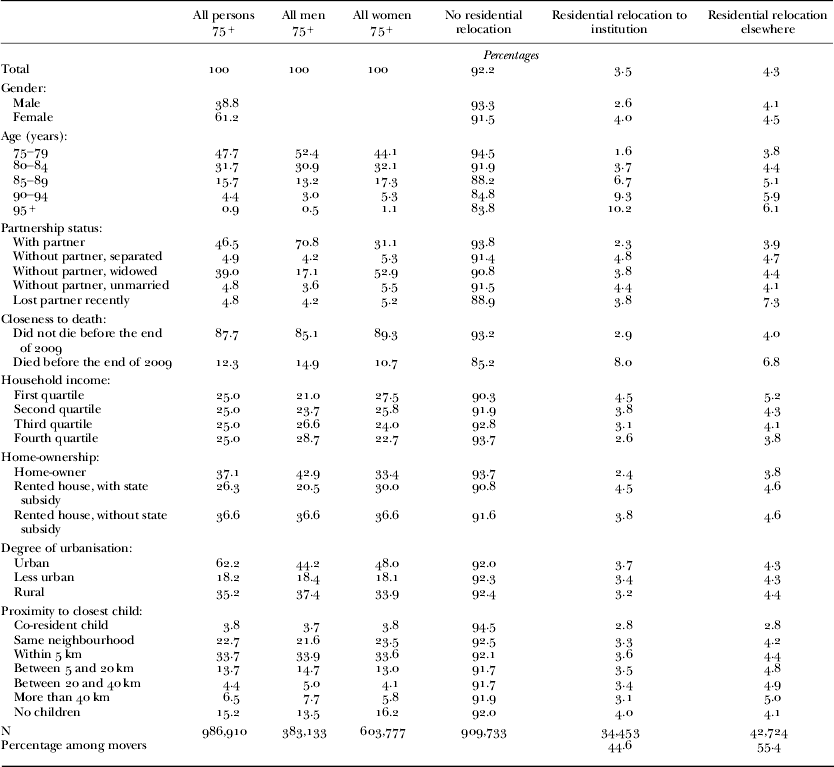
Almost 8 per cent of the people aged 75 years and older changed residence in 2008 (Table 1). Among this group, 45 per cent relocated to a care institution while 55 per cent moved elsewhere. Women, very old people and individuals who had recently lost their partner changed residence relatively often. Compared with people who were not close to death, people who were close to death changed residence more often: 8 per cent of the people who were close to death relocated to a care institution, nearly 7 per cent moved elsewhere. For people who were not close to death this was 3 and 4 per cent, respectively. The very old and those who were close to death moved most often to a care institution. However, a greater proportion would have been regarded as having moved to an institution if a shorter minimum duration of stay had been chosen (see the sensitivity analysis in the Results section).

Sixty per cent of all of people had at least one child living within 5 km, and nearly three-quarters had a child living within 20 km. Both types of residential relocation occurred less often when a child lived very close by, i.e. when a child was co-residing or was living in the same neighbourhood. Moreover, when their children lived farther away, these people moved somewhat less often to a care institution and moved somewhat more often elsewhere. Finally, the relocation behaviour of childless older people was not different from that of their peers with children.
Multinomial regression analyses of residential relocations (main effects model)
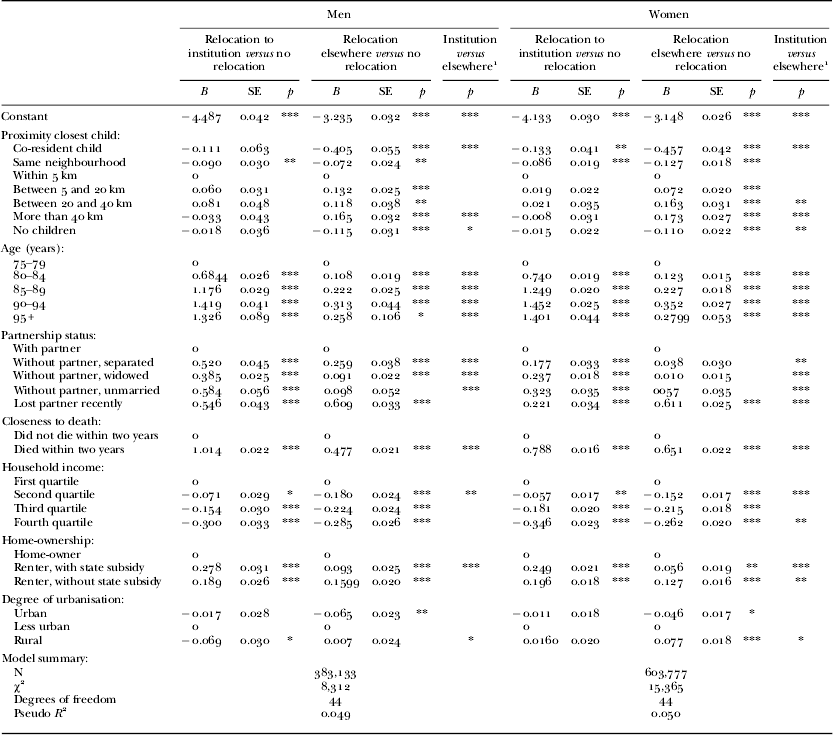
We hypothesised that the close proximity of children would be associated with a lower propensity to change residence (hypothesis 1). Indeed, people were less likely to change residence when their children were co-residing or were living in the same neighbourhood, and were more likely to relocate elsewhere when their children were more than 5 km away (Table 2). However, having children who were living over 40 km away seems to have been a reason for moving to a care institution. In accordance with hypothesis 2, the effects of proximity were found to be stronger and more often significant for relocations elsewhere than for moves to a care institution.
Multinomial logistic regression for the residential relocation of people aged 75 years and older in 2008, stratified by gender

Notes: SE: standard error. km: kilometre. Reference group is no residential relocation. 1. Significance levels for models with reference category ‘residential relocation elsewhere than to care institution’.
Significance levels: * p<0.05, ** p<0.01, *** p<0.001.
The effect of intergenerational proximity differentiated by partnership status
In line with previous studies, the results showed that men and women without a partner were more likely to change residence than those who were living with a partner, and that the recent loss of a partner had a particularly strong effect on relocating elsewhere (main effects of partnership status in Tables 2 and 3). For women, widowhood and separation had the strongest positive effect on moving to a care institution, whereas among men an increased risk of moving to a care institution was found for all categories in which a partner was absent.
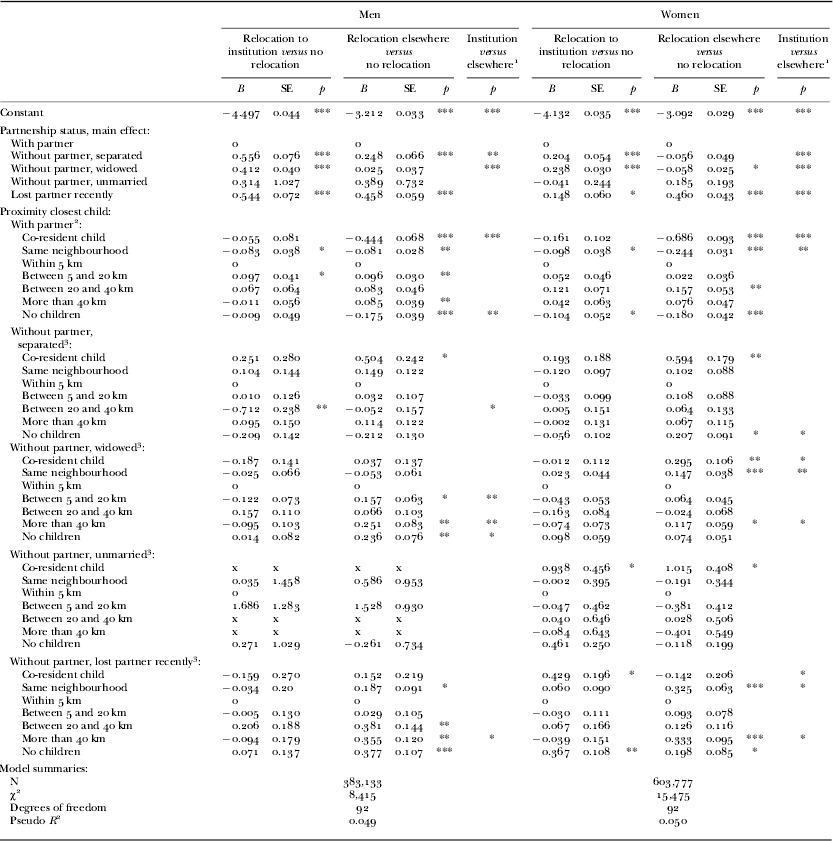
Multinomial logistic regression for the residential relocation of people aged 75 years and older in 2008, stratified by gender

Notes: SE: standard error. km: kilometre. x: not enough cases (N<10). Reference group is no residential relocation. Estimates interaction: partnership status × proximity closest child. Control variables in both models: age, closeness to death, income, home-ownership and degree of urbanisation; estimates of these main effects correspond with the main effects in Table 2 and are therefore not presented. 1. Significance levels for models with reference category ‘residential relocation elsewhere than to care institution’. 2. Main effect of proximity of closest child. 3. Additional effect compared with main effect proximity to closest child.
Significance levels: * p<0.05, ** p<0.01, *** p<0.001.
We hypothesised that intergenerational proximity would have a greater negative effect on the residential relocations of people without a partner than on the relocations of older people with a partner (hypothesis 3a). The results from Table 3 revealed that, for people with a partner, having co-resident children and having children living in the same neighbourhood were negatively associated with the likelihood of relocating elsewhere, compared with having children living farther away (see the main effect of the proximity of the closest child, to be read as the effect for those with a partner). The interaction effects did not, however, indicate that having children who were living very close by had a greater negative effect on the likelihood of relocating among people without a partner than among people with a partner. In fact, any statistically significant parameters of very close proximity for the categories without a partner were positive, which implies that the negative association with the likelihood of moving elsewhere was less, or was even positive. For example, for separated men the positive interaction parameter for having a co-resident child more than offset the negative parameter for those with a partner. This finding does not support hypothesis 3a. However, for widowed men and women and those who had recently lost their partner, the interaction parameters for having children living more than 40 km away rather than within 5 km were positive for relocating elsewhere. This is in line with hypothesis 3a, and may indicate that these older people were likely to move towards their children.
We additionally hypothesised that among older people without a partner the effect of intergenerational proximity on changing residence would have the greatest effect for people who had recently lost their partner, a smaller effect for widowed people and the smallest effect for separated people (hypothesis 3b). Except for the strong positive association between having children living farther away and relocating elsewhere among parents who had recently lost their partner, our findings do not support this hypothesis. Women with co-residing children who had lost their partner recently were more likely to move to a care institution, whereas for men who were widowed or who had lost their partner recently we found negative associations of co-residence with moving to an institution. This finding may mean that in the absence of a partner, co-resident children are less able to meet the increased need for assistance of their mothers than of their fathers, possibly because women are more likely to suffer from multiple chronic disabilities than men (Macintyre, Hunt and Sweeting Reference Macintyre, Hunt and Sweeting1996; Verbrugge Reference Verbrugge and Apple1990).
Residential relocations of older childless people
We hypothesised that childless older people would be less likely to move elsewhere than to an institution compared with older people with children who were living farther away (hypothesis 4a), but were more likely to move to a care institution than older people with children living farther away (hypothesis 4b). In line with hypothesis 4a, it was estimated that childless people had a smaller propensity to move elsewhere than parents whose children were not co-residing or living in the same neighbourhood (Table 2). But hypothesis 4b was not confirmed, as the main effect model did not show that childless people had a different propensity to move to a care institution than people with children living farther away. Yet the interaction effects in Table 3 suggest that the smaller propensity to change residence elsewhere particularly held for those with a partner, and that childless women with a partner were less likely to move to an institution. Furthermore, (recently) widowed childless men were more likely to move elsewhere than childless men with a partner. In addition, childless women who had lost their partner recently were more likely to move to an institution than childless women with a partner. These findings confirmed the assumption that partnership status is an important predictor of residential relocations at older ages.
Control variables
The effects of the control variables (Table 2) were largely in line with existing knowledge. With increasing age, people were more likely to change residence, with stronger effects on moving to a care institution. Overall, people who were close to death were more likely to change residence than those who were not close to death, with significantly stronger effects on moving to a care institution. The difference was, however, greater for men, which might be because men are more likely to suffer from terminal conditions that require more intensive assistance, whereas women are more likely to suffer from chronic conditions that can be managed in an adjusted housing situation (Dykstra and De Jong Gierveld Reference Dykstra and De Jong Gierveld2004; Zhang and Hayward Reference Zhang and Hayward2001). Those with higher incomes and home-owners were less likely to change residence. Finally, older people who were living in more urban areas were less likely to move elsewhere than people living in more rural areas, which may reflect different opportunity structures for adjusted housing and care facilities.
Sensitivity analyses
We performed a sensitivity analysis in order to explore whether the effects of the explanatory variables would change when in the dependent variable, the minimum duration of stay in a care institution varied between seven and 120 days in the category ‘residential relocation to a care institution’ (results not shown). The effect of closeness to death on the propensity to relocate differed for both types of relocations, with greater effects for shorter durations of stay. This indicates that people were likely to die shortly after admission, which is in line with existing knowledge about high mortality rates in care institutions (Grundy Reference Grundy2011). Moreover, with increasing duration of stay, the effect of age on moving to a care institution was greater. No substantial differences emerged in the effects of the other explanatory variables.
Another sensitivity analysis was performed to explore how the effects of the variable closeness to death would change if the definition only included those who died in 2008, rather than in 2008 and 2009. The 2008 variant of closeness to death had a much weaker effect on the propensity to relocate to a care institution (0.176 for 2008 compared with 0.866 for 2008 and 2009). This might be because in the 2008 variant a smaller proportion of older people were in need of more intensive assistance, i.e. were at risk of moving to a care institution.
Discussion
With this study, our aim was to provide new insights into the extent to which the proximity of adult children affects the propensity of older people to change residence. A major contribution of this study is our differentiation between relocations to care institutions and relocations elsewhere than to care institutions. While this distinction is relevant given the current debate about the provision of care and support in ageing populations, it has rarely been made in previous studies because surveys often exclude the institutionalised population. Another strength of our approach is that we investigated the relocation behaviour of all people aged 75 and older registered in the Netherlands. These register data provided us with a large number of cases and relocation events, and allowed us to avoid the selective exclusion of those not able to respond to a questionnaire, and to thereby include the ‘old-old’.
We hypothesised that older people would be less likely to change residence if they had children living very close by. Moreover, we argued that partnership status would be associated with the need for assistance and the desire for family contact. Finally, we hypothesised that the effects of intergenerational proximity on changing residence would differ by partnership status.
In accordance with our expectations, we found that older people were less likely to move elsewhere when their children were living very close by, and they were more likely to do so when their children were living farther away. In addition, as we hypothesised, these effects were found to be stronger for relocations elsewhere than for moves to a care institution. However, these findings became more nuanced when we looked at the partnership status of the parents. Having co-resident children and children living in the same neighbourhood decreased the likelihood of relocating elsewhere among older people who were living with a partner, but less for those who were not living with a partner. Our findings might indicate that for older people without a partner, their children who were living close by were not able to provide the resources that otherwise would have been provided by a partner. However, our finding that (recently) widowed people with children who were living farther away were more likely to relocate elsewhere suggests that they did not have a proper proximate resource to make up for the loss of their partner. This finding raises questions about the extent to which moves towards children could represent a substitute for the absence of a partner, and possibly also for moves to institutions; this question should be addressed in future research. The overall finding that having children living close was negatively associated with the likelihood of moving to a care institution, and the finding that the associations between having co-resident children and moving to an institution were reversed for fathers who had lost their partner versus for mothers who had lost their partner, also requires further investigation.
Our investigation could have been more specific if more detailed information about physical and mental health were available. Our proxy for health, closeness to death, is not reliable enough for investigating the interaction effects between health and intergenerational proximity. Such an investigation would, however, generate more detailed insights into whether and in which direction health, intergenerational proximity and residential relocations at older ages are associated. It would also have been informative to study residential destinations other than subsidised care institutions only; the implications of having children living close by could be different for adapted housing and for private care institutions. Given the administrative character of the register data, more detailed information about health and the type of residence could not be obtained.
In addition to these data issues, our approach has some other limitations. First, we measured the proximity of the closest child at the beginning of 2008 and assumed that this distance remained constant throughout the year. However, the children could have changed residence during the observation period, which could have affected the proximity of the closest child. Furthermore, we assumed that having at least one child living close by can meet the older person's need for assistance and desire for contact. Accounting for multiple children living close by could provide additional insights into the relocation behaviour of older people. Furthermore, because the specific characteristics of the adult children are known to affect the level of commitment, the contact frequency and the level of support provided (Rossi and Rossi Reference Rossi and Rossi1990; Silverstein, Gans and Yang Reference Silverstein, Gans and Yang2006; Spitze and Logan Reference Spitze and Logan1990; Stein et al. Reference Stein, Wemmerus, Ward, Gaines, Freeberg and Jewell1998), the incorporation of the gender, age and partnership status of the closest child could generate more insights into the extent to which the characteristics of the proximate children affect the residential relocations of older people. We therefore propose that future studies consider these characteristics.
In the context of ageing populations, Western governments are increasingly moving towards policies that encourage ‘ageing in place’ in order to postpone and decrease the use of expensive subsidised professional residential care facilities (Davies and James Reference Davies and James2011). These policies also assume that growing old in one's own place of residence, where the local social environment provides support, best serves the needs of the elderly (Davies and James Reference Davies and James2011). Also because the number of older and disabled elderly continues to increase, these developments indicate that the provision of informal support can play an even more salient role in the near future than it already does nowadays (Attias-Donfut, Ogg and Wolff Reference Attias-Donfut, Ogg and Wolff2005; Haberkern and Szydlik Reference Haberkern and Szydlik2010). Informal support has already been shown to reduce the costs of formal care for older people (Van Houtven and Norton Reference Van Houtven and Norton2004). The results of this study suggest that the availability of proximate children may affect the future residential choices of older people. This could, for example, be the case if future policies assigned more responsibility to informal care-givers, or if the criteria for entering residential care facilities were to become stricter (Johansson, Sundstrom and Hassing Reference Johansson, Sundstrom and Hassing2003). Community and housing policies could therefore stimulate the future planning of communities and houses that enable multiple generations to live close to each other in order to provide a basis for the exchange of intergenerational support. For example, older persons in need of support from their children might be prioritised to get access to (adjusted) housing close to their children. Communities may also stimulate the construction of special housing that enables multiple generations to live in one house while maintaining privacy and some independence.
The analyses presented in this article have shown that very close intergenerational proximity is associated with fewer residential relocations at older age, but in different ways for moves to institutions and moves elsewhere, and depending on the partnership status of the parent.
Acknowledgements
We are grateful for the pleasant collaboration with Statistics Netherlands. M. van der Pers performed all statistical analyses and wrote the paper, and E. U. B. Kibele and C. H. Mulder supervised the data analyses and contributed to revision of the paper.