INTRODUCTION
The chemistry used for the radiocarbon (14C) dating of wood has frequently been based on variations of the venerable Jayme-Wise procedure for the isolation of holocellulose, using repeated acidic chlorite oxidations, or further purified to α-cellulose by adding strong alkali extractions (e.g. Loader et al. Reference Loader, Robertson, Barker, Switzur and Waterhouse1997; Gaudinski et al. Reference Gaudinski, Dawson, Quideau, Schuur, Roden, Trumbore, Sandquist, Oh and Wasylishen2005). Sometimes organic solvent extractions are employed first to remove oils, waxes and resins (e.g. Leavitt and Danzer Reference Leavitt and Danzer1993), and alkaline peroxide has also been used following holocellulose preparation (Park et al. Reference Park, Kim, Cheoun, Kim, Liu and Kim2002). In other examples, simpler methods such as ABA (Southon and Magana Reference Southon and Magana2010; Hajdas et al. Reference Hajdas, Hendriks, Fontana and Monegato2017) or more complex techniques such as those using Schweizer’s reagent (Switzur Reference Switzur1989; Wissel et al. Reference Wissel, Mayr and Lücke2008) have been useful, while some other methods have proven unreliable (e.g. Anchukaitis et al. Reference Anchukaitis, Evans, Lange, Smith, Leavitt and Schrag2008).
Traditional holocellulose preparations using only chlorite oxidations are frequently inadequate when wood samples are from near-background sediments (Chappell et al. Reference Chappell, Head and Magee1996). Gillespie et al. (Reference Gillespie, Fifield, Levchenko and Wells2008), simplified the isolation of cellulose by eliminating organic solvent extraction and inert gas-blanketed strong alkali extraction, using twice repeated acidic chlorite oxidation and 1M NaOH extraction at 80°C, followed by the stepped combustion scheme of Bird et al. (Reference Bird, Ayliffe, Fifield, Cresswell, Turney, Barrows and David1999). While this procedure did eventually yield ages >50,000 BP, there were many failures in both chemistry and combustion.
Described here is a new procedure called 2chlorOx, which uses only inorganic reagents with oxidative bleaching in both alkaline and acidic solutions, offering simplicity with shorter laboratory time.
MATERIALS AND METHODS
Samples
∙ New Zealand kauri (Agathis australis) woods: one sample is A/B wood from the FIRI 14C intercomparison study, the other is from Renton Road sediments known from the geology to be >200 ka.
∙ Woody fragments, probably Podocarpus sp., from cores in highly organic sediments of Lake Xere Wapo, New Caledonia, known from other procedures to be >50 ka BP.
∙ Black woody lumps from a core in Holocene age sandy sediments on the Darling River flood plains near Menindee in western New South Wales, Australia.
∙ Ground wood holocellulose samples, originating from 20-year blocks of bog oak tree rings from Ireland and England, with exactly known ages from dendrochronology.
Chemistry
Some preliminary work (not shown) on alternative chemistry sequences was performed on modern hardwood and softwood shavings, using visual whiteness of product as the sole quality criterion. It is expected that pure cellulose preparations should be paper-white rather than the yellow-brown-red of raw woods or the pale yellow of most holocellulose preparations. Variations in the chlorite bleaching solution (using acetic acid, phosphate buffer or hydrochloric acid at pH 1–4) suggested that the different acids made very little difference to the oxidation in either reaction speed or product whiteness, and therefore HCl (being inorganic and readily available) is the preferred acid for chlorite bleaching. When using the acidic dichromate oxidation method at 60°C for different times, observations confirmed previous reports of the rapid destruction of both cellulose and lignin in wood (e.g. Santos et al. Reference Santos, Bird, Pillans, Fifield, Alloway and Chappell2001), which did not produce the same whiteness of product as that achieved with chlorite bleaching.
In the experiments reported here, a new sequence of oxidation chemistry suitable for radiocarbon and stable isotope analyses was developed. Improvements on previously reported methods were noted when using alkaline sodium hypochlorite (sourced from a local supermarket as regular “laundry bleach” containing 35 g/L NaOCl and 4 g/L NaOH) as the first oxidation reagent, before a standard acidic chlorite oxidation. In this way the oxidation of lignin and other colored (undesired) wood components can proceed in both acidic and alkaline solutions. My studies found that hypochlorite bleach containing 0.5–1M NaOCl in 0.1–1.0M NaOH, and chlorite bleach containing 0.5–1.0M NaClO2 in 0.5–1.0M HCl worked satisfactorily.
This is the novel 2chlorOx cellulose chemistry protocol:
∙ Soak ground wood @ room temperature for 2 hr in alkaline hypochlorite bleach
∙ Centrifuge, decant, 1M HCl wash, centrifuge, and decant
∙ Heat @ 70°C for 2 hr in acidic chlorite bleach
∙ Centrifuge, decant, 1M HCl wash @ 70°C, centrifuge, and decant
∙ Water wash, centrifuge, and decant
∙ Repeat the above five steps, then wash to neutrality with distilled water.
In the procedure outlined here, two systems were used on a thermostatic hotplate with a 2-L saucepan as water-bath: (1) using a metal rack holding 8 × 15 mL screwcap polypropylene centrifuge tubes, or (2) using a plastic rack holding multiples of 8 × 2 mL snap-cap polypropylene tubes. Both worked well for the 70°C acidic chlorite oxidations, which did not cause the caps on 2-mL tubes to pop open; alkaline hypochlorite oxidations were accomplished in the same tubes and racks at room temperature. The 15-mL tubes were centrifuged in a large floor-standing MSE™ centrifuge with swing-arm rotor, the 2-mL tubes in a Scilogex™ DM1008 benchtop fixed rotor minicentrifuge.
For the pale-yellow-colored ground holocellulose tree ring samples, ~0.5 g was used in the first room-temperature alkaline hypochlorite oxidation, allowed to proceed overnight in 15-mL tubes. This yielded more than enough for 3 subsamples, with all subsequent steps carried out in 2-mL tubes. There was a minor operational difficulty with these finely ground samples: sometimes the material did not completely spin down in the relatively low speed minicentrifuge used. My solution was to use smaller sample weights (<20 mg) first sieved with ~0.5-mm stainless steel mesh to remove fines. Samples were finished with multiple distilled water washes until neutral.
After the chemistry, samples were freeze-dried for combustion and graphitization using standard methods at the different AMS dating laboratories employed in this study (Fifield et al. Reference Fifield, Bird, Turney, Hausladen, Santos and di Tada2001; Fink et al. Reference Fink, Hotchkis, Hua, Jacobsen, Smith, Zoppi, Child, Mifsud, van der Gaast, Williams and Williams2004; Fallon et al. Reference Fallon, Fifield and Chappell2010). The 14C age results presented here are background-corrected and normalized conventional 14C ages (Stuiver and Polach Reference Stuiver and Polach1977), as provided by the laboratories.
Below are comparisons between previously published results on near-background wood samples with new measurements using the 2chlorOx procedure, together with new work on bog oak tree-ring holocellulose samples from England and Ireland, and large fragments of black wood recovered from a river flood plain core in western New South Wales. The methods used are summarized thus:

Except where a temperature is specified, all other steps are performed at room temperature. Holocellulose and 2chlorOx methods are modified from procedures reported in Gillespie et al. (Reference Gillespie, Fifield, Levchenko and Wells2008) and Stevenson et al. (Reference Stevenson, Gillespie, Hope, Jacobsen, Fallon and Levchenko2010), and the ABOX method from Bird et al. (Reference Bird, Ayliffe, Fifield, Cresswell, Turney, Barrows and David1999). Most of the chemistry for this work was done in the author’s home shed-laboratory, although some were later carried out (or completed) at the ANU or ANSTO radiocarbon laboratories.
RESULTS
Dendro-Dated Oak Tree-Ring Samples
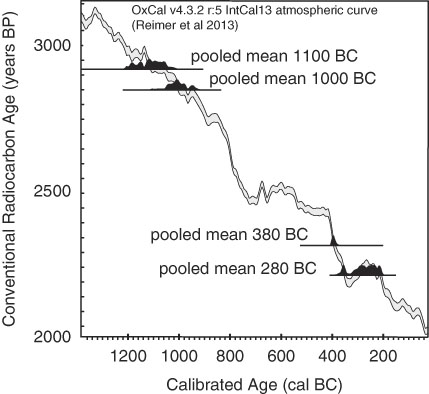
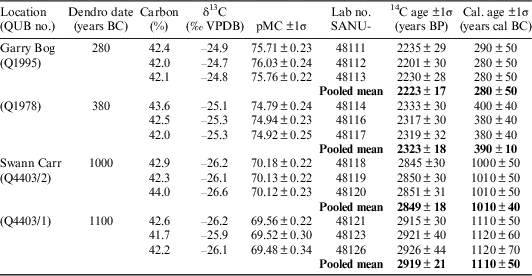
The results presented in Table 1 for the bog oak tree-ring samples treated using the 2chlorOx method show good agreement between the triplicate measurements of both δ13C and 14C age. These results, not unexpectedly, compare favourably with the isotope work on holocellulose preparations from wood originating in the same sites, as used for the Irish high-precision calibration curve (McCormac et al. Reference McCormac, Baillie, Pilcher, Brown and Hoper1994); but as for other material isolated in this study, the 2chlorOx cellulose products were paper-white. Probability distributions for the pooled mean ages are plotted in Figure 1 against the IntCal13 calibration curve (using OxCal 4.3.2); the excellent matches strongly suggest that the 2chlorOx protocol yields reliable ages.
OxCal plot of four pooled mean age probabilities (black) for tree ring samples from England and Ireland, against IntCal13 (shaded curve).
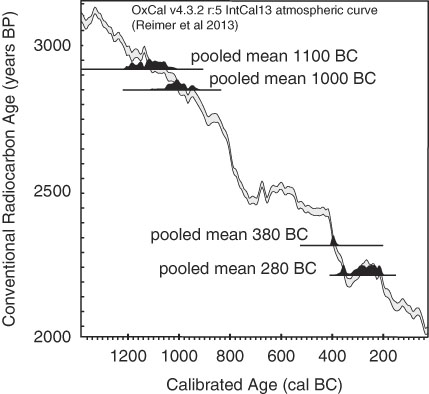
Oak tree ring samples received as milled holocellulose (dendro- date is mid-point of bidecadal blocks) from Garry Bog, Northern Ireland, and Swann Carr, England, showing measurements made on cellulose prepared using the twice-repeated hypochlorite/chlorite method (2chlorOx).

pMC=background-corrected and normalized percent modern carbon, relative to modern standard (Oxalic Acid I).
%C measured with Elemental Analyser, uncertainty ~0.2%; δ13C measured with IRMS, uncertainty ~0.2‰.
Pooled mean ages calculated with CALIB 6, conventional radiocarbon ages calibrated using IntCal13 with OxCal 4.2 (online).
These known-age holocellulose samples were treated using the full new procedure to demonstrate that the 2chlorOx protocol (including supermarket bleach) does not add old carbon to the finished cellulose product.
Near-Background Samples
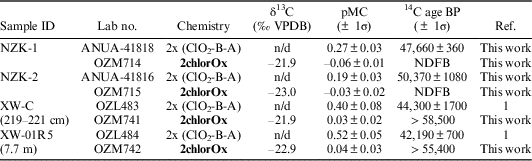
Table 2 shows comparative results from experiments on dating ancient woody material: NZK-1 (FIRI A/B consensus 0.24 pMC; Scott Reference Scott2003) and NZK-2 (MIS VII, ~240 ka) are kauri logs from the north island of New Zealand; XW-C 219-221 and XW-01R5 7.7 m are macrofossil/woody fragments found in cores taken from highly organic sediments at Lake Xere Wapo, New Caledonia. While the NZ kauri wood samples are relatively clean with a pale brown color, the Xere Wapo samples are not. For sample XW-C 219-221, separate δ13C measurements on particles with different colors (Linda Barry, personal communication, 2012) revealed values of –25.6‰ (brown-black), –24.2‰ (light brown), and –22.9‰ (yellow-white), suggesting that several oxidation/contamination states of wood are present in the submerged sediments.
Summary radiocarbon measurements for near-background woods from New Zealand and New Caledonia, showing chemical pretreatment comparison and stable isotope ratios where available.

pMC=background-corrected, normalized percent modern carbon, relative to modern standard (Oxalic Acid I).
A=acid, B=base (alkali); OCl=hypochlorite, ClO2=chlorite, 2chlorOx=2x (OCl-A-ClO2-A).
NDFB=not different from background.
Reference 1: Stevenson et al (Reference Stevenson, Gillespie, Hope, Jacobsen, Fallon and Levchenko2010).
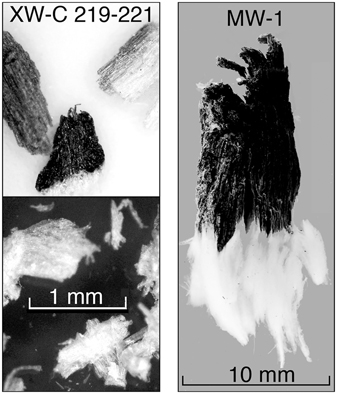
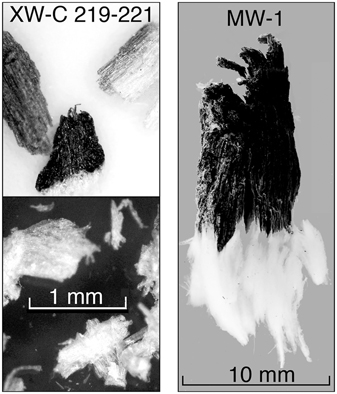
As shown in Figure 2 (left panel), the 2chlorOx cellulose protocol yielded a paper-white product, and the age increased from 44,300 BP to >58,500 BP. The increase in age for sample XW-01R5 7.7m from 42,190 ± 700 BP on holocellulose to >55,400 BP on 2chlorOx cellulose is also significant, and matches the measurement on a hypochlorite-bleached, pollen-rich 38–50-µ sample (SANU-8320, NDFB; Stevenson et al. Reference Stevenson, Gillespie, Hope, Jacobsen, Fallon and Levchenko2010). Increasing age following 2chlorOx cellulose preparation is clearly significant for the four samples in Table 2, and all are now effectively 14C background.
(Left panel) Photographs of New Caledonia sample XW-C 219-221 before (top) and after (bottom) 2chlorOx cellulose treatment; (right panel) photograph of black wood sample MW-1 from sandy sediments near Menindee, New South Wales, the lower half was soaked in alkaline hypochlorite bleach overnight, then briefly washed with 1M HCl and water.
This work demonstrates that:
(a) previously reported holocellulose preparations using repeated acid chlorite oxidation with 1M NaOH extractions do not efficiently decontaminate wood with a true age close to laboratory background, particularly for dark colored material such as that found in Lake Xere Wapo sediments;
(b) the 2chlorOx method produces paper-white cellulose, which yields significantly older 14C ages than holocellulose preparations.
Strongly Colored Wood
Sample MW-1 (field identity BHMAR79A-2, 8.7m) is from a core taken in the Coonambidgal 1 region of the Darling River scroll-plain phase near Menindee in western New South Wales, for which context, stratigraphy, and summary multi-method ages have been presented in Lawrie et al. (Reference Lawrie, Brodie, Tan, Gibson, Magee, Clarke, Halas, Gow, Somerville, Apps, Smith, Christensen, Abraham, Hostetler and Brodie2012). As received, the sample consisted of sandy sediment with large waterlogged woody fragments, the outer surface and interior of which were dark-brown to black with tree-ring structures visible.
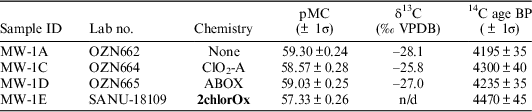
A crushed sample was treated using the holocellulose method, yielding a pale-yellow to pale-grey product. Another crushed sample was treated using the ABOX method described in Bird et al. (Reference Bird, Ayliffe, Fifield, Cresswell, Turney, Barrows and David1999) with three 2-hr treatments of acidic dichromate oxidation at 60°C, yielding a small residue containing a few black bits among the pale-brown majority. Those two products and an untreated raw wood sample were measured at ANSTO, while a separate crushed sample treated with the 2chlorOx protocol was measured at ANU; these results are presented in Table 3. The photograph in Figure 2 (right panel) shows a piece of MW-1 wood after half was suspended overnight in alkaline hypochlorite bleach and briefly rinsed in HCl and water. The three ANSTO dates are statistically identical (T statistic 3.92 cf. χ2 5.99, 2 dof, with pooled mean age 4239 ± 21 BP; calculated using CALIB 6), and they are significantly younger than SANU-18109 (4470 ± 45 BP).
Radiocarbon measurements on black wood sample MW-1, recovered from a vibra-core in sandy sediments near Menindee, NSW, showing chemical pretreatments and δ13C values where available.

pMC=background-corrected and normalized percent modern carbon relative to modern standard (Oxalic Acid I).
Chemistry: A=acid, B=base (alkali), OCl=hypochlorite, ClO2=chlorite, ABOX=method of Bird et al (Reference Bird, Ayliffe, Fifield, Cresswell, Turney, Barrows and David1999).
2chlorOX=2x (OCl-A-ClO2-A).
Stable C isotopes measured with IRMS, uncertainty ~0.2‰.
Sample location, stratigraphy, collection and summary multi-method ages reported in Lawrie et al (Reference Lawrie, Brodie, Tan, Gibson, Magee, Clarke, Halas, Gow, Somerville, Apps, Smith, Christensen, Abraham, Hostetler and Brodie2012).
DISCUSSION
In the experiments reported here, several oxidation chemistries have been applied to wood samples to explore performance differences, building on previous work with dichromate oxidation (Bird et al. Reference Bird, Ayliffe, Fifield, Cresswell, Turney, Barrows and David1999; Santos et al. Reference Santos, Bird, Pillans, Fifield, Alloway and Chappell2001), and with chlorine-based oxidants (Gillespie Reference Gillespie1997; Gillespie et al. Reference Gillespie, Fifield, Levchenko and Wells2008; Stevenson et al. Reference Stevenson, Gillespie, Hope, Jacobsen, Fallon and Levchenko2010). One major problem, in this author’s opinion, is that the strongest oxidation reagents (such as highly acidic chlorate or dichromate) are not chemically selective, so that the desired product, cellulose, may be destroyed about as much as other organic constituents present. This will not, in many cases, significantly change the original sample to contaminant ratio, nor produce a paper-white product.
For the near-background samples—New Zealand kauri wood and Xere Wapo podocarp wood—the expected result is 14C background, i.e. zero percent modern carbon (pMC). The oldest 14C ages shown in Table 2 are given as Not Different From Background (NDFB), or as some large non-finite age (such as >53,400 BP), while the pMC measurements scatter around the desired zero value. Black sample MW-1 from the Menindee Lakes region of western New South Wales, has characteristics similar to the woody plant clippings that quickly (a few days) turn black in home compost heaps: black on the outside first, then much more slowly darkening throughout the interior. Such black material found in sediments has not necessarily ever been in a fire (Gillespie Reference Gillespie1997), and tends to give 14C age outliers that are frequently much younger than consensus dates from the use of different sample materials and/or dating methods (e.g. Gillespie Reference Gillespie1998). This work demonstrates that the 2chlorOx protocol was clearly better on this darkly colored wood than (a) no treatment, (b) the holocellulose method, or (c) the ABOX method.
Unlike some published methods, in the 2chlorOx procedure introduced here oxidations can be done under normal laboratory conditions: at room temperature for alkaline hypochlorite, and in a 70°C water bath for acidic chlorite. It seems likely that the high vapour pressure of gaseous Cl2 and chlorine oxides present above the alkaline hypochlorite solution protects the wood from atmospheric CO2, so that no carboxylation or other reactions on cellulose can take place, which might alter the natural carbon isotope ratios (Jull et al. Reference Jull, Donahue and Damon1996; Kouznetsov et al. Reference Kouznetsov, Ivanov and Valetsky1996; Hedges et al. Reference Hedges, Bronk Ramsey and Van Klinken1998; Hatté et al. Reference Hatté, Morvan, Noury and Paterne2001). Since the alkalinity of the hypochlorite solution is provided by only ~0.1M NaOH, a 1M HCl wash is sufficient to both acidify and clear the residue.
No claims are made about the detailed structure of the cellulose product prepared by the 2chlorOx method. However, Garvey et al. (Reference Garvey, Simon and Parker2005, Reference Garvey, Paris and Gillespie2007) studied the nanoscale arrangement of microfibrils using wide angle x-ray diffraction (WAXD) on cellulose prepared from different source materials, noting that alkaline hypochlorite bleached preparations showed peak broadening comparable with known α-celluloses such as filter paper and cotton. Woods with higher resin content than Southern Hemisphere native eucalypt, podocarp and kauri, or Northern Hemisphere native pine wood, have not been tested, but the examples tested here do not appear to require solvent extraction before (or strong alkali extractions after) the oxidations. These experiments produced material with paper-white color, with %C values close to the theoretical 44.4% of α-cellulose and δ13C ratios show the expected shift toward less negative values from whole wood to cellulose (e.g. Wilson and Grinstead Reference Wilson and Grinsted1977; Cullen and Grierson Reference Cullen and Grierson2006).
This study was designed to address economic and practical considerations for preparation of cellulose samples destined for isotopic analyses. Given the simple chemistry, the 2chlorOx protocol introduced here is quicker and simpler than most other published methods, such as those based on α-cellulose preparations. Using this procedure, many samples can be processed in less than one day and the wood sample encounters only alkaline hypochlorite bleach, 1M HCl, acidic chlorite bleach and distilled water. All experiments used single-temperature 850°C bulk combustions, on the not unreasonable assumption that if superior selective chemistry is diligently carried out, then the cellulose produced will have high purity and not suffer the large sample losses experienced with some other methods. It may be preferable, especially for material near the radiocarbon background, to use a reputable laboratory reagent rather than the readily available supermarket bleach employed for almost all samples in this work. However, the dates reported here on known-age tree ring samples show that this bleach does not add detectable old carbon to the samples.
CONCLUSIONS
The experiments described in this work were directed toward improving the radiocarbon dating of contaminated wood samples. It has been shown that background 14C ages can readily be attained by using twice-repeated alkaline hypochlorite-acidic chlorite oxidations, the 2chlorOx protocol introduced here, without the necessity for organic solvents, strong alkali solutions or an inert gas blanket. Whiteness of product was the main criterion used for appraisal during development of this chemistry procedure, since pure cellulose should be paper-white. The cellulose produced by this method from the samples tested is clearly better for 14C dating of both near-background and late Holocene wood than standard holocellulose or ABOX pretreatment methods. This novel 2chlorOx method uses only inorganic reagents and is simpler, quicker and cheaper than most other reported methods for the isolation of cellulose for isotope measurements.
ACKNOWLEDGMENTS
I thank Alan Hogg, Janelle Stevenson, John Magee, and Mike Baillie for samples used in this study, and I greatly appreciate the assistance provided in graphite preparation, stable isotope and/or AMS radiocarbon measurements by Stewart Fallon, Rachel Wood, and Keith Fifield at ANU, Vladimir Levchenko, Fiona Bertuch, and Linda Barry at ANSTO, and David Wheeler at the University of Wollongong. Many of the chemicals and some laboratory equipment were funded by a Small Strategic Grant to RG from the Centre for Archaeological Science, University of Wollongong. Some of the δ13C and 14C measurements included here were funded by AINSE grant 10/143 to RG for isotopic analyses at ANSTO, others were run free of charge by Keith Fifield and Stewart Fallon at the ANU facilities. I thank Associate Editor Steven Leavitt, Rachel Wood, Sarah Gornall, and two anonymous reviewers for comments and suggestions, which greatly improved the manuscript.