


Introduction
In social mentality theory (Gilbert, Reference Gilbert1989, Reference Gilbert2001, Reference Gilbert and Gilbert2005) the interplay in social situations between emotional, motivational, cognitive, and behavioural processes is conceptualized as reflectioning underlying evolutionary derived systems that shape relationships between the self and others. Social mentalities are implicated in care-giving, care-eliciting, formation of interpersonal alliances, social rank and sexual behaviour. They have a critical role in appraising threat, enhancing safeness, and in regulating the affect associated with these fundamental evolutionary challenges (MacBeth, Schwannauer and Gumley, Reference MacBeth, Schwannauer and Gumley2008). According to whether the environment is threatening or safe, all organisms must co-ordinate a range of internal processes in order to pursue goals, enact strategies and co-create social roles (Buss, Reference Buss2003; Gilbert, Reference Gilbert1989, Reference Gilbert1992). Whether environments are threatening or safe, humans have (often rapid) access to an evolved menu or suite of strategic responses (ways of attending, feeling, behaving and thinking) to aid adaptive responding (Gilbert, Reference Gilbert and Gilbert2005).
Social mentality theory refers to the development of the “human warmth syndrome” whereby human beings develop, through secure attachments with primary care givers, the ability to have compassion towards themselves and others. A secure attachment facilitates the development of internal working models of others as “safe, helpful and supportive”. The internalization of this helps the individual to develop self-soothing and compassionate behaviours towards themselves and others. This activates the safe(ness) social mentality. The threat-defence mentality is activated in situations of perceived and actual threat. For example, social rank may provide a source of threat, whereby dominant individuals will issue commands and hold power, whilst subordinates will take those commands and be submissive. Social mentality theory states that the role relationships that exist between people can also exist within people and arise from internal working models of early relationships. Therefore, human beings can internalize the voice of a critical other and develop a submissive/subordinate response to this. This model can help to explain the occurrence of command hallucinations. It has been demonstrated that people who experience auditory hallucinations often relate to them as though they were relating to real external others. In particular, the voices are commonly experienced as malevolent, derogating, shaming and self-critical (Legg and Gilbert, Reference Legg and Gilbert2006).
Developmental theory helps us understand the impact of early attachments on adult psychopathology and hence the development of safe(ness) or threat focused social mentalities. Previous research shows that early attachment experiences influence the ability to develop safe and secure adult relationships (Bowlby, Reference Bowlby1988). Gilbert (Reference Gilbert and Power2004) refers to two consequences that result when parents are unable to create (and stimulate) safeness, are threatening or shaming, and do not convey warmth. First the “under-stimulation” of positive affect and warmth systems; and second, the child is more likely to be “threat focused”, seeing others as a source of threat. Subsequently, they are more social rank focused, especially on the power of others to control, hurt or reject them. Sloman (Reference Sloman, Sloman and Gilbert2000) and Sloman, Gilbert and Hasey (Reference Sloman, Gilbert and Hasey2003) have shown that those who have not been able to internalize a sense of warmth (able to stimulate positive affect in the mind of others) and who feel unloved by others, can set out on quests to earn their place, becoming excessively seeking, competitive and sensitive to rejection (Gilbert, Reference Gilbert and Power2004).
People with psychosis who also commit offences often come from backgrounds that reduce the safe(ness) mentality and result in an activation of the threat focused mentality. Read et al. (Reference Read, Goodman, Morrison, Ross, Aderhold, Read, Mosher and Bentall2004) have shown that the very high incidence of childhood trauma (emotional, sexual and physical abuse or neglect) and a diagnosis of schizophrenia is not attributable to chance. Experiences of bullying, shame, and other humiliation experiences (Bebbington et al., Reference Bebbington, Bhugra, Brugha, Singleston, Farrell, Jenkins, Lewis and Meltzer2004; Campbell and Morrison, Reference Campbell and Morrison2007) trauma and loss (Romme and Escher, Reference Romme and Escher1989) are also associated with increased risk of developing psychosis. Such traumatic life experiences can lead to the collapse and disorganization of attachment characterized by impaired mentalization and theory of mind, fragmentation, dissociation and segmentation of episodic memories; and use of competing and inconsistent coping responses (Liotti and Gumley, Reference Liotti and Gumley2008; Read and Gumley, Reference Read and Gumley2008). Such early experiences may compromise the development of inner warmth. We know that many people who have psychosis and who have also offended have had such life experiences (Boswell, Reference Boswell1996; Fonagy et al., Reference Fonagy, Target, Steele, Steele, Leigh, Levinson, Kennedy, Atkinson and Zucker1997) and we understand that this has an impact on attachment organization and increases propensity for a threat focused social mentality or “paranoid mind” (Gumley and Schwannauer, Reference Gumley and Schwannauer2006).
The potential importance of developing inner warmth came from observations that some high self-critics could understand the logic of cognitive behavioural therapy, and could generate alternative thoughts to self-criticism, but rarely felt reassured by such efforts (Lee, Reference Lee and Gilbert2005). Similar observations were made when a self-esteem programme was piloted with a group of patients with psychosis in a high security hospital (Laithwaite and Gumley, Reference Laithwaite and Gumley2007). The findings of this preliminary study were encouraging and demonstrated an improvement in self-esteem, and depression. A noticeable change in positive symptomatology was not evident, due to most participants being remitted of their positive symptoms prior to the group commencing. Furthermore, participants in the group spoke about their early adverse experiences and how this contributed to the development of low self-esteem. However, it was clear that many participants were able to challenge their self-criticism on an “intellectual level” but continued nevertheless to report feelings of worthlessness and low self-esteem.
The participants in both the above studies (Lee, Reference Lee and Gilbert2005; Laithwaite and Gumley, Reference Laithwaite and Gumley2007) came from traumatized backgrounds. It is postulated by Gilbert (Reference Gilbert and Power2004) that individuals with such experiences are compromised in their ability to generate a model of compassion, and hence the ability to self-soothe. Further studies have demonstrated that a lack of self-compassion is associated with increased vulnerability to a number of indicators of psychopathology (Neff, Reference Neff2003a). We know this is relevant because compassion helps to tap into safeness mode, which helps to regulate affect. This is significant with regards to relapse and recovery after psychosis as a key aspect in relapse is high levels of emotional distress and affective dysregulation in the period before, during and following the acute phase of psychosis. For example, findings from retrospective and prospective studies have shown that the most commonly reported early signs of relapse are fearfulness, anxiety, poor sleep, irritability, tension, depression and social withdrawal (Herz and Melville, Reference Herz and Melville1980; McCandless-Glimcher et al., Reference McCandless-Glimcher, McKnight, Hamera, Smith, Peterson and Plumlee1986; Birchwood, Hallett and Preston, Reference Birchwood, Hallett and Preston1989). In terms of recovery, studies by Birchwood, Mason, MacMillan and Healy (Reference Birchwood, Mason, MacMillan and Healy1993) and Rooke, Birchwood and Iqbal (Reference Rooke and Birchwood1998) have shown that patients with depression following an acute psychotic phase were more likely to have experienced more compulsory admissions and loss of, or drop in, employment status. Gilbert formulates this according to social rank theory, whereby schizophrenia is a major life event that leads to significant loss in social status and role in society. Those who experience post-psychotic depression may indeed have greater insight into such losses and fear subsequent relapse for this reason.
Gilbert and colleagues (Gilbert, Reference Gilbert1992, 1997, Reference Gilbert, Gilbert and Bailey2000; Gilbert and Irons, Reference Gilbert, Irons and Gilbert2005) have developed compassionate mind training (CMT) to help people develop compassion and the ability to self-soothe, regulate affect and hence provide an antidote to the threat mode. This model is based on the premise that self-criticism is significantly associated with shame-proneness and that self-criticism is associated with lifetime risk of depression (Murphy et al., Reference Murphy, Nierenberg, Monson, Laird, Sobol and Leighton2002). CMT proposes that some people have not had the opportunity to develop their abilities to understand sources of their distress, be gentle and self-soothing in the context of set-backs and disappointments, but are highly (internally and externally) threat focused and sensitive. CMT seeks to change an internalized dominating-attacking style that elicits a submissive response to one that elicits a caring and compassionate response.
There is a poverty of published research carried out into people with psychosis in forensic clinical settings. This is despite the fact that this is a population with complex and long-term needs. This population has generally experienced past trauma; poor relationships with significant others, disrupted attachment histories and has the double stigma of experiencing severe mental health problems and being offenders (Laithwaite et al., Reference Laithwaite, Gumley, Benn, Scott, Downey, Black and McEwen2007; Boswell, Reference Boswell1996; Fonagy et al., Reference Fonagy, Target, Steele, Steele, Leigh, Levinson, Kennedy, Atkinson and Zucker1997). Recovery in this population is not just about reduction of symptoms or distress, but reduction/management of risk of violent offending. It is therefore important that therapies that have been researched in general mental health settings are adapted and piloted with this population. A recovery programme that draws on CMT is attractive as it has a developmental perspective that focuses on the effect of disrupted attachment histories on the current functioning of the individual and their ability to respond to self-criticism, self-soothe, and modify distress. Hence a programme that focuses on developing a compassionate understanding of those vulnerabilities may promote recovery and help those seeking safety strategies, which in turn may reduce the risk of violent re-offending.
Aims
The aim of this group intervention was to evaluate the specific aims of the Recovery After Psychosis Programme. The aims of this programme were:
○ To improve depression
○ To improve self-esteem
○ To develop compassion towards self
○ To improve social comparison and to reduce external shame
Method
Design
A within-subjects design was used. Participants were assessed at the start of group, mid-group (5 weeks), the end of the programme, and at 6-week follow-up.
Participants
The State Hospital is the maximum-security hospital for Scotland and Northern Ireland and provides treatment and care in conditions of special security for individuals with mental disorder who, because of their dangerous, violent or criminal propensities, cannot be cared for in any other setting (The State Hospitals Board for Scotland, 2005). There are 11 wards covering admissions, rehabilitation and continuing care. Patients in the hospital and participants in the study are familiar with being assessed on a regular basis by health professionals who are vigilant to issues of risk and mental health.
Inclusion/exclusion criteria
Participants were considered eligible for the group if they had a primary diagnosis of schizophrenia, schizo-affective disorder or bi-polar affective disorder (those with bi-polar affective disorder had a history of psychotic features). Potentially eligible participants were excluded from the study if they had an organic illness, severe intellectual disability, and were not able to provide informed consent. Participants were also excluded if they were involved in other research. All participants in this study had a primary diagnosis of schizophrenia, or bi-polar-affective disorder.
Procedure
Ethical approval was given by the Local Research Ethics Committee (LREC number 06/s1103/76). Participants were recruited from a high security inpatient NHS setting. Letters were sent to Responsible Medical Officers and clinical psychologists in the hospital in order to identify potential participants. Prior to seeking informed consent from potentially eligible patients, the respective patient's Responsible Medical Officers were asked to provide consent for their patient to be approached. Following consent, patients were approached by a chartered clinical psychologist (HL) and following a full description of the study, patients were invited to participate.
Assessments
Assessments were administered to participants at the start, at 5 weeks (mid group), and at the end of the programme, with a 6-week follow-up. All the clinical outcome measures were standardized measures, either self-report questionnaires or structured interviews with acceptable psychometric properties.
Inter-rater reliability
All psychometric assessments were carried out by the assistant psychologists who had both received in-house training in the delivery of such assessments. Both were trained to use the Positive and Negative Syndrome Scale (PANSS) using video assessment (with reliability at r > 0.80).
Primary outcomes
Social Comparison Scale (SCS): this scale was developed by Allan and Gilbert (Reference Allan and Gilbert1995), and is an 11-item scale that taps global comparisons to others in the domains of attractiveness, rank and group fit (feeling similar or different to others). A lower total score reflects relative inferiority compared with others, whereas a higher total score indicates relative superiority.
External Shame (the Other as Shamer Scale – OAS): this scale was developed by Goss, Gilbert and Allan (Reference Goss, Gilbert and Allan1994) and Allan, Gilbert and Goss (Reference Allan, Gilbert and Goss1994) to measure external shame (how an individual thinks others see him/her). The scale consists of 18 items asking respondents to indicate the frequency of their feelings and experiences to items such as, “I feel insecure about others’ opinion of me” and “other people see me as small and insignificant” on a 5-point Likert scale (never, seldom, sometimes, frequently, almost always). A total score is given by adding up the items; a higher score indicates greater experience of external shame.
Self Compassion Scale (SeCS; Neff, Reference Neff2003b). This scale is a self-report measure that explores self-compassion in individuals. It is a 26-item scale that measures self-compassion (13 items) and coldness towards the self (13 items). There are six subscales – three measure self-compassion: common humanity, self-kindness and mindfulness. There are also three subscales to measure coldness towards the self: self-judgment, over identification, and isolation. Responses are given on a 5-point Likert scale ranging from 1 = “almost never” and 5 = “almost always”. Subscale scores are computed by calculating the mean of subscale item responses. To compute a total self-compassion score, reverse score the negative subscale items – self-judgment, isolation, and over-identification – then compute a total mean. The higher the total score, the greater the self-compassion (NB: this is recommended scoring by Neff, personal communication, but not scoring of original 2003b paper).
The Beck Depression Inventory II (Beck, Steer and Brown, Reference Beck, Steer and Brown1996) was used as a self-report measure of mood (score range 0–63). Higher scores reflect increase in self-reported low mood.
The Rosenberg Self-Esteem measure (RSE; Rosenberg, Reference Rosenberg1965; Rosenberg, Schooler, Schoenbach and Rosenberg, Reference Rosenberg, Schooler, Schoenbach and Rosenberg1995) is a 10-item self-report measure of self-esteem. Higher scores (range 0–30) are indicative of higher self-esteem.
The Self-Image Profile for Adults (SIP-AD; Butler and Gasson, Reference Butler and Gasson2004) consists of 30 self-descriptions and is a self-report questionnaire. Participants are invited to rate themselves as they are and how they would like to be (ideal) along each self-description. A self-image score (SI) represents how the individual feels about him/herself. A high self-image score suggests the person has a positive view of him/herself. Self-esteem (SE) reflects an individual's evaluation of him/herself. On the SIP-AD this is operationalized as the discrepancy between how the person sees him/herself and how they wish to be (ideal). A high score reflects a wide discrepancy and therefore lower scores are interpreted as reflecting high self-esteem.
Secondary outcomes
The Positive and Negative Syndrome Scale (PANSS; Kay, Fiszbein and Opler, Reference Kay, Fiszbein and Opler1987) measures 32 symptoms on a 7-point Likert scale, deriving three composite subscales: Positive, Negative, or General Psychopathology. Higher raw scores indicate higher symptomatology.
Intervention
The Recovery After Psychosis programme was delivered by a team comprising two chartered clinical psychologists (HL and PC), an advanced practitioner (MO'H), a trainee clinical psychologist (LA) and two assistant psychologists (SP and PD). The group was delivered by three therapists (due to security reasons). The first group was facilitated by HL, MO'H and SP and the last two groups were facilitated by HL, MO'H, PC and LA. SP and PD provided between group session individual support. The programme was developed by HL and AG and based on Compassionate Mind Training (Gilbert, Reference Gilbert2001). AG provided the group facilitators with clinical supervision. The programme ran for 10 weeks (20 sessions). This involved two sessions a week. The programme was divided into the following three modules:
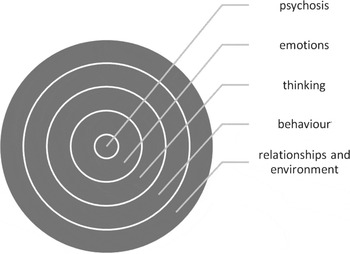
Module one: understanding psychosis and recovery. The aim of this module was to help patients conceptualize the holistic nature of psychosis and the impact of this on various aspects of their lives. Patients were encouraged to think about psychosis in relation to their emotions, their cognitions, their behaviour, relationships and environment (see Figure 1). This model was then used to understand recovery. Therefore patients were encouraged to think beyond recovery as symptom reduction, but also to view recovery in terms of their emotions, feelings, relationships with others and their environment. To help patients with this, the metaphor of the “pebble in water” was used, so that they could understand how recovery or progress in one area of their life can have an impact on another area. Another group exercise involved using the metaphor of “recovery as a journey”, which helped create a visual experience of the many difficulties that they may face in the future, and the “tools” they need to take with them on their journey to help with this.
“Pebble in the water” conceptualization of recovery and psychosis

Module two: Understanding compassion and developing the ideal friend. In this module the group explored the concept of compassion and the many features of this (strength, forgiveness, acceptance, trust, non-judgemental). The strengths and weaknesses of these characteristics were discussed in depth. This exercise progressed to the creation of the “ideal friend”. The intention of creating this ideal friend is for patients to be able to refer to “someone” who is compassionate and, over time, it is anticipated that they will internalize the characteristics of this ideal friend, to develop their own compassionate responses towards themselves and others. Guided discovery techniques were used to illicit an image of this ideal friend, and patients were encouraged to focus on characteristics such as voice tone, facial expressions, and body posture. Throughout the remainder of sessions, the programme referred to the ideal friend, and used exercises to help develop compassionate responding. Participants were asked to keep a diary of any negative emotions and self-critical thoughts they experienced during the week, and how they responded to this using their “ideal friend”.
Module three: Developing plans for Recovery after Psychosis. This part of the programme involved the development of a Recovery After Psychosis plan (focusing on triggers, early warning signs, use of safety behaviours, action plan and agreed coping strategies). This information was used to create a compassionate letter, which involved participants writing a letter to themselves (as written by their ideal friend). This letter contained encouragement and support in relation to how to respond to set-backs and how to seek help in the future.
Results
Participant characteristics
Three groups were run in the hospital. There were 19 (all male) participants in total and 18 participants completed the programme. The mean age of the participants was 36.9 (SD 9.09). The mean duration in hospital was 8 years. Five participants had received a diagnosis of schizophrenia; 10 paranoid schizophrenia and 3 bi-polar affective disorder (these 3 participants had experienced auditory hallucinations when elated, although at the time of the group, these had remitted). Eight of the participants also had a co-morbid personality disorder, namely anti-social personality disorder. One participant was considered to be in the “borderline” intellectual disability range.
Outcome measures
Analyses were carried out using SPSS for windows (version 14). Descriptive statistics were conducted and further analyses were carried out using Friedman's ANOVA. Significant overall effects were followed up with Wilcoxon signed ranks (two-tailed). Effect sizes based on Wilcoxon signed ranks are provided for all outcome measures for the purposes of transparency. It should be noted that p measures were not adjusted for multiple comparisons. This was a pilot study and thus we did not want to potentially miss significant outcomes by restricting p values.
Primary outcomes measures
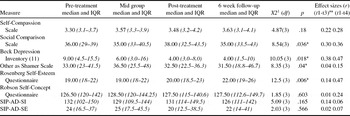
Overall significant changes were found on the Social Comparison Scale, Other As Shamer Scale and the Beck Depression Inventory II, the Rosenberg Self-Esteem measure and the Self-Image profile for Adults. Further analyses using Wilcoxon signed ranks test found significant changes on the Social Comparison Scale between the start and end of the group (Z = 1.96, n-ties = 11, p < .05, r = 0.3) and this change was maintained at follow-up (Z = 2.148, n-ties = 10, p < .05, r = 0.36). A small change was found on the Other as Shamer scale between the start of the group and 6-week follow-up (Z = .801, n-ties = 11, p> .5, r = 0.15). Significant changes on the Beck Depression Scale were found at the end of treatment (Z = 2.332, n-ties = 15, p < .05, r = 0.38) and at 6-week follow-up (Z = −2.825, n-ties = 16, p < .01, r = 0.47). An overall significant change was found on the Rosenberg self-esteem questionnaire. Further analyses using Wilcoxon signed ranks test demonstrated a significant change at 6-week follow-up (Z = −2.80, n-ties = 15, p < .01, r = 0.47) from baseline. Significant changes were not found on the Self-compassion scale, the Robson self-concept questionnaire or the Self-image profile for adults.
Primary outcome measures: change in assessment measures over course of treatment (Median, IQR and Friedman's analysis)

*significant results
**t1-t3 (pre-treatment to end of treatment)
t1-t4 (pre-treatment to 6 week follow-up)
Effect sizes calculated on Wilcoxon signed ranks
Secondary outcome measures: PANSS

*significant results
**t1-t3 (pre-treatment to end of treatment)
t1-t4 (pre-treatment to 6 week follow-up)
Effect sizes calculated on Wilcoxon signed ranks
Secondary outcomes
Significant changes were found on the PANSS general psychopathology score at the end of the group (Z = 2.23, n-ties = 14, p < .05, r = 0.38) and this was maintained at follow-up (Z = 2.75, n-ties = 12, p < .01, r = 0.41). Significant changes were not found on the PANSS positive, negative or depression scales.
Discussion
This was a pilot, pre-trial study. This was the first time that a compassion focused group intervention has been run at the State Hospital and, to our knowledge, the first time that it has been run with a forensic clinical population. The primary objective of this study was to evaluate whether the programme would improve depression, improve self-esteem, develop self-compassion and social comparison and lower the experience of shame compared with others, and hence improve how an individual perceives how others see him/her.
The findings of this study demonstrated a large magnitude of change for levels of depression and self-esteem as measured by the Beck Depression Inventory II, and Rosenberg Self-Esteem Inventory. A moderate magnitude of change was found for the social comparison scale and general psychopathology, with a small magnitude of change for shame, as measured by the Other as Shamer Scale. These changes were maintained at 6-week follow-up. Gilbert (Reference Gilbert and Gilbert2005) has shown that self-critical thinking biases are influential in the development and maintenance of psychopathology; therefore a programme such as this recovery programme, which focuses on developing compassionate responses to shame, self-critical and self-attacking thoughts, will likely lead to a reduction in depression, shame and an increase in self-esteem. Much of the research on psychopathology has focused on depression; however, we know that self-critical thinking, shame and low self-esteem also play a role in the development and maintenance of psychotic experiences (Bentall, Kinderman and Kaney, Reference Bentall, Kinderman and Kaney1994; Garety, Kuipers, Fowler, Freeman and Bebbington, Reference Garety, Kuipers, Fowler, Freeman and Bebbington2001; Smith et al., Reference Smith, Fowler, Freeman, Bebbington, Bashforth, Garety, Dunn and Kuipers2006). We observed changes on the general psychopathology scale that may be associated with a reduction in shame and self-critical thinking. However, in a larger scale study, investigating the mediating effects of changes in compassion, shame and self-critical thinking on general psychopathology might be interesting. Furthermore, anger is a common response to rejection from others, shame and feeling inferior (Gilbert and Miles, Reference Gilbert and Miles2000; Baumeister, Smart and Boden, Reference Baumeister, Smart and Boden1997), and therefore an intervention that focuses on reducing shame, and improving comparison with others, may have an impact on reducing anger and possibly risk of violent offending. This again could be explored in a larger scale trial of a compassion focused group on shame, anger and risk reduction. There is limited published research carried out on interventions for psychosis with a mentally disordered population. However, although this study drew from patients in a high security setting, the results sit favourably with a case series study of three patients with psychosis, anger problems and substance misuse in a low security environment (Haddock, Lowens, Brosnan, Barrowclough and Novaco, Reference Haddock, Lowens, Brosnan, Barrowclough and Novaco2004) and with a self-esteem group intervention carried out in high security (Laithwaite and Gumley, Reference Laithwaite and Gumley2007).
A significant change was found on the Rosenberg self-esteem questionnaire but not on the other measures of self-esteem. In the self-esteem group evaluation (Laithwaite and Gumley, Reference Laithwaite and Gumley2007) self-esteem was found to be strongly correlated with scores on the BDI II. That is, lower self-esteem was associated with more severe depressed mood. Therefore it was unclear whether changes in self-esteem were related to changes in depressed mood or vice versa. Although correlations between scores on the BDI II and the Rosenberg self-esteem measure were not carried out in this study, it is possible that a similar relationship was present. Indeed, Rosenberg and colleagues have found that the negative correlation between the two variables “seems to be due somewhat more to the effect of depression on self-esteem than to the effect of self-esteem on depression” (Rosenberg et al., Reference Rosenberg, Schooler, Schoenbach and Rosenberg1995, p. 145). Furthermore, the findings from Birchwood and Iqbal (Reference Birchwood, Iqbal, Wykes, Tarrier and Lewis1998) draw attention to the fact that depression in psychosis is particularly common, with prevalence estimates ranging from 22% to75%, depending on criteria used.
Significant changes were not found on the self-compassion scale. However, the median score on this measure is comparable with norms developed on a general student population (Neff, Reference Neff2003a, Reference Neffb). It may be that the self-report of compassion is different for individuals who have lacked the experience of compassion from others during critical periods of their development. This would be consistent with the proposals of social mentality theory. There were several challenges to delivering this programme. The concept of compassion is one that is not usually discussed in forensic clinical settings where notions of symptom reduction and risk management prevail. Participants were able to describe the characteristics of compassion but struggled to relate these characteristics to themselves. For example, acceptance and forgiveness generated much discussion in the group, with many participants reportedly feeling uncomfortable about self-forgiveness as it may be interpreted as lack of remorse or empathy for their victims. The programme focused on developing acceptance for past behaviours but taking responsibility for future possible outcomes. This seemed to empower many of the group participants as there was some hope of moving on from the stigma and shame of the past to being positive about the future. This change in looking at future possibilities also helped participants respond to self-attacking thoughts that seemed to be mainly past orientated. There is a movement to promote forgiveness in violent offenders and to promote the potential to develop a “good life” (Ward and Marshall, Reference Ward and Marshall2004), with this being seen as a more positive approach to offender rehabilitation as it helps to engage individuals in therapy, and subsequently may reduce risk of future violent offences (Day, Gerace, Wilson and Howells, Reference Day, Gerace, Wilson and Howells2008).
Many of the participants initially found it challenging to generate a compassionate image. This was not just simply that participants in the group found it difficult to access early memories, as some could clearly describe memories of inconsistent care-giving – it was that they could not relate to personal experiences of compassion, and therefore found it challenging to generate an internal working model of a compassion. The research on attachment theory may help to explain this. When early attachment experiences are compromised, this may result in insecure adult attachment states of mind. We know from research that individuals with psychosis and with violent offending histories often have experienced disrupted attachment histories (Boswell, Reference Boswell1996; Read and Gumley, Reference Read and Gumley2008). For example, limited early experiences of care giving conducive to secure attachment and limited experience of mirroring, where needs of the infant are reflected on by their care-giver (Fonagy, Gergely, Jurist and Target, Reference Fonagy, Gergely, Jurist and Target2002). Such early attachment experiences have an effect on the development of mentalization and subsequent regulation of affect (Liotti and Gumley, Reference Liotti and Gumley2008). Therefore individuals’ ability to reflect on their own emotional mental states and memories may be compromised (Bowlby, Reference Bowlby1988., Fonagy et al., Reference Fonagy, Gergely, Jurist and Target2002). Such early attachment histories might also have been associated with avoidant/dismissive coping styles. The compassion focused therapy encouraged participants to reflect upon episodic memories that may have resulted in some participants feeling anxious or distressed and using avoidant coping styles so as not to think about an image. Furthermore, individuals operating in a threat focused social mentality may have experienced a degree of fear when generating a compassionate image (Gilbert, Reference Gilbert2003). To overcome some of these challenges, group facilitators offered support and helped the group to generate a group compassionate image, and also suggested that they could think of a place or non-human object that generated feelings of warmth and safety.
There are several limitations to this study. In particular, the study was conducted with a small sample of participants without any matched control group. We therefore cannot be fully confident that the changes observed over time are fully attributable to the effects of the intervention. Future research could incorporate a larger sample size, and randomization to an appropriate control condition, which would improve the reliability and generalizability of findings. In addition, many of the measures used in the study do not have published norms and have not been validated with a forensic clinical population. However, comparisons can be drawn with previous studies that have used these measures. We know that patients in the forensic clinical population score higher on external shame and lower on social comparison compared with a student population (Goss et al., Reference Goss, Gilbert and Allan1994; Gilbert, Cheung, Grandfield, Campey and Irons, Reference Gilbert, Cheung, Grandfield, Campey and Irons2003). Gilbert and Proctor (Reference Gilbert and Proctor2006) developed a group intervention for six patients with major/severe long term and complex difficulties. At the start of this group, the mean score for participants was much higher on external shame than the forensic clinical population. However, at the end of the intervention, the scores on external shame and social comparison were comparable with the forensic clinical population. It is also important to recognize that Bonferonni corrections were not used in the analysis. One limitation of the study is the accepted p value was not corrected for the number of multiple comparisons and small sample size. However, we considered that given the pilot nature of the study that the increased risk of type I errors was acceptable. This was because we wished to estimate which outcomes were more important to measure in a larger randomized study. Facilitators involved in the delivery of the group were also involved in the completion of psychometric assessments. To reduce bias, future evaluation of the programme would be improved by using raters independent of the treatment programme.
In conclusion, this preliminary study evaluated a compassion focused group intervention for patients with psychosis residing in a high security setting. The findings demonstrate an improvement in depression, self-esteem, and rating of self compared with others, and a reduction in shame, and general psychopathology. Further replication of this study could involve a waiting list control group, a larger sample size and independent rating of change in outcome. Further research could also involve extending this protocol to non-forensic populations.
Acknowledgments
Dr Karen Allan, Lead Consultant Clinical Psychologist at the State Hospital and Ms Patricia Cawthorne, Clinical Nurse Specialist and Psychological Therapies Operational Manager.




Comments
No Comments have been published for this article.