INTRODUCTION
A diagnosis of cancer can lead to physical and psychological symptom burdens that affect both patients and their families. However, formal evaluation of caregiver symptom burden is not part of the regular clinical oncology or palliative care setting encounter. Caregivers have reported the presence of chronic pain, fatigue, difficulty sleeping, decreased appetite, financial burden, marital strain, and emotional distress, among other symptoms (Edwards & Ung, Reference Edwards and Ung2002; Matthews, Reference Matthews2003; Grunfeld et al., Reference Grunfeld, Coyle and Whelan2004; Costa-Requena et al., Reference Costa-Requena, Cristofol and Canete2012). A longitudinal study on the caregivers of patients with cancer showed that 75% of them experienced physical problems before the patient was discharged from the hospital and that these problems continued for about half of the caregivers once the patient was discharged (Oberst & Scott, Reference Oberst and Scott1988). Jensen and Given (Reference Jensen and Given1991) studied 248 caregivers of cancer patients in the Family Homecare Cancer Study, where ~53% of caregivers reported moderate to severe fatigue not related to age or duration of caregiving. Social burden was reported by Siegel et al. (Reference Siegel, Raveis and Houts1991) in 483 caregivers of cancer patients undergoing or who had undergone chemotherapy or radiation, with 56% describing moderate to severe burden. Financial burden was related to having to use up their savings or securing loans to pay for healthcare costs as well as having to limit work hours or quit their jobs entirely (Siegel et al., Reference Siegel, Raveis and Houts1991). Caregiver symptom burden may affect their ability to provide care to the patient, which is crucial since recent medical and insurance policy changes have resulted in shortened hospital stays, and the majority of patient care is thus shouldered by patients' families (Laizner et al., Reference Laizner, Yost and Barg1993; Schott-Baer, Reference Schott-Baer1993; Edwards & Ung, Reference Edwards and Ung2002). Therefore, a regular measurement of caregiver symptom burden would allow us to have a basis for early support and referral for their care.
The World Health Organization (2016) defines palliative care as “an approach that improves the quality of life of patients and their families facing the problem associated with life-threatening illness, through the prevention and relief of suffering by means of early identification and impeccable assessment and treatment of pain and other problems, physical, psychosocial, and spiritual.” In addition to relieving the suffering of patients, palliative care utilizes a holistic interdisciplinary approach to provide psychosocial support for family caregivers who may be overwhelmed with the burden of caregiving, especially with chronically ill patients. Furthermore, palliative care can prioritize not only the care of family caregivers during a patient's illness but also during grief and bereavement after the death of a loved one (McHugh et al., Reference McHugh, Arnold and Buschman2012; Del Ferraro et al., Reference Del Ferraro, Ferrell and Van Zyl2014; Dev & Dev, Reference Dev, Dev and Bruera2015).
The Edmonton Symptom Assessment System (ESAS) is one of the most commonly used tools for measuring patients', but not caregivers', symptoms (Bruera et al., Reference Bruera, Kuehn and Miller1991; Vignaroli et al., Reference Vignaroli, Pace and Willey2006; Moro et al., Reference Moro, Brunelli and Miccinesi2006; Nekolaichuk et al., Reference Nekolaichuk, Watanabe and Beaumont2008; Carvajal et al., Reference Carvajal, Centeno and Watson2011; Kang et al., Reference Kang, Kwon and Hui2013). This instrument has been expanded by adding financial distress and spiritual pain as items to be measured (ESAS–FS) (Kang et al., Reference Kang, Kwon and Hui2013). The ESAS is completed regularly by our patients in both outpatient and inpatient settings. Whereas there are various validated caregiver tools available, the majority have been sporadically used in clinical settings, but mainly for research purposes, due to the time and/or budgetary constraints involved (including needing trained staff to administer the instrument), so that they generally take more than 20 minutes to complete (Higginson & Carr, Reference Higginson and Carr2001). With this background, we wanted to explore assessing caregiver symptom frequency using the ESAS with the convenience of it being readily handed out to both patients and caregivers simultaneously for completion. Furthermore, this allows regular documentation of caregiver symptom burden scores to follow changes in scores, which can serve both clinical and research purposes. The development of an instrument that would allow for assessment of caregivers' physical and emotional symptom burden on a regular basis in a clinical setting would allow providers to better identify those caregivers who will require higher levels of support.
The primary objectives of the present study were to determine the feasibility of the ESAS in assessing caregiver symptom burden and to determine its concurrent validity with the Zarit Burden Interview–12, Bedard version (ZBI–12). We wanted to determine whether the ESAS measured different aspects of burden compared to the ZBI–12. The secondary objectives of the study included determination of caregiver-reported usefulness of its completion in a regular clinic setting, as it has not been used to measure caregiver symptom burden as of yet. As part of our secondary objectives, we also examined the association of caregiver symptom intensity and patient symptom intensity to test the hypothesis that caregiver symptom burden is increased in cases where there are higher levels of patient symptom burden. Finally, as part of our secondary objectives, we analyzed any association between caregiver symptom burden with various patient and caregiver demographics, caregiver and patient comorbidities, caregiver activities, patient performance status, and cancer diagnosis and prognosis, as we hypothesized that these would also contribute to increased caregiver symptom burden.
METHODS
The institutional review board at The University of Texas MD Anderson Cancer Center approved this study, and all the patients and caregivers provided informed written consent.
Patient and Caregiver Population
Eligible patients who attended the outpatient supportive care clinic at MD Anderson Cancer Center were screened and subsequently asked to participate. Patients were included if they had a diagnosis of locally advanced recurrent or metastatic cancer and had a primary caregiver who was present with them on clinic visits. Both patients and caregivers had to be 18 years of age or older and proficient in English. Patients were excluded if they had impaired cognition, as determined by the interviewer based on ability to understand the nature of the study and the consent process. If a patient was experiencing significant symptom burden at the time of the visit, to allow for caregiver participation without imposing further burden on the patient, we allowed caregivers to complete or assist in completing the patient's ESAS.
Data Collection
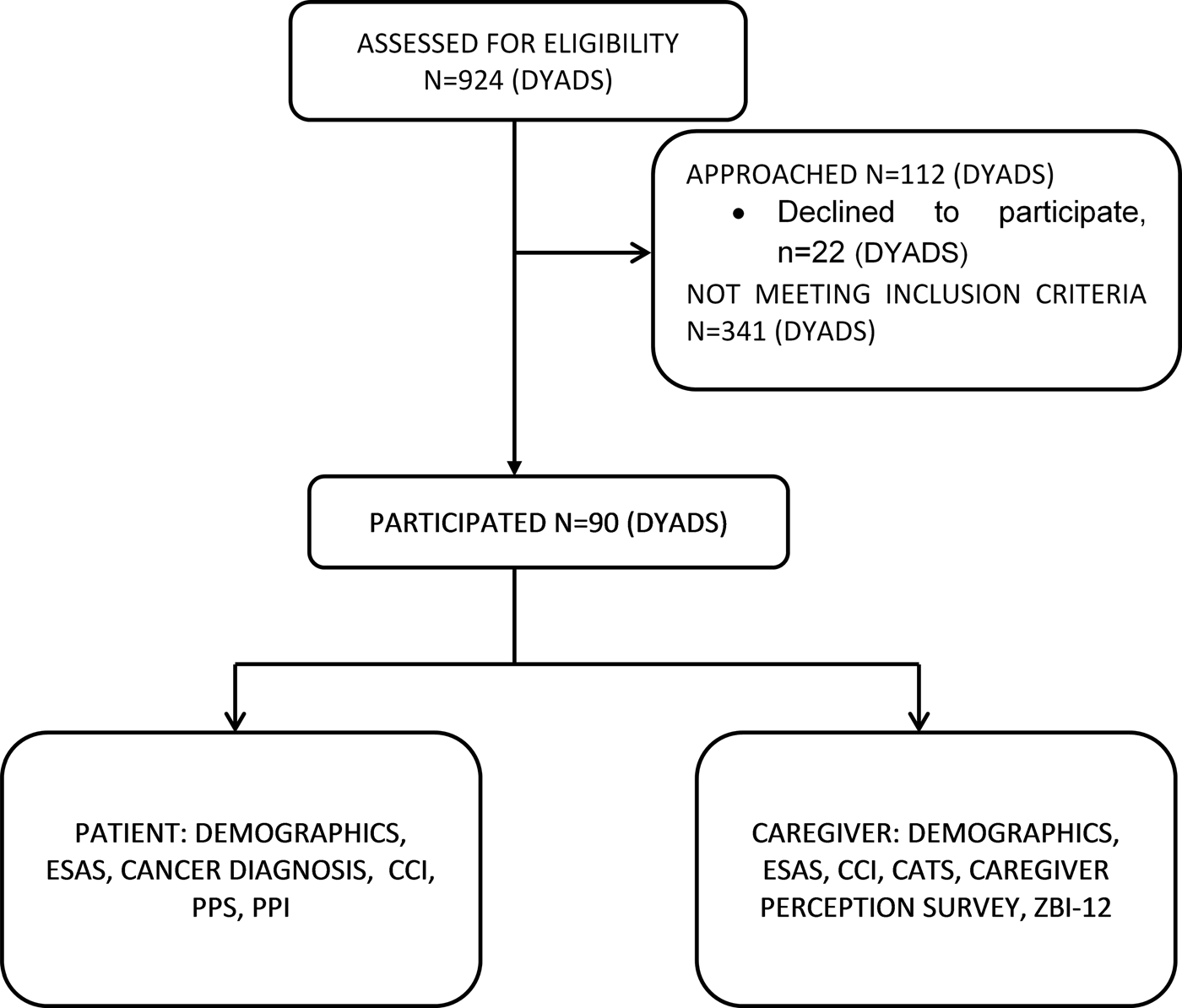
The following patient data were collected: demographics, including age, gender, ethnicity; cancer diagnosis, stage, current cancer treatment; comorbidities (the Charlson Comorbidities Index [CCI]); performance status (the Palliative Performance Scale [PPS]); prognostic score (the Palliative Prognostic Index [PPI]); and ESAS scores. The following caregiver data were collected: demographics, including age, gender, ethnicity, relationship to patient, religion, education level, employment, number of other persons they were also caring for; comorbidities (the CCI); caregiving activities and average time per day (the Caregiver Activities Time Survey [CATS]); sense of burden (ZBI–12, Bedard version); the Caregiver Perception Survey (CPS); and ESAS scores. At the end of the questionnaire, caregivers were asked to recommend items that they believed were important for assessing caregivers in the future that were not standardized items in the ESAS. The CONSORT diagram is depicted in Figure 1.
The CONSORT diagram for our study.

Edmonton Symptom Assessment System–Financial–Spiritual (ESAS–FS)
The ESAS is a widely used 10-item scale measuring a variety of physical (pain, fatigue, nausea, loss of appetite, drowsiness, well-being, shortness of breath, insomnia) and psychosocial (depression, anxiety) symptoms (Bruera et al., Reference Bruera, Kuehn and Miller1991; Vignaroli et al., Reference Vignaroli, Pace and Willey2006; Moro et al., Reference Moro, Brunelli and Miccinesi2006; Nekolaichuk et al., Reference Nekolaichuk, Watanabe and Beaumont2008; Carvajal et al., Reference Carvajal, Centeno and Watson2011; Watanabe et al., Reference Watanabe, Nekolaichuk and Beaumont2012; Kang et al., Reference Kang, Kwon and Hui2013; Hui et al., Reference Hui, Shamieh and Paiva2016). Clustering of these symptoms into physical and psychosocial clusters was analyzed and found to be consistent in a study by Yennurajalingam et al. (Reference Yennurajalingam, Kwon and Urbauer2013) on advanced cancer patients. In our study, we employed a 12-item version of the ESAS (the ESAS–FS) that was developed by the Department of Palliative Care at the MD Anderson Cancer Center and included nonvalidated items—financial distress and spiritual pain—to determine the feasibility of the ESAS in assessing caregiver symptom distress and its correlation with patient scores. The validated 10-item version was used to determine concurrent validity with the ZBI–12. The 12-item version had been used by Delgado-Guay et al. (Reference Delgado-Guay, Chisholm and Williams2016) in assessing spiritual pain in advanced cancer patients. We used a cutoff of 1–3 for mild symptoms, 4–6 for moderate symptoms, and 7–10 for severe symptoms. These cutoff scores were also used in studies by Kang et al. (Reference Kang, Kwon and Hui2013) and Selby et al. (Reference Selby, Cascella and Gardiner2010) and also parallel the National Comprehensive Cancer Network (NCCN) guidelines on pain and fatigue intensity scores (Swarm et al., Reference Swarm, Abernathy and Anghelescu2013; Berger et al., Reference Berger, Mooney and Alvarez-Perez2015).
The Zarit Burden Interview-12, Bedard Version (ZBI–12)
The ZBI–12, Bedard version, is the validated, shortened version of the Zarit Burden Interview, which is a widely used caregiver burden instrument (Bedard et al., Reference Bedard, Molloy and Squire2001; Deeken et al., Reference Deeken, Taylor and Mangan2003; Higginson et al., Reference Higginson, Gao and Jackson2010). We used the ZBI–12 to examine the association of caregiver symptom burden and caregiver burden, and to test the concurrent validity of the ESAS.
Caregiver Perception Survey
Caregivers were asked 10 questions to globally assess their evaluation of completing the ESAS to assess their symptom burden. The first question in the survey assessed the caregiver-reported usefulness of completing the ESAS to express their symptom burden, with answers ranging from “completely agree” to “completely disagree.” In addition, the survey also had items that evaluated whether the ESAS addressed their main problems, inquired about what items the caregivers felt could be added or removed, and allowed participants to evaluate their overall experience of completing the ESAS (see Appendix A).
Caregiver Activities Time Survey (CATS)
The CATS was developed to measure time spent by formal/paid caregivers and informal/unpaid caregivers across a range of custodial activities, particularly activities of daily living and instrumental activities of daily living (Clipp & Moore, Reference Clipp and Moore1995). It includes two scales, one each for formal and informal caregivers. In our study, we only utilized the scale for the informal/unpaid caregivers.
Charlson Comorbidity Index (CCI)
The CCI is a well-validated tool that has been widely used to measure comorbid disease status in healthcare databases (Sundararajan et al., Reference Sundararajan, Henderson and Perry2004; Hall, Reference Hall2006). It was employed in our study to find any association between patients' existing medical conditions (aside from their cancer diagnosis) and caregiver symptom burden.
Palliative Performance Scale (PPS)
The PPS measures the physical status of the patient by using five observer-rated domains, which are correlated to the Karnofsky Performance Scale. It is also one of the indices utilized in the PPI to assess clinical prediction of survival (Anderson et al., Reference Anderson, Downing and Hill1996; Harrold et al., Reference Harrold, Rickerson and Carroll2005). It was employed in our study to find any association between patients' functional status and caregiver symptom burden.
Palliative Prognostic Index (PPI)
The PPI is an objective assessment aid that was developed to assist clinicians in predicting survival in terminally ill cancer patients (Morita et al., Reference Morita, Tsunoda and Inoue1999; Reference Morita, Tsunoda and Inoue2001). It was used in our study to find any association between patients' prognosis and caregiver distress.
Definition of Feasibility
Feasibility was defined as >70% of caregivers completing 9 out of the 12 ESAS items.
Definition of Usefulness
Usefulness was defined as caregiver-reported usefulness based on their overall experience of completing the ESAS scale: “completely agree” or “partially agree” (item 1 on the CPS).
Definition of Primary Caregiver
A primary caregiver was defined as the person most responsible for providing care to the patient on a daily basis.
Statistical Analysis
A total of 90 patients achieved 82% power to test the primary hypothesis that the proportion of caregivers completing the ESAS would be greater than 70% (H0: p ≤ 0.7; HA: p > 0.83) using a one-sided binomial test when the type I error rate was 2.5% (NCSS/PASS software).
Spearman's correlation coefficients were used in order to measure concurrent validity between the ZBI–12 and the 10-item ESAS. Some 90 patients provided 84% power to show that the correlation was significantly greater than 0.50 assuming a true correlation of at least 0.70 using a one-sided test of Pearson's correlation coefficient at a significance level of 2.5%.
The secondary objective of usefulness was assessed using item 1 of the CPS (see Appendix A). The secondary objective of determining the association of ESAS scores between patients and caregivers was assessed separately for each item of the 12-item ESAS–FS using Spearman's correlation coefficients and associated significance tests, including Wilcoxon's Rank–Sum Test or the Kruskal–Wallis test. Further correlations were calculated based on patient-validated psychometric subscales of the ESAS, including the physical distress score (pain, fatigue, nausea, shortness of breath, drowsiness, appetite, and sleep) and the psychosocial distress scores (anxiety, depression). The correlation of total ESAS scores was also determined. In addition, we correlated the 12-item ESAS scores with items of the different tools mentioned in the secondary objectives (ZBI–12, CCI, CATS, PPS, PPI).
Descriptive statistics such as means and proportions were performed for all patient and caregiver demographics. The Kaplan–Meier method was used to estimate overall survival (OS) time, and the log–rank test was utilized to compare OS times between or among patient demographic/clinical-pathological characteristics groups and ESAS groups (high vs. low defined by median score or determined by the Martingale residual). A multivariate proportional Cox model was applied to estimate the association between important covariates and overall survival time.
RESULTS
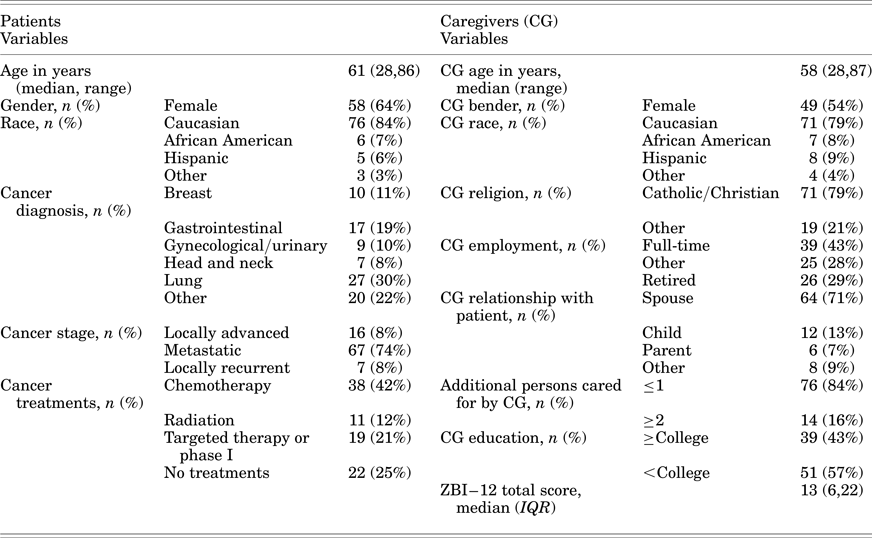
The data were collected from 90 patients and their primary caregivers. The mean age (SD) of patients in the study was 60 (12), and the mean age (SD) of caregivers was 57 (13). Some 54% of caregivers were female, 43% were employed full-time, and 71% were spouses. Further demographic data are summarized in Table 1.
Patient and caregiver characteristics (N = 90)

There were 22 refusals to participate in the study. Among these, 8 (36%) were due to time constraints, 4 (18%) patients or caregivers were not feeling well and not able to participate, 9 (41%) did not want to participate in any kind of research study, and 1 (5%) caregiver declined due to family conflicts.
The use of the ESAS for caregivers was found to be feasible, as 100% of caregivers completed the ESAS (defined as having completed at least 9 of the 12 items). A test that the true proportion is greater than 70% was significant (binomial test, p < 0.0001). Some 66 of 90 (73%) caregivers found completing the ESAS to be useful in measuring caregiver distress as per the CPS.
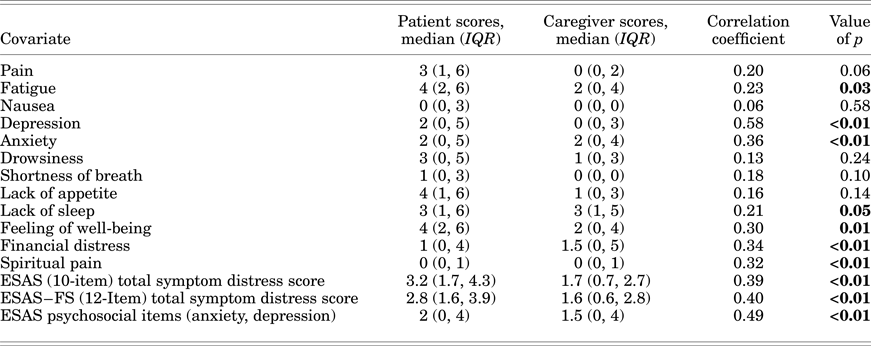
A total of 86 caregivers (96%) reported an intensity ≥ 1, and 68 caregivers (76%) reported an intensity of ≥ 4 for at least one symptom. The most frequently reported symptoms with an intensity ≥ 1 were: lack of sleep (81%), poor well-being (72%), fatigue (71%), anxiety (64%), and financial distress (58%). These were the same symptoms that were most frequently reported with an intensity ≥4: lack of sleep (47%), anxiety (32%), financial distress (32%), poor well-being (31%), and fatigue (30%) (Table 2).
Frequency of caregiver-reported symptoms

We analyzed the correlation between caregiver ESAS and patient demographics (cancer type, stage, treatment) and caregiver demographics (gender, race, religion, education, employment, relation to patient, additional persons cared for), and none of these correlations were found to be statistically significant. Regarding other variables, there was a significant association between caregiver ESAS and time spent feeding and housekeeping and total time on combined caregiver activities, as well as total ZBI–12 scores. Most caregiver activities involved feeding, medication preparation and administration, and housekeeping.
With respect to ESAS items, there were statistically significant associations between patients and caregivers for fatigue, depression, anxiety, lack of sleep, feeling of well-being, financial distress, spiritual pain, and total ESAS score. The highest level of correlation was observed for depression. The median patient and caregiver ESAS–FS scores were 2.8 and 1.6, respectively (Table 3).
Severity and correlations between patient and caregiver ESAS scores (N = 90)

IQR = interquartile range.
There were additional items that certain caregivers recommended for future evaluation. The most relevant items included time management, coping abilities and resources, the need for better communication with physicians, and their relationship with the patient. Certain caregivers also identified items that they felt could be removed from the caregiver ESAS, of which they cited “medical-specific questions” and “physical health area” generally, and “pain and nausea” specifically.
Concurrent validity of the ESAS with the ZBI–12 was not established. The correlation between total ESAS symptom distress score and total ZBI should be at least 0.7, but the result of our analysis was a Spearman's correlation coefficient of 0.53 (p = 0.74).
DISCUSSION
In this prospective study, we found that the ESAS was a feasible tool for identifying caregiver symptom burden. Furthermore, 73% of caregivers found that completing the ESAS was useful for expressing their symptom burden. We did not explore whether completion of the ESAS by caregivers would also be found useful by clinicians and researchers. However, we believe that this would also be useful in their practice and that further research is needed to determine clinician- and researcher-related usefulness of completion of the caregiver ESAS.
The median caregiver ESAS scores suggested mild symptom burdens. However, some scores identified a moderate degree of symptoms, particularly fatigue, anxiety, lack of sleep, feeling of well-being, and financial distress. One explanation for the generally lower scores may be that, while caregivers tend to overestimate patients' symptom burden levels (Nekolaichuk et al., Reference Nekolaichuk, Maguire and Suarez-Almazor1999; Bruera et al., Reference Bruera, Bush and Willey2009), they may significantly report lower levels of symptom burden for themselves and refuse to acknowledge their own symptoms while involved in the process of caregiving. On the other hand, this also demonstrated that the ESAS may be a useful screening tool for caregiver symptom burden in being able to detect 96% of caregivers with mild or greater symptoms and 76% with moderate or more severe symptoms. More research is necessary to better understand the different caregiver symptoms that may be more prevalent and need to be followed.
Regarding caregiver activities, only feeding, housekeeping, and total caregiving hours showed significant associations with caregiver ESAS scores. This may signify that the expression of symptoms by caregivers are significantly associated with many of patients' expressions of distress (anxiety, depression) and less with the level of patient performance and their level of involvement with care early on in the patient's care. This might be because this was an outpatient population, and patient functional status was relatively good. As the patients become more ill, caregiver activities may factor in more.
Patient and caregiver scores were strongly correlated with psychosocial areas (anxiety, depression, financial distress, spiritual pain) and also with certain physical symptoms (fatigue, well-being, lack of sleep). These correlations were not surprising, as previous studies have found similar correlations between patient and caregiver scores, including sleep disturbances, financial distress, and spiritual pain (Yesilbalkan et al., Reference Yesilbalkan, Ozkutuk and Ardahan2010; Philips & Lazenby, Reference Philips and Lazenby2013). In addition, Delgado-Guay et al. (Reference Delgado-Guay, Ferrer and Rieber2015), in a study of advanced cancer patients, found that financial distress was an important factor contributing to the suffering of advanced cancer patients and their caregivers. Pain, nausea, shortness of breath, and appetite were not highly correlated, and these physical symptoms were also identified by caregivers as items that they would prefer to see removed. These findings suggest that there is an association between patient-reported severity of symptoms and caregiver symptoms. Since in the vast majority of cases caregivers do not undergo regular assessment, these data also focus on delivering support to those caregivers who express higher levels of symptoms and on the need to assess these symptoms. These pertinent positives and negatives are also important to consider together with their additional concerns in the continued development of a holistic caregiver distress instrument that would be able to measure relevant physical and psychosocial symptoms. On the other hand, the recommendations of caregivers to include certain items in future evaluations and to remove others (such as pain and nausea) require further research to examine their generalizability and rationale.
A significant correlation was found between caregiver symptom burden and caregiver sense of burden (total ZBI–12 score), which may demonstrate that the proportion of symptom burden also increases with the level of burden felt by caregivers. However, we were not able to demonstrate concurrent validity with the ZBI–12. This could be interpreted to mean that the two instruments measure different aspects of caregiver burden—for example, that the ZBI is a well-known tool that measures caregiver burden while the ESAS measures physical and psychosocial symptom burden. Further studies examining the psychometric properties of the ESAS as a caregiver symptom burden tool need to be conducted.
One limitation of our study was that it was conducted in an outpatient setting. Patients and caregivers in an inpatient setting might have different levels of distress, particularly in cases where cancer treatment is not feasible and the goals of care have shifted to palliative-based care. Future studies would be recommended in populations with increased levels of dependency, such as in an acute palliative care unit or a hospice setting. Our study was also conducted in the homogenous setting of the caregivers of patients with advanced cancer. Further research is required to demonstrate the feasibility of using this instrument to assess psychometric properties in the caregivers of patients in other illness settings.
In summary, we found the ESAS to be feasible and useful for caregivers to complete. Moreover, the ESAS allows early diagnosis of caregiver symptom burden and could generate early referrals to clinicians and counselors. Further research and psychometric analysis must be conducted to reconstruct the ESAS so that it could better capture significant physical and psychosocial symptoms in caregivers.
DISCLOSURES AND ACKNOWLEDGMENTS
There are no commercial associations to disclose with respect to this study. There are no conflicts of interest to disclose from any of our authors. We would like to acknowledge the assistance with patient–caregiver enrollment, data collection, and data processing given by Janet Williams, m.p.h., Charles Masino, m.s., and Susan Frisbee-Hume, r.n., o.c.n.
SUPPLEMENTARY MATERIALS
To view supplementary materials (Appendix A) for this article, please visit https://doi.org/10.1017/S1478951517000098.