


Introduction
The term ‘patent medicine’ from the Georgian era carries a lot of baggage. The fiercely critical approach of Victorian writers who normally regarded them as useless and almost synonymous with deceit has persisted amongst some historians to the present day. ‘Perhaps the most worthless of consumer goods in the eighteenth-century marketplace’ and ‘“quack” cures, which were likely to have produced little benefit for those who took them in physiological or pharmacological terms’, are two recent descriptions.Footnote 1 Yet they were a popular form of therapy amongst the public in Georgian England with over two million bottles or boxes sold each year by the early nineteenth century.Footnote 2 We have no evidence that they were worse than the orthodox therapy prescribed by regular practitioners in this period, and indeed their constituents were similar.Footnote 3 Regardless of any opinions on their efficacy, patent medicines have interested some historians as the first nationally available, branded, goods, sold at a fixed price, apart from books.Footnote 4 Their clear names, extensive sales across the country and frequent newspaper advertisements mean that they can be studied in a surprising degree of detail for a Georgian consumer product. As a result, we can discover a great deal about the benefits and consequences of their patenting.
Until the 1852 Patent Law Amendment Act the English patent system was a ramshackle legal device, which had developed piecemeal from the sixteenth century with little statutory intention.Footnote 5 In the Georgian period, most patents were sought to preserve intellectual property and to grant the inventor a temporary monopoly for his novel product over fourteen years. But medicine patents were pursued for other reasons, and the exclusive use of the medicine recipe was largely maintained by secrecy, often for a much longer period. For medicines, this legal device was employed as a malleable form of official endorsement at a time when other therapies had no recognition from the state, and as a form of copyright of the medicine's name.
An understanding of the patent culture of Georgian owned medicines will need to encompass two observations. One is that most ‘patent medicines’ were never actually patented and even fewer had a current patent. As we shall see, the term was adopted for a broad range of owned medicines as the wholesalers and retailers sought to extend the authority of the patent to medicines that had not received one. Using the approach adopted by the government to decide which medicines should be subject to excise duty, ‘patent medicines’ can be defined as those which had an owner and a secret recipe, and were advertised.Footnote 6 By 1830, over 1,300 such owned medicines were listed for excise duty, while up to that year only 117 medicines had ever been patented.Footnote 7 Two patents were taken out by women. Also, a patent expired after fourteen years, so the number of medicines with a current patent never exceeded thirty-one in the Georgian era. Many owners avoided patenting their medicines, and the award of a patent clearly had both advantages and disadvantages.
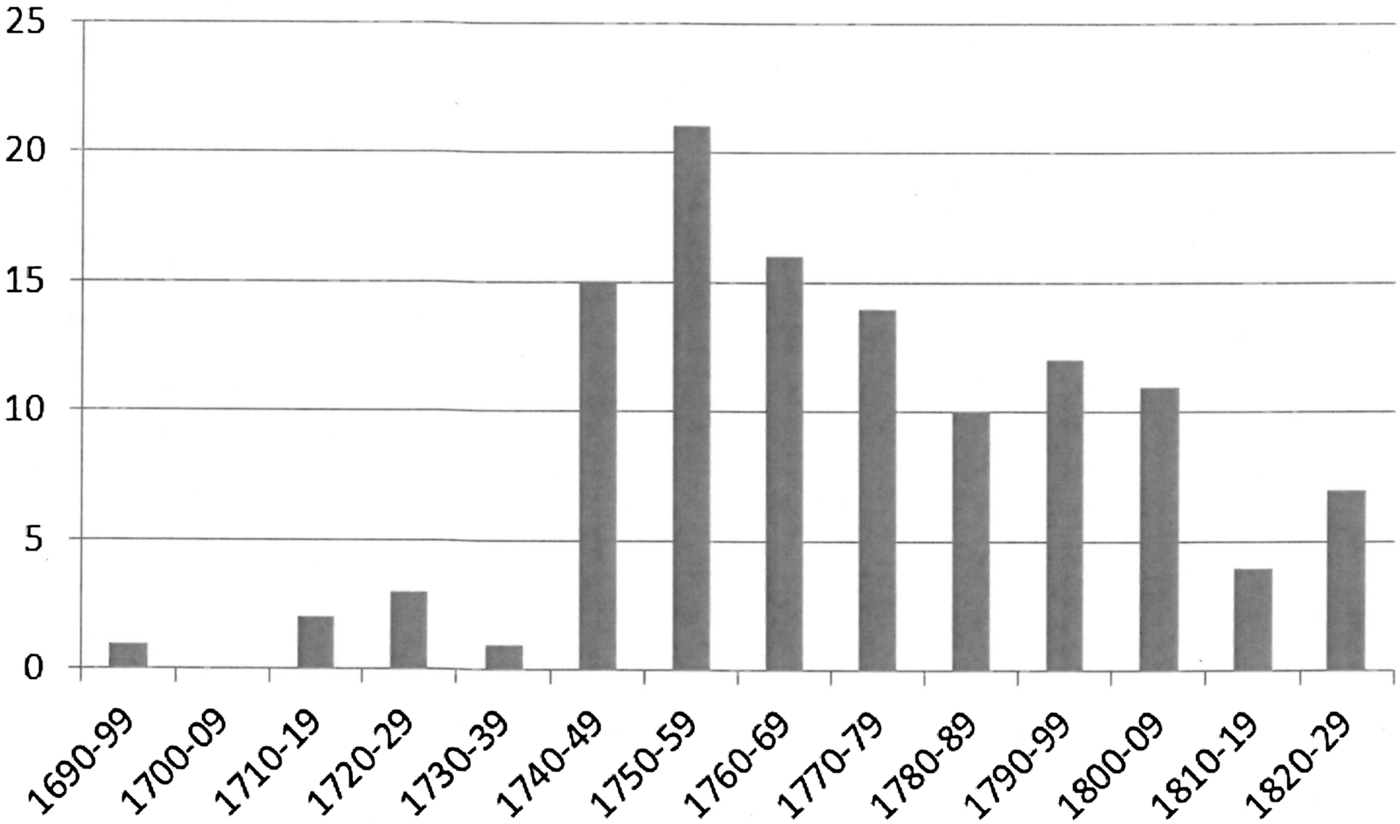
The second observation to be accommodated is that the demand for patents was not uniform: it reached a peak in the mid- to late eighteenth century, and then fell (Figure 1). This decline is even more striking when we consider the progressive increase in the overall number of all types of patents from around 1770.Footnote 8 In addition, nine of the sixteen medicine patents issued during 1806–1830 were described as ‘improved’ or ‘new formulation’, and another one without a specification was probably not legal, leaving only six completed applications for novel products. Thus the patenting of new medicines was predominately, but not entirely, confined to the 1740–1805 period. So the pros and cons of patenting must have varied over time and any discussion of the culture of medicine patenting in this period must explain this.
Number of patents for medicines in each decade.

Medicine patentees have left no written records of their intentions outside some snippets in promotional material. So the evidence for their aims and concerns is derived from their actions. In the context of the commercially driven medical market, the structure of health care in this period, this is no bad thing as behaviours will often be more revealing than self-justifying explanations. One revelation is that the owners relied on recipe secrecy to maintain the monopoly of the composition of their medicines, not on the uncertain legal processes available to Georgian patent holders. They did use these legal powers to create a form of copyright for the medicine names. However, for the owners, the major benefit of a medicine patent was the resulting royal or government authority which implied that the medicine was effective. This authority proved to be very malleable in the owners’ hands. The reasons for not patenting included the cost and inconvenience of doing so, uncertainties as to whether the patent specification would reveal the recipe to others, and a possible diminution in the reputation of the patentee. In addition, the government inadvertently provided an alternative form of official authority when it introduced the medicine excise stamp in 1783.
The core of this research is the records of Bennet Woodcroft and colleagues, who in the 1850s and 1860s turned the previous patent records, handwritten on legal rolls scattered over three offices, into printed and catalogued registers. In particular, they published abridged specifications of patents relating to medicine, surgery and dentistry in a single volume, allowing me to extract the patents dealing with medicines, and then to look at the description of their patentees in a separate chronological index.Footnote 9 The few historians who have looked again at the original rolls confirm that Woodcroft's records are reliable.Footnote 10 So I have collected some details of all the medicine patents and their patentees up to 1830, the end of the study period.
Benefits of patenting medicines
The intended benefit of the patent system for a medicine owner was to ensure that his recipe could not be copied for a period, a form of temporary property retention. In theory, the owner had fourteen years to publicize and sell his medicine unhampered by imitations. But the medicine owners showed little confidence that they could achieve this solely on the legal authority of the patent. The policing of a patent was left to the courts, with the Privy Council giving up all its remaining powers to intervene in 1752.Footnote 11 The maintenance of the patent's monopoly was in the hands of individual judges with little legal precedent to ensure consistent decision making, and recourse to the courts was expensive. A Parliamentary select committee concluded in 1829 that uncertainties in the law made the legal protection of all patents inadequate.Footnote 12
Furthermore, defending a medicine patent in the courts, which would be based on the specification of the patented medicine, had a fundamental problem. The specification did not normally reveal the precise composition of the product and a patentee would not want to jeopardize the crucial secrecy of the recipe by revealing it for the court.Footnote 13 So a precise comparison of the original recipe and the counterfeit version would be impossible, and a prosecution of an apparently copied recipe would be unlikely to succeed. Owners preferred to rely on secrecy to retain their monopoly of the medicine's recipe:Footnote 14 this monopoly persisted for as long as the recipe remained hidden, which was often considerably longer than the patent's fourteen years.
As Christine MacLeod has suggested, the owners utilized the legal benefit of the patent in a different way by attempting to exploit it as a form of copyright for the medicine's name in an era when only printed works officially received this protection.Footnote 15 An owner often wished to prevent the imitation of the medicine's name, rather than, as the patent system was supposed to do, prevent the imitation of the medicine's contents. The name of an unpatented medicine could be protected by the common law under certain circumstances.Footnote 16 But in 1783, Lord Mansfield confirmed in Singleton v. Bolton that the name of a patented medicine possessed more defence against imitation than the name of an unpatented one.Footnote 17
Attempts to protect the name of a medicine could prosper, as shown by Richard Stoughton's successful 1721 prosecution of William Wilkinson for a number of offences against his patented medicine, including Wilkinson's imitation of publicity materials and using a nearby warehouse.Footnote 18 Also, according to a newspaper advertisement in 1807, Ebenezer Sibly's successor had successfully obtained an injunction from the Lord Chancellor forbidding the use by a competitor of the name of the Reanimating Solar Tincture, which Sibly had patented in 1795.Footnote 19 In 1794, the widow of Francis Spilsbury demonstrated the importance of the name ahead of the contents when she advertised that she was now the sole proprietor and patentee of the very successful Antiscorbutic Drops, and that part of the reason for her late husband getting a patent was to protect the public from ‘spurious compositions’.Footnote 20 In other words he had wanted to prevent other medicines being sold with the same name, regardless of their composition. An owner would probably have been less unhappy for the composition of his, or her, medicine to be reproduced than for its name to be copied.
This ownership of the name was particularly important for the commercial success of medicines. Secret medicines could be very lucrative, with several owners and wholesalers buying estates and becoming country gentlemen.Footnote 21 But there was always the risk of imitations: by the late eighteenth century several versions of Daffy's Elixir, Anderson's Scots Pills and Bateman's Pectoral Drops were being sold. Any transfer of ownership by sale or inheritance was a vulnerable period for the appearance of multiple versions, and the owners could go to considerable lengths to establish their entitlement. For example, a relevant portion of a will might be published in a newspaper advertisement and also printed on the directions which accompanied every bottle.Footnote 22 Few proprietors went as far as Swinton, the owner of a version of Daffy's Elixir in the 1800s: his given names were Anthony Daffy, the name of the original proprietor in the 1670s.Footnote 23 Swinton's son had the same names, and they must have been part of a long-term ownership strategy, although it is not clear whether these names were acquired by father and son at baptism or later.
This use of the patent as a means of establishing ownership for the name of the medicine was made more attractive by the possibility of patenting a medicine long after it had been introduced, whatever the stated aims of the patent system. For instance, Francis Spilsbury introduced his Antiscorbutic Drops around 1770, but only patented them in 1792.Footnote 24 Spilsbury's widow wrote that her husband had obtained the patent to protect the medicine as the property of the family.Footnote 25 Similarly, according to an advertisement, Ford's Pectoral Balsam of Horehound was available in 1794, but it was patented in 1816.Footnote 26 It seems that this protection of the medicine's name could be utilized for an already successful medicine and not wasted on commercial failures.
The main day-to-day benefit of a medicine patent was its royal or government authority, which could be used to imply that the medicine was both original and effective. Most of the assumptions underlying this authority were incorrect: the patent was a legal, not an executive, device, and the medicine did not have to be substantially original or demonstrably effective. Nevertheless, it was an apparent official endorsement at a time when no other authority was available for medicines in England. The authority of the patent was extensively, and often inaccurately, used in the promotion of patented medicines. A common technique was the printing of a large royal crest across the top of a handbill or posted bill promoting a patented medicine, which immediately provided a visual emphasis that this medicine was under some form of royal protection.Footnote 27 Newspaper advertisements frequently reminded readers that a patented medicine had royal or governmental approval. For example, a newspaper advertisement for Dr Walker's Jesuits Drops stated that ‘his majesty has been pleased to bestow on him the Royal Letters Patent for England, Ireland, Scotland, and the plantations in America’.Footnote 28 It is very unlikely that George III was aware of his implied approval of a treatment for venereal disease. Similarly, an advertisement for Ford's Balsam of Health was headed ‘Under the protection of the government, by Royal Letters Patent’.Footnote 29 Accuracy did not stand in the way of the patent being milked for as much authority as possible. Furthermore, the owners took little notice of the fourteen-year duration of a patent when they used its authority to promote their medicines. Thus an advertisement for Turlington's Balsam of Life in 1781 had a single heading, ‘By the King's Patent’, though its patent had been granted thirty-seven years earlier.Footnote 30
Another manipulation of the patent was to transfer as much of its authority as possible from the medicine to the applicant. Then the conviction carried by the patent could be widened to the patentee's unpatented medicines by a number of means. One method was the ambiguous use of a heading: for example, a handbill from Francis Newbery, describing sixteen patented and unpatented medicines, was headed ‘By Virtue of the King's Patent’, thereby extending this royal authority to all of them.Footnote 31 Another technique for spreading the authority of the patent was to publicize a wholesale or retail premises as a patent medicine warehouse. Thus a 1781 newspaper advertisement from Jackson, Warter and Co. had two headings. The first was ‘By the authority of the King's Patent granted to Jackson, Warter and Co’, and the second was ‘At their royal patent wholesale medicinal warehouse, Fleet Market, London’.Footnote 32 Fifteen medicines were then mentioned in the advertisement, but only three can be clearly identified as having received a patent. This advertisement is also another example of the stretching of a patent for publicity purposes: Jackson, Warter and Co. are not recorded as having ever received a medicine patent. All medicine patents in this period were granted to individuals, or a small group of individuals, not to companies, and even if we acknowledge the single patent obtained by the senior partner, Thomas Jackson, in 1761, this had expired by the time of the advertisement. It suited many vendors to be vague about which of their medicines were genuinely patented and to imply that their patented and unpatented medicines were similar.
So the owners and wholesalers successfully manipulated the patent system to fulfil their needs. They could do this because the supervision of patents was in the hands of the courts, not the government. The Privy Council had some rarely used supervisory powers up to the middle of the eighteenth century, but throughout the Georgian period controversies about patents were normally settled by judges.Footnote 33 So unless an interested party had incurred a substantial financial loss and was prepared to instruct lawyers, a potential transgressor of patent law was free to do anything he or she liked.
Disadvantages of patenting medicines
In spite of these commercial and legal advantages, and a patent system which could be stretched to amplify them, most of these owned secret medicines never possessed a patent. So there must have been substantial disadvantages as well. No records were kept for any application which was declined, so we do not know if some applications for these medicines were rejected. An occasional example of a medicine failing to obtain a patent can be found.Footnote 34 But it seems that such rejections were uncommon, at least after a formal request had been submitted. So we can conclude that the owners of most unpatented medicines had not applied for one. Several reasons can be found for their restraint.
Why did not every medicine owner with some spare money quickly send in an application for a patent to the relevant office? Well, requesting a patent was far from a cheap and rapid process. A major reason for not applying was the considerable expense and inconvenience required. Obtaining a patent for England would cost between £100 and £120 plus the cost of any legal assistance, with a similar sum for each of Scotland and Ireland if required: patents for the whole of the United Kingdom were only available from 1852.Footnote 35 Most artisans earned significantly less than this amount in a whole year, and these fees would only be affordable by those who already owned a successful medicine, or who were prepared to accept a substantial financial risk. The procedure required attendance in person, and it was laid down in the 1536 Clerks Act, which was designed to generate fees for unsalaried officials and certainly not to make a submission quick and convenient. The application had to go through up to ten offices on different sites, with the applicant paying fees at each stage and being responsible for steering it through.Footnote 36 The patent would be enrolled in any one of three Chancery offices: to find a specification of a similar product, all three offices had to be searched.Footnote 37 The only stage which was not normally a formality was the Attorney or Solicitor General's Office, which had to decide whether the application was legal, not whether it was original: this office usually relied on a statement from the applicant that it was a novelty.Footnote 38 A submission would require the patentee, or his representative, to be in London for one or two months: patent agents only appeared in the early nineteenth century.
The cumbersome procedure required in London seems to have deterred medicine owners from outside the south-east of England, including those with several available medicines who did not obtain any patents, such as Samuel Solomon in Liverpool, Edmund Swinfen in Leicester, G. Ramsay in Penrith, and John Lignum in Manchester. Seventy-four (79 per cent) of the ninety-four patentees with recorded addresses came from London or the Home Counties. So the potential commercial benefits of obtaining a patent had to be weighed against the enormous upfront costs and the personal inconvenience. This helps to explain why patents were sometimes sought only after the medicine had been available, and presumably profitable, for several years.
Another major problem with a patent was that it could potentially reveal the secret recipe of the medicine. After all, the principle behind the patent system was that the owner was granted a fourteen-year monopoly of a novel product in exchange for making its construction generally known and available for manufacture by others when the patent expired. The risk was heightened by rivals being able to enter a caveat with the office dealing with the patent so that they would be notified of any application in their area of interest before the application was processed.Footnote 39 Owners showed no confidence that the patent system would legally protect their recipe, as we have seen. The secrecy of the recipe was crucial to the commercial success of a medicine, as it allowed a premium price, which not only ensured a good profit but also paid for the extensive national advertising needed for a successful medicine. The cost of national advertising was substantial, with several owners spending several hundred pounds a year.Footnote 40 The owners of medicines went to considerable lengths to maintain this secrecy. For example, Richard Greene, a Lichfield surgeon-apothecary, would not reveal the constituents of his rhubarb medicine even when questioned by his brother.Footnote 41 A common technique for concealing the recipe was to keep no written record and pass the information on verbally to descendants. Thus Elizabeth Shackleton, a member of the Lancashire minor gentry, recorded in her diary in 1776 that she had told her son the secrets of her medicine for the bite of a mad dog, writing that ‘God grant him good of it to keep the secret and that it may do well’.Footnote 42
The specification, which was required for all patents after 1734, was the document which could, and perhaps should, have revealed the secret of the recipe and so might have prevented the long-term commercial success of a medicine. But during the mid-eighteenth-century peak of medicine patenting, the owner did not normally run a risk of the patent specification allowing a competitor to duplicate the medicine. How was this sleight of hand achieved? First, the specification was submitted after the patent had been granted, usually within one to four months: it was not part of the application process. So the prior notification of applications to rivals would divulge nothing of importance at that time. Second, in this era, chemical processes were difficult to describe on paper as they relied on empirical experience and subjective assessments, such as the taste of a substance. In addition, the patentee could be deliberately obscure about some describable aspect of the chemistry. In his 1747 specification, Dr James concealed the true nature of his Fever Powder by using a mixture of precise terms – ‘in an unglazed earthen vessel’ – and vague descriptions – ‘adding to it from time to time any animal oil and salt’.Footnote 43 As Christine MacLeod has described, the specification of a medicine in the mid-eighteenth century was not required to explain the production process in any detail: for example, James freely admitted that ‘in my specification I mention no particular salt, but reserve to myself the choice of whatever salt I find by experience to answer my purposes best’.Footnote 44 He was so successful in this disguise that efforts to copy his powder after the patent had expired, including one commissioned by the Apothecaries Company, had only limited success, and the original medicine, renamed Pulvis Jacobi Vera, was still being ordered for the army and navy in the 1870s.Footnote 45
Although some owners were able to patent a medicine without being concerned that the specification would reveal its secrets, this was not true of all owners. At the beginning and end of the Georgian era, owners were probably more apprehensive about the specification, as we shall see in the exploration of the rise and withering of medicine patenting. In the middle period, when most medicine patenting was carried out, the need to submit a specification might still have deterred some proprietors, though evidence for this is lacking. The owners most likely to have been discouraged would be those selling a medicine with a simple composition and no chemical processes: its specification might then have been helpful to a rival. By contrast, those selling a more complex chemical compound with stages of production would have little to fear from the specification in the mid-century.
Turning to another potential reason to avoid seeking a patent, did patenting a medicine in the Georgian era have a negative moral dimension which deterred applicants, particularly orthodox medical practitioners? This is a difficult question to answer as few sources from this period explain why something did not happen. Also, the Georgian medical market had no clear division between regular practitioners, who should have received a recognized training, and irregular practitioners, who had not.Footnote 46 No comprehensive medical register existed in Britain until 1858. Nevertheless, we can see that some regular practitioners, and non-medical tradesmen with substantial reputations, were prepared to be patentees. Thus the physician Robert James patented his Fever Powder (1747) and his Analeptic Drops (1774), another physician and Nonconformist minister Theophilus Lobb patented his Family Tincture (1762), and the surgeon John Norton did the same for his Maredant's Drops (1764). Both James and Norton were regarded as regular practitioners by James Adair, that vituperative critic of many aspects of medical care, when he wrote about owned medicines in the 1790s.Footnote 47 Lobb had an MD from Glasgow and was a licentiate of the Royal College of Physicians.Footnote 48 Some non-medical patentees were well known in other occupations, for example Benjamin Collins, the publishing bookseller and printer of the Salisbury and Winchester Journal, who patented his Cephalic Snuff in 1773, and Humphry Jackson, a well-known chemist and inventor who patented his Cordial Bitter Tincture in 1753.
Other practitioners who took out patents had a much lower reputation and were regarded by many contemporaries as quacks. Indeed, Richard Rock appeared in this role in several of Hogarth's prints, including A Harlot's Progress (1732) and Morning (1738): Rock took out a patent for a preparation for venereal disease in 1751. William Brodum's name became almost synonymous with quackery in the 1800s: he patented two medicines in 1799. Overall about 40 per cent of the patentees up to 1830 who provided a description of their occupation claimed to be a regular physician, surgeon or apothecary, a percentage broadly similar to that found amongst the owners of all nationally available patent medicines.Footnote 49 But such a claim was easy to make, and many seem dubious in an era when an Aberdeen MD could be purchased for thirteen pounds without the applicant entering Scotland and anybody could call themselves a surgeon or an apothecary regardless of their previous training.Footnote 50
In spite of this association, some regular practitioners and reputable non-medical tradesmen were prepared to take out patents, alongside some poorly regarded irregulars. However, this finding does not answer the question whether taking out a patent would reduce the reputation of a regular practitioner or a tradesman: patentees might have accepted a loss of standing in exchange for the financial rewards of a patent. We can get some impression of the reputational risks of medicine patenting to regular practitioners by looking at their attitudes to owned secret medicines in general. As we have seen, most secret medicines were not patented, but all patented medicines were intended to be secret. If a practitioner was worried about the morality of any involvement with secret medicines, he would certainly be concerned about the morality of patenting medicines. So the attitudes of regular practitioners towards secret remedies in general is an imperfect surrogate for their attitude to the ownership of patent medicines.
When we explore these views, differences emerge amongst the branches of the medical profession. Most regular physicians were cautious about any involvement with secret remedies, at least from around 1760. One example of this reluctance was Glass's Magnesia, which had largely been invented by Thomas Glass, a prominent Exeter physician; but Thomas passed it to his brother Samuel Glass, an Oxford surgeon, to own and sell it.Footnote 51 The cause of this reluctance was probably the need for a successful late eighteenth-century physician to attain the qualities of a gentleman and remain at a distance from commercial activity.Footnote 52 The London physician William Fordyce provides an example of the importance of such a reputation to a physician. As a surgeon, he had patented a stomach pill in 1763, but ten years later he had become a physician and, though well aware of the commercial potential of his powder for fevers, he felt unable to sell it as a secret medicine:
Had I been more ambitious of dying a rich man, than of living a useful member of Society, the powers of our Prophylactic Powder in preventing putrid fevers, or of nipping them in the bud … would have remained a secret while I lived.Footnote 53
Robert James's patenting of his Analeptic Pills in 1774 seems to have been the last application by a physician who could be regarded as a regular. The ‘physicians’ Ebenezer Sibly and William Brodum were patentees after this date, but they were considered to be irregulars by many of their contemporaries, while William Henry patented his Magnesia in 1816 as a chemical process, not as a medicine.Footnote 54
Both surgeons and apothecaries were more prepared than physicians to create secret remedies. Samuel Glass actively promoted his Magnesia in the 1760s.Footnote 55 Edmund Swinfen, a surgeon-apothecary and major of Leicester, provided other examples in the 1790s, with his Swinfen's Electuary for stone and gravel, Swinfen's Worm Cakes, and several other medicines bearing his name.Footnote 56 Edward Galliard, an Edinburgh apothecary, insisted that the recipe of his antimonial febrifuge, the Edinburgh Powder, should remain secret.Footnote 57 Perhaps the most striking example can be found in the correspondence during 1783 between John Hunter, one of the best-known surgeons in London, and Edward Jenner, the future discoverer of vaccination. Jenner, at the time an ambitious Gloucestershire surgeon-apothecary, intended to develop his own secret Tartar Emetic, and corresponded with his friend and teacher John Hunter on the best methods of doing so.Footnote 58 Hunter emphasized the importance of maintaining the complete secrecy of the Tartar Emetic's recipe – ‘I would also desire you to burn your book, for you will have all the world making it’.Footnote 59 For some reason, Jenner did not go ahead with his plans. Surgeons and apothecaries were more tolerant of the secrecy of a recipe than physicians, and some did take out medicine patents throughout the Georgian period. However, all regular practitioners became concerned about the negative effects of a patent on their reputation as the eighteenth century progressed.
I suspect that the very high cost and inconvenience of obtaining a patent is the primary explanation for most ‘patent medicines’ remaining unpatented. An owner would have to be anticipating, or achieving, large profits for patenting to be affordable or worthwhile. The penalties for financial misjudgement could be severe in this period: bankruptcy might lead to several years in prison. When the owner was in the happy state of receiving a good yield from the medicine, he would then be concerned about the possible risks posed by the specification to the secrecy of the successful recipe, the essential means of preserving that yield in the long term. Patenting a well-known medicine might also pose a reputational risk, though the importance of this would vary from owner to owner.
The rise and withering of medicine patenting
To understand fully the pros and cons of patenting medicines in Georgian England, we also have to be able to explain the rise and withering in the numbers of medicines patented (Figure 1). Most medicine patenting was confined to the 1740–1805 period. The first point to make is that this was not found with other types of patented goods, so it was not due to changes in the patent system in general. For example, if we look at the patents for medical devices, such as trusses, beds and bathing devices, together with those for therapies other than medicines, such as exercise and electrical machines, a very different distribution of patents is found (Figure 2). Medical devices and therapies other than medicines were not patented before the 1760s, followed by a rise towards the end of the century and no clear fall. This pattern is broadly in line with the overall number of all types of English patents, which rose progressively from the 1770s.Footnote 60 The rise and fall of medicine patents must be largely due to factors specific to these owned and secret medicines.
The distribution by decade of patents for medical devices and therapies other than medicines, in comparison with those for medicines.

The rise of medicine patenting was secondary to changes in the market for ‘patent medicines’ and their ownership in the middle third of the eighteenth century. Helped by advertising in the expanding provincial press and improved communications, true national markets were created for several medicines, and the owners and wholesalers became more expert and specialized in supplying the medicines across the country. The pattern of ownership and distribution altered. Previously, owners had only been associated with a small number of medicines, often a single one.Footnote 61 The owner directly linked to a single medicine persisted throughout the Georgian period, but some owners now introduced a string of medicines for a range of different conditions. Early examples were the notorious Joshua Ward (1685–1761), an irregular practitioner who enjoyed the patronage of George II, who sold his nine pills and drops from the 1730s, and the apothecary John Hill (1714–1775) who produced eight herbal remedies, starting from the 1740s.Footnote 62
By the mid-eighteenth century, not only were some owners devising an assortment of medicines, but others, accompanied by wholesalers, were selling a collection of medicines which they had not created. They were acquiring the medicines by one means or another, including purchase and inheritance. John Newbery (1713–1767), the prominent publishing bookseller, was a part-owner of the famous Dr James's Fever Powder. He was also part of a four-man group that bought the right to sell Hooper's Pills in 1743, and he owned a share of Dr Bateman's Pectoral Pills from 1761.Footnote 63 A major interest in five patent medicines was recorded in his will.Footnote 64 At the same time, Cluer Dicey (1715–1775) was building a range of medicines for national distribution, advertising twenty-two medicines together in 1769.Footnote 65 Joseph Collett, who styled himself a ‘dealer in medicines’, took out patents for four different medicines between 1744 and 1758, and he later patented a urinary catheter. ‘Patent medicines’ had become consumer products to be handled by the commercial practices of the time, not just medical therapy at a distance.
So the participants in the industry had become more commercially aware, and they were probably seeking greater protection for their property. Also, selling medicines across the country needed better publicity and improved branding: both were enhanced by the authority of the royal patent. Thus not only were more medicines coming to the market, but there was also a greater perceived benefit from obtaining a patent. The large sums spent on advertising and the country estates purchased by a few successful owners show that substantial profits were being made: patent applications had become more affordable.
However, the suddenness of the increase in the 1740s is more difficult to explain: these changes of the medicine market and ownership developed over several decades. Owners have not left records of their decisions on patenting and only speculation is possible. At the beginning of the century, there was little incentive and precedent to patent medicines. Then, as the national markets developed, the specification requirements in the patent system probably held back medicine patenting. As already described, proprietors were always concerned about retaining the secrecy of their recipe to maintain their commercial advantage, and the specification attached to a patent had, in theory, the potential to reveal it to a competitor. So none of the seven patentees up to 1734 chose to provide the optional specification. After this date, a specification was compulsory for all patents, and, probably as a result, no more medicine patents were obtained until 1742. In other words, not a single specification for a medicine was submitted before 1742. From this year the number of medicine patents grew rapidly, with seven in 1744 alone. It seems that it took a few years from 1734 for potential patentees to realize that the specification for a chemical process, such as making a medicine, did not have to be sufficiently detailed to allow reproduction. Once this had been appreciated, many medicines could be patented without the risk of a direct copy, and a sudden surge in medicine patenting was the result. The owners of other medicines which had not yet been patented might feel obliged to join in. The first three patents from 1742 were all claimed by owners outside London: Robert Hayward described himself as an apothecary in Bristol, two members of the Betton family described themselves as gentlemen in Shropshire, and John Hooper described himself as an apothecary and man-midwife in Reading. The next ten patents were all owned by Londoners. It is unclear why medicine owners outside London, with no apparent links to each other, were the first to appreciate that a specification did not negate the benefits of a patent.
The reasons for the decline in medicine patenting towards the end of the century, at a time when overall patenting activity in England was increasing sharply, were multiple. One probable reason was a concern that changes in the requirements of the specification could compromise the secrecy of the recipe. Lord Mansfield's judgement in Liardet v. Johnson (1778) determined that the patentee should ensure that the specification was sufficient for a skilled tradesman to make the product without further experimentation after the patent had expired.Footnote 66 This seemed to place the patentee under a positive obligation to provide useful information on the composition of the medicine. Once again, the specification was threatening the secrecy of a patented medicine, though several more legal judgments were required before the specification of patents became fully informative.Footnote 67 By the end of the eighteenth century, an owner would be more concerned about the risks to the secrecy of his recipe posed by the specification than he would have been thirty years earlier.
Another cause for the withering of medicine patenting was a growing concern that the owner's professional or social standing might be reduced by the acquisition of a patent. Patenting a medicine had always had negative connotations for some, although this is difficult to document, as we have seen. However, by the 1790s patenting medicines and the ownership of secret remedies were coming under stronger attack. The provocative physician James Adair had forceful views on the ownership of secret medicines by regular practitioners: ‘Some of these nostrum-mongers have been appendages to the profession; and broken apothecaries and chemists have quitted their proper callings for this idle trade’.Footnote 68 A more considered, authoritative, opinion was provided by the Manchester physician Thomas Percival in an early book on medical ethics: ‘No physician or surgeon should dispense a secret remedy, whether it be his invention, or exclusive property’.Footnote 69 By the early nineteenth century, patent medicines were coming under more concerted attack by the proponents of medical reform, preventing patent applications by anybody who wished to remain within the orthodox medical professions. This discouragement of medicine patenting by regular practitioners would have also restrained patenting by non-medical owners. In this period, owners wanted to follow the practices and customs of orthodox medicine as much as possible: providing alternative commercial therapies in opposition to principles of regular practice was uncommon before the 1820s.Footnote 70 Thus condemnations of patent or secret remedies would deter non-medical owners, as well as medical ones, from seeking a patent. In short, patenting of medicines was going out of fashion.
However, the major cause of the decline in medical patenting in the late eighteenth century was probably the introduction of the compulsory medicine excise stamp, another official device which could itself provide many of the benefits of the patent, but with much less expense and inconvenience. The excise duty on ‘patent medicines’ was introduced in 1783 and revised in five later Acts up to 1812. It was collected by the application of a government-printed stamp, by all producers, to every bottle or box (Figure 3). The excise duty depended on the price of the medicine, and stamps of several values were sold by the government's Stamp Office.Footnote 71 The stamp had an engraving of a crown, which was positioned over the cork, and the stamp was then stuck to the side of the bottle by the two wings, or it was glued to the outside of the box. Major owners or wholesalers could have their names printed on the stamp by the Stamp Office, and smaller ones could sign their names on the stamp.
1½ d medicine excise stamps from Francis Newbery and Dicey and Company (Thackray Museum, Leeds).

The excise stamp enhanced the standing of all patent medicines by bestowing a degree of official recognition and authority which was denied to orthodox therapy. The physical presence of the official stamp, with a crown at its centre, on every bottle or box gave the medicine an unintended respectability, which was visible with each new purchase. Furthermore, allowing the larger vendors to have their own names engraved on the stamp linked them with the apparent official endorsement. The stamp also carried a strong implication that the medicine was effective: John Dingwall Williams, a lawyer petitioning the House of Commons, accused the government of profiting from patent medicines by ‘extracting a miserable profit to the revenue of the state from the tolerance and encouragement of ignorance, imposture and mischief’.Footnote 72 A particular advantage of the excise stamp in comparison with the expensive, cumbersome patent was that there was no additional cost or inconvenience in obtaining this form of official endorsement for all patent medicines; the duty was paid by the consumer.
Like the patent, the excise stamp could be a form of copyrighting, but backed by much clearer laws than the patenting system, not limited to fourteen years, and posing no threat to the secrecy of the recipe. The printing of the names, or the signatures, of the owners or wholesalers on the excise stamp made it more difficult for a counterfeiter to sell his own medicine under the original name. Copying the stamp would be forgery. Furthermore, in comparison with the uncertain case law supporting a patent, the excise stamp was supported by recent statutory law with clear mechanisms and penalties.Footnote 73 Proprietors were not slow to advertise that imitating the stamp was a felony and the possibility of the death penalty could be mentioned. For example a newspaper advertisement for Dr Bateman's Pectoral Drops mentioned ‘a stamped label, pasted on the phial, with the names of Dicey and Co, no 10, Bow Churchyard, printed on it, a favor obtained from the Commissioners of the Stamp-Office, the imitation of which is, of course, a capital offence’.Footnote 74 Indeed, Thomas Collicott, a London medicine vendor, was sentenced to death, later commuted to transportation, at the Old Bailey in 1812 for what seems to have been a fairly crude forgery of the sixpenny stamp.Footnote 75 Table 1 shows how the excise stamp largely replaced the patent as a promotional tool in newspaper advertisements.
Citations of the patent and the excise stamp in the medicine advertisements in continuous runs of four provincial newspapers during selected six-month periods (% of all the medicine advertisements). The newspapers are the Leeds Intelligencer, the Leeds Mercury, Aris's Birmingham Gazette, and the Salisbury and Winchester Journal.

After 1783, medicine proprietors had a cheaper, universal and more effective system of establishing ownership and benefiting from government authority than the medicine patent. The excise stamp was policed by the government and backed by clear statutory law, including some predetermined penalties. Though it was considerably less malleable than the patent system, this rigidity did not matter as the stamp was compulsory for all owned medicines, and indeed it probably deepened the accompanying authority. The excise stamp undoubtedly contributed to the declining importance of the medicine patent in the late Georgian period.
The optional and malleable patent system
In spite of contemporary designation as ‘patent medicines’, many of these secret, advertised and owned medicines were commercially successful without obtaining a patent. Exactly how lucrative is uncertain as few sales figures or annual accounts for these medicines are available, but we can make a rough assessment that medicines which were repeatedly advertised over several years and appeared to have prosperous owners must have sold well. If we consider just the successful medicines whose owners had some claim to be regular practitioners, some were patented, such as Dr James's Fever Powder, Norton's Maredant's Drops and Ching's Worm Powder. However, other successful medicines with medical owners, such as Glass's Magnesia, Henry's Magnesia and Hill's herbal medicines, were not patented as medicines and did not seem to suffer as a result. Differences in the indications or methods of promotion between patented and unpatented medicines are not apparent.
So patenting a medicine was optional, even at the height of its popularity in the mid-eighteenth century. The advantages of a patent could be considerable: we should not underestimate the benefits of a royal or government authority at a time when no other form of health care received this endorsement. Securing a form of copyright for the name of the medicine was also temporarily valuable. But the potential threats to the secrecy of the recipe and the financial hazard of laying out over a hundred pounds before receiving any benefit also had to be pondered. Each owner had to balance the pros and cons of patenting and make his or her decision. This decision might be influenced by moral considerations, such as an apparent desire to put the good of humanity ahead of the commercial benefits of patenting. Coming to a conclusion may have been difficult for some owners, but fortunately the government came to their rescue by inadvertently providing a more practical alternative to patenting in the medicine excise stamp. The excise stamp remained very satisfactory for both the government and medicine owners over many years. For the government, it provided revenue and outlived many other excise duties of this period, doubling to fund another war in 1915, and finally being abolished in 1941.Footnote 76 For the owners, until 1885 the Stamp Office resisted requests from critics to qualify the apparent official approval: from that year all stamps carried the warning ‘this stamp implies no government guarantee’.Footnote 77
The granting of a patent was not the end of the decision making. In the absence of any day-to-day policing, the patent system was malleable, and patentees could bend it in several ways, as we have seen. The patent was a flexible device for the patentee, who could choose to use it in different ways to promote or protect his or her medicine for an indefinite period. It could also be extended by being treated as a personal award, or an endorsement of the premises. The patentee had to decide how the patent was to be deployed: leaving it dormant would have been a waste of money and effort. As long as the various usages of the patent did not provoke a legal claim from an injured party, patentees could get away with almost anything.
By a variety of methods, patenting medicines in Georgian England could benefit their owners in the unregulated medical market. However, it did not significantly influence the shape or methods of that market, apart from providing a useful, persistent, group name for all owned secret medicines whether they had been patented or not. If the patenting of medicines had not existed in this period, the production and selling of ‘patent medicines’ would have essentially been the same, albeit under a different name.