Findings
Since the mint species identification based on the morphological criteria is not always sufficient enough, we focused our study on implementation of internal transcribed spacer (ITS) 1 and ITS2 polymorphisms as promising molecular taxonomy criteria. The research material used in this study consisted of three mints: Mentha piperita L., M. longifolia L. (Huds) and M. aquatica L. The database searches have shown no records for ITS1 and ITS2 sequences of species listed above. The taxonomic identity of plant specimens was determined by standard plant identification reference guide (Delipavlov, Reference Delipavlov2003). The plant tissues were stored on ice until arrival at laboratory facility and immediately frozen in liquid nitrogen and stored at −80°C. The total DNA extraction was done using DNeasy Plant Mini Kit (Qiagen, Cat. No. 69104) according to the manufacturer's requirements.
Based on the ITS1 and ITS2 sequences available for mint species on NCBI database, a set of primers flanking the ITS1 and ITS2 region were designed as follows: ITS1F: 5′−GAAACCTGCAAAGCAGACC−3′ and ITS2R: 5′−GTCGAAGGTGAGACGCTG−3′. Amplification of ITS1-5.8S-ITS2 region was performed using Pfu-Turbo DNA polymerase (Agilent Technologies, Cat. No. 600252) under the following PCR conditions: 4 min at 94°C, 30 cycles at 94°C for 30 s, 52°C for 45 s, 68°C for 2 min. The PCR products were subsequently separated on 0.8% agarose gel purified using QIAEX II kit (Qiagen, Cat. No. 20021) and cloned into CloneJet 1.2/blunt vector (Thermo Scientific, Cat. No. K1231), according to the manufacturers requirements.
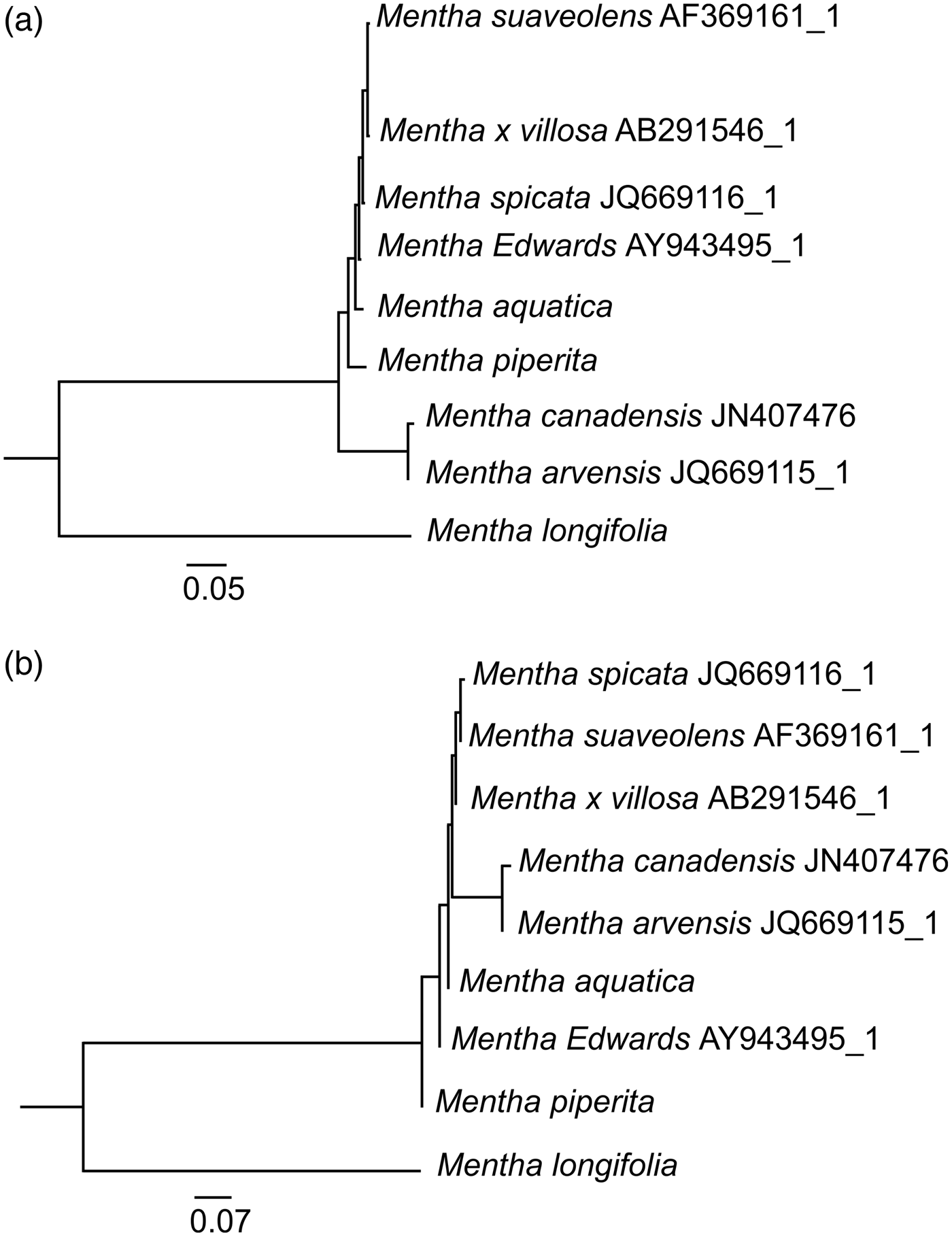
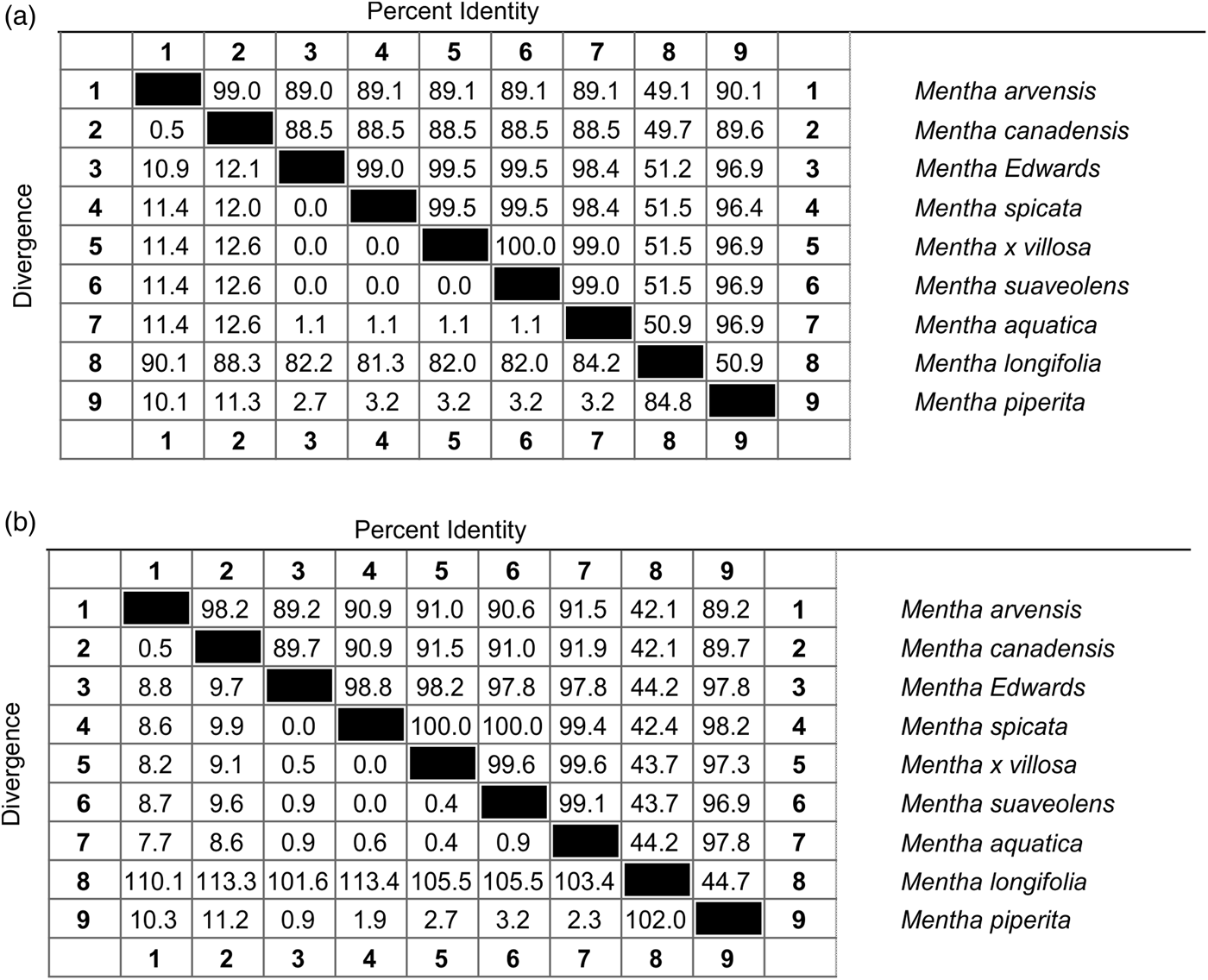
Twelve clones per construct (four per each Mentha species, studied) were selected and submitted for DNA sequencing at Mycrosynth company (Switzerland) facility. The resulted Ab1 files for each independent run were imported in SeqMan module of Lasergen 10, edited for mismatches, and sequences corresponding to the vector parts and 5.8S RNA encoding region were trimmed. Resulted sequences were exported and published at NCBI database with following accession numbers: KR611529 (Mentha aquatica), KR611531 (Mentha longifolia) and KR611530 (M. piperita). For the purpose of the study the sequences corresponding to the ITS1 and ITS2 of M. canadensis (JN407476), M. edwards (AY943495_1), M. spicata (JQ669116_1), M. villosa (AB291546_1), M. suaveolens (AF369161_1) and M. arvensis (JQ669115_1), obtained from NCBI database, and newly obtained ITS sequences for M. aquatica), M. longifolia and M. piperita were extracted as individual files. Both, ITS1 and ITS2 sequences of all Mentha species were compared in separate alignments. Based on the alignment data two phylogenetic trees were constructed: (1) based on the ITS1 sequence distances (Fig. 1A) and (2) based on the ITS2 sequence distances (Fig. 1B). Two different clusters on the phylogenetic trees, shown in Fig. 1 are distinguishable. The first cluster includes M. edward, M. spicata, M. villosa, M. suaveolens, M. aquativa and M. piperita, while the second cluster consists of two mint species: M. arvensis and M. canadensis. In our hands in both phylogenetic analyses, based on ITS1 and ITS2 sequences, M. longifolia has shown the highest degree of sequence distance (Fig. 2), and therefore is visualized on the phylogenetic tree as a most distinct branch. Two of the Mentha species included in this study – M. suaveolensins and M. villosa, appeared to be undistinguishable based on both ITS1 and ITS2 sequences as well (Fig. 2). Comparison of sequence identity of the ITS2 region reveals another barely discernable cluster of three mint species: M. spicata, M. suaveolensins and M. villosa. Since M. spicata and M. suaveolensins do share 99.5% sequence identity, both species can be discerned based on the ITS1 region.
Phylogenetic relationships of nine Mentha genotypes based on ITS1 (A) and ITS2 (B).

Sequence distance, respectively similarity of ITS1 (A) and ITS2 (B), of Mentha species used in this study.

The advantages of IST1 and ITS2 polymorphisms are widely used for identification and study of microorganisms (Ivanova et al., Reference Ivanova, Morozov, Kukina, Maksakovskaia, Rabinovich and Poltaraus2001; Korabecna et al., Reference Korabecna, Liska and Fajfrlik2003), insects (Hribova et al., Reference Hribova, Cizkova, Christelova, Taudien, de Langhe and Dolezel2011), plants (Ritland et al., Reference Ritland, Ritland and Straus1993; Nikoloudakis et al., Reference Nikoloudakis, Skaracis and Katsiotis2008) and animals (Nuchprayoon et al., Reference Nuchprayoon, Sangprakarn, Junpee, Nithiuthai, Chungpivat and Poovorawan2003; Tatonova et al., Reference Tatonova, Chelomina and Besprosvannykh2012). The NCBI database search for ITS1 and ITS2 sequences of Mentha species provided limited information. In this study, we have cloned and sequenced ITS1 and ITS2 regions of tree mint species: M. piperita, M. longifolia and M. aquatica. The data obtained were subsequently used in ITS1 and ITS2 sequence alignment analysis. The two phylogenetic trees, which were drawn based on the alignments with ITS1 and ITS2 sequences respectively available on NCBI from other Mentha species, showed a similar pattern of phylogenetic distances. Although ITS1 region has been reported in some studies as a better molecular marker compared with ITS2 (Wang et al., Reference Wang, Liu, Huang, Bengtsson-Palme, Chen, Zhang, Cai and Li2015), our data clearly indicate that both regions can be successfully used in barcoding of Mentha genus. However, due to the complete identity of ITS regions of some Mentha species (also shown in this study), implementation of those markers for phylogenetic studies should be considered case by case.
Acknowledgement
This work was supported by grant NI 13 BF 004.
Authors’ contribution
Dr Samir Naimov and Dr Elena Apostolva contributed on ITS1 and ITS cloning and sequencing; Dr Galina Yahubyan on data analysis; and Dr Rumen Mladenov, Dr Plamen Soyanov, Dr Ivanka Dimirova-Dyulgerova and Krasimir Todotov supplied plant materials and helped in species identification.