The literature on the Turkish National Struggle and the transformation from the Ottoman Empire to the modern Republic of Turkey is vast and comprehensive. However, some institutions formed by the leaders of the Committee of Union and Progress (CUP) are largely neglected in the literature. The CUP was the ruling political entity in the Ottoman state between 1908 and 1918, before its leading figures fled the country. The CUP institutions the Renewal Party (Teceddüt Fırkası) and Karakol played an important role in the formation of national resistance in Anatolia before Mustafa Kemal's arrival.
Erik Jan Zürcher's seminal book, The Unionist Factor: The Role of the Committee of Union and Progress in the Turkish National Movement,Footnote 1 is the most significant contribution to the literature regarding the role of Unionists in the Turkish National Struggle. Zürcher challenged the main theses of Turkish historiography, which attribute a central role to Mustafa Kemal in the formation and development of the Turkish National Struggle. Zürcher suggests that the Unionists initiated the resistance and were divided between pro- and anti-Kemalist factions. Another important contribution is Emel Akal's Mustafa Kemal, Committee of Union and Progress and Bolshevism at the Beginning of the National Struggle (Milli Mücadelenin Başlangıcında Mustafa Kemal, İttihat Terakki ve Bolşevizm).Footnote 2 Akal suggests that the Unionists formed the Turkish National Struggle via a top-down approach and organized local resistance by forming the National Forces. Akal also asserts that the Unionists did not view Kemal as the movement's natural leader; rather, because he was close friends with the leading figures of the Renewal Party and Karakol (Ismail Canbulat and Rauf Orbay, respectively), they eventually suggested his name as the potential leader.
This article focuses on two significant institutions, the Renewal Party and Karakol, and emphasizes the role of Unionists in the National Struggle. It demonstrates the connection between the Unionists and the national resistance organizations in Anatolia by examining two institutions formed through the Committee of Union and Progress and its secret organization, the Special Organization (Teşkilat-ı Mahsusa).
In modern historiography, memoirs are considered sources to be approached carefully. Mainstream Turkish historiography takes Mustafa Kemal's famous “Speech” (Nutuk),Footnote 3 delivered for 36.5 hours over six days in 1927 at the Republican People's Party (RPP) Congress, as the main source for the Turkish National Struggle. However, the speech is found in the memoirs of Mustafa Kemal, and while it is supported by a number of documents, some important historical concepts and institutions are omitted. The role of Unionists and the impact of such organizations as the Renewal Party and Karakol, for instance, are ignored in the Speech as well as in other works by Turkish historians that constitute the pillars of Turkish historiography. Examples of such works are Yusuf Hikmet Bayur's History of Turkish Revolution (Türk İnkılabı Tarihi),Footnote 4 Mahmut Goloğlu's History of the National Struggle (Milli Mücadele Tarihi),Footnote 5 and Enver Behnan Şapolyo's Kemal Ataturk and the History of the National Struggle (Kemal Atatürk ve Milli Mücadele Tarihi). Footnote 6 These works identify the beginning of the Turkish National Struggle as Kemal's passage to Anatolia in May 1919 – the exact date his memoirs, namely the Speech, begins.
This article also considers memoirs of individuals who took part in the Turkish National Struggle to analyze the role of Unionists in the formation of resistance through the Renewal Party and Karakol. In so doing, it aims to show that the Unionists, who ruled the country for close to a decade, did not disappear abruptly after the war but rather helped establish national resistance groups. This in turn demonstrates an historical continuity between the CUP regime and the war's aftermath.
At the end of World War I, CUP leaders held a meeting at which they reached a three-part decision: First, they would leave the country if it became necessary; second, some Unionists would go to Anatolia to continue their work; and third, some would stay in Istanbul and go into hiding if danger arose. It is clear that Unionists experienced each part of the decision: It did become necessary for the top leadership to go abroad, with one segment fleeing to Anatolia and another staying in Istanbul. The group that went to Anatolia organized as the Renewal Party, which eventually became the Association for Defense of National Rights. The group that remained in Istanbul formed Karakol and eventually helped the resistance in Anatolia by sending military officers, ammunition, and other materials.
In his memoirs, Fethi Okyar, one of the CUP's leading figures, mentions that he met with Talat Paşa immediately after the signing of the Armistice of Mudros. In this meeting Talat Paşa asked him if he would like to take an active role in the party “in the event that [it] takes on a new identity.”Footnote 7 Okyar responded that it was necessary for the organization to acquire a new name and identity and to appear before the nation with a suitable program. He made the following statements, which provided the road map for the National Struggle (Milli Mücadele) under the leadership of his closest friend, Mustafa Kemal Paşa:
This massive organization cannot stay in its current place. It must continue its mission, coming before the nation with a new name and a program worthy of the name chosen. In my opinion, the most critical thing is for this establishment to not be left ungoverned. For if there is to be a struggle over the existence of an autonomous state, the foundation of this struggle will once again be the organization of the Committee of Union and Progress, which extends in every direction. Because this organization represents, to a great extent, the strength that the country possesses, how can this be sacrificed?Footnote 8
Here, Okyar summarized the political framework of post-CUP Ottoman organizations aiming to save the country and give the people a right to self-determination. The first example of these organizations is the Renewal Party.
The Renewal Party
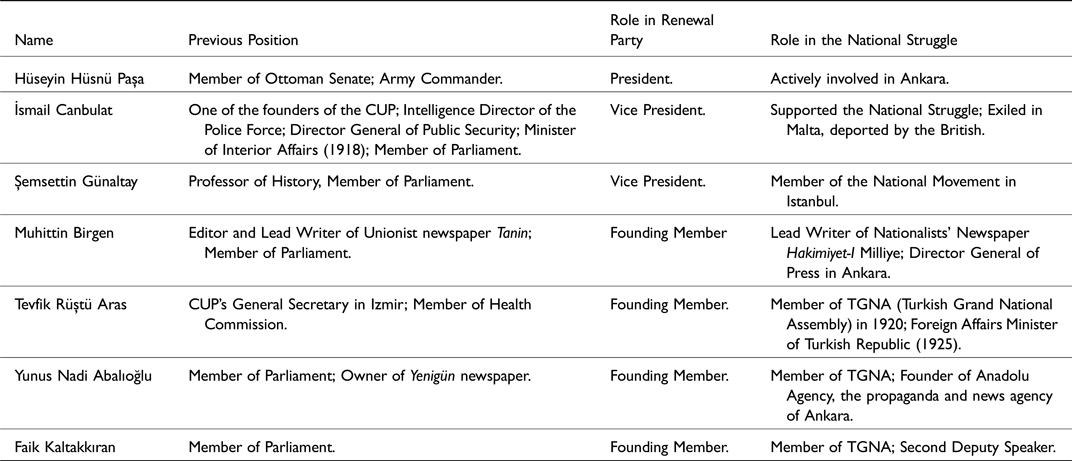
Okyar explained that the Renewal Party (Teceddüt Fırkası) was formed in the Congress that subsequently gathered: “The party did not reach the level that was hoped for. The true successor of the Union and Progress was the Association for Defense of National Rights [Müdafaa-i Hukuk Cemiyetleri], which shouldered the burden of the National Struggle.”Footnote 9 The task of preparing the Renewal Party program fell to a committee composed of such names as İsmail Canbulat, editor and lead writer of Tanin Newspaper, Muhittin (Birgen), Şemsettin (Günaltay) Bey, and Tevfik Rüştü (Aras).Footnote 10 These individuals were also among Mustafa Kemal's close circle during the National Struggle (Table 1).
Founders and Members of the Renewal Party and their Status

While some newspapers of the period claim that Mustafa Kemal was a member of the Renewal Party, he refuted this by sending a statement to the press.Footnote 11 Indeed, Emel Akal claims that the Renewal Party was established to replace the CUP, but it was the CUP's lower-ranking members who had criticized their leaders’ policies and who took control of this new political party.Footnote 12 According to Muhittin Birgen, “The Renewal Party aimed to create a radical new Turkish party different from the anarchic and conservative history of the CUP.”Footnote 13 The Renewal Party's founders established eligibility criteria for membership, including the blocking of CUP members accused of committing various crimes and who had caused the country to take part in the war.
The Renewal Party program had 175 articles. According to Zürcher, the program is an early example of some of the reforms brought about by the Kemalist Republic.Footnote 14 However, due to its ties with the CUP, the government shuttered the party on May 6, 1919, and seized its assets. Yet according to Aydemir,Footnote 15 one Renewal Party account was not transferred to the government: some CUP members had already traveled to Anatolia from Istanbul and continued operating with their salaries sent from Renewal Party headquarters.Footnote 16 Some of the CUP's local branches and club houses in Anatolia were named Renewal Party branches, and after the party's closure their names were changed to the Association for Defense of National Rights. These became the central agencies in the organization of the National Struggle.Footnote 17
As mentioned, CUP leaders aimed to form a national resistance in Anatolia. Because of the occupation and disarmament of the Ottoman army, resistance could not be carried out openly. An underground organization was needed to acquire weapons and recruit discharged soldiers from the Ottoman army. The name of this organization was Karakol.
Karakol
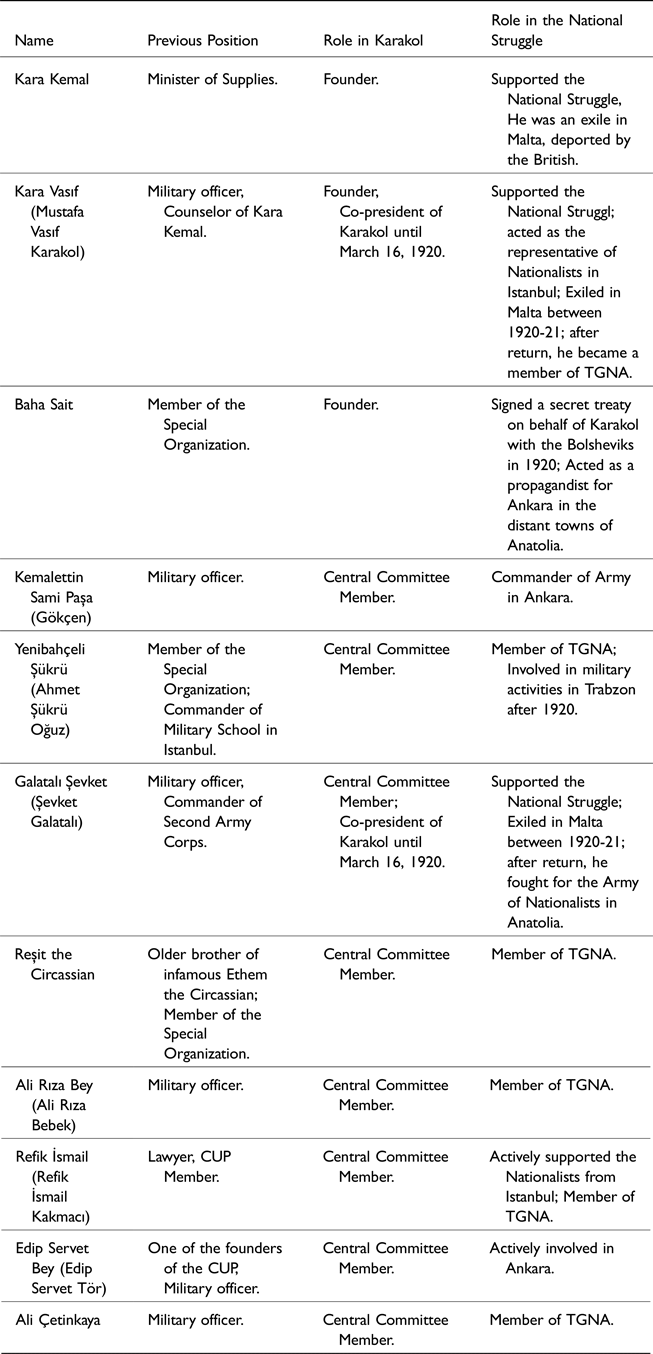
Karakol initially emerged as an underground protection and resistance group among the remaining members of the CUP in Istanbul, and it eventually became a secret organization supporting the National Struggle in Anatolia.Footnote 18 Before leaving the country, Talat Paşa instructed a prominent member of the CUP, Kara Kemal, to continue Unionist activities via a secret organization. Kara Kemal shared this instruction with another Unionist, Kara Vasıf, and the name of the organization became Karakol, referring to the titles of both founders, “Kara.”Footnote 19 Karakol was established in early November 1918. Halide Edip Adıvar mentions Karakol in her memoirs, stating that its leader Kara Vasıf Bey was one of the most patriotic people she had ever known.Footnote 20 Halide Edip explained that she was invited to a secret Karakol meeting in which she and Kara Vasıf Bey sat with another Karakol member, District Governor Kemal Bey (Kemalettin Sami Paşa), and made plans to send youth, most of whom were officers, to regions where Turks were in the majority in order to awaken and prepare the people.Footnote 21
Avcıoğlu states that co-founder of Karakol Kara Kemal organized and cultivated a following among groups such as bakers, porters, and boatmen, and used these Unions in the service of national struggle.Footnote 22 Karakol also operated in other provinces and districts to keep CUP members organized under a single roof.Footnote 23 Karakol's program stated that a secret National Army was established based on the Ottoman army's existing staff and military organization.Footnote 24 All of the commanders and their subordinates were appointed but their identities were not circulated. Because the leaders desired an army that could act quickly under any circumstances, they kept it small.Footnote 25 They also established Karakol branches to organize local defense organizations and local battalions for resistance. Each battalion, also called a “combat unit,” consisted of 40-200 soldiers and 1-4 officers in provinces, districts, and towns, and 5-10 soldiers in sub-districts and villages.Footnote 26
Abidin Nesimi notes that the WWI battalion structure dubbed the Special Organization (Teşkilat-ı Mahsusa) consisted of various cells independent from each other, with each cell comprised of a leader, a doctor, two or three executioners, and a valet who ran errands.Footnote 27 CUP members who fled to Anatolia after the war used this structure, forming small-scale military teams and civilian gangs through volunteer battalions. These groups pardoned some prisoners, and the branches of the Association for Defense of National Rights and governorships provided aid and protection.Footnote 28 Some who formed such cells in Anatolia after the war and were active members of the Special Organization included Rıza Bey, Yahya Kaptan, Yahya Kahya, Halis Turgut, Celal (Bayar), Dr. Mazhar (Germen), and Ali Cenani.Footnote 29 These individuals were active during the National Struggle and some became part of Mustafa Kemal's inner circle. Indeed, the secrecy and organization skills honed through the Special Organization structure were also useful in national resistance (Table 2). Both the Renewal Party and Karakol established connections in Anatolia and sent their members to its inner regions to organize the resistance. Because all the CUP branches in Anatolia had been transformed into Renewal Party units, Karakol members and other Unionists easily secured logistical support in the vast and unknown territories.
Founders and Central Committee of Karakol and their Status

Organization of Resistance in Anatolia
When Karakol members moved to name the leader of the National Struggle in Anatolia, Enver Paşa's uncle Halil Paşa was suggested. However, because Halil Paşa felt that Unionist resistance should be concealed, he rejected the offer.Footnote 30 When Kara Kemal was detained in Bekirağa Prison in March 1919, he instructed a group of Karakol members who visited him – Yenibahçeli Şükrü Bey, Kara Vasıf, and Ali (Çetinkaya) Bey) – to travel to Anatolia to find a leader. The name they proposed was Mustafa Kemal.Footnote 31 These members also distributed tasks among themselves. Kara Vasıf, for example, undertook organizing within Istanbul, and Yenibahçeli Şükrü Bey became the commander of the Kuvayi Milliye of Kocaeli and its surroundings. Halil Paşa stated in his memoirs that Karakol members considered it more appropriate for Mustafa Kemal to develop relations between Karakol and local resistance groups such as the Association for Defense of National Rights since it was important to conceal from foreign powers that Unionists were behind these organizations.Footnote 32 Mustafa Kemal Paşa also confirmed his connection with Karakol in his meeting with Kara Vasıf Bey in Sivas, stating that when he returned to Istanbul after the Mudros Armistice he learned about Karakol's goals and its strategy of concealing Unionist involvement in the resistance activities, which he welcomed.Footnote 33
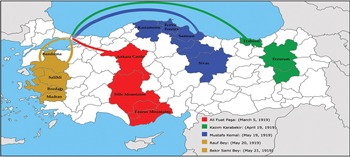
Following the occupation of Izmir by Greek armies, Karakol sent Rauf (Orbay) Bey to the region, where he organized meetings in Bandırma, Balıkesir, Salihli, Ödemiş, Aydın, Nazilli, and Afyon, and arrived in Ankara on June 8, 1919, to meet with Ali Fuat Paşa. Rauf Bey, who knew Ethem the Circassian and his brothers during World War I under the Special Organization, convinced them to join the National Struggle.Footnote 34 Rauf Bey also persuaded Colonel Bekir Sami (Günsav) to lead the remaining military forces in the Greek-occupied region, and the Istanbul government appointed him commander of the corps on May 20, 1919, as a result of Karakol efforts.Footnote 35 Colonel Bekir Sami ensured that the region's people participated in the National Struggle, and acted brutally, especially against those who cooperated with the Greek armies (Fig. 1).
The Destinations and Dates of Dispatch of the Leading Figures

A letter sent to the former president of the Turkish Historical Society Tevfik Bıyıklıoğlu in 1952 by Lawyer Hamid Şevket İnce, one of the leading figures who initiated resistance against the Greek occupation in Ödemiş, demonstrates the influence of CUP, and specifically Karakol, on the National Struggle:
I was in Istanbul during May 1919 to follow up a legal case. On May 15, 1919, everyone in Istanbul started to talk about the occupation of Izmir by the Greeks. . . and a protest meeting was held in the Darülfünun (today's Istanbul University) Conference Hall the next day. I was also present at this meeting. . . . When Rıza Tevfik Bey, in his speech defending the Ottoman government as a Senate member, said that the occupation was inevitable and people should remain calm, I began to speak and said that I would travel to my hometown Ödemiş the following day and I would initiate a resistance with my friends there and to organize the defense of my hometown against the Greeks. After my speech, Baha Sait Bey (who was a member of Karakol) said that he wanted to talk to me privately. We met with him at a former clubhouse of CUP and he said the following to me: “Two days ago, it was decided to send a great commander (Mustafa Kemal) to Samsun region, yesterday a national hero (Rauf Bey) was sent to the occupied region. I will introduce you to a high-ranking commander (Bekir Sami), who will travel to the occupied region tomorrow night.”Footnote 36
In his memoirs about the occupation in Istanbul, İsmail Hakkı Sunata stated that one of his friends, in a meeting at the Turkish Hearth on May 27, 1919, said that a resistance organization had been established in Bandırma that would fight the Greeks, and that whoever wanted to join the organization would be transferred to the region.Footnote 37 Rauf Bey traveled around the Balıkesir-Manisa-Alaşehir-Afyon Karahisar region to form resistance against the Greek armies after Bandırma and met with the underground CUP organization members in these towns, conveying to them the instructions from Karakol.Footnote 38
Telegrams sent by the American journalist Louis E. Browne from Sivas to the United States at the end of the Sivas Congress include the following statements made to him by Rauf Bey:
We are ready to lose some territories because we were defeated in the war. It is possible if we are no longer able to keep Mesopotamia and Syria. . . . We have a great military force and within a few weeks, our troops can reach to the number twice the former military force of 50,000 men. We have the necessary number of cannons, rifles and ammunition to equip this army.Footnote 39
This shows that preparations for possible resistance in Anatolia were made during WWI and that as a military commander Rauf Bey became aware of them.
Ali Çetinkaya wrote in his memoirs that he considered putting a “K.M.” (to represent Kuvayi Milliye-National Forces) sign on the armbands of those organized to resist the Greek army, but because the letter “K” would signal “Komite- committee” and Unionists, he instead used Kuvayi Milliye.Footnote 40 Rahmi Apak also stated in his memoirs that the ordinary people of Anatolia were more inclined to welcome the battalions riding horses with bandoleers, bombs hanging from their belts, long daggers, and kalpaks than the military officers. This was because people considered military officers the cause of all the wars and the troubles they suffered during them. Consequently, “gang leaders” such as Demirci Mehmet Efe and Ethem the Circassian formed and strengthened the Kuvayi Milliye more easily by using these types of battalions.Footnote 41 Tekeli and Ilkin claim that it is not accurate to consider the Association for Defense of National Rights the sole organization behind the civil resistance in Izmir and the Aegean region; they note that formerly established associations such as the Turkish Hearth and the Teachers’ Association (Muallim Cemiyeti), in which Unionists were actively involved, were also effective in forming resistance groups and were supported by the Renewal Party.Footnote 42
Some of the most important evidence regarding Karakol's influence on the resistance in the Aegean region is the diary of Hacım Muhittin (Çarıklı) Bey. Hacım Muhittin was the organizer of congresses gathered in the region and was a former member of the Special Organization. During the occupation of Izmir, while he was in Istanbul, Hacım Muhittin contacted Karakol after meeting with Kara Vasıf Bey. He then traveled to Bandırma to form the resistance against the Greek armies.Footnote 43 Later he conveyed Karakol's regulations and orders given to him by Kara Vasıf to contacts and other units of resistance in the region. Hacım Muhittin gathered the Alaşehir Congress, and participants in this congress elected Kara Vasıf Bey as their chairman and representative.Footnote 44
As these examples show, CUP leaders designed the National Struggle of Turkey, and the organization's second-rank members who remained in Turkey after WW1 organized its activities. Through the use of the CUP and its networks, the Renewal Party and Karakol built the first national resistance movements in Anatolia. Karakol members in Istanbul also used their connections and positions in the government to facilitate the travel of leading figures of the National Struggle, such as Mustafa Kemal, Rauf Bey, and Colonel Bekir Sami, to Anatolia.