


What explains the persistence of political dynasties in democracies?Footnote 1 A considerable presence of dynasties has been documented in democracies as diverse as the U.S. (Feinstein Reference Feinstein2010), Japan (Asako et al. Reference Asako, Iida, Matsubayashi and Ueda2015), Ireland (Smith and Martin Reference Smith and Martin2017), and India (Chandra Reference Chandra2016), and a growing body of research attempts to uncover the mechanisms behind this phenomenon. A prominent explanation points to the electoral advantages of a dynastic background, suggesting that dynastic ties might function in a way that is similar to the well-known incumbency advantage. The incumbency advantage includes the direct advantages of being in office (such as name recognition and experience), as well as the deterrence of high-quality challengers (e.g., Carson, Engstrom, and Roberts Reference Carson, Engstrom and Roberts2007). It is not difficult to imagine how a dynastic candidate, particularly one who immediately succeeds his or her family member in the same district, might “inherit” part of a predecessor’s incumbency advantage, which can thus be thought of as an inherited incumbency advantage.
Recent studies of the incumbency advantage estimate the causal effect of incumbency on future election outcomes through the use of regression discontinuity (RD) designs applied to close elections, where the “treatment” of winning office can be considered “as good as random” (Lee Reference Lee2008). In candidate-centered electoral systems—i.e., where votes are cast for individual candidates rather than party lists—the incumbency advantage is substantial (e.g., Fowler and Hall Reference Fowler and Hall2014; Erikson and Titiunik Reference Erikson and Titiunik2015, for the U.S.).
Dal Bó, Dal Bó, and Snyder (Reference Dal Bó, Bó and Snyder2009) similarly use the RD design to evaluate the causal effect of incumbency on the creation of a political dynasty in the context of historical U.S. congressional elections. Although holding office does not have an effect on the innate characteristics of a politician’s child or other relatives, it certainly increases their connections and name recognition. For congresspersons who narrowly won their first re-election, the probability of having a family member serve in the future increased by six percentage points, on average, and up to fourteen percentage points in the South. In the Philippines, where single-member district (SMD) elections are also used, Querubin (Reference Querubin2016) finds that candidates who narrowly won their first election were twelve percentage points more likely to have a future relative serve in office. In other words, dynasty formation appears to become more likely the longer a (potential) founding member holds office, suggesting a “power-treatment” effect on elite families.Footnote 2
These studies provide compelling evidence that incumbency and length of tenure play an important causal role in the creation of dynasties in candidate-centered environments. However, dynasties also exist in party-centered environments—viz. closed-list proportional representation (PR) systems—where votes are cast not for candidates but for parties, and thus where the underlying mechanism of name recognition of individual candidates, in theory, does not carry the same sort of electoral relevance as it does in candidate-centered environments (e.g., Carey and Shugart Reference Carey and Shugart1995; Shugart, Valdini, and Suominen Reference Shugart, Valdini and Suominen2005). In such contexts, it is less clear whether and how incumbency relates to the probability of forming a dynasty. Moreover, a recent study by van Coppenolle (Reference van Coppenolle2017) finds no effect of first-term incumbent re-election on the probability of forming a dynasty using historical data from the U.K. House of Commons, which suggests that the “power-treatment” effect may not operate in the same way across different contexts.Footnote 3
In this study, we apply an RD design adapted for use in PR list systems (Folke Reference Folke2014) to empirically investigate the relationship between incumbency and dynasties in the party-centered environment of closed-list PR elections in Norway. In the process, we first extend the incumbency advantage literature from a candidate-centered environment, where it has been extensively studied, to a party-centered environment, where surprisingly little scholarship exists.Footnote 4 Under Norway’s closed-list system voters’ decisions are, in theory, based more on evaluations of parties and those parties’ policy programs than on the candidates on the lists.Footnote 5 Moreover, a candidate’s rank position, and thus how likely he or she is to win a seat, is determined by the party, not voters. We provide the first empirical evidence using an RD design of an incumbency advantage for individual politicians in a party-centered, closed-list PR system.
We then test whether there is an inherited incumbency advantage under Norway’s party-centered system. As noted, RD designs have previously been used to identify a causal effect of incumbency on dynasty formation in candidate-centered SMD contexts. Norway’s closed-list PR system is theoretically more party-centered than these contexts, yet dynastic politicians still account for roughly 7% of members of parliament (MPs)—a proportion that is comparable to the U.S. (Dal Bó, Dal Bó, and Snyder Reference Dal Bó, Bó and Snyder2009; Feinstein Reference Feinstein2010). Does the emergence of dynasties in a party-centered environment like Norway operate in the same fashion as it does in candidate-centered environments? We find no evidence that it does. We discuss the implications of these novel empirical findings in the context of existing studies, and spell out directions for future research.
INSTITUTIONAL SETTING AND DATA
Our dataset includes all candidates who ran in the 18 national legislative elections between 1945 and 2013 (elections are every four years).Footnote 6 For the sample we analyze, there are 19–20 districts with a median magnitude of seven seats. In all parties, nominations and list order are determined by local conventions attended by party delegates (Valen Reference Valen, Gallagher and Marsh1988). The renomination of former candidates, including incumbents, is not automatic. Party identification among voters is high: roughly 70% in the early postwar period, and around 50% by the 1980s (Bengtsson et al. Reference Bengtsson, Hansen, Hardarson, Narud and Oscarsson2013, 71). We limit our analysis to candidates in the eight main parties: Labor Party (DNA), Liberal Party (V), Socialist Left Party (SV), Conservative Party (H), Communist Party (NKP), Christian Democrats (KrF), Progress Party (FrP), and Center Party (SP).Footnote 7
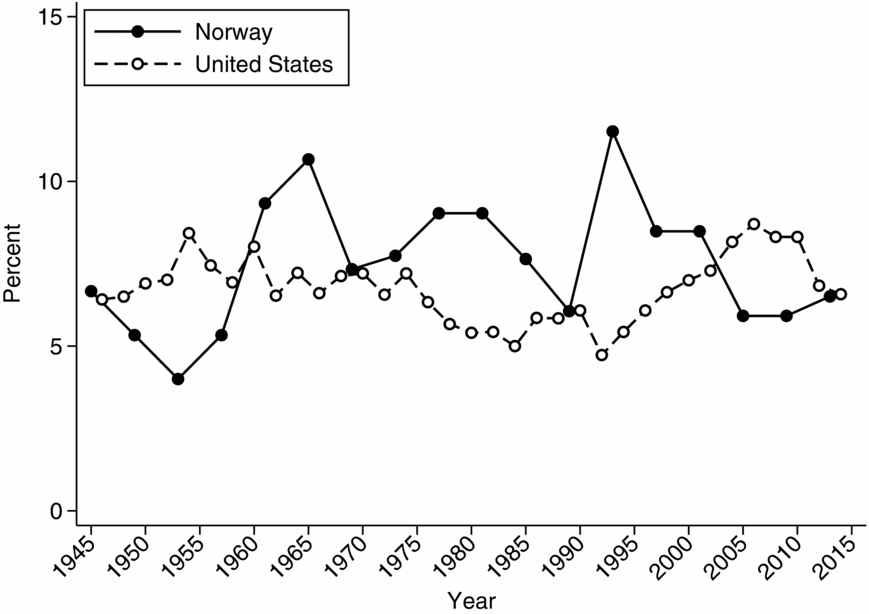
Party vote counts at the district level allow us to measure how close each candidate was to winning (losing) a seat, given the number of votes and seats won by each party and the candidate’s list position. Biographical data for all cabinet ministers, MPs, and deputy MPs serving at least 100 days during a term come from the Archive of Politicians at the Norwegian Centre for Research Data.Footnote 8 Importantly for our purposes, this dataset also includes information on family ties between politicians. Figure 1 shows the proportion of Norwegian MPs after each election who were related to a formerly serving MP or cabinet minister. For comparison, the figure also plots the proportion in the U.S. House of Representatives over the same time period. In both countries, the proportion has remained relatively stable—between 5% and 10%.
Political Dynasties in Norway and the United States, 1945–2015

We construct a variable, Family member winning future seat, which is a dummy variable equal to one if a candidate has a relative who becomes an MP or cabinet minister in the future.Footnote 9 For elected candidates, this variable accurately captures dynastic ties. For unsuccessful candidates, we lack systematic biographical data unless the candidate served as a deputy, or won a seat in a different election. Luckily, the Norwegian system of designating the runners-up as deputies means that information on family ties for the vast majority of marginally unsuccessful candidates is also available. We extensively searched online records for biographical information on the remaining candidates who were next in line to win a seat, which delivered several additional cases of family ties.
Before proceeding to our RD strategy, we report the results of simple linear probability models relating political power to dynasty formation (Family member winning future seat). In addition to length of tenure (Terms served), we explore the correlation with having ever been ranked first on the party list (First-ranked) and having ever served in cabinet (Cabinet experience).Footnote 10 The full results are presented in Appendix Table A.1 (available online).Footnote 11 Because these power-related variables may be correlated with each other as well as dynasty formation, we explore them each separately, then all together. All three variables correlate positively with dynastic succession; however, in the joint specification, there is no longer a statistically significant association for seniority (Terms served), and the point estimate is small (0.007). These correlations suggest that cabinet experience (point estimate = 0.053 in the joint specification) and being list leader (point estimate = 0.040) may be particularly important for forming a dynasty in Norway’s party-centered environment, but beg the question of whether incumbency or length of tenure in office matter at all, in contrast to previous findings in candidate-centered environments. To pin down the causal effect of incumbency on dynasty formation, we must rely on the RD design.
ESTIMATION STRATEGY
Our data sample for the RD design is based on candidates running in the 1953–1981 period (13,306 candidate-year observations).Footnote 12 We limit the sample to this period for two reasons. First, we need a sufficiently large period after candidates have run in order for family members to (potentially) appear in the data. Second, we want to avoid complicating the analysis with a 1953 reform where the Modified Sainte-Laguë seat allocation method replaced D’Hondt, a 1989 reform that introduced adjustment seats, and the 1985 election, in which parties were allowed to form joint lists.Footnote 13
Candidates can be broadly classified as belonging to one of three categories: those with (1) a safe position, (2) some chance of winning, and (3) virtually no chance of winning. For our purposes, only the second group is relevant.Footnote 14 In two-party SMD elections, it is straightforward to measure electoral closeness, since a predefined threshold (50% of the total vote count) decides the winner. In multimember PR elections, this is more complicated, since the number of seats a party wins depends on the vote counts of all parties, and there is no predefined threshold to win an additional seat. As a measure of closeness, Folke (Reference Folke2014) proposes to measure the distance to a seat threshold as the minimum total vote change across all parties that would be required for a party to experience a seat change. We implement this measure (Win margin) to capture how close a marginal candidate was to losing (winning) a seat.Footnote 15
Our baseline empirical specification is a local linear regression of the form
 $$\begin{eqnarray}
Y_{i}&=&\beta _{0}+\beta _{1}Seat_{i}+\beta _{2}\text{\emph {Win margin}}_{i}\nonumber\\
&&+\,\beta _{3}\text{\emph {Win margin}}_{i} \ {\scriptstyle\bullet} \ Seat_{i}+\xi _{i},
\end{eqnarray}$$
where Seat i (incumbency treatment) is a dummy equal to one that is deterministically assigned to candidate i in election t if he or she has a positive win margin and therefore wins a regular (nondeputy) seat in parliament. Equation (1) allows the slope of the regression line to differ on either side of the discontinuity by including the interaction of Win margin and Seat. ξi is an error term. We cluster standard errors at the candidate level.Footnote 16
Y i represents one of four outcome variables: (1) a dummy variable equal to one if candidate i runs in the subsequent election; (2) a dummy variable equal to one if candidate i wins a seat in the subsequent election; (3) the total number of terms served by candidate i (including partial terms based on days served as a deputy MP); or (4) a dummy variable equal to one if candidate i has a family member who ever wins a seat in the future. In the first two cases, β1 estimates the average incumbency advantage in a “sharp” RD framework.Footnote 17
In our analysis of the inherited incumbency advantage, we consider the third case, where terms served is the outcome variable, as the first-stage equation. This equation estimates how tenure in office changes with seat status in the current election. In the fourth case, where Family member winning future seat is the outcome variable, β1 is a reduced form estimate that pins down how the probability of having a family member serving in the future depends on a candidate’s seat status in the current election. The local average treatment effect of serving one additional term can be recovered by dividing this estimate by the discontinuity jump in the first-stage equation, i.e., using a “fuzzy” RD framework (Lee and Lemieux Reference Lee and Lemieux2010).
RESULTS
We first present graphical evidence using a common bandwidth of five percentage points for Win margin. Figure 2 gives the RD plots based on candidates’ contemporaneous (election t) win margin for each of the four outcome variables. We plot local averages of the outcome variables calculated within bins of half a percentage point, and fit separate regression lines on each side of the discontinuity. The vertical line represents a “zero” win margin, and indicates the transition from candidates who marginally lost to those who marginally won.
RD Plots of Incumbency Advantage and Inherited Incumbency Advantage

There is clear evidence of an incumbency advantage. In the top-left panel of Figure 2, we see that winning a seat in the current election increases a candidate’s probability of running again in the next election. Moreover, the top-right panel indicates that the probability of winning in the next election roughly doubles. Note that this calculation includes all candidates who ran at election t (i.e., it is not conditional on running at t + 1).Footnote 18 The bottom-left panel shows that the total number of terms served appears to jump from about 1.5 to 3.0 at the cutoff. When it comes to the inherited incumbency advantage, however, there is no clear evidence that winning a seat has a causal effect on the future political careers of family members. The bottom-right panel indicates that the probability of having a family member winning a seat in the future is about 0.04 for both marginal losers and marginal winners close to the cutoff.
In Table 1, we give the regression results using the mean-square-error optimal bandwidth for each model as suggested by the algorithm developed by Calonico et al. (Reference Calonico, Cattaneo, Farrell and Titiunik2017). The first column provides the baseline results based on Equation (1). In Columns (2)–(5), we sequentially add fixed effects for year, party, district, and list rank to the model specifications. Finally, the specification in Column (6) adds a set of control variables for occupation and gender.
RD Estimates of Incumbency Advantage and Inherited Incumbency Advantage

Note: Each cell represents RD estimates based on Equation (1) using the mean-squared-error optimal bandwidth calculated by the Calonico et al. (Reference Calonico, Cattaneo, Farrell and Titiunik2017) algorithm. In Column (6), we include dummies for candidates’ gender and prior occupation (see Appendix Figure A.15). All specifications include separate linear control functions on each side of the discontinuity. Standard errors clustered at the candidate level are in parentheses.
Consistent with the graphical evidence, the results show evidence of a substantial incumbency advantage—about 24 percentage points [Panel B, Column (1)]—for a marginally elected candidate. The estimate is statistically significant and insensitive to the inclusion of controls [cf. Columns (2)–(6)]. The results from Panel A in Table 1 suggest that a large part of this advantage comes from renomination.Footnote 19 For a marginally elected candidate, the probability of being on the ballot in the next election increases by about 24 percentage points [Panel A, Column (1)].Footnote 20 In Panel C, we provide the results for the number of terms served, which can be considered our first-stage equation. We find that a narrowly won seat increases the number of terms served by 1.6. Finally, in Panel D, we provide results for the inherited incumbency advantage. The estimated effects are close to zero, and insignificant in all specifications. Using a fuzzy RD, we estimate a local average treatment effect of serving one more term of −0.009, with a confidence interval that excludes substantial positive effects.Footnote 21
REMARKS
In this study, we provide the first empirical test using an RD design of whether an individual incumbency advantage—as documented in numerous candidate-centered contexts—exists in a party-centered, closed-list PR system: it does. We also provide the first such test of whether an inherited incumbency advantage—as documented in a few recent studies using data from candidate-centered contexts—exists in such a party-centered system: we find no evidence that it does. We offer two interpretations of our empirical null findings for the relationship between incumbency and dynasty formation—both of which point to internal party networks as the mechanism behind the creation of dynasties in party-centered contexts like Norway.
First, it appears that there are many failed candidates whose relatives nonetheless go on to get elected in the future. Since list rank, and thus one’s probability of getting elected, depends on the decisions of the party’s local nominating conventions—not primary election voters, as in the United States—it should perhaps not be surprising that an active candidate who narrowly misses out on getting elected might still have close enough ties to party activists to result in his or her relatives being better placed in future nomination decisions. The fact that candidate selection is by law decentralized to local party organizations may contribute to this network effect. For example, Valen (Reference Valen, Gallagher and Marsh1988, 220) notes that “Norwegians do not ‘run for office.’ Candidacies are expected to emerge from active participation in party work.” List balance on geography and group interests tends to be achieved through lower-ranked candidates, while those at the top of the list tend to be selected on the basis of characteristics like “platform abilities” and enjoying “confidence within the party.” Would-be dynastic candidates are likely to have a leg up on these characteristics.
An additional factor that may explain our null findings for the inherited incumbency advantage is that the dominant families in Norwegian politics tend to occupy safe list positions. About half (48%) of the senior members of dynasties in our full sample are never close enough to the cutoff for winning or losing a seat to be included in our estimation sample. Rather, the results of the simple linear probability models suggest that they are important movers and shakers in the party organization and leadership. While about 4% of MPs with no cabinet experience had a relative follow them into office as an MP, nearly 12% of cabinet ministers had a relative in parliament. Similarly, 8% of MPs who were at any time ranked at the top of their party list during their tenure were followed into parliament by a family member, compared to just 2% of MPs who were never list leaders.Footnote 22
Our take on these descriptive patterns is that cabinet promotion and being list leader may be particularly useful for establishing a dynasty in party-centered contexts like Norway, while serving many terms perhaps not. On the other hand, it is important to consider that the types of politicians who are likely to achieve such high positions in the party and government may ex ante possess the qualities (personal character, education, expertise, and so on) that make them valuable to parties. If these qualities are at all heritable, then their family members may be of similar high quality. As we do not have plausibly exogenous variation in cabinet promotion or rank, we cannot estimate the causal effect of these variables on the formation of dynasties.
Our null finding for the inherited incumbency advantage in the party-centered context of Norway is both theoretically and empirically important for understanding the formation of dynasties in comparative perspective. Political dynasties are a common phenomenon in many democracies, but the exact mechanisms involved in their perpetuation appear to differ depending on the institutional context. Compared to the larger and statistically significant effects that have been estimated in candidate-centered contexts like the U.S. and the Philippines, the null finding from Norway suggests that incumbency plays a smaller explanatory role in the mechanisms underlying dynastic politics in countries with strong party organizations and party-centered voting. Combined with the absence of an effect in the United Kingdom (van Coppenolle Reference van Coppenolle2017), our results suggest a need for more comparative investigations across different institutional contexts, and additional time periods.
SUPPLEMENTARY MATERIAL
To view supplementary material for this article, please visit https://doi.org/10.1017/S0003055418000047.
Replication material can be found on Dataverse at https://doi.org/10.7910/DVN/TTE3SQ.




Comments
No Comments have been published for this article.