I. INTRODUCTION
The extremely high carrier mobility, thermal conductivity, and ballisticity of charge transport make carbon nanotube (CNT) an excellent candidate for achieving the next generation of high-speed and high-performance RF electronics at the nanoscale, including field-effect transistors (FET), oscillators, frequency multipliers, sensors, and wireless devices.
The analysis of multichannel transport in CNT is usually carried out by “discrete” models, such as TB, and “continuous” models, such as effective mass and kp approximations, which stem from the approximation of TB around particular points of the dispersion curves. The reasons for the success of these models reside in that they make use of fairly good and verified assumptions, two in particular: transport is ballistic due to low dimensionality and high purity of carbon lattice and the energy interaction between electrons is weak because of the relatively long distances involved in charge displacement and is typically smaller than energy broadening due to temperature and contacts.
In this work, we exploit a multimode model of quantum transport that allows easy simulation of multi-walled CNT-FET, despite the possibly large number of walls. A general model is currently proposed in the literature in order to analyze the properties of carrier transport [Reference Davies1] of this kind of device [Reference John, Castro, Pereira and Pulfrey2–Reference Alam and Lake12].
This work summarizes and collects some of our recent achievements in the simulation and modeling of CNT devices. A self-consistent multi-mode approach to charge transport has been developed. Here we report some simulation results, considering the contribution of different walls to the total current driven by a four-walled CNT under externally applied voltage. Each wall includes, eventually, many electronic bands. The numerical convergence of the applied iterative scheme has also been explicitly shown.
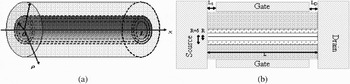
In a typical CNT-FET configuration, source and drain contacts are placed at the CNT terminations; we assumed that a cylindrical gate electrode completely surrounds the CNT. An insulator, of high relative permittivity (ɛ = 25), fills the space between the nanotube and the gate electrode. Perfect vacuum has been assumed within the CNT. The simulated structure is shown in Fig. 1.
(a) Geometry of a multi-walled CNT-FET. (b) Section of a double-walled CNT. L is the nanotube length, R and R + δ are the radii of the smaller and larger wall, respectively; we assume L S and L D → 0.

We start by recalling the basic points of the approach already used in analyzing the behavior of a single-walled CNT in the configuration of Fig. 1 [Reference Rozzi, Mencarelli, Maccari, Di Donato and Farina6]. We will report the main results thus obtained, and compare these results with those obtained by extending the model to multi-walled and multi-band CNTs. A self-consistent solution of the system of Poisson and Schrödinger equations directly provides both the linear charge along the nanotube and the electrostatic potential along the CNT:
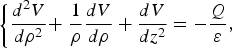

Following the notation of [Reference John, Castro, Pereira and Pulfrey2], V is the electrostatic potential within the outer cylinder, Ψh (Ψe) is the z-dependent wave function of a hole (electron) of energy E, traveling under the effect of a local potential energy U h (U e), and Q is the nanotube linear charge density, which is given by the difference between electron and hole charges, diffused from drain and source. We refer to the gate, source, and drain voltages as V g, V s, and V d, respectively.
A self-consistent solution of equations (1) and (2) is achieved when

Here the symbol “ = ” indicates the convergence of an iterative scheme, which is reached when the charge and potential differ from their values calculated at the previous step by less than a very small percentage. The Landauer–Büttiker formula [Reference Davies1] is used to calculate the total current flowing through the CNT:

In (4), e is the electron (hole) unit charge for I e (I h), h is Plank's constant, T e (T h) is the transmission probability through the channel for the electrons (holes), and f s,d is the Fermi function at the source and drain.
Such a simplified model highlights the main characteristics of the transistor operation and provides the parameters of interest such as, for example, current–voltage curves, linear charge density, and transconductance [Reference Rozzi, Mencarelli, Maccari, Di Donato and Farina6]. In [Reference John, Castro, Pereira and Pulfrey2], the attention is focused, mainly, on the transmittance properties of the carriers through the channel: it is noted that the transmission probability of electrons and holes is a very highly peaked function. This is basically due to the abrupt discontinuities seen by the carriers along their path in the metal–CNT–metal structure. In other words, the resonance peaks are made so sharp by the band-offset of CNT and metal, as well as by the spatial modulation of the potential energy induced by the applied electrostatic voltage. For example, if the external potential is just enough to allow the electron wave function to propagate in the channel, the CNT becomes a resonant cavity very slightly coupled to the external electrodes.
In [Reference Fiori, Iannacone, Lundstrom and Klimeck13], the Poisson–Schrödinger model was improved in order to take an account of a more realistic geometry of the metal electrodes. Moreover, an analysis of the dependence of the device properties to variations of the geometric parameters was performed [Reference Pourfath, Kosina, Cheong, Park and Selberherr3]. The model also lends itself to the analysis of the dynamic behavior of a CNT-FET: in [Reference Castro, Jhon, Pulfrey, Pourffath, Gehring and Kosina14] the unity-current-gain frequency f T was estimated by means of an equivalent circuit, whose lumped elements are computed in the electrostatic limit.
This contribution is intended to provide further improvements to the models described above. In particular, the following items have been introduced. (i) The investigation of the effects of nanotube sub-bands, which are usually neglected, on the transistor device operation. (ii) The extension of the analysis to the case of multi-walled CNTs.
The improvement (i) is necessary as one may deal, in practice, with nanotubes of “large” diameters and/or with high applied voltages. In the former case, the dispersion curves may have many branches, i.e. sub-bands, very close to the fundamental one, so that their contribution to the total charge and current has to be included. Similarly, in the latter case, the high applied voltage may shift the local band structure to such an extent that some sub-bands carry a non-negligible contribution to charge transport. The improvement (ii) provides an important generalization to the analysis of nano-FET devices, as multi-walled CNTs may be easier to obtain and manipulate than single-walled CNTs.
II. MULTIPLE BAND TRANSPORT
In a multiple channel (band) simulation, equation (2) becomes

where m indicates the mth wall and n indicates the nth sub-band. We still keep distinct all quantities related to electrons and holes. The potential energy appearing in (5) is defined as
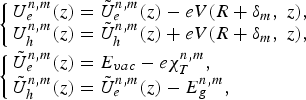
where R is the radius of the smallest of the CNT walls, E vac is the vacuum energy, χTn,m is the electron affinity for the carriers of the (n,m)-channel, E gn,m is the nth energy gap of the mth wall, and V is the electrostatic potential satisfying the Poisson equation, evaluated in correspondence of the radius (R + δm) of the mth wall. The boundary conditions for V are given by
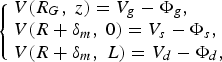
where R G is the radius of the gate electrode and Φg, Φd, Φs are the work functions of gate, drain, and source, respectively. The effective mass m en,m (m hn,m) is derived from the parabolic approximation of the nth branch above (below) the band gap of the dispersion curves of the mth wall.
The contributions of the (n,m)-channel to the linear charge and to the current are computed by solving separately the respective Schrödinger equations. However, even though the wave functions of different channels are not spatially coupled, they are coupled through the Poisson equation (1), because they all contribute to the source charge:
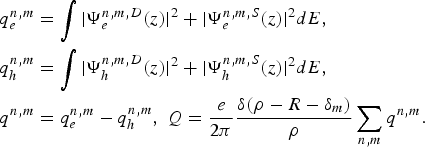
As for the charge, the total current is provided by the sum of the contributions of each wall with its own sub-bands
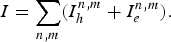
In (9), I h,en,m is the current of the (n,m)-channel:

where T hn,m (T en,m) is the transmission probability through the (n,m)-channel for holes (electrons).
III. EXAMPLES
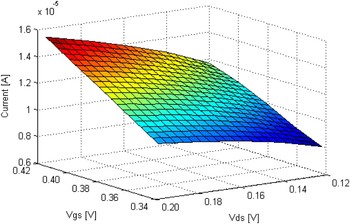
Figure 2 shows the total current, computed self-consistently with the electrostatic potential, for a four-walled CNT, 20 nm long. The current, obtained by an iterative computational scheme, as described above, is plotted as a function of drain and source voltages.
Current of a four-walled CNT, 20 nm long, after numerical convergence of the iterative Schrodinger–Poisson scheme. The four CNT have the following chiralities: (10,0), (19,0), (28,0), and (37,0).

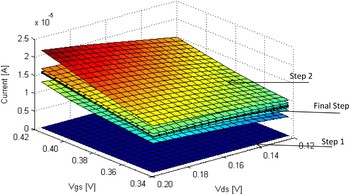
In Fig. 3, we show the numerical intermediate steps of this iterative scheme, which produce the current of Fig. 2 as final computational result.
Current of the four-walled CNT of Fig. 2: convergence is reached after a few iteration steps.

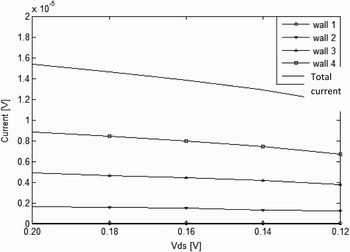
In Fig. 4, we report, for completeness, the contributions of the walls of the considered four-walled CNT to the total current, as a function of the drain voltage for a fixed drain voltage, after numerical convergence.
Current of any of the four walls of the four-walled CNT of Fig. 2 after numerical convergence, as a function of V d, with V g = 0.4 V. The total current is also shown (no marker).

IV. CONCLUSION
In this contribution, we report on numerical simulation of CNT-based transistors. In particular, we characterize the use of multi-walled CNT as channels for charge transport and evaluate the contribution to the electric current of individual walls, with emphasis on the numerical features of the implemented algorithm.
 Davide Mencarelli received the Laurea degree in electronics engineering from the Polytechnic University of Marche, Ancona, Italy, in 2002, and is currently working as post Doc at the same University. His research interests are in analysis and modelling of integrated optical devices. He is currently involved with analytical/numerical techniques for the modelling of nandevices. From 2007 he is a member of the Italian National Institute for the Physics of Matter (INFM).
 Luca Pierantoni was born in Maiolati Spontini, Italy in 1962. He received the ‘Laurea’ degree (summa cum laude) in Electronics Engineering in 1988 and the Ph.D. degree in 1993 from the Department of Electronics and Automatics at the University of Ancona, Italy. From 1989 to 1995, he was with the Department of Electronics and Automatics of the University of Ancona, as a Research Fellow. From 1996 to 1998 he worked at the Technical University of Munich, Germany, in the Institute of High-Frequency Engineering as Senior Research Scientist. In 1999 he joined the Department of Electromagnetics at the Polytechnic University of Marche, Ancona, Italy as Assistant Professor. His current research interests are in the Elettronica e Telecominucazioni, Università Politecnica delle Marche, Ancona, Italy, as an Assistant Professor. His current research interests are multiphysics modeling of nanodevices. He is the Chair of the IEEE MTT-25 - RF Nanotechnology technical committee.
 Andrea Di Donato received the Laurea degree (summa cum laude) in electronics engineering and the Ph.D. degree from the University of Ancona, Ancona, Italy, in 2000 and 2003, respectively.
He is currently with the Department of Electromagnetism, University of Ancona (presently Polytechnic University of Marche). His research interests include the development of analytical/numerical methods for the analysis and modeling of integrated optical devices. Dr. Di Donato is a member of the Optical Society of America and the Italian National Institute for the Physics of Matter.
 Tullio Rozzi (M'66-SM-74-F'90-LF07) obtained the Laurea degree in Physics (1965), Pisa (Italy), and the PhD in Electronic Engineering from Leeds University. From 1968 to 1978 he was a Research Scientist at the Philips Research Laboratories, The Netherlands. In 1978 he obtained the Chair of Electrical Engineering at the University of Liverpool and, in 1981, the Head of the Electronics Group at the University of Bath. Currently, he is the Head of the Department of Electromagnetics at the Polytechnic University of Marche. In 1975, he was awarded the Microwave Prize by the IEEE MTT-S. He is Life Fellow of the IEEE.