1. Introduction
Hybrid kinematic machining unit (HKMU) with five-axis machining capability is proposed as a complement to traditional five-axis machine tools and multi-axis articulated machining robots [Reference Su, Fang and Tang1, Reference Wu, Gao, Zhang and Wang2]. From a topological perspective, HKMU is structured as a hybrid mechanism combining serial and parallel mechanisms. Parallel mechanisms are generally acknowledged for their compact size, ease of inverse kinematics, and high stiffness, while serial mechanisms offer advantages such as stacked design, ease of forward kinematics, and large workspace [Reference Sun, Liu, Lian, Wang and Song3–Reference Sun and Lian8]. By integrating both types into HKMU leverages the strengths of both while mitigating their respective weaknesses. Therefore, HKMU is seen as a promising alternative solution for efficient five-axis machining in various industrial fields [Reference Modak and K9, Reference Chengjun, Hao and Long10]. Successful commercial implementations of HKMU include well-known systems such as the Tricept robot, Exechon robot, and Eco-speed centers [Reference Hosseini, Daniali and Taghirad11–Reference Huang, Dong, Liu, Sun and Chetwynd13]. Inspired by these successes, recent work by the authors introduces a novel five-axis HKMU integrating a one translational and two rotational parallel manipulator with a serial module with two translational sliding gantries. Previous research indicates that this kind of HKMU concept offers advantages in compact structure, improved flexibility, and larger workspace volume [Reference Russo, Zhang, Liu and Xie14]. However, achieving precise machining requirements for industrial fields, such as aerospace structural components, imposes stringent performance demands on such equipment, particularly in terms of machining accuracy [Reference He, Zhang and Yue15]. Thus, a key challenge in applying such novel HKMU to aerospace component machining lies in realizing its high-precision positioning capabilities. The foundation of this work is geometric error modeling and source error identification.
In practical applications, the positioning accuracy of machining equipment is influenced by factors such as geometric errors, structural elastic deformation, thermodynamic deformation, and system parameter calibration [Reference Gao, Ibaraki, Donmez, Kono, Mayer, Chen, Szipka, Archenti, Linares and Suzuki16–Reference Kim, Nam, Ha, Hwang, Lee, Park and Min19]. For instances, in the redundantly actuated parallel manipulators, internal force distribution is one of the most important issues. Xu et al present a novel method for optimizing internal force to minimize the deformation of key components in a parallel manipulator, improving the manipulator precision [Reference Wu, Li and Xu20]. Besides, geometric errors originating from the equipment itself are the most fundamental and have a decisive impact, requiring prioritized consideration to lay the foundation for further improvements in positioning accuracy performance. Similar to traditional five-axis machine tools, the study of geometric errors in novel HKMU primarily involves two aspects: (1) Geometric error modeling: establishing a mapping model that accurately describes the error sources related to the joints and kinematic limbs of the robot and their impact on the end-effector positioning/orientation accuracy, to accurately depict the propagation of geometric errors in the robot’s kinematic chain; (2) Geometric source error identification: using mathematical methods to accurately differentiate the types of geometric source errors existing in the robot’s joints and kinematic limbs, distinguishing between compensable and noncompensable source errors, thereby providing foundational data for kinematic error calibration and geometric tolerance design.
Firstly, as the foundation of precision design and kinematic calibration, geometric error modeling plays an important role. The main methods for geometric error modeling are D–H method, vector method, and screw method. The classical D–H matrix model is widely used, but have a disadvantage that it is singular for manipulators when two adjacent joints axes are parallel [Reference Hayati and Mirmirani21]. In order to overcome this phenomenon, many modified models including MD-H model, S-model, zero-reference position model, and the Product of Exponential (POE) model have been proposed [Reference Wang, Shen and Lu22, Reference Fu, Jian and Yang23]. He et al established an error modeling for kinematic equivalent limb using the modified D–H method and proposed a calibration method to significantly reduce the mechanism error [Reference He, Ding, Gao and Zhang24]. Based on the improved D–H method, Kong et al. eliminated the influence of passive joint errors and established a geometric error modeling for the 3PRRU parallel robot [Reference Kong, Chen, Zhang and Wang25]. Zhang et al established compact kinematic models for multi-DOF joints with POE formula and proposes a geometric error simplification method based on this, which improves the efficiency of error compensation [Reference Zhang, Shi and Chai26]. Chen et al. eliminated the redundant errors through a reformulated local POE model by adding additional frames to the center of joints [Reference Chen, Wang and Lin27]. Sun et al established an error modeling for parallel robots using the instantaneous screw method. Besides, they further proposed a calibration framework for parallel kinematics and compared it with existing methods [Reference Sun, Lian, Yang and Song28]. Zhang established a geometric error modeling for a 4RSR over-constrained parallel robot using the screw method and validated the model by Solidworks [Reference Zhang, Lian and Song29]. However, the above researches mostly focus on parallel mechanisms or is limited to the parallel mechanisms within hybrid robots, with little consideration given to the cumulative effects of both parallel and serial mechanisms’ errors. Furthermore, Wang et al. [Reference Wang, Wu and Handroos30] established the error modeling of a serial–parallel hybrid robot which connected by a four-DOF multilink serial mechanism and a six-DOF hexapod parallel manipulator with the POE method. Liu et al. [Reference Liu, Yan and Xiao31] established the error modeling of the TriMule robot with the D–H method and Back Propagation Neural Network (BPNN) and designed an embedded joint error compensator based on a BPNN. Ye et al. [Reference Ye, Wu and Wang32] established the error modeling for a typical hybrid robot which has an over-constrained parallel module. It is important to note that the novel hybrid robot proposed in our manuscript not only includes external actuation joints (joints that are directly connected to a fixed base) and over-constrained parallel module but also features a configuration where the parallel module is connected to the serial module through a frame, rather than directly. This unique topology and structural layout of the new serial–parallel hybrid mechanism presents new challenges for error modeling.
Secondly, for robots with less than 6 DOF, it is important to distinguish the type of source errors because it cannot compensate for all source errors [Reference Song, Tian, Tian and Liu33]. In general, the impact of geometric source errors on terminal accuracy can be divided into compensable source errors and noncompensable source errors. Compensable source errors can be compensated through kinematic calibration, while noncompensable source errors require tolerance design to reduce their impact on terminal accuracy [Reference San, Ding and Zhang34]. The approach for source error identification is to take inner product of the source errors with the driving and constraint directions. In this sense, the error projected in the driving direction is a compensable source error and the error projected in the constraint direction is a noncompensable error [Reference Chen, Xie and Liu35–Reference Wu, Yue, Chen, Nie and Zhang37]. Ni et al has established an error modeling for a general five-axis hybrid machine tool based on a 3-PRS parallel spindle head and conducted source error analysis on the serial and parallel parts, respectively [Reference Ni, Jia and Zhang38]. Huang et al. conducted geometric error modeling for a class of low degree of freedom mechanisms with closed-loop quadrilateral support chains and separated the compensable and noncompensable error terms, laying a solid foundation for accuracy analysis [Reference Huang, Chetwynd, Mei and Zhao39]. Tian et al. used the properties of dual vector spaces to separate uncompensated source errors from error models [Reference Tian, Shen, Lv and Yin40]. Considering that the above proposed HKMU possesses five degrees of freedom along with the spindle’s rotational motion, it is indeed accurate to state that this HKMU exhibits six degrees of freedom from a kinematic perspective. However, a key distinction lies in the spindle’s rotational motion, which is not constrained by the parameters of the kinematic equations governing the mechanism. Consequently, for geometric source errors that project in the direction of this rotational motion, effective compensation cannot be accomplished by merely modifying the mechanism’s motion parameters. This indicates that the HKMU still contains noncompensable source errors. However, existing research on geometric error source identification mostly targets parallel mechanisms, or separately studies the parallel and serial modules within hybrid mechanisms, with little consideration given to the relationship between the error sources of parallel and serial modules. Since the parallel and serial modules integrated into HKMU are independently driven, this allows for the possibility of mutual compensation between the error sources of the two modules. Therefore, when identifying the error sources of HKMU, careful consideration must be given to the projection of error sources from both modules onto each other, that is, the potential for complementary error sources between the serial and parallel modules.
Aiming at the above-mentioned problem, this study will propose a geometric error modeling and source error identification methodology for a serial–parallel HKMU with five axis. For this purpose, the rest of this article is organized as follows. Section 2 formulates the kinematic equations after a brief structure description for the proposed HKMU. Then, a minimal kinematic error modeling is established for the serial–parallel HKMU with a comprehensive consideration on both the parallel and serial modules simultaneously. Based on this, a set of composite error indices is proposed in Section 3, and the proposed kinematic error indices are adopted to evaluate the terminal accuracy throughout the reachable workspace of the moving platform of the HKMU. In Section 4, a modified projection method is proposed to identify such transformable source errors, so as to determine the actual compensable and noncompensable source errors of the HKMU. The detailed identification approach for the serial module and the parallel module are presented on the basis of the modified projection method. Then, the effectiveness of the modified projection method is verified by error compensation and comparison analysis with the previous projection method. Finally, some conclusions and remarks are presented in Section 5.
2. Geometric error modeling
2.1. Structure description and kinematic formulation
A HKMU with five-axis synchronization motion is presented in this section to illustrate the proposed error modeling method. The prototype and schematic diagram of the five-axis HKMU are depicted as Figure 1(a) and 1(b), respectively.
Prototype and schematic diagram of the HKMU.

As shown in Figure 1, the HKMU integrates a parallel module with a serial module. The parallel module mainly consists of two PRU limbs, a PRS limb, a moving platform, and a fixed base. Herein, ‘R’, ‘U’, ‘S’, and ‘P’ represent revolute joint, universal joint, spherical joint, and actuated prismatic joint, respectively. Each limb connects to the fixed base and the moving platform at point
 $A_{i}$
and point
 $B_{i}$
, respectively.
 $M_{i}$
is the geometric center of a revolute joint in the ith limb. The serial module is designed as a worktable to install workpiece with two orthogonal sliding gantries.
 $G_{i}$
represents the end point of sliding gantry.
 $P$
represents the geometric center of the worktable. With these structural arrangements, the spindle deployed in the HKMU can perform five-axis synchronization machining with respect to the installed target workpiece.
For ease of description and derivation, the following coordinate systems are defined. A fixed coordinate system
 $O-xyz$
is attached to the fixed base with
 $O$
at the center of
 $A_{1}A_{2}$
, in which
 $z$
axis is perpendicular to the
 $\Delta A_{1}A_{2}A_{3}, x$
axis is coincident with the vector of
 $\overline{OA_{3}}$
, and y axis is decided by the right-hand rule. A reference coordinate system
 $O^{\prime}-uvw$
is attached to the moving platform with
 $O^{\prime}$
at the center of
 $B_{1}B_{2}$
, in which
 $z$
axis is perpendicular to the plane of
 $\Delta B_{1}B_{2}B_{3}, x$
axis is coincident with the vector of
 $\overline{O^{\prime}B_{3}}$
, and y axis is decided by the right-hand rule. A worktable coordinate system
 $P-x_{0}y_{0}z_{0}$
is attached at the geometric center point
 $P$
, in which
 $z_{0}$
axis is perpendicular to the plane of worktable and
 $x_{0}$
axis is parallel to the vector of
 $\overline{G_{1}G_{2}}$
, the direction of
 $y_{0}$
axis can be decided by the right-hand rule.
Herein, the inverse kinematic conclusions of the HKMU are given, detailed formulations are attached as Appendix A for clarity.
 \begin{align} \left\{\begin{array}{l} d_{i}=\hat{h}_{i}cos\hat{\theta }_{i}-\sqrt{\left(\hat{h}_{i}cos\hat{\theta }_{i}\right)^{2}+a^{2}-{\hat{h}_{i}}^{2}}\left(i=1,2,3\right)\\[3pt] d_{4}=y_{0}+r_{b}\sin \theta _{0}\sin \psi _{0}\\[3pt] d_{5}=x_{0} \end{array}\right. \end{align}
where
 \begin{align} \left\{\begin{array}{l} \hat{h}_{1}=\sqrt{\left(-r_{b}\mathrm{s}\psi _{0}\mathrm{s}\theta _{0}+r_{a}-r_{b}\mathrm{c}\psi _{0}\right)^{2}+\left(0.85-z_{0}-r_{b}\mathrm{s}\psi _{0}\right)^{2}}\\[3pt] \hat{\theta }_{1}=\arccos \left[\left(0.85-z_{0}-r_{b}\mathrm{s}\psi _{0}\right)/\hat{h}_{1}\right]\\[3pt] \hat{h}_{2}=\sqrt{\left(-r_{b}\mathrm{s}\psi _{0}\mathrm{s}\theta _{0}-r_{a}+r_{b}\mathrm{c}\psi _{0}\right)^{2}+\left(0.85-z_{0}+r_{b}\mathrm{s}\psi _{0}\right)^{2}}\\[3pt] \hat{\theta }_{2}=\arccos \left[\left(0.85-z_{0}+r_{b}\mathrm{s}\psi _{0}\right)/\hat{h}_{2}\right]\\[3pt] \hat{h}_{3}=\sqrt{\left(-r_{a}+r_{b}\mathrm{c}\theta _{0}\right)^{2}+\left(0.85-z_{0}-r_{b}\mathrm{s}\theta _{0}\mathrm{c}\psi _{0}\right)^{2}}\\[3pt] \hat{\theta }_{3}=\arccos \left[\left(0.85-z_{0}-r_{b}\mathrm{s}\theta \mathrm{c}\psi _{0}\right)/\hat{h}_{3}\right] \end{array}\right. \end{align}
r a and r b represent the radius of the fixed base and the moving platform, respectively; a represents the length of link M i B i (i = 1, 2, 3); x 0, y 0, z 0, ψ 0, θ 0 represent the pose coordinates of the moving platform measured in P-x 0 y 0 z 0.
According to the structure of the HKMU, a ‘U’ joint or a ‘S’ joint can be equivalent into two or three orthogonally arranged revolute joints. Thus, the twist of a limb exerts at the center point
 $O^{\prime}$
of the platform can be expressed as
 \begin{align} \boldsymbol{\$ }_{t}=\sum _{j=1}^{m}\hat{\omega }_{i,j}\boldsymbol{\$ }_{i,j}m=\left\{\begin{array}{l} 4,i=1,2\\[3pt] 5,i=3 \end{array}\right. \end{align}
where
 $\boldsymbol{\$ }_{i,j}$
is a unit twist screw of the jth equivalent joint in the ith limb assemblage and
 $\hat{\omega }_{i,j}$
represents the intensity (angular or linear velocity) of an equivalent revolute joint or prismatic joint.
For the limbs 1 and 2 with a topology of PRU, the joint twist system can be written as
 \begin{align} \left\{\begin{array}{l} \boldsymbol{\$ }_{i,1}=\left[\boldsymbol{0}_{3\times 1};\, \boldsymbol{s}_{i,1}\right]\\[3pt] \boldsymbol{\$ }_{i,2}=\left[\boldsymbol{s}_{i,2};\, \boldsymbol{r}_{i,2}\times \boldsymbol{s}_{i,2}\right]\\[3pt] \boldsymbol{\$ }_{i,3}=\left[\boldsymbol{s}_{i,3};\, \boldsymbol{r}_{i,3}\times \boldsymbol{s}_{i,3}\right]\\[3pt] \boldsymbol{\$ }_{i,4}=\left[\boldsymbol{s}_{i,4};\, \boldsymbol{r}_{i,4}\times \boldsymbol{s}_{i,4}\right] \end{array}\right. \left(i=1,2\right) \end{align}
where
 $\boldsymbol{s}_{i,j}$
(i = 1 ∼ 3) represents an unit vector of the jth equivalent joint in the ith limb assemblage;
 $\boldsymbol{r}_{i,j}$
denotes the position vector of point
 $A_{i}, M_{i}$
and
 $B_{i}$
expressed in the reference
 $O^{\prime}-uvw$
.
Based on the reciprocal principles of the screw theory, the constraint wrench of a PRU limb can be expressed as
 \begin{align} \left\{\begin{array}{l} \boldsymbol{\$ }_{wc,i,1}=\left[\boldsymbol{0}_{3\times 1};\, \boldsymbol{s}_{i,3}\times \boldsymbol{s}_{i,4}\right]\\[3pt] \boldsymbol{\$ }_{wc,i,2}=\left[\boldsymbol{s}_{i,2};\, \boldsymbol{r}_{i,3}\times \boldsymbol{s}_{i,2}\right] \end{array}\right. \left(i=1,2\right) \end{align}
When the actuated prismatic joint of the limb is locked, an additional constraint wrench can be given as
 \begin{align} \boldsymbol{\$ }_{wa,i}=\left[\boldsymbol{p}_{i};\, \boldsymbol{r}_{i,3}\times \boldsymbol{p}_{i}\right] \left(i=1,2\right) \end{align}
where
 $\boldsymbol{\$ }_{wa,i}$
denotes an actuation wrench associated with the ith limb;
 $\boldsymbol{p}_{i}$
represents the unit vector of the vector
 $\overline{M_{i}B_{i}}$
.
For the limb 3 with a topology of PRS, the joint twist system can be written as
 \begin{align} \left\{\begin{array}{l} \boldsymbol{\$ }_{3,1}=\left[\boldsymbol{0}_{3\times 1};\, \boldsymbol{s}_{3,1}\right]\\[3pt] \boldsymbol{\$ }_{3,2}=\left[\boldsymbol{s}_{3,2};\, \boldsymbol{r}_{3,2}\times \boldsymbol{s}_{3,2}\right]\\[3pt] \boldsymbol{\$ }_{3,3}=\left[\boldsymbol{s}_{3,3};\, \boldsymbol{r}_{3,3}\times \boldsymbol{s}_{3,3}\right]\\[3pt] \boldsymbol{\$ }_{3,4}=\left[\boldsymbol{s}_{3,4};\, \boldsymbol{r}_{3,4}\times \boldsymbol{s}_{3,4}\right]\\[3pt] \boldsymbol{\$ }_{3,5}=\left[\boldsymbol{s}_{3,5};\, \boldsymbol{r}_{3,5}\times \boldsymbol{s}_{3,5}\right] \end{array}\right. \end{align}
Similarly, the constraint wrench of a PRS limb can be given as
 \begin{align} \boldsymbol{\$ }_{wc,3}=\left[\boldsymbol{s}_{3,2};\, \boldsymbol{r}_{3,3}\times \boldsymbol{s}_{3,2}\right] \end{align}
By locking the actuated prismatic joint, an additional constraint wrench be expressed as
 \begin{align} \boldsymbol{\$ }_{wa,3}=\left[\boldsymbol{p}_{3};\, \boldsymbol{r}_{i,3}\times \boldsymbol{p}_{3}\right] \end{align}
where
 $\boldsymbol{\$ }_{wa,3}$
denotes an actuation wrench associated with limb 3;
 $\boldsymbol{p}_{3}$
represents the unit vector of the vector
 $\overline{M_{3}B_{3}}$
.
Series module can be considered as a single open limb with its actuation wrench in the same direction as the two slides gantries. They can be written as
 \begin{align} \left\{\begin{array}{l} \boldsymbol{\$ }_{wa,4,1}=\left[\boldsymbol{s}_{4,1};\, \boldsymbol{r}_{4,1}\times \boldsymbol{s}_{4,1}\right]\\[3pt] \boldsymbol{\$ }_{wa,4,2}=\left[\boldsymbol{s}_{4,2};\, \boldsymbol{r}_{4,2}\times \boldsymbol{s}_{4,2}\right] \end{array}\right. \end{align}
where
 $\boldsymbol{\$ }_{wa,4,i}$
denotes the ith actuation wrenches associated with series module.
 $\boldsymbol{s}_{4,j}$
represents a unit vector of the jth slides gantry in the series module.
 $\boldsymbol{r}_{4,j}$
denotes the position vector of point P
i
expressed in the reference
 $O^{\prime}-uvw$
.
The constraint wrench of a PRS limb can be given as
 \begin{align} \left\{\begin{array}{l} \boldsymbol{\$ }_{wc,4,1}=\left[\boldsymbol{s}_{4,1}\times \boldsymbol{s}_{4,2};\, \boldsymbol{r}_{4,1}\times \left(\boldsymbol{s}_{4,1}\times \boldsymbol{s}_{4,2}\right)\right]\\[3pt] \boldsymbol{\$ }_{wc,4,2}=\left[\boldsymbol{0}_{3\times 1};\, 0;\, 0;\, 1\right]\\[3pt] \boldsymbol{\$ }_{wc,4,3}=\left[\boldsymbol{0}_{3\times 1};\, 0;\, 1;\, 0\right]\\[3pt] \boldsymbol{\$ }_{wc,4,4}=\left[\boldsymbol{0}_{3\times 1};\, 1;\, 0;\, 0\right] \end{array}\right. \end{align}
Based on the above kinematic formulations, the geometric error modeling process of the HKMU can be carried out in what follows.
2.2. Elimination of redundant errors
For description facility, Figure 2 depicts the local coordinate systems defined in the limb assemblages and the orthogonal sliding gantries.
Local coordinate systems of the limb assemblages and the orthogonal sliding gantries.

As shown in Figure 2, the system
 $O_{i,j}-x_{i,j}y_{i,j}z_{i,j}$
is defined as the local coordinate system for the jth joint in the ith limb. The system
 $P_{i}-x_{4,j}y_{4,j}z_{4,j}$
is defined as the local coordinate system for the jth sliding gantry in the serial module. Herein,
 $z_{i,j}$
is along with the jth joint axis;
 $x_{i,j}$
coincides with the common normal of
 $z_{i,j}$
and
 $z_{i,j+1};O_{i,1}$
overlaps with
 $A_{i};O_{i,j}(j\gt 1)$
is the intersection of
 $z_{i,j}$
and
 $x_{i,j-1};P_{1}$
is the geometric center of the front sliding gantry in the serial module;
 $P_{2}$
is the intersection of
 $z_{4,2}$
and
 $x_{4,1}$
. Another axis
 $y_{i,j}$
can be defined by the right-hand rule. Meanwhile, the system
 $O-xyz$
is considered as the 0th local coordinate system in the parallel module; the system is considered as the last local coordinate system for each limb in the parallel module. Similarly, the system
 $O-xyz$
and the system
 $P-x_{0}y_{0}z_{0}$
are considered as the 0th and the last local coordinate systems for the serial module, respectively.
Based on the above definitions, the geometric error of the coordinate system
 $O_{i,j}-x_{i,j}y_{i,j}z_{i,j}$
with respect to the coordinate system
 $O_{i,j-1}-x_{i,j-1}y_{i,j-1}z_{i,j-1}$
can be defined as
 \begin{align} \boldsymbol{\delta }_{i,j}=\left[\delta x_{i,j}\quad \delta y_{i,j}\quad \delta z_{i,j}\quad \delta \psi _{i,j}\quad \delta \theta _{i,j}\quad \delta \varphi _{i,j}\right]^{\mathrm{T}} \end{align}
where
 $[\delta x_{i,j}\quad \delta y_{i,j}\quad \delta z_{i,j}]^{\mathrm{T}}$
and
 $[\delta \psi _{i,j}\quad \delta \theta _{i,j}\quad \delta \varphi _{i,j}]^{\mathrm{T}}$
represent the position error and the orientation error between the adjacent coordinate systems, respectively.
To simplify the geometric error modeling process, the linear dependent andredundant items need to be removed from the geometric source errors. Thus, the elimination principles of redundant geometric source errors are given as
(1) When the (j-1)th joint is a prismatic joint,
 $\delta z_{i,j}$
can be merged;
(2) When the (j-1)th joint is not a prismatic joint and the motion axes of the (j-1)th joint intersect with the jth joint,
 $\delta y_{i,j}$
and
 $\delta \theta _{i,j}$
are not included in the transformation;
 $\delta \varphi _{i,j}$
can be merged;
(3) When the (j-1)th joint is not a prismatic joint and the motion axes of the (j-1)th joint and the jth joint do not intersect, then only
 $\delta y_{i,j}$
does not participate in the transformation;
According to the above principles, geometric source errors in a PRU limb can be given as
 \begin{align} \left\{\begin{array}{l} \boldsymbol{\delta }_{i,1}=\left[\delta x_{i,1}\quad \delta y_{i,1}\quad \delta z_{i,1}\quad \delta \psi _{i,1}\quad \delta \theta _{i,1}\quad \delta \varphi _{i,1}\right]\\[3pt] \boldsymbol{\delta }_{i,2}=\left[\delta x_{i,2}\quad 0\quad 0\quad \delta \psi _{i,2}\quad \delta \theta _{i,2}\quad \delta \varphi _{i,2}\right]\\[3pt] \boldsymbol{\delta }_{i,3}=\left[\delta x_{i,3}\quad 0\quad \delta z_{i,3}\quad \delta \psi _{i,3}\quad \delta \theta _{i,3}\quad \delta \varphi _{i,3}\right]\\[3pt] \boldsymbol{\delta }_{i,4}=\left[\delta x_{i,4}\quad 0\quad \delta z_{i,4}\quad \delta \psi _{i,4}\quad 0\quad 0 \right]\\[3pt] \boldsymbol{\delta }_{i,5}=\left[\delta x_{i,5}\quad \delta y_{i,5}\quad \delta z_{i,5}\quad \delta \psi _{i,5}\quad \delta \theta _{i,5}\quad \delta \varphi _{i,5}\right] \end{array}\right.\left(i=1,2\right) \end{align}
The geometric source errors in a PRS limb can be expressed as
 \begin{align} \left\{\begin{array}{l} \boldsymbol{\delta }_{3,1}=\left[\delta x_{3,1}\quad \delta y_{3,1}\quad \delta z_{3,1}\quad \delta \psi _{3,1}\quad \delta \theta _{3,1}\quad \delta \varphi _{3,1}\right]\\[3pt] \boldsymbol{\delta }_{3,2}=\left[\delta x_{3,2}\quad 0\quad 0\quad \delta \psi _{3,2}\quad \delta \theta _{3,2}\quad \delta \varphi _{3,2}\right]\\[3pt] \boldsymbol{\delta }_{3,3}=\left[\delta x_{3,3}\quad 0\quad \delta z_{3,3}\quad \delta \psi _{3,3}\quad 0\quad 0\right]\\[3pt] \begin{array}{l} \boldsymbol{\delta }_{3,4}=\left[\delta x_{3,4}\quad 0\quad \delta z_{3,4}\quad \delta \psi _{3,4}\quad 0\quad 0\right]\\[3pt] \boldsymbol{\delta }_{3,5}=\left[\delta x_{3,5}\quad 0\quad \delta z_{3,5}\quad \delta \psi _{3,5}\quad 0,\quad 0\right] \end{array}\\[3pt] \boldsymbol{\delta }_{3,6}=\left[\delta x_{3,6}\quad \delta y_{3,6}\quad \delta z_{3,6}\quad \delta \psi _{3,6}\quad \delta \theta _{3,6}\quad \delta \varphi _{3,6}\right] \end{array}\right. \end{align}
Similarly, geometric source errors in the sliding gantries can be expressed as
 \begin{align} \left\{\begin{array}{l} \boldsymbol{\delta }_{4,1}=\left[\delta x_{4,1}\quad \delta y_{4,1}\quad \delta z_{4,1}\quad \delta \psi _{4,1}\quad \delta \theta _{4,1}\quad \delta \varphi _{4,1}\right]\\[3pt] \boldsymbol{\delta }_{4,2}=\left[\delta x_{4,2}\quad \delta y_{4,2}\quad 0\quad \delta \psi _{4,\,2}\quad \delta \theta _{4,2}\quad \delta \varphi _{4,2}\right]\\[3pt] \boldsymbol{\delta }_{4,3}=\left[\delta x_{4,3}\quad \delta y_{4,3}\quad 0\quad \delta \psi _{4,\,3}\quad \delta \theta _{4,3}\quad \delta \varphi _{4,3}\right] \end{array}\right. \end{align}
After elimination, it can be found that the HKMU contains 89 source errors for the whole parallel module and the serial module.
2.3. Error modeling
According to Eq (3), the error twist at point
 $O^{\prime}$
can be expressed as
 \begin{align} \boldsymbol{\$ }_{\mathrm{e}}=\sum _{j=1}^{n}\delta \omega _{i,j}\boldsymbol{\$ }_{i,j}+\boldsymbol{\$ }_{\mathrm{G},i} n=\left\{\begin{array}{l} 4,i=1,2\\[3pt] 5,i=3 \end{array}\right. \end{align}
 \begin{align} \boldsymbol{\$ }_{\mathrm{G},i}=\sum _{j=1}^{m}\boldsymbol{A}\boldsymbol{d}_{i,j-1}^{O^{\prime}}\boldsymbol{P}_{i,j}\boldsymbol{\delta }_{i,j} m=\left\{\begin{array}{l} 5,i=1,2\\[3pt] 6,i=3 \end{array}\right. \end{align}
where
 $\boldsymbol{A}\boldsymbol{d}_{j-1,i}^{O^{\prime}}$
and
 $\boldsymbol{P}_{i,j}$
denote the adjoint transformation matrix and the position transformation matrix between the system
 $O_{i,j-1}-x_{i,j-1}y_{i,j-1}z_{i,j-1}$
and the system
 $O^{\prime}-x^{\prime}y^{\prime}z^{\prime}$
, respectively. The two transformation matrices can be formulated as
 \begin{align*} \boldsymbol{A}\boldsymbol{d}_{i,j-1}^{O^{\prime}}=\left[\begin{array}{c@{\quad}c} \boldsymbol{T}_{i,j-1}^{O^{\prime}} & \left(\boldsymbol{r}_{i,j-1}^{O^{\prime}}\times \right)\boldsymbol{T}_{i,j-1}^{O^{\prime}}\\[3pt] \boldsymbol{0}_{3\times 3} & \boldsymbol{T}_{i,j-1}^{O^{\prime}} \end{array}\right] \end{align*}
 \begin{align*} \boldsymbol{P}_{i,j}=\left[\begin{array}{c@{\quad}c} \boldsymbol{I}_{3} & \left(\boldsymbol{r}_{i,j}^{j-1}\times \right)\\[3pt] \boldsymbol{0}_{3\times 3} & \boldsymbol{I}_{3} \end{array}\right] \end{align*}
where
 $\boldsymbol{T}_{i,j-1}^{O^{\prime}}$
represents the rotational transformation matrix between the system
 $O_{j-1,i}-x_{j-1,i}y_{j-1,i}z_{j-1,i}$
and the system
 $O^{\prime}-x^{\prime}y^{\prime}z^{\prime};\,\boldsymbol{r}_{i,j-1}^{O^{\prime}}$
represents the position vector between
 $O_{j-1}$
and
 $O^{\prime}-x^{\prime}y^{\prime}z^{\prime};\,\boldsymbol{r}_{i,j}^{j-1}$
denotes the position vector between
 $O_{i,j}$
and
 $O_{i,j-1}-x_{i,j-1}y_{i,j-1}z_{i,j-1};\,\boldsymbol{I}_{3}$
is a
 $3\times 3$
identity matrix.
Taking the inner product on both sides of the Eq (16) with
 $\boldsymbol{\$ }_{wa,i}^{\mathrm{T }}$
, one may eliminate the motion error of passive joints and there is
 \begin{align} \boldsymbol{\$ }_{wa,i}^{\mathrm{T }}\boldsymbol{\$ }_{e}=\delta \omega _{i,1}+\boldsymbol{E}_{ae,i}\boldsymbol{\varepsilon }_{i} \end{align}
Herein
 \begin{align*} \boldsymbol{E}_{ae,i}=\left[\begin{array}{l@{\quad}l} \boldsymbol{E}_{ae,i}^{a} & \boldsymbol{E}_{ae,i}^{b} \end{array}\right] \nonumber\\[-25pt] \end{align*}
 \begin{align*} \boldsymbol{E}_{ae,i}^{a}=\left[\begin{array}{l@{\quad}l@{\quad}l@{\quad}l} \boldsymbol{\$ }_{wa,i}^{\mathrm{T }}\boldsymbol{A}\boldsymbol{d}_{i,O}^{O^{\prime}}\boldsymbol{P}_{i,1} & \boldsymbol{\$ }_{wa,i}^{\mathrm{T }}\boldsymbol{A}\boldsymbol{d}_{i,1}^{O^{\prime}}\boldsymbol{P}_{i,2} & \boldsymbol{\$ }_{wa,i}^{\mathrm{T }}\boldsymbol{A}\boldsymbol{d}_{i,2}^{O^{\prime}}\boldsymbol{P}_{i,3} & \boldsymbol{\$ }_{wa,i}^{\mathrm{T }}\boldsymbol{A}\boldsymbol{d}_{i,3}^{O^{\prime}}\boldsymbol{P}_{i,4} \end{array}\right]\left(i=1,2,3\right) \nonumber\\[-25pt] \end{align*}
 \begin{align*} \boldsymbol{E}_{ae,i}^{b}=\left\{\begin{array}{l} \left[\boldsymbol{\$ }_{wa,i}^{\mathrm{T }}\boldsymbol{A}\boldsymbol{d}_{O^{\prime}}\boldsymbol{P}_{i,4}^{O^{\prime}}\right]\\[3pt] \left[\begin{array}{l@{\quad}l} \boldsymbol{\$ }_{wa,i}^{\mathrm{T }}\boldsymbol{A}\boldsymbol{d}_{i,4}^{O^{\prime}}\boldsymbol{P}_{i,5} & \boldsymbol{\$ }_{wa,i}^{T}\boldsymbol{A}\boldsymbol{d}_{O^{\prime}}\boldsymbol{P}_{i,5}^{O^{\prime}} \end{array}\right] \end{array}\right.\begin{array}{l} \left(i=1,2\right)\\[3pt] \left(i=3\right) \end{array} \nonumber\\[-25pt] \end{align*}
 \begin{align*} \boldsymbol{\varepsilon }_{i}=\left\{\begin{array}{l} \left[\begin{array}{l@{\quad}l@{\quad}l@{\quad}l@{\quad}l} \boldsymbol{\delta }_{i,1} & \boldsymbol{\delta }_{i,2} & \boldsymbol{\delta }_{i,3} & \boldsymbol{\delta }_{i,4} & \boldsymbol{\delta }_{i,5} \end{array}\right]\\[3pt] \left[\begin{array}{l@{\quad}l@{\quad}l@{\quad}l@{\quad}l@{\quad}l} \boldsymbol{\delta }_{i,1} & \boldsymbol{\delta }_{i,2} & \boldsymbol{\delta }_{i,3} & \boldsymbol{\delta }_{i,4} & \boldsymbol{\delta }_{i,5} & \boldsymbol{\delta }_{i,6} \end{array}\right] \end{array}\begin{array}{l} \left(i=1,2\right)\\[3pt] \left(i=3\right) \end{array}\right. \nonumber\\[-25pt] \end{align*}
 \begin{align*} \boldsymbol{A}\boldsymbol{d}_{O^{\prime}}=\left[\begin{array}{c@{\quad}c} \boldsymbol{T} & \boldsymbol{0}_{3\times 3}\\[3pt] \boldsymbol{0}_{3\times 3} & \boldsymbol{T} \end{array}\right] \end{align*}
where
 $\Delta \omega _{i,1}$
represents zero offsets for the ith actuated prismatic joint;
 $\boldsymbol{A}\boldsymbol{d}_{O^{\prime}}$
denotes the rotational transformation matrix of the system
 $O^{\prime}-uvw$
. In addition,
 $\boldsymbol{A}\boldsymbol{d}_{i,4}^{O^{\prime}}\boldsymbol{P}_{i,5}(i=1,2)$
and
 $\boldsymbol{A}\boldsymbol{d}_{3,5}^{O^{\prime}}\boldsymbol{P}_{3,6}$
are equivalent with
 $\boldsymbol{A}\boldsymbol{d}_{O^{\prime}}\boldsymbol{P}_{i,4}^{O^{\prime}}(i=1,2)$
and
 $\boldsymbol{A}\boldsymbol{d}_{O^{\prime}}\boldsymbol{P}_{3,5}^{O^{\prime}}$
, respectively.
Taking the inner product on both sides of Eq (16) with the one of the constraint wrench
 $\boldsymbol{\$ }_{wc,i}$
, one may have
 \begin{align} \boldsymbol{\$ }_{wc,i}^{\mathrm{T }}\boldsymbol{\$ }_{e}=\boldsymbol{E}_{ce,i}\boldsymbol{\varepsilon }_{i} \nonumber\\[-25pt]\end{align}
 \begin{align*} \boldsymbol{E}_{ce,i}=\left[\begin{array}{l@{\quad}l} \boldsymbol{E}_{ce,i}^{a} & \boldsymbol{E}_{ce,i}^{b} \end{array}\right] \nonumber\\[-25pt] \end{align*}
 \begin{align*} \boldsymbol{E}_{ce,i}^{a}=\left[\begin{array}{l@{\quad}l@{\quad}l@{\quad}l} \boldsymbol{\$ }_{wc,i}^{\mathrm{T }}\boldsymbol{A}\boldsymbol{d}_{i,O}^{O^{\prime}}\boldsymbol{P}_{i,1} & \boldsymbol{\$ }_{wc,i}^{\mathrm{T }}\boldsymbol{A}\boldsymbol{d}_{i,1}^{O^{\prime}}\boldsymbol{P}_{i,2} & \boldsymbol{\$ }_{wc,i}^{\mathrm{T }}\boldsymbol{A}\boldsymbol{d}_{i,2}^{O^{\prime}}\boldsymbol{P}_{i,3} & \boldsymbol{\$ }_{wc,i}^{\mathrm{T }}\boldsymbol{A}\boldsymbol{d}_{i,3}^{O^{\prime}}\boldsymbol{P}_{i,4} \end{array}\right]\left(i=1,2,3\right) \nonumber\\[-25pt] \end{align*}
 \begin{align*} \boldsymbol{E}_{ce,i}^{b}=\left\{\begin{array}{l} \left[\boldsymbol{\$ }_{wc,i}^{\mathrm{T }}\boldsymbol{A}\boldsymbol{d}_{O^{\prime}}\boldsymbol{P}_{i,4}^{O^{\prime}}\right]\\[3pt] \left[\begin{array}{l@{\quad}l} \boldsymbol{\$ }_{wc,i}^{\mathrm{T }}\boldsymbol{A}\boldsymbol{d}_{i,5}^{O^{\prime}}\boldsymbol{P}_{i,5} & \boldsymbol{\$ }_{wc,i}^{T}\boldsymbol{A}\boldsymbol{d}_{O^{\prime}}\boldsymbol{P}_{i,5}^{O^{\prime}} \end{array}\right] \end{array}\begin{array}{l} \left(i=1,2\right)\\[3pt] \left(i=3\right) \end{array}\right. \end{align*}
Restructuring Eq (18) and Eq (19) and writing these formulations into a matrix form
 \begin{align} \boldsymbol{J}_{e}\boldsymbol{\$ }_{e}=\boldsymbol{\delta }_{\omega }+\boldsymbol{E}_{e}\boldsymbol{\varepsilon } \end{align}
Herein
 \begin{align*} \boldsymbol{\delta }_{\omega }=\left[\begin{array}{l@{\quad}l@{\quad}l@{\quad}l} \delta \omega _{1,1} & \delta \omega _{2,1} & \delta \omega _{3,1} & \boldsymbol{0}_{1\times 3} \end{array}\right]^{\mathrm{T }} \nonumber\\[-25pt] \end{align*}
 \begin{align*} \boldsymbol{J}_{e}=\left[\begin{array}{l@{\quad}l@{\quad}l@{\quad}l@{\quad}l@{\quad}l} \boldsymbol{\$ }_{wa,1}^{\mathrm{T }} & \boldsymbol{\$ }_{wa,2}^{\mathrm{T }} & \boldsymbol{\$ }_{wa,3}^{\mathrm{T }} & \boldsymbol{\$ }_{wc,1}^{\mathrm{T }} & \boldsymbol{\$ }_{wc,2}^{\mathrm{T }} & \boldsymbol{\$ }_{wc,3}^{\mathrm{T }} \end{array}\right]^{\mathrm{T }} \nonumber\\[-25pt] \end{align*}
 \begin{align*} \boldsymbol{E}_{e}=\left[\begin{array}{l@{\quad}l} \boldsymbol{E}_{ae} & \boldsymbol{E}_{ce} \end{array}\right]^{\mathrm{T}} \nonumber\\[-25pt] \end{align*}
 \begin{align*} \boldsymbol{E}_{ae}=diag\left[\begin{array}{l@{\quad}l@{\quad}l} \boldsymbol{E}_{ae,1} & \boldsymbol{E}_{ae,2} & \boldsymbol{E}_{ae,3} \end{array}\right] \nonumber\\[-25pt] \end{align*}
 \begin{align*} \boldsymbol{E}_{ce}=diag\left[\begin{array}{l@{\quad}l@{\quad}l} \boldsymbol{E}_{ce,1} & \boldsymbol{E}_{ce,2} & \boldsymbol{E}_{ce,3} \end{array}\right] \nonumber\\[-25pt] \end{align*}
 \begin{align*} \boldsymbol{\varepsilon }=\left[\begin{array}{l@{\quad}l@{\quad}l} \boldsymbol{\varepsilon }_{1} & \boldsymbol{\varepsilon }_{2} & \boldsymbol{\varepsilon } \end{array}_{3}\right]^{\mathrm{T }} \end{align*}
Based above, the geometric error modeling of the parallel module of the HKMU can be expressed as
 \begin{align} \boldsymbol{\$ }_{e}=\boldsymbol{J}_{e}^{-1}\boldsymbol{\delta }_{\omega }+\boldsymbol{J}_{e}^{-1}\boldsymbol{E}_{e}\boldsymbol{\varepsilon }=\boldsymbol{J}_{\omega }\boldsymbol{\delta }_{\omega }+\boldsymbol{J}_{\varepsilon }\boldsymbol{\varepsilon }\end{align}
 \begin{align*} \boldsymbol{J}_{\varepsilon }=\boldsymbol{J}_{e}^{-1}\boldsymbol{E}_{e} \nonumber\\[-25pt] \end{align*}
 \begin{align*} \boldsymbol{J}_{{\unicode[Arial]{x03C9}} }=\boldsymbol{J}_{e}^{-1} \end{align*}
In the HKMU, the serial module is considered as an individual kinematic chain with two orthogonal sliding gantries that do not dependent on the parallel module. Thus, the error twists of the serial module at point
 $P$
can be expressed as
 \begin{align} \boldsymbol{\$ }^{\prime}_{e}=\sum _{j=1}^{2}\delta \omega _{4,j}\boldsymbol{\$ }_{4,j}+\boldsymbol{\$ }_{G,4} \nonumber\\[-30pt] \end{align}
 \begin{align*} \boldsymbol{\$ }_{G,4}=\sum _{j=1}^{3}\boldsymbol{A}\boldsymbol{d}_{4,j-1}^{P}\boldsymbol{P}_{4,j}\boldsymbol{\delta }_{4,j} \end{align*}
where
 $\boldsymbol{A}\boldsymbol{d}_{4,j-1}^{P}$
denotes the adjoint transformation matrix of the system
 $O_{4,j-1}-x_{4,j-1}y_{4,j-1}z_{4,j-1}$
with respect to the system
 $P-x_{0}y_{0}z_{0}$
.
Finally, combining the error twists both of the parallel module and the serial module, the geometric error modeling of the HKMU can be expressed as
 \begin{align} \hat{\boldsymbol{\$ }}_{e}=\boldsymbol{A}\boldsymbol{d}_{O^{\prime}}^{P}\boldsymbol{\$ }^{\prime}_{e}+\boldsymbol{\$ }_{e} \nonumber\\[-25pt] \end{align}
 \begin{align*} \boldsymbol{A}\boldsymbol{d}_{O^{\prime}}^{P}=\left[\begin{array}{l@{\quad}l} \boldsymbol{I}_{3\times 3} & \boldsymbol{r}_{O^{\prime}}^{P}\times \\[3pt] \boldsymbol{0}_{3\times 3} & \boldsymbol{I}_{3\times 3} \end{array}\right] \end{align*}
where
 $\boldsymbol{r}_{O^{\prime}}^{P}$
denotes the position vector of point
 $O^{\prime}$
with respect to
 $P-x_{0}y_{0}z_{0}$
; the other items can be formulated as
 \begin{align} \hat{\boldsymbol{\$ }}_{e}=\hat{\boldsymbol{J}}_{\omega }\boldsymbol{\delta }_{\omega }^{h}+\hat{\boldsymbol{J}}_{\varepsilon }\boldsymbol{\varepsilon }_{h} \nonumber\\[-25pt] \end{align}
 \begin{align*} \hat{\boldsymbol{J}}_{\omega } = \left[\begin{array}{l@{\quad}l@{\quad}l}\boldsymbol{J}_{{\unicode[Arial]{x03C9}} } & \boldsymbol{\$ }_{4,1} & \boldsymbol{\$ }_{4,2}\end{array}\right] \nonumber\\[-25pt] \end{align*}
 \begin{align*} \hat{\boldsymbol{J}}_{\varepsilon }=\left[\begin{array}{l@{\quad}l@{\quad}l@{\quad}l}\boldsymbol{J}_{\varepsilon } & \boldsymbol{A}\boldsymbol{d}_{4,O}^{P}\boldsymbol{P}_{4,1} & \boldsymbol{A}\boldsymbol{d}_{4,1}^{P}\boldsymbol{P}_{4,2} & \boldsymbol{A}\boldsymbol{d}_{4,2}^{P}\boldsymbol{P}_{4,3}\end{array}\right] \end{align*}
where
 $\bigtriangleup \boldsymbol{\varepsilon }_{1}\boldsymbol{\varepsilon }_{h}$
and
 $\boldsymbol{\delta }_{\omega }^{h}$
denote the source errors and the zero offsets of the HKMU, respectively.
3. Geometric error estimation
Based on the above geometric error modeling, the position and the orientation errors of the platform induced by the geometric source errors of the HKMU can be estimated throughout its workspace. To be specific, the following simulation experiments of the geometric errors of the proposed HKMU are conducted through MATLAB software.
To investigate the geometric error distribution of the platform quantitatively, a set of indices, namely, CEI abbreviating for composite error index is proposed. The proposed CEI is defined as the Euclid norms of the error twists of the platform of the HKMU, which is formulated as follows
 \begin{align} \left\{\begin{array}{l} \sigma _{T}=\sqrt{\sum _{i=1}^{3}\hat{\boldsymbol{\$ }}_{e,i}^{2}}\\[3pt] \sigma _{R}=\sqrt{\sum _{i=4}^{6}\hat{\boldsymbol{\$ }}_{e,i}^{2}} \end{array}\right. \end{align}
where
 $\sigma _{T}$
and
 $\sigma _{R}$
denote the linear and angular errors indices of the platform respect to P-x
0
y
0
z
0;
 $\hat{\boldsymbol{\$ }}_{e,i}$
denotes the ith row of the matrix
 $\hat{\boldsymbol{\$ }}_{e}$
. From the definitions, it can be found that the index of CEI quantitatively describes the composite error of the platform at a certain configuration. In such a way, a larger value of CEI means a larger geometric error, indicating more attention should be paid to the corresponding configuration in the reachable workspace of such a HKMU.
Taking the proposed HKMU in Figure 1 as an example, the main dimensional parameters of the prototype are listed in Table I.
The main dimensional parameters of the prototype.

In Table I, the length of r a , a and r b are given; θ U is the allowed rotational angles of the U joint; θ S refers to the allowed rotational angles of the S joint; θ R denotes the allowed rotational angles of R joint; l p and l s denote the maximum strokes of the prismatic actuations of the parallel module and serial module, respectively. According to the given dimensional parameters, the workspace of the moving platform respects to P-x 0 y 0 z 0 is illustrated in Figure 3.
Workspace of the HKMU.

As shown in Figure 3, it can be seen that the workspace distributions are position-dependent and symmetrical aboutψ =0° and x =0, which coincides with the symmetrical structure of the proposed HKMU. Moreover, the orientation range of the moving platform is ψ = −40°∼40° and θ = −52°∼52°, while the position range of the moving platform is x = −0.10 m∼0.10 m, y = −0.17 m∼0.17 m and z = 0.05 m∼0.54 m. These ranges determine the maximum reachable workspace of the HKMU. Considering large corner and lack of practicality due to the performance problem, θ and ψ in orientation space is less than 40°. Within the estimated workspace, a set of typical working planes of z = 0.15 m, 0.25 m and 0.35 m are chosen to illustrate the linear and angular errors of the platform of the HKMU.
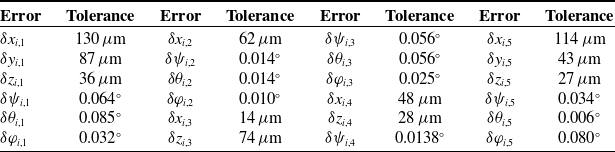
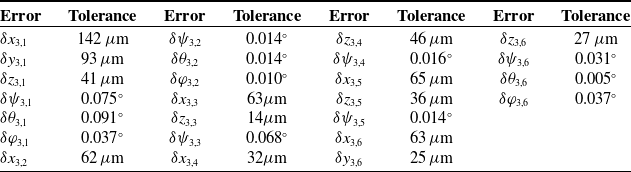
Herein, the initial tolerances of the limb assemblages and the sliding gantries of the HKMU are given as Tables II–IV based on engineering experience. For batch production of the components in the HKMU, the geometric source errors are random variables which are characterized by normal distributions. The value of a position or orientation source error can be generated from a normal distribution with a mean value of zero and a standard deviation of 1/6 corresponding tolerances listed in Tables II–IV. Thereafter, Monte Carlo simulations of the kinematic errors of the HKMU are carried out in the allowed tolerance zones and the number of samples is set as 105. The variations in CEI with respect to the orientation workspace and the position workspace of the HKMU are illustrated in Figure 4 and Figure 5, respectively.
Tolerances of the PRU limbs (i = 1, 2).

Tolerances of the PRS limbs.

Tolerances of the sliding gantries.

Error distributions throughout the orientation workspace.

Error distributions throughout the position workspace.

As shown in Figure 4, the distributions of the linear and the angular error indices of the HKMU at three typical working planes demonstrate a symmetrical surface varying with orientation angles. This phenomenon may be evidence that the terminal errors of the HKMU are position-dependent and axially symmetric about ψ = 0°. This is coincident with the symmetric structural features of the parallel module integrated in the HKMU. It can also be observed from Figure 4 that the average and maximum values of the linear error index are 201.6 µm and 384.1 µm, respectively, while the average and maximum values of the angular error index are 0.048° and 0.11°, respectively. From the perspective of error reduction, the proposed HKMU has better terminal accuracy when the position is near to the home position of the platform.
As shown in Figure 5, the distributions of the linear and the angular error indices of the HKMU at three typical working planes demonstrate a symmetrical but slightly fluctuating surface varying with position coordinates. This phenomenon may evidence that the terminal errors of the HKMU are heavily position-dependent and axially symmetric about x 0 = 0. It can also be observed from Figure 5 that the average and maximum values of the linear error index are 186.7 µm and 209.6 µm, respectively, while the average and maximum values of the angular error index are 0.036° and 0.041°, respectively. This indicates that the impact of changes in the z coordinate on the linear and the angular error indices of the HKMU is much greater than the impact of changes in the x and y coordinates. Therefore, to reduction the geometric errors of the terminal platform, the HKMU are suitable for working near the plane of x = 0 as well as the home position of z coordinate.
Further comparative observations of Figure 4 and Figure 5 reveal that the impacts of angles ψ and θ, as well as coordinates z on the linear and the angular error indices of the HKMU are much greater than the influence of coordinates x and y. That is to say, the terminal accuracy of the platform of the HKMU is mainly determined by the parallel module rather than the serial module. This condition implies that the proposed HKMU has better terminal accuracy when the geometric source errors of parallel module have been designed or compensated within an acceptable range.
4. Identification of the geometric source errors
The geometric source errors of the HKMU can be divided into compensable source errors and noncompensable source errors. Among them, the compensable source errors refer to those errors that can be directly compensated through kinematic calibration, while the noncompensable source errors often require corresponding tolerance design in early design stage to reduce their impacts. Before the kinematic compensation and tolerance design, it is necessary to precisely identify the compensable and noncompensable source errors from total source errors of the HKMU. Typically, the projection method can be used to identify the compensable and noncompensable source errors of the parallel module and serial module separately [Reference He, Lian, Song and Sun41], and then taking the union of the corresponding source errors of the two modules yields the compensable and noncompensable error sets of the HKMU.
By using the projection method, the noncompensable errors and compensable errors of the HKMU are distinguished from the error coefficient matrix formulated and sorted into
 $\delta \boldsymbol{\varepsilon }_{1}$
and
 $\delta \boldsymbol{\varepsilon }_{2}$
as follows
 \begin{align} \left\{\begin{array}{l} \delta \boldsymbol{\varepsilon }_{1}=\left[\begin{array}{l} \delta x_{1,1};\, \delta \theta _{1,1};\, \delta \varphi _{1,1};\, \delta \psi _{1,2};\, \delta \varphi _{1,2};\, \delta z_{1,3};\, \delta \psi _{1,3};\, \delta \theta _{1,3};\, \delta z_{1,4};\, \delta \psi _{1,4};\, \delta x_{1,5};\, \delta z_{1,5};\, \delta \psi _{1,5};\, \delta \varphi _{1,5};\, \\[3pt] \delta x_{2,1};\, \delta \theta _{2,1};\, \delta \varphi _{2,1};\, \delta \psi _{2,2};\, \delta \varphi _{2,2};\, \delta z_{2,3};\, \delta \psi _{2,3};\, \delta \theta _{2,3};\, \delta z_{2,4};\, \delta \psi _{2,4};\, \delta x_{2,5};\, \delta z_{2,5};\, \delta \psi _{2,5};\, \delta \varphi _{2,5};\, \\[3pt] \delta y_{3,1};\, \delta \psi _{3,1};\, \delta \varphi _{3,1};\, \delta \psi _{3,2};\, \delta \varphi _{3,2};\, \delta z_{3,3};\, \delta \psi _{3,3};\, \delta x_{3,4};\, \delta \psi _{3,4};\, \delta x_{3,5};\, \delta z_{3,5};\, \delta \psi _{3,5};\, \delta x_{3,6};\, \\[3pt] \delta y_{3,6};\, \delta z_{3,6};\, \delta \theta _{3,6};\, \delta \varphi _{3,6};\, \delta z_{4,1};\, \delta \psi _{4,1};\, \delta \theta _{4,1};\, \delta \varphi _{4,1};\, \delta x_{4,2};\, \delta \psi _{4,2};\, \delta \theta _{4,2}\delta \varphi _{4,2};\, \delta x_{4,3};\, \\[3pt] \delta \psi _{4,3};\, \delta \theta _{4,3};\, \delta \varphi _{4,3} \end{array}\right]\\[7pt] \delta \boldsymbol{\varepsilon }_{2}=\left[\begin{array}{l} \delta y_{1,1};\, \delta z_{1,1};\, \delta \psi _{1,1};\, \delta x_{1,2};\, \delta \theta _{1,2};\, \delta x_{1,3};\, \delta \varphi _{1,3};\, \delta x_{1,4};\, \delta y_{1,5};\, \delta \theta _{1,5};\, \delta y_{2,1};\, \delta z_{2,1};\, \delta \psi _{2,1};\, \delta x_{2,2};\, \\[3pt] \delta \theta _{2,2};\, \delta x_{2,3};\, \delta \varphi _{2,3};\, \delta x_{2,4};\, \delta y_{2,5};\, \delta \theta _{2,5};\, \delta x_{3,1};\, \delta z_{3,1};\, \delta \theta _{3,1};\, \delta x_{3,2};\, \delta \theta _{3,2};\, \delta x_{3,3};\, \delta z_{3,4};\, \delta \psi _{3,6};\, \\[3pt] \delta x_{4,1};\, \delta y_{4,1};\, \delta y_{4,2};\, \delta y_{4,3} \end{array}\right] \end{array}\right. \end{align}
Herein, the noncompensable source errors listed as
 $\delta \boldsymbol{\varepsilon }_{1}$
mean that require tolerance design in early design stage to reduce their impacts on the errors of the terminal platform, while compensable source errors in
 $\delta \boldsymbol{\varepsilon }_{2}$
can be compensated through appropriate calibration in kinematic sense. According to the Eq (26), there are 57 noncompensable source errors and 32 compensable source errors in the geometric error propagation of the HKMU.
Due to the integration of parallel and serial modules in the HKMU, and the independent driving of parallel and serial modules, it is possible for the source errors between parallel and serial ones to be projected onto each other. That is to say, there are source errors considered noncompensable through traditional projection method, while which can be transformed into compensable source errors after projection onto parallel/serial modules. Therefore, this paper proposes a modified projection method to identify such transformable source errors, so as to determine the actual compensable and noncompensable source errors of the proposed HKMU. The main ideas of the modified projection method are as follows:
1) To initiate, the geometric source errors originating from parallel and serial modules are projected individually onto the respective driving and constraint directions of each module. This process yields the preliminary compensable and noncompensable error sets. Eq (26) succinctly represents this projection.
2) Continuing, the noncompensable source errors attributed to the serial module are projected onto the driving direction of the platform of the parallel module. This endeavor aims to identify source errors capable of transformation, thereby discerning which parallel module can potentially compensate for.
3) Subsequently, symmetrical projection is applied, projecting the noncompensable source errors attributed to the parallel module onto the driving direction of the other limbs and serial module. This step aims to identify source errors capable of transformation, allowing for the recognition of those which serial module can potentially compensate for.
4) Take the union of the original compensable source errors and the aforementioned transformable source errors to obtain the actual compensable source errors of the HKMU, along with the corresponding noncompensable source errors.
4.1. Source error analysis for the serial module
This section presents an approach for identifying the transformable source errors from the serial module of the HKMU. The main process is shown in Figure 6. Herein, Eq (27) is adopted to solve the pose of the moving platform after compensation.
The identification approach for source errors in serial module.

 \begin{align} \boldsymbol{T}^{\prime}=\boldsymbol{R}_{f}\left(\delta \right)\boldsymbol{T}=\left[\begin{array}{c@{\quad}c@{\quad}c} c\varphi ^{\prime}c\theta ^{\prime} & -s\varphi ^{\prime}c\theta ^{\prime} & s\theta ^{\prime}\\[3pt] s\varphi ^{\prime}c\psi ^{\prime}-c\varphi ^{\prime} s\theta ^{\prime} s\psi ^{\prime} & s\varphi ^{\prime} s\theta ^{\prime} s\psi ^{\prime}+c\varphi c\psi ^{\prime} & -s\psi ^{\prime}c\theta ^{\prime}\\[3pt] s\varphi ^{\prime} s\psi ^{\prime}-c\varphi ^{\prime} s\theta ^{\prime}c\psi ^{\prime} & s\varphi ^{\prime} s\theta ^{\prime}c\psi ^{\prime}+c\varphi s\psi ^{\prime} & c\theta ^{\prime}c\psi ^{\prime} \end{array}\right] \end{align}
where
 $\boldsymbol{R}_{f}(\delta )$
denotes a transformation matrix which rotating
 $\delta$
degree around the
 $f$
axis;
 $\psi ^{\prime}, \theta ^{\prime}, \varphi ^{\prime}$
denotes the new orientation after compensation.
As shown in Figure 6, for the ith source error
 $\delta _{s,i}$
in the serial module, the main idea is to first project it to the driving and constraint direction, and then check the corresponding inverse kinematics results. First, project the source errors to the driving and constraint directions of the moving platform in the parallel module, and select only the source errors projected in the driving directions. Second, take the selected source errors as the terminal position and/or angle deviation of the moving platform and obtain the compensated positions and/or angles through coordinate transformation as shown Eq. (27). Third, bring the compensated position and/or angle parameters of the moving platform into the inverse kinematics model of the HKMU, solve for the corresponding actuation inputs d
1∼d
5, and determine whether each actuation quantity exceeds the stroke of the prototype. For the compensated positions and / or angles that can be satisfied by the moving platform within the reachable workspace, it corresponds to a transformable source error.
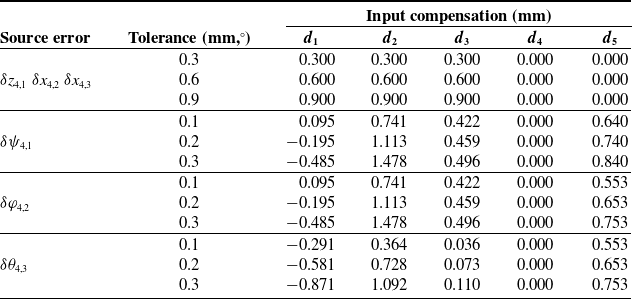
Compensation requirements for source errors in serial module.

The identification approach for source errors in parallel module.

According to this approach, it finds that the source errors of
 $\delta z_{4,1}, \delta x_{4,2}, \delta x_{4,3}, \delta \psi _{4,1}, \delta \varphi _{4,2}, \delta \theta _{4,3}$
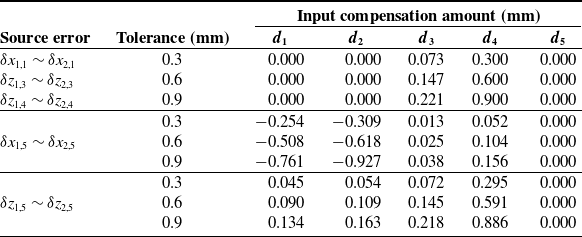
can be transformable and further compensated for the serial module of the HKMU. Taking a typical pose of ψ = 10°, θ = 20°, x = 0.05 m, y = 0.07 m, z = 0.26 m as an example, Table V shows the compensation requirements for each source error under different tolerances. It can be seen that
 $\delta z_{4,1}, \delta x_{4,2}, \delta x_{4,3}$
can be compensated through parallel module without serial module. Besides,
 $d_{4}$
(along x direction) does not participate in error compensation. This condition may lie in that parallel module do not generate displacement along x axis.
4.2. Source error analysis of the parallel module
Similarly, the approach to identifying transformable source errors from the parallel module of the HKMU involves two steps: projection onto the driving/constraint directions and subsequent examination of the inverse kinematics results. The primary procedure is illustrated in Figure 7.
As shown in Figure 7, the first step entails projecting the source error
 $\delta _{p,i}$
onto both the driving and constraint directions of the corresponding limb. Subsequently, for the source error projected onto the constraint direction, further projection needs to be performed onto the driving and constraint directions of the serial module and other limbs. Then, the source errors meeting the following conditions are selected: (1) the source errors solely projected onto the driving direction of serial module; (2) the source errors solely projected onto the driving direction while having the same directional noncompensable source error
 $\delta _{p,j}$
. Herein, when the source error
 $\delta _{p,i}$
can be compensated, and there is a new noncompensable error
 $\delta _{p,j}-\delta _{p,i}$
. Next, the selected source errors are treated as linear and angular deviations of the moving platform, respectively. These are then transformed into compensatory positions and/or angles through coordinate transformation. At last, the compensatory position and/or angle parameters of the terminal platform are introduced into the kinematic inverse model of the HKMU, deriving the corresponding actuation inputs d
1∼d
5. The adequacy of each actuation is assessed to measure whether it falls within the stroke limits of the actuators. The selected error source that enables the moving platform to perform position and / or angle compensations within its reachable workspace is a transformable source error.
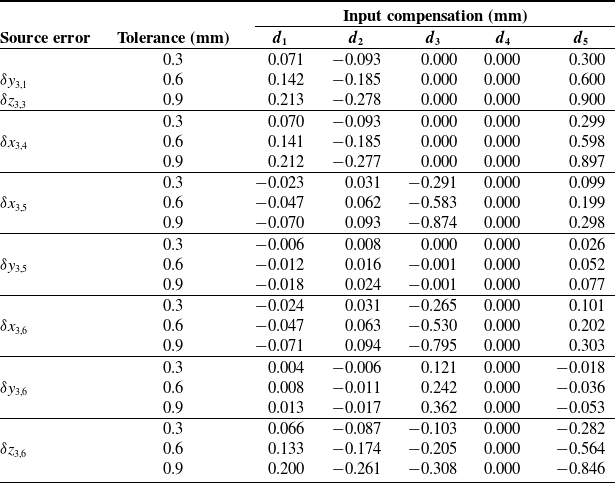
Compensation requirements for source errors in parallel module (Single source error).

According to this method, it finds that the source errors of
 $\delta y_{3,1}, \delta z_{3,3}, \delta x_{3,4}, \delta x_{3,5}, \delta y_{3,5}, \delta x_{3,6}, \delta y_{3,6}, \delta z_{3,6}$
can be transformable and further compensated for the parallel module of the HKMU without generating additional noncompensable source errors in the same direction. Meanwhile, the source errors of
 $\delta x_{1,1}, \delta z_{1,3}, \delta z_{1,4}, \delta x_{1,5}, \delta z_{1,5}$
can be transformed into compensable source errors while generating additional noncompensable source errors in the same direction.
Taking a typical pose of ψ = 10°, θ = 20°, x = 0.05 m, y = 0.07 m, z = 0.26 m as an example. Tables VI and VII show the compensation requirements for each source error under different tolerances with single source error and multiple source errors, respectively. Herein,
 $\delta a\sim \delta b$
represents the combination of two source errors
 $\delta a$
and
 $\delta b$
in Table VII. It can be seen that
 $d_{4}$
(along x direction) only participate in error compensation in limb 3. Similarly,
 $d_{5}$
(along y direction) only participate in error compensation in limb 1 and limb 2.
Compensation requirements for source errors in parallel module (Multiple source errors).

4.3. Error compensation and comparison analysis
Adopting the modified projection method described above, such transformable source errors can be identified and then the actual noncompensable and compensable source errors can be determined for the proposed HKMU. As a result, the noncompensable errors and compensable errors of the HKMU are distinguished and sorted into
 $\delta \boldsymbol{\varepsilon }^{\prime}_{1}$
and
 $\delta \boldsymbol{\varepsilon }^{\prime}_{2}$
as what follows
 \begin{align} \left\{\begin{array}{l} \begin{array}{l} \delta \boldsymbol{\varepsilon }^{\prime}_{1}=\left[\begin{array}{l} \delta \theta _{1,1};\, \delta \varphi _{1,1};\, \delta \psi _{1,2};\, \delta \varphi _{1,2};\, \delta \psi _{1,3};\, \delta \theta _{1,3};\, \delta \psi _{1,4};\, \delta \theta _{1,5};\, \delta \varphi _{1,5};\, \delta x^{\prime}_{1};\, \delta \theta _{2,1};\, \\[3pt] \delta \varphi _{2,1};\, \delta \psi _{2,2};\, \delta \varphi _{2,2};\, \delta z^{\prime}_{3};\, \delta \psi _{2,3};\, \delta \theta _{2,3};\, \delta z^{\prime}_{4};\, \delta \psi _{2,4};\, \delta x^{\prime}_{5};\, \delta z^{\prime}_{5};\, \delta \theta _{2,5};\, \\[3pt] \delta \varphi _{2,5};\, \delta \psi _{3,1};\, \delta \varphi _{3,1};\, \delta \psi _{3,2};\, \delta \varphi _{3,2};\, \delta \psi _{3,3};\, \delta \psi _{3,4};\, \delta \psi _{3,5};\, \delta \psi _{3,6};\, \delta \theta _{3,6};\, \\[3pt] \delta \varphi _{3,6};\, \delta \theta _{4,1};\, \delta \varphi _{4,1};\, \delta \psi _{4,2};\, \delta \theta _{4,2};\, \delta \psi _{4,3};\, \delta \varphi _{4,3} \end{array}\right]\\[3pt] \end{array}\\[3pt] \delta \boldsymbol{\varepsilon }^{\prime}_{2}=\left[\begin{array}{l} \delta x_{1,1};\, \delta y_{1,1};\, \delta z_{1,1};\, \delta \psi _{1,1};\, \delta x_{1,2};\, \delta \theta _{1,2};\, \delta x_{1,3};\, \delta z_{1,3};\, \delta \varphi _{1,3};\, \delta x_{1,4};\, \\[3pt] \delta z_{1,4};\, \delta x_{1,5};\, \delta y_{1,5};\, \delta z_{1,5};\, \delta \psi _{1,5};\, \delta y_{2,1};\, \delta z_{2,1};\, \delta \psi _{2,1};\, \delta x_{2,2};\, \delta \theta _{2,2};\, \\[3pt] \delta x_{2,3};\, \delta \varphi _{2,3};\, \delta x_{2,4};\, \delta z_{2,5};\, \delta \psi _{2,5};\, \delta x_{3,1};\, \delta y_{3,1};\, \delta z_{3,1};\, \delta \theta _{3,1};\, \delta x_{3,2};\, \\[3pt] \delta \theta _{3,2};\, \delta x_{3,3};\, \delta z_{3,3};\, \delta x_{3,4};\, \delta z_{3,4};\, \delta x_{3,5};\, \delta z_{3,5};\, \delta x_{3,6};\, \delta y_{3,6};\, \delta z_{3,6};\, \\[3pt] \delta x_{4,1};\, \delta y_{4,1};\, \delta z_{4,1};\, \delta \psi _{4,1};\, \delta x_{4,2};\, \delta y_{4,2};\, \delta \varphi _{4,2};\, \delta x_{4,3};\, \delta y_{4,3};\, \delta \theta _{4,3} \end{array}\right] \end{array}\right. \end{align}
where
 $\delta x^{\prime}_{i}$
and
 $\delta z^{\prime}_{i}$
represent the transformed source errors of
 $\delta x_{2,i}-\delta x_{1,i}$
and
 $\delta z_{2,i}-\delta z_{1,i}$
, respectively.
According to the Eq (28), in fact, there are 39 noncompensable source errors and 50 compensable source errors for the HKMU. Compared to the preliminary compensable error set obtained by the projection method, there are 18 compensable source errors can be additionally identified for the HKMU through the proposed method. This may help to improve the accuracy of kinematic calibration of the compensable source errors and can reduce the difficulty and workload of tolerance design for noncompensable source errors of the HKMU.
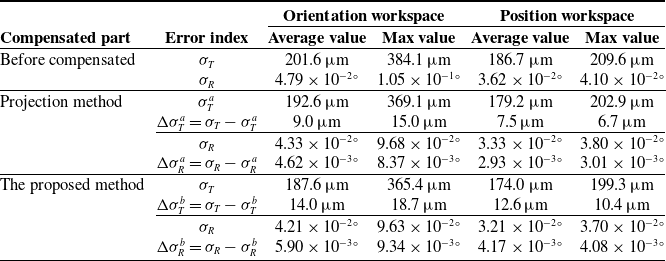
To quantitatively compare the modified projection method with the previous projection method, let us consider the error compensation analysis for the prototype of the HKMU in Figure 1. One may, respectively, conduct kinematic compensation on the compensable source errors identified by both methods. Subsequently, the compensation results after source error identification are presented in Tables VIII and IX. Herein,
 $\Delta \sigma _{T}^{a}$
and
 $\Delta \sigma _{T}^{b}$
represent the variations of the terminal position error after compensation;
 $\Delta \sigma _{R}^{a}$
and
 $\Delta \sigma _{R}^{b}$
represent the variations of the terminal orientation error reduction after compensation. For clarity, the geometric error indices of the platform are measured and provided separately for the orientation and the position workspaces of the HKMU.
Comparison of compensation effect between two methods.

The improvement in accuracy of comparative projection method.

From Tables VIII and IX, it is evident that compared to the previous projection method, the proposed method reduces the average and maximum values of geometric error index
 $\Delta \sigma _{T}$
within the orientation workspace of the HKMU by 55.6% and 24.7%, respectively. Similarly, within the position workspace, the proposed method reduces the average and maximum values of geometric error index
 $\Delta \sigma _{R}$
by 42.3% and 35.5%, respectively. These results manifest a significant enhancement of the proposed modified projection method in the geometric error compensation effectiveness of the HKMU.
5. Conclusions
This paper proposes a method for HKMU to distinguish the actual compensable and noncompensable source errors. Based on the conducted analysis, some conclusions are drawn as follows.
(1) The error modeling of HKMU is established to derive an error mapping formulation. The composite error indices are used to describe the terminal accuracy distributions. In addition, the compensable and noncompensable source errors are preliminary determined in serial and parallel modules based on error projection.
(2) A modified projection method is proposed for distinguishing the actual compensable and noncompensable source errors of the HKMU. In general, this method can identify transformable source errors in the noncompensable source errors which are determined in serial and parallel modules based on traditional error projection method. These identified source errors can be transformed into actual compensable source errors through the adjustment of the HKMU.
(3) The results show that the method can find out 18 actual compensable source errors additionally. When the actual compensable source errors are compensated, the average and maximum values of geometric error of the HKMU significantly reduced compared with the traditional projection method. Taking the average values as an example, the liner error indices in the orientation workspace and position workspace of HKMU reduce 55.6% and 27.7% respectively. The angular error indices in orientation workspace and position workspace of HKMU were reduced by 68.0% and 42.3%, respectively.
Author contributions
Yifeng Shen and Tengfei Tang conceived the study and written the manuscript. Wei Ye performed statistical analyses. Jun Zhang contributed to the conception design. All authors commented and read the manuscript.
Financial support
This work was supported by the National Natural Science Foundation of China (no. 52375009), the Open Research Fund of State Key Laboratory of Intelligent Manufacturing Equipment and Technology (no. IMETKF2024017), and the Science Foundation of Zhejiang Sci-Tech University (ZSTU) (no. 22242255-Y). This work also is A Project Supported by Scientific Research Fund of Zhejiang Provincial Education Department (no. Y202353493).
Competing interests
The authors declare no conflicts of interest exist.
Ethical approval
None.
Appendix
From the vector diagram shown in Figure. A1, the vector equation of HKMU can be expressed as
 \begin{align} \boldsymbol{r}_{p2}=\boldsymbol{r}_{p0}+\boldsymbol{r}_{p1}-\boldsymbol{q} \nonumber\\[-25pt]\end{align}
 \begin{align} \boldsymbol{q}=\boldsymbol{r}_{ai}+l_{i}\boldsymbol{w}_{i}+\boldsymbol{a}_{i}-\boldsymbol{r}_{bi} \end{align}
where
r
p2 denotes the vector
 $\overline{PO^{\prime}}$
;
r
p0 and
r
p1 denote the Component of vector
 $\overline{OP}$
in the xOy plane and z axis;
q
denotes the vector
 $\overline{OO^{\prime}}$
;
r
ai
and
r
bi
denote the vector
 $\overline{OA_{i}}$
and
 $\overline{O^{\prime}B_{i}}$
;
w
i
denotes the unit vector
 $\overline{A_{i}M_{i}}$
and l
i
denotes the length of slide rail in the ith limb;
a
i
denotes the vector
 $\overline{M_{i}B_{i}}$
.
First, the parallel module is solved separately because of its coupling. The rotation change matrix of the moving platform can be expressed as
 \begin{align} \boldsymbol{T}=\boldsymbol{R}_{x}\left(\psi \right)\boldsymbol{R}_{y}\left(\theta \right)\boldsymbol{R}_{z}\left(\varphi \right)=\left[\begin{array}{c@{\quad}c@{\quad}c} c\varphi c\theta & -s\varphi c\theta & s\theta \\[3pt] s\varphi c\psi +\textit{l} {\varphi}s\theta s\psi & -\textit{s} {\varphi}s\theta s\psi +c\varphi c\psi & -s\psi c\theta \\[3pt] s\varphi s\psi -\textit{l} {\varphi}s\theta c\psi & \textit{s} {\varphi}s\theta c\psi +c\varphi s\psi & c\theta c\psi \end{array}\right] \end{align}
Based on the structure of parallel modules, the geometrical relations can be obtained between their vectors as follow
 \begin{align} \left\{\begin{array}{l} \left(\boldsymbol{T}\cdot \boldsymbol{r}_{b2}\right)^{\mathrm{T}}\cdot \boldsymbol{r}_{a3}=0\\[3pt] {\boldsymbol{r}_{a3}}^{\mathrm{T}}\cdot \boldsymbol{q}=0\\[3pt] {\boldsymbol{r}_{a1}}^{\mathrm{T}}\cdot \left(l_{3}\boldsymbol{w}_{3}+\boldsymbol{a}_{3}\right)=0 \end{array}\right. \end{align}
By solving the Eq (A4), the pose of the moving platform respect to O-xyz can be expressed as
 \begin{align} \left\{\begin{array}{l} \varphi =0\\[3pt] x=0\\[3pt] y=-r_{b}\mathrm{s}\psi \mathrm{s}\theta \end{array}\right. \end{align}
Vector diagram of the HKMU.

Based on the above analysis, the vector equation of HKMU can be solved to obtain its position inverse solution.