Introduction
Does the sense of shared identity with a rebel side in an armed conflict favorably predispose civilians to insurgents? One argument asserts that civilians “in between the two fires” support a stronger side irrespective of other factors (Kalyvas Reference Kalyvas2006). This makes the level of territorial control by incumbent or insurgent forces the best predictor of public attitudes toward the warring sides. The theory of asymmetrical effect, by contrast, suggests that identities create strong in-group biases, which leads individuals to react differently to civilian victimization by incumbent and insurgent forces (Lyall, Blair, and Imai Reference Lyall, Blair and Imai2013). If civilians identify themselves with the same group as rebels, they are less likely to change their view of insurgency even in the face of rebel violence.
The armed conflict in Donbas offers an important test of the role of identities in shaping civilian views of insurgents. The start of the fighting was preceded by a series of protest rallies across the region triggered by the ouster of President Viktor Yanukovych in late February 2014. Protesters, some allegedly bused to boost rally size from the neighboring Russian regions, expressed a wide range of demands from holding a referendum on autonomy status for Donetsk and Luhansk oblasts to joining the Russian Federation. Tensions escalated further with the capture of regional government buildings in Donetsk and Luhansk on April 7 by local separatist groups and their subsequent announcement of the referendum on independence of the two oblasts. The military phase of the conflict began on April 12 with the takeover of the police station and city council of Sloviansk in Donetsk oblast by the armed unit led by a former officer of Russia’s Federal Security Service (FSB) Igor Girkin (also known as Strelkov). In response, the Ukrainian government declared the start of the counter-terrorist operation (ATO) and began mobilizing troops and volunteer units to stop the separatist advance. In the first months of the conflict, armed separatist groups in various cities across the region lacked a unified command structure or any coherent ideology. The size and the composition of these units also differed in each town of the region. The two major units in Donetsk—Vostok Brigade and Oplot Battalion—were led by local commanders Aleksandr Khodokovsky and Aleksandr Zakharchenko and drew on local volunteers. By contrast, the core of the so-called Sloviansk brigade with Girkin in charge consisted of well-armed Russian paramilitaries with prior military experience and recent involvement in Moscow’s campaign to annex Crimea. The rebel contingent in Antratsyt in Luhansk oblast included many Russian Don Cossacks led by their ataman Nikolai Kozitsyn. Other armed groups in towns like Druzhkivka, Lyman, or Artemivs’k (now Bakhmut) were much smaller, poorly equipped, and consisted predominantly of locals with diverse backgrounds ranging from former Afghan war veterans and local industry workers to petty criminals. Overall, the presence of Russian mercenaries in the region grew steadily in the first six months of the conflict with a limited number of Russian special operation forces (SOF) participating in covert actions in support of rebel units across the entire theater of operations (Reisinger and Golts Reference Reisinger and Golts2014). Still, Russian regular army units engaged in the conflict only in late August in order to prevent the impending defeat of separatist formations (General’na Prokuratura Ukrainy 2017).
The broad range of actors involved in organizing and waging the war in Donbas allows for different conceptualizations of the conflict. While some scholars view it primarily as a “hybrid war” between Russia and Ukraine and put an emphasis on its external causes, others analyze the conflict through the theoretical lens of rebellions or insurgency campaigns and focus on the conflict’s internal drivers.Footnote 1 These alternative views of the conflict, however, are not necessarily mutually exclusive. As Bukkvol (Reference Bukkvol2016, 19) notes, covert deployment of Russian SOF in a hybrid warfare role “in no way excludes that there also was significant local initiative for rebellion against Kiev.” This article views the conflict in its first months as primarily of an asymmetric nature with the Ukrainian armed forces facing weaker and poorly organized rebel units composed mainly of lightly armed locals or Russian mercenaries who could easily blend with civilians. Hence, we recognize the armed conflict in Donbas at its initial stage as an example of an irregular insurgency campaign.Footnote 2
Despite becoming a hotbed of separatism in the spring of 2014, Donbas has been relatively heterogeneous in its identity structure. While most of its residents (44%) at the time prioritized various localized forms of identity over national attachment, a quarter of respondents in the region have identified themselves primarily as Ukrainian citizens (Rating Group Reference Group2014, 17). Hence, if identities affected public views of insurgency, we should see major differences in the way locals in Donbas responded to the presence of insurgents in their localities. Those prioritizing local identities should have been more supportive of the movement, which promised to protect locals from encroachments of the new government in Kyiv. By contrast, those identifying themselves with Ukraine, should have viewed such a movement as a threat to their own status and welfare. At the same time, if identity is a trivial factor in the conflict it should have no effect on the local attitudes to insurgents.
This article tests the theoretical proposition about the impact of identity using an original survey conducted in May–June 2015 in eight towns of the Donbas region. Each of these towns was under insurgent control in April–July 2014 and under full government control when the survey was conducted. Based on bivariate and multivariate regression analysis we find strong evidence that the respondents’ identity influenced their views of insurgents. Those who identified themselves with the region or their hometown were more likely to attribute ideational motives to their actions. They were also less likely to feel threatened by insurgents and to report instances of civilian victimization on the part of separatist fighters. By contrast, those who identified themselves as Ukrainian citizens were more likely to attribute material motives to insurgents, experience fear in their presence, and report knowledge of civilian harm caused by rebel actions. Other variables, such as age, language use, or level of education, had no significant effect on their views of insurgents. This article offers the first empirical evidence of the relevance of identity cleavage for explaining the origins and dynamics of the armed conflict in Donbas. It argues that the strength of regional identity in Donbas facilitated the insurgency by fostering a shared perception of security risks, allowing for a coordinated response to the perceived security crisis, creating a cohesive pool of recruits and supporters, and offering an alternative means of legitimization for the self-proclaimed authorities.
In the following section we review theoretical arguments linking identity to the rise of the armed conflicts. The third section discusses the distribution of identities and preferences of the people in the region, what makes it different from other regions in Ukraine, and the reasons for strengthening of regional identity in the decade preceding the conflict. In the fourth section, we describe our research design, explain methods of analysis, and present our main findings. Next we explain what our findings may suggest about the role of identity in the outbreak of the conflict. We conclude by drawing broader implications of our argument for the literature on the causes of civil wars.
Identity Formation and Violence
On the most general level identity is a “category that can be used to classify or describe an individual” (Chandra Reference Chandra and Chandra2012, 101). It denotes a membership in a group based on a variety of attributes, which can be modified under social influence (Laitin Reference Laitin1998, 21). Membership in ethnic identity categories is based on descent and, hence, is harder for an individual to change in the short term (Chandra Reference Chandra and Chandra2012; Horowitz Reference Horowitz1985, 55–56). Membership in non-ethnic identity categories, by contrast, is more prone to frequent and quick changes since they are based on non-descent-based attributes and necessitate only an individual choice. Laitin (Reference Laitin1998), for example, examines identity cascades or shifts in language communities that can happen relatively quickly if an individual decides to adopt a new language as the primary means of communication. Although adoption of a new language does not entail a shift in one’s ethnic identity, it can create a new nominal identity which an individual might activate in the future (Chandra Reference Chandra and Chandra2012, 102). Once activated it usually creates an “affective tie” (Young Reference Young1993) or “powerful emotional appeal” (Laitin Reference Laitin1998, 16) that encourages strong in-group solidarity among those sharing this identity attribute.
The attributes of a regional identity may vary, but they require, at the very least, a sense of attachment to a geographically bounded space arising out of one’s origin in that region or residence there. In contrast to ethnic identity, which may also be linked to a geographic area (Toft Reference Toft2005; Bates Reference Bates1974), the regional identity category is not restricted by familial lineage. Regional identity then belongs to non-ethnic identities lacking a “baseline constraint,” which is formed out of attributes that cannot be quickly acquired or dislodged and are identifiable to outsiders (Chandra Reference Chandra and Chandra2012, 124). It also presumes the “blurring” of ethnic differences and elevation of non-ethnic identity boundaries resulting in “multiethnic localism” (Wimmer Reference Wimmer2013). Regional identity becomes part of the menu of nominal identities through personal experience of inhabiting the region and interacting with its residents. Meanwhile, its activation entails a conscious self-placement in a group tied to a region and elevating membership in this group over other attachments.
Violent conflict has been a potent force behind activation of identities and triggering of identity shifts (Kalyvas Reference Kalyvas2008; Chandra Reference Chandra and Chandra2012; Sambanis and Shayo Reference Sambanis and Shayo2013; Nair and Sambanis Reference Nair and Nicholas2019). It is often preceded by a nonviolent confrontation, which also contributes to “crystallization of the identities and boundaries of ethnic groups” (Cederman, Gleditsch, and Buhaug Reference Cederman, Gleditsch and Buhaug2013, 23). The accounts of violence that rely on identity labels from established discursive frameworks encourage further mobilization along identity lines. They also contribute to framing the conflict in identity terms. This, in turn, forces even non-participants to choose between the salient identity categories. Violence may also raise the costs of remaining attached to an activated identity. Shifts in attachments may then lower individual risks associated with maintaining a specific identity profile. Finally, violent actions might lead to reassessment of the content and meaning of an identity category (Chandra Reference Chandra and Chandra2012, 175). This may activate another identity category more compatible with one’s fundamental moral or political beliefs.
Once solidified, a newly activated identity category may become a focal point for armed mobilization leading to escalation of violence (Hardin Reference Hardin1997). Scholars of civil wars point to the decisive role of ethnic (Horowitz Reference Horowitz1985), religious (Laitin Reference Laitin2000), linguistic (Bormann, Cederman, and Vogt Reference Bormann, Cederman and Vogt2017), and socioeconomic (Collier and Hoeffler Reference Collier and Hoeffler2004; Regan Reference Regan2009) identities in forming and maintaining rebel organization. They have been shown to encourage rebel recruitment through norms of reciprocity, lower the costs of coordination through shared communication codes and informal institutions (Bates Reference Bates1983; Petersen Reference Petersen2001), increase social control (Kalyvas Reference Kalyvas2006, Humphreys and Weinstein Reference Humphreys and Weinstein2008), and minimize defection rate through in-group policing (Humphreys, Posner, Weinstein, and Habyarimana Reference Habyarimana, Humphreyes, Posner and Weinstein2007). The importance of identity cleavages may be particularly crucial at the escalatory stage of the rebellion following the conflict breakout. One study shows that higher ethnic homogeneity of regions where rebel groups emerge is correlated with the greater likelihood that they succeed in gaining support and sustaining the insurgency once violence begins (Lewis Reference Lewis2016). The causal mechanisms behind this relationship may be related to the process of collective identity shift or replacement. McCauley (Reference McCauley2014) argues that identities may influence political preferences and a change in activated identities may generate new norms and policy priorities. As a result, collective identity shift may produce a rise in support for policy outcomes, such as secession, which earlier received little popular backing. This, in turn, could provide a favorable social environment for an insurgent campaign. In a similar vein, Sambanis and Shayo (Reference Sambanis and Shayo2013) suggest that social identity or the intensity of one’s identification with a group, determines the strength of one’s commitment to fighting on behalf of this group. Apart from the strength of pre-existing identities, they also observe that conflict itself may influence one’s salient social identities by heightening interethnic differences, lowering group status, or damaging national reputation. The resulting outcome could be national fragmentation and strengthening of subnational or ethnic group identification over national loyalties. We elaborate on how these mechanisms of identity shifts could be relevant for the Donbas conflict following the analysis of our main findings.
Regional Identity in Donbas
The empirical research on Donbas conducted before the outbreak of the armed conflict has consistently pointed to the strength of its regional identity. There is a near consensus in earlier studies that the Donbas region possessed unique identity traits compared to the rest of Ukraine, which influenced its political orientation (Melvin Reference Melvin1995; Kuromiya Reference Kuromiya1998; Kononov Reference Kononov2005; Osipian and Osipian Reference Osipian and Osipian2006; Zimmer Reference Zimmer and Swain2007). In the earliest English-language study of Ukrainian regions after World War II, Donbas was characterized as the “least Ukrainian district in its population and national character” with local inhabitants “visualizing themselves as occupying a Russian island in a Ukrainian sea.”Footnote 3 Despite its strong cultural ties to Russia, Donbas identity effectively subsumed various ethnic identifications into an “urban melting-pot” (Wilson Reference Wilson2002) making the region open for “anyone who settles there” (Osipian and Osipian Reference Osipian and Osipian2006). According to a prominent Ukrainian sociologist Illia Kononov, interethnic relations in Donbas have been based on the “dominant Russian-Ukrainian coalition,” which produced a unique synthesis of Russian and Ukrainian cultures (Kononov Reference Kononov2005). This had important implications for shaping local political preferences. According to one study, in political terms Ukrainian-speakers in Donbas “look more like Russian speakers in that region than like Ukrainian-speakers elsewhere in the country” (Barrington and Faranda Reference Barrington and Faranda2009, 249). The authors of this study note that Ukrainian-speakers in Donbas actually tended to be more supportive of Russia than “independent effects of region or language would otherwise suggest” (Barrington and Faranda Reference Barrington and Faranda2009, 248). The cross-ethnic coalition proved quite resilient when the issue of Donbas’ status within Ukraine became central to the political process in the region. As Giuliano (Reference Giuliano2018) finds, the newly emerging pro-separatist coalition in Donbas in April 2014 included both ethnic Russians and ethnic Ukrainians, even though the former supported separation in larger numbers.
The key attribute of Donbas identity was a “sense of belonging to a community forged through the industrialization and urbanization of the Donetsk coal basin from the 1860s onwards” (Osipian Reference Osipian2015, 128). According to Zimmer (Reference Zimmer and Swain2007, 102), residents of Donbas “imagine” the region not in territorial terms, but as a “homogeneous space distinguished by a uniform socio-economic situation.” Following industrialization, Donbas identity also acquired a heroic dimension having been amplified by the “Soviet cult of miners and steelworkers” (Zimmer Reference Zimmer and Swain2007). In a series of polls conducted during the first decade of Ukraine’s independence, Kononov similarly finds that about half of Donbas residents consistently tended to view themselves as belonging to a “unique community of people with roots both in Ukraine and Russia” (Kononov Reference Kononov2005). Ethnolinguistic cleavage, then, was of minor significance in its political mobilization in the first post-Soviet decade. Rather, it was “primarily socio-economic and cultural in nature” (Sasse Reference Sasse, Hughes and Sasse2003, 85) aimed at reasserting the region’s status vis-à-vis the capital (Siegelbaum and Walkowitz Reference Siegelbaum and Walkowitz1995, 144). Regional autonomy of Donbas was one of the political demands of striking miners in July 1993. A year later it became the only region holding a special plebiscite in which over two-thids of local voters supported establishing a federal structure within Ukraine, supported its membership in the Russia-led Commonwealth of Independent States, and supported making Russian the second state language.
One of the key indicators of the strength of regional identity was exclusive identification with the region or town of residence over civic attachment to the state. In 1994 a quarter of respondents in Donbas characterized the region as their “homeland” and another 34% said that their home was the Soviet Union (Bekeshkina Reference Bekeshkina1994, 46). One study indicates that in the first 10 years of Ukraine’s independence, regional identity grew even stronger in large urban centers like Donetsk where 69.5% identified themselves as “donetchannyn/ka” (Donetsk resident) in 2004—by far the most popular type of identity category among respondents.Footnote 4 At the same time, “Ukrainian” identity hovered at around 40% in the 10 years between 1994 and 2004.Footnote 5 The activation of regional identity in the first post-Soviet decade at the expense of national identification countered a stronger attachment to Ukrainian statehood. In 1994 poll, 63% of respondents in Donbas—more than in any other region including Crimea—said they would have voted against Ukraine’s independence had there been a repeat of the 1991 referendum (Bekeshkina Reference Bekeshkina1994, 44). Nearly 20 years later, in August 2013, a majority (57%) still indicated that they were fully or largely against Ukrainian independent statehood.Footnote 6 An even greater share of respondents (66%) said they were in favor of Ukraine’s unification with Russia, which was far higher than in any other region.Footnote 7 When the armed conflict began in the spring of 2014 the share of those who defined themselves through their residence in Donbas or their native town was almost double the number of those for whom Ukrainian citizenship was an indispensable characteristic (51.3% against 28.1%).Footnote 8
The strengthening of regional identity in Donbas throughout the 2000s can be partially attributed to its “particization” (Cox Reference Cox1997; Stoll Reference Stoll2013) by the political machine of the Party of Regions (POR). It received over 70% of the votes cast in Donbas in two out of three parliamentary elections and became a dominant party in the region controlling distribution of local patronage and rents. Rhetorically, POR positioned itself as the sole defender of the region’s economic and political interests and sought to amplify local grievances over Kyiv’s policies. During the 2004 presidential election, references to “Donbas character” became a staple of the presidential campaign of the party’s leader and then Prime Minister Viktor Yanukovych (Osipian and Osipian Reference Osipian and Osipian2006). Similarly, the rise of POR to political prominence in the early 2000s coincided with more frequent mentions of a special “Donetsk identity” in regional newspapers (Kotyhorenko et al. Reference Kotyhorenko2014, 460). Yanukovych’s election campaign in 2004 further politicized the regional cleavage by creating false fears that the opposition leaders would discriminate against residents of Donbas once in power. The emerging regional divide became particularly visible during the Orange Revolution when Western Ukrainians, who were the predominate population on the Maidan confronted residents of Donbas, who were brought for counter-rallies in Kyiv to support their presidential candidate and Donbas native Yanukovych.Footnote 9 Since then the “orange” parties equated the victory of POR with the triumph of donetskie (a generalized reference to the Donetsk clan), which helped them to retain their electoral base in Western and Central Ukraine (Hale Reference Hale2010, 94). By contrast, POR leaders often labeled their opponents as “fascists” and a threat to the Russophone culture of Donbas, which reinforced POR’s position as a focal point for political coordination of the region’s residents. While the party’s rhetoric stressed the importance of elevating the region’s status within Ukraine, it avoided making explicitly separatist demands (Kul’chyts’kyi and Yakubova Reference Kul’chytskyi and Yakubova2016, 643). Still, the politicization of the regional cleavage during the Orange Revolution coincided with the creation in 2005 of a new quasi-separatist group “Donetsk Republic” led by Andrei Purgin. Although the courts quickly ruled to ban the group on appeals from the Security Service, in May 2014 its black, blue, and red flag became the symbol of a new self-proclaimed state. In Purgin’s words, the flag represented “the protection of regional interests,” which was equally attractive to groups with “absolutely different ideologies” (Judah Reference Judah2015, 153).
Regional identity also became an ideological platform for a network of activists and academics who drew on historical myths to justify more radical claims for autonomous status for Donbas and even its separation from Ukraine. The history of the Donetsk–Kryvyi Rih Republic, which existed in 1917–1918 as a separate entity, became a reference point for a generation of Russophile activists in Donbas following the dissolution of the Soviet Union (Kornilov Reference Kornilov2012). At the same time, these groups viewed Donbas as an inextricable part of the “Russian World” and Russian Orthodox civilization and, hence, conditioned their support for Ukrainian statehood by its continued alignment with the Russian state. Historically grounded justifications for this view pointed to ethnic Russians as the original settlers in Donbas in the 16th century and Don Cossacks as founders of the eastern outposts of the Russian empire bordering the Azov Sea (Wilson Reference Wilson1995). Donbas, according to such a narrative, remained distinct from traditional Ukrainian lands and became an administrative part of Ukraine only after an arbitrary redrawing of republican boundaries by the Soviet leadership in 1921. One study of Donetsk intellectual elites in the mid-1990s demonstrated that they also overwhelmingly pointed to differences in historical experience as the most important reason for their current policy disagreements with Western Ukraine (Shulman Reference Shulman1999, 926). As Wilson (Reference Wilson1995, 283) perceptively observed, this Russophile historiography “created the ideological basis for a movement for regional autonomy or even separatism in Donbas.” Purgin became one of the organizers of the pro-Russian rallies in February–April 2014, while the first armed group – the People’s Militia of Donbas – was started by Pavel Gubarev who had long promoted the idea of the region’s belonging to the “Russian world” (Gubarev Reference Gubarev2016). While popular support for an explicitly separatist cause has been traditionally negligible with only 8% in favor of Donbas separation in 2012 (Rating, August 2012), this share almost quadrupled to 31% by the first week of March 2014.Footnote 10 With more people suddenly predisposed to separatist appeals, did the identity cleavage affect popular mobilization behind the insurgents?
Regional Identity and the Donbas Conflict
Most of the existing accounts of the armed conflict in Donbas either pay cursory attention to the role of regional identity or omit it altogether focusing, instead, on ethnic, linguistic, or socio-economic cleavages. For example, recent studies pointed to social discontent (Matsuzato Reference Matsuzato2017), economic insecurity (Giuliano Reference Giuliano2015), and elite bargaining failures (Strasheim Reference Strasheim2016) as the key causal variables behind the armed conflict. Katchanovski (Reference Katchanovski2016) finds that residence in Donbas is “the biggest determinant of pro-separatist views,” but does not explain the significance of the regional variable through the prism of individual identity choices. Matveeva (Reference Matveeva2016) points to the significance of identity for the start of the conflict, but defines the range of identity choices through people’s cultural and political orientations toward Russia and the West and overlooks regional loyalties. Another work (Osipian Reference Osipian2015) mentions regional identity only in the context of the effectiveness of the Russian propaganda campaign in Donbas and avoids considering its independent effect on starting and sustaining the insurgency. Similarly, Wilson (Reference Wilson2016) downplays the role of regional identity suggesting that it is merely a “baseline factor” in explaining “pro-Russian mobilization.” Instead, he stresses the significance of organizational resources in the form of financial support and arms supplies from Russia. Another study similarly rejects the causal significance of “identity-based explanations” and finds that economic structure, particularly the concentration of machine-building enterprises tied to Russia, explains variation in rebel control (Zhukov Reference Zhukov2016). It operationalized identity through ethnic (Russian) and linguistic (Russophone) composition of the region overlooking earlier findings that ethnic markers are not the defining attributes of Donbas identity.
This study is based on the premise that regional identity in Donbas played a crucial role in generating and sustaining the insurgency through three parallel mechanisms. Firstly, regional identity became, in the absence of an ideology, the main cognitive device that helped to form a common public view of regime change in Kyiv and coordinate the local response across the region to the shared perception of threat. Secondly, regional identity became a tool of recruitment and mobilization of locals in support of the insurgency once the separatist movement was underway. Local civilians were actively involved in blocking Ukrainian troops, providing food for militants guarding the checkpoints, and informing them about the movement of Ukrainian combat units. Thirdly, regional identity helped to generate legitimacy for the new separatist governing structures that claimed to act exclusively on behalf of the region. This fostered general public compliance and cooperation with the self-proclaimed authorities from the earliest stages of the insurgency.
We test the relationship between regional identity and support for insurgents in Donbas through a series of indirect questions that may help to minimize the problem of “preference falsification” clearly present in the post-war setting. We asked respondents to: (1) identify the motives of insurgents; (2) estimate the extent to which they felt threatened in the presence of insurgents; (3) testify to the level of civilian abuse at the hands of insurgents.Footnote 11 If shared identity encouraged civilian support for insurgents, we should expect those respondents who identify themselves with the region to interpret motives of separatist fighters through largely idealistic lenses, experience no fear in their presence, and downplay the frequency of civilian abuse at the hands of insurgents. This yields the following three hypotheses:
Hypothesis 1: Civilians with regional identity were more likely to attribute ideational motives to insurgents based on the need to defend the interests of the region and its residents.
Hypothesis 2: Civilians with localized identity were less likely to experience fear or intimidation in the presence of insurgents.
Hypothesis 3: Civilians with localized identity were less likely to report instances of civilian victimization on the part of insurgents.
Research Design and Sample Characteristics
We measure the significance of identities for shaping civilian attitudes regarding the separatist insurgency using the survey conducted in eight towns of Donetsk and Luhansk oblasts from May 26, 2015 to June 6, 2015. All towns in the sample were under insurgent control for about the same period from mid-April 2014 to early July 2014 and served as the bases for insurgent units, but experienced different levels of intensity of violence during the active phase of the insurgency. Four of the sampled cities (Slovians’k, Kramators’k, Lysychans’k, Severodonets’k) experienced substantial insurgent activity and were strongholds of several leaders of the insurgency (Igor Strelkov in Slovians’k and Aleksei Mozgovoi in Lysychans’k). In the other four towns (Druzhkivka, Lyman, Sivers’k, Rubizhne) rebel units were smaller and violence was less intense. The selection of diverse towns was intended to make an overall sample more representative of the various forms of insurgent control that locals experienced. The choice of exclusively urban locations for a survey reflects the nature of a town-centered insurgent campaign.
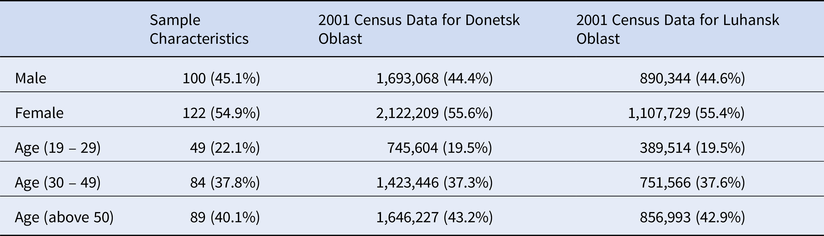
The survey design was quota sampling based on the population structure of the region in terms of gender crossed by age after stratification by urban center. Probabilistic sampling was not used since the refusal rate was too high for this survey method. The interviewers conducted the survey in randomly selected sites of each town finding respondents until the desired quota for each category was reached. All interviews were face-to-face and confidential. The final sample (N = 222) closely approximated gender and age group proportions of the population of two oblasts (see Table 1). The sample included 155 Russian-speakers (69.8%) and 67 (30.2%) Ukrainian speakers, which also approximates the language use in the region.Footnote 12 Most of the respondents (43.7%) received at least some university education, another 39.6% received vocational education, and 16.2% had secondary education or less. A third of respondents in the sample (32.9%) were employed in the private sector, another 14.9% worked in state-owned enterprises, 2.3% were civil servants, and 15.8% were unemployed. The sample also included 64 pensioners (28.8%) and 12 (5.4%) students. By place of origin, the sample included mostly natives of Donbas with 107 (48.2%) respondents born in Donetsk oblast and 68 (30.6%) born in Luhansk oblast. The rest were born either in other regions of Ukraine (8.5%), in the Russian Federation (8.6%), or other countries (3.6%).
Sample Characteristics and Census Data for Donetsk and Luhansk oblasts.

This study has several methodological limitations. Firstly, any survey that relies on personal recollection of prior events may be marred by recall bias, so the results should be treated as rough estimates of respondents’ views rather than precise assessments. The survey technique based on nonprobability sampling also produces results that may not be representative of the population as a whole. However, the goal of the paper is to examine the effects of identity choices and individual expreriences on views of insurgents rather than to establish with a high degree of certainty what residents of the region think. The final sample includes members of main identity groups approximating their respective shares in the population as a whole, which allows us to draw meaningful comparisons of their group orientations. Secondly, the armed conflict in Donbas can be classified as a “flashbulb event,” which was both unexpected and highly consequential for respondents (Brown and Kulick Reference Brown and Kulik1977). This suggests that respondents were more likely to form durable memories of the events and the circumstances surrounding them. Since the poll was conducted approximately 13 months after the start of the conflict, we can also expect a large degree of consistency in recollection of respondents’ impressions. Furthermore, it is reasonable to expect that the eruption of the armed conflict in Donbas had a great emotional effect on the residents given the rarity of the event and the political polarization surrounding it. This, in turn, could serve to cement the initial memories and make them more immune to distortions by subsequent media reporting and political spin (Hepp et al. Reference Hepp, Gamma, Milos, Eich, Ajdacic-Gross, Rössler, Angst and Schnyder2006). Another potential methodological problem of the study is related to the political sensitivity of some of the questions and risks associated with expressing views that could be interpreted as being sympathetic to insurgents. As a result, we refrained from asking any direct questions about personal attitudes regarding the insurgency or specifics about instances of victimization. While there could still be some preference falsification among respondents, the consistency in our survey findings indicate that the results were not significantly affected by these problems.
Survey Results
The survey began with a set of general identity questions, which addressed the respondents view of their region and its relationship to Ukraine. The majority of respondents (52%) identified themselves using local identity dimensions (town or region) and another 39% identified themselves primarily as Ukrainian citizens.Footnote 13 Two other identity categories—Russian (4%) and Soviet (5%)—were much less common. Almost half of respondents (46%) agreed with the statement that Donbas is a “unique region in Ukraine, which is distinct from other Ukrainian regions.” For most, the insurgency was a local phenomenon with about a half of respondents indicating that they knew someone among fighters personally (31%) or through friends and neighbors (21%). There was also frequent interaction with rebels on the streets, which occurred daily (36%) or almost daily (32.4%).
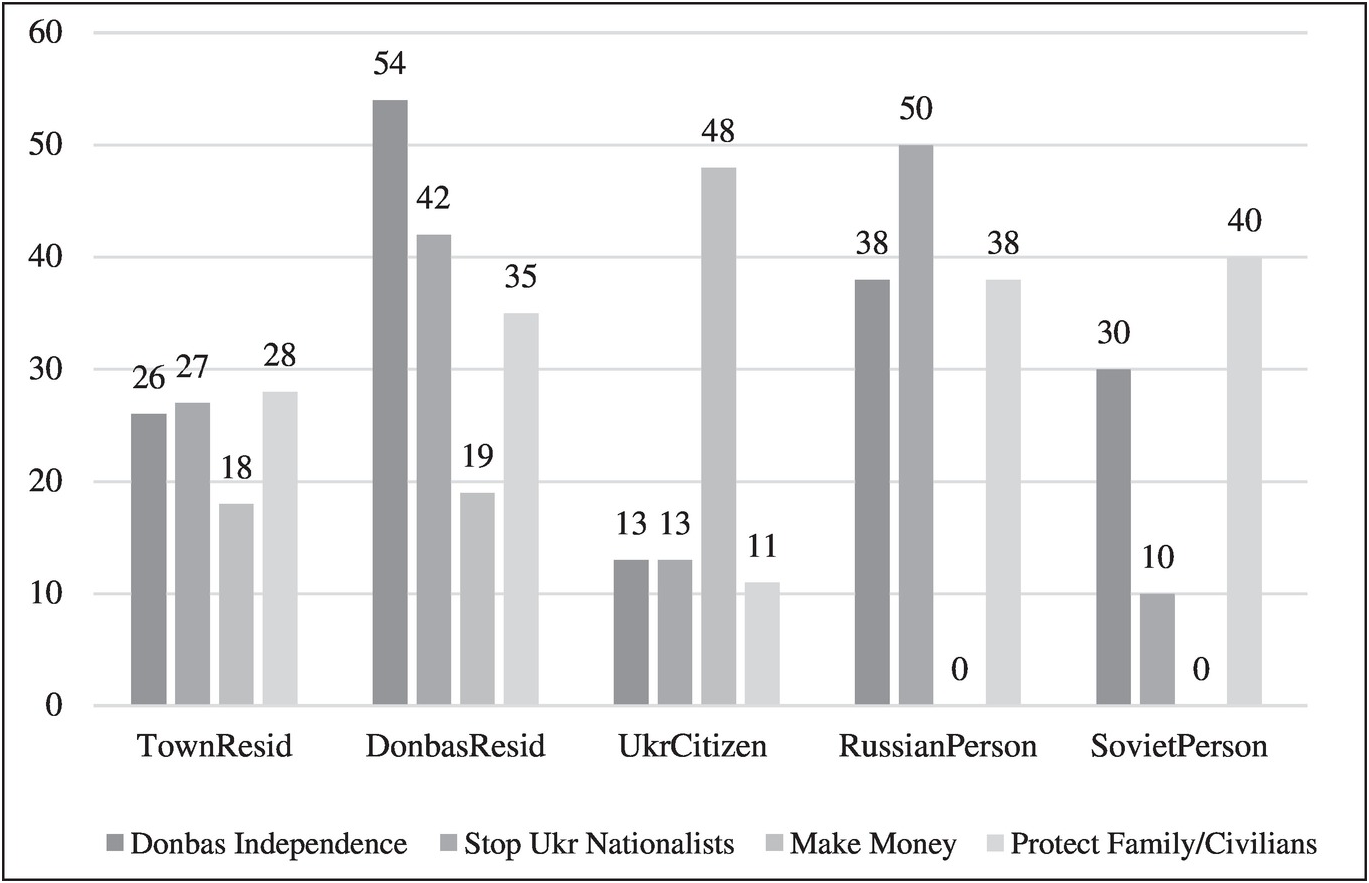
In a separate question, we asked respondents to identify up to three possible motives for joining the insurgency. This question could be used as a strong predictor of respondents’ own views regarding insurgents. The attribution of ideational motives may indicate a more sympathetic view of rebels, while attribution of materialistic goals may reflect greater opposition to the insurgency. The most common suggested motives were to earn money (27.5%), to gain independence for Donbas (24.3%), to protect family and friends (23%), and to stop Ukrainian nationalists (21.2%). The bivariate analysis using a chi-square test of independence shows that there is a significant relation between one’s identity and motive attribution. Those who identified themselves as Ukrainian citizens were more likely to explain participation in the insurgency based on financial transactions ( $ {X}^2 $
(4, N = 202) = 26.86, p < 0.001). By contrast, those who identified themselves with the region of Donbas were more likely to explain people’s participation in the insurgency by ideational motives, such as the need to defend Donbas’ independence (
 $ {X}^2 $
(4, N = 202) = 19.14, p=0.001) or stop Ukrainian nationalists (
 $ {X}^2 $
(4, N = 202) = 15.25, p = 0.004). These findings are in line with the first hypothesis that respondents with regional identity were more prone to indicate grass-roots support for the insurgency. As Figure 1 illustrates, various ideational motives are the leading explanation of insurgency participation for all respondents whose identity was not based on civic attachment to Ukraine.
Primary Identity of Respondents and Suggested Motives of Insurgents (in % of respondents).

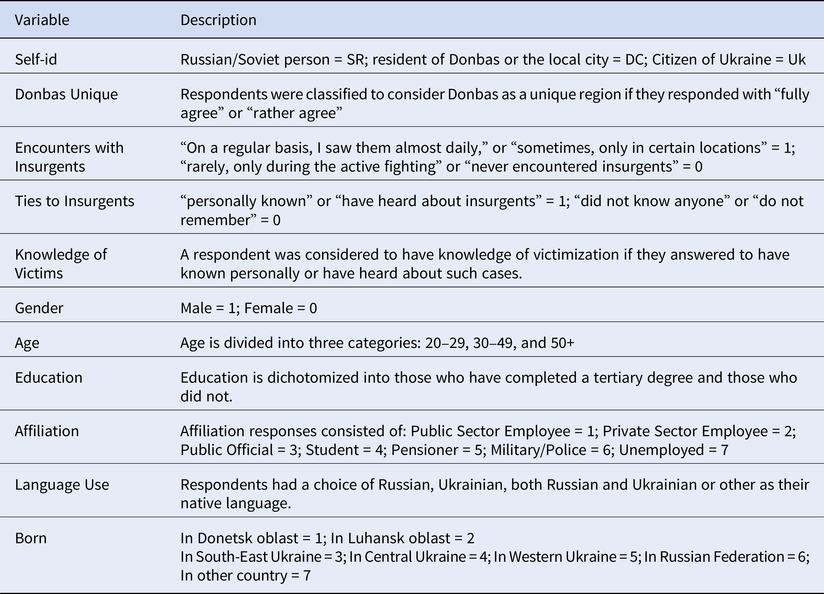
We tested the second hypothesis asking respondents whether they felt threatened in the presence of insurgents. Half of respondents (50%) said that they never experienced a sense of threat, while a third (35%) said they felt threatened always or sometimes. Among those who felt threatened, almost half (45%) said they were afraid of becoming a victim of a physical attack by the insurgents. The second most common source of fear, however, was related to the possibility of an attack by the Ukrainian military (31.5%), which shelled the positions of insurgents. Other reasons for the sense of threat were the fear of arrest (23.6%) and extortion (21.4%). To establish the significance of identity in comparison to other social and demographic variables in shaping the perception of insurgent threat we first used the Cochran-Mantel-Haenszel (CMH) general test of association. The demographic variables included in this test in addition to identity are a respondent’s age, gender, education level, and language (see Table 2).Footnote 14
Description of Variables.

We also added a variable that reflected respondents’ view of Donbas as a unique region compared to other regions in Ukraine, which served as another proxy indicator for regional identity. Additionally, respondents self-identified themselves as a resident of Donbas or local resident of the city (DC), citizen of Ukraine (Uk), or Russia/Soviet person (RS). Finally, we added social variables that reflected respondents ties to insurgents, frequency of their encounters with insurgents, and their knowledge of victimization. Civilians were considered to experience a pertinent sense of threat if they answered “yes, always” or “sometimes” to the question “Did you feel threatened by insurgents?” and not a pertinent sense of threat if they answered, “almost never” or “never.” Out of the 213 non-missing responses, 74 (35%) acknowledged a pertinent sense of threat. We determined statistical significance at  $ \alpha =0.05. $
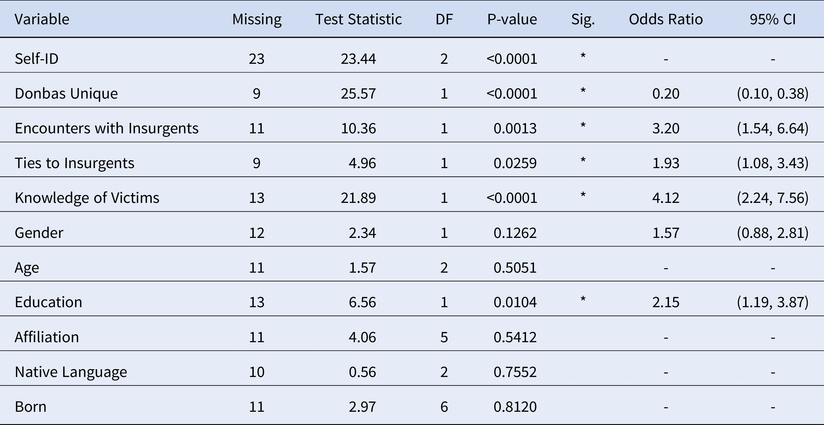
Odds ratios with 95% Wald confidence intervals (CI) were calculated where appropriate. Table 3 gives the results for the univariate associations with sense of threat. Self-identification (p-value < 0.0001), view of Donbas as a unique region (p-value < 0.0001), encounters with insurgents (p-value = 0.0013), ties to insurgents (p-value = 0.0259), knowledge of victimization (p-value < 0.0001), and education (p-value = 0.0104) were significantly associated with a sense of threat.
CMH Test of Association with Dichotomized Sense of Threat: Univariate Associations Collapsed Variables.

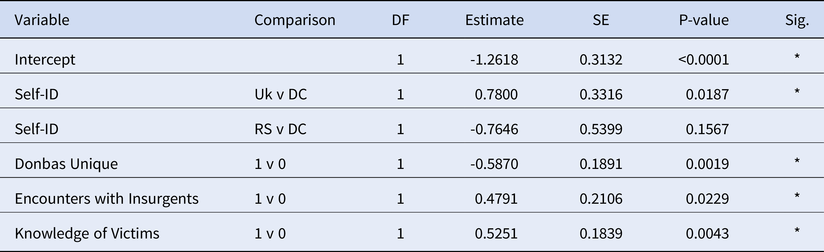
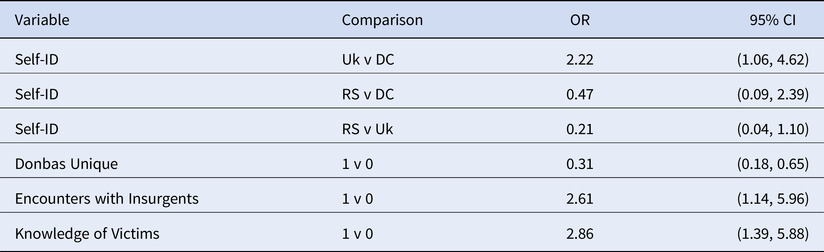
Based on the significant univariate associations, we used a logistic regression model to explore the associations from a multivariate viewpoint. Variables that were not significant were removed from the model including ties to insurgents and education.Footnote 15 The final chosen model is given in Table 4 and corresponding odds ratios and 95% Wald confidence intervals are given in Table 5.
Selected Multivariate Logistic Regression Model for Sense of Threat.

Odds Ratios for Logistic Model on Sense of Threat.

The variables that remained significant once all variables were taken into consideration, were self-identification (p-value = 0.0187), viewing Donbas as a unique region (p-value = 0.0019), encounters with insurgents (p-value = 0.0229), and knowledge of victimization (p-value = 0.0043). The odds of experiencing a sense of threat for those identifying themselves as Ukrainian is 2.22 [95% CI: (1.06, 4.62)] times the odds of those identifying with the Donbas region or their hometown. Interestingly, classifying as Russian or Soviet is not significantly different from the Donbas/city classification in terms of chances of experiencing a sense of threat (p-value = 0.1567). The odds of experiencing a sense of threat is 2.61 [95% CI: (1.14, 5.96)] times greater for respondents who have encounters with insurgents. Similarly, the odds of experiencing a sense of threat is increased by a factor of 2.86 [95% CI: (1.39, 5.88)] for those who have knowledge of victimization compared to those who do not. Although identity is a weaker predictor of the sense of threat than direct exposure to insurgents, it has a significant effect. In accordance with the second hypothesis, localized identity makes it less likely that a person would feel threatened by insurgents. Keeping all other variables constant, viewing Donbas as a unique region decreases the odds of experiencing a sense of threat by 69% [OR: 0.31, 95% CI: (0.18, 0.65)].
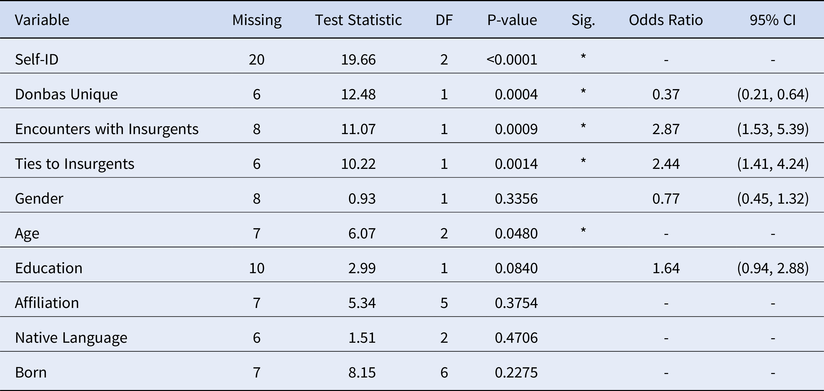
For testing the third hypothesis we asked respondents whether they knew of anyone who was harmed or injured by insurgents. A respondent who acknowledged knowing directly or hearing about instances of victimization was considered to have knowledge of victimization. Out of the 209 non-missing responses, 97 (46%) had knowledge of victimization. Table 6 gives the results for the CMH general test of association and associated 95% confidence intervals where appropriate for the odds ratio of the univariate variables with knowledge of victimization.
CMH Test of Association with Dichotomized Knowledge of Victimization: Univariate Associations Collapsed Variables.

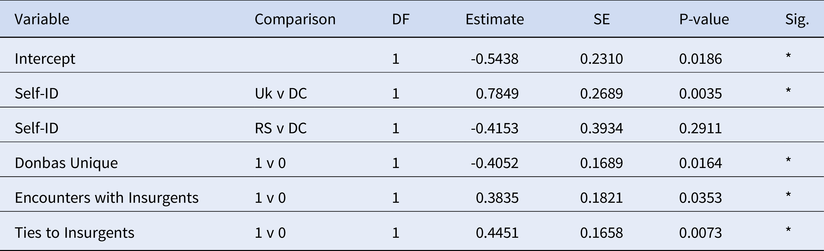
Self-identification (p-value < 0.0001), view of Donbas as a unique region (p-value = 0.0004), encounters with insurgents (p-value = 0.0009), ties to insurgents (p-value = 0.0014), and age (p-value = 0.0480) were significantly associated with knowledge of victimization. We further explored the relationship of the significant univariate associations within a multivariate logistic regression model with knowledge of victimization as the dependent variable. Variables that were not significant were removed from the model including age. The final model is given in Table 7 and corresponding odds ratios and 95% Wald confidence intervals are given in Table 8.
Selected Multivariate Logistic Regression Model for Knowledge of Victimization.

Odds Ratios for Logistic Model on Knowledge of Victimization.

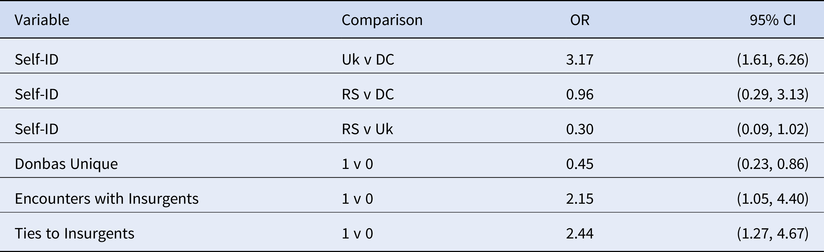
The model consisted of the variables: self-identification (Uk v DC: p-value = 0.0035), viewing Donbas as a unique region (p-value = 0.0164), encounters with insurgents (p-value = 0.0353), and ties to insurgents (0.0073). In line with our third hypothesis, individuals with localized identity were much less likely to report instances of civilian victimization by insurgents (p-value=0.0035). The odds of possessing knowledge of victimization for those identifying themselves as Ukrainian are 3.17 [95% CI: (1.61, 6.26)] times greater than those identifying with Donbas or the local city. Russian/Soviet respondents were not significantly different from the Donbas/local city respondents in terms of knowledge of victimization (p-value = 0.2911). Another indirect measure that shows the significance of local attachment is the respondent’s view of Donbas as a unique region. The odds of knowledge of victimization decrease by 65% for those identifying Donbas as unique. Proximity to insurgents, by contrast, increases the odds of reporting victimization. Those who claimed to have encountered insurgents were 2.15 [95% CI: (1.05, 4.40)] times more likely to report victimization than those who did not. Those who claim to have known insurgents were 2.44 [95% CI: (1.27, 4.67)] times more likely to bear witness to civilian victimization compared to those who had no familiarity with them.
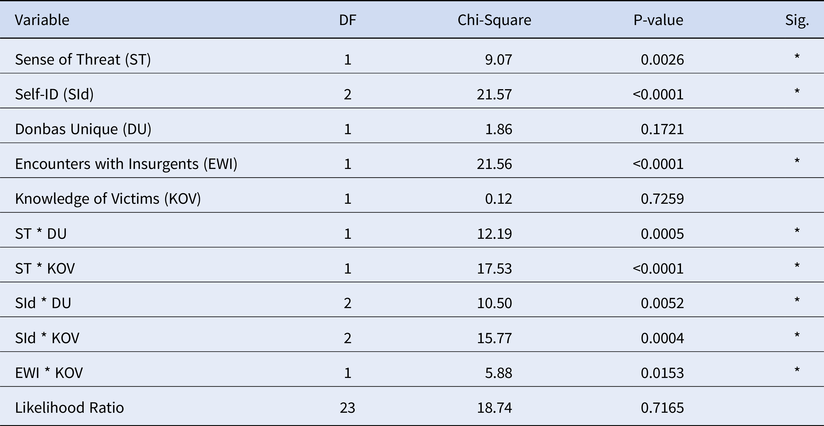
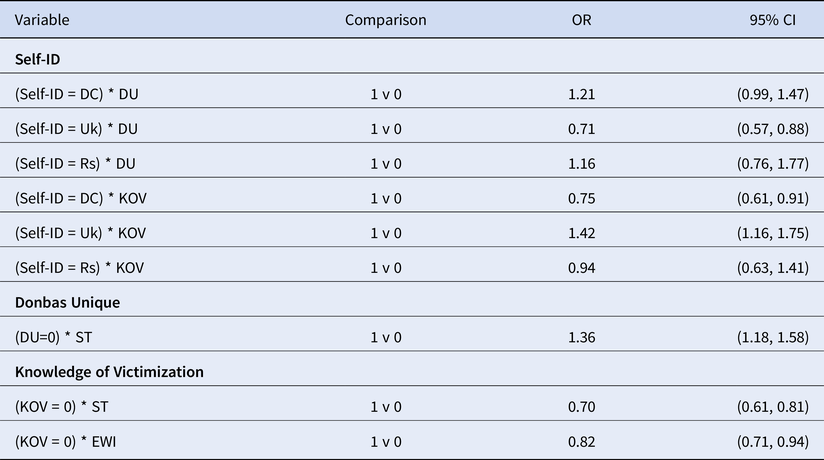
Finally, we used a log-linear model to analyze the associations between variables from the two logistic regression models within a multidimensional contingency table allowing one to consider higher-order interactions. The model aims to identify significant associations between variables to explain the response pattern of each respondent without defining a single variable as a dependent factor. The chosen log-linear model is shown in Table 9 and corresponding odds ratios and 95% Wald confidence intervals are given in Table 10.
Log-linear Model for Multidimensional Contingency Tables.

Odds Ratios from Loglinear Model.

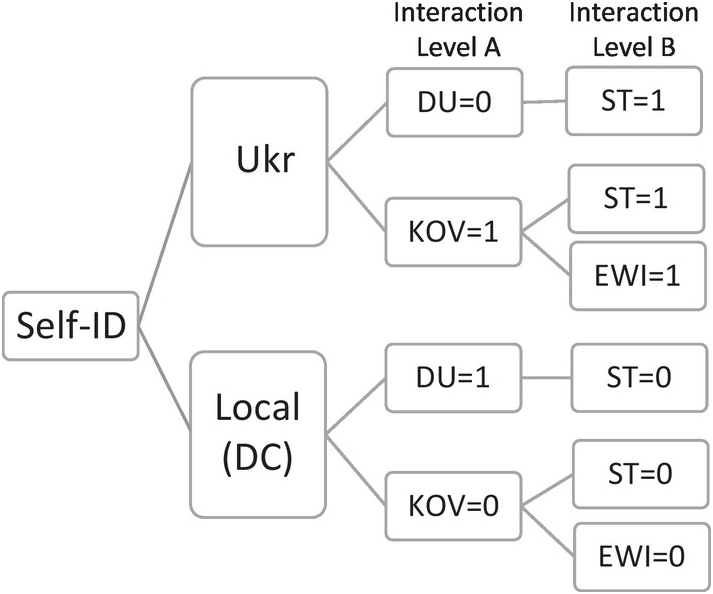
Three-way or higher order interactions are not required to explain the response patterns of civilians to the questionnaire (p-value = 0.7165). Variables that were not significant in a two-way interaction or a univariate sense were removed from the model. There were five significant two-way interactions. Ukrainian identity significantly decreases the odds of viewing Donbas as a unique region by 29% [OR: 0.71, 95% CI: (0.57, 0.88)] and increases the odds of knowledge of victimization by a factor of 1.42 [95% CI: (1.16, 1.75)]. Whereas, identifying as a resident of Donbas or hometown increases the odds of viewing Donbas as a unique region by a factor of 1.21 [95% CI: (0.99, 1.47)] and decreases the odds of knowledge of victimization by 25% [OR: 0.75, 95% CI: (0.61, 0.91)]. The odds of experiencing a sense of threat are increased among those who do not view Donbas as a unique region by a factor of 1.36 [95% CI: (1.18, 1.58)] and decreased by 30% [OR: 0.70, 95% CI: 0.61, 0.81] among those without knowledge of victimization. Figure 2 summarizes the interplay between self-identification, viewing Donbas as a unique region, knowledge of victimization, and encounters with insurgents. The category with a significant increase in the odds is indicated at each stage.
Schematic of the category in which the odds are increased for significant interrelated two-way associations from the log-linear model. Interaction level A: Self-identification (SId) with viewing Donbas as a unique region (DU) and self-identification with knowledge of victimization (KOV). Interaction level B: Viewing Donbas as a unique region with a sense of threat, knowledge of victimization with a sense of threat (ST), and knowledge of victimization with encounters with insurgents (EWI).

To summarize, identity based on civic attachment to Ukraine makes it less likely that a person would view Donbas as a unique region and more likely that a person would report on victimization by insurgents with both increasing the odds of experiencing a sense of threat. On the contrary, regional identity makes the reporting of insurgent victimization less likely and heightens the likelihood of seeing Donbas as unique, which in turn are associated with a lower sense of threat from insurgents. The results from the log-linear model further corroborate the logistic regression results with a combined viewpoint of a sense of threat and knowledge of victimization. In addition, both variables are found to be important to describe the responses from the survey without pre-specifying any particular variable as the dependent factor.
Discussion of the Results
The findings of this study suggest that respondents with localized forms of identity (regional or town-based) in Donbas had strong in-group biases toward the insurgents. They were more likely to attribute ideational motives to their actions, experience no threat from insurgents, and indicate no knowledge of insurgent victimization. This corresponds with the expectations of the theory of asymmetric effect, which suggests that civilians condition their assessments of combatants based on their group membership (Lyall, Blair, and Imai Reference Lyall, Blair and Imai2013). If they view themselves as belonging to the same group as rebels, they are more likely to accentuate positive aspects of their actions and ignore or downplay their negative consequences. Consistency of results across a variety of attitudinal questions resolves the endogeneity problem that may arise when using reported civilian victimization as the sole measure of in-group bias (Lyall, Blair, and Imai Reference Lyall, Blair and Imai2013). Identity variable should then be added to the causal chain accounting for the onset of the armed conflict in Donbas. The formation of armed groups calling for independence of two Donetsk and Luhansk oblasts and the first violent clashes with Ukrainian forces juxtaposed regional with national identity, which allowed these groups to draw support from broader segments of the public aligned along a new identity cleavage. The role of activated regional identity could then be critical in escalating the conflict from an uprising by several small armed groups to an insurgency campaign involving thousands of local civilians who actively contributed to the uprising.Footnote 16
These conclusions may be puzzling given that support for Donbas secession from Ukraine among the region’s residents has been low throughout its independence. How could separatist entrepreneurs turn regional identity into a vehicle of popular mobilization behind a secessionist cause? Prior research on regional identity dynamics points to several possible mechanisms. Just like ethnic identity of a territorially concentrated minority group, regional identity coexists with national identity, but it is not necessarily fully nested in the national identity category (Hierro and Galleo Reference Hierro and Gallego2016). This means that for some members of a group their activated regional identity may be complementary with national identity, while others see it as being in contradiction with some or each of its attributes. When such contradictions emerge, national and regional identities would have a cross-cutting character that would make some regional identifiers exclude themselves from the national group. Donbas identity holders could then be differentiated based on their relationship to national Ukrainian identity. On one side of an identity continuum are those who embrace all attributes of Ukrainian national identity while maintaining their attachment to the region (dual identifiers). In the middle are those who can accept civic attributes of national identity (sense of belonging to the Ukrainian state), but refuse to identify with its cultural attributes or nation-building myths (partial identifiers). Finally, the third type of Donbas identity holders reject both civic and cultural attributes of Ukrainian identity along with its nationalizing myths (exclusivist identifiers). They hold a Ukrainian passport, but privately have never accepted Ukraine as their own state. Each of these identity types has a set of corresponding political preferences. Dual identifiers are more likely to support an administrative status quo, Ukraine’s unitary status, and European integration. Partial identifiers are more predisposed to supporting an autonomous status for Donbas and Ukraine’s federalization as well as economic union with Russia. Finally, an exclusivist identity type is the one favoring Donbas separation or Ukraine’s full integration with Russia.
The extent of cross-cuttingness between national and regional identities has depended on the relative size of each group. Partial and dual identifiers prevailed in Donbas for most of the post-independence years, which made separatism a marginal phenomenon in the region. However, the rise of anti-government protests in Kyiv in November 2013 produced intense regional polarization within Ukraine. The prominence of far-right groups during the violent clashes with the police in January–February 2014 allowed the Russian media to frame the Euromaidan revolution as an attempted Western-sponsored nationalist coup. It also raised fears about further ethnonationalist redefinition of Ukrainian identity and the negative consequences of cutting economic ties with Russia. The cumulative effect of these developments was an overall shift in the direction of a more exclusivist identification with Donbas among its residents as a means of withstanding a nationalizing wave from Kyiv.Footnote 17 Dual identifiers were then likely to take a more ambivalent stance toward Ukrainian statehood demanding a referendum on regional autonomy or withdrawing from politics all together.Footnote 18 Partial identifiers, on the other hand, were more likely to side with exclusivists and withdraw their “contingent consent” behind Ukrainian statehood. The resulting outcome was a heightened cross-cutting nature of national and regional identities and the rise of popular support for emerging armed groups which rejected dual or partial identification with Ukraine.
The growing embrace of exclusively defined Donbas identity facilitated the insurgency by creating a base of civilian support behind the insurgent units. Access to such a support base was critical for consolidating insurgent control for four reasons. Firstly, it provided rebels with access to resources in the form of food or financial donations, which might be particularly important in the case of resource-scare insurgent campaigns. In our poll two-thirds of respondents (63.2%) indicated that locals offered various types of assistance to the rebels with the most common being food supplies. Secondly, it provided insurgents with a pool of recruits to consolidate territorial control and sustain resistance in the face of counterinsurgent operations (Kudelia Reference Kudelia2019). Thirdly, civilian supporters became a source of information, which allowed for selective application of violence against internal and external opponents (Kalyvas Reference Kalyvas2006). Finally, civilian support, particularly during the so-called referendum on May 11, 2014, served the purpose of external legitimation of separatist leaders, who positioned themselves as advocates of broader group interests rather than as a self-serving criminal entity.
The findings presented in the article suggest a different explanation for the regional concentration of the armed conflict in Ukraine. The existing accounts explain failure of separatist efforts in other parts of southeastern Ukraine by pointing to the coercive power of pro-Ukrainian oligarchs or weaker economic ties to Russia (Portnov Reference Portnov2015; Zhukov Reference Zhukov2016). However, if support behind local rebel groups results from increasing salience of the regional cleavage and growing incompatibility between regional and national identities, as this article suggests, successful large-scale insurgency could emerge only in the areas with an activated regional identity redefined in exclusivist terms. Hence, despite Moscow’s backing of separatist activists in other regions with Russian-speaking majorities, like Odesa or Kharkiv, they failed to mobilize broader public support due to the weakness of pre-existing regional identity open to an exclusivist redefinition anywhere outside Donbas.Footnote 19
Conclusion
Theoretical approaches to explaining the onset of civil wars have gradually moved away from a structural focus of earlier studies and to the study of microfoundations of the armed conflicts (Kalyvas Reference Kalyvas2006; Staniland Reference Staniland2012; Lewis Reference Lewis2016; Balcells Reference Balcells2017). This article suggests the viability of this approach for the study of the onset of the armed conflict in Donbas, which has earlier been viewed in predominantly macro-level terms. It demonstrates the significance of regional cleavages for explaining the escalation of the armed conflict in Donbas and the sustained insurgency campaign. It reveals how civilian attitudes toward insurgents were shaped by individual identity choices creating strong positive or negative biases regarding the separatist rebellion. Those who identified themselves primarily with the region or their towns of residence were more likely to convey a more favorable view of insurgents and feel less intimidated in their presence. By contrast, Ukrainian identifiers were more likely to indicate disapproval of insurgents, interpret their motives through a material lens, and report sensing fear when encountering them. Donbas identifiers were also much less likely to acknowledge civilian abuse by the rebel side than those with Ukrainian identity.
These findings suggest several potential avenues for micro-level research in the study of the outbreak of armed conflict in Donbas. Firstly, to fully account for the origins of the conflict requires close examination of the formation and composition of initial self-defense groups and the type of rhetoric they used in addressing local civilians. This will allow for the examination of the rise in salience of regional identity cleavage and the relative significance of internal and external actors (Russia) for its redefinition in exclusivist terms. Secondly, there needs to be further research of the mechanisms of recruitment and mobilization into rebel groups at the early stage of the war with a focus on the use of identity frames. Thirdly, understanding of initial dynamics of insurgency requires the study of rebel governance and its relationship with civilians, particularly various types of social control that insurgents used to encourage civilian cooperation. The article also has implications for designing effective state policies following the end of the conflict. If strong regional identity played a prominent role at the outset of the war, it is likely to have only solidified in rebel-held areas after years of their de facto separation from Ukraine. Meanwhile, many policy innovations of the Ukrainian government since 2014, particularly in educational and language spheres, were based on ethnocentric ideas about the need to achieve a greater homogeneity of the Ukrainian nation. Successful reintegration of parts of Donbas would then require adjusting state policies to the often divergent cultural needs of local residents in order to allow greater compatibility between national and localized identity types.
Acknowledgments.
The authors would like to thank Jack Tubbs, Nina Potarska, Svitlana Nidzvetska, Galya Rusanevich, Serhiy Solodko, Anton Pechenkin, Anastasia Lykholat, and the two anonymous reviewers for their comments and assistance with various parts of this project.
Financial Support.
The original survey used in this article was supported through funds from Baylor University Research Committee Small and Mid-Range Grant Program (Project 303303305).
Disclosure.
Authors have nothing to disclose.
Supplementary Materials.
To view supplementary material for this article, please visit http://dx.doi.org/10.1017/nps.2019.68.