During the Second World War Mr Willcocks Goldsworthy McKenzie and his wife were walking their dog in an area north of the town of Thame when they saw something glistening in the soil. Investigating further, Mr McKenzie recovered a group of five medieval gold rings and ten silver coins. An inquest led by the Coroner was held on 28 May 1940; the jury decided that the find was treasure trove. With the support of the Art Fund, the Ashmolean Museum acquired the hoard, which became known as the ‘Thame Hoard’.
Little attention has been paid to the hoard as a whole since its discovery, nor has an assessment been attempted of the find-spot, though the impressive reliquary ring has featured in general publications on later medieval jewellery or in exhibitions and their catalogues. The hoard merits a re-examination in light of methodological developments and other archaeological finds from the last seventy-five years. This paper addresses in particular the date of the reliquary ring, the significance of the find-spot of the hoard near a watercourse of the River Thame, the ownership of the objects, the deposition date of the hoard, how this example of hoarding compares with those in other periods and how the curation of objects and coins affects our dating of hoards.
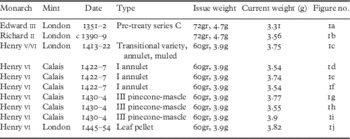
As noted by Cessford et al and Allen,Footnote 1 later medieval hoards containing coins and jewellery are atypical. By 2013 only seventeen of 495 known English and Welsh coin hoards dated between 1066 and 1544 contained both types of artefact, with rings being the most common type of jewellery found in mixed hoards.Footnote 2 The dates of the coins are most often used to date the deposit, the latest dated coin providing a terminus post quem. In the case of the hoard found near Thame in 1940, the ten silver groats date from 1351 to 1454 (table 1).
Details of the ten silver groats found in the hoard, with corresponding references to figure 1

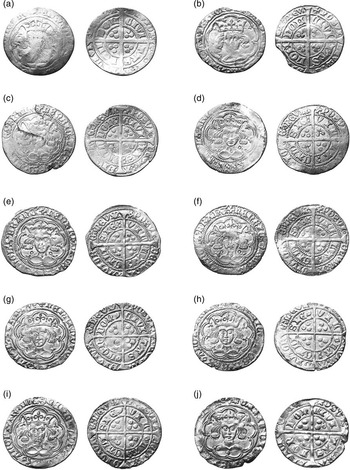
The two earliest groats are somewhat worn, but the latest are in good condition, suggesting that they were not in circulation for very long (fig 1).Footnote 3
The ten silver groats from the hoard. Photograph: © Ashmolean Museum, University of Oxford

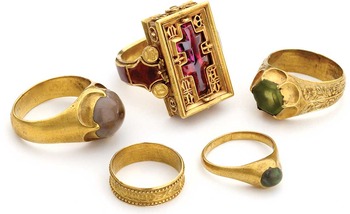
The gold rings are (fig 2):
-
a) a posy ring with tout pour vous inscribed on the outer band;Footnote 4
-
b) a large stirrup ring set with a large toadstone (the fossilised tooth of the extinct Lepidotes fish);
-
c) a smaller stirrup ring set with a cabochon turquoise;
-
d) a large bezelled ring with engraved shoulders, a table-cut peridot and a small quatrefoil hole cut behind the bezel;Footnote 5
-
e) an ornate reliquary ring set with cut amethyst, thought to have held a fragment of the True Cross.Footnote 6
The five gold rings from the hoard. Left to right: toadstone stirrup ring, posy ring, reliquary ring, turquoise stirrup ring and the peridot ring with engraved shoulders. Photograph: © Ashmolean Museum, University of Oxford

While the first four were dated to the fourteenth and fifteenth centuries, Evans et al suggested a date of the early sixteenth century for the reliquary ring, and hence a sixteenth-century deposition date.Footnote 7 Evans’s suggestion that the hoard was lost from Thame Abbey at its Dissolution was based on the location of the hoard find-spot north of Thame, her dating of the reliquary ring and the suggestion that amethyst was used in abbatial rings. These features led her to conclude that the reliquary ring ‘must probably have belonged to Robert King’ who was appointed as Abbot of Thame in 1529, to a house that had suffered under his predecessors’ rule.Footnote 8
In the catalogue for the Age of Chivalry exhibition,Footnote 9 a late fourteenth-century date was proposed for the reliquary ring based on Hunt’s comparison of the ring with a late fourteenth-century casket in the Museum of Fine Arts, Boston,Footnote 10 and on documentary references to rings containing fragments of the True Cross. A Parisian workshop was also suggested. The earlier date of the ring and the coin evidence has been used to argue deposition during the Wars of the Roses in 1460.Footnote 11
While all these interpretations are plausible, there has been little discussion of other possibilities as to the deposition date or the place of the hoard in the landscape. The conventional association with Thame Abbey has not been questioned, apart from Cherry’s thought, in his discussion of the Fishpool Hoard, that the owner of the reliquary ring could equally have been secular as religious.Footnote 12 Most recently Campbell has called attention to the fact that the hoard and the ring – ‘perhaps the most exceptional of all ecclesiastical rings’Footnote 13 – is still little known.Footnote 14 Finally, the place of this hoard within the wider context of multi-period hoarding has yet to be considered.
THE RELIQUARY RING
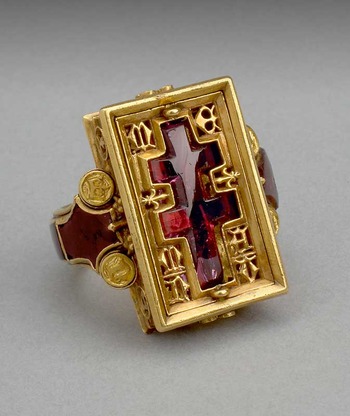
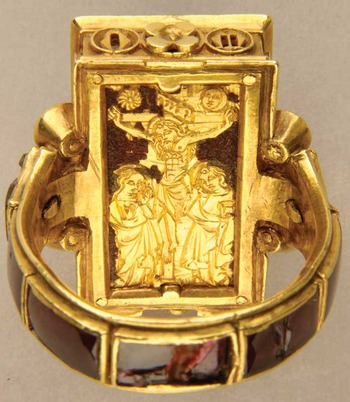
The most sumptuous ring in the hoard is the large, highly decorated and beautifully crafted gold reliquary ring (fig 3). The hoop of the ring is set with cut amethyst, its box bezel is decorated on the top with a large cut amethyst in the shape of a double-armed cross and the gold openwork frame is decorated with lettering and two fleurs-de-lis. The sides of the bezel have similar lettering, and the shoulders are decorated with gold roundels enclosing two more letters and two crowns. Altogether the letters read domine memanto [sic] mei (‘O Lord, Remember me’) from Luke 23:42.Footnote 15 The bezel is opened by rotating two quatrefoil flowers at either end of the box, and inside is a void to hold a relic (fig 4). The reverse of the bezel has an engraved scene of the Crucifixion (fig 5). While no detailed description of every element of the ring is required here, there are some aspects that have not been identified to date, and need highlighting and consideration. These include the use of enamel, the imagery and the possibility that a second relic was held in the ring.
The reliquary ring showing the patriarchal amethyst cross and openwork top of the bezel with part of the motto domine memanto [sic] mei. Photograph: © Ashmolean Museum, University of Oxford

The open bezel with the decorated base of engraved foliage. Photograph: © Ashmolean Museum, University of Oxford

The underside of the bezel showing the Crucifixion scene. Photograph: © Ashmolean Museum, University of Oxford

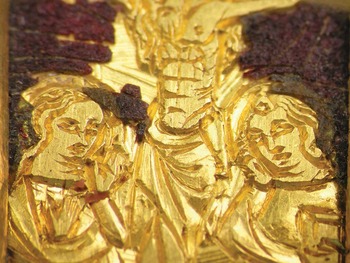
The surviving enamel on the ring includes the rouge cler on the background of the basse-taille Crucifixion scene, and traces of a green enamel on the edges. Yellow (now with a green tinge) fills the halos above the heads of the Virgin and St John (fig 6). The depiction of the Virgin is unconventional in that her hair is clearly visible – a trait that is more often associated with Mary Magdalene in Crucifixion scenes. Nevertheless, there is no other attribute, such as an unguent jar or a skull, to suggest that Mary Magdalene is intended. It is possible that the Virgin is depicted as having removed her kerchief to cover Christ’s loins, leaving her hair uncovered. This action is referred to in The Myrrour of the Blessid Life of Ihesu-Christ (Nicholas Love’s popular 1401 translation of the thirteenth-century Franciscan text Meditationes Vitae Christi).Footnote 16
A magnified image of the heads of the Virgin and St John, showing the red and green/yellow enamel. Photograph: © Ashmolean Museum, University of Oxford

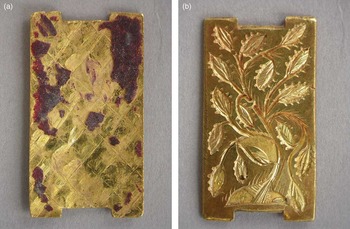
Rouge cler traces appear again on the hatched face of the plate that sits under the patriarchal cross – this would have originally created a darker tone to the amethyst above (fig 7a). A very small trace of red was found behind one of the openwork letter ‘M’s on the bezel. It is unclear whether this is a thin layer of enamel or a reddish tarnish.Footnote 17 If the former, it suggests that all the letters may have had a red ground behind them. No other enamel can be identified on the engraved foliage panels inside the bezel, as has been previously suggested by Campbell.Footnote 18 The foliage motifs seen in figures 4 and 7b are not identical; and both plates have been decorated to take into account the opening mechanism by adjusting the placement of the leaves, indicating that they were decorated after the main body of the ring was constructed and are not reused elements. Differing gold colours show that two types of gold were used for the plates.Footnote 19 The loose plate with rouge cler on one side and engraved foliage on the other is made up of two thin sheets of gold beaten together – this is clearly evident when looking at the section of the plate, and the mistake made by the engraver in carving too deeply and going through the thickness of the decorated plate (fig 7b).
The plate from under the cross: (a) obverse (with traces of rouge cler); (b) reverse with engraved foliage. Note that the engraver’s mistakes are clearly visible at the base of the tree. Photograph: © Ashmolean Museum, University of Oxford

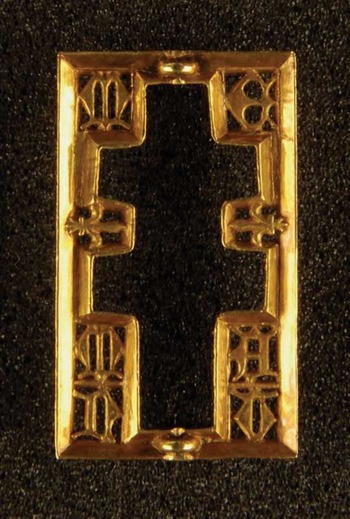
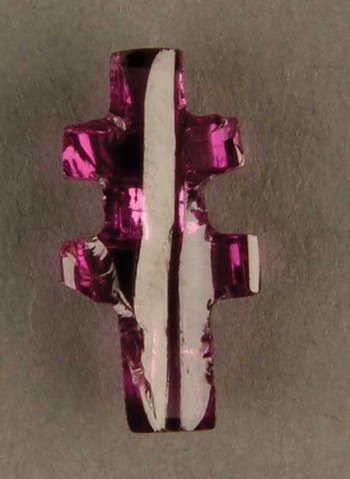
The patriarchal or double-armed cross is exceptionally well executed, with tapered sides to ensure it is held in place by the openwork top panel (fig 8). No one, however, has previously mentioned that the reverse of the vertical arm has a purposefully carved hollow groove (fig 9). It is highly unlikely that a jewel-cutter would have included this feature if it were to serve no purpose. It may have been intended to improve the light reflection, but it could also have accommodated a second relic. This may have been a second splinter of the True Cross or a thorn from the Crown of Thorns. Supporting this hypothesis is the slight concave curve to the red enamelled panel that backs the jewel cross, which could have accommodated and supported the relic. Other later medieval reliquary pendants have survived that would have contained multiple relics, such as the c 1200 reliquary from Whithorn, Galloway, with twelve cells that once would all have held relics, including a cross-shaped setting that probably held a fragment of the True Cross.Footnote 20
The openwork top of the bezel. Photograph: © Ashmolean Museum, University of Oxford

The reverse of the amethyst cross with its hollow groove. Photograph: © Ashmolean Museum, University of Oxford

Nobody has yet suggested a possible meaning for the foliage on the ring’s decorated plates. The two plants or trees depicted have distinct rounded bases, perhaps suggesting they are the acanthuses sprouting from the root and symbolising Christ’s ascension (see figs 4 and 7b). However, the leaves appear to have points along their edges and at the tips – more like holly than acanthus. The trunks and branches of the engraved trees have projecting thorns. In the absence of a botanical counterpart, the trees might be a composite created by the goldsmith to reference the Rood and the thorns from which the Crown was made. As part of the reliquary ring the decorated plates would have encompassed the relics, one of which was decorated with blood-red enamel. These elements, together with the relics, the inscription and the Crucifixion scene, would have encouraged the wearer to reflect on the redemptive power of Christ’s suffering.
Dating this ring has proved to be a challenge; many publications offer no date other than that of the hoard’s supposed burial.Footnote 21 Hunt’s work moved back the date of manufacture from Evans’s early sixteenth century to the end of the fourteenth century; however, the key comparative piece that influenced his reassessment, and that of Alexander and Binski, has since been shown to be modern.Footnote 22 The piece in question was a tortoiseshell ‘casket of similar workmanship’ acquired by the Boston Museum of Fine Arts from Hunt.Footnote 23 Hunt went so far as to suggest that the same workshop, or even the same artist, produced the ring and the tortoiseshell casket, with its openwork lettering.Footnote 24 In 1991 the casket was identified as a Gothic Revival piece of nineteenth- or early twentieth-century manufacture,Footnote 25 but the reliquary ring was not reassessed. Despite this error, Hunt did make valuable comparisons with decorative Lettres Bâtards in fourteenth- and fifteenth-century manuscripts, and on this basis, too, he believed a late fourteenth-century date was correct.Footnote 26 Oman also argued for a fourteenth-century date in his study of rings,Footnote 27 and research into French and English goldsmithing and enamelling by Campbell led her to speculate a date of c 1350.Footnote 28 Alexander and Binski’s references to documentary sources reveal that reliquary rings holding fragments of the True Cross were in circulation in the late fourteenth century; for example, a ring containing ‘lignum dominicium’ belonging to Richard ii was repaired by a goldsmith in 1397.Footnote 29
With this in mind, further comparisons are presented here to refine the date of manufacture to c 1400. The style of the openworked letter ‘M’s in the memanto [ sic ]mei domine invocation are comparable to fifteenth-century pilgrim badges made up of crowned ‘M’s, representing the Virgin Mary, Queen of Heaven. A cuttle-bone mould for such crowned angular ‘M’s has been excavated among metalworking materials of fifteenth-century date in London.Footnote 30 Spencer argues that the more rounded ‘M’s found on pilgrim badges are earlier, dating from c 1350–1400,Footnote 31 and are comparable in form to the elaborate Founder’s Jewel of c 1350 in New College, Oxford. A silver, crowned ‘M’ badge of angular style from Haddenham, Buckinghamshire, has been dated to the fifteenth century by James Robinson,Footnote 32 and a second badge formed of all the letters of maria has also been stylistically dated to the same period.Footnote 33 Thus, it may be argued that the style of the angular ‘M’s on the reliquary ring shifts the dating from the fourteenth century to the turn of the fifteenth century (or just after).
The ring may well have been used for many generations after its manufacture. That Richard ii had his reliquary ring repaired shows the care invested in such a precious devotional object. ‘Antique’ rings are referred to within inventories and the ownership of True Cross reliquary rings continued right into the sixteenth century. For example, in the 1530 inventory made at the death of Margaret of Austria (b. 1480), a ring and tablet are of particular note as being comparable to the reliquary ring from the Hoard:
77. Une bague ou ymage a demi rond, ou qu’est ung crucifix attaché en une croix de bois de deux couleurs, que l’on dit estre de la saincte croix, et les ymages de Notre-Dame et sainct Jehan, couvert d’ung cristal, et le tout mus en or; et derriere est graveé une ymage de la Veronique, pesant 2 ½ onces 2 estrellins 3 gramms. … 86. Ung petit tableau d’or, ou qu’est une ymage de Notre Dame, assise en ung siege, tenant son enfant, esmaillé de blanc et rouge; a l’entour est escript en lettres d’esmail blanc: O mater dei memento mei nunc et in hora mortis. Et derriere se ferme a deux demies-portettes, pesant 1 once 9 ½ estrellins 4 gramms.Footnote 34
77. A ring or an image half in-the-round, which is a crucifix attached to a wooden cross in two colours, which is said to be from the Holy Cross, and the images of Our Lady and St John, covered in crystal, and everything set in gold; and on the back is engraved an image of the Vernicle, weighing 2½ ounces 2 estrellins 3 grams. … 86. A small tablet in gold, which is an image of Our Lady, sitting in a seat, holding her child, enamelled in white and red; around it is inscribed in white enamelled letters: O mater dei memento mei nunc et in hora mortis (‘O Mother of God, remember me now in my hour of death’). And it is closed behind two half-doors, weighing 1 ounce 9½ estrellins 4 grams.
It is not possible to tell whether these pieces were new or old when acquired by Margaret, but there is the possibility that a French craftsman – perhaps a member of her court – made them.Footnote 35 A Parisian craftsman has also been proposed as the maker of the hoarded reliquary ring – although one that might have been working in England at the turn of the fifteenth century.Footnote 36
Place
It is impossible to say with certainty for whom the reliquary ring was made, but a closer analysis of the place of the hoard does suggest an alternative owner to the abbot of Thame prior to its deposition. Bradley has recently advocated the refocusing of our investigations of hoards to their place in the landscape and associations with topographical features.Footnote 37 In Yates and Bradley’s study of Bronze Age hoards in the south east of England, a connection between hoard find-spots and watery locations was noted,Footnote 38 as has been recognised in other regions and periods.Footnote 39 What is striking about Yates and Bradley’s study is that, on the West Sussex coastal plain, deposits of metalwork were found to be related to ‘minor tributaries rather than major rivers’, and to locations beside or overlooking springs and confluences.Footnote 40 While these are interpreted as votive deposits, with the depositors not intending to recover the objects, the choice as to where these hoards were placed was clearly based on a social construct.Footnote 41 Although the Bronze Age deposition events occurred within a very different time and belief system, we can similarly pay more attention to the placement of the later medieval hoard, and ask what factors may have been behind the choices concerning its deposition.
When they were found in 1940 near the River Thame, the rings and coins were partially embedded in alluvial sediment that had been dredged in the summer of 1939 and deposited about 1.5m (5ft) from the water’s edge. The treasure was taken to the police; nothing else was found as a result of further investigation of the find area.Footnote 42
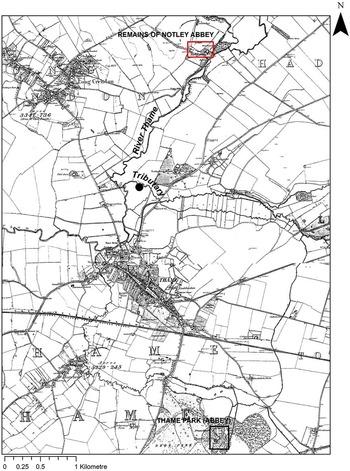
Several possibilities might explain how the hoard arrived at this location: it may have been deposited in the water as a votive offering; it may simply have been lost. Equally, it may have been buried or deposited on one of the banks with the intent to retrieve it, perhaps close to a landmark tree that has subsequently been lost to bankside erosion. Given the tributary locations of Bronze Age hoards already noted,Footnote 43 it is important to record the fact that the water alongside which the hoard was found was not the River Thame as is often stated,Footnote 44 but a small tributary of the Thame, now labelled as a drain on the modern OS 1:5000 map, though in fact it forms the historic boundary between Haddenham parish, in Buckinghamshire, and Thame, in Oxfordshire, and appears as such on the 1st edition County Series maps (fig 10).Footnote 45 In the later medieval period, both the Buckinghamshire and the Oxfordshire sides of the find-spot were open meadow.Footnote 46 Moreover, the tributary joins the River Thame around 230m west of the find-spot, and the confluence marks the intersection of the boundaries of Haddenham and Long Crendon parishes, Buckinghamshire, and Thame (fig 11).
Annotated 1885 1st edition County Series map showing the find-spot of the hoard (black dot); the location of the remains of Notley Abbey to the north (red rectangle); and Thame Abbey (which became Thame Park) to the south (black rectangle). Map: © Crown Copyright and Landmark Information Group Limited (2015); all rights reserved

Map showing the parish boundaries of Haddenham, Long Crendon and Thame and the find-spot of the hoard (black dot). Long Crendon’s boundary follows the line of the River Thame, and the confluence of the three boundaries is at the point where the tributary meets the river. Map: author

It is likely that this administrative boundary was well known to local people in the later medieval period, and there are several other factors that suggest that the location for the burial of the hoard was specifically chosen as an important and easily remembered place. Following the relocation of the main road from Aylesford to Oxford through Thame in 1219, the borough prospered and expanded.Footnote 47 An important bridge was built on this new road at Scotsgrove End, just 350m south east of the hoard’s find-spot; it was recorded as needing repairs in 1444–5.Footnote 48 The River Thame itself was an important transport route, navigable by barge until the eighteenth century.Footnote 49 Indeed, nearby Notley Abbey, in Buckinghamshire, petitioned the King and Council during the second quarter of the fourteenth century with a complaint that the gorces (‘pools’) erected by Sir John Molyns had interrupted the abbey’s river traffic.Footnote 50
Boundaries have long been identified as liminal places with deep cultural and social meanings,Footnote 51 but little attention has been paid to the continuity of such associations into the later medieval period. A hoard found near the River Alne at Alnwick Abbey, Northumberland, provides a noteworthy comparison from this period for the Oxfordshire hoard. Two silver brooches and two copper-alloy seal matrices were found together during repairs to a bridge over the river.Footnote 52 The fourteenth-century brooches bear Latin forms of ‘Jesus of Nazareth King of the Jews’, and have been interpreted as a protective offering deposited by someone from the abbey, perhaps at a time of threat from the Scots.Footnote 53 The fourteenth-century matrices, despite their base metal forms and the likelihood that they originally had a secular owner(s), also had religious legends and symbols. One was of three scallop shells with the legend ‘+ ie sv sele de amvr lele’ (‘I am the seal of loyal love’); and the second a figure with the legend ‘time et ama deum’ (‘Fear and love God’). The key feature, apart from the religious character of the hoard, is the chosen deposition spot at the water’s edge, and at the river forming a boundary to the precinct of Alnwick Abbey.
Purposeful foundation deposits or deliberate concealment of coins in Scotland have been discussed by Hall in relation to secondary uses of these objects.Footnote 54 Within his survey a key example is a black farthing found in a pit dug into a boundary ditch of Blackfriars monastery and interpreted as having an apotropaic function.Footnote 55 Two further parallels for possible ritual deposits of religious objects at watery locations can be cited. A cruciform badge mould was found on the shores of Lake Derwentwater, near Keswick, Cumbria, at a point where pilgrims would leave the mainland to travel to St Herbert’s Island – a deposition as a ‘ritual pilgrimage offering’ has been suggested.Footnote 56 And most relevant to the hoarded reliquary ring is a fifteenth- to sixteenth-century pendant reliquary for a Holy Rood fragment found in the River Tay at Carpow, Perth and Kinross. Hall observed that this chance find contained apotropaic power and could have been ritually deposited by a pilgrim while crossing the Tay by ferry, on their way to or from St Andrews.Footnote 57 While not administrative boundaries, these watery places could be viewed as liminal locations, the liminality relating not only to the physical disjunction of land and water, but also to the transformational experience of the traveller crossing the water and moving closer to the sacred destination.
Natural features and watercourses feature prominently in the administrative boundaries of the medieval period.Footnote 58 Notley Abbey, like Alnwick, also used the natural waterway of the River Thame as its eastern boundary. Indeed, the founding charter of c 1160 specified ‘all land in Earl’s Park and between park and Thaeme Stream’.Footnote 59 The river and other natural watercourses were sources of water, transport, food, physical bounds and, ultimately, socially and economically significant places.
The water itself was also symbolic in ceremonies of the Catholic faith, and featured prominently in later medieval ritual or ‘devotional’ landscapes. Anderson has argued the case for the ritual discard of pilgrim ampullae in landscapes, particularly on arable land, and the ritual use of the holy water that they contained.Footnote 60 These objects were relic holders too, like our reliquary ring – although of lower value and workmanship. But they were equally important in their use and potentially their placement in the landscape. In their study of the ritual landscape of the Witham Valley, Lincolnshire, Stocker and Everson have also shown that water, causeways, medieval votive depositions and monastic foundations were closely and symbolically linked.Footnote 61
The place in the landscape has had an effect on the modern story of the hoard. The dredging of the waterway and the recovery of the rings and coins was a matter of chance, but the fact that the deposit was left on the southern – Thame – side of the water has led, perhaps erroneously, to an association with Thame Abbey that now requires consideration.
OWNER(S) AND DEPOSITION DATE
Suggesting who the owner was and when the hoard was deposited is as difficult to establish today as it was in the 1940s. The possible date of the hoard’s deposition has clouded the interpretation of the owner and date of the reliquary ring. Cherry has cautioned against the assumption that the owner must have been of the Church and opened the discussion to include the possibility of a layman with high status, and that the reliquary ring dates from before the loss of the hoard in the 1460s (Cherry’s deposition date based on the date of the youngest coin).Footnote 62 However, a new proposition is made here: that the rings and coins were not associated with Thame Abbey and its abbot, Robert King,Footnote 63 but rather with the abbey of Notley; and all the rings may once have belonged to laymen or women, before being given as votive offerings to one or more of the abbey’s shrines.
Notley Abbey
Notley, situated 2km north east of the hoard’s find-spot (see fig 10), was one of the largest and wealthiest Augustinian abbeys in the Oxfordshire region, and the wealthiest monastic community in Buckinghamshire. Little is known about it compared with other houses, and it has rather been overshadowed by Dorchester Abbey, Oxfordshire, and perhaps by its mid-twentieth-century owners, Vivien Leigh and Laurence Olivier.Footnote 64 As at Dorchester Abbey, Notley followed the customs and observances of the Arrouaisians, although connections between English and Irish houses with the mother-house of St Nicholas, Arrouaise, weakened over time.Footnote 65 Excavation has been limited and the cartulary was destroyed,Footnote 66 but we know it was founded by Walter Gifford in around 1160, and that Notley was wealthier than Dorchester and St Frideswide’s, Oxford, at the Dissolution; its possessions being valued at £495 18s 10d (gross).Footnote 67 The wealth of Notley was primarily amassed through eleven dependent parish churches and tithes, rather than through land ownership. These included the chapel of St Anne at Caversham, near Reading.
A possible scenario offered here to explain the composition and deposition of this hoard is that the rings and coins had been offerings at a shrine belonging to Notley, and that the group of objects were rescued from this shrine and hidden before Thomas Cromwell’s Commissioners arrived in 1538. The shrine may have been that of St Mary in the chapel of St Anne at Caversham, or they might have formed offerings at a shrine at the abbey itself.
Our Lady of Caversham was a well-known place of pilgrimage, which experienced fluctuations in popularity. It had royal patrons who visited or made benefactions: Henry iii, Elizabeth of York (in 1502) and Henry viii (who made offerings of 18s 4d in 1517 and 6s 8d on Lady Day in 1520). Catherine of Aragon also visited in 1522. By 1535 the offerings were valued at £8.Footnote 68 The wealth of the chapel, although nowhere near that of the popular Walsingham,Footnote 69 was reflected in the ‘image of our ladye’ that Dr London, Cromwell’s Commissioner, took down and described as being ‘plated with silver’. It was also reported to Cromwell that the Notley canon who ‘sang in [the] chapel and had the offerings … was accustomed to show many pretty relics’.Footnote 70 Would the reliquary ring of gold and amethyst have been too splendid for this relatively minor shrine? Perhaps. However, Isabel Beauchamp, Countess of Warwick, who died in 1439, bequeathed to Our Lady of Caversham:
a crown of gold made of my chain, weighing twenty five pounds, and other broken gold in my cabinet; and two tablets, the one of St Katherine, the other of St George, the precious stones of which tablets to be set in the said crown. I will that my tablet, with the image of Our Lady … be offered unto our Lady of Walsingham … and a tabernacle of silver, like the timber to that over our Lady of Caversham.Footnote 71
As Haigh and Loades have commented, this wish may never have been fulfilled as the crown was not recorded by London.Footnote 72 But perhaps her wish was honoured and the crown, among other valued offerings, had been pre-emptively removed to Notley for hiding.
At least one principal relic housed at Caversham was reported as being ‘conveyed home to Notley’ before Dr London or his assistants could lock it up or send it to Cromwell in September 1538.Footnote 73 This was an angel with one wing that was reputed to have carried to Caversham the spearhead that pierced Christ’s side upon the Cross. Dr London wrote to Cromwell that he had sent a servant ‘purposely for it’ when it was found to be missing. We know, therefore, that Notley was facing a threat to its valued and powerful relics, not only at the outlying chapel, but also at the abbey. Among the other ‘idolatrous’ relics that Dr London listed at Caversham was the dagger that slew Henry vi, the knife that killed St Edward and ‘many other holy things’. London ‘defaced that chapel inward and … sent home the canon to his monastery at Notley’.Footnote 74 No doubt the canon forewarned his fellows and perhaps took some small relics or treasures from the chapel with him. It is also possible that some were taken earlier, along with the one-winged angel, in anticipation of London’s visit. London notes in his letter to Wriothesley on 17 September that he had missed a ‘piece of the holy halter Judas was hanged with’.Footnote 75 Perhaps there were other items he had missed, such as the rings and silver groats.
In other religious houses attempts were made to save their treasures from Cromwell. When his Commissioners arrived at Glastonbury Abbey there was a distinct lack of valuables and much was subsequently found in various hiding places. Pollard, Moyle and Layton reported, in correspondence with Cromwell, that they had found:
money and plate hid in walls, vaults, and other secret places, and some conveyed to divers places in the country, and they expect to find more if they wait here a fortnight … At their first entry into the treasury and vestry [they] found neither jewels, plate, nor ornaments, sufficient for a poor parish church, but recovered it by diligent enquiry and search … The abbot and monks had embezzled and stolen as much plate and ornaments as would have sufficed for a new abbey.Footnote 76
As Cherry suggests, perhaps more lies undisturbed in the ground in Somerset.Footnote 77
We can imagine many attempts were made to save the holy relics and treasures, and three further examples may be cited. In Ludlow, friars also hid cruets, chalices, a pax, a paten and a foot of a monstrance from their house in an ‘old hose’.Footnote 78 Significantly, they were hidden in a ditch behind their friary – a nearby and memorable place. The Prior of the Charterhouse at Coventry was also reported as conveying the ‘substance of the house’ to a number of men, along with ‘part hid in the earth’.Footnote 79 Along with Ramsey Abbey’s possible hoarding of a fourteenth-century censer, incense boat and pewter plates in Whittlesea Mere,Footnote 80 this evidence shows that attempts were made to hide monastic treasures before Cromwell could seize them.
The one-winged angel of Caversham was eventually recovered by London’s servant and sent to Cromwell. The plate of Notley Abbey suffered the same fate as the angel, as recorded in a letter from London to Thomas Thacker,Footnote 81 but the piece of halter, and perhaps the five gold rings and silver groats, were not recovered.
These offerings, and indeed the ‘images’ of shrines removed at the Dissolution, were potentially of a great age – and certainly this was an inherent characteristic of the relics revered by devotees. The spearhead that the angel reportedly brought to Caversham was at St Mary’s shrine by 1160 (and perhaps since 1106),Footnote 82 and remained in the chapel until its confiscation by London in 1538. Isabel’s bequest, too, provides evidence of items that might have been popular with secular men and women, such as tablets or rings, that moved into religious contexts as offerings. Money was also a popular bequest, and some coins could have been kept at the shrine rather than being subsumed straight into the coffers of the religious community. We know coins were part of relic collections as indicated by London’s relic inventory of Reading Abbey, where ‘there be a multitude of small bonys, large stonys and coinys which wold occupie iiij shets of paper to make particularly an inventory of any part thereof’.Footnote 83 Coins were left at Becket’s shrine in Canterbury, and such offerings are depicted in early thirteenth-century stained glass in Trinity Chapel, Canterbury Cathedral.Footnote 84 Some coins may have been used in protective rituals before they were offered at saints’ shrines. For example, during her labour in 1300, Margaret of France placed coins upon her belly and invoked Thomas Becket. These coins were then sent to Canterbury to be placed upon his altar.Footnote 85 Hall has argued that British coins minted with crosses held sacred power and the cross gave the objects an apotropaic value – they were an element of the widespread Rood cult.Footnote 86 Coins were, therefore, an apt object to use in invocations and gifts to shrines.
THE HOARDED COINS AND THEIR PERFORMATIVE ROLE
While Evans’s dating of the reliquary ring has been modified, she was open to the possibility that the coins, as well the rings, were kept for generations before deposition in the 1540s.Footnote 87 The lack of early sixteenth-century coins in the hoard and relatively unworn 1445–54 coins cannot be considered a conclusive reason for the hoard’s deposition not to have occurred around eighty years later. The earliest coins themselves were a century old when the latest coins were minted, and we have other evidence for curation and use of coins long past their economical use.Footnote 88
Taking a closer look at the coins, their minting dates and weights suggest that they were assembled before or perhaps around the time of the reduction in weight standard in 1464–5 (see table 1). The 15 grain penny standard introduced in 1412 was replaced by a new weight based on the 12 grain penny. A full weight groat should have weighed: 4.7g pre-1412/3; 3.9g from c 1412/13 to 1464/5; and 3.1g post-1464/5. There is evidence of clipping, but none to the 1464 weight of 3.1g. It is therefore possible that they were assembled and withdrawn from currency before the transition to the new weight standard. The groats were not returned to a mint for re-coinage, even when the mint price was high. Allen has suggested that by 1470 less than 5 per cent of groats in circulation had been struck before the weight reduction of 1464.Footnote 89 While 5 per cent is relatively low and carry-over estimates are just that, Allen does show that pre-1464 coins were in economic circulation. What cannot be gauged is the proportion that was out of economic circulation and functioning as devotional offerings at shrines.
While the 1464/5 re-coinage and its effect on groat circulation supports a deposition date in the 1460s, the fact that the hoard only contains groats is also worth considering. Hoards containing groats alone are unusual among silver coin hoards in the period 1351–1544.Footnote 90 The groat was the highest value denomination in silver coinage and so was not the small change of daily life, nor is it representative of a contemporary purse in the late fifteenth or early sixteenth centuries. The assemblage, therefore, represents a deliberate selection of a single high denomination coin, supporting the suggestion that the coins would have been a suitable, and not invaluable, gift to a shrine. As noted above, Henry viii’s gifts to Caversham constituted shillings and pence, and Elizabeth of York offered 2s 6d in 1502.Footnote 91 The coins could have been offered as either a group (worth 3s 4d in total in the 1460s), or as several smaller donations over time. Accumulation at the shrine over a long period of time was in itself a potential amplification of their powers.Footnote 92
Also of interest are the outer obverse legends of the groats that read ‘posui deum adiutorem meum’ (‘I have made God my helper’). This declaration may have formed part of the pious offering and invocation for a literate donor. Similarly, the legend would have been significant when hiding the hoard and invoking a plea for help during the religious upheaval. As already discussed, the crosses on the groats would have added to their apotropaic and devotional function. Notably, the majority of the coins in the hoard are from Henry vi’s reign, perhaps chosen due to their depiction of this venerated king – indeed, one who was commemorated at Caversham where the dagger that slew him was enshrined as a relic. Many pilgrim tokens of the cult of ‘Good King Henry of Windsor’ depicted the king and some were fashioned in pewter after his gold nobles.Footnote 93 Before the defeat of the Yorkist line in 1485 and subsequent freedom to venerate the ancestor of Henry Tudor, devotion had been restricted by Edward iv and Richard iii. This belated freedom, and the fact that pilgrims were travelling to Windsor until as late as 1543,Footnote 94 may support the interpretation of long-term curation and gifting of Lancastrian groats to the shrine in the later fifteenth or early sixteenth centuries. Significantly, the hoard contains no coins of Edward iv or Richard iii – perhaps we are seeing a deliberate choice in devotional coins, rather than the result of deposition before the 1460s.
If we accept the premise that these ten coins and the rings were rescued and smuggled out of a shrine, then the coin composition of the hoard need not be rigidly interpreted as coin hoards traditionally are – that is, with regard to classification, circulation patterns and date of deposition. Kelleher has argued that coins in hoards ‘were perceived differently [from single coins] by their owners and were infused with meanings’;Footnote 95 while he links these meanings to storing and possessing wealth, he also acknowledges the new meanings coins held when reused. These coins, and others from the later medieval period, had a non-numismatic function and a more ‘performative role’ as Hall describes it.Footnote 96
The Wars of the Roses and the Fishpool Hoard, dated to the 1460s, provide a convenient moment in history with which to link the hoard found near Notley – an interpretation first proposed by Cherry.Footnote 97 But the Fishpool Hoard is distinct, with a range of jewellery and more than 1,200 gold coins – quite unlike the complete rings and few silver groats that could have been discreetly carried in a purse. Additionally, no military action directly affected Thame or the nearby area, and we might expect it was an imminent and tangible threat that was the reason for hiding such a valued and significant group of objects. Fear of pogroms were reasons for Jews to hide their treasures in the mid-fourteenth century in mainland Europe.Footnote 98 The threat of the destruction of shrines and the removal of their associated offerings, and even the death of anti-Reformers, may have rather been the motivation at Notley in the sixteenth century.
The memorable location, near to Notley Abbey, and perhaps even on land owned by Notley, might have provided the opportunity to retrieve the hoard at a time when it was felt safe to do so, or when the religious changes were reversed. This reversal was anticipated at churches in Melford and Freckham in Suffolk, and in Flawford, Nottinghamshire, where alabaster altar panels were hidden,Footnote 99 but also at the other religious houses where treasures were being hidden in places that could be remembered.
TOWARDS A METHODOLOGY FOR LATER MEDIEVAL HOARDS
A recent Portable Antiquities Scheme conference and its proceedings, edited by Naylor and Bland, revitalised interest in British hoards and incorporated papers on material from prehistory to the seventeenth century.Footnote 100 However, there is a gap in the sequence of papers – none address later medieval hoards containing objects, while numismatics takes a front seat for the period. Allen has shown that this bias is partly due to the relatively small number of hoards with objects.Footnote 101 Nevertheless, they do occur, as do groups of non-precious metal objects without coins, which are not traditionally viewed as treasure or ‘hoards’Footnote 102 and thus are not discussed in the context of hoarding. For the early medieval period, Naylor has presented the potential of investigating non-precious metals in water-related deposits and what have been identified as ‘special deposits’.Footnote 103 These are interpreted as being permanent and thus votive and not buried with the intention of recovery. The practice of such hoarding seems to have evaded recognition in studies of the later medieval or post-medieval periods because the material (for the latter period, at least) falls within a different terminology. ‘Concealed’, rather than hoarded, post-medieval objects and garments are found in buildings. From what we understand of these finds, they were removed from circulation and were permanently deposited with no intention of recovery. Following Bland’s definition,Footnote 104 they are then ‘votive hoards’. The non-precious nature of the commonly recovered shoes or items of clothing distances them from the term ‘hoard’, which is more often associated with coins or precious metal objects. This suggests a problem with terminology and definitions that need to be addressed within each study on such material; but also to remind archaeologists that hoarding and ‘special deposits’ continued through prehistory, the Middle Ages and into the modern period. It is the causes, contextual meanings and social constructs that need to be sought in each case, and then compared.
A striking similarity between the hoards is their location. Just like the prehistoric and early medieval hoards, and, indeed, the later medieval examples referred to above, the place of the post-medieval ‘concealed’ objects is often located at boundaries and liminal points. These are not in the landscape, but in buildings – in areas associated with entrances and exits; for example, chimneys, window jambs, door jambs and roofs. The reasons for such deposits are often cited as being for the protection of the household and the inhabitants.
It has been argued here that the deposit of gold rings and silver coins near Thame was associated with the closure of monasteries and the destruction of a shrine. This deposit (as with the other examples of treasures rescued in the face of Cromwell’s Commissioners) was carefully placed in a meaningful location on a hoped-for temporary basis, with the physical features of the landscape used to create a mental map of the burial spot. It is certainly possible, if not probable, that a monk burying such treasured pieces, including the double reliquary ring, would have prayed before, during and after the act of burial with the hope of recovering the material when the threat of the Reformation had ended and a return to Catholicism was imminent. The inscriptions on the coins – ‘I have made God my helper’ – reinforced that plea. A link might even have been made between the intended recovery of the hoard and Christ’s death and resurrection.
The curation of objects and coins leads to problems with the traditional method of dating hoards using the latest minted coin. Only very recently have studies demonstrated that later medieval coins could be curated for a number of years,Footnote 105 and thus can only provide a terminus post quem. The coin hoard at Bredon Hill, Worcestershire, has also challenged hoarding dates based on the latest coin; the archaeological context of the Roman hoard was dated to ‘not before ad 350’ and thus seventy years later than the latest coins.Footnote 106 Reece has also stressed the need to understand the composition of coin hoards, with particular consideration to the assembly date of the components.Footnote 107 Perhaps in the case of the hoard found near Notley Abbey, an assembly date would be when the coins – and rings – became part of Notley Abbey’s possessions. Furthermore, the coins in hoards undergo a change in function;Footnote 108 having been taken out of circulation, they lose their primary meaning and are no longer true currency. As offerings to a shrine, the coins came out of circulation and gained a new, secondary purpose and meaning as gifts to and ‘possessions’ of the shrine. A third role would then be imparted to them through their hoarding.
Future interpretations of hoards and hoarding need to look more closely at the objects and coins, the physical context, proximity to features and places, and the social and spiritual context of events that may have led to their assembly and deposition. A more nuanced investigation is required for such finds and clear definitions of terminology, including ‘hoard’, ‘votive’, ‘treasure’ and ‘concealed’. Studies will have to straddle intra-disciplinary divisions, too. In the case of the hoard found near Notley Abbey, knowledge about the objects, coins and the landscape has been drawn together in an attempt to investigate the hoard, its composite pieces and its historical context more fully.
As Bradley has advocated, the place of the hoard in the landscape has been scrutinised to uncover a deeper understanding of the hoard and a proposed alternative to its accumulation and deposition. It also highlights the continuing significance of waterways and boundaries into the later medieval period. This work begins to supplement Stocker and Everson’s investigation of the symbolic meanings of landscape in the medieval period,Footnote 109 but from a focus on a single group of objects. Stocker and Everson lament the lack of fully developed symbolic landscape studies in medieval archaeology,Footnote 110 and their work indicates the need for studies that analyse and interpret entire landscapes – including their finds, religious sites and topography – over time. As demonstrated by Griffiths et al, boundaries in the early medieval period were embedded at all levels of society.Footnote 111 Similarly, in the following period, boundaries were equally important, but their metaphysical and non-administrative roles feature little in archaeological texts.
The significance of the convergence of three parish boundaries near to where the hoard of rings and coins was buried is a social construct continued from the pre-Conquest period. The perception of this area – of the tributary, the river, the boundaries and the proximity to Notley Abbey – was vital in the choice made by the individual hiding the rings and coins. No doubt, thought and care went into the act and embedded an additional existential dimension into the physical landscape. Elements of the natural world became a secret marker and protector of the hoard – within which the objects themselves were powerful entities containing apotropaic, semi-precious stones, images and relics.
Acknowledgements
I am grateful to Mark Norman and the Conservation Department in the Ashmolean for assisting with the delicate work of opening the reliquary ring and discussing aspects of it, and for the close-up photography. Additional thanks are due to John Cherry, FSA, John Naylor and the Journal’s anonymous reviewers, and also to Christopher Gerrard, FSA, Nick Watson and Andrew Wilson for their comments on earlier drafts. Finally, may I thank Julian Baker in the Ashmolean Museum’s Heberden Coin Room, Nathalie Barrett, Susie Nash and colleagues from the Courtauld Institute of Art for their enthusiasm and thoughts on the reliquary ring.
ABBREVIATIONS AND BIBLIOGRAPHY
Abbreviations
- AMAA
-
Ashmolean Museum of Art and Archaeology, University of Oxford
- BM
-
British Museum, London
- MFA
-
Museum of Fine Arts, Boston
- PAS
-
Portable Antiquities Scheme
- TNA
-
The National Archives, London
- V&A
-
Victoria and Albert Museum, London