


Introduction
It is widely accepted that caregivers of children with an intellectual disability (ID) are at increased risk of experiencing mental health difficulties compared with parents of typically developing children (Singer, Reference Singer2006). However, as literature within this area has expanded and developed it has become increasingly apparent that this relationship between parenting a child with an intellectual disability and poorer mental health is more complex than initially described. Child factors (e.g. age, ability, challenging behaviour) have been explored with varying results.
A number of studies have focused upon the relationship between challenging behaviour and maternal mental health and have documented a strong association between the presence and the extent (e.g. frequency, severity) of challenging behaviour and elevated levels of maternal stress and mental health difficulties (e.g. Hastings, Reference Hastings2002; Mash and Johnston, Reference Mash and Johnston1990; Tomanik et al., Reference Tomanik, Harris and Hawkins2004). However, the variability in how parents respond to the challenges of raising a child with an intellectual disability and challenging behaviour suggests that there may be a range of parental factors (e.g. socio-economic status; Giallo and Gavidia-Payne, Reference Giallo and Gavidia-Payne2006) and cognitive or psychological processes influencing the relationship (Horsley and Oliver, Reference Horsley and Oliver2015), either by mediation or moderation. These have also begun to be explored in the positive psychology literature, exploring the underlying cognitive factors contributing to the variability in positive well-being in parents raising children with intellectual disabilities (Beighton and Wills, Reference Beighton and Wills2016). Models such as the Model of Parent‒Child Interactive Stress (Mash and Johnston, Reference Mash and Johnston1990), aim to explain this variability through inter-linking factors that combine or interact to contribute to stress in parents and families.
Coping strategies have repeatedly been suggested as one of the key mechanisms by which parents adapt to the process and stresses associated with raising a child with a disability (Smith et al., Reference Smith, Seltzer, Tager-Flusberg, Greenberg and Carter2008) and therefore influence their mental health and well-being. Hastings et al. (Reference Hastings, Kovshoff, Brown, Ward, Degli Espinosa and Remington2005) reported the results of a multidimensional coping inventory, the Brief COPE, in mothers and fathers of children with autism, and explored the relationship between coping strategies and parental well-being. Factor analyses of the 28 items from the Brief COPE identified four factors; active-avoidance coping (nine items), problem-focused coping (seven items), positive coping (six items) and religious/denial coping (four items). There was no effect of child age on coping strategies reported but there was an effect of parent gender, with mothers reporting more active-avoidance and problem-focused coping strategies than fathers. Mothers who showed more active-avoidance coping strategies reported more symptoms of anxiety and depression. Religious/denial coping was associated with depression in mothers and depression and anxiety in fathers. Finally, parents who adopted more positive coping strategies reported lower levels of depression. In a longitudinal study, Benson (Reference Benson2010) also used the Brief COPE in a sample of 113 mothers of children with autism. Although using a different factor structure, he found a similar profile of results; higher use of avoidant strategies (distraction and disengagement) increased parental distress but problem-focused coping strategies (engagement and cognitive reframing) had minimal impact on reducing maternal distress. Benson also noted that maternal well-being and positive health were associated with higher levels of cognitive reframing and lower levels of disengagement coping strategies. However, neither of these studies explored the impact of challenging behaviour on maternal coping strategies and how these may affect the relationship with maternal mental health.
Although there has been a considerable focus upon coping strategies in parents of children with autism, even within this population, the nature of parenting stress and coping remains inconclusive, especially when compared with parents of children without autism or ID (Lai and Oei, Reference Lai and Oei2014; Lai et al., Reference Lai, Goh, Oei and Sung2015; Sivberg, Reference Sivberg2002). There has been comparatively less exploration of these factors within the ID literature. Consequently, although most studies agree on a relationship between challenging behaviour and elevated maternal distress, there is less consensus on the role of cognitions, with some research suggesting a mediating or moderating effect (e.g. Baker et al., Reference Baker, Blacher and Olsson2005), whilst others (e.g. Hill and Rose, Reference Hill and Rose2009) noting no effect. It may therefore be the case that such effects may not always be present, but may only be present in specific subgroups of individuals. As the coping styles literature has such mixed results, it would be reasonable to assume that perhaps coping styles may not have independent relationships with mental health, but may combine to make profiles of high/low coping styles that are at more or less risk for mental health difficulties. Such relationships have been noted in other areas of mental health and intervention research (e.g. Karakus, Reference Karakus2013; Wiedemann et al., Reference Wiedemann, Schuz, Sniehotta, Scholz and Schwarzer2009) but to date have not been explored within the intellectual disability literature. This, coupled with a very limited focus on specific types of cognitions or behaviours, such as coping strategies, in this field, highlight the need for further research in the area.
Rose et al. (Reference Rose, Nelson and Hardiman2016) note that one limitation in the parental cognitions literature is the lack of discrimination between topographies of challenging behaviour. Given that meta-analyses have identified different risk markers and prevalence rates for different topographies of behaviour (e.g. McClintock et al., Reference McClintock, Hall and Oliver2003; Petty and Oliver, Reference Petty and Oliver2005), that topographies of challenging different behaviour influence different referral patterns (Adams et al., Reference Adams, Oliver, Kalsy, Peters, Broquard and Basra2008) and service use (Adams et al., Reference Adams, Handley, Simkiss, Walls, Jones, Knapp, Romeo and Oliver2016) and influence staff cognitions (e.g. Dilworth et al., Reference Dilworth, Phillips and Rose2011), it seems imperative that literature focusing upon parental well-being now begins to consider differences between different forms of challenging behaviours.
The aim of the present study is firstly to document the most frequently used or reported coping strategies within a sample of mothers with children with intellectual disabilities, and secondly to investigate whether these coping strategies mediate any relationship between child factors (age, challenging behaviour and adaptive functioning) and maternal psychological functioning. The final aim of this study is to explore whether each mediation within the Model of Parent‒Child Interactive Stress is independent for each coping style, or whether coping styles may influence (or moderate) the mediation within other models. This will be explored through moderated mediation, which explores whether the mediation model remains significant when another factor (the moderator) is changed.
Based upon the previous literature and the Model of Parent‒Child Interactive Stress (Hassall et al., Reference Hassall, Rose and McDonald2005; Mash and Johnston, Reference Mash and Johnston1990; Rose et al., Reference Rose, Nelson and Hardiman2016), the following hypotheses are made:
(1) There will be a positive relationship between the number of forms of challenging behaviour and poorer maternal mental health (elevated maternal anxiety and depression, elevated negative affect and/or reduced positive affect).
(2) There will be no association between child age or ability and measures of maternal mental health.
(3) There will be a relationship between (a) increased active-avoidance coping strategies and poorer maternal mental health and (b) increased positive or problem-focused coping and better maternal mental health.
(4) Maternal coping strategies will mediate the relationship between a number of forms of challenging behaviour and maternal mental health.
(5) The mediating effect of maternal coping strategies will differ based on the topography of challenging behaviour.
As there is no previous work exploring moderated mediation in mothers of children with intellectual disabilities with or without challenging behaviour, no directional hypotheses are made.
Method
Ethics
Ethical approval was received from the University of Birmingham Research Ethics Committee.
Participants
The sample consisted of a subgroup of parents/carers recruited to a larger study investigating the behavioural functioning of children and adults diagnosed with rare genetic syndromes associated with neurodevelopmental disabilities and intellectual disabilities (e.g. Moss et al., Reference Moss, Oliver, Aaron, Burbidge and Berg2009). This sample was deemed suitable for this study given that recruiting a sample of children with mixed aetiologies has been used in a range of previous studies exploring psychological factors in parents of children with ID (e.g. Lloyd and Hastings, Reference Lloyd and Hastings2009).
Three hundred and eighty-seven parents and carers of children aged 15 or under with one of eleven rare genetic syndromes (Angelman, Cri du Chat, Cornelia de Lange, Prader-Willi, Lowe, Smith-Magenis, Sotos, 1p36 deletion, 9q34 deletion (Kleefstra syndrome), 8p23 deletion and Phelan McDermid) were invited to complete an online questionnaire by letter or email. Recruitment adverts were also placed on the research group's Facebook page. A total of 113 (29.20%) participants agreed to take part. Twenty-four participants were excluded because they were not the child's mother or adoptive mother (i.e. were fathers, grandparents, foster carers or paid carers) or because they had not completed all of the measures in the online questionnaire.
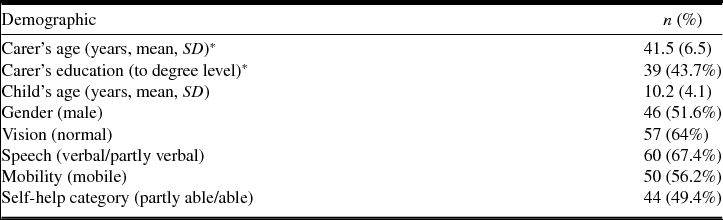
Following the exclusions, the final sample consisted of 89 mothers of children with one of eleven neurodevelopmental disorders: Angelman syndrome (AS, n = 14), Cornelia de Lange syndrome (CdLS, n = 9), Cri du Chat syndrome (n = 11), Lowe syndrome (n = 2), Phelan-McDermid syndrome (PMS, n = 5), Prader-Willi syndrome (PWS, n = 15), Soto syndrome (n = 6), Smith-Magenis syndrome (SMS, n = 9), 1p36 deletion syndrome (n = 12), 9q34 syndrome (n = 1) and 8p23 syndrome (n = 5). All children lived at home full-time with their carers. Demographic information on mothers and children are presented in Table 1.
Demographic information for all participants (n = 89)

*Seven mothers chose not to provide this information.
Measures
Demographic information
A background questionnaire was used to collect information about mothers’ age and level of education, children's age, genetic or clinical diagnoses, gender, speech and mobility and living arrangements. Mothers completed the following three questionnaires addressing the dimensions of their well-being and coping strategies.
The Brief COPE is a 28-item shortened version of the original COPE scale developed by Carver et al. (Reference Carver, Scheier and Weintraub1989). It consists of 14 subscales, each containing two items that represent a coping strategy. Participants rate the extent to which they use a coping strategy for their child by indicating either ‘I haven't been doing this at all’ (score of 1), ‘I've been doing this a little bit’ (score of 2), ‘I've been doing this a medium amount’ (score of 3) or ‘I've been doing this a lot’ (score of 4). At the point of development of the scale, Carver stated that all scales of the Brief COPE were at least minimally acceptable in terms of internal reliability with three of the scales having an α value of 0.50‒0.59, with all remaining scales having α values of 0.60 upwards (Carver, Reference Carver1997). The four-factor subscale structure proposed by Hastings et al. (Reference Hastings, Kovshoff, Brown, Ward, Degli Espinosa and Remington2005) was chosen over the four-factor structure suggested by Benson, as the factors used by Hasting et al. are based on the individual items rather than subscales. In this sample, with the exception of the religious/denial subscale, the Cronbach's alpha statistics were similar to that reported by Hastings et al., being .74 for active-avoidance, .85 for problem-focused, .71 for positive coping and .54 for religious/denial coping. Results will be reported in two ways: coping strategies and factor (subscale) groupings suggested by Hastings et al.
The Hospital Anxiety and Depression Scale (HADS; Zigmond and Snaith, Reference Zigmond and Snaith1983) was used to examine self-reported levels of anxiety and depression. The items are rated on a scale of 0 to 3, and indicate the degree to which the participant agrees with a given item. This gives a maximum total of 21 for each of the subscales, with clinical cut-off points in terms of severity of presentation based upon the composite scores. Although this measure was published in 1983, it continues to have good test‒retest reliability and concurrent validity data reported at subscale and total score levels for parents of children with neurodevelopmental disabilities (Bjelland et al., Reference Bjelland, Dahl, Haug and Neckelmann2002; Jones et al., Reference Jones, Hastings, Totsika, Keane and Rhule2014). In this sample, Cronbach's alpha was .72 for anxiety and .85 for depression.
The Positive and Negative Affect Scale (PANAS; Watson et al., Reference Watson, Clark and Tellegen1988) consists of twenty descriptive words, ten reflecting positive affect and ten reflecting negative affect. Participants were asked to rate the extent to which they felt this way over the past week on a Likert-type scale. A higher score reflects a higher frequency of the emotions. The PANAS has been shown to have excellent internal reliability (Watson et al., Reference Watson, Clark and Tellegen1988). In this sample, Cronbach's alpha was .92 for the positive and the negative emotions subscales.
The Wessex Scale (Kushlick et al., Reference Kushlick, Blunden and Cox1973) measures both social and physical capacity of people with disabilities. Carers answer a number of questions that relate to physical capacity including vision, hearing and mobility, and social capacity such as communication, literacy and self-care. Since its development, the validity and reliability of the scale have been robustly supported (Oliver et al., Reference Oliver, Petty, Ruddick and Bacarese-Hamilton2012). Higher scores on this measure are an indication of greater level of ability.
The Challenging Behaviour Questionnaire (CBQ; Hyman et al., Reference Hyman, Oliver and Hall2002) evaluates the presence or absence of self-injury, aggression, destruction of property and stereotyped behaviour in the last month. Previous examination of the psychometric properties of the questionnaire has demonstrated good inter-rater reliability with reliability coefficients ranging from 0.61 to 0.89 (Hyman et al., Reference Hyman, Oliver and Hall2002). This study uses the data detailing the presence/absence of four behaviours that the questionnaire describes as challenging behaviours (self-injury, aggression, destruction of the environment and stereotyped behaviours) and the number of forms of challenging behaviour rated as present (0‒4).
Results
Number of challenging behaviours
Only nine (10.1%) of children were reported to have shown no challenging behaviour in the previous month, 18 (20.2%) were reported to have shown one topography, 11 (12.4%) two topographies, 21 (23.6%) three topographies and 30 (33.7%) four topographies of challenging behaviour within the month preceding questionnaire completion.
Measures of maternal mental well-being
The mean anxiety score was 10.8 (SD = 3.8) with a minimum score of 2 and maximum of 17. The mean depression score was 6.9 (SD = 4.2) with a minimum score of 0 and maximum of 18. Both the positive and negative affect scores ranged from the minimum to maximum (10 to 50) with a mean for positive affect of 30.1 (SD = 9.7) and negative affect of 20.9 (SD = 8.9).
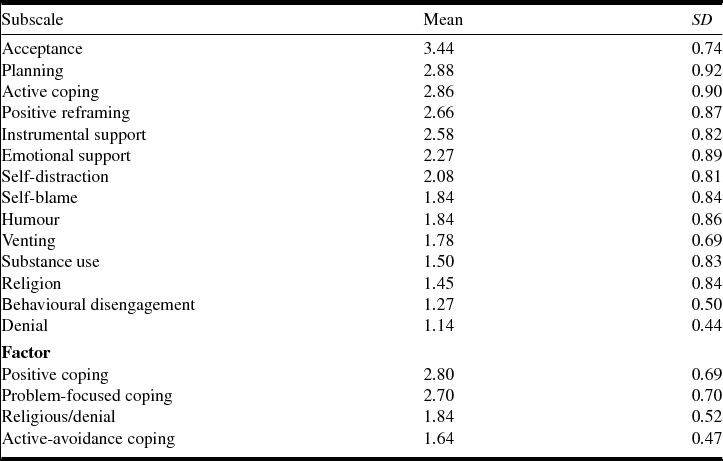
Mean scores per item for each coping strategy (from most to least frequently used)

Coping strategies used
In order to complete the first aim of the study and document the most frequent coping strategies used by parents of children with intellectual disabilities, the mean score for each of the fourteen strategies and four subscales were calculated and are presented in Table 2. Due to differing numbers of questions in each subscale, the mean score per question is reported for each of the four factors recommended by Hastings et al. (Reference Hastings, Kovshoff, Brown, Ward, Degli Espinosa and Remington2005). For ease of comparison, the scores for each subscale are also presented as mean score per item. Therefore, for each row of data in Table 2, the minimum score is 1 and the maximum score is 4.
The most frequently used coping strategy was acceptance, followed by planning, active coping and positive reframing. The coping strategies that parents reported using the least were substance use, religion, behavioural disengagement and denial. This is also reflected in the four subscale scores, with positive coping being the most frequently reported coping method and the active-avoidance coping strategy being the least frequently reported.
Association between child variables and maternal mental health
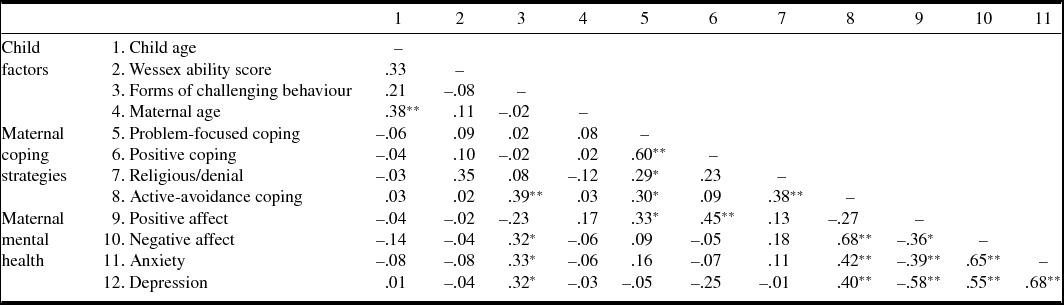
In order to test the first and second hypotheses, that an increased number of forms of challenging behaviours will be associated with poorer maternal mental health but that there will be no relationship between forms of challenging behaviour and child variables (age and ability), a series of correlations were conducted. The results of these correlations are presented in Table 3. Alpha was set to .01 to correct for multiple correlations.
Pearson's correlation coefficients and p values between coping strategies, child variables, maternal age and maternal mental health

*p < .01; **p < .001.
The results indicate a positive correlation between the number of forms of challenging behaviour and increased maternal negative affect, anxiety and depression, but no association with positive affect. Hypothesis 1 can be partially accepted. There was no association between child age or ability and maternal mental health. Hypothesis 2 can therefore be accepted.
Associations between coping strategies and maternal mental health
To address hypothesis 3, the mean score per item was calculated for each of the four subscales and correlated with the four subscales assessing maternal mental health: positive affect, negative affect, anxiety and depression. As shown in Table 3, higher levels of problem-focused and positive coping strategies are associated with increased positive affect. Higher levels of active avoidance coping strategies are associated with higher levels of negative affect and increased levels of anxiety and depression. The religious/denial coping strategy was not associated with any of the maternal mental health variables measured. Hypothesis 3 can therefore be accepted.
The mediating effect of coping strategies between number of forms of challenging behaviour and maternal mental health
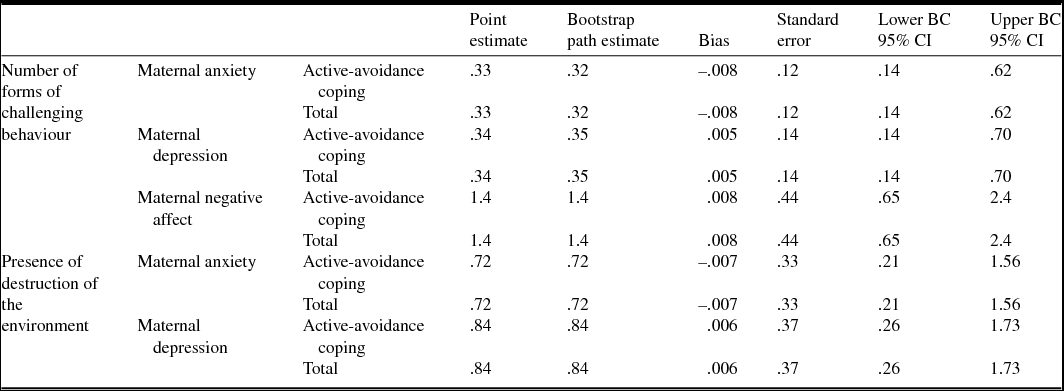
The Parent‒Child Interactive Stress model predicts that maternal cognitions mediate the relationship between challenging behaviour and maternal psychological distress. Table 3 shows that only the active-avoidance subscale was correlated with both the number of forms of challenging behaviour and three of the measures of maternal mental health (depression, anxiety and negative affect). Therefore, only this variable was entered into the mediation analyses which used the bootstrapping method with bias-corrected confidence estimates (MacKinnon et al., Reference MacKinnon, Lockwood and Williams2004; Preacher and Hayes, Reference Preacher and Hayes2004). In the present study, the 95% confidence interval of the indirect effects was obtained with 5000 bootstrap resamples (Preacher and Hayes, Reference Preacher and Hayes2008). The results are summarized in the upper section of Table 4.
Mediation of the effect of challenging behaviour (number of forms and the specific topography of destruction of the environment) on maternal mental health through active-avoidance coping

n = 89; bootstrap sample size = 5000; BC: bias-corrected.
Maternal anxiety
Results of the mediation analysis confirmed the mediating role of active-avoidance coping strategies in the relationship between challenging behaviour and maternal anxiety (b = .89, SE = .28, p = .002). The overall model was significant (R 2 = .22; p < .0001) and accounted for 22% of the variance in maternal anxiety. The number of forms of challenging behaviour was no longer a significant predictor of maternal anxiety after controlling for the mediator (b = .55, SE = .28, p = .05), consistent with full mediation.
Maternal depression
Results of the mediation analysis confirmed the mediating role of active-avoidance coping strategies in the relationship between challenging behaviour and maternal depression (b = .92, SE = .32, p = .005). The overall model was significant (R 2 = .18; p = .002) and accounted for 18% of the variance in maternal depression. The number of forms of challenging behaviour was no longer a significant predictor of maternal depression after controlling for the mediator (b = .57, SE = .32, p = .08), consistent with full mediation.
Maternal negative affect
Results of the mediation analysis confirmed the mediating role of active-avoidance coping strategies in the relationship between challenging behaviour and maternal negative affect (b = 2.06, SE = .67, p = .003). The overall model was significant (R 2 = .47; p < .0001) and accounted for 47% of the variance in maternal negative affect. Forms of challenging behaviour were no longer a significant predictor of maternal negative affect after controlling for the mediator (b = .65, SE = .55, p = .24), consistent with full mediation.
Hypothesis 4 can be partially accepted, as only the active-avoidance coping strategy mediated the relationship between the number of forms of challenging behaviour and maternal anxiety, depression and negative affect.
Exploring a moderated mediation model of number of forms of challenging behaviour to maternal mental health
Given the correlations between some of the coping styles reported in Table 3, it is not unreasonable to assume some relationship between them or their influence on other factors. In order to identify whether any of the coping styles that were not entered into the above mediations have a statistical influence on the strength of the mediations between the number of forms of challenging behaviour to maternal mental health, moderated mediation analyses were undertaken. This aimed to explore whether the three coping styles that did not mediate the relationship between the number of forms of challenging behaviour and maternal mental health (problem-focused, positive and religious/denial coping) moderate the mediating effect of active-avoidant coping. A bootstrapped Model 8 of the PROCESS Macro (Hayes, Reference Hayes2012) identified two moderated mediation models (moderation of the direct effect only) that are summarized in Fig. 1.
Moderated mediation model for the relationship between challenging behavior and maternal mental health. *p < .05; **p < .01; ***p < .001.

Further inspection of the data for both maternal anxiety and depression notes that at low (one standard deviation below the mean) or average levels of problem-focused coping, the indirect effect is significant, i.e. the mediation is present (anxiety low problem-focus coping CI .09 to .74; average problem-focus coping CI .07 to .57; depression low problem-focus coping CI .17 to .96; average problem-focus coping CI .13 to .73). However, when the levels of problem-focused coping are high (+1SD), both the direct and the indirect effect is non-significant and therefore the relationship between forms of challenging behaviour and maternal mental health is not mediated (indirect; anxiety CI ‒.01 to .60, depression CI ‒.04 to .74; direct anxiety CI ‒.90 to .57, depression high problem-focus coping CI ‒1.0 to .70).
Exploring the mediating effect of coping strategies based upon topography of challenging behaviour
Given that the topography of challenging behaviour has been shown to impact upon maternal stress and cognitions by Rose et al. (Reference Rose, Nelson and Hardiman2016), the final stage of the analysis planned to repeat the mediation analyses with the dependent variable being the presence/absence of the specific topography of challenging behaviour. The active-avoidance subscale was the coping strategy subscale that correlated with both a specific topography of challenging behaviour (destruction of the environment; r = .29, p = .007) and measures of maternal depression (r = .30, p = .004) and anxiety (r = .32, p = .003). Therefore, only these variables were entered into the mediation analyses. The results are summarized in the lower section of Table 4.
Maternal anxiety
Results of the mediation analysis confirmed the mediating role of active-avoidance coping strategies in the relationship between the presence of destruction of the environment and maternal anxiety (b = 2.3, SE = .80, p = .004). The overall model was significant (R 2 = .19; p = .0001) and accounted for 19% of the variance in maternal anxiety. The presence of destruction of the environment was no longer a significant predictor of maternal anxiety after controlling for the mediator (b = 1.6, SE = .79, p = .05), consistent with full mediation.
Maternal depression
Results of the mediation analysis confirmed the mediating role of active-avoidance coping strategies in the relationship between the presence of destruction of the environment and maternal depression (b = .92, SE = .32, p = .005). The overall model was significant (R 2 = .19; p = .002) and accounted for 19% of the variance in maternal depression. The presence of destruction of the environment was no longer a significant predictor of maternal depression after controlling for the mediator (b = .16, SE = .89, p = .07), consistent with full mediation.
Hypothesis 5 can be partially accepted as only the active-avoidance coping strategy mediates the relationship between the presence of destruction of the environment and maternal anxiety and depression.
Follow-up exploration of potential moderated mediation pathways for the two mediation pathways described above were undertaken but no significant moderators of the mediation were found.
Discussion
The results showed that although active-avoidance coping was the least frequently reported coping strategy, it is associated with higher levels of negative affect and increased levels of anxiety and depression. It mediates the relationship between the number of forms of challenging behaviour and maternal anxiety, depression and negative affect, but only when mothers have average or lower problem-focused coping. The mediation is not present in mothers with higher levels of problem-focused coping. Active-avoidance coping also mediates the relationship between the presence of destruction of the environment and maternal anxiety and depression. As per previous research into parents of children with autism, higher levels of problem-focused and positive coping strategies are associated with increased positive affect.
Active-avoidance coping, which includes behaviours such as self-blaming, self-criticizing, doing something to think about it less, and using drugs or alcohol to get through or make oneself feel better, have been associated with negative mental health in a range of samples, including cancer patients (e.g. Stanton and Snider Reference Stanton and Snider1993), caregivers for individuals with chronic disease (Billings et al., Reference Billings, Folkman, Acree and Moskowitz2000), hospitalized burn patients (Fauerbach et al., Reference Fauerbach, Heinberg, Lawrence, Bryant, Richter and Spence2002), and individuals coping with terrorist attacks (Silver et al., Reference Silver, Holman, McIntosh, Poulin and Gil-Rivas2002). It is also associated with less positive outcomes for interventions (see Taylor and Stanton, Reference Taylor and Stanton2007, for a thorough review). Given the robustness of its influence across a range of populations, it is unsurprising that it was the consistent mediating factor between forms of challenging behaviour and maternal anxiety, depression and negative affect, and the presence of destruction of the environment and maternal anxiety and depression in this study. The model accounted for 47% of the variability in negative affect scores, but only 22% of the anxiety and depression scores. This may be due to the different forms of measurement, with the negative affect requiring a Likert rating of the frequency of negative emotions and the anxiety and depression subscales requiring a Likert rating of specific behaviours, such as ‘I get sudden feelings of panic’ or ‘I have lost interest in my appearance’. It may be that a rating scale such as the Hamilton Anxiety Rating Scale (HAM-A; Hamilton, Reference Hamilton1959), which lists physical symptoms of anxiety rather than behaviours, would provide a different profile of results.
Longitudinal studies documenting coping strategies and mental health in parents of individuals with intellectual disabilities (e.g. Seltzer et al., Reference Seltzer, Greenberg and Krauss1995) suggest that certain coping strategies can ‘buffer’ the negative effects of caring for an individual with intellectual disabilities, therefore reducing the risk of later stress or mental health difficulties. The results of this study support this assertion, as the results of the moderated mediation model show that there was no significant direct or indirect relationship between the number of challenging behaviours and maternal anxiety or depression in mothers who have strong problem-focused coping. The protective factor of problem-focused coping has been previously identified by Essex et al. (Reference Essex, Seltzer and Krauss1999) who noted that problem-focused coping strategies at baseline were predictive of levels of depression 7.5 years later, but only for parents of children with more severe intellectual disabilities. Woodman and Hauser-Cram (Reference Woodman and Hauser-Cram2013) also noted that problem-focused coping strategies moderated the impact of caregiving demands on depressive symptoms three years later.
The recent focus upon parenting interventions for children with intellectual disabilities, most notably children with autism, has led to the recognition that parental factors, as well as child factors, may influence the effectiveness of this intervention and resulting child outcomes (see Hastings and Johnson, Reference Hastings and Johnson2001). Given that parental mental health is associated with a child's progress and response to intervention (Robbins et al., Reference Robbins, Dunlap and Plienis1991), it could be posited that working with parental cognitions and behaviours in addition to a child's behaviour would be the most effective approach to reducing difficult or challenging behaviour within this population. The results within this research help to identify parents who may benefit most from interventions: those showing high active-avoidant coping styles with average or below problem-focused coping. Interventions would therefore encourage adjustments towards more helpful, problem-focused coping strategies (which could be achieved using a cognitive behavioural model) associated with improvements with parental mental health and reduce active-avoidant coping styles.
Although active-avoidant coping may be the least frequently reported coping style, its impact on the relationship between challenging behaviour and maternal anxiety, depression and negative affect is significant. Interventions specifically targeted at reducing the use of active-avoidance strategies and encouraging problem-focused and positive coping strategies have been shown to reduce perceived stress and depression and increase self-efficacy in populations, including patients who were HIV positive (e.g. Chesney et al., Reference Chesney, Chambers, Taylor, Johnson and Folkman2003) and those with chronic pain (Keefe et al., Reference Keefe, Blumenthal, Baucom, Affleck, Waugh and Caldwell2004; Rhee et al., Reference Rhee, Parker, Smarr, Petroski, Johnson and Hewett2000). Given that active-avoidance coping appears to have a similar influence on a range of populations, it may be that these interventions could be easily adapted and trialled in parents of children with ID, perhaps initially targeting parents of children who have the mix of high active-avoidant coping styles with average or below problem-focused coping that strengthens the relationship between challenging behaviour and mental health.
The relationship between only one topography of challenging behaviour (destruction of the environment) and maternal anxiety and depression was mediated by the active-avoidance coping style, although the model only explained 19% of the variance. Given that the prevalence was similar for of each of the four forms of challenging behaviour in the CBQ (60.7‒67.4%), and that almost half (46%) of children who were showing one to three forms of challenging behaviour did not show destruction of the environment, the mediated relationship between numbers of topographies of challenging behaviour and maternal anxiety and depression cannot simply be explained by the presence or absence of destruction of the environment. Previous studies (e.g. Adams et al., Reference Adams, Oliver, Kalsy, Peters, Broquard and Basra2008, Reference Adams, Handley, Simkiss, Walls, Jones, Knapp, Romeo and Oliver2016) have discussed how behaviours that have more of an external impact (e.g. destruction of the environment, wandering) affect people differently to those that have more of an impact upon the person showing the behaviour (e.g. self-injury, withdrawal from social activities). Whilst this could be used to explain the relationship between destruction of the environment and maternal mental health (which is mediated by active-avoidance coping), it cannot explain why such a relationship is not present between aggression and maternal mental health. It may be that aggression has a different impact than destruction of the environment, as one could argue that the locus of the impact differs (i.e. in one scenario, a person is at risk of being harmed whilst in the other, material goods are at risk). Further research, with larger samples and a more detailed measure of challenging behaviour, such as the Behavior Problem Inventory (Rojahn et al., Reference Rojahn, Matson, Lott, Esbensen and Smalls2001), would allow for greater insight into this model and explore such relationships with a range of topographies of challenging behaviour.
Whilst it is important to note the associations, it is also important to note the key non-significant associations, as these are also informative for researchers, yet are often over-looked. First, parental coping styles were not associated with child age or ability score on the Wessex scale. This is concordant with the finding that parental stress levels are influenced by some child factors, such as challenging behaviour, health problems and sleep difficulties, but not level of cognitive ability (Cahill and Glidden, Reference Cahill and Glidden1996). Second, there was no association between any measures of parental mental well-being and the religious/denial coping subscale. However, it may be that these factors may have more of an individual influence rather than benefit measurable within a group design.
There are a number of limitations to this study. Whilst the Brief-COPE is a well-validated measure of coping strategies, it is limited in how much information it can accrue on the experience of parenting a child with an intellectual disability. The Cronbach's alpha for the religious/denial subscale was .54, suggesting that this subscale has unsatisfactory reliability within this sample. This subscale may therefore not reflect a unidimensional construct within this sample and may have reflected multiple constructs that had similar or differing relationships with the dependent or independent variables. Although there is a lot of research exploring mediator variables cross-sectionally, it is acknowledged that mediation models are stronger and more accurate when completed with longitudinal data. This study should therefore be repeated with a longitudinal design.
Whilst the heterogeneous sample in this study allowed exploration of coping strategies and well-being across mothers of children with an array of rare genetic syndromes, it may also bring increased variability into the sample. It may be that parents of children with rare genetic syndromes cope or adapt to behaviour problems differently than parents of idiopathic intellectual disabilities, perhaps by attributing the behaviour to the syndrome, although this is yet to be explored within the literature. Also, the data were collected via questionnaire rather than by direct assessment, limiting the detail with regard to behaviour and ability or IQ. Finally, it is important to reflect on the generalizability of the sample. Given that these mothers were originally recruited via parent support groups, and that they had the time to complete an online questionnaire, there is a potential for a recruitment bias.
Conclusions
Understanding the factors that influence or explain increased levels of mental health difficulties, stress and elevated negative emotions in this population is important if effective treatments are to be implemented. This study highlights that, as reported in mothers of children with autism, specific coping strategies are associated with increased psychological well-being and distress. Higher levels of problem-focused and positive coping strategies are associated with higher levels of positive affect. Active-avoidance coping strategies, although the least commonly reported, have the strongest impact upon maternal mental health, being associated with higher levels of negative affect, increased levels of anxiety and depression and mediating the relationship between challenging behaviour and maternal mental health, but only within those with average or below problem-focused coping skills. This highlights the importance of detailed research and analysis of data in order to inform interventions for these coping strategies when implementing both parental or behavioural interventions.
Acknowledgements
We are grateful to all the parents and families for taking part in this research and for the syndrome support groups for facilitating the data collection.
Conflicts of interest: The authors have no conflicts of interest with respect to this publication.
Ethical statement: The authors assert that all procedures contributing to this work comply with the ethical standards of the relevant national and institutional committees on human experimentation and with the Helsinki Declaration of 1975, and its most recent revision.
Financial support: This paper presents independent research partly funded by the National Institute for Health Research (NIHR) Post-Doctoral Fellowship Programme (D.A. grant number PDF-2010-03-02), Jerome Lejeune, and Cerebra. The views expressed are those of the authors and not necessarily those of the NHS, the NIHR, Cerebra or the Department of Health.




Comments
No Comments have been published for this article.